




Abstract
Malaysia is estimated to be one of the four largest recipients of Chinese Belt and Road Initiative investment worldwide, with China surpassing Singapore to become the largest foreign investor in Malaysia in 2016. Chinese investment in Malaysia consists largely of top-down urban mega-developments, many of which are built on reclaimed land and have faced significant criticism from locals, media, environmentalists, and politicians for their audacious plans, exclusive nature, and disregard for local people and ecosystems. Using Forest City as a case study, this paper introduces the concept of urban speculation for survival to elaborate on how – beyond their initial planning and financing – foreign-owned, master-planned megaprojects involve continual speculation as they navigate shifting political contexts and economic challenges. Specifically, we outline three main phases to the new city’s development and investigate how its marketing and identity have evolved over time in response to mounting criticism and shortfalls in sales. Situating Forest City within the trend of speculative urbanism, we demonstrate how – rather than being monolithic – the outcomes of top-down Chinese investment and mega-development in a much smaller Southeast Asian country simultaneously shape and are shaped by local and transnational economic, political, and social dynamics, as corporate Chinese actors are forced to negotiate and compromise on their ambitious overseas ventures.
Keywords
Introduction
Over the past decade, Chinese foreign direct investment (FDI) in Malaysia has increased exponentially 1 , particularly following the launch of the Belt and Road Initiative (BRI) in 2013. Malaysia has become a hotbed of Chinese investment for reasons including its natural resources, lower costs of labour, eagerness for FDI, and economically and geopolitically strategic location next to Singapore and along the Strait of Malacca (Juego, 2018; Lim, 2018; Yeoh et al., 2018). Real estate comprises one of the major sectors of Chinese FDI in Malaysia, increasingly in the form of urban megaprojects and concentrated in the Special Economic Zone (SEZ) of Iskandar Malaysia in Johor, where we have identified at least eight Chinese-financed, -planned, and -constructed real estate developments launched since 2012 with a gross developmental value (GDV) of over U.S.$1 billion 2 . China surpassed Singapore to become the largest real estate investor in Malaysia in 2013, and the largest overall foreign investor in Malaysia in 2016 (Hamzah, 2020; Lim, 2018).
The largest Chinese-financed urban project outside of China is Forest City, a new master-planned city being built on four artificial islands off Malaysia’s south coast, across the Johor Strait from Singapore (Figure 1(a)). The developer is Country Garden Pacificview
3
(CGPV), a subsidiary of Country Garden, the largest private property developer in China. Domestically, Country Garden specializes in large-scale, mixed-use developments in medium-sized cities or outlying urban areas, often including hotels, resorts, schools, and other community amenities (Cohen, 2014; Kumar and Kawase, 2022). Country Garden first expanded outside of China in 2012 with its relatively smaller, mixed-use, luxury high-rise Danga Bay – located just down the coastline from Forest City in Iskandar Malaysia. However, Forest City is a much larger, more ambitious project than any that the developer has previously undertaken. Since construction began in 2014, the new ‘green and smart’ city has attracted significant attention for its audacious plans, expensive price tag, Chinese ownership, and dubious environmental record (Mahrotri and Choong, 2016; Schneider, 2018). Former Malaysian prime minister Mahathir Mohamad has been one of the project’s fiercest critics, announcing in August 2018 that foreigners would no longer be allowed to buy property or receive visas to live in Forest City (Bloomberg News, 2018). Planned for 700,000 residents and estimated to cost U.S.$100 billion, Forest City represents an unprecedented level of autonomy for a Chinese real estate developer in Malaysia (Moser, 2018). Currently, at least half of island one has been reclaimed. Many buildings are complete, including 65 condo towers, over 200 villas, a private international school, luxury hotel, eco-museum, and a retail and office complex (Figure 1(b)). As of 2019, 15,000 residential keys had been handed over, while work on land reclamation for the second island was delayed in 2020 due to slow sales during the pandemic (Kumar, 2020b). (a–b) Forest City is built on reclaimed land just across the water from Singapore. Sources: Google Earth, 2021; Authors, 2019).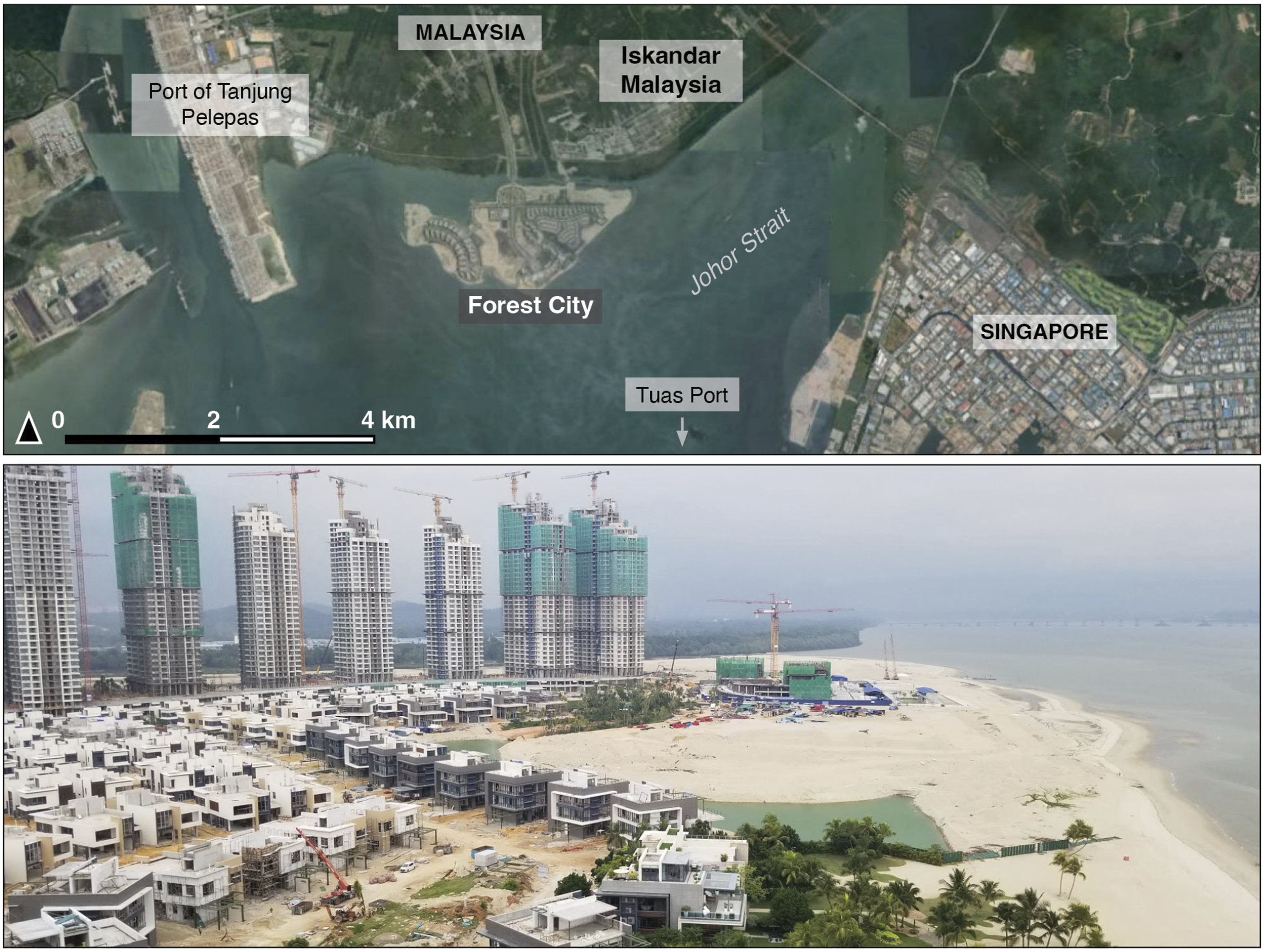
Globally, China’s rapid rise as a major player in international construction, lending, and geopolitics has sparked concerns over sovereignty and ‘debt-trap diplomacy’ (Williams et al., 2020). China has long encouraged both private and state-owned companies to seek contracts abroad as a means to secure economic and political power for the state, beginning with the ‘go out’ policy in the late 1990s and early 2000s and continuing through the BRI (Yeoh et al., 2018). Despite Country Garden being a private rather than state-owned developer 4 , Forest City’s construction was perceived by Malaysia and Singapore as a provocation with potential to upset geopolitical relations in the region (Moser, 2018), prompting Mahathir to refer to growing Chinese investment in Malaysia as a ‘new version of colonialism’ in October 2018 (Jaipragas, 2018). The high prevalence and oversupply of luxury condo developments in Iskandar Malaysia reflects the role of Chinese companies in driving real estate speculation overseas as ‘vent for surplus’ (Phelps and Miao, 2020: 316). Yet, the urban dimensions of the BRI and Chinese foreign investment, including the connections between real estate and geopolitics (Rogers and Koh, 2017), remain relatively underexplored (Bunnell, 2021; Williams et al., 2020).
This paper explores how Chinese foreign investment in Forest City involves a unique form of urban speculation premised on the financialization of housing, wherein housing is commoditized as a good bought and sold for financial gain rather than for use as a home. Prior to the pandemic, the majority of Forest City’s buyers were Chinese nationals seeking second homes, vacation rentals, or investment properties, intending to cash in on Forest City’s appealing location and future real estate value. In many places in Asia, housing financialization and speculative urbanism involve significant inflows of foreign investment into real estate, characterized by public-private partnerships and, often, the outflow of profit (Fauveaud, 2020; Goldman, 2020). Forest City clearly functions as a vehicle for wealth accumulation by a foreign investor class, and does not address local housing needs (Koh, 2021). Johor has the worst property overhang in Malaysia, with an estimated 75% of housing units by Chinese developers in Iskandar Malaysia unsold (Hamzah, 2020), while management expects only 30% occupancy of Forest City at any given time (tour guide, personal communication, May 2017). In a 2018 press conference, Mahathir highlighted these concerns regarding the uneven distribution of benefits, stating, ‘Our objection is because [Forest City] was built for foreigners, not built for Malaysians. Most Malaysians are unable to buy those flats’ (Schneider, 2018).
Situating Forest City within the trend of speculative urbanism, this paper demonstrates how political and financial challenges have forced the project to adapt its branding and identity throughout its implementation. Specifically, we outline three phases to the project’s 8-year history, chronicling Forest City’s progression from a Chinese enclave, to its attempted ‘Malaysianization’ and internationalization, to its more recent survival strategies that position the project as an ecological steward over the surrounding area. We suggest that Forest City’s developmental phases illustrate two key points about Chinese investment in Malaysia. First, through an analysis of Forest City’s continuous pivots in sales and marketing strategies, we explore how speculation in a master-planned new city continues well beyond the initial planning stage, as the developer seeks to make a project in peril politically and economically feasible. Second, we demonstrate the role of Malaysian political elites in negotiating the terms of Chinese investment abroad, as CGPV has been forced to compromise on its original vision of a luxury, Chinese enclave in Malaysia in order to keep the project afloat. Taken together, these two points disrupt the notion of the blank slate or ‘white canvas’ that new city developers envision when planning and marketing their projects, illuminating some of the complex local and transnational dynamics that shape the outcomes of Chinese foreign investment.
This article draws on research conducted between 2017 and 2021, including interviews with consultants, urban planners, and Forest City management and sales staff in Malaysia (2017–2019) and remotely, through videoconferencing (2021). We conducted participant observation and site visits prior to the COVID-19 pandemic (2017–2019), and critically analyzed media coverage, official promotional materials, city plans, and press releases in order to understand CGPV’s shifting public rhetoric over time. In this paper, we first situate Forest City within broader discussions of urban megaprojects as speculative urbanism and suggest that the concept can be productively extended to examine the ways in which foreign-financed, top-down master-planned megaprojects involve constant speculation as they navigate the hurdles of implementation. Second, we outline three notable phases in Forest City’s development, illustrating how the project’s branding and marketing and sales strategies have evolved in response to criticism from Malaysian actors and broader economic and political challenges. Third, we discuss the significance of Forest City as a case study in speculative urbanism and Chinese foreign investment, and demonstrate how Chinese-financed, overseas urban megaprojects are negotiated and facilitated by local actors. Finally, we highlight some of the limitations of Forest City’s environmental and social pivots, and assess its relevance to contexts beyond Malaysia.
Speculative urbanism and Chinese investment in Southeast Asia
In this paper, we characterize Forest City as a particular and extreme form of speculative urbanism, connecting it to scholarship on the recent rise of Chinese foreign investment in Southeast Asia. Broadly, speculation describes expectations of increased future value or, ‘the making present and materializing of uncertain futures’ for profit (Bear et al., 2015: 387), as new urban infrastructure is constructed for ‘primarily political or economic purposes, rather than to meet real […] demographic or market demand’ (Marcinkoski, 2016: 10). Speculative urbanism is a useful framework for understanding the emergence of urban megaprojects and transnational real estate developments (TREDs) (Koelemaij and Derudder, 2021), including the role of local actors in monetizing land to facilitate large-scale foreign investment in local housing markets (Shatkin, 2016). In his research on urban transformations in Bengaluru, Goldman (2011) conceptualizes speculative urbanism as a transformative mode of urban development and governance built on new ‘alternative’ forms of finance capital; new governmental reforms aimed at acquiring land for foreign housing and real estate investment; the financialization and assetization of urban land, housing, and infrastructure; and the expansion of neoliberal economic reforms, urban inter-referencing, and transnational policy experts (Goldman, 2020: 1252).
Scholarship on speculative urbanism primarily examines the motivations for this high-risk, entrepreneurial mode of development, including rent-seeking (Phelps and Miao, 2020), ‘world city’ aspirations (Goldman, 2011), and inter-urban competition and referencing (Zhang, 2017). For example, Koh et al. (2021) link speculative urbanism to Forest City’s green identity, arguing that the project leverages its green brand for economic purposes. Urban mega-developments are highly speculative due to their supply-driven nature (Koelemaij and Derudder, 2021), uncertainty of success, and dependence on market conditions as their developers seek to extract value from real estate sales (Shin, 2016) and skyrocketing land prices (Goldman, 2020). Although foreign investors and private developers play significant roles in financing and building speculative megaprojects, state actors are actively involved in dreaming up, planning, facilitating, and leasing land for new, elite, large-scale real estate developments and spaces of exception (Goldman, 2011; Koelemaij and Derudder, 2021; Shin, 2016; Zhang, 2017). Despite the risks associated with speculative urban development – including market crashes, uneven distribution of benefits, public debt, and environmental degradation – urban inter-referencing, aspirations to be the next ‘world city’, and competition to attract global finance capital and investment continue to drive the inception of spectacular and speculative urban megaprojects across Asia and beyond.
Although speculative urbanism offers a framework through which to understand the impetus for megaprojects like Forest City and analyze the transformation of peri-urban areas in Asia, scholars have paid less attention to what happens to speculative urban megaprojects after they begin construction, as master plans evolve and depart from their original top-down plans and utopian visions. This gap is partly due to the fact that most new cities have yet to move beyond early planning stages (Brill and Reboredo, 2019; Moser and Côté-Roy, 2021), while others are surrounded by opaque institutional structures or exist in contexts where dissent and protest are not tolerated. A handful of studies examine how master-planned urban megaprojects mutate as they are planned and built (Cugurullo, 2018), as they encounter financial, legal, political, and cultural obstacles (Shatkin, 2011), resistance from local residents (Kundu, 2016; Upadhya, 2020), or ‘frictions’ – a concept Colven (2020) extends to describe the ways in which global capitalism is simultaneously produced and disrupted is it expands its power and reach. For example, Songdo was originally designed as a ‘non-Korean’ city for international businesses and residents; however, the developer’s failure to attract significant international investment led to a process of ‘Koreanization’, resulting in changes to the original master plan and physical landscape of the city (Shwayri, 2013). We suggest a similar process of ‘Malaysianization’ is underway in Forest City, as its foreign developer navigates local criticism and constraints that were not anticipated in the project’s initial plan.
A small number of recent studies analyze the implementation processes of top-down, overseas, Chinese-financed megaprojects, pushing back against narratives of a hegemonic China and emphasizing that the success of these projects is dependent on how successfully they navigate the local context. Research in African contexts demonstrates how delays, financial losses, and a developer’s inability to address the social equity and environmental concerns of local government can lead a planned, luxury new city to fail (Ballard and Harrison, 2020; Brill and Reboredo, 2019), and how the ‘Chineseness’ of urban projects is diluted as their developers ‘set in motion infrastructures beyond their control that are subsumed into the local context’ (Goodfellow and Huang, 2020: 670). In Malaysia, Liu and Lim (2019) similarly suggest that the success of BRI-related projects is contingent on the convergence of national Malaysian and Chinese interests, the alignment of Malaysian federal and state visions, and the fulfilment of Malaysia’s Bumiputera policies – all factors that have been sources of friction during Forest City’s construction. Recent scholarship provides a nuanced picture of China’s rise in Southeast Asia by expanding analysis beyond traditional state actors to examine how local government, businesspeople, and residents ‘negotiate asymmetry, circumvent hegemony, and embrace, resist, or manipulate the terms dictated by Chinese capital’ (Nyíri and Tan, 2016: 5), and by examining Indigenous perspectives on Chinese real estate development in Malaysia (Cai, 2022).
In the context of growing accusations surrounding China as a ‘neocolonial power’ (Nyíri and Tan, 2016: 12) and intensifying urban speculation in Southeast Asia (Koh, 2021; Nam, 2020; Zhang, 2017), Forest City reveals the unique vulnerability of an enormously ambitious and expensive foreign-owned, private, Chinese-financed project with an ‘interurban marketing strategy’ (Koh, 2021) highly dependent on cross-border flows of investors. In this paper, we suggest that the concept of speculative urbanism can be productively extended to examine not only the forms of governance and finance that bring speculative urban visions to life, but also provides a fruitful analytical lens to understand how master-planned megaprojects evolve as they are implemented. By highlighting the dynamic and contingent implementation process of Forest City, we illustrate the influence of Malaysian state actors within foreign Chinese-financed megaprojects and demonstrate how CGPV has been forced to adapt the project’s identity to survive and to justify the project’s existence beyond a purely speculative vehicle for exclusive real estate and capital accumulation. More broadly, our analysis brings political and urban geography literature into conversation by applying the lens of speculative urbanism to the trend of Chinese investment in foreign megaprojects.
Rebranding Forest City: Survival strategies for a precarious Chinese new city
When Forest City first began construction in 2014, it was seemingly ushered through by the Sultan of Johor, Ibrahim Ismail, who controls the majority of the Johor state government’s 34% stake in the project (Williams, 2016). There had been no announcement about the new city, and media only learned of it after locals noticed sand being dumped on their fishing grounds in the Johor Strait. As the following section demonstrates, the initial aggressive action of CGPV contrasts sharply with Forest City’s later, more cautious approach, illustrating how even a $100-billion new city built by China’s largest private property developer and backed by the Sultan has been forced to compromise on its original vision. Below, we outline three broad phases of Forest City’s development, beginning with its creation as a Chinese enclave, its subsequent Malaysianization, and, finally, its intensifying environmental rhetoric as the project faced decreased sales amid a global pandemic. We highlight how Forest City’s various survival strategies correspond to different phases of the new city’s development, tied to local and global dynamics that CGPV has been forced to navigate and associated with various changes in CGPV’s and Malaysia’s leadership. 5 By outlining different phases in the evolution of Forest City’s strategy and identity, we explore how speculation for survival continues through the management and branding of the new city even after construction has begun, as the developer continues to negotiate challenges to and criticism of the project.
Phase 1 (2014–2016): Forest City as a luxury tropical enclave and investor haven for Chinese nationals
Forest City sells investors on ‘a prime model of future cities’ (CGPV, n.d.) and a ‘global metropolis’ (interview, 22 Oct. 2018). Like other speculative megaprojects, Forest City required a massive upfront injection of capital in order to begin land reclamation and construction, depending on private equity, debt financing, and real estate sales to bring its vision to life.
Forest City’s mode of development during the early stages of construction can be characterized as an ‘ask for forgiveness, not permission’ approach, involving opaque processes of approval and legal and environmental concessions: CGPV began construction without consulting Singapore and local residents, beginning land reclamation on a seagrass bed that had been earmarked for environmental protection. To understand how Forest City received approval for construction in an environmentally sensitive and protected marine area without any local consultation, it is necessary to outline the role of local political actors in easing regulations and granting exceptions to the developer. In particular, Forest City depended on the Sultan of Johor, the state’s constitutional monarch and an active businessman. Although the Sultan is not directly involved in Johor governance 6 , multiple sources indicate that his political and economic influence led to the approval of Forest City by the Johor state government and Department of Environment (DOE). The Sultan originally came up with the idea for a new real estate development where Forest City would eventually be located, and Country Garden reportedly paid U.S.$55 million to the Sultan for the land title after he approached the company with the idea. The Sultan’s significant stake in Forest City is presumably in exchange for facilitating Country Garden’s expansion into Johor through the creation of CGPV as a joint venture (Schneider, 2018; Williams, 2016).
In June 2014, less than 6 months after land reclamation began, the Malaysia federal DOE issued a stop work order to Forest City, requiring the developer to complete a detailed environmental impact assessment (DEIA). In January 2015, CGPV received approval from the federal DOE following its DEIA, with the agreement that Forest City’s area would be downsized by one third and that the project would be split into four islands instead of one, so that the seagrass could regrow in the channels between the islands (Williams, 2016). In press releases at the time, CGPV claimed that it voluntarily stopped work on the project, though the stop work order was clearly mandated by the federal government. Shortly after land reclamation recommenced, CGPV sought out an international planning consultant to create a new master plan for Forest City, hiring Sasaki, a U.S.-based firm, in 2016. Even though Country Garden’s team had already drawn a master plan for Forest City, Sasaki was brought in to create a new plan designed for the four islands rather than the one, and to bring in environmental expertise and an international perspective that could bolster the project’s credibility (planner, interview, 25 Mar. 2021).
Despite a number of concessions on the part of CGPV to the Malaysian government – completing the environmental impact assessment, splitting the island into four, downsizing the project area by a third, and offering some compensation for local villagers (Williams, 2016) – the overwhelmingly Chinese character and branding of the project did not fundamentally change in this early phase. Forest City operated with little regard for local residents and Malaysians generally, marketing itself almost exclusively to Chinese nationals, who joined free investor tours organized by Country Garden and arrived in busloads at the Forest City sales gallery to purchase one or more condos on site (Figures 2(a) and (b)). In 2016, Chinese nationals bought 70% of all units (Tan and Yong, 2017). (a–c) Chinese tourists visit the Forest City sales gallery on real estate tours organized by Country Garden (top). Forest City is marketed as a green city by the sea with freehold apartments for sale (bottom). Source: Authors.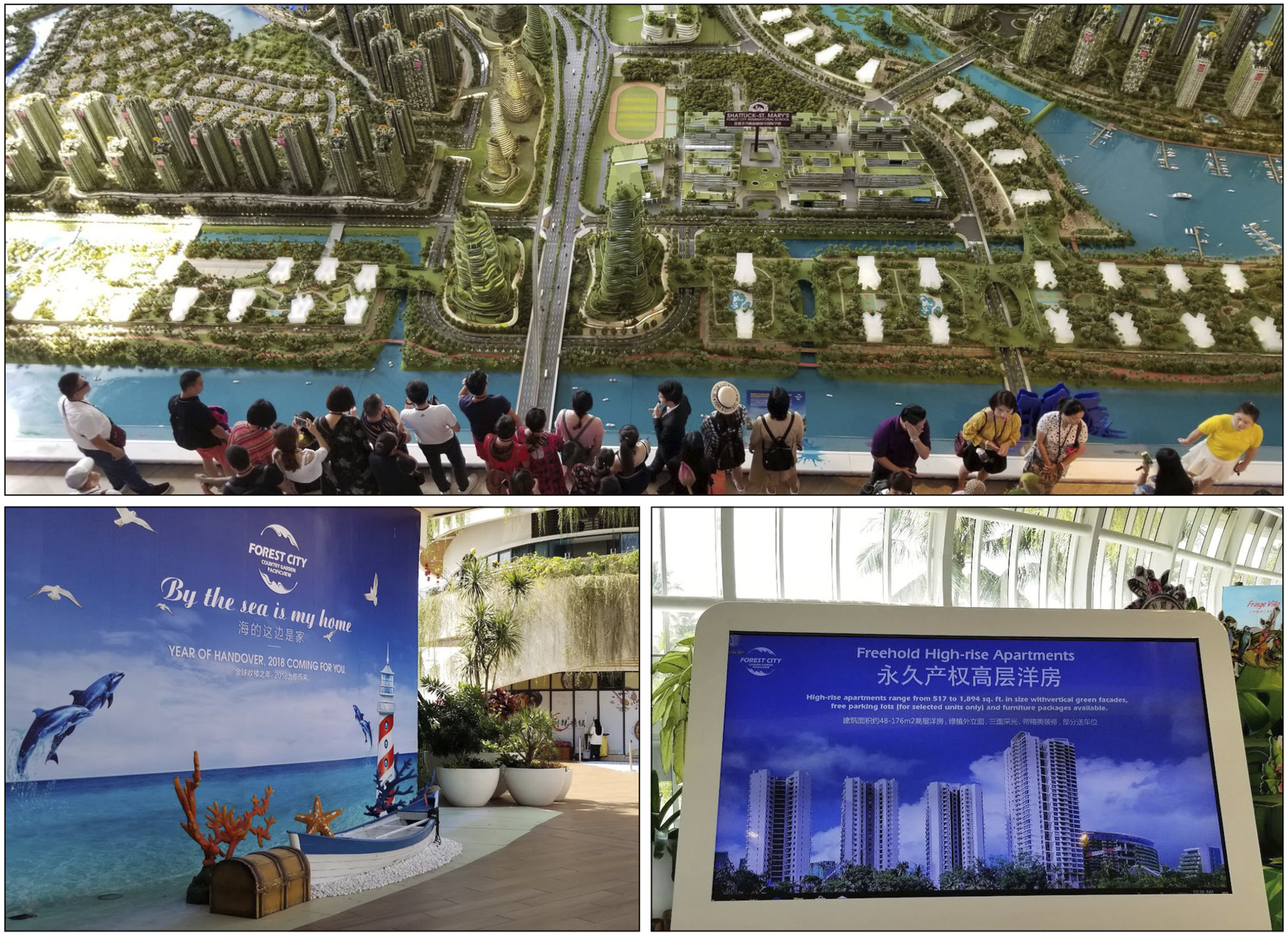
The developer’s early neglect for local regulations and nearby villagers is reflected not only in the exclusive marketing of the private, gated city to Chinese nationals, but in its disregard for environmental protection: land reclamation at Forest City contributed to increased sediment, shifting water currents, and worsening pollution, negatively impacting local Malay and Indigenous Orang Asli villagers who rely on fishing and mussel farming to make a living (Rahman, 2017). Within the new city, Country Garden replicated its aesthetic of ‘green everywhere’ – its signature style in its real estate developments within China (Koh et al., 2021: 14) – making little attempt to use local plants or provide spaces such as kitchen gardens or fruit trees that are valued by Malay populations and villagers in the area (Moser and Avery, 2021).
Beyond the project’s marketing and design, Moser (2018: 938) characterizes Forest City as a ‘neocolonial outpost’ during this era, due to its strategic geopolitical location and ‘extraordinary and unprecedented concessions of sovereignty from Iskandar Malaysia’. For one, Forest City was controversially selling ‘freehold’ properties (Figure 2(c)), as opposed to the 99-years leases that are common practice for foreign buyers in Singapore and Malaysia. Foreign investors could also receive fast-tracked permanent resident visas after buying property at Forest City through Malaysia’s ‘Malaysia My Second Home’ program. Additionally, Forest City’s unique status as ‘an SEZ [Special Economic Zone] within an SEZ’ – offering investors an additional layer of tax incentives on top of those already offered by Iskandar Malaysia – and its use of private security in the project generated confusion and uncertainty over whether Malaysian laws would apply (Moser, 2018: 939). In sum, although China has never officially claimed Forest City as part of the BRI or any broader state strategy, Forest City threatened to ‘disrupt and undermine regional ties’ due to its provocative nature, strategic location, unprecedented autonomy, and potential to reinforce China’s expansionist agenda (Moser, 2018: 939).
Phase 2 (2017–2019): The Malaysianization and internationalization of Forest City
Despite various efforts to improve public perceptions of the project, including a botched public meeting with local villagers (Mahavera, 2014), press releases attempting to clear ‘misconceptions’ about the project (CGPV press release, 5 Jan. 2015), and donations to local schools, Malaysians and international commentary increasingly perceived Forest City as a Chinese enclave, a threat, and a troubling concession of sovereignty (Lee, 2018). Designing the private city overwhelmingly for Chinese nationals, CGPV initially made little attempt to include Malaysians. Against a backdrop of growing Chinese foreign investment in Malaysia under Najib, Mahathir emerged as one of the most vocal and high-profile critics of Chinese investment in Malaysia, repeatedly expressing concern over Forest City’s Chinese ownership. In 2018, Mahathir came out of retirement to run in the general elections, promising to reconsider various Chinese projects approved by Najib if elected. In May 2018, Mahathir pulled off a surprise victory, illustrating the degree to which his anti-China rhetoric resonated with Malaysian voters amid concerns about the growing number of Chinese workers in the country and lack of benefits and opportunities for Malaysian companies (Lee, 2018; Minter, 2018). Shortly after being elected, Mahathir suspended several Chinese-financed megaprojects in August 2018, including the East Coast Rail Link and a natural gas pipeline (Erickson, 2018), and announced that foreigners would no longer be granted visas for purchasing property in Forest City (Bloomberg News, 2018).
Under pressure due to the growing tensions surrounding Chinese-financed projects in Malaysia, CGPV hired Ng Zhu Hann, an internationally educated Malaysian Chinese lawyer, in mid-2017 as Forest City’s Director of Strategy to devise a business plan that would address criticism from Malaysian officials about the exclusive nature of the project while upholding the Chinese developer’s interests. In a 2018 interview, Ng explained that his role was to mediate and act as a conduit between the two boards overseeing the joint venture, one Malaysian and one Chinese. On top of strategic investment, Ng oversaw areas including media and corporate communications, government relations, and branding development, highlighting Forest City’s acute attention to marketing and public relations. Forest City’s shifting strategy during this second phase primarily consisted of cultural changes, in an effort to convince the Malaysian government and public that the project was not just a Chinese gated community but, rather, a multicultural new city where anyone is welcome and that provides a number of benefits to the local economy. Specifically, under Ng’s leadership Forest City devised a strategy of ‘Malaysianization’: In the beginning, when [CGPV] marketed this project, that’s a different range of people that we wanted to reach out to. But the proximity to both [Malaysia and Singapore], being […] along the busy Straits of Malacca, is one of the geographical strengths of this project [….] At this moment in time, Forest City is very much Malaysianize. As a result of such, the recognition from the state government in branding this project, it’s not only for the local people of Johor, but Malaysia and the whole of South Asia. That is the direction we are actually moving towards. (interview, 22 Oct. 2018)
The Malaysianization strategy sought to make Forest City (appear) more inclusive of and beneficial to Malay(sian)s, such as by hiring more Malaysian workers, making plans for affordable housing, and implementing Malay cultural features in the showroom and around the project. CGPV began employing Malay musicians in the sales gallery and hired Malay drummers to greet investor tourists on the red carpet leading to the sales room (Figure 3). In press releases and in interviews with Forest City management, CGPV asserts that as of 2018, 80% of its employees were Malaysians. Ng claims that Forest City’s initial targeting of Chinese citizens was simply a function of Country Garden’s existing reputation in China and connection to the Chinese market, rather than a calculated decision, affirming that the project’s marketing focus has evolved in several ‘phases’: Country Garden is currently the biggest developer in China, and […] the majority of our database and customers are from China. So naturally, in any projects, when you first sell, you sell […] where your strength is. But this is only the first phase. Any project in itself, there are many phases. [Now] we have nine sales galleries across different countries, and 13 sales galleries in Malaysia [….] We know that a project cannot flourish if it relies on a single demographic from a single country of origin. There’s no way it can survive. And not only that, we wanted to become a global metropolis. When you want become a global metropolis, you must attract people from all around the world. So naturally, it’s part of our strategy to cater to people of different markets, and as you can see, the percentage of buyers from mainland China has reduced significantly in the past year, I would say. And other buyers from different demographics has increased, especially from Indonesia, Singapore, and Southeast Asia markets. That is the direction we should continue to move towards. (interview 22 Oct. 2018) Forest City advertises customers from around the world, using stock photos and testimonials written in English and Mandarin (top). At the entrance to the Sales Gallery, Malay drummers greet investor tourists (bottom left). Source: Authors.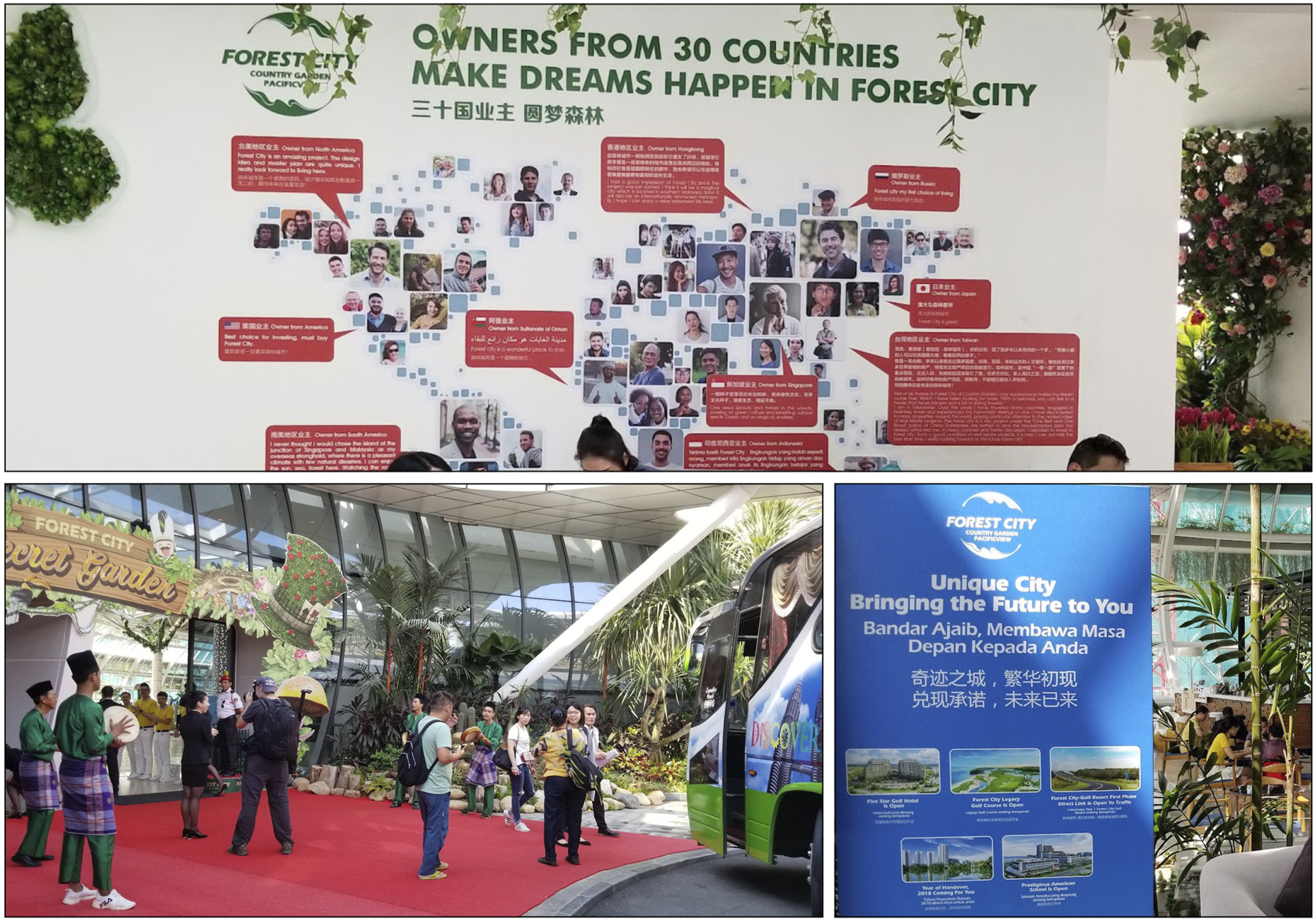
This narrative regarding a global set of residents departs drastically from rhetoric seen in Phase 1 and marks a significant shift in the branding of Forest City. Beyond a desire to pursue a more global class of elite investors and become a ‘global metropolis’, the timing of Forest City’s pivot to attracting multiple nationalities of buyers is notable for two reasons. First, in early 2017, China imposed stricter capital controls in an attempt to limit outflows from the country, prompting Forest City to close its sales galleries in mainland Chinese cities (Tan and Yong, 2017). The new regulations suddenly made it difficult for Chinese buyers to purchase properties abroad and prevented a number from completing purchases of flats for which they had already made down payments to Forest City (He, 2017). Second, the timing of Forest City’s Malaysianization strategy coincided with Mahathir’s re-emergence in the public sphere as an outspoken critic of Chinese investment, his subsequent re-election as prime minister, threats to ban foreign Chinese buyers from Forest City, and attempts to shut down other Chinese-financed projects in Malaysia. Despite Forest City being granted a number of environmental and legal concessions and an unprecedented level of autonomy in Phase 1, Country Garden was nonetheless forced to navigate complex local politics, identifying the Malaysianization strategy as a solution to improve the project’s image and convince Mahathir and the public that the new city would benefit the region. Ng emphasizes the need to continually cooperate with the federal government in order to secure a future for the project, a consideration that was not particularly evident when Forest City first began construction in Malaysia: For our company, we believe that in order to develop long term, we need to work with the government. So if the government, if there is any changes in policies, we will adapt, and more importantly, we will respect the decision of the government, not only at state, but also federal [level]. And that is the direction the company is going to take consistently moving forward. (interview, 22 Oct. 2018)
One way in which Forest City apparently complied with the federal government’s requirements and sought to appear more accessible to Malaysians is through its public support of the government’s affordable housing agenda, as mentioned by Ng and advertised in later press releases from CGPV (press release, 29 Mar. 2019). Questions remain, however, regarding how meaningful this Malaysianization strategy will be. For the most part, CGPV pursued cosmetic changes to Malaysianize Forest City, such as incorporating Malay cultural features, drummers, and musicians in the sales gallery. Although hiring more Malaysian workers is a tangible benefit, there has been no further announcement of any affordable housing, nor there is any way to verify CGPV’s claims about what percentage of employees are Malaysian.
Phase 3 (2020–): Forest City as ecological steward
People desire to live in nature where everything is surrounded by mountains and rivers, and everything is covered with trees and flowers. Especially during the pandemic, this desire has become even stronger. Fortunately, Forest City has made this kind of living dream come true. (CGPV press release, 22 Apr. 2020)
In early 2020, two major events further altered the future prospects of Forest City. First, in February 2020, Mahathir was ousted from office as his governing coalition collapsed (Beech, 2020). Second, the emergence of the COVID-19 pandemic in early 2020 exacerbated Forest City’s already precarious finances as a project reliant on real estate sales. As Malaysia closed its borders in early 2020 and implemented travel restrictions, foreign investor tourists could no longer visit Forest City, while the government suspended new applications to the Malaysia My Second Home program, with no indication of when the program would resume (Ng, 2020). During this same time period, other multi-billion-dollar Chinese-financed and constructed megaprojects in Malaysia have collapsed due to financial troubles, most notably the Melaka Gateway and Bandar Malaysia projects (Kumar, 2020a; Yatim, 2021).
In January 2020, reports were already emerging in local media that Country Garden Malaysia had laid off 400 employees as part of a ‘man power optimisation exercise’ and that Forest City laid off at least 60% of its staff (Tan, 2020). Although CGPV denied these reports and threatened legal action against anyone reporting ‘misinformation’ about the company, it did confirm that an ‘internal organisational restructuring exercise’ was taking place in order to ‘improve the management efficiency […] and enhance the operations’ (press release, 23 Jan. 2020). Further, CGPV insists that the ‘cyclical’ nature of the real estate industry means that employees and resources may be reshuffled ‘according to the annual business development direction’. This restructuring was only the beginning of Forest City’s troubles, as sales reportedly dropped by over 90% between March and June of 2020 (Kumar, 2020b). In March 2020, Country Garden Real Estate (CGRE) issued three tranches of sukuk, a type of bond compliant with Islamic finance, to raise a total of MYR 495 million, stating that ‘these issuances fully reflect the confidence that Malaysian capital markets have in both Country Garden Group and CGRE’s long term development in Malaysia’ (press release, 21 Apr. 2020). The continued use of debt financing to build luxury real estate illustrates ongoing speculation amid and despite Forest City’s financial troubles. At risk of becoming another white elephant, Forest City is operating in survival mode, facing tight finances, a lack of visitors and investment, and an empty, partially built new city.
Based on an analysis of official press releases and promotional materials, we suggest that since early 2020, CGPV has – at least through public statements and official communications – renewed its efforts to advertise Forest City’s sustainability and environmental benefits, implementing and publicizing several new ‘green’ environmental awareness, education, and protection initiatives that coincide with the post-Mahathir and COVID-19 era. In contrast to Forest City’s earlier disregard for environmental protection and subsequent backtracking during Phase 1, its more recent environmental focus represents a significant pivot in strategy and rhetoric regarding the meaning of environmental sustainability. Whereas the previous two phases focused on attracting or representing particular demographics of residents, Phase 3 reinforces a broader search for an identity that can justify Forest City’s existence beyond its purpose as a speculative real estate and investment vehicle, and demonstrates the ‘instrumental nature of green urbanism discourses for advancing economic interests’ (Koh et al., 2021: 7). Although Forest City has always branded itself as a ‘green’ city, CGPV’s recent announcements regarding environmental education and awareness appear to represent a renewed and somewhat reinterpreted commitment to ideas of environmental and urban sustainability, reflecting attempts to go beyond simply including physical green plants and features (Moser and Avery, 2021).
Most notably, Forest City opened a new Eco Museum in September 2020 to showcase local species and marine habitats. CGPV also announced an Ecological Development Action Plan (September 2020) and a Construction Environmental Management Plan (February 2020) – neither of which are publicly available. It further claims that from 2020 to 2023, ‘green and smart’ are its key focus areas for its current phase of ecological development, with plans to build a second exhibition hall for the Eco Museum, a four-km ‘eco-corridor’, and continue the ‘Forest City Go Green’ program, which involves environmental education programming and events (press release, 21 Sept., 2020). Forest City has also created a volunteer program for local youth in collaboration with a local NGO, which aims to ‘share knowledge, give exposure to participants, raise awareness on how to protect the environment through simple actions such as reducing the use of plastic straws, planting trees, using their own shopping bags and carrying their own containers when buying food for take away’ (press release, 25 Aug. 2020). Even if some of CGPV’s recent environmental initiatives were planned prior to the COVID-19 pandemic, the significant increase in the number of news releases publicizing the project’s environmental initiatives since early 2020 indicates ongoing attempts to attract investment and ward off criticism by improving the project’s public image.
Urban speculation for survival
Despite Forest City’s status and reputation as a foreign-controlled Chinese enclave on Malaysian territory (Moser, 2018), speculative urbanism draws attention to the local political actors who actively sought to facilitate Chinese foreign investment in Malaysia and Johor. The Sultan’s backing and Forest City’s skirting of environmental regulations illustrate ‘the exceptional rules of dispossession enacted in the name of world-city making’, as the speculative new city ‘[redefines] state relations, urban citizenship, rights and rules of access’ (Goldman, 2011: 556). The Sultan acted as a ‘broker’ for Forest City’s development (Goldman 2011), identifying the ocean as an untapped land bank and identifying a ‘new means to sell or lease state land to corporate developers’ (Shatkin, 2016: 142). As a consequence, local villagers face decreased access to common fishing and hunting grounds, increasingly polluted waters, and diminishing shellfish populations, while foreign investors who can afford to buy into the project received fast-tracked visas and a new luxury ‘green’ city with private security, education, and leisure spaces. Forest City’s management notes that the proposition of building artificial islands offered significant advantages for Country Garden, as building on top of the ocean minimized possible sources of friction or resistance, including existing land rights and infrastructure: When you’re going to build green and smart, there must be a white canvas where you can repaint it together [….] If you reclaim, you can plan it from scratch, especially if you want it to be a global metropolis attracting people from all over the world. (interview, Oct. 2018)
Yet, despite the ‘white canvas’ the Sultan and Country Garden envisioned, Forest City’s implementation and construction processes have been neither straightforward nor smooth, as CGPV has navigated several delays and roadblocks including a stop work order, political threats, border closures, and precarious finances. Scholarship on speculative urbanism focuses primarily on the actors, financial mechanisms, and governmental reforms that facilitate the inception of such megaprojects (Goldman, 2011, 2020; Koelemaij and Derudder, 2021; Koh, 2021), rather than the survival strategies pursued by the developers to mitigate financial risk after construction begins and properties are sold. Forest City embodies several of the key characteristics of speculative urbanism (Goldman, 2020), including the exceptions to existing regulations granted by the Sultan to Country Garden to encourage foreign investment, the involvement of the Johor sovereign wealth fund (KPRJ) in Forest City, and the financialization of land and urban infrastructure. However, a key difference is that in Bengaluru, little has been built as foreign investors bought and sold shares in local developers (Goldman, 2020), whereas in Forest City, the developer plans to not only build but operate the new city once it is completed. As speculative investments in mega-developments may take decades before returning a profit, a project at the scale of Forest City with a 25- to 30-years implementation timeline must continually ‘generate confidence’ in potential investors and ‘create expectations of […] high future valuations to attract private capital investments’ and sustain momentum (Upadhya, 2020: 149).
This continual need to ‘generate confidence’ can be seen in Forest City’s evolving survival strategies over time, as genuine threats to the project’s financial and political feasibility have prompted shifts in strategy that demonstrate a unique form of speculation for survival, in addition to the dynamics of speculative urbanism that brought Forest City to life in the first place. Speculation for survival can be seen in how Forest City’s pivots in rhetoric and marketing serve ‘primarily political and economic purposes’ (Marcinkoski, 2016: 10), as CGPV scrambled to Malaysianize in response to Mahathir’s anti-China rhetoric and out of concern that the prime minister could shut down the project entirely. Likewise, Forest City’s recent environmental initiatives – such as the Eco Museum and ‘Go Green’ project – were implemented by the Brand Management Department, suggesting that these are first and foremost marketing tactics rather than environmental concerns. Regardless of whether such strategies succeed in keeping the project afloat, Forest City’s adaptations in response to environmental, political, and financial setbacks illustrate the productive nature of ‘frictions’ in continuing to move the megaproject forward in the face of uncertainty (Colven, 2020). Speculative urbanism requires the developers and investors behind mega-developments to place bets on highly uncertain future returns, forcing constant speculation and shifting survival strategies as the project is constructed.
Conclusion
This article has explored Forest City as an illustrative case study of two interrelated trends in urban mega-development in Southeast Asia: Chinese foreign investment and speculative urbanism. Through an analysis of Forest City’s contested implementation process and corresponding survival strategies, we make two key contributions. First, we demonstrate how a Chinese-financed new city in Malaysia – a small player in global economics and geopolitics relative to China – has been forced to adapt, negotiate, and change course in response to political and economic challenges and criticism. Second, we build on the concept of speculative urbanism to situate Forest City and understand the logic behind its developmental phases, suggesting that the concept can be productively extended to examine the implementation process of a Chinese-financed urban megaproject and demonstrate how speculation for survival continues long after the initial planning process has concluded.
Forest City exemplifies how, rather than fulfilling a grand strategy to achieve dominance or hegemony in Southeast Asia, the grounded realities of Chinese investment do not necessarily align with state policy goals or ambitions (Nyíri and Tan, 2016). In contrast to the existing scholarly focus on national territory and nation-states as the primary units of BRI analysis (Williams et al., 2020), our research offers an in-depth case study of the multiple sub- and transnational dynamics that have facilitated and shaped the development of a new Chinese-financed city in Malaysia. A close examination of Forest City’s various developmental phases reveals the complex relationalities between developers and state actors (Mouton and Shatkin, 2020), the role of Malaysian actors in seeking out and negotiating the terms of Chinese investment (Liu and Lim, 2019), and the often messy implementation processes of master-planned megaprojects (Cugurullo, 2018). Further, this case study illustrates the incomplete power of corporate Chinese actors abroad, even in economically weaker countries, disrupting ‘China-centric’ accounts of geopolitical and economic power in the construction and financing of megaprojects (Lin et al., 2021; Williams et al., 2020: 129). This analysis could be used to foster more comparative work on how Chinese investment is negotiated in other urban and peri-urban Southeast Asian contexts, how its scale compares to the predominant mega-developments seen in Malaysia, and how similar speculative urban dynamics facilitate the circulation of urban models and capital across space.
It remains to be seen whether the changes implemented by Forest City are truly effective in including Malaysians in the project and protecting the environment. Three points may hinder Forest City’s potential to create meaningful social and environmental benefits. First, CGPV’s Malaysianization and rebranding appears to stem from the criticism of high-level Malaysian politicians and international actors, rather than meaningful engagement with nearby residents and villages. Second, as we have suggested, Forest City’s green rhetoric and environmental initiatives do not fundamentally challenge the premise of the project nor its speculative mode of development, but are rather calculated decisions aimed at building a better public image, and correspondingly, attracting greater attention and investment during times of financial hardship. Third, the highly speculative financing behind Forest City means that should the project succeed, the majority of profits will accrue to Country Garden and to the Sultan of Johor, neither of which are stakeholders with any direct mandate to serve the Malaysian public. Forest City may contribute taxes, create jobs, and provide donations to certain local communities, but ultimately shareholders will profit the most from the urbanization of the ocean in Johor.
In the coming years, Forest City’s mode or direction of development may continue to shift according to market demand, economic realities, and political considerations. Some strategies from Forest City’s earlier phases have continued into the present, suggesting an ongoing financial need for Malaysian buyers and investors, even though the threat of Mahathir has waned. For example, attempts to communicate a Malay identity for the project are ongoing, seen in advertisements for tickets to a 2021 Ramadan buffet at the Forest City Golf Hotel. However, as of mid-2022, Forest City remains largely empty, with few visitors and residents and many storefronts – and the only hotel on the island – shuttered. Throughout Iskandar Malaysia, luxury condos sit empty and foreign property owners struggle to sell units for fractions of their original value (Yusof, 2021). These struggles are compounded by a lack of confidence in Country Garden following the Chinese property developer crisis that emerged in the fall of 2021 (Huang and Choong Wilkins, 2022), in which several prominent Chinese developers – most notably, Evergrande Group – defaulted on bonds after missing repayment deadlines. The crisis highlights the consequences that can occur when urban speculation is left unchecked, and the limits of the Chinese state’s willingness to back over-leveraged private developers, contrary to perceptions that a developer like Evergrande was ‘too big to fail’ (Wang, 2021).
Although the dire state of the Johor real estate market, the recent collapse of the Melaka Gateway and Bandar Malaysia projects, and the Chinese property developer crisis may spell trouble for Forest City, intriguingly, some scholarship demonstrates that urban speculation can continue even during times of crisis. For example, ‘deteriorating fiscal conditions’ apparently ‘reinforced the speculative and entrepreneurial nature of Songdo City development’ (Shin, 2016: 86). As recently as January 2022, Country Garden successfully issued a U.S.$500 million dollar bond (Kumar and Kawase, 2022). Future research can shed light on how Forest City can bounce back from its sluggish sales, whether it will need to change more than just rhetoric to survive, and what further adaptations CGPV might pursue. The environmental and cultural strategies outlined in this paper indicate some acknowledgement of a need to provide more than just new real estate to a region that is already vastly oversupplied in luxury condos, as Forest City devises new strategies to market itself in the face of pushback from people who understand the social, political, economic, and environmental problems associated with speculative urban development. Such survival strategies ultimately demonstrate the contested and negotiated nature of Chinese investment in Malaysia, and the highly precarious nature of foreign-owned, speculative urban megaprojects.
Footnotes
Acknowledgements
We thank the anonymous peer reviewers and the editor for their analysis and constructive feedback on this manuscript. The research on which this article was based was funded by the Social Sciences and Humanities Research Council of Canada (SSHRC) and the Fonds de Recherche du Québec - Société et Culture (FRQSC), with additional support from the McGill University Faculty of Science and Department of Geography. We would also like to thank Laurence Côté-Roy for her generous support and feedback on an earlier draft of this paper, and Dezső Lovicsek for his contributions to the New Cities Lab’s research on Chinese investment in Malaysia. Finally, we are grateful to Michelle Gagnon for her insights on Chinese urban mega-developments in Malaysia.
Declaration of conflicting interests
The author(s) declared no potential conflicts of interest with respect to the research, authorship, and/or publication of this article.
Funding
The author(s) disclosed receipt of the following financial support for the research, authorship, and/or publication of this article: This research has been supported by a SSHRC Insight Grant (#247641), a SSHRC Joseph-Armand Bombardier Canada Graduate Scholarship, and an FRQSC Bourse de Maîtrise en Recherche (#271410).
