




Abstract
The radical changes to the UK town centre retail landscape over the past 60 years are well documented. What are less well documented are accounts of how the internal processes of town centre governance impact on the retail landscape. From the 1990s UK government dictums, aimed at arresting decline, have advised local authorities to engage with local stakeholders and invite otherwise excluded stakeholders into the previously established rituals and routines of local governance. The aim of this paper is to analyse the influence of the ‘organisational culture(s)’ of town centre custodians (which we conceptualise as the ‘town centre paradigm’) on their actions to improve the retail vitality and viability of their locale. Through a comparative case study of four UK town centres manifesting contrasting governance ‘stereotypes’, we explore how different town centre ‘custodians’ interpret government policies and, perhaps more importantly, how their behaviour impacts on the retail development landscapes of their town centres.
Introduction and contextualisation
The past 60 years have seen radical changes in the UK retail landscape as increased ‘off-centre’ development, and latterly the growth of internet retailing, have threatened the vitality and viability of traditional town centres (Grimsey et al., 2013; Wrigley and Lambiri, 2015). To ameliorate the perceived negative impact, from the 1990s governments of all political persuasions have introduced various planning and management initiatives to maintain the commercial ‘health’ of town centres through specific measures (see Guimarães, 2017) of viability (defined in terms of the strength of commercial markets and investments) and, vitality (defined as the general busyness of the centre (see Cox et al., 2000)) with varying impacts on the physical town centre retail landscape (see Hallsworth and Coca-Stefaniak, 2018).
There is a burgeoning literature on urban place management structures and activities, manifested in town centre management (TCM) schemes (e.g. Coca-Stefaniak et al., 2009; Page and Hardyman, 1996; Warnaby et al., 1998, 2005), and business improvement districts (BIDs – e.g. Grail et al., 2020; Ward, 2007), although these urban management initiatives (particularly BIDs) have been the subject of some critique (e.g. Cook, 2009; De Magalhães, 2014; Ward, 2010). However, the impacts of retail planning policies on urban place management ‘paradigms’ (which can be thought of in terms of the heuristics that help determine the behaviours and patterns of relations between actors) – often incorporated in the set of assumptions held relatively in common and taken for granted (Johnson et al., 2017) by those responsible for the governance of town centres - are arguably less well documented.
In the 1960s and 1970s, it was generally accepted that the practice(s) of town centre governance followed a ‘command and control’ form of ‘governance by government’ through “a process where the Local Authority delivered the welfare state, with few non-statutory interactions between Council and business leaders” (Davies, 2002: 22). Since the late 1980s, however, changes in the retail landscape have arguably been instrumental in the development of more heterarchic governance modes characterised by collaboration and networks of stakeholders and manifested structurally in the creation of more than 600 TCM schemes and 300 BIDs in the UK over the years.
Urban management initiatives are not, however, an option for all localities, especially where retailers and other town centre stakeholders have chosen not to become involved and/or not supported their creation (see Medway et al., 2000, in the context of TCM schemes, and Grail et al., 2020, in relation to BIDs). Consequently, there are many town centre ‘custodians’ - defined as those with responsibility for maintaining and improving the town’s competitive position (here conceptualised in terms of vitality and viability) often in a complex and challenging spatial environment (see Lewis and Nieman, 2009) - that do not have access to such schemes. They must embrace the concept of urban management, yet adopt traditional hierarchical paradigms which, to a greater or lesser extent, still dominate their local governance structures and influence local retail strategies (Davies, 2002, 2017).
Yet, from a policy perspective, there are seeming contradictions here. Many town centre custodians have to embrace change (especially when faced with adverse circumstances, such as, most recently, the impact of the COVID-19 pandemic) but may be uncertain as to how to react to maintain the commercial ‘health’ of their town centres (Ntounis et al., 2020). Other custodians, whilst embracing change, may adopt, or are forced into, ‘traditional’ (and perhaps inappropriate) governance modes in order to meet challenges to their retail landscape that (arising from the context-specificity of places) are complex, volatile, and spatially unique (Davies, 2002). This creates challenges for policy makers - while government dictums to ameliorate the negative effects of retail change guide toward generalisability, there appears to be no prescriptive best practice guide that can similarly be applied to all town centres (Healey, 2004). Consequently, an important issue relates to how town centre custodians create and maintain the retail ‘health’ of their town centre, and their efficacy in achieving this is reliant on the extent to which they interpret change and - collectively - adapt to particular change in their town centre, under the aegis of national policy directives. Here, any specific local measures developed to improve the retail ‘health’ of town centres will, we suggest, be influenced by the values, beliefs, behaviours, and the ‘taken-for-granted’ assumptions that custodians adopt - factors which Johnson et al. (2017), from a corporate strategy perspective, conceptualise as elements of organisational culture.
The aim of this paper is to analyse the influence of the ‘organisational culture(s)’ of town centre custodians - which we conceptualise as the ‘town centre paradigm’ - on their actions to improve the retail vitality and viability of their locale. Drawing on the strategic management literature, we begin by explicating the notion of the ‘town centre paradigm’ and its potential influence on different urban governance modes, before reporting the findings of an inductive, qualitative investigation of the ‘collective experience’ of elite custodians determining their ‘town centre paradigm’, which in turn, influences local retail development strategies, in four contrasting places based on their governance stereotypes (i.e. Government, Collective Action, Created Partnership and Market Mediated Anarchy).
Literature review
Academic interest in “how urban built environments, societies and political economies are shaped and reshaped” (McCann, 2017: 313) underpins urban governance studies. McCann suggests that research in the late 1980s/early 1990s (particularly Harvey’s (1989) work on ‘entrepreneurial governance’) informed debates regarding temporal shifts in State–market–society relations, manifest in: 1. New relations (i.e. partnerships) oriented towards (re)development among public institutions and with a range of quasi-non-governmental organisations; 2. A scalar reorganisation of the rights and responsibilities of the nation state, involving both ‘up-scaling’ (of regulatory and distributional responsibilities to supra-national organisations) and ‘down-scaling’ (to localities); 3. Changing relationships between State and citizens (increasingly regarded as ‘stakeholders’) that reshaped long-standing understandings of rights and obligations, and facilitating greater scrutiny for “even the most taken-for-granted notions, such as ‘public’ and ‘private’”; 4. The related rise of ‘entrepreneurial governance’, characterised by incentivising investment, and marketising cities as commodities through place marketing activity etc. (McCann, 2017: 314).
The purported ‘coming together’ of top-down State planning and free-market anarchy (Jessop, 2003, 2016) has become a popular topic. Accepting the premise that governing town centres was a task too overwhelming for public sector organisations or free markets to influence alone, both policy makers and academics have turned their focus towards how local authorities could work with private interests to achieve collective goals (Peel, 2003; Pierre, 2005); or put otherwise, in developing heterarchical modes of governance. Indeed, in many cases collaboration and partnership have become bywords for the ‘urban management’ initiatives - such as TCM and BIDs - mentioned above.
In the specific context of retail development in town centres, this recent model of ‘purportedly’ (Jessop, 2016) more heterarchical urban management contrasts sharply to the governance approaches of the 1960s–1970s where local authorities often maintained a somewhat distanced relationship with local (retail) businesses (Davies, 2002, 2017). Subsequent ‘waves’ of decentralised retail development (see Schiller, 1986), however, brought a realisation that more had to be done to protect traditional urban retail provision and, in many places, this has been interpreted as necessitating new governance forms; thus, the debate surrounding the move to ‘flatter’ forms of collaborative practice has become an important theme in political science (Goldsmith and Garrard, 2017). There are critics, however, who suggest that any collaboration only offers a “privatist, entrepreneurial ethos, which, despite promises of openness and participation [is] nearly always perceived as a one-sided and less than democratic process” (McCann, 2017: 316).
We argue that a significant factor in how those responsible for the management of town centres attempt to adapt to retail change is reliant on how they interpret policy - and change - in their particular locale. This creates opportunities for different approaches contingent upon different interpretations of what the town centre custodians value; what they believe; and how they behave. These three factors, argue Johnson et al. (2017), ultimately guide the taken for granted assumptions that are at the core of organisational culture, or in this context the collective ‘culture’ of the town centre custodians who drive an urban place management initiative - what we define here as the ‘town centre paradigm’. Here, the town centre paradigm can be considered in terms of a set of heuristics (which may ultimately carry the meaning of a ‘pattern’) that can influence the relations between actors responsible for urban management. This paradigm will ultimately guide their approach to retail development in their town through their “collective experience applied to a situation to make sense of it and inform a likely course of action” (Johnson et al., 2017: 197), within the broader context of national land-use and development policy. The paradigm may thus emerge from the behaviours of - and patterns of relations between – actors, without necessarily requiring a conscious plan or pre-designed framework. Consequently – and echoing Davies’s (2002) contention that places are complex, volatile, and spatially unique – different paradigms can emerge in different urban locales, as they are essentially local-level interpretations that are contingent on local contexts, rather than conforming to some pre-determined (national-level) model (although with the caveat that localities have to work within broad national level policy parameters).
Further explicating the concept of the (organisational) paradigm, Johnson et al. (2017: 197) introduce the notion of the ‘cultural web’ to determine “the behavioural, physical and symbolic manifestations…that inform and are informed by the taken for granted assumptions” which inform the paradigm. In this particular context, such means of representing the ‘town centre paradigm’ is arguably made more complicated by the fact that town centres historically consist of independently cultural organisations, and moreover, heterarchic governance forms are recognised a being ‘messy’ (Horvath, 2017). Nonetheless, external observers may find it “relatively easy to identify [the cultural web] simply by listening to what people say and watching what they do” (Johnson et al., 2017: 197–8): for example, through the various ‘cultural web’ elements, such as stories and symbols (e.g., the town centre area plan; marketing campaigns; and town centre ‘health check’ reports - see URBED, 1994; Warnaby et al., 2005); through rituals and routines (e.g., the way(s) in which town centre strategies are developed - see URBED, 1997; Warnaby et al., 2002); and from this one can determine the organisational and power structures (see in this context, ATCM, 1997; Coca-Stefaniak et al., 2009: Grail et al., 2020) and the control systems (see Hogg et al., 2007; Riviezzo et al., 2009) that aim to deliver their spatial strategy.
However, developing a ‘collective experience’ among multiple, disparate stakeholders (as in town centres) can often be hindered by those who say one thing yet do another. To cut through the dilemma of rhetoric and action, Schein suggests one looks for the values that govern custodians’ behaviour: “In identifying such values…we usually note that they represent accurately only the manifest, or espoused values of a culture. That is, they focus on what people say is the reason for their behaviour, what they ideally would like those reasons to be, and what are often their rationalisations for their behaviour. Yet, the underlying reasons for their behaviour remain concealed or unconscious” (1993: 2).
Johnson et al. (2017) endorse this stance, and in this context, we suggest that observing the behaviour of town centre custodians is crucial to understanding how town centre paradigms function, as behaviour holds place management initiatives together through attitudes and actions “that form a coherent pattern” (Schein, 1984: 2), thereby reinforcing the heuristics underpinning behaviour and relationships. To analyse different cultural webs evident in this context, one must therefore identify the ties that influence collective action, for as Schein argues, “there cannot be a culture unless there is a group that owns it”. Culture that is ‘owned’ becomes embedded in groups that: (1) have been together for a period of time and have seen and overcome problems; (2) have had the opportunity to solve those problems and observe the effects of their solutions; and (3) have taken in new members who share their values (Schein, 1994). Thus, in this context, the strength of the town centre paradigm - and its influence - is defined by the homogeneity and stability of the group (Schein, 1994).
As González and Healey (2005) note, all governance initiatives have the potential to change the embedded cultures in which they are institutionally located. However, change can create greater challenges because the internal complexity, embedded power structures and relative inflexibility of public institutions are generally unresponsive to such developments (Healey and Vigar, 2015). Consequently, those with power or influence retain their independence and are more likely to take a lead in any new process (Fretter, 1993; Van den Berg and Braun, 1999). This can create ‘organising capacity’ around key ‘custodians’, who “enlist all actors involved and, with their help, generate new ideas to develop and implement a policy designed to respond to fundamental developments and create conditions for sustainable development” (ibid: 995).
We therefore suggest when identifying variations in how the town centre paradigm is manifested, one should determine how the behaviour, rather than solely the rhetoric, of custodians influences the process of governance in a locale. In a specific retail context, these custodians are most likely ‘rooted’ to ‘their’ town centres. Thus, to identify the elite custodians, one needs to identify who constitutes the “inner circle” (Useem, 1984: 3) of ‘movers and shakers’ - the influential local “Mr Bigs…[that] redevelop and generate their cities” and towns (Peck, 1995: 16). These individuals could be elected officers of the local authority, private sector business elites, or custodians who assume dual roles (e.g. entrepreneurial local authorities). What matters is that they are able to influence others; a notion “founded on the idea that if you really want to accomplish anything in the urban domain, you need to accost the business elites and other key figures in society and involve them in the decision-making process” (Stone, 1989 cited in Hendriks, 2014: 6–7).
As suggested above, urban governance is ‘messy’ (Horvath, 2017), and in line with Massey’s view that “contributors to academic literature come from particular trajectories [which] shape what we focus on, how we focus and the terms and languages we use to express our ideas and findings” (2005, cited in Healey, 2007: vii), scholars have defined this ‘messiness’ in terms consistent with their particular area of interest. For example, Pierre (1999, 2016) advocated concepts of political efficiency (managerial), distribution (corporatist), growth (pro-growth) and welfare (re-distribution) as institutional acts that increase the city’s “capacity to act” (Stone, 1989, cited in Pierre, 1999: 389). DiGaetano and Strom (2003) defined conceptual governance forms of: clientelist, corporatist, managerial, pluralist, and populist as outcomes of the relationships of key influential decision makers, where structural formality and inclusiveness define political outcomes. Bulkeley and Kern (2006) suggested four distinct concepts, namely: self-governance, governing by provision, governing by authority, and governing through enabling. Davies (2002) proposed three distinguishing concepts - governance by government; governance by partnership; and governance by networks.
The premises that paradigms have the capacity to evolve from State control and free-market dichotomies, and that they are influenced by an inner core of local ‘movers and shakers’ (Useem, 1984) acting as town centre ‘custodians’, leads us to suggest four stereotypes of possible town centre paradigms (arising from the behaviour and relationships between actors); namely, Government; Created Partnership; Collective Action; and Market Mediated Anarchy, outlined in Figure 1. These stereotypes are not mutually exclusive, as influence is contingent on both context and temporality, whereby changes may shape a town centre through (re)actions to local circumstances, some of which may be planned, others more serendipitous. a conceptual framework of four town centre paradigms (adapted from Coca-Stefaniak et al., 2009; Davies, 2002; Jessop, 2016).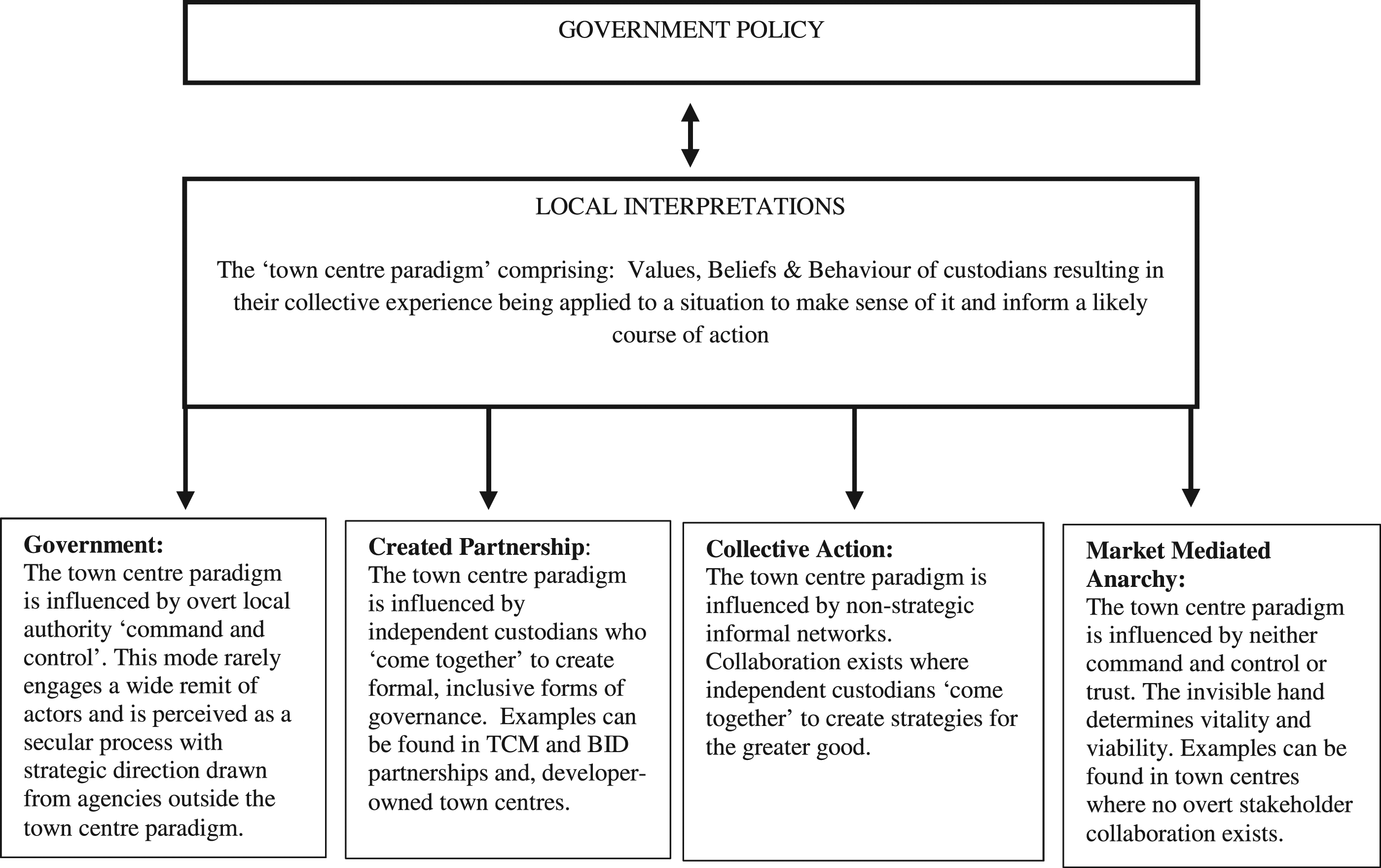
Figure 1 positions these paradigm stereotypes as four distinct forms. At opposing ends are formal regulated Government (i.e. the State) and the unregulated free market form of Market Mediated Anarchy (Jessop, 2016). In-between are forms of heterarchic governance: Collective Action as an informal inter-organisational form of governance that crosses cultural boundaries to address local issues; and Created Partnership as a more formal inter-organisational modus operandi that creates a more unified ‘town centre culture’ to promote place. We now move to discuss the influence of the town centre ‘paradigm’ in four locations corresponding to these different governance stereotypes.
Methodology
In adopting a qualitative, inductive approach to investigate the ‘collective experience’ of elite custodians in determining local retail development strategies, a comparative case study design was adopted (Yin, 2017), which determined the choice of case studies reported below. In approaching respondents in each location, we were mindful of the following caveat: “Elite interviews provide valuable information from perspectives of power and privilege. However, the information elites provide may be biased or inaccurate, and researchers must be knowledgeable about the elites they interview. Therefore, the use of triangulation in studies using elite interviews is crucial” (Natow, 2019: 1).
Data sources
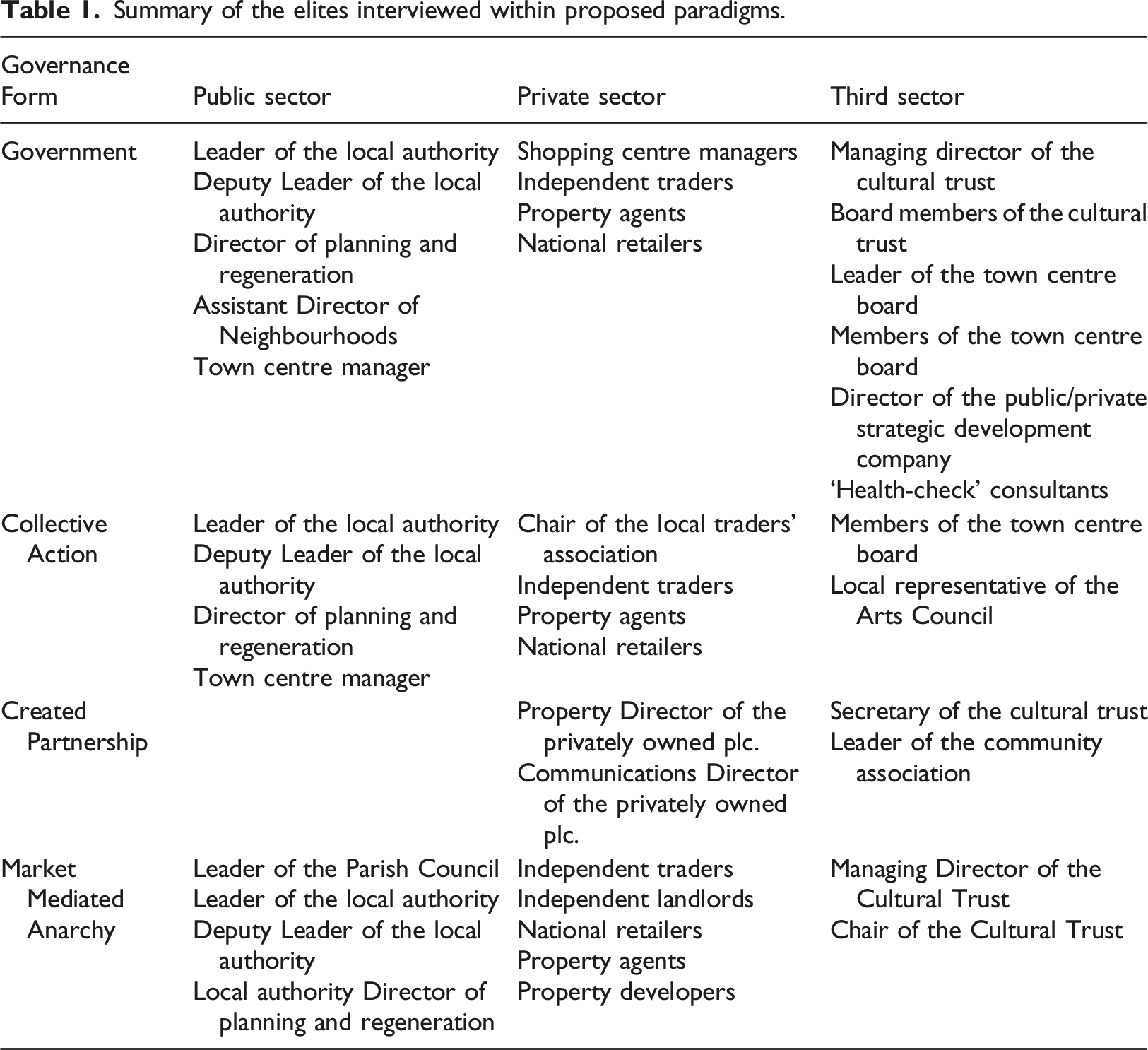
Summary of the elites interviewed within proposed paradigms.
Elite interviews and discussions
Natow (2019: 1) notes that elite interviews of individuals “who hold powerful positions that have an individual and unique knowledge, or information from a privileged perspective, can be a crucial data source for studies examining public policy, politics, and power relationships”. Such interviews were the main data source, compiled over a 4-year period (2014–2018), with evidence collected during several visits and phone conversations with these town centre ‘custodians’. The ‘way in’ (Hallsworth and Evans, 2008) was the leader of the main administrative entity, and from this, a ‘snowballing’ technique (Atkinson and Flint, 2001) identified other ‘custodians’ to be interviewed.
Initially discussions were recorded, but it became obvious that this method was too rigid. To understand the reasons for ‘behaviour’, rather than the espoused ‘rhetoric’, it was often necessary to turn the tape off and listen to what interviewees had to say, with a priori questions used as informal prompts to guide the conversation (Davies, 2017). Field notes were taken from these discussions and written up after interviews. From these recordings and notes came the quotes used within this paper – verbatim when recorded, or reconstructed from contemporaneous notes. Transparency was essential in terms of gaining the interviewee’s trust and, maintaining good etiquette throughout the research process was vital (Harvey, 2011), as we wanted to tell their story as custodians as part of an ‘organisational culture’, rather than personally identifying them and associating them with what were essentially collective decisions. Therefore, although there are references to positions within organisations, the interviewees themselves - and the places where they are located - remain anonymous.
Documentary analysis
Documents were understood as written texts that served as a record, or piece of evidence (Smith, 1974) that in this context generally consisted of commissioned reports, generated either by consultants (external to custodians’ cultural paradigms), or by employees/officers of local entities as part of a Local Area Plan. It was important to compare ‘internally’ and ‘externally’ generated documents where possible, as potentially there was a chance of a greater bias in ‘internally’ generated reports (Schein, 2003, 2017).
Site visits
Over 50 site visits were made to all four locations, as it was important to understand the geography of the place, the competing retail offer, and to compare the back-story of previous ‘health-check’ reports to the timeline of retail development in each location. The resulting fieldnotes were particularly useful in supplementing interview data by shedding “additional light on textual content” (Decrop, 1999: 347). Indeed, site visits often had a serendipitous outcome, as the understanding of town centre paradigms was refined by an iterative combination of meeting elites, revisiting ‘health-check’ reports, and continual site visits.
Data analysis
All data obtained were treated as text and subject to an established process of thematic coding (Crang, 2005), guided by a priori issues of commercial vitality and viability. Thus, themes that came from discussions with ‘elites’ reflected the impact of governance concepts on those measures. This inductive bottom-up approach generated themes that were data-driven (Braun and Clarke, 2019), for as Patton (1990: 464) states, “it is in data analysis that the strategy of triangulation really pays off”.
Findings
Three key interrelated cross-case themes emerged from custodians’ espoused beliefs and values (drawn from discussions, published ‘health-check’ documents and strategic plans), and their behaviour (informed by site visits). Each theme has its antecedents in the literature outlined above. The first - Organisational conflicts of cultural norms – is arguably one consequence of the ‘messy’ (Horvath, 2017) nature of governance in this context – especially in heterarchic forms, whereby town centre custodians emerged from private, public sectors and third sectors (see Table 1), with potentially different perspectives on how the world works and roles/cultures/underpinning ethe of organisational entities within the town centre, and for how the consequent ‘paradigm’ was created and maintained. The second theme, relating to the Temporal influence(s) of local governance, emerges from Schein’s (1994) suggestion that an ‘owned’ culture (resonating with the paradigm concept) is inherently temporal, becoming embedded in groups that have been together for some time facing - and solving - problems, and observing the effects of their solutions. The final theme - Entrepreneurial imperatives of town centre custodians - resonates with Harvey’s (1989) articulation of the overarching entrepreneurial governance strategies increasingly adopted by those responsible for urban management. We now explore each of these themes in more detail.
Organisational conflicts of cultural norms
Within all four governance stereotypes under study some cultural differences were evident. Inter-organisational attempts to work together sometimes foundered on perceived cultural differences between stakeholders: “All the traders are negative, negative, negative. We suggested that the town centre traders start a BID to get more money into their centre, but they stuck two fingers up to us. We could raise council tax by 2% to give them a million pounds, but what would they do with it? And the residents would ask, what am I getting for the rise?” (Deputy Leader, Local Authority - Collective Action).
These differences sometimes existed within (especially public sector) organisations, depending on individuals’ different roles: “One of things I have to do is respond to the public and the politicians. Members [politicians] are seen as a bit of an irritation, but you have an awareness as an officer of the Council that the Leaders were democratically elected, and you are there to carry out their ideals.” (Executive Director, Local Authority – Government).
Although of interest, narratives of inter- and intra-organisational conflicts per se were not considered to be particularly revealing about the ‘collective experience’. There will arguably always be conflicting views and indeed, Johnson et al. suggest that in such culturally diverse environments, organisational conflicts between the rituals and routines of custodians are anticipated, as the “expectations of stakeholder groups will differ” (2017: 135). Of greater interest were the causes of those conflicts, which directly affected the ability of custodians to ‘come together’. Here, a contributing factor was the extent of custodians’ commitment to their town centre paradigm; if custodians were ambivalent towards a shared ‘town centre culture’, or inconsistent in their approach towards it, confusion with other stakeholders could ensue (Schein, 2017). This was particularly apposite when the public sector overtly intervened in town centre governance (especially evident in the Government and Collective Action stereotypes), and especially when political parties changed their priorities towards the town centre: “Town centres were better before they needed managing” (Executive Director, Local Authority – Government) “I will be honest with you, we haven’t invested in the town centre in the past, we really haven’t and that shows” (Leader, Local Authority – Collective Action).
These responses from different local authority custodians implied a certain ambivalence towards their town centre paradigms before government dictums ‘required’ them to engage with other stakeholders. When they did engage, their behaviour appeared to create a degree of confusion that contributed to conflict - not only with other custodians, but also within their Council chambers.
An example was found in the Collective Action case, when in the early 2000s, local authority custodians (guided by the ‘expertise’ of invited consultants), believed the town centre “was tired” and in need of re-development. Consequently, the local authority sold public land to private developers, and in the process created a new edge-of-centre retail destination. The local authority’s “Masterplan” intended to create a cultural hub and lifestyle centre where the traditional town centre had been, thereby creating a “new” town centre that better reflected the town’s “heritage and diversity”. However, this plan appeared to be only partly thought through. When a significant number of town centre retailers relocated to this new development, the local authority was presented with a gaping commercial hole in the town centre; no money to redevelop it, and antagonised town centre traders who had worked tirelessly to retain the vitality and viability of their businesses whilst this strategy was being developed. Consequently, there was no evidence of a shared ‘collective experience’ and, as a result, cultural differences were exacerbated. 15 years later, the town centre remained largely un-developed; traders bemoaned a lack of political commitment and action; and the local authority remained entrenched in the ‘belief’ that they had acted on ‘expert’ advice. A similar situation also emerged in the next theme relating to the temporal influence.
Temporal influence(s) of local governance
In all cases, there was evidence of the influence that past behaviour had on current governance. In some cases, the impact of time appeared to unify town centre custodians, whereas in others, it divided them. An example of the latter occurred in the Government case. In the mid-2000s, the local authority placed its trust in private developers to extend the retail footprint of the town centre’s primary managed shopping centre. The local authority believed this re-development would create retail competitive advantage over local town centres and, for its part, provided land for redevelopment in the town centre. This collaborative strategy, however, did not have the desired effect: “The Council were hoodwinked regarding the re-allocation of retailers into the [redeveloped shopping centre] leaving the local authority with empty unsuitable units, and [the redeveloped shopping centre] with all the key players. To compound the problem, the [shopping centre] pays the rent on the vacant units to stifle competition and drive the retail offer to their part of the town through a more attractive retail environment. The Council were too naïve, and you do have to be really tough with property developers; they are buggers, they really are. They promise you everything, and we should have thought more into the future. Guarantees were given at the time, but when the political leadership changed, we weren’t on the case. We should have enforced ourselves more on them” (Executive Director, Local Authority - Government).
This temporal influence on current governance was again apparent in the late 2010s, when the local authority decided to consolidate its civic offices and relocate them to the town centre. As a result of past actions, all private involvement was excluded from local governance and, in the absence of private interest, the local authority adopted the joint roles of entrepreneur and administrator to re-develop the town centre. In excluding private interests, the local authority appeared to isolate itself in the town centre paradigm; in effect, there was no-one to collaborate with.
Past influences had marked differences when comparing the behaviour of public and private sector actors. In the Created Partnership case, the passage of time appeared to create a unity of purpose between custodians. Here, some town centre partners were, at any one time, more equal than others (e.g. at certain points in time individual custodians held positions of greater influence over the town centre paradigm), but there was always a shared unity of purpose towards the town centre. From a governance perspective, this unity of purpose appeared to contribute to a compromise situation of mutually beneficial outcomes where, despite conflicting organisational cultures, each custodian’s vested interest contributed to the overall town centre paradigm through a process that was co-constituted, and not solely considered within their roles as separate spheres (Gualini, 2001). This unity of purpose was evident in the compromise afforded to other custodians when re-developing the town centre: “The challenge is that the Cultural Trust want it all to look like a film set, but retailers don’t want that anymore, so we have to try and work with both. How do we make Grade 2 listed buildings meet changing retailers’ needs and keep the Cultural Trust happy? A lease is coming to an end and we aim to dig the basement out to make it more attractive. But how do you do that with a Grade 2 listed building? You can consider the mess, but that is part of the challenge” (Property Director – Created Partnership)
What appeared to enhance unity of purpose was that private sector-influenced forms of local governance (Created Partnership and Free Market) functioned without an overt local authority influence. This is not to suggest that there was no such influence; to do so would be a “fatal conceit” (Morgan et al., 1999: 196). Indeed, there will always be a level of State influence in the guise of planning, highways and infrastructure etc.; rather, the influence of the local authority within the town centre paradigm was limited to an advisory and regulatory capacity. Consequently, in the private sector-influenced cases, the passage of time appeared to create a healthy conflict where cultural differences were contained within the spatial boundaries of the town centre, and governance was galvanised in “the setting of struggle” (Kipfer, 2002: 138). How custodians behaved in this setting of the struggle was the defining factor when creating a unity of purpose.
The entrepreneurial imperative(s) of custodians
The entrepreneurial imperative was manifest through a strategic imperative to act and was a critical factor in shaping any ‘collective experience’ within the town centre paradigm. This imperative was contingent on a combination of two factors: (1) a commitment towards the town centre; and (2) a mandate to act (or perhaps more accurately, to react, given the frequent apparent inability to plan for long-term strategic change on the part of local authorities).
A commitment to the town centre paradigm
This factor identified that in public sector-oriented cases (Government and Collective Action) political leadership in town centres could be inconsistent: “Politics means the town centre gets neglected if there is change and the new people don’t focus on the centre. If the Leader has a social, rather than economic bias this is reflected in policy and understanding, if the bias is commerce this will surface in its aims” (Local Authority Leader – Collective Action)
Indeed, in these cases, public sector custodians appeared to have leadership forced upon them as a requirement of government dictums from the 1990s. The requirement to actively engage with the town centre paradigm was not necessarily motivated through a willingness to be involved with other stakeholders in the struggles of adapting to change over time; nor through a perceived responsibility for the economic success of the town centre. Such a requirement did, however, offer new routes to town centre funding in times of public sector austerity: “We are more successful at raising money than the Council, we got a £750,000 lottery bid for the museum and £250,000 the year before, so we brought a million pounds worth of investment into the town centre. People realised that the way we invested in the place needed doing differently and a Cultural Trust that is a non-statutory provision has opportunities for a better funding mechanism” (Managing Director of Culture and Leisure - Government)
In private sector-oriented governance forms (Created Partnership and Market Mediated Anarchy), custodians comprised a collective identity of, among others, traders, landlords, public trusts, private investors and developers. To these custodians a commitment to their town centre was less of a choice and more an economic necessity. The distinction between public and private governance forms raised an interesting observation: a requirement to solicit ‘expert’ advice appeared to increase rhetoric, but crucially limited local authority action, which, in turn, increased conflict within the ‘town centre paradigm’: “The Council have a different agenda than the town centre traders and we have to appease both. I would hate to get them in the same room though” (Executive Director – Collective Action)
In effect, because local authorities were new to the concept of involved engagement with their town centre paradigms (in terms of seeking to influence other custodians), they required guidance from ‘experts’ to supplement their ability to act, a requirement that conversely appeared to dilute their ability to lead, and exacerbated the ‘messiness’ of governance because an ability to act locally could become constrained by political stalemate: “We can submit the plans and do all the reports, but when it gets to [national government] they ignore it because it doesn’t fit into their political pocket...we can’t just have the money [from government], there are conditions attached. They like to give us the responsibility but then tell us how to spend it. They have no trust in what we do, so they micro-manage the project themselves” (Leader, Local Authority – Collective Action)
A desire to act however, was only part of the equation; another crucial factor related to the ability of custodians to actually act, as discussed below.
A mandate to act
In local authority-oriented governance forms (Government and Collective Action), a mandate to act had to be supplemented by the impartial evidence of consultants: “The [government] insist on objective reports. They are very evidence based, and independent evidence at that. As everything has to be evidence based, we have no alternative” (Leader, Local Authority – Collective Action)
Any such advice given, due to the perceived contemporary functional obsolescence of town centre retail units (Hughes and Jackson, 2015), was often to extend the town centre boundary for retail development. In Government and Collective Action, the consultant’s advice was generally accepted, and local authority custodians adopted ‘centrifugal’ (Colby, 1933)
1
approaches to retail development. The local authority’s rationale for consenting to this expert advice was that: “If we didn’t do it, the retailers and developers would just go to [other towns]. So, it is better to have them here at least” (Leader, Local Authority – Government) “The fact that retailers were threatening to pull out made us develop the area. Yes, we lost some of the stores to the new centre, but if you look at the space they took in the new centre it was a lot more than they were taking in the town centre, so it was worth it” (Executive Director, Local Authority – Collective Action)
Despite the consistency of advice, however, there were differences in local authority behaviour because an imperative to act was reliant on whether the local authority had a mandate to do so. For example, in the Government case, despite adopting a centrifugal strategy to retail development, the local authority used its political control and entrepreneurial spirit to utilise public monies and borrowings from the Public Sector Loans Board to invest in the town centre: “I wanted the town centre to be arty rather than the usual cobble streets and hanging baskets, nice as they are. I wanted something different, so I used the many hundreds of thousands of pounds from the sale of a waste facility to redevelop the centre” (Deputy Leader, Local Authority – Government) “If we buy vacant units we can then say to investors, look what do you want, and one, two, three, bang, knock them into one, and off we go. So instead of waiting for the market to return, and instead of waiting for these investors to make a decision about one bit of a portfolio, we can decide our own future” (Leader, Local Authority – Government).
In the Collective Action case, the Local Authority did not have a political majority and therefore any mandate to act was only enabled via lengthy negotiations through Council chambers. This is where governance became ‘messier’ as political decisions required ‘impartial’ evidence to validate strategic plans. If the plans were long-term, and based on impartial evidence from consultants (e.g. the decision to consent to a major shopping centre on an edge–of–centre site), any negotiation was relatively consensual; however, the ability for decisive short-term action was limited by a drawn-out process through Council chambers: “The Local Authority owns around 24% of the car parking space in the town. From May 2016, we will be subsidising that to cost £2 for a full day’s shopping in the town. It took me 18 weeks to get that through Council, with all the meetings and objections from Members, as well as the cost of commissioning the report. So that shows you the political problems we have” (Leader, Local Authority – Collective Action)
A lack of a political mandate in the Collective Action case meant that custodians could not fully commit to actions consistent with the broader town centre paradigm. It was not that they were ambivalent, but as a local authority, they were inconsistent in their approach towards it, and confusion with other stakeholders ensued. Furthermore, due to the limits of local authorities’ cultural boundaries, town centre paradigms were compromised by their behaviour. In deciding to develop away from the town centre (as was the situation in the Government case), local authorities not only created conflict in their town centre paradigms, but also excluded other custodians from having a meaningful voice. Both had an abundance of governance rhetoric but there was no real evidence of a ‘collective experience’ of local stakeholders.
By contrast, private sector-oriented cases of Created Partnership and Market Mediated Anarchy adopted ‘centripetal’ (Colby, 1933) approaches to retail development and had local mandates to (re)act, either as a collective organisation (in the Created Partnership case, the property assets of the town centre were privately owned) or individually as independent retailers, and private landlords (i.e. Market Mediated Anarchy). Here, the adoption of centripetal strategies was ultimately influenced by space, as custodians in the Created Partnership and Market Mediated Anarchy case were limited by their spatial footprint. The restrictions on space (resulting from their limited spatial jurisdictional remit), however, had two key consequences; any development was contained within the town centre; and - crucially - local governance not only came together, it also had to work together. Whilst a centripetal approach to retail development arguably made governance less messy, it did not reduce conflict; and time created its own power struggles and acts of compromise. What appeared to simplify local governance, and the town centre paradigm, was the exclusion of ‘expert’ advice from consultants, a lack of retailer lobbying, and crucially a lack of local authority intervention.
Concluding comments
Our aim in this paper was to explore the concept of the ‘town centre paradigm’ (defined in terms of the heuristics underpinning behaviour and relationships between town centre ‘custodians’), and how those paradigms in different, contrasting places in turn influenced town centre custodians and their actions, to improve the retail vitality and viability of their locale. We explored four stereotypes of local governance that reflected the ‘collective experience’ of custodians (although we acknowledge there are potentially as many governance modus operandi as there are individual town centres). We suggest that the ‘town centre paradigm’ can be considered in terms of a local interpretation of national policy by town centre ‘custodians’, and in many cases any interpretation is/was heavily influenced by advice from outside (e.g. consultants etc.). We believe this point is pivotal to understanding the impact of town centre paradigms on the retail landscape.
Prior to the1990s, the local authorities in public sector led cases (Government and Collective Action) generally had little desire to further engage with other stakeholders in their town centre. Comments from local authority custodians that “town centres were better before they needed managing” displayed a somewhat ambivalent perspective before national government dictums were interpreted as an imperative to become more actively involved, and arguably develop a more overtly entrepreneurial approach (consistent with our final cross-case theme). When local authorities became more actively engaged, their behaviour was predicated through “political entities built on self-interest, not common interest” (Dobson et al., 2009: 125), linking to our first cross-case theme relating to conflicts of organisational norms, and indeed, their behaviour often marginalised other local stakeholders. For example, when local authorities sought advice, they did so from business consultants who were considered ‘experts’ in their fields yet had no locally-based vested interest in the town centre. Thus, when local authorities devised retail strategies based on such advice, they adopted ‘centrifugal’ approaches to retail development, reflecting their broader spatial jurisdictional remit beyond the town centre itself. In contrast, private sector cases (Created Partnership and Market Mediated Anarchy) did not have this wider remit, and consequently they retained a focus on the town centre through ‘centripetal’ strategies.
In soliciting the advice of ‘experts’ and by adopting centrifugal strategies, local authorities appeared to marginalise any ‘collective experience’ in the town centre paradigm (Coca-Stefaniak, 2013; Fosberg and Nelson, 1999; Hospers, 2017). This behaviour was somewhat concerning, because the case studies suggest that maintaining commercial vitality and viability had arguably more chance of success if stakeholders ‘stayed together’ and ‘worked together’ (a quote attributed to Henry Ford, cited in Dooly, 2008), resonating with our second cross-case theme, relating to the influence of temporal aspects. Thus, reflecting on the nature - and influence - of the concept of the ‘town centre paradigm’, in the context of this research, town centre vitality and viability over time was facilitated by: (1) a supportive consistency of local/private authority action towards the town centre; (2) a private/public entrepreneurial imperative to invest in the town centre; and (3) a willingness of custodians to compromise. In effect, the town centre paradigm was galvanised by custodians who were motivated to overcome problems together (Schein, 2017) and it was compromised when custodians marginalised other local stakeholders. In adopting such strategies, local authorities risked division and isolation in local governance, which was both costly and strategically limiting.
In 2022, there are many reasons why a ‘collective experience’ within the context of the town centre paradigm is important. Numerous examples exist where local authorities are investing heavily in town centres. For example, a fifth of all shopping centre sales since 2016, valued at £1 billion, have been to local authorities – a strategy financed with “dumb money” (Butler, 2019 online), with significant concerns over councils’ ability to revive the shopping centres they are investing in. Indeed, concerns about local authority investments have prompted the Treasury to issue new guidance and to increase interest rates on public borrowing as a deterrent against further purchases (ft comment, 2018; Drapers, 2019). Moreover, official guidance (MHCLG, 2019) suggests that the priority for the regeneration of town centres is through an increased ‘diversity of use’, where town centre strategies arguably require flexible and collaborative approaches, not solely from ‘experts’ and authorities (private or public), but more importantly, from local town centre stakeholders.
Perhaps, the most significant challenge to local governance may, however, come from the fallout of the COVID-19 pandemic on the retail landscape, as all town centres try to figure out how to move from a stage of “crisis” to one of “pre-recovery”, through the “crucial step [of] building collective capacity [through] coordinated leadership” (Ntounis et al., 2020 online). In an environment where the impact of COVID-19 on town centres is “potentially catastrophic, on a level not seen before” (ATCM, 2020 online), the challenges for town centre custodians will be considerable. It would be reasonable to suggest that, now more than ever, these custodians (both private and public) should aim to engage with each other, in the ‘setting of the struggle’, to maintain the vitality and viability of their locale.
We believe that this research can further inform the debate on how local governance in town centres functions in response to retail change; in particular, through an understanding of how behaviour impacts on the rituals and routines of local governance. We hope that his research may inform custodians as to the potential consequences of their behaviour on governance and vitality and viability and inform policy makers that the interpretation of ‘expert’ advice can create unnecessary conflict and division within the town centre paradigm.
Footnotes
Declaration of conflicting interests
The author(s) declared no potential conflicts of interest with respect to the research, authorship, and/or publication of this article.
Funding
The author(s) received no financial support for the research, authorship, and/or publication of this article.
