




Abstract
From 2013 to 2016, two pipeline projects were vigorously contested in the Tiohtià:ke: Montreal area in Quebec, Canada. These disputes are analyzed as instances of the urban politicization of fossil fuel infrastructure. This politicization involves power struggles for authority in energy landscapes, particularly in relation to the material entanglement of energy in the city-region, that is, which parts of the infrastructure and landscapes come to matter. Drawing on work from political ecologists and scholars pressing for a rematerializing of urban studies, we supplement their insights with a conceptualization of struggles for urban authority in the governance of energy, in two parallel processes: one of performing centralized urban authority (notably with the media) and a second messier politics of multiplicities operating in spaces of urban governance and resistance. Struggles for urban authority are co-constructed with the socio-material realities of infrastructure and involve actors who are engaged in everyday practices of regulating, maintaining and protecting landscapes. Yet, in the mediatization of urban energy landscapes, certain voices, notably of Indigenous communities, remain on the margins, resulting in few challenges to settler colonialism and climate-changing extractivism.
Introduction
Social movements have been pressing for an end to fossil fuels as a more transformational form of climate change action than decarbonization or carbon neutrality. In economies dominated by fossil fuel interests, energy remains tied to values of safety, freedom, economic development, and nation-building, which materialize in carbonscapes that are deeply connected with settler colonialism (Haarstad and Wanvik, 2017; Davine et al., 2017; Cowen, 2020). Contestation of fossil fuel infrastructure challenges these values, notably by making their costs for livelihoods and the living more visible. Paterson argues that the difficult task today is “how to keep alive the sort of political imaginary involved in the end of fossil fuels frame, and the way it sharpens our focus on the ends of climate action” (932), while also recognizing the need for multiple forms of collective action to address the cultural and socio-material politics of energy in cities.
We think this problem setting is important because it highlights a particular conjuncture for energy politics in recent years: the growing engagement of urban social movements and urban political elites against fossil fuel infrastructure (Sicotte and Joyce, 2017; Van Neste, 2020) in tandem with low-carbon policies. This urban contestation makes visible the deep entanglements of energy in urban landscapes, but have yet to be thoroughly studied in that regard (see however Simpson, 2020). In Canada, fossil fuel interests are also deeply intertwined with politics, political-economy, and our global contribution to climate change because pipeline capacity has been for more than a decade “a significant constraint on oil sands development and profitability” (Hoberg, 2013), while it is estimated that 83% of reserves should not to be extracted in order to limit global warming to 1.5°C (Welsby et al., 2021). As pipelines are “the arteries of capitalism,” pressure to build more of them is high (Simpson, 2020). Yet, mobilizations have helped reproblematize the broader energy chain pipelines are part of, with increased visibility to social, ecological and political issues related to what was extracted, who was displaced, what they transport or leak, and what it produces locally and globally (Barry, 2013).
We are particularly interested in the urban politization of pipelines. Our conceptualization of this urban politicization builds on a trend in the urban energy transition literature to study urban politics in relation to infrastructure, with an emphasis on rematerializing urban studies. It involves looking at the “process of making things matter,” with urban materiality becoming “a key arena for urban politics” (Rutherford, 2014: 1451). This rematerializing also involves analyzing the ordering of urban spaces and landscapes by infrastructure, through the privileging of capitalist circulations over other socioecological relations in the city (Simpson, 2020; Cowen, 2020; Sanzana Calvet and Castán Broto, 2020).
These approaches underscore the importance of studying what parts of energy infrastructure come to matter in political struggles and which socioecological relations are emphasized under capitalism and place-based resistance. While we take this literature as inspiration, certain components of the process of politicizing the materiality of energy in cities have been largely overlooked. What is acknowledged in energy conflicts is partly a function of the performativity of political mobilization and power struggles, including in the everyday governance and maintenance of the infrastructure (Pilo, 2021) which should be conceptualized.
In this article, we use pipeline disputes to enrich our understanding of how energy infrastructure is politicized in the urban setting in two ways: first, in considering the parts and socioecological flows of the embedding of energy infrastructure in landscapes that come to matter in urban mobilization; and second, how political processes and power struggles give visibility and meaning to this material and metabolic embeddedness of energy. The urban politicization of energy infrastructure relate to this material politics and its relationship with struggles for authority, that is, who is to govern.
We start by presenting our argument on the urban politization of energy, drawing on contributions on the role of the media in the performance of authority, when formal governance arrangements are challenged or unclear. In addition, we discuss the media relates to spaces of urban governance and resistance, especially those involved in maintaining landscapes and infrastructures entangled with energy in the city. We then present the case study’s context and methods as well as our analysis of the pipeline disputes in the Tiohtià:ke:Montreal area.
Performing and assembling urban authority on energy
Unlike past representations of the oil commodity chain as stable and resistant to change, Haarstad and Wanvik (2017) conceive of carbonscapes as assemblages of material and social elements (institutional and cultural practices), connected in stable or unstable ways. Stability and change are contingent upon a set of territorializing and deterritorializing processes. Oil distribution infrastructure is one of the three carbonscapes discussed by Haarstand and Wanvik, where local and regional resistance, environmental spills, media attention, sudden oil price changes, and geopolitical incidents reveal instability and moments of potential change. We will look at such a moment of instability in the Montreal region’s resistance to pipelines and the accompanying media attention.
To investigate how urban actors succeeded in claiming the authority to say “no” to pipelines, we were prompted to further conceptualize how urban authority is assembled on energy infrastructure issues. Part of the answer lies in the rich literature on the material politics of energy infrastructure and how certain parts and metabolic flows come to matter. Another part of the answer lies in the conceptualization of the urban polity and the political processes of claiming authority and legitimacy to govern or resist energy. Large infrastructure networks are often not under the authority of urban governments, despite increasing interest in urban political autonomy vis-à-vis infrastructure (Hodson and Marvin, 2009). Although pipelines fall under federal jurisdiction in Canada, Hoberg (2013) highlights the questions and uncertainties stemming from potential vetoes by Indigenous communities or subnational governments. To understand how urban actors gain authority, the urban polity needs to be conceptualized as a dynamic relationship between two parallel processes: one of performing centralized urban authority (notably in the media and political elite spaces) and a second messier politics of multiplicities with overlapping spaces of governance and resistance.
We are inspired by the work of Hajer (2009) that challenges the classical-modernist way of governing, with its rituals and sets of practices. He emphasizes how dramaturgical components of politics and the performance of legitimate authority become key when routine and institutionalized procedures are non-functional or successfully questioned, and there is no longer a clear political center, but rather a broad range of audiences and sites where politics is conducted. Every political utterance is received by a different audience who may interpret it differently. Although the authorities’ control over meaning is reduced, the media also provide a “pedestal” where skilled leaders can enjoy high visibility and participate in the performance of authority. As Hajer notes: “If it appears that there is a political center, this is because it is successfully staged as such” (2009: 43). The media currently play a crucial role in the political dynamics of authority-making.
Performing authority in the media
The role of media in the performance of urban leadership and authority on energy infrastructure has been largely overlooked. Although many contributions have shown the importance of the media in portraying (and co-producing) public acceptance or non-acceptance of energy projects generally (Sovacool et al., 2022), they typically do not discuss how media coverage affects how disputes evolve. You et al. (2022) found that degree of urbanization positively correlates with media attention and dispute intensity. Anderson et al. (2018) showed the importance of media in attributing blame for disasters to authorities. Their conclusions were also in line with previous studies showing that media coverage of environmental disasters and energy conflicts does not necessarily mean increased coverage of climate change per se. Local issues, disputes, and ideologies play a more dominant role.
More generally, media visibility has long been considered a key, albeit ambiguous, factor for the success of social movements (Koopmans, 2004). For example, in an analysis of 57 cases of resistance to extractive projects in Canada, Gobby et al. (2021) found that “67% of successful efforts employed media-based activism,” and Davine et al. (2017) showed that the media widely promoted tar sands extraction in Canada by portraying Canadians as “a unified group, hardworking and dependent on oil” (433), as opposed to counter-narratives emphasizing First Nations territorial claims and other forms of opposition in provinces and municipalities outside Alberta. However, there are still few empirical analyses of the media’s role in contentious multi-scalar urban governance issues, where cities and federal governments oppose each other on energy infrastructure, apart from acknowledgment that “policy actors, each in their own ways, now need to ‘govern with the news,’” with ambiguous effects on democracy (Schillemans and Pierre, 2016:6, citing Cook, 2005). Koopmans (2004) also argues that performance in the media can transform the perception of who is most in charge, as well as the political opportunity structure for further mobilization.
The media naturally have their own preferred ways of telling the news in order to capture their audiences and stage the political center. One key role is that of “accountability entrepreneurs” initiating, triggering, providing, and amplifying a formal or informal accountability process (Jacobs and Schillemans, 2016). Given that the construction of energy infrastructure in Canada is subject to environmental and safety assessments with public hearings, the media has covered these assessments as key moments in challenges from social movements and the mobilization of potential or symbolic vetoes by provincial and local governments (Hoberg, 2013). Such formal procedures set boundaries in terms of legitimate actors and spaces for consideration in terms of environmental and social impacts (Hunsberger and Klocher Larsen, 2021; Salomons and Hoberg, 2014).
Besides the media coverage and amplification of such debates, researchers have noted a personalization of politics in the media, where greater attention is given to charismatic leaders who become symbols of political organizations (Figenschou and Thorbjørnsrud, 2018). Hajer uses the concept of “situational credibility” to describe “the way in which the credibility of an actor is dependent on the combination of his/her performative habitus and the setting in which he/she operates” (2009: 71). Koopman also emphasizes that the discursive opportunities of the media which some actors mobilize “are not free-floating media creations that are independent of extra-medial power relations” (2004: 377). Performing authority in the media means acquiring not only visibility (“the extent to which a message is covered by the mass media”), but also, as Koopmans argues, resonance and legitimacy, that is, “the extent to which others react to a message,” and “the degree to which such reactions are supportive” (2004: 367).
An urban politics of multiplicities
The urban politicization of energy does not only happen in the media. For many urbanist scholars, the complex and dense fabric of political spaces is constitutive of urban politics (Castells, 1983; Magnusson, 2011; Nicholls, 2008). The city has been described as a relational incubator, with a concentration of interlinked organizations and associations that serve as a basis of alliances and protest movements (Nicholls, 2008). Magnusson has discussed the multiplicity of authorities in cities, arguing that multiple forms of self-government are a characteristic of urban politics, with many (if not most) issues in the city self-regulated by individuals or groups with little or no relation to the State, working on different registers, with “only some of them are arranged in a neat hierarchy, though most are not,” (Magnusson, 2011: 4).
In recent scholarship on energy infrastructure, Pilo (2021) has shown the importance of such multiplicity of actors involved in the governance and everyday negotiations of electricity infrastructure. In the case of Rio de Janeiro, commercial actors, technicians, and also criminal gangs controlling access to favelas and military operations were part of the heterogeneous governance of electricity infrastructure, producing inequalities in the network. For Lawhon et al. (2018), the notion of heterogeneous infrastructural configuration enables to acknowledge the different practices, actors and uses that are part of infrastructure, even while hidden or marginalized. We think we can learn much from these theories developed in studies of the Global South.
Indeed, in the North as well, many grassroots spaces—for example, of community services or caring for the land—are little known or recognized outside the communities involved and may be repressed by governments. This is dramatically the case of Indigenous modes of land and water governance and stewardship that were historically dismantled as territories were stolen and colonial governance structures superimposed. Nonetheless, Indigenous communities continue to resist, and care for land, water, and ecosystems as they live, fish, and hunt on unceded territory beyond the restricted reserves where they were confined (Corntassel, 2020; Tomiak 2017). Indigenous resistance and resurgence spaces need to be recognized as part and parcel of urban politics.
State multi-scalar governance, especially given past metropolitan governance reforms, should be added to this dense nexus of urban mobilization and self-government. Metropolitan governance was meant to provide organization at a city-regional scale, particularly for planning and services. Although these new state spaces (Brenner, 2004) affect the urban political landscape, they are rarely mentioned in the energy and climate transition literature, while urban coalitions of social interest increasingly assert, in these governance spaces, a desire for more control and influence over energy, water, and transportation issues for reasons of competitiveness, safety, and economic growth (Hodson and Marvin, 2009).
Although these different spaces of urban politics, governance, and resistance do not all carry the same weight and are far from being free of power struggles, there are times when some of their motivations, discourses, tactics, and practices align to produce convergent political forces (Nicholls, 2008; Sicotte and Joyce, 2017; Gobby et al., 2021; Van Neste, 2020).
In sum, the urban polity has been characterized as a politics of multiplicities, with several spaces of governance and resistance that overlap in complex, power-laden, and often awkward ways. This does not mean that there are no dominant actors. Rather, as explained by Hajer above, the political center has to be staged with at times substantial dramaturgical performance of authority. We are therefore interested in how the authority claims performed in the media relate to other contexts beyond the media and are acknowledged by other groups mobilizing in the urban region.
The relevance of considering this multiplicity does not solely rest on analyses from the urban political and social movement literature. It also comes with the recognition that energy is embedded in urban infrastructure and landscapes, involving many actors and governance practices (Pilo, 2021). This material embeddedness is discussed in the next section.
The infrastructure parts and flows that come to matter
To study the politics of what comes to matter in urban energy conflicts, we need to also understand the entanglement of energy in the city. Recent work on urban energy transitions has been focusing on this, considering the relations between human agency and the artefacts composing the infrastructural systems we have built and the ecological resources on which they rest, in the landscapes and places where we live (Broto, 2019; Rutherford, 2020).
We draw on two complementary angles on the entanglement of energy in the city. First, recent work on rematerializing urban studies through infrastructure has delved into the relationships between human agency and the artifacts composing the infrastructural systems, by analyzing the parts of the infrastructure assemblage that come to matter more, given the constraints and opportunities they represent for the actors involved and their politically charged projects. The technical deployment, maintenance, or renovation of infrastructure are studied in terms of how they are not only socially constructed and made obdurate within power structures (Rutherford, 2020) but also materially constrained, through the physicality of the infrastructural parts and the “unruliness” of water or energy flows defying human control, producing intimative and collective feelings of insecurity in the case of spills and infrastructure failures (Graham, 2010).
Second, the concept of energy landscape is useful for visualizing socio-natural, metabolic energy flows and the ones given greater emphasis, by proponents of the infrastructure, and resistance to it. As Broto and Calvet explain (2020: 282): “A landscape perspective enables an analysis of the production of space with the material and symbolic networks that support capitalism. Such a perspective forces the analyst to examine spatial transformations in their full diversity, looking at energy infrastructures alongside the places that people inhabit. Hegemonic strategies of land appropriation emerge alongside the agencies of the people who contest them.”
In the production and maintenance of fossil fuel infrastructure, land, subsoil, and water become used and entangled. Spaces become appropriated for the metabolic flows of capitalism, while energy itself is a fetishized commodity, with the extent of implied sacrificial zones usually remaining hidden (Arboleda, 2016). A recurring core theme of resistance is the contestation of this invisibility, and the defense of territorial and Indigenous modes of governance that holistically care for water, land, and subsoil (Estes, 2019; Gobby et al. 2021; Adkin 2016). The costs of the extraction and transportation of oil from tar sands in Western Canada on Indigenous communities is immense (Parlee, in Adkin 2016), while the Quebec dominant energy source, hydroelectricity, also developed with the infliction of severe environmental injustice on Indigenous communities in northern Quebec, who were displaced, had their food contaminated by mercury and their territories radically transformed (Desbiens, 2014). If infrastructure is understood more and more now as hybrid, unfinished, often unequal (Pilo, 2021; Lawhon et al., 2018), there is still a legacy of massive energy infrastructure carried by state territorial projects, and justified by a discourse of national autonomy and universal reliable access to energy.
With the growing discourse around ecological security and urban resilience, Hodson and Marvin (2009) argue that urban regions are increasingly presenting themselves as leaders in the reconfiguration of infrastructure to face threats like climate change and ensure the protection and autonomous management of amenities like secure water access. However, there are definite consequences in emphasizing certain metabolic flows and defining what is deemed more “essential” in terms of resilient infrastructure and landscape (Anguelovski et al., 2016) but also in representing territories and the relations between different flows (for example, between energy and water use) in biased and selective ways, often ignoring certain epistemologies, conditions, and modes of life, especially of Indigenous nations (Robb et al., 2021).
Building on these concepts, our case study analyzes which parts and flows of energy landscapes come to matter in debates, and which remain marginalized. We also examine the urban spaces of governance and resistance involved in regulating and/or caring for energy landscapes, and which are given visibility in the urban mobilization against pipelines through performance in the media.
Context and case study
In 2013, at a time of increase in project proposals to transport crude oil from Alberta and recent cutbacks in federal safety and environmental assessment procedures, a train transporting crude oil exploded in the town of Lac Mégantic, Quebec, killing 47 people and destroying much of its downtown. As a result, public and municipal mistrust of the State’s ability to regulate oil transportation escalated. In the same period, between 2013 and 2016, two pipeline projects were heavily contested in Quebec.
These two pipelines were projected to pass through suburban and semi-rural towns in the Tiohtià:ke: Montreal area. The Enbridge project involved an existing 40-year-old pipe in which the flow was set to reverse direction and increase in volume in order to bring tar sands oil from Alberta to a Montreal refinery. Federal National Energy Board (NEB) hearings on this project were wrapping up when TransCanada began visiting municipalities to present its Energy East pipeline project. Formal NEB hearings on the TransCanada project began in 2016 but were suspended and finally canceled. Although this project was abandoned, the Enbridge Line 9B flow reversal did go through.
Research on the installation of hydroelectric power lines in Quebec by Simard et al. (2006) showed that municipalities were typically passive allies of energy infrastructure providers, with non-publicized negotiations and financial compensations. In the pipeline debates, most municipalities chose instead to play a more vocal role. These debates also occurred shortly after a grassroots movement of ordinary citizens (and some municipalities) gaining a moratorium against shale gas extraction in Quebec. This citizen mobilization then continued in marches, direct action, and coalitions against pipelines that have been documented in greater depth elsewhere (Van Neste, 2020).
Quebec, including the area around Montreal, has several local planning bodies, at the town, regional, metropolitan, and water-basin scales. In particular, the municipal entities at the regional level have spatial planning responsibilities and are involved in risk management and the protection of regional waterways—responsibilities often cited in the pipeline debates. All of these planning entities are included when we speak of municipal actors below. The Montreal Metropolitan Community (MMC) covers a broader territory than these regional bodies, consisting of 82 municipalities and 3.9 million people in 2014. Launched in 2001, the MMC’s first metropolitan-wide efforts to plan and pool resources were not particularly successful. The pipeline debates, particularly around water and safety issues, strengthened the MMC and its public visibility.
The two Indigenous reserves in the MMC area—Kahnawake and Kanasetaka (both from the Kanien’keha:ka nation)—also became very much involved in pipeline contestations. Not only do Indigenous land claims greatly exceed these confined areas, the proposed pipeline crosses Kanien’keha:ka hunting and fishing grounds and threatens land, water bodies, and the climate. Chief Serge Otsi Simon described climate change as “the single greatest threat to our way of life as Indigenous Peoples” (2015:2).
Approach and methods
Our press analysis was conducted on newspaper articles published between 2013 and 2016, the period during which the Enbridge and TransCanada pipelines were being debated in formal settings and in the media. “Peaks” of media attention on pipelines in Montreal were analyzed (using the keywords “oléoduc/pipeline” and “Montreal”), with each peak corresponding to a period with more than 100 articles per month. Our corpus consisted of 1763 articles from the four major newspapers distributed in Montreal (La Presse, Journal de Montréal, Le Devoir, and The Gazette) as well as from local newspapers in the region contained in the Eureka database, duplicates and opinion letters were deleted.
We conducted three types of analysis. We began with the article headlines, identifying the ones that explicitly mentioned an actor involved in the pipeline debates, and counting the types of actors cited (e.g., “
We also performed a documentary analysis and conducted 11 long interviews with residents and municipal officials in towns involved in both the Enbridge and TransCanada pipeline debates, and one with the MMC. Fifteen shorter interviews with activists were also conducted during rallies. The position of municipalities and citizens in the provincial, federal, and metropolitan hearings on the pipelines were analyzed. Interviews served to (1) understand the key issues for participants, as well as dispute perceptions and mobilization settings and (2) investigate strategic use of the media by certain actors and how media representations resonated with other movement participants.
Media performance on pipelines in the metro Montreal area
The first finding on media performance concerns the actors receiving the most coverage: municipal actors in the MMC territory did have significantly more visibility. Over the five identified media peaks, municipal actors represented 20% of the actors mentioned in headlines, compared to 19% for pipeline and oil refining companies, 15.6% for citizen protestors and environmental groups, 15% for the federal government and the NEB, 10.4% for the provincial government or provincial political parties, and only 1.6% for explicitly identified First Nations groups or activists. Complete content analysis of the articles showed that identified First Nations groups and activists were mentioned in 10% of the articles, yet rarely enjoy center stage. Conversely, in the total corpus of articles, coverage of MMC municipalities (38% of the articles for the entire period), and especially in winter 2016 (60%), was particularly significant, both in number and in content, regarding their authority to say “no” to pipelines and the positive reception of this claim. This contrasts with the other tiers of government as shown above, and also outnumbered citizen protestors and First Nation communities.
One important characteristic of the media coverage was the personalization of the conflict around Montreal Mayor and MMC President Denis Coderre. A politician with much experience (formerly in the federal government) and media savvy, Coderre was very strategic in his media relations to gain more ground in the pipeline debates. Several of the events he organized and key expressions he used came to frame the news around pipelines.
The MMC successfully staged how they were filling an institutional void in the environmental and safety regulation of pipelines in Canada. This was done by emphasizing two kinds of argument related to the literature review presented above. The first concerned the governance failures of the environmental and safety regulation of pipelines in Canada, which the MMC successfully addressed through their own procedures. Indeed, the MMC organized technical and political spaces—a metropolitan oversight (“vigilance”) committee, the MMC public consultation, and multiple press conferences, to enhance their legitimacy. Media coverage of these governance arguments are presented in Figure 1 and also explained in detail below. Media coverage of the MMC governance and procedural arguments.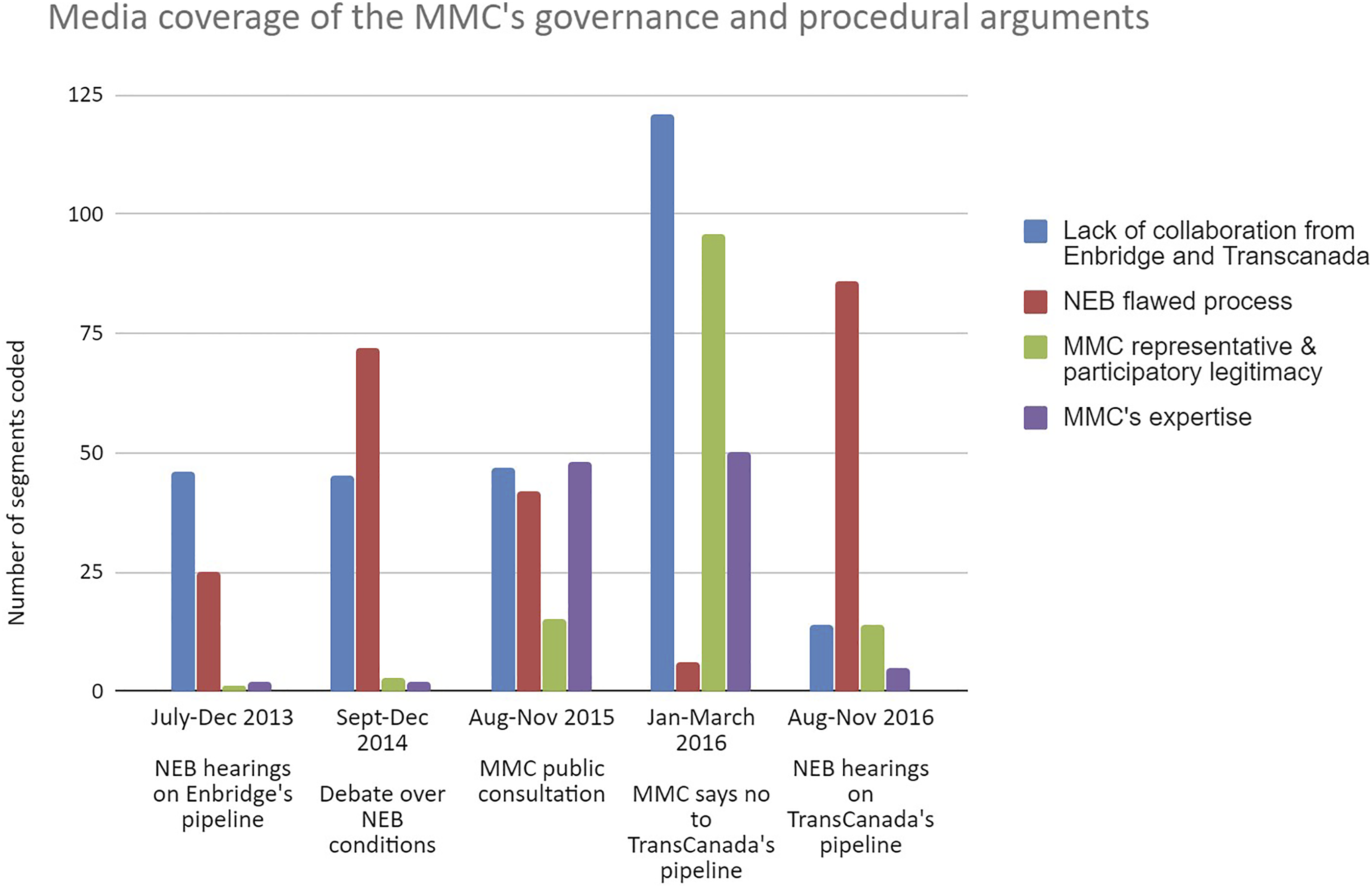
The second kind of argument in favor of an urban authority over pipelines was based on the threatened landscapes and metabolic flows that municipalities were demonstrably responsible for safeguarding and maintaining. These themes and the associated media coverage between 2013 and 2016 are presented in Figure 2. The arguments most covered concerned water and public safety, followed by minimal local economic benefits, energy, and climate issues and the MMC’s territorial planning and environmental goals (protection of woods, wetlands, and agricultural land). Municipal officials interviewed were upset and surprised that the pipeline companies had no up-to-date information on the territories their pipelines would cross and that this aspect appeared irrelevant in the decision-making process. This made the officials feel that they were being sidelined and overruled, which was a conception also emphasized by the citizens opposed to shale gas who coalesced into the “Coule pas chez nous” [Do not flow though our neighborhood] network. Media coverage of the MMC main arguments against the pipelines.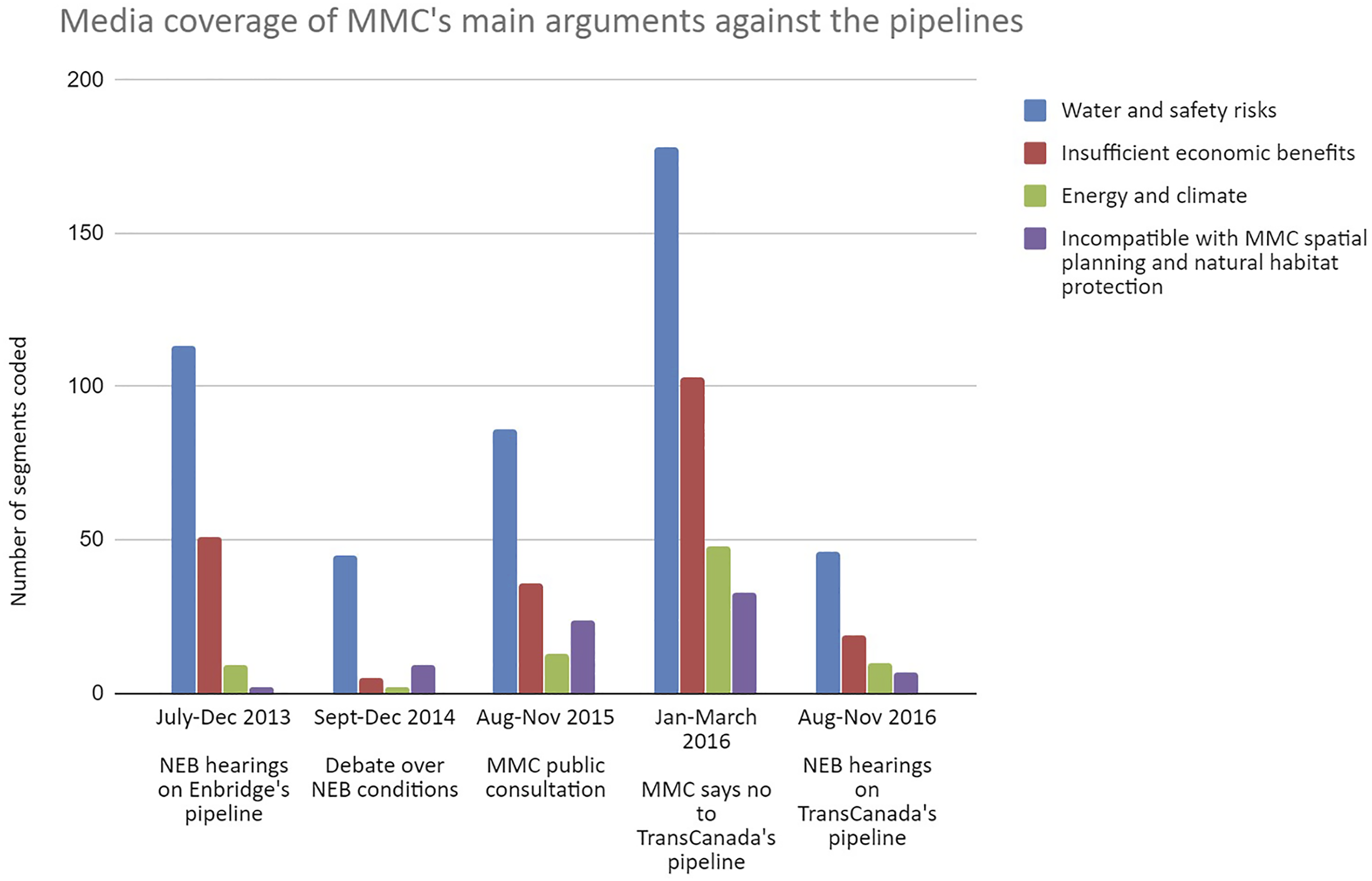
The defense of landscapes and territories was a converging topic for municipalities, citizen protestors, and First Nations, although these actors did not receive equal media attention. The press frequently presented the mobilization of citizen and municipal actors in the same articles, giving some resonance to each other’s claims. First Nations groups had their distinct messages opposing the pipelines in the Montreal region from the outset, with chiefs from Kanesatake and the Assembly of First Nations Quebec-Labrador receiving the most media coverage for their comments concerning pipeline impacts on their unceded territory. Newspaper coverage of their involvement was marked by emphasis on coast-to-coast First Nations’ alliances against pipelines and tar sands.
The following sections contain a chronological outline of the dispute, showing for each period who was given greater visibility, through what performance and how urban spaces of governance and resistance were mobilized. We also show which parts of the infrastructure, landscapes, and metabolic flows came to matter most in the media coverage.
Emerging mobilization and reconfiguration of subjectivities on the pipeline infrastructure
The National Energy Board (NEB) hearings on Enbridge’s Line 9B project took place in the summer and fall of 2013; participants had just submitted their briefs when the Lac Mégantic disaster occurred. Municipalities and citizens not living in the one-km zone of the pipeline, or not qualified as “experts,” were not allowed to speak at the hearings, nor could certain topics (e.g., climate change impacts and the nature of tar sands development) be discussed. In 2013, demonstrations opposing these restrictions received only a small amount of media coverage, which primarily focused on the companies’ poor attitudes as corporate citizens rather than on the NEB process itself. However, the joint press conference the City of Montreal organized with environmental groups was criticized by a pipeline company as indicating a lack of neutrality by the City, and such joint efforts were apparently not repeated. Demonstrations on Kanien’kehà:ka territory with both Indigenous and non-Indigenous activists and environmentalists joining forces to oppose pipelines and visibilize the impacts on unceded territories were also covered in the media.
The multiplicity of actors involved during this period was reflected in diverse media coverage. The part of the media covering referring to municipalities was lower than in following periods (17%), which is expected given that gas and oil pipelines had generally not been on most municipalities’ radar until then. As one professional of a regional planning body recalled when speaking about Enbridge’s existing Line 9B: “until recently... to be honest ... it wasn’t even on our map. I’ve been here for 8 years and no one had ever spoken about it.”
In one adjoining peripheral area along the Montreal–Ottawa infrastructure axis, the pipelines had been identified as an issue because they added to the existing set of challenges around development risk management due to the combined presence of three national highways, three pipelines, two railways, and a booming residential sector. Following First Nations groups and environmental NGOs, municipal actors and residents committees from this area were the first to mobilize and be admitted at the Enbridge Line 9B hearings as “directly affected” parties, because they were on the pipeline path. They then mobilized other municipal actors.
Broader municipal mobilization followed very quickly. In the climate of anxiety and fear over public safety related to shipping crude oil in the wake of the Lac Mégantic disaster and the restricted NEB hearings, several municipalities voted in favor of a formal provincial environmental assessment and public hearings (which they trusted more than the federal equivalent). Instead of the formal provincial process, however, the provincial government announced a commission of elected officials to specify the province’s requirements for approving the Enbridge project. During the commission hearings (by invitation only), municipalities voiced their concerns about safety in the case of pipeline failure, and the unequal capacity of municipalities to handle safety and emergency plans and operations. The provincial commission did not produce any follow-up and received little media coverage. A provincial “vigilance unit” was announced but it had no resources and held almost no meetings up to the end of 2015. The provincial commission, however, did affect the subjectivities of the municipal participants interviewed, who felt a weighty responsibility just a year after Lac Mégantic in the absence of any perceived provincial or federal support.
The MMC then set up a metropolitan oversight committee of up to 55 participants by contacting the municipalities and regional bodies of the metropolitan area and beyond to assemble internal municipal expertise on public safety measures, territorial planning, and environmental protection. This quickly became the information hub for directly seeking information from Enbridge and TransCanada. Since the MMC was an existing metropolitan planning structure, with a permanent staff, a network of inter-municipal relations and a council of municipally elected officials, the new metropolitan committee relied greatly on resources from the MMC and other regional planning bodies. All this work also demonstrated to municipalities the MMC’s overall relevance. While the Montreal Mayor captured a lot of media attention, he also took great pains to include mayors from suburban and semi-rural municipalities at press conferences, who were then also quoted in newspaper articles (30% of pipeline articles mentioning MMC municipalities from 2013 to 2016 cited mayors other than Coderre). Journalists also tended to refer to the MMC’s positions and not those of the City of Montreal.
Media performance in 2014
The NEB approved the Enbridge 9B Line reversal on condition that the company complied with 30 requirements. In September 2014, a month before the date set for the Line 9B reversal to go ahead, the NEB had still not released any information on whether the company had met the stipulated requirements. The MMC published a press release stating that the two conditions (waterbody crossings and emergency safety plan coordination between Enbridge and municipalities) most closely monitored by their oversight committee still did not appear to have been met. Coderre did not shirk the issue, stating “it is time to show the NEB has some teeth.” This clearly put the NEB process at the center of media coverage, as shown in Figure 2 (a success compared with its negligible treatment in 2013). Furthermore, newspaper headlines gave a lot of political weight to MMC involvement, for example, “Montreal unsatisfied by Enbridge responses” and “Enbridge does not meet all conditions, judges the MMC.” Three weeks later, when NEB confirmed it had more information from the company in response to the MMC’s letter, the media portrayed this as a victory for the mayor: “Montreal wins a round against Enbridge” and “NEB thanks the mayor for his vigilance, and will inform the MMC of Enbridge’s progress in complying with the conditions.” This was the first staged action by the Mayor which showed the MMC filling a regulatory void, and journalists definitely contributed to this staging of authority.
2015: The MMC holds its own public consultation and showcases its expertise
The second stage media action that showed Montreal filling an institutional void occurred in 2015 when, with low democratic input at the federal or provincial level, the MMC launched its own public consultation to gauge opinions on the TransCanada pipeline. The MMC received 143 briefs and six days of videotaped hearings were published on its website. The MMC presented a detailed report after the consultation, stating that the vast majority of participants (92%) were against the pipeline.
The participatory event was not only used tactically by the MMC to demonstrate public opposition to the pipeline but also to give greater visibility to landscape, water, and territorial issues, based on the expertise gathered via the metropolitan oversight committee; 42% of the citations in the MMC report came from 11% of the briefs and documents submitted by municipal actors. Journalists covered these territorial threats documented by the MMC (affecting woods, farmlands, and wetlands). One of the few studies outsourced by the MMC was widely publicized by the press as well in both 2015 and 2016 as it envisioned the threat to the drinking water of the entire region of four million people if a spill occurred without a prompt response: “a study produced by the MMC reported that if a leak were to happen in the Ottawa River, the oil spilled could contaminate 26 water intakes including those of the Montreal region, after 12 h.” It would contaminate water ecosystems and the first water intake after only 4 h (a much shorter timeframe than the company’s reaction delay, especially at the occasional manual pumps on Line 9B requiring in-person intervention, which citizen direct action visibilized later). Quotations from journalists portrayed the study and the information gathered by municipalities as significant counter-evidence to TransCanada’s statements.
As caretakers of their territories, the Kanien’keha:ka Band Councils participated in the MMC consultation to state their opposition to both pipelines, exhorting the MMC to do the same for territorial and climate change reasons. Anishinaabe activists also disrupted the MMC participatory event to voice their non-recognition of MMC authority over Indigenous lands. While MMC concerns received substantial media coverage, only a handful of articles covered Indigenous expertise and respect for landscapes and hunting and fishing practices, their concern for threats to natural flows, and the constraints on their input to the federal hearings. Few articles also explicitly linked the pipelines to climate change as an existential threat, as Indigenous leaders and activists did.
There was also internal divergence among municipalities over the Enbridge Line 9B. In the final months prior to its approval, citizen groups had gone from town to town to have councils adopt resolutions demanding hydrostatic testing of the old pipe. This movement also reached the MMC who supported the citizen demands, and the NEB accordingly agreed to ask Enbridge for hydrostatic tests (high-capacity water pumping) on its 40-year-old pipeline to prove the pipe was still in good shape. After the results were received, the NEB gave its final approval to the Enbridge 9B Line reversal. However, local environmental activists, Indigenous leaders and activists, and several municipalities voiced their opposition because the tests were conducted by the company itself, the water pressure was lowered from that initially demanded, and the single test performed in Quebec was not in the segment requested near the Ottawa River. Although citizen groups and some municipalities were described in the media as “stunned,” “outraged,” or at least “discomfited,” Coderre spoke reassuringly that he trusted the NEB and Enbridge, and that oversight would continue. Some municipalities remained deeply opposed to the Line 9B reversal yet received little coverage in the media after Coderre accepted the NEB’s final decision. This low level of subsequent media coverage of Enbridge continued even after the Office of the Auditor General of Canada’s harsh report on the NEB (January 2016), which showed that it had not followed up on the requirements imposed for past pipeline approvals, nor on non-compliance with regulations. A regional planning body on the Montreal outskirts (the first mobilized in 2013) continued to make representations by issuing letters and press releases, but neither the MMC nor the NEB followed up. The centralization of authority around the MMC’s leadership had a cost: considerably less media coverage of increasingly dissident voices in the Montreal region.
Social movements were also not convinced. A few days after Line 9B became operational, protestors forced a service interruption by turning off a manual valve located on the periphery of the Montreal region where a spill could have catastrophic consequences without a timely response from Enbridge (as documented by the MMC). This was covered in the press including an article headlined “Protest shows Enbridge not ready for emergency, activists say,” with activists citing the risks posed to water and the high likelihood of a spill, as well as the continued lack of emergency plans. The same action on a section in Ontario was taken by Indigenous women who were then arrested (whereas white activists in Quebec were not). Protestors periodically succeeded in regaining media attention, but media coverage in the following months still followed the MMC’s agenda of accepting Line 9B and focusing instead on the TransCanada pipeline.
2016: The MMC says “no” to TransCanada; NEB hearings are disrupted and canceled
The highest peak of media pipeline coverage was in 2016, with 60% of the articles giving visibility to MMC municipalities. Indeed, on January 21, Coderre and several other metro mayors held a press conference to announce that the MMC was opposed to the TransCanada pipeline, citing as reasons the arrogance of the company who refused to participate in their fall consultation, and the documented environmental, public safety and water risks, with little positive economic impacts, as summarized in its 2015 report. TransCanada quickly responded in the media, promising an office in Montreal “to rebuild bridges with the MMC.” Meanwhile, the Quebec economic community made a call for “realism and pragmatism.” More acerbic reactions across the country came the same day. The Saskatchewan Premier tweeted “I suppose the mayors from the Montreal region will politely return their part of the $10 billion in equalization payments received from the West,” a statement that was later posted on a huge billboard in front of Montreal City Hall by a right-wing group, to which Coderre quickly responded, “Population of the MMC: four million... Population of Saskatchewan: 1.13 million....” These Twitter exchanges were extensively covered in the print media. Other Western Canada politicians issued statements like the Saskatchewan Premier’s, and the argument continued for a week in a controversy that purportedly “threatened national unity.” The Alberta Premier demanded that the mayors should not be so dramatic and irrational about the risks, adding that the MMC “lacks vision and is not considering the greater interests of the nation.” The “inevitable reliance on oil for decades to come” was also used to discredit the opposition.
As shown in Figure 1, the main arguments covered by journalists in support of the MMC during that period were the fact that TransCanada “did not do its homework” (documenting impacts on landscapes, water, and safety, which the MMC, in contrast, had become experts on) and that the MMC, with its public participation and population of four million was legitimate and broadly representative. Coderre specifically cited the equally vocal opposition from First Nations groups. The press and popular TV shows were behind the MMC in Quebec, claiming the West was “Quebec bashing,” even though the Montreal English-language press was more critical of Coderre. Outside Quebec, the Globe and Mail was harsher, calling the MMC’s position “petty provincialism.” The debate cut to the core of two divisive issues in Canadian politics: Western economic reliance on tar sands oil and the difficulties in exporting it, and the will of many Quebecers (even federalists like Coderre) to have more autonomy and recognition.
The debate continued for several weeks, including at interrupted provincial environmental hearings on TransCanada (where water safety risks were extensively discussed) and during a personal meeting between Prime Minister Justin Trudeau and Mayor Coderre. Although Trudeau announced a change in the federal process with more public participation, and consideration of climate change impacts, he later reiterated that “a fundamental responsibility of any Canadian prime minister is to allow for our resources to reach markets,” justifying pipelines in the historical context of Canadian colonial trade in fur, fish and wood (Bellavance, 2016:2).
In summer 2016, journalists published evidence of a meeting between a TransCanada lobbyist, the NEB president and two commissioners. Both Coderre and First Nations groups called for the suspension of the public hearings and environmental activists demanded the resignation of the NEB commissioners. Nevertheless, the NEB hearings still opened in Montreal. However, on the first day, a dozen activists entered carrying a banner bearing the word “Mascarade” and shouting their opposition. The hearings were suspended. Coderre was extensively quoted by journalists alongside coverage of the activists’ disruption, commenting that “this type of incident reflects the general opposition to the project.” A few weeks later Prime Minister Trudeau announced that the environmental assessment was revised and would also need to include indirect greenhouse gas emissions for this project. TransCanada subsequently abandoned its Energy East project.
The urban politicization of energy infrastructure
In this paper, we have analyzed the urban politicization of fossil fuel infrastructure in two ways: first, by considering which parts of the infrastructure and flows of the energy landscape came to matter, which costs of the circulation of fossil fuels were acknowledged; and second, by attempting to improve understanding of political processes and struggles over authority around this material and metabolic embeddedness of energy in urban landscapes. We think it crucial to study and theorize the political process itself in order to reveal the structural and contingent biases and opportunities in urban mobilizations for the governance of energy infrastructure.
What are the urban political patterns that structure the politicization of energy landscapes? Drawing on the work of Hajer, Magnusson and scholars of urban and Indigenous movements, we argue there is a dynamic relationship between two parallel processes: the performance of centralized urban authority (notably in the media and other political elite spaces) and a second messier politics of multiplicities, with overlapping spaces of urban governance and resistance. Urban authority is performed and staged in the media because urban leaders do not have institutional authority over large energy infrastructures. Although the Canadian federal government has centralized authority over energy, an alternative authority was mobilized in metropolitan Montreal to represent broader urban mobilization, building on new and old metropolitan and regional spaces of governance. This performance of urban authority was somewhat ridiculed by other Canadian provinces in 2016, which revived Quebec nationalism against the rest of Canada and the fossil fuel lobbies.
Beyond such scalar politics, there is also a messier politics with a multiplicity of actors involved which is co-constructed by and with the socio-material realities of the infrastructure and landscape. Indeed, there are many actors involved in everyday governance, regulation, maintenance, and resistance in relation to energy landscapes/infrastructures—what Lawhon et al. call “heterogeneous infrastructure configurations.” Actors can change their infrastructure-entangling subjectivities and practices as they participate in conflicts about the infrastructure itself. As Star points out: “infrastructure is a fundamentally relational concept, becoming real infrastructure in relation to organized practices” (1999: 380).
The pipeline disputes in Montreal illustrate this. In the emerging mobilization and subjectivation in 2013, the municipal, regional, and local actors involved realized that although they were enmeshed in the fossil fuel infrastructure network, they had no control over it. They were part of a heterogeneous infrastructure configuration that had been invisible to them until the reality of how the pipelines affected their existing practices and policies to protect waterways, woods, and farmed areas became apparent. This emphasis on water and landscapes was also initially tactical as municipal actors did not feel they had the authority to speak about energy, deemed to be a provincial or federal affair. On the other hand, pipelines were also perceived as daunting due to responsibility and apprehension around public and water safety in the case of an accident or spill, combined with mistrust of pipeline companies as well as of both federal and provincial authorities. Such subjective relationships with both existing and planned pipelines explained the initial substantive response from citizens and the municipal sector, and the enthusiastic support given to Coderre, who pushed this in the media. While Coderre was very skilled, his voicing of concerns and eventually opposition to the pipeline in the media was also greatly supported by mobilization beyond the media scene.
Thanks to grassroots action, specific infrastructural parts came to shape key moments in the dispute: manual pumps on the Line 9B pipeline crossing waterways became meaningful artifacts in terms of corporate and federal safety failings. Given that manual pumps were expected to cause slow responses to spills, municipalities asked many questions and funded studies on the potential impact of slow responses on the quality of drinking water. Direct citizen action was applied to these artifacts with the manual shutting off of Line 9B after the tar sand oil shipment approval was reversed. Divergence indeed came when the MMC accepted this Enbridge reversal. Another technical characteristic then became an issue: how was the pipeline to be hydrostatically tested to prove its reliability under heavier flow of crude oil? Grassroots mobilization collected resolutions from town to town that pressured the MMC to demand such hydrostatic testing. The fact that the MMC had developed a direct channel of influence to the NEB and the pipeline company facilitated the impact of this citizen initiative to obtain an additional test. However, the mobilization process also made municipalities increasingly circumspect and more aware of citizens’ concerns, which explained how many continued their mobilization against the Line 9B reversal, even after the MMC gave its blessing. This in turn virtually stopped media coverage of dissident voices.
We can thus see both the gains and the costs of MMC mayor Coderre’s control of the media coverage in this performance of urban authority. On the one side, it was very powerful to show a void in the federal and provincial safety assessments of the pipeline, while staying within the understanding of state regulation of risks (through municipal governments). Indeed, the socio-material components of this politization process were linked to the reliability of infrastructural parts and people’s level of trust in (different scales) of government to ensure their safety and the maintenance of urban landscapes. On the other side, it also reproduced the notion of a centralized and hierarchical authority, with the MMC able to impose when the debate (on Enbridge) should end, and the state procedures accepted. At this point, the multiplicity of actors and practices involved disappeared from the media coverage.
What came to matter most in the media did not mirror the severity of the harm to landscapes and people, nor the gravity of future risks, nor, of course, all actors’ subjectivities and meanings. Indeed, tar sands were more directly contested by social movements and Indigenous leaders long before municipal actors mobilized, even if the latter ended up with greater media coverage. Although tremendous damage was inflicted on First Nations communities by colonialism and extractivism (particularly by tar sands extraction and transport and related disconnections from land), Indigenous voices and meanings on energy landscapes were scarcely featured in the media, either quantitatively or qualitatively (in 10% of the articles in our corpus compared with 38% for municipal actors); and when their voices were heard, their opposition was often mentioned without much presentation of their vision of the struggles.
Furthermore, the extent to which the NEB process evaluating pipeline projects limited public debate (disallowing any reference to climate change and restricting participation to experts or those living directly along the proposed pipeline route) had no corresponding coverage in the media, even though these constraints were frightening. It took evidence of direct lobbying on the NEB in 2016 for the media to increase coverage. Unlike the scant media coverage of climate change in the pipeline debates, the risks posed by oil leakage into the Greater Montreal waterways that provide drinking water became a central focus in the media due to municipal mobilization and entanglement in this part of the landscape.
Urban contestation of fossil fuel infrastructure shows how much the making and imagining of “infrastructure otherwise” relates to a different ordering of urban spaces and the privileged socio-natural flows in it (Cowen, 2020; Simpson 2020). Other possibilities and meanings are made visible when the embeddedness of infrastructure in landscapes and everyday practices of maintenance and care are discussed, and through which alternative political subjectivities are developed. If the centralized performance of authority in the media helps oppose the fossil fuel regime and visibilize some of this entanglement, it is these mobilizations behind the media scene that carry more transformative visions of urban landscapes beyond fossil fuel, albeit with tensions and blinders.
Footnotes
Declaration of conflicting interests
The author(s) declared no potential conflicts of interest with respect to the research, authorship, and/or publication of this article.
Funding
The author(s) disclosed receipt of the following financial support for the research, authorship, and/or publication of this article: Financial support for the research came from Fonds de recherche du Québec Société et Culture (183086) and Institut national de la recherche scientifique.
