



Abstract
Policy mobilities scholarship has comprehensively challenged the methodological nationalism and rational orthodoxies of policy studies. Contributing to recent debates on policy mobilities and post-politics, this paper examines how struggles over the ‘national’ shape policy on the move. Focussing on attempts to embed accountable care models across the English National Health Service (NHS), I consider how ‘integration’ has been mobilised as a seemingly irresistible solution to the failures of market-orientated healthcare reforms in times of austerity. Yet, I foreground how campaigners slowed down the local contracting of accountable care through repoliticising circulating policy as the ‘Americanization’ of the NHS. The paper emphasises the ongoing, yet shifting and politically contested, role of the state and national spatial imaginaries in the making and translating of globally mobile policy. Rethinking the times and spaces of politics and policy in the current conjuncture, I conclude by warning of the limits of nostalgia for the post-war national welfare state when pushing for universal healthcare as a right for all.
Introduction
Long hailed as a newcomer to policy studies, literature on policy mobilities has now firmly arrived. Suspicious of rational and positivist orthodoxies within political science, geographers, sociologists and others have been unsettling taken-for-granted notions of policy as straightforwardly bounded by, and transferred between, discrete territories (Clarke et al., 2015; McCann, 2011). Instead, a conceptual vocabulary of assemblages, mobilities and translations has been adopted to study how policy moves in a globalised world (McCann and Ward, 2013; Temenos and McCann, 2013). Against linear accounts of identifying, packaging up and transferring ‘policies that work’ from place to place, critical policy mobilities approaches focus on the social and ideological dynamics conditioning and reworking urban policy as it travels. And for anyone studying policymaking today, it is hard to ignore the increasingly influential role of intermediaries such as management consultants and think-tanks promoting the latest, predominantly neoliberal policy ‘solutions’ and ‘best practices’ (Peck and Theodore, 2015). Thinking along these lines, globally circulating, locally embedded policy can now be understood to stretch ‘beyond the traditional bounds of the state, although never entirely divorced from its institutions’ (McCann, 2011: 114).
So how, then, might we think about nations and states within the making of globally mobile policy? Certainly, any residual ‘methodological nationalism’ within policy studies has been rightly contested, doing away with accounts of policy as an exclusively national phenomenon (Clarke et al., 2015: 21–22), and with it, the tendency to focus on policy transfer between national governments (McCann and Ward, 2013). After all, the persuasive presence of non-state intermediaries borrowing and reworking ideas from elsewhere offers a powerful example of how national politics and policy is made through connections and relations stretching across and beyond state territories. Though, as Clarke et al. (2015: 19) remind us, any turn towards ‘methodological globalism’, as if policy smoothly traverses undifferentiated global space, is just as analytically problematic. Rather, the paper takes as a starting point that it is necessary to understand the making up of policy and place as both relational and territorial (Cochrane and Ward, 2012). As such, I seek to contribute to policy mobilities scholarship through exploring the whereabouts of the state within the making and translating of mobile policy and how this is articulated through the imagined geographies of the nation in the current conjuncture.
To help do so, I build on policy mobilities scholarship engaging with emergent literature on the post-political. Of late, there has been rather a lot of interest in ‘post-politics’ and ‘anti-politics’ as keywords to convey growing disenchantment with liberal democratic state institutions and the narrowing of political debate, as well as resurgent nationalist-populist political movements (Beveridge and Koch, 2017; Beveridge and Featherstone, 2021; Clarke, 2008). Diverging from readings of the post-political inspired by Jacques Rancière which tend to restrict analysis of the ‘state’ and ‘policy’ to the police order, I expand on geographical understandings that take seriously political mobilisation and contestation within and through the spaces of the state (Etherington and Jones, 2018). In particular, I am concerned with the depoliticisation of mobile policy and strategies displacing the contentious politics of policymaking. Yet by holding open the possibility, at least, that policy can be remade otherwise, I pay close attention to the resistances, disruptions and counter-mobilities reworking mobile policy (Lauermann and Vogelpohl, 2019; Temenos, 2017).
My aim is to examine how political struggles over the ‘national’ condition how policy moves. I do so through studying attempts to embed Accountable Care Organisations (ACOs) across England. ACOs are contract-based multi-organisational arrangements bringing together healthcare providers through population-based payment models designed to improve quality of care whilst reducing expenditure (Fisher and Shortell, 2010). ‘Accountable’ or ‘integrated care’ has gained traction internationally within attempts to limit growing expenditure on healthcare in times of austerity. As a World Innovation Summit for Health report affirms, despite facing financial, regulatory and political obstacles, the spread of ACOs worldwide presents ‘new opportunities for co-operation with private sector organisations and companies to deliver health services traditionally supported through public provision’ (McClellan et al., 2016: 19). The National Health Service (NHS) was created in 1948 as a universal, comprehensive public health system at the heart of the post-war British welfare state. It has witnessed major restructuring over recent decades, including devolving health responsibilities to Scotland, Wales and Northern Ireland in 1999, yet the political, cultural and emotional significance of the NHS continues to resonate across Britain today. As I shall discuss, claims of the ‘Americanization’ of the English NHS became attached to circulating ACOs, with campaigners warning their uptake emulates, or at least further prepares the ground for, a privatised ‘US-style’ insurance-based healthcare system in place of universal healthcare free at the point of need. 1
The paper demonstrates the ongoing, yet shifting and politically contested, role of the state and national spatial imaginaries in the making and translating of mobile policy. Contributing to recent policy mobilities scholarship, I emphasise how learning from places elsewhere is enrolled into the mobilising and depoliticising of ‘integration’ as a seemingly irresistible solution to the failures of previous market-orientated healthcare reforms. Yet through paying attention to the otherwise post-political spaces of policy such as judicial reviews and parliamentary reports, as well as protest marches and online activism among a resurgent political left, I place stress on the repoliticisation of mobile policy whereby struggles over the national travel and mutate with policies-on-the-move. As such, I foreground how the Americanization of the NHS framing offers a popular, if problematic, spatial vocabulary to articulate the messy, partial and non-linear processes of neoliberal healthcare reform. Through adopting narratives of Americanization, campaigners helped slow down and rework, if not halt, the local contracting of accountable care across England, whilst reinvigorating the possibility of ‘renationalising’ healthcare beyond the reach of the market.
The paper is structured as follows. I first discuss how the state registers within geographic scholarship on policy mobilities and post-politics, paying attention to growing interest in policy counter-mobilities. Accountable Care Organisations are then introduced whilst outlining the research following the policy. Findings are examined across four sections, considering the whereabouts of the state and the imagined geographies of the nation within the making and translating of mobile accountable care policies. Rethinking the times and spaces of politics and policy in the current conjuncture, I conclude by warning of the limits of nostalgia for the post-war national welfare state when pushing for universal healthcare as a right for all.
Restating the political geographies of mobile policy
Geographers, urban studies scholars and others have set the agenda for examining the socio-political dynamics of how globally circulating urban policies move, mutate and become embedded (Baker et al., 2016; Cochrane and Ward, 2012; McCann, 2011; Temenos and Baker, 2015; Temenos and McCann, 2013). Rather than fully formed discrete objects passing effortlessly across space, social constructivist and relational conceptualisations examine how policies are assembled, intersect and get reworked through learning from places ‘elsewhere’ (Baker and McGuirk, 2017; Robinson, 2015). Inherited traditions studying the transfer of policy ‘between countries’ are cause for concern within policy mobilities approaches, given the privileging, even reifying, of the national scale within formalist studies of policy (McCann, 2011; McCann and Ward, 2013). Policy mobilities scholarship thus poses a foundational challenge to much of the policy transfer literature, unsettling the idea that nation, state and policy are commensurable. As Cochrane and Ward (2012) contend, ‘it appears that it is no longer possible to view the world through lenses that implicitly or explicitly locate the politics of public policy within national bounded systems, nor even to position them straightforwardly within nested scalar hierarchies’.
In a move away from state-centric accounts of policy, research has turned to explore the spatial practices of non-state intermediaries within powerful circuits of ‘global’ policy (Prince, 2012). With management consultants, think-tanks and advisory firms mediating how policy ideas circulate, policy mobilities studies take seriously the multiple spaces through which policy travels and mutates. Instead of adhering to typologies and frameworks of government actors and policymaking routines, critical scholarship has paid attention to policy convergence spaces such as conferencing events (Cook and Ward, 2012; Temenos, 2016), policy tourism and learning from ‘successful’ places (González, 2011) and even the role of social media in circulating policy ‘models’ (Temenos and Baker, 2015). Rather than allusion to voluntaristic rational choice selection, then, policy mobilities scholarship attends to the uneven power geometries through which an enlarged class of transnational intermediaries mobilise policy.
Circulating policy knowledge and technocratic expertise corresponds with recent geographical interest in processes of depoliticisation, often framed in terms of ‘post-politics’ or ‘anti-politics’ (Clarke, 2012; Temenos, 2017). Informed variously by thinkers such as Jacques Rancière, Chantal Mouffe and Colin Crouch, the political realm is understood to have been hollowed out whereby neoliberal rationalities and practices are sustained through seemingly consensus-based approaches to decision-making foreclosing political disagreement and dissensus (on the similarities and differences between these thinkers, see Wilson and Swyngedouw, 2014). Through technical-managerialist claims of ‘sustainability’, ‘efficiency’ or ‘modernisation’, globally circulating policy tends to prefigure market-orientated solutions that are, as Rancière (2006: 49) would have it, positioned as ‘resolving the problem but at the costs of eliminating politics’.
Taking decisions outside of political contestation is precisely the point. No longer can we locate policymaking routines and responsibilities principally within the domain of governments and state bureaucracies under instruction from elected ministers (Raco, 2013). Through the expanded influence of corporate interests and ‘independent’ quasi-state bodies, ‘post-ideological’ agreement legitimises welfare reforms including state-led privatisations, new public-private partnerships and contracting-out of public services through Special Purpose Vehicles such as Private Finance Initiative (Raco, 2013). It becomes a daunting prospect to even understand complex new contractual, legal and regulatory arrangements shaping public services, let alone re-imagine alternatives!
So, what is even left of the state? And is there no alternative? For some inspired by Rancière, the political is enacted at a distance from the capitalist state whereby struggle and contestation operates through moments of rupture as ‘the people’ fill the streets with protest shattering illusory consensus (Dikeç and Swyngedouw, 2017). For others, the entrenching of austerity has undermined state power, prompting calls to re-imagine and enact counter-politics through de-centring the local state (Beveridge and Koch, 2019). This latter move circumvents a consensus/conflict binary to avoid reducing the political to heroic revolutionary practices with little hope for everyday resistances (Beveridge and Koch, 2017). Transformative urban politics are possible, Beveridge and Koch (2019: 18) argue, as ‘[t]he local state still seems to offer opportunities, even if the wider institutions of liberal democracy and the nation state do not’. Whether through hostility or ambivalence, there appears little appetite to engage directly with national state institutions. This resonates with what Wills (2019) identifies as a collective apathy among geographers to work with changing political institutions of liberal democracies in favour of locating radical politics beyond elections, political parties, state bureaucracies and parliamentary activities.
Yet there have been efforts to theorise the post-political through examining processes of depoliticisation within and through the spaces of the state (Etherington and Jones, 2018). Depoliticisation may be understood as a political strategy for displacing and deferring conflict (Hay, 2007). Strategies of governmental depoliticisation, such as delegating responsibilities to quasi-state agencies, boards and commissions, sit alongside wider discursive strategies and the shifting of social matters outside of public concern (Wood and Flinders, 2014). Crucially, rather a lot of cultural-political work goes into maintaining the claims of being ‘non-ideological’ or ‘outside of politics’, such that Clarke (2008: 142) observes ‘de-politicization carries with it the possibility, and indeed threat, of re-politicization’.
Travelling policies may become the site of resistance and renegotiation as well as neoliberalisation (Peck and Theodore, 2015). Through attending to what Temenos (2017) calls the ‘everyday proper politics’ of mobile policy, the practices of non-elites can have a role in (counter)mobilising policy (Baker et al., 2019). All kinds of ‘resistances, disruptions and alternative pathways’ (Temenos, 2017: 585), however modest, become important. This presents opportunities, for instance, to build relational strategies of fast activism counter-mobilising trans-local fast policy (Lauermann and Vogelpohl, 2019). Whilst counter-policy mobilities may well move ‘beyond as well as between state-to-state movements’ (Temenos, 2017: 585), as Jones (2010: 248) observes, ‘when performing their practical politics, agents [may] imagine and identify a discrete, bounded space characterised by a shared understanding of the opportunities or problems that are motivating the very nature of political action’. How the making and translating of spatially unbounded policies are articulated through the imagined geographies of the nation, I suggest, requires careful consideration.
That is not to say existing policy mobilities scholarship has been ‘dreaming away the power of the national state’ in policymaking (McCann and Ward, 2013: 7). After all, whilst such approaches question the preoccupation with the national scale within policy transfer literatures, unsettling taken-for-granted notions of policy, nation and state is clearly not the same as proclaiming the demise of the nation state. But rather, as Bok and Coe (2017) suggest, there has been a lack of analytical attention towards how national state actors may actively mobilise policy, rather than state institutions existing as intermediary infrastructure for embedding mobile policies. State agencies can become entangled within travelling policy ideas, as Choon Piew Pow (2014) demonstrates through the ‘entrepreneurial’ dynamism of city-state agencies assembling policy within and beyond the global south, with the Singaporian state shaping projects across China, Rwanda, Saudi Arabia, Brazil and Vietnam. My interest here therefore is in studying mobile health policy with an appreciation of the state as a relationally constituted site of policymaking and political strategies.
Changing welfare settlements combine different healthcare providers, regulators, funders and sites of care spanning public, private, community and family whereby who cares may vary (Kofman and Raghuram, 2015). Across England, the NHS has enduring significance, yet has been targeted for perpetual restructuring by successive Conservative and Labour governments over recent decades. Spatially sensitive accounts of such changes are necessarily messy and non-linear. Broadly speaking, since the 1990s, marketisation has led to the separation of the ‘purchasers’ and ‘providers’ of healthcare, initially between NHS organisations, and later, private sector providers. Privatisation and the growing role of the private sector within clinical and non-clinical services is both contested and politically contentious, at least in part, due to complex contracting and organisational arrangements following rounds of reform. The Health and Social Care Act 2012 was the most recent legislative attempt to embed market competition in the NHS and is widely criticised for producing ambiguity, a lack of accountability and unsettling the health service in times of austerity (Hammond et al., 2018).
As I shall elaborate, a turn towards ‘integration’ and attempts to embed circulating Accountable Care models into local reforms has been framed by campaigners in terms of the ‘Americanization’ of the NHS as the latest attempt to privatise healthcare in England. Making connections between policy mobilities and post-politics literatures, the hope is to contribute to political and academic debates on the remaking of the NHS and how struggles over the ‘national’ condition mobile policy in the current conjuncture.
Following the policy: Accountable Care Organisations
The ‘origins’ of ACOs are frequently located in the passing of the United States Patient Protection and Affordable Care Act in 2010. As part of the federal Medicare healthcare insurance program, later incorporating state Medicaid and commercial insurers, ACOs are contract-led multi-organisational arrangements bringing together healthcare providers through population-based payment models designed to improve quality of care whilst reducing costs (Fisher and Shortell, 2010). Accountable Care Organisations promote shared savings between providers who become financially responsible for their patient populations by coordinating care premised on keeping patients healthy over longer time periods; through monitoring and sharing clinical and financial performance data, the aim is to maintain expenditure below a target level with profits shared among providers (Fisher and Shortell, 2010; Tu et al., 2015). Moving away from fee-for-service payments, a range of public and private ACOs now operate across the US, from hospital-led initiatives to community health partnerships involving pharmaceutical conglomerates, adopting varying levels of financial risk/share agreement.
There is, however, what has been described as a ‘global occurrence’ of accountable or integrated care influenced by supranational state and non-state organisations such as the World Health Organisation, Commonwealth Fund and European Commission (Ow Yong and Cameron, 2018: 5). Think-tank and management consultant policy networks circulate ‘exemplars’ such as the ‘Alzira Model’ in Valencia, Spain, a public-private partnership between Ribera Salud (90% owned by healthcare conglomerate Centene) and the Valencian government funded through Private Finance Initiative. 2 The ‘Canterbury model’ between the Canterbury District Health Board and medical group, Pegasus, is often cited, whilst ‘not-for-profit’ consortium Kaiser Permenante features as a key reference in accountable care predating the Affordable Care Act. Critical voices draw similarities with Health Maintenance Organizations established under Nixon, becoming controversial for their restrictive access to healthcare. There is no singular origin for ACOs, although as we shall see, association with the USA has become particularly significant in England.
Studying the movement of policy can seem both unpredictable (Wood, 2016) and strangely familiar (Temenos and McCann, 2013). I first encountered ACOs through research into health and social care devolution in Greater Manchester, England, whereby ‘Local Care Organisations’ were being assembled into the city-regional devolution project. Although a self-declared ‘global front-runner’ in health and care reform, local state managers expressed a degree of caution about the already politically contentious devolution project becoming associated with policies that appeared ‘too American’ (see further Lorne et al., 2021: 322). My inability to pin-down what these models were, why they were taking hold, and crucially, what the impact on healthcare might be, prompted me to ‘follow the policy’ beyond localised policy adoption within the city-region (see Peck and Theodore, 2012).
The risk is, of course, efforts to follow the policy only reproduce the elitism of transnational policy networks under investigation (Bok, 2015: 3). With limited funding, my capacity to travel with circulating policy was necessarily constrained. Research initially focused on policy networking to understand the mobilising and depoliticising of accountable care. Informed by insights from Greater Manchester, I set about focussing on the practices of management consultants and think-tanks facilitating and sharing policy learning (following Prince, 2012). I had sought to shift focus away from NHS organisations and local government that post-doctoral health policy research had otherwise pulled me towards (on the methodological and political challenges as a policy intermediary working within and beyond the state, see Lorne, 2021). As such, I attended (by no means inexpensive) think-tank events such as Accountable Care Summits and international best-practice symposia, collated policy guidance and documentation, whilst trying to interview management consultants and think-tank policy experts.
However, accountable care grew controversial over the course of the 18 months research between 2017–2019. Growing public interest drew my research towards health activism and concerns surrounding ACOs, privatisation and the ‘Americanization’ of the NHS. As I shall elaborate, disputes prompted judicial reviews and belated scrutiny from House of Commons Committees. Alongside observing these events, I attended protest marches and maintained close attention to social media and the online presence of campaigners, whilst retaining focus on those in the Labour Party mobilising against ACOs in Parliament and campaigning activities. I undertook twelve semi-structured interviews, three with think-tank and management consultants, and the rest with campaigners, including academics, doctors and former-NHS managers. For the remainder of the paper, I discuss the spatial practices and imaginaries involved in mobilising and contesting accountable care.
The arrival of accountable care in England: An irresistible concept?
At first glance, accountable care may appear as if it arrived in England out of nowhere. For many, reference to ‘Accountable Care Organisations’ registered, somewhat in passing, upon the publication of the Five Year Forward View (NHS, 2014). Published under the rather misleading branding of the ‘NHS’ (given the fragmented NHS is no longer a single public national health service), the policy document and subsequent guidance was led by NHS England. NHS England (legally, NHS Commissioning Board) was established in 2013 as a national non-executive ‘arm’s length’ body intended to take the politics out of the running of the health service (Hammond et al., 2018). Delegating decision-making from the Department of Health to NHS England as a quasi-independent body exemplifies what Wood and Flinders (2014: 151) identify as ‘governmental depoliticisation’, where health policy would be driven – government ministers repeatedly reassured – by ‘what the NHS is asking us for’. To be clear, NHS England is not the English NHS. Yet with the Secretary of State for Health at a distance from accountability, NHS England moved from overseeing day-to-day operations of the health service to becoming de facto national state policymakers.
‘Integration’ quickly took hold as the prevailing policy agenda. It marked a departure from the privileging of competition in the co-ordination of the NHS. In fact, despite decades of market-orientated restructuring, competition is not mentioned once in the Five Year Forward View (Hammond et al., 2018). Without primary legislative change, competitive tendering for services premised on payment by results was downplayed. Rather, integration would promote collaboration between healthcare providers through population-based capitated or fixed budgets. ‘Collaboration’ was taken to mean NHS organisations working with local government, leaving unclear the future role of voluntary sector organisations, and as would become critical, the private sector or ‘independent sector’ as NHS England put it. Indeed, naming strategies played an important role in the depoliticising work of framing the policy problem to overcome. As a response to the failures of the latest market-orientated reforms less than 2 years previous, integration was positioned as putting an end to ‘fragmentation’, albeit without doing so in explicitly political terms. And in any case, who could argue against wanting care to be ‘integrated’?
Statecraft took a distinctly experimental turn ‘working around’ existing legislation. There was no public deliberation or political debate, no White Papers setting out government proposals for reform. Instead, a series of ‘new care models’ were promoted whereby different configurations of ‘horizontal’ and ‘vertical integration’ between (nominally private) primary and (much-reformed public) secondary care organisations would ‘dissolve the traditional boundaries’ in how care is provided, said to have existed since the formation of the NHS. Through bids for competitive funding, a series of ‘vanguards’, ‘pioneers’, and ‘test-beds’ were encouraged to pilot ideas locally prior to any change to primary legislation (Bailey et al., 2017). Rather shadowy, extra-legislative ‘fast policy’ experiments (Peck and Theodore, 2015) in new care models thus operated outside of conventional policy routines with an absence of substantive political scrutiny or even tokenistic public involvement.
NHS England instead heralded an international consensus whereby population-based accountable care presented a pragmatic solution to the problems of structurally fragmented healthcare. As financial ‘deficits’ grew among under-funded NHS organisations and performance measures declined, local managers were urged to be quicker and bolder in learning from the ‘best examples’, not just across England but internationally. As the Five Year Forward View establishes: ‘At their most radical, PACS [Primary and Acute Care Systems; one of the new care models] would take accountability for the whole health needs of a registered list of patients, under a delegated capitated budget - similar to the Accountable Care Organisations that are emerging in Spain, the United States, Singapore, and a number of other countries’ (NHS, 2014: 21).
As the complexities of the much-maligned Health and Social Care Act 2012 became apparent, integration was mobilised as a seemingly irresistible solution to the failures of previous market-orientated healthcare reforms in times of austerity. The narrative driving the integrated care agenda became: if the NHS is to become ‘sustainable’ in order to last another 70 years, there was a need to be brave and pursue ‘radical transformation’. Rest assured, ‘[o]ur nation remains unwavering in that commitment to universal healthcare’, yet whilst ‘our values’ have not changed, the world has (NHS, 2014: 2). Circulating accountable care models, then, were located within an emergent international consensus towards the future of healthcare and it was made clear the NHS had much to learn if it was to ensure its long-term viability.
Depoliticising accountable care and learning from elsewhere
‘If cut-and-paste approaches to health system design worked, we would all be enjoying excellent health care. We cannot simply dismantle a century-old health system, like London Bridge or a Greek Temple, and reassemble it on foreign soil. The wiring and the plumbing are all different. Our plugs don’t fit in their sockets. Local NHS health systems face similar challenges to Montefiore [in New York] and, in many cases, are pursuing similar solutions. But the jury is out on, say, whether the details of US accountable care contracts, replete with risk transfer and incentives and penalties, can bear the trip across the Atlantic’ (King’s Fund think-tank event, April 2018).
At a two-day Accountable Care Summit in 2018, a ‘rising star’ policy expert from the King’s Fund reflected on lessons learnt from their time in New York City. Their visit was funded through a prestigious Harkness Fellowship facilitated by the Commonwealth Fund to attract international policy researchers to the US. The Montefiore health system in the Bronx was hailed an accountable care pioneer, and we would get a taste of how it had become a ‘successful’ health delivery system where others ‘failed’. Just like in England, we were told, New York faces similar problems. With different funding arrangements reduced to technical matters, the stress was placed on building strategic partnerships and having a social mission whereby population health was framed as a common ‘risk’ to be managed. It was insisted policy learning would not be frictionless; as the architectural metaphor above hints – echoing McCann’s (2011: 111) critique of policy transfer travelling akin to pass-the-parcel or moving jars on shelves – you cannot just dismantle their model and reassemble it here. The limitations of treating policy learning as a ‘cut-and-paste’ transfer from one place to another were made clear. Helpfully, however, the King’s Fund would be close at hand – for a fee – to make adaptation as smooth as possible.
For managers getting up to speed with the latest policy trends, conference events function as important policy ‘convergence spaces’ (Temenos, 2016: 121). Think-tanks have expanded into the health policy circuit holding breakfast briefings, day-long masterclasses and policy summits. Held in Central London, King’s Fund events cost £100s to attend featuring high-profile keynote speeches from international policy gurus, the Secretary of State for Health and NHS England managers setting out their future ambition for policy. Events attract remarkable numbers of public sector managers, as well as private and voluntary sector organisations. In fact, the King’s Fund have become the ‘trusted authority’ on health policy in England, showcasing the ‘best’ of local NHS front-runners and global exemplars identified through their policy networking. In noting the ambiguous definition of ACOs, a House of Commons Library briefing on Accountable Care even relied upon the King’s Fund for explanation.
Managers make something of a pilgrimage to hear about the promise of integrated care, learning from experiences and reflections from Alaska to New Zealand. There was, in fact, no lack of awareness among NHS managers of the difficulties of learning from ‘exemplar’ models. However, difficulties were reduced to technical issues. One of the Academic Health Science Networks in England (quasi-autonomous NHS-funded membership organisations comprised of academic, healthcare and private sector organisations) sets out the dynamics of horizon scanning within policy learning documentation circulated on ACOs. Through collating ‘lessons from elsewhere translated to England’ it states: ‘Policy makers are following reform in other countries, and importing ideas from elsewhere faster and faster. Being influenced by ideas coming from other systems - it’s ok - the fundamental demographic and epi[demological] issues are the same pretty much anywhere in the world’ (Yorkshire and Humber Academic Health Science Network, 2015: 6).
With the accelerated worlds of health policy now a well-recognised phenomenon, learning from ‘other countries’ was the typical framing. Crucial, here, is re-assurance it is okay to learn from elsewhere irrespective of socio-political circumstances. Muddling through in pursuit of ‘excellent’ healthcare was narrowed to questions of realigning organisational incentives and procuring contracts. Thus, the NHS European Office (2014: np) could comfortably affirm the much-heralded ‘Alzira model’ public-private partnership in Spain ‘gives us a great deal to think about’. The Alzira contract was however terminated early, returning healthcare to the direct public management of the Valencian government in light of a series of governance and economic failures (Comendeiro-Maaløe et al., 2019). This reflects a distinctive absence of attention to the political dimensions of what Lovell terms ‘policy failure mobilities’ (Lovell, 2017: 46) in worlds of health policy.
Without change to legislation, contracting ACOs was presented by policy intermediaries in depoliticised terms as the common-sense solution to the unravelling of the purchaser/provider split embedded since the Thatcher government. Echoing Allen and Cochrane on the role of external consultants making their presence felt through confirming existing policy directions (Allen and Cochrane, 2010: 1080–1081), health policy elites legitimised, rather than determined, the mobilising of integrated care across England. Think-tanks downplayed, sometimes even obscured, the politics of mobile policy, combining appeals to an international consensus through technocratic language and identifying exemplars to emulate. When pushed by critical voices – often those working in the health service who had witnessed repeated reorganisations over many years – there would be tentative acknowledegment of the relatively limited evidence justifying contracting accountable care models. Yet the ‘neutral’ role of intermediaries had already discursively depoliticised policy (Wood and Flinders, 2014), flattening the social and ideological trajectories through which accountable care travelled. As a policy expert joked at the April 2018 event: ‘Just don’t tell people New Zealand copied the USA twenty years ago’!
Think-tank policy experts thus positioned themselves close at hand with the necessary technical knowledge to smooth over the frictions when translating ACO policy models. Careful selection of places to learn from helped depoliticise mobile policy, such that travelling models reasserted the ‘common sense’ ideals of containing healthcare expenditure and managing ‘risky’ populations, whilst seemingly leaving behind any contentious political association. Policy translation, however, would not be without resistance.
Mobilising against the Americanization of the National Health Service
To say referencing US healthcare was politically toxic is an understatement. With ongoing local NHS reforms obscured from the public (Hammond et al., 2017) and consultancy firms commissioned to help ‘turn down the noise’ around planned cuts to services (Health Service Journal, 2017: np), campaigners were quick to warn about ACOs in terms of the ‘Americanization’ of the NHS. A think-tank policy expert elaborates: ‘The word ‘accountable’ was particularly problematic for people here in this country because of the link between ACOs and American model… American concept, or certainly a model that is used in America – whether or not it’s actually American – is used in America. It’s become a concept that is associated with the Americanization of healthcare and the privatisation of healthcare, and something that people here are very uncomfortable with (Think-tank policy expert, interview; April 2018).
From circulating articles online through to sharing protest materials, campaigners emphasised similarities between healthcare in the US and ongoing reforms across England. Any hint of policy learning from the US provoked backlash. Paired with resistance to austerity politics, the spatial imaginary of contrasting two diametrically opposed national ‘health systems’ discursively repoliticised circulating accountable care policy. The threat of the repoliticising integrated care was, indeed, never far away (following Clarke, 2008).
The prevailing narrative became one of direct emulation, even the wholesale replacement of the NHS with a privatised ‘US-style’ insurance-based system. Neoliberal healthcare reforms over several decades tended to be conveyed by campaigners in linear, temporal terms such as ‘how to dismantle the NHS in 10 easy steps’ following a ‘blueprint the government does not want you to see’ (El-Gingihy, 2018). The adoption of accountable care became attached to fears it would lead to the end of the NHS as we know it, as set out in an article circulating on social media: ‘It would seem that the process is not so much about learning as full scale replication of dominant for-profit US models, and under whichever guise these are currently adopting. While being presented as a key component in ensuring the continuity of the NHS, it seems ACOs could be, much like in the US, a means of destroying single payer national healthcare systems’ (Player, 2016: np).
Claims of the Americanization of the (British) NHS are in fact not new. Such reference was first made to describe the influence of Stanford professor and Kaiser Permanente consultant, Alain Enthoven, under reforms initiated by Thatcher in the 1980s (Mechanic, 1995). But as an enduring synonym for privatisation, evoking the powerful spatial imaginary of Americanization became an effective strategy for activists adopting relationally national approaches to resist mobile ACO policy (cf Lauermann and Vogelpohl, 2019 on relationally local approaches) [see Figure 1]. It is perhaps striking, too, that the NHS is talked about above as a ‘single payer’ system, given the term carries little weight in the UK. The framing of copying US healthcare ‘under whichever guise’ repoliticised accountable care policies-on-the-move, simplifying the otherwise messy, non-linearity of decades of successive, predominantly neoliberal health reforms. Badge linking NHS privatisation and 'Americanization' handed out at a protest march.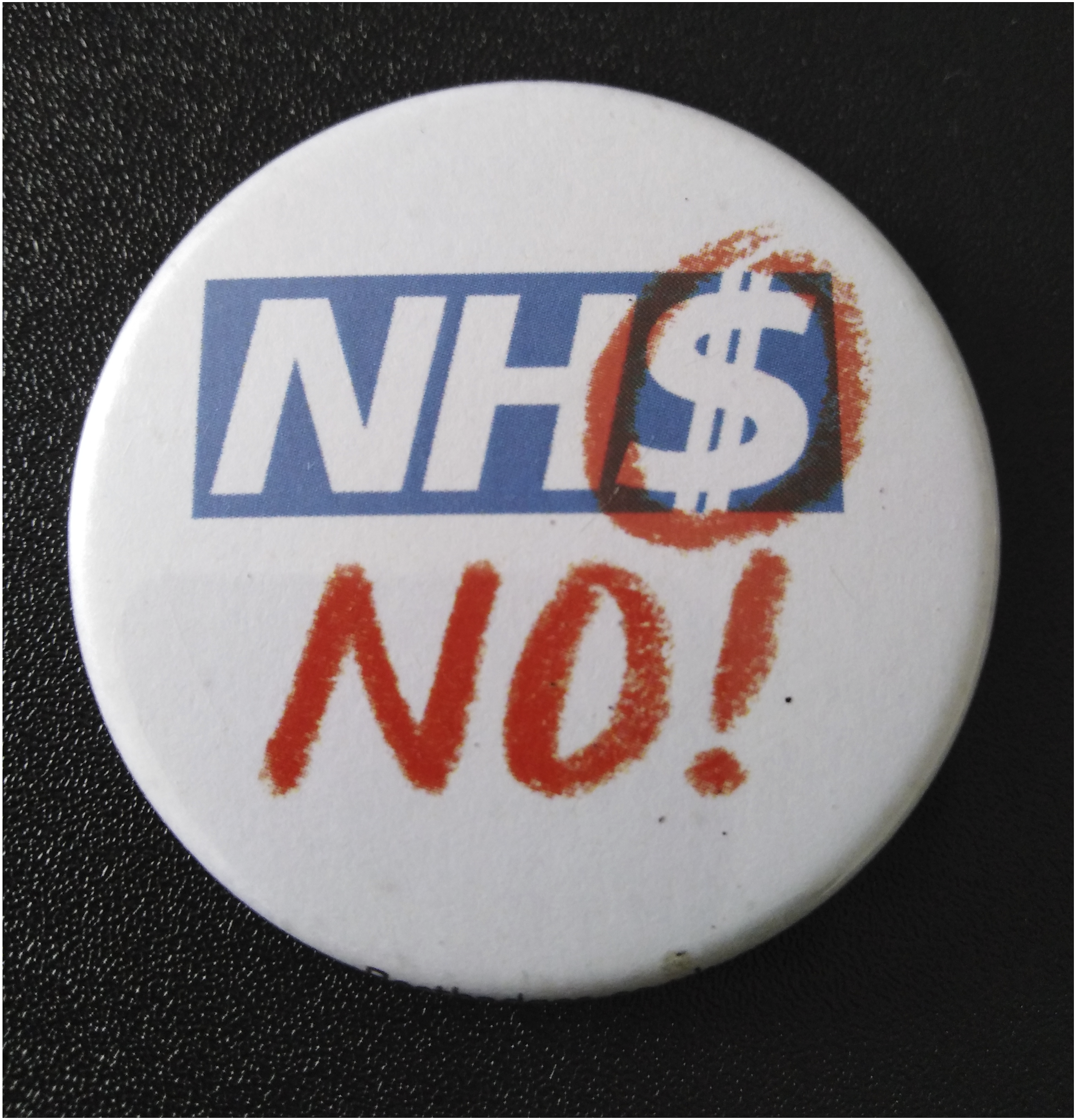
Americanization became shorthand among campaigners unpacking the multiple socio-political circuits of transnational policy. A multitude of local and national campaign groups such as Keep our NHS Public and NHS For Sale? published research online tracing what Crouch (2011) has documented as the ‘revolving door’ connections between former-NHS managers and government figures with private health companies, consultancies and investment funds. Presentations in Davos on the financial sustainability of health systems by the World Economic Forum with consultancy firm McKinsey’s gained particular critical attention. The project was stewarded by Sir Simon Stevens, then-President of the US-based UnitedHealth Group, who became Chief Executive of NHS England. As a former health policy advisor to Tony Blair, Stevens (2004: 43) previously declared ‘the era of English “exceptionalism” in health care is over’, becoming a central figure in concerns surrounding US healthcare companies winning NHS contracts (The Guardian, 2004). For some, Stevens personified the ‘stealth privatisation’ of the NHS on behalf of – if one-step removed from – the Conservative government through adopting accountable care. Despite the multiple geographies of policy assembled into local accountable care developments, invoking direct contrast between the US and English healthcare systems provided a popular spatial vocabulary to disrupt the post-political consensus that rolling out integrated care was unquestionably right.
NHS England repeatedly dismissed claims of privatisation as ‘post-truth’ politics driven by emotion rather than the reality of accountable care policies enabling ‘collaboration’ between providers (on post-truth and the post-political, see further O’Callaghan, 2020). Their rejections echoed depoliticisation strategies among the likes of the World Economic Forum who declared its ‘neutral platform is essential to resolve an emotional debate in a fragmented industry’ bringing together industry, governments, academics, and civil society groups as ‘constructive health debate must rest upon a sound economic framework and an objective, fact-based point of view’ (World Economic Forum and McKinsey & Company, 2012: 3). Certainly, limitations of the Americanization framing even prompted hesitation among some campaigners for fear it blunted their legitimate criticisms: ‘moving to an ACO as they are currently envisaged doesn’t complete the Americanization in their terms … the term Americanization hides as much as it reveals. It has been used a lot. And it’s run away with itself and it’s become used in ways we didn’t really want it to be used’ (Campaigner, Interview; May 2018).
The powerful, if overly simplistic, spatial imaginary juxtaposing healthcare reform with the USA stuck. And it was an association NHS England would find hard to shake. For all their malleability, international spatial imaginaries became vital political resources for resisting mobile ACO policies.
Public matters
The draft Accountable Care Organisation Contract model was published in August 2017 by NHS England. Modifying the NHS Standard Contract, three levels of integration were possible: virtual, partial or full. Multi-million-pound contracts could last up to 10 years whereby a lead provider would have contractual obligation for coordinating services. In the absence of legislative change, contracts would be entered into EU procurement processes via the Open Journal of the European Union in line with Public Contracts Regulations 2015. It was possible, if as NHS England assured unlikely, that a private sector body could win these contracts.
In a bid to stop the ACO contract, two crowdfunded judicial reviews were launched. The more high-profile review included Professors Stephen Hawking and Allyson Pollock among other academics and clinicians gaining substantial media attention. Reviews were limited to the specifications of the contract focussing on the absence of consultation, lack of clarity and transparency, challenging the transfer of decision-making from statutory purchasers to hybrid providers, and how rationing services would undermine comprehensive healthcare provision. Wider concerns were collective responsibility, social solidarity and equity of access to healthcare would be further undermined by ACOs, re-drawing the boundary between universal health and means-tested social care (Sutaria et al., 2017). Struggles coalesced around ensuring public national ownership whilst reversing marketisation and privatisation: ‘The way they’re proposed in terms of entering into the [ACO] contract, they will be some form of legal entity…so they will be a corporate entity, a company limited by shares, they could be a company limited by guarantee, they could be an NHS Foundation Trust, which would then have some form of joint venture agreement. They could be anything essentially. They will have to have some legal form, that’s the bottom line’ (Campaigner, interview; May 2018).
The two judicial reviews failed to halt the ACO contract. Judgements found payment mechanisms to be lawful and a political matter not for the courts, nor were they contrary to the purchaser/provider split under the National Health Service Act 2006. Legal challenge was not replacement for political struggle. But nor were policy counter-mobilities an absolute failure with ACO contracting substantively slowed down. As McCann and Ward (2015) note, policy mobility and immobility is often mutually constitutive. Judicial reviews forced public consultation, generating more than 45,000 responses from activist-campaign group, 38 Degrees. With continued pressure applied over the legal form of ACOs, the emphasis contracts should be held by statutory bodies even became a key recommendation of the Health and Social Care Commons Committee belatedly scrutinising the uptake of integrated care. ACOs could not, therefore, proceed at the rapid pace sought.
In a striking reversal of looking to the USA as an ‘exporter’ of policy models (Cook, 2018), the UK government was repeatedly forced to explicitly disassociate with healthcare models from places elsewhere: International examples of organisations calling themselves ‘ACOs’ look very different in the context of different health economies and different legislative frameworks. Comparisons to other countries' health economies are misleading and NHS England has published several documents describing what an ACO might look like in the context of the NHS (Public government response to the ACO contract, 2018).
The Department of Health and Social Care – rather than just NHS England – had been moved to distinguish international accountable care models from what was proposed in the ACO contract. Frustrated, in both senses, by the repoliticisation of accountable care, it was renamed the Integrated Care Provider (ICP) contract in attempts to distance any association with those models once championed.
Political contestation forced scrutiny of the changing relationships between the local NHS and national imaginaries of the health service, once at the heart of the post-war British welfare state. A rejuvenated Labour Party now championed an alternative vision ‘renationalising’ the health service, having only previously expressed tentative support for an NHS Reinstatement Bill. As Stephen Hawking (2017: 472–473) outlined at the Royal Society of Medicine on the shifting balance of forces shaping healthcare: ‘On the one hand, there is the force of the multinational corporations, which are driven by their profit motive. In the US, where they are dominant in the healthcare system, the corporations make enormous profits, healthcare is not universal and is hugely more expensive for the outcomes, than in the UK. We see that the direction in the UK, is towards a US-style insurance system, run by the private companies and that is because the balance of power right now is with the private companies. On the other hand, there is the force of the public and of democracy. Opinion polls consistently show that the majority of the public agrees with me and is in favour of a publicly provided NHS and opposes privatisation and a two-tier system’.
England and the UK are problematically conflated, here. But the speech illustrates the enduring significance of national spatial imaginaries in articulating notions of publicness and politics. The making and translating of accountable care policies otherwise depoliticised by narratives of integration were situated instead within a popular politics referencing and comparing healthcare between the USA and UK. Now the seemingly post-political spaces of policymaking, such as judicial reviews, as well as public protests and campaigning, played an important role in slowing down and reworking the circulation of mobile ACO policy. And whilst the integration agenda continues to mutate across England with integrated care systems starting to take shape, to date no ICP contracts have been procured.
Conclusion
The aim of this paper has been to foreground how struggles over the ‘national’ condition, rework and resist mobile policy. Without returning to the residual methodological nationalism of policy transfer studies, I suggest there is a need to rethink the whereabouts of the state within the making and translating of globally circulating policy and how this is articulated through the imagined geographies of the nation. Through studying the mobility of accountable care policies, I have demonstrated how ‘integrated care’ has been simultaneously mobilised and depoliticised as a seemingly irresistible solution to the failures of previous market-orientated healthcare reforms across England. Yet, local contracting of accountable care policies was slowed down and repoliticised through counter strategies reframing mobile policy as the Americanization of universal healthcare to foreground issues of national public ownership and legal form. Situating national policy mobilities within the dynamics of depoliticisation and repoliticisation, the paper stresses the enduring, yet shifting and politically contested, role of the state and national spatial imaginaries on how policy moves, mutates and gets reworked.
Policy mobilities scholarship rightly foregrounds the multi-scalar and relational flows of circulating policy. As McCann and Ward (2012: 327) insist, the ‘sites from and to which policies are transferred need to be understood not as discrete territories but, rather, as unbounded, dynamic, relational assemblages’. Researching how policy travels in a globalised world, it is therefore vital to pay attention to the state within the spatial arrangements of power through which mobile policies touch down and settle, and what Jones (2009: 497) talks about in terms of ‘temporal depth’. This is not, I don’t think, at odds with policy mobilities literatures (McCann, 2011: 109), although geographers might seek out a richer temporal conceptual vocabulary than existing notions of fixity. As this research suggests, there can be stubborn adherence to ‘an avowedly territorial narrative and scalar ontology’ (Jones, 2010: 248) among protestors seeking to resist fast policy and ‘go back’ to what existed, or was perceived to exist, previously. After all, it was both the UK government and NHS England that became the target of political contestation in attempts to stop the lengthy contracting of accountable care and push for the ‘renationalisation’ of the health service. And yet the frictions and political strategies to slow down and rework mobile policy reach across and beyond the nation. While national and supranational procurement laws may indeed force attention towards territorial geographies, policy and legislation may be distorted, disputed and stretched beyond its limits.
There is no guarantee attempts to depoliticise mobile policy will hold. With policy always open to the possibility of being remade otherwise, my intention here has been to demonstrate how circulating policy can be reworked through counter-mobilising strategies resisting contracting, pushing for public scrutiny and forcing governmental commitment, at least, to the idea of universal healthcare. However, it is not my intention to situate mobile policy within a simple case of depoliticisation = bad, (re)politicisation = good (Hay, 2014). Rather, I suggest the dynamics of depoliticisation and repoliticisation can variously displace and revitalise the politics of mobile policy with major implications for changing welfare states and public services. Most immediately, further research might expand on policy counter-mobilities and the contractual termination of ‘exemplars’ such as the Alzira Model in efforts to avoid ‘reversion of the reversion’ under new political administrations (Comendeiro-Maaløe et al., 2019). Political action is already underway seeking to abolish Private Finance Initiative in Britain through nationalising existing service contracts and return hospitals to genuine public ownership, and it is not wholly inconceivable ‘integrated care’ agendas could be remade differently to be explicitly anti-marketisation.
But there are other political struggles in play here. Attaching national spatial imaginaries to circulating policy may be politically expedient but can also be problematic. In the ‘clamour of nationalism’, politicians across the political spectrum have become quick to declare their love for the ‘Great British institution’ of ‘our’ National Health Service (see further Valluvan, 2019). For a resurgent political left galvanising around the Corbyn-led Labour Party, the NHS and its founding principles of universalism have helped articulate progressive alternatives to neoliberal hegemony in the current moment. Through cultivating a particular kind of ‘affective nationalism’ (Antonsich et al., 2020), much emphasis was placed on the need to resist ‘selling the NHS to Trump’ and warning what the public would lose if we don’t struggle to keep it. But who is this ‘we’, exactly?
A concern is nostalgia for the NHS harking back to a post-war ‘golden age’ of public services risks reproducing national-exceptionalist narratives whilst obscuring the colonial exclusions, dis/connections and injustices integral to the formation of national welfare states across Europe (Bhambra and Holmwood, 2018; Raghuram et al., 2009). Whilst wholly supportive of activists seeking to reinstate a truly public health service to end marketisation and privatisation, any framing of political struggles in terms of going back to a post-war ideal risk remaining silent to exclusionary ideas of publicness expressed through the imagined unity of the nation (Newman and Clarke, 2009). After all, claims of ‘protecting the NHS’ have been remarkably easily re-located at the heart of right-wing politics: from the role of the NHS in bolstering English nationalism and neo-colonial imaginaries within campaigning for the UK to leave the European Union (Fitzgerald et al., 2020) through to the reach of the state into hospitals through hostile ‘everyday bordering’ (Yuval-Davis et al., 2018) and the introduction of an ‘immigration health surcharge’ legitimised through the racist, anti-immigrant claim ‘it’s a national, not international health service’. As Temenos (2017: 594) insists, it is critical geographers ‘fight to change the terms of debate through objects such as policy and the strategies that are employed to engage policy and its outcomes in particular ways’. To my mind, then, it is necessary to confront the prevailing conditions through which policy takes hold, whilst at once seeking alternative visions, projects and vocabularies. The double meaning of the sub-title of this paper – resisting the Americanization of universal healthcare – reflects such demand.
Anti-politics, in the current moment, is often articulated through nationalist and racialised imaginaries (Beveridge and Featherstone, 2021). For the political left in Britain, however, progressive politicisation has been vital in generating alternatives to austerity and neoliberal globalisation. ‘Nationed narratives’ may indeed help forge new solidarities across spatial divisions and resist circulating fast policy (Featherstone and Karaliotas, 2018: 286), including pushing for genuinely public healthcare as a right for all. Yet those campaigning to protect the NHS through evoking national spatial imaginaries must be continuously alert to how the very idea of ‘universal’ healthcare is susceptible to co-option in the name of nationalism and racial exclusion. And not only has the global pandemic stressed the ongoing importance of nations and states within policymaking, but governmental strategies of depoliticisation and deferral through ‘following the science’ raise fundamental questions over whose lives are deemed to matter (Clarke, 2021). Rethinking the times and spaces of politics and policy, there is a need for policy mobilities scholarship to grapple with shifting articulations of nation, state and welfare in the current conjuncture.
Footnotes
Acknowledgements
I would like to thank all informants for their time and generosity in taking part in the research. I am grateful to everyone in Geography at the Open University for commenting on an earlier draft, Michael Lambert for the ongoing discussions on the NHS and John Clarke who kindly commented on a revised version. Finally, thank you to Joe Painter and anonymous reviewers who helped strengthen the paper.
Declaration of conflicting interests
The author(s) declared no potential conflicts of interest with respect to the research, authorship, and/or publication of this article.
Funding
The author(s) disclosed receipt of the following financial support for the research, authorship, and/or publication of this article: This study is supported by a Royal Geographical Society (with the Institute of British Geographers) Small Research Grant.
