



Abstract
Taking as its starting premise that we have a politics of space because space is political at the level of ontology, this article investigates how the governing of regional development is guided by a set of prominent political rationalities that revolve around the notions of competition and competitiveness. To this end, I mobilise the Foucauldian framework of governmentality to provide empirical illustrations drawn from a 5-year long research project concerning globalisation in Swedish sub-national regions. These illustrations show how regions are governed through rationalities that stress adaptability, attraction, environment and sustainability as well as leadership in order to prevail in their inevitable competition for vital resources. I argue that as these chains of rationale are put into motion in the contemporary politics of space, they not only promote specific and particular ways of developing regions, but also displace certain practices and objects from the realm of the political to the realm of a natural order. I therefore conclude that current expressions of the politics of space have strong tendencies to deny its own political foundations. Instead, competition and competitiveness are inscribed as naturally occurring features in social relations, thereby elevating their importance in the creation of new sub-national spaces.
Introduction
I repeat that there is a politics of space because space is political (Lefebvre, 1976:33)
As Henri Lefebvre (1991), Doreen Massey (2005) and many others have argued, space can be considered political at the level of ontology. Therefore, it follows that we have a politics of space that often stands at the centre of rule in a wide variety of societies and political systems throughout human history (Storey, 2012). Indeed, a continued expression of this political dimension can be seen in the many ongoing social practices that strive to appropriate, shape and mould space into territorial formations upon which various governing systems can act. In this sense, territory can be understood as the outcome of political forces whilst at the same time it is also one of the primary mediums through which such forces are realised (Elden, 2005; Painter, 2010). Thus, I argue that studying practices where territory is being re-imagined and reshaped, such as sub-national regional development, provides a vantage point from which broad registers of rule become visible. Not least, it makes it possible to further theorise the rationalities that inform and render this present governing of space possible in the first place.
This article therefore investigates how the governing of contemporary regional development, understood as an expression of the politics of space, operates under perceived notions of intense global competition. I hold that the hegemonic discourse of competitiveness among states and regions contributes to a (re)production of state space that is important for understanding future trajectories of capitalism and democracy. In particular, the results of the analysis conducted here relates to the broad and ongoing conceptualisation of neoliberalism as a variable, yet distinct, mode of governing across domains of society (e.g. Brown, 2015; Hall, 2011; Peck, 2013). By interpreting the prevailing rationalities of regional development in the light of this literature I offer an empirically grounded addition to theoretical discussions concerning the intersection of politics, space and governing. Moreover, this empirical approach also allows me to develop a novel approach for analysing political rationalities more generally.
The overarching purpose of this article is thus twofold. On the one hand, the article aims to provide insight into contemporary expressions of the politics of space through empirical illustrations in the context of regional development. On the other hand, it is to develop a framework for analysis of political rationalities that draws on what William Walters (2012) alludes to as the governmentality ‘software’. My approach rests on three points of departure which are outlined below.
Firstly, to repeat, I argue with Lefebvre and more recent writers (e.g. Elden, 2005, 2010; Painter, 2010) that territory can be understood as a particular expression of state space that is the result of political struggles over space. The precise contours and shape that territory takes is therefore a contingent formation, hinging on political rationalities that aspire to govern space and turn it into a calculable and predictable domain that allows for political intervention and control in certain ways. Regional development is a suitable example of such struggles and ambitions.
Secondly, given the above, it follows that whilst space can generally be understood to be shaped into particular expressions of territory through social relations, it can also be said more specifically that this process of turning space into territory is also a matter of governing. To conceptualise this and lay the groundwork for empirical illustrations, I turn to the increasingly rich strand of literature sometimes termed governmentality studies. This body of work continues the legacy of Foucault’s (2007, 2008) lectures at College de France where he theorised what it means to govern any domain of social reality and how such governing is nested in mental and cognitive registers. As such, governmentality studies offers a number of useful concepts for theorising the art of governing and whilst Foucault’s own lectures in many ways did not address the relationship between state and space this has been an important topic in more recent works (Dean, 2010; Ettlinger, 2011; Huxley, 2008; Miller and Rose, 2008; Walters, 2012). Indeed, as scholars have pursued issues of biopolitics seeking to understand how populations are turned into the state’s most valuable asset and therefore must be governed meticulously, they have also come to argue that to shape a population is deeply intertwined with shaping space into specific articulations of territory (Hannah, 2000, 2009; Rose-Redwood, 2006, 2012).
Thirdly, the focus here is on a contemporary and situated case of governing space, namely regional development in Sweden. In this context, the article draws on a large corpus of documents generated during a 5-year long research project concerned with the changing contours of Swedish regions. There, like elsewhere in Europe, regional development has changed over the past decades, taking on a new purpose, shifting the focus from production of growth and redistribution of wealth among sub-national territories to an emphasis on competition and competitiveness. In short, the Swedish case works particularly well for illustrating the emergence of new rationalities of governing given its pronounced social democratic legacy and its focus on redistribution and equality.
Following this introduction, the text is laid out in the following way: a more thorough account of the Governmentality literature and its approach to governing is provided; current literature on regional development is presented, with a specific focus on Sweden, in order to contextualise the empirical case; the case is described with respect to data collected and is further elaborated with my take on empirical illustrations. This also includes a discussion on methodology where I develop my own take on analysing rationalities in terms of modes and chains. This approach is then mobilised in the analytical section of the article where the empirical illustrations of the political rationalities that govern Swedish regional development today are presented. Finally, the analysis is used as a point of departure for discussion in the concluding section about questions of space, politics and competition as a neoliberal trait of governance.
Governmentality and rationalities of rule
Most scholars working within the tradition would probably agree that whilst governmentality studies has risen to become something like a school of thought over the past decades, it does not encompass a theory in any strong sense of the word (Walters, 2012). Rather, analytics of governing that draw on governmentality for inspiration revolve around a set of concepts, themes and topics that are tied together in various ways. However, whilst there are common ways of conducting a governmentality analysis, there are no absolute interpretations that prescribes exactly how this must be done. Indeed, in this sense, governmentality can be considered as more of a toolbox than a preconfigured and ready-made analytical perspective that should be applied in one particular fashion regardless of circumstance (Dean, 2010). Along these lines, William Walters (2012:5) has warned about what he calls a form of applicationism, being the tendency to treat governmentality as a fully formed perspective, that unintentionally restrains the potential of the toolbox. In fact, he argues that ‘[t]he toolbox needs to be reimagined as a dynamic, transactional space – more akin to the fluid world of software design and computing than the settled scene of the tool shed’.
In this paper, I ascribe to such a view of governmentality analysis as the notion that it should be open for modification, updates and patches. I present a study that first and foremost focuses on so-called political rationalities that underpin the general mentalities of rule and which make up the underlaying logic of a particular way of governing. This means that I try to understand ‘what forms of thought, knowledge, expertise, strategies and means of calculations’ (Dean, 2010:42) are nested in the governing of space and territory. Thus, according to Bacchi and Goodwin (2016: 42f) political rationalities are ‘the rationales produced to justify particular modes of rule’ and they function as ways that make any form of activity thinkable to both rulers and the ruled. These diagrams of power ‘draw upon the theories, ideas, philosophies, and forms of knowledge that characterise our intellectual heritage’.
Furthermore, this means that the analysis presented here deviates somewhat from more prominent ways of applying governmentality analysis, namely, to specify and detail a range of so-called governmental technologies. In short, these are the tangible mechanisms and apparatuses that relay the political rationalities and make them operational (e.g. Li, 2007; Miller and Rose, 2008; Öjehag-Pettersson, 2020). By contrast, my take on governmentality in this article could be said to resemble forms of Foucauldian discourse analysis, however, with Walter’s (2012) position in mind, I argue that this is still an expression of the toolbox, or perhaps a patch for the software. Indeed, whilst the analysis of rationalities overlaps in important ways with analyses of discourses, such as for instance in the influential approach advanced by Carol Bacchi (Bacchi and Goodwin, 2016), the political rationalities are more akin to explicit attempts at steering, controlling and directing something or someone. In other words, they are attempts to govern aspects of reality (Brown, 2015). Nevertheless, as a methodology that focuses on the interconnections between problematisation, political rationalities and discourses, Bacchi positions her approach as a variation of the governmentality toolbox, further underlining the manifold possible applications of this form of analysis.
Taken together I argue that my focus on the political rationalities that underpin the governing of Swedish regional development can help interpret contemporary expressions of the politics of space. Whilst governmentality analysis often focuses on how humans are constituted as subjects of and for rule, a growing number of studies have also pointed out that biopolitics is not only about the population. Rather, space and territory must also be made into objects that serve the general rationalities that dominate governing in a particular time and place (e.g. Elden, 2005, 2007, 2010, 2013; Ettlinger, 2011; Hannah, 2000, 2009; Huxley, 2008; Rose-Redwood, 2006, 2012). I will elaborate my take on how to approach political rationalities as part of an empirical analysis shortly, but firstly, a brief contextual description of regional development, with a specific focus on the Swedish case, is warranted.
Regional development in an era of global competition
Regional development throughout Europe and beyond has gone through a number of significant changes during the past decades. To begin with, scholars started to notice the increasing status of the sub-national region as a spatial scale in the global economy, designating regions as ‘resurgent’ both in the sense of politico-economic significance as well as academic importance (cf. Jones and MacLeod, 1999; Paasi, 2009; Lobao et al., 2009). Larger than local spaces, yet small enough to be flexible and governable in ways that nations were not, sub-national regions came to be conceptualised as primary units in the wake of globalisation and territorial competition for resources (Bristow, 2005).
In relation to this, a movement of sorts arose that involved academics theorising the development as well as policy makers and politicians pushing for a process of change and transformation of regional development. This school of thought came to be labelled New Regionalism (Keating, 1998) and from the onset it involved a rather heated debate concerning the intermeshing of researchers and policy makers with some critics calling new regionalist research ‘theory led by policy (Lovering, 1999). That being said, many of the more prominent scholars on new regionalism did not conflate careful and rigorous research with policy advice or policy influence. Rather, they not only continued to point out the importance of new regionalism, they also rethought their own claims and maintained that the changing role of regions was vital in understanding the evolution of global capitalism (e.g. Harrison, 2006; MacLeod, 2001).
The changes that new regionalist scholars pointed to as most important were first and foremost related to globalisation. Here the argument was straightforward in that globalisation was understood as putting the nation state under tremendous pressure, which in turn made states reconsider their territorial organisation. By devolving power and responsibilities to more independent regions, states could now shift the meaning of regional development so that rather than the state existing for its regions, the reverse applied. Generally speaking, in this situation regions where responsible for producing growth and considered to be heavily involved in competing with each other for scarce resources that could help them come out as winners in an ongoing competition (Gren, 2002).
In Sweden, the changes have followed these more general lines, however, in many ways this probably means a more pronounced shift in policy than has occurred in many other countries. Like in the rest of Scandinavia, regional development in Sweden was for a long time a matter of redistribution of resources with the outspoken agenda to have no significant discrepancies in living conditions throughout the country. In other words, in this old paradigm there was to be no division between rich and poor parts of the country and active measures were taken to even out differences that nevertheless occurred. Today, on the other hand, the situation is quite different. Indeed, a number of policy initiatives and regulatory changes within the country have altered regional development as a practice in significant ways. Not least, this is visible in the fact that the policy area as such has been renamed from ‘regional development’ to ‘regional growth policy’. Much more than before, regions are understood as competing globally and nationally for resources, a competition that in the end will be useful for the state since it will propel the competitiveness of the nation as a whole. At the same time, regions must now in a sense fend for themselves in their quest for prosperity and whilst growth has been an overarching goal for regional development for a long time, it has never emphasised competition so heavily before (Johansson, 2013; Mitander, 2015; Mitander et al., 2013, 2017; Säll, 2014; Öjehag-Pettersson, 2015).
Case and methodology
As regional development in Sweden is being made the object of governing we may conceptualise it as an assemblage of objects, subjects, discourses and practices that together form a vibrant unity, stable enough to approach empirically, yet always in the making, transforming and changing (e.g. DeLanda, 2016; Deleuze and Guattari, 2009; Ong and Collier, 2005). Moreover, from a governmentality perspective, to govern a particular domain or aspect of reality is not the exclusive matter of formal authorities or government bodies (Dean, 2010). Rather, a multitude of powers reach into the assemblage with intentional, as well as unintentional, attempts to control, order and steer it in certain directions. In this sense, governing Swedish regional development is a multivalent practice, dispersed in a space that transcends the geographical boundaries of Swedish territory.
Even if we consider only formal governments and agencies, these exist at different scales, from the very local to the supranational. In addition, the governing of this assemblage is visible in practices that take place in many other sites with less formal authority, but which does not equate to an automatic lessening of influential power. Consider for instance the significant amount of ‘expertise’ in the form of academics, consultants and policy gurus that reaches into regional development, as well as the capitalist interests tied to, for example ‘clusters’ and ‘innovation systems’ so integral to regional development at this point. Therefore, in sum, to approach a case conceptualised in this way requires a methodology for data generation that focuses more on affiliations, connections and alloys than on delineations and compartmentalisation.
Whilst that may be so, as a researcher one needs to impose some form of structure that makes a theoretical construct like the assemblage researchable. In this case it means that I have followed two principles for generating data. Firstly, that I study written texts in the form of documents. I consider these to be remnants of the practices of governing regional development in which this governing leaves traces. In short, this means that I probably guide my analysis more towards formal governing structures than informal ones. Secondly, that these texts have been produced in a sort of stretched presence. This means that whilst I attempt to study contemporary governing, such practices are not only dispersed in space, but also in time. Thus, the documents that eventually became part of my data have been produced between the years 2007 and 2018.
With these principles in mind I chose three ‘entry points’ for the assemblage where I could collect documents. These were three central websites run at different scales in the official governing hierarchy of regional development that all served as information sites with links to a wide array of texts including official policy documents, expert reports, commissions, white papers, green papers and assessments. The websites were (1) the official site of the European Union on regional development hosted by the European Commission called Inforegio; (2) a similar site for the national government of Sweden on Regional Growth; and (3) a Web site hosted by the Swedish Association for Local Authorities and Regions (SALAR) simply called Regional responsibilities and division. From these points of entry, I followed all links to documents concerning the governing of regional development and based on these I conducted a first analysis. Throughout this reading I followed references to other documents referred to and subsequently also collected those. For the new and added documents I repeated this process until I started to approach something of a theoretical saturation in the sense that no new documents seemed to be referred to in the material.
Finally, then, I ended up with a corpus containing 81 different sources. As mentioned above, these included official policy documents and strategies from local, regional, national and EU-level government as well as evaluations and expert reports from organisations such as the Organisation for Economic Co-operation and Development (OECD), the European Spatial Planning Observation Network (ESPON) and various other cooperation arenas where policymakers and researchers meet and exchange ideas. In the following analysis a particular form of document figures repeatedly, which I refer to as a Regional Development Strategy (RDS). To clarify, this is a document that each of the 21 Swedish regions must produce and which they must be able to show the national government. To complicate things a bit further Swedish regional governance is complex, and quite messy, involving different authorities and agencies. Therefore, the political body responsible for carrying out regional development may differ from region to region. The data generation process as well as other forms of data collection were part of a 5-year long research project on the connection between globalisation and the changes in regional development in Sweden. As mentioned, what is presented here are illustrations based on this data and additional analysis as well as more extensive insights into the governing structures of Swedish regional governance is available elsewhere (Öjehag-Pettersson, 2015).
Empirical illustrations
Given the constraint of the format in an article such as this I do not aspire to, nor claim, to present a complete description and analysis of an entire policy field such as regional development in Sweden. Rather, I regard the following analysis as empirical illustrations, which means that the point here is not to give an account that fully exhausts the data that is being used. However, I do claim that the illustrations help to demonstrate theoretical points and empirical processes and that by reading them together it is possible to provide a concluding discussion along the lines of the topic for this article. However, before I present the illustrations, I will introduce my take on how to analyse political rationalities.
Rationalities: analysing modes and chains
So far, I have only discussed the notion of political rationalities at a rather abstract level. At this point, therefore, I wish to articulate my more precise take on what I search for and how I conduct an empirical analysis focussing on political rationalities. Firstly then, an iterative reading of the documents included in the corpus has been used to code, classify and thematically organise the material and reconstruct its main rationalities. This procedure was inspired both by the post-structural take on retroduction suggested by Glynos and Howarth (2007) as well as Foucault’s (1980) ‘ascending analysis of power’. In short, this means that I did not depart from a general theory of how the rationalities of regional development function, yet my knowledge of the field helped guide my construction of categories and codes. Given that I work with a rich, diverse and comprehensive data set this reading does not exhaust the material. Rather than accounting for all aspects of the documents, what is presented below are the most salient and qualitatively important rationalities. This means that they are not only referred to, but are also discussed, theorised and figure prominently throughout the documents. They also structure arguments, steer reasoning and basically renders questions, problems and logics within the corpus intelligible in the first place.
My interpretation is that it is not possible to reduce the political rationalities at work in the corpus to a few single, dominant ones. Rather, there are many rationalities that operate in the governing of regional development and they function independently of each other, yet often also in conjunction. Analytically, therefore, I make the point to distinguish between modes of rationale, on the one hand, and chains of rationale on the other. When referring to a mode of rationale then, I mean to designate the individual articulation of a specific political rationality such as ‘competitiveness’ or ‘leadership’. Sometimes these modes operate on their own, however, they often also link together and reinforce one another. Such linkages between modes of rationale then form what I call chains of rationale where the modes become elements of a wider structure.
Thus, the work required to reconstruct chains of rationale represent another step in the analysis where I again pay attention to salience and latent patterns in the material. In principle then, modes of rationale can link up and form chains with all other modes, however, some combinations will likely be more salient than others. In this analysis, I have identified four such salient chains as detailed below. Whilst this step then reduces the complexity of the analysis, it still retains the importance of individual modes of rationale and allows for an interpretation where reduction and multiplicity are present at the same time.
Chains of rationale: governing regional development
Through the analysis of the 81 documents in my corpus I have reconstructed 14 different modes of rationale that form four different chains. In Figure 1 below I provide a topological map of how the modes make up elements of larger chains. Importantly, this figure conveys a general logic of relations. It does not represent distance or importance of individual modes. As can be seen, all 14 modes stand in some form of relation to each other as elements of these chains. The four elements in bold have given name to the chains. Elements and chains of rationale.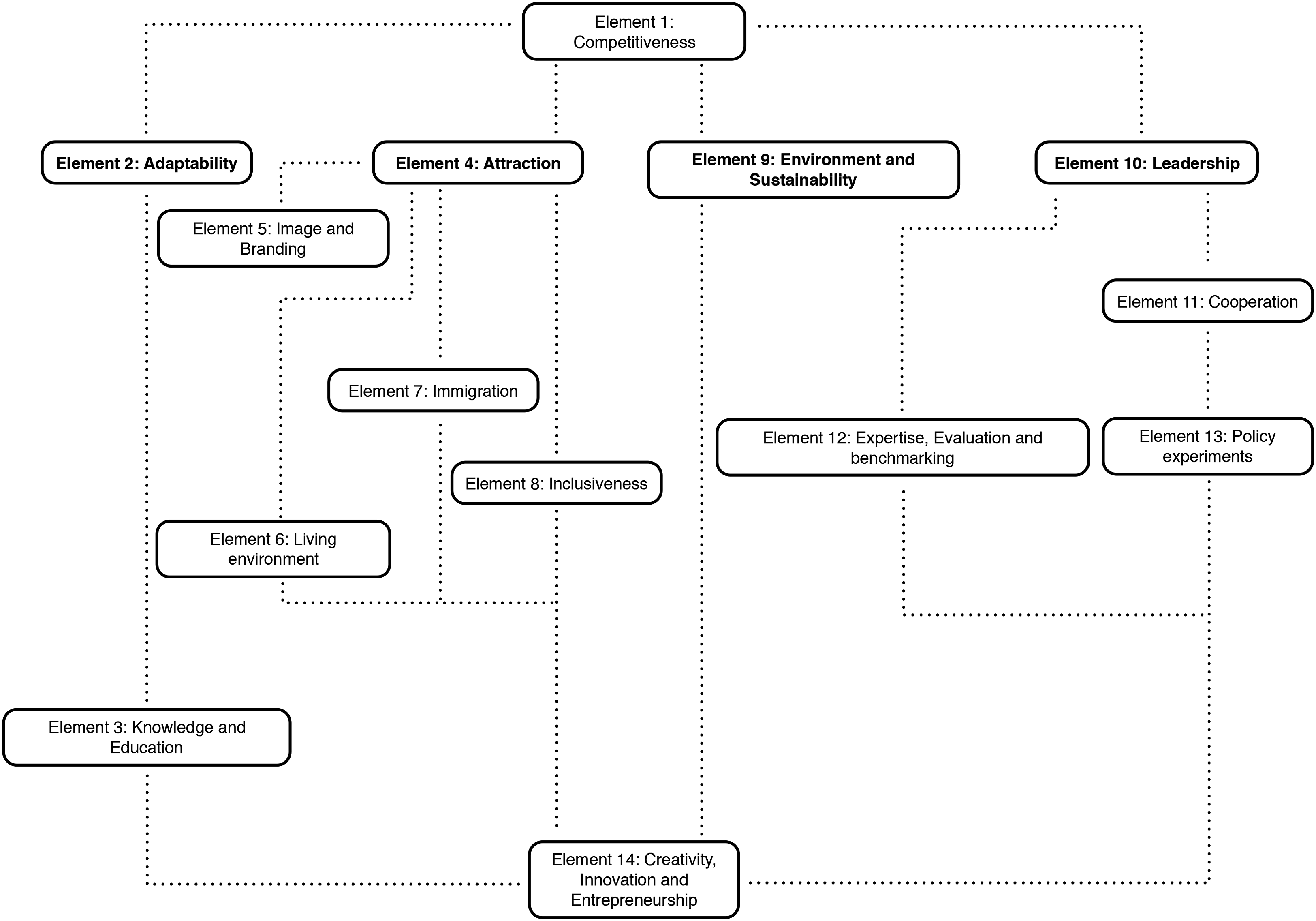
The modes of rationale provide an underlaying logic for the texts, producing a general frame and structure for the assemblage of regional development in the sense that they provide it with specific directions, purpose and meaning. Even though I have argued that the modes of rationale are not reducible to one or two dominant ones, I do recognise that they may be more or less centrally located in the structure of articulations. Along this line then, the mode I have labelled ‘competitiveness’ as well as the one labelled ‘Creativity, Innovation and Entrepreneurship’ hold special positions within the material.
As for the competitiveness rationale, it is continuously reiterated as part of the inevitable position all regions must find themselves dealing with – namely global competition. This particular understanding of globalisation figures uniformly in the documents as something of a natural phenomenon. Unhinged from human and social relations, it is articulated as something that imposes an order and a problem for government that we cannot really do anything about, much like a tsunami, a hurricane or the eruption of a volcano. The primary consequence of this is that all regions find themselves in a fierce global competition and literal struggle for survival. Thus, competitiveness is something that must be pursued, and in the material that I have analysed, the primary way to reach it is through creativity, innovation and entrepreneurship. Therefore, as can be seen in Figure 1, competitiveness as well as creativity, innovation and entrepreneurship are two modes that are elements in all four chains. Indeed, they tie the chains together and help them sit next to each other as part of a larger aim.
Description of modes and chains.
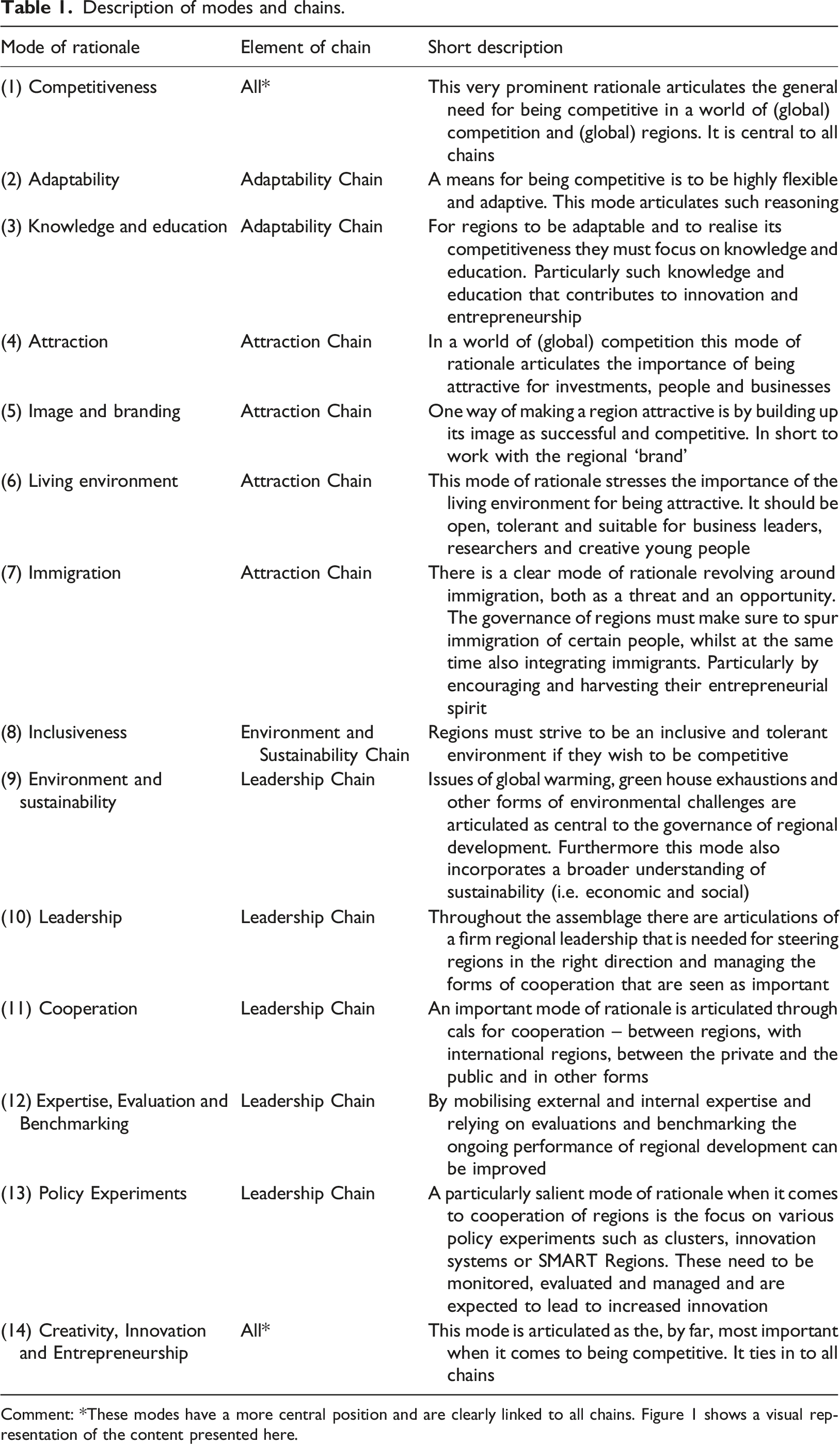
Comment: *These modes have a more central position and are clearly linked to all chains. Figure 1 shows a visual representation of the content presented here.
The adaptability chain
The adaptability chain represents a very salient theme that runs through the corpus. In essence, it ties together modes of rationale that addresses the challenges of the volatile circumstances that are assumed to follow in the wake of a fierce global competition. Consequently, Swedish regional development must reconstruct the regions into spaces that can better deal with this challenge. Adaptability is therefore pushed to the forefront of policies. Reasoning such as that of the Regional Development Strategy (RDS) of the Swedish region of Norrbotten is illuminating in this regard:
Global competition and new technical opportunities have transformed the demands for knowledge and skills. Both organisations and individuals have to be prepared to change – change jobs, learn new things, and know more things. It is becoming ever more difficult to pursue a career and make do with schooling acquired in the past. The ability to change has in itself turned into a crucial skill, both for individuals and for organisations/businesses (RDS Norrbotten, 2012:55).
Note how adaptability applies to organisations as well as individuals. This means that an important task is to inscribe the regions with structures that produce adaptability. Physically this can be a matter of working with infrastructure for large scale commuting or for regional enlargement, which is a general topic in the corpus. If enlargement is not realised formally as a new territorial division with fewer and larger regions, existing regions should nevertheless work with providing opportunities for spatial restructuring. A common notion is to promote urban centres as hubs that tie together peripheral parts of the regions so that small towns and rural communities can, in effect, become part of urban areas by contributing with some specific function. In other words, power operates here in such a way that large segments of the territories that are being formed are only allowed to survive if they can find a way to benefit those that are deemed vital and resourceful.
At the same time, these measures to enhance the adaptability of regions are entangled with articulations that promote ‘flexibility’ and ‘life-long learning’ among the population, highlighting how the politics of space is a vital part of biopolitics more generally. Thus, adaptability is also very much a matter of promoting new forms of education. This applies across the board from pre-school up to university level degrees and by offering special programs for people who have been laid off. A central theme then is that inhabitants must gain new forms of knowledge and be more willing to take risks in order to mitigate the effects of global competition. Education must therefore be realigned to allow for this by promoting entrepreneurial behaviour and creativity to produce innovation.
Whilst adaptability is articulated in conjunction with all levels of the education system, universities are stressed as the most important locus in this regard. This is not only because they can provide education and thereby help produce the people that are needed, but also because they are hubs for innovation, creativity and entrepreneurship. That being said, throughout the corpus, Swedish universities are described as lacking in important aspects and as not realising their full potential. This kind of reasoning is primarily about the ability to promote entrepreneurship and to convert scientific and scholarly activity into sellable products. Even among the richest, oldest and most prestigious universities this is a problem. Thus, Region Uppsala writes
Despite the advantageous conditions and all the resources used for research and education, the Uppsala region creates relatively little value in terms of salaries and growth. The capability of the system to create use value from innovations must therefore be strengthened. The results of the massive measures taken should be highlighted more. Efforts in cutting-edge industries must be combined with entrepreneurship and production in a broad sense, for all lines of business. There is a great potential here for new companies and more jobs (RDS Uppsala, 2013:11)
To sum up then, the adaptability chain ties together education and knowledge with the notion of adaptability as a way for regions to become competitive. Moreover, it links this adaptability over and over again to notions of innovation, creativity and entrepreneurship which are features that should be pursued in the education system in order to produce adaptable citizens, in addition to being features which in and of themselves help to make the region ready to meet the challenges of volatility with the trait of flexibility.
The attraction chain
The next empirical illustration I wish to make concerns what I have labelled the attraction chain. Again, departing from the notion of intense global competition the attraction chain ties together modes of rationale concerning image and branding, living environments, inclusiveness and immigration and bestow these with qualities that can help make the region an attractive space. In short, to be attractive to both people and investment is considered fundamental in the global competition. As articulated by the Swedish Government (2014:18) in the National Strategy for Regional Growth and Attraction:
The ability to attract, keep, and develop skills, businesses and capital is crucial for the creation of attractive and competitive regions and municipalities. People contribute skills, run companies and invest capital. They are looking for a living environment which offers good housing opportunities as well as work, service, healthcare and spare time activities. This means that municipalities must collaborate in a systematic way with regional and national agents to develop attractive environments where both women and men want to live, reside, visit, and run businesses.
Being attractive here is very much about catering to a specific class of people. Most important here are the creative professionals such as scientists, engineers, writers, programmers and entrepreneurs who are often thought to like specific features in terms of living environment. Regions therefore seek to create environments that combine the amenities of inner city living, a tolerance of diversity and outdoor recreational opportunities associated with an active lifestyle: The challenge also involves offering a sufficiently global living environment which includes among other things cultural events, coffee shops, restaurants, and a diverse population. This must be combined with the advantages of smaller towns and municipalities in terms of closeness to nature, services, small-scale structures and social networks. We must also guarantee good opportunities for education and demands and expectations related to the innovations and entrepreneurship of young people. In order to attract new inhabitants and qualified jobs as well as keep people and businesses already in place, we work together to increase the attractiveness of the region. It is important for us to improve even more in the area of promoting the strengths of the region through systematic long-term profiling efforts and coordinated marketing. (RDS Jönköping, 2013:29).
Immigration is in this sense a tricky part within the various policy documents since it is articulated in two distinct ways. Firstly, there is a form of immigration that should be promoted – to attract the creative professionals who will bring with them innovation and entrepreneurship. Secondly, there is an issue of dealing with more immigration as a problem. In general, this relates to refugees and immigration that requires active measures in terms of integration. Interestingly though, this problem of immigration is also viewed as an untapped potential in terms of innovative capacity and in the long run, global competitiveness. The OECD provides precisely this perspective in their territorial review of Region Skåne:
Breeding new entrepreneurs should be a priority as they are a very scarce resource in Skåne. Untapped potential for entrepreneurs exists in certain population categories, such as immigrants, youth and women. Mobilising this dormant pool could have a double impact: increasing the number of new companies and bringing more diversity, which is a breeding ground for innovation (OECD, 2012:149).
Taken together, the attraction chain first and foremost articulates a rationality that underlines the importance of regions being attractive in various ways. Hence, regional development must be governed in such a way that it allows for regions to cater to particular segments of the population and to produce an environment where they wish to reside. In connection to this, it is often recognised that marketing and branding, in the same vain as that of companies and corporations, is increasingly important in order to get the message across that any particular region is actually a place worthy of consideration by creative professionals as they plot their next move. Thus, the politics of space becomes visible here through the ways that power includes, excludes, promotes and hinders different appropriations of the spaces it forms into sub-national territories. Indeed, this chain of rationale explicitly nominates groups of people for which the spaces should be made.
The environment and sustainability chain
A chain of rationale pertaining to the environment and sustainability is the third illustration I want to make here. Indeed, notions of climate change, global warming and pollution are often referred to as the most pressing issues that regions face today. Because of their problematic relationship to the idea of continuous growth, the way that this chain of rationale enters the documents in the corpus is often as part of an implicit question that runs something along the lines of ‘how are we going to be able to produce growth and at the same time be sustainable’? In short, the answer to this is often to be more creative, more innovative and to let loose the entrepreneurial spirit of people, yet this does not mean that the problem is portrayed as easily solvable in the documents and policies.
Rather, the threat of climate change is very real, and often it is articulated throughout the texts in relation to the EU2020 strategy where it is stated that: Climate and resource challenges require drastic action. Strong dependence on fossil fuels such as oil and inefficient use of raw materials expose our consumers and businesses to harmful and costly price shocks, threatening our economic security and contributing to climate change. (EC, 2010:6).
However, even though there is a serious tone here, and elsewhere throughout the corpus, it is also clear that what is first and foremost at stake are economic interests and competitiveness. Given the prevailing importance of creativity, innovation and entrepreneurship the threat is often turned into opportunity for those who will master it. In effect, this also turns sustainability issues into questions of competitiveness since regions that restructure in the right way can be prosperous:
We not only need to decrease emissions but also adapt our society to changes that we know are pending. We should also see this restructuring as an opportunity. We can lower costs and strengthen our competitive edge. This work contributes to new business opportunities and jobs as new products, ideas, and solutions are created. In the county of Kalmar, we are good at environmental technology and energy issues. In these areas, many companies have export potential. We can sustain a good breeding ground for strong, growing, and profitable businesses here. It can be done by creating environments that promote innovations and entrepreneurship (RDS Kalmar, 2012:34).
Whilst climate change and global warming are part of this chain, it is also broader in its conception of sustainability. Not least, a prominent feature in this regard is the importance of gender equality. The way that this aspect of sustainability is articulated is similar to that of climate change in the sense that here too lies an opportunity for those who can master the problem and tap into the benefits of gender equality. However, gender inequality is seldom understood as a problem in itself. Rather, it is a problem because regions are missing potential growth and competitiveness by not harvesting the innovative capacity of women well enough. That being said, it is important to recognise that gender equality is a theme that is readily present throughout the material. In short, it seems particularly important to create conditions that empower women and enable them to pursue successful careers as entrepreneurs. However, since gender inequality is seldom discussed in terms of power structures, one discursive effect here is a form of responsibilization. Women need help to change themselves, whilst the privileged position of men is seldom challenged.
Thus, we may understand the environment and sustainability chain as a rationale that transforms critical concerns with issues such as climate change and gender inequality into possibilities for innovation and in the long run competitiveness and growth. Moreover, it also presents sustainability issues such as climate change and gender equality as more or less devoid of power relations. Rather, like global competition, they appear to simply be a part of the world, not an effect of particular social struggles. This is one example of how the chains of rationale presented here convey the practice of regional development as technical and neutral, concealing the political dimension present in any making of space(s).
The leadership chain
One way to classify the previous three chains is to emphasise how they bring together modes of rationale that are important for regional development in terms of what to focus on. That is to say, they point out certain paths and directions as more important for producing competitiveness whilst also articulating important challenges that must be overcome. When it comes to the fourth and final example, the leadership chain, it instead consists of elements directed towards the actual governance. Hence, it connects leadership, cooperation, policy experiments as well as expertise, evaluation and benchmarking. Consider the way leadership is discussed in the RDS of the region of Dalarna: Regional development and growth efforts are so complex that nobody can manage on their own. It is necessary to cooperate and collaborate, both across political domains and between the regional and local levels. Many agents in different roles take part. […] Leadership is a prerequisite and a key factor for success when it comes to the potential results of regional strategies. Consequently, it is important that the regional leadership can run development efforts in such a way that the necessary focus on a few strategically important challenges is maintained. Tactical games in which different agents block each other or try to displace the responsibility for what happens onto others should be avoided (RDS Dalarna, 2014:25).
It is clear that in this case leadership is a matter of bringing order to what may be a situation of disagreement and to bring different parties and interest in line with each other. Cooperation then, is a matter of pulling towards the same goal – competitiveness and success in the global market. Whilst it is seldom defined or precisely spelt out in the corpus, leadership does not equal political leadership. Rather, it resembles management, and is often referred to as a ‘thing’ rather than a ‘doing’. Metaphors such as engine, motor or driver are often associated with the leadership, and when it is spelt out it is identified as someone representing the most prominent stakeholders in the region. Indeed, a problem for this governing is that private interests are not sufficiently included in the formulation of strategies and programmes, as for instance in OECD’s territorial review of Sweden: While private actors are clearly involved in the financing of regional policy, their role in designing regional strategies appears more limited, although progress has been made with the implementation of the regional growth policy (…) Regional leaders have a critical role in ensuring enhanced public- private co-operation on the design of a regional strategy/vision for regional growth, based on regional comparative advantages (OECD, 2010:231).
Often, the rationale for including more private interest in the actual policy formulation rests on their central role in various policy models and experiments. For instance clusters, innovation systems, SMART regions and cities as well as Triple (or Quadruple) Helix, are examples of such initiatives stressing ways to best foster innovation by bringing stake holders together to move in a specific direction. In conjunction with this, politics and political figures are very much downplayed. Instead, what is given quite a lot of room are experts and expertise. Private consultancy firms or organisations such as the OECD are held in high regard as legitimate policy experts capable of providing input as well as evaluation and benchmarking.
All in all, the different elements of the leadership chain are considered vital for the instalment of new regional spaces that can face global competition and mitigate some of its threats. Again, this is also a rationale that presents the endeavour to transform and change sub-national territories as non-political, whilst still presenting what are quite clearly political solutions.
Concluding discussion: neoliberal politics of space
In this article I have used the case of Sweden to illustrate how contemporary regional development rests upon powerful chains of rationale that first and foremost strive to realise a new form of sub-national space: the competitive region. The analysis was made possible by considering how different modes of rationale link up, reenforce each other and then form the chains. In the following I argue that this governing through competition and competitiveness can be interpreted by considering Foucauldian notions of the multifaceted concept of neoliberalism.
As argued, for instance by Peck (2013), Hall (2011) and Brown (2015:48), neoliberalism is ‘neither singular, nor constant in its discursive formulations and material practices’. Yet, at the same time it is a global project and phenomenon that, whilst differentiated, contradictory and changing, still bears enough resemblance in its various expressions to warrant the broad concept in the first place. Thus, ‘all “local” neoliberalisations exist in a relational global field, not as islands’ (Peck, 2013:151) and whilst we should be careful not to overextend the explanatory capacity of the concept, in the Foucauldian tradition at least (e.g. Brown, 2015), it is hard to disregard it as an analytical category.
In the present case, the way the chains of rationale operate in regional development help constitute a sub-national territory that is not only focused on growth and increased wealth, which has been part of this practice for a long time. Rather, they could be said to produce financialised spaces (Brown, 2015) in the sense that regions are shaped and realised primarily for capital, including human capital, to produce a return on investment. Indeed, many of the features articulated in the chains and modes of rationale deviate significantly from a more classic liberal understanding of what a polis is and should be.
For example following Foucault (2007) in his governmentality lectures, one important deviation from classic liberal thought in the chains of rationale discussed above lies in the way that competition replaces all other facets of economic purpose such as exchange or satisfaction of needs. This, in turn, legitimises inequality in the form of winners and losers in the global struggle, where the rules and functions of private business are projected upon territorial units, accepting that some of them will prevail whilst others will founder. Moreover, the chains of rationale also follow Foucault’s (2007, 2008) general observations that under neoliberalism, human capital replaces labour and entrepreneurship replaces production, forming what he labels ‘an enterprise society’. In this case, as mentioned, it allows for a transformation of how we conceive of space as inhabitable by people in the sense that regions are constructed primarily as units for and of homo oeconomicus, seeking opportunities for investment and capital appreciation. The presence of this rational man in the modes and chains of rationale illustrated in this paper also represents a stark contrast with the absence of the Aristotelean figure that we may designate homo politicus. As Brown (2015) argues, this eradication of politics and political virtues in favour of economic ones, is a fundamental feature of neoliberal political rationalities. Hence, the politics of space I have illustrated here is one that refuses to recognise itself as political. Rather, the chains of rationale that govern contemporary regional development in Sweden are ones where sub-national territories are inscribed with qualities that not only builds on ontological assumptions pertaining to neoliberalism, but which also actively advances them and naturalises them. In particular, this allows for a rapid deployment of what Peck and Theodore (2015) call ‘fast policy’ and ‘experimental statecraft’ where the political dimension of space pointed to by Lefebvre (1976) is not primarily addressed by politicians but rather by experts and expertise in the form of influential scholars, consultants and other private interests. I therefore conclude that current (neoliberal) expressions of the politics of space have strong tendencies to deny its own political foundations. Instead, competition and competitiveness are inscribed as naturally occurring features in social relations, thereby elevating their importance in the creation of new sub-national spaces.
Footnotes
Declaration of conflicting interests
The author(s) declared no potential conflicts of interest with respect to the research, authorship, and/or publication of this article.
Funding
The author(s) received no financial support for the research, authorship, and/or publication of this article.