



Abstract
This article analyses the changing relations and deal making processes between the State of Finland and Finnish cities in the context of the so-called partnership approach in regional development. Within the partnership approach, the state apparatus and cities are figuratively posited as equal partners, though this equality has not been achieved in practice. The approach, promoted by consecutive Finnish governments, is analysed as an active mode of territorial politics that aims to capture or produce certain forms of urbanisation. These strategic partnerships are analysed by utilising the so-called regional cities, a group of smaller Finnish cities, as a case study. The article looks at how different participants, interviewed state officials and mayors of the regional cities, evaluate and frame the partnership approach. While the interviewees often regard the partnership approach as a functional mode of interaction and development, in practice, it creates and solidifies spatial categories and further contributes to the justification of instances of spatial selectivity. It becomes evident that deal making as a mode of regional development policy relies on hierarchisation and categorisation reflecting wider trends in state spatial transformation. The article argues that while failing to address the needs of smaller cities, the deal making process is nevertheless manifest in terms of demonstrative politics and so-called non-deals where deal making practices are constantly upheld but without clear content.
Introduction
This article looks at the changing institutional relations between the state government and cities in Finland. Recent literature in this field highlights the growing importance of city deals and state – local cooperation in regional policy in the context of decentralisation and devolution (e.g. Ayres et al., 2018; Jones 2018; O’Brien and Pike 2015, 2019; Waite and Morgan 2019; Etherington and Jones 2016, Van der Zwet et al. 2019 etc.). These analyses on deal making as the mode of regional policy in the UK and beyond emphasise how devolution, city regionalism, spatial selectivity and austerity politics are woven into, or transformed within, the new deal making systems.
Deal making in the context of territorial policy can be seen as a way to utilise local knowledge and nurture endogenous growth potentials or also to secure financing for infrastructure (O’Brien and Pike 2014, 2019). On the other hand, city deals, it has been argued, have added to the observed increase in spatial disparities, as well as to the growth of informal and opaque politics (Pike et al., 2016a) and thus have been criticised for their lack of accountability and effectiveness (Jones et al., 2017). This article contributes to these literatures by analysing the so-called partnership approach in Finnish regional development policy. By utilising the group of smaller Finnish cities, termed ‘regional cities’, as a case the article offers a new line of thought on analysing deal making and its related policy failures as part of the larger political process that constitute urbanisation, or can be viewed as a consequence of it. The article approaches deal making as the prevailing mode of implementing national regional policy and actualising the urbanisation strategies of the state. More closely, this article makes a contribution by highlighting how the institutional changes within the state, deal making and subsequent spatial categorisations might constitute systemic governance failures (cf. Jones 2019), especially in non-metropolitan regions that are lacking in proper urbanisation, by producing what is here termed ‘non-deals’. The article analyses the political substance, motives and aims of the deals through the eyes of the participants, and shows how deals without clear objectives turn into demonstrative policy-making and reinforce the state – local hierarchies.
Finnish partnership policy is situated within the wider ongoing discussion over urbanisation and the neoliberal competition-led state’s spatial transformations (e.g. Moisio 2018; Jonas and Moisio 2018; Bristow 2005, 2010; Peck and Tickell 2002; Brenner 1998, 2003, 2009; Brenner et al. 2003; Brenner et al., 2010; Crouch and Le Gales 2012; Rossi 2017; Scott 2017). The article outlines how the seemingly equalising practices and narratives of public-public partnerships create and justify spatial selectivity (cf. Jones 1997) and the hierarchisation of state territory through varying practices of deals and non-deals. Despite analysing deal making and regional policy through its application to smaller cities, this article does not however intend to comment on the discussions on the shifting meanings of smaller cities as spaces of growth (see Frick and Rodriguez-Pose 2018; Harrison and Heley 2015), focusing only on the politics of deal making and regional development in general.
The current trend in terms of city regionalism and ‘metropolitanisation’ represents something of a continuing trend in relation to the spatial transformation of the Finnish state from a more dispersed and redistributive model towards more centralised and competitively oriented one (Moisio and Leppänen 2007; Moisio 2012; Ahlqvist and Moisio 2014). That is, Finland is progressing towards a metropolitan state model comprising only a few competitive city-regions (Leppänen 2011). These transformations can be seen through the changing geopolitical rationalities of spatial governance (Moisio and Paasi 2013) as the city regional and metropolitan imaginaries have gained something of a hegemonic position in Finnish regional politics (Luukkonen and Sirviö 2019). This framework offers a useful canvas to extend the analysis of urbanisation, city regionalism and state spatial transformation by focusing on the peculiarities of Finnish partnership policy and deal making.
In Finland, the government and state apparatus have traditionally retained strong influence over regional development. Despite this, Finnish municipalities have nevertheless continued to enjoy a relatively strong measure of independence, robust fiscal autonomy and extensive competencies in the absence of regional units of governance. The new regional structure involving the creation of county councils is to be put in place with direct elections in 2022, but these bodies will not have any competence over regional development. This system provides ample opportunity to analyse deal making, institutional transformation and the unfolding of new spatial strategies. Moreover, the emphasis of this paper on non-deals, or policy failures, makes the Finnish case even more noteworthy; it shows how those regions battling with structural change and low volumes of urbanisation are lost within the urban-centric practices of regional development despite the strong and historically motivated political recognition of regions. Here, the seemingly equal practices of Finnish partnership policy actually reveal the importance of informal political institutions and their transformation.
The partnership policy is situated in the context of the politics of urbanisation: the institutional transformation of the state within the context of post-Fordist capitalist urbanisation (see, e.g. Scott 2017; Moisio 2018; Rossi 2017), state spatial transformations and related political processes. Arguments are drawn on how urbanisation and, e.g. city regionalism (e.g. Jonas and Moisio 2018; Ward and Jonas 2004; Jonas 2013) as political strategies and spatial processes are essential when it comes to understanding these institutional transformations and policy failures within the dealmaking process. On the other hand, the article also stresses the importance of the institutional transformation of the state when analysing the political circumstances of urbanisation within the nation–state. In other words, the changing institutional setting is seen both as being affected by urbanisation and its related state spatial transformations and as actively contributing to them.
The empirical material of the study was produced in two rounds. First, from May to October 2019, 37 interviews were undertaken with various political figures. Interviewees included representatives from the major political parties in Finland, the mayors of major cities and regions, various third and private sector representatives and officials from various branches of the state apparatus. These interviewees each held strategic positions in relation to the ongoing discourses on the Finnish politics of urbanisation. The interviews helped to formulate a solid background in terms of analysing the political processes, differing interests, institutions and policy-making processes in respect of the politics of urbanisation and partnerships. During the interviews, more general themes such as urbanisation in Finland, future outlooks, the economy, sustainability and national territorial strategies were also discussed.
The primary material for this article consists of 12 interviews conducted from May to November 2020. The aim of these interviews was to probe, in detail, the issue of Finnish regional cities and their prospective partnerships with the state. The interviewees represented (1) the relevant ministries overseeing partnership policy (the Ministries of Finance, the Environment and Economic Affairs and Employment). Themes such as the general aims and motivations of the partnership policy and the issues surrounding regional cities were discussed with these key officials. Similarly, (2) a number of regional cities’ Mayors were interviewed about how they understood and evaluated partnership policy, its justification, outcomes and the motivations of the state. In these interviews, themes such as the general concept of the partnership policy, its conventions, practical issues, aims and objectives and national territorial strategies were discussed.
Institutional transformations, power relations and decentralisation are approached from a dualistic standpoint in this article. That is to say, the article posits state officials and regional city representatives as the two groups through which the processes are approached. As such, their interviews are analysed separately. This approach is useful in revealing some of the theoretical questions arising in respect of the institutional and spatial transformation of the state as well as on differentiating spatial development. The interviewees were asked to reflect upon how they viewed the partnerships and the approaches to them used by their counterpart across the negotiating table, while also reflecting on questions arising from the theoretical literature, such as the institutional transformation of the state, power relations, and for example, mechanisms of decentralisation.
This article is structured as follows. In the next section, follows a brief theoretical discussion. After that, a contextualisation of the Finnish partnership policy and the Finnish regional cities as part of it is outlined. The partnership policy is then broken down by utilising the analysis generated by the interviews. A short discussion and conclusions are offered in the final section.
The politics of urbanisation as a framework for analysis
Van der Zwet and colleagues (2019) point out how the ‘city deal’ as an institutional arrangement has gained broad attention globally, particularly in the UK. O’Brien and Pike (2015, 2019) note how the city deals in the UK, aimed at the fostering and unlocking of growth, lead to spatial differentiation and territorial competition. In these analyses, infrastructure and its funding play a major part within the deal making process. Deal making policies are seen as relying on both decentralisation and the utilisation of local competencies and responsibilities, while at the same time central authority is ultimately retained. O’Brien and Pike (2019) explain this as a tendency to foster both entrepreneurial and managerialist governance (cf. Harrison 2008). While the city deals in general display a city-regional or metropolitan focus, for example, Clelland (2020) analyses non-metropolitan or spatially inclusive deal making procedures. This article also takes the perspective of minor, non-metropolitan cities to offer a perspective on deal making as a general territorial strategy.
Waite and Morgan (2019) view city deals as a transformative element incrementally affecting the state space through intersecting systems of deal making. They argue that so-called metrophilia can be witnessed in the composition of city deal procedures and in the uneven rollout of the deals. As such, the deal making and related processes rework or materialise the city regional politics and related geopolitical power plays (Jonas and Moisio 2018; Moisio and Paasi 2013). Therefore, it is meaningful to analyse city deals in the context of the politics of urbanisation and state spatial strategies.
The Finnish partnership policy is analysed in comparison to processes in other countries, such as devolution and city deals in the UK and contrasted with the global trend towards decentralisation. In the UK context, devolution is interrogated as a process of transferring power to the regions on behalf of the state government on regional development (see, e.g. Goodwin et al., 2005; Pike and Tomaney 2009; Ayres et al., 2018). According to Jones et al. (2005), devolution cannot be seen only as a ‘hollowing out’ (see Jessop 2004) of the state and its power, but also as a “filling in” (formulations of new power structures and roles), and also as a significant restructuring of governance systems. That is, devolution qualifies as state restructuring rather than state erosion (Peck 2001). Similarly, the Finnish partnership approach is not analysed here as a transfer of power to the regions, but as a process of restructuring of power relations and institutional architectures of the state towards more ‘entrepreneurial’ forms of governance.
These discussions on devolution and the hollowing out of the state clearly relate to the wider literatures on state spatial rescaling. Brenner and Theodore (2002) note how the creation of new state spatialities involves the downward transfer and decentralisation of power to boost growth at local levels. Decentralisation and economic governance can be seen as interlinked processes (Goodwin et al., 2005), while state institutional transformations centred around an ongoing struggle over the balance of the retained and devolved authority (Jones and MacLeod 2004). These rescaling literatures are also interested in how devolution is associated with the management of complexities and attached to economic growth and its dividends (Pike and Tomaney 2009). Rodriguez-Pose and Gill (2005) however point out that devolution often correlates with worsening spatial disparities.
These restructured power relations and the new institutional architectures can be interpreted as a relative strengthening of the state governments and their discretionary powers. Scarpa (2009) and Pike and Tomaney (2009) shift attention to the role of the central government in controlling the subnational processes of governance. Moreover, Pike and Tomaney (2009) note how the transfer of power to the local state is not incompatible with the continuing, dominant, role of national government, rather this rhetoric helps the central state apparatus to pursue its neoliberal agenda.
Further, the analyses of decentralisation and deal making fit neatly with those on spatial selectivity (e.g. Jones 1997) and city regionalism (e.g. Ward and Jonas 2004; Jonas 2013; Harrison 2012). Harrison (2008, see also Ansell 2000; Hudson 2005) notes how the regional state does not challenge the supremacy of the state government, but rather that the local units, especially city-regions, can be seen as being utilised by the state government in the context of neoliberal geoeconomic competition (cf. Moisio 2018). This centrally orchestrated regionalism (Harrison 2008, see also Jones and MacLeod 2004) aims at creating local powerhouses and endogenous units of growth by utilising local knowledge and by seeking effectiveness in governance, but retaining funding and regulation in the hands of the state. This article addresses deal making as a strategy to urbanise the state territory. It focuses in particular on the failures of this system when it comes to non-metropolitan regions, and how the new urbanisation-centric institutions produce non-deals when certain criteria for actual deals are not met.
‘Informal and unspecified, but highly structured procedures’
The partnership policy is a rather novel approach in Finland and refers to the somewhat unstructured public-public relations between the state government and Finnish municipalities within the broad scope of regional development and related political processes. Regional development here refers to a wide range of policy sectors from infrastructure to employment, education and, for example, housing. The partnership policy is laid out in governmental programmes (Government of Finland, 2019) and in policy documents on urban issues (e.g. Ministry of Economic affairs and Employment 2018) but its scope is not strictly outlined.
The origins of this approach are hard to specify even for the interviewed experts, but the last two Finnish governments in their respective governmental programmes have emphasised it. Before this approach, Finnish governments have promoted (e.g.) various systems of programme-oriented development in the wake of EU membership (see, for example, Vartiainen 1998). Within these systems, the different branches of the state apparatus had important managerial power to steer and control regional development initiatives (see, for example, Sotarauta 2015) through specific regional programmes. The programme-oriented approaches already emphasised the role of regional knowledge and innovations. In the partnership approach, these roles are now emphasised to an even greater extent.
Within the partnership narratives (see, e.g. Government of Finland 2019; Ministry of Finance 2018), the municipalities and the state apparatus are posited as equal partners who engage in regional development initiatives with mutual interest through discourse and negotiation. The approach is primarily a new mode of addressing relations between the state and the regions, positioning the two as two equal partners in action. The partnership approach consists of institutionalised, but often informal procedures. Through negotiations and direct channels, the state apparatus and the municipalities keep up a constant discourse over regional needs and problems, local resources and initiatives and, for example, governmental law proposals. The state government weighs local initiatives and participates through selective procedures and deal making where some strategic aims and goals are met. As an informal and rather opaque system, the partnership approach is often repeated in policy documents, strategies and in professional seminars (etc.), but seldom addressed in more general political discourses. The partnership policy manifests itself as a de-politicised and technocratic managerial strategy rather than as a political issue with implications for electoral politics. Moreover, the policy does not contain any clear redistributive elements, but highlights how the cities and regions themselves can foster their regional development prospects without any actual transfer of power or committed resources from the state.
As one interviewee puts it, the partnership policy is an ‘informal and unspecified, but highly structured’ procedure. While the partnership conventions are not put into writing, partnerships are nevertheless mentioned as the key regional policy in various governmental policy papers (especially on urban development, e.g. the Ministry of Economic Affairs and Employment 2018, the Ministry of Finance 2018, the Ministry of the Environment 2018) and in the governmental programme (Government of Finland, 2019).
Moreover, the partnerships have various practical forms. In this article, I utilise concepts such as ‘partnership’ and ‘dealmaking/city deals’. The former points to the more general ethos or mode of interaction, while the latter points to (the drive for) the actual agreements with aims, funding and specific contractual status. At their most basic level, the partnerships are manifest in new kinds of political language that emphasise reciprocal understanding, the exchange of knowledge and ideas, discourse and trust between the state apparatus and cities and processes that might materialise in joint development programmes, ad hoc deals and funding from the state government. In its most concrete form, partnerships materialise in institutionalised and recurrent agreements (actual city deals) between the state and individual cities or city-regions. Perhaps the most notable of these city deals are the so-called Agreements on Land-use, Housing and Transportation, which the state government settles with the four major city-regions 1 over infrastructure investments every four years. Another, more recent example is the so-called Innovation Ecosystem Agreements, which the state government agrees with the 21 Finnish cities that host higher education units where specific funding is also agreed. The regional cities that form the focus of this study are however excluded from such recurrent city deals.
Some key figures in Finland and in Finnish regional cities 2019. Figures in the upper part of the table represent totals, whereas those in the lower part are weighted averages. All statistics from Official Statistics Finland (OSF 2021a, OSF 2021b).
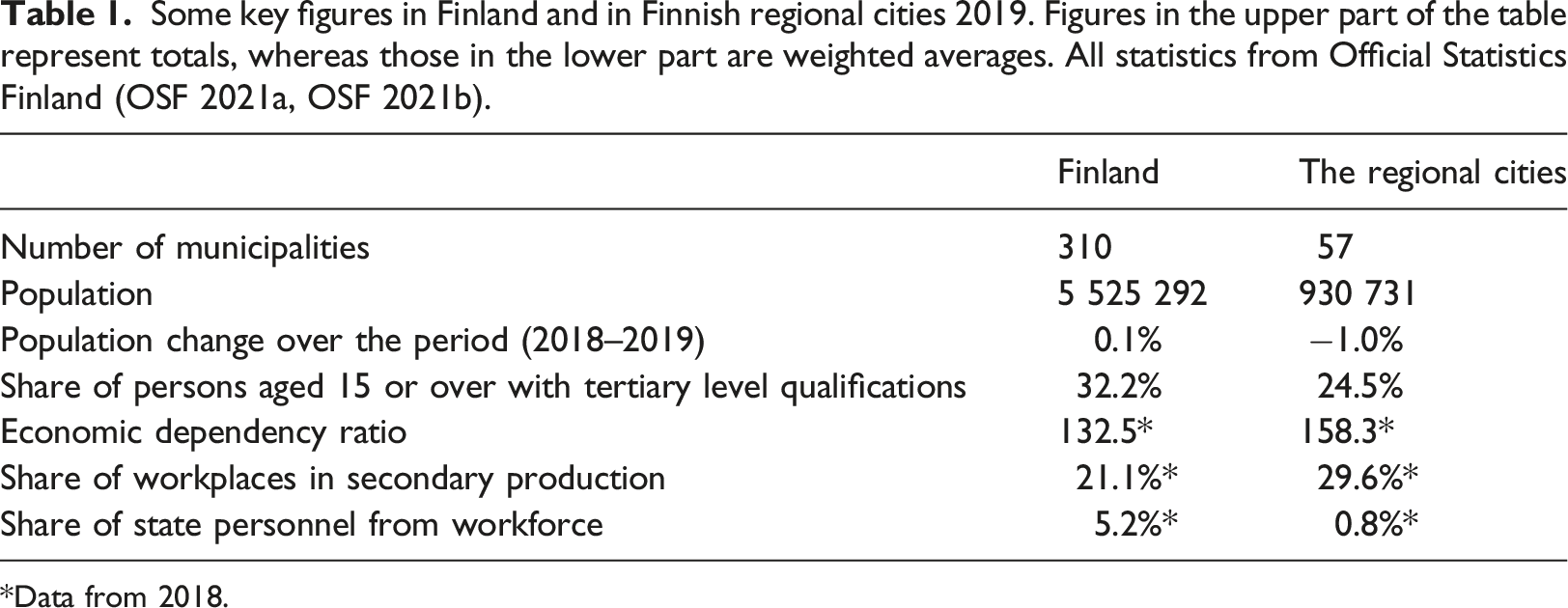
Data from 2018.
Moreover, the government does not engage in partnerships directly with an individual regional city, but interacts with the so-called Regional Cities Network (Seutukaupunkiverkosto), a semi-formal network formed in 2007 to promote the regional cities’ interests. Partnership procedures between the government and the regional cities network are, in addition, only vaguely articulated. The Regional Cities’ Programme does not outline what kinds of conventions exist in the partnership between the government and the network, nor does the programme outline the aims of the partnership approach.
The Finnish partnership policy and the regional cities
In this section, the interviews with the state officials (from here on: ‘the officials’) and the mayors of the regional cities (from here on: ‘the mayors’) are analysed separately and then compared. These diverse responses can be seen to revolve around five interlinked themes between the two groups, respectively. This section first lays down the thematically oriented arguments of the state officials, which are then compared to the similarly categorised arguments of the mayors before a brief analysis.
The partnership approach as a clear-cut and effective method
First, when asked about the general motivations behind the partnership policy, the officials considered it an important procedure to secure the strategic interests of the state. This statement reveals the centrally orchestrated nature of the policy and is informative in analysing the shortcomings of the deal making between the state and regional cities. These strategic interests that, according to the interviewees, are manifest, for example, in innovations, strategic investments and in reducing the obstacles to growth where necessary, are forwarded as the key justification to undertake selective policies within partnerships. These strategic interests were openly discussed by the officials during the interviews, but are not always officially laid down in writing nor found in government programmes. The argument goes that while the regions and municipalities are given responsibility over regional development, the government and state apparatus want to secure some specific processes that in one way or another are essential for wider political objectives. In a sense, the officials therefore emphasise the importance of the downward transfer of responsibilities as a way to produce regional growth (cf. Brenner and Theodore 2002), but steer the state’s focus on certain issues that largely constitute trajectories of knowledge-intensive capitalism (see Moisio 2018). One interviewee from the Ministry of Finance explains the securing of strategic interests of the state in this way: “The partnerships are based on a phenomenon-based approach and agreements (between the state government and municipalities). The partnerships are undertaken in order to tackle and manage large-scale phenomena. For example, the global connections unfold within the major city-regions, and the state must play a role in these connections.”
Second, the officials justify the peculiarities within the partnership policy by pointing to some financial restraints. A lack of resources is mentioned forcing the state apparatus to undertake selective policies to secure the productivity and effectiveness of state investments (cf. Pike et al. 2018). The argument here goes that if state participation and investments are spread too thinly across the state territory, the loss of investment effectiveness and subsequent underinvestment in strategic processes would harm the state’s overall national development goals. This becomes evident in how one interviewee from the Ministry of Economic Affairs and Employment argues for the need for selective policies: “The rationale for selective policies is based on the peculiar characteristics (of cities) which are evident in land-use, housing and transportation, and the growth-related challenges major cities face. The ranking is undertaken because if we give everything to every region, in a situation where the minor cities truly are small places, the value of what we could do would diminish.”
Third, especially when it comes to the case of regional cities, the officials refer to the partnership policy as “the management of regional interests”. In so doing, the officials highlight the number of regional cities (and other smaller municipalities) and their diverse needs and voices. By performing these partnerships with the regional cities network, the state apparatus is able to ‘contain’ their interests. This grouping of regional cities is, it is argued, able to crystallise the message, needs and situations of these cities in a series of easy-to-grasp bullet points instead of dealing with 57 individual and possibly differing voices. This again exemplifies how the partnerships are strongly guided by the state ministries and can be viewed in parallel with other processes of centrally orchestrated regionalism (see Ansell 2000; Harrison 2008). The official from the Ministry of Environment argues revealingly: “As we cannot create tailored [place-specific] policies, we must build categories. Probably these categories are not always so thoroughly considered or thoughtful, and the [representatives of] cities aren’t perhaps always aware of them.”
This statement gives away the managerial or task-oriented perspective of the partnership policy. By drafting programmes and forums for partnerships, the state further legitimises the regional cities as a meaningful spatial category. This hierarchisation and categorisation can be seen as technical strategies through which the participants aim at creating meaning for the deals in a situation where deal making is wanted but lacking in clear objectives.
Fourth, the officials quite straightforwardly admit that the partnership procedures carried out with the regional cities are in fact a way to exhibit equality among the different cities and networks in Finland. In comparison to city deals agreed with major Finnish cities, deal making with the regional cities’ association is essentially demonstrative policy-making. That is, similar narratives about equal partnership and cooperation are performed with the smaller cities in the same way as with major city-regions in order to maintain the illusion of regional equality and to fulfil the promises of the governmental programme (see Government of Finland, 2019). One official thus categorises the partnership with regional cities as a ‘soft version’ of those undertaken with the major city-regions. This can be read as a clear example of how spatial selectivity (see Jones 1997) is both performed and justified through institutional processes. Moreover, one interviewee indicated that the state government undertakes the partnership with regional cities in order ‘to fulfil their (the regional cities’) desire for interaction’, further indicating that the state government might not have similar needs for partnership procedures with the regional cities. That is, the state apparatus demands the partnership approach and deal making as the mode of interaction, but does not seem to have a clear strategy nor objectives for this interaction. The official from the Ministry of Finance puts it neatly thus: “We put more temporal resources into the partnerships with the major cities than with the others. To secure a strong image of spatial equality [between different cities and regions], we also note the others.”
Fifth, the officials argue that the partnership policy is a way to secure qualitative control over the process of urbanisation. By this, the interviewees indicate that the state can, when needed, participate in determining some qualitative aspects of development within growing city-regions, but also steer the growth to spatially favoured locations through deal making and infrastructure agreements. That is, the state utilises the partnerships to nurture the urbanisation potentials (see Moisio and Rossi 2020) of cities and regions as well as a kind of imaginary of highly skilled urbanism and its support by infrastructure and cooperation. When it comes to regions losing populations, among them most of the regional cities, the need for containing the qualities of urbanisation seemingly becomes a non-issue. As a growth-centric procedure, deal making with the regional cities consists of a constant search for actual content, as metropolitan-specific issues such as higher education, innovations and infrastructure investments are excluded from the negotiations. As an official from the Ministry of Economic Affairs and Employment puts it: “To secure first-class urbanisation, it is in order to select and order the places that genuinely urbanise.”
The narrative of proper or high quality urbanisation is repeated throughout the primary and secondary interviews. Quite often, this is associated with such themes as knowledge-intensive and innovation-led growth, density, public transport investments and sustainable development. The assumed regional urbanisation potential thus steers the mechanisms of deal making.
In short, the officials seem to have a rather straightforward outlook on the partnership approach. They do emphasise the approach as a key mechanism through which the state government is able to utilise local knowledge and transfer responsibility to the regions, as well as to secure strategic political interests. However, despite the arguments emphasising equality and local responsibilities, they also describe the partnership approach as a method of governance, as a system that enables the state government to undertake certain policies and retain power over regional development in Finland (cf. Harrison 2008). From the perspective of the officials, there seem to be no clear-cut objectives nor a strategy for the partnership with the regional cities.
The partnerships as positive, but fuzzy and incomplete mechanism
The mayors of the regional cities, however, often display a rather different and slightly more varied take on the aims, means and mechanisms of the partnership approach. In their argumentation, the approach is viewed as a rather fuzzy and elusive concept. Importantly, when the regional actors evaluate the partnerships, they in fact focus on analysing the acts and efforts of the state. Next, the arguments and considerations of the mayors are analysed through five notions, as was the case with the officials above.
First, despite the fuzziness of the concept, the mayors in general evaluate the partnership approach in a rather positive manner. In their account, the approach has yielded some positive outcomes for the regional cities and most notably has strengthened their position among the Finnish municipalities in terms of governmental recognition. The mayors report how they have gained access to the state and are being recognised in the form of recurring meetings, task forces and contacts with government ministers and members of the Finnish Parliament. They applaud how the informal arrangements and initial discourse has consolidated into somewhat more structured procedures. In general, the mayors indicate that the regional cities’ network has been able to magnify their message at the government level and that their specific problems and needs are ‘actually heard’ through the mechanisms of the partnership approach. As such, their position in the territorial competition has been enhanced. Some of the interviewees, however, indicate that due to the fuzziness of the concept, they do not have a clear picture of how successful the approach has actually been. The following citations show that despite initial optimism, the mayors also see problems with the partnership. One mayor from the North Ostrobothnia region argues: “We now sit at the right tables with the state [ministries] and the role of the regional cities is recognised. We [regional cities] are now understood as a spatial entity and we have representation in all crucial policy-making arenas concerning cities and urban development, except for the agreements on land-use, housing and transportation and other such deals.”
Another mayor from North-eastern Finland is optimistic about the future of the partnerships: “We have achieved close connections [with the government], and the Regional Cities Programme was a good thing. We gained recognition and leverage in policy-making. It is still hard to point out what we have achieved, but for example, the members of the Parliament have started to recognise us and talk about us. Achievements or wins can’t be yet listed, but it is the long-term work that is meaningful, and we’ll see what happens then.”
Second, the Mayor’s emphasise that the partnership approach undertaken with the regional cities network has dual benefits. In addition to the above-mentioned gains in direct channels and dialogue, the network has created a meaningful arena of peer support and mutual learning for the regional cities. The mayors point out that the partnership approach brings the cities together not only vis-à-vis the state government, but also facilitates important day-to-day operations and cooperation. A mayor from southern Finland gives an example of cooperation within the network: “Take for example the consultation rounds for the governmental law proposals. The small municipalities are not heard (by the government) and their statements are useless. In a small city like ours, it is also quite a workload to draft responses to these proposals. Through the regional cities network we are able to share the burden and to coordinate joint statements […] for example we split into smaller groups, some have responsibility over labour market questions, others over social services, etc.”
Therefore, both the officials and the mayors agree that the grouping of the regional cities in the partnership policy has obvious benefits, albeit from different perspectives. In fact, the network cooperation of the regional cities executes directly the conclusions of the Implementation Programme of the Regional Cities Programme (Ministry of Economic Affairs and Employment 2020). From the perspective of the state at least, perhaps some wider objectives are thus met.
Third, despite being somewhat optimistic about the partnership process and its outcomes, the mayors generally remain unsure in relation to the longer term aims of the approach. In other words, they have no clear picture of the differing interests and strategic alignments of the state government when it comes to the regional cities. The demonstrative or empty nature of the deal making process becomes increasingly evident in the lack of real objectives, monitoring or evaluation for these partnerships. The mayors are aware of the selective core of the government’s partnership approach and argue that despite the increased level of interaction, the government has not indicated what kind of role or status has been envisioned for the regional cities as part of the development of the state territory. This reinforces the image of how the partnership policy and new institutional arrangements are spatially contingent and differential (cf. Jones et al. 2005). The following citation from a mayor from Southwest Finland depicts the magnitude of distrust over the state’s broader strategies and the role of smaller cities within them: “I do not know what the government aims are in terms of development policy, nobody seems to know! And the political parties have made no alignments whatsoever. The current government recognises all regions in their programmes, but does not clearly indicate its regional aims or strategies. There is a lack of spatial vision!”
Fourth, the mayors indicate that the interaction between the government and different cities is not equal despite the equalising narrative of the partnerships. Practically, all mayors agree that the prioritisation of the major city-regions in terms of investment and infrastructure agreements is sometimes justified, but criticise the lack of similar investment agreements as a severe hindrance for the regional cities. That is, the mayors legitimise the government’s selective city-regional policies (see Moisio, 2018; Moisio and Rossi 2020) but call for selective policies of their own. This analysis reinforces the image that while deal making is designated as the aim and mode of regional policy, the state has difficulty in coming up with or agreeing upon on content for these deals. The spatial selectivity can here be seen as working in reverse, excluding certain spaces from what is regarded by the mayors as common and needed. From their perspective, deal making should culminate in infrastructure investments (cf. O’Brien and Pike 2015), but the officials are adamant that these are reserved for major city-regions. A mayor from North Ostrobothnia puts it thus: “The cities are put in clear castes! Which is not invariably a bad thing, as the government must target its investments for profitability. But the viewpoint of the industry is not a part of these evaluations. For example, transport investments, these would support our competitive advantage and GDP growth. In my evaluation, they should be more important than supporting housing.”
They then go on to provide a clear example of the bargaining process: “We asked the Ministry about the investment agreements, like the major cities have. Their response was that these are only undertaken with “the big ones,” and all the rest just keep coming here and asking for their own. So, they didn’t say “no,” but indicated that if they would give us something, they needed to address all the others (regions, smaller municipalities etc.) as well.”
Lastly, the above-mentioned notions more or less boil down to the fifth observation. The Mayors indicate that despite emphasis on the equality of the two partners, the dynamic cannot escape the hierarchical status of the two. That is, a kind of rhetoric-reality gap seems to exist (see Ayres et al., 2018) when it comes to how partnerships are depicted in common formulations and how they are manifest in practice. Despite somewhat neutral or mixed attitudes towards the partnerships, the Mayors are unambiguous when it comes to the actual orientation of the power structures within the policy. The government is often depicted by the mayors as a resource-pool, or as a manager of regional interests. The interviewed officials also recognise these claims. In this sense, the partnerships are reduced to a territorial competition over governmental funding, a situation where institutional hierarchies are reinforced rather than diminished. As such, the partnership policy is a clear example of how the state retains its authority despite the narratives emphasising decentralisation (see, e.g. Pike and Tomaney 2009). Another interviewee from South Ostrobothnia region puts it like this: “Equal partnership [between the government and regional cities] is what is aimed for, but it is not [yet] realised. Nobody expects us to be equal in all aspects but we could have proper forums and could address some issues equally.”
The partnership approach as speaking at cross-purposes
An outline of how the different parties treat the partnership approach in regional development.
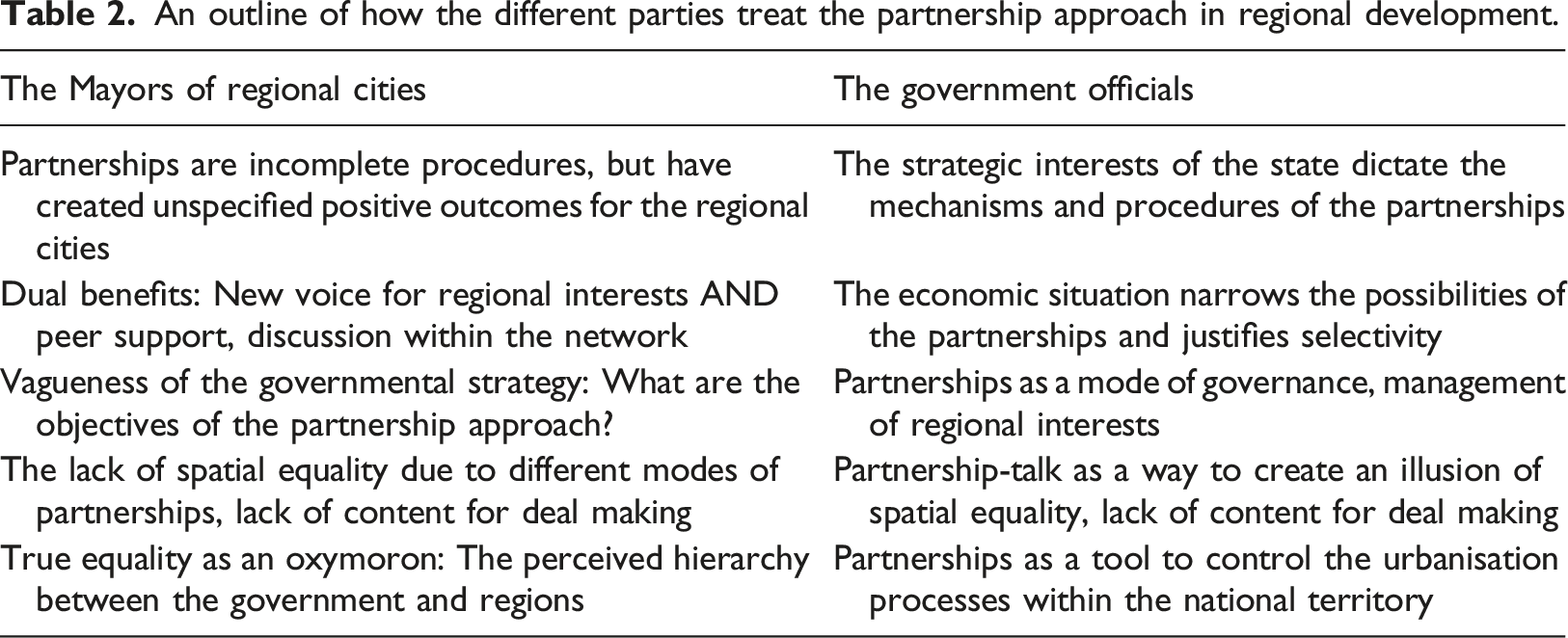
Further, this categorisation in itself and the imaginaries attached to the regional cities seem to justify selective policies. The state officials repeat how the partnership policy is a way to secure ‘the strategic interests’ of the state government. These interests are identified as securing competitive and qualitatively positive urbanisation, regional innovation capabilities, learning and international competitiveness, but also, for example, tackling of societal challenges in growing cities and securing sustainable development goals. These strategic interests, according to the officials and sometimes also to the Mayors, are not met within the kind of spatial category the regional cities represent. The official from the Ministry of Environment argues: “The idea is to act more efficiently to promote the common good. The [Helsinki] metropolitan region is the most obvious area of special attention, but there are others as well. We made an alignment that not all development must be metropolitan-specific, but that the large size [of the city-region] can justify something. The some policies should not be introduced in Lapua [a small city], but there are reasons why it is only carried out here [the Helsinki region]: we manage and control the so-called urban-specific phenomena and growth-related problems.”
This citation displays how partnerships as the mode of regional policy are understood and institutionalised with major city-regions in Finland, but relegated to mere discussions followed by an anguished search for purpose in relation to the smaller cities. Much of this could be explained by pointing to the above-mentioned strategic, growth/urbanisation-centric interests of the state. More broadly, it seems that the Mayors’ analysis of the state as lacking a clear (or indeed, any) spatial strategy for non-metropolitan regions to be somewhat accurate. Nevertheless, the two parties use time and resources to create a meaningful, and somewhat appreciated system of cooperation. The partnership policy however runs into trouble on multiple fronts in addressing the questions of declining regions within an urbanising state, and thus play out as a (series of) policy failure(s) and non-deals (cf. Jones 2019). As such, these partnerships quickly become demonstrative, implementable policy in name only, where dealmaking retains its central status as a mode of interaction and central aim despite the existence of real content or progress.
There are four interrelated notions that constitute no-deals in Finnish partnership policy. First, the deal making in these situations lacks clearly defined objectives and outlines. Second, the absence of broader spatial strategies beyond the urbanising centres and other select spaces complicates the process of finding purpose and mutual benefits for the partnerships. The post-Fordist urbanisation or ‘metropolitanisation’ as a state territorial strategy (see Luukkonen and Sirviö 2019) leaves open the question of what to do with such regions that do not match this imaginary or possess certain perceived potentials. Third, the deals are also lacking in terms of funding. Earmarked resources for state – regional city partnerships are scarce and mostly allocated through competitive mechanisms to individual development projects. Fourth, the deal making process in general displays a strong connection to infrastructure investments (cf. O’Brien and Pike 2015, 2019) and growth-centric policy. In contrast to major city-regions, the regional cities are seen as lacking the material or strategic need for new investments by not displaying notable growth, urbanisation or competitive capabilities.
To summarise, the interviewed Mayors’ emphasise that despite paying increased attention to their problems and needs in the context of the semi-institutionalised partnership practices, the state government does not seem to have a clear vision of what, in practice, to do with these regions. The regional development needs of regional cities, as explained by the Mayors, primarily relate to road infrastructure, vocational and applied sciences education and industrial capabilities more generally. The state’s strategic focus on controlling and developing the urbanisation potentials however effectively disregards the needs of these regional cities, as the strategic interests of the state and regions do not coincide. In this sense, these regional cities can be seen as being reduced to places from the past within the state, which aims to develop itself through support for a knowledge-intensive and innovation-led economy (Moisio 2018). The regional cities are not seen as competitive in this regard. These regional cities have been consolidated as a group with a strong industrial imaginary which affects their positions within regional development policy and more generally within the politics of urbanisation by marking them as regions of the past and thus as ‘unwanted’.
Conclusions
The Finnish partnership approach is constituted by fuzzy dialogue and loosely structured procedures. Importantly, the partnership approach is manifest in a wide array of different outcomes and policies in different regions. Partnerships are clearer, structured and institutionalised in city deals when it comes to major city-regions (cf. Moisio, 2018), and fuzzier and only vaguely articulated when it comes to minor centres like regional cities. The vagueness and experimental nature of the policy leads to a situation where the differential outcomes are both legitimised (when it comes to major city-regions) but not thoroughly addressed (when it comes to smaller cities) within the political narratives.
Therefore, as deal making is solidified as the mode of performing regional development, it effectively contributes to territorial disparities in two incremental ways (see Waite and Morgan 2019). First, clear and measurable progress is witnessed in major city-regions in terms of their institutionalised city deals. Second, the deal making process fails systemically to address the problems and regional development needs of non-metropolitan areas which cannot offer something specific or strategic in return in order to secure similar deals. Whereas, the major cities are celebrated as the national economic champions (Crouch and Le Gales 2012) of the knowledge-based economy (Moisio 2018), the state does not seem to have a clear vision for the smaller cities. This is clearly manifest in the rhetoric of decentralisation and partnership without the actualisation of deals, despite the existence of some, often scarce, experimental or competitive funding for individual projects. As such, the mode of deal making in itself is transformative, selective and hierarchical. The problems of deal making depict how the state fails in imagining a role or purpose for non-metropolitan or non-competitively evaluated places. In such places, a partnership without clear or shared aims manifests itself in non-deals, a constant search for content or any real strategy to develop these regions.
The existence of non-deals exemplifies the problems of state transformations in contemporary urbanisation-centric settings. The strong political voice and leverage of regions demands a measure of equity in terms of regional treatment in relation to governmental programmes. However, the urbanisation-centric political institutions are, in practice, producing rather differential and selective outcomes. The will to develop ‘old’, waning industrial places fails when tools and policies are drawn solely from ‘new’, post-Fordist, knowledge-intensive spatial imaginaries. As a result, the state – local hierarchies are being reproduced and highlighted, despite institutions that emphasise the equal status of the two.
While deal making has gained traction globally in territorial policy (see, e.g. Van der Zwet et al. 2020), this article shows how the possibility of non-deals is a constitutive element within this kind of a system. While deal making is used to advance the state strategies to develop certain forms of knowledge-intensive and growth-centric urbanisation, but is also emphasised as a tool to work with different kinds of places in general, the urbanised or urbanisation-centric political institutions are the key element in respect of policy failure in non-growing regions. This leads to demonstrative policy-making and to the forlorn search for a reason for the policy itself. Within the context of demonstrative policy-making, the state allocates time and resources to facilitate, sustain and evaluate the partnership process without providing actual or measurable content. The selective city regionalism and the strategic status of urbanisation (see Moisio and Paasi 2013; Jonas and Moisio 2018; Moisio 2018) becomes evident in how the city deals and non-deals are negotiated and justified with different spatial categories.
In effect, the institutional change of the state vis-à-vis the regions can be interpreted as constitutive forms of the politics of urbanisation and the construction of post-Fordist state spatialities. Interestingly, the interviewed state officials evaluate the needed policy through the abstract evaluation of the regional or city-specific urbanisation capacities. Urbanisation as a phenomenon creates an important framework for the partnerships and justifies the need for them in the first place. Urbanisation is regarded as a process that the state must somehow control and manage and the partnership policy aims at nurturing the development and qualities of urbanisation in Finland. In this sense, the partnership policy, institutional transformation and non-deals can be analysed as parts of a wider political process where urbanisation both affects national politics and policy-making and is, in turn, affected by them.
Footnotes
Declaration of conflicting interests
The author(s) declared no potential conflicts of interest with respect to the research, authorship, and/or publication of this article.
Funding
The author(s) received no financial support for the research, authorship, and/or publication of this article.
Note
Author Biography
 ). Soininvaara’s doctoral thesis addresses the politics of urbanization as constitutive form of post-Fordist state spatial transformations. Before, Soininvaara has studied for example the languages and narratives within the politics of urbanization, as well as spatial hierarchies within the urbanizing nation–state.