



Abstract
Social inclusion frameworks to enhance ‘diversity’ inform late neoliberal municipal governance in North American metropolitan areas, especially in central cities, but suburban LGBTQ2S constituencies are neglected by researchers. This paper, therefore, uses linguistic discourse and content analysis of an LGBTQ2S-inclusion archive of municipal public-facing communication in the Canadian peripheral municipalities of Burnaby, New Westminster, and Surrey, in the Vancouver city-region to trace the micro-patterns of linguistic ambivalence shaping suburban sexual citizenship. It demonstrates municipal variance in vernacular vocabularies of LGBTQ2S social inclusion that signals equivocation within divergent local linguistic political opportunity structures for suburban sexual and gender minorities. It concludes with a typological narration that details varied gradations of linguistic obfuscation, revealing patterns of civic ambivalence towards LGBTQ2S social inclusion amidst suburban diversity. Across a shared regional geography, the paper shows that LGBTQ2S populations are infrequently referenced relative to other marginalized social groups and that their presence in social inclusion frameworks is dictated by the extent to which they align with civic priorities, particularly festivalization and marketization, but also safety, welcoming newcomers, integrating seniors, and anti-discrimination initiatives.
Introduction
Public plans, policies, and strategies are commonly understood as a trajectory of purposive action through which political institutions – “structures exercising state authority in accordance with embedded values” – shape society (Tuohy, 1992: xvii). Like laws and rules, municipal plans, policies, and strategies are localized technologies of power central to governance that guide its priorities (Cooper and Monro, 2003). Municipal governance frameworks promoting ‘diversity’ have become increasingly commonplace (Valverde, 2012), strategically marketable “signifier[s] of everything and yet nothing” (Morrish and O’Mara, 2011: 974). As a mainstay of contemporary neoliberal municipal governance, diversity seeks to “capitalize on and gain from a context of differentiation” (Jones, 2011: 163) but often erases the most disempowered and non-commodifiable bundles of difference at the expense of intersectionality. While civic leaders may acknowledge the ‘diversity’ of their cities, as this paper shows, diversity paradigms frequently recognize “a simple plurality, a harmonious juxtapositioning” that inadequately appreciates the interrelations that mutually construct its different elements (Massey, 2007: 88). Thus, “problems of difference, among a host of axes of difference” may be elided, fostering a disconnect between diversity as an institutionalized discourse and the frictions that play out in everyday life (Ettlinger, 2010: 54).
Municipal social inclusion frameworks are a mechanism to enhance the participation of marginalized populations in governance (Fincher et al., 2014). Although much Lesbian, Gay, Bisexual, Transgender, and Queer (LGBTQ+) ‘equalities’ legislation is national (Browne et al., 2019; Gorman-Murray, 2011; Hubbard, 2013), the ‘diversity turn’ that seeks to integrate LGBTQ+ constituencies into municipal social inclusion frameworks of large metropolitan areas is often limited to central-cities (Cravens, 2015; Murray, 2015). Much less is known, however, about Lesbian, Gay, Bisexual, Transgender, Queer, and Two-Spirit (LGBTQ2S) 1 social inclusions in suburban North America, where the majority of an increasingly diverse population actually lives (Grant, 2009). Historically, suburbs have been interpreted as places where “narratives of conservatism overwhelm those of inclusion” (Niedt, 2013: 1), especially the grassroots social movement politics associated with LGBTQ+ activisms (Lichterman, 1996). Initially built to house heterosexual nuclear families, suburban local government focuses on managing development through the techno-production of its infrastructure (Grant, 2009), often at the expense of the social planning required by its diversification. Composed of a set of independently governed locales with different political opportunity structures, the suburban periphery potentially shelters great spatial variance in the social inclusion of sexual and gender minorities (Smith, 2005). Political opportunity structures are the “consistent – but not necessarily formal, permanent, or national – dimensions” of political contexts that can afford ‘opportunities’ for political mobilization (Tarrow, 1998: 8). In a municipality, they can be created through: the bureaucratic partitioning of government responsibilities; funding by departments and advisory committees; and the establishment of plans, policies, and strategies. A municipality’s keyword vernacular vocabulary of social inclusion as revealed through its public-facing communication channels variably structures its linguistic political opportunities for social inclusion (Statham and Tillie, 2016).
This paper focuses on the language of LGBTQ2S municipal social inclusion in the Canadian peripheral municipalities of Burnaby, New Westminster, and Surrey within the Vancouver city-region. Language has the power to shape subjects, construct knowledge, and define who is either the same or different (Foucault, 1978). In municipal governance, Statham and Tillie (2016: 182) have shown how discursive political opportunity structures are shaped through public debate, generating more “public visibility and legitimacy to certain behaviours, opinions, and expressions while marginalising or stigmatising others”. With specific attention to the LGBTQ2S vocabulary as it co-occurs with social inclusion keywords in municipal records, this paper draws upon Carolyn Tuohy’s (1992) concept of “institutional ambivalence” to demonstrate how gradations of linguistic equivocation within diversity paradigms have different and uneven municipal manifestations. Ambivalence describes the state of having mixed feelings or contradictory ideas, while equivocation signals the use of ambiguous language to avoid committing oneself. For Tuohy (1992: xvii), “[w]hat appears distinctive about Canadian institutions is their extraordinary capacity to embody conflicting principles within structures ambiguous enough to allow for ad hoc accommodations over time” – what she has called “Canada’s ‘institutional ambivalence’.” While Tuohy (1992) interprets Canadian federal policy as legitimizing competing principles by valuing coexistence and accommodation, prioritizing the federal-provincial dynamic within policy arenas like health and labour relations, this paper chooses a different field where divergent interests are aggregated – municipal social inclusion, and, more particularly, the inclusion of sexual and gender minorities. Despite the inclusion of sexual and gender orientation in federal and provincial human rights legislation in Canada, municipal governments have not consistently integrated policies, plans, and strategies for including LGBTQ2S populations, creating scalar tensions and, ultimately, gradations of ambivalence.
The paper argues that the public records of each municipality exhibit varied gradations of linguistic ambivalence regarding the social inclusion of sexual and gender minority suburbanites leading to linguistic obfuscation – rather than clarification or specificity – of LGBTQ2S stakeholders in suburban diversity paradigms. Peripheral municipal discourses are distinct, however, yet a general pattern of festivalization and marketization is apparent, that fails to fully appreciate the heteronormativity of social and economic policies. The argument is unpacked across four sections beginning with a review of the sexual citizenship, social inclusion, and suburban municipal governance literatures. Next, it describes the project’s mixed methods data collection strategy that combines the quantification of content analysis with the qualitative elements of linguistic discourse analysis. The fourfold empirical section documents civic ambivalence through the variable presence of LGBTQ2S populations and themes in municipal public-facing communication. The concluding discussion considers the utility of linguistic ambivalence as a means to appreciate the specific location of LGBTQ2S constituents in Canadian suburban municipal social inclusion frameworks.
Sexual citizenship, social inclusion policies, and suburban municipal governance
In contemporary liberal democracies, the state is understood as a complex set of institutions that work in a dynamic, but sometimes contradictory, relationship with the economy and civil society to condense, guide, and promote particular interests and norms (Cooper and Monro, 2003). Under neoliberalism, state restructuring has realigned governments with the priorities of private investors, businesses interests, and more recently the “creative class” (Florida, 2002), over political visibility and collective responsibility for the needs, rights, and care of marginalized social groups. Robust Marxist, feminist, and queer critiques of Florida’s (2002, 2005) policy-resonant and divisive creative class thesis have revealed its inherent homonormativity, whiteness, and classism (e.g., Muller Myrdahl, 2011; Oswin, 2012; Parker, 2017; Peck, 2005). By now, it is clear that the “creative turn” in urban governance has distorted policy priorities and deepened inequalities (Parker, 2017). Furthermore, cities that privilege neoliberal ideologies of competition, consumption, and individualism often commodify and marketize ‘difference’ in place-branding, opportunistically leveraging diversity in ways that foreclose enhanced social inclusions. Promotional frameworks may deploy municipal “social landscapes” to “emphasize the entrepreneurial and cosmopolitan dimensions of the contemporary city over community needs and problems” (Paganoni, 2012: 15). When urban social inclusion policy is enveloped in, and dictated by, creative city diversity branding, it limits potential alternatives, particularly for marginalized groups.
Social inclusion, however, must be held in tension with its more critical counterpart – social exclusion – which emerged in the closing decades of the twentieth-century as state welfare and collective consumption infrastructures were reconfigured, featuring prominently in policy discourses in Europe and the United Kingdom. Defined as a multi-dimensional process through which individuals or social groups are disaffiliated to some degree from the societies in which they live (e.g., exclusion from citizenship rights, labour markets, civil society, and social arenas) (Gerometta et al., 2005), social exclusion gained global policy traction, influencing analyses of social disadvantage and focusing attention on the “problems and deficits of those labelled ‘excluded’” (Cameron, 2007: 397). Yet, in its identification of barriers to participation, social exclusion also pathologized and responsibilized ‘the excluded’ to address their own problems and “became the datum point against which social inclusion is both empirically measured and conceptually defined” (Cameron, 2007: 397). Social exclusion and social inclusion, then, exist in a complex and dynamic interrelationship. Interpreting social inclusion through the lens of Tuohy’s (1992) institutional ambivalence, sees its expression in the exclusion of individuals or social groups in one domain and their simultaneous embrace in another. The inclusion/exclusion binary is also “an exercise in normative boundary setting – a means of distinguishing between a form of social being characterized by normality, morality, responsibility, independence and competitiveness” and that “marked by difference, redundancy, pathology, immorality and obsolescence” (Cameron, 2007: 401).
Where LGBTQ+ citizens fit into municipal social inclusion policies, however, remains unclear. Historical accounts of the regulation and repression of LGBTQ+ people in urban space implicate various agencies of municipal governance, but the limited literature on more recent urban governance is varied and includes electoral processes (Bailey, 1999; Brown et al., 2005), municipal anti-discrimination ordinances (Chapman, 2011; Fejes, 2008), the regulation of gay sex premises and spaces (Brown and Knopp, 2016; Prior and Crofts, 2011) alongside interventions on queering urban planning (Doan, 2015). The incorporation of gay village districts and pride celebrations into the redevelopment and tourism strategies of neoliberal municipal regimes (Bell and Binnie, 2004; Collins, 2004; Nash and Gorman-Murray, 2015) has long been a focus, with attention to the pivotal role of municipal business improvement associations (Gorman-Murray and Nash, 2017; Nash and Gorman-Murray, 2015) in shaping a corresponding “homo-entrepreneurial” ethos (Kanai and Kenttamaa-Squires, 2015).
Some of the earliest research examining the intersections between LGBTQ+ activism and the local state, was Brown’s (1994) study of how HIV/AIDs activists reshaped politics in Vancouver, and British scholarship on how activists made use of the “New Left’s” “equal opportunity” policies to promote the interests of gays and lesbians in local councils. The interface between municipal governments and LGBTQ+ activists remains a critical area of study (Browne and Bakshi, 2013; Cooper, 2006; Cooper and Monro, 2003; Richardson, 2005). In light of these greater “equalities” some scholars consider the extent to which national anti-discrimination legislation and civil rights recognitions, such as same-sex marriage, have unevenly filtered down to municipal governments (Cooper, 2006; Cooper and Monro, 2003). In this vein, Cooper and Monro (2003) provide an important examination of sexuality’s structural relationship to local government in their study of British municipal authorities who, between 1990 and 2001, took up the “controversial… sexuality agenda”. They determine that laws resourcefully structure local political agency by requiring the pursuit of gay and lesbian equality, but given how inconsistently embedded these laws are in governance structures and processes, individual “champions” remain important change agents. Related scholarship by Richardson (2005) draws attention to the ways that governance may produce normative sexual subjects through multiple forms of “professionalization” that see activists and community groups adjust to neoliberal agendas in order to secure funding and advance their cause.
Within city-regions, it is large central cities that are publicly heralded as hubs of policy innovation and service and resource provision for marginalized communities and it is their peripheries that are framed as playing ‘catch-up’ or ‘me-tooism’ (Grabher, 2018). Summarized in detail elsewhere (Podmore and Bain, 2020, 2021), a rich Anglo-American-Australian suburban studies tradition has inspired Canadian scholarship on suburban governance, but it prioritizes a political economy perspective to the neglect of the agency of residents and the social politics of suburban communities (e.g., Ekers et al., 2012; Filion, 2015; Filion and Kramer, 2011; Grant, 2009; Hamel and Keil, 2015). In this scholarship, heterosexuality is taken for granted – it is unnamed and unmarked – with the unstated assumption of a “straight state” (Canaday, 2009). Certainly, suburban scholars consider pressing political problems such as redistribution, sustainability, and racialized segregation (e.g., Filion, 2015), but sexuality is in abstentia. Scholarship from elsewhere, however, shows that “heterosexual norms and practices permeate local government’s internal culture, relations with citizens, and regulatory practices, as well as its policies and conduct” (Cooper and Monro, 2003: 248). If diversity governance is reflected in contemporary catchwords like ‘participation,’ ‘engagement’, and ‘outreach’, equally important is what is said about marginalized populations, where it is said, and how such language informs the vernacular vocabulary of social inclusion.
Reading suburban social inclusion into municipal public-facing communication
If municipalities are understood as the formal institutional “upperground” wherein procedural and interpretive authority resides (Cohendet et al., 2010), from a social constructionist perspective, urban plans, policies, and strategies are a “codebook” – a shared system of social meaning – within the administrative state to build a common knowledge base facilitating public understanding (Fischer, 2003). With their particular vocabulary, urban plans, policies, and strategies stabilize language and contribute to the embedding and reproduction of dominant group interests within the political agenda. For Fischer (2003: 56), “political language is in important ways political reality itself”; its potency comes from how it linguistically frames the world.
This paper uses linguistic discourse and content analysis of municipal public-facing records to understand where and how peripheral municipalities in Vancouver linguistically signal LGBTQ2S inclusions through vernacular keywords. In the tradition of Raymond Williams (1976), keywords are “semantically flexible” but deeply socially meaningful terms whose symbolic associations shift over time according to purpose and speaker. Within municipal social inclusion frameworks, keywords, adapted by local actors, articulate their unique civic brand of social inclusion. As Valverde (2012) demonstrates in her critique of the power relations of the creative city, grassroots calls for a more “diverse city” have been coopted through symbolic association between “diversity” and “tolerance” that elide a distaste for discrimination. Such articulations are part of a complex set of public-facing mediations between civic leaders, municipal departments and committees, and local para-public and community activists around who, how, and upon what terms constituencies are included in municipal governance. Sexual and gender minorities are frequently under-represented in and by such governmental bureaucratic frameworks, constraining the vocabulary used to represent their interests in the ensuing local linguistic political opportunity structures they create. By attending to gradations of linguistic ambivalence within public records regarding the social inclusion of sexual and gender minority suburbanites, this paper reveals the micro ways in which linguistic obfuscation – rather than clarification or specificity – can shape suburban sexual citizenship and erase its intersectional complexity.
As part of a larger research project on the everyday lives, activisms, and governance inclusions of suburban LGBTQ2S Canadians living in municipalities on the peripheries of Montreal, Toronto, and Vancouver (Bain and Podmore, 2021),
2
this paper focuses on three Vancouver city-region suburban case studies (Burnaby, New Westminster, and Surrey) which were chosen for the density of LGBTQ2S residents, activism, and print-media representation (Figure 1). These suburbs have a relatively high proportion of suburban same-sex households in the Census Metropolitan Area (CMA), with Burnaby, New Westminster, and Surrey constituting 16.1, 13.5, and 18.2 percent respectively (Statistics Canada, 2017). They are also notably different in terms of their population size, demographic composition, and land area, but are all located on the unceded territories of the Coast Salish people – including the QayQayt (Kee-kite), Kwantlen (kwaant-luhn), Katzie (KUT-zee), Kwikwetlem (Kway-quit-lum), xʷməθkʷəýəm (Musqueam), Semiahmoo, Tsleil-Waututh (Slay-wah-tuth), Sḵw
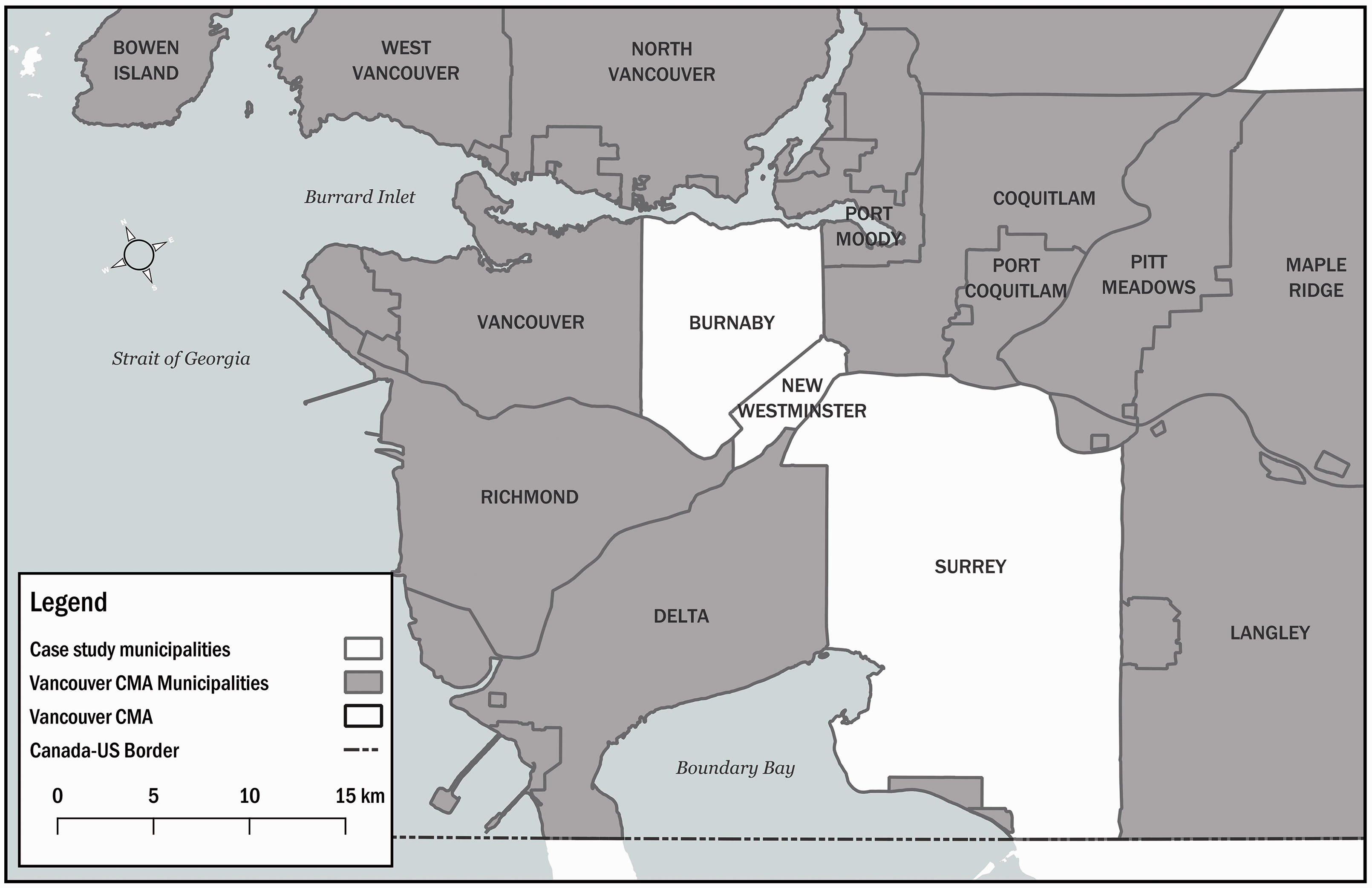
Map of case study municipalities in the Vancouver City-region.
An archive of civic LGBTQ2S social inclusion elements was built for each suburban municipality by collecting all civic records addressing sexual and gender minority citizenship. Municipal websites were treated as public-facing communication channels and searched using the keyword function to identify specific mentions of various iterations of the LGBTQ2S community within council and committee minutes, departmental reports, and plans, policies, and strategies. All documents were retrieved from a sampling frame of the three city websites as of May 2020 and the results from these queries formed an archive containing LGBTQ2S references. The result was a dataset of scattered instances when LGBTQ2S people and issues are explicitly named in municipal records.
The resulting LGBTQ2S municipal archive is geographically coherent, yet place-specific and temporally sequenced. This paper uses mixed methods, combining linguistic discourse analysis with content analysis to document the location, type, and quantity of the language used to describe sexual and gender minorities, and their relative positioning within social inclusion frameworks. To interpret where LGBTQ2S constituents are positioned within the vernacular vocabularies of social inclusion, documents were classified according to municipality, year, and government actor (Table 1).
Municipal Documents Referencing LGBTQ2S Themes and Populations (Council and Committee Minutes, Departmental Reports and City Plans, Strategies and Policies) in Burnaby, New Westminster and Surrey, 1995–2020.
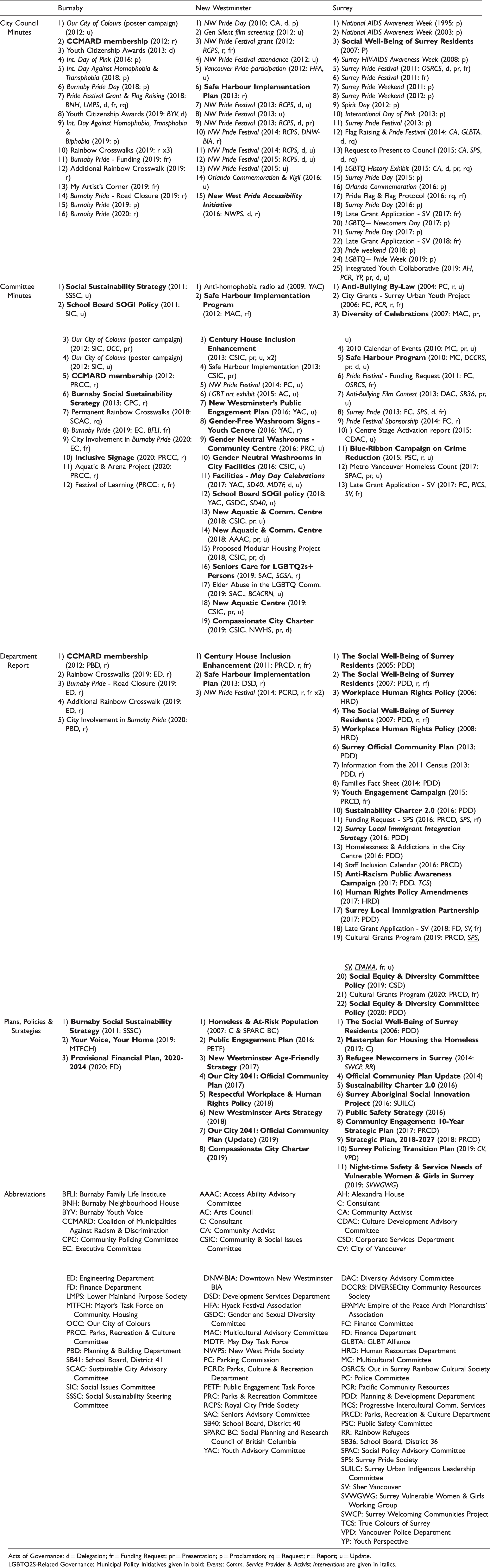
Acts of Governance: d = Delegation; fr = Funding Request; pr = Presentation; p = Proclamation; rq = Request; r = Report; u = Update.
LGBTQ2S-Related Governance: Municipal Policy Initiatives given in bold; Events: Comm. Service Provider & Activist Interventions are given in italics.
Textual segments referring to LGBTQ2S populations and themes were then both qualitatively and quantitatively analyzed using a four-fold strategy. Linguistic discourse analysis identified, extracted, and interpreted the portions of text referencing LGBTQ2S populations in co-occurring relation to a document’s language of social inclusion. Keywords were then inductively identified, selected, and quantified from these segments and the wider document for the content analysis (a sample of n = 20,384 keywords). The quantification of directed content analysis permitted the tracking of the “multiplicity, variety, instability, and historical contingency” of the language of social inclusion and its document-wide co-occurrence with LGBTQ2S references (Feltham-King and Macleod, 2016: 5). A two-part condensing of keywords occurred, grouping words with similar roots and meanings together and then isolating LGBTQ2S topics, events, and identities, culminating in 20 clusters of social inclusion terms (Table 2).
Word Frequencies and Goodness-of-Fit Chi-Square results for Selected Social Inclusion Themes Related to LGBTQ2S Content in Council, Committee and Department Minutes, and Planning Documents for Burnaby, New Westminster and Surrey (1995–2020).
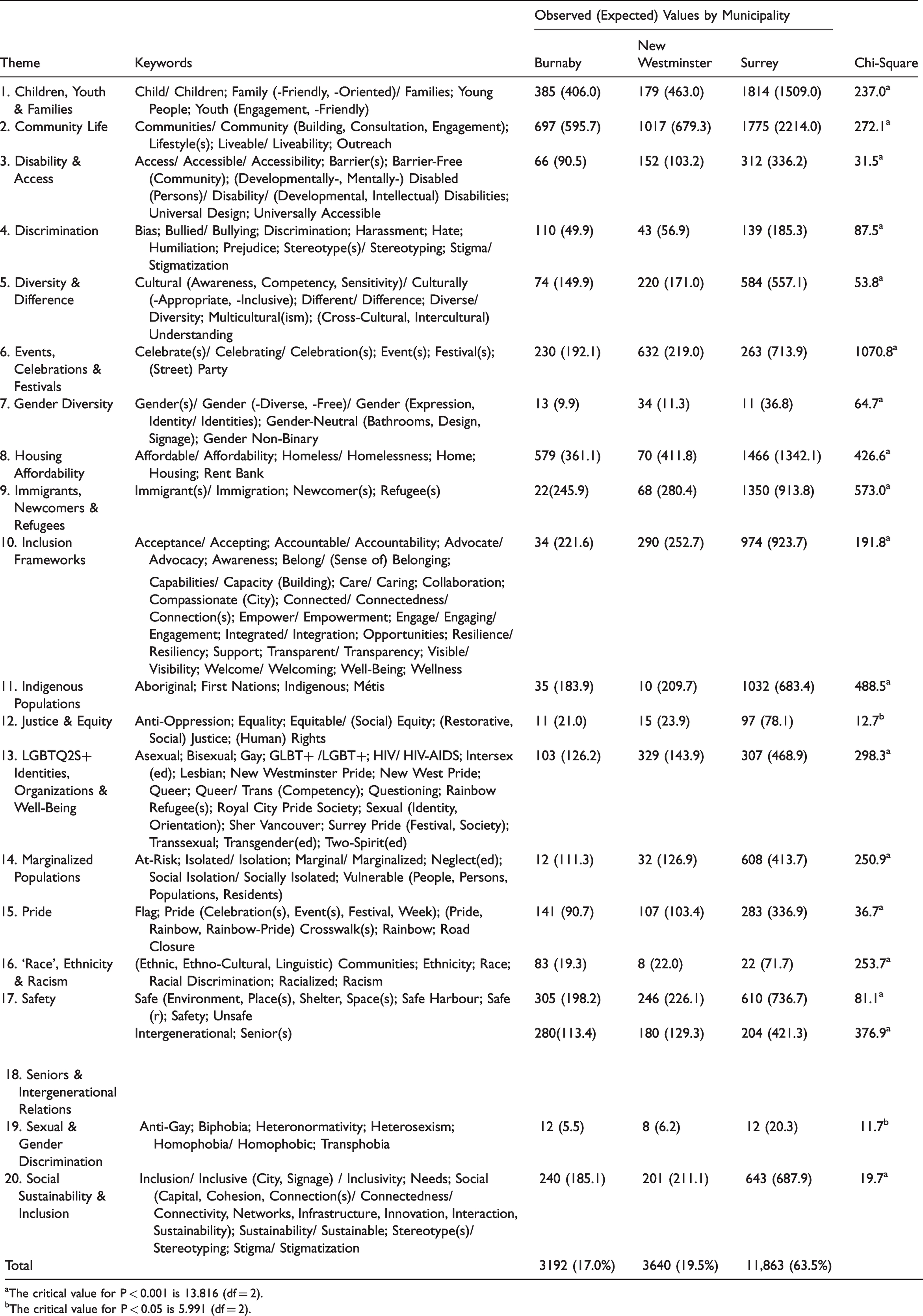
The critical value for P < 0.001 is 13.816 (df = 2).
The critical value for P < 0.05 is 5.991 (df = 2).
To compare the frequency and relative significance of the selected keywords and prioritized social inclusion identity groups across each of the case studies, two statistical tests were conducted. First, a chi-square (χ2) “goodness-of-fit” test with 2 degrees of freedom (df = 2) was run for the 20 clusters to identify the municipal variation in their observed and expected frequencies so as to create a vernacular discursive portrait of the LGBTQ2S linguistic political opportunity structure available in each suburb. The clusters were disaggregated into component parts, and the top twenty words from the keyword database were selected and illustrated using Excel treemaps in order to illustrate different city discourses. Representing each social inclusion keyword as nested proportional rectangles, the treemaps permit the visualization of their relative frequency in the database. Second, to identify who is involved and included as part of the sexual and gender non-normative constituency, all LGBTQ2S-related identities were tallied and graphed. The relative significance of references to LGBTQ2S populations were then determined by comparing their frequencies to those of other prioritized minority groups. A chi-square “test of independence” (df = 12) was used to determine whether the relative importance of each identity group varied by municipality.
The linguistic discourse and content analysis of keywords permitted the further development of a social inclusion vernacular typology for each municipality. Keywords were extracted to determine the municipality-specific vocabulary of inclusion, qualitatively highlighting both predominant and unique terms. The resulting narratives weave these words together into municipal portraits of LGBTQ2S inclusion as part of the contradictory implications of their respective diversity brands. This preliminary typology (as captured in the municipal case study subheadings) comparatively showcases gradations of linguistic ambivalence within public records and the micro-politics of sexual and gender diversity governance across adjacent suburbs.
Analysing LGBTQ2S municipal inclusion and suburban linguistic ambivalence
This section analyzes gradations of linguistic ambivalence in the LGBTQ2S archive of suburban social inclusion. First, the occurrence of LGBTQ2S themes and populations in municipal documentation is detailed. Second, the prioritization of LGBTQ2S constituencies relative to other social groups are considered. Third, the co-occurrence of LGBTQ2S-themes within the broader language of suburban social inclusion is detailed. Finally, a typology of linguistic ambivalence is developed in order to characterize the vernacular vocabularies of LGBTQ2S social inclusion.
Queer fragments in the LGBTQ2S archive of suburban inclusion
Disaggregated by municipality and the type of document (council and committee minutes, departmental reports, and city plans, policies and strategies) for the period between 1995 and 2020, Table 1 illustrates where LGBTQ2S references occur in the LGBTQ2S archive of suburban inclusion for Burnaby, New Westminster, and Surrey. The table is organized horizontally by municipality and vertically by municipal source (e.g., council minutes, committee minutes, department reports, and plans, policies and strategies). Each action is numerically listed and presented in chronological order. The acts of governance are coded, noting whether they are a delegation, a funding request, a presentation, a proclamation, a report, or simply an update. The bold text font reveals municipal policy initiatives while the italics font signal events, and the underlined font indicates activist and community interventions. While the resulting list of interventions appears substantive, the types of LGBTQ2S references recorded are few and infrequent, varying from inclusion in a list of non-discrimination clauses to brief discussions of funding requests by community-based LGBTQ2S organizations, often in reference to Pride festivities. The table, therefore, illustrates municipal ambivalence through the prevalence of symbolic gestures, normalizing language, and the innocuous locations from which LGBTQ2S keywords arise.
City Council minutes are a way to showcase governance priorities – providing a record of who may speak, about what, and the extent of civic action. When an LGBTQ2S issue comes before these councils, it primarily takes three forms: proclamation; funding request; and festivalization. Proclamations account for 31 percent in Burnaby and 56 percent in Surrey of LGBTQ2S content before councils. Since 2010, New Westminster has had an annual pride proclamation that accompanies its flag raising ceremony independent of council. LGBTQ2S topics are also a component of other proclamations such as International Day of Pink (Burnaby), International Day Against Homophobia and Transphobia (Burnaby), and HIV-AIDS Awareness Week (Surrey). While it is possible to chart shifting symbolic associations of municipal social inclusion keywords in these proclamations, in large part they are formulaic, a repetitive annual recitation of the same statements alongside issues and celebrations concerning multiple interest groups (e.g., domestic violence, homelessness, bullying, National Seniors’ Day, International Women’s Day). Although funding requests are predominantly in support of annual pride festivities, they are also opportunities for activists to frame the work of their organizations and articulate specific needs. In these seemingly mundane moments, social inclusion language shifts sharply from community needs to municipal festivalization. This is especially notable in New Westminster where 73 percent of the council records are pride-related. However, even in Surrey where the themes are more varied, pride still constitutes 52 percent of all LGBTQ2S content in council minutes.
Municipal committees and departments push councils for social change. Whether social issue-related committees raise LGBTQ2S concerns depends upon who is advising and which delegations present to them. Social issues are often siloed within the mandates of specific committees with limited intersectional crossover. For example, New Westminster’s Seniors’ and Youth Advisory Committees and Surrey’s Multicultural Committee offer a few examples where LGBTQ2S populations are recognized as intersecting with other social groups. Often it is only in passing comments, interjections, and points of information where the needs or exclusions of LGBTQ2S people are noted. Meanwhile, departments play an evidence-based role in researching requests, documenting needs, verifying suitability, and raising awareness of LGBTQ2S concerns. Across all three municipalities, departments that deal with planning, development, and engineering or culture and recreation have the highest number of references to LGBTQ2S populations. Finance, human resources, and corporate services also fund community groups and initiate LGBTQ2S-competency training. Few plans or policies reference LGBTQ2S populations and there are no policies that explicitly address sexual and gender minorities. Both New Westminster and Surrey list LGBTQ2S populations in their official community plans. In Burnaby, there are no references made; instead, generic, seemingly heterosexual nuclear ‘family’ needs are the basis of their social sustainability platform with respect to housing policy and service provision. At this macro-scale of planning, LGBTQ2S subjects are found most commonly in lists of marginalized populations. New Westminster’s Age-Friendly Strategy (2017b) is the exception where a gay male couple is profiled for their move to the municipality. LGBTQ2S constituents are more likely to appear in plans and strategies developed by para-public organizations in partnership with municipal governments. In Surrey, plans and strategies regarding policing, safety, homelessness, refugees, or Indigenous populations all mentioned LGBTQ2S subjects. Overall, policy references were as infrequent as council references, reinforcing the marginality of LGBTQ2S constituencies in suburban municipalities.
Social inclusion of LGBTQ2S and other suburban constituencies
Figure 2 highlights the linguistic specificity of who is designated as ‘in need’ of social inclusion, and the priority given to homeless, children and youth, immigrants and refugees, and Aboriginal 3 and Métis. The particularities of this list of social groups reflect regional social inclusion imperatives; shaped by, their location upon the unceded territories of multiple Indigenous populations and the international migration gateway function of Vancouver. Due to high land and housing costs, homeless populations are also a significant concern, even in suburban areas. Thus, the most frequent subject in the archive is not LGBTQ2S, but rather people experiencing housing precarity followed closely by children and youth whose numbers are larger in peripheral municipalities. Of the 7,971 references to social groups, only 7 percent refer to LGBTQ2S identities, constituting one percent less than seniors.
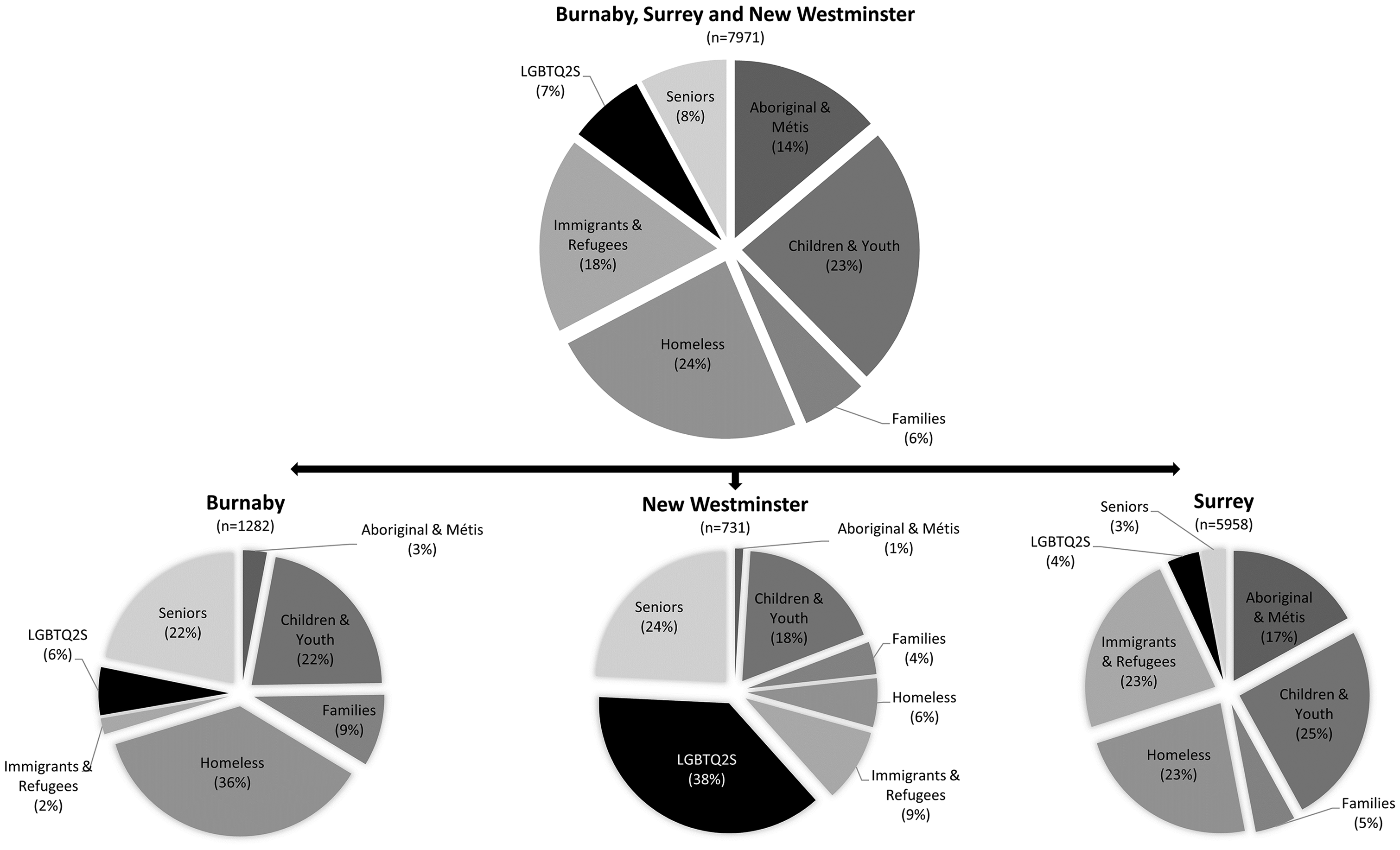
Percentage of references to target populations for social inclusion initiatives in Burnaby, New Westminster, and Surrey, 1995–2020.
However, a chi-square test of independence (df = 12) showed that social group identities were independent of municipality, indicating high levels of variation between case studies. If New Westminster followed the predicted pattern of expected values, its references would be at a quarter of the observed value of 268. Such exceptional variability underscores that LGBTQ2S citizens are prioritized in New Westminster’s social inclusion initiatives. The pie charts in Figure 2 further illustrate municipal variability in LGBTQ2S coverage: Burnaby is 6 percent; New Westminster is 38 percent; and Surrey is 4 percent. Notably, in New Westminster, LGBTQ2S people are the largest social category; they amount to more than fragments of passing reference and instead are the target subjects of social inclusion. In Burnaby and Surrey, sexual and gender minorities are only referenced infrequently and, thus, are ambivalently incidental to social inclusion.
LGBTQ2S co-occurrences with the language of suburban social inclusion
Treemaps efficiently represent hierarchical data as nested rectangles, using relative size to accentuate the relational importance of particular themes. Figure 3 represents the frequency counts of the top twenty social inclusion words in the LGBTQ2S archive (with LGBTQ2S-specific references shown in black). Given the deliberate construction of the archive from municipal documents containing few LGBTQ2S references, it is remarkable that LGBTQ2S content occurs in the top 20 keywords. In fact, social inclusion-related themes rarely co-occurred in the same sentence with LGBTQ2S content. Such linguistic treatment conveys an ambivalence linked to the lack of substantive connections and meaningful discussion of LGBTQ2S topics in relation to broader social inclusion concerns. The treemaps also reveal the particular social groups prioritized within them including homeless, children and youth, and seniors. Some of the dominant keywords convey the particular brand of inclusion within each municipality, while others are so generic they convey little in the way of social group or municipal specificity (e.g., “community” including notions of “liveability” and “lifestyle” as well as “building,” “consulting,” and “engaging with community”) and signify ambivalence.
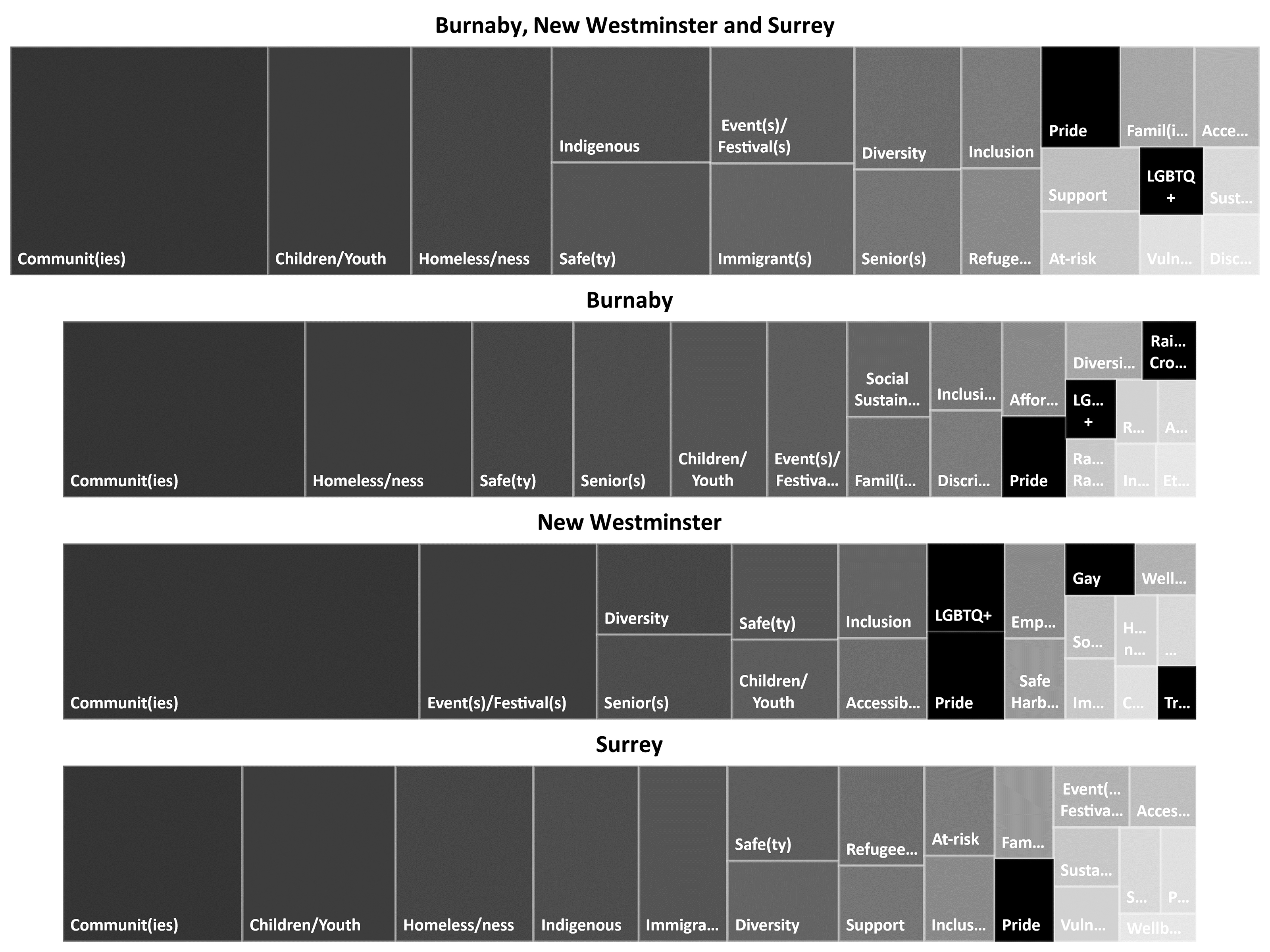
Treemaps of the top 20 condensed keywords for Burnaby, New Westminster and Surrey, 1995–2020.
The most predominant LGBTQ2S theme is “pride”, an annual event that celebrates ‘openness’ and inclusion, but also signals the centrality of festivalization. Despite a common treatment of LGBTQ2S citizens as festivalized subjects, there were important municipal differences. In Burnaby, “pride” and variations on “rainbow crosswalk” ranked higher than iterations of the municipally-used LGBTQ+ acronym. New Westminster was the only municipality where the LGBTQ+ acronym ranked above “pride” as a keyword and it was also the municipality with the largest number of LGBTQ2S keywords in the top 20, including other subject positions such as “gay” and “transgender”. In Surrey, reference to pride is frequent, but LGBTQ2S populations are not among the top 20 keywords. Surrey’s other inclusion priorities include at-risk social groups (e.g., homeless, Indigenous, children and youth, and immigrants and refugees) while their vernacular vocabulary emphasizes vulnerability and well-being. The treemaps, therefore, visually demonstrate that for these three suburban municipalities LGBTQ2S issues just barely register on the governance radar and predominantly within a festivalization framing, and they are competing with an array of complex social issues that take inclusion priority.
The chi-square analysis of the 20 clusters of social inclusion keywords further revealed differences between the municipalities in terms of their observed and expected frequencies with the frequency of use varying significantly (P < 0.001 for all tests) by city. Using a “goodness-of-fit” chi-square test in this way not only permits an individual comparison of each social inclusion keyword by municipality, but also allows a vernacular discursive portrait of each suburb to emerge that frames its place-specific linguistic political opportunity structure. Table 2 shows the tri-municipal patterns of linguistic variance between observed and expected values with the highest chi-square values in descending order: 1) events, celebrations, and festivals; 2) housing affordability; 3) immigrants, newcomers, and refugees; 4) Indigenous populations; and 5) seniors and intergenerational relations. Festivalizing terms had the highest value, driven by the higher observed than expected values in New Westminster and lower-than-expected values in Surrey. Housing affordability had higher-than-expected observed values in Burnaby and lower-than-expected in New Westminster. Burnaby’s geographic proximity to the City of Vancouver amplifies real estate and housing costs, particularly in redeveloping areas near the public transit Skytrain that connects to Vancouver. Immigrants, newcomers, and refugees had much higher than expected observed values in Surrey while Burnaby and New Westminster had a deficit. Surrey referred to Indigenous populations with greater frequency than expected in conjunction with lower-than-expected values for Burnaby and New Westminster. Finally, while seniors and intergenerational relations were important in all three, Burnaby and New Westminster reference this population group more than expected.
Within the social inclusion vernacular of each municipality, there were four predominant LGBTQ2S themes all with relatively low chi-square scores. LGBTQ2S+ identities, organizations, and well-being had the highest chi-square statistic which is largely shaped by the over-discussion of this topic in New Westminster and an under-discussion in Surrey, which was slightly more significant than that of Burnaby. Pride was moderately significant reflecting the high value overall for events, celebrations, and festivals. Gender diversity and sexual and gender discrimination are the most important social inclusion concepts, yet none of the municipalities over- or under-emphasized these in the documentation (sexual and gender discrimination had the lowest chi-square value of 11.7, making its critical value for p less than 0.05). In sum, while there was important linguistic variability across the case study municipalities, the prioritization of pride and festivalization predominated and came at the expense of the discussion of specific LGBTQ2S identities, gender diversity, and forms of sexual and gender discrimination, demonstrating overall a civic ambivalence to suburban LGBTQ2S needs and concerns.
Typologies of suburban linguistic ambivalence
In what follows, a typology of linguistic ambivalence is constructed using the vernacular vocabulary of each municipality. The objective is to narrate distinctive suburban portraits extracted from the above analysis. These portraits accentuate the LGBTQ2S inclusions of each municipality so as to characterize the politics and tensions surrounding the governance of sexual and gender minorities and to reveal the micro-ways that equivocation varies within a shared regional geography.
Burnaby: The “socially sustainable” yet discordant city
Burnaby characterizes itself as a “socially sustainable city,” celebrating its award-winning 2011 Burnaby Social Sustainability Strategy. Social sustainability (along with economic and environmental), “is about people – individuals and the community working together to meet their needs, realize their potential, and prosper in a healthy environment” (City of Burnaby, 2011: 2). Burnaby’s commitment to social sustainability has been developed through the adoption of different social policies (e.g., Burnaby Multiculturalism Policy, Civic Youth Strategy, Equity Policy, Child Care Policy, Healthy Community Policy, and Adaptable Housing and Group Home Policies). Sense of belonging and social cohesion are keywords that express social sustainability with particular mention of the elimination of barriers, social bias, and discrimination. Priority social groups are “linguistic”, “ethnic,” and “ethno-cultural” communities with particular emphasis on “religious beliefs” and “faith groups”. The celebration and “respect” of the municipality’s “increasing diversity” is leveraged to “maximize the potential of all, build[ing] a stronger community, and prepar[ing] the City for the future, thereby supporting the goals of community inclusion, a liveable community and community resilience” (City of Burnaby, 2011: 38).
Burnaby adopts a critical stance on heterosexism and homophobia, employing these terms and distinctively using the adjective “homophobic”. LGBTQ2S youth are the subject of Burnaby’s recent recognition of sexual and gender diversity with the young persons’ category of “questioning” as a keyword. Following a regime change at City Hall in 2018, LGBTQ2S constituencies were talked about with greater frequency, often using more contemporary terminology. For example, Burnaby is the only municipality to employ the term “intersex” and reference “biphobia” and “transphobia”. However, Burnaby’s most distinctive signature terms for LGBTQ2S inclusions are “visibility” and “rainbow crosswalk”. Although many municipalities in the Lower Mainland have installed rainbow crosswalks, for Burnaby they are important infrastructural tools to render its LGBTQ2S-friendly status more visible in the suburban landscape. The municipality alone has installed a total of five such crosswalks (with a sixth planned). Such practices reinforce the ways that Burnaby uses infrastructure to manifest its social inclusion priorities.
Despite Burnaby’s commitment to social inclusion and its celebration of a harmonious inter-cultural diversity, it remains a discordant city that is cross-cut by frictions arising from the juxtaposition of labour politics, religious lobby groups, progressive school boards, and redevelopment pressures. These frictions delayed the social inclusion of Burnaby’s LGBTQ2S residents. Municipal elections have been shaped by an impasse between a labour-based City Hall stronghold that ignored LGBTQ2S needs while struggling for re-election over a Provincial School Board Sexual Orientation and Gender Identity (SOGI 123) policy rejected by conservative faith constituencies. More recently, LGBTQ2S inclusion has been driven by para-public agencies and specific municipal services (e.g., its public libraries and recreation centres) that work in tandem with the city’s social planners to build a broader, yet still ad hoc, language of social inclusion for sexual and gender minorities. Ambivalence is evident in the prolonged silence on LGBTQ2S inclusions at City Hall which stalled more systemic change and fostered a reliance upon informal mobilization within para-public organizations.
New Westminster: The “compassionate” yet festival city
New Westminster’s statement on social inclusion is contained in Our City, 2041 (City of New Westminster, 2017a: 27): “New Westminster is a healthy, inclusive and thriving community where people feel connected with each other.” The community plan is grounded in building social and physical connection to local heritage and river frontage, and fostering a “socially-minded” citizenry. However, New Westminster’s explicit positioning through a language of care as the “compassionate city” is derived from a 2019 New West Hospice Society partnership proposal. Compassionate communities “publicly encourage, facilitate, support and celebrate care for one another during life’s most testing moments and experiences” (New West Hospice Society, 2019: 1). While this framing expresses deep empathy for its populace and validates populations rarely addressed by municipal leaders (e.g., people living with intellectual and developmental disabilities, chronic and terminal illness, in recovery, dealing with renoviction, and low-income seniors), the compassionate city moniker is held in tension with the celebration of difference through festivalization.
The language of social inclusion in New Westminster revolves around an intergenerational combating of disenfranchisement and social isolation through social connection. The deployment of “social capital” and “equity” demonstrates critical municipal investment in rectifying social exclusions, while “empowerment” and “public engagement” intended to generate mutual respect across differences are also co-optable goals within the rhetoric of late neoliberalism. Although moments of equivocation can be found in the residual lingering of words like “acceptance”, “awareness”, and “tolerance”, New Westminster is the only city to mention “exclusion” in conjunction with “stigma” and the notion of being “disassociated from society”. This reckoning with socio-economic minorities is reflected in its vision for a “safe city” that can be a place of “shelter”, “liveability”, “meaning”, and “well-being” for its residents. Yet, intercultural and cross-cultural interpretations of diversity are muted in New Westminster's inclusion documents.
New Westminster’s framing of LGBTQ2S inclusion is embedded in a concomitantly complex and contradictory vocabulary. This municipality is the only one to use specific references, some associated with a critical stance on heteronormativity, while others are linked to distinct local LGBTQ2S activities: a Seniors’ Gay-Straight Alliance; the Sexual Orientation and Gender Diversity (SOGI) school board policies; the historic Stonewall uprising that launched the Gay Liberation Movement; and naming LGBTQ2S demonstrations of mourning as “vigils”. Also notable is the distinctive appearance of terms associated with increased inclusion of gender diversity (e.g., “gender expression,” “gender identit(ies),” “gender reassignment,” and “gender-free”) and associated terms (e.g., “in transition,” “trans-inclusive,” and “trans-competent”) and an emphasis on “queer competency” (fostered through the local embrace of the provincial Safe Harbour Program). New Westminster has also integrated gender diversity into its understanding of universal access to restrooms and changing rooms within its newly constructed and renovated recreational facilities.
In sum, New Westminster’s diversity paradigm is robust and substantive, but its emphasis on festivalization and its white-Anglo “Royal City” heritage undermines the complex work of inclusion. The place of LGBTQ2S populations in municipal social inclusion frameworks exemplifies its civic celebration of difference with records in council being associated with pride festivities, implicating LGBTQ2S subjects in downtown revitalization and Business Improvement Area programming for Columbia Street (the only street identified by one of the three municipalities with the LGBTQ2S population). For New Westminster and adjacent municipalities, this suburban ‘main street’ is but a backdrop for a roster of other festivals embedding LGBTQ2S social programming into the diversity paradigm of a ‘royal’ city that still finds distinction in its predominantly colonial, working-class heritage.
Surrey: The “inclusive” yet preferential city
Surrey is the only municipality to self-brand as “the inclusive city” in its Sustainability Charter 2.0 with the stated goal of creating “a thriving, green, inclusive city” that is “sustainable” and “resilient” (City of Surrey, 2016: 16–17). It is also the only municipality to pair this term with “welcoming” as a social ideal (i.e., “building a more welcoming and inclusive community”) (Surrey Welcoming Communities Project, 2014). Surrey strives to be inclusive and welcoming by prioritizing the needs of specific marginalized social groups (e.g., immigrants, newcomers, and refugees as well as Indigenous and youth populations). It is also the only municipality of the three to articulate the importance of “youth engagement” and “youth friendliness”. Moreover, Surrey is particularly attentive to “at-risk” and “vulnerable” groups of residents who have the potential to be victimized and exploited with significant public commitments to reducing poverty and homelessness.
In Surrey, “social infrastructure” and “social innovation” are used to characterize its ideal landscape of inclusion, employing terms such as “social equity” and “social responsibility” and promoting community ideals of “wellness”. Its understanding of social infrastructure is multifaceted and includes a range of concepts that speak to the eradication of exclusion and the promotion of cross-cultural understanding. More than the other two municipalities, the action verbs of social inclusion are: “outreach” and “advocacy” to augment “awareness”; and “capacity”, “connectedness”, and “participation” for its marginalized residents. In so doing, Surrey deliberately seeks to foster “resilience,” “resourcefulness,” and “recognition”. “Restorative justice” and “reconciliation” for Indigenous peoples are concepts unique to Surrey’s public vocabulary, as is a generic emphasis on “support” for disadvantaged communities. Surrey’s civic language of social inclusion leverages “human rights” and “multiculturalism” to build “cultural awareness” and “cultural competency”, while being “culturally inclusive” and “culturally appropriate”. While Surrey approaches cross-cultural sensitivity and competency through a training lens, such instruction largely does not extend to its LGBTQ2S communities. Like Burnaby, Surrey makes safety a civic priority, but is distinguished by its emphasis on the creation of “safe space(s)” or “safe environment(s)”, and concomitant concern for the violence of bullying that can accompany “discrimination”, “prejudice”, and “stereotypes”. Surrey is distinctive in its occasional employment of highly critical terms regarding marginalization and exclusion (e.g., “neglect” and “segregation”) and questioning power relations (e.g., “anti-oppression” and “social justice”), but these are often siloed into bundles attributed to one particular group and not shared between or across groups.
While there is a distinctive critical employment of social inclusion terms, Surrey’s language rarely extends to include LGBTQ2S concerns. Surrey’s LGBTQ2S populations are seldom referenced, with “pride” more significant than the constituency itself. There were few distinctive Surrey keywords beside “GLBTQ” (as opposed to “LGBTQ”) and references to populations living with HIV-AIDS. From the social inclusion keywords, new concepts were introduced by LGBTQ2S activist groups (e.g., “alienation”, “loneliness”, “peer-support”, and “suicidal ideation”). Surrey documents made more references to Pink Shirt Day, which like International Day of Pink noted by Burnaby, is an event used to promote the eradication of bullying that signals LGBTQ2S youth as part of its subtext for groups who experience victimization. Other vernacular LGBTQ2S keywords in Surrey include “allies” and “anti-homophobia” and the only reference to the Rainbow Refugee Committee, a group supporting and advocating for “people seeking refugee protection because of persecution based on sexual orientation, gender identity, or HIV status” (Surrey Welcoming Communities Project, 2014: n.p.).
Surrey is a much larger municipality than either Burnaby or New Westminster making its plans, policies, and social inclusion initiatives appear more comprehensive and sophisticated in their employment of its language. Moreover, upon first reading, its vocabulary appears coherent and current, redolent with a mixture of terms derived from different socio-political stances and changing over a long time. As a larger and rapidly expanding municipality focused on the approval of land development applications (Grant, 2009), Surrey also grapples with social issues that are not as aggregated in the other municipalities (e.g., homelessness, youth disenfranchisement, addictions, and poverty) and the segmentation of particular large ethnic communities from one another. These tectonic undercurrents inform civic understandings of inclusion for Surrey’s LGBTQ2S populations; not only are they hard to reach despite the activism of a select few, but they also bring messy intersectional “obscure needs” that render them more of an “electoral liability” than a political asset in a late neoliberal city that prioritizes festivalization (Cooper and Monro, 2003).
Conclusion
To date, Canadian suburban governance scholarship has attended to the power relations of civic decision-making, yet has seldom foregrounded sexual and gender diversity in its interrogation of the interactions between state, market, and civil society actors. Instead, it remains focused on ‘hard’ technical infrastructure to the neglect of ‘soft’ social arrangements that undergird the capacities of people in specific places. As localized technologies of power, social inclusion frameworks are no less central to suburban governance than political-economic processes – they guide civic priorities, set normative boundaries, and create political opportunity structures to address the tensions and juxtapositions emerging in rapidly diversifying peripheral landscapes.
Leveraging Tuohy’s (1992) concept of “institutional ambivalence,” this paper has contributed to the suburban governance literature by drawing attention to the political work of inclusion that language can do (or not) for sexual and gender minorities. By reading the vernacular vocabulary found in an archive of municipal public-facing communication, it has revealed the linguistic equivocations of LGBTQ2S social inclusions embedded within suburban political opportunity structures. Linguistic discourse and content analyses of the archive distilled social inclusion keywords and their co-occurrence with LGBTQ2S themes, accentuating civic ambivalence towards sexual and gender minority constituents. The municipally-variant vocabulary of LGBTQ2S social inclusion signals divergent local linguistic political opportunity structures for suburban sexual and gender minorities. Each municipality’s vernacular vocabulary has informed a typological narration that demonstrates varied gradations of linguistic obfuscation demonstrating an ambivalence towards LGBTQ2S social inclusion amidst suburban diversity.
Overall, LGBTQ2S social inclusion is formulated in the backrooms of City Hall in social issues committees and departmental reports, making fleeting appearances in policies, plans, and strategies or in proclamations and pride festival funding requests before councils. Despite an archive focused entirely on LGBTQ2S inclusion, the variable absence and uneven presence of related keywords conveys significant obfuscations through a lack of clarity, consistency, and specificity when targeting LGBTQ2S constituencies. With the exception of New Westminster, the content analysis has shown that LGBTQ2S populations are infrequently referenced relative to other marginalized social groups and that their presence in inclusion frameworks is dictated by the extent to which they align with civic priorities such as festivalization, safety, welcoming newcomers, integrating seniors, and anti-discrimination initiatives. However, municipal variation resulted in uneven political opportunity structures that did not demonstrate that any one municipality is more LGBTQ2S-inclusive than another: high levels of festivalization in New Westminster are not necessarily more inclusive than the non-discrimination lists in Surrey’s policy frameworks or Burnaby’s recent intensive use of rainbow crosswalks to visibly mark its landscape as LGBTQ2S-friendly.
While not comparative per se, this paper juxtaposes three peripheral municipalities in order to provide place-specific texture to a very understudied topic. Many LGBTQ2S North Americans live in governance landscapes similar to these suburbs. Therefore, it remains important to address ongoing specific material and financial needs for the provision of LGBTQ2S-specific safe and sustained health and social spaces with community-based programming for all ages and across ethno-cultural, Indigenous, racialized, class, and, sexual and gender differences. As the chi-square analysis revealed, each municipality has different linguistic political opportunity structures upon which LGBTQ2S constituents can draw, but all are notably thin and fragile. Following the adoption of its 2011 Social Sustainability Plan, Burnaby has remained committed to improving the quality of life for individual citizens by providing socio-economic opportunities and a healthy environment. However, until 2018, LGBTQ2S constituencies were not incorporated into this framework. More overtly, LGBTQ2S inclusions were part of a discordant politics necessitating political trade-offs between LGBTQ2S constituencies and the morality politics of faith-based communities. While the visibility and access that New Westminster affords LGBTQ2S constituencies appears ideal, redevelopment politics and festivalization partially undermine its goal of being a compassionate city that cares about its most marginalized populations. The slippery slope of commodifying LGBTQ2S events and identities plays with well-established diversity paradigms that prefer harmonious juxtapositions to the complexities of intersectional differences. Surrey with its explicit “inclusive city” brand, long but sporadic history of LGBTQ2S inclusions, and deep integration of cross-referenced policy frameworks, appears institutionally to discursively embrace difference. However, in the face of rapid development, large youth populations, rising concentrations of Indigenous, diasporic, and at-risk populations, Surrey is a “preferential” city where LGBTQ2S inclusions are overshadowed by competing and siloed social issues that take priority.
This paper’s typology is a valuable starting point for understanding the micro-linguistic ways that ambivalence operates within suburban municipal social inclusion frameworks. Beyond language, ongoing work needs to unpack the discourses that inform municipal political opportunity structures. A crucial next step is to extend the vernacular vocabularies of LGBTQ2S inclusions through a discourse analysis of its larger “grammar of use” that frames civic actions and outcomes (Cohendet et al., 2010). Moreover, the typology is inductive and place-based, making it difficult to extrapolate or export to other contexts. Thus, a subsequent step is to develop a generic typology to assess the responsiveness of municipal governance to sexual and gender minority constituents. The application of such a typology to urban planning and policy practices could identify opportunities for enhanced suburban sexual citizenship. These preliminary findings further convey the importance of attention to, and comparative consideration of, the multi-scalar diffusion of LGBTQ2S inclusion initiatives and their varied adaptations by suburban governance actors.
Footnotes
Declaration of conflicting interests
The author(s) declared no potential conflicts of interest with respect to the research, authorship, and/or publication of this article.
Funding
The author(s) received no financial support for the research, authorship, and/or publication of this article.
