



Abstract
Since its open-door policy for welcoming asylum seekers in 2015, Germany has experienced a resurgence of anti-immigrant sentiments and a backlash against the safeguarding of human rights. Such perceptions of asylum seekers and their accommodation are shaped in urban neighborhoods, where street-level bureaucrats try steering such perceptions. While much literature has discussed how immigrant affairs departments promote intercultural encounter or acceptance of diversity, we know relatively little so far if and when urban planners steer perceptions of migration-related diversity. Yet, urban planners work closely with residents in urban regeneration programs and were confronted with residents’ anxieties about the potential impact of the asylum seeker accommodation when large reception centers were opened in 2015. The article aims to fill a gap in the literature. Based on two in-depth case studies it shows how structural contexts inform whether urban planners span disciplinary boundaries and act as broker between residents and the state in order to steer perceptions of asylum seeker accommodations. The article is based on field research and qualitative interviews in two large German cities. The article contributes to literatures on perceptions of migration and diversity, urban planning and urban regeneration, street-level bureaucracy, boundary spanning and brokerage.
Keywords
Introduction
The article is a first major attempt to examine urban planners’ role in steering residents’ perceptions of the reception and accommodation of immigrants in urban neighborhoods. In the urban planning literature, migration-based diversity has so far been predominantly discussed in more abstract and normative ways. Scholars promoted “multicultural planning” (Quadeer, 1997, 2011) and emphasized the importance of addressing difference and of striving for equality and justice in urban planning (Fainstein, 2009; Fincher and Iveson, 2008; Sandercock, 2000, 2003; Thomas, 1997, 2008). Different from such more abstract and normative work, this article focuses on the practices of urban planners working on the “street-level” when they are confronted with perceptions of migration-based diversity in the context of urban renewal.
A considerable amount of research has focused on perceptions of migration-related diversity and public opinion on immigration (Greussing and Boomgarden, 2017; Hellwig and Sinno, 2017; Sobolewska et al., 2017). We know that the influx of large numbers of immigrants often results in an anti-immigrant backlash and the upsurge of right-wing politics (Lesinska, 2014) and that such resistance against diversity is voiced in neighborhood development and urban renewal programs (Harwood and Myers, 2002; Meier, 2013; Mepschen, 2019). A part of that literature has investigated the role of the state in steering perceptions of immigration. Yet, to date most of this literature has focused on dedicated immigrant affairs departments (de Graauw, 2018; Jones, 2013; Schiller, 2017) and hardly any attention has been paid to the role of urban planning departments and urban planners in steering perceptions and evaluations of diversity in diverse neighborhoods (although see Pemberton, 2017). Focusing on the reactions to the recent accommodation of large number of asylum seekers in German cities, this article thus asks:
How can we understand if and when urban planners steer residents’ perceptions of asylum seekers accommodations in two large German cities?
The subquestions are: Did urban planners try to steer residents’ perceptions of the accommodation of asylum seekers in reception centers in the neighborhood? Did they try to explain the accommodation of asylum seekers to citizens and hence mediate and reduce contestation? How do structural factors inform whether or not urban planners act as boundary-spanners and brokers to steer perception of diversity?
Germany is a particularly interesting context to study the role of urban planners in steering citizen’s perceptions of migration-related diversity. The country was never following a clear-cut multicultural or assimilationist model and is therefore less captured in the migration literature than other Western European countries such as the UK or France (Schönwälder and Triadafilopoulos, 2016). Yet, guest worker and family reunification schemes, increasing inner-European migration and most recently the arrival of large numbers of asylum seekers have left an imprint on large German cities (Bommes, 2006; Mau and Verwiebe, 2010). In particular, the urban centers in the Western part of Germany are nowadays characterized by super-diversity. For long Turkish guestworkers and their children were the largest and most visible immigrant group in Germany (Münz et al., 1999), but the number of countries of origin as well as legal channels has diversified over the past years (Vertovec, 2015). In an exceptional move of opening its borders the country has welcomed asylum seekers fleeing regional conflicts and wars in Afghanistan, Iraq and Syria in 2015. While this created an exceptional momentum of solidarity and a new pride in the country’s “Willkommenskultur,” Germany since 2017 has an extreme right-wing political party 1 represented in parliament (Bundestag) - for the first time since the Second World War. So Germany can be characterized by its ambiguity in its response to migration-related diversity. On the one hand, the country has been reluctant to portray itself as a migration society and witnessed a resurgence of anti-immigrant political parties. On the other hand, the German government has opened its borders to larger groups of immigrants at points in time and increasingly recognizes the irreversible diversification of its population.
Such ambiguities of responding to migration-based diversity play out not only in national political debates or policy-making processes, but also in the perceptions of citizens responding to the creation of asylum seeker accommodation in urban neighborhoods. It is here, where the arrival of large numbers of asylum seekers became most tangible, as large compounds and buildings were quickly transformed into asylum seeker reception centers in 2015. Urban planners, who are active in neighborhood urban renewal and citizen involvement, were challenged to address this development. Did they try to steer residents’ perceptions of asylum seeker accommodations?
The article is structured as follows: Part 2 introduces the relevant literature, Part 3 delineates the selected methods and Part 4 outlines the case selection. Part 5 analyzes the empirical material, Part 6 discusses the findings and how we can understand that urban planners in one case acted as boundary spanners and brokers, whereas this was not the case in the other case study. Part 7 concludes the article.
The understudied role of urban planners in steering citizen’s perceptions of migration-based diversity
Perceptions and representations of migration as (potentially) undermining social cohesion are nothing new, but have been recorded throughout history and across places (Betz, 2017). The arrival of immigrants is often accompanied by contention (Young, 2018). Especially after the influx of a larger number of immigrants, an increase in anti-immigrant voting and support of parties from the right of the political spectrum is common (Lesinska, 2014). Existing research on super-diverse neighborhoods has captured perceptions of ethnic minorities in cities, focusing on intergroup relations and constructions of established and outsiders (Bynner, 2019; Elias and Scotson, 1965; Meier, 2013). Scholars have demonstrated the possibility of new encounters (Valentine, 2008) and used the notion of “conviviality” to capture the fragile process of living together in diversity (Gilroy, 2004; Heil, 2014). In many urban spaces, diversity has indeed become commonplace and an everyday and normal aspect of social life (Wessendorf, 2013; Wise and Velayutham, 2009). Other scholars pointed out that negative perceptions of immigrants among the established population exist and are more likely in socio-economically deprived areas (Gökariksel and Secor, 2018; Havekes et al., 2014). They showed that urban diversity can be rejected in such neighborhoods and established residents may draw boundaries and exclude immigrants (Alba and Duyvendak, 2019; Bynner, 2019; Meier, 2013; Mepschen, 2019; Paulle and Kalir, 2014; Vollebergh, 2016; Wekker, 2019). We therefore expect that more deprived neighborhoods provide a more difficult context for steering the perceptions of residents’ and mediating the contestation of the accommodation of asylum seekers.
Given that migration is often accompanied by contention of members of the host society, the decision to welcome and accommodate large numbers of asylum seekers can be considered a risk taken by policy-makers and governments. As Beck (1999) argued, such risks with unforeseeable consequences and outcomes are deliberately taken today and this is accompanied by knowledge production to calculate the risks and to make those risks appear controllable. However, when risks become ‘recognized’ and become collective knowledge, they can develop an incredible political dynamic (Beck, 1992: 77). An intensified public perception of crisis (Beck, 1999: 56) results in high expectations by residents that the government takes measures in order to control these risks (Bekkers et al., 2017: 29). Applied to this study, I expect that a clear communication about the length of asylum seeker accommodations and assurance of the limited impact for the longer-term urban regeneration process can support that residents consider a perceived risk as being under control. The more clear-cut the estimates of the timeline and potential impact of asylum seeker accommodations on the urban regeneration, the more likely that urban planners steer the perceptions of citizens so that they accept the accommodation of asylum seekers.
Local governments are actively invested in governing migration-related diversity, and in many cities have become more self-confident and proactive in trying to inform local perceptions and relationships (Schiller, 2016: 218). The role of urban planning for governing migration-related diversity has been seldomly spelled out (Pemberton, 2017). This can also be linked with the strong institutionalization of urban planning as separate discipline with its responsibilities being clearly differentiated from the responsibilities of social affairs departments in German municipalities (Bogumil and Holtkamp, 2013). Yet, as Fincher et al. (2014) pointed out, urban planning is increasingly involved in dealing with social differences and disadvantage in cities, for example by commodifying diversity for tourism and urban regeneration and by regulating public spaces to prevent conflict between ethnic groups. In Germany, programs like “Soziale Stadt” (Nantz and Fritsche, 2012) played an important role to introduce urban planners to issues that were traditionally considered as the responsibility of social affairs departments. This development goes hand in hand with the outsourcing of urban planning departments, which nowadays are often created as semi-private agencies of the municipality. Such a development is due to the introduction of New Public Management, i.e. the introduction of market- based principles in the public sector, which often entails changes in internal structures and processes of organizations with the goal of achieving more flexible structures and less hierarchy (Dieffenbach, 2009: 897). In this research we consider organizational embeddedness of urban planning departments in municipal organizations and openness to deal with diversity as linked. Hence, we expect that urban planners who are embedded in the functional lines of a municipal organization will be less likely to address migration-related diversity (which is formally in the responsibility of ‘immigrant affairs’ or ‘immigrant integration’ departments), whereas urban planners who are positioned outside of the municipal organization will be more likely to steer the perceptions of migration-related diversity among residents.
Within urban planning, citizen-involvement has experienced a boom since the 1970s and many urban planners are used to interacting with local populations in the framework of citizen involvement strategies. This boom of citizen involvement is often associated with a trend of governance, that is the development of more collaborative mechanisms of policy-making. Other than top-down policy making, governance means that policies are decided upon and implemented by coalitions of state representatives and citizens, local associations, interest groups, and private actors (Giersig, 2008: 55; Sullivan and Skelcher, 2002). It starts with the idea that the roles of public officials, as well as their relationships with politicians and civil society, are being transformed. Officials need the capacities to establish collaborative and participatory forms of policymaking and have some discretionary power (Peters, 2010: 327). Captured in the literature as “street-level bureaucrats” (Lipsky, 1980) such officials directly interact with residents on a daily basis (Evans, 2010) and they have some discretion in implementing policies, meaning that they have some autonomy in interpreting policy decisions in response to the concrete needs of citizens (Hupe et al., 2015; Lipsky, 1980). Urban planners are often involved both at the strategic as well as on the street-level. They design urban renewal programs and manage the application for funding schemes, but they also interact with residents on the street level in the framework of citizen involvement procedures.
Given that social issues and migration-related diversity in German municipalities were traditionally not considered as the responsibility of urban planners, it depends on boundary-spanning and brokerage whether or not urban planners steer perceptions of asylum seeker accommodations. “Boundary-spanners” are officials, who operate at the boundaries of their own organization and create bridges and linkages between citizens and municipal entities (Meerkerk and Edelenbos, 2014; Weerts and Sandmann, 2010; Williams, 2002). They can play an important role in (proactively) finding and developing common ground between actors (Edelenbos and van Meerkerk, 2018). They select relevant information (Tushman, 1977) and they pass on or translate this information to the other side of the boundary, that is citizens or voluntary organizations (Van Meerkerk and Edelenbos, 2014). By contrast, when organizational boundaries are kept intact, bureaucrats act as gatekeepers (Haas, 2015; Sturdy and Wright, 2011) and guards (Ancona and Caldwell, 1988). “Brokers” is a related concept that was developed for capturing officials who mediate between the state and citizens and help find a reasonable compromise and reduce intense conflict (Sabatier, 1999). As such brokerage is also defined as the social mechanism of mediation between state and citizens in participatory urban governance (Koster, 2012; van Hulst et al., 2012). In network research brokers are considered those individuals that can bridge so-called structural holes (Burt, 1992). While the notion of boundary-spanning is more about translation across organizational boundaries, the brokerage concept emphasizes differences in viewpoints and the mediation of conflicts. Operationalizing these concepts for the study, an urban planner acting as a boundary-spanner would proactively seek to create understanding and acceptance for the city’s responsibility to receive and accommodate asylum seekers. An urban planner acting as a broker would seek to reduce contestation among residents and mediate in case of conflict relating to the accommodation of asylum seekers.
The article considers the potential influence of structural factors on the boundary spanning and brokerage in steering residents’ perceptions. Relevant structural factors were inductively defined based on interviews and observations. They include the physical characteristics and socio-economic profile of the neighborhood, the arrangements between regional state and city about the accommodation of large numbers of asylum seekers, and the setup and mandate of urban planning departments, urban renewal programs and citizen involvement strategies. To summarize my expectations above, I expect that a more favorable socio-economic profile of the neighborhood, clear agreements on the asylum seekers accommodation between regional state and municipality, and a positioning of the urban planning department outside of the organizational hierarchies of the municipality are related to boundary-spanning and brokerage of urban planners, whereas I would expect them to act less as brokers and more as gatekeepers in a context of socio-economic deprivation, an embeddedness of urban planners in the municipal organization, and a lack of an explicit agreement between region and municipality on the duration of and future plans for the asylum seeker accommodation.
Methods
The research is based on participant observations from October 2015 to July 2016 in citizen involvement processes 2 in Frankfurt und Mannheim, in two neighborhoods where large asylum seeker reception centers were installed in 2015.
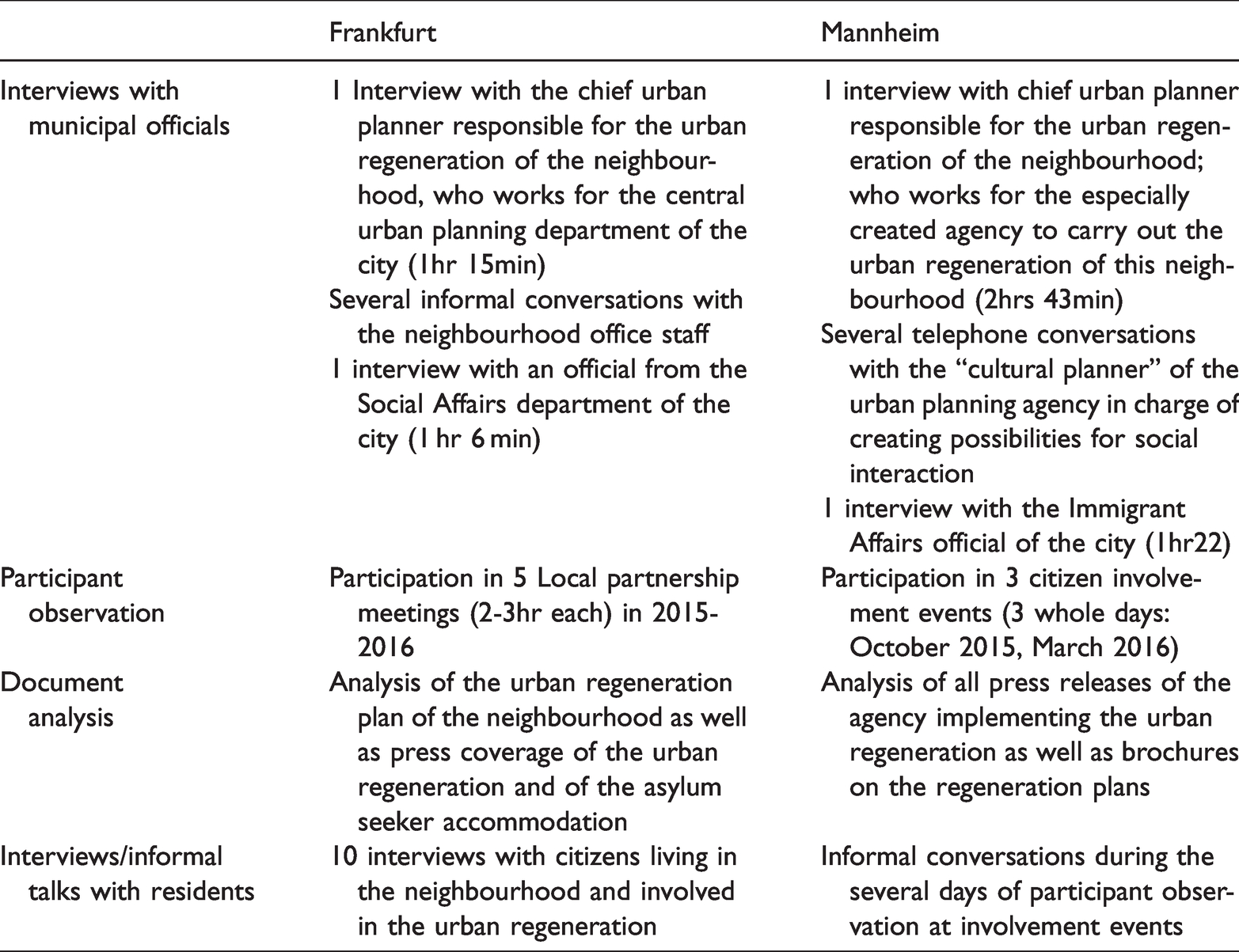
The collected data entails field notes based on participant observation (Okely, 2013) in citizen involvement meetings, interviews and informal conversations with residents and officials, as well as the analysis of documents (see Table 1). For this article I drew on all of this data. This includes the interviews with the urban planners, in which I asked about the embeddedness of urban planning in the municipal organization, on the overall character of the urban regeneration in the neighborhood studied, on the organization of the accommodation of asylum seekers in the neighborhood and their experience of citizens’ perceptions of the asylum seeker accommodation. Participant observation in meetings between urban planners and citizens added a more in-depth insight into urban planners’ practices and the ways in which they related and responded to citizens, which allows going beyond official accounts that are yielded through policy documents and interviews. Further, I drew from interviews with citizens in Frankfurt, in which I asked about their motivation of participating in the citizen involvement, their experience of the process of urban regeneration and their interactions with the urban planners, and their assessment of the asylum seeker accommodation. Organizing interviews with citizens in Mannheim was more difficult, because most people participating in the citizen involvement did not yet live in the neighborhood at the time and just incidentally attended citizen involvement events. Therefore, in this case I carried out informal conversations and participant observations over whole days in the citizen involvement events, taking notes immediately as well as retrospectively in a fieldnote journal.
The semi-structured interviews were transcribed and analyzed together with the field notes with the help of the Atlas.ti Software. The data was coded following a Grounded Theory methodology, identifying first open codes and then categories and their interrelationships through axial and selective coding (Charmaz, 2006; Strauss and Corbin, 1990). Theoretical saturation was reached by also comparing the two cases along the way and asking about aspects that were mentioned or stuck out in one case, but not in the other.
Case selection
The research took place in two neighborhoods 3 located in two larger cities in the Western part of Germany. The article takes them as two examples of urban contexts, where the accommodation of asylum seekers in the wake of the “long summer of migration” challenged urban planners to react to and steer residents’ perceptions of migration-related diversity in the context of ongoing citizen involvement processes. Both selected neighborhoods were undergoing a substantive urban renewal trajectory. In both cases the urban renewal was accompanied by a citizen involvement strategy to ensure that current/prospective residents were involved in the decisions and progress of the urban renewal. In 2015 both neighborhoods were designated to host the respective region’s largest reception centers for the initial accommodation and registration of asylum seekers of the whole regional state, 4 making them exceptional cases in Germany. Up to 2000 (in Frankfurt) and up to 5000 asylum seekers (in Mannheim) should be accommodated. 5 At the same time there were also important differences between the two cases, which included a different physical and socioeconomic situation, a clearer agreement on the length of the asylum seeker accommodation, and a different position and embeddedness of the urban planners in the organizational structure of the municipality. The similarities and differences between the neighborhoods can help understand variation in urban planners’ steering of the perceptions of asylum seekers accommodations.
Analysis
Did urban planners shape citizens’ perceptions of diversity?
Urban planners steered perceptions of the accommodation of asylum seekers to very different extent and in very different ways in their meetings with citizens.
In the Frankfurt neighborhood, local residents confronted urban planners with their worries and claims in light of the creation of the asylum reception center and received a reluctant and defensive response by urban planners. They rejected any responsibility for the asylum seeker reception center and its potential effects, arguing they had not been involved in the decision to install the reception center in this neighborhood. In an interview with an urban planner after the aforementioned meeting of the local partnership, he said: Those are all topics that don’t have anything to do with the neighborhood development program and resident involvement. But interested residents need a forum, you cannot just tell them that we are not interested in these topics. They don’t differentiate, they just see their concerns. Although we tell them these issues are not eligible for funding in this program, it isn’t part of our integrated concept for action. But if we take these people serious and we do take them serious and want to involve them in our topics, then we need to offer them a forum, even when these are topics where we cannot help, like yesterday evening. Because it goes beyond our opportunities and our horizon by far. (IP1 Line77)
In contrast to the Frankfurt neighborhood, urban planners in Mannheim proactively addressed the installation of the asylum seeker reception center and potential consequences, without even being confronted with the issue by residents. They did so at the very beginning of their 3-day citizen involvement event in October 2015. This was the kick-off event for their citizen involvement strategy, which included information evenings as well as a range of cultural and sports activities. In this case of citizen involvement, the audience were residents who considered buying or renting an apartment in the neighborhood in the future. As you can see in the following quote, the urban planner in his opening speech pre-empted concerns of citizens and sought to gain their understanding for the situation, spanning what some would consider as the boundaries of urban planning: I welcome you today in a contemplative mood. (…) In this neighborhood, we want to have diversity, a diversity of people, of cultures, different handicaps. Yet, global politics has brought us the biggest handicap. We have 7000 asylum seekers in this area since first of September. We take these 7000 asylum seekers serious, but we are also very powerless. We do our utmost as service providers in steering the process, as integration politicians, etc. I was happy to experience all the voluntary work, but we are also at the limits. We are happy that we found a very complicated agreement with the federal state after many days of negotiation that there is an upper limit of how many people we can accommodate here. We have fought to have the former school, sports arena and the church etc. free (of asylum seeker accommodation) to allow encounters, infrastructures, language classes etc. In addition, we had to change the program [of our involvement event], because we cannot celebrate when the asylum seekers are just there. But it is about carrying out the most important parts of the program anyways, here on the fringes of the area.’ (Chief urban planner, Speech at opening of involvement event 16/10/2015).
In Mannheim, the chief urban planner framed the presence of asylum seekers as relating to their long-term goal of creating a diverse, mixed neighborhood. By discursively bridging the domains of social affairs and urban planning, he acts as a boundary spanner of the urban planning department. Also, by proactively addressing the presence of asylum seekers, he addressed challenges and conflicts around the accommodation before they even arose. He therefore became a broker who mediates between the state and citizens and who communicates the responsibility of the city to accommodate the asylum seekers. Also, his self-representation as negotiation partner of the regional state and thus as someone who has a say in the decision on the maximum capacity and expansion of the asylum seeker reception center attests to his ownership and his willingness to span boundaries for managing the situation.
To summarize, I found significant variation in urban planners’ steering of citizen’s perceptions of the asylum seeker accommodation in the two cases. In Mannheim, urban planners acted as brokers and spanned the boundaries of urban planning. They proactively steered citizens’ perceptions and promoted an acceptance of the accommodation of diversity. In the Frankfurt case, urban planners acted as gatekeepers of urban planning, defending the boundaries of what they can do. They took a passive approach, rejecting any responsibility for the asylum seeker accommodation when confronted by residents, and doing little to explain the accommodation of asylum seekers in the neighborhood understood to citizens.
When did urban planners steer perceptions of the asylum seeker accommodation?
Even though the two cases were similar in that they had both large ongoing urban renewal programs accompanied by citizen involvement strategies and had been selected as location for the largest asylum seeker reception center for their respective regional state, we found that urban planners steered citizens’ perceptions to a differing extent. In order to better understand this variation, we now turn to some of the differences between the two neighborhood cases.
The physical and socio-economic characteristics of the neighborhoods
The neighborhood in Frankfurt had experienced a decline of physical structures and services due to the industries and closure of supermarkets and quality shops. The Frankfurt neighborhood was characterized by high unemployment (12.9%, which was the highest in the city), among which many youngsters of immigrant background (Stadt Frankfurt am Main, 2008: 66). There was an established discourse in the neighborhood that linked migration with economic decline. In the Mannheim case, there was no established population of the neighborhood at the time of the research (except for resident living on the fringes of the neighborhood) and the neighborhood was created from scratch on a former US military base. The planners had from the very beginning fostered a discourse of diversity as a desirable aspect of the new neighborhood. This context of different physical structures and socio-economic conditions made it easier for urban planners to create a positive narrative around asylum seeker accommodation in the Mannheim case and steer resident’s perceptions towards adopting such a narrative and more difficult in the Frankfurt case, with an established discourse that linked migration with economic decline.
The agreements of the regional states and cities on the accommodation of asylum seekers in the neighborhood
In the case of Frankfurt, the reception center was installed without the involvement of the urban planning department in a large vacant industrial building on the fringes of the neighborhood. There was no clear timeline presented as to how long the reception center would remain there or where asylum seekers would be accommodated afterwards, feeding worries that on the long-run, asylum seekers may be accommodated by the city in vacant buildings and apartments (of which there were plenty) in the neighborhood. In the Mannheim case, the mayor together with the chief urban planner was involved in striking a deal with the regional state that the city would accommodate large numbers of asylum seekers for their initial reception on the compound for initial reception, but that all the asylum seekers would be relocated to other cities in the long run. In short, there was a clear timeline that made the risk of the asylum seeker accommodation in Mannheim calculable. In Frankfurt, no such timeline was provided, leaving residents’ fears of a potential long-term accommodation of the asylum seekers in the neighborhood unaddressed. The stronger involvement of urban planners in the decision-making on installing asylum seeker reception centers and the clear decision and communication on the length of the asylum seeker reception center supported urban planners’ proactive steering and a clear communication towards residents in Mannheim. In Frankfurt, the exclusion of urban planners from the decision-making process on the asylum seeker accommodation made them reluctant to proactively steer residents’ perceptions. Also, there was little information they could give to residents about the length, which made the situation unpredictable.
The set-up of urban planning departments, urban renewal programs and citizen-involvement strategies
In the Frankfurt case the urban planning department was embedded in the municipal organization as one of its departments. The organizational structure of the municipality can be characterized as following a traditional model of bureaucratic organization, with clear-cut functional lines and hierarchies. In the case of Mannheim, the city created a separate urban planning agency with 15 employees only for the implementation of the urban renewal program. The agency was positioned outside of the municipal organization and hence was not dependent on following the functional lines of the municipality, yet had short communication lines with the mayor. The more independent positioning of urban planners vis-à-vis the municipal organization enabled urban planners to define the scope of their work more freely, without the need to consult and cooperate with municipal departments and to respect sectoral or disciplinary boundaries. In Frankfurt urban planners were acutely aware of such boundaries and were weary to go over questions they considered in the social affairs departments’ remit. This also was reflected in urban planners steering of citizen perceptions on migration-based diversity: while urban planners did not hesitate to do so in Mannheim, urban planners in Frankfurt declared that this was out of their remit and referred to responsible officials in other departments.
Collected data.
Discussion
The article presents an analysis of the extent to which urban planners acted as boundary-spanners of urban planning departments and brokers between state and residents in order to steer residents’ perceptions towards accommodating new asylum seekers.
My analysis showed how in one case urban planners spanned boundaries to address migration-related diversity and acted as brokers to shape perceptions of diversity in the context of their work. These findings tell us something about the location of governing migration-related diversity within municipal organizations. Governing migration-related diversity in such cases is no longer solely in the responsibility of designated immigrant affairs departments, but urban planning departments and urban planners also address migration-related diversity in their work. At the same time, urban planners are not always spanning the boundaries and acting as brokers to steer perceptions of migration-diversity. In fact, the observations from Frankfurt show that urban planners can be reluctant to do so. We can understand such a “hands-off” approach as follows:
First, high unemployment in a neighborhood and an established discourse that links migration with economic decline was not conducive to the proactive steering of residents’ perceptions. Conversely, the creation of a neighborhood from scratch linked with a positive framing of diversity as desirable for the neighborhood, was related to a proactive steering of citizens’ perceptions of the asylum seeker accommodation.
Second, a lack of clear agreements on the length of the asylum seeker accommodation hampered urban planners’ capacity to steer residents’ perceptions, as they had little to relativize the risks vis-a-vis the residents. Furthermore, excluding urban planners from the decision-making table on the asylum seeker accommodation made them reluctant to act as brokers. They rejected taking responsibility for a decision that was not theirs, as they were not involved in locating the asylum seeker accommodation in the neighborhood. Conversely, agreeing a clear timeframe and conditions was related to a proactive steering of citizens’ perceptions of migration-related diversity by urban planners. Also, involving urban planners in the decision-making on the asylum seeker accommodation fostered that urban planners acted as brokers.
Third, a traditional bureaucratic structure, with urban planners embedded in large urban planning departments and dependent on following the functional lines and hierarchies of the municipal organization, provided them with little leeway to define the scope of their work and made them reluctant to span disciplinary boundaries and address potential social implications of the asylum seeker accommodation in the neighborhood. Having an urban planning department located outside of the municipal organization was related with boundary spanning and urban planners who defined migration-related diversity as part of their responsibility and within the scope of their work. This links to previous research that found that boundary spanners often originate from private and societal organizations rather than from governmental organizations (Meerkerk and Edelenbos, 2013), and adds that semi-public agencies also seem to allow for more boundary spanning than departments embedded in the municipal hierarchy.
Conclusion
The article has highlighted the relevance of structural factors for boundary spanning and brokerage of urban planners in steering perceptions of the accommodation of asylum seekers. To facilitate brokerage and boundary-spanning behavior, the socio-economic context of the neighborhood, the embeddedness of urban planning departments in municipal organizations and the multi-level governance arrangements about the length of asylum seeker accommodations are important. This insight helps nuance the common emphasis on agency in the literature on street-level bureaucracy and brings to the foreground the mediating role of structural factors.
Based on the comparison of the two cases the article has exposed significant variation between urban planners’ steering of perceptions of asylum seeker accommodations. While a comparison of two cases does not allow to generalize, we do expect similar dynamics in other urban contexts resembling those that were studied here. We expect that the results could be transferable and could be reproduced in other neighborhoods with urban renewal programs and asylum seeker accommodations, although more research would be needed to support this.
Further research is needed to carry out systematic comparisons of urban planners’ boundary spanning and brokerage in light of migration-driven diversification. We need more systematic insights into the conditions for boundary spanning and brokerage of street-level bureaucrats and for the fostering of acceptance of migration-related diversity in departments other than immigrant affairs. This would allow municipalities to promote conditions which allow boundary-spanning and brokerage and to have a more coordinated and consistent approach to steering perceptions of migration-based diversity.
Footnotes
Declaration of conflicting interests
The author(s) declared no potential conflicts of interest with respect to the research, authorship, and/or publication of this article.
Funding
The author(s) disclosed receipt of the following financial support for the research, authorship, and/or publication of this article. This article is supported by max-planck-institut zur erforschung multireligiöser und multiethnischer gesellschaften.
