



Abstract
‘Smart’ imaginaries have been enthusiastically embraced by urban planners and policymakers around the world. Indians are no exception. Between 2015–2018, following national government guidelines to use participatory and inclusive processes, many cities developed proposals for a smart city challenge. Successful proposals received financial and technical support from the national government. We examine the making of the smart city proposal submitted by New Town Kolkata (NTK). We ask how (un)democratic was the making of the proposal, along three aspects: distributive, participatory, and responsive. Based on an analysis of documents and interviews with policymakers and citizens, we find that NTK’s smart city imaginary largely failed to be distributive. It rarely accounted for the specific needs of poorer and vulnerable citizens. City officials invested considerable effort in using participatory techniques, but citizen participation was tightly controlled through top-down design and practice of the techniques. The latter often facilitated one-way flow of information from the city administration to the citizens. The proposal was responsive to some citizens’ voices, but only those belonging to the more affluent classes. A messy diversity of citizens’ voices was thus closed down, as the city officials filtered and cherry-picked citizens’ voices that were well-aligned with the official technocratic vision of ‘global’ smart urbanism. The paper shows how democracy can be put in the service of technocracy, within a rhetoric of citizen participation and social inclusion that embodies smart urbanism.
Keywords
Introduction
Democracy in India is in decline (The Economist, 2020; The Guardian, 2021). People are being silenced or marginalised, if they are seen as not fitting into the visions of the future designed by the powerful. Some cases of silencing and marginalisation, such as criminalisation of the government’s critics (HRW, 2016, 2021), lay bare the authoritarian tendencies underpinning Indian democratic governance. In other cases, the suppression of unfitting voices can occur within a rhetoric of citizen participation and social inclusion adopted by the government. We focus on the latter suppression within participation, by studying the making of a ‘smart city’ imaginary in Kolkata, as part of the National government’s 2014 Mission to develop hundred smart cities (Roy, 2016).
Smart city developments around the world are criticised for being inherently technocratic and exclusionary, while extending neoliberal control by large multinational corporations of urban development (Cardullo and Kitchin, 2019; Hollands, 2015). Moving beyond critique, scholars describe alternative forms of smartness (McFarlane and Söderström, 2017), where concerns of democracy such as participation and inclusiveness are central. Focusing on the participatory making of a smart city proposal from New Town Kolkata (NTK), West Bengal, we contribute to the literature by showing how technocracy and control operate within ostensibly democratic processes (cf. Arora et al., 2020).
We focus on three questions. First, how does the proposal envision the distribution of smart city benefits to citizens of different social groups? Second, how participatory is the proposal in its making, by affording possibilities to raise divergent and dissenting voices to marginalised citizens? Third, is the proposal responsive towards the voices of the marginalised? To address these questions, we focus on urban mobility aspects of NTK’s proposal. Mobility is considered central to smart city discourses (Khanna and Khanna, 2015: 40).
We approach smart city proposals as socio-technical imaginaries (Jasanoff and Kim, 2009). Such imaginaries are directly involved in the material transformation of social realities, through sciences and technologies that are central to shaping human imagination and political orders. Imagination is not the preserve of policymakers and politicians advised by experts, but rather widely distributed among a nation’s citizens. Without citizens’ collective imagination, a “state may be, or may become, little more than an empty shell, though possibly one with brutal and oppressive instruments at its command” (Jasanoff, 2004: 25–26).
Unfortunately, citizens’ collective imagination is not devoid of power asymmetries. Diverse imaginations often compete or conflict with each other. Powerful actors attempt to advance their visions over those of marginalised actors. In this way, promoted imaginaries work as “active exercises of power in selection of development priorities, allocation of funds, and most importantly acceptance and suppression of political dissent” (Jasanoff and Kim, 2009: 123). Thus, the power of imaginaries such as smart city proposals, helps realise some social and material futures while marginalising others (Das, 2020; Gaffney and Robertson, 2018; Söderström et al., 2014).
We make two contributions to the growing literature on smart cities. First, our novel conceptual approach to smart cities as (un)democratic imaginaries, combines the envisioned distribution of benefits with the articulation of diverse voices. Our approach can be used to critically examine the (un)democratic making of smart imaginaries in other cities and of alternative imaginaries like green and sustainable cities. Second, by studying the practice of participatory forums and techniques used in the making of an ostensibly people-centred and socially inclusive imaginary, we show how the city officials and their participation consultants work as gatekeepers, by cherry-picking and translating some ideas out of a wide range of concerns and solutions offered by participating citizens. The selected ideas are attached to, or are consistent with, technology-centred ‘global’ visions of smart urbanism. Poor and marginalised residents often do not fit such visions. Their voices, interests and knowledges are filtered out, which yields a ‘participatory’ process that puts democracy at the service of technocracy.
The next section presents an overview of the literature on smart city developments, focusing on questions of inclusion and participation. Then, we develop our conceptual approach to imaginaries as distributive, participatory and responsive. ‘Methods: Documents and interviews’ section provides a brief description of methods used for data collection. This is followed by the ‘Analysis’ section. In the final section, we discuss our results and offer some concluding reflections.
The ‘smartness’ of cities
Smart cities represent a digital turn in urban development (Datta, 2018; Wiig and Wyly, 2016: 487), aimed at ‘optimising’ cities using digital solutions developed by technology firms and promoted by management consultants. Smart cities are criticised as technocratic (Muggah, 2014; Ponting, 2013; Stapper et al., 2020), because technologies are sold as apolitical solutions to environmental problems such as air pollution and to complex social issues of exclusion and inequality. Critics argue that smart solutions fail to address the needs of poor and marginalised citizens (Das, 2020; Datta, 2015; Vanolo, 2013; Watson, 2014). By catering primarily to middle- and high-income groups, smart solutions can thus worsen social and economic inequalities (Das, 2020; Willis, 2019).
To counter this, Willis (2019) calls for closer attention to activities through which marginalised people meet their needs by using digital technologies and data. Such recognition is argued to pave the way for marginalised people’s inclusion in the smart city. However, such inclusion takes place in a wider neoliberal context where smart city visions are attached to investments in ‘human capital’ (Caragliu et al., 2011; Neirotti et al., 2014), and inputs by self-decisive, independent and aware citizens (Lara et al., 2016). Based on neoliberalism, smart urbanism configures citizens as consumers of marketised services (Cardullo and Kitchin, 2019). Smart cities assign new responsibilities to citizens and communities to serve as sensing nodes providing (big) data to control centres (Gabrys, 2014; Vanolo, 2013). Yet, neoliberal smartness does not mean the elimination of red tapes, particularly in India (Gupta, 2012). Smart city interventions involving e-governance continue to constitute citizens through bureaucratic practices of form-filling and waiting-in-queues; thereby deploying digital technology to make bureaucratic governance even more ubiquitous (Datta, 2018).
Smart imaginaries are argued to marginalise citizens’ skills and innovations developed at the grassroots (Boni et al., 2019; Calzada and Cobo, 2015). To tackle such social marginalisation, scholars call for a reorientation of ‘smartness’ from technologies to people (Capdevila and Zarlenga, 2015; Vanolo, 2013). Rather than approaching cities as ‘sets of actions and transactions’, which can be controlled using modern sciences and technologies (Schindler and Marvin, 2018), ‘people-centred’ smart city proposals aim to harness the ‘collective intelligence’, diverse knowledges of citizens (Gabrys, 2014; McFarlane and Söderström, 2017; Saunders and Baeck, 2015: 8, 44; Trencher, 2018). As they are embedded strongly within communities, locally developed technologies are argued to produce more effective sustainability outcomes than corporate-driven smart city imaginaries (Kummitha, 2020).
The move to people-centred smart cities is seen as challenging the ‘strange placelessness’ of smart city imaginaries that promote the same ‘solutions’ everywhere, from Singapore to Nairobi and beyond (Odendaal, 2021). People-centred smartness then means redirecting attention to place-based complexity of social and ecological problems and of wider range of actors working to address the problems (Bakıcı et al., 2013). As Kundu (2016: 100) argues: “through their individual actions and collective practices, people are central to the processes of place-making as they constantly reconfigure landscapes, things and possibilities.” Critical in moves towards place-based people-centredness, is grappling with power embedded in imaginaries that shape everyday life in smart cities (Datta and Odendaal, 2019).
Addressing issues of power is central for working towards parity between all citizens’ agency (Blue et al., 2019), in developing people-centred smart city imaginaries through participatory processes (Corsini et al., 2018). Many governments have now adopted citizen participation in designing smart city visions (Cardullo and Kitchin, 2019; Kruks-Wisner, 2018). Participation can indeed facilitate transparency, collaboration and social learning (Ferro et al., 2013; Luque et al., 2014). Often, however, participation can be governed by powerful interests, rather than by the interests of the marginalised and poor (Das, 2020). These interests can also be reproduced by consultants organising participatory forums (Stapper et al., 2020), where participating citizens are passively brought on board for legitimation purposes (Raman, 2013).
The Indian National smart cities Mission promotes active participation by citizens (Datta, 2018). Such forms of invited participation (Wynne, 2007), designed by government institutions and their consultants, have earlier been attempted in Indian cities (Patel et al., 2016). Many such participatory interventions were biased towards inviting the middle and upper-middle classes (Coelho et al., 2013). They were marred by elite capture (Chattopadhyay, 2015; Kundu, 2011; Zérah, 2009), under which the middle and upper-middle classes consolidate their advantages in service delivery. These classes may also use their voice, empowered through participatory governance, to vilify the poor residing in informal settlements as threats to urban development (Chattopadhyay, 2015; Zérah, 2009). To tackle these challenges, engagement with grassroots NGOs, community-based bodies with elected representatives, and women activists is considered crucial for effective design of participatory spaces (Williams et al., 2018).
Unfortunately, despite effective design of participatory spaces in celebrated regional contexts like Kerala, it can still be difficult to avoid the marginalisation of the least powerful in the practice of participation (Williams et al., 2018). Many urban citizens in India can show reluctance in communicating with others who are considered inferior on the basis of caste, religion or class (Mahadevia et al., 2016). In general, it is difficult to find successful examples of participatory urban governance, which are not marred by power asymmetries of different kinds. It is therefore crucial to go beyond approaches to include or integrate poor and marginalised people in smart governance, by instead approaching them as knowledgeable “problem solvers” and creative innovators in their own right (Harriss, 2005; Pansera and Sarkar, 2016). Solutions and innovations developed by the urban poor and marginalised, can then help develop plural people-centred alternatives to technocratic smart cities (Datta, 2018).
This raises the following questions: how can participatory governance engage with marginalised citizens and empower community initiatives, to nurture plural alternatives to ‘smart’ technocracy (Capdevila and Zarlenga, 2015)? How can participatory decision-making ensure that the promised benefits of smart cities are accessible to the most marginalised citizens? Can smart cities be re-imagined as ‘democratic ecologies’ (Araya, 2015: 13), in which possibilities are expanded for empowerment and bottom-up civic engagement, enabling marginalised citizens to ‘co-produce public systems of governance’?
Far from being general, answers to such questions are situated in specific contexts such as that of Kolkata. Prominent among participatory urban governance initiatives in Kolkata are planning programmes such as “Kolkata Urban Services for the Poor” and the development plan of Kolkata’s twin city of Howrah (Bannerji, 2020). Historically, participation in the city has gone hand in hand with the growth of ‘neoliberal urbanism’ across the country (Chattopadhyay, 2017; Sengupta, 2013). This has meant that participatory agendas have often lacked transparency, hidden real motives, and characterised by the unwillingness of political leaders to go beyond ‘politics of patronisation’ (Cornea, 2020; Dasgupta, 2020). Given these issues, the emphasis on participatory and inclusive smart city by the National Mission guidelines, offered an opportunity for New Town Kolkata (NTK) to gain greater legitimacy from its citizens and from wider political society.
Smart as (un)democratic?
Emphasising participation in techno-scientific developments such as smart cities, Jasanoff and Kim (2015: 97) argue for ‘grassroots participation’ in which “local people need to be listened to, not just “consulted” or “educated”.” This can mean delegating decision-making power to citizens (Arnstein, 1969). To enable citizen-led transformations, it is argued that participatory forums and techniques need to be sensitive and symmetrical towards diverse interests and understandings (Stirling et al., 2007). To achieve this symmetry, the workings of power mean that participatory forums and techniques need to enlarge the space for voices of the most marginalised. Examples of participatory techniques include citizens’ juries (Pimbert and Wakeford, 2002), hybrid forums (Callon et al., 2009), open space technology (Owen, 2008), and deliberative mapping (Davies, 2006). These techniques differ in terms of how they address relations of power structured around gender, class, bureaucratic, and expert-lay hierarchies.
To tackle power in participatory making of smart city imaginaries, dissenting and divergent voices of (marginalised) citizens must be made central. For this purpose, we direct attention to three aspects of a democratic imaginary: a) distributive, b) participatory, and c) responsive. Key questions that emerge from this approach are outlined in Figure 1.
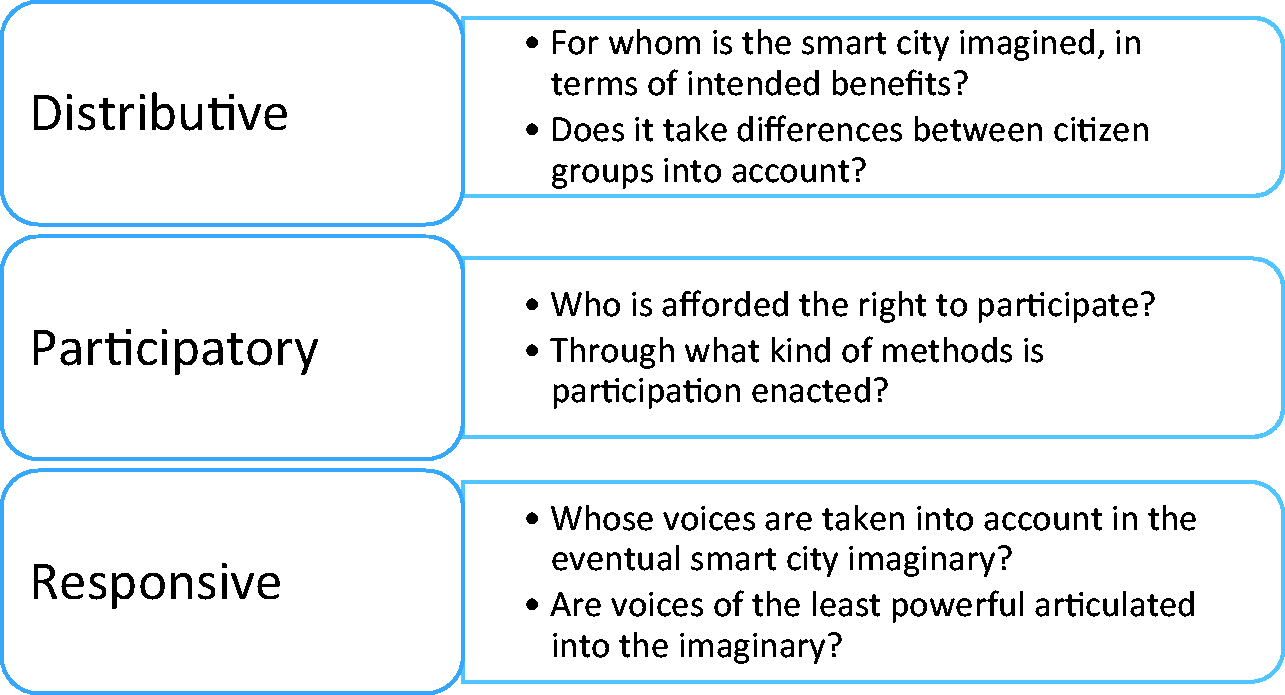
Questions emerging out of rethinking smart as (un)democratic.
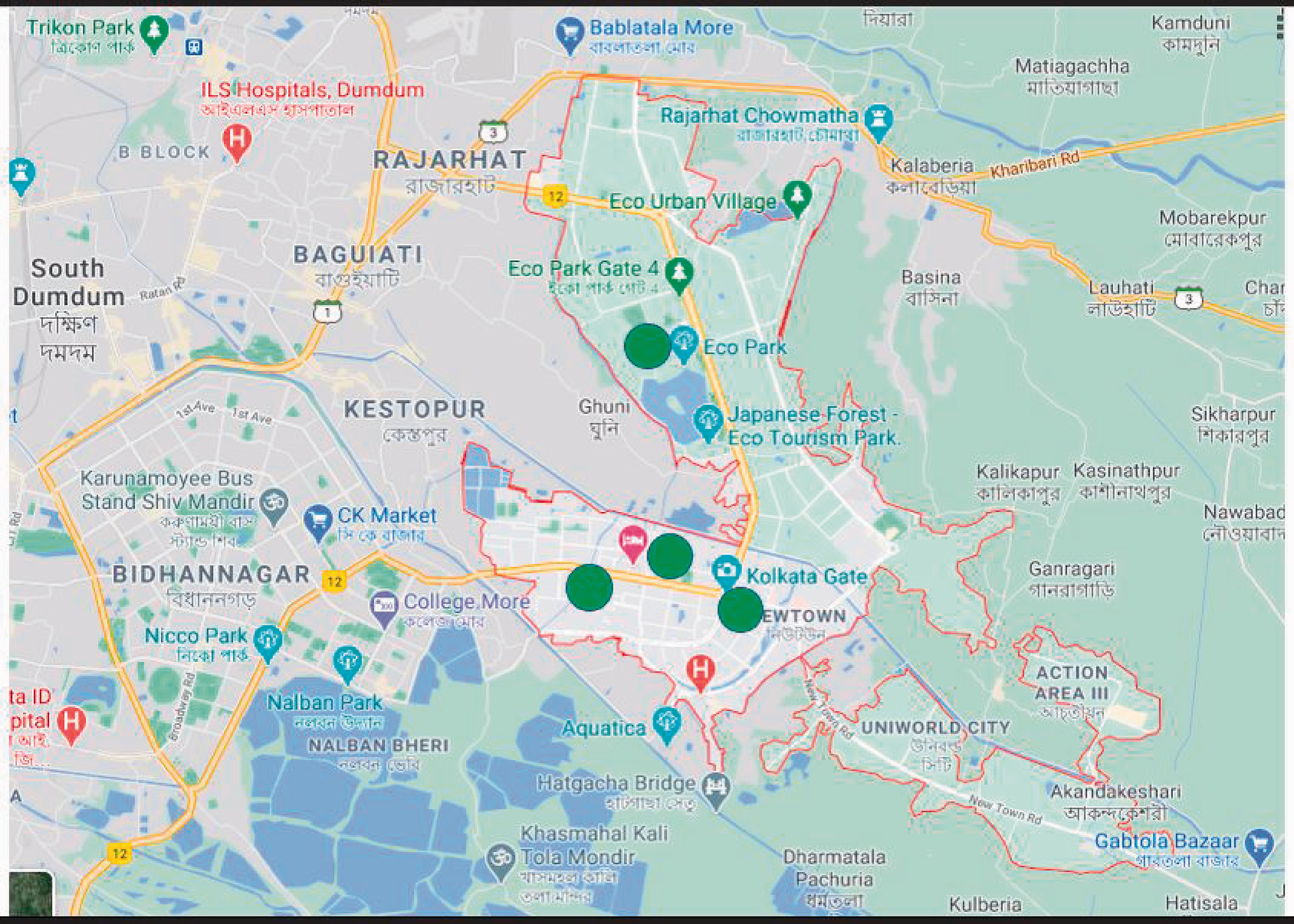
Map of New town Kolkata (red border) and surroundings, marked with sites for interviews and document collection (green circles). Source: Google maps, accessed 14th March 2021.
A smart city imaginary is distributive if its benefits are considered available to all citizens, irrespective of their social group (concerning class, caste and gender). Building on theories of distributive justice of actions (Vallentyne, 2007), here we aim to map whose needs the smart city is imagined as serving, and whose capabilities it is seen as developing. In unequal cities, needs and knowledges of the poor and marginalised often diverge from those of the middle and upper classes. For example, while the poor may demand access to clean drinking water and safe cycling infrastructure, the middle and upper classes may desire gated communities and elevated expressways. We ask if the smart city imaginary takes such differences into account.
A smart city imaginary is participatory if (in its making) diverse groups of citizens, and particularly those who are marginalised, are afforded opportunities to raise their voices (Williams et al., 2018). By mapping the forums and techniques used by smart city planners to enable citizen participation, we examine whether the participatory methods eventually closed down decision-making processes, by excluding the marginalised and silencing the messy diversity of voices (and interests), with the aim of arriving at an authoritative and prescriptive proposal (Stirling, 2008).
A smart city imaginary is responsive if diverse citizens’ voices and knowledge, raised through participatory methods, are taken into account by policymakers and other decision-makers. This means that more marginalised voices are able to influence policies, and that differences between citizens’ voices are articulated in the imaginary (de Hoop and Arora, 2020; Williams et al., 2018), rather than classifying everyone under the homogenous category of ‘citizen’ or ‘resident’. The crucial consideration here, is not whether citizens’ voices matter, but rather which voices are made to matter and how they help transform the policymakers’ smart city imaginary. In particular, how are the voices of the least powerful included by planners and policymakers? Does the latter inclusion open up space for plural people-centred alternatives beyond the dominant smart city imaginary promoted by policy?
Methods: Documents and interviews
To map the smart city imaginaries produced at national and city levels, we rely on the National Smart Cities: Mission Statement and Guidelines (MoUD, 2015), and on two versions of NTK’s proposal submitted to the national smart city challenge (NKDA, 2015a, 2016a). Winners of this challenge received funding and technical support from the national government.
Each version of NTK’s proposal includes annexures containing minutes of official meetings, copies of memoranda of understanding between the New Town Kolkata Development Authority (NKDA) and other organisations, as well as details of citizen engagement processes during proposal development (NKDA, 2015b, 2016b). We also analyse the feedback provided by national government officials on the proposal’s first version (MoUD, 2016), responding to which NTK authorities prepared the second version and annexures.
We complement the document analysis with 32 semi-structured interviews conducted with policy practitioners, middle class as well as marginalised citizens in Kolkata (see Figure 2 for location of interviews). We asked the citizens about their smart city aspirations as well as how, where, when they were consulted in the process. With (transport and urban development) policy practitioners, we tried eliciting how they organised participation processes, what imaginaries of urban mobility exist for the smart city and how they made decisions on the inclusion/exclusion of citizens’ voices into NTK’s final smart city proposal.
Our interviewees included a senior city official planning urban transformation in NTK; an urban planner critical of land use planning and design of the city before the smart city era; and a private consultant who helped the government draft smart city plans. We interviewed three middle-class citizens who represented their residential communities in participatory consultations for developing NTK’s smart imagery. We also conducted short interviews with twenty marginalised people including rickshaw pullers, autorickshaw drivers, roadside vendors, fruit and vegetable sellers, cleaners and construction workers, who offered valuable insights into their everyday practices as well as problems with the smart city imaginary. About half of them informed that they were not aware of citizen consultations, another half were aware and were invited to ‘focus groups’ but didn’t have the time or willingness to go for what they considered to be ‘fancy events’.
Analysis
NTK is located on the north-eastern fringe of the central district of Kolkata, India. Until the early 1990s, it was primarily a rural area supporting agricultural and pastoral activities. NTK was originally planned as a modern business district, with residential quarters for roughly one million people (NKDA, 2016c). Private developers invested in housing and commercial sectors, mainly for the (upper) middle classes (Bose, 2014: 392). Around 200 rural households were displaced from their (agricultural) lands to make way for NTK. According to official reports, displaced people were offered ‘a rehabilitation and resettlement package in accordance with norms of Government of India and State government’ (HIDCO, 1999: 8). The stated visions for NTK’s development in the 1990s were ‘modern’ efficiency, aesthetic attractiveness and environmental sustainability (HIDCO, 1999). The overarching ambition was to make NTK a regional and national financial hub (Hochadel, 2016). On this ambition is overlaid the new smart city imaginary.
NTK covers an area of 35.5 sq. km, comprised of residential ‘gated’ apartments overlooking agricultural lands adjoining the city. The surrounding rural communities act as ‘service villages’, supplying ‘servants, housekeepers, drivers, cleaners, cooks’ to NTK’s urban residents (Kundu, 2016: 96). The main administrative body organising local services and amenities is the New Town Kolkata Development Authority (NKDA). The central planning agency for overall urban development is the Housing Infrastructure Development Corporation (HIDCO). NKDA and HIDCO took the lead in preparing NTK’s proposal for the national Smart City Challenge, using inputs from firms like IBM, SAP, Oracle, Wipro, Shapoorji Pallonji, and Intel (NKDA, 2015a: 49). Future Cities Catapult, a UK-based consulting firm, helped organise citizen engagement. In developing the proposal’s mobility components, representatives from West Bengal’s state Transport Department were involved.
As an imaginary, NTK’s proposal promises to prepare the city for economic and demographic growth, offering its citizens the ‘best in class urban living experience’ (NKDA, 2015a: 16). Other promises include becoming a ‘global’ services hub by attracting new tech companies, setting up hospitals and higher education institutions, as well as offering citizens opportunities for better work-life balance by hosting entertainment centres, parks and museums. The proposal emphasises the goals to be achieved in accordance with the National Mission guidelines, including IT connectivity, e-governance and mechanisms for active citizen participation in the smart city’s decision-making processes (NKDA, 2015a: 16–17). In the following we ask if the proposal as democratic as it claims to be.
A ‘distributive’ imaginary?
The National Mission calls for ‘sustainable and inclusive’ development, to improve quality of life, employment opportunities and incomes for everyone, but particularly ‘the poor and the disadvantaged’ (MOHUA, 2017). In addition, the National Mission guidelines for preparing smart city proposals state that: “applying smart solutions in the transport sector (Intelligent traffic management system) and reducing average commute time or cost to citizens will have positive effects on productivity and quality of life of citizens” (MoUD, 2015: 8). Here, two issues are worth highlighting.
First, the smart solutions are assumed to be beneficial a priori, for citizens’ productivity and quality of life. This marginalises all uncertainties. All possible hurdles experienced in ‘implementing’ smart urbanism are effectively ignored. These hurdles can include problems in procuring the ‘smart’ technologies, securing the necessary land, and developing the requisite skills. Any adverse effects of the technologies, on the environment and on vulnerable people are also not considered.
Second, the smart solutions are assumed to benefit all citizens’ productivity and quality of life. Differences with respect to class, gender, caste, age, disability, and neighbourhood are not considered. For instance, technologies like smart parking systems mainly benefit people who own cars. Poor people are more likely to benefit from safe bicycling infrastructure or a low-cost public transport system that connects their homes with workplaces.
Following the National Mission guidelines, NTK’s proposal frames transport in a smart city to be ‘plentiful and attractive to people of all income levels’ (NKDA, 2015b). This erasure of differences and inequalities from the proposal depoliticises NTK’s smart city imaginary. Many people in NTK earn their living from driving rickshaws, vending fruits and vegetables from pushcarts, labouring on construction sites, working as security guards in flats and offices, and cleaning and cooking as domestic ‘servants’ in the middle- and upper-class homes. Some of these workers live in the city. Others commute from surrounding villages. Nearly all of them use public transport services, roads and other infrastructure on a daily basis. How are their specific needs attended to, in NTK’s smart city proposal?
NTK proposes to build a ‘hawkers’ corner’ or a community marketplace for small and marginal vendors ‘to set up shop in an organised manner’, instead of using pushcarts to sell at their customers’ doorstep (NKDA, 2015a: 42, 43). Such initiatives are publicised as attempts to offer ‘safe spaces’ for these vendors, as part of the city’s efforts to be inclusive (following the National Mission). However, notes from meetings held in February 2016 reveal a not-so-inclusive logic behind this initiative. The ‘hawkers’ corner’ was considered as a response to the “increasing menace of encroachment of roadside public places by hawkers,” which was seen as creating “nuisance by littering of waste in adjoining roads & footpaths and visual pollution,” while “also hampering free flow of traffic in service roads” (NKDA, 2016b: Annexure 4: 12). The smart city thus aimed to control the vendors in an enclosed ‘hawkers’ corner’. As one of our respondents notes, ‘it was [considered] essential to remove them from eye-sight in order to present New Town as a clean and smart city’. This smart initiative is also unsatisfactory for many middle-class residents who considered the designated ‘corner’ as a distant and inconvenient location to shop from.
Another ostensibly ‘pro-poor’ intervention is the introduction of the Toto (a battery-operated rickshaw), proposed to create new employment opportunities. By simplifying the bureaucratic process of acquiring a driving licence and vehicle registration, low-income individuals are encouraged to own and drive a Toto (as a mode of shared/public transport) for a living. However, the overarching goal here appears to be the promotion of deregulation and marketisation of transport, as exemplified by this statement from an interview with a government official:
I believe in market mechanisms. Market regulates the price and creates entry and exit barriers. Let us [government] not put additional barriers.
The same neoliberal thrust is wrapped up in citizen choice and inclusion in the NTK imaginary’s promotion of bicycling. Here, differences among citizens are acknowledged by considering that bicycling might not work for all citizens. As noted by a city official:
We are not advocating that everyone should start bicycling or people should bike to work … cycles will never be popular among elderly citizens, but we are not suggesting one size fits all strategy. Citizens with different needs and choices will be able to choose what suits him/her most.
A ‘participatory’ smart city imaginary?
The National Mission guidelines highlight citizen participation as crucial to smart city proposal development: “The proposal will be citizen-driven from the beginning, achieved through citizen consultations, including active participation of groups of people, such as Residents Welfare Associations, Taxpayers Associations, Senior citizens and Slum Dwellers Associations. During consultations, issues, needs and priorities of citizens and groups of people will be identified and citizen-driven solutions generated.” (MoUD, 2015: 22 emphasis added)
The National mission guidelines emphasise the use of digital technologies for citizen participation, by asking: “how much of social media, community, mobile governance have been used during citizen consultation?” (MoUD, 2015: 35 emphasis added). Even for achieving the ostensibly people-centred citizen participation, the national government’s smart city imaginary is centred on digital technologies. While restricting participation to those who are adept with digital technologies, this technology-centred framing may be geared towards promoting the contracting of private firms to design and implement “tools for tailor-making stakeholder engagement” (Corsini et al., 2018: 6).
Attempting to adhere to the National Mission guidelines, NTK’s proposal highlights the ‘quantity’ of participation, stating that the city: “engaged with around 83% of the residing population (29880 residents) to obtain their feedback on city profile and understand their aspirations, visions and goals. Approximately 21% of respondents (7560 persons) provided inputs for formulating the Smart City Plan through 138 events.” (NKDA, 2016a: 19) “Respondents included – senior citizens, housewives, students, professionals including IT employees, informal sector workers, children, non-resident property owners, citizens seeking to relocate to New Town in near future, entrepreneurs, developers, businessmen, city administrators, elected representatives, academicians and other government institutions along with visitors to the city” (NKDA, 2016a: 19)
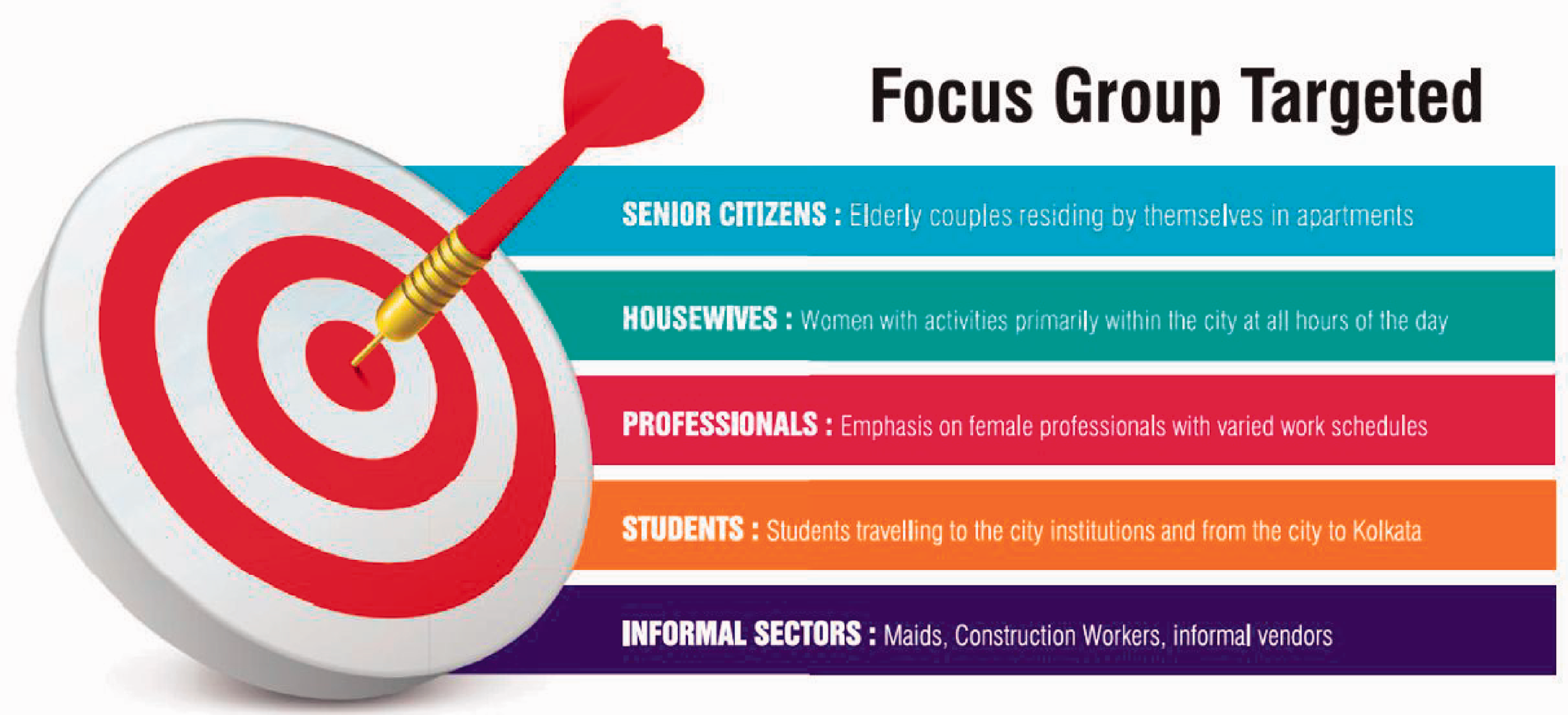
Citizens’ Groups targeted in the Consultation Process. Source: NKDA 2016b: 3.2.1 Open access.
During interviews, our respondents offered useful insights into ‘who participated’ in the smart city consultations. One interviewee observed that a middle-class family including senior citizens, male and female professionals, children, domestic workers, cooks, nannies and pets was generally represented by a single male member of the family. Women only attended the meetings if male family members could not attend, or if male members considered the meetings to be ‘childish endeavours’ not worth attending. Another interviewee described how a few enthusiastic (often retired) male residents, held in high esteem by local government officials due to their successful professional careers, were personally invited to the consultation sessions. Clearly, these influential people were not the marginalised, vulnerable citizens that the National Mission guidelines had emphasised.
Each participating residential community, such as the residents’ welfare association of a neighbourhood, selected a representative to attend the NTKDA meetings and workshops. This representative was generally middle class rather than a poor resident of the neighbourhood (as has been observed in other experiments with participatory urban governance in Indian cities: Chattopadhyay, 2015; Kundu, 2011). Before the participatory gatherings in NTK, some representatives collected ideas from other residents, or wrote up their own ideas and validated the same with other residents of the community. Recalling one meeting for representatives of a residents’ welfare associations, one respondent noted: “After an introductory speech by the chair, we were showed some video clips (of smart cities around the world). We were then asked to propose any ideas and opinions about making New Town a smart city.”
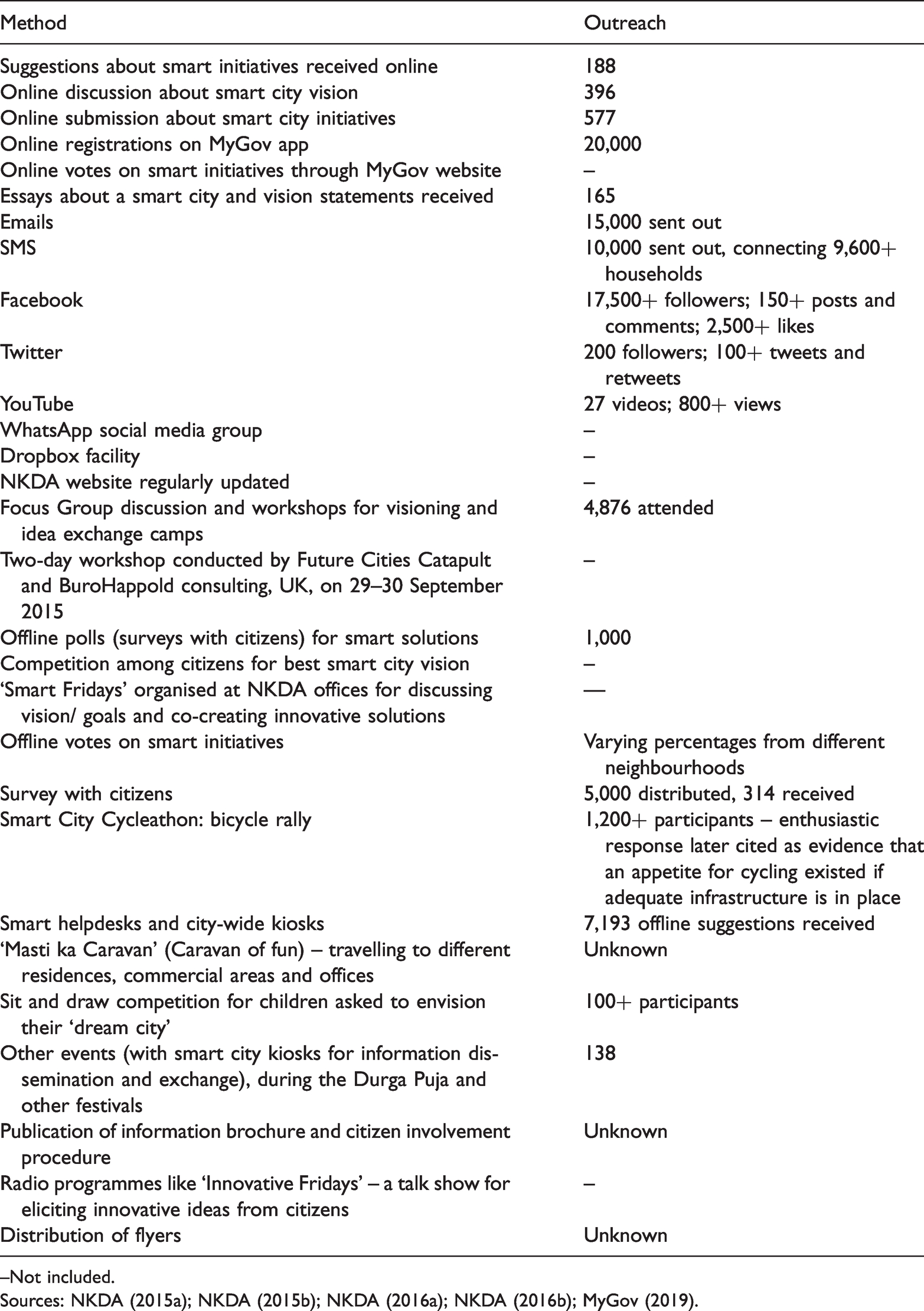
In contrast to the paucity of information on ‘who actually participated’ in achieving the ostensible goal of co-creating the imaginary, NTK’s proposal is replete with details about the methods used for citizen participation. A wide variety of techniques were used, as listed in Table 1.
Methods used for citizen engagement in 2015–2016.
–Not included.
Sources: NKDA (2015a); NKDA (2015b); NKDA (2016a); NKDA (2016b); MyGov (2019).
Most methods listed in Table 1, such as the distribution of flyers, help desks, and regularly updated website, communicate information to citizens rather than co-producing the smart city imaginary with them. There is also a clear bias towards online media for citizen engagement. Such a bias ends up excluding those citizens who do not operate a digital device. Yet, many citizens were heard through face-to-face forums such as focus group discussions and workshops (NKDA, 2016b: 3.2.2). Unfortunately, NTK’s smart city documents do not describe these forums’ design or outcome. The quantity of participation is thus highlighted, without providing an explanation of content and quality. Unsurprisingly, therefore, many of our respondents claimed that (marginalised) citizens cannot be considered as having co-produced the imaginary.
Without two-way communication between citizens and city officials, participation is reduced largely to (elite, digitally savvy) citizens’ access to information provided by smart city promoters. Voices of dissent and citizens’ divergent interests are marginalised, which closes down the development of the imaginary. As we document in detail below, the final proposal remains largely within the bounds of technocratic smartness as imagined by urban planners/administrators and their partners in tech firms and consultancies. This is also reflected in the proposal’s emphasis on the consultants who organised participation on behalf of the city, instead of the voices of thousands of local citizens who were counted as participants. Ultimately, while citizen participation was counted as significant in terms of numbers, the actual impact of people’s voices appears to have been limited.
A ‘responsive’ smart city imaginary?
Having an avenue to participate does not necessarily ensure that citizens actually influence the eventual imaginary. Our conversations with NKDA officials revealed that the information gathered from citizens was reviewed, ‘cleaned up’, and some ideas were cherrypicked out of the received input. This turned NTK policymakers into gatekeepers, who not only framed the design and practice of citizen engagement (as detailed above), but also controlled the influx of ideas. Enacting this control, they accepted some ideas as relevant for the proposal, while discarding others. Therefore, only a small selection of the voices raised by citizens is articulated in the final proposal.
The National Mission guidelines emphasise the articulation of citizens’ voices, by asking: “How well does the vision come out of the needs, aspirations and wishes of the local people to make their city more liveable?” (MoUD, 2015: 33). “Do the goals flow from visions identified through citizen consultation?” (MoUD, 2015: 34). The guidelines call for the inclusion of “details of [the] process for co-creating every step (ideas, strategies, implementing mechanism and financial solutions) through an extensive consultation process” (MoUD, 2015: 35).
The first version of NTK’s proposal does not respond to these questions. It provides only a brief description of the different citizen engagement methods used. It does nevertheless claim that the smart city vision was collectively imagined, incorporating citizens’ inputs, without specifying which inputs were incorporated and how. The second revised version of the proposal is more detailed in representing citizens’ voices. An example of this is shown in Figure 4, which details citizen feedback on mobility. The figure shows that ‘walkability’ and ‘transport’ each constituted 10% of the total citizen responses (NKDA, 2016a: 48). Under transport, the citizens’ emphasis is overwhelmingly on public transport, both concerning the expansion of options, pan-city connections and last-mile connectivity (between a bus or metro stop and the passenger’s office or home). How do these citizens’ concerns align with the smart mobility initiatives and solutions included in NTK’s proposal?
Indeed, many of the mobility initiatives proposed are consistent with citizens’ emphasis. Below is a list of such proposed initiatives (NKDA, 2016a: 27): five smart bus stands and one smart bus terminus; a carpooling programme; a cycling project; 145 km of pedestrian-friendly pathways and citizens’ plaza; nine smart parking lots; an app for autorickshaws/Totos; 30 autorickshaw/Toto stands with charging station, waiting area, water fountains and other amenities; mono-rail and sky trains; bike-sharing facilities; eight new metro stations and a ‘multi-modal transport hub’ in each metro station, to ‘create seamless transport connectivity across [different] public transport modes’ (NKDA, 2016b: 3.7.2).
In the proposed initiatives, however, digital technologies are nearly always central. Mobility is imagined in the form of technologies like the ‘smart auto-Toto app’, ‘bus locator’ and ‘app for ride pooling’ (NTKDA, 2016b: 3.7.2). From citizens’ feedback (Figure 4), it is clear that the use of digital services in mobility was not a citizen concern. Digital technologies were instead imagined by planners and experts involved in proposal development. Officials took pride in offering digital solutions and admitted that these initiatives are aimed at making NTK a ‘world-class city’ (cf. Burns et al., 2021; Roy, 2011: 259). As noted by an official we interviewed:
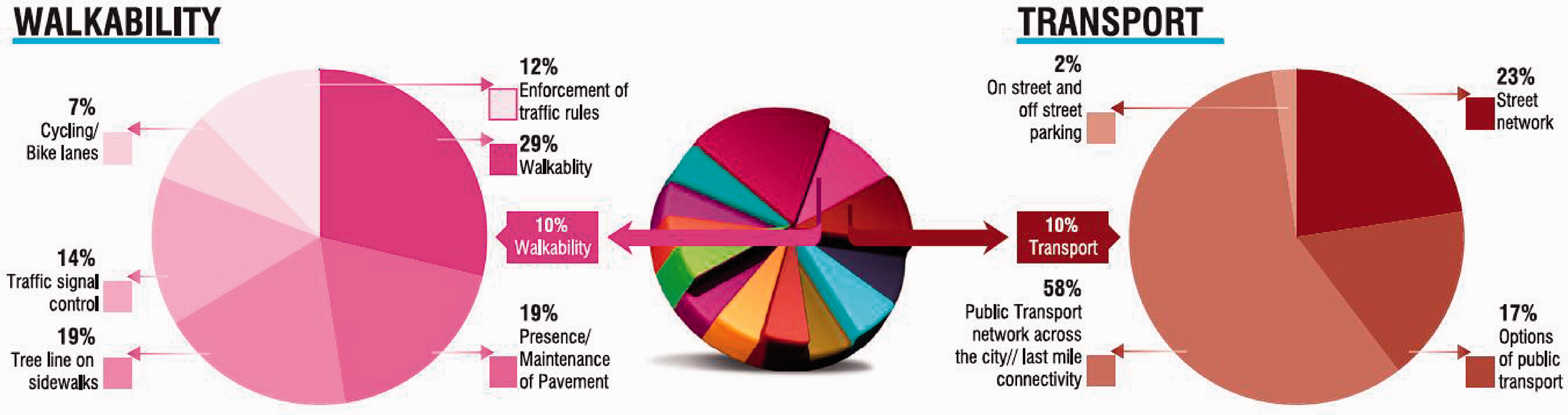
Citizen Feedback on Mobility Issues in NTK’s Smart City Proposal. Source: NKDA 2016b: 3.2.2 Open access.
“if people in New York enjoy certain facilities, why would people in India not have those facilities?”
The official’s statement indicates that NTK’s smart imaginary is not simply driven by local needs and citizens’ voices. If ‘globality’ of a city like New York is centred on digital technology, then clearly there is a tension between that aspiration and an imaginary that is responsive towards the needs and knowledges of the city’s residents, particularly the most marginalised among them (Bose, 2014; Burns et al., 2021). Rather than directly addressing citizens’ needs of accessible public transport, safe pedestrian and bicycling infrastructure, NTK officials translated citizens’ voices into the promotion of digital technologies following ‘global’ smart imaginaries (Wiig and Wyly, 2016: 488).
The revised version of NTK’s proposal contains a critical annexure titled ‘Model “Liveable” Neighbourhood’, which attempts to articulate the needs and challenges of living in the city, voiced by three anonymised NTK citizens (NKDA, 2016b: 3.6.5). Following a suggestion by the UK-based consultancy, Future Cities Catapult, NTK officials selected one young woman (aged 27, who had recently moved back to India after living abroad), one middle-aged man (aged 55, working in a private firm) and a senior citizen (male, aged 74, retired, middle class).
The woman’s concerns focus on the lack of walking and cycling infrastructure, poor air quality and lack of safety in the neighbourhoods. The middle-aged man is concerned about access to doctors, health facilities and markets for food, while the senior citizen emphasises the need for last-mile connectivity using para-transit modes and public spaces for community gatherings (NKDA, 2016b: 3.6.5). Mobility is central to all three citizens’ concerns. While the articulation of the three citizens’ concerns is useful, the proposal does not describe why these citizens were selected and how representative their articulations were of the concerns of poor and marginalised women and men living and working in NTK. Instead, this exercise of articulating citizens’ testimonies appears to have helped tick a box in the National Mission’s proposal preparation guidelines (NKDA, 2016a: 90).
In order to grasp NTK’s responsiveness to citizens’ needs, two observations are crucial. First, engagement exercises aimed to gather citizens’ concerns regarding their perceived needs and challenges of living in NTK, rather than any innovative solutions and initiatives based on the citizens' own knowledge and experience. The imagination of all initiatives and solutions was thus solely the preserve of ‘official’ smart city promoters (including urban planners, policymakers, hired consultants and tech firms). In fact, participation can help pave the way for city officials to present their predetermined priorities as smart solutions to the concerns raised by citizens.
Second, considering that only three citizens’ voices were highlighted in the revised version of the proposal, it is likely that the solutions proposed by the urban planners and policymakers were not responses to diverse citizens’ concerns at all. Instead, the latter concerns may have been selected, filtered out of a diversity of citizen inputs (see above), to include in the proposal because they were consistent with the technological solutions that the planners and policymakers had already defined and incorporated into the smart city imaginary. Thus, it may be technological solutionism that governs the development of NTK’s smart city imaginary even when it is attempting to be responsive towards citizens’ concerns.
To map some voices that are not included in the proposal, we requested our interviewees to narrate their concerns and solutions (focussing on transport and mobility), which they raised earlier during face-to-face consultations with city officials and their consultants. Citizens narrated concerns and solutions such as traffic congestion, improvements to city roads, good public transport and communication. They also included some specific suggestions such as escalator and lift services in metro stations; safe, well-lit and clean underpasses for walking and crossing busy roads; direct bus connectivity to all parts of central Kolkata as well as higher frequency and more reliable public bus services. These concerns and solutions show that smart urban mobility is not necessarily driven by apps or other digital technologies. Citizens focus instead on the reliability, accessibility and convenience of good public transport infrastructure.
The middle-class citizens we interviewed proudly noted that the chair of the NKDA readily accepted their proposals in consultation meetings. NKDA officials also informed us that citizens’ viewpoints in many cases helped them reframe smart city strategies. As one city official notes, “normally we wouldn’t have given priority to walkability, but citizens’ feedback showed us [new] directions to allocate our limited budget.” This indicates that the policymakers and planners were open to at least some alternative directions of smartness highlighted by upper- and middle-class citizens. Yet, officials also clarify that citizens’ voices only mattered when they ‘made sense’. As observed by a city official: “Often citizens’ concern is their immediate neighbourhood; they would hardly ever reflect on an overall aggregate strategic planning. If you listen too much to citizens’ views, you go nowhere. You need to take control and do strategic planning.”
In general, NTK’s smart city proposal is responsive to some voices belonging to the middle- and higher-income citizens who may be employed in (or retired from) prestigious government jobs, own a flat in one of the expensive gated communities, and/or possess connections with (international) businesses. Voices of poor and marginalised people are absent in the imaginary. Such voices are thus systemically excluded. Although the participatory development of the imaginary included focus group consultation with the so-called informal sector, and the imaginary articulated a smart initiative of “organised vending zones for 600 informal vendors” (NKDA, 2016a: 43), this initiative was not co-produced with poor and marginalised people working in the ‘informal’ sector.
Discussion and conclusions
Our analysis shows that New Town Kolkata’s smart city imaginary largely failed to be distributive. It rarely accounted for the specific needs of poorer and vulnerable citizens. In the event where needs of poor citizens were highlighted, such as in the promotion of the battery-operated Toto, they served as a ruse for neoliberal marketisation of public services, confirming the historical rise of neoliberalism in Kolkata and beyond (Sengupta, 2013).
City authorities invested considerable effort in using participatory methods for citizen engagement. However, citizen participation was governed by: top-down framing of the design and practice of participation, often prioritising one-way digital communication, consistent with technocratic and globalising teleology of smart cities; dominating influence of middle- and upper-classes, rather than poor and marginalised citizens; an emphasis on the ‘quantity of participation’ rather than on its quality; and focus on identifying citizens’ needs and concerns rather than their knowledge-production and innovation initiatives. While citizen-led articulation of problems has real potential for democratising urban planning (Calzada, 2018), NTK missed opportunities to co-produce the imaginary with citizens. Also, possibilities for citizens to challenge the content of the imaginary were not nurtured.
People in-charge of developing the imaginary were responsive to some middle-class citizens’ voices. Consistent with these voices, plural alternative smart solutions were proposed, such as walkability and cycling. However, citizens’ concerns and solutions articulated in the proposal, were generally tied to digital technologies. In general, aspirations to be ‘world-class’ smart and accompanying technological solutionism appear to have provided the basis for officials’ filtering and cherry-picking particular issues, out of the wide range of citizen inputs that were received. Participatory democratic exercises were thus put at the service of technocracy and control (cf. Arora et al. 2020).
By excluding citizens’ voices that diverged from official technocratic visions of ‘global’ smart urbanism, a messy diversity of citizens’ voices was closed down in the making of the smart city imaginary (despite its emphatic celebration of citizen engagement). Thus excluded were voices, interests and knowledges of the city’s low-income groups, including people who live or work as maids, vendors and construction workers. Such exclusion has been observed across other participatory urban governance efforts in Indian cities (e.g., Chattopadhyay, 2015; Williams et al., 2018). Participation is also observed to be biased towards the middle and upper-middle classes (Coelho et al., 2013; Patel et al., 2016). In the foregoing, we have shown how management of participation and its deployment to legitimise top-down official visions (Raman, 2013; Stapper et al., 2020; Zérah, 2009), plays out in practice as city officials and their hired consultants filter and favour those concerns that appear aligned with technology-centred visions of smart urbanism.
To develop imaginaries that are genuinely responsive to the needs and knowledges of its marginalised citizens, modern technologies developed and sold by large corporations must be decentred, and grassroots innovations and practices must be foregrounded (Boni et al., 2019). The latter innovations and practices offer plural alternatives enabled by poor and marginalised citizens, which are crucial for truly people-centred and democratic smart cities.
Finally, our conceptual framework focused on distributive, participatory, and responsive imaginaries, can help scrutinize sociotechnical developments for smartness or sustainability, as more or less (un)democratic. A growing literature shows that poor and marginalised citizens do not fit ‘smart’ visions of marketized technocratic development, particularly in highly unequal cities like Kolkata. Contributing to this literature, we have shown how unfitting voices are excluded and controlled in practice, even within ostensibly participatory and inclusive developments, by policymakers and consultants playing the role of gatekeepers. However, our contribution is valuable only if it helps deepen democracy in urban governance, by transforming smart and sustainable imaginaries to be based on the voices/knowledges and innovations produced by poor and marginalised citizens. Without such a democratic transformation, smartness is likely to remain a metaphor for neoliberal technocracy.
Footnotes
Acknowledgments
We would like to thank Johan Schot, Ed Steinmueller, Fred Steward, Gordon McGranahan and Jaideep Gupte and anonymous reviewers for their feedback on the paper. We thank STEPS working paper series for publishing an earlier version of this paper. We thank participants of the annual meeting of Association of American Geographers (AAG) in Boston, April 2017, and SPRU PhD forum 2018 for suggestions and feedback.
We are also grateful to two anonymous reviewers and the editor for very helpful suggestions. Any remaining errors are our responsibility.
Declaration of conflicting interests
The author(s) declared no potential conflicts of interest with respect to the research, authorship, and/or publication of this article.
Funding
The author(s) disclosed receipt of the following financial support for the research, authorship, and/or publication of this article: The first author acknowledges support from the university of sussex business school for a graduate teaching assistantship.
