




Abstract
Climate change effects, views and approaches vary based on geographical location, class, gender, age and other climate related social factors. It is thus relevant to explore how various government bodies/authorities involved in dealing with climate change represent and act on social difference across diverse societies. This article performs a discourse analysis of climate policy documents from three Swedish government agencies: the Transport Administration, the Energy Agency, and the Environmental Protection Agency. This in order to explore how the different agencies represent social difference: what is made visible; what is obscured; what are the implications? We collected a purposive, collated sample of literature through online searches and personal communications with agency staff. We apply an intersectional approach to the sampled literature. The article finds that while each agency articulates an awareness of social difference, this tends to manifest in broad terms. It argues that this has the effect of obscuring differential climate impacts and effects of climate action, with potential environmental justice implications. Finally, the article concludes by proposing that incorporating intersectional approaches will support more effective, inclusive and equitable climate action, in Sweden and elsewhere.
Introduction
International climate objectives– as in the Paris Agreement and in the Sustainable Development Goals (SDGs) – require substantial societal changes (Nilsson et al., 2013) largely implementable at a national level. Here, government agencies are crucial as authoritative institutions expected to implement international and national climate goals and realize them through policy. Previous research on climate policy-making indicates that climate institutions in the Global North, e.g. in the European context, lack knowledge about climate relevant social differences, vital for reaching the SDGs’ justice and equity measures (Alber et al., 2017; Allwood, 2014; Buckingham and Le Masson, 2017: 3–5; Magnusdottir and Kronsell, 2015, 2016). This article contributes with analysis of Swedish governmental agencies’ discourse on social differences. Such agencies are important to climate policy making, but comparatively under researched (cf. Magnusdottir and Kronsell, 2021). Sweden represents an enlightening case as the country is considered a trailblazer in environmental policy (Skovgaard et al., 2018) and in decarbonization (Bäckstrand and Kronsell, 2015). Sweden is considered a progressive example of contemporary climate governance (Hildingsson, 2014; Lundqvist, 2004) with ambitious climate policy targets (Tobin, 2015; Zannakis, 2009) as well as environmental performance (Burck et al., 2018; OECD, 2014). Sweden has comparably low‐carbon intensity, has cut national carbon emissions by over 25% since 1990 (SEPA, 2018) and is aspiring to become one of the first fossil fuel free societies (Swedish Government, 2017: 36). However, Swedish actions are not without criticism (Hult and Larsson, 2016). This article problematizes the blind spots of ‘successful’ climate governance. The findings are relevant to those interested in improving accepted wisdom around the way forward as well as those seeking alternative paths.
Sweden is an advanced welfare state, suggested to have the capacity and institutional legitimacy to negotiate conflicts between the state, the market and society (Meadowcroft, 2005). Indeed, Sweden has both formal and informal procedures in place to include different sectors and social actors in policy-making and we might expect Sweden’s necessary climate transitions to address issues of social justice and equity. However, thus far the tendency has been to prioritize economic actors at the expense of others, resulting in insufficient and unequal climate outcomes (Kronsell et al., 2019). Achieving Sweden’s goal of becoming a fossil fuel free society by 2045 demands considerable action that will result in societal changes with, most likely, far-reaching effects.
Government agencies are important because they frame representations of climate problems, suggest strategies, make policies and set targets. These institutions produce and reinforce, but may also challenge, societal power relations by, for example, distributing resources, promoting specific norms and values and by including or excluding certain groups’ needs and knowledge. Despite the inherently social and political character of this work and its effects, (Swedish) climate policy-making has largely focused on technological innovations and economic incentives, with inattention to social dimensions. This matches findings on climate policy-making in most industrialised states (Griffin Cohen, 2017; Magnusdottir and Kronsell, 2015, 2021). The diversity of the public and the various needs and behaviour patterns of different groups are insufficiently recognized. However, as recent research increasingly highlights: greenhouse gas emissions, vulnerability to environmental impacts and political participation vary across the population, according to gender, race, class, age and other intersectional factors (Djoudi et al., 2016; Kaijser and Kronsell, 2014; Schlosberg, 2013). This is the case across Swedish environment, energy and transport sectors (Magnusdottir and Kronsell, 2021). As such, climate policy requires recognition of social differences. Current non-recognition risks undermining action on climate change and causing conflicts with other sustainability goals (Swedish Government, n.d.). If such differences are not recognised, climate policy risks being both ineffective (by focusing on the wrong targets) and reinforcing inequalities.
In this article, we explore how social differences appear within the climate change policies of three Swedish government agencies through a critical discourse analysis of their key steering documents. These are, variously, the Swedish Environmental Protection Agency (SEPA, Naturvårdsverket), the Swedish Energy Agency (SEA, Energimyndigheten), and the Swedish Transport Administration (STA, Trafikverket). Each of these are prominent actors in Swedish climate change policy, acting as an interface between international and national policy and local level action (Kronsell et al., 2012; Nilsson et al., 2013), as well as in the broader context of the Global North (Magnusdottir and Kronsell, 2021). We apply an intersectionality approach to key steering documents of these agencies – a useful way to investigate the normative assumptions of official conceptualisations of social difference. The guiding research question is: how is social difference framed in Swedish climate policy?
The article is structured as follows. Next, we present background information on the three government agencies. We then describe the key theoretical lenses of intersectionality and environmental justice and their relationship to feminist institutionalism. We then present the critical discourse analysis, before delving into the data for discussion of implications. Finally, we conclude by highlighting the main findings and their wider relevance beyond the case itself. We argue that the sampled agencies’ documents reflect simplistic understandings of social difference leading to a simplistic framing of the social consequences and impacts of climate change and climate-related action. We argue that intersectional insights therefore need to be incorporated into Swedish agencies’ climate policy-making.
Background
This article ties into and contributes to theoretical advances on the green welfare state (Eckersley, 2004). In particular, how state institutions can develop in ecologically sustainable directions (Bäckstrand and Kronsell, 2015; Duit et al., 2016) and to ongoing debates on the role and importance of policies and institutions to environmental performance (Duit, 2016). Reaching climate objectives requires robust democracies (Laestadius, 2018) and a crucial element of democracy is the ability to be inclusive of the needs of the constituency, in terms of equal representation and justice. Hence, democracy has to be sensitive to social difference, long-term interests, humans, non-humans and nature (Donoso, 2017). Democracy in the welfare state goes beyond elections and parliamentary politics and includes democratic institutions and the way they shape agendas, make and implement policies. While some scholars strongly doubt that state administrative practices will advance climate politics (see Schlosberg et al., 2019) we argue there is potential for positive change in and through state administrative practices.
In Sweden, government agencies provide part of the decision base for policies, realize government policies and respond to national and international climate targets (e.g. the SDGs and climate goals). While each agency is obliged to pursue climate policies based on the climate goals adopted by the Swedish parliament (Swedish Government, 2017) they act with a certain degree of independence – making them policy actors relevant to study in their own right. The three state agencies in focus here (below) are each involved in climate policy-making in different policy fields and we purposively chose them for their relevance to Swedish climate action.
The Swedish Environmental Protection Agency, the state body for environmental issues, is the agency with perhaps most climate-change related activity, tasked with supporting the Swedish government’s production of climate action plans every fourth year alongside other activities (SEPA03; wSEPA6). These other activities include monitoring of Sweden’s environment, observing the status of pollutants and pollution levels; invasive and native species; and pesticide use in farming, to mention a few (SEPA03). As an actor, the SEPA compiles knowledge and develops and implements environmental policy. SEPA’s activities intersect with other agencies’ work, including both the SEA and STA. The SEA works on the conversion from fossil fuel to renewables and curbing energy use, contributing “facts, knowledge, and analysis of supply and use of energy” in Swedish society (Energimyndigheten, 2015). The STA is responsible for long-term transport infrastructure planning, construction and maintenance and works with climate policies in relation to transport. Both the SEA and STA’s respective sectors, energy and transport, are heavy contributors to Swedish carbon emissions (SEPA10: 21). All three agencies are relevant for this study as prominent players within Swedish government climate action.
A critical perspective on climate policy
Our approach is based on a feminist institutional standpoint that argues that institutions matter for politics and in policy making. Said institutions are important to study because they organise power inequalities through formal as well as informal rules and practices (Krook and Mackay, 2011; Ljungholm, 2017). Within, feminist institutionalism, focus has often been on the role institutions play in the production and reproduction of gender and other forms of social difference and subsequent political effects. A feature of institutions like government agencies is the possibility that they might exhibit a degree of ‘path dependence’. This means that rules and norms of behaviour cause particular pattern-bound effects over time which can make them durable and resistant to change (Krook and Mackay, 2011; Mackay et al., 2010; March and Olsen, 1989). On the one hand, this adds resilience. For example, despite changes of government and a global economic crisis, cross-party support for environmental policies has continued to be a feature of Swedish politics (Skovgaard et al., 2018). On the other hand, it may be very difficult for institutions to change. For example, both the SEPA and the Swedish International Development Cooperation Agency (SIDA) are reportedly characterised by “a hegemony of the natural scientific viewpoint” (Arora-Jonsson, 2018: 740) that prioritizes technical and economic strategies over socially oriented strategies. This might also limit the institutional understanding of the importance of social factors in climate policy-making. Put simply, we expect each agency to view the world through its own institutional lens, which will bring particular issues (and in the case of social justice, identities) into and out of focus, affecting agency actions. As feminist institutionalists, we seek to analyse the explicit and implicit norms that form part of each of the sampled agencies’ institutional lens.
Path dependence entails the normalisation of discursive worldviews (Ljungholm, 2017), where the agencies are co-constructed with particular discursive representations of problems and their solutions. Each agency has different tasks and responsibilities and relies upon different types of expertise and knowledge: for example, that of natural scientists, transport engineers, energy system engineers, innovation experts or others. We expect that each institution will generate distinct discursive narratives around climate change and social inclusion. Regarding social inclusion, we expect that different policies will represent/frame social in/exclusion in different ways with concomitant implications for their effects. Social in/exclusion is something that is done through policy representations – for example, men and women are gendered through policy framings, with certain groups rendered more or less visible (Bacchi and Eveline, 2010). As such, this research interrogates what ‘social in/exclusion’ exists within the sampled government agencies (Bacchi and Eveline, 2010: 112).
In examining sampled climate institutions, this article draws upon feminist theory and environmental justice research. In the discourse analysis of policy documents, we apply a particular critical framework to explore different framings of social inclusion among the government agencies. These provide two complementary approaches with different foci to explore the uneven impacts of environmental policy and problems. The following section presents these bodies of theory in some detail.
Intersectionality first emerged from black feminist activism in 1970s and 1980s USA as a critique of essentialism within mainstream emancipatory movements. Black women found themselves misrepresented by and excluded from both black emancipatory movements that claimed to speak for all black people, and white feminist middle-class movements claiming to speak for all women, regardless of colour or class (Castán Broto and Neves Alves, 2018). Within academia, Crenshaw (1991) has argued that experiences shaped by overlapping patterns of sexism and racism were missing from either feminism or antiracism discourses. Intersectionality has therefore been, and continues to be, developed as a way to broaden the analysis of gender power relations since gender cannot be isolated analytically from other social differences (Davis, 2014). Intersectionality explores how social power relations, based on categories of difference such as gender, class, age and race, are interconnected (Cho et al., 2013; de los Reyes and Mulinari, 2005; Lykke, 2010). Social justice research is not simply interested in the differences between e.g. different gender groups, but also with differences within those groups. This is relevant to the discussion of the causes, effects and politics of climate change.
While gender has been shown to be relevant to climate change (Alston and Whittenbury, 2013; Resurrección, 2013) it is nested beside other social differences, such as context and place (Magnusdottir and Kronsell, 2015, 2016; Nagel, 2012) or economic status, when, for example, explaining carbon emissions (Ergas and York, 2012) and ecological footprints. Apart from assisting us in avoiding unidimensional analyses of inequality, intersectionality aids in analysis of the situated nature and sociality of power and knowledge. Power relations in a specific place and situation can generate a certain type of knowledge (Agarwal, 2000). It is important to question universal claims and instead ask what type of knowledge is being privileged and rendered prominent in questions regarding climate change (Kaijser and Kronsell, 2014). We therefore use intersectionality to shed light on how the various agencies’ climate documents employ and articulate knowledge on social differences.
There are several different approaches to intersectional research, each with different understandings of the intersectional complexity of social life. This research focuses on the categories that emerge within the sampled agencies policy documents (see Methods, below). As such, it initially draws on the “anticategorical tradition”. This research tradition deconstructs extant analytical categories – life is more complicated than a single gender choice (McCall, 2005: 1773). However, this article is also concerned with the complex, knock-on effects of any climate-change impacts on diverse social groups, and concern for what is being neglected. As such, insight is also drawn from the “intra-categorical tradition”. This approach focuses upon “particular social groups at neglected points of intersection…. In order to reveal the complexity of lived experience within such groups” (McCall, 2005: 1774). This research explores the complexity of overlooked groups’ life experiences. For instance, an example of this is research focusing on the lived experiences of black women in the US, who are at the intersection of the more prominent social categories ‘women’ and ‘black’ (Davis, 1982). Generally, anti and intra-categorical analyses are attentive to the “strategic essentialism” inherent to political framing of an issue (Gaard, 2001). Often this deconstruction hails from a particular perspective, with its own essentialist positions (e.g. Tamale, 2020). This is a product of the “on-going necessity of group politics” (Crenshaw, 1991: 1296). This research is no exception and we seek to remain reflexive and mindful of the limitations of our own particular perspective (cf. Haraway, 1991).
Complementing this intersectionality-led approach, we assess the implications of particular framings of social categories through the lens of environmental justice. Environmental justice also emerged in the 1970s and 1980s and originates from movements and work on environmental racism in the US that revealed how environmental pollution impacts unequally on communities of colour (Bullard et al., 2008). This research has explored how urban planning and development is often linked to, predicated upon and perpetuating in practice various social inequalities and uneven exposure to environmental impacts along lines of race, geography and income (e.g. Bullard and Wright, 2008; Cutter and Finch, 2008; Pulido, 2000). The environmental impacts of modern living are often unevenly distributed. “[T]he sociology of environmental justice can be seen as the study of the interactions between a differentiated society and a differentiated environment. That is, different social groups are differentiated in their access to resources, power, privilege, and opportunities” (Timmons Roberts et al., 2018: 235). For example, it may be possible for some social groups, through greater access to wealth and/or power to avoid the effects of pollution caused by their lifestyles.
However, environmental justice is more than just about distribution; it also recognises the diversity of communities affected and their extent of participation in environmental policy (Schlosberg, 2004). Furthermore, it also draws attention to scale as in a globalised world the environmental impacts of a country’s citizens’ lifestyles may well be felt far away and become a factor in the politics and planning of both the causing nation and those affected by it. As such, societies facing climate challenges find themselves parts of global systems, which have direct relevance to their needs and possibilities for climate action locally, regionally, nationally and internationally (Martínez-Alier, 1997). Similarly, environmental justice literature has increasingly turned to discussion of “the crucial nature of the relationship between environment and the provision of justice itself” (Schlosberg, 2013:51). Thus, social justice (i.e. justice for humans) is inseperable from environmental protection (Pellow, 2018). This turn has been influential in revealing how power flows through the multitude of multi-species relationships on our planet, and how these power relations often result in marginalization for the many and environmental privileges for the few (Pellow, 2018). In this article, we take inspiration from recent developments towards a critical environmental justice that, with insights from critical race theory, feminist studies and critical animal studies, expands on earlier literature to also include an intersectional perspective, and a focus on the multiple forms of inequality that drive and characterise environmental injustice (cf. Pellow, 2016, 2018). Through engagement with the literature on (critical) environmental justice, we are able to discuss the framings of climate action and society integral to the sampled material.
Discourse analysis of policy frames/representations
This article seeks to extract data from published information and key policy documents of each of the three chosen government agencies. The intention is to paint a picture of how each agency represents climate change and social inequality internally and online. As such, after Dryzek (2013) and Bacchi (1999), we chose discourse analysis (see below) as the primary analytical tool. In this paper, we define discourses as social texts, which construct “meanings and relationships, helping define common sense and legitimate knowledge” (Dryzek, 2013: 9). Discourses are historically situated and are both constructed and constructive (Potter and Wetherell, 1987). From a discursive perspective, we interpret ‘path-dependence’ as a dominant or hegemonic discourse, meaning that institutional understandings of social difference may ossify. With complex issues, such as pushes for sustainability, there are often several plausible perspectives upon them, with discourses playing an important role in how people interpret and act on the world. Taken as discourse, the sampled literature is understood as collected “representations and systems of meaning” about the world that collectively represent reality in a particular way to make it explicable (Howarth, 2010: 311). In such an approach, one does not seek to discuss research problems separate from their representation “because the shape [these representations] give to the problem, and because of what they imply about what should be done or should not be done” (Bacchi, 1999: 9).
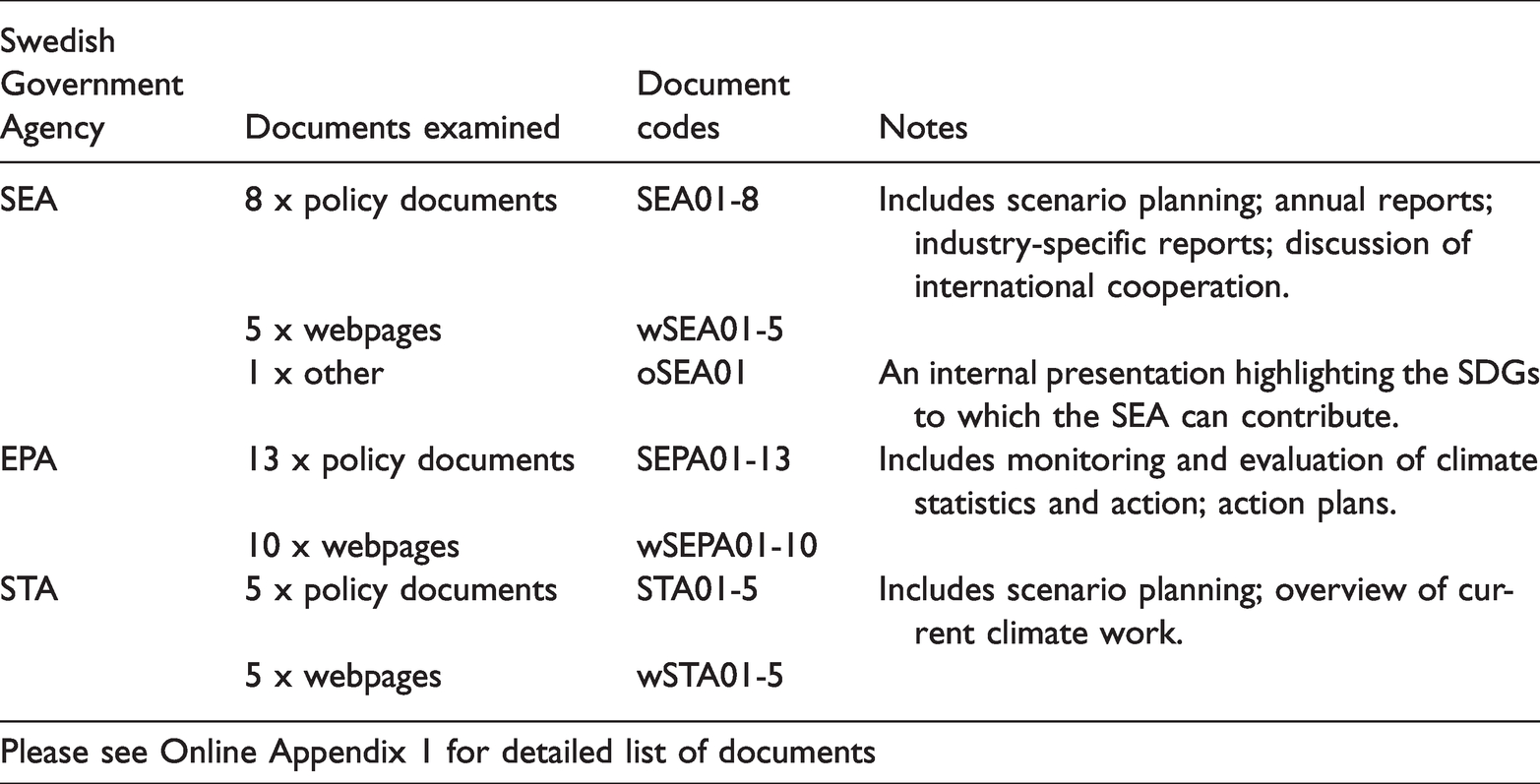
We collected data through two methods: firstly, by purposively examining the websites of each agency, searching for steering documents on the theme of climate change. Secondly, key informants at each agency identified the documents that they considered important in guiding their and their agency’s work. In total, a body of 47 documents was collected and scrutinised (see Table 1; Online Appendix 1). These included web pages aimed at staff members but accessible to the wider public. Likewise, various reports in response to Swedish government tasks to plan and steer Swedish society and infrastructure towards sustainability. These documents' intended audience are national and international policy-makers as well as other actors within each agency’s respective sector. Most documents are written in Swedish. Quotations below are the research team’s own translations.
The documents analysed.
We employed a grounded theory-inspired approach (cf. Charmaz, 2014); we coded implicit or explicit expressions of social difference within the sampled articles. We then generated concepts in parallel as patterns emerged through qualitative analysis of body of texts (cf. Bryman, 2004). Documents were scrutinised for references to ‘society’ (samhälle) alongside specific social categorisations (e.g. ‘women’ [kvinnor]). However, as the sampled articles were considered representative of discourses of social difference within the respective agencies, attention was paid to the basic entities, agents, metaphors and fundamental assumptions about reality that were represented within the discourse (cf. Dryzek, 2013). Hence, we examined what was implicit beyond what is explicitly labelled society (e.g. the existence of ‘states’) that underpin institutional worldviews and action. A series of categories emerged that collectively highlighted the norms that underlie the agencies’ work and the (non-) recognition of climate relevant social differences (Kaijser and Kronsell, 2014). In terms of method, this entails comparison of agencies’ framings of social diversity with extant knowledge about the variety within Swedish society. This necessitates a certain amount of strategic essentialism in that it assumes that simplistic categories are ‘out there’. However, with focus upon document-based discourse, it is impossible to get precise information on individual performances of intersectional identities in practice. As such, we feel that constructive knowledge can still be produced based on already prominent categories within Swedish society. Inspired by Bacchi, this provided the basis for critical analysis of representations of social difference and the effects and underpinnings of this representation, which formed the basis for analysis (1999: 12–13).
One thing to note is that this analysis itself takes place within a particular context, which should be borne in mind when scrutinising documents fixed in time – constructions of social difference will continue to develop within the agencies examined. Likewise, the documents examined are often long and may evidence multiple, complex, nuanced and contradictory framings. However, one may learn much by examining framings of social in/exclusion in specific policy proposals (Bacchi and Eveline, 2010).
Analysis – Deconstructing discourses of difference
In order to deconstruct different agencies’ conceptualisations of social difference it is necessary for us to outline the stories about the nature of the world within the sampled documents. These stories about the world interpellate with social categories. This section is structured as follows. (1) the overall discursive world-views of the agencies are briefly presented, (2) which we then critically discuss. We explicitly home in on social difference as it emerges within the sampled literature and provide critical comment.
The discursive worldview – Encouraging rational ecological behaviour
Each agency has a specific purview – the SEPA focuses on “the environment”, while the STA and SEA focus on traffic and energy systems respectively. These domains comprise a variety of actors at different social scales (from the individual up until the international level). The agencies largely see their role as ensuring the stable continuation and adaptation of their respective preserves; steering their respective sectors based on the direction of the Swedish state. When it comes to dealing with climate change, adaption and mitigation agencies have a role in encouraging their system’s transition to a more sustainable form. As such, each of the agencies have published documents outlining different courses of climate action for their work based on IPCC scenarios and Swedish and international climate targets (SEA01; SEA08; STA01; STA03; SEPA01; SEPA03).
There are commonalities within the representations of sampled agencies. The SEPA calls a significant part of their work “leading the way” or “guidance” (“vägledning”) and the metaphor is apt for the different agencies’ climate action (SEPA03). As such, the agencies see their role as encouraging actors (who may be private individuals or businesses or even sectors) to make climate-friendly decisions. They hold a view of other agents in their respective sectors as responding to incentives, nudges and costs in a largely rational choice manner. The following quotes illustrate this: In order to incentivise the development of climate-smarter technologies, the price of emissions must be higher (SEA02: 46). Changing to a social structure leading to reduced travel is very much dependent on the effects of the measures and the instruments on total transport demand and on how transport is distributed between different modes (STA03: 67). Our long-term environmental work involves, among other things, proposing, investigating and evaluating instruments of various kinds. It may involve financial or legal instruments, but also instruments in the form of information and community planning (wEPA08).
The three agencies also work on Sweden’s “green”
1
, transport and energy infrastructures respectively. Historically, infrastructure decisions and planning made particular assumptions about the Swedish climate, which climate change now challenge. For example, it is recognized that warmer, wetter winters will affect the performance and maintenance of infrastructure designed to withstand cold and snow and affect ecological systems. This necessarily affects the rebuilding and renewal of infrastructure. For example, the STA sees its role as ensuring that Sweden remains effectively woven together within the transport system assuring continued mobility and accessibility to mobility, something that could conceivably clash with the need to ensure sustainability: It is also important to ensure that basic infrastructure becomes available even in a future climate, for example one with high water levels. Accessibility is an especially important consideration when planning socially important functions (wSTA03)
In sum, the sampled documents paint a picture of agencies actively involved in steering their respective sectors, but also functioning in a reactive manner, both to the Swedish state but also to the other actors within relevant socio-environmental systems. Consequently, the views of stakeholders are considered and their needs for e.g. stability given some weight but overall in a superficial manner. Thus, within the energy sector, individuals and businesses are to be encouraged to adopt more climate-friendly lifestyles and practices. Similarly, in the transport sector, people are to be encouraged to move away from car-based mobilities with increased emphasis upon public transport. In both cases, it is a reactive approach, with hopes that technological advances will play a role in this, making working at a distance more feasible as well as making e.g. electric cars more practical for more people. This is in line with the neoliberal trajectory of ecological modernization historically prominent in Swedish (and global) environmental politics, whereby environmental improvements are possible within a growth paradigm and through increased efficiency and innovation (Lundqvist, 2004). Alongside this, the SEPA has a mandate to encourage people to actively visit and protect nature. This is in many ways reminiscent of a body of discursive traditions known as environmental problem solving discourses. “The discourses of environmental problem solving recognize ecological problems, but treat them as tractable within the basic framework of the political economy of industrial society” (Dryzek, 2013: 73). In particular, it resembles what Dryzek calls the “administrative rationalism” discourse: liberal capitalism and the administrative state are considered givens, with managers and experts (embodied within a agencies and other advisory, research bodies) understood to have a role in controlling and managing their portfolios. In this epistemology, nature is responsive to human problem solving and people are largely subordinate to the state (although government agencies remain motivated by public interest and are in some senses reactive to markets, individuals and businesses).
This integral epistemology, with its concomitant model of learning and human behaviour, provides a first opportunity to draw upon intersectionality theory. A key underlying assumption seems to be that behaviour is “the outcome of a linear and ultimately rational process” (Harrison and Gail, 1998: 2) of decision-making usually pursued by rational individuals (Hargreaves, 2011). As a result, there is a presumed information deficit among citizens (cf. Burgess et al., 1998; Owens, 2000) which should be addressed through education to promote more rational and ‘climate friendly’ attitudes; based on an understanding of beliefs, attitudes and values as predicators of such outcomes. There is an emphasis on informing people of the environmental impacts of their behaviour in the hope that they will rationally make changes to their lifestyles. However, as a model of learning and behavioural change it is arguably overly simplistic and cognitivist (cf. Boström et al., 2018: 5). The Swedish agencies are not alone with these notions of sustainable behaviour, as these ideas predominate in current discourses for governing sustainable behaviour change. Bamberg suggests that these behavioural ideas have received so much attention because they treat attitudes, beliefs, values, needs as “situation invariant orientation patterns” (2003: 22) involving a linear simplicity that may appeal to policy-makers. I.e. if a person’s relevant values or beliefs are identifiable and altered, concomitant behavioural changes will occur throughout that person’s lifestyle. This is problematic, suggesting as it does that people exist in a social and political vacuum, with identical opportunities for action (Hargreaves, 2011). Several critics argue that these excessively individualistic approaches fundamentally fail to address the integral ways in which material infrastructures, social relations and context are essential to the performance of social practices (see e.g. Hargreaves, 2011; Hobson, 2003; Nye and Hargreaves, 2010; Shove, 2003; Southerton et al., 2004; Spaargaren and Van Vliet, 2000).
Questioning a homogenous Sweden
At a certain level, there is an integral framing of social difference within many of the examined documents. Indeed, all three agencies affirm a commitment to equality in their work, both within their organisation and the systems they steer and support. For example, the SEA states: We work actively to promote equality and diversity, both in our own operations and in the assignments we carry out. Our work is characterized by mutual respect and tolerance for differences and no form of abusive discrimination or discrimination is accepted (wEA01)
In evaluating transport sector actions, the most prominent division within society that the STA recognises is around densities of population in different areas. Many climate actions are considered more effective/feasible in urban areas (STA05: 66). Towns are to be reorganised around transport hubs to become less sprawling if they are to reduce their climate emissions (STA01; STA03). STA documents classify different densities of habitation within three categories: ‘large urban’ (storstad), ‘middle-sized’ (medelbebyggda) and ‘sparsely-populated’ (glesbygd). Attention is paid to the implications of particular measures on these three categories. For example, efforts to reduce speed on roads will only sparingly affect sparsely-populated areas in part because there is recognition that those areas have greater dependency upon personal (car) transport than urbanised areas. Linked to this notion of accessibility the STA periodically refers to the mobilities of different groups. Indeed, increased focus on public transport is argued to likely have positive consequences for societal groups without cars. Likewise, women are expected to benefit from an increased emphasis on public transport, as they are reportedly greater users than men are. Finally, disabled people and children are expected to benefit from a reduction in car use in city centres (STA05: 86–7, 89). The documents lack any recognition that social difference can also imply differential power relations; the capacity to act by different members of society is necessarily variable nor how the intersections between groups (e.g. older women) may lead to different groups being affected differently.
In a similar fashion, within the sampled literature on the SEA there is discussion of how to reduce societal energy use and the extent that this is required (SEA08). This is described as occurring within various sectors and at different scales, including at the individual household level. There is likewise discussion of whose responsibility it is to promote energy-use reduction (SEA08: 82). In discussing different climate scenarios, there is consideration of the role of individual choice regarding energy-use reduction (SEA01) and the extent that such behavioural change is practical (SEA08). As with the STA, there is hope that technological innovations will make it easier for users to track and reduce their energy consumption (SEA08: 21). Within the sampled literature, there is an awareness that changes to society will affect different groups differently (SEA01). With low-income groups broadly understood to be most negatively affected by any changes (SEA08: 21). Furthermore, differences between the interests of different groups (not least at different social scales) are acknowledged as potential sources of conflict, notably over what actions to prioritise (e.g. SEA08: 43, 64).
A broad concern for social rights and inequities is incorporated into scenario planning, with some scenarios considered better or worse for social outcomes (SEA01). Within this broad aim, equality is largely seen around two categories: accessibility and gender (specifically differences between men and women). These are discussed in turn.
Regarding accessibility, the SEA directly echoes the STA’s approach with its distinctions between different population densities (SEA01: 28). Firstly, a climate-friendly society needs to be energy efficient and effective (SEA08, oSEA01). This concern appears on a number of social scales, for example, the distribution of the Swedish population presents particular infrastructure challenges – the bulk of the population is in the South but the North produces most renewable domestic energy (SEA08). Within the sample, it is hoped technology is able to solve these issues, at least in part.
When it comes to gender, the SEA’s website asserts that women tend to be excluded from the energy sector and that this represents a challenge to be dealt with: Uneven representation, within the social and energy spheres or elsewhere, can have different consequences when deciding on goals and measures at all levels, and when using measures that will contribute to the energy and climate policy goals. In the same way, change and technological development are influenced by who designs the technology and by assumptions about how energy should be converted and who should use new [energy] solutions. Differences in gender can also be seen in people's energy use. It is reasonable to assume that men and women's ideas and actions may look different based on the social structures of society. Similar differences can be found in a division between young and old, differences in place of residence and in other differences with regard to socio-economic variables. In addition, there are differences depending on where in the world we are - a major energy and climate-related challenge in some quarters is to increase women's access to energy to improve women's health as well as to increase women's opportunities for wage work. (wSEA04)
The SEPA’s work has an inherently temporal aspect; future members of society have an explicit stake in contemporary action (cf. wSEPA03; wSEPA07; SEAP01; SEPA03; SEPA04; SEPA06; SEPA12). It is through this understanding of their remit and their work context that the SEPA engages with social difference. Social difference also emerges around several other aspects of the SEPA’s work. For example, efforts to encourage people to access nature sometimes target children or newcomers to Swedish society (SEPA12: 97). Similarly, the SEPA in its role as monitor of pollutant levels in the Swedish environment, tracks pollution exposure within the human population. This work includes some monitoring of specific parts of the population e.g. children or pregnant women (e.g. SEPA12: 191). Finally, the SEPA clearly sees part of its role as integrating voices from different social groups in their work. As such, SEPA tracks the numbers and age groups of men and women employed on a yearly basis, but does not provide information on their roles or the ways that their perspectives are integrated into the organisation (SEPA12: 122–3). It is acknowledged that framing society as a homogeneous whole is inaccurate, with repercussions for sustainability work. However, statistics on climate-change and social difference are lacking (SEPA10: 58). Having said this, SEPA contrasts women and men’s different climate values and behaviours (SEPA10: 59). Likewise, there are periodic mentions of the impact of changes upon men and women’s respective free time (SEPA07: 19) including discussion of household labour (SEPA10: 61). However, there is seldom explicit interrogation of social difference in the bulk of the sampled material.
One notable distinction between the climate change discourses of SEA, SEPA and the STA is that the former have greater international focus. Sweden’s environment and energy system connect to those of other countries. Concomitant to this knowledge is an awareness that rich countries in the Global North utilise a disproportionate percentage of the Earth’s resources and that there is a need for justice action internationally, which leads to Sweden’s participation in global climate goals (SEA03; SEA04; SEA08). However, in these documents less-developed countries are largely homogenised, with no in-depth discussion of the differential impact upon groups in those countries beyond generic international goals to reduce poverty.
Summarising the foregoing, the analysed material predominantly depicts the Swedish population as homogeneously able to act rationally as individuals on information about their climate impacts. However, the ability to act may vary between different social groups extant in a context of unequal power relations. For example, levels of ‘tech literacy’ differ among particular social groups, where both age and ethnicity are important. So those who may have less ability to utilise Swedish-language digital information may be less able (or willing) to make certain changes. Alternatively, different social groups may have different values around lifestyle choices. Power is also a key concept when analysing what lifestyle changes policy-makers suggest. Different groups have different possibilities for action. There is considerable literature suggesting that climate institutions are characterized by hegemonic masculinity and homogenous expertise, which may exclude both different values and knowledge (Alston, 2014; Magnusdottir and Kronsell, 2016). For example, this may be relevant when it comes to gender differences regarding the importance of car ownership and usage and how this affects efforts to promote sustainable transport systems (e.g. Balkmar, 2018). Climate policy-making that does not fully understand gendered power relations is less likely to be effective in shifting people away from car ownership. Continuing with this example, it is also worth considering how different social and/or economic groups may have different mobilities when moving towards a low-transport society. For example, Sámi reindeer herding is increasingly dependent upon transporting flocks over distances by road transport because of the growth of societal infrastructure on traditional grazing routes. This has had several effects, with reindeer herding becoming a more costly business (Gallardo et al., 2017). Speaking hypothetically, one can imagine a low-transport society favouring reindeer herding as reduced transport infrastructure equates to less obstacles to foraging. On the other hand, if road transport becomes more expensive it may become even harder for Sámi reindeer herders to maintain their lifestyles and identities. Other groups may be more or less extremely affected by changing paths of societal development.
Returning to the sampled literature, there is periodic recognition of a need for a more nuanced conceptualisation of society (SEA08:19; SEA01: 115; STA01: 28; SEPA08: 9; SEPA10: 58) and as a consequence the agencies have begun to commission research aimed at filling this knowledge gap (e.g. SEA07; SEPA07). However, at present the agencies struggle to acknowledge social differentiation beyond gender (in this case meaning men and women) and population densities. This suggests that there is potential for deeper investigation of how climate change actions affect different groups. Indeed, there is no explicit discussion of ethnicity and cursory discussion of class and age to name three forms of social differentiation. This likely reflects the legal situation in Sweden, where it is illegal for agencies to identify ethnic minority groups (Hübinette, 2014); heavily affecting the data that state agencies may collect.
This point is understandable from another angle, through relation to the notion of environmental justice. Climate action is framed as acting on society as a largely undifferentiated whole (cf. Timmons Roberts et al., 2018). The sampled agencies variously assert that they play a role to ensure justice both in the present and future generations (STA02: 3; wSEA01) both domestically and abroad. However, there is seldom discussion of how change affects different societal groups
2
or recognition of different experiences within society (Schlosberg, 2004). For example, the STA reveals an awareness that changing the traffic system may produce negative as well as positive effects. However, there is little discussion of the distribution of these effects within society: A disadvantage of building near stations is partly a security problem with many people near the travel centre (derailments, dangerous goods and more) and partly the risk of increased noise exposure. (STA02: 74)
There is a further element to this, pushing for people to move towards environmentally-friendly lifestyles (e.g. SEA08: 19 or SEPA12) may have different impacts on different groups of people and this may affect power relationships between different groups, improving or worsening different groups’ situations between one another and their possibilities for political engagement (Schlosberg, 2004). As a hypothetical example, if the burden of cleaning clothes falls primarily upon women, moving away from drier usage may constrain their free time (cf. MacGregor, 2006). Overall, many of the lifestyle transitions envisaged are interpretable as part of efforts to integrate certain ecological values into society. They seek to encourage particular mind-sets and lifestyles (cf. Dobson and Bell, 2006). Within the sampled literature, there is no acknowledgement that individual lifestyles are embedded in power relationships and that these may be affected by any changes to life-styles in unexpected ways. It may be that any benefits of societal changes will be uneven across a diverse society.
A further point related to the simplistic framing of social difference in the sampled documents pertains to those categories that are present, areas with varying population densities and gender. Previous intersectional research highlights further matters for discussion: the extent that in representing social difference in this simplistic manner there is a risk of perpetuating extant iniquitous and inaccurate representations. Taking the example of gender in order to illustrate the point, extant research has highlighted that there is a tendency for women to be framed as either “virtuous” or “vulnerable” within global climate discourse. This thinking is visible within the sampled literature as women framed as automatically benefitting from e.g. changes to the transport system (STA04: 86). Arguably, one can interpret this as suggesting that women should naturally see that it is in their interests to support these societal changes. This may be criticised along several lines, firstly it fails to distinguish between the markedly different situations of women within and between societies. Secondly, it takes it as given that all women differ from men. Thirdly, it may also have the effect of increasing women’s responsibility to participate in climate change action without providing any concomitant rewards (Arora-Jonsson, 2011). A final point links to this, several sampled documents argue for the importance of a diversity of views within society and the need to incorporate women and others into sectors where they are currently marginalised (wSEA04; SEPA12), seeing this involvement as part of a general win-win of climate adaptation (STA04: 89). This embodies a very limited notion of environmental justice and injustice; there is no discussion about differences in access to power in political representation and policy-making beyond the need for more involvement of women. This limited approach to incorporation of society’s diversity has been criticised. This relates to feminist discussions of the limitation of descriptive representation or simply; “adding women and stirring” instead of aiming for substantive representation (Scott, 1983). This fails to take into account the importance of the form that incorporation of social groups in policy and planning takes and raises a question about whether any and all incorporation is good incorporation (Schlosberg, 2004). For example, in the case of Swedish forestry management, mostly male industry figures articulated desire for the integration of female voices, but also argued for the need for women forest owners to be more proactive in the industry, i.e. in their terms, more like their male counterparts (Holmgren and Arora-Jonsson, 2015). As such, one can question the diversity-benefits of incorporating marginalised groups if this only occurs if their opinions match dominant, extant values.
Conclusion – A need for intersectionality
This article has explored the social categories conceptualised and recognised within key policy documents from the Swedish Environmental Protection Agency, the Swedish Energy Agency and the Swedish Transport Administration. Within the discourses of the sampled literature, government agencies play a role in constructing, steering and ensuring the smooth running of their respective areas of responsibility. When it comes to climate action, they see their role as building and maintaining infrastructure in as climate-friendly a manner as possible. They also see their role as nudging the other actors involved in their systems (e.g. businesses and consumers) towards making environmentally positive decisions wherever possible. Decisions that the agencies wish to facilitate through support for innovation and information provision. In this work, the SEPA has prominence as the monitor of the Swedish environment, which it seeks to maintain. In not questioning these roles, the agencies arguably evidence a certain amount of path dependency. This is interesting because, as noted earlier, Sweden is considered an exemplar of climate governance.
The agencies reveal a largely ecomodernist, environmental problem-solving and individualised environmental discourse, which resulted in the framing of several policies to enhance rational individual choices towards more sustainable lifestyles. Even though lifestyles indeed need to change, such a discourse manifests a simplistic understanding of sustainable behaviour, neglects how social relations and context are fundamental to the performance of new social practices, and often sees humans as existing in a social and political vacuum, failing to acknowledge that people have different opportunities for action. An over-emphasis on individual agency also risks putting too heavy a burden and responsibility for change on the shoulders of the ‘citizen-consumer’, while disregarding the responsibility of governments and large corporations (Hobson, 2002). Instead, there is a need to move beyond the individual as the principle agent of action and to recognise that individuals belong to complex webs of relations with other humans and things. Change depends on the interaction between all those elements, rather than on the isolated action of the individual. An intersectional analysis can therefore aid us in grasping these complex webs of power relations.
Application of an intersectional approach has highlighted two things. Firstly, institutional understandings of social difference are simplistic, with many different social categories and their intersection unrecognised. Secondly, this simplicity has implications for the environmental justice of any climate change action. Environmental justice as a concept is born of an awareness that environmental problems and efforts to solve them do not affect all society members equally. Furthermore, environmental justice is an integral feature of the international goals that form the starting point for much climate action. This is certainly the case for Sweden with the sampled agencies directly discussing their impact on the SDGs (oSEA01; SEPA02). If Swedish government agencies (and other institutions articulating Dryzek’s problem-solving discourses [2013]) wish to seriously engage with environmental justice in their work around climate change then they need tools. These tools should allow them to appreciate the complex manner that agency action partially constructs and perpetuates social difference. Likewise, they need to appreciate climate action will have complex effects, which will both materially impact different groups in differential fashion and, in turn, likely affect the possibility of any climate action’s success.
This article argues that inclusive climate policy-making needs an intersectional approach to appreciate social difference and justice. Simply as a starting point, a problematising approach to the categories each agency utilises is likely to reveal both social dimensions that have been overlooked but may also lead to potential new forms of climate action. As a hypothetical example, if the STA were to interrogate their threefold dimensions of population density (see above), would that present more options for environmentally friendly transport? Might there be subcategories of sparsely populated areas, which due to their geographical and social characteristics could utilise different public transport options better than was predicted in the sampled material? Further research could complement this by scrutinising the different power relations and processes that produce particular representations of social difference. This article represents a call for greater integration of intersectional thinking into (Swedish) climate policies, as well as calling for greater collaboration between intersectional scholars and policy-makers in the identification of tools that allow for more equitable environmental (and otherwise) policy-making.
The three Swedish government agencies did show some sensitivity to justice, equity and equality in their policy documents. However, such concerns were rather superficial and unsystematically addressed; they were affected by the basic agendas of the agencies, which determine what kind of social issues were in focus. Nevertheless, we have noted a certain openness, and even curiosity, to attend to such issues. As such, we also see an opportunity to engage with policy-makers in dialogue on how intersectional aspects can become central to climate policy-making in the future. Whilst mapping one’s way to a utopian goal like ‘sustainability’ is always a difficult, partial and contradictory, our hope is that through constructive engagement we can take pragmatic steps forward (Eckersley, 2021). This would involve drawing inspiration from people-centric and earth-centric technologies and diverse forms of social organisation rather than the command-and-control and individualistic approaches of ecomodernism (e.g. Parker et al., 2014). From these future experiences, we hope Sweden can provide a learning example for likeminded states. For scholars, this article’s theoretical application of intersectionality and environmental justice provides an example for deepening the (Feminist) institutionalism literature by linking concepts of path dependency to deconstruction of normative discursive concerns.
Supplemental Material
sj-pdf-1-epc-10.1177_23996544211005778 - Supplemental material for Intersectionality and climate policy-making: The inclusion of social difference by three Swedish government agencies
Supplemental material, sj-pdf-1-epc-10.1177_23996544211005778 for Intersectionality and climate policy-making: The inclusion of social difference by three Swedish government agencies by Benedict E Singleton, Nanna Rask, Gunnhildur Lily Magnusdottir and Annica Kronsell in Environment and Planning C: Politics and Space
Footnotes
Acknowledgements
This research forms part of the FORMAS funded project Intersectionality and Climate Policy Making: Ways forward to socially inclusive and sustainable welfare state (FR-2018/0010). We are grateful to staff members of the three studied government agencies for their assistance in collecting documents for analysis.
Declaration of conflicting interests
The author(s) declared no potential conflicts of interest with respect to the research, authorship, and/or publication of this article.
Funding
The author(s) received no financial support for the research, authorship, and/or publication of this article.

Notes
Biographical notes
References
Supplementary Material
Please find the following supplemental material available below.
For Open Access articles published under a Creative Commons License, all supplemental material carries the same license as the article it is associated with.
For non-Open Access articles published, all supplemental material carries a non-exclusive license, and permission requests for re-use of supplemental material or any part of supplemental material shall be sent directly to the copyright owner as specified in the copyright notice associated with the article.
