




Abstract
Programmes of migration regulation in the Mediterranean Sea constantly evolve and adapt, changing in accordance to shifting migration patterns and EU policies. Despite the commitment to governing mobility in this sea, migrant death continues to be a significant and indeed growing problem in the Mediterranean. While scholars have examined how the geography of the US-Mexico border is incorporated into an architecture of exclusion (Doty, 2011), this article considers how the sea conceals the violent political workings of a maritime geography that grows increasingly risky for migrants. By bringing the sea to the fore, the article interrogates how the space of the maritime has come to be understood as ungovernable and perilous and what the implications of such framings are in contemporary migration management. The article specifically examines how the maritime geography was framed in early maritime law as unruly and untameable, as well as the way the sea was used to justify the deaths of African captives in insurance law during the Middle Passage. These contexts demonstrate the longer standing logics in contemporary maritime migration management, whereby the assumed fatal materiality of the maritime is used to obscure political violence.
Introduction
In 2014, the former Minister of the Foreign Office of the UK stated, “We do not support planned search and rescue operations in the Mediterranean” as they function as “an unintended ‘pull factor’, encouraging more migrants to attempt the dangerous sea crossing” (Travis, 2014). Implicit within this statement is not only the idea that some migrants must be left to perish at sea but that politicians would not be culpable for these migrant deaths, rather the sea would be. Scholarly work on mobility control and migration studies focuses on bordering practices and its consequences (Basaran, 2010, 2015; Hyndman and Mountz, 2007; Tazzioli, 2016; Williams and Mountz, 2018). Within this context, scholars have explored how responsibility for migrant death is often ascribed to smugglers, NGO rescue missions, migrants undertaking risky journeys, or a lack of capacity (Basaran, 2015; Cusumano and Pattison, 2018; Squire, 2017). The sea remains somewhat backgrounded within this discussion. This article focuses on the sea in the politics of regulating bodies in the Mediterranean, exploring how the maritime geography exculpates programmes of migration governance of migrant death. The article unpacks the tendency of the maritime space to be characterised as both perilous and ungovernable and how this framing has come to be employed as an apparatus in strategies of migration regulation in the Mediterranean. Drawing on Philip Steinberg’s (2001) “social construction” of the sea, the article further develops an understanding of the socialisation of the sea in the context of the control of human mobility and the ways certain deaths are framed as natural and innate to this geography rather than as political problems. The article focuses on the Central Mediterranean route, and more specifically, the search and rescue (SAR) operations coordinated by Italian authorities as they are responsible for the majority of SAR missions in this geography (Cusumano and Pattison, 2018: 58).
The article presents a three-part intervention into migration control at sea. It begins with the section “Modern Mobility Control in the Mediterranean”, which focuses on the contemporary context of migration regulation and the commitment to governing this sea. This contrasts with the way deaths are associated with the treacherousness of this sea. Following this, the article explores “The Ungovernable Seas”, which interrogates the historic legal frameworks which have emphasised the unmanageability of maritime geographies. This section articulates how the sea has at times been framed as distinct to land in its incompatibility to order, allowing us to consider what the implications of this are in the context of migration regulation. The article then turns to “Perilous Seas”, interrogating how the perils of the maritime geography have been used historically to obscure the political significance of certain deaths at sea. This section analyses the way the maritime was constructed as responsible for the deaths of African captives in insurance law during the transatlantic slave trade. While the transatlantic slave trade differs from today’s context, it reveals a historic logic to using the supposed treacherousness of the maritime to mask political violence at sea. Through considering these contexts where the sea has been emphasised as ungovernable and perilousness, what is revealed is how certain shared understandings of the materiality of the maritime are useful to strategies of migration regulation.
Modern mobility control in the Mediterranean
There is nascent research on the significance of the maritime geography in strategies of migration management. For example, Stierl (2016: 565), in explaining the Mediterranean NGO known as Alarm Phone, articulates the way the discourse on migrant vessels in the Mediterranean functions to enable a “re-activation” of the imaginaries “of the sea as a lawless space”, in which disaster is assumed to be a “quasi-natural” outcome. Equally Walters (2008: 5), in articulating the specific type of mobility experienced by the stowaway, highlights the paradox of framing the maritime geography as “a lawless space beyond sovereignty and justice” despite being increasingly navigated and secured. This contradictory framing of the maritime as at once governed and yet wild is explored in this article. In most detail, Pezzani and Heller (2013) have evidenced the political violence and exclusion migrants face within this geography through the project of Forensic Oceanography. A number of scholars in migration and border studies have considered the governing agendas in the Mediterranean Sea (i.a. Lutterbeck, 2006; Tazzioli, 2016) and the way they contribute to a retraction of migrant rescue in this sea and an increase in migrant fatality (Basaran, 2015; Pezzani and Heller, 2013; Squire, 2017). This article extrapolates on this cannon of research to interrogate how shared understandings of the maritime space allow the sea to assume culpability for migrant death. First, however, it is necessary to consider the significant developments in migration control in the Central Mediterranean and what these developments illustrate of a commitment to governing this sea.
There have been several significant changes to the programmes of mobility control in the Central Mediterranean. The Central Mediterranean refers to migratory journeys from Tunisia and Libya toward Italy, comprising one of the main migratory routes across this sea. One of the changes to migration regulation within this route occurred in October 2013, when there were two migrant shipwrecks of great proportion near the island of Lampedusa, culminating in the deaths of 636 migrants (Tazzioli, 2016: 1). These disasters seemed to expose the “limits of tolerability” toward migrant death in the Mediterranean and subsequently led to the deployment of Mare Nostrum, a military rescue regime operated by the Italian Government (Tazzioli, 2016: 5). Mare Nostrum had an extended area of operation, rescuing boats both within Italy’s search and rescue zone as well as the rescue zones of Malta and Libya (Carrera and Den Hertog, 2015: 4). While the programme had an expanded capacity for rescue, it also operated with a military capacity and, as such, contributed to the regulating of migrants intercepted or rescued at sea (Tazzioli, 2016: 2). However, it was only a twelve month program, lasting from October 2013 to November 2014. Due to the financial burden on Italy and the political contestation around rescues, Mare Nostrum was terminated.
A joint operation between the EU external border agency Frontex and Italy was launched in late 2014. Titled Operation Triton, it was implemented as a replacement to Mare Nostrum. Mare Nostrum and Triton were structured around divergent objectives, with the Frontex programme revealing “border control as the primary task instead of rescue operations” (Tazzioli, 2016: 13). As an obligation of international law Triton does in fact engage in rescues, “but only in the context of border controls and surveillance activities and not as part of its official mandate” (Carrera et al., 2017: 21). As such, Triton emerged with a significant surveillance mechanism in absence of a strong capacity for rescue and with a retracted area of operation, only executing missions in a thirty nautical mile zone off the Italian coast (Carrera and Den Hertog, 2015; Tazzioli, 2016: 2). Human rights organisations critiqued the replacement of Mare Nostrum with a Frontex agenda that had a design of intercepting and bordering rather than rescuing, however, the two programmes were not necessarily oppositional in function. Mare Nostrum created “a spatial amplification of the stage of rescue”, while following this, Triton emerged with a greater policing agenda (Tazzioli, 2016: 2). Thus, while these programmes may not reflect a consistent approach to migrant rescue, they both contributed to turning this sea into a “space of governmentality” (Tazzioli, 2016: 2). Rather than being counter-posing, these programmes illustrate evolving approaches to containing migrants within the Central Mediterranean geography.
As Triton did not function with an agenda of rescue concomitant to Mare Nostrum, there was an immediate lull in active search and rescues zones in this sea. The Italian Maritime Rescue and Coordination Centre (MRCC), responsible for ensuring search and rescue within the Sicilian Straight, recognised this lack of safeguard against disaster and requested that merchant vessels actively engage in rescue in this geography (Pezzani and Heller, 2015: 5). This had the effect of shifting “extremely dangerous search and rescue operations onto large merchant ships” (Pezzani and Heller, 2015: 3). In consequence, two disasters of enormous scale transpired in April 2015 after merchant vessels attempting to help migrants in distress made significant errors. Within one week 1,200 migrant lives were lost at sea. Following this disaster, in April 2015, the operational capacity of Triton was increased as the EU Member States pledged to triple the funding budget, in addition to expanding the geography over which Triton had responsibility, and adding “naval, air and personnel assets” to the Operation (Traynor, 2015). The Executive Director of Frontex, Fabrice Leggeri, stated in response to the expansion of Operation Triton, “We have dramatically increased the deployment levels in the Central Mediterranean to support the Italian authorities in controlling its sea borders and in saving lives, too many of which have already been tragically lost this year” (European Union, 2015). The expanded budget and geography of Frontex meant that the Triton programme in the Central Mediterranean came to cover “a stretch of sea similar to which the Navy had under Mare Nostrum” (Tazzioli, 2016: 11). After three years of operation, and in response to “changing patterns of migration”, Operation Triton was replaced in February 2018 with a similar joint operation, termed Themis. Frontex states that Themis will place a greater emphasis on “law enforcement”, “border crime”, and intelligence than previously, and will function in an expanded area across the Central Mediterranean (Frontex, 2018). The constant revision of these operations demonstrates the “protean nature” (Tazzioli, 2016) of mobility control in this sea. The perpetual modification to these programmes reveals the commitment of the EU to governing this sea and controlling maritime migration.
The rate of death of migrants in the Mediterranean.
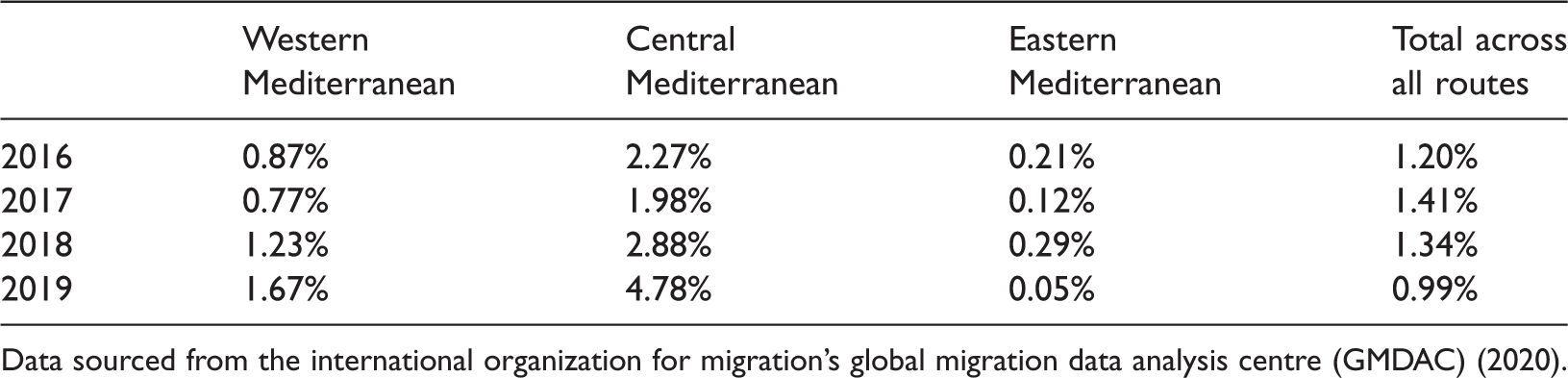
Data sourced from the international organization for migration’s global migration data analysis centre (GMDAC) (2020).
The rate of migrant death in the sea decreased marginally in 2018 and then again in 2019. Yet, when we look exclusively at the Central Mediterranean route, the death rate has increased each year from 2017, with 2016 being a notorious year of migrant fatality in this route. Moreover, this data refers to deaths of persons during attempted crossings, but we if focus on deaths of migrants in proportion to those arriving in Europe, the mortality rate for 2019 increases to 7.82% (GMDAC, 2020: 7). It is important to note that this rate of death has increased despite a significant decrease in migrant arrivals and in overall number of deaths at sea.
Rescues coordinated by MRCC.
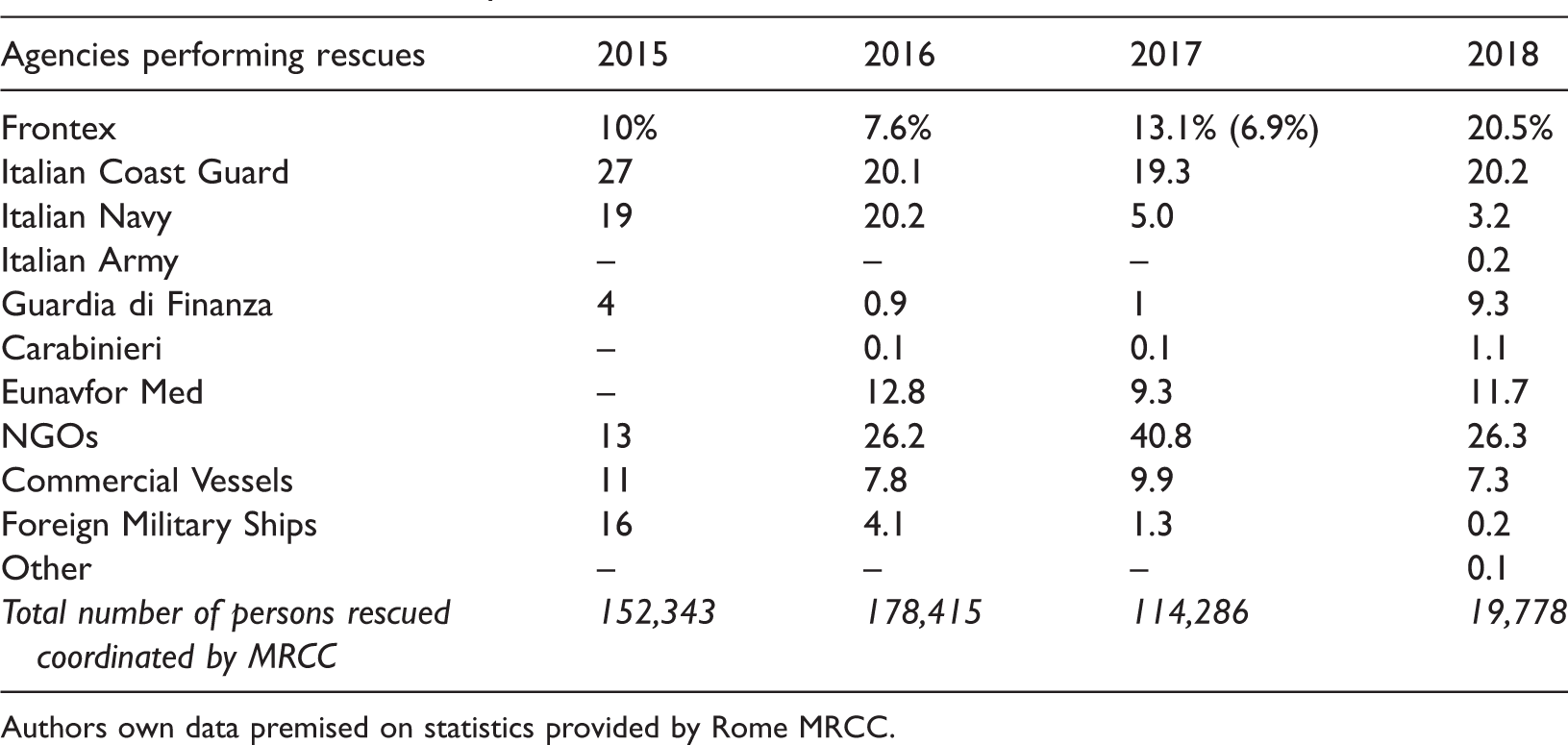
Authors own data premised on statistics provided by Rome MRCC.
While rescue was not originally part of the Triton mandate, as stated above, since the expansion of this programme in 2015, Triton has been working to help “Italian authorities in controlling its sea borders and in saving lives” (European Union, 2015). By 2016, within a year of the three-fold increase in funding to Triton, rescues on behalf of Frontex had decreased. According to IOM data, in the same year, the rate of migrant death in the Central Mediterranean route peaked. Corroborating the lack of impact that the increase in Frontex’s budget has had on expanding rescue at sea, the NGO Sea-Watch has noted a confusing absence of European agencies deployed under Frontex’s Operation Triton in assisting rescue missions. The co-founder of Sea-Watch has been left questioning, “what is happening with the funds which were increased for the Frontex mission Triton after the boat disasters in April, the funds which were intended for sea rescue; where are the ships?” (cited in Stierl, 2017: 12). This statement reflects the political violence imbedded in a programme of migration governance that expands in capacity in absence of an increase in rescue operations. The commitment to governing mobility at sea contributes to a proliferation of technologies of policing in this sea, while leaving migrants exposed to the perils of this geography.
In late 2016, an EU Regulation (2016/1624) called for a broader approach to migration management at Europe’s borders, demanding “integrated border management” (IBM) and the expanded role of Frontex in achieving this (Art. 3, Art. 4, Art. 11). This encouraged a shared responsibility between Frontex and Member State authorities, as well as an increase in Frontex staff and equipment (Council of the European Union, 2018: 12). While Frontex appears to have engaged in an increase in rescues in 2017 and 2018, statistics from 2017 onward now include the co-financed projects run by Frontex and Italian agencies which formally were not included in their rescue figures. For example, in 2017 Frontex was responsible for 13.1% of rescues. Yet, in separation from co-financed programmes, Frontex was only responsible for 6.69% of rescues in 2017 (Italian Coast Guard, 2017: 14), a number comparable to the 7.63% of rescues they performed in 2016. While Frontex operates with an expanding budget, compared to other rescues performed, they do not provide extensive support to rescue operations. For example, over 40% of rescues in this region of the Mediterranean were performed by NGO vessels in 2017 and over 26% were performed by NGOs in 2018. In fact, between 2016 and 2018, NGOs rescued more migrants than any other individual operation organised by Rome MRCC.
While Frontex has not significantly expanded rescues at sea, a myriad of factors have further accentuated risk for migrants in the Central Mediterranean route. This is illustrated by Member State policies which limit rescue. There is a history of criminalising migrant rescue in this sea, demonstrated by the Cap Anamur case in 2006, when Italy led criminal proceedings against seafarers who rescued migrants, charging them with aiding and abetting illegal immigration (Basaran, 2015; Del Valle, 2016). More recently, the change in Government in Italy in 2018 led to a restriction on humanitarian practices in this sea. A policy instituted by the former Deputy Prime Minister, Matteo Salvini, saw ports closed to humanitarian rescue and the disembarkation of migrants (Tondo, 2018). 1 Furthermore, multiple criminal investigations were staged against humanitarian rescue operations, including against the Iuventa boat operated by Jugend Rettet, which has been detained in Italy since 2017 under allegations that the crew were colluding with smugglers (Heller and Pezzani, 2018).
As a result of both the restrictions on disembarking migrants and the criminalisation of rescue operations in recent years, there has been a retraction of NGOs rescuing migrants at sea. In August 2018, NGO boats ceased patrolling the Central Mediterranean route for several months, exposing their “longest absence” from this sea since they began operation in 2015 (Tondo, 2018). The withdrawal of NGOs is reflected in the numbers above, which demonstrates how NGO rescues almost halved between 2017 and 2018. This undermines SAR practices at sea (Tazzioli, 2016), as well as the moral responsibility of a state to ensure SAR operations take place (Cusumano and Pattison, 2018: 54). In addition to Italian policies, risky practices by the Libyan Coast Guard (LCG) in pulling back migrants to Libya have proliferated, equally contributing to risk in this sea. The EU has invested significantly in training the LCG, initially under the former EU programme Eunavfor Med, which had a stated objective of interrupting smuggling networks, and now under its replacement, Operation Irini (Council of the European Union, 2020). These interdictions by the LCG are frequently violent in nature and often have deadly consequences, as discussed below. Thus while fewer migrants took to the Mediterranean Sea in 2019, the NGO Alarm Phone, which answers calls of migrants at sea, have reported that they have “never before received as many distress calls from this Central Mediterranean region proportional to the number of departures” (2020). In other words, as migration regulation proliferates in this sea, the sea becomes increasingly risky for migrants.
The fatal sea
In the context of migration and its regulation, the Mediterranean Sea is often emphasised as having a “fatal” materiality. The UN News report: “Mediterranean crossing still world’s deadliest for migrants” (UN News, 2017), while Reuters quotes the IOM in informing: “Mediterranean ‘by far the world’s deadliest border’” (Reuters, 2017). Concomitantly, there are various instances when politicians have framed migrant rescue as a pull factor, encouraging migrants to take risky journeys, as highlighted in the introduction of this article. This discourse suggests that drownings are to be expected; that migrant deaths can be understood as innate outcomes of maritime crossings. The framing of the Mediterranean as lethal allows the natural geography to be configured as responsible for migrant death, even when programmes of rescue are furled back. Through situating the sea as not only unruly and wild but also culpable, the sea becomes agential in migration management, with its deadly potential integrated into an architecture of migration regulation.
Doty (2011: 607) has demonstrated how “the raw physicality of some natural environments have an inherent power which can be put to use and can function to mask the workings of social and political power”. Doty has argued this in relation to the US-Mexico border, explaining how the natural geography of this border has been mobilised against migrants. Doty focuses on the US border policy of “Prevention Through Deterrence”, which was implemented in the 1990s under President Clinton and aims to seal routes of travel by pushing migrants into more dangerous geographies in order to dissuade them from migrating. This policy has contributed to over 7,000 known migrant deaths (Devereaux, 2019). The unruliness of the landscape of the US-Mexico border has been integrated as a technology of regulating migrants. With an enmity actively inscribed into the deserts and river that separate these two states, the geography acts as a “moral alibi”, exculpating the US of fatalities that occur in this geography (Doty, 2011). De León (2015: 4) equally unpacks how “environmental processes that erase evidence” are mobilised in the control of human mobility in the US-Mexico border.
The maritime is a geography known to be transient and unstable, perpetually in motion with a volatility that can capriciously transform a glassy surface to choppy waters or turbulent crests of waves. It is also, much of the time, distant from populations due to its geographical breadth. It consequently has an opacity tied to its existence, an outcome of both a condition of impermanence and remoteness. In this sense, the seas are not unlike other geographies with shifting surfaces. Indeed deserts and seas have similar imaginative qualities to them (see Abulafia, 2005; Miran, 2018). Miran (2018: 156) writes, “Just like deserts that can be imagined as seas,” these ever-changing geographies can be considered as “an empty space, an ahistorical place, and an area of deprivation to be promptly traversed on the way to the more propitious areas located beyond it.” These assumed ahistorical spaces with an exaggerated ephemerality to their materiality have the capacity to conceal traces of events or evidence attesting to a structural violence. The emphasis here is not the physical similarities of these geographies, but rather the way they have been politically constructed as perilous in the context of migrant journeys. In the Mediterranean, the configuration of the maritime as perilous has allowed for migration governance to work through the sea. Exemplifying this, the portrayal of the Mediterranean in the media as a deadly space reproduces the natural wildness of the sea, which is precisely how the maritime space is integrated into migration control. Such portrayals facilitate systems of mobility control developing in scope in concomitance to inflating migrant fatalities; the assumptions of the unruliness of the maritime justifies the paradox of expanding programmes of mobility control in a sea that becomes increasingly dangerous for migrants.
While the Mediterranean Sea is portrayed as treacherous for migrants travelling to Europe, the seas do not function this way for all. In fact, for seafarers in European waters maritime journeys are safer than ever. Statistics from the European Maritime Safety Agency (EMSA) reveal a decrease in casualties at sea within the territorial seas and internal waters of EU Member States, as well as in relation to ships flying the flag of a Member State. Within these geographies, there were 696 fatalities between January 2011 and December 2018, with the number of “serious casualties” at sea steadily decreasing since 2014 (EMSA, 2019: 8). In considering who must capitulate to the dangers of the sea, an evident inequality emerges in which racialised migrant lives are exposed to the perils of the maritime space. This discussion illustrates how, despite this sea being subject to evolving systems of migration regulation, exposing the commitment to governing this space, migrant risk and fatality increases. From here, the article interrogates how unmanageability and peril have become associated with the maritime and how such framings conceal the political violence of a regime of migration control that proliferates risk.
Ungovernable seas
When politicians argue for the need to limit rescue missions at sea, or when news media refer to this sea as the world’s deadliest for migrants, the image of the sea as an unordered and unruly geography is drawn to the fore. In considering how governing regimes can expand in this sea while the Mediterranean remains characterised as treacherous, it is important to consider how the geography of the maritime has been socialised as a space that is both subject to governing regimes as well as beyond a capacity to be governed. This paradox developed in accordance to early laws, through which “an idealization of the sea as an unmanaged and unmanageable surface” emerged, which in many ways continues to be “an idealization that resonates with the spatial assumptions that permeate realist theories of international politics” (Steinberg, 2001: 17). In the context of migration management, the assumption of the maritime as “unmanaged” and “unmanageable” exists in contrast to the networked programmes of policing and surveillance that regulate mobility in this sea. It is necessary to explore how the idea of an unordered space came to be tied to this geography and how the socialisation of the sea, meaning the shared understandings we have of it, are employed in contemporary strategies of mobility regulation.
The sea has, at times, been treated in legal and political discourse as distinct to territory in being beyond a governability, while at others times it has been framed as subject to forms of control. In a European context, the condition of freedom associated with the maritime emerged as natural law and allowed maritime geographies to be understood as at once used yet beyond control. The sea was configured in early law as res communes or common property meaning that, like air, it belonged to all. 2 The basis of this lies in Cicero, who suggested that the “natural law prohibition on ownership of the sea meant that it was unlawful to place restriction on navigation” (Benton, 2009: 123). This shifted notably with the Treaty of Tordesillas in 1494, through which the maritime empires of Spain and Portugal divided the seas and their uses along a single line. This line did not indicate the building of territory at sea, nor was it the granting of sovereignty at sea; rather, it functioned as the dividing of movement (Benton, 2009: 22–3). The undoing of the Treaty of Tordesillas transpired after a dispute arose when the Dutch East India Company seized a Portuguese trading vessel. Hugo Grotius, a young lawyer at the time, was hired by the Dutch. While arguing in defence of the Dutch and their seizure of the Portuguese vessel, Grotius presented an idea of free trade which more broadly challenged the control the Spanish and Portuguese held over the high seas. Grotius asserted a need for freedom of navigation at a point in history when the seas were subject to trading monopolies and when navigating maritime geographies was the only method of communicating with overseas colonies. The principle of freedom at sea came to be codified by Grotius and his enumerations of Mare Liberum in 1609. It is important to emphasise that Grotius was not arguing that the sea was res nullius, a geography belonging to no one, but rather articulated a form of collective stewardship at sea (Steinberg, 1999: 260), in which it should be “lawful for any nation to go [by means of sea] to any other and to trade with it” (Grotius, 2004: 10).
Grotius’ ideas were grounded in the notion that the maritime was unlike society’s territorial foundation in that it was indelibly unpossessable as a result of its incompatibility to occupation; “that which cannot be occupied, cannot be the property of anyone, because all property has arisen from occupation” (Grotius in Rothwell and Stephens, 2010: 3). Mare Liberum emphasises that “the physical characteristics of the oceans mean that the seas do not permit a comparable level of control” to that of the land (Klein, 2011: 13). The supposition here is that while land can be ordered and thus occupied, the sea is inversely defined by its un-orderability. Hence, in the early 1600 s, there was an understanding of the ocean as an environment that must capitulate to its inability to be managed or controlled. As Steinberg writes (2001: 34), this notion of freedom is largely based on the construction of the ocean as “an untameable space that resists ‘filling’ or ‘development’”. The grounded conceptualisation of politics has been articulated by Carl Schmitt (2003 [1950]), who claims politics to be a terrestrial phenomenon as land carries the traces of society and this, in turn, instils order. While Grotius’s argument in support of trade routes belonging to the community of nations prevailed as law, his ideas were not without dispute, with arguments also developing in defence of the sea as a space of “enclosure” 3 (Steinberg, 2001: 39). Yet, coalescing with an emerging merchant capitalism and the growing need for freedom of transport at sea, Grotius’s Mare Liberum developed as dogma (Rothwell and Stephens, 2010: 3).
During the era of capital industrialism the challenge was paradoxically, “to develop a regulatory mechanism that complemented the great void idealization” of oceans so as to maintain a “friction-free transportation surface” (Steinberg, 2001: 125). What this meant was that the ambition of law from the middle of the nineteenth century onwards was to preserve the notion of the sea as a “non-territory”, in spite of the awareness of its constant use (Steinberg, 2001: 126). During this time, while there was an increase in demand for regulations relating to the sea from 1850 to 1890, such significant events as the 1889 International Maritime Conference turned out to be failures of such (Steinberg, 2001: 125–126). The powers present at this conference were those invested in shipping and were hence concerned as much with creating regulations at sea as they were with maintaining the configuration of the maritime as beyond strict governance. The conference can be interpreted as an attempt to create stability without constraint and hence functioned largely to preserve the logic of a free sea. Steinberg (2001: 14) writes, The major drawback of a perspective centered around the construction of ocean-space as a transport surface is its implication that the sea was and is an unmanaged space. If the ocean is conceived as merely a void between societies – a surface across which goods must travel so that international trade may occur – no regulation of the ocean itself is needed. According to this conception, the behaviour of ships at sea still would require regulation, but the sea itself, as a formless surface across which ships sail, is beyond territorial control.
Steinberg writes, “[t]here are few concepts more problematic in international law than that of the ‘free sea’ … [as there is a] specific kind of ‘freedom’ that is being implemented in the ocean … that is not so ‘free’ for those caught on the wrong side of its self-appointed guardians” (2001: 268). The configuration of the maritime geography as a space with freedom of movement and restricted governmentality is nowhere more sharply contrasted than in the regulation of maritime migrants in the Mediterranean Sea. Not only do the “protean” European programmes of migration control function with an agenda of stopping undesirable maritime movements, they do so in a way which disregards the safety of migrant lives at sea. As Heller and Pezzani (2017: 96) articulate, “Migrants die not only at sea but through a strategic use of the sea … .when they drown following a shipwreck or starve while drifting in its currents, there is nothing ‘natural’ about their deaths”. Conceptions of the maritime geography as distinct to territory in being beyond manageability facilitates programmes of migration control expanding in concomitance to an increase in migrant death. The next section builds on the ideas of an unmanageable sea to elucidate the implications of framing the maritime as perilous.
Perilous seas
The configuration of the maritime as a perilous space has been of utility to strategies of mobility regulation for centuries. The Zong case in the late 1700s, in which African captives were thrown overboard in the Caribbean, is the first recorded documentation I have found in which the materiality of the maritime was used to conceal the brutality of the regulation of human mobility at sea. While not within the Mediterranean, this case demonstrates a clear example of how the assumed materiality of the maritime was used to mask political violence and absolve culpability for death at sea. This section thus illuminates how insurance policies of the transatlantic slave trade emphasised the treacherousness of the maritime geography while concomitantly standardising a condition of death for certain subjects at sea.
If we take as a given that the maritime is a socialised space with a historic use that informs a contemporary epistemology, it is impossible to discuss modern migration and the management of mobile bodies from the global south at sea without addressing what Du Bois (2017: 727) has called the “most magnificent drama in the last thousand years of human history … the transportation of ten million human beings out of the dark beauty of their mother continent into a new-found Eldorado of the West”. During the eighteenth century, the apogee of the slave trade, the British dominated the Atlantic slave route and they established what was essentially a triangular network of trade; from England to Africa, Africa to the Americas, and the Americas back to England. Shedding light on the brutality of the Middle Passage, the journey from Africa to the Americas, Rediker (2007: 9–10) writes, the slave ship was a “war machine, mobile prison, and factory”, that “produced race” by transforming “a motley crew of sailors … [into] ‘white men’ … [and a] multiethnic collection of Africans [into] ‘black people’”. Pezzani (2013: 152) transposes Rediker’s racialisation at sea into a contemporary context by stating that today, “overcrowded and unseaworthy boats” crossing the Mediterranean, “have become the perfect machine to produce subjects” ideally suited to “over-exploitation on the informal labour markets of late capitalism” (citing Schneider). While the deaths of African captives striate the Atlantic, where it is estimated over 1.8 million Africans perished on route to the “New World” throughout the nearly four-hundred years of slavery (Rediker, 2007: 5), the Mediterranean reveals a geography where programmes of migration governance expand, along with migrant fatality.
Slavery and the treatment of forced (African) migrants during the Atlantic slave trade not only created a condition within this liquid geography in which death was anticipated, insurance policies were codifying practices in the transportation of captives at sea and framed the maritime as a treacherous environment within which death, for some, could be classified as “natural” and requisite. This is encapsulated by the Zong case, through which it emerges how the perils of the geography were used as an ordering tool during this period of forced mobility. The Zong ship departed the Gold Coast from Accra, the capital of modern day Ghana, setting sail to the Americas on 18 August 1781, carrying a total of 442 captives and 17 crew (Lewis, 2007: 361). During the eighteenth century it was expected that 13% of captives on-board slavers vessels would perish crossing the Middle Passage (Webster, 2007: 289). However, in addition to the greater number of fatalities the Zong experienced during the journey, the crew also jettisoned a significant number of their captives from the ship in the waters of the Caribbean, many of whom were hogtied before being disbanded. After an error in navigation, in which the ship sailed past its destination of Jamaica, the Zong found itself in open waters with low fresh water supplies. The ship’s first mate, James Kelsall, stated there to be enough water for four days, but that the journey back to Jamaica would take 10 days. Consequently, on 29 November, the crew were ordered to begin jettisoning captives into the ocean in order to preserve the water supplies for the remaining human cargo and the crew. Kelsall estimated that, in total, the “number of drowned amounted to 142” people (Lewis, 2007: 364). When the Zong arrived at its destination in Jamaica, it had on-board only 208 captives, less than half of its original prize (Lewis, 2007: 364).
Upon hearing of the loss of cargo at sea the owners of the slavers vessel, a syndicate of merchants from Liverpool led by William Gregson, claimed thirty pounds per head for each jettisoned slave from their underwriters, led by Thomas Gilbert. The insurers denied the claim which lead to the case, Gregson v. Gilbert, in March 1783. The case disputed whether the captives were jettisoned out of necessity as a consequence of what was known as “perils of the sea”, or whether it was a result of the ignorance of the captain, who not only failed to navigate to Jamaica, but also passed Tobago without stopping; an island where ships often replenished their water supplies. The jurors found in favour of the plaintiffs, ruling that the mass jettison was a consequence of the “perils of the sea” and the principle of “general average”.
The legal principles upon which the case was based, the “perils of the sea” and the rule of “general average”, present interesting legal framings of the sea. “Perils of the sea” indicates damage or accidents that result from natural forces; while “general average” suggests that it was just to sacrifice the few in preservation of the many. The application of maritime insurance law in the eighteenth and nineteenth centuries was often a matter of ambiguity. Despite the English being a “seafaring nation”, the sovereign state “not only never possessed a code of marine insurance, but it was long before even the simplest rules concerning the subject were admitted as law-giving in judicial decisions” (Martin, 1876: 121). This latency in domestic maritime law mirrors the broader conceptualisations of the sea as exterior to the legal terrains of territory, as discussed above. It also created some ambiguity in the application of these terms.
“Perils of the sea” was a broad and loosely applied concept in merchant insurance law at the time. While the term indicated damage or accidents that resulted from natural forces, this could include anything from aspects of the natural elements of the environment, such as winds and waves (Annesley, 1808: 68), to the violence pertaining to maritime travel, such as piracy, rebellion, arrest, and shipwreck (Oldham, 2007). Yet, it was understood that perils of sea specifically did not encompass the natural demise of the ship, crew, or cargo (Abbot, 1893: 233; Oldham, 2007). While the owners of the Zong could claim an event related to the seas caused the deaths of captives, regarded as cargo, they could not claim for the lives of captives who perished “naturally”.
During the transatlantic slave trade there was a presumed naturalness to the death of captives. In 1781, two years prior the case of the Zong trail, John Weskett published A Complete Digest of the Theory, Laws, and Practice of Insurance. Weskett’s Digest was commonly used and his detailing on the insuring of human captives reads as follows: The insurer takes upon him the risques of the loss, capture, and death of slaves, or any other unavoidable accident to them: but natural death is always understood to be excepted: – by natural death is meant, not only when it happens by disease or sickness, but also when the captive destroys himself through despair, which often happens: but when slaves are killed, or thrown into the sea in order to quell an insurrection on their part, then the insurers must answer (cited in Oldham, 2007: 303).
In the case of the Zong, it was argued that “[n]ot to kill the slaves would be to jeopardise the safety and health of everyone on board” (Walvin, 1992: 17). This was the “general average” principle in maritime law, in which it was understood that it was just to sacrifice the few for the preservation of the many, including the preservation of the ship at large. Such actions were presumed to be executed “collectively, in the heat of the moment” (Armstrong, 2007: 351). Joseph Arnould (1849: 884), in A Treatise on the Law of Marine Insurance, explained that to evoke general average, the “sacrifice must have been made under the urgent pressure of some real and immediately impending danger, and must have been resorted to as the sole means of escaping destruction”. In the case of the Zong, the principle of general average was claimed due to a situation of emergency in which, as a consequence of the perils of the sea, there was an urgency to jettison the African captives in order for the rest of the crew and captives to prevail: “for the ship to be saved, part of the ‘cargo’ had to be sacrificed” (Armstrong, 2007: 351). The urgency of this policy contradicts the nature of the staggered discharging of slaves into the Caribbean, especially those that were jettisoned after rain had started to fall. 4 It is, however, likely that the captain and his crew were aware that it was standard practice in British insurance law, from the 1770 s onward, that insurers were not responsible for goods damaged at sea by the agents of the insured party. As such, if the crew had arrived at their destination with captives who had poor market value due to the hardship of an extended passage, their reduced value could not be reclaimed. Yet, there was no doubt that if the captives “were totally lost” that the full thirty pounds per head could be redeemed from the insurer (Lobban, 2007: 326).
The unfathomable cruelty that defined the transatlantic slave trade indicates that such violence as mass murder was not, in itself, of significance in the Middle Passage. At this time, African captives were predominantly treated in law and practice as mere cargo. Indeed, as Walvin (1992: 16) writes, this specific case was “nothing like the catastrophic losses suffered by some other slave ships”. While Walvin (1992: 16) has referred to this case as the “most grotesquely bizarre of all slave cases heard in an English court”, he also acknowledges that it was not one that contested notions of either “freedom or slavery”. Whilst the case presented a fascination for abolitionists, it did not present any moral conflict over the industry of slavery, but was rather a dispute between the corporate agents acting within it. Yet, the insurance industry and its ties to mercantilism were largely responsible for the standardisation and regulation of laws and policies at sea (Steinberg, 2001: 126). As such, it is worth considering the impact of the Zong case on socialising specific conditions of the maritime as perilous and culpable in the context of governing racialised bodies at sea.
In the Mediterranean today, the precariousness of the sea is exaggerated for migrants by agents of mobility control. This is demonstrated by practices of pushbacks and pullbacks at sea, which not only deny migrants the right to asylum but also subjects them to dangerous practices of return. Forced pushbacks and pullbacks are not uncommon in this sea. In fact, as early as 2004 Italy was pushing back maritime migrants to Libya from Lampedusa (Spijkerboer, 2007: 132). More recently, a report by Forensic Oceanography has documented a violent pullback of migrants in the Central Mediterranean by the LCG. In November 2017, a boat which departed Tripoli carrying approximately 150 migrants put out a distress call. While the NGO Sea-Watch instigated a response, reached the vessel in distress and had the capacity to rescue everyone, it was soon interfered with by the LCG. The LCG intervened using Ras Jadir, a ship donated by the Italian Government and with eight of the 13 crew onboard having been trained through Eunavfor Med (Forensic Oceanography, 2019). Nine cameras on the Sea-Watch vessel documented the rescue, exposing the extreme violence executed on behalf of the LCG, including the beating of migrants pulled onto their vessel (Charles et al., 2018). While Sea-Watch managed to rescue 59 migrants, 20 migrants drowned and a further 47 were picked up by the LCG and returned to Libyan detention centres. Some of those who drowned did so trying to escape the LCG and the situation of forced return (Charles et al., 2018). Such violent practices that deny the safety of migrant lives at sea expose how the sea is not innately fatal for migrants; rather, risk is exaggerated while the assumptions of the sea as perilous expunge responsibility.
Redefining rescue as a problematic incentivisation for migrants further exaggerates the risk of this sea. Rescue operations in the Mediterranean have recursively been described as a “pull factor” for migrants, while humanitarian and private rescuers have been penalised for performing rescues. The Mare Nostrum programme, operating with an expanded capacity for rescue in the Central Mediterranean, was contested by politicians for making the seas safer and supposedly encouraging migrants to travel by boat to Europe. Thomas de Maizière, former German Interior Minister, referred to Mare Nostrum as “an emergency plan but has proven to be a bridge to Europe”, while the former UK foreign minister, Lady Joyce Anelay, referred to humanitarian rescue missions as a programme encouraging migration (Riddervold and Bosilca, 2017: 9). This approach to limiting rescue assumes that the sea will be ascribed culpability for non-rescue, while implicitly suggesting that the risk of this geography can be used to restrict migratory movements.
A parallel has been drawn between the economic and labour exploitation of these mass periods of migration across the Atlantic and the Mediterranean. Proglio (2018: 410) writes, “just as the deportation and enslavement of millions were related to the construction of the western idea of progress, so present-day massive migration is related to the circulation of financial assets and the exploitation of resources in the name of democracy and equal opportunities”. Yet, the concern here is with the correlation in the use of the sea that these periods of time demonstrate, where its assumed nature is used to disguise political violence. In the contemporary context, the term “Black Mediterranean” has emerged in the context of migration management in the Mediterranean Sea. It was coined by Di Maio (2013), building upon Gilroy’s “Black Atlantic” (1993) to emphasise the racial logic underpinning the governmentality of this sea and the growing rate of death in this maritime geography (see also Proglio, 2018). The emergence of this term, Black Mediterranean, signifies the creation of a sea where bodies are lost without political significance. These two entry points into the maritime, while not correlating in many socio-political dynamics, reveal parallel practices in which the ungovernable and perilous assumptions of the sea are used against certain bodies, allowing unnatural deaths to be considered natural.
The shifting mandate of programmes of migration regulation and the proliferation of policing technologies in this sea elucidate a commitment on behalf of the European Union and Member States to regulating migration and to governing this sea. Yet, these efforts do not translate to protecting migrant lives. In fact, even as numbers of migrant crossing in the Central Mediterranean route have decreased, migrant deaths have increased. Despite constant tragedies in the Mediterranean, rescues, including those by NGO operations, continue to be restricted. This exposes the continuation of the logic exposed in the Zong case, whereby racialised lives can be exposed to political violence at sea while the socialisation of the maritime space as perilous obscures responsibility. The principle of “perils of the sea”, a vague principle referring to the unruliness of the maritime, is used as it was during transatlantic slavers journeys to conceal practices which expose migrants to death. Migrants thus do not perish in the Mediterranean because the sea is beyond governability, but rather because the sea has been turned into an agent of migration governance, assuming responsibility for migrant death, while limiting migratory flows.
Conclusion
The Mediterranean Sea is not dissimilar to other border geographies made distinctly dangerous by certain conditions related to the regulation of human mobility. For example, the border between Greece and Turkey, amongst other perils, still has unaccounted for mines; while the US-Mexico border, through the policy of “Prevention Through Deterrence”, aims to deter migrants through closing safe routes of travel and forcing migrants into increasingly treacherous terrains. Each of these geographies have their own architectures of violence that contribute to fatality. The programmes deployed to regulate mobility in the Mediterranean do not function to make this sea safer for migrants and in fact, as programmes increase in remit, the sea becomes an increasingly fatal space for migrants. What is important to understand is how the natural environment is turned into a “moral alibi” (Doty, 2011) for governing apparatuses, expunging responsibility for migrant death.
Building on Steinberg (2001) we can consider not only how shared conceptions of the sea developed, but how they have become part of an apparatus of migration regulation. Certain understandings we have of maritime spaces exculpates programmes of mobility control in the Mediterranean, concealing “the workings of social and political power” in this sea (Doty, 2011: 607). The freedom of the seas, which emerged in early canons of law and was then cultivated by the desire to keep the surface of the deep seas frictionless for the transportation of goods, informs an understanding of the maritime geography as beyond a capacity for governing. This has allowed systems of regulation to expand, while the sea continues to be framed as beyond a governability. Building on this, insurance laws during the transatlantic slave trade emphasised the disorder of the maritime geography, using the perils of this geography to justify the violent and deadly treatment of African captives at sea. The policies in place during this time, such as the inclusion of African captives as cargo, not only contributed to the codification of Africans as commodities, it also normalised a practice in which the death of some could be configured as “natural”. As such, even when people were hogtied and jettisoned, culpability could still be ascribed to the sea.
The socialisation of the sea as unmanageable and as perilous continues to inform strategies of mobility control today. This is demonstrated in the political rhetoric that argues for a furling back of rescue in the Mediterranean, as well as in the expanding role of Frontex in the Central Mediterranean and the concomitant increase in migrant fatality in this same geography. While Frontex does not operate with a mandate of rescue (Lutterbeck, 2006: 5), Frontex has specifically stated a commitment to supporting rescues at sea. Moreover, the very presence of Frontex assets at sea suggests a greater number of vessels that have an obligation to engage in SAR OPS. Despite these alleged commitments, these policies rely on the socialisation of the sea as unmanaged and perilous. As such, migrant deaths are assumed to be natural outcomes of maritime travel. This sea is not simply responsible for migrant death, rather it has an assumed fatal materiality that has the capacity to conceal the political violence of programmes of mobility control.
Footnotes
Acknowledgements
I would like to thank Jef Huysmans, Katharine Hall, Bryan Mabee, and Elaine Kelly for their feedback and encouragement on previous drafts. I would also like to thank the anonymous reviewers for their insightful comments.
Declaration of conflicting interests
The author(s) declared no potential conflicts of interest with respect to the research, authorship, and/or publication of this article.
Funding
The author(s) received no financial support for the research, authorship, and/or publication of this article.