




Abstract
In this article we explore the idea of public accountability in the contemporary entrepreneurial governance of cities, which are influenced by market dependency and private sector involvement. We specifically focus on the fragmentation of public accountability through hybrid contractual landscapes of governance, in which the public and private sector actors interactively produce a diversity of instruments to ensure performance in service. This is in sharp contrast to the traditional vague norms and values appealed to by urban planning institutions, to safeguard the public interest. We argue that within these complex contractual governance environments public accountability is produced by public and private sector actors, through highly diverse sets of contractual relations and diverse control instruments that define responsibilities of diverse actors who are involved in a project within a market-dependent planning and policy making environment, which contains context-specific characteristics set by the specific rules of public-private collaboration. These complexities mean public accountability has become fragmented and largely reduced to performance control. Moreover, our understanding of contractual urban governance remains vague and unclear due to very limited empirical studies focusing on the actual technologies of contractual urban development. By deciphering the complex hybrid landscapes of contractual governance, with comparative empirical evidence from The Netherlands, UK and Brazil, we demonstrate how public accountability is assuming a more ‘contractual’ and unpredictable meaning in policy and plan implementation process.
Keywords
Introduction
In recent years complex individualized ‘governmentalities’ have emerged that characterise the current phase of late capitalism through their assemblage of technologies, routines and modes of conduct (Peck, 2013). This is particularly the case with property-led urban regeneration, which is increasingly dependent on contractual arrangements between public and private sector actors. In this context planning has increasingly assumed the form of a complex collection of contracts seeking to regulate urban development dominated by public-private partnerships, outsourcing of government functions, or privatization (Forrer et al., 2010). This form of planning characterises a specific type of urban development, and creates contractual landscapes, which contain complex regimes of accountability (Taşan-Kok et al., 2019a; Dubnick, 2010) in which public and private stakeholders are connected through contractual rules (clauses, statutory regulations, penalties, sanctions or incentives, etc). With these in mind, and as a response to growing literature on decreasing perceived responsibility and accountability of the public sector in this form of urban planning, this article develops a new conceptual framework to understand the public accountability mechanisms accommodated in dynamic, hybrid contractual landscapes of governance by asking how the meaning of public accountability changes in this complex regulatory environment; and whether, and to what extent public accountability ‘disappears’ in such planning processes? While seeking answers to these questions we also illustrate the contemporary forms of public accountability in property-led urban regeneration projects on the basis of our research findings.
One cannot simply ‘read off’ the specific forms public accountability takes due to the enormous diversity of associated regulatory arrangements. These changes are redefining the nature of accountability, which takes on a more contractual, complex, and fragmented form. Fragmentation here refers to the institutional complexity caused by the increasingly diverse types of actors (organisations) involved in contemporary urban development, or as Pattberg et al. (2014: 5) put it, the ‘proliferation, specialization and diversification of institutions, actor-constellations, norms and discourses active in an issue-area’. These regulatory activities accommodate equally complex regimes of accountability, which are difficult to follow, analyse, conceptualise and evaluate. Aiming to fill this gap, we meticulously studied the complex contractual forms of accountability regimes in diverse governance systems, which not only enabled us to establish the theoretical foundations of ‘hybrid contractual landscapes of governance’ but also to decipher the nature of the transformation of public accountability in urban planning.
The existing literature recognises that these contractual forms of urban development, created by private sector involvement, diminishes the public sector’s accountability to urban residents (Healey, 2006; Raco, 2014). However, understanding of this process remains vague and unclear. Our study untangles the dynamics of contractual governance in urban regeneration across a range of different contexts. The complex web of relations accommodated in these projects are produced by a diversity of relations, actors and funds, and controlled through a variety of legal instruments. Each urban regeneration project contains complex networks of relations, which the planning system seeks to accommodate through different zoning and planning mechanisms. In this complex governance environment, public responsibilities are unclear as they are delegated to diverse parties at diverse scales, and standardized bureaucratic routines no longer function.
We conceptualize the phenomenon of complex hybrid contractual landscapes formed by these fragmented regimes of accountability. An accountability regime refers to the collection of rules and regulations, which we call ‘pockets of micro-regulation’, that constitute responsibilities and liabilities for each involved actor (public or private organisations, NGOs, individuals, etc) in an urban project. We argue that fragmented accountability regimes are produced by bundles of contractual relations which define the responsibilities of diverse actors within a market-dependent planning environment. In simple terms, each accountability regime creates and uses specific control instruments to bind parties together, which cannot be standardised. We draw on several sources of information including interviews, contracts and desk-research that resulted in institutional mapping, discourse and contract analysis conducted for a larger research project that aimed to investigate contractual governance in Brazil, the Netherlands and the UK. Studying three different institutional frameworks, we show how these hybrid contractual landscapes create new institutional complexities in the governance and planning of contemporary cities. Although the consequences of these accountability regimes vary in different governance contexts, we show in this article that creating regulatory instruments that attempt to hold those involved accountable at multiple scales of governance makes overall public accountability difficult to enforce. Thus, as argued by Poulsen (2009), while public accountability does not entirely ‘disappear’, it creates the co-existence of competing, and arguably irreconcilable, modes of governance and contradictory interpretations of administrative accountability. As we demonstrate, there is not a lack of legal mechanisms to hold (somebody) accountable in this form of planning. On the contrary, as demonstrated elsewhere (Taşan-Kok et al., 2019a) there is an increasing amount and diversity of accountability mechanisms codified in the contracts, increasing the complexity of the regulatory environment, making it ‘difficult to see the forest for the trees’. Thus these fragmented accountability regimes are not only formed by the complex bundles of institutional relations, along with a diversity of regulatory control instruments, but they are also dependent on market conditions, which prevents production and reproduction of predictable and standardized accountability mechanisms.
Ironically, even though the public sector attempts to create concrete measures to ‘control’ private sector actions and remain accountable to citizens through concrete and operational forms of regulation, the overall meaning of public accountability becomes more opaque. This approach of ensuring public accountability through control instruments for private sector involvement appears to be indicative of what Verhaeghe (2012) refers to as the ‘loss of norms and values in a wider society’, generating different types of ethics based on codes and regulations including ‘contract ethics’. In this regulatory environment it is difficult to have an overall view on responsibilities as each public-private collaboration seems to be obscured by a ‘contractual wall of silence’ and ‘commercial confidentiality’ on top of the complex web of relations and responsibilities defined by regimes of accountability. Accountability to the public, which traditionally is assumed to be based on transparency, has mutated into mechanisms seeking to ‘balance’ commercial interests, privacy regulations and rules of control, rather than to guarantee and protect a wider public in this environment (Raco, 2013).
In the following section we first explore the idea of hybrid landscapes of governance before providing an analysis on the implications of the involvement of a diversity of actors and their mutual relations in creating regimes of accountability. We then focus on the actual forms taken by instruments of accountability developed and deployed to control different aspects of public and private cooperation through contracts. Finally, we illustrate how control instruments measure and regulate the performance of private sector involvement whilst simultaneously becoming accountability tools, albeit of a diverse and project-specific form, adding to the complexity of urban governance.
Analysing regimes of accountability in Brazil, the Netherlands and UK
Context
We collected and analysed data from nine cases from Amsterdam, Maastricht and Amersfoort in the Netherlands; Bristol, Gloucester, and Taunton in the UK; and São Paulo and Rio de Janeiro in Brazil. 1 In all countries, the regeneration projects had their own ‘contextual logic’ created by the prevailing political decision-making culture and planning traditions, leading to diverse approaches to accountability. We selected the cases that satisfy a set of criteria: Private sector partners play a significant role in the project; contracts are in place between public, private, and/or other types of actors; the project is significant for those involved but also for the wider area/city; the project is either well underway or completed; the project aims to achieve a mix of objectives – economic, social and environmental – that can be related to sustainable urban development; the area has existing or adjacent residents who have ‘claims on the area’ or are even part of the partnership, for instance by being represented on the governing board; and the project includes the use of a series of planning instruments that help achieve certain project outcomes.
In Brazil the types of ‘contractual regeneration’ projects we studied are a relatively recent phenomenon (Martins and Santos Pereira, 2019). The Public Private Partnership (PPP) Law was introduced in 2004, establishing the security conditions for private investment. Much of what the contracts establish is laid out in laws. The Consorted Urban Operation, for example, is defined by a national law (City Statute); its conditions and requirements are set in a Master Plan, which is a municipal regulation. The same applies to PPPs. This means that many of the rules and norms applied are based on Statutory Planning. In the selected cities São Paulo and Rio de Janeiro there were potentially significant opportunities to improve infrastructure and encourage various forms of economic development through private sector involvement in low-density, undervalued areas, close to areas of great real estate interest. They all proposed to promote social housing in these areas as part of urban regeneration. However, in terms of the overall projects the amount of social housing stayed marginal.
In the Netherlands there has always been – and probably always will be – a dialogue between public and private sector actors through formal and informal institutional ties, and urban planning has long been based on a regulated consensus-based model of planning. Contractual arrangements are part of plan-driven Dutch urban development tradition, but the nature of these partnerships with increased market dependency and private sector involvement has been changing. The Dutch private sector has been involved in contractual agreements through joint ventures, concessions, and private development (van den Hurk and Taşan-Kok, 2020). The selected projects reflected the transformation of Dutch urban governance through different periods of time and represent different periods in terms of contractual agreements, processes and accountability instruments. Particular relations between public and private sector actors were established in these periods in diverse forms of urban regeneration, regulated through private-law agreements (Taşan-Kok et al., 2019a). The Dutch planning model has been traditionally based on active land development, where the public sector provides (sells) private sector land ready for development, which creates continuous negotiation, dialogue and contractual relations. Diverse accountability mechanisms have always been part of urban regeneration contracts since the late-1980s.
In the UK the partnership approach has been firmly established since the early 1990s, indeed one might say this approach has become the standard modus operandi, of urban regeneration. Depending on the public authorities’ intentions and the market conditions, the decision-making processes in the UK vary in terms of the attitudes of developers and investors towards the planning system. Planning agreements are set to regulate each project’s special conditions, and legislation allows local authorities to request financial contributions by the developer to pay for infrastructure works that enable the development to go ahead (Taşan-Kok et al., 2019b). Private developers often renegotiate these agreements after contracts had been signed (Burgess et al., 2011). All three UK cases had been essentially ‘abandoned’ for a number of years and had few, if any residents, living there or adjacent to them. The Harbourside development is on a site previously used for port related activities in central Bristol, to the west of the city center. The development is for mixed use – housing, leisure/recreational and cultural facilities. The Quays site is located in part of the former docks in Gloucester. The development focused on the provision of retail, accommodation, and leisure activities. The Firepool project is viewed as a strategic employment site in Taunton; the development has a ‘business focus’ including creative knowledge-based industries as well as incorporating retail, leisure and housing. In addition, the creation of a high-quality public realm is aimed for.
Research methods and data
Following an initial phase of desk research, we used a qualitative form of Social Network Analysis (SNA) to create institutional maps illustrating how the governance of contractual urban regeneration was institutionalised. The institutional maps highlighted the specific configuration of actors involved and resource interdependencies, channels for the exchange of resources, information, and knowledge in each project. However, the complex institutional maps are only illustrated through abstract figures in this article. In each country they revealed there were differences in the governance of private sector involvement in urban regeneration. By selecting case studies with similar backgrounds, location and characteristics, we aimed to understand the instrumentalisation of accountability measures. We analysed the details of the contractual documents structuring the involvement of the private sector in urban regeneration, and investigated the impacts of new meanings, forms and control instruments related to the public sector in the selected projects.
In total in-depth and semi-structured interviews were conducted (35 in the Netherlands; 30 in the UK; and 31 in Brazil) with public and private parties involved in contractual agreements. For this article information from 12 respondents has been used for direct reference, although we have used general knowledge accumulated from the above-mentioned interview data as well. Secondly, we analysed how public accountability is practiced in the three countries by using micro level content and discourse analysis. Our comparative methodology was based on observed similarities to explain common characteristics (of complexifying governance of urban regeneration in three countries), which is defined by Pickvance (2001) as ‘universalizing comparative analysis’.
Due to regulatory and planning system differences in three countries some differences exist in contractual governance of urban regeneration as explained above. There are also some similarities in the ways public sector authorities dealt with power hierarchies, and involvement of private sector companies through certain legal, contractual instruments, and those common trends were our point of departure for the next section.
Hybrid landscapes of contractual governance in urban regeneration
Along with the contemporary neoliberal forms of development of cities, complex new governmentalities have emerged, which Arts and Lagendijk (2009) characterise as new mentalities and acts of governing, involving more administrative tiers in policymaking. First, public administrations have developed increasingly multi-organisational, fragmented, and multi-scalar regulatory structures by downscaling government responsibilities and cooperating with market actors (Brenner, 2004; Swyngedouw et al., 2002). Secondly, in order to cope with the multi-scalar and multi-sectoral interconnectivity between increasingly complex arrays of actors and organisations, new technologies of governance are constantly created and deployed (Harvey, 1989; Moore et al., 2018), albeit often on an ad hoc basis. Therefore contracts, legal deeds and agreements become increasingly important instruments to regulate these relations.
The term ‘hybrid contractual landscape’ is used here to address a specific form of urban governance, which consists of ‘pockets of micro regulation’s (Taşan-Kok et al., 2019a), which define and contain accountability regimes (see Figure 2). What is common in all these ‘pockets’ is an evolving and often complex mix of regulatory landscapes and forms of privatisation. ‘Hybrid’ refers to the complex articulation of regulatory forms. More specifically, it addresses mixed, evolving and dynamic relations, bundled together through different regulatory instruments to address the individualized needs of property development. These dynamic multi-actor environments, resembling what Peck (2013) defines as ‘hybrid neoliberal practices’, containing bundles of project-specific, inter-institutional regulations and rules that aim at diverse scales of governance to control the responsibilities and actions of participating organisations (see Figure 1). These bundles are not only loaded with dense, overlapping institutional relationships containing contracting/formal links, funding channels, and lobbying/informal relationships, but also their density, form and contents change constantly in each project, creating fragmented and dynamic regimes of accountability.
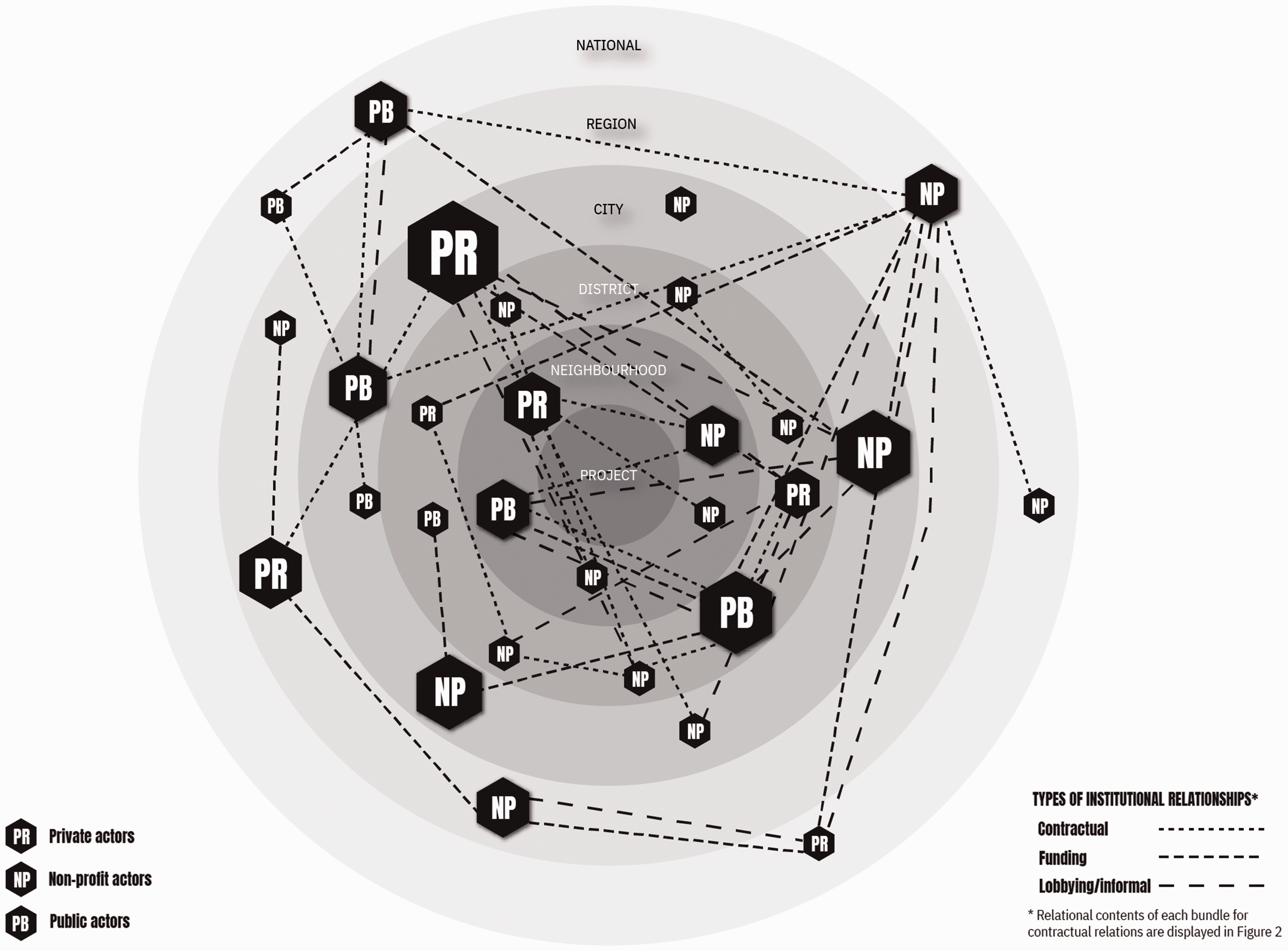
Accountability regime in a project.
How then, in these dynamic landscapes of governance, are public accountability mechanisms accommodated? Critiques of neoliberal meta-narratives are usually based on the macro-level economic, social and political drivers of change, and miss what Blanco et al. (2014, pp. 3130-3131) term the ‘micro-level accounts of the messiness of local urban politics and practices’. We seek to shed some light on the impact of these ‘messy local urban practices’ in relation to the accountability of the public sector. Accountability is linked to a specific set of relationships created through obligations and requirements accepted by both public sector and private firm(s) in the form of a contract. It is based on ‘technical apparatus of rules’, focusing on control and consequence (Heidelberg, 2015). In hybrid contractual landscapes diverse forms of accountability are created through regulatory deals as a result of a complex and interactive form of negotiation, renegotiation and consensus building processes. They are formed by the co-production and interactive transformation of rules and regulations through contracts. In that sense, it brings to the public sphere a form of market rationality, in which the requirement of profit implicitly sets the fundamental rules of control during these negotiation processes.
In what follows we aim to show first of all, how, in this complex governance environment, bundles of contractual relations form accountability regimes, what these regulatory control instruments contain, and how they are affected by market conditions. We then focus on these instruments and investigate their nature. As we indicated, the boundaries of public and private sector roles and responsibilities are blurred due to the complexity and multi-scalar diversity of these instruments and relations. We then show how this complexity adds to the messiness of local policymaking practices, resulting in public accountability becoming opaquer on the one hand, and simultaneously more concrete and operational on the other, as the public sector searches for concrete measures to “control” private sector actions so as to remain accountable to citizens in an increasingly complex governance environment.
Fragmented regimes of public accountability in hybrid contractual governance
Involvement of the private sector in the development of a project influences the interaction between public authorities and citizens due to the profit-oriented nature and power dynamics of businesses. These complex networks of relations are defined by a diversity of institutional relations and control mechanisms coordinated through the legal containers of contracts, funding and lobbying relations. In each relationship, competing and sometimes conflicting modes of governance not only co-exist through diverse interpretations of administrative accountability but are also interactively produced through regulations, legal documents, and contracts set by public and private sector agencies, which aim to control the different actions of involved parties.
Traditionally accountability refers to the ‘virtuous behaviour’ official authorities ought to display in order to conform with their public duties. In terms of urban development, decision-making, and policy implementing bodies need to be accountable for their actions, decisions and the consequences of their choices, which requires defining the boundaries of ethical or moral decisions in a normative manner. Thus governments, politicians and public officials are held responsible by explaining and justifying their actions and decisions to a wider public, not just in elections but also through specific formal institutional mechanisms and more ‘informally’ through the media. The respective responsibilities of public and private sector actors, their accountability and involvement in these services differ, depending on the form of collaboration established between public and private sector actors.
In the public administration literature these forms of accountability based on mutual responsibilisation and control mechanisms is described as co-governance or hybrid forms of public accountability (Goetz and Jenkins, 2001; Jenkins and Goetz, 1999; Poulsen, 2009). However, increasingly complex project-driven urban development makes it difficult to understand the fundamental principles of who is accountable, why and what they are accountable for. This complexity derives from three intertwined sets of dynamics: one is defined by a set of complex bundles of institutional relations and the other by a particular set of instruments to control formal/contractual relations, which for every single project form a unique, context-dependent regime of public accountability. Neither of these are practiced in a standardised manner. And finally, market-dependent conditions add to the fragmentation of public accountability due to the project-specific context in which public-private collaboration takes place. Each project, shaped by institutional relations, regulatory control instruments, and specific market conditions, forms an accountability regime (Figure 1).
As urban regeneration projects proliferate, pushed and pulled by the market conditions and regulatory frameworks, the web of rules and accountability mechanisms are formed in each of them, forming regimes of accountability through contracts, setting responsibilities, liabilities and sanctions to deal with the involvement of diversity of actors through an ever expanding web of regulations setting a very complex and hybrid landscape of governance (Figure 2).
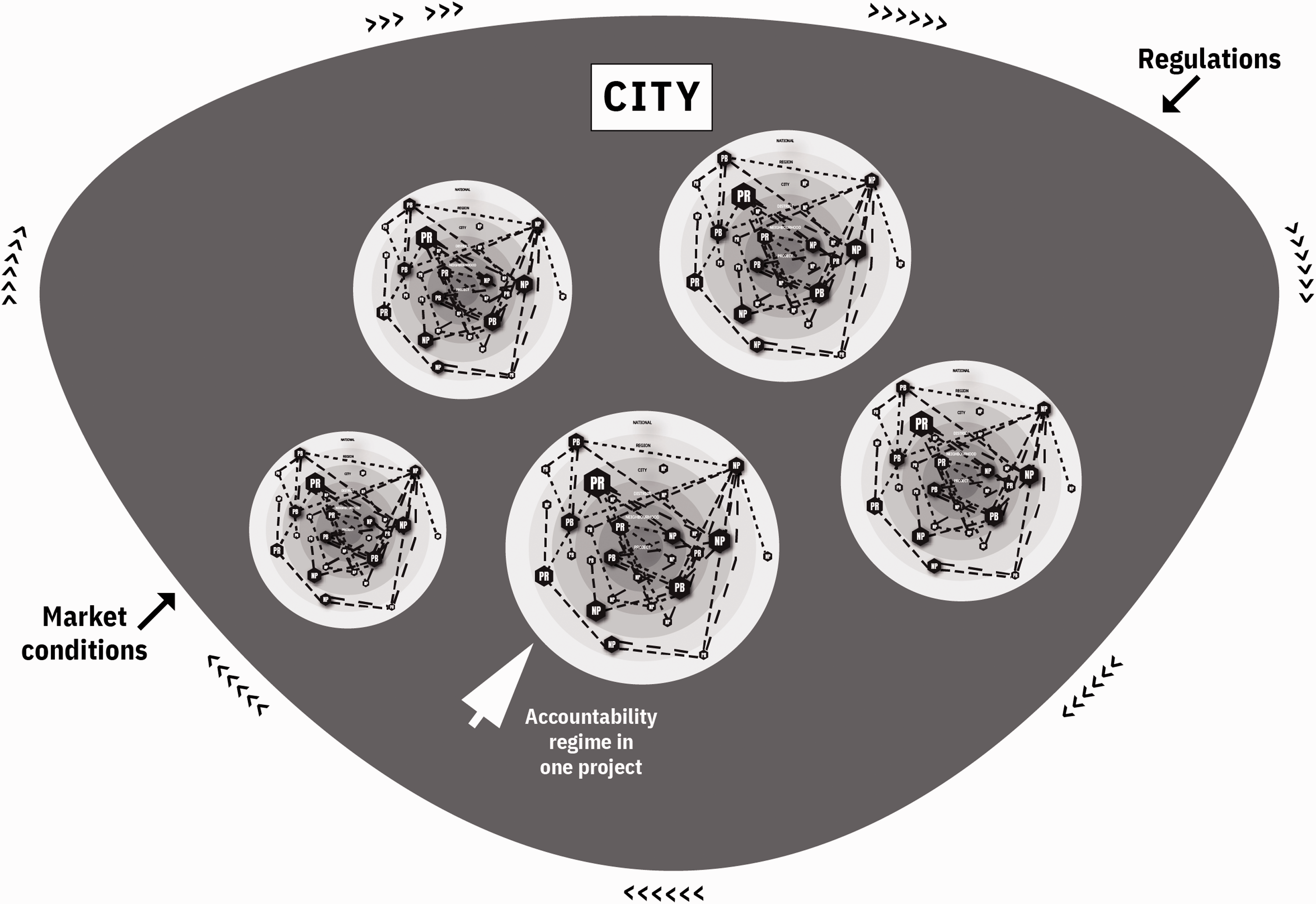
Hybrid landscape of governance.
The combination of these tendencies, we believe, is becoming a trend in contemporary governance contexts across the globe, forming diverse and fragmented regimes of accountability as we studied and illustrated in the cases of Dutch, British and Brazilian cities.
Complex bundles of institutional relations
In order to understand the changing perception of public accountability in this context, one needs to understand the type of relationship(s) contracts seek to control and the mechanisms through which the subject of contracts are ‘held to account’. The relations between public and private sector actors are subject to performance measurement through jointly agreed criteria, controlled through sanctions or penalties, and stimulated through incentives. The complex web of relations that exist in each project means that for every project local government has to devise tools and develop custom-made contractual agreements as each time the legal impact of the contracts may be different. In each project accountability regimes are established based on ever changing and context dependent relations and regulations, forming pockets of micro-regulation practices (see Figure 1).
This is a simplified and illustrative picture of a project, showing how public, private and non-profit actors are linked through bundles of multi-scalar financial, formal or informal relationships at a particular point of time, forming a complex accountability regime. This illustration is abstracted from more complex institutional maps that provide the existing connections between real actors in the nine case study projects from Brazil, the Netherlands, and the UK. What is important to note is that each project, even within the same institutional system, has its own unique contractual landscape of hybrid relationships, which can be mapped at a point in time, though the reality contains a set of dynamic and ever-changing relations set by regulatory instruments that is difficult to convey in a static institutional map (Taşan-Kok et al., 2019b). Although exhibiting different forms and linkages, three categories of relationships emerge: funding; lobbying (informal relationships, advisory relationships, oral consensus, etc.); and formal relationships (e.g. planning legislation, contracts, legal agreements, etc.).
Categorized by public, profit, and non-profit sectors at national, regional, urban, district and neighbourhood scales, our institutional maps revealed certain patterns of relations. Both the Dutch and UK cases exhibit ‘centralisation’ tendencies, particularly at the city scale, albeit more in the former. However, care must be taken to avoid over-generalising these trends. For instance, in one of the Dutch cases the City of Amsterdam retains a key role in terms of formal and lobbying relations, while national government plays equally dominant roles in the other selected cases. Greater fragmentation of responsibilities and relations are observed in the UK cases where national, city, district and even neighbourhood scales of public sector organisations are involved. Moreover, various central government organisations/agencies retain a significant presence in the UK cases in terms of funding, while in the Brazilian and Dutch cases this is either organised around a single organisation or provided through a variety of funding relations. Each country displays different relations established through control instruments. In the Netherlands, each project has very different formal relations displaying different densities in each project. Lobbying also varies widely in the three countries. In Brazil lobbying relations seem to be scattered horizontally in some projects and more centrally focused in others. In the UK the significance of lobbying varied between cases and in different phases of the developments (e.g. in the planning stage when it was most evident).
The accountability regimes in the three cities, reflected in the institutional maps, demonstrates the presence of a complex web of rules and regulations, leading to a byzantine set of responsibilities and liabilities in each project. However, the characteristics and nature of the fragmentation of accountability regimes display different causes in each country. The fragmentation of accountability regimes in Brazil is influenced by visible income inequalities spatialised in cities, more involvement of informal mechanisms in city building, as well as power hierarchies embedded in urban politics. The projects in the Netherlands and the UK were much smaller than in Brazil, but were also encouraging the development of new economic opportunities, often through the involvement of ‘third sector’ bodies. Accountability regimes in general both in the Netherlands and the UK, are more focused on legitimising the developments themselves and new forms of power, rather than addressing basic societal inequalities related to housing and infrastructure.
Although trust relations and learning practices were established through the interactions between public and private sector actors, this process of reciprocal relationships did not directly include citizens, nor was it transparent especially during the initial stage of development, a stage that contains complex lobbying activities between public and private sector agencies. Vancoppenolle and Verschuere (2012) describe the problems caused by this complex set of relations as ‘dysfunctional or non-existent accountability relations’. In this environment, these complex patterns of relations created diverse, and at times impenetrable, forms of accountability. As we are interested in understanding the nature of contractual (formal) landscapes of governance, in the next section we will zoom in on the formal relationships where public accountability was interactively produced and safeguarded by project specific regulatory control instruments between the public and private actors involved.
Regulatory control instruments in contractual relations
Dubnick and Frederickson (2011) argue that regulatory tools such as contracts seek to solve the problems of control, legitimacy and performance, and to frame general public and private sector responsibilities. While diverse forms of accountability exist within one project they are primarily concerned to control ‘wrongdoing’, thereby creating fragmented regimes and forms of accountability. Lindberg (2013) defines several types of accountability (bureaucratic, patron-client, fiscal, political, audit, societal, representative, peer professional, legal and reputational) based on their vertical and horizontal source, and strength of controls in public administration. What emerges as significant is the ‘objective of control’ attached to these mechanisms and the dominance of management and performance oriented instruments. In order to understand these complex accountability regimes in urban regeneration it is necessary to zoom in on these formal relationships set by contracts. These tools, which mainly aim to control and regulate the relationship between the involved parties in contractual relationships, accumulate forming bundles of diverse sizes as illustrated in Figure 3.

Illustrative contents of contractual relations.
The contractual relations in each project are interactively produced through an array of institutional tools to control diverse behavioural, procedural and democratic processes as can be seen in Table 1. These institutional tools are categorised on the basis of the empirical material from the selected case studies, which is summarised in Appendix. As can be seen from this material there is a great diversity of tools and use of measures even within the same country or city. Procedural control mechanisms in contracts usually contain quality, time and tools for project management, responsibilities and ethics. These mechanisms seek to guarantee price and transactions through tools like option agreements, measure performance relative to the arrangements made in the contract, and determine management quality, liability on obligations and clauses to guarantee exit conditions in case things get out of control. Democratic control and transparency mechanisms contain communication and confidential agreements on the one hand, and participation regulations and conditions on the other. Behavioural control mechanisms usually aim to control opportunistic behaviour and speculation in a project to prevent un-intended actions by setting non-compliance penalties and also to prevent conflicts through dispute resolution measures.
Type of control instruments in contractual relations.
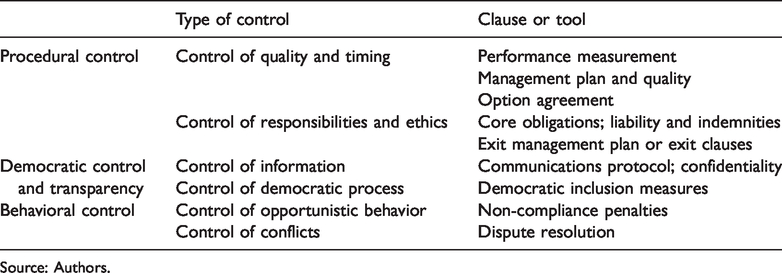
Source: Authors.
As illustrated in the table, which is created from the analysis of our nine cases we can observe diverse institutional relations regulated through different types of contractual agreements that contain a diverse set of control tools (see details from each project in Appendix). Analysing our cases we can see a considerable variation in the instruments designed to control project management quality and timing. For example, in the Dutch case performance measurement is not always controlled in each project, while in Brazil and the UK it is. The same goes for non-compliance penalties to control opportunistic behaviour. In the case of the Netherlands and Brazil they seem to be used in some projects but not always, while they were not part of the legal agreements in the British cases. This is noteworthy as penalties are important tools for local government to control the timing and quality of the development process. What is also of particular interest is the wide variety of control of information and democratic processes even within the same institutional context. What emerges clearly is the prevalence of fragmented forms of accountability and the absence of forms accessible to citizens/residents. Nor is it possible to identify standardised forms of accountability and control instruments that transcend projects within one country. Taken together what this implies is that accountability and control regimes are constructed on an ad hoc basis, arguably reflecting the prevailing economic, political and ideological contexts and the relative balance of forces (e.g. bargaining positions) between the relevant parties.
Market-dependent conditions and project-specific context of public-private collaboration
In addition to the variety of available instruments that aim to shape public-private sector responsibilities and relations in a project, market conditions also add to the fragmentation of public accountability regimes created by hybrid contractual landscapes of governance. As municipalities function in close relation with the market and public services are increasingly dependent on private sector involvement, the context in which the accountability regimes are formed through complex relations and tools as explained above are also sensitive to the special market conditions. Our analysis shows that under market-dependent conditions these complex governance landscapes necessitate some context-specific capacities on the part of the public sector including flexibility, knowledge of commercial and legal conditions, ability to deal with uncertainties, and ability to function within market conditions, prioritizing the public interest.
Flexibility in terms of collaboration and negotiations between parties
The fact that legal instruments bind together the different parties involved in the process requires them to carefully negotiate processes and targets. In order to be able to manoeuvre within the system, and adjust the project based on changing market conditions, collaboration has to provide a certain level of flexibility. In the case of Brazil, Consorted Urban Operations give local government considerable discretion to interpret the urban operation regulations in order to prioritize works or housing once all are previewed in the law and in the contract. From the beginning of 2003 to 2017, in Água Espraiada, housing was the last priority, resulting in less than 5% of the promised housing being completed. After that, pressure from former residents (about 1800 families) and of civil society representatives saw action with an agreement made requiring that new works only be commissioned once all of the removed families got their new homes (Urbanismo, 2017). 2
The flexible nature of contractualism may have varied consequences. For example, the conduct of negotiations that take place between the private parties involved in the development may effectively ‘exclude’ the public sector from the process of negotiations. In the case of Belvedere, Maastricht, the private sector actors who were responsible for the development had their own agreement. The municipality agreed to these negotiated decisions, which allowed them avoid any risk related to the property development which they considered an attractive outcome. Although informed to a certain extent, the municipality actually knew very little about these negotiations in the case of the Belvedere, Maastricht case (Respondent 1).
These flexible negotiation dynamics can easily breach the ethical boundaries of private sector responsibilities and exclude residents from the process. Even though there may be opportunities created for residents to influence the process, it is not really a co-production process with active inclusion practices that puts the needs of the wider society at the centre of the priorities as defined by the private sector companies. These procedural forms of participation, as argued by Fainstein (2000), fail to take structural inequalities and hierarchies of power into account. On the other hand this situation facilitates the creation of performance control mechanisms between the public and private sector actors. Thus, such an approach is likely to remain as a part of the contemporary planning experience. However, it also contributes to the great variation and fragmentation of control of the public sector in urban regeneration.
Commercial and legal knowledge and experience with regard to public parties
Planning by contract results in a process of one-off developments compatible with an entrepreneurial governance environment where relationships between the public and private sector are closer and frequently overlap. In situations where plan implementation processes follow an opportunity-driven form, the assemblage of contracts inevitably fragments public accountability. As each project is ‘different’, standard contracts cannot be used for different projects, and planners face considerable difficulties in terms of understanding the legal consequences of their decisions. Defined as ‘plurality of expert knowledge’ (Taşan-Kok and van den Hurk, 2019), the diversification of knowledge that planners accumulated through their experience with contract making and negotiations with the private sector, makes it difficult for such knowledge to be standardized and used elsewhere.
Urban regeneration projects thus operate in an environment in which regulatory requirements and public benefits have to be balanced, which is the most common challenge and reason they fail: they must contain rules that appear to protect investors to be attractive but they must assure the maximum public benefit at the same time. The implication is that sometimes loopholes emerge in contracts, as in the case of Amsterdam where the terms of the affordable (student) housing development (rents, units, size, etc) were agreed for the contract by the project manager from the City of Amsterdam and the developer. However, the contract did not specify how long these conditions were to apply, which allowed the developer to turn it into a more expensive housing development at a later date (Respondent 2). Put simply, after the project was completed rents were increased to a level that was no longer affordable. However, learning from this experience, planners could include such stipulations in a new generation of contracts. This represents an example of how planners can gain and apply commercial knowledge.
A lack of commercial knowledge can also lead to more substantial consequences for a city that goes beyond small mistakes in contracts. In Brazil, this can be seen in the case of Porto Maravilha (Rio de Janeiro), a large revitalization project of about five million m² where half of the area has a massive presence of derelict/underused warehouses and industrial plants, and half is dominated by low-income residential settlements. The project aims to improve urban infrastructure and public services, recover historical buildings and sites, introduce new cultural attractions and touristic venues, and enhance the supply of office, retail and residential space within the area, increasing the stock of housing to about 70,000 people. Its funding was designed to be made by selling CEPACs (Certificate of Additional Construction Potential). The CEPAC was first created in 2003, in São Paulo, in the OUCAE, as a municipal security, to be sold at auction on the stock exchange, corresponding to a certain amount of virtual land (building rights) to be used for construction inside regeneration projects in urban operations. In Porto Maravilha all the CEPACs were sold to just one single shareholder, a semi-public national pension fund (the public agency that manages a compulsory employee savings fund - FGTS). According to a high-ranking actor within CDURP (Urban Development Corporation of the Port Region of Rio de Janeiro) this was a mistake as the single shareholder was able to design and manage the development to suit their own interests and their availability of resources without any regard for the timing of the development and impacts on the success of the whole project and the wider urban area (Respondent 3). In fact, this strategy proved to be unsuccessful in sustaining the project as there was a lack of resources to invest by the FGTS / Caixa Economica (National Savings Bank) due to the economic crisis, which slowed the development of the project as a whole and therefore failed to attract new investors who were afraid to invest in the project (Respondent 3). In São Paulo, where the CEPACs were sold in parts to diverse developers, land values increased so much that the public agency could not buy all the land that was needed to the planned works and housing promotion.
However, there is a transformative learning experience attached to these negative experiences. In Amersfoort, the Netherlands, the municipality experienced a remarkable learning curve not only because the legislation has become sharper but also because the municipal council is more experienced with dealing with changing plans and dynamic decisions (Respondent 4). It means that planners accumulate knowledge and experience of working with the private sector through contracts while they learn and become better equipped to negotiate with private parties. However, it also strengthens tendencies towards the development of ad hoc systems of control and accountability that downgrade democratic forms of accountability.
Legal uncertainties due to the multi-scalar and dynamic practice of regulations
Legally binding mechanisms are insufficient to ensure public accountability as legal uncertainties materialise beyond single contracts. A range of factors play a role in these uncertainties: the size of projects; complexities of changing market dynamics; and multi-actor contexts that force local governments to be more alert and prepared for uncertain market conditions. However, as some of the Dutch cases show, important shifts in planning discourse have occurred: local governments are increasingly aware of the need for ‘due diligence’, which is an investigation process companies would usually follow prior to signing a contract (Respondent 5). In the Buiksloterham case, residents became stakeholders in a self-build housing scheme, which can be considered as a more democratic form of urban regeneration (Lloyd et al., 2015). The process became so complex with multiple stakeholders and rules that understanding how the parts of the overarching project ‘fit together’ appeared to be difficult. These complexities led the City of Amsterdam to relax certain regulations to prevent similar problems in the future (Respondent 6).
As urban regeneration projects are dependent on market conditions, local governments have to turn legal uncertainties to their advantage to keep the market parties interested as the Belvedere project in Maastricht shows. This scheme, which was badly affected by the 2008 crisis and re-phased, is a complex project, as the business strategies of investors and developers changed during/after the crisis. Penalties were not included in the main contract for this project despite the fact that the joint-venture setting created some interesting opportunities to do so, given the clear transfer of tasks/responsibilities and the risk to private sector actors (Respondent 1). A similar situation occurred in Brazil, in the Operacao Urbana Agua Espraiada scheme in São Paulo where part of the works became infeasible due to high costs, resulting in the suspension of this part of the contract, making the process move slower (Respondent 7). Another example is the case of Taunton, where the initial agreement between the Taunton Deane Borough Council (TDBC) and the developer was a ‘straight land sale’ without consideration of social housing (Respondent 8). This agreement had to be renegotiated by an arms-length delivery organisation, and the percentage of social housing on the site was increased considerably. The site now includes a tower block that provides a significant level of social housing on the site. On the other hand, being squeezed between market dynamics, funding limitations and a desire to regenerate derelict areas, means local governments can use legal uncertainties to the advantage of planning. Speaking about the Harbourside regeneration project a respondent from Bristol City Council (Respondent 6) indicated that the City shared the costs of hiring local architects with other stakeholders to draw up a visualization, rather than a master plan.
Taken together these cases indicate a clear tendency for legal uncertainty, created by the dynamic practices of law at multi-scalar levels, to transform urban regeneration projects into an on-going multifaceted game where strict rules and legal agreements were intentionally and unintentionally combined with uncertainties, providing further justification for the use of non-standard instruments to control their consequences.
Private sector parties have their own mode(s) of conduct, rules and traditions within which they function. While categorizations of developers and investors within the property industry provides valuable insights (Adams et al., 2012), they provide little evidence regarding the impact of complex sets of rules of conduct in urban development through contracts. It is not only that there is considerable diversity within a single category of actors (developers or investors), but also that the diversity of agents involved in a project differs from case to case. Considering the number and functions of all the additional actors such as mediators and networking agents, and their associated rules of conduct, traditions and demands, it is not surprising that the control instruments developed to safeguard the public interest become fragmented and diverse, changing from one project to another. One of the most repeated aspects of private sector involvement in urban regeneration projects that we investigated were privacy rules and issues connected to this issue. In Bristol’s Harbourside project, for instance, one of the biggest challenges was ensuring that the Harbourside Sponsors Group’s decisions were accountable to the public, as this clashed with commercial confidentiality and the company did not want their involvement to be public knowledge (Respondent 10). However, despite the conditions set by the market, existing local networks of governance employed forms of deal-making and consensus building even though there was no legal obligation at this stage of the project.
In addition to the diversity of actors and their legal actions, another trend in the private sector is noteworthy. In different ways, but certainly as a tendency, many responsibilities were transferred to a private special purpose vehicle such as a joint venture company. As a result, municipalities could not directly oversee everything that took place in terms of accessing the contracts related to the development of specific plots within the overall development. There is a widespread practice of sub-contracting the development of specific plots, which means that a considerable number of contracts signed involve only private entities. One respondent from the municipality highlighted the consequences of this trend, as seen in the case of the Eemkwartier project in Amersfoort: the city was not part of the ground exploitation, construction and housing preparation for that reason (Respondent 11).
This diversity and complexity also create a necessity for contract management to be a task of its own to ensure overall regulatory control concerning these increasingly complex development processes. In São Paulo, OUCAE is managed by two public companies: SP Urbanism and SP Works. The manager of the first explained that one company (SP Urbanism) is responsible for managing OUCAE and the other (SP Works) undertakes general management, the release of financial resources, and the monitoring of interventions. The latter is also the executing agency as it holds the contracts; and is also responsible for hiring staff and following up the development. Our respondent underlined that both companies deal with the each other’s departments in the municipality (Respondent 7).
Moreover, a contract defines the obligations and responsibilities of the private sector parties and also defines the boundaries for each partner. The contract for works in the OUCAE case in São Paulo involved four contractors, each of which was responsible for a package of 25% of the works. These disaggregated tasks included part of a tunnel, part of streets, viaducts and part of a park and 1,000 housing units on land to be made available to them. As in the case of Amsterdam above, the contract did not specify how long these conditions were to apply. A senior agent from the Municipal Secretary of Housing of the Municipality of São Paulo explained that when the tunnel plan was suspended due to a lack of funds, it also influenced the provision of housing as well (Respondent 12).
Although involvement of multiple stakeholders does not inevitably diminish public accountability, as can be seen from these experiences, it does create a kaleidoscopic image of who is accountable, why and what they are accountable for. One thing is certain, the everchanging set of actors, their demands and diversity in contractualising their businesses make it difficult for local governments to function in multi-actor, large-scale regeneration projects and limits their ability to construct a comprehensive form of public accountability.
Conclusions
In late capitalism, where public planning activities are increasingly reacting to and structured by market activities and preferences, attempts to maintain public accountability are sought, measured and ensured through contracts that aim to define roles and responsibilities in urban development. The actual contracts, their contents and legal implications have become too complex to follow through traditional comprehensive accountability and control mechanisms. We argue that accountability does not necessarily ‘disappear’ or diminish in a linear way but mutates, taking on different forms requiring new instruments that attempt to control aspects of private sector involvement seeking to protect the public interest through contractual instruments. Rather than relying on norms and values based on the ethics of public service, the public sector seeks to develop more concrete and measurable instruments of control to ensure over-arching accountability. As we elaborated above, these complex bundles of relations and set of instruments function in a market-dependent environment where specific context-dependent conditions of public-private collaboration add to this complexity and runs the risk of reducing transparency and accountability. As a result, although new forms of accountability may be created to control the use and management of public resources, especially in urban regeneration this accountability may not concern residents.
In order to assess public accountability in this context it is necessary to understand the diversity entailed in the structure and form of contractual relationships. This implies that there are a variety of forms of regulation through contracts and other regulatory instruments. As illustrated above, the complex hybrid landscapes of contractual governance create fragmented regimes of accountability. We have shown that the co-existence of administrative accountability (Poulsen, 2009) in hybrid contractual landscapes contributes to the development of a particular form of democratic deficit as the governance system becomes too complex, which leads to multiple, and potentially incompatible, accountabilities (Hupe and Hill, 2007). The current literature on contractual governance provides an ambiguous picture of private sector involvement in urban development due to the lack of empirical evidence on contracts. What is not clear in the literature dealing with public accountability is that everything that is defined or included under the framework of ‘public accountability’, actually refers to pre-factum accountability, which is, according to Darwall (2006), concerned with establishing the existence of moral obligations before an instance of moral wrongdoing (Dubnick, 2013). Thus, pre-factum accountability reduces public accountability down to ‘performance measurement’ (Dubnick and Frederickson, 2011).
We have illustrated that in the practice of urban regeneration projects there is a diversity of: regulatory instruments; contracts created to define responsibilities in each step of each action; and control that seek to safeguard public accountability, which create a variety of accountability mechanisms. In each project these are combined together, in unpredictable ways, to produce ‘unique regulatory and control regimes’. This contrasts sharply with classic notions of accountability, which tend to be universal and abstract, based on general ethical principles and norms. Moreover, in this entrepreneurial governance environment where the citizen may be seen and treated as a consumer, the forms of accountability may function to satisfy “consumer rights”.
In addition to these overarching pressures, in the context of urban regeneration projects further complexities are created through dynamic contractual landscapes. These are the product of sets of dynamic relationships between participants, a diversity of relations among miscellaneous actors, that through regulatory control instruments seek to help the public sector safeguard accountability in relation to private sector involvement. However, the public sectors’ use of control instruments has been criticised for marginalizing democratic accountability to ensure that it does not get in the way of ‘operational efficiency’ (Raco, 2013) and ‘performance management’ (Fine et al., 2017). Our analysis shows how these control instruments are co-produced by the public and private sector through complex webs of mutual relations, which create a form of ‘invisible bureaucracy’ (Guttman and Willner, 1976) that undermines any wider notion of public accountability.
In this messiness, we also argue that traditionally conceived public accountability has been displaced by new forms of accountability that function in ways that are difficult for non-specialists to understand thus making transparency more opaque, and more traditional forms of accountability difficult to exercise. While pre-factum accountability in urban development creates complexities, it also opens potentials for the development of new measurements/instruments of accountability, albeit ones that are more difficult to understand and exercise. However, contracts exclude residents (citizens) in the sense that they do not have any direct involvement in the co-production of public accountability. Residents are not a party that ‘signs’ the contract and frequently have no access to the contract. Their form of accountability remains that of electing and protesting. Thus accountability and transparency are reduced or even eradicated vis-à-vis local citizens and the wider democratic polity. The results of these can be more visibly seen in the case of Brazil where harsher socio-spatial inequalities are experienced especially in the urban regeneration areas where the needs of already under-privileged residents of favelas could be easily disregarded by the fragmented regimes of public accountability (Martins and Santos Pereira, 2019; Nobre, 2012). In the UK and the Netherlands, however, some mechanisms to seek justice exist in urban regeneration areas if the residents are dissatisfied, though, perhaps only exercised by a few active citizens.
Whilst we can see an element of veracity in Vancoppenolle and Verschuere’s (2012) conclusion that the involvement of other actors (for- or non-profit) does not necessarily lead to a total loss of public accountability this claim has to be treated with a degree of caution as a great deal depends on the experience, knowledge and political will of those involved to utilise these ‘new tools’ of accountability to maintain public accountability. In circumstances where these are absent then public accountability may indeed be diminished or even disappear. In a number of our cases, particularly in the UK and the Netherlands, the co-production of public accountability through complex sets of relations between public and private sector actors undoubtedly became more obscure and fragmented but this did not entirely suppress general public accountability, albeit it made it less easy for citizens to see the consequences. In the Brazilian cases, the public sector acts in order to obtain financial gains to support development projects, thus assuming the primacy of a profit-making logic rather than one of accountability to the community (Martins and Santos Pereira, 2019). For instance, CEPACs (building rights) are seen as financial means and sold by the municipality in auctions on the Stock Market. This creates a situation that favours landowners and specific sectors such real estate and construction, and makes it easier to overlook the demands of affected slum residents (Nobre, 2012), thus, diminishing accountability particularly to the favela population. This is not an imperfection of the hybrid governance structure, but rather of the logic of the system (Fialho Martins, 2015; Siqueira, 2014).
Clearly, what the processes we have discussed do is to distort available comprehensive accountability mechanisms and over-ride general ethical rules by turning them into a complex and fragmented set of rules set by incomprehensible and non-transparent (especially for the citizens these services or projects are produced for) legal documents, which are not standardized. Such a context does indeed represent a real threat to the exercise of public accountability in any meaningful sense. In this messy policy environment, it is not surprising that public accountability may be perceived as a ‘mere spectator’. However, the problem of urban regeneration today is not the lack of performance control tools, or legitimacy, but their proliferation and the attendant increasingly blurred frame of general public and private sector responsibilities, which emerges in parallel to general public norms in hybrid contractual landscapes of governance. And, arguably, under market-led planning, without clear public norms we cannot have accountability. As Korthals Altes (2019) underlined the accurate coding of accountability mechanisms in contracts and establishing who is accountable may help to clarify what needs to be enhanced in the next contractual relationship. However, to clarify and re-set the public norms in these complex policy environments, more comparative empirical research is needed to decipher the positions of complex set of actors whose roles are becoming increasingly ambiguous. It is indeed more important to provide a clear understanding of public and private sector actors’ roles and responsibilities, which are getting closer to each other, than developing a standardised and ineffective set of instruments that aim to provide a vague understanding of ‘public accountability’. Acknowledging the complexity of these new institutional settings, which are formed by complex hybrid contractual landscapes is also important. This understanding can help to identify a new set of ‘shared norms’ and ‘facilitative behaviours’ on the basis of which public accountability can be re-defined through inclusive mechanisms rather than through public delivery tools aiming to satisfy commercial interests.
Footnotes
Acknowledgements
Within the framework of PARCOUR (Public Accountability to Residents in Contractual Urban Redevelopment) project, the researchers Dr. Martijn van den Hurk, Dr. Alvaro Pereira, Dr. Andrew Tallon, Dr. David Williams, Pauloa Oliviera, Gabriel Palladini, and Sofia Bittencourt helped us to collect part of the data we used in the paper. We thank them for their collaboration and contribution for this research. We also thank the anonymous referees for their constructive comments and suggestions.
Declaration of conflicting interests
The author(s) declared no potential conflicts of interest with respect to the research, authorship, and/or publication of this article.
Funding
The author(s) disclosed receipt of the following financial support for the research, authorship, and/or publication of this article: This transnational collaborative research project is funded by the collaboration of research councils of FAPESP, ECRC, and NWO under Grant number 485-14-010. The views expressed in this report do not necessarily represent those of the funding organisations.
