




Abstract
This paper seeks to add empirical depth and conceptual nuance to how we understand the dynamics of geopolitical interactions. It does so by turning attention to the role of space in how modes of politics are articulated. The micro-spaces of international institutions are brought to the fore through an examination of how geopolitical actors of different prescribed statuses – state diplomats and representatives of minority communities – interact in the spaces of the UN Office at Geneva. Focusing on the UN Forum on Minority Issues the paper adopts an inductive approach to draw out dynamics of scripting, disruption, (in)visibility and affective atmospheres in this space. Three empirical snapshots of the eighth and ninth Forums are presented. The first focuses on spatial scripting within Room XX and examines experiences of sublime aesthetics and the cadences of the Forum’s proceedings. Attention then turns to the actions of particular states which interrupted minority speakers and engaged in spatial practices of intimidation. Third, the agency of minority representatives in asserting their presence through reclaiming space and small acts of subversion is examined. The paper concludes with a discussion of how to approach the often contradictory modes of politics articulated at the UN and the potential for further geographical investigation of this international institution.
The United Nations is an international organisation that is, in essence, state-led and state-run. Yet, states are far from the only actors present at UN forums and conferences. Rather than a narrow diplomatic corps consisting solely of traditional state diplomats, UN diplomacy is constituted of a ‘larger and more complex diplomatic community’ that includes an array of non-state actors (Wiseman, 2015: 327, emphasis added). However, beyond such observations there remains a paucity of analysis of this ‘networked UN diplomatic community’: what are the power dynamics between these actors? What diplomatic norms and practices do its participants share? To what extent are non-state actors perceived as a threat to the position of member states? (Wiseman, 2015). In this paper I seek to add empirical depth and conceptual nuance to how we understand the dynamics of such geopolitical interactions. I do so by turning attention to the role of space in how modes of politics are articulated. Specifically, I examine the micro-spaces of international institutions (Weisser and Müller-Mahn, 2017) in terms of how geopolitical actors of different prescribed statuses – state diplomats and representatives of minority communities – interact in the spaces of the UN Office at Geneva.
That little critical scholarly attention has been paid to modes of politics articulated at the UN is perhaps unsurprising. From the outside the UN appears as a sterile site of geopolitics: its status as a global power broker has seemingly diminished, and its day-to-day business is sluggish thanks to oppressive protocol. Moreover, as a space of ostensibly formal geopolitics conducted by elite actors, institutions such as the UN run counter to critical geopolitics’ recent focus on the everyday, embodied and intimate practices of geopolitics (e.g. Dixon, 2015; Smith, 2012). However, in this paper I argue that it is precisely by focusing on the micro-political practices within the UN that it can emerge as a revealing site of geopolitics. This is underpinned by two particular spatial dynamics. First, is the fact that, as a members club, the UN is an institution premised on practices of inclusion and exclusion and the differentiation of actors as inside or outside the organisation has implications for access to certain spaces and how particular individuals and groups behave within that space. Second, individuals with these prescribed identities as members and non-members are, at particular times and in particular places within the UN buildings, in close proximity. They might encounter each other in corridors, sit next to each other in conference rooms and, in certain circumstances speak during the same session. These spatial characteristics open up a series of questions: How is (non)membership and (non)belonging articulated through spatial practices at the UN? To what extent are spatial practices used by members of the club to exclude and control non-members? What agency do non-members have within the spaces of the UN? What modes of politics are being articulated?
In attempting to address these questions, I focus on the UN’s ‘Forum on Minority Issues’ where civil society representatives hold states accountable to agreed norms related to national or ethnic, religious and linguistic minorities. This is a unique platform within the UN system as representatives from minority communities are, for two days a year, in principle on an equal footing with representatives of states and international organisations. In what follows, my focus is not on the substantive content of the Forum nor the norms underpinning it (see Lennox and Bíró, 2017), but the Forum as a site of (geo)politics: an ‘institutional, epistemological and geographical space through which geopolitical representations are made and received and in which geopolitical practices are performed and played out’ (Sharp, 2013: 209). At first glance it might be expected that adversarial modes of politics predominate in this space, with minorities challenging state practices and states reacting defensively. However, rather than read the political articulations of actors at this Forum through the lens of particular political theorists and fit practices to understandings of antagonistic or associative registers of politics, I am instead interested in the messiness and liveliness of politics in this space (Massey, 2005). To this end my strategy has been to immerse myself in the activities of the Forum and draw out modes of politics and spatial practices from what I observed. In line with my broadly inductive approach, I focus here on modes of politics as a broader and less conceptually burdened concept than practices of dispositions in order to encompass the range of interactions, activities, embodied experiences and processes through which politics takes place. For inspiration in how to approach this ‘geopolitical site’, I turn to literature in anthropology, geography and sociology that has ethnographically examined the role of power relations, ritual performances and (in)visibility in political institutions. I bring this work into dialogue with scholarship in cultural geography on affective atmospheres to examine the spatial practices through which geopolitical agency is produced, articulated and contested, and how the material and affective setting of the UN influence behaviour by, and interactions between, state and non-state actors.
The research that underpins this paper is based primarily on observations made during the eighth and ninth Sessions of the Forum on Minority Issues held in 2015 and 2016, respectively. Transcripts of speeches delivered at the Forum provide a rather sanitised version of the event and it is only by being in the room do you get a sense of the inter-personal dynamics, shifts in atmosphere and rhythm of the proceedings, as well as glean insights from chance encounters with delegates over lunch, in the corridors, and on the bus back into town at the end of the day. I sat towards the back of the room during the sessions and used anthropological techniques of noting the comportment and interactions of participants, trying to capture shifts in atmosphere during the discussions and recording descriptive accounts of protocols and disruptions. This thick description of the Forum was supplemented by semi-structured interviews with 27 participants from minority communities and three staff members from NGOs before and after these sessions on their expectations and experiences. Qualitative research in diplomatic environments can be challenging (Adler-Nissen and Pouliot, 2014; Müller, 2013) and crucial to my access both to the Forum and to minority representatives present there has been ongoing work with the Unrepresented Nations and Peoples Organization (UNPO), a coalition of indigenous peoples, stateless nations and minority communities. Given my embeddedness in this community of minority representatives, this paper presents the experiences of the Forum from the perspective of these delegates.
After discussing how scholars have thus far approached the UN and sketching out a series of performative and affective dynamics that emerge from work on geopolitical sites I briefly set the context regarding the position of minorities at the UN. I then present three empirical snapshots of the eighth and ninth Forums. The first focuses on spatial scripting within the Forum’s venue and examines experiences of sublime aesthetics and the cadences of the proceedings. Attention then turns to the actions of particular states which interrupted minority speakers and engaged in spatial practices of intimidation. Third, I turn to the agency of minority representatives in asserting their presence through reclaiming space and small acts of subversion. The paper concludes with a discussion of how to approach the often contradictory modes of politics articulated at the UN and the potential for further geographical investigation of this international institution.
The UN as a site of lively geopolitics
Varying degrees of scholarly attention have been paid to the UN as a site of geopolitics. Within geography the UN largely remains a terra incognita with almost no geographical scholarship focused on the spaces or practices of the main UN bodies. One notable exception is a special issue of Political Geography published in 1996 on ‘political geography and the UN’ which sought to encourage geographers to contribute ‘to the education of the people of the world about the UN’ (Glassner, 1996: 229). However it is revealing that the articles ‘were not to be theoretical … but rather were to describe, explain and analyze practical, day-to-day UN activities’ (Glassner, 1996: 227, emphasis in the original), from boundary disputes (Prescott, 1996) to environmental protection (Momtaz, 1996) and peacekeeping (Chopra, 1996).
In comparison to geography, considerably more attention has been paid to the UN in the field of international relations (IRs) (see Barnett and Finnemore, 2008). Realist approaches, for example, perceive the UN as a tool of the great powers, and as battlegrounds where rivalries are played out. In contrast, rational institutionalist and English School approaches both frame the UN as promoting cooperation, with the former presenting the UN as an impartial broker, and the latter turning attention to the UN’s use of norms and moral suasion. In general, this work within IR has been at the macro-scale, focusing on institutional design and questions of global governance (e.g. Voeten, 2000). It is only in recent years that attention has turned to the inner workings of the UN and the micro-level practices of UN diplomats and bureaucrats. Leading this initiative have been scholars adhering to constructivist approaches who, in embracing the practice turn, have examined the social dynamics and bureaucratic routines within the institution (e.g. Adler-Nissen and Pouliot, 2014; Ambrosetti, 2012). In a similar vein, political anthropologists have attended to everyday interactions and shared habits at the UN in order to examine ‘how international organisations involve collective and individual actors in their … attempt to neutralise political conflict, and create new political fields’ (Müller, 2013: 2).
Missing from much of this existing scholarship on the UN is a focus on the particular modes of politics articulated at the UN and the spatial dynamics of interactions between different actors within the ‘UN diplomatic community’. Turning to literature in diplomacy studies only gets us so far with these queries. Not only are diplomatic practices at the UN ‘vastly underestimated and undertheorized’ (Wiseman, 2015: 329) but scholars of diplomacy have largely overlooked issues of place and space (McConnell, 2019), and where they have, there has been a notable absence of theoretical engagement with these concepts (e.g. Neumann, 2013).
A potentially more productive line of enquiry is an emergent body of work that reads politics at the UN through a post-foundational theoretical lens, focusing on the ‘post-political forms of regulation and governance’ (Mouffe, 2005) that appear to be conducted in many parts of the UN system (e.g. Garsten and Jacobsson, 2011; Weisser and Müller-Mahn, 2017). This scholarship brings to the fore the depoliticisation of politics in particular UN forums and the production of norms of consensus and harmony in other forums. Yet the assumption that the UN is one of the last bastions of associative politics in what is an increasingly antagonistic geopolitical landscape is also being troubled. Cowan (2013), for example, discusses the ambivalence around the term ‘non-politicised’ in the context of the Universal Periodic Review (UPR) mechanism where the human rights record of each member state is peer-reviewed every four years. Whilst the UPR is framed as a consensual space where political antagonisms are muted in a search for compromises and cooperation, these are not ‘non-political’ spaces: states still strive to advance their political interests at the UN and ‘the “old” geopolitics of state rivalries and alliances … are, at times, openly expressed’ (Cowan, 2013: 127).
In many ways, viewing the UN through the lens of associative/dissociative politics has the potential to speak in revealing ways to geographical scholarship that interrogates the relationship between space, politics and the political (Dikeç, 2005; Sparke, 2005). In terms of the empirical focus here – the interaction of member states and marginalised groups at the UN – an apposite starting point might be the ideas of Jacques Rancière (1999). As an example of where the marginalised ‘take the stage, make themselves heard and put a claim on society’s members to be recognised as their equals’ (Van Munster, 2009: 266), the Forum resonates with Rancière’s focus on recuperating politics from the point of view of the excluded and oppressed. In addition, Rancière’s work brings to the fore the importance of spatial processes and dynamics to the workings of politics, with politics being understood as ‘something that requires staging, mediating and subjectifying’ (Davidson and Iveson, 2014: 151). However, for the purpose of this paper I do not want to start with a priori assumptions regarding the nature of politics in this space. As Featherstone and Korf (2012) note, the counter-position of associative and dissociative traditions of theorising the political can produce ‘an unhelpfully limited sense of “actually-existing” forms of contestation’ (665). Instead my approach is to keep the lines of enquiry more open and remain attentive to the lively and messy character of political activity and interactions at the UN. Following Massey’s (2005) insistence that space is characterised by co-existence and multiplicity I am interested in diverse, intersecting and seemingly contradictory registers of politics, the ‘comic and tragic, enthralling and appalling, ludic and frightening’ (Spencer, 2012: 729).
Yet the question remains how to research the generative character of political activity within an institution like the UN. Whilst my primary strategy has been broadly inductive – drawing out modes of politics and spatial practices from what I observed at the Forum – I have also sought inspiration from cross-disciplinary work that ethnographically examines a range of (geo)political site including international conferences (Craggs, 2014; Hodder, 2015), court rooms (Gill, 2016; Jeffrey and Jakala, 2014) and national parliaments (Crewe, 2010; Spary, 2010). By turning attention to auditory rhythms, modes of participative actions and emotional reactions, this literature hones in on spatial, performative and affective registers which provide a useful interpretive guide to approaching this ‘field’. A series of dynamics also emerge from this work on the micro-spaces of formal politics which I use as provocations in my analysis of the Forum on Minority Issues.
The first is to question the extent to which space and practices are deliberately scripted. The growing body of work on the role of performance in statecraft and diplomacy frames political spaces as inherently theatrical (Alexander, 2011; Jeffrey, 2013; McConnell, 2016, 2018). Illustrative of this is Shimazu’s (2014) examination of conference diplomacy as theatre with the host city providing the stage upon which delegates perform to an audience of local people and international press (see also Craggs, 2014; Death, 2011). This work on theatricality usefully points us to consider the role of audiences, the ‘performative articulations of power’ in constituting spaces of politics (Gregson and Rose, 2000: 434) and the practices of choreography and scripting. The latter provides valuable insights into the deliberate use of particular spatial and performative repertoires as disciplinary tools. As Spary (2010) notes in the context of debate in the Indian parliament, ‘ritual is rule-governed, its performance exerts normative pressure on its participants (Lukes, 1975: 90) to act in certain ways according to a regulatory system of norms or “scripts”’ (341).
However, in viewing sites of (geo)politics through the lenses of theatre and performance there is a danger that we portray too static a picture and that choreographed theatricality is a distraction from the messy realities of political practices and interactions (Jeffrey and Jakala, 2014). In circumventing this, it is important to also be attentive to a second dynamic: the unscripted and the spontaneous. Particularly enlightening in this regards is work by scholars of legislative studies who focus on the transgressive practice of disruption (Crewe, 2010; Spary, 2010). The creative potential of disruption (Rai, 2010) is particularly apparent when it is carried out by ‘space invaders’ (Puwar, 2007), individuals who, due to certain identity markers, challenge the circulation of power within institutions. Indeed, more generally, the fact that the normalising of particular performances leads to the marginalising of those actors whose modes of behaviour deviate in some way thereby shines a light onto broader practices of inclusion and exclusion (Rai, 2010). This opens up the third dynamic of (in)visibility and (in)audibility in the spaces of political institutions. As Puwar (2010) notes in her reflections on race and gender in parliamentary spaces, we should be asking who has a voice within these spaces, who is heard and what is dismissed as ‘noise’ (299)?
Finally, cross-cutting the scripted/unscripted dynamics of politics are emotional and affective registers. On the one hand, we can think of scholarship on the symbolism of politics that traces the deliberate arrangement of physical settings to evoke emotional and aesthetic reactions (Cohen, 1987; Edelman, 1964; Neumann, 2006). On the other hand, there is the growing body of work by cultural geographers that details how ‘affect necessarily exceeds attempts at engineering and directing feelings and can, momentarily at least, seem outside attempts at control’ (Anderson, 2006; Closs Stephens, 2016: 185; Thien, 2005). In order to hold these qualities in tension, it is instructive to turn to recent scholarship on the (geo)political dimensions of ‘affective atmospheres’. As Closs Stephens (2016) argues in her examination of how nationalism operates affectively and atmospherically, this notion is a ‘provocation that invites us to address the role of “moody force fields” in the making and shaping of collective publics’ (182). By encouraging us to think of different affective tonalities and intensities within institutional spaces that lead to the intangible production of shared affinities (Craggs, 2014: 98), the notion of affective atmospheres therefore has the potential to add depth to understandings of modes of political behaviour. In what follows, I use these dynamics of scripting, disruption, (in)visibility and affective atmospheres as a loose analytical toolkit for examining interactions at the Forum on Minority Issues. However, before turning to the Forum itself, I situate this platform within the broader UN system.
Minorities at the United Nations
Prompted by concerns regarding the plight of Jews in Eastern Europe after the First World War, a nascent minority rights regime was adopted by the League of Nations (OHCHR, 2012). However as Mazower (2009) notes, ‘minorities would find less protection under the UN than they had done under the League’ (24–25) both due to the UN’s focus on universal human rights and decolonisation, and its fierce defence of national sovereignty. That said, the UN has, under the auspices of the Office of the High Commissioner for Human Rights, ‘gradually developed a number of norms, procedures and mechanisms concerned with minority issues’ (OHCHR, 2012: 2). This emerging minority rights regime was formalised in the 1992 Declaration on the Rights of Persons belonging to National or Ethnic, Religious and Linguistic Minorities and a Working Group on Minorities was set up in 1995 to review progress in realising the aims of this Declaration. As a result of the Group’s deliberations, the Forum on Minority Issues was established in 2007 by the Human Rights Council. Held for two days each November at the UN Office in Geneva, each session of the Forum focuses on a particular theme and is chaired by a different expert on minority issues. 1
In many ways the Forum is structurally limited, certainly when compared to the position of indigenous communities within the UN system (Bellier, 2013). As the Minorities Declaration is non-binding, recommendations made by the Forum are not formally adopted by states and there is thus no obligation for states to report on compliance (Lȃm, 2007; Lennox and Bíró, 2017). Yet, despite these substantive limitations, the Forum is a valued platform as a unique space within the UN where state and non-state stakeholders can not only come together for engagement and dialogue but do so with unparalleled parity of participation. Within the space of the Forum they have equal speaking time during the moderated debate and there is no hierarchy in the order of interventions. In addition, for representatives of minorities, civil society organisations and NGOs, this is a notably accessible forum within the UN system as these delegates are not required to have consultative status with the Economic and Social Council in order to attend: pre-registration with the OHCHR Secretariat is all that is required. Minority participants I interviewed described the Forum as ‘a place to shame states about their human rights record’, ‘where we can put legitimacy onto our own struggle’ and the only space within the UN where ‘minorities are the main protagonists’. To date, the Forum has received little academic attention, with the exception of ongoing work by Lennox and Bíró (2017) who, from a social constructivist perspective, are tracing trends in attendance and discourses at the Forum. This paper seeks to complement this emerging research by adopting an ethnographic lens on the Forum and addressing questions of state/non-state interactions.
The sublime and the scripted: Spatial ordering in Room XX 2
I’m in the queue for security at Pregny Gate, the public entrance to the Palais des Nations. Delegates from West Papua, Balochistan, and Ogaden greet each other, exchanging pleasantries but also stories of colleagues who have had accreditation withdrawn at the last minute. Everyone is anxious until they are through security, have had their accreditation verified and their two-day pass printed … The foyer of Building E is as drab as its exterior, with a small shop selling UN-branded merchandise, screens detailing meeting schedules, and trestle tables in various states of folded-ness, ready for the next temporary exhibition. Entering Room XX, however, is like entering another world. It’s a vast circular conference room, brightly lit and able to seat over 700. Cream leather chairs are arranged in concentric arcs, there is a gallery above for interpreters, and screens on the walls to broadcast the proceedings. And then there is the ceiling: a dazzling sculpture by Spanish artist Miquel Barceló consisting of brightly coloured stalactites made from pigments sourced from all continents. I watch as representatives of minority communities – particularly those for whom this is their first time at the UN – are awestruck by the setting. They pause at the doorway, taking in the ceiling, reaching for their phone to take photographs.
3
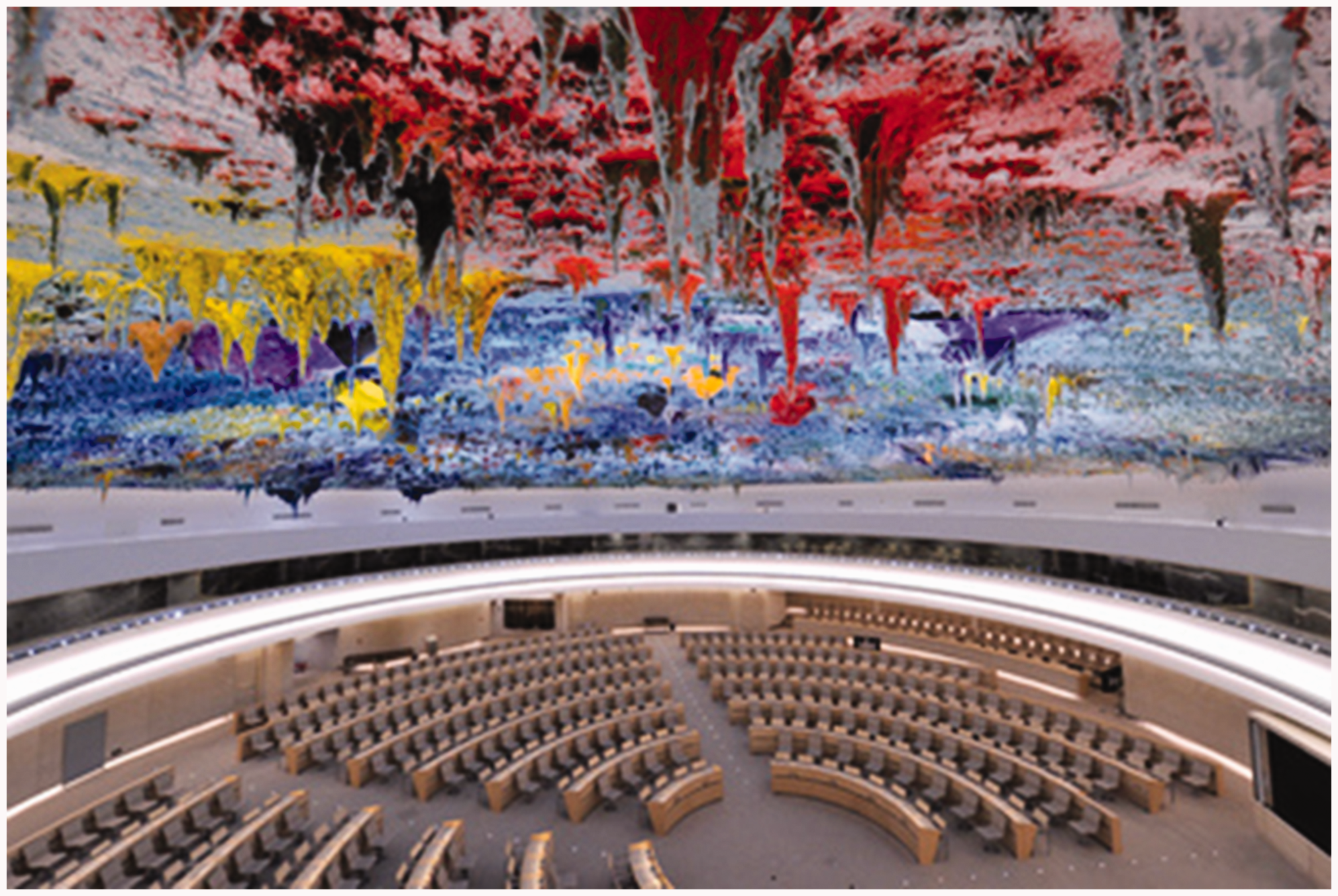
The Human Rights and Alliance of Civilizations Room (formerly Room XX) at the Palais des Nations, Geneva. Source: UN Photo/Jean-Marc Ferrés.
The scale and dazzling beauty of the ceiling, along with the ‘archi-textures’ (Puwar, 2010) of the room, point to the second aesthetic: that of the sublime. What we have in Room XX is the feeling of a sacred space that heightens the sense of awe of those who speak within it. As Neumann (2006) has argued, whilst the grand diplomatic extravaganzas of Byzantine diplomacy may have long disappeared, resonances remain today in how state diplomats curate an air of separateness and superiority. The resulting ‘timorousness with which the uninitiated approach diplomats at work’ means that ‘the superiority of diplomats remains in the doxic realm’ (Cohen, 1987; Neumann, 2006: 887). Central to the aesthetic of the sublime is the experience of overwhelming grandeur and dislocation from the everyday. For those who are outsiders to the UN, and particularly those who come to speak on behalf of their communities, Room XX is an imposing and a daunting space. Minority representatives recounted that, by the time they had got through security they were feeling confident: they had achieved a lot, from securing time off work to scraping together funds to come to Geneva and, in many cases, acquiring a Swiss visa. Yet their confidence often dissipated as soon as they stepped into Room XX and were over-awed by the setting and what was ahead of them. As a young female delegate put it: it’s not just the size of the room, it’s the feeling that you have when you come in. You stop and you think, what am I doing here? How can I make a speech here? Really I wanted to run out! But then you think, I have my responsibility. I am here to represent my community, I must get past my nerves! (Interview, December 2015)
This affective atmosphere also has a profound effect on how different actors within Room XX use the space. As the room fills up with delegations it becomes apparent that, like court rooms and parliaments, actors of different prescribed statuses move within and claim space in different ways. Representatives of minority communities are often initially cautious. Their lack confidence in the space is manifest in trying to work out where they should sit: most first opt for seats at the back but then, observing other delegations, they pluck up the courage to move to empty chairs towards the front. In contrast, state delegations and staff from international organisations arrive just as the session opens, and move about the space with confident ease, finding their name cards from the box at the back and claiming a prime seat.
Confidence certainly plays a key role in such spatial practices displayed at the Forum, but what insights does this give us about the spatial ordering more generally? The answer is one characterised by ambivalence. On the one hand, the UN, and this Forum in particular, are, in principle, spaces open to all. Indeed, with the parity of participation, the geometry of state/minority community relations is notably flattened within the Forum. On the other hand, the UN is a highly differentiated institution, historically marked by deep divisions of race, gender and nationality, and in many ways it remains a segregated space. Not only do accreditation requirements vary for different categories of actors attending the Forum but access to particular parts of the UN buildings is also regulated by the pass around your neck. This segregation is particularly stark during lunchtime, with a subsidised canteen for state delegates and UN staff, and an expensive cafeteria for everyone else. Thus, although the UN Offices at Geneva are far from being a total institution, what emerges from such observations of both imagined and physical boundaries is a particular form of spatialisation and partitioning. Based on the identification and classification of actors as insiders and outsiders and the positioning of them in their ‘proper place’ (re Foucault, 1977), participants at the Forum are differentially (dis)empowered and the space thereby becomes governable.
Key mechanisms through which this space is managed are via rules of procedure and the establishment of a set cadence to the Forum’s proceedings. As I noted in my field-diary, a rhythm to the proceedings of the forum is quickly established: At the start of each substantive agenda item the Chair makes opening remarks before giving the floor to invited experts who each have seven minutes to speak about the theme of this year’s Forum. The remaining time in each agenda item – around two hours – is given over to 3 minute oral interventions from states, NGOs and minority communities. Time-keeping is strictly enforced with a countdown timer displayed on the screens beneath footage of the speaker. If delegates overrun they are cut off first by the Chair’s gavel and, if that does not have the desired effect, then the speaker’s microphone is unceremoniously switched off. (24 November 2015)
Yet how different actors both comprehended and adhered to the protocols of the Forum varied significantly, and exposed and augmented power differentials. With regards to participants’ grasp of the protocols, it is important to remember that ceremony and ritual ‘are deployed both to awe and to put beyond contestation the everyday workings of institutions and in so doing secure the dominant social relations that obtain within it’ (Rai, 2010: 287). A distinguishing factor between different actors in the room was their familiarity – or lack thereof – with the written and tacit rules of this space. Put simply, representatives of minority communities have neither the formal training nor the socialisation in diplomatic norms that state diplomats do. As a result, for minority representatives who engage in lobbying in their spare time, the rules and rituals of UN diplomacy constitute an alien environment. This was manifest in differences in how actors at the Forum delivered their oral interventions, from their auditory cadences to their fluency in UN codes of communication. However, more noticeable was the range of ways that actors interpreted, and manipulated, the rules of procedure. Particularly during the ninth session it became apparent that the universality of the rules of procedure and the predictability of practices within Room XX should not be taken for granted.
Disruptive interruptions and spatial intimidation by ‘spoiler states’ 6
The first few interventions from the floor proceed according to the established protocol. Then the representative of the Southern Mongolian Human Rights Information Centre (SMHRIC) takes the floor. He begins by setting out ‘the devastating effect of mining, land-grabbing and environmental destruction by the Chinese in Mongolian rural pastoralist areas’ and then details the excessive use of force by Chinese police on Mongolian herders who seek to defend their land. At this point there is a loud banging noise. Everyone looks around. It is the representative from the People’s Republic of China who is violently rapping their name card on their desk. The Chair asks the speaker to stop and gives the floor to the Chinese representative to make a ‘point of order’. The latter delivers a statement ‘reiterating that the autonomous region of Mongolia in China is an inalienable part of the Chinese territory’, denouncing ‘separatist elements’ using the Forum to challenge member state’s ‘sovereignty and territorial integrity’ and asking the chair to ‘stop the discourse’. In the 18 minutes that follow Iran, Venezuela, Russia, Syria, Pakistan, Cuba, Libya and Mauritania all make points of order to support the statement made by the Chinese delegation, while Austria, Canada, the United States, Norway and the United Kingdom make statements asking that other state delegations respect the right of civil society representatives to participate in the Forum. The Chair eventually allows the SMHRIC representative to continue his statement: he does so with remarkable composure.
7
As transgressions of the norms of the appropriate use of points of order, these were deliberately disruptive acts: their purpose was arguably not to further the debate through a mode of deliberative practice (as per Spary’s (2010) analysis of disruptions in India’s Lok Sabha), but was to shut down the space that minority speakers have within the Forum. There were two aspects to this strategy. First, spoiler states used their interruptions to discredit minority speakers and have it on record their objection to what was being said. Second, they sought to disrupt the flow of debate with the aims of both attempting to shorten the speaking time of particular speakers and thereby reduce the overall number of speaking slots available over the two days. In this regard, the excessive protests of the same states and the similarity in the language used meant it felt like there was a set script being followed.
In addition, the position and even presence of minority representatives at the Forum was challenged by at least two states at the end of the ninth session. Syria used its intervention to raise an objection to a section in the draft resolution that states are equal to non-state actors in this Forum and Russia asked for the rules of participation in the Forum to be modified to restrict participation to NGOs with ECOSCO status. These examples of UN members trying to exclude minority actors by seeking to change the rules of admission reinforce the sense of the UN being a closed club. As one minority representative said with an air of frustrated resignation: this is how it is and so they [member states] are the ones who own the place. It’s true that it’s supposed to be everyone’s house but in practice it’s member states who in general rule the UN. This event was made for people to be able to speak up but still you are in their place. (Interview, November 2016)
Some minority representatives read this gladiatorial dynamic as part of a geopolitical game. As one delegate noted, ‘I’ll be disappointed if [Country X] doesn’t interrupt me. There’s kudos to being interrupted – you know you’re speaking truth to power when they are provoked like that’. However, it is important to remember that these disruptive interruptions were, in many ways, aimed at intimidating minority speakers. For some minority representatives this is their first face-to-face encounter with diplomats from their state. As the proceedings of the Forum progressed it became apparent that, alongside the interruptions, some state delegations were using other strategies to try to intimidate minority representatives. For example, some state representatives would often choose seats next to or behind minorities from their territories both in the Forum itself and at lunchtime side events. As one minority delegate noted: there’s the subtle things … they [Country Y delegation] would sit quite close to you they sort of linger … you sense them all the time. But they actually never come and talk to you, they never approach you. They are not like say the [Country Z diplomats], they are not aggressive in public, they don’t always bang the microphone when you’re speaking, they are more, they try to be more diplomatic, more calm, which is actually more frightening because you really don’t know what they are thinking … it’s not so obvious to everyone else that they are being intimidating … it’s the invisible intimidation strategies that they have. (Interview, December 2016) They also try to intimidate … not directly yourself but through family members because they think that would be more effective … so to try to tell you that what you are doing is not only affecting yourself but also your family members. They contact my father afterwards, often. They say “she was there again. She wasn’t supposed to do this, why is she doing this?”. (Interview, January 2016)
Minorities asserting their presence: Spontaneity, subversion and reclaiming space
By the second day of the Forum, whilst the state interruptions continue, the tense atmosphere has dissipated somewhat; the rapping of name cards no longer makes hairs stand up on the back of my neck! Indeed there’s now a familiar predictability as to which states will raise points of order and by now statements in support of minority speakers are greeted with applause. But, just when it feels like the Forum has descended into a gladiatorial farce there is a jolt back to the realities of what is being discussed: long-standing cases of discrimination, persecution and human rights abuses. Respondent A: I really enjoy the feeling of being there, you know. Feeling that the [Country X] delegation are seeing us and are being really angry. Once I even put our briefing paper on their table. It’s really self-empowering. You also need that in our struggles [laughs] Respondent B: I’m the same. I also just smile when I see the [Country Y] delegation. Just to show them that I don’t have a problem. They have the problem. Respondent A: yeah, it’s empowering being at the UN – having photos of you there and sharing that with your community. Marking the little successes. We don’t have many moments to celebrate so we have to acknowledge all the little things. Respondent C: … being present at the UN, it gives you the good publicity. The UN is where you can get credit for your people from the international community. At the UN the whole world is there so it’s kind of a stage…. it’s where you can air your problems.
As noted in the extract from my field-diary above, a key strategy for the expression of agency was through the use of applause. This action started out as spontaneous and unscripted, as a way of showing gratitude to those states which raised points of order in favour of minority representatives’ right to speak during the Forum, and thus a contagious ‘affective transmission’ (Closs Stephens, 2016: 185) between diverse minority representatives. As the Forum progressed the applause became more deliberate. It became both a form of protest against the actions of spoiler states and an expression of solidarity for the minority representatives who were being interrupted. Applause thus became an ordinary action invested with special meaning in this space. It is also an action that, in ‘transgressing that which is considered sacred to the institution and its members’ (Spary, 2010: 342) was read as disruptive by UN members. For, whilst the sharp rapping of name cards on desks is a sound that is startling to the uninitiated, it is nevertheless relatively common within conference rooms at the UN and is thus normalised within this space. In contrast, applause is a sound deemed to be out of place in Room XX, ‘thus rendering marginal those that are seen to be the “others” within the institutional space’ (Rai, 2010: 284). Indeed a number of member states used their interventions to complain about the applause. As the representative of the Republic of Cuba put it in an intervention, applause for one side and non-applause for the opposing side sits badly and doesn’t give a good impression … I would request that all present observe the unwritten rule, but one that has been observed throughout the years of existence of the HRC. We would request a modicum of respect within this Forum. While some voices fill the architectural volume of the buildings with speech that is both spoken and heard (Spivak, 1988), others are assigned the status of the “hysterical” (Gatens, 1996: 54) and “noise” which is chaotic, wild and disruptive (Attali, 1985) or “noise” as turbulence and nuisance (Serres, 2007). (299)
There were also less formal and more opportunistic ways through which minority representatives sought to carve out space at the UN. Some delegates made use of shared spaces to directly approach state representatives. For example, a representative from a minority in China intercepted a Syrian diplomat in the corridor who had spoken in favour of China’s interruption of the Southern Mongolian speaker, in order to explain the persecution they faced. Another delegate encouraged her peers to make full use of the facilities at the UN: there is [a] room downstairs and there is computers and copy machines that we can use to make fliers [e.g. for side events] … We don’t have to be afraid. We are the one who have rights … so we should be strong, we have to be strong enough to represent our people. It is important to know we can use these rooms, these copiers. This is our right. (Interview, December 2015)
Minority representatives also sought to moderate their visibility in the Forum in creative ways. A number of representatives from politically sensitive territories were careful about the name of the organisation that they registered under with a number opting to register under the name of a human rights organisation or cultural association rather a liberation front or political party so as to try to ensure that they got a hearing at the Forum. Other delegates took a different approach and used the platform of the Forum to publically promote their cause with, for example, the Acheh Sumatra National liberation Front making their own name card – in the same style as the state ones, but slightly bigger – which showed up clearly on the video screens. Small acts of resistance were similarly in evidence. As the last few delegates trickled out of the room, a representative from a minority in Iran went to the empty desks of Iran and Syria and turned their name cards upside down. They then took a photograph which they promptly posted on social media with the message ‘the session was over and everything I could do was this’.
Conclusion
What can these observations of various practices, spatial orderings and affective atmospheres tell us about the modes of politics at play within this UN Forum? At one level there is a supposed neatness and order to proceedings at the UN. With its rigid categorisation of actors, set speaking times and rules of procedure, this is a heavily scripted space (Bourdieu, 1986). Reinforced by the imposing setting the established political norms of the UN system are articulated through its carefully scripted ‘sovereign grammars’ (Saward, 2015) and modes of policing whereby individuals are allocated to particular hierarchical social classes (Rancière, 1999). Yet reading the practices at the Forum through the lens of post-political scholarship only gets us so far. The Forum may be constituted of a defined ‘established order’ (UN member states) and marginalised, disenfranchised others (minority representatives), but paying attention to the micro-practices, performative repertoires and shifts in affective atmosphere in Room XX exposes tensions and contradictions in the modes of politics being articulated. For example, whilst at first glance the spontaneous acts by the ‘marginalised’ in this context could be read as transgressive, undermining the power and authority of this UN Forum by subverting its protocols, these delegates are not trying to challenge or transform the UN system per se. These are not ‘acts of politics’ in the Rancièrian sense as ‘extremely determined activity antagonistic to policing’ (Rancière, 1999: 29). Indeed it is important to remember that the Forum is in many ways a politically limited and limiting space. Unlike UN Charter-based and treaty-based bodies where advocacy by civil society groups can seek to influence State parties’ compliance with their treaty obligations, the Forum on Minority Issues can cynically be viewed as a mere talking shop where lip-service is paid to minority groups. Member states attend to variously monitor which minority groups attend and to laud their own record regarding minority rights. However, as I have sought to demonstrate in the above discussion, this means neither that minority representatives are powerless in this space nor that member states treat the Forum as inconsequential.
In terms of the tactics of disruptive interruptions by the spoiler states, we should not sanitise this by reading it through the lens of political theory. This is not simply moments of antagonism within what is otherwise a space of associative politics. Rather, one outcome of the inductive strategy adopted here is the capacity to describe what happened at the Forum in terms not usually used either in the context of diplomacy or vis-à-vis behaviour at the UN – as spoiler states intimidating, bullying and blocking minority representatives (Unrepresented Diplomats Project, 2019). The intimidation of minority representatives through orchestrated interruptions is in effect UN members closing down space for what they deem to be ‘troublesome’ non-members to speak and act politically. Yet, as discussed in the previous section, minority representatives employ a range of strategies to assert their presence and to claim space. These delegates seek visibility and audibility in this space, ensuring that their community is listed on the video-screens and that their intervention is heard, not least to demonstrate to communities back home that they have a voice at the UN. Moreover, given their ‘outsider’ status at the UN, minority representatives are able to draw on different performative repertoires to states, making use of humour, spontaneity and improvisation. Not only do such repertoires bring with them the ‘potential of opening up new political spaces, vocabularies and discourses’ (Rai, 2010: 292) but this is also civil society actors resisting being ‘co-opted to serve watered down intergovernmental agendas rather than advancing their own visions and objectives’ (McKeon, 2009: 11). They are refusing to play the game of associative politics that, scholars argue, NGOs engaging with the UN have been in danger of being drawn into, thereby ‘rendering technical’ political controversies (Müller, 2013: 14).
For minority representatives, therefore, the UN is experienced as a space that is simultaneously empowering – representing your community to an international audience, and publically airing your grievances – and disempowering – being silenced by members states, and feeling frustration as to the lack of political clout underpinning the Forum. Indeed tensions and contradictions were a recurrent theme across my observations of the Forum session. In the same way as there is a fine line between the sublime and the absurd, so there are moments when comedy and tragedy jut up against each other. For example, the same representative who had inverted the name cards of Iran and Syria had, earlier that day, used their intervention to raise the case of a family member who is currently held as a political prisoner in Iran.
Being attentive to such incongruities and the messiness of politics at the UN both implies and demands a particular conceptual approach to this site of geopolitics. Just as I have avoided imposing existing theories of politics and the political onto this context, so my findings cannot be neatly packaged. Rather, having been guided by my observations and open-ended questions what I can offer is a ‘series of analytical hooks that collectively contribute to a more nuanced understanding’ (Kuus, 2014: 196) of politics at the UN, and place-based interactions between geopolitical actors more generally. First, whilst attending to ambiguities and to coexisting registers of politics is instructive, we also need to acknowledge the role of melodrama in international organisations. For, by being attuned to exaggerated political behaviour – from intimidation to acts of collective solidarity – heightened emotional registers and shifts in affective atmospheres, the boundary between the personal and the political becomes truly blurred (Thien, 2005). Second, I have argued that space matters, both to how modes of politics are articulated and how geopolitical agency is produced and contested. Just as ‘the court is not a neutral backdrop to the trial process but, rather, its architecture, materials, and spatial organisation shape the production of law’ (Jeffrey and Jakala, 2014: 657) so the spaces of the UN shape the production of international diplomacy. With the UN thus emerging as an unsettling, generative and lively space, I want to conclude by making the case for geographers to (re)turn our geopolitical gaze onto the UN. As a site where there is a disturbing disconnect between the ‘big issues’ of human rights in places physically far from Geneva or indeed New York, and the micro-practices that pervade the conference rooms, the UN offers valuable insights into geopolitical agency and the complex and often unequal workings of geo-power.
Footnotes
Acknowledgements
I would like to thank all my respondents for their time and patience, and the UNPO for facilitating my access to the Forum. Valuable feedback on earlier drafts of this paper was received from members of the ‘Transformations’ research cluster at the School of Geography and the Environment, University of Oxford, faculty at the Geography Department at the National University of Singapore, members of the research team and advisory board of the AHRC funded ‘Conferencing the International’ project based at the University of Nottingham, and participants at the 2018 ‘Researching the UN’ conference held at the University of Geneva.
Declaration of conflicting interests
The author(s) declared no potential conflicts of interest with respect to the research, authorship, and/or publication of this article.
Funding
The author(s) disclosed receipt of the following financial support for the research, authorship, and/or publication of this article: This research was supported by the John Fell Fund (2015–2016) for a project on diplomatic representation in the margins and a British Academy Mid-Career Fellowship (2017; MD160003).