




Abstract
On November 20–21 2023, the Royal Society in London hosted a landmark scientific meeting led by Professor Wickliffe C Abraham, Professor Timothy VP Bliss, Professor Graham L Collingridge, and Professor Richard GM Morris. The conference, commemorating the 50th anniversary of the discovery of Long-Term Potentiation, focused on discussing the latest research and developments in the field of synaptic plasticity. We have invited former presidents of the British Neuroscience Association, Professor Graham Collingridge CBE FRS and Professor Richard Morris CBE FRS, for interviews.
On November 20–21 2023, the Royal Society in London hosted a landmark scientific meeting led by Professor Wickliffe C Abraham, Professor Timothy VP Bliss, Professor Graham L Collingridge, and Professor Richard GM Morris. The conference, commemorating the 50th anniversary of the discovery of Long-Term Potentiation (LTP), focused on discussing the latest research and developments in the field of synaptic plasticity.
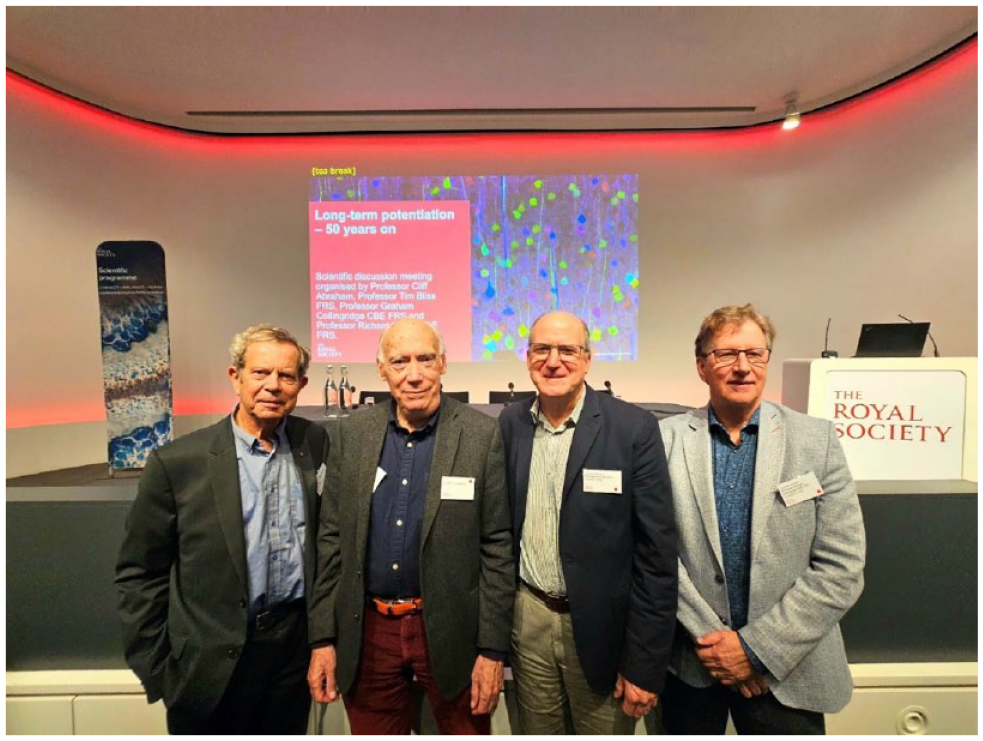
Organisers of LTP50 (from left): Professor Richard GM Morris, Professor Timothy VP Bliss, Professor Wickliffe C Abraham, and Professor Graham L Collingridge.
LTP: a key to neural learning
LTP, a process where repeated activation strengthens synaptic connections, was first detailed by Tim Bliss and Terje Lømo in 1973 (Bliss and Lomo, 1973). This phenomenon has since become a crucial concept in neuroscience, offering insights into how memories form and how learning occurs at the neuronal level.
The 2-day event at the Royal Society brought together eminent scholars and researchers to explore the molecular mechanisms of LTP, its implications for learning and memory, and its role in various neurological disorders such as Alzheimer’s disease, depression, and chronic pain. The meeting highlighted both historical perspectives and current trends in the study of synaptic functions.
Debates and collaborations: forging a path forward
The study of LTP has not been without its debates, particularly regarding the precise locations and mechanisms of synaptic strengthening. The contention whether changes occur on the sending or receiving side of a synapse, or both, has fuelled extensive research and collaboration. The diverse viewpoints have enriched the field, pushing the boundaries of our understanding further.
In 2016, the Brain Prize was awarded to Professor Timothy Bliss, Professor Graham Collingridge, and Professor Richard Morris for ‘their ground-breaking research on the cellular and molecular basis of LTP and the demonstration that this form of synaptic plasticity underpins spatial memory and learning’.
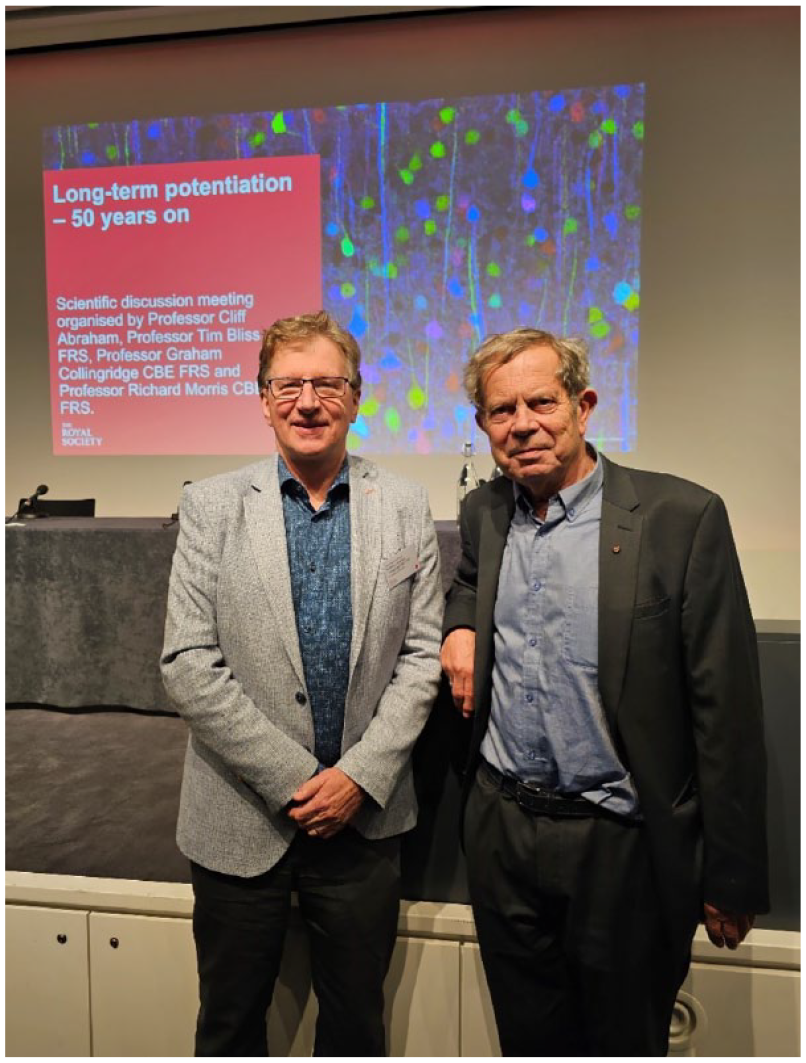
Former BNA presidents (from left): Professor Graham L Collingridge and Professor Richard GM Morris.
How did you get involved in LTP research?
Professor Collingridge: I was inspired by the original publication in 1973, where Tim Bliss and Terje Lømo (1973) had described the discovery and properties of LTP. Their work opened the door for researchers to understand the synaptic basis for learning and memory at the molecular level; a field of research that is intensely investigated to this day. My involvement in the field started when I was a postdoc in the laboratory of Hugh McLennan, at the University of British Columbia in Vancouver, Canada. The lab had just started to study LTP in hippocampal slices, and from the first moment, I witnessed LTP I was hooked. I knew that LTP was what I wanted to study for the duration of my postdoc (Bliss and Collingridge, 2019). Little did I know then that. I would still be fascinated by LTP today, which my lab in Toronto studies to this day.
Professor Morris: Much of my work has been on spatial memory and more recently, episodic-like memory. I became intrigued by the possibility that an LTP-like process could mediating memory encoding in the hippocampus for both of these. My work on spatial memory began after meeting Lynn Nadel and John O’Keefe back in 1973 and learning about place cells. This led to the creation of the water maze to study spatial learning (Morris, 1981). Later, in the 1980s, I was invited to a very important historical meeting about LTP held by the Max-Planck Society in castle at Bavaria (Morris, 2013), affectionately called the ‘Schloss Hippocampus’ meeting. During the meeting, I met several people who really inspired me, including a researcher called Gary Lynch, a pivotal figure in the early days of LTP. Gary had been publishing his interesting work on the idea that glutamate receptors get inserted into the postsynaptic membrane, and this is the mechanism by which the synapses got stronger (Lynch and Baudry, 1984). I started doing some experiments with Gary on the impact of a serine protease inhibitor called leupeptin and went back to Edinburgh to run a water maze experiment with leupeptin (later published with Gary and some colleagues from Irvine) (Morris et al., 1986). However, following Graham Collingridge et al.’s (1983) study published in 1983, I also did an in vivo LTP study using the drug 2-amino-5-phosphonopentanoic acid (APV) study and showed that APV blocked both LTP in vivo and learning in the water maze (Morris et al., 1986). This finding changed the focus of my research.
What has been the most rewarding and challenging aspect of LTP research you have had to address throughout the years?
Professor Morris: I tried to perfect our observation that infusing APV into the lateral ventricles completely blocked LTP. In control animals, we saw LTP, but then, in the animals treated with APV, LTP was blocked. We thought in the lab – ‘this really works’. I thought, right, this is it. Go for it! And we did with variations in the infusion protocol, the behavioural paradigm, and in lots of other ways. The event arena was introduced to get a handle on episodic-like memory (Bast et al., 2005; Day et al., 2003; Takeuchi et al., 2016; Tse et al., 2007, 2023).
Professor Collingridge: The most rewarding aspect of LTP research was the experiments I performed in Hugh McLennan’s laboratory. Hugh gave me free rein to work on any aspects of glutamate receptor research, so it was natural for me to investigate their roles in LTP. I had trained under the influence of Jeff Watkins FRS and his colleagues in Bristol (Dick Evans) and London (John Davies). Jeff had discovered the N-methyl-D-aspartate (NMDA) receptor, and both Jeff and Hugh had developed selective NMDA receptor antagonists (Bliss and Collingridge, 2019). Given the tools available, it seemed natural to ask whether the NMDA receptor had any role to play in LTP. I still recall the time when I observed the blockade of the induction of LTP by these NMDA receptor antagonists.
The most challenging aspect of my career has been to obtain sufficient research funding to conduct the LTP research that I feel is important. I am convinced that a detailed understanding of the molecular basis of synaptic plasticity is essential if we wish to provide better treatments for neurodevelopmental, psychiatric, and neurodegenerative disorders.
How does our understanding of LTP contribute to insights into neurological disorders like Alzheimer’s disease or autism?
Professor Collingridge: Enormously, it is probably the biggest development in the last 10–15 years. LTP-like mechanisms are probably impaired in a whole range of neurodevelopmental, psychiatric, and neurodegenerative disorders. Researchers like Michael Rowan are pioneering our understanding of how oligomeric species of amyloid beta are toxic to synapses by impacting LTP. His early work with Roger Anwyl in Trinity College, Dublin, has been transformative (Rowan et al., 2003). Building upon these pioneering discoveries, studies of LTP (and its cousin LTD) will, I think, increasingly drive our understanding of what goes wrong in dementia and many other brain disorders.
Professor Morris: Disorders of LTP are certainly a contribution, but I am a bit more cautious than Graham in what can be claimed to date. Alzheimer’s is a complex condition, and I am sceptical that an impact of the disease on synaptic plasticity is the ‘be-all-and-end-all’ of what is going on. There is certainly a great deal of interest in the impact of the disease on synapses in other ways, with work in Tara Spires-Jones’ (current BNA president) lab in Edinburgh being at the forefront.
What historic advancements in technology like optogenetics have influenced LTP research?
Professor Collingridge: Optogenetics has driven our understanding of engrams. This is relevant to the question since most investigators consider that LTP underlies engram formation. Optogenetics has also been impactful in relating LTP to behaviour in specific networks. There have been some impactful studies on plasticity trying to relate the role of LTP and Long Term Depression (LTD) with specific learning and memory paradigms, as exemplified by recent work from Richard’s lab (Martin et al., 2000; Redondo and Morris, 2011; Takeuchi et al., 2016; Tse et al., 2023; Wang et al., 2010).
Professor Morris: To combine ‘gain of function’ optogenetic experiments with behavioural studies (primarily in the amygdala) has contributed a lot to investigations of memory, but there is a way to go in developing novel methods of tagging cells and of light-activation of specific potentiated synapses rather than whole cells.
What are the future technological innovations required to progress LTP research?
Professor Collingridge: We still need higher-resolution imaging. There have been major advances, of course: two-photon microscopy and super-resolution microscopy. But there is scope for higher resolution, faster imaging, and hence the need for new genetic and chemical reporters. Something that is likely to make a big splash on LTP research is the development of fast voltage sensors. LTP was discovered by voltage recordings in localised brain regions. With voltage sensors, the spatial-temporal nature of LTP, both within neurons and across neuronal networks, can soon be studied at an unprecedented level of resolution.
The most impactful advances in LTP are going to translate our knowledge of LTP in rodents into treatments for depression, dementia, and other conditions. This work is starting, but I think there is a lot of scope, and I think we will be seeing a lot more therapeutic intervention through the understanding of LTP.
Professor Morris: I agree that imaging will be key to the future.
What is the future of LTP research?
Professor Collingridge: Now, people are very interested in engrams. The work from Professor Bong-Kiun Kaang provides very direct evidence that LTP-like mechanisms are important for the formation of engrams (Choi and Kaang, 2022). Overall, we have come a long way towards satisfying Hebb’s prediction of how memories were formed.
As former BNA presidents, what advice would you offer to young scientists entering the field of LTP research or learning and memory?
Professor Morris: Combine focused mastery of one technology with wider conceptual interests, because then you’re learning from others about what might be interesting scientific problems, but you also have got something specific by way of a skill that you can offer.
Professor Collingridge: Follow your interests. And, as Richard says, master one technique but have a good understanding of the various approaches used today. Neuroscience is very much a multidisciplinary field; therefore, it is important to have a good general knowledge of all the principles of biology, from molecular biology, electrophysiology, pharmacology, imaging, and behaviour. It is going to be very important to have some expertise in all those areas – gone are the days when you could be really good at one technique, and not know too much about anything else. I think integrative approaches are going to be so important.

LTP50 speakers at the Royal Society of London.
Future directions in LTP research
The conference also served as a forum for discussing future research directions. The application of new technologies, such as optogenetics and advanced imaging techniques, has provided researchers with tools to manipulate and observe synaptic activity in unprecedented detail, paving the way for novel therapeutic strategies.
The collective sentiment of the meeting emphasised the evolving nature of LTP research, which continues to be a fertile ground for interdisciplinary collaboration and innovation. As the field looks ahead, there is a strong focus on harnessing these insights to develop new interventions for neurological conditions.
Conclusion
The LTP50 conference not only celebrated the significant milestones of the past half-century but also set the stage for the next decades of research in synaptic plasticity. It underscored the enduring relevance of LTP in neuroscience and its potential to contribute to our understanding of the human brain and its disorders. As research continues to advance, the insights gained from LTP studies are expected to play a crucial role in shaping the future of neurological research and therapy.
The issue is now published at Philosophical Transactions of the Royal Society B:
https://royalsocietypublishing.org/toc/rstb/2024/379/1906.
Professor Graham Collingridge’s biography:
https://physiology.utoronto.ca/faculty/graham-collingridge.
Professor Richard Morris’s biography:
Footnotes
Author contributions
R.M.-H. contributed to investigation; writing – original draft; and writing – review and editing. D.T. contributed to conceptualisation; investigation; project administration; resources; supervision; validation; visualisation; writing – original draft; and writing – review and editing.
Declaration of conflicting interests
The author(s) declared no potential conflicts of interest with respect to the research, authorship, and/or publication of this article.
Funding
The author(s) received no financial support for the research, authorship, and/or publication of this article.
