The current work examines theoretically the heat transfer behaviour on the ethylene glycol (EG)-based nanofluid containing titanium oxide () nanoparticle flowing through a channel of parallel squeezing plates. Due to its vast applications, such as bearing and lubrication systems in addition to cooling thermal systems, the flow of nanofluid via a channel comprising of a static lower porous plate through which injection/ suction occurs and a moving top plate is analysed in the study. The non-linear PDEs concerning the fundamentals of flow and energy arising in this problem are modified into a system of non-linear ODEs by implementing suitable similarity transformations. By employing the standard procedure of HPM, an approximated analytical solution is achieved for the problem considered and is then matched with the numerical solutions achieved by the classical FDM. The current investigation primarily highlights the exploration of the velocity profile, gradient of pressure, coefficient of skin friction, temporal field and Nusselt number for distinctive values of parameters that have physical significance in the study. It is apparent from the figures that an elevation in the Eckert number causes the temporal profile to retard. However, an elevation in the nanoparticle’s volume fraction elevates the temporal distribution curve as the plates approach towards one another in the case of injection. Moreover, an elevation in the nanoparticle’s volume fraction elevates the gradient of pressure in the direction. Furthermore, it is concluded that the results achieved by the two techniques are in harmony.
In the present-day scenario, the flow of fluid has become one of the most enchanting and challenging fields due to its vast scientific and technical applications. Numerous disciplines such as aeronautical, chemical, environmental and mechanical engineering are underpinned by the fundamentals of fluid mechanics. Thus, any advancement in the analysis of fluids will have a direct impact on these domains. Tracing back to ., the initial study on fluids was conducted by Archimedes1 while exploring buoyancy and fluid statics after which he proposed his very popular law ‘The Archimedes Principle’. Subsequently, all applied fields are braced by fluid mechanics. Due to this, fluid mechanics finds numerous applications in the real world, including engineering, industrial, medical, and scientific fields. Fluid mechanics is crucial in aerospace, civil and mechanical engineering for designing structures, vehicles, aircraft, hydraulics, pumps, and airfoils. Furthermore, this branch helps in analysing and managing water resources, wastewater treatment processes, and pollution dispersion.
The flow of fluids through a channel of two plates placed parallelly is one of the interesting areas to researchers due to its prominent applications that revolutionize the modern world. One of the major applications of this phenomenon is in the lubrication technology. In these systems, the fluid is made to flow betwixt two parallel surfaces in order to examine the properties of lubricants in bearing and other machinery which in turn helps in reducing friction and wear. Further, the flow of fluids between parallel plates finds its applications in designing heat exchangers where the fluid is responsible for transferring heat from one media to another. Yet another application of this phenomenon is in filtration and separation technologies where this kind of flow is used to enhance the efficiency of capturing specific particles from the fluid. Furthermore, this phenomenon finds several applications in microfluidics, coating and painting processes, viscometry, aerodynamics, and biological systems. These applications demonstrate the versatility and significance of analysing the flow behaviour of fluids between parallel plates in both theoretical and practical scenarios.
Squeezing flow occurs when a fluid is forced through a confined space or between two surfaces that are moving towards each other. This phenomenon is particularly important in various applications across multiple sectors, such as lubrication technologies, materials sciences, food processing industries and many more. The flow of fluid through a channel comprising of squeezing parallel plates is a critical area of study in fluid mechanics, with broad implications across various fields of engineering and science. Understanding this flow can lead to better designs and optimizations in systems involving viscous fluids. Qureshi et al.2 examined the thermal transmission on the Casson fluid flow confined betwixt parallel squeezing circular plates. Further, Jalili et al.3 conducted a thorough numerical analysis on the two-dimensional transient MHD squeezing Casson fluid flow under solar irradiance influence.
Porous plates are engineering structures characterized by their ability to allow fluid flow through their interconnected voids. This flow geometry finds immense industrial and engineering applications that include filtration, chemical processing and heat exchangers. The study of flow through porous media involves understanding how fluids interact with solid materials, which can significantly influence flow behaviour and pressure distribution. Porous plates play a vital role in numerous industrial and scientific applications. Understanding their flow dynamics is essential for optimizing processes involving filtration, heat exchange and other fluid-related tasks. By exploring the interactions between fluids and porous media, engineers can design more efficient systems and materials.
The field of study that integrates the principles of magnetism with fluid dynamics and thermodynamics is termed magnetohydrodynamics or simply MHD. Primarily, MHD focuses on examining the characteristics of fluids that possess an ability to conduct electricity such as plasmas, liquid metals, saltwater, and others that are influenced by an external magnetic field. In MHD, the key interactions take place between the magnetic fields and the motions of the electrically conductive fluids. The fluid flow can generate electric currents, which in turn influence the magnetic field, creating a complex interplay between these two phenomena. This principle is fundamental in various applications, including astrophysics like the behaviour of stars and galaxies, engineering processes like magnetic confinement fusion and geophysics for studying the Earth’s core and magnetosphere. One of the remarkable aspects of MHD is its ability to allow for the control of flow dynamics using magnetic fields, which can lead to improved efficiencies in energy systems and novel technologies in propulsion, cooling and materials processing. A theoretical investigation on the unsteady two-dimensional viscous fluid flow betwixt squeezing parallel plates influenced by a magnetic field that is applied externally was considered by Sweet et al.4 Further, Rahbari et al.5 analysed both analytically and numerically the transport of heat in the MHD UCM fluid flow through a parallel channel. Several authors have analysed the MHD effect on the flow of various fluids under different geometry in the past.6,7
The pressure gradient is a critical yet often overlooked aspect in many studies of fluid flow, primarily due to its mathematical and conceptual complexity. However, a clear understanding of the pressure gradient is essential for analysing fluid flow between parallel plates, where it acts as the principal force driving the motion of the fluid. In such flow configurations, the pressure difference along the length of the channel initiates and maintains the movement, shaping the velocity distribution across the gap between the plates. This, in turn, significantly affects key flow characteristics such as shear stress, volumetric flow rate, and the transition between laminar and turbulent regimes. Comprehensive analysis of the pressure gradient is crucial for accurately predicting fluid behaviour and is indispensable in the design and optimization of various engineering systems, including lubrication mechanisms, microfluidic devices, biomedical applications and heat exchangers. Without this understanding, the effective modelling and control of fluid flow in these systems remain incomplete.
Singh et al.8 theoretically examined the flow of an incompressible viscous fluid through a channel bounded by parallel plates, explicitly considering the role of the pressure gradient. This work was further extended by Hamza9 to investigate the effects of injection and suction applied at the lower plate on the flow behaviour. Furthermore, Sampath et al.10 analysed the influence of various physical parameters on the flow of Casson fluid, with particular attention to the pressure coefficient. Several other researchers have explored fluid flow characteristics while emphasizing the significance of the pressure gradient, highlighting its critical role in accurately understanding and predicting flow dynamics in the past.11–13
A fundamental thermodynamics concept that involves the motion of thermic energy is called Heat transfer. The three primary mechanisms through which heat transfer arises are conduction, convection and radiation. Understanding heat transfer and its mechanisms is crucial in science and engineering which leads to the advancement of efficient systems with numerous applications, from industrial processes to everyday household appliances, enhancing comfort, safety and energy efficiency. Mustafa et al.14 investigated thoroughly the transport behaviour of heat and mass in the viscous fluid flowing betwixt squeezing parallel plates theoretically. Further, Khan et al.15 deliberated the analysis on the heat transfer behaviour in the Casson fluid flow that is squeezed betwixt parallel plates. Furthermore, Sampath et al.16 examined theoretically the thermally radiative heat transfer behaviour on the MHD UCM fluid flow betwixt a moving top and stationary porous lower plate through which the fluid is sucked out or injected. Numerous researchers have analysed theoretically the transfer of heat in the recent past.17,18
The process through which the internal friction (viscosity) inherent in the fluid, transforms the fluid’s kinetic energy into thermal energy is referred to as viscous dissipation. This phenomenon occurs when a fluid flows, particularly under shear stress, leading to energy losses that manifest as heat. In a viscous fluid, the molecules interact with one another, and when they move past each other, energy is lost due to these interactions. Moreover, the rate of viscous dissipation is related directly to the fluid viscosity, the velocity gradient (how quickly the fluid velocity changes with position), and the shear stress. Viscous dissipation is significant in various engineering applications, including lubrication, heat exchangers and fluid dynamics simulations. It can impact the efficiency of machines and the performance of systems where fluid transport is involved. Singh and Gorla19 illuminated the results of Joule heating, transpiration, heat sources, viscous dissipation and thermal diffusion by conducting the boundary layer analysis. The fluid flow past a moving surface with an impact of the externally applied magnetic field, viscous dissipation and a constant source of heat was studied by Venkateswarlu et al.20 Also, Swain et al.21 investigated theoretically the gradient of heat transportation in the viscous dissipated MHD Newtonian fluid flow with Joule heating aloft a porous sheet that stretches in the flow direction. Several researchers in the past have theoretically investigated the impact of viscous dissipation on the heat transfer characteristics.22–24
In view of the present-day scenario, the industrial and technological sectors are in need of a class of fluids that have higher thermal, electrical and mechanical characteristics as compared to conventional heat transfer fluids. To fulfil such a demand S. U. S. Choi and Eastman25 proposed a novel kind of heat transfer fluid coined as ‘Nanofluid’. These are one of the dominant classes of fluids that are concocted by amalgamating nano-sized particles, known as nanoparticles in the conventional fluids that are adopted in heat transfer processes. Incorporating these particles in the traditional heat transfer fluid enhances the thermal, electrical, and mechanical characteristics of the base fluid. Nanofluids are very prominent by virtue of their vast application concerning the equipment of heat transfer such as electronic cooling systems, heat exchangers and radiators. Also, the insertion of these metallic particles into the conventional fluid can upgrade the heat transfer performance and strength of the fluid, having led to their superiority in numerous disciplines. Das et al.26 in their book “Nanofluids: Science and Technology” have detailed numerous views of nanofluids, together with their synthesis, heat transfer, theoretical modelling and applications. He et al.27 examined experimentally the repercussion of nanofluid suspended by on the base fluid’s rheological and thermal characteristics. It was noticed by the authors that the base fluid’s thermal conductivity enhanced with an elevation in the quantity of nanoparticles added, while the conduction retards as the particle size was elevated.
Sheikholeslami et al.28 theoretically analysed the behaviour of heat transfer on the nanofluid flow betwixt two horizontal plates placed in a rotating system under the impact of suction and injection. To analyse the effect of different nanoparticles, the authors considered water-based nanofluids suspended by copper, silver, alumina and titanium oxide and found that titanium oxide had the highest heat transfer efficiency. Santra et al.29 analysed the sequel of water-based nanofluid suspended by copper nanoparticles as a cooling medium by simulating the heat transfer behaviour that is caused by the natural laminar convection in a deferentially heated square cavity. Dogonchi et al.30 analysed the influence of thermal radiation on the characteristics of heat transfer in the unsteady MHD flow nanofluid between two infinitely long squeezing parallel plates. Several other authors have further analysed the enhancement of base fluid’s heat transfer by incorporating nanoparticles in the past.30–43
Once the considered physical problem is formulated successfully, it is necessary to solve the resulting mathematical equations arising with relevant boundary conditions. Due to the entangled non-linearity in the fundamental equations, the known analytical techniques fail to yield results to the elementary equations that govern the flow and heat, thus introducing computational techniques. Although numerical methods present an approximate solution to the governing equations, researchers encountered several challenges in solving these equations numerically. In order to encounter these difficulties, a novel class of techniques that were capable of yielding a better approximate solution with lesser time and storage efficiency was proposed by the researchers terming it as semi-numerical techniques. One such powerful, elegant, and advanced semi-analytical technique that is capable of solving non-linear boundary value problems efficiently and conveniently is the Homotopy Perturbation Method (HPM). Initially put forward and developed by He44–46 in 1999, HPM is an amalgam of homotopy in topology with the classical perturbation methodology. Further, the author illustrated the efficiency and practicality of the method using examples. Furthermore, Babolian et al.47 proposed a global homotopy equation to solve non-linear differential equations using HPM.
Nanofluids have garnered considerable attention in recent years due to their superior thermal performance in various heat transfer applications. Among them, water-based nanofluids have been extensively studied, both theoretically and experimentally. However, despite the promising thermophysical properties and practical utility of EG as a base fluid, especially in industrial cooling and thermal systems, EG-based nanofluids remain insufficiently explored. Moreover, a majority of prior studies have primarily emphasized momentum and energy transport, while critical aspects such as pressure gradient behaviour, the role of viscous dissipation, and the influence of external magnetic fields have been largely overlooked. These limitations hinder a comprehensive understanding of flow and heat transfer characteristics in more complex and realistic scenarios. Motivated by these gaps, the present study aims to theoretically analyse the enhancement of thermal transport in EG-based nanofluids containing nanoparticles, with a particular focus on the pressure gradient and the interplay of magnetic fields and viscous dissipation. This study considers the flow of the nanofluid confined between two squeezing plates, where the top plate moves towards or away from a fixed bottom plate, accompanied by suction or injection at the lower plate. With the intention to achieve an approximate solution, the obtained mathematical equations are approached by HPM. Moreover, the solution achieved using HPM is further compared with the numerical solution attained by adopting classical FDM. It is noticed in the study that the solutions achieved by two independent techniques are in good harmony with one another.
Mathematical formulation
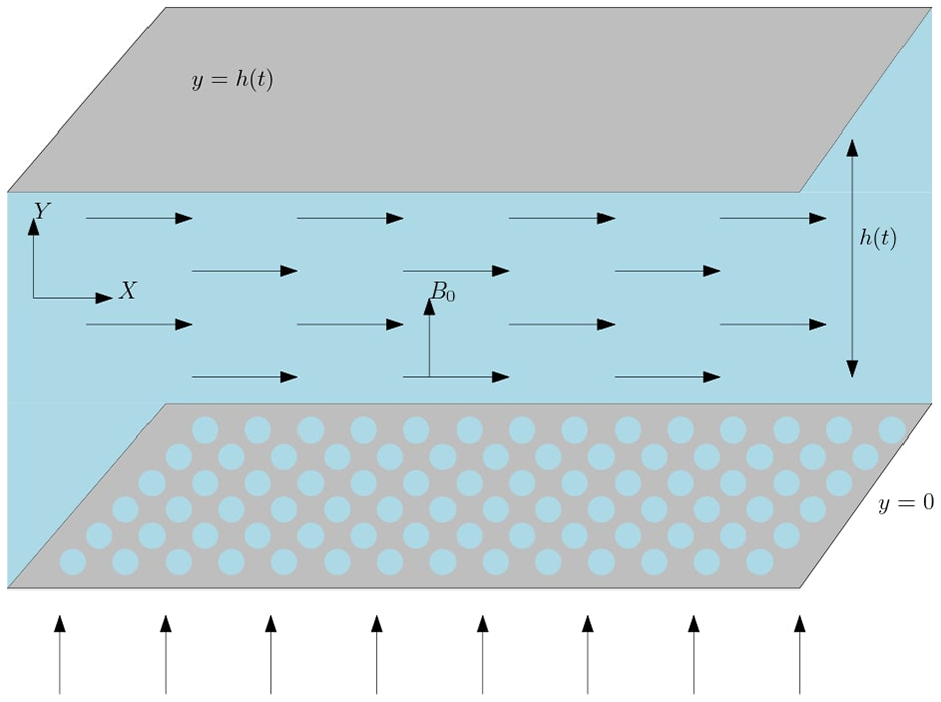
An unsteady two-dimensional analysis on the heat transfer properties in an incompressible MHD nanofluid flow comprising of nanoparticle in EG between a stagnant lower porous plate and a squeezing upper plate is considered in this study. It is considered that the top plate approaches and dilates from the stationary lower porous plate as demonstrated in Figure 1.
Schematic flow diagram.
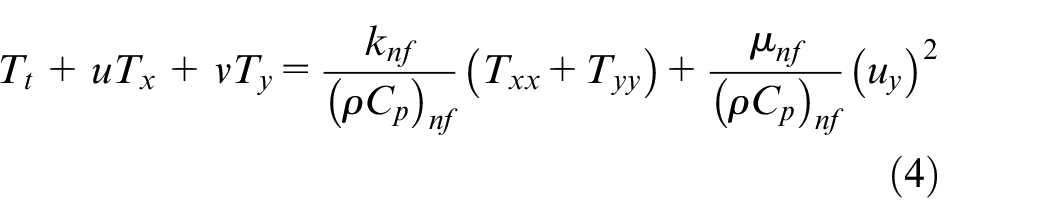
The unsteady two-dimensional fundamental equation governing the momentum and energy in the flow of an incompressible EG-based nanofluid are given by8,30,48
The corresponding boundary conditions to the considered problem are:
where and respectively signifies suction and injection.
The adopted similarity transformation to reduce non-linear PDEs into non-linear ODEs are given as follow8
Satisfying the continuity equation, the following form is taken by the governing flow equations:
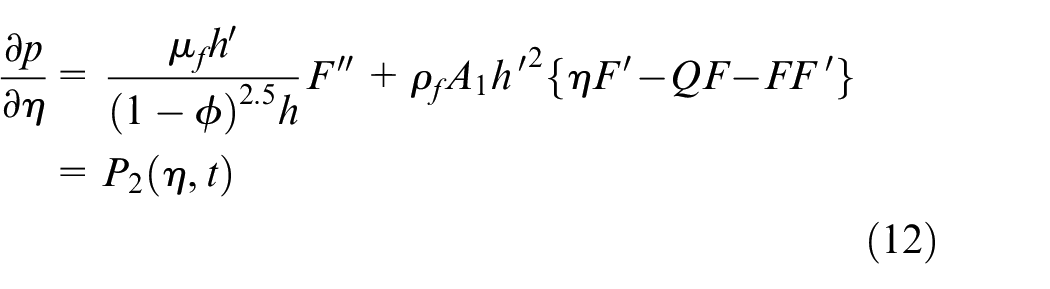
From the equation (12) the pressure gradient is described by,
It is implied from equation (13) that the pressure is independent of and is a function of alone. Thus,
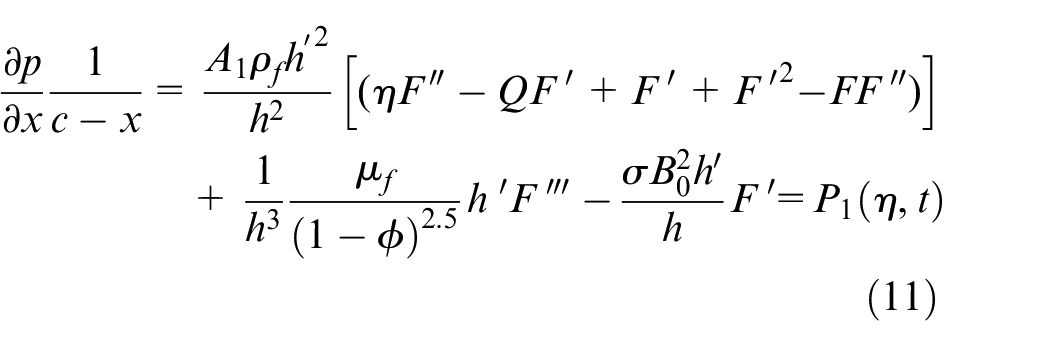
Differentiating (11) with respect to yields
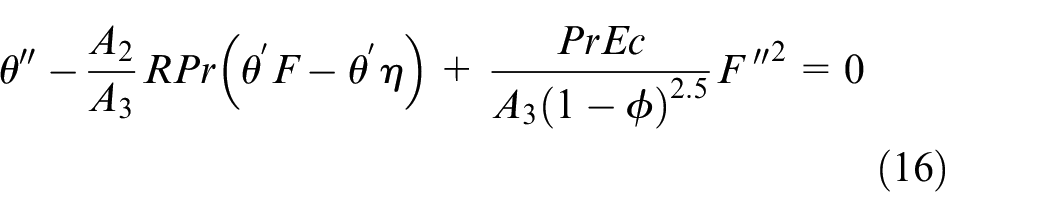
Substituting (7–10) in (4), the energy equation transforms into,
The similarity solution exists only if and are constants. Since , integrating gives,
where and indicate the top plate dilating and approaching the lower plate respectively causing the squeezing flow to exist with such a velocity profile until . From (17), it can be concluded that and hence (15) becomes
The corresponding boundary conditions concerning equations (16) and (18) after employing similarity transformations reduce to,
The skin friction
In this study, the expression for skin friction coefficient is defined as28:
The analytical solution is cumbersome for the considered problem, due to the inheritance of non-linearity. Hence, the approximate solution is achieved by employing suitable computational techniques. The current research study aims to obtain the approximate solution by employing a semi-analytical method, HPM. On the basis of the solution obtained adopting HPM, the velocity fields and temporal distribution profiles are graphically presented in this study. Further, the numerical values corresponding to the coefficients of skin friction, pressure gradient and Nusselt number obtained by HPM is then compared with that of the values obtained employing a well-established numerical technique, FDM.
Homotopy perturbation method
The coupling of the topological concept homotopy with the classical perturbation procedure is the HPM. Further, HPM is an elegant and powerful technique that is capable of yielding an approximated analytical solution to a broad range of non-linear situations arising in various engineering and applied science fields. In the present study the obtained non-linear ODEs concerning the flow and energy are approached by HPM as follows:
Let ’s denote the differential operators acting on ’s that represent the unknown functions. Further, let represent the known function in the equation. The problem considered is therefore given by,
where .
Generally in HPM, s are indicated by,
where and respectively denotes the linear and remaining parts of .
The homotopy equation is built in the pattern described below by choosing the initial guess, , wisely from the boundary conditions,
The solution to equation (33) is assumed in the power series form as expressed below,
At , the solution of the given problem is the equation (34).
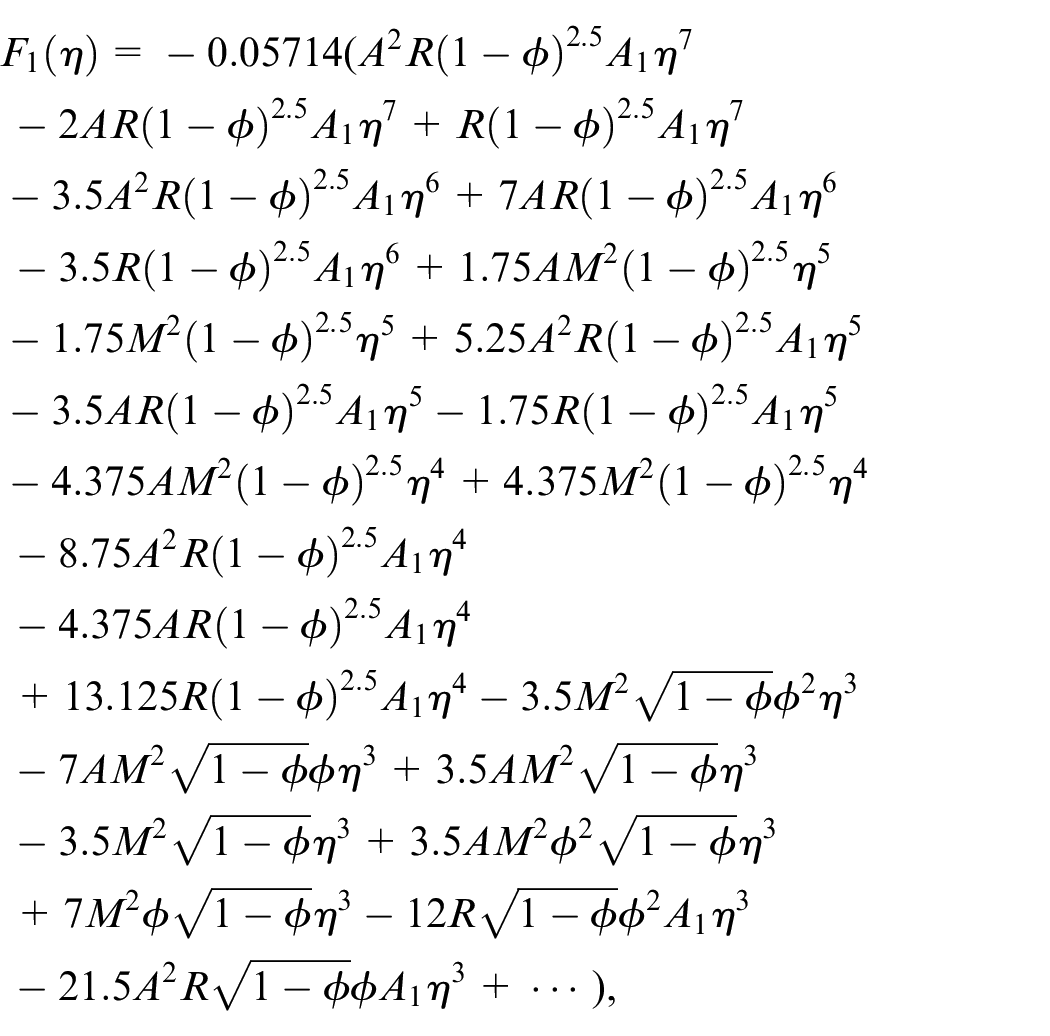
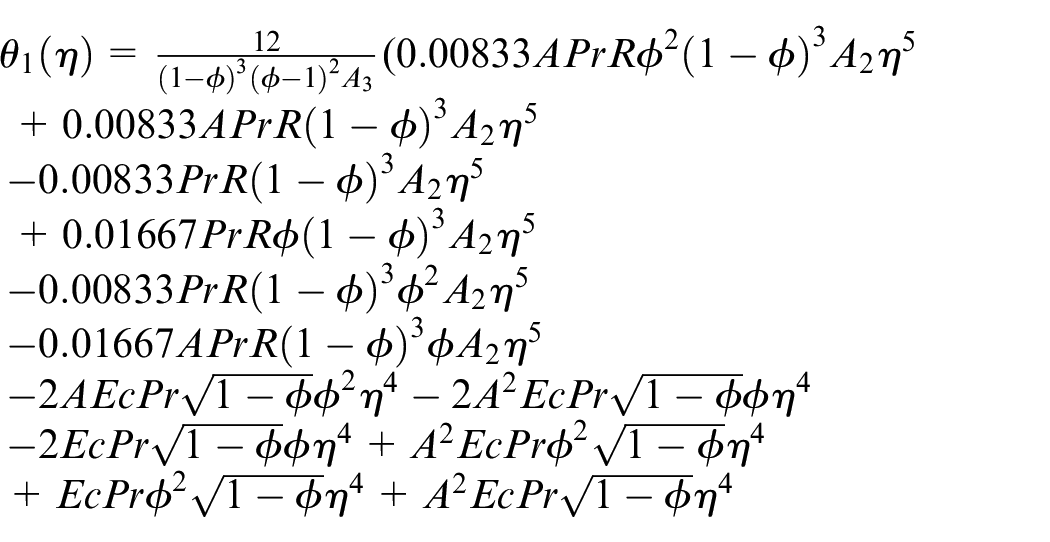
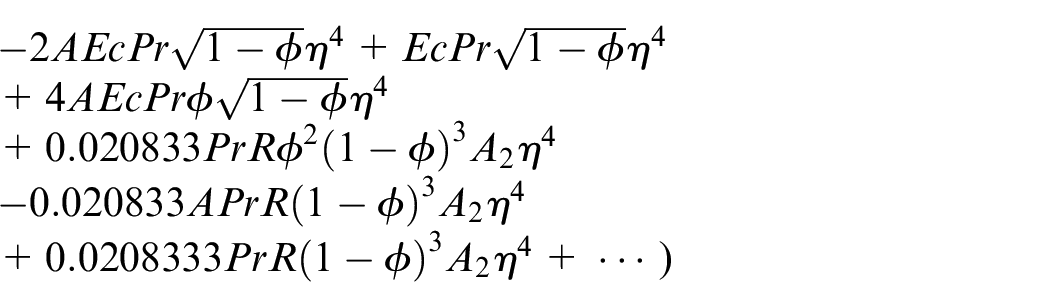
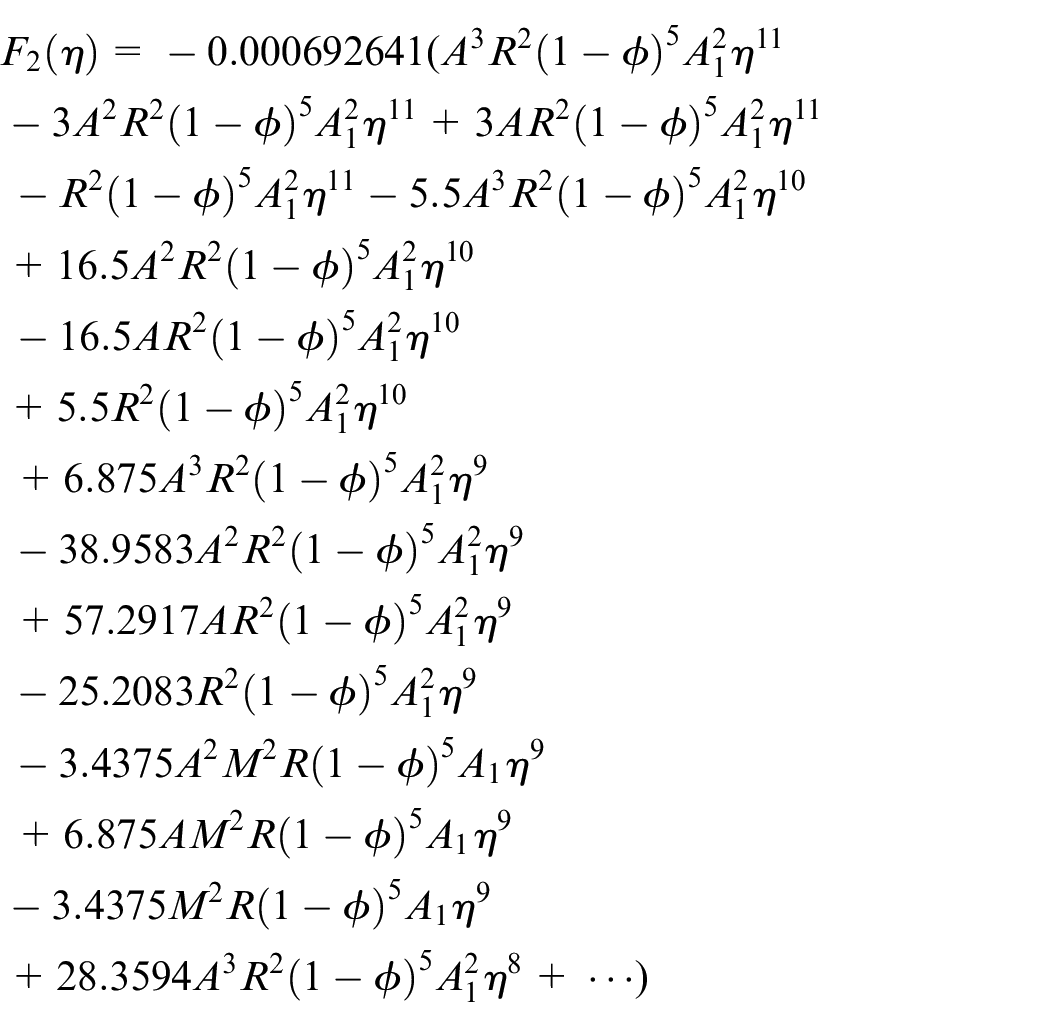
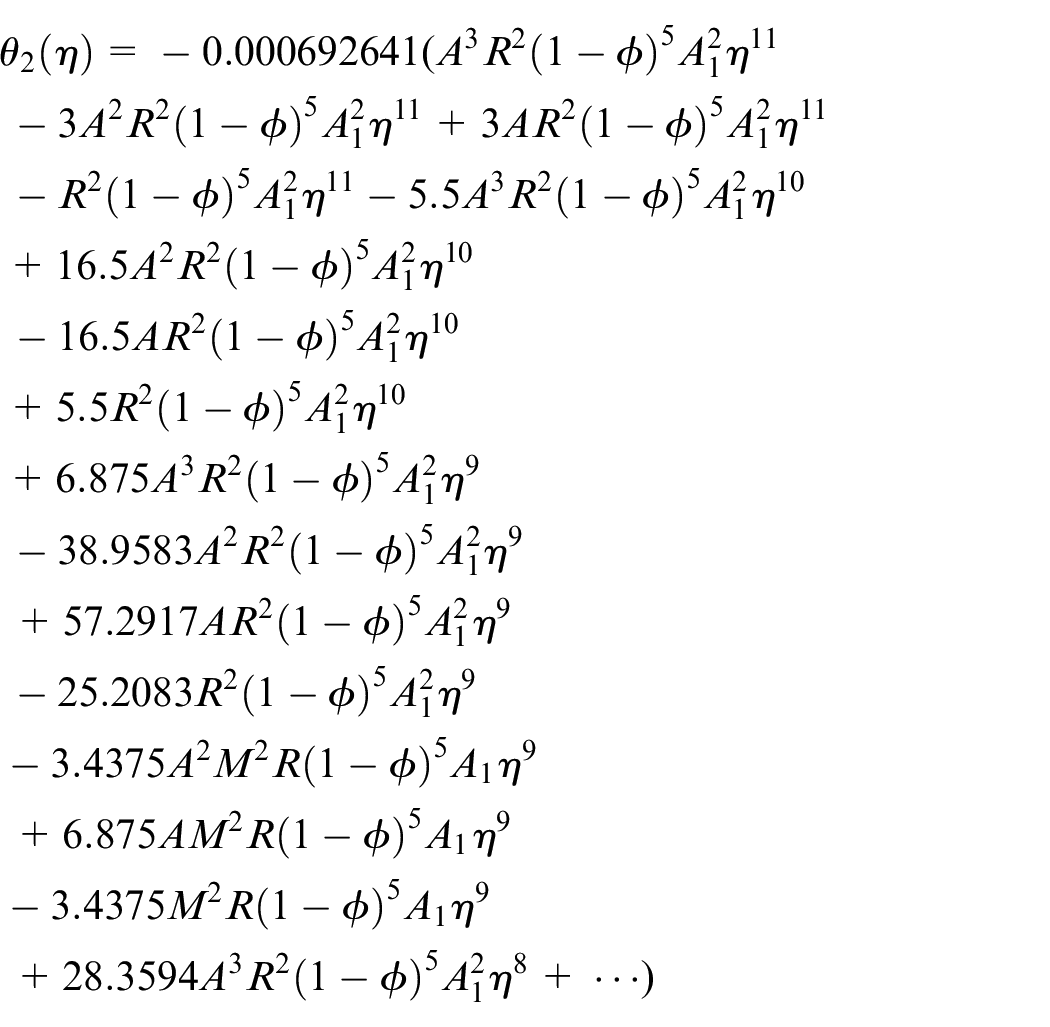
By adopting the standard HPM procedure prescribed above, the first three initial order solutions are obtained as follow:
Finite difference method
The finite difference method or simply FDM is one of the oldest and most renowned numerical technique that possesses a broad range of application in solving non-linear differential equations arising in various of applied science and engineering sectors. The technique primarily involves discretizing the flow derivatives by expressing in terms of Taylor’s series. The nonlinear ODEs obtained from the governing flow and heat equations are solved by employing FDM and compared with the results extracted from HPM. Thus, by employing both methods the skin friction coefficient, directional pressure gradient and Nusselt number are numerically estimated and tabulated.
Results and discussion
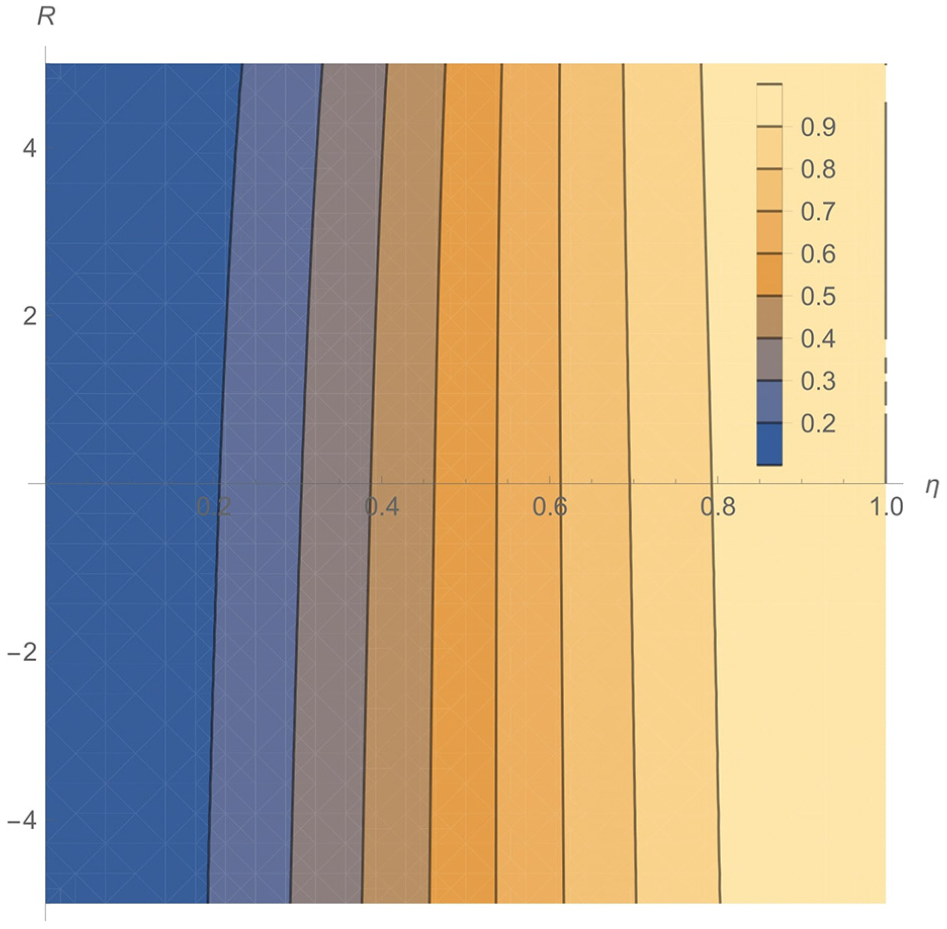
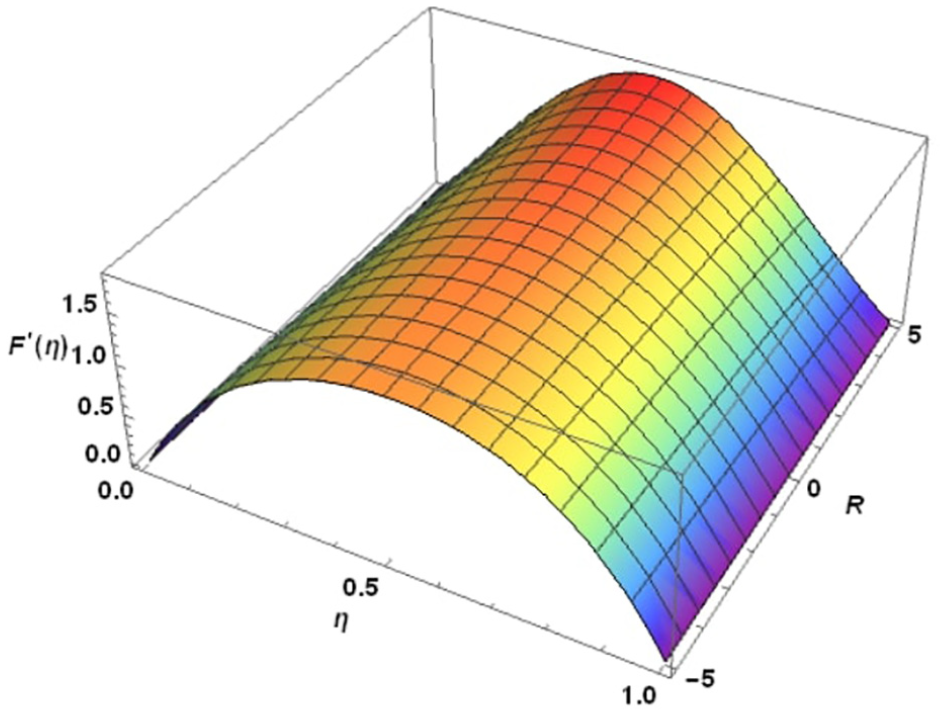
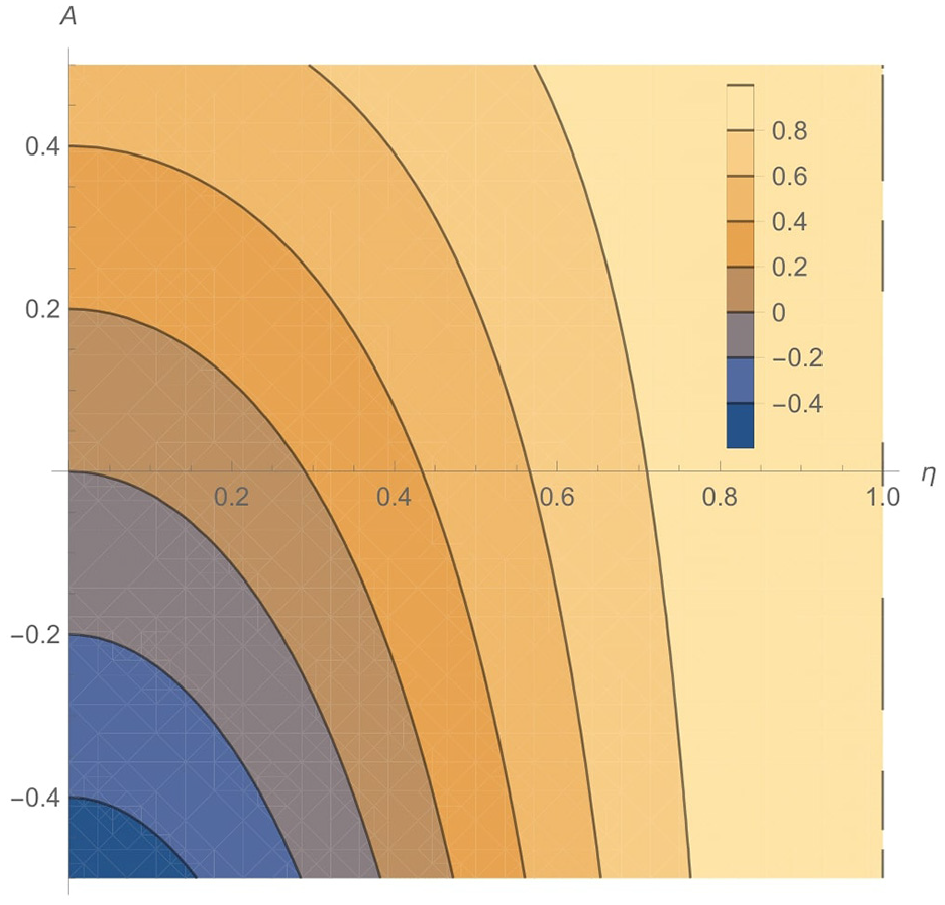
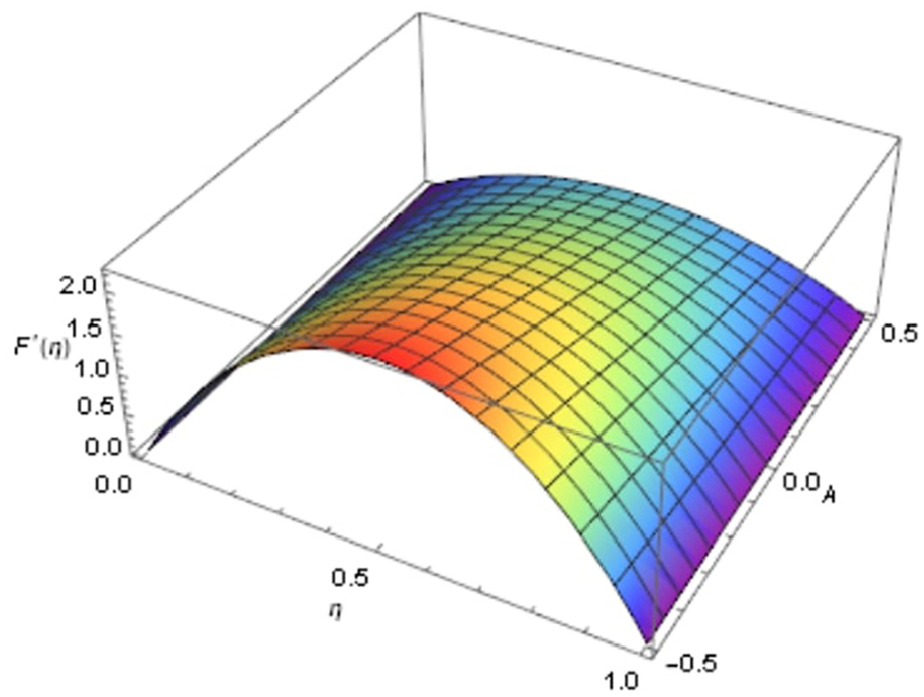
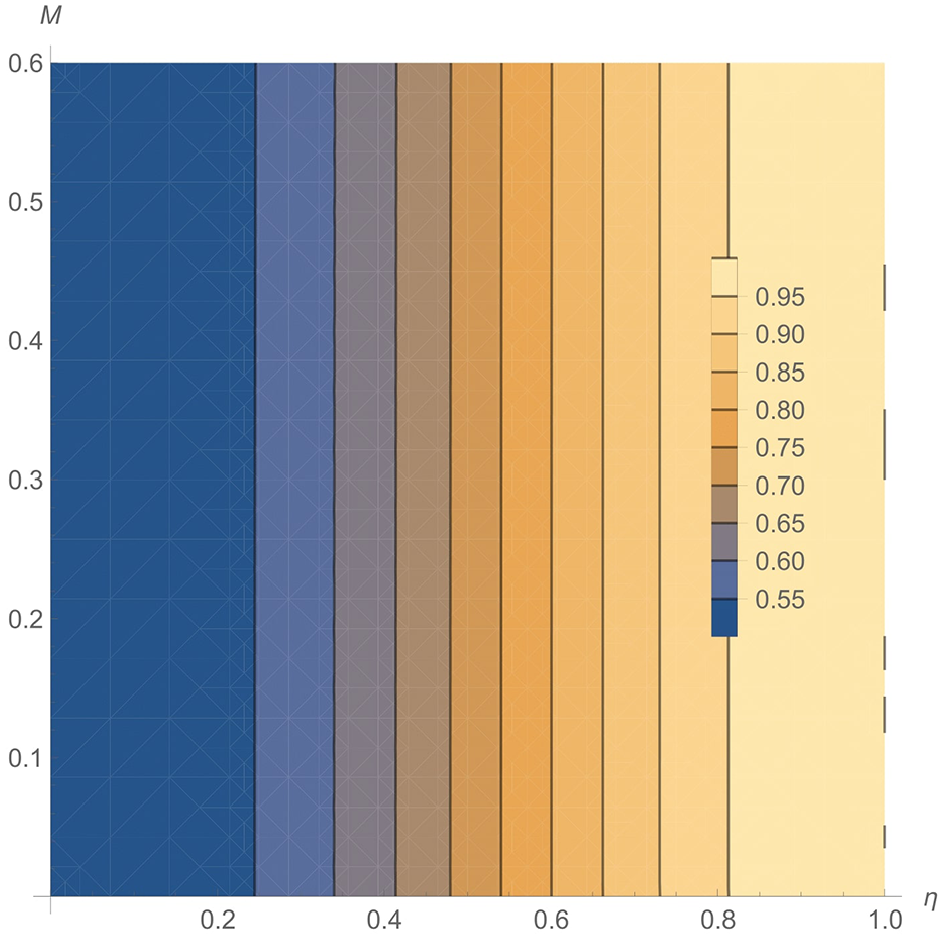
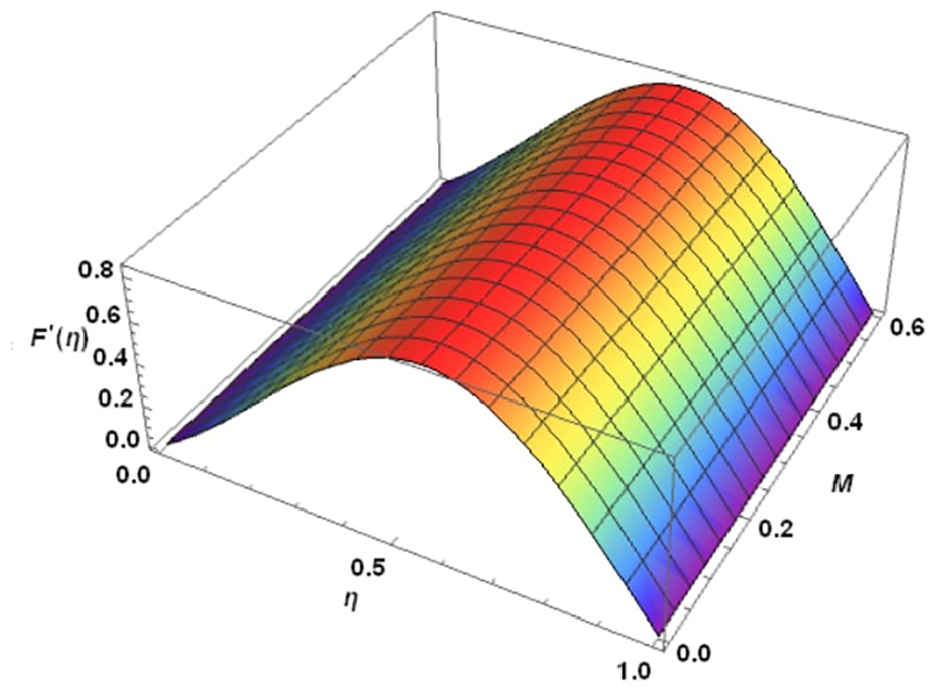
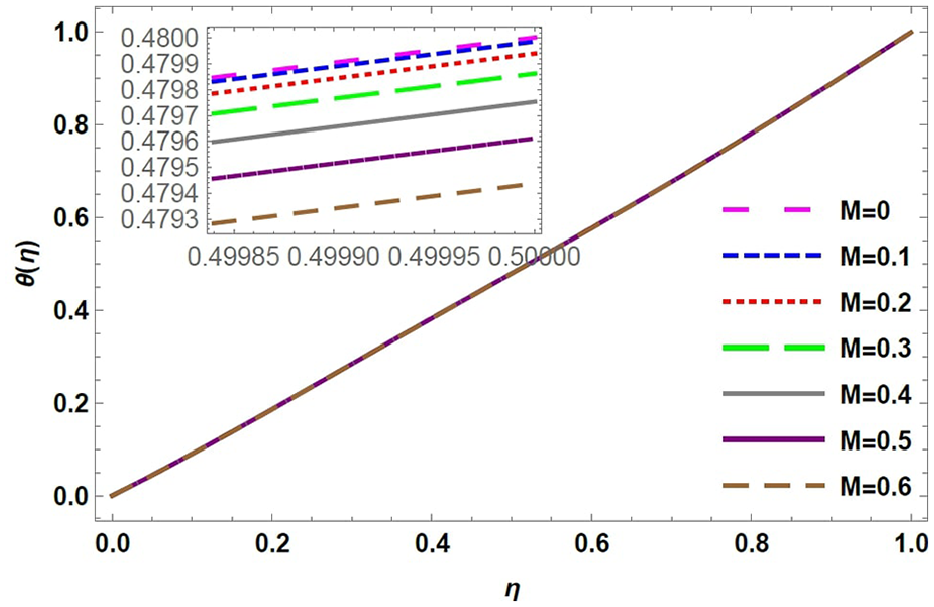
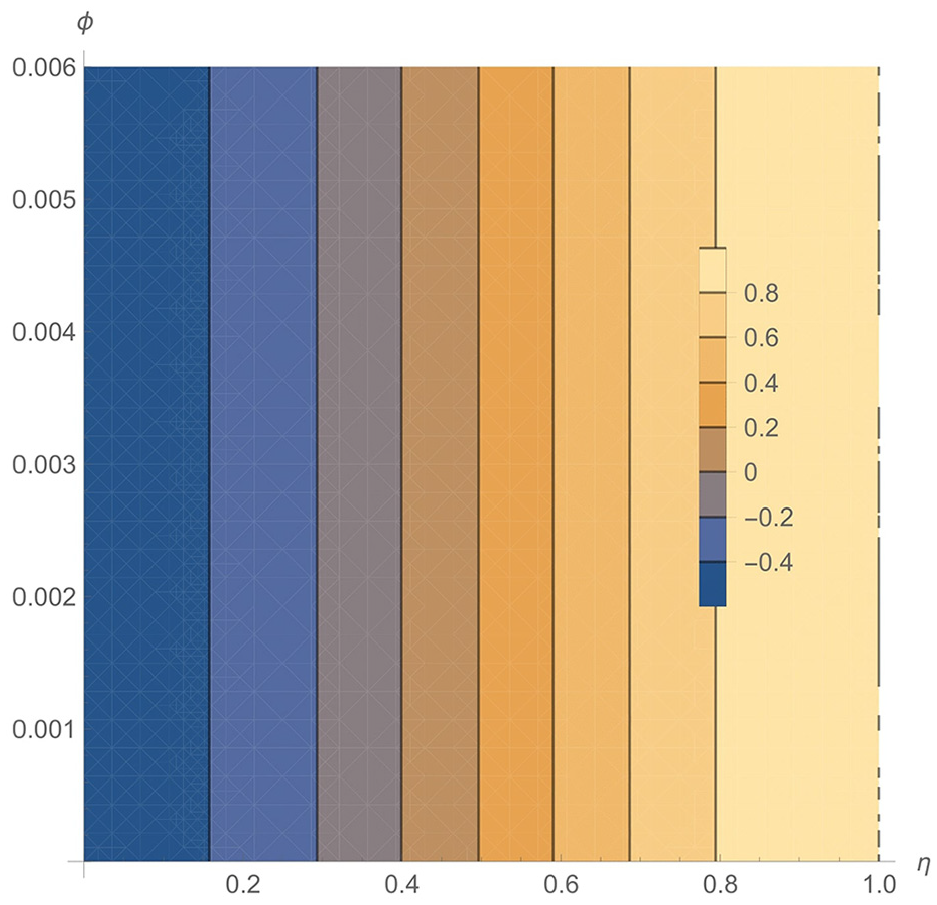
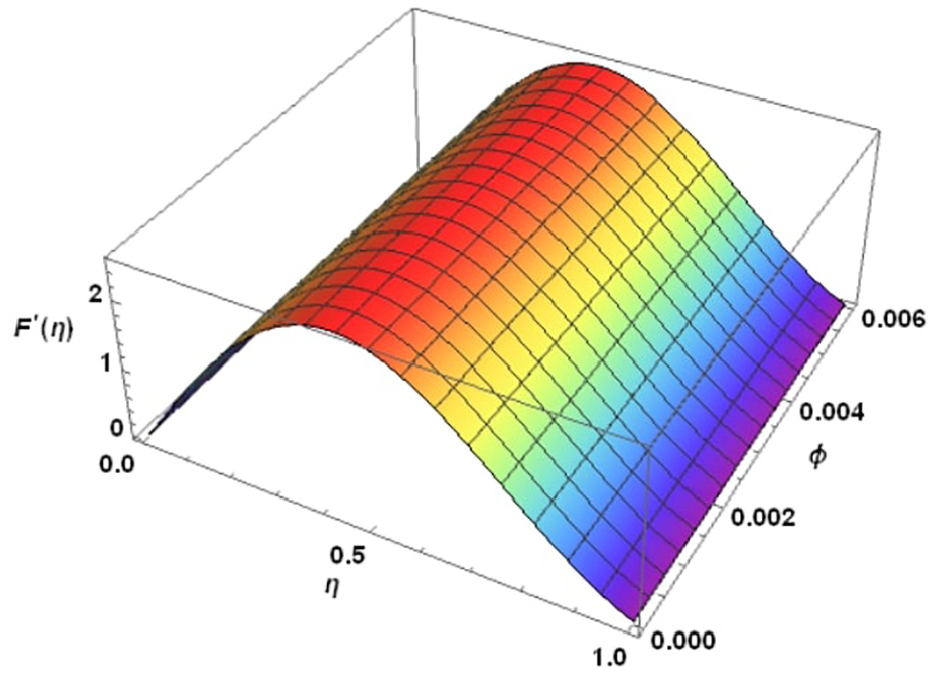
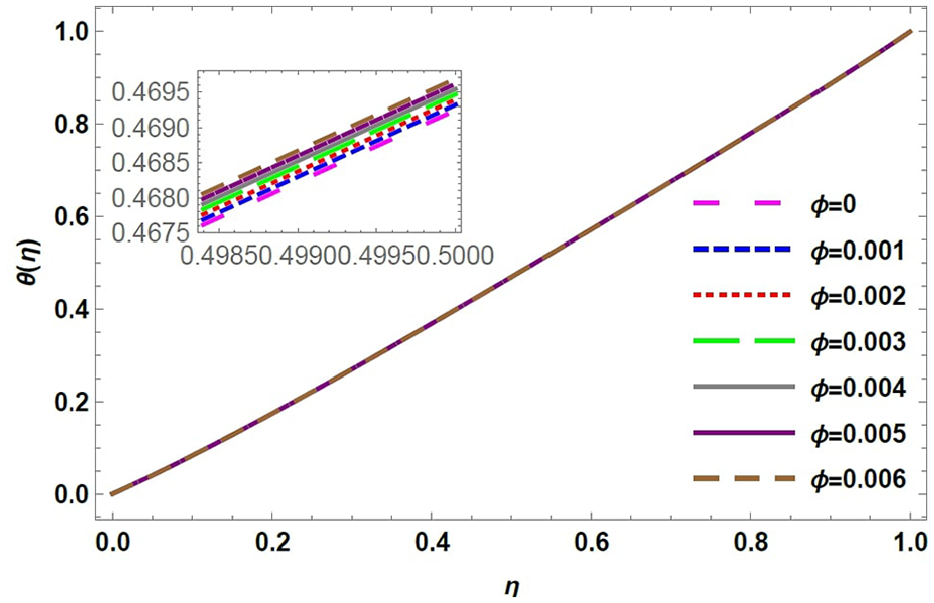
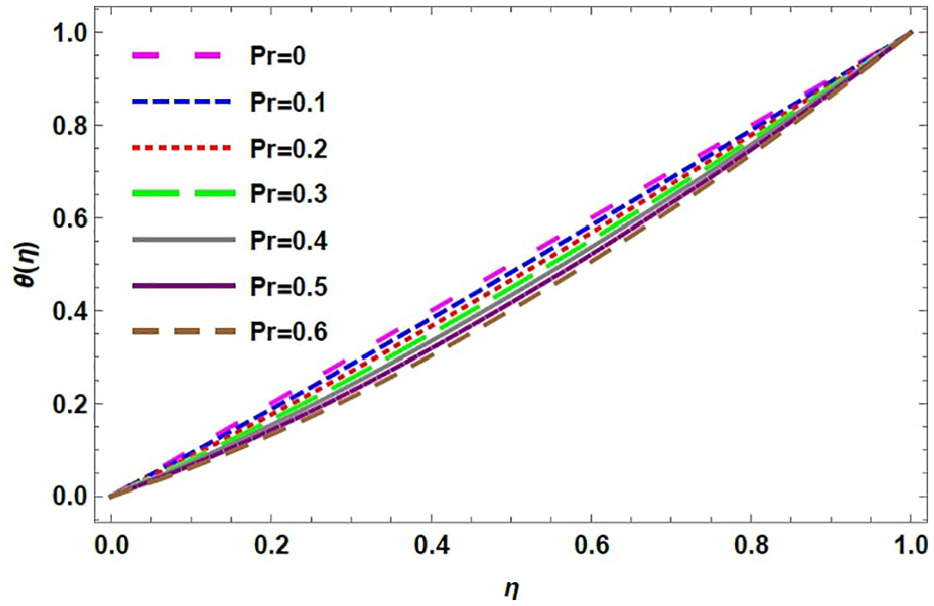
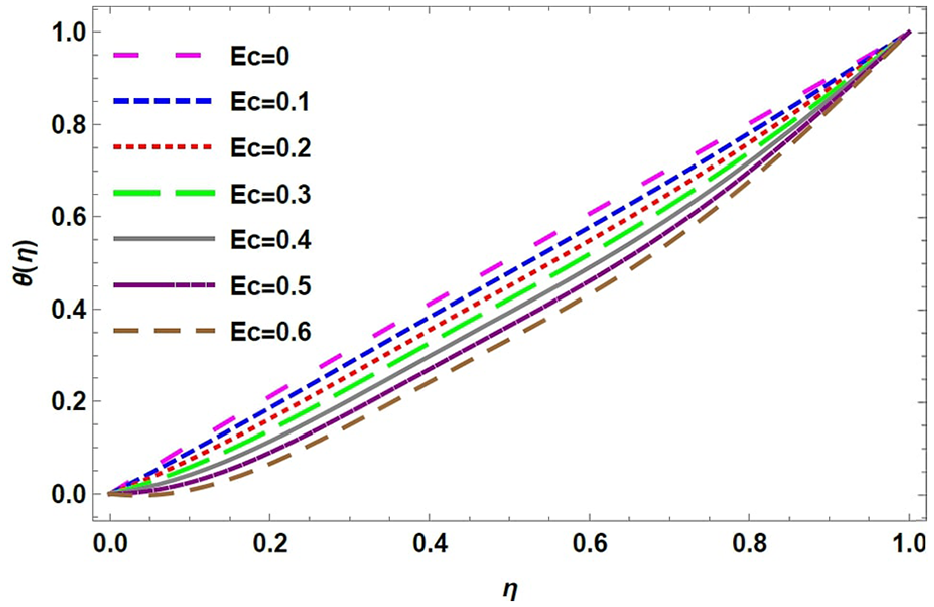
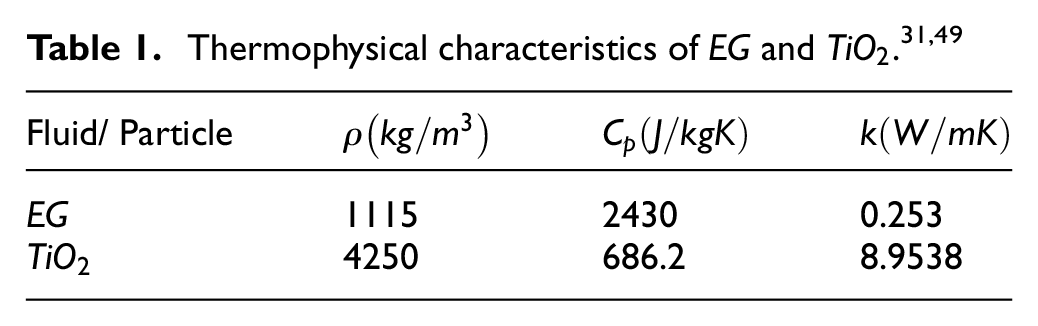
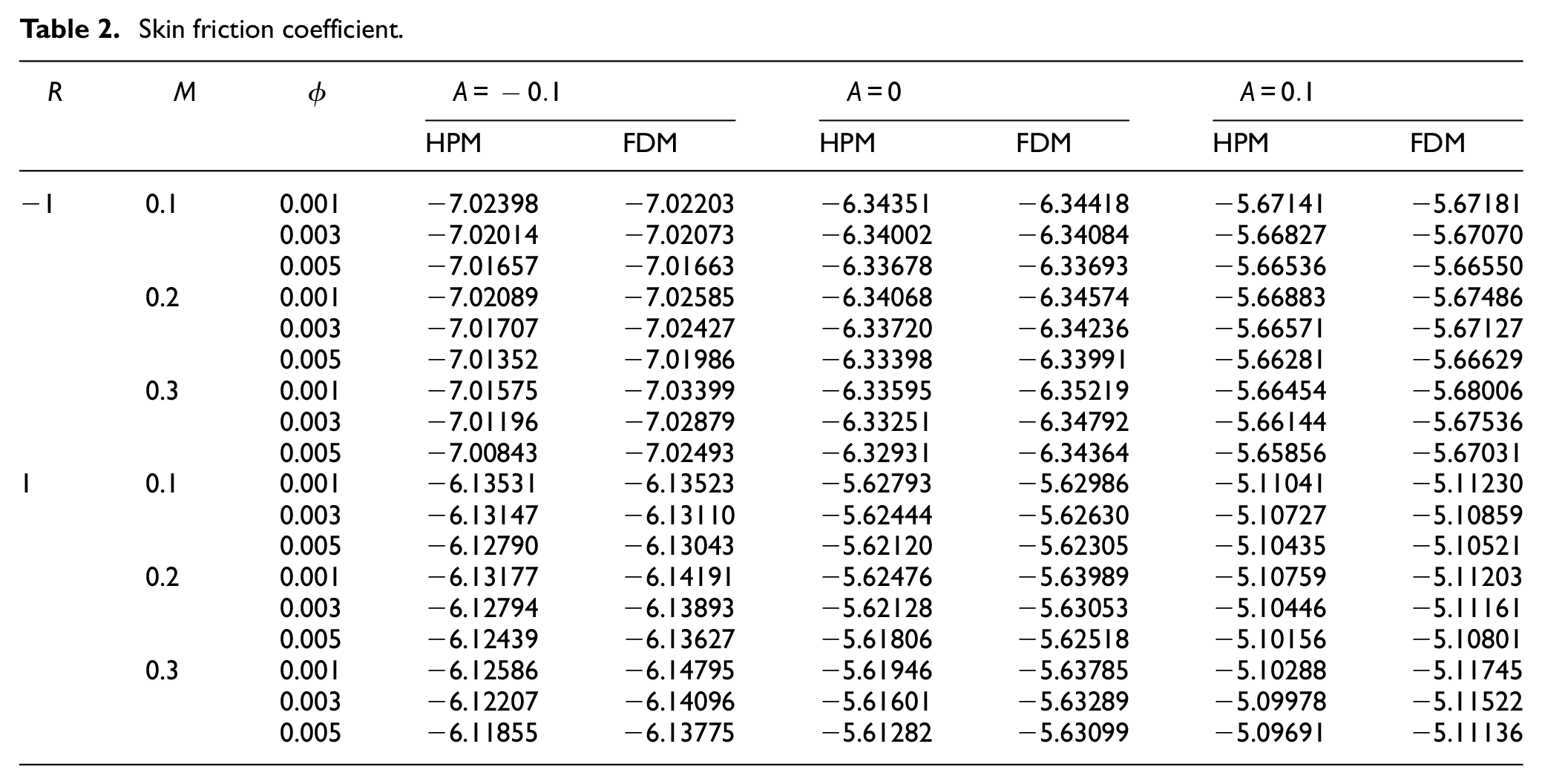
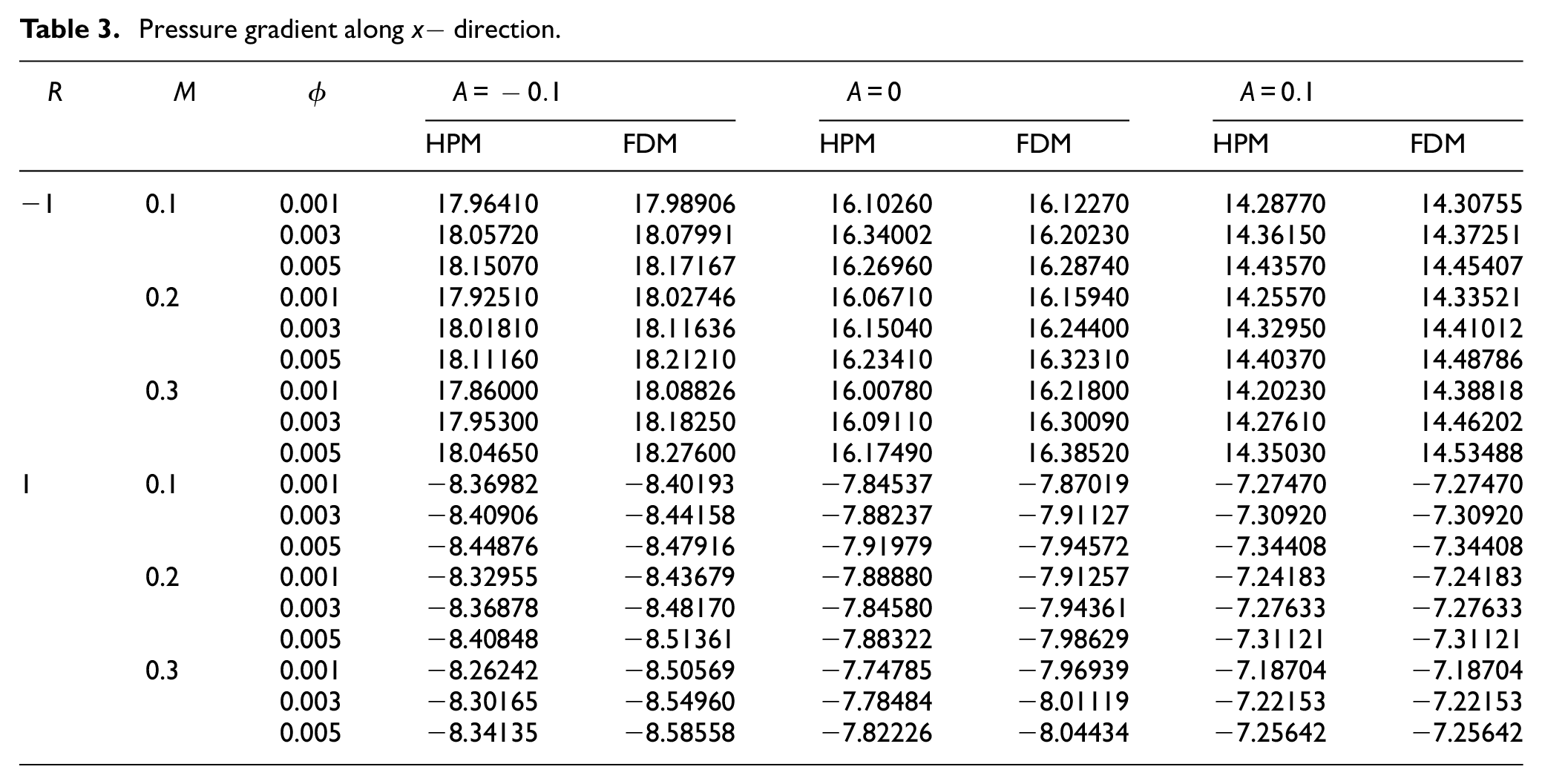
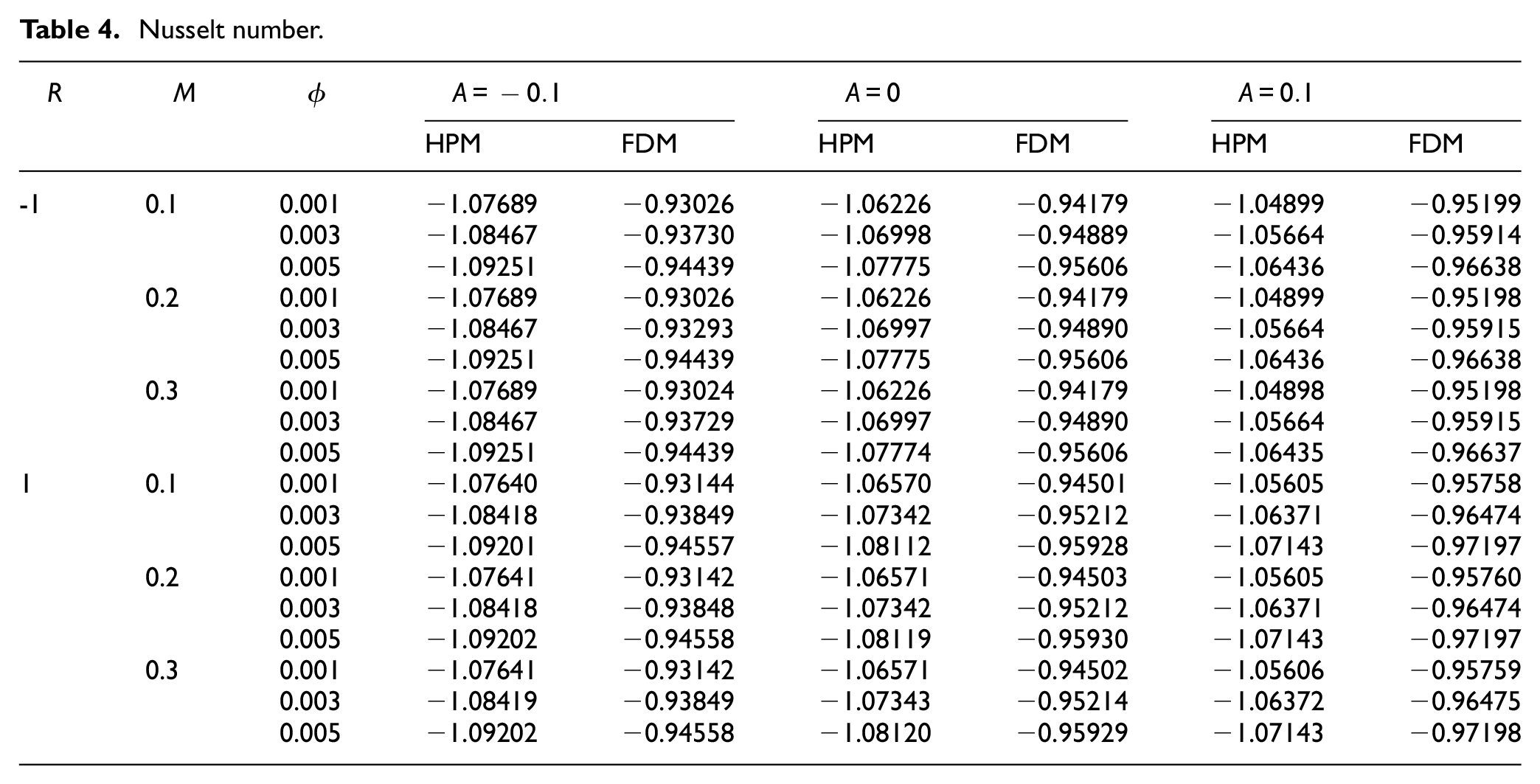
This section summarizes briefly the heat transfer study on the EG-based nanofluid containing nanoparticle flow betwixt parallel squeezing plates with the repercussions of externally applied magnetic field and viscous dissipation. Further, in this study the top plate is considered to be in motion, that is, approaching or dilating from the stationary lower porous plate through which the nanofluid being injected in or sucked out . The graphs and tables here represent how the relevant physical parameters influence the velocity distributions, temporal fields, skin friction coefficient, pressure gradient and Nusselt number. The repercussions of various physical parameters like , , , and on the velocity profiles and temporal distributions are graphically presented in Figures 2 to 15. Table 1 represents the thermophysical behaviour corresponding to the base fluid and nanoparticle. Furthermore, the numerical values concerning the skin friction coefficient and pressure gradient along direction for a varied range of the appropriate parameters are tabulated in Tables 2 and 3 respectively. Further, Table 4 present the numerical values corresponding to the Nusselt number for distinct parameters considered in the study.
Impact of on the axial velocity distribution field for .
Impact of on the radial velocity distribution field for .
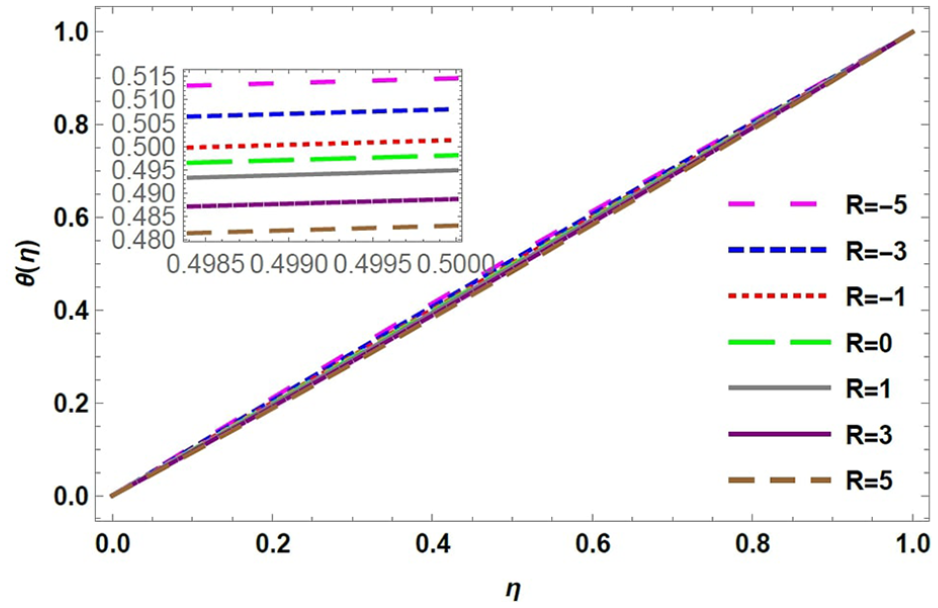
Impact of on the temporal distribution field for .
Impact of on the axial velocity distribution field for .
Impact of on the radial velocity distribution field for .
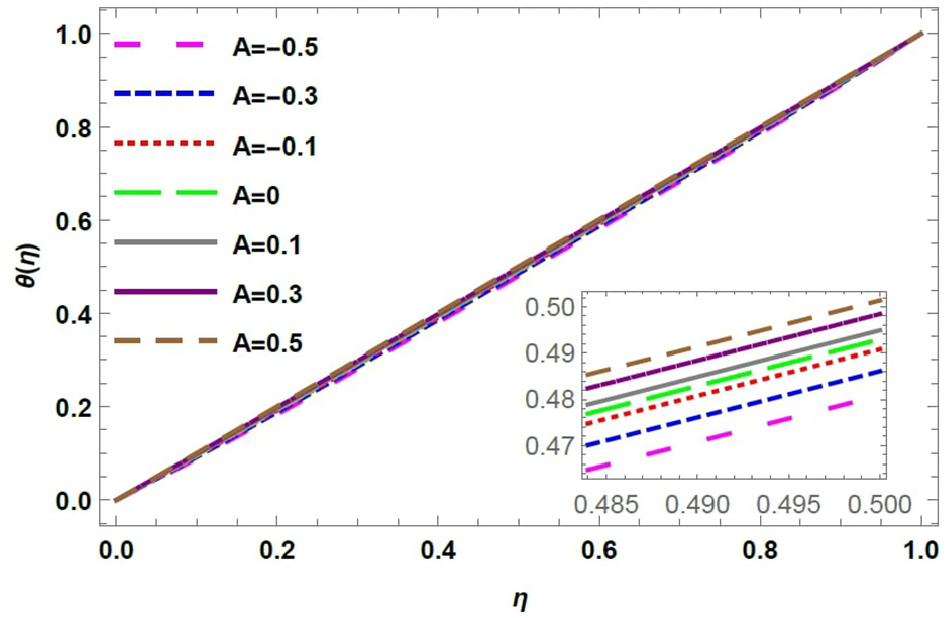
Impact of on the temporal distribution field for .
Impact of on the axial velocity distribution field for and .
Impact of on the radial velocity distribution field for and .
Impact of on the temporal distribution field for and .
Impact of on the axial velocity distribution field for and .
Impact of on the radial velocity distribution field for and .
Impact of on the temporal distribution field for and .
Impact of on the temporal distribution field for and .
Impact of on the temporal distribution field for and .
The repercussion of on the velocity distribution curves is presented in Figures 2 and 3. From Figure 2, it is apparent that an elevation in rises the axial velocity in the region and retards further for both suction and injection cases. An increase in indicates a relatively higher inertial force compared to the viscous force as a result of which the fluid can move more freely due to a reduction in the viscous drag initially. However, after a certain point, the flow shows a turbulent nature leading to an increased mixing. This in turn causes the axial velocity to increase initially and decrease later for both injection and suction cases. Further, it is evident from Figure 3 that the radial velocity rises in the core region as increases. Due to the instability and enhanced mixing caused by the increase in , the momentum transfer within the fluid tends to increase. As a result of this, the fluid particles are being pushed outward more aggressively which in turn elevates the radial velocity in the core region. Moreover, Figure 4 demonstrates the impact of on the temporal profile. It is noticed that in the case of suction, the temperature distribution field retards with an elevation in , whereas the temporal field elevates in the case of suction. In other words, the temporal field elevates as the plates dilate in the case of injection and as the plates approach in the case of suction. The behaviour is evident due to the contribution of shear stress on the energy transfer, that is, in the injection case as the plates dilate, the shear stress promotes the mixing and enhancing of the thermal conductivity among the nanoparticles resulting in an enhanced heat transfer and dispersion of thermal energy. Similarly, in the case of suction, as the plates approach each other, the space allocated for the flow narrows down, experiencing greater shear stress leading to a rise in the temporal profile.
The repercussion of on the velocity distribution fields is shown in Figures 5 and 6. It is apparent from Figure 5 that the axial velocity elevates with a rise in , that is, as the suction increases, the axial velocity increases, whereas the axial velocity retards with an increase in injection. This is because as the suction increases, a pressure difference is created that draws a greater amount of fluid into a designated area. As more amount of fluid is drawn, the continuity equation which states that the rate of mass flow remains constant comes into play. To retain a constant flow rate through the confined passage, the fluid velocity must elevate in the axial direction. Conversely, as the fluid is injected into the system, the flow pattern is disrupted due to the addition of fluid in the designated area, thereby increasing the local pressure causing the overall velocity to reduce axially. From Figure 6, it is noticed that an elevation in reduces the radial velocity. In other words, an elevation in injection raises the radial velocity, whereas the radial velocity declines with an increase in suction. This behaviour can be attributed to the intricate relation between injection and the radial velocity, that is, as the injection increases, a larger amount of fluid is introduced into the system as in the case of pumps and turbines. This additional fluid that is injected elevates the flow momentum causing the fluid particles to move faster leading to an elevated radial velocity. On the contrary, an increase in the suction causes the system’s pressure to reduce creating a vacuum effect. This reduced pressure decelerates the fluid flow resulting in the radial velocity to decline as the fluid is sucked out of the system rather than being pushed out. Further, a rise in elevates the temporal profile as observed in Figure 7. In other words, an increase in injection causes the temporal profile to retard, whereas the temporal distribution elevates with a rise in suction. This phenomenon is observed because, as the suction in the flow increases, the pressure between the plates drops allowing the fluid to expand in turn causing the fluid’s temperature to rise due to adiabatic effects. Conversely, as injection increases, the fluid generally at a lower temperature is introduced. This newly introduced, thus tends to absorb heat from the surrounding fluid causing the system’s overall temperature to reduce.
The sequela of the parameter concerning to the applied magnetic field on the velocity distribution is graphically presented in Figures 8 and 9. It is apparent from Figure 8 that as elevates, the axial velocity tends to decrease in the case of suction as plates dilate, whereas the axial velocity elevates as the upper plate approaches the lower one. However, in the case of injection, the axial velocity is found to elevate as the plates depart whereas the axial velocity retards as the plates move closer. From Figure 9, it can be inferred that in the case of suction, the radial velocity depletes with an elevation in as the plates depart, whereas the radial velocity increases as the plates approach each other. On the contrary, in the case of injection, an elevation in the elevates the radial velocity for both plates approaching and dilating from each other. Generally, a rise in the magnetic parameter indicates a stronger dominance of an applied external magnetic field on the flow of fluid. This stronger influence causes the viscous drag to increase due to the Lorentz force. As the plates move apart, the flow becomes less efficient causing both the axial and radial velocities to drop. In addition to this drop in the velocities, the suction further reduces the velocities causing an additional space between the plates. However, as the plates approach each the fluid is forced out of the confined space which results in elevated axial and radial velocities. On the contrary, in the case of injection, as the plates move apart, the resistance experienced by the fluid reduces due to the additional space caused by the dilation along which the magnetic field applied reduces the turbulence by promoting a more streamlined flow creating room for an elevation in both the axial and radial velocities as the fluid flows towards the expanding gap. Conversely, as the plates approach each other, the reduction in the space provided for the flow increases the friction and the resistance faced by the fluid. This friction and resistance leads to a higher pressure in the region as a result of which the axial velocity tends to retard, as fluid has less space to accelerate. The repercussion of on the temporal profile is graphically displayed in Figure 10. It is witnessed from the graphs that an upsurge in leads to a retardation of the temporal distribution. As the magnetic field is applied, a force is exerted on the charged particles in the nanofluid which dampens the flow. Due to this increased resistance, the flow velocity reduces. This reduction in the velocity causes the convective heat transfer mechanism to diminish leading to a decline in the heat distribution in turn reducing the temporal profile. Furthermore, the resilience offered by the Lorentz force on the flow due to the magnetic effect which further reduces the momentum and disrupts the flow. The so-caused reduction in the flow velocity leads to insufficient mixing consequently resulting in a more uniform but depleted temporal distribution.
The repercussion of on the velocity distribution curves is demonstrated in Figures 11 and 12. It is deduced from the figures that in the suction case, an elevation in causes the axial velocity to retard as the plates depart whereas the axial velocity elevates as the upper plate approaches the lower one. However, a reverse tendency is apparent in the injection case. In the suction case, as increases the axial velocity declines as the plates depart due to congested flow. Further, this increase in solid content creates an additional resistance to flow causing the fluid to struggle to move through the media of increased density leading to a decline in the axial velocity. Conversely, as the plates move closer, the distance between plates decreases leading to an increase in the pressure and flow path which in turn elevates the axial velocity. On the contrary, in the case of injection, as the plates depart the axial velocity tends to elevate with the elevation in as the added nanoparticles accommodate more easily allowing the velocity to increase axially as the system can adequately allow the injection of additional volume of the fluid. On the other hand, as the plates approach closer, the flow is obstructed by the solid particles leading to a decrease in the axial velocity. Further, it is noted from the figures that for both suction and injection, an elevation in elevates the radial velocity as the plates depart whereas the radial velocity declines as the plates come closer. The repercussion of on the temporal distribution curve is illustrated in Figure 13. It is noticed from the figures that in the case of suction, the temperature distribution rises with an increment in as the plates depart whereas the profile declines as the plates approach. However, a reverse behaviour is shown in the injection case. The following pattern in the temporal profile is apparent with an increment in due to the complex interplay of the enhanced thermal characteristics, viscosity differences, improved dispersion stability and flow dynamics that are influenced by the movement of plates and injection/suction.
Figures 14 and 15 graphically display the influence of the non-dimensional parameters, and on the temporal profiles respectively. It is noticed from the figures that in the suction case, an increment in causes the temporal distribution to retard as the plates depart, whereas when the plates are approaching, an increment in amounts to an elevation in the temperature field distribution. However, in the case of injection, an elevation in causes the temporal field to decline for both plates approaching or dilating. Prandlt number is a dimensionless number that compares the rate of momentum and thermal diffusivities. A higher Prandlt number indicates that the momentum diffuses faster than heat in the flow. As the plates dilate during suction, the separation and turbulence in the flow increase at the boundary layer due to the lowering of pressure between the plates. As increases, the thermal boundary layer becomes more thicker in comparison to the momentum boundary layer. This thickening of the thermal layer causes the thermal profile to deplete, further reflecting a less efficient heat transfer as a result of the thermal energy not being able to replenish as the fluid flows out. However, as the plates approach each other, the fluid is compressed causing the heat transfer to enhance leading to a rise in the temporal distribution. This behaviour is observant due to the fact that an increment of , in this case, indicates the thermal diffusion is slower when compared to the momentum diffusion which results in a more effective mixing causing the profile to elevate. Contrarily, in the case of injection, as the plates move towards or away, a shearing effect in the fluid is generated which is further affected by the increase in which causes the heat transfer to be less effective due to the slower diffusion of thermal energy as compared to the momentum energy. As a result of these, the temporal distribution is found to reduce due to the movement of plates. Further, it is apparent from the figures that an elevation in the parameter corresponding to the viscous dissipation, , the temporal distribution depletes in all scenarios. The dimensionless parameter that represents the relative importance of the kinetic energy to that of the thermal energy in the flow is the Eckert number. An elevation in increases the temperature gradient and the viscous heating which generates a higher thermal resistance in the fluid. As a result of this resistance, the heat takes a longer duration to propagate through the fluid, thus slowing down the overall temperature of the flow.
Table 2 displays the numerical values of dimensionless skin friction coefficient for distinct values of , , , and . From the table it is noticed that an elevation in the Reynolds number leads to a retardation in the skin friction coefficient’s magnitude, that is, the skin friction coefficient elevates as the plates approach each other whereas retards as the plates dilate. As elevates, the velocity gradient in the fluid layer adjacent to the plates depletes as a result of an elevation in the distance between plates. This causes the shear stress to retard which in turn reduces the skin friction. However, as the top plate approaches the lower, the fluid is squeezed between the plates and is forced to flow in the middle of a small gap due to which the velocity gradient rises resulting in higher friction at the plates. Further, the coefficient of skin friction rises as the fluid is injected whereas the friction coefficient declines when the fluid is sucked out. This is due to the turbulence and shear stress arising in the boundary layer caused by injecting the fluid at the bottom plate whereas the friction coefficient reduces as the fluid is sucked due to the reduction in the turbulence and stability. Additionally, it is apparent from the table that an elevation in the parameter corresponding to the applied magnetic field leads to a depletion in the skin friction coefficient due to the fact that an upsurge in the magnetic parameter causes the flow to stabilize as a consequence of the Lorentz force generated which further reduces the frictional force at the walls. Also, an elevation in , the skin friction coefficient is found to retard. This behaviour is evident as the addition of nanoparticles alters the flow characteristics mainly near the surfaces which in turn causes the friction coefficient to deplete.
The sequel of parameters that pose a physical impact on the dimensionless directional pressure gradient is numerically tabulated in Table 3. It is perceived from the table that a hike in the Reynolds number causes the pressure gradient to retard. This behaviour is evident due to the fluid occupancy in the additional area created by the plates dilating from each other, which in turn amounts to a decrease in the pressure. However, as the plates approach each other, the flow area reduces which causes the particles to have additional collision along with compression caused by the plates in turn leading to an enhanced pressure gradient. It is also observed that as the fluid is injected into the flow, the pressure gradient elevates, whereas the pressure gradient retards as the fluid is sucked out as a result of additional space for the flow of fluid. Furthermore, an elevation in the magnetic parameter causes the pressure gradient to retard due to the generation of the drag force caused as an implication of the Lorentz force affecting the flow. However, an elevation in the nanoparticle’s solid volume fraction elevates the pressure due to the enhanced collision rate caused by the nanoparticles added.
The numerical values corresponding to the Nusselt number coefficients for a fixed value of Eckert number and Prandtl number are displayed in Table 4. Furthermore, the table demonstrates the impacts of , , , and on the Nusselt number. It is apparent from the table that an elevation in the Reynolds number and injection/suction parameter causes the magnitude of the Nusselt number coefficient to retard. This phenomenon is caused due to the thickening of the thermal boundary as the plates depart from each other, leading to a lower heat transfer. However, an elevation in the nanoparticle’s volume fraction causes the Nusselt number’s magnitude to elevate. This behaviour is evident as a consequence of an elevation in the which causes the surface area available for heat transfer to increase. This larger contact area between solids and fluids enhances the overall heat transfer rate. However, the magnetic parameter displays a non-significant impact on the Nusselt number coefficient.
Conclusion
The current study uncovers the impact of suspending in on the velocity distribution, gradient of pressure, skin friction coefficient, temporal field and Nusselt number in the viscous dissipated MHD flow. Furthermore, the flow is considered to be occurring betwixt a pair of squeezing plates placed parallel to one another in such a way that the top plate approaches and dilates from the bottom fixed plate through which injection and suction take place. It is essential to theoretically analysis this kind of fluid models to predict the outcomes due to their extensive applications in various engineering and industrial sectors specifically in advanced cooling systems, filtration, lubrication and bearing, solar energy systems and many more. Moreover, the impact of various parameters arising in the study such as Reynolds number, injection/suction parameter, magnetic parameter, solid volume fraction, Eckert number, and Prandtl number on the velocity and temperature distribution fields, skin friction coefficients, pressure gradient, and Nusselt number are thoroughly examined.
Further, this analysis reveals several key effects of flow parameters on the behaviour of -based nanofluid within a squeezing porous parallel plate system. An increase in the Reynolds number initially enhances the axial velocity but leads to a reduction beyond a certain threshold, while the radial velocity experiences a rise in the core region. Axial velocity is augmented by suction and diminished by injection, whereas the radial velocity is suppressed with an increase in the injection/suction parameter. Furthermore, an increase in the nanoparticle volume fraction enhances the temporal velocity distribution, particularly during plate convergence in the injection scenario and plate separation under suction conditions. A rise in the Eckert number tends to decelerate the temporal velocity profile, indicating stronger thermal dissipation effects. Additionally, increasing the magnetic parameter reduces both the skin friction coefficient and the axial pressure gradient, though it exhibits negligible influence on the Nusselt number. The skin friction coefficient also declines with higher nanoparticle concentrations, while the axial pressure gradient intensifies. Notably, the Nusselt number consistently improves with increasing nanoparticle volume fraction, highlighting the significant enhancement in thermal performance due to nanoparticle inclusion.
Furthermore, in order to compare the outcomes obtained by HPM, the considered problem is approached by the scheme of classical FDM. It is concluded from the tables that the solutions achieved by the two independent techniques (HPM and FDM) are found to be in harmony with one another.
Future scope
The present study is confined to a theoretical analysis of the influence of viscous dissipation on heat transfer characteristics in the MHD flow of -based nanofluid through a squeezing porous channel, excluding the effects of external forces such as gravity. Future research could extend this work by incorporating additional physical phenomena, including external body forces, ion slip effects, temperature jump conditions and the behaviour of gyrotactic microorganisms. Moreover, complementing the theoretical findings with comprehensive experimental investigations would offer deeper insights and potentially broaden the applicability of the study in various industrial and engineering contexts.
Footnotes
Appendix
Acknowledgements
The authors would like to thank Manipal Academy of Higher Education, Manipal; Kuwait College of Science and Technology, Kuwait; Nitte Mahalinga Adyantaya Memorial Institute of Technology, Nitte; and Thakur College of Engineering and Technology, Mumbai for their support.
Declaration of conflicting interests
The author(s) declared no potential conflicts of interest with respect to the research, authorship, and/or publication of this article.
Funding
The author(s) received no financial support for the research, authorship, and/or publication of this article.
ORCID iD
Sampath V. S. Kumar
References
1.
Archimedes. On floating bodies, book I. In: HeathTL (ed.) The works of Archimedes: edited in modern notation with introductory chapters. Cambridge: Cambridge University Press, 2009, pp.253–262.
2.
QureshiMARafiqMBashirY, et al. Analytical and numerical approach for the analysis of heat transfer of squeezing flow between two parallel plates. Case Stud Therm Eng2024; 54: 103979.
3.
JaliliBRezaeianAJaliliP, et al. Squeezing flow of Casson fluid between two circular plates under the impact of solar radiation. ZAMM J Appl Math Mech2023; 103(9): e202200455.
4.
SweetEVajraveluKVan GorderRA, et al. Analytical solution for the unsteady MHD flow of a viscous fluid between moving parallel plates. Commun Nonlinear Sci Numer Simul2011; 16(1): 266–273.
5.
RahbariAAbbasiMRahimipetroudiI, et al. Heat transfer and MHD flow of non-Newtonian Maxwell fluid through a parallel plate channel: analytical and numerical solution. Mech Sci2018; 9(1): 61–70.
6.
MohamedMKAOngHRSoidSK, et al. MHD natural convection flow of Casson ferrofluid at lower stagnation point on a horizontal circular cylinder. J Adv Res Numer Heat Transfer2024; 25(1): 25–36.
7.
KhanNMPanK.Advanced numerical analysis of Casson MHD nanofluid flow with bioconvection and Marangoni convection on an inclined surface. Multiscale and Multidisciplinary Modeling, Experiments and Design2025; 8(3): 197.
8.
SinghPRadhakrishnanVNarayanKA.Squeezing flow between parallel plates. Arch Appl Mech1990; 60(4): 274–281.
9.
HamzaEA.Suction and injection effects on a similar flow between parallel plates. J Phys D Appl Phys1999; 32(6): 656–663.
10.
V.sSKPaiNP. Suction and injection effect on flow between two plates with reference to Casson fluid model. Multidiscip Model Mater Struct2019; 15(3): 559–574.
11.
HoshyarHAGanjiDDBorranAR, et al. Flow behavior of unsteady incompressible Newtonian fluid flow between two parallel plates via homotopy analysis method. Lat Am J Solids Struct2015; 12(10): 1859–1869.
12.
KumarVSSPaiNP. A study of magnetic effect on flow between two plates with suction or injection with special reference to Casson fluid. Front Heat Mass Transfer2019; 12(23): 1–9.
13.
ShirkhaniMRHoshyarHARahimipetroudiI, et al. Unsteady time-dependent incompressible Newtonian fluid flow between two parallel plates by homotopy analysis method (HAM), homotopy perturbation method (HPM) and collocation method (CM). Propulsion Power Res2018; 7(3): 247–256.
14.
MustafaMHayatTObaidatS.On heat and mass transfer in the unsteady squeezing flow between parallel plates. Meccanica2012; 47: 1581–1589.
15.
KhanUKhanSIAhmedN, et al. Heat transfer analysis for squeezing flow of a Casson fluid between parallel plates. Ain Shams Eng J2016; 7(1): 497–504.
16.
SampathKVSDevakiBPaiNP.Analysis of MHD and heat transfer characteristics of thermally radiative upper-convected Maxwell fluid flow between moving plates: semi-analytical and numerical solution. CFD Letters2024; 16(4): 39–53.
17.
AbbasNShatanawiWMustafaZ.Thermal analysis of non-Newtonian fluid with radiation and MHD effects over permeable exponential stretching sheet. Case Stud Therm Eng2025; 68: 105895.
18.
FrancisPSambathPNoeiaghdamS, et al. Computational analysis of bioconvective MHD hybrid nanofluid flow of non-Newtonian fluid over cone/plate: a study based on the Cattaneo-Christov heat and mass flux model. Eng Sci Technol Int J2025; 63: 101970.
19.
SinghAKGorlaRSR. Free convection heat and mass transfer with hall current, joule heating and thermal diffusion. Heat Mass Transf2009; 45: 1341–1349.
20.
VenkateswarluBSatya NarayanaPVTarakaramuN.Melting and viscous dissipation effects on MHD flow over a moving surface with constant heat source. Trans Razmadze Math Inst2018; 172(3): 619–630.
21.
SwainBKParidaBCKarS, et al. Viscous dissipation and joule heating effect on MHD flow and heat transfer past a stretching sheet embedded in a porous medium. Heliyon2020; 6(10): e05338.
22.
AgrawalAPandaJP.Study the effect of thermal diffusion and viscous dissipation on MHD flow of micropolar fluid. Int J Appl Comput Math2025; 11(2): 31.
23.
JatKSharmaKSoniP, et al. Effect of radiation and slip parameter on MHD mixed convective Casson fluid flow along a vertical stretching sheet. Proc IMechE, Part E: J Process Mechanical Engineering2025; 239(2): 627–644.
24.
MahmoodZRafiqueKAbd-ElmonemA, et al. Computational analysis for transport properties of γ-Al2O3 with different base fluids over rotating sphere with viscous dissipation and porous media. J Therm Anal Calorim2025; 150: 2059–2077.
25.
ChoiSUSEastmanJA. Enhancing thermal conductivity of fluids with nanoparticles. IL: Argonne National Lab, San Francisco, CA, 1995, pp.99–105.
26.
DasSKChoiSUYuW, et al. Nanofluids: science and technology. Hoboken, NJ: John Wiley & Sons, 2007.
27.
HeYJinYChenH, et al. Heat transfer and flow behaviour of aqueous suspensions of tio2 nanoparticles (nanofluids) flowing upward through a vertical pipe. Int J Heat Mass Transf2007; 50(11-12): 2272–2281.
28.
SheikholeslamiMHatamiMGanjiDD.Nanofluid flow and heat transfer in a rotating system in the presence of a magnetic field. J Mol Liq2014; 190: 112–120.
29.
SantraAKSenSChakrabortyN.Study of heat transfer augmentation in a differentially heated square cavity using copper–water nanofluid. Int J Therm Sci2008; 47: 1113–1122.
30.
DogonchiASDivsalarKGanjiDD.Flow and heat transfer of MHD nanofluid between parallel plates in the presence of thermal radiation. Comput Methods Appl Mech Eng2016; 310: 58–76.
31.
KhanZHHussainSTHammouchZ.Flow and heat transfer analysis of water and ethylene glycol based Cu nanoparticles between two parallel disks with suction/injection effects. J Mol Liq2016; 221: 298–304.
32.
AlkasasbehHTMohamedMKA. MHD (SWCNTS + MWCNTS)/H2O-based Williamson hybrid nanouids flow past exponential shrinking sheet in porous medium. Front Heat Mass Transfer2023; 21: 265–279.
33.
AlkasasbehHAl FaqihFMShoulAS.Computational simulation of magneto convection flow of Williamson hybrid nanofluid with thermal radiation effect. CFD Letters2023; 15(4): 92–105.
34.
AlkasasbehHTAl FaqihFMAlizadehA, et al. Computational modeling of hybrid micropolar nanofluid flow over a solid sphere. J Magn Magn Mater2023; 569: 170444.
35.
PattnaikPKMishraSBaitharuAP, et al. Cu-kerosene and Al2O3-kerosene boundary layer nanofluid flow past a stretching/shrinking surface. Proc IMechE Part N2023; 237(3–4): 75–81.
36.
AlkasasbehHT.Exploring three-dimensional MHD Maxwell hybrid nanofluid flow: a computational study on a stretching sheet. J Comput Appl Mech2024; 55(1): 77–91.
37.
KumarVSSDevakiBBhatPG, et al. Analysis of flow and heat transfer characteristics of ethylene glycol-based magnetite nanoparticles squeezed between parallel disks with magnetic effect. J Therm Anal Calorim2024; 149: 12219–12230.
38.
ShahzadTMunirSSalahuddinT, et al. Numerical insights of heat and mass transfer in a Darcy-Forchheimer porous space subjected to MHD dissipative stagnation point flow of cross nanofluid towards a melting stretching cylindrical surface. Int Commun Heat Mass Transf2024; 159: 108088.
39.
ZarPMJaliliBJaliliP, et al. Thermal study of magnetohydrodynamic nanofluid flow and Brownian motion between parallel sheets. Int J Thermofluids2024; 23: 100806.
40.
AlkasasbehHT.Modeling the flow of Casson nanofluid on a stretching sheet with heat transfer: a study of electric MHD and Darcy-Forchheimer effects. Partial Differ Equ Appl Math2025; 13: 101109.
41.
MunirSTurabiYUUB. Impact of heated wavy wall and hybrid nanofluid on natural convection in a triangular enclosure with embedded cold cylinder under inclined magnetic field. Arab J Sci Eng2025; 50(6): 4007–4020.
42.
SimsekH.Mhd slip flow of ethylene glycol and water mixture based Al2O3 nanofluids between micro-parallel plates. Case Stud Therm Eng2025; 68: 105923.
43.
TurabiYUUBMunirSAminA.Numerical analysis of convective transport mechanisms in two-layer ternary (TioO2− SioO2− Al2 O3 ) Casson hybrid nanofluid flow in a vertical channel with heat generation effects. Numer Heat Transf A Appl2025; 86(6): 1673–1687.
HeJH.A coupling method of a homotopy technique and a perturbation technique for non-linear problems. Int J Non Linear Mech2000; 35(1): 37–43.
46.
HeJH.Homotopy perturbation method: a new nonlinear analytical technique. Appl Math Comput2003; 135(1): 73–79.
47.
BabolianEAziziASaeidianJ.Some notes on using the homotopy perturbation method for solving time-dependent differential equations. Math Comput Model2009; 50(1-2): 213–224.
48.
SobamowoMGAkinshiloAT.On the analysis of squeezing flow of nanofluid between two parallel plates under the influence of magnetic field. Alex Eng J2018; 57(3): 1413–1423.
49.
AhmedJShahzadAFarooqA, et al. Thermal analysis in swirling flow of titanium dioxide–aluminum oxide water hybrid nanofluid over a rotating cylinder. J Therm Anal Calorim2021; 144(6): 2175–2185.