




Abstract
In the present study, mechanical properties optimization is investigated for an Al-Al2O3 composite nanostructure. The Al-Al2O3 composite nanostructure is considered an Aluminum nanowire reinforced by spherical Al2O3 particles. The structure tensile test is simulated via molecular dynamics simulation using LAMMPS. The mechanical properties of the composite are extracted from the obtained stress-strain curve of the composite. The important mechanical properties include maximum stress and toughness. An optimization process is then applied to maximize the mechanical properties of the composite via metaheuristic optimization algorithms including Genetic Algorithm (GA), Ant Colony (ACO), and Grey Wolf Optimizer (GWO). Since the studied nanostructure is mono crystal, the reinforcing mechanism differs from that of a grained macro material. Therefore, the optimization variables are not confined to size and volume fraction but they also include the location of the particles. The optimization is performed for 0.05 and 0.10 volume fractions and different particle sizes with respect to the location of particles. Applying the optimization process, the mechanical properties of the studied composite nanowire are substantially improved for tensile loading. The results reveal that the placement of the particles has a considerable effect on the improvement of mechanical characteristics. At last, a pattern is presented for the placement of particles to achieve the highest tensile characteristics of Al-Al2O3 composite nanowires.
Introduction
In the complicated material applications during the recent decades, the composite materials with nano-scaled structures are highly attended. These materials are widely used in nano and micro-sized electro-mechanical systems. The nanostructures are used in a wide variety of forms including nanoparticles, nanorods, nanowires, nanotubes, and nanoshells. In mechanical applications, the nano-structured composite materials are designed to achieve high strength to weight ratios.
Beside the experimental methods, theoretical investigation of the nano structures is so important for development of nano systems. Therefore, different methodologies are conducted to study the mechanical behavior of nano-scaled structures including atomistic modeling, continuum mechanics modeling, and hybrid atomistic-continuum mechanics modeling. 1
Carbon based materials such as graphene and Carbon nano tubes (CNT) are widely used for composite reinforcement. Abdollahi and Davoodi investigated the influence of covering a germanium nanowire with a single wall CNT on mechanical properties via molecular dynamics (MD) simulation. 2 The reinforcing effect of graphene is also proved for multilayered polymer nanocomposites and graphene-cement composites using MD.3,4 MD studies are also performed by Hou et al. about cement-polymer nanocomposite mechanical properties and reinforcement mechanism.5,6 In another study, the structure, reactivity and interfacial bonding of Graphene oxide reinforced cement nanocomposites is investigated via MD. 7
As seen, MD simulation methods are so applicable for study of nano structures in different conditions. For example, temperature dependent mechanical properties of graphene reinforced polymer nanocomposites are studied using MD simulation. 8
Metal matrix composites (MMCs) are the most important composites as their strength to weight ratios are higher than the others. MD simulation is widely used for studying such materials. 9 MD simulation for mechanical properties of magnesium matrix composites reinforced with nickel-coated single-walled carbon nanotubes reveals a considerable improvement in the Young’s modulus. 10 Choi et al. presented an MD study about CNT-reinforced aluminum composites under uniaxial tensile loading. 11 Through another MD analysis, metal matrix composites reinforced with graphene sheets and CNTs were proposed to improve the properties of metals. 12 Weng et al. presented a study about strengthening mechanism of nano-laminated graphene-Cu composites under compression via MD. 13 A stress-strain study of graphene reinforced aluminum nanocomposite under compressive loading is performed via MD revealing that the compressive strength of nanocomposite material is much larger than that of pure Aluminum. 14
In addition to the carbon made materials, Al2O3 is a very useful material for reinforcement of composites as it is one of the hardest materials in nature. Increase in mechanical properties of epoxy-Al2O3 nanocomposite is observed due to the incorporation of Al2O3 nanoparticles. 15 The synergic effect of CNT/Al2O3 reinforcements on multiscale epoxy-based glass fiber composite is also proved via experiments and MD. 16
Nano particles of Al2O3 are widely used for reinforcement of metal matrix composites. Excellent mechanical properties and fatigue performance of Al-Al2O3 metal-based nanocomposites makes them suitable for various applications. 17 Other performed studies show that adding Al2O3 nano particles significantly enhances the mechanical properties of aluminum matrix composites including hardness and tensile properties.18,19
In the present study, the mechanical strengthening effect of Al2O3 nano particles on an Aluminum nano-matrix is investigated. Here, the aim is to maximize this effect with respect to the size and arrangement of the particles. Heshmati et al. studied interface, waviness, agglomeration, orientation and length of the CNT as key parameters affecting the mechanical properties of CNT-reinforced composite beams. 20 In addition, the relation between overall mechanical properties and the architecture of composites is reported by Zhang et al. for the nanocarbon reinforced composites. 21 In order to obtain the mechanical properties, spherical Al2O3 particles are scattered inside an Aluminum nanowire matrix and tensile test of the generated composite is simulated via LAMMPS. LAMMPS is a well-known molecular dynamics simulator invented by Sendia national lab. It’s a free open source program that utilizes the MPI parallel computation system which makes it applicable for complicated problems with high number of particles.
As shown in Figure 1, the study is started by an initial problem evaluation. In this stage, the overall plan is designed regarding initial simulations. The problem is then divided into multiple optimization problems with respect to the volume fraction and size of the reinforcing Al2O3 particles. In order to have a cost function for every problem, a MATLAB function is generated taking positions of nanoparticles and giving the LAMMPS tensile test simulation results. The optimization algorithms are applied to each problem to find the best particle positions maximizing the mechanical characteristics in each case. The best results are then aggregated and a pattern is proposed for placement of particles giving the highest strengthening effect.
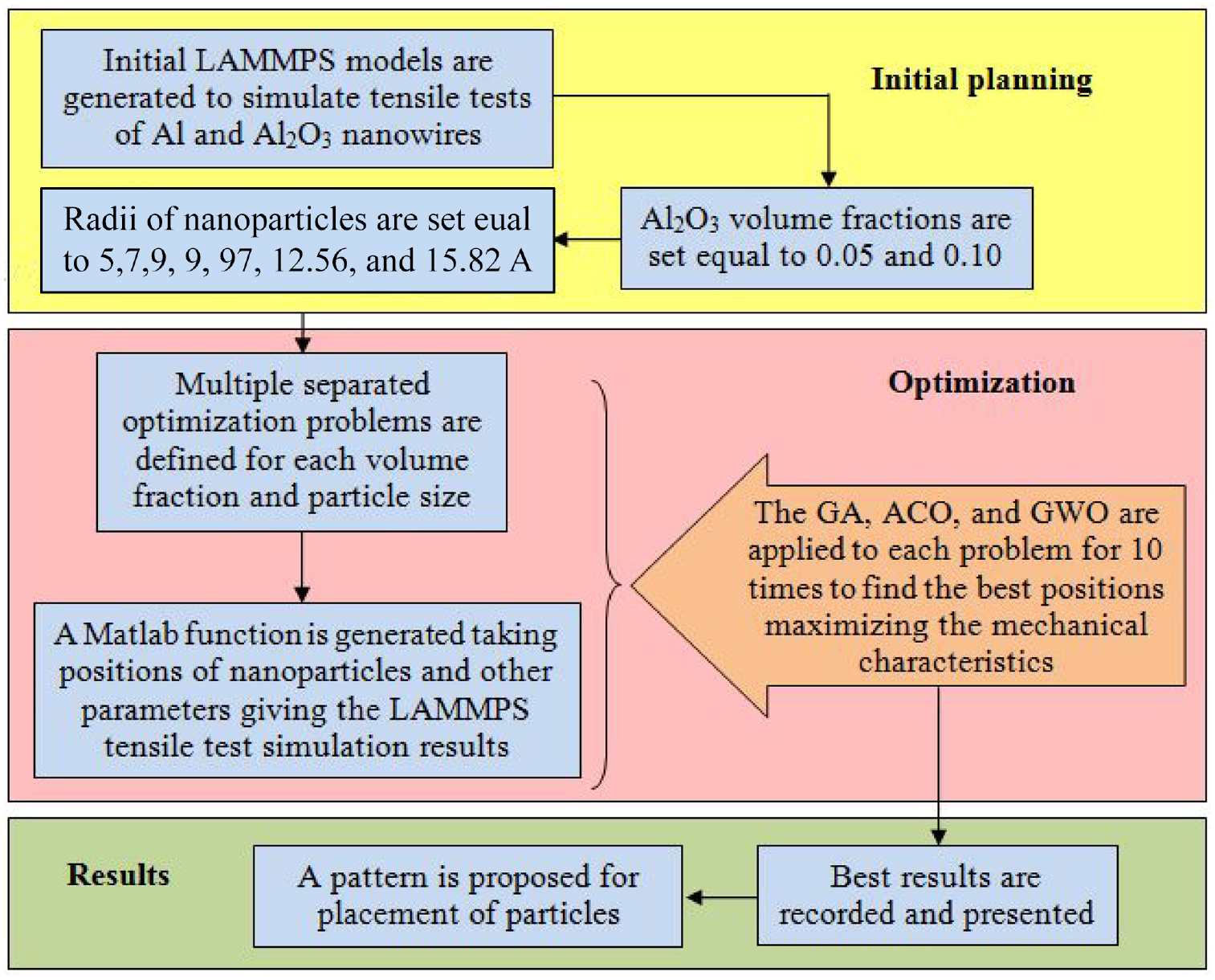
Flowchart of the present study.
Molecular dynamics simulation
The MD simulation is performed using LAMMPS for initial simulation of tensile tests of Al and Al2O3 nanowires. The mechanical properties of the structure are then obtained regarding the tensile test simulation results. To define a problem, LAMMPS takes text commands through data and input files. The data file includes the initial positions of the atoms and input file presents the geometry and material properties. These text files are generated via MATLAB as commands to be run in LAMMPS.
The initial atomic order, geometry and material properties are defined in MATLAB codes with respect to the investigated problem. These properties consist of crystal structure of the material, lattice constant or size of a unit cell, atomic mass, geometry, and dimensions of the nano-structure. Aluminum crystal has an FCC structure with lattice constant of aAl = 4.0496 Å. 22 The Alumina particles are of α-Al2O3 phase with a hexagonal crystal structure and lattice parameters of aAl-O = bAl-O = 4.758 Å, cAl-O = 12.991 Å, α = 90°, β = 90°, and γ = 120°. 23
An essential part of the problem definition is to specify a suitable potential function that certifies the solution accuracy. Potential functions assign the interactions between atoms. In the present study, ReaxFF potential function is used that is developed by Zhang et al. 24 for Al/α-Al2O3 interfaces. The ReaxFF potential is successfully applied for variety of problems.24–26
In order to simulate the Aluminum nanowire tensile test, firstly, an 18aAl × 12aAl × 12aAl block is generated (Figure 2). In this study, time step of
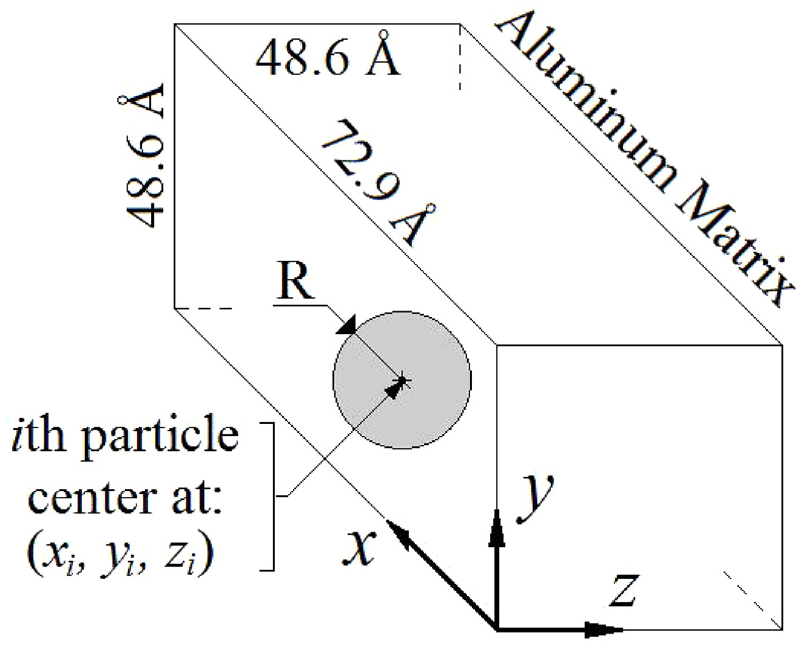
The investigated nanostructure.
In order to simulate the tensile loading condition, two loading regions are considered at the ends of the block with depth of aAl (x ≤ 4.05 and x ≥ 68.85 Å). The loading regions move apart giving engineering strain rate of
Capturing the atomic quantities in time and space at every 100 steps, the simulation results are recorded to achieve the stress-strain curve. The stress-strain data consists of stress and strain vectors with
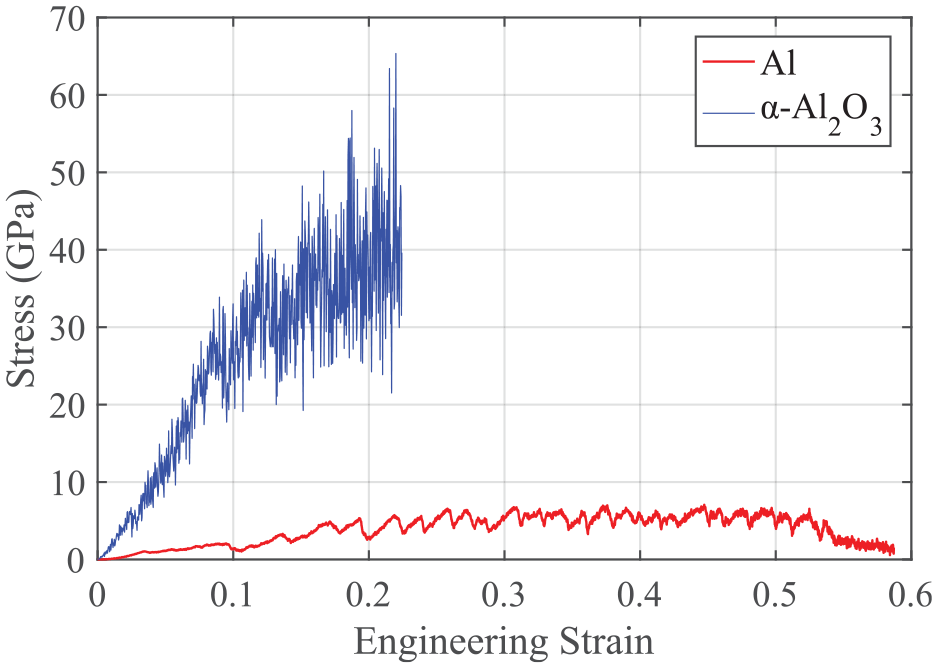
The stress-strain curves obtained for Al and Al2O3 nanowires.
The toughness (

where

In addition, the
The mechanical properties of Al and Al2O3 nanowires extracted from MD simulation.

Optimization
In this section, the aim is to maximize the mechanical properties of an Aluminum nanowire reinforced by α-Al2O3 particles. The first step is to define an objective function dealing with mechanical properties. The objective function is considered as a linear combination of

Classically, strengthening effect of particles in a composite depends on volume fraction (

where
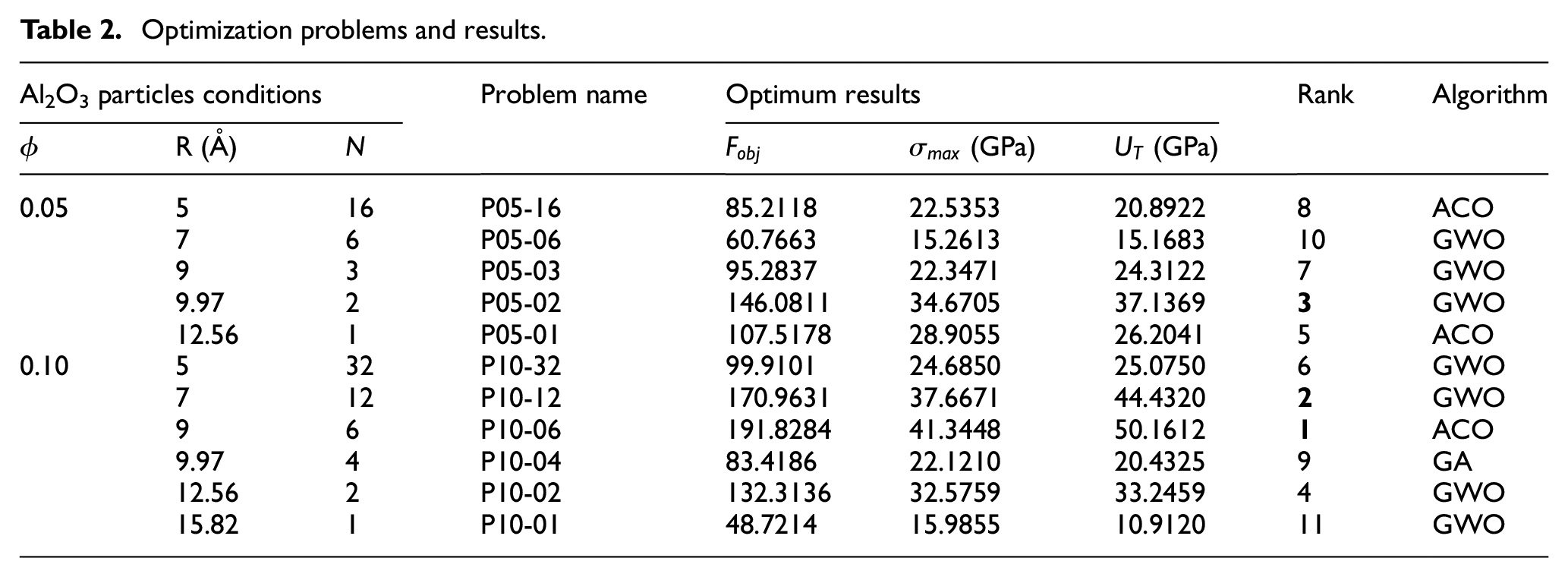
Optimization problems and results.

and

Here, t is a minimum thickness of matrix that is necessary to have a stable structure. Regarding the initial simulations, t is taken equal to 2 Å. Each problem also includes some constraints to avoid interference of particles. There are

where
The utilized optimization algorithms
Metaheuristic algorithms are random-based methods commonly inspired from nature such as GA. 28 GA is one of the earliest metaheuristic algorithms resembling natural selection in the evolution process of living creatures. In GA, an initial set of random solutions is evolved through biologically inspired operations such as mutation, crossover, and selection to optimize the problem.
ACO is a swarm intelligence based method of optimization. 29 Such methods deal with a random initial population of solutions that moves and explores the optimization space to achieve the best solution with respect to a naturally inspired rule governing an intelligent swarm. This population is also known as the search agents. In ACO, the search agents movements mimic the behavior of real ants.
The GWO is another swarm intelligence based optimization method studied and verified attending to various benchmark functions and problems. 30 Simulating the leadership hierarchy and hunting mechanism of grey wolves in nature, this algorithm has shown an excellent performance compared to the other metaheuristic algorithms.
Results and discussion
Each method is applied to each problem for 10 times and the best results are presented. In each problem, the aim is to find a placement for particles maximizing the
As seen, fining the particles does not necessarily lead to higher mechanical properties and there is an optimum range. This optimum range is obviously observable for
For better study of the particles placement effect, the convergence trends of the top optimizations are revealed in Figure 4. Study of these curves shows that correct selection of both size and location of particles can improve the mechanical properties of the composite nanowire by 527% for
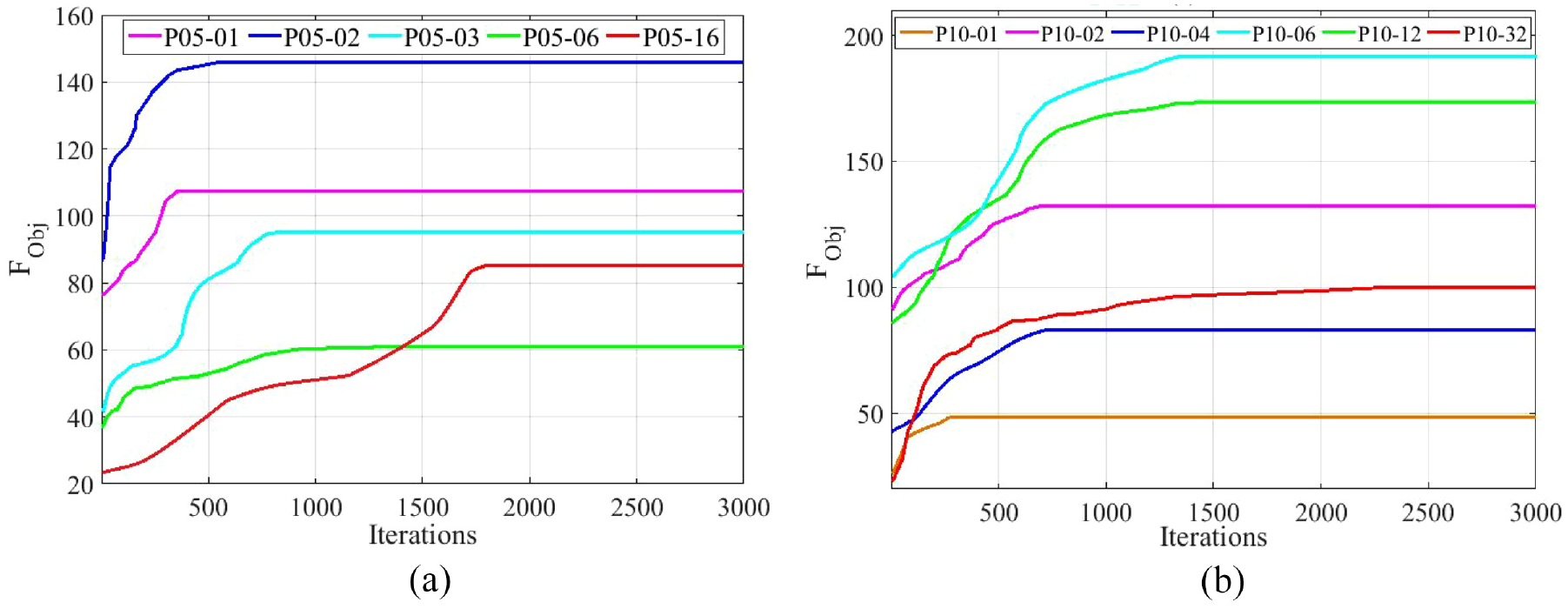
The best convergence trends for (a)
The optimum stress-strain curves are presented in Figure 5. Comparing these curves with stress-strain curves of Al and Al2O3 (Figure 3), reveals that the material deformability and ductility is highly improved. Specially, attending the failure strain, the composite material flexibility is much higher than that of its components.
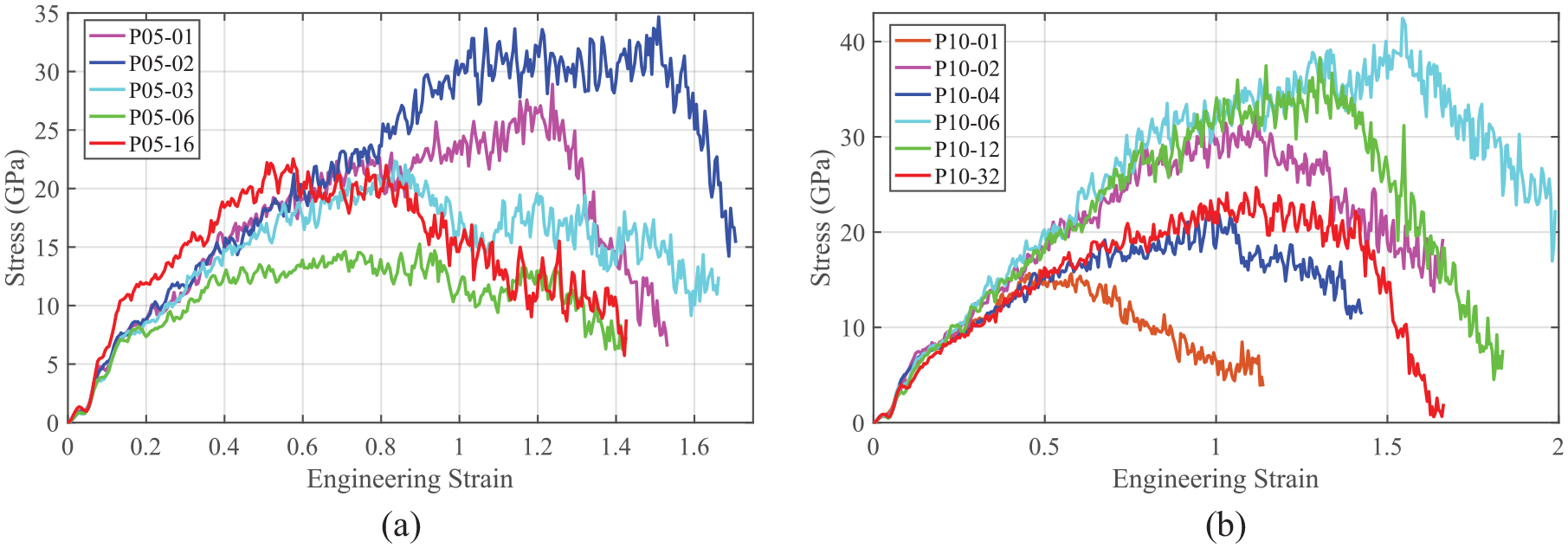
The stress-strain curves obtained for optimum structures (a) Φ=0.05 and (b)
The strengthening mechanism
Presence of reinforcing particles in MMCs confines movement of dislocations that leads to better mechanical behavior. However, there is no atomic disorder in the present nanowire model. Thus, there must be another strengthening mechanism for nanostructures. In order to understand such mechanism for Al-Al2O3 nano composite, the tensile test simulation trend for P05-01 is shown in Figure 6. The optimum solution of this problem has gained the fifth rank in Table 2. Figure 6 shows the behavior of the α-Al2O3 spherical particle during tension.
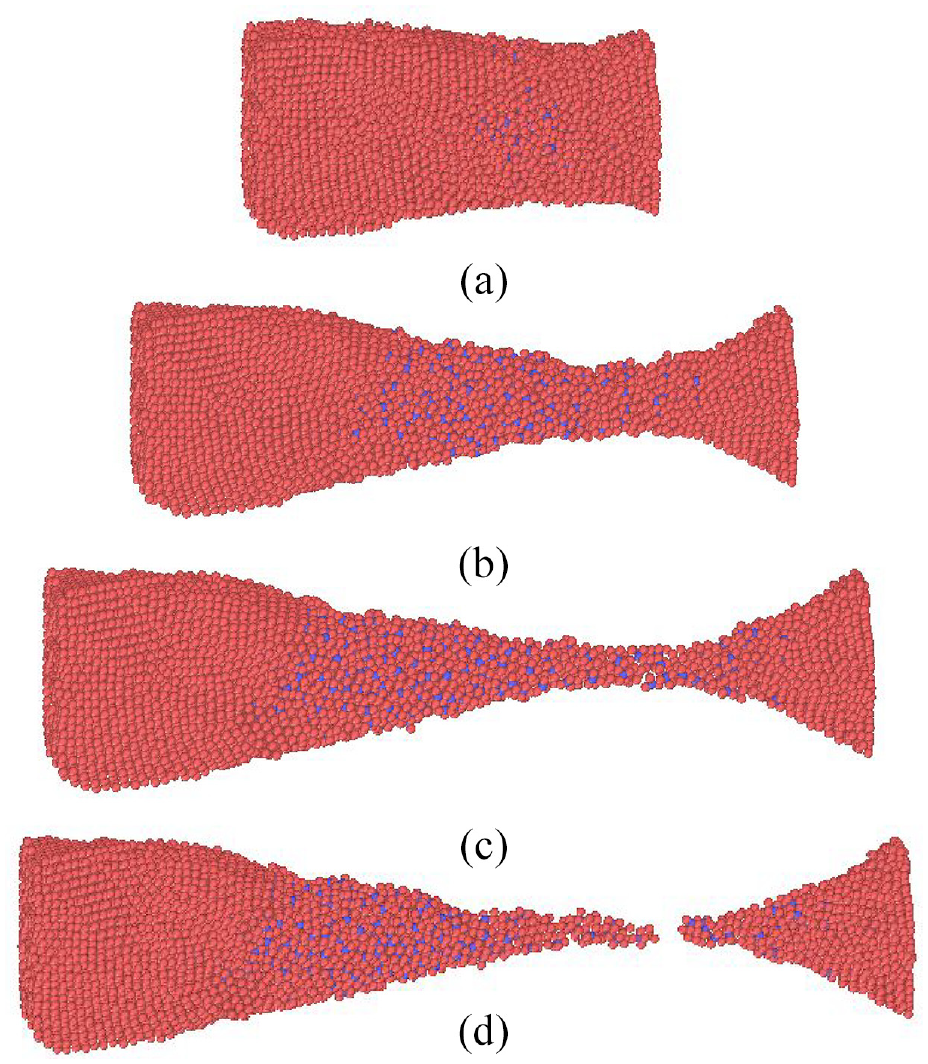
The tensile test simulation trend for P05-01(a)
As seen, the spherical Al2O3 particle is disintegrated inside the structure. Therefore, some additional deformation energy is consumed for breaking its atomic bonds. This additional energy dissipation leads to an additional resistance against deformation that improves the mechanical properties. In all other simulations, it is observed that wideness of particles shattering inside the matrix increases the tensile strength. Furthermore, electrical charge transfer among atoms causes rebinding and extra energy dissipation. There might be different mechanisms for other reinforcing materials such as ceramics and polymers which can be studied.
Optimum pattern
As seen, the effect of reinforcing particles on mechanical properties of a nanowire is highly influenced by emplacement of the particles. Therefore, there must be an optimum pattern for arrangement of the particles that is studied in this section. Figure 7 reveals the front and side views of the optimum patterns for three top ranked problems. In all patterns, the particles are concentrated at the ends of the block while there are partly no particles in the middle.
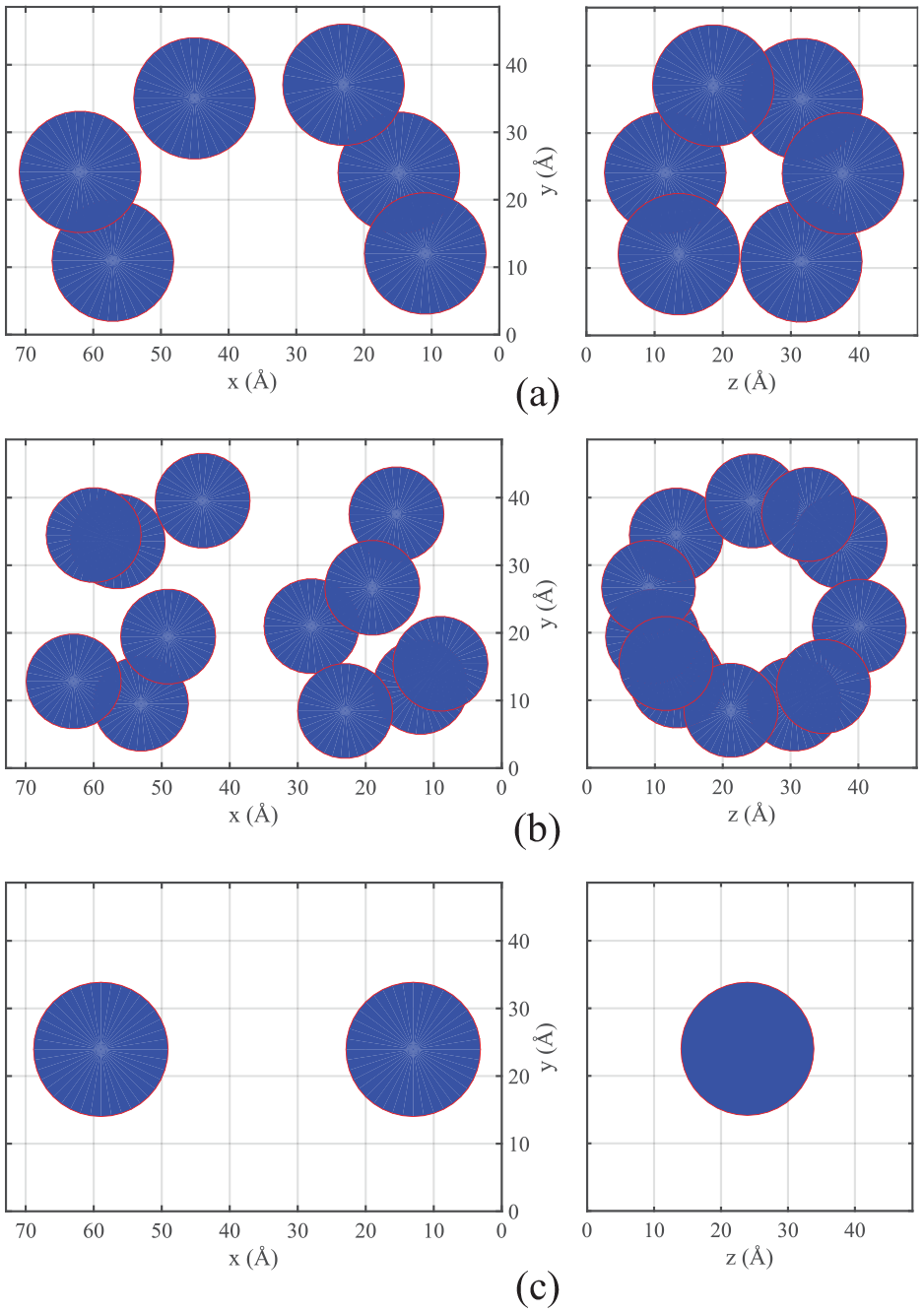
Front and side views of the top three optimum patterns (a) P10-06, (b) P10-12, and (c) P05-02.
The overall shape of the first two patterns which belong to P10-06 and P10-12, resemble a coil spring. The spring pitch length is short at the ends and it is long in the middle. In each ring of the spring, three particles are located almost making an equilateral triangle in side view. An approximate central symmetry is also observed is patterns. The third pattern (P05-02) obviously shows the importance of particle concentration in ends. This pattern is repeated for P10-02 which has the fourth rank. In P10-02 optimal model, particle centers are closer to the center because of their size. Therefore, in these cases, size and position of particles is more important than their volume fraction.
Pattern generalization
The results were obtained for a very short piece of nanowire, but they might be extended for micro and macro materials with different geometries even. The length of the nanowire was also limited and the size effect was not considered in the problem. For a long nanowire, the third and fourth patterns seem to be easy choices. It means scattering the particles on the centerline of the wire. Diameter of the particles must be about 0.41–0.52 of the wire width and the distance between their centers is closer at the ends and farther in the middle.
To prove the claim, the strengthening of a cylindrical Aluminum nanowire is studied in this section. The wire diameter is taken as equal to 60.74 Å (15aAl) and its length is taken as equal to 607.44 Å (150aAl). The length value is achieved after a convergence analysis with respect to the wire length. The tensile test was simulated for different lengths and no sensible variation in mechanical properties was observed for lengths higher than 120aAl.
To reinforce this nanowire, 16 spherical Al2O3 particles with a diameter of 27.6 Å are aligned on its centerline (
Comparison of proposed pattern results with best random results.
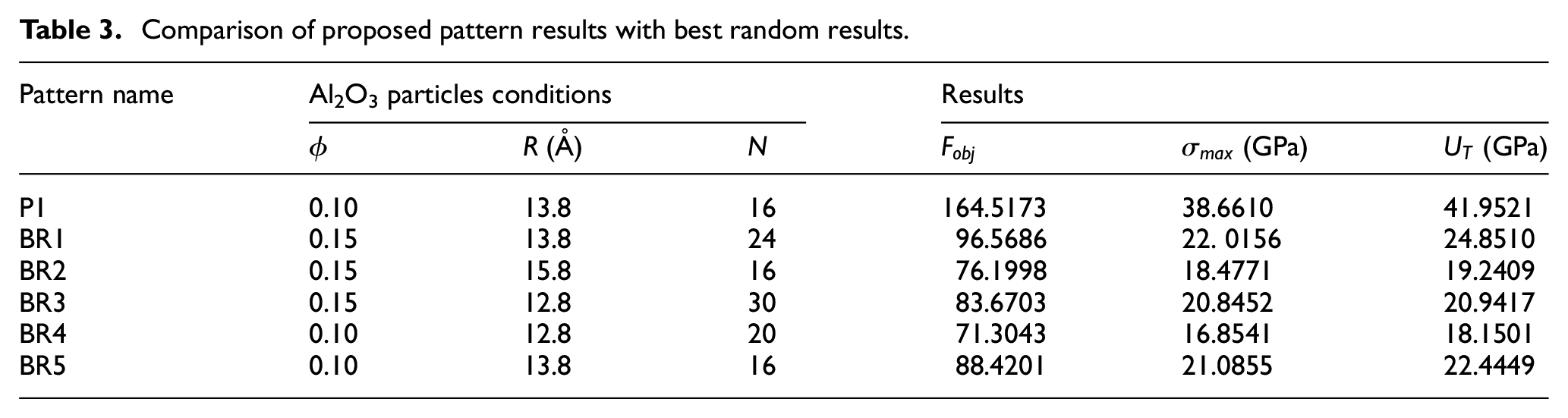
The BR1 is the pattern that gives the best results among 20 random patterns with 24 spherical Al2O3 particles with a diameter of 27.6 Å. BR2 is the best of 20 random patterns with 16 spherical Al2O3 particles with a diameter of 31.6 Å. BR3 is the best of 20 random cases with 30 particles with a diameter of 25.6 Å.
The BR4 is the best random case with 20 particles with a diameter of 25.6 Å (
As seen, the proposed pattern (P1) with
Conclusion
In this study, a scheme is presented for optimal reinforcement of nano scale composite structures. Metaheuristic optimization algorithms including GA, ACO, and GWO are used to optimize the structure of a composite Al/α-Al2O3 nano block to maximize its mechanical properties. The mechanical properties of the structure are obtained using MD simulation of the block under tensile test.
The spherical particles of α-Al2O3 are scattered inside a block of Aluminum nanowire. Various volume fractions and radii are assumed for the particles. Therefore, 11 optimization problems are defined for the assumed volume fractions and radii. The GWO method is then applied to each problem to find the best particles emplacement maximizing the mechanical properties. The best optimization results are reported out of 10 tries.
The optimization convergence trends reveal that the enforcement effect of particles not only depends on size and volume fraction, but it also depends on emplacement of particles. An optimized emplacement of particles averagely improves the mechanical properties of the composite for more than 100% in comparison to random placements. This percentage might rise up to 300% in some cases. In many cases, the effect of particles arrangement is even higher than that of volume fraction and size.
Studying the best arrangements, an optimum pattern is proposed for particles. The optimum pattern resembles a spiral form with high concentration at the ends and low concentration in the middle. In addition, the optimum diameter of the spherical particles is about half of the nanowire width. The results may also be applied for micro and macro scale composites. As a future study program, the presented scheme may be applied for different materials eliminating the size effect. The particles shape might also be considered as an effective parameter.
Footnotes
Appendix
Declaration of conflicting interests
The author(s) declared no potential conflicts of interest with respect to the research, authorship, and/or publication of this article.
Funding
The author(s) received no financial support for the research, authorship, and/or publication of this article.
