




Abstract
Nanocomposites have low weight and the improvement in properties is significant due to their nanostructure. Finding the properties of nanocomposites by experimental or computational methods is the priorities of researchers. Numerous studies on stress-strain behavior, strength, elastic-plastic behavior, bending, buckling, torsion, and other material behavior have been performed using the finite element method, which was reviewed in this study. In all the researches, the results obtained from the finite element method were in proper agreement with the experimental and analytical results. The use of the finite element method allows further studies on nanocomposites, which may not be possible in an experimental method or may require a lot of time and cost. In the following, a model of copper/CNT nanocomposite was studied using finite element method. The model was composed of a CNT in a box of pure copper. The stress contour and displacement contour of model was obtained and the results showed a 135% growth in nanocomposite Young’s module.
Introduction
Before defining a nanocomposite, the composite must first be defined. Composite is a material that is produced from two or more materials. The matrix has a series of defects (such as mechanical, electrical, and thermal properties) which are eliminated by adding a reinforcing component. Nanocomposites have a similar definition to composites, except that at least one of the dimensions (length, width, or height) is within the nanometer range. Most of the time, nanocomposites have a mass form, but there are many cases where nanocomposites are used in the form of nanocoatings, thin films, nanofibers, etc. Three Types of nanocomposites are polymer, ceramic, and metal-based nanocomposites. One of the problems in composite fabrication is the need to add large amounts of reinforcing components to the matrix, which makes the properties of the composite part significantly different from the properties of the matrix. In general, it can be said that nanocomposites have higher Special properties compared to composites. Special properties are the amount of a property divided by the density of that substance. In fact, the special property expresses which one has the higher desired property by considering the same weight between two or more substances. Due to these advantages, one of the main areas in which nanotechnology has entered and has been welcomed by researchers is in the field of nanocomposites. Due to the important role of nanocomposites, in this study, simulation of nanocomposites and finding their mechanical properties by the finite element method will be investigated.
In 2020, Sadeghpour et al. 1 studied graphene polymer nanomaterials with different amounts of graphene under quasi-static tensile tests using the finite element method, which uses a tensile load on both sides of the sample. They proposed a new modified method to modeling the stress-stress response of a highly deformed graphene nanomaterial. Their results showed that by adding 5 wt% of nanomaterials, the modulus of elasticity increases from 330 to 1290 MPa.
Liu et al. 2 investigated the effect of multiple hardening mechanisms on carbon nanotubes nanocomposites using the FE method. The success CNTs in increasing the strength of polymers is frequently attributed to the additional energy consumed by pulling carbon nanotubes. They presented a multiscale computational method that fully demonstrates the structural features at the nanoscale and microgrids well. After simulation and evaluation, they achieved the following results:
When the position, orientation, and compatibility of carbon nanotubes in the polymer are optimized, the nanocomposite’s strength can be growth to 280%.
Without proper optimization and orientation, carbon nanotubes can only increase nanocomposite strength by 14%.
To strengthen and harden nanocomposite, it is not enough to just modify them, it is also necessary to optimize the distribution and orientation of CNTs.
Cui et al. 3 adjusted the amounts of silver nanowires in nanocomposites. Silver nanowire (AgNW) is a conductor for the production of flexible and stretchable electrodes. In this study, a tensile-resistant thermal sensor is designed based on silver nanowire composites so that a silver nanowire network is enclosed in a thin film of polyamide. Their effects confirmed that with growing temperature, the resistance also increases, which has a linear relationship with each other. Finite element analysis simulations using ABAQUS were done, and the results showed good agreement with the experimental study.
Alam 4 used micro-mechanical modeling and analysis of nanocomposite materials. They used a special method to obtain static deformations of nanocomposite materials. Each unit cell contains several components. Their results showed that the use of quantum nanocomposites increases stress strength. Also, increasing the volume of the reinforcements, increases the compressive and tensile strength of the nanocomposites.
In 2020, Sadeghpour et al. 5 simulated small scale graphene-based nanocomposites and analyzed the stress and strain rate using the finite element method. Surface slip, which causes friction, is known as the main failure mechanism and affects the performance of nanocomposites. By creating different models in FEA software (ABAQUS), it has been shown that surface slip affects nanocomposites in two ways. First, it limits the transfer load of the nanocomposite. In the second stage, this creates shear discontinuities and thus leads to additional pressure on the body. Also, if the volume fraction of graphene increases, stress and strain tolerance will also increase.
Rahimi Mehr et al. 6 in 2021 studied the process of integration and density distribution of magnesium/silicon carbide powder in nanocomposite using FEM modeling and experimental methods. Cold isostatic pressure was used to produce completely dense magnesium/silicon carbide nanocomposites with uniform distribution of Sic particles. The effect of the density distribution of silicon carbide nanoparticles on the flexibility of nanocomposites was investigated. The results of finite element modeling of the samples were compatible with the experimental results.
Hao and Hossain 7 studied the strength of silica nanocomposites using the FE method. They proposed a new method to investigate the effect of surface interaction on the mechanical properties of silica nanocomposites. The results showed that the crack starts slowly from the left and gradually reaches the hole embedded in the piece, causing failure, which can be reinforced using nanocomposites. Effective behavior is also strongly influenced by the surface tensile force.
Nasirshoaibi et al. 8 studied the properties of porous polymer nanocomposites using tensile load test. The result of these simulations can significantly reduce the cost of production of these materials. Their results showed that adding nanoparticles to polypropylene improves the properties of samples. In all models, the Marlowe model has compatibility with experimental. The study of coefficient effect of friction on the force-displacement curve related to the bending test showed that the lower the coefficient of friction, the smaller the area under the force-displacement curve.
Ghasemi et al. 9 found the mechanical properties of Al/SiO2 by experiment and simulation method. The tensile test of samples shows that the addition of 1% of silica significantly increases the properties of composites.
In 2012, Motamedi et al. 10 investigated the effect of straight and curved CNTs on the reinforcement of hyper-elastic nanocomposites using the FEA method. The results showed that the elastic mechanical properties are increased by the addition of carbon nanotubes. In addition, several vol% of CNTs were simulated and it proved that the strength of the nanocomposite increases with the more vol% of carbon nanotubes.
Also, Motamedi et al. 11 studied the temperature change on the properties of aluminum/ SWNTs nanocomposite using the MD simulation method. The results showed that with increasing temperature, elastic modulus of the composite decreases. In particular, increasing the temperature to more than 600 K reduces elastic modulus about 12%. The ultimate stress of the nanocomposite also decreases with increasing temperature. The role of carbon nanotubes in composite reinforcement was also studied.
Norouzi et al. 12 simulated the polymer nanocomposite and nanomechanical properties of graphene using the FEA method. They randomly distributed the graphene nanomaterial among a cubic polymer. They used a simulation method to investigate the properties of graphene in various directions. Their results showed that:
As the percentage of graphene increases, the stress tolerance also increases.
Different properties for graphene in various orientations indicate that the homogenous assumption of graphene is incorrect.
In 2020, Javid and Biglari 13 investigated the effect of different volume fractions of reinforcement in polyurethane nanocomposite. Using finite element simulation, they simulated polyurethane (PUR) nanocomposites in ABAQUS software. In this study, the effect CNTs on the mechanical properties of PUR is also investigated.
Their results show that FE simulation can have a good prediction of nanocomposite performance compared to the experimental results.
Also, for weight percentages of 4.7 or more, the accumulation phenomenon occurs and the mechanical properties of the foams decrease.
2–4 wt% CNTs increased the compressive strength of the nanocomposite, 49%–80%, respectively, which is a very significant amount.
Yang et al. 14 simulated the mechanical behavior of reinforced polyethylene nanocomposites (graphene oxide) using ABAQUS software and the finite element method. Stress-strain diagrams and elastic constants were also obtained. Their results were evaluated using both longitudinal and transverse modes. ABAQUS analysis showed that the longitudinal shear modulus is overestimated.
In 2019, Doagou-Rad et al. 15 did multiscale modeling to investigate the elastic properties of polymer nanocomposites reinforced with CNTs and graphene. Simultaneous use of nanomaterial properties and hybrid morphology can effectively increase the hardness values. Also, as the weight percentage of nanomaterials increases, its elastic modulus will increase.
In 2019, Zhou et al. 16 used the FE method to find the properties of magnesium nanocomposites and their combination with carbon nanotubes. They worked experimentally and then simulated nanocomposite in ABAQUS software. The results showed that silicon carbide nanoparticles at various temperatures caused strength at high temperatures. also, the results showed that the nanocomposite can withstand less stress and strain at 200°C than at 150°C.
Hussein et al. 17 proposed a new method to simulate graphene oxide using micro-mechanical modeling. Graphene is widely used in engineering due to their relative ease of construction and good quality. The results were shown with volumetric percentages of 1%, 2%, and 3% of graphene. Nanocomposite with 3 vol% of graphene showed the highest resistance under tensile load. They used simulation-based computational micromechanics and compared the simulation results with the experimental results, which were very well compatible, and the error was reported to be below 3%.
In 2020, Prasadh et al. 18 simulated magnesium nanocomposites reinforced with hollow silica using the FE method. Synthesized composites showed lower corrosion rates compared to pure magnesium.
In 2020, Baek et al. 19 proposed a new multiscale model to show the effect of silicon nanoparticle aggregation on the mechanical properties of Si/epoxy nanocomposites. They investigated the effect of nanomaterials with of 1, 3, and 5 vol%. Their results showed that nanomaterials with a volume percentage of 5 vol% have the highest strength, which is about 39.5 MPa.
Balobanov et al. 20 investigated the micro-mechanical performance of high-density polyethylene nanocomposites with alumina reinforcement. They used the FE method to study the pull behavior of nanocomposites. In addition, they experimentally investigated the effect of nanoparticles on scratch properties. Their results showed that the nanoparticles had only a small effect on the pull behavior, but in the case of alumina nanoparticles, there is an increase in elastic penetration up to 12%.
In 2019, Kianfar et al. 21 modeled three-dimensional finite element of polyethylene nanocomposites reinforced by carbon nanotubes. To find the mechanical behavior of nanocomposite using FE software, the Python programing method was used to produce RVE elements. Analysis of nanocomposite materials shows that they may be a great choice for absorbing energy under impact loads.
Vahidi Pashaki et al. 22 proposed a method for machining of aluminum composites reinforced with carbon nanotubes based on the developed finite element method. To simulate machining, composites reinforced with carbon nanotubes were used under dry and refrigerated conditions, in which various parameters (loading of CNTs and cutting speed) would be investigated. To make practical assumptions, the mechanical and thermal properties of materials are considered as a function of temperature. The results showed that at 60 m/s, cooling reduced the plastic strain of the workpiece to 12%.
Asadian and Shelesh-Nezhad 23 showed the behavior of a viscoelastic polymer composite. Numerical simulation can help to find composite viscoelastic formulations. Three-dimensional FE simulations of polymer/clay nanocomposites have been performed. The results of the simulations were slightly different from the experimental data, especially in the amount of low weight percentage (2 wt%). But for the 4 wt% of nanomaterials, the variations among the experimental and simulated results increased.
Ranjbar and Feli 24 studied a new analytical model to investigate the effect of loading on cantilevered carbon nanotube/nanocomposite beam using the FE method. The results showed that increasing the volume percentage of nanomaterial will increase the strength of the beam.
In 2020, Yas et al. 25 found the thermal behavior of a Montmorillonite/polymer nanocomposite. Due to the low cost of calculations, the finite element method and ABAQUS software had been used. Low density polyethylene has been used in this research. The addition of Montmorillonite reduces the coefficient of thermal expansion, while this increases the thermal stability of the nanoparticle-reinforced polymer composite.
Li 26 analyzed the performance and stability of an arched object under load using numerical modeling. Nonlinear equilibrium equations were investigated using the potential energy principle. Then the buckling load (critical) was found based on thin-walled shell theory and displacement performance. Also, the effects of porosity coefficient and buckling rate were investigated. The nanomaterial used in this simulation was graphene. The nanomaterial was placed symmetrically on the middle to improve flexural stiffness.
The results obtained by Li are as follows:
More porous reduce buckling. However, small amounts of graphene nanomaterials (1%) can increase the buckling load by about 50%.
Geometric parameters (e.g. L/W ratio, thickness) of graphene show little effect on the critical buckling load (constant volume).
In general, more porous in the body reduce Young’s modulus. Further graphene density increases Young’s modulus.
Lee’s results show that the use of graphene nanomaterials can withstand more critical loads and reduce buckling.
In 2019, Shahgholian-Ghahfarokhi et al. 27 studied the torsional buckling of graphene base nanocomposite cylinders, using the FE method in ABAQUS software. The modified micromechanical model (Halpin) is used to find the modulus of tension and to calculate the Poisson’s ratio of materials. Their results are as follows:
The higher the weight percentage of graphene, leading to the higher the torsional torque tolerance.
Increasing the porosity coefficient leads to reducing the torsional strength and thus reducing the stiffness of the material by increasing the voids.
Their results showed that the use of nanocomposites increases torsional torque tolerance and cylindrical shell strength, which can be very useful in the design of materials.
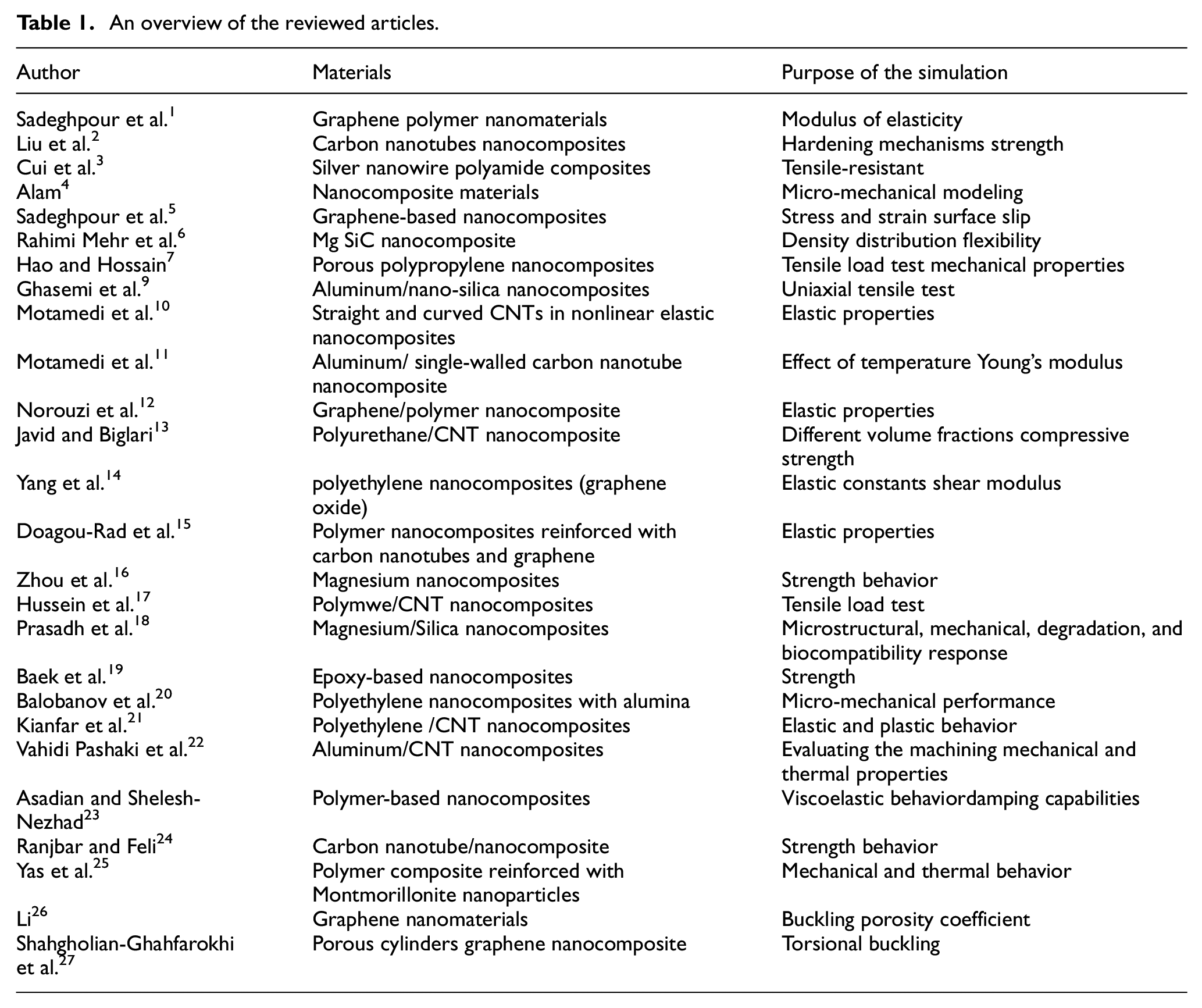
Table 1 shows a summary of the research done for simulation of nanocomposites.
An overview of the reviewed articles.
Result and simulation
Finite element model of copper matrix/carbon nanotube nanocomposite was done for a RVE sample (Figure 1).
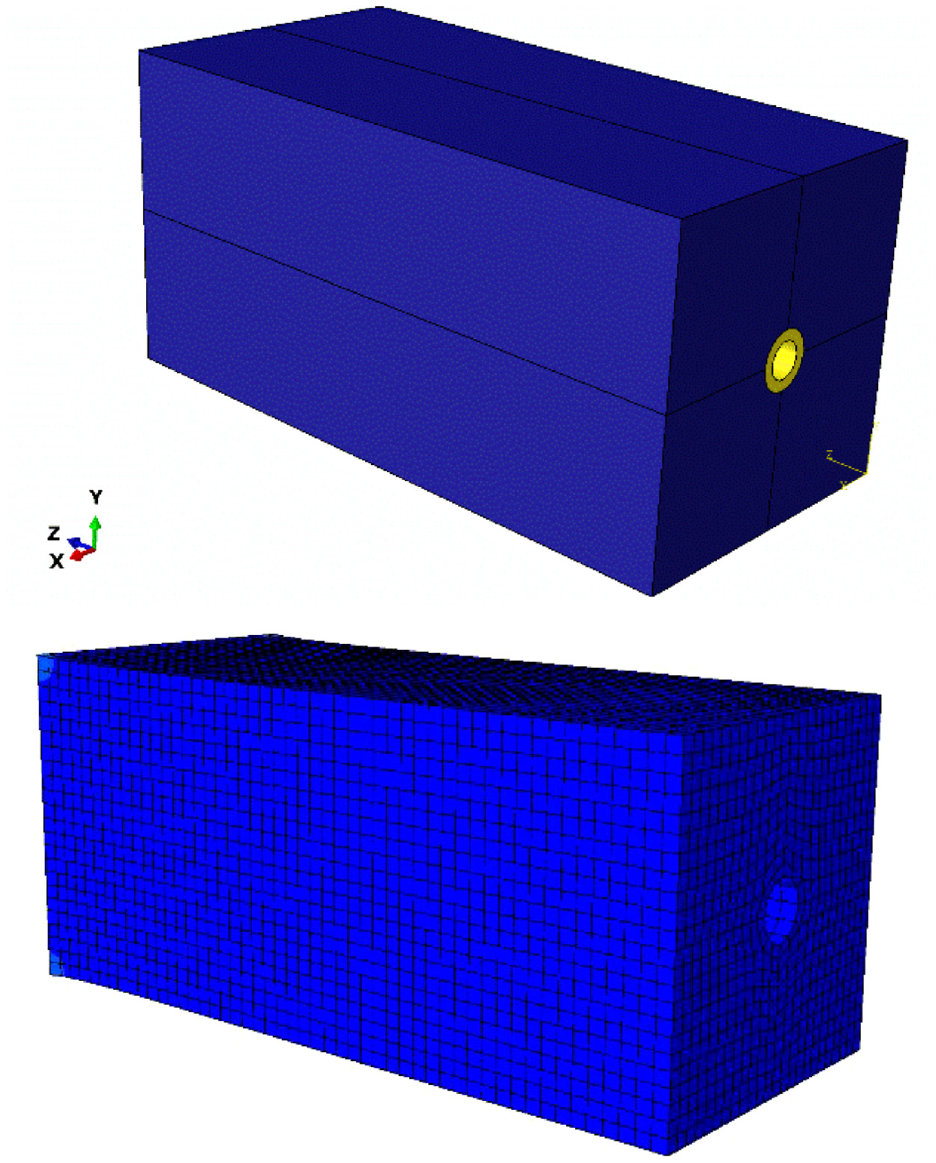
Finite element model of nanocomposite.
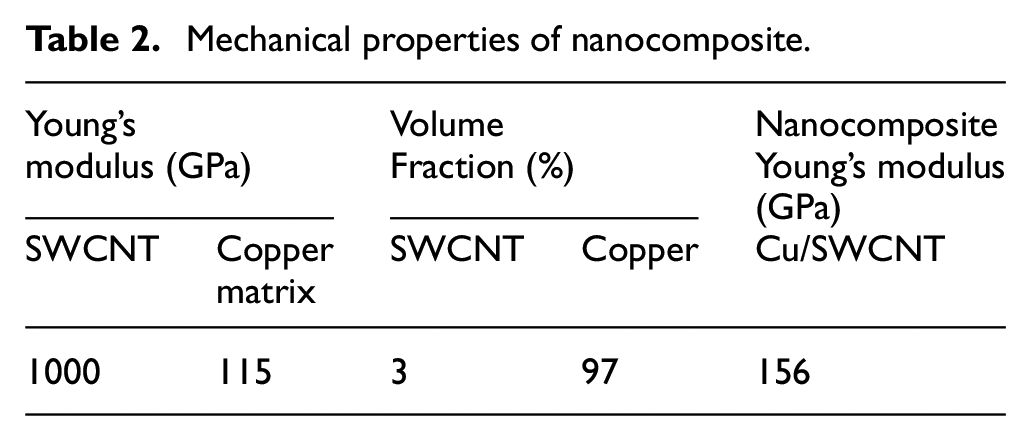
To do this, a box of copper with Young’s modulus of 115 GPa, and a continuum tube (CNT) with Young’s modulus of 1000 GPa were considered. For cohesive zone between CNT and copper, a friction interaction was assumed. As can be seen, the copper strain is more than CNT strain which highlights the CNT role in the strengthening of the composite. In Figure 2, the von Misses stress contour of the composite was shown. The figure shows the role of CNT in suffering more stress in composite compared to copper. ABAQUS software was used to simulate RVE. Solid 8-node linear brick for CNTs and copper is used.
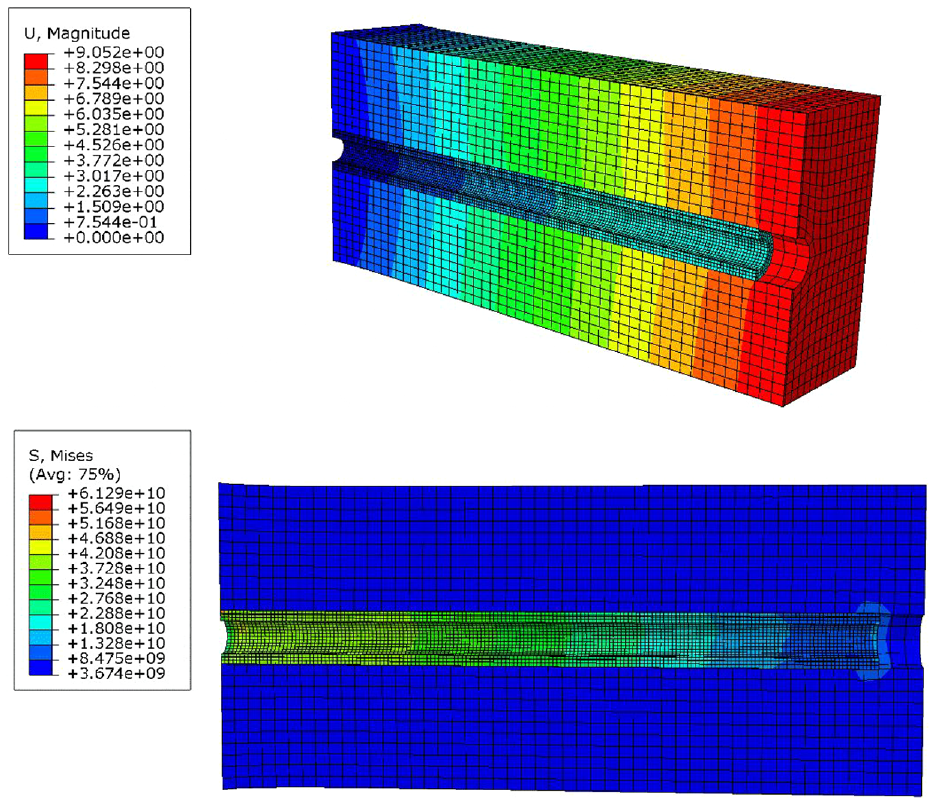
Displacement countour and stress contour of model.
Stress-strain curve for copper-CNT nanocomposite was shown in Figure 3. For finding Young’s modulus of nanocomposite, the slop of stress-strain curve should be gain which is about 156 GPa.
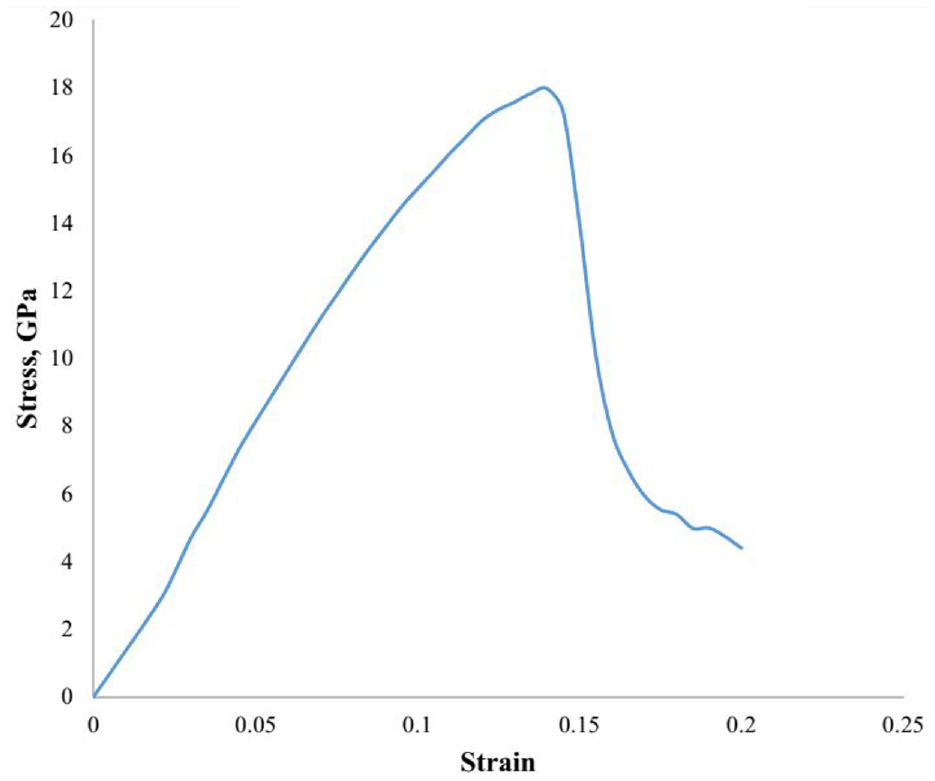
Stress-strain curve of nanocomposite.
The results show in Table 2. As can be found, the Young’s modulus of nanocomposites is about 135% of pure copper.
Mechanical properties of nanocomposite.
Conclusion
In this research, the use of the finite element method in finding the mechanical properties of nanocomposites was investigated. Numerous studies on stress-strain behavior, strength, plastic elastic behavior, bending, buckling, torsion, and other cases have been performed using the finite element method, which was reviewed in this study. In all the researches, the results obtained from the finite element method were in proper agreement with the analytical and experimental results. The use of the FE method allows further studies on nanocomposites, which may not be possible in an experimental method or may require a lot of time and money.
Also, Research showed that nanomaterials can have a positive effect on the performance of parts under load and cause greater strength.
In the following, a model of copper/CNT nanocomposite was studied using finite element method. The model was composed of a CNT in a box of pure copper. The stress contour and displacement contour of model was obtained and the results showed a 135% growth in copper Young’s module.
Footnotes
Authors’ contributions
All authors contributed to the design and implementation of the research, to the analysis of the results and to the writing of the manuscript.
Declaration of conflicting interests
The author(s) declared no potential conflicts of interest with respect to the research, authorship, and/or publication of this article.
Funding
The author(s) received no financial support for the research, authorship, and/or publication of this article.

Availability of data and material
The data that support the findings of this study are available from the corresponding author
Code availability
The LAMMPS package is free and open-source software.