An investigation of the stability of an micropolar nanofluid overlying a sparsely packed porous medium and implanted in a parallel conduit is reviewed. Linear and also nonlinear terms are incorporated for the study. A Darcy-Brinkman-Forchheimer drag force model is deployed. To evaluate nanoscale effects the Buongiorno model is employed. The equations for mass, momentum, angular momentum, energy and nanoparticle species conservation with correlated wall conditions are non-dimensionalized. Modified diffusivity ratio and Lewis number stable the system, the micropolar parameters concentration Rayleigh number destable system for stationary convection. Concentration Rayleigh number, micropolar parameters stabilize and Lewis number destabilizes the system for oscillatory convection. Applications of the study include micro/nano-fluidic devices, nano-doped energy systems and packed beds in chemical engineering.
Eringen1 explained the concept of micromorphic or “simple microfluids.” This elegant mathematical framework model certain microscopic effects. A simpler division of microfluids was also contributed by Eringen2 which exhibit only micro-rotational effects and possess micro-rotational inertia and such fluids are known as micropolar fluids. Micropolar fluids provides a rheological formulation of balance equations required for microfluids and thereby greatly facilitates the extraction of analytical and numerical solutions in boundary value problems. Micropolar fluids are characterized by a non-symmetric stress tensor and physically represent viscous fluids containing non-deformable (rigid) particles (micro-elements) which can sustain body couples, couple stresses, and possess a rotational filed. Eringen3 also presented the applications related to micropolar fluids. Micropolar fluids constitute a non-Newtonian fluid dynamics and as such have been deployed to simulate accurately many diverse liquids arising in industrial, medical and environmental applications. Some recent studies featuring micropolar fluid dynamics have examined geophysical convective plumes,4 stratified flows,5 bacterial slime dynamics,6 and stagnation coating flows of engineering constitutional components. The investigations have also demonstrated the exceptional versatility of this rheological model.
In many technological and geophysical systems, thermal instability (also known as Rayleigh-Bénard convection) plays a momentous aspect. The micropolar fluid convection was first advised by Ahmadi.7 Datta and Sastry8 concluded that for Rayleigh numbers to be positive or negative (negative Rayleigh number is unrealistically high for actual physical systems) the convection sets on. Lebon and Perez-Garcia9 observed that for the convection sets on for stationary case. Pérez-Garcia et al.10,11 showed adopting micropolar fluid that, for stationary convection the subcritical stability was not possible. Dhiman et al.12 opted a variational finite element technique to compute Rayleigh-Bénard convection using different types of boundary conditions on micropolar fluid. They showed that greater microrotation characteristic accelerate the onset of instability using dissimilar boundaries. They further proved that for the rigid-free wall condition, the critical Rayleigh number is elevated for increasing wave numbers and shows high sensitivity to micropolar effects. Sharma and Gupta13 discussed the stability using micropolar fluids and confirmed that suspended particles and rotation parameter can instigate over-stability in the system. They further concluded that the critical Rayleigh number for stationary and over-stability convection is boosted with increasing rotation parameters whereas it is suppressed with greater micropolar effects by fixing wave number. Further studies have been communicated by Payne and Straughan14 (on nonlinear micropolar thermal stability in permeable media), Goyal and Jaimala15 (on double-diffusive micropolar convection with cross diffusion effects) and Sharma et al.16 (on ferromagnetic thermal convection onset in porous media). All these studies have established the significant impact of micropolar material properties to understand the stability. Although micropolar fluids are in themselves a comprehensive pattern for simulating microstructural effects in non-Newtonian fluids, they have also been analyzed in conjunction with other rheological effects. These include shear-thinning/shear-thickening micropolar boundary layer flows,17 viscoplastic micropolar stretching sheet flows18 and more recently micropolar viscoelastic enrobing flows on a cone with the Jeffreys model.19
The onset of convection using porous matrix is of great interest in modern engineering systems and arises in for example, microfluidic devices, heat exchangers, cooling of electronics components, building insulations, and drying processes. Owing to the high surface area achieved with porous fibers, fluid mixing characteristics, higher thermal conductivity, and facility for deployment, natural convection through porous bed has attracted considerable attention in recent years. A comprehensive review of many studies has been provided by Nield and Bejan20 and their survey includes wavy surface instability, double-diffusive convection, stratified flows, mixed convection in non-Newtonian sandwiched layers, super-critical convection in geophysics, vapor front instability, phase change etc.
In the last several years, an ingenious method for developing the thermal transfer characteristics by suspending ultra fine metallic particles in common fluids such as water and oil was investigated. The term nanofluid relates to these colloidal fluids engineered at the nanoscale. Nanofluids are applicable in automotive industries, energy saving devices, nuclear reactors, etc. The unique characteristic property of nanofluids is to increase the thermal conductivity. Nanofluids have great potential as coolants due to their enhanced thermal conductivities. Nanoparticles also have biomedical applications including cancer therapy and nano-drug delivery. Eastman et al.21 and Choi et al.22 presented that thermal conductivity was enlarged by as much as 160% when a less number of nanoparticles or nanotubes was added to the base fluid. Buongiorno23 predicted that the sum of the relative (slip) velocity and velocity of the base fluid to be the velocity of the nanoparticles. Nanofluids play a compelling role for thermal management in next-generation microfluidic/nanofluidic devices, energy systems, fuels, lubricants etc. The review papers by Kakaç and Pramuanjaroenkij,24 Fan and Wang,25 and Yu and Xie26 have manifested that the research on nanofluids using CNTs (carbon nanotubes) and metallic/metallic oxide nanoparticles was in large scale. Shekar et al.27 investigated numerically to study natural convection in a square cavity filled with a nanofluid porous medium. They concluded that the Brownian motion effects reduces the absolute maximum value of streamlines and isoconcentrations. The Brownian motion reduces the skin friction coefficient and Nusselt numbers. The thermophoresis force increases the values of average skin friction coefficient and Nusselt number along with the increase in radiation parameter. Shekar et al.28 also investigated the natural convection flow in a porous square cavity filled with a nanofluid in the presence of magnetic field and viscous dissipation. They claimed that the Brownian motion reduces the skin friction coefficient and Nusselt numbers. The local skin friction and local Nusselt number decreases with the increase in Eckert number and Brownian motion parameter while it increases with the parameters of thermophoresis, magnetic field, and buoyancy ratio. Finite element analysis of magnetohydrodynamic transient free convection flow of nanofluid over a vertical cone with thermal radiation was performed by Balla and Naikoti.29 They remarked that the velocity profile decreases with magnetic parameter, Lewis number and Prandtl number and increases with radiation parameter, Brownian motion parameter, thermophoresis parameter, ratio of Grashof numbers and power law index parameter. The combined effect of viscous and Ohmic dissipations on unsteady, laminar magneto convection fully developed flow in a vertical rectangular duct considering the effects of heat source/sink was investigated by Kishan and Shekar.30
The non-Newtonian nature of nanofluids at certain volume fraction fractions (percentage doping) has also been confirmed experimentally in many studies. These include pseudo plastic (shear thinning) performance copper oxide or alumina nanoparticles dispersed in carboxymethyl cellulose (CMC),31 viscoelasticity,32 glycol nanofluids,33 plug flow in multiwall carbon nanotubes and magnesium oxide nanoparticles suspended in engine oil base fluid34 and titanium dioxide-bentonite drilling mud fluids.35 Many non-Newtonian models have been explored to define discrete nanofluids in applications including Carreau shear-thinning models,36 power-law pseudoplastic/dilatant models,37,38 Casson viscoplastic models,39 the Johnson-Segalman viscoelastic model,40 and Oldroyd-B viscoelastic formulation.41 Using porous matrix, several analyses of the in Newtonian/ non-Newtonian nanofluid on the stability have also been communicated. These include Bhadauria and Agarwal42 who also examined rotational body forces. Binary nanofluid was chosen by Agarwal et al.43 to investigate thermosolutal convective instability. Buongiorno two-component model was employed by Sheu44 to research the thermal convection in an Oldroyd-B nanofluid. He established that there is competition between Brownian motion, thermophoretic body force and viscoelastic parameter (Weissenberg number) leading to a dominance of oscillatory over stationary modes. He also identified that with viscoelasticity, oscillatory instability may arise in both bottom- and top-heavy nanoparticle distributions cases. These studies did not however consider microstructural aspect of nanofluids. Several detailed experimental and molecular dynamics computational studies have confirmed that the rotation of nanoparticles and their shape and size can dramatically influence migration.45–47 These studies have among other aspects identified that the irregular micro-motions of nanoparticles can substantially enhance acceleration which in turn control properties of the thermal conductivity. This may explain other phenomena including clustering and heterogenous thermal distributions recorded in rheological nanofluids.48 The micropolar model therefore provides a logical framework for exploring spin of suspended particles in nanofluids and more elaborate simulation of their behavior. A number of researchers have therefore examined transport phenomena in engineering using micropolar nanofluid. Recent investigations include Abdul Latiff et al.49 who used Maple software to compute the transient slip micropolar nanofluid dynamics in extrusion/contracting sheet flows including micro-organism bioconvection. Rafique et al.50 reported on Hiemenz convection flows of micropolar nanofluids from a tilted surface. Bourantas and Loukopoulos51 employed a meshless point collocation method with a velocity-correction algorithm and the Tiwari-Das model to enumerate convection in a tilted square cavity containing micropolar-nanofluid (aluminum oxide-water) at different volume fractions. Prasad et al.52 presented finite difference solutions for axisymmetric thermosolutal micropolar nanofluid along a cylinder using a modified Buongiorno nanoscale model.
In this investigation, a more detailed appraisal of microstructural characteristics for the permeable micropolar nanofluid stability analysis is presented. A non-Darcian model is implemented considering hydrodynamic drag effects. The Buongiorno pattern is utilized to replicate nanoscale effects (Brownian motion and thermophoretic body force). Extensive visualization of solutions and different convection modes (stationary, oscillatory) are presented. Furthermore, new insight into gyro-viscosity micropolar material parameter effects is elucidated via a regional diagram in which variations of critical Rayleigh and wave numbers are delineated into different quadrant regions. The inspection therefore constitutes an important advancement in current understanding of micropolar nanofluid thermosolutal instability simulation of relevance to geothermics, micro/nanofluid systems and materials fabrication.
Formulation and method of solution
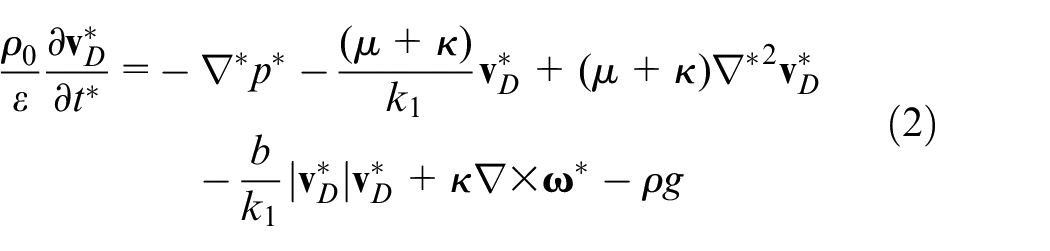
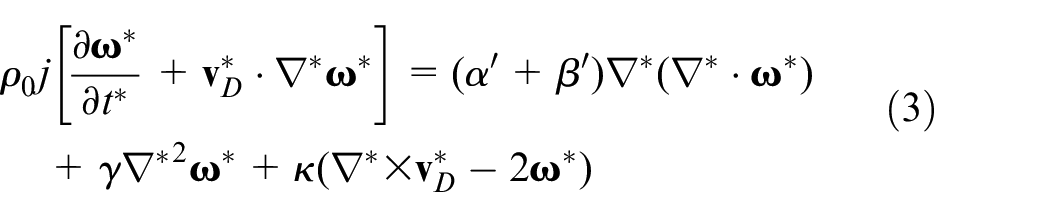
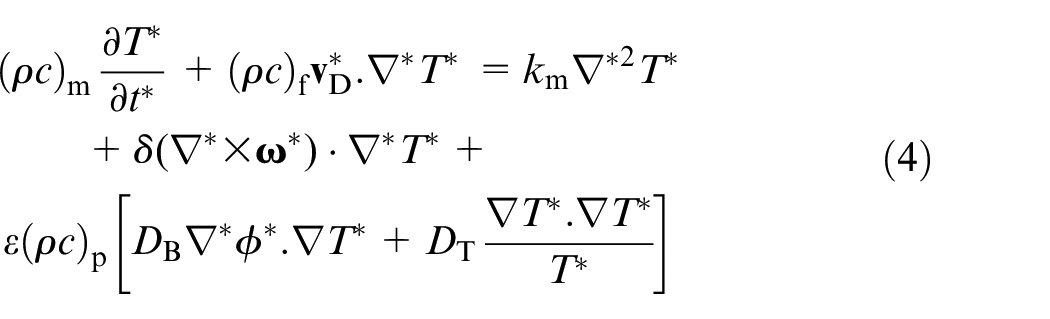
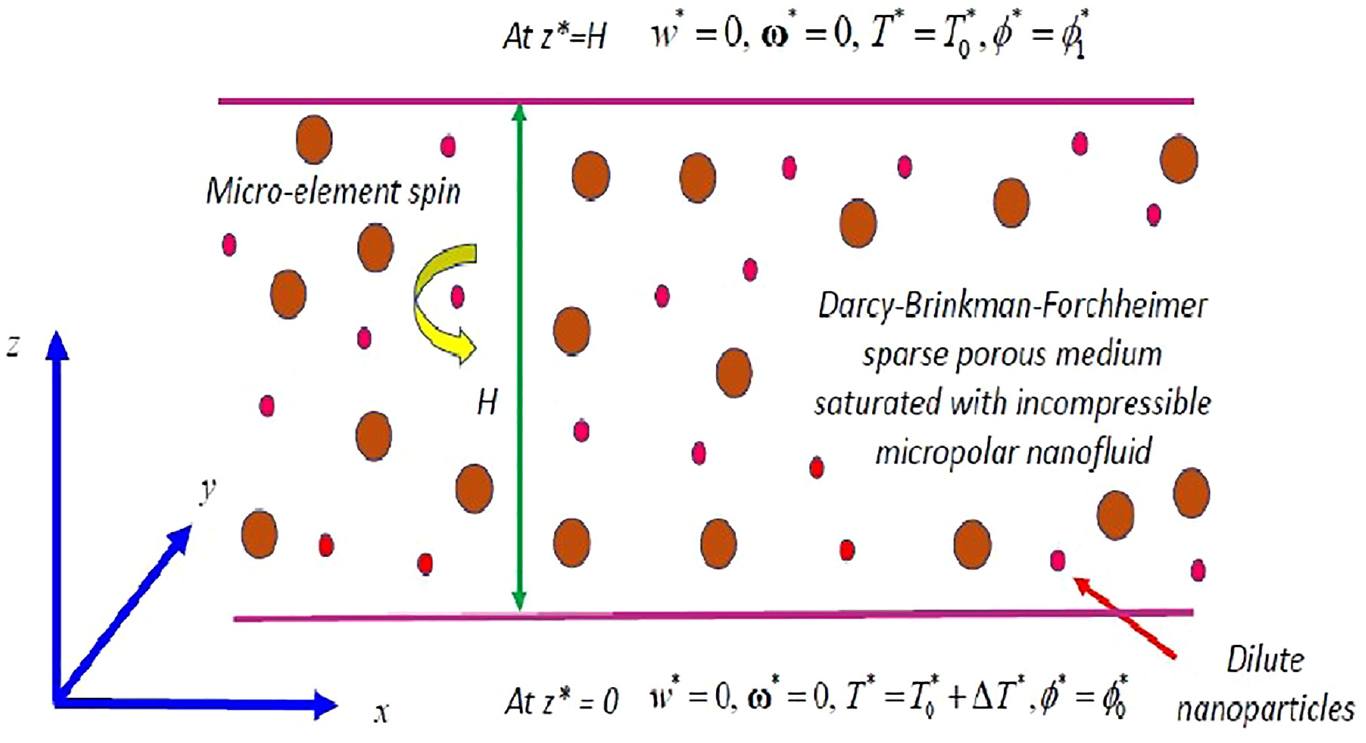
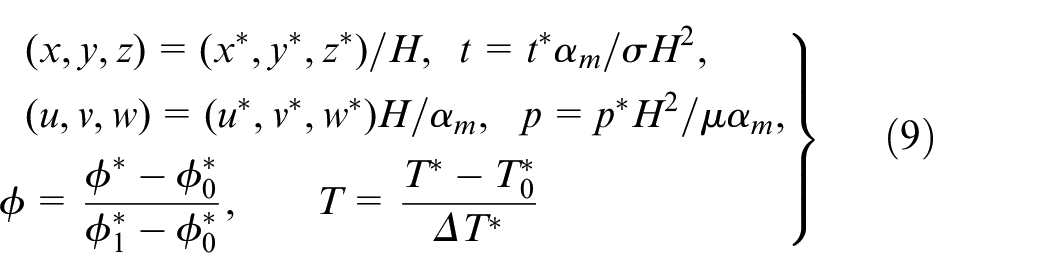
The regime to be analyzed comprises a micropolar nanofluid-saturated porous layer, and the top and bottom walls are heated with a temperature difference (confined between two infinite horizontal plate boundaries located at z* = 0 and z* = H) The objective model is exposed in Figure 1. Following Eringen1,3 and Buongiorno,23 the mass, momentum, angular momentum (micro-rotation), energy and nanoparticle species conservation equations together with the non-Darcy model incorporating the Boussinesq paradox may be presented as:
Schematic diagram.
where , and are velocity, spin and temperature; Here, is the nanofluid Darcy velocity. Writing and are total density, and reference density, is the medium permeability, is Forchheimer constant for nonlinear velocity term; is the nanoparticle volume fraction, is the porosity, is the temperature, is Brownian diffusion, is the thermophoretic diffusion coefficient, pressure, viscosity, gravity and microinertia; , and are Eringen’s micropolar viscosity coefficients. mixture heat capacity, fluid heat capacity, the thermal conductivity and the coefficient denoting the link between thermal and the microelement spin (gyratory motion). The state equation is given by:
Here is the temperature (reference) at the lower boundary, is the particle density, and is the heat expansion coefficient. volumetric fraction of the nanoparticles and temperature are treated to be constant on the boundaries.
Hence the wall settings are (following Buongiorno23):
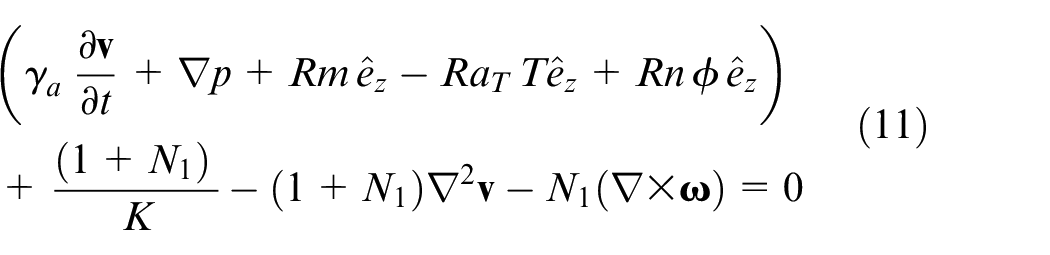
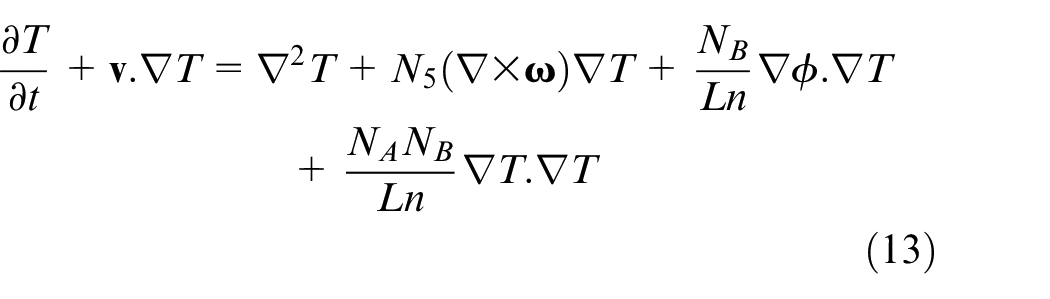
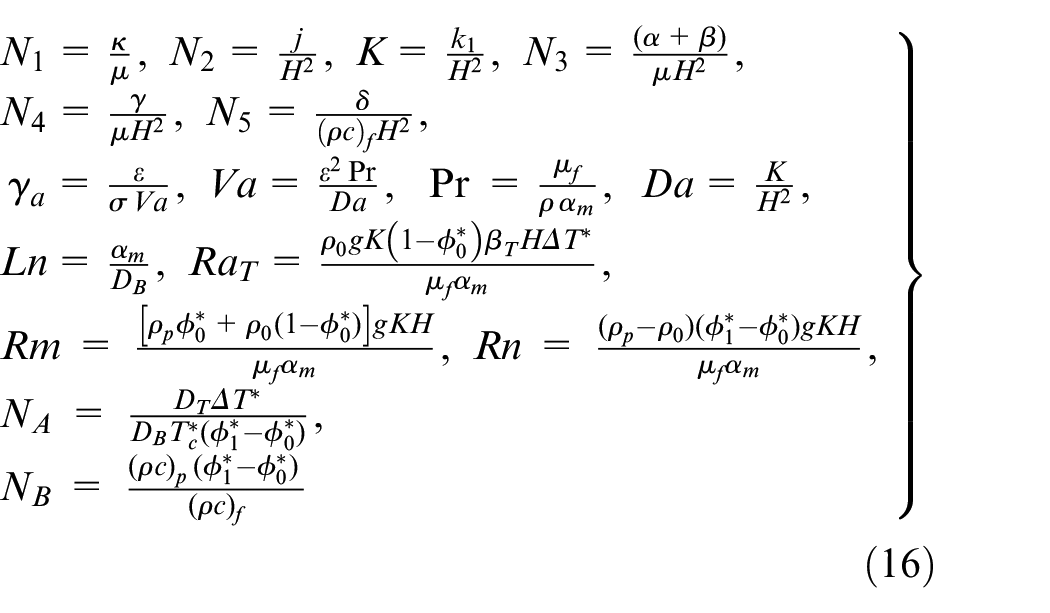
The parameter is the non-dimensional acceleration coefficient, is a Lewis number, is the thermal Rayleigh–Darcy number, is a Vadász number, Pr is the Prandtl number, and is the Darcy number. Rm basic-density Rayleigh number, and Rn is concentration Rayleigh number, respectively. is a modified particle-density increment and is a modified diffusivity ratio. Equation (11) has been linearized by not including the product of T and .
Basic solution
The solutions of equations (10)–(15) are considered to be time-independent quiescent varying in the z-direction only and takes the form
According to Buongiorno,23 for most nanofluids is large, of the order of –. The volume fraction of the nanoparticles decrement is typically not less than and this suggest that Lewis number, Ln is large, of order –, while is less than 10. Hence the basic solutions become
Perturbation solution
By imposing the perturbations on the basic solution. Using:
merely quantifies the basic pressure gradient and therefore is not connected in the following analysis.
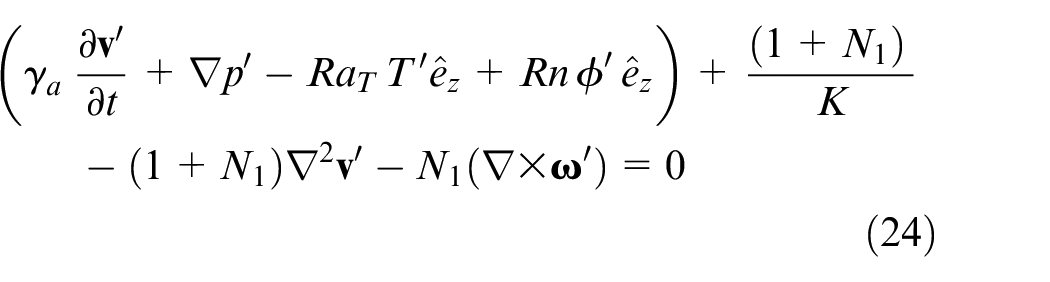
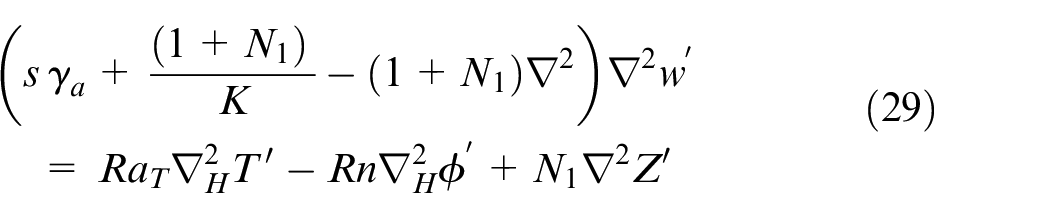
Operating on equation (24) with curl curl and applying the relation curl curl grad div - and imposing weak heterogeneity assumption on equation (23), yields the following equation.
is the two-dimensional Laplacian operator on the horizontal plane.
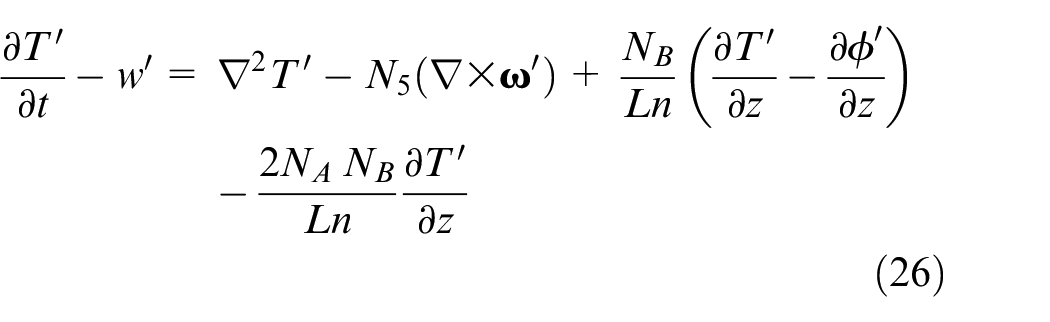
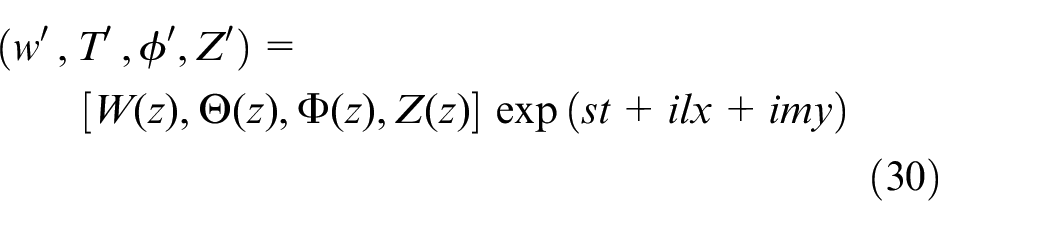
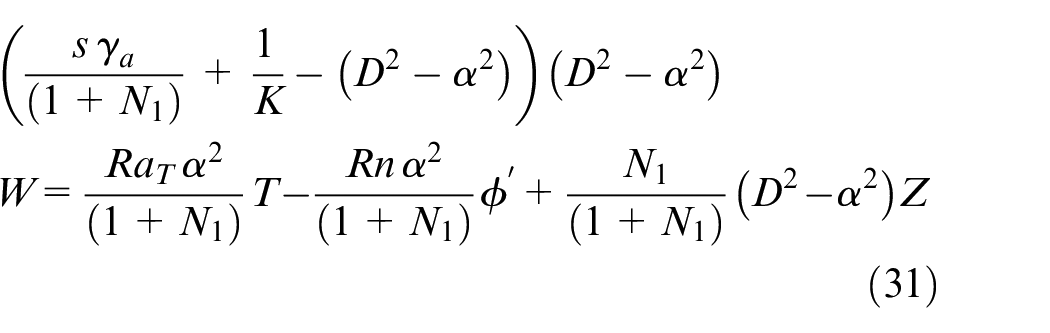
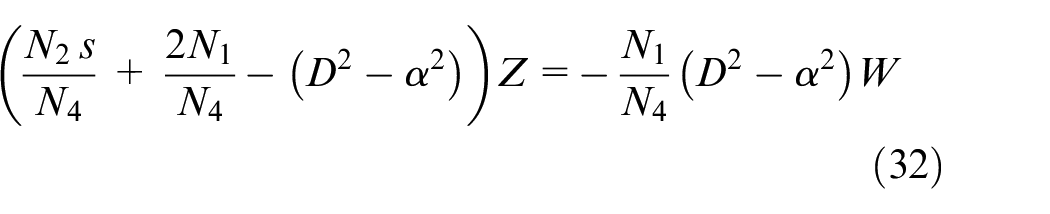
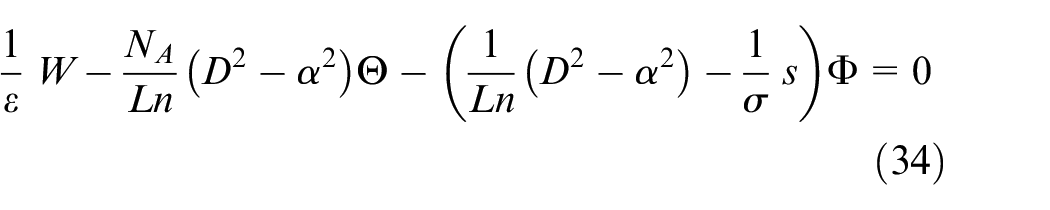
The differential equations (25), (26), (27), (29) along with (28) constitute a linear boundary-value problem and is determined adopting the method of normal modes. We write:
Implementation in the differential equations (25)–(27) and (29) leads to:
where
Thus is a dimensionless horizontal wave number.
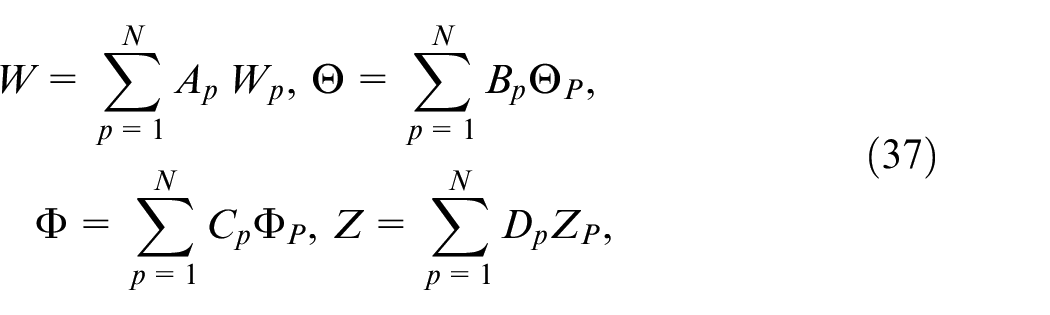
For neutral stability the real part of s is zero and , where is real denoting the frequency. By the Galerkin method approximate results are established for the equations (31)–(35). The trial functions are:
A system of 4N linear algebraic equations in 4N unknowns , p = 1, 2, . . . N are obtained by making the residuals orthogonal to the trial functions. The eigen values are extracted by vanishing the determinant of coefficients. become one of the eigenvalue which helps to compute in terms of other parameters. Trial functions satisfying the boundary condition (37) are:
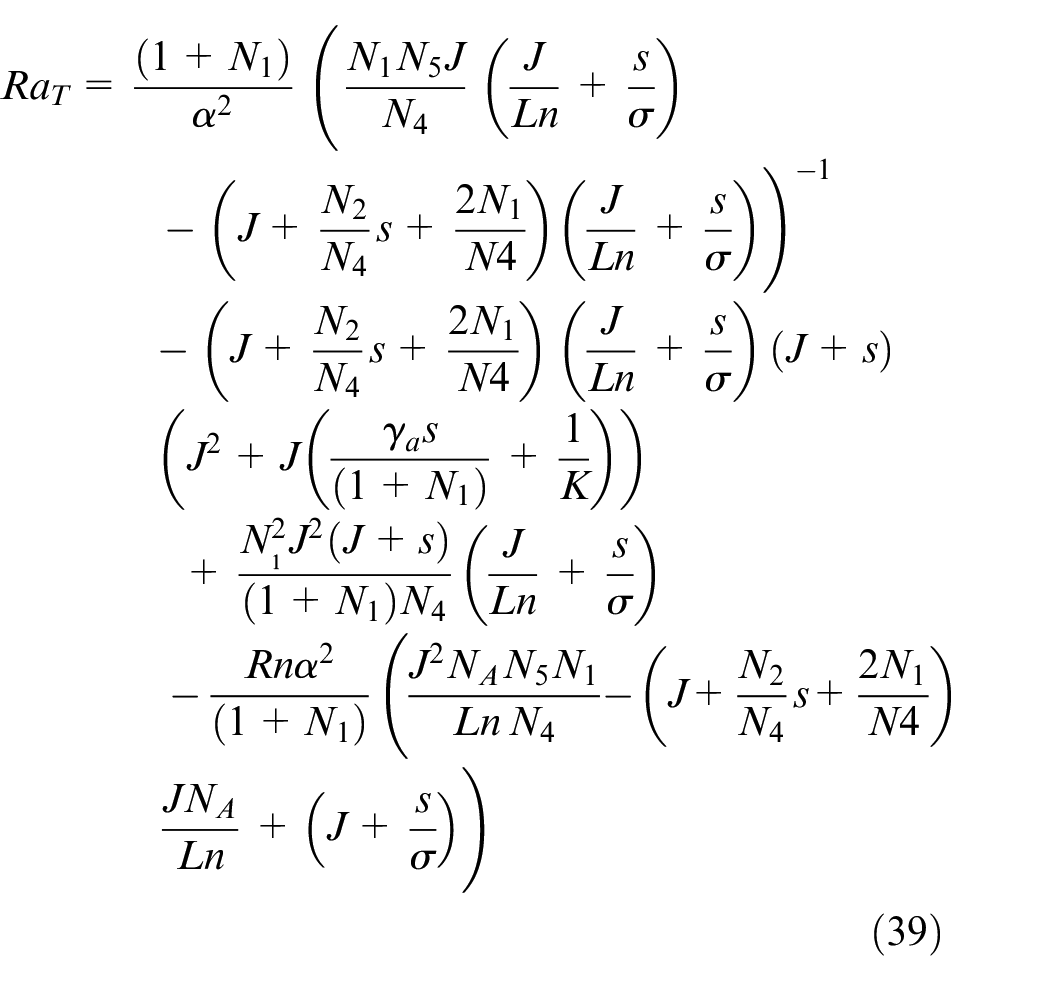
The Eigen value equation is:
Linear stability analysis
Stationary mode
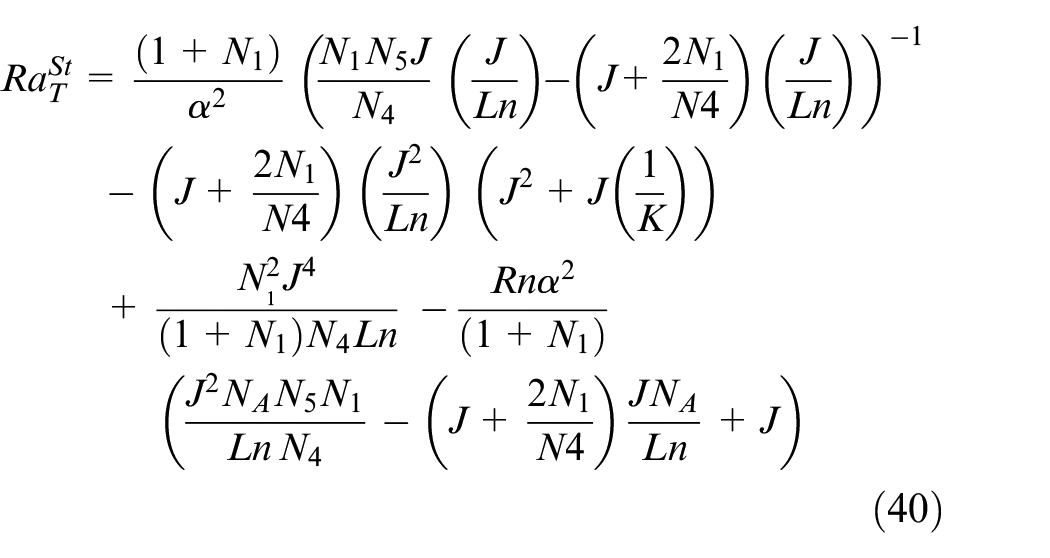
For steady case we take and as a first approximation. Therefore, the Rayleigh number for steady state is
Oscillatory mode
Consider in equation (39) and after removing the complex strings in the denominator we get
Dropping the subscript and setting leads for the relation
and , , , are lengthy algebraic expression and omitted for brevity.
If there are no positive solutions for equation (43), then it implies that oscillatory instability does not exist. The oscillatory neutral Rayleigh number is derived by choosing the minimum of the two positive solutions of equation (43) with (equation (42)). There are possibilities of having two positive solutions for , however for the values chosen for and , end up with only one positive solution of equation (42) which endorse that there exists only one oscillatory neutral solution. Equation (43) is minimized with wave number numerically after substituting for values greater than zero, from equation (42) for distinct values of dimensionless parameters to create convection in oscillatory mode.
Stability analysis for non-linear terms
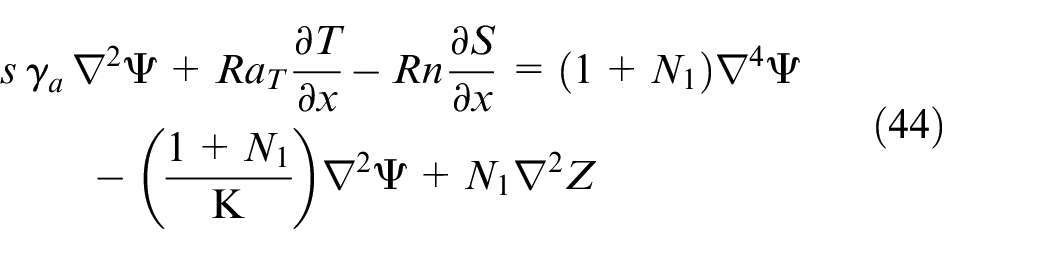
Assuming physical quantities to be independent of and considering only two-dimensional rolls, introducing stream function and eliminating pressure yields
Equations (49)–(52) are evaluated by subjecting them to stress-free, isothermal, iso-nano-concentration boundary conditions:
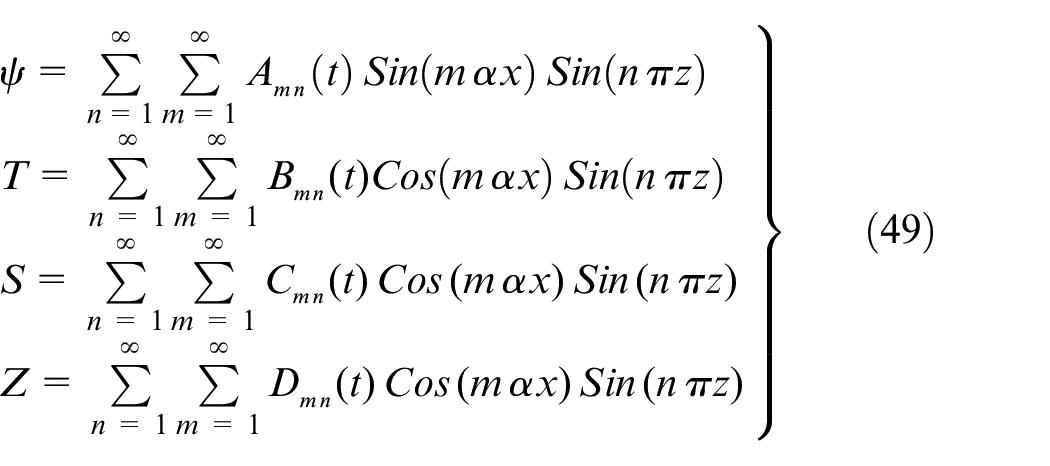
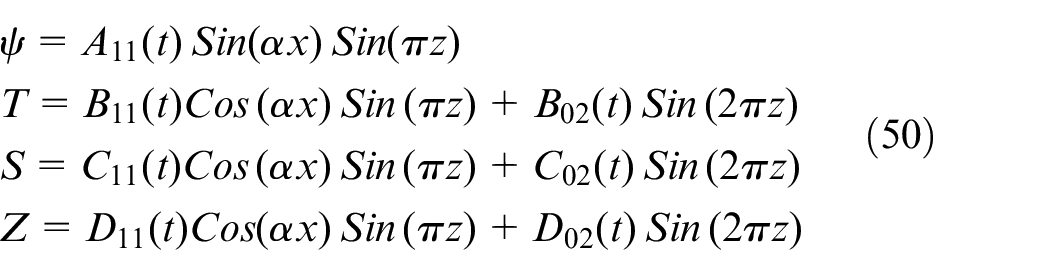
To perform a local non-linear stability analysis, the following Fourier expansions are adopted:
Taking (0, 2) modes for temperature, and (1, 1) modes for stream function and nanoparticle concentration gives
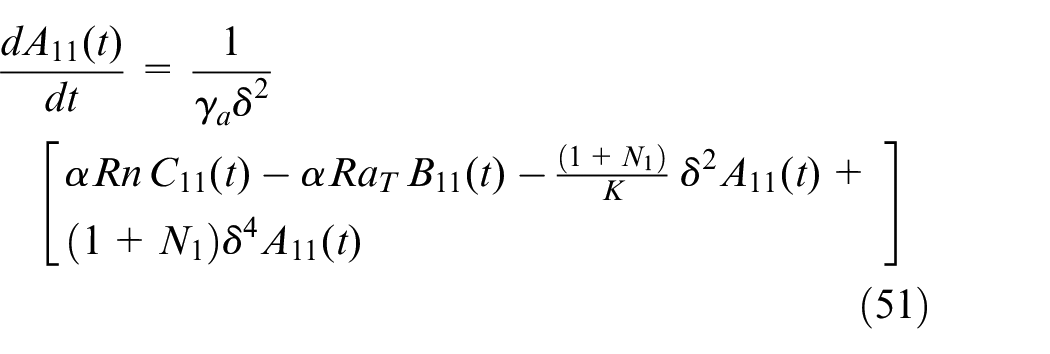
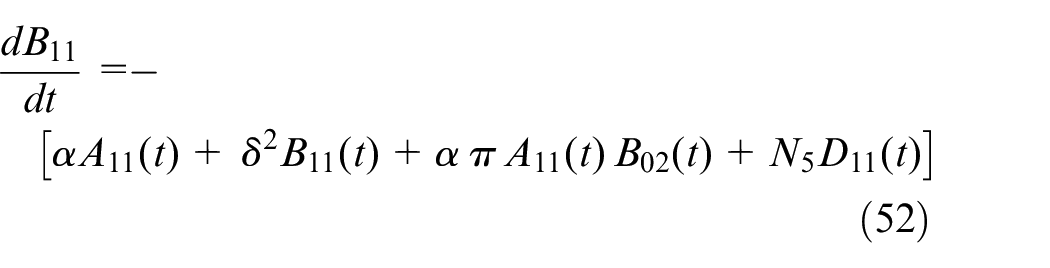
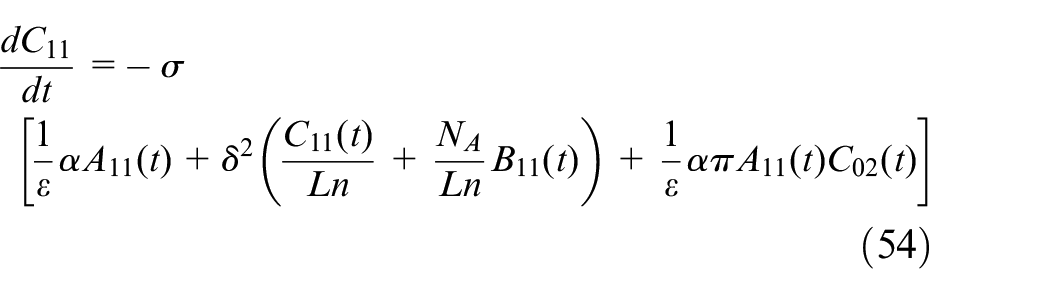
The amplitudes which are functions of time are ,,, ,, and . By the interactions of and and , the flow fields are distorted. It is evident that is minimally represented, as it is the simplest possible form for satisfying the plate conditions. The amplitude is lean on time and should be evaluated. The term is the nominal representation for and is included. The term perform the basic depiction for the distortion of the mean temperature field. The reason for the value 2 in the argument is that the mean temperature field is distorted by the convective term , in the heat equation; since both and have components proportional to , this will force a dependence on the mean temperature. Similar remarks apply to angular spins and the nanoparticle concentrations.
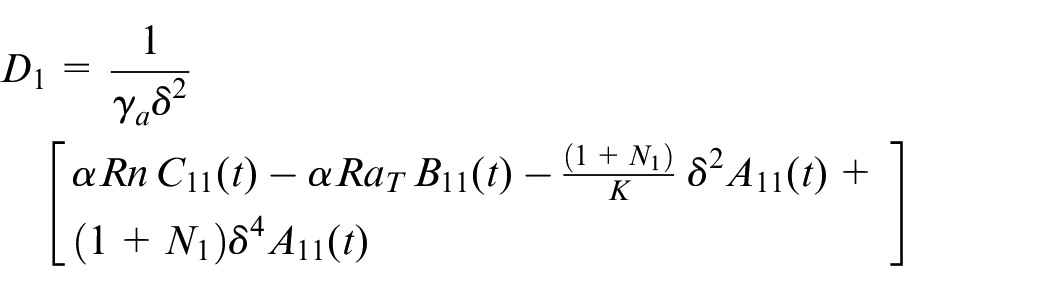
Adopting orthogonality condition over the Eigen functions we obtain
In case of steady motion , (i= 1, 2, .., 7) and writing all s in terms of yields:
Along with
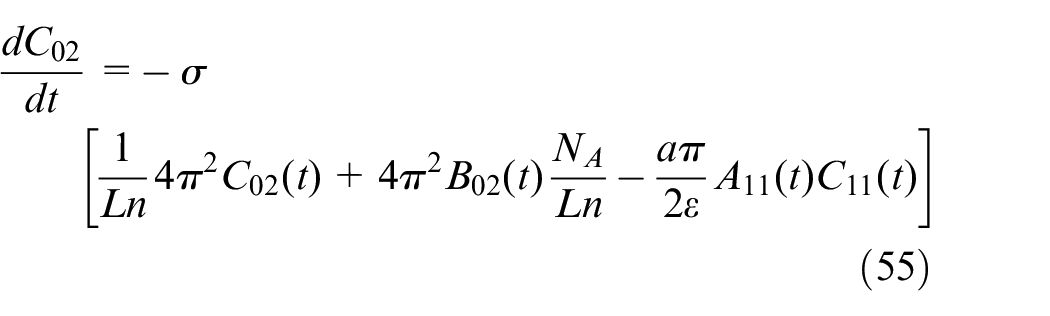
Runge-Kutta method is engaged to acquire the solutions of the above system of simultaneous ordinary differential equations.
Nanoparticle transport of concentration and heat transport
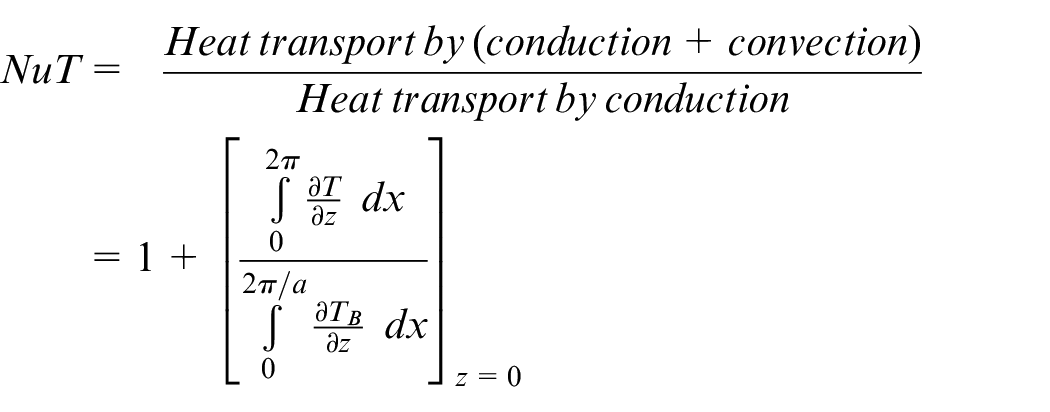
The Thermal Nusselt number is described as (following Malashetty et al.54)
Substituting expressions (24) and (50) in gives:
is the thermal Nusselt numbers. is estimated similar to and they are:
Results and discussion
Prior to elaborating the computational results, some discussion is warranted regarding the parameter of the micropolar fluid describing the coupling between thermal flux and spin flux. The thermodynamic restriction imposed on the coefficients of micropolar viscosity is
The sign of as suggested by Lebon and Perez-Garcia9 is negative (or and constant given in Datta and Sastry8 will result in a stationary onset for the plates heated either from down or above. However, in Payne and Straughan14 and he showed that oscillatory convection occurs only for heating the upper plate and stationary convection occur only heating the lower plate.
We will discuss the stability characteristics for arbitrary choices of , since the thermodynamic restrictive condition (6) does not require polarity of or explicitly, nor indeed does . Under the condition there is no coupling between the heat flux and spin flux, and one can conjecture that the stability characteristics will be identical to those of classical Rayleigh-Bénard convection. The oscillatory convection is not possible when . Heating the lower plate the convection in stationary mode occurs. The micropolar fluid in the presence of porous material is more stable when compared with the fluid without the porous material. The Rayleigh number increases by increasing (progressively more densely packed porous bed). Hence, porous material helps to stabilize the flow system. Porous materials also provide a greater surface area for energy transfer as noted by Bég et al.53
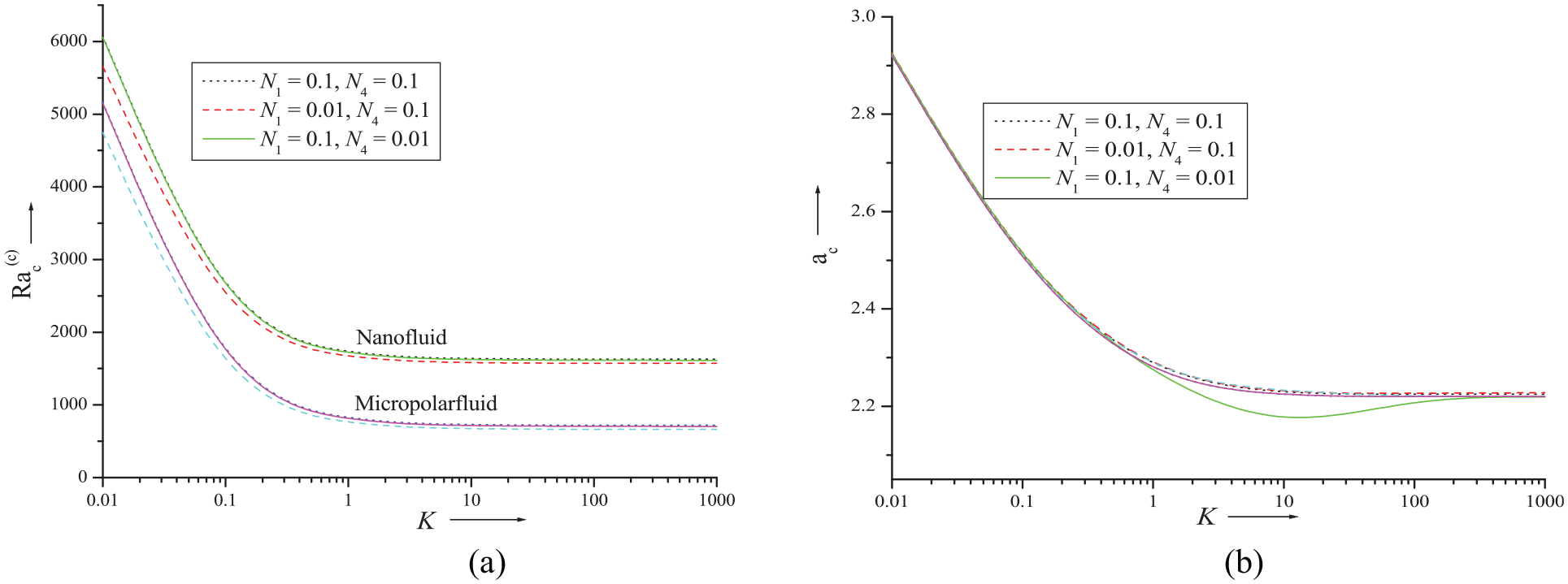
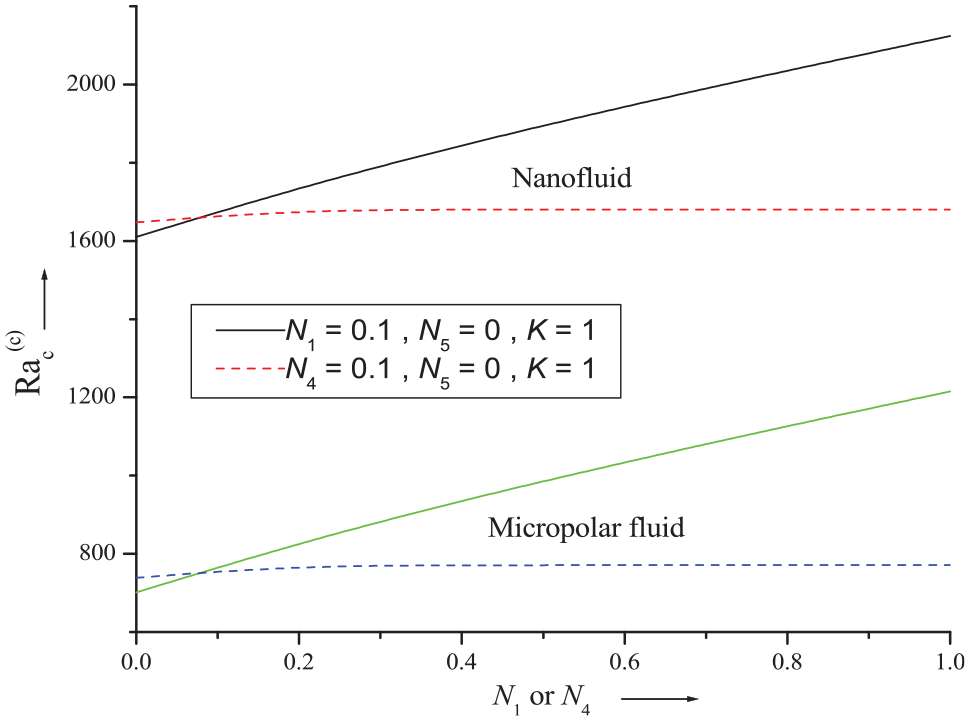
Figures 2 to 4, are the graphs of the critical Rayleigh and wave numbers for micropolar fluid with suspension of nanoparticles and without the suspension of nanoparticles. Figure 2(a) and (b) exhibit (critical Rayleigh number) and (critical wave number) with different sets (vortex viscosity parameter) and (spin gradient viscosity parameter) decrease as permeability, increases for the case (vanishing micropolar coupling parameter). and approach to the limiting values 719.348/2.219, 664.043/2.221, and 704.363/2.215 with being 0.1/0.1, 0.01/0.1, and 0.1/0.01, respectively, as becomes very large, which corresponds to vanishingly small porous media effects. It is also evident from Figure 3 that the Rayleigh number increase with or for and . Curve behaves as a monotonic increasing function of with while curve albeit initially increasing with thereafter apparently exhibits independence of when for .
(a) The sketch of versus for and (b) the sketch of versus for .
The sketch of versus or for .
(a) The sketch of versus and (b) the sketch of versus .
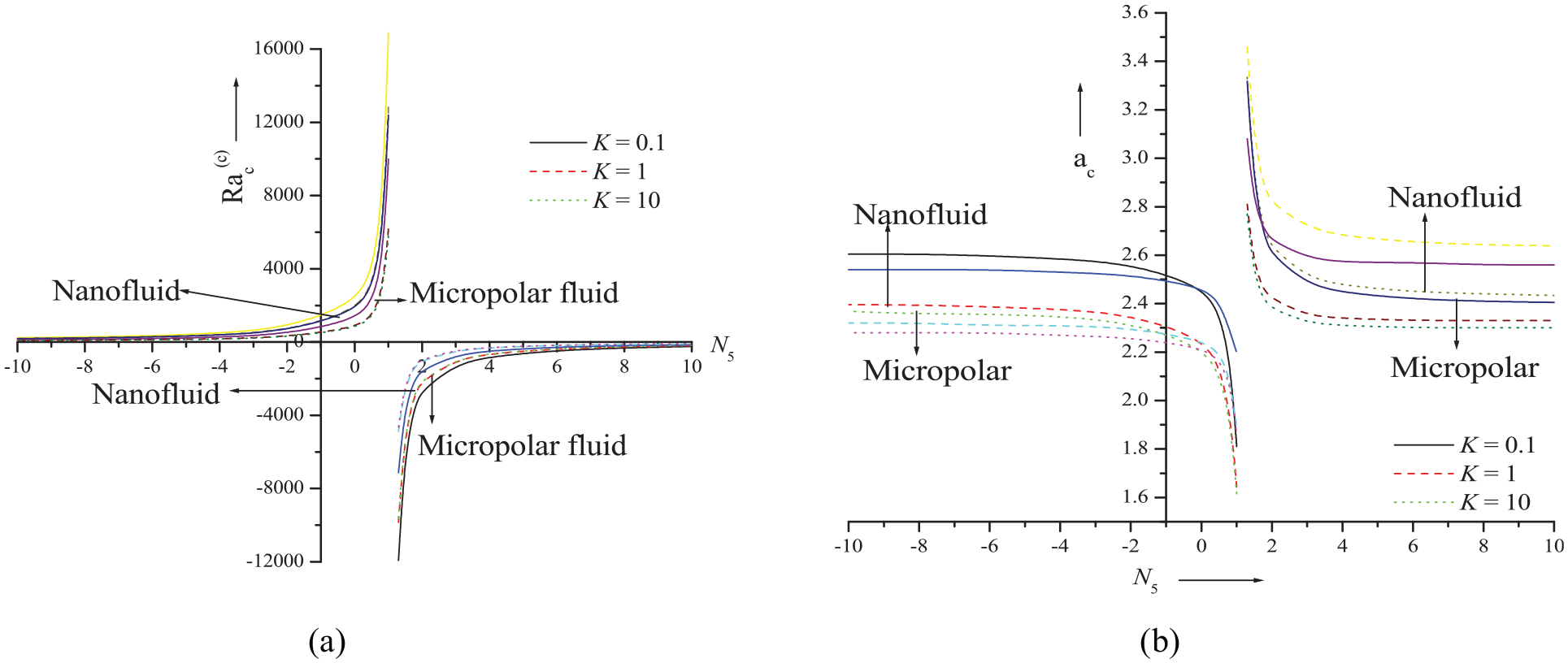
Figure 4(a) and (b) show the diversity of and with the micropolar coupling parameter, . Inspection of Figure 4(a) flourish that the Rayleigh number is discontinuous with variation. for lower is greater than that computed for larger . For Negative values of , and for positive values of .
Figure 4(b) reproduce that the approaches a limiting value for different when is large positive or large negative. There also exists a discontinuity for the wave number as is near that threshold. From these sketches it is concluded that the value of and is lower for only micropolar fluid compared with micropolar nanofluid, that is, the convection is induced earlier in purely micropolar fluids than with micropolar nanofluids. This accord the fact that the thermal conductivity of nanofluids is higher than ordinary fluids, signifying that the existence of nanoparticles influence the initiation of convection.
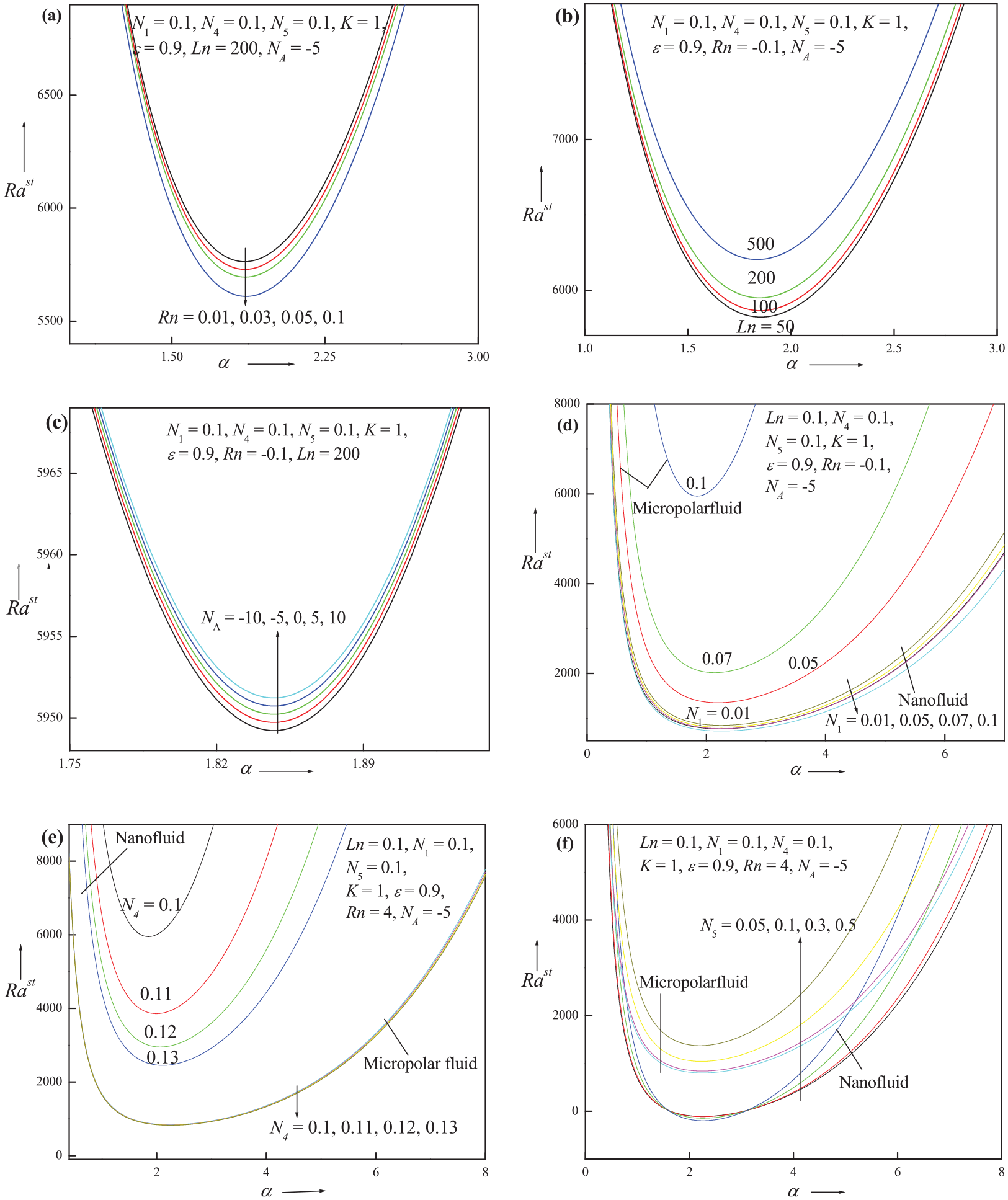
The thermal Rayleigh number for stationary and oscillatory convections have been defined earlier in equations (40) and (43) respectively. Figure 5 (stationary convection) prove that large values of destabilize the system as decreases by enlarging . Figure 5(b) signals that as Lewis number increases the also increases which indicates that the system gets stabilized for large values of . To sketch the profiles in Figure 5(b) to (f), the value of is taken as −0.1. Physically positive values of leads for top-heavy and bottom-heavy for negative values of . The values of are advanced by enhancing values of and hence approach the convection to occur as can be viewed in Figure 5(c).
Trajectories of neutral stability for stationary convection on (a) , (b) , (c) , (d) , (e) , and (f) .
The enact of , , and on thermal Rayleigh number are displayed in Figure 5(d) to (f) for micropolar nanofluid and only for micropolar fluid. These figures detail that for only micropolar fluid as and increases increases but it decreases for . Thus and advances and delay the onset of convection. For micropolar nanofluid, decreases with and which cases the system to destabilize and increases with which stabilize the system.
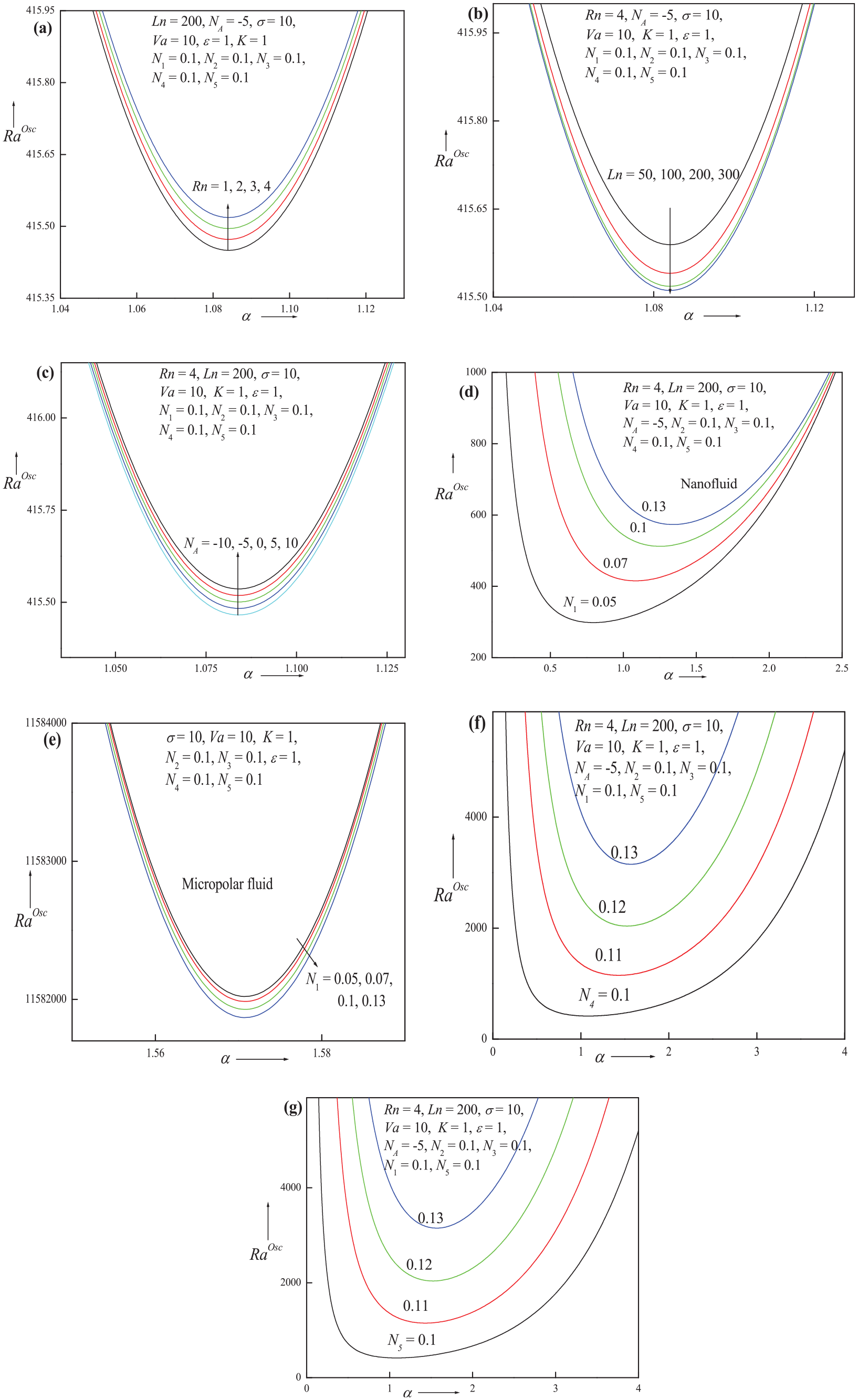
Figure 6(a) to (g) characterize the oscillatory convection with several selected parameters. In Figure 6(a) it is realized that as raises is also upsurged which will quicken the convection. reduces the and induces the destabilization (Figure 6(b)). however does not exert any noteworthy impact on the convection (Figure 6(c)) as the values of are not altered significantly. The impact of for nanofluid (Figure 6d) and micropolar fluid interpret that increases for nanofluid and downturn for micropolar fluid with . Hence nanofluid helps to hasten and micropolar fluid lag the convection to set on. The is boosted with (Figure 6(e)) and (Figure 6(f)) and hence and help to stable the system.
Trajectories of neutral stability for oscillatory convection on (a) , (b) , (c) , (d) , (e) , (f) , and (g) .
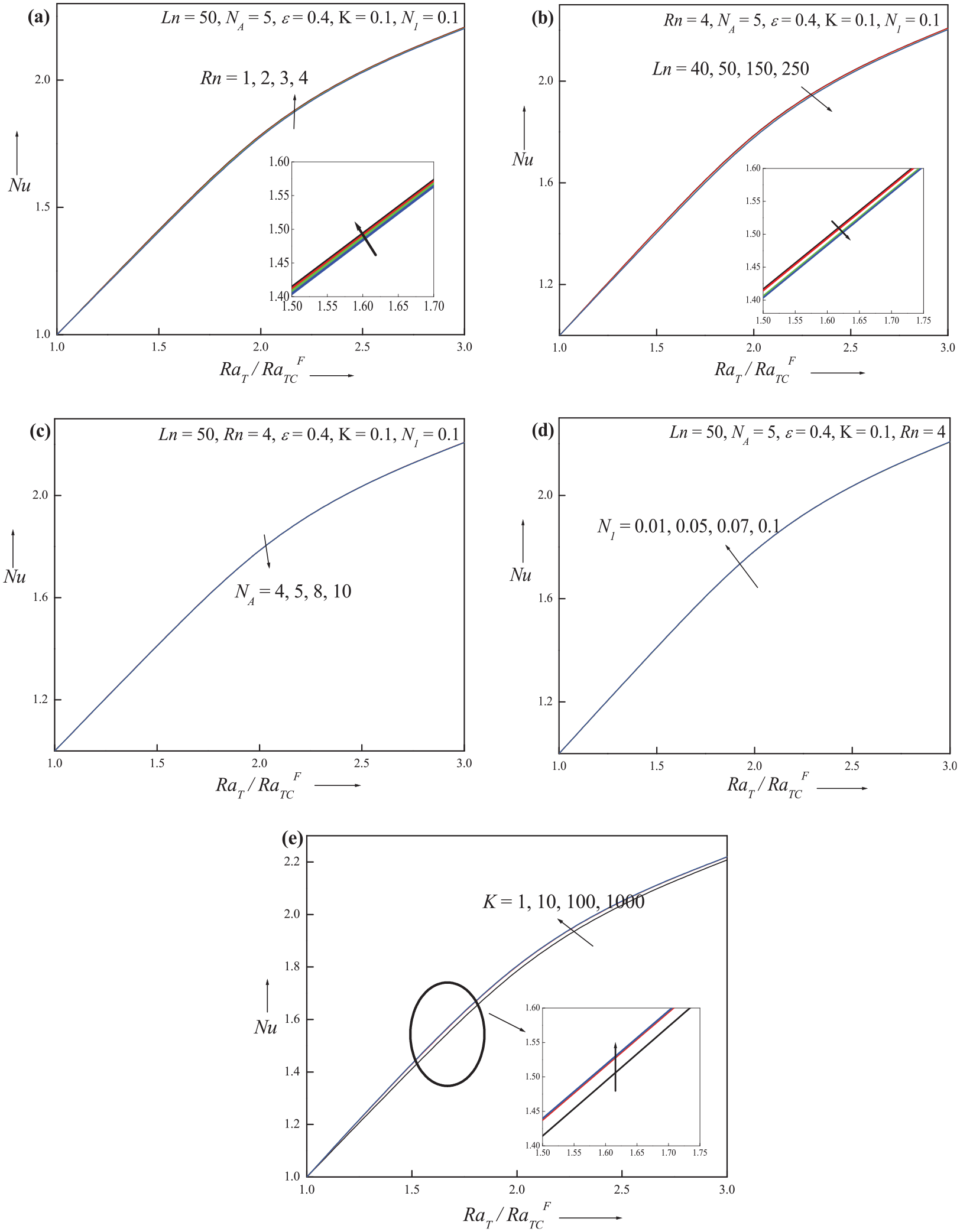
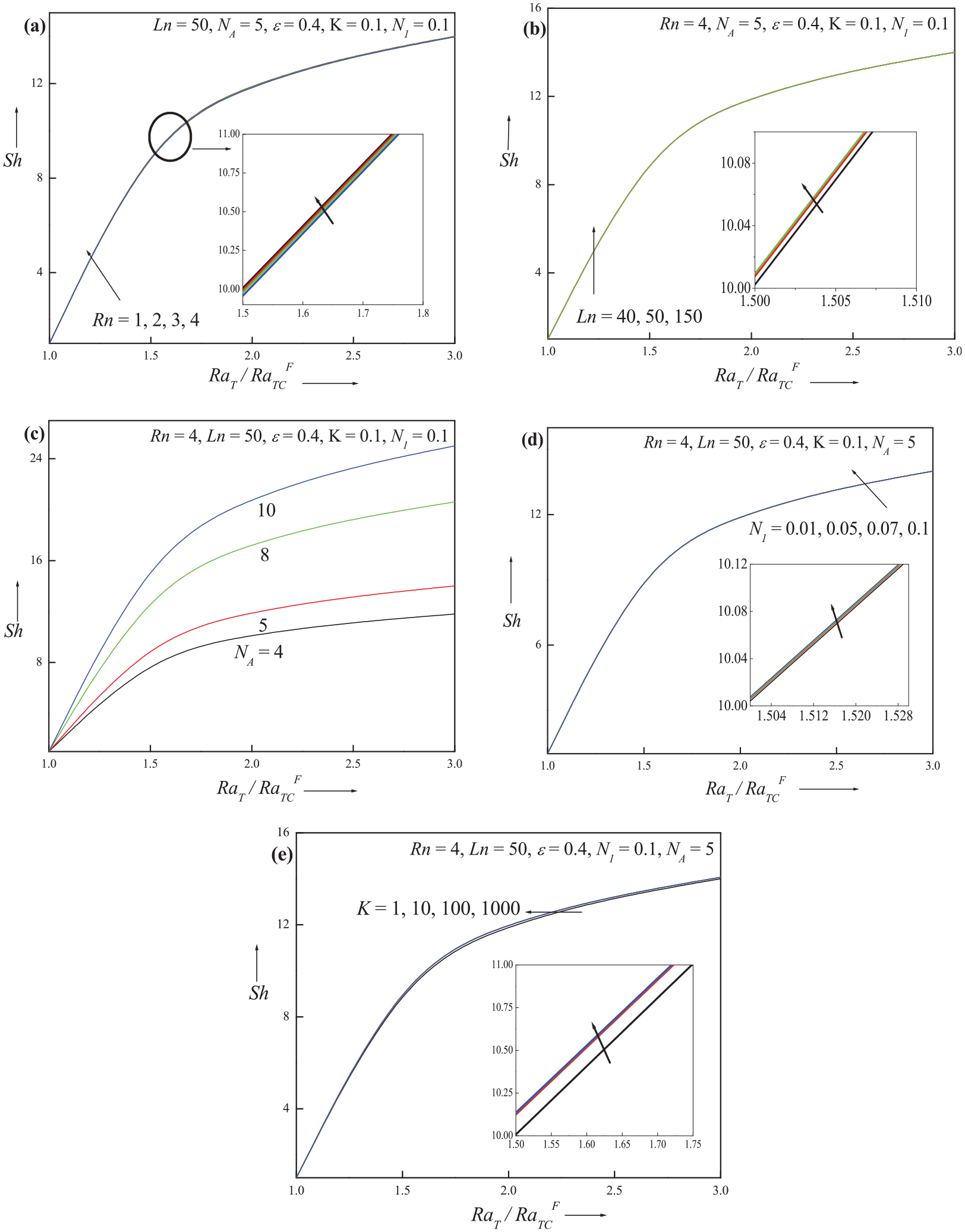
To understand the heat and mass transfer, nonlinear scrutiny is undertaken in this study. The Nusselt , and shearwood numbers are computed in terms of and the impact of and are outlined in Figures 7 and 8 respectively. In general from Figures 7 and 8 one can conclude that both and posses the value 1 at the conduction state and the maximum bound for is 3 (similar observation was made by Malashetty et al.54) both for micropolar and micropolar nanofluid. Shearwood number attains the upper limit to be 3 for micropolar fluid and it is flexible for micropolar nanofluid (nanofluid upper bound property was similar to Bhadauria and Agarwal42). Transfer of mass and heat are sustained by as narrated in Figures 7(a) and 8(a) because and are enhanced with . The Lewis number reduces and increases as can be detained in Figures 7(b) and 8(b) respectively. The modified diffusivity ration does not play any role on (Figure 7(c)) whereas it increases significantly (Figure 7(d), similar to Bhadauria and Agarwal42 ). Micropolar parameter do not disturb much the (Figure 7(d)) and Sh (Figure 8(d)). The mass and heat transfer are stimulated by the porous parameter .
Trajectories of Nu with on (a) Rn, (b) Ln, (c) , (d) , and (e) .
Trajectories of with on (a) Rn, (b) Ln, (c) , (d) , and (e) .
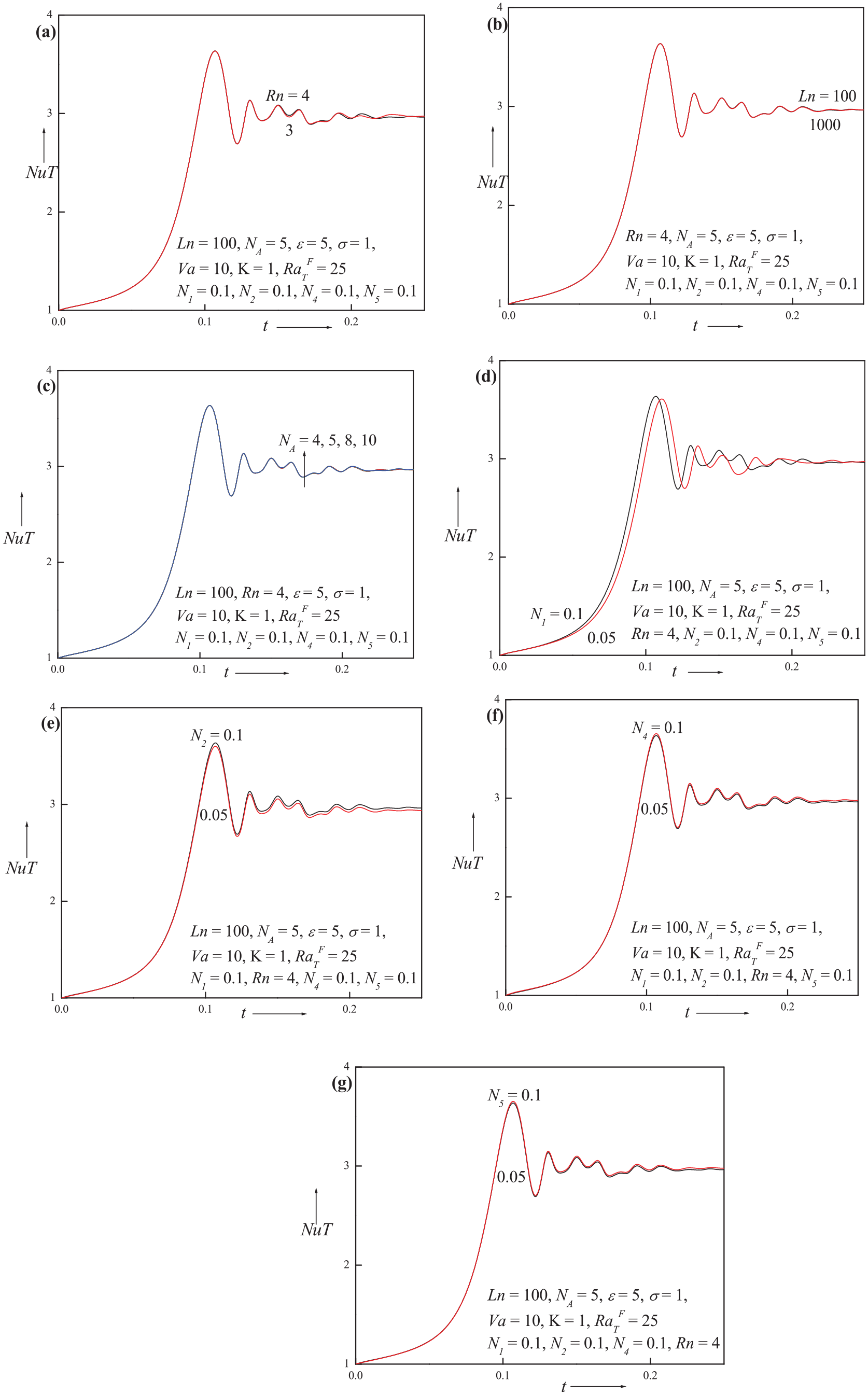
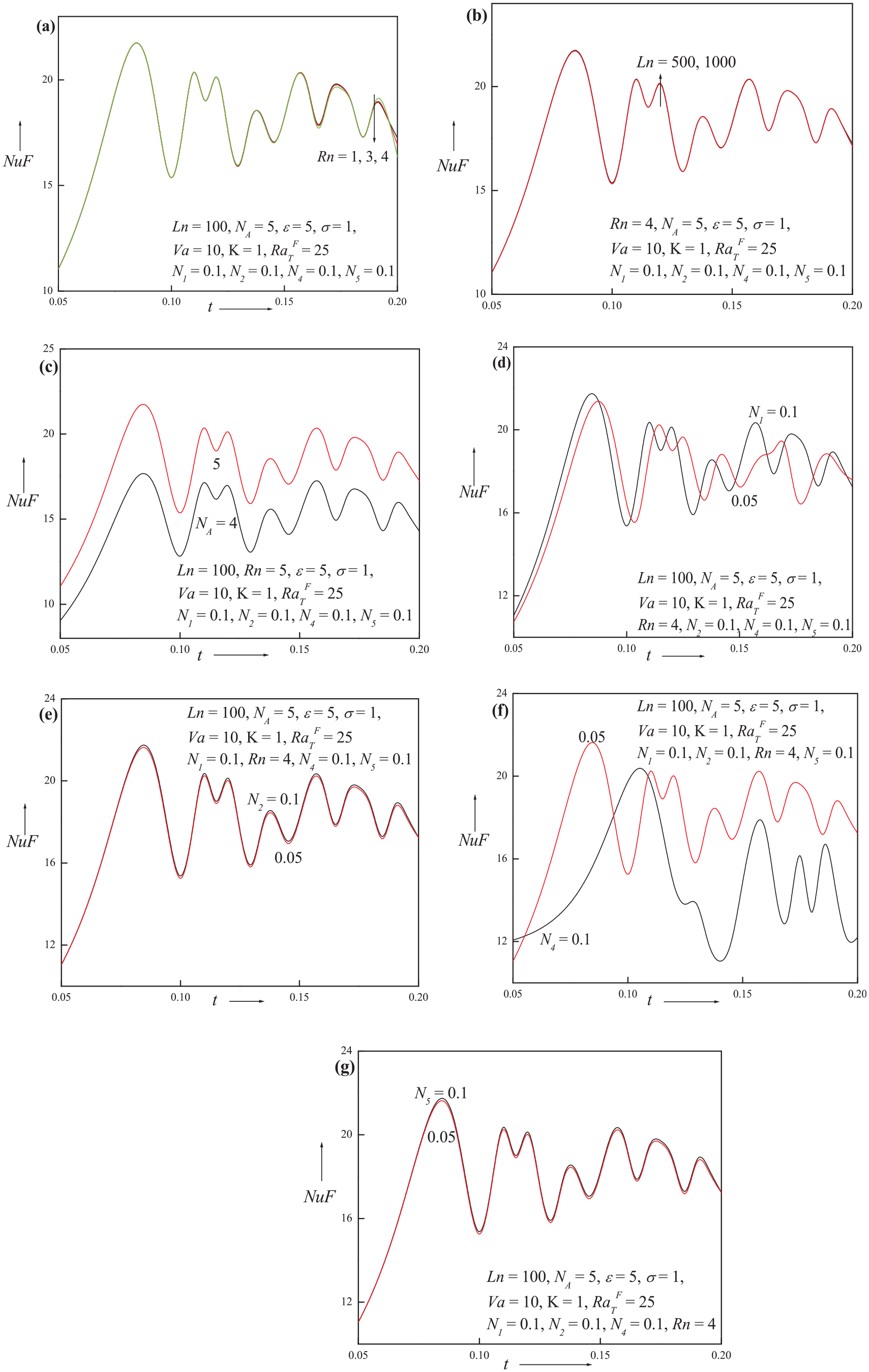
The transition from linear to non-linear convection although challenging, reveals delightful information of the fluid dynamics. The unsteady transient property of and are sketched in Figures 9 and 10 respectively. Initially when time is small, large oscillations occur for both and and these oscillations tends to steady state after a some time. Figures 9 and 10 illustrate the transient property of thermal and concentration Nusselt numbers over the key parameters. Figures 9(a) and 10(a) report that as increases and is diminished claiming that transfer of heat is reduced to the boundaries and the similar result was also mentioned in Agarwal et al.43 The suppresses (Figure 9(b)) and it helps to increase (Figure 10(b)). The modified diffusivity ratio (Figures 9(c) and 10(c)), micropolar parameters , and (Figures 9(d), (e), (g), 10(d), (e) and (g)) portrait that they all activates both and . The micropolar parameter (Figures 9(f) and 10(f)) accelerate and decelerate .
Trajectories of versus (a) Rn, (b) Ln, (c) , (d) , (e) , (f) , and (g) .
Trajectories of versus on (a) Rn, (b) Ln, (c) , (d) , (e) , (f) , and (g) .
Conclusion
The micropolar nanofluid saturated overlying on the porous bed inserted in a horizontal channel was taken to study stability. The upper plate was cooled and the lower plated was heated importing non-Darcy model and Buongiorno’s nanoscale model. Normal mode method was utilized for linear terms analysis and two term Fourier series was implemented to solve nonlinear terms. The reports are
Convection sets in earlier in micropolar fluids compared with micropolar nanofluids.
For stationary convection, increasing Lewis number , modified diffusivity ratio and micropolar parameter helps to stable the system while concentration Rayleigh number and the micropolar parameters and destabilizes the system.
For oscillatory convection, an elevation in the , , , and leads for the stable system, destabilizes and will not disturb the status of the system.
For steady finite amplitude motions, and porous parameter reinforce the mass and heat transfer, do not significantly change the transfer of heat and mass, and strengthen the mass transfer but condense the heat transfer.
The transient Nusselt number and Sherwood number are both accentuated by expanding , , while and rise the heat transfer and hinder the mass transfer and opposite impact was observed with
The transient Shearwood and Nusselt numbers were oscillatory for short time and for enormous time they approach steady state.
This work is confined to rigid horizontal boundaries. However wavy boundaries offer key advantages in heat transfer enhancement also55,56 and these may be explored in future investigations in addition to motile micro-organism bio convection phenomena.
Footnotes
Appendix
Declaration of conflicting interests
The author declared no potential conflicts of interest with respect to the research, authorship, and/or publication of this article.
Funding
The author received no financial support for the research, authorship, and/or publication of this article.
ORCID iD
Jawali Channabasappa Umavathi
References
1.
EringenAC. Theory of micropolar fluids. J Math Mech1964; 16(1): 16.
2.
EringenAC. Simple microfluids. Int J Eng Sci1964; 2: 205–217.
3.
EringenAC. Microcontinuum field theories- II fluent media. New York: Springer, 2001.
4.
BégOAMotsaSSKadirA, et al. Spectral quasilinear numerical simulation of micropolar convective wall plumes in high permeability porous media. J Eng Thermophys2016; 25: 576–599.
5.
UmavathiJCChamkhaAJShekarM. Flow and heat transfer of two micropolar fluids separated by a viscous fluid layer. Int J Microscale Nanoscale Therm Transp Phenom2017; 5: 23–49.
6.
AliNAsgharZBégOA. A mathematical model of bacterial gliding on a thin layer of micropolar slime. Results Phys2018; 9: 682–691.
7.
AhmadiG. Stability of a micropolar fluid layer heated from below. Int J Eng Sci1976; 14: 81–89.
8.
DattaABSastryVU. Thermal instability of a horizontal layer of micropolar fluid heated from below. Int J Eng Sci1976; 14: 631–637.
9.
LebonGPerez-GarciaC. Convective instability of a micropolar fluid layer by the method of energy. Int J Eng Sci1981; 19: 1321–1329.
10.
Pérez-GarciaCRubíJMCasas-VázquezJ. On the stability of micropolar fluids. J Non-Equil Thermody1981; 6: 65–78.
11.
Pérez-GarcíaCRubíJM. On the possibility of overstable motions of micropolar fluids heated from below. Int J Eng Sci1982; 20: 873–878.
12.
DhimanJSSharmaPKSinghG. Convective stability analysis of a micropolar fluid layer by variational method. Theor Appl Mech Lett2011; 1: 042004.
13.
SharmaVGuptaS. Thermal convection of micropolar fluid in the presence of suspended particles in rotation. Arch Mech2008; 60: 403–419.
14.
PayneLEStraughanB. Critical Rayleigh numbers for oscillatory and nonlinear convection in an isotropic thermo-micropolar fluid. Int J Eng Sci1989; 27: 827–836.
15.
GoyalNJaimala. On thermosolutal convection in micropolar fluid in porous medium: Soret-Dufour phenomenon. AIP Conf Proc2012; 1453: 197–202.
16.
SharmaAKumar BhartiPShandilRG. Linear stability of double-diffusive convection in a micropolar ferromagnetic fluid saturating a porous medium. Int J Mech Sci2007; 49: 1047–1059.
17.
SuiJZhaoPChengZ, et al. A novel investigation of a micropolar fluid characterized by nonlinear constitutive diffusion model in boundary layer flow and heat transfer. Phys Fluids2017; 29: 023105.
18.
KasimARMAl-SharifiHAMArifinNS, et al. Numerical solutions on boundary layer of Casson micropolar fluid over a stretching surface. In: Proceedings of the third international conference on computing, mathematics and statistics, ICMS2017 (eds KorLKAhmadARIdrusZ, et al., eds), Singapore, June2019.
19.
MadhaviKRamachandra PrasadVSubbaRaoA, et al. Numerical study of viscoelastic micropolar heat transfer from a vertical cone for thermal polymer coating. Nonlinear Eng2019; 8: 449–460.
20.
NieldDABejanA. Convection in porous media. 6th ed. Berlin: Springer, 2016.
21.
EastmanJAChoiSUSLiS, et al. Anomalously increased effective thermal conductivities of ethylene glycol-based nanofluids containing copper nanoparticles. Appl Phys Lett2001; 78: 718–720.
22.
ChoiSUSZhangZGYuW, et al. Anomalous thermal conductivity enhancement in nanotube suspensions. Appl Phys Lett2001; 79: 2252–2254.
23.
BuongiornoJ. Convective transport in nanofluids. J Heat Transf2006; 128: 240–250.
24.
KakaçSPramuanjaroenkijA. Review of convective heat transfer enhancement with nanofluids. Int J Heat Mass Transf2009; 52: 3187–3196.
25.
FanJWangL. Review of heat conduction in nanofluids. J Heat Transf2011; 133: 1–14.
26.
YuWXieH. A review on nanofluids: preparation, stability mechanisms and applications. J Nanomat2012; 2012: 1–17.
27.
ShekarBCKishanNHarithaC. Convection in nanofluid-filled porous cavity with heat absorption/generation and radiation. J Thermophys Heat Transf2017; 31: 549–562.
28.
ShekarBCHarithaCKishanN. Magnetohydrodynamic convection in a porous square cavity filled by a nanofluid with viscous dissipation effects. Proc IMechE, Part E: J Process Mechanical Engineering2019; 233: 474–488.
29.
BallaCSNaikotiK. Finite element analysis of magnetohydrodynamic transient free convection flow of nanofluid over a vertical cone with thermal radiation. Proc IMechE, Part N: J Nanomaterials, Nanoengineering and Nanosystems2016; 230: 161–173.
30.
KishanNShekarBC. Finite element analysis of fully developed unsteady MHD convection flow in a vertical rectangular duct with viscous dissipation and heat source/sink. J Appl Sci Eng2015; 18: 143–152.
31.
HojjatMEtemadSGBagheriR, et al. Rheological characteristics of non-Newtonian nanofluids: Experimental investigation. Int Commun Heat Mass Transf2011; 38: 144–148.
32.
AnoopKBKabelacSSundararajanT, et al. Rheological and flow characteristics of nanofluids: influence of electroviscous effects and particle agglomeration. J Appl Phys2011; 106: 034909.
33.
MengZWuDWangL, et al. Carbon nanotube glycol nanofluids: Photo-thermal properties, thermal conductivities and rheological behavior. Particuology2012; 10: 614–618.
34.
AlirezaieASaedodinSEsfeMH, et al. Investigation of rheological behavior of MWCNT (COOH-functionalized)/MgO - engine oil hybrid nanofluids and modelling the results with artificial neural networks. J Mol Liq2017; 241: 173–181.
35.
BégOAEspinozaDESKadirA, et al. Experimental study of improved rheology and lubricity of drilling fluids enhanced with nanoparticles. Appl Nanosci2018; 8: 1069–1090.
36.
JyothiKSudarsana ReddyPSuryanarayana ReddyM. Carreau nanofluid heat and mass transfer flow through wedge with slip conditions and nonlinear thermal radiation. J Braz Soc Mech Sci Eng2019; 41: 415.
37.
BégOAUddinMJKhanWA. Bioconvective non-Newtonian nanofluid transport in porous media containing micro-organisms in a moving free stream. J Mech Med Biol2015; 15: 1550071.1–1550071.20.
38.
LiBLinYZhuL, et al. Effects of non-Newtonian behaviour on the thermal performance of nanofluids in a horizontal channel with discrete regions of heating and cooling. Appl Therm Eng2016; 94: 404–412.
39.
BégOARaoASNagendraN, et al. Numerical study of hydromagnetic non-Newtonian nanofluid transport phenomena from a horizontal cylinder with thermal slip: aerospace nanomaterial enrobing simulation. J Nanofluids2018; 7: 115–128.
40.
HayatTAyubSAlsaediA, et al. Numerical simulation of buoyancy peristaltic flow of Johnson-Segalman nanofluid in an inclined channel. Results Phys2018; 9: 906–915.
41.
KhanSURaufAShehzadSA, et al. Study of bioconvection flow in Oldroyd-B nanofluid with motile organisms and effective Prandtl approach. Phys A Stat Mech Appl2019; 527: 121179.
42.
BhadauriaBSAgarwalS. Natural convection in a nanofluid saturated rotating porous layer: a nonlinear study. Transp Porous Media2011; 87: 585–602.
43.
AgarwalSSachetiNCChandranP, et al. Non-linear convective transport in a binary nanofluid saturated porous layer. Transp Porous Media2012; 93: 29–49.
44.
SheuLJ. Thermal instability in a porous medium layer saturated with a viscoelastic nanofluid. Transp Porous Media2011; 88: 461–477.
45.
Gómez-MerinoAIArjona-EscuderoJLSantos-RáezIM, et al. Microstructure and thermodynamic properties of aqueous alumina nanofluids. Powder Technol2019; 353: 509–515.
46.
CuiWShenZYangJ, et al. Rotation and migration of nanoparticles for heat transfer augmentation in nanofluids by molecular dynamics simulation. Case Stud Therm Eng2015; 6: 182–193.
47.
CuiWBaiMLvJ, et al. On the flow characteristics of nanofluids by experimental approach and molecular dynamics simulation. Exp Therm Fluid Sci2012; 39: 148–157.
48.
DasSKChoiSUS. A review of heat transfer in nanofluids. Adv Heat Transf2009; 41: 81–197.
49.
Abdul LatiffNAUddinMJBégOA, et al. Unsteady forced bioconvection slip flow of a micropolar nanofluid from a stretching/shrinking sheet. Proc IMechE, Part N: J Nanomaterials, Nanoengineering and Nanosystems2016; 230: 177–187.
50.
RafiqueKAnwarMIMisiranM, et al. Numerical analysis with Keller-box scheme for stagnation point effect on flow of micropolar nanofluid over an inclined surface. Symmetry2019; 11: 1379.
51.
BourantasGCLoukopoulosVC. MHD natural-convection flow in an inclined square enclosure filled with a micropolar-nanofluid. Int J Heat Mass Transf2014; 79: 930–944.
52.
PrasadVRGaffarSABégOA. Heat and mass transfer of nanofluid from horizontal cylinder to micropolar fluid. J Thermophys Heat Transf2015; 29: 127–139.
53.
BégOAZuecoJTakharHS. Laminar free convection from a continuously-moving vertical surface in thermally-stratified non-Darcian high-porosity medium: Network numerical study. Int Commun Heat Mass Transf2008; 35: 810–816.
54.
MalashettyMSSwamyMSSidramW. Double diffusive convection in a rotating anisotropic porous layer saturated with viscoelastic fluid. Int J Therm Sci2011; 50: 1757–1769.
55.
BégOAMotsaSSBégTA, et al. Numerical study of nonlinear heat transfer from a wavy surface to a high permeability medium with pseudo-spectral and smoothed particle methods. Int J Appl Comput Math2017; 3: 3593–3613.
56.
UddinMJKhanWAQureshiSR, et al. Bioconvection nanofluid slip flow past a wavy surface with applications in nano-biofuel cells. Chin J Phys2017; 55: 2048–2063.