




Abstract
Background:
How support and informational needs of people with systemic sclerosis (SSc) may differ by time since diagnosis is not known. Our objective was to determine if informational and support needs of recently diagnosed individuals with systemic sclerosis differ from people diagnosed for longer periods of time.
Methods:
The North American Scleroderma Support Group Members survey included 30 items on reasons for attending support groups. Respondents were classified by time since diagnosis of 0–3 years, 4–9 years or 10+ years. Survey item responses were dichotomized into Not Important or Somewhat Important versus Important or Very Important. We conducted Chi-square tests with Hochberg’s Sequential Method to identify item differences by time since diagnosis.
Results:
A total of 175 respondents completed the survey. Most support needs were rated as Important or Very Important by respondents, regardless of disease duration, particularly needs related to interpersonal and social support (10 items; median 81%) and learning about disease treatment and management strategies (11 items; median 82%). Discussing other aspects of living with systemic sclerosis (e.g. spirituality, discussing disease with family and friends) was rated lower (9 items; 44%). Respondents with 0–3 years since diagnosis were the highest on 29 of 30 items. Respondents with 0–3 years since diagnosis were significantly higher on items related to discussing medical care and 4 items on other aspects (spirituality, talking with family and friends, financial issues, sexual issues).
Conclusion:
People with systemic sclerosis have a wide range of information and support needs, regardless of their disease duration, but people with recent diagnoses have greater needs.
Introduction
Systemic sclerosis (SSc, scleroderma) is a rare chronic autoimmune connective tissue disease characterized by skin fibrosis and potential pathological changes to internal organs (lungs, kidneys, gastrointestinal tract, heart). 1 There is no known cure, trajectory is unpredictable, and few resources are available to support coping among people living with the disease.1–3
Little is known about the challenges and support needs among people with rare diseases, including SSc, and whether they evolve over time. A 2019 content analysis of open-ended survey responses from 1157 people with rare diseases from the United States reported that those with more years since diagnosis were less likely to describe a need for informational support and that their expertise on their condition increased. Individuals with a recent diagnosis reported being less connected to rare disease organizations and support groups. 4 We did not identify any studies on challenges and support needs among newly diagnosed versus those with long-standing disease in SSc. However, guides for patients and families written by health care providers and patients5,6 identify challenges for those with new diagnoses that include understanding and accepting their diagnosis; emotions that may arise from the diagnosis, such as shock, fear, panic and disbelief; coming to terms with having a disease with an unpredictable course and no known cure; creating a medical team with a primary specialist and other relevant personnel and becoming a competent self-advocate. 7
In North America, many people with SSc attend peer-led support groups affiliated with patient organizations to obtain education about their disease, learn skills to better manage their condition and obtain social support, which may include emotional support and informational and tangible task-related support.8–11 We previously conducted a survey of support group attendees and non-attendees from North America, which highlighted the many different reasons why people with SSc attend support groups.8,9 We did not, however, examine support needs based on time since diagnosis. Understanding the informational and support needs of people recently diagnosed versus others who have lived longer with SSc could potentially improve the ability of health care providers and SSc support groups to address needs at different disease stages.
Our objective was to determine if the informational and support needs of recently diagnosed individuals with SSc (0–3 years) differ from people who have been diagnosed for longer periods of time (4–9 years, ⩾10 years) and, if so, the ways in which these needs differ.
Methods
This was a cross-sectional study and secondary analysis of data from the North American Scleroderma Support Group Members Survey. 8
Participants and procedures
Participants were people with SSc from Canada or the United States who attended support groups and completed an anonymous survey via the online survey tool Qualtrics between April and August 2015. 8 Respondents were recruited through: (1) postings on the Scleroderma Canada, United States National Scleroderma Foundation and Canadian provincial SSc organization websites and social media platforms (e.g. Facebook, Twitter); (2) distribution of flyers at the 2015 National Scleroderma Foundation conference; (3) announcements in SSc patient newsletters; (4) emails to support group leaders and members and (5) postings in SSc-related chat rooms.
Respondents could complete the survey in English or French. After clicking on the survey link and selecting their preferred language, a brief consent form described study objectives and provided instructions to complete the survey. Respondents could close their browser and not participate or provide consent by clicking an arrow to continue with the survey. The survey was set up using cookies to prevent respondents from completing the survey multiple times. Survey respondents confirmed that they had been diagnosed with SSc, were support group members and resided in Canada or the United States. They provided sociodemographic and disease-related information, including SSc subtype and time since diagnosis.
The study was approved by the Research Ethics Committee of the Jewish General Hospital in Montréal, Québec, Canada. Respondents were not required to provide written informed consent because the survey was done anonymously and did not involve collection of any identifying data.
Scleroderma support group members survey
Initial items for the survey were obtained from a similar survey related to experiences of cancer support group members 12 and adapted to improve relevance for SSc. Initial survey items were reviewed by research team members, including researchers with expertise in SSc, patient organization representatives and members of a Patient Advisory Board. Team members made recommendations to remove items minimally relevant for SSc or to generate new items on content important to SSc that was not included in the initial item set. Items were reviewed iteratively by team members until consensus on a final item pool was reached. The final survey consisted of a demographics questionnaire and 30 items that assessed the importance of possible reasons for attending SSc support groups, rated as Not Important, Somewhat Important, Important or Very Important. Previous studies found that the scale includes three factors: (1) Obtaining Interpersonal and Social Support (10 items), (2) Learning about Disease Treatment and Symptom Management Strategies (11 items) and (3) Discussing Other Aspects of Living with Scleroderma (9 items).8,13
Surveys were translated from English into French using a forward–backward translation method. A native French speaker from Québec, Canada, translated the questionnaire from English into French, emphasizing conceptual understanding rather than literal translation. Then, the French version was reviewed by a native French speaker from France to ensure that vocabulary was suitable for participants from France. The questionnaire was then translated back to English by a native English speaker with no knowledge of the initial questionnaire. The back-translated survey items were compared with the original English version by members of the research team to ensure conceptual equivalence of the translation.
Statistical analyses
SSc disease duration was classified as 0–3 years, 4–9 years or 10+ years. Survey item responses were dichotomized into Not Important or Somewhat Important versus Important or Very Important. A Chi-square test was performed for each item to compare the proportion of participants between the three disease duration groups who rated the item as Important or Very Important. The post hoc Hochberg’s Sequential Method was used with statistically significant items to assess which of the three disease duration groups significantly differed from other groups.
Results
Sample characteristics
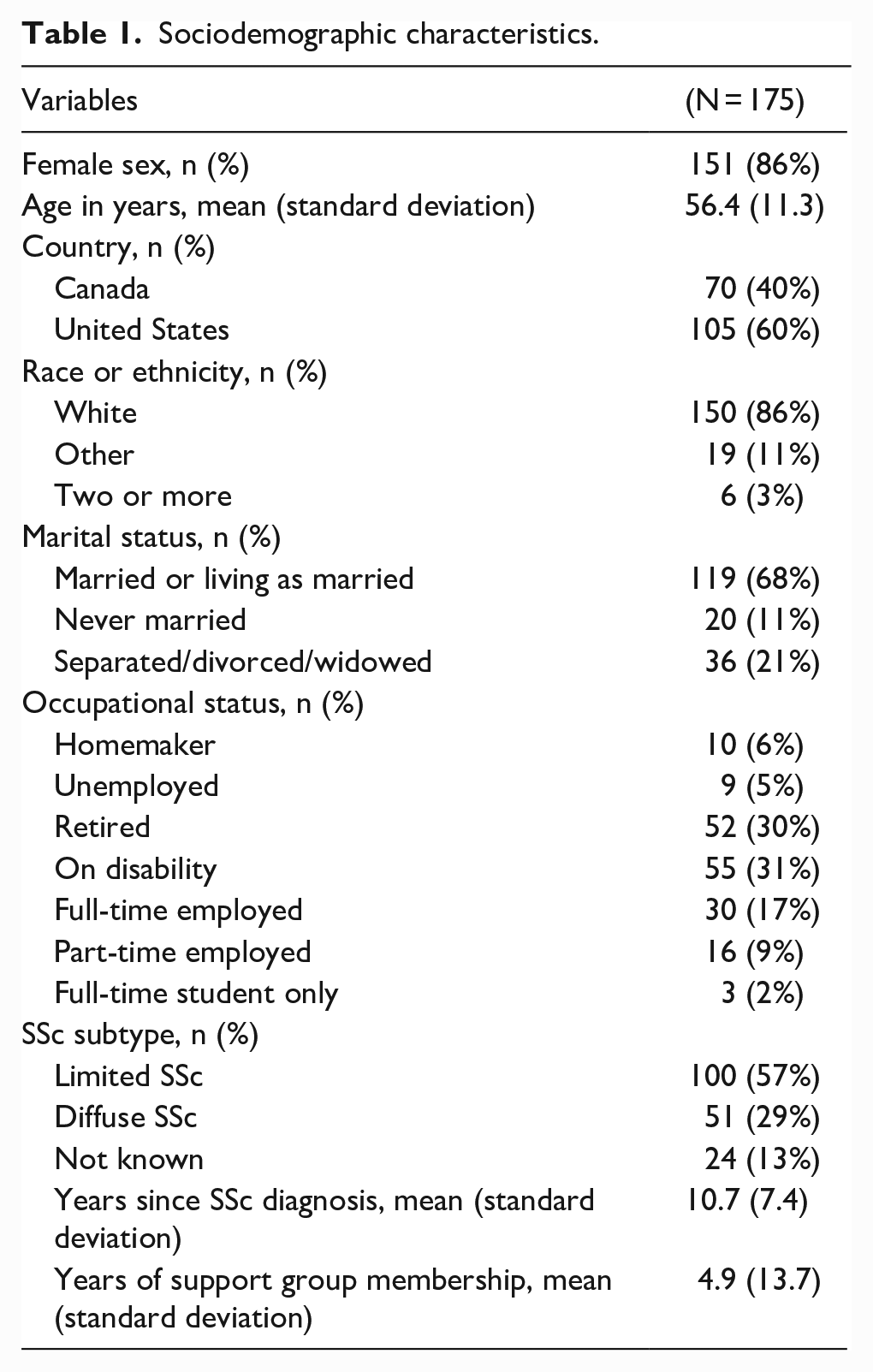
Altogether, 175 people with SSc from the United States or Canada completed the survey. Mean participant age was 56.4 years (standard deviation (SD) = 11.3), and mean time since diagnosis was 10.7 years (SD = 7.4). Most participants were female (86%), White (89%), from the United States (60%), in a committed relationship or married (68%) and reported having limited SSc (57%). A minority were working part-time or full-time (26%). There were 40 participants diagnosed 0–3 years ago (23%), 50 participants diagnosed 4–9 years ago (29%) and 76 participants diagnosed >10 years ago (43%) (see Table 1).
Sociodemographic characteristics.
Differences in support and information needs based on time since diagnosis
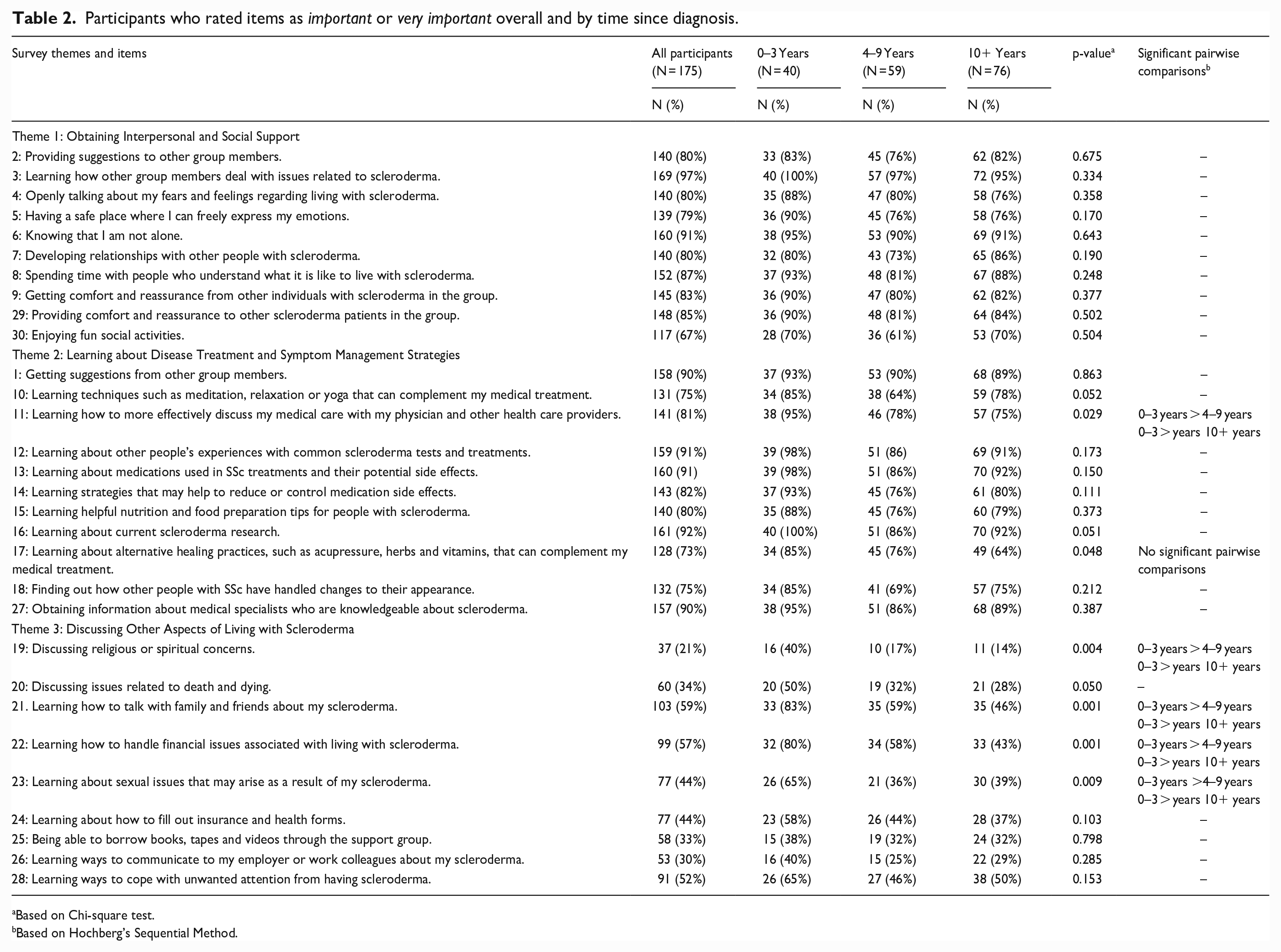
The proportion of respondents who rated items as Important or Very Important was between 67% and 97% (median 81%) for the 10 items in the Obtaining Interpersonal and Social Support theme, between 73% and 92% (median 82%) for the 11 items in the Learning About Disease Treatment and Symptom Management Strategies them and between 21% and 59% (median 44%) for the 9 items in the Discussing Other Aspects of Living with Scleroderma theme (Table 2).
Participants who rated items as important or very important overall and by time since diagnosis.
Based on Chi-square test.
Based on Hochberg’s Sequential Method.
Of the 30 items, a higher percentage of people 0–3 years since diagnosis rated Important or Very Important compared to those 4–9 or 10+ years since diagnosis for 29 items. The exception (item 7: Developing relationships with other people with scleroderma) was not statistically significant. There were no statistically significant differences between time since diagnosis categories for 24 items. There was one item (item 17: Learning about alternative healing practices, such as acupressure, herbs and vitamins, that can complement my medical treatment) with an overall statistically significant between-group difference but no pairwise differences.
There were five items for which there were pairwise differences. For each of these items, significantly more respondents 0–3 years since diagnosis rated Important or Very Important compared to respondents 4–9 years or 10+ years since diagnosis. One of the five items with pairwise differences was related to disease treatment and symptom management (item 11: Learning how to more effectively discuss my medical care with my physician and other health care providers). The other four items were all related to other aspects of living with SSc, including Discussing religious or spiritual concerns (item 19), Learning how to talk with family and friends about my scleroderma (item 21), Learning how to handle financial issues associated with living with scleroderma (item 22) and Learning about sexual issues that may arise as a result of my scleroderma (item 23).
Discussion
The main finding of this study was that most informational and support needs were rated as Important or Very Important by North American support group attendees, regardless of disease duration, particularly needs related to interpersonal and social support (10 items, median 81%) and learning about disease treatment and management strategies (11 items, median 82%). Discussing other aspects of living with SSc was rated lower (9 items, median 44%). There were five items that had significantly different pairwise ratings between disease duration groups, and in each case, respondents with time since diagnosis of 0–3 years were more likely to rate the items as Important or Very Important than those with 4–9 years or 10+ years since diagnosis. Items related to learning how to more effectively discuss medical care with physicians and other health care providers, discussing religious or spiritual concerns, learning how to talk to family and friends about having SSc, learning how to manage financial issues related to having SSc and learning about sexual issues related to SSc.
This is the first study to examine challenges and support needs of people with SSc in relation to their disease duration. Results underline that most people with SSc who attend support groups, regardless of their disease duration, have important support and educational or information needs that they seek to address in support groups, but that recently diagnosed individuals have the greatest needs across areas. Guides for patients and families for people with SSc5,6 have emphasized the emotional aspects of a new or recent diagnosis, and this study found that these were salient needs that, among people who attend support groups, also extend to people with longer disease duration. Guides for patients and families have also emphasized the need to create a medical team and learn about disease management strategies, and, consistent with this, this was rated most highly by people 0–3 years from diagnosis in this study.
Health care providers should be aware of the high level of support and information needs among people with recent diagnoses. Peer support group leaders can also use the results from this study to ensure that topics relevant to all members are addressed. Support groups comprised of members with different disease durations can effectively address each member’s needs by sharing experiences and how members have coped with the types of challenges identified in this study for people with recent diagnoses.
There are limitations that should be considered in interpreting results from this study. First, study participants were support group members and may not be representative of others with SSc. More research is needed on support and information needs for patients who do not attend support groups. Second, this was a convenience sample that was recruited via patient organizations and social media and that required use of the Internet to respond, which may have resulted in an overrepresentation of people with SSc who are more actively involved in self-management of their disease than others. Because we recruited via open announcements, there was no way of knowing the proportion of eligible participants who were aware of the study who decided to participate. Nonetheless, participant characteristics were similar to those from major national and international SSc cohorts. 14 Third, our sample was not large enough to analyse across disease duration categories by disease subtype or participant characteristics, including socioeconomic characteristics.
In conclusion, the results of this study confirm that SSc patients have a range of information and support needs, regardless of disease duration. Respondents with less time since diagnosis, however, have greater needs overall and in particular areas related to learning how to manage their disease and to cope psychologically and socially. Ideally, rheumatologists who care for SSc patients can provide formal educational resources to new patients or direct them to organizations, such as the Scleroderma Patient-centered Intervention Network (SPIN), 15 or other patient organizations,16–18 which can provide those resources. More research is needed on support and information needs among people with SSc beyond those who attend support groups.
Footnotes
Declaration of conflicting interests
The author(s) declared no potential conflicts of interest with respect to the research, authorship and/or publication of this article.
Funding
The author(s) disclosed receipt of the following financial support for the research, authorship and/or publication of this article: Ms S.P. was supported by a Social Sciences and Humanities Research Council Canadian Graduate Scholarship – Master’s Award, Dr R.S.H. by a Canadian Institutes of Health Research Postdoctoral Fellowship Award and Dr B.D.T. by a Tier 1 Canada Research Chair, all outside of the present work. There was no specific funding for this work, and no funders had any role in conception and planning of article content, decision to publish or preparation of the manuscript.
