



Abstract
The nature of global work is undergoing a transformative shift. Digital technologies now enable collaboration across national boundaries without requiring physical presence, giving rise to virtual forms of global work. This phenomenon, commonly referred to as global virtual work, has attracted substantial research attention across three business disciplines: international business, information systems, and human resource management. However, each discipline studies the phenomenon from a distinct perspective, often developing in isolation. This results in fragmented knowledge and limited cross-fertilization. In this article, we examine how each discipline conceptualizes and studies global virtual work. We then develop future research perspectives that are inspired by the three aspects of global virtual work: (1) global aspects, (2) virtual aspects, and (3) work-related aspects. We identify thematic overlaps, contradictions, and potential for integration across disciplines, proposing a forward-looking, interdisciplinary research agenda on global virtual work. By synthesizing insights across disciplines, we provide an integrative understanding of the topic. Our approach emphasizes the importance of considering different disciplinary lenses, promoting cross-disciplinary research, and integrating theoretical and empirical perspectives to capture the complexity of global virtual work.
Keywords
Introduction
Globally operating organizations are currently facing profound changes (Belderbos et al., 2025). In the past, these organizations primarily relied on physical, cross-border exchanges of employees for collaborative efforts, such as expatriates (Davies et al., 2019), international business travelers (Kollinger-Santer and Fischlmayr, 2013), and migrants (De Haas et al., 2019). Consequently, the concept of global work was rooted in the idea that employees from different countries and cultures would gather in person to collaborate (Shaffer et al., 2012). However, digital advancements (Weritz et al., 2025) and emerging work practices (Caligiuri et al., 2020) are reshaping the nature of global work (Froese et al., 2025). Today, globally operating organizations are moving away from physical, cross-border employee exchanges. Instead, they are increasingly relying on virtual forms of collaboration, commonly known as virtual work, remote work, telecommuting, and distant work (Gibson et al., 2022). Cross-border virtual work is referred to as global virtual work (Nurmi and Hinds, 2016). It can be defined as collaboration between individuals, teams, and organizations across borders that relies solely on digital technologies (Hinds et al., 2011; Stahl and Maznevski, 2021). This form of collaboration is particularly shaped by the macroenvironment, including cultural and country factors (Froese et al., 2025). According to recent forecasts, nearly 1 billion workers are eligible for global virtual work, and the number of jobs that can be performed both virtually and globally is expected to grow by 25% in the coming years (World Economic Forum, 2024). Key drivers of global virtual work for organizations include access to a broader pool of global talent regardless of physical location (Kirkman et al., 2013) and reduced labor costs (Gibson et al., 2019). For employees, benefits of global virtual work include reduced relocation expenses and travel time (Wang et al., 2020). Inspired by a literature review on global virtual work by Froese et al. (2025), we see that these developments underscore the need for more interdisciplinary research to adequately capture the multifaceted and interdependent facets of global virtual work.
To date, research on global virtual work is strongly influenced by three distinct disciplines within the field of business: international business (IB), information systems (IS), and human resource management (HRM; Froese et al., 2025). IB research focuses on the organizational goals/motivators and country environments (Meyer et al., 2020) that underlie global virtual work. IS research examines emerging technologies and the selection and implementation of digital technologies required for global virtual work (Gibson et al., 2022) as well as interaction processes between humans and digital technologies (Sarker et al., 2019). From an HRM perspective, global virtual work has primarily been studied through work-related lenses that address the navigation and management of individuals, workforces, and organizational systems, drawing on insights from human resource management, organizational behavior, and organizational psychology (Björkman and Welch, 2015; Blay et al., 2024).
Each discipline offers a distinct perspective on global virtual work. However, these streams have often evolved in isolation. This separation has resulted in fragmented knowledge and limited cross-fertilization, leaving opportunities for integration untapped (Froese et al., 2025). This is problematic because global virtual work is inherently multifaceted, simultaneously involving cross-country institutional complexities, technology-mediated collaboration, and the management of dispersed workforces. Thus, understanding any one dimension in isolation risks overlooking critical interdependencies. For instance, understanding the role of Artificial Intelligence (AI) in global virtual work requires not only an understanding of its technical features, but also of national regulations (Meyer et al., 2023) and individual skills and openness to adoption (Cetindamar et al., 2024). To address these challenges, we require interdisciplinary, integrative research paradigms and approaches (Brandl and Rabl, 2026) that combine the various aspects and perspectives of global virtual work (Selmer et al., 2022). Therefore, we aim to examine how each discipline conceptualizes and studies global virtual work by outlining its respective lenses and perspectives. Based on that, we synthesize and integrate these perspectives by identifying overlaps, contradictions, and opportunities for integration across disciplines. In doing so, we develop a cross-disciplinary and integrative research agenda.
We make two main contributions to the literature. First, we provide a conceptual, interdisciplinary mapping of global virtual work research across the three core business disciplines (i.e. IB, IS, and HRM), outlining their respective focal areas and clarifying how each contributes to the field. For instance, we show how IB research emphasizes multilevel institutional environments (Bartlett et al., 2024) and the tension between global integration and local responsiveness (Meyer et al., 2020), while IS research examines how emerging technologies such as Virtual Reality (VR) and AI reshape collaboration (Benitez et al., 2018). We also highlight how HRM research addresses individual competencies, workforce diversity, and organizational practices in global virtual work (Froese et al., 2025). In doing so, we gain an understanding of how each discipline approaches global virtual work from its distinct angle. This assessment of the status quo offers a springboard for identifying complementarities between the disciplines.
Second, we contribute by moving toward integration, highlighting opportunities for cross-disciplinary collaboration, and offering a more holistic understanding of this complex phenomenon. We outline a forward-looking research agenda that bridges disciplinary silos and identifies avenues for future research at the intersections of IB, IS, and HRM. For example, we propose research on emerging technologies (Abbasi et al., 2024), where understanding its effects in global virtual work requires insights into cross-cultural and regulatory contexts (i.e. the IB perspective; Tsui et al., 2007), technological design and usage patterns (i.e. the IS perspective; Chang et al., 2024), and individual skills (Presbitero, 2020b, 2021) and openness to adoption (i.e. the HRM perspective; Froese et al., 2025). In doing so, we aim to foster the cross-fertilization of ideas across fields and contribute to developing a more comprehensive, interdisciplinary, and integrative body of knowledge on global virtual work in ways that no single disciplinary perspective can achieve alone.
The disciplines’ perspectives on global virtual work
Global virtual work is a multifaceted phenomenon that encompasses cross-country aspects, the utilization of digital technologies, and the management of human resources. Based on the concept of global virtual work, IB provides global perspectives, IS contributes (socio-)technological foundations, and HRM offers work-related perspectives (Froese et al., 2025). To give an overview of the different perspectives, we outline how each discipline conceptualizes global virtual work, highlighting key concepts, and their defining characteristics.
International business: Global perspectives
The IB perspective foregrounds the global context in which global virtual work is embedded. From this view, IB is concerned with how firms (and individuals) configure, coordinate, and govern global virtual work across spatial (e.g. countries), temporal (e.g. time zones), and institutional boundaries (e.g. regulatory regimes; Meckl and Heubeck, 2025). For multinational enterprises and domestic firms alike, global virtual work represents a strategic shift in cross-border organization. It can increase structural flexibility and scalability, but it also intensifies coordination demands and exposes international firms to greater institutional and geopolitical complexity (Blay and Froese, 2022; Froese et al., 2025).
The integration–responsivity framework (Prahalad and Doz, 1987) provides a useful lens for theorizing global virtual work. In particular, the concept of transnational strategy emphasizes that internationally operating firms must reconcile three interdependent strategic imperatives (i.e. global integration, local responsiveness, and worldwide learning) to achieve both efficiency and adaptability (Bartlett and Ghoshal, 1989). Global firms operate as integrated networks that leverage globally dispersed knowledge while remaining sensitive to local institutional and cultural conditions. Global virtual work is central to this logic because it decouples coordination from physical co-location (Bartlett et al., 2024). Its core features align with transnational demands: digital connectivity can facilitate global integration, context-sensitive virtual collaboration can support local responsiveness, and continuous virtual interaction can enable worldwide learning. Overall, global virtual work can support transnational strategy, but it does so by rebalancing (rather than eliminating) tensions between standardization and differentiation.
A related IB challenge is that international firms (and individuals) operate across heterogeneous institutional systems. In global virtual work, this means that international firms must continually navigate competing expectations regarding regulatory compliance, labor practices, and data governance (i.e. macroenvironmental constraints; Froese et al., 2025). Sustaining organizational coherence, therefore, requires governance mechanisms that accommodate institutional diversity while maintaining strategic alignment across global and virtual domains (Bartlett et al., 2024; Besharov and Smith, 2014). Global virtual work unfolds within multilevel institutional environments spanning global, regional, and national systems (Bartlett et al., 2024). Supranational bodies shape trade rules, cross-border investment, and data governance (Deresky and Miller, 2022). Regional frameworks influence market integration and digital interoperability (Collinson et al., 2020). National institutions (e.g. labor law, taxation, data privacy regulations, political dynamics, and language) further condition the feasibility and costs of virtual collaboration (Koveshnikov et al., 2026; Lazarova et al., 2023; Tenzer et al., 2017). Finally, organizational and national sustainability considerations can also shape location and coordination choices associated with global virtual work (Montiel et al., 2021). Thus, such an environment can intensify exposure to overlapping and sometimes competing institutional logics, increasing strategic and managerial complexity.
Information systems: (Socio-) technological perspectives
From the socio-technological IS perspective, global virtual work can be understood as the selection and implementation of digital technologies and the embeddedness in digital infrastructures that enable distributed collaboration across geographical, temporal, and cultural boundaries (Raghuram et al., 2019). Furthermore, the IS perspective helps to align individuals, practices, contexts, and the broader institutional landscape. Video-conferencing systems have become the default for virtual work and collaborative tasks (Hacker et al., 2025). Yet, they generate, for example, “Zoom fatigue” (Fauville et al., 2022) and constant self-evaluation that reduce spontaneity and increase stress (Riedl, 2022). Moreover, a colleague’s status on Teams or Zoom reveals little about their current work context. Working properly in global virtual work environments also involves a well-functioning visual and auditive experience. However, limitations in video conferencing tools and other means of digital communication pose challenges to collaboration (Daffern et al., 2021) in global virtual work.
To overcome visual and auditive limitations in virtual work, a recent wave of research has started to concentrate on emerging technologies, such as VR. VR is an immersive virtual world and avatar-driven space where persistent digital environments extend beyond simple replicas and are often embedded in broader ecological systems, that encompass users’ social, organizational, and technological environment (Marabelli and Newell, 2022; Wang et al., 2023). By representing colleagues as avatars, immersive worlds can restore the spontaneity lost in video calls; a user “standing” in a virtual lounge signals an openness to chat, recreating informal cues typical of physical offices (Ko and Jang, 2014). This embodied presence also interacts with country-specific digital infrastructures, such as varying 5G adoption, which influence the functionality within and the capabilities of globally operating organizations to implement global VR collaboration (Srinivasan and Eden, 2021) and raise sustainability and responsibility questions, such as environmental footprints and digital inequality (Kirchner-Krath et al., 2024; Wolf et al., 2024).
These two types of meetings—video conferencing and immersive, avatar-driven worlds—can also be combined to hybrid meetings that blend full-immersion head-mounted displays with traditional two-dimensional video streams. Head-mounted displays provide the spatial cues envisioned by the immersive environments, but motion-sickness and equipment costs limit widespread use. By allowing participants to appear as avatars while others join via livestream video, hybrid meetings preserve embodied presence for those who can use VR and maintain accessibility and health safety for the rest (Lenning et al., 2023). These environments boost embodiment, flow, and collaboration relative to standard video conferencing (Van Schaik et al., 2012), although they may also cause exhaustion and cybersickness (Breves and Stein, 2023; Hennig-Thurau et al., 2022). These trade-offs are amplified when AI tools are integrated, creating technology-mediated communication that blends human and machine agency (Hancock et al., 2020; Sundar and Lee, 2022), raising geopolitical and regulatory complexities around cross-border AI deployment (Coche et al., 2024; Luo, 2022).
Human resource management: Work perspectives
From an HRM perspective, global virtual work represents a complex, cross-national context of navigating and managing people and work-related processes. It covers all aspects of human behavior in organizations, including the management of human resources, organizational behavior, and organizational psychology (Froese et al., 2025). In doing so, HRM’s involvement in global virtual work aims to understand and facilitate the activities, functions, and processes that attract, develop, and retain the human resources of globally operating organizations across national boundaries (Fan et al., 2021). HRM in global virtual work acknowledges individual, workforce, and organizational levels (Froese et al., 2025).
At the individual level, HRM emphasizes the individual characteristics and capabilities that shape how employees engage and perform in global virtual work settings (Björkman and Welch, 2015). A core focus lies on employees’ knowledge, skills, abilities, other characteristics (KSAOs), and behaviors which are essential to their effectiveness in global virtual work. Certain KSAOs are especially critical for global virtual work, including digital technical skills (Benitez et al., 2018) and cross-cultural or global leadership skills (Lu et al., 2022; Presbitero, 2020b, 2021). Recognizing the role of cultural values is another essential part to consider when working in global and virtual work environments (Muethel and Hoegl, 2010). Furthermore, a range of behaviors, including conflict resolution (Davaei et al., 2022) and collaborative behavior (Blay et al., 2024), are essential for successful interaction in global virtual work environments. The workforce level focuses on global virtual work group and team characteristics. The workforce in globally operating organizations differs substantially from more traditional, co-located contexts. Organizations engaged in global virtual work are characterized by a differentiated and diverse workforce composition, such as geographical (Gibson and Gibbs, 2006) and national differences (Taras et al., 2019). These differences create an inherently complex workforce, representing challenges and opportunities for global virtual work (Björkman and Welch, 2015; Lazarova et al., 2023). Finally, the organizational level addresses organizational practices for global virtual work, integrating individual and workforce characteristics into actionable HRM frameworks (Björkman and Welch, 2015). A key aspect is global job design, which necessitates that organizations consider and incorporate alternative arrangements, such as global virtual gig work, global digital nomads, and global virtual teams, into their operations (Froese et al., 2025).
Cross-disciplinary foundations for future research on global virtual work
While much of the research on global virtual work has been conducted within either disciplinary boundaries or topic-based research clusters (Raghuram et al., 2019), there is significant overlap among IB, IS, and HRM topics and research potential at their intersection. For example, at the intersection of IS and HRM, there is research on the relationships between the material and virtual work in teams, such as meeting and communication practices that create complementarities between the physical and virtual layers (Robey et al., 2003), extra work that digitalization and virtualization create (e.g. to fulfill human needs and to keep organizations functioning; Baptista et al., 2020; Hafermalz and Riemer, 2021), as well as possible negative social comparisons and envy between workers with and without access to virtual work (Maier et al., 2022). Research at the intersection of IS and HRM, considering aspects like technical capabilities, workplace wellbeing, and job design, saw a boost particularly during the COVID-19 pandemic and its aftermath (Aroles et al., 2021). At the intersection of IS and IB lies research on online labor platforms, crowdwork, and the idea that digital technologies and information systems have made it easier than ever for different organizations to engage globally with external communities and workers for value generation (Gol et al., 2024; Lehdonvirta et al., 2019). Notably, HRM perspectives on the structures and practices required for organizations to manage a global workforce beyond employees (Altman et al., 2021) and related online labor platform ecosystems (Keegan and Meijerink, 2023) have also emerged, indicating further recent cross-pollination across IB, IS, and HRM.
Given these research opportunities, we should consider integrating different disciplines to gain a more comprehensive understanding of global virtual work. Figure 1 illustrates the three research disciplines, their primary areas of focus, and the research potential that emerges from their intersections.
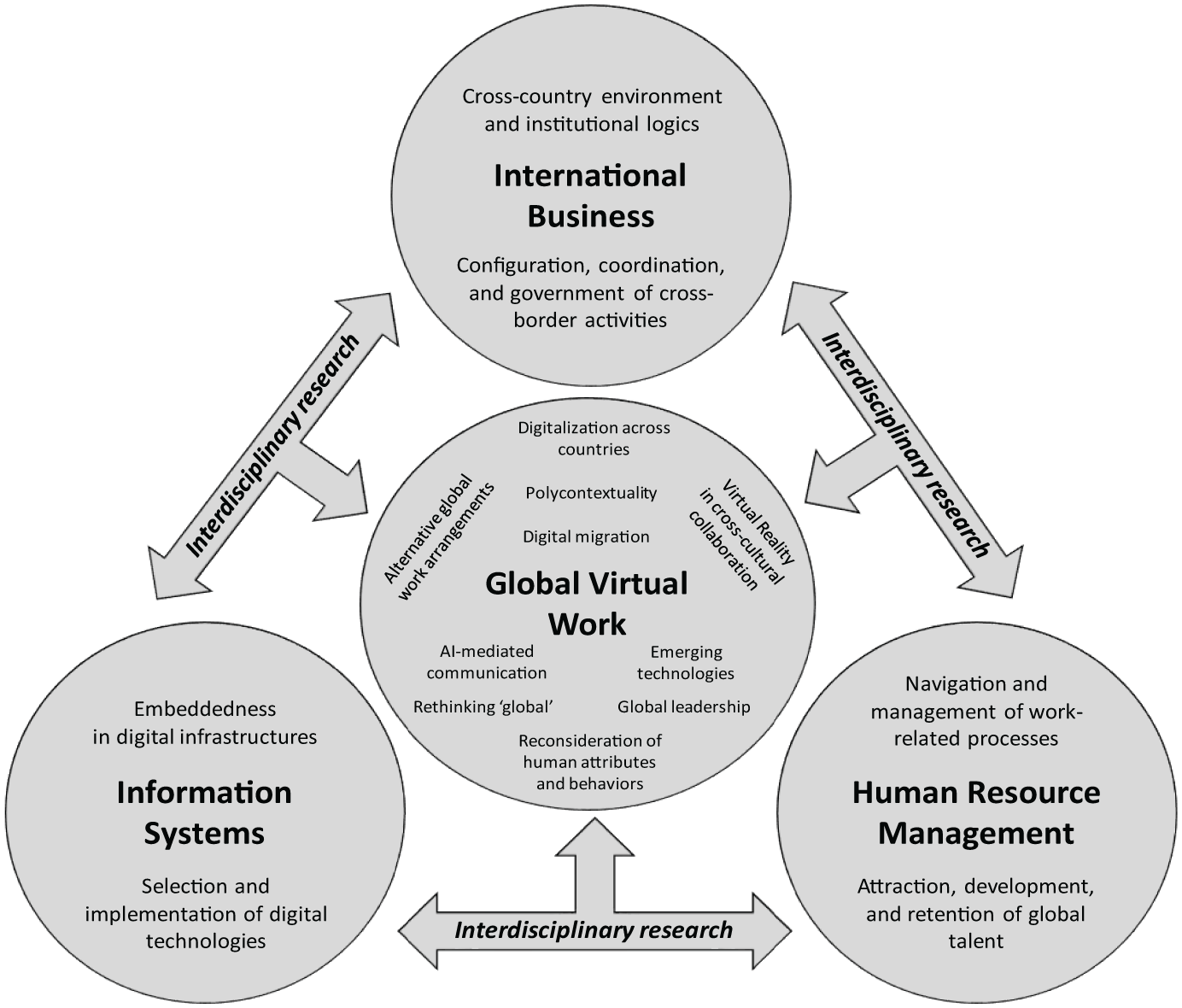
Research overlap across disciplines studying global virtual work.
Interdisciplinary and integrative future research directions on global virtual work
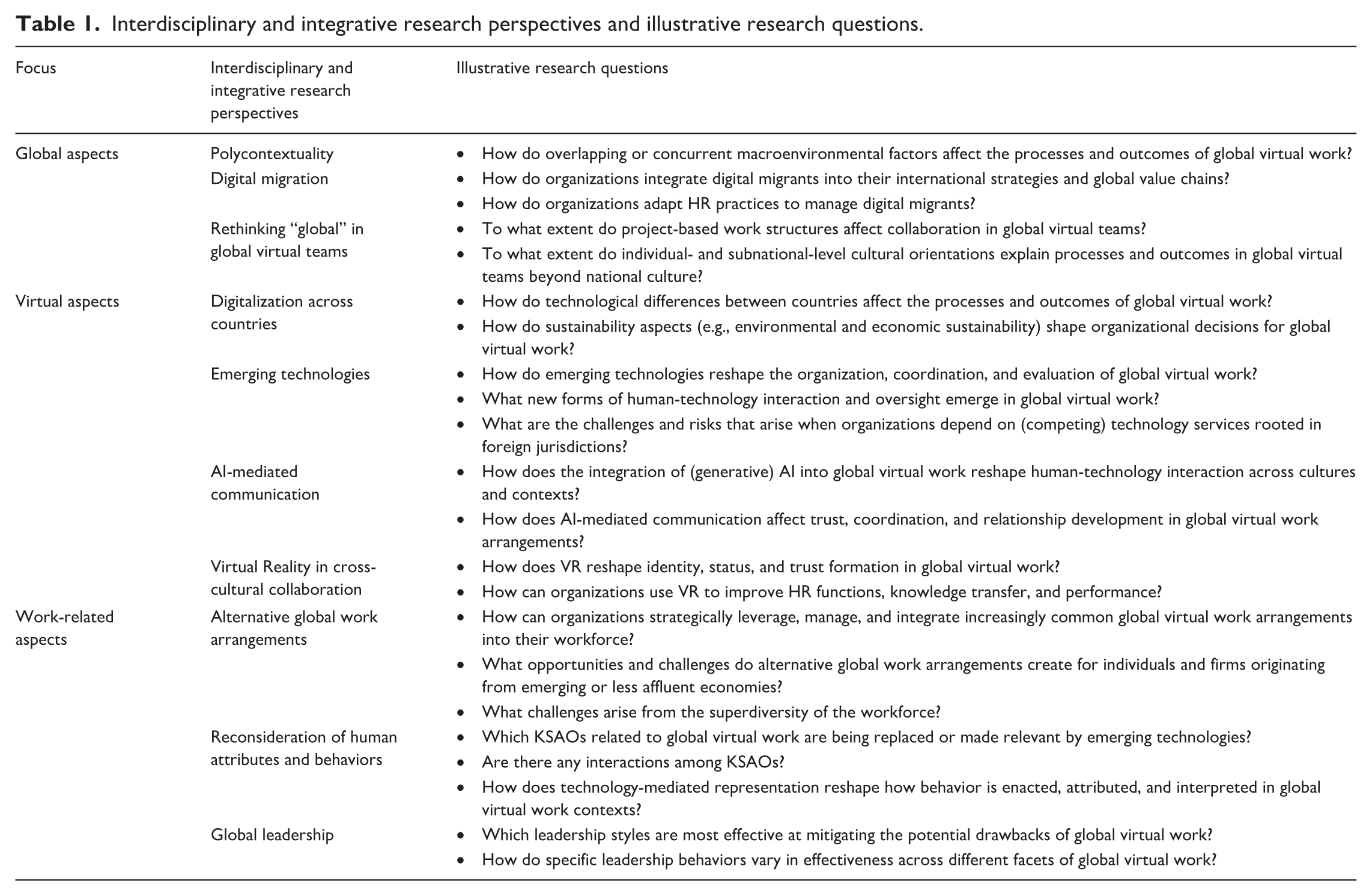
To adopt an interdisciplinary and integrative research approach to understanding global virtual work, we identified overarching future research directions. We highlight avenues for future research that address the (1) global, (2) virtual, and (3) work-related aspects of global virtual work, drawing inspiration from the IB, IS, and HRM literatures. Although these three aspects are intertwined, we use each as an analytical entry point and overarching lens to structure our research agenda. Each aspect highlights pressing research opportunities rooted primarily in one disciplinary perspective, while linking them to related concerns in the others. In doing so, we outline research potential anchored in one disciplinary perspective yet particularly promising for cross-fertilization and integrative theorizing. To further stimulate interdisciplinary and integrative research on global virtual work, we develop research questions (see Table 1).
Interdisciplinary and integrative research perspectives and illustrative research questions.
Future research directions on global aspects of global virtual work
Future research on the global aspects could aim to better understand the international (i.e. cross-country) challenges of global virtual work. Previous research has examined global “grand challenges” (George et al., 2016), but comparatively little is known about the impact of the macroenvironment (e.g. cross-country context) and its implications for global virtual work (Froese et al., 2025). Global virtual work unfolds within heterogeneous country environments characterized by differences in culture, digital infrastructure, labor market institutions, and political and regulatory conditions. Yet, research has only begun to examine how specific macroenvironmental features systematically influence global virtual work.
Polycontextuality
Unlike virtual work (e.g. telecommuting), which primarily occurs in a single location context (e.g. a single cultural context; Popescu and Pudelko, 2024), global virtual work operates in a polycontextual environment. This means that multiple contexts simultaneously affect the parties involved (Tsui et al., 2007). Previous studies have shown that macroenvironmental factors (e.g. laws/regulations, culture, economic conditions, and crises) act as critical determinants of work processes and decisions for international work arrangements (e.g. expatriate assignments; Shaffer et al., 2012). However, how these factors interact and influence virtual forms of global work, which operate across multiple, distinct, and overlapping contexts, remains underexplored. This corresponds with interdisciplinary research examining situations in which multiculturalism (IB perspective; Stahl and Maznevski, 2021), global work arrangements (HR perspective; Taras et al., 2019), and digital collaboration platforms and communication technologies (IS perspective; Daffern et al., 2021) intersect to constitute global virtual work. These intersecting influences further resonate with research on institutional logics in global virtual work environments (e.g. in hybrid organizations; Belte, 2022). Institutional logics refer to historically and socially constructed practices, rules, beliefs, and assumptions that evolve over time. These logics manifest at various levels and differ between nations, markets, and organizations (Thornton et al., 2012). Institutional logics can also emerge within globally operating organizations, and they can be influenced by the geographic and cultural contexts in which organizations and their members are embedded (Greenwood et al., 2010). Applied to global virtual work, this means that organizations and individuals are simultaneously exposed to multiple logics (Besharov and Smith, 2014), which may vary by context and time (Thornton et al., 2012). Since global virtual work can occur within different institutional logics concurrently, such as individuals simultaneously working in multiple global virtual teams across multiple country contexts (cf. Berger et al., 2022), future research should examine how polycontextuality shapes the structures and outcomes of global virtual work across space and time.
Digital migration
There is research potential on digital migration that integrates IB and HR perspectives on cross-border talent flows without physical relocation with an IS perspective on how digital technologies can be leveraged to enable such work effectively. Prior research has extensively studied expatriates (e.g. Karunarathne et al., 2025; Schmid and Froese, 2025) and migrants (e.g. Hajro et al., 2022) who work (physically) in a foreign country. Beyond working in a foreign country, digital migration refers to the decoupling of work from physical location, where individuals work virtually across borders while residing outside their country of employment or citizenship. Examples of digital migrants include corporate employees working remotely from abroad, so-called virtual expatriates (Selmer et al., 2022), and platform-based freelance workers serving foreign clients (Gautam et al., 2024). Digital migration suggests that place still matters in global virtual work, opening a new research agenda linking global mobility and virtual work.
A first key research direction concerns how digital migration reshapes firms’ internationalization strategies and global configurations. Digital migrants allow firms to access foreign talent without establishing physical subsidiaries or engaging in foreign direct investment, suggesting new, asset-light modes of international expansion. Future research could examine how firms integrate digitally migrated labor into global value chains, how this affects coordination and control across borders, and whether digital migration complements or substitutes for traditional international staffing models such as expatriation and offshoring. Furthermore, digital migration has important implications for organizations’ approaches to global talent management. While digital migrants enable organizations to access a larger talent pool worldwide, it complicates legal compliance and performance management and requires the effective implementation of adequate digital technologies to effectively mediate and manage this form of migration (Froese et al., 2025). Thus, future research could examine how organizations adapt HR practices and digital tools to manage digital migrant workers.
Rethinking “global” in global virtual teams
Revisiting the notion of the “global” in global virtual teams encourages integration of IB perspectives on institutional and geographic embeddedness, HR perspectives on team processes and emergent states, and IS perspectives on how digital infrastructures redefine distance and proximity. Over the last few decades, research has focused on studying cultural, linguistic, and time zone differences in global virtual teams (Jimenez et al., 2017; Taras et al., 2019). However, it is becoming increasingly clear that these factors often represent manageable “inconveniences” rather than the fundamental determinants of global virtual team success. We, therefore, call for future research on global virtual teams that incorporates more nuanced thinking. We could move beyond “the usual suspects” in global virtual teams research and explore the role of differential task-related and macroenvironmental realities in which global virtual teams operate.
First, global virtual teams are almost always project teams (Martins et al., 2004), and multiple team membership is a norm (Berger et al., 2022). Unlike traditional co-located teams, where employees in the same office often dedicate their entire workday to joint objectives (Raghuram et al., 2019), global virtual team members usually juggle multiple roles and duties alongside different focal projects. These competing commitments are often invisible to their distant global virtual team colleagues, but they frequently affect a member’s contribution to the global virtual team more than their cultural values or personality traits. Taken together, these characteristics suggest that the temporary, often short-lived, and deliverable-driven nature of global virtual teamwork may be a central driver of processes and outcomes in these teams. Consequently, observed teamwork effects in global virtual teams may stem from how time-limited project structures allocate attention, resources, and interdependence among members.
Second, scholarship increasingly questions the assumption that culture meaningfully represents individuals in organizations. Evidence shows that within-country variation in values often exceeds between-country differences, making nationality a weak proxy for how team members think, communicate, and collaborate (e.g. Taras et al., 2016). Moreover, studies highlight ecological fallacies, in which country averages are incorrectly mapped onto individual behavior (Tung, 2008). For global virtual teams, this suggests the need to move beyond national labels and attend to individual differences and subnational contexts that more directly shape teamwork (Stahl et al., 2010). At the individual level, international orientation, prior cross-border experience, and personal value configurations have been shown to predict collaboration and adjustment more strongly than national affiliation alone (Stahl and Maznevski, 2021). Such findings imply that how team members construe and enact differences (Wiesenfeld et al., 2017) within their global virtual team, may matter more for their functioning and outcomes than their structural attributes (e.g. national differences).
Future research directions on virtual aspects of global virtual work
There is a significant discrepancy between current technological advancements and the state of research (Dwivedi et al., 2023). Little is known about the ongoing digital transformation within and across countries and the impact of (specific) technologies on entities involved in global virtual work (Froese et al., 2025). Therefore, we encourage further research on the virtual (i.e. socio-technological) aspects of global virtual work.
Digitalization across countries
Digitalization across countries invites research on digital infrastructures (IS perspective) across different national contexts (IB perspective), and the implications of these differences for work and workforce processes (HR perspective). Technological advancements (e.g. AI and 5G) are critical to successfully transforming business processes and models and improving employee and customer experiences (Wessel et al., 2021). During the COVID-19 pandemic, many organizations digitalized their business processes, recognized the potential business value of these strategies, and increased investments in digital technologies (Benitez et al., 2023). However, organizations often struggle to utilize digital technologies effectively in the context of global virtual work. Given the varying pace and scope of digitalization across countries (Srinivasan and Eden, 2021), country-specific digital technologies and infrastructures (e.g. 5G adoption) can significantly influence the digital capabilities of globally operating organizations and their workforces. This raises questions about the sustainable use of such technologies (Kirchner-Krath et al., 2024) and their responsible application (Wolf et al., 2024).
Furthermore, environmental and economic sustainability often play an important role in organizational decisions to adopt global virtual work. When digital infrastructures are sufficiently developed within and across countries, organizations can reduce travel and coordination costs, thereby saving financial resources while limiting the environmental impact associated with physical mobility (Banalieva and Dhanaraj, 2019; Montiel et al., 2021). Future research should therefore examine how sustainability considerations and cross-country digital capabilities jointly shape organizational decisions regarding global virtual work.
Moreover, unequal access to digital technologies and infrastructures across countries may constitute a largely overlooked structural barrier, introducing new forms of inequality into global virtual work (Goldenthal et al., 2021). Despite the importance of these issues, the academic literature in this area remains underdeveloped, highlighting the need for future research that more explicitly engages with this topic and its implications.
Emerging technologies
Examining emerging technologies calls for integrating IS scholarship on the design and implementation of new technologies, IB perspectives on global institutional and regulatory differences, and HR perspectives on the redesign of work. With (generative) AI reconfiguring work as we write (Adam et al., 2025), the future of global virtual work is uncertain. For example, recent statistics from Upwork (i.e. one of the largest global freelance platforms connecting clients and workers for jobs such as programming, design, and digital marketing) show that the combination of humans and AI affects trust and work, but that demand for human oversight and skills to combat AI “workslop” is also on the rise (Upwork Research, 2025). IS scholars, well-versed in researching the design of novel and emerging technologies such as AI (Abbasi et al., 2024), are seemingly well-positioned to tackle such paradoxical findings. However, AI is not just another tool; it is “the frontier of computational advancements that references human intelligence in addressing ever more complex decision-making problems” (Berente et al., 2021: 1435), and its implications reach far beyond work (Stein and Shollo, 2025).
Therefore, to understand the future of global virtual work in the age of AI, we need an inter- and cross-disciplinary endeavor, involving not just IS, IB, and HRM, but also law, psychology, sociology, and public policy, without which we cannot hope to understand or guide the future of work (Wiese, 2025). Based on that, integrating third-party AI tools into global virtual work introduces geopolitical and regulatory complexities. Because global virtual work is conducted across multiple national and institutional contexts, employees may rely on different, and potentially competing, AI systems that are developed, hosted, and governed under distinct legal regimes. This fragmentation raises important questions regarding jurisdiction, accountability, and compliance. Research could analyze the risks arising when firms depend on AI services hosted in foreign jurisdictions, especially amid diverging national regulations and political frictions. Differences in data protection and privacy regimes create challenges for data governance (Coche et al., 2024), shaping how organizations can deploy, coordinate, and control AI-enabled work processes across borders. Recent discourse on economic de-globalization (Godsell et al., 2023) highlights the vulnerability of firms that rely on foreign (competing) technology providers amidst rising techno-nationalism (Luo, 2022). Future research could also explore strategies for mitigating these risks, such as developing AI capabilities in-house, using hybrid systems (i.e. combining global and local AI models), and engaging in “friend-shoring” of critical AI resources (i.e. sourcing or locating AI hardware and infrastructure in politically aligned and trusted partner countries). Investigating how globally operating organizations navigate the balance between emerging technologies and global efficiency, as well as their exposure to external political and regulatory regimes, will be important for future research in global virtual work.
AI-mediated communication
Communication in IB contexts is increasingly shaped by technological developments that go beyond traditional digital media. Therefore, we call for integrating IS perspectives on AI-driven communication systems and their implementation, IB perspectives on cultural differences, and HR perspectives on communication practices. Specifically, future research could explore the implications of global virtual communication becoming increasingly AI-mediated. Classical theories of computer-mediated communication (e.g. Daft and Lengel, 1986; Dennis et al., 2008; Kock, 2004) theorize the capabilities of traditional communication media, such as email or video conferencing, under the assumption that only human-generated messages flow through these channels. AI tools violate this assumption: they actively modify, augment, or even generate messages, thereby exercising goal-directed agency (Hancock et al., 2020). Thus, AI-mediated communication combines human with AI agency in a single, co-creating communicative process (Sundar and Lee, 2022). This new phenomenon opens several avenues for future research.
One key question is how globally operating organizations can configure AI systems to support their desired positioning on the continuum between global standardization and local responsiveness. Early evidence shows that users tend to adapt their interaction styles to align with the structures imposed by AI systems (Hancock et al., 2020). A single global AI system (e.g. corporate chatbot) could therefore standardize how information is framed and circulated, reinforcing integration and consistency across a transnational organization. At the same time, studies indicate that fine-tuning on local corpora and languages (Naidoo and Chadha, 2025; Wang et al., 2024) or context-sensitive prompting (Tao et al., 2024) enhances the sensitivity of AI systems to local cultures and norms. This suggests that globally operating organizations may leverage decentralized or locally trained AI systems to increase responsiveness to regional market needs and institutional conditions. Accordingly, future research may investigate the trade-off between a single global AI system and culturally sensitive locally trained AI systems and how to best navigate this.
Future research could also explore how AI systems can support globally operating organizations in governing global virtual work. Employees who co-write business emails with ChatGPT were found to adopt not only the linguistic style but also the implicit values of the chatbot (Guo et al., 2024; Jakesch et al., 2023). Whereas ChatGPT primarily reflects the values of people from Western societies (Cao et al., 2023; Li et al., 2024), globally operating organizations could retrain their in-house AI systems to internalize not national, but corporate values and adjust their responses accordingly. For example, an AI chatbot in human resource management (Nyberg et al., 2025) or a decision-support system (Lindner et al., 2025) could be trained to respond to employee queries in a manner consistent with organizational values, such as respectfulness and inclusiveness. Such AI systems may reinforce organizational values among a globally dispersed workforce. Since AI systems are increasingly understood not as mere tools or mediators of global virtual communication, but as team members (Anthony et al., 2023; Dennis et al., 2023), their role as potential champions for organizational (IB) strategy in global virtual work settings could also be studied.
Virtual Reality in cross-cultural collaboration
This line of research invites interdisciplinary inquiry integrating IS perspectives on recent advancements in immersive technologies, IB perspectives on differences within and across countries, and HR perspectives on how individuals and teams engage with and work through such technologies. Specifically, an important and largely unexplored avenue for future research on global virtual work concerns the role of VR and its integration into the emerging “Metaverse,” defined as a decentralized, persistent, and immersive three-dimensional virtual universe (Marx et al., 2025; Peukert et al., 2022). The Metaverse extends VR by enabling persistent, avatar-mediated interaction in shared virtual spaces, allowing globally distributed actors to engage in ongoing collaboration and social interaction beyond episodic encounters (Marx et al., 2025). VR has the potential to reduce perceived distance and transform how global virtual work is experienced and coordinated (Peukert et al., 2022). Despite this promise, research on VR in global virtual work remains at an early stage, with most existing insights emerging from adjacent domains such as education, training, and information systems (e.g. Chang et al., 2024; Marabelli et al., 2025; Yan et al., 2025). Accordingly, future, interdisciplinary research is needed to theorize how VR reshapes the core dynamics of global virtual work and to specify the conditions under which it can enhance work processes and outcomes.
A first research direction concerns how VR reshapes identity, status, and trust formation in global virtual work. VR enables embodied interaction through avatars, spatial presence, and nonverbal cues, which may fundamentally alter how individuals perceive themselves and others (Marx et al., 2025; Peukert et al., 2022). Prior evidence suggests that a higher degree of avatar-user resemblance can foster more positive attitudes toward an avatar, thereby shaping how individuals experience presence and relate to others in virtual environments (Suh et al., 2011). Building on this work, future studies could investigate how VR affects identity construction, power dynamics, and status signaling across different cultural and organizational hierarchies (Won and Zhou, 2024). At the same time, VR may reconfigure trust dynamics by shifting attention from formal roles to lived interaction and shared experience, raising important questions about when VR strengthens interpersonal trust and when it reinforces bias or exclusion.
A second avenue for future research concerns how organizations can strategically use VR to enhance HR functions, knowledge transfer, and performance in global virtual work (Marx et al., 2025). VR may enable more immersive recruitment, onboarding, training, and performance management processes by simulating realistic work environments and complex social interactions across borders (Boughzala et al., 2012). Future studies could explore how VR supports the transfer of knowledge, shared mental models, and experiential learning that are difficult to achieve through conventional digital media. At the same time, more research is needed to identify boundary conditions, such as organizational strategy, task complexity and cultural diversity, under which the use of VR facilitates individual, team, and organizational performance.
Future research directions on work-related aspects of global virtual work
Regarding future research on work-related aspects, we would like to highlight the potential for research on individual, workforce, and organizational aspects of global virtual work. Global virtual work is characterized by the blurring of traditional work arrangements and the emerging (ir)relevance of KSAOs (Froese et al., 2025). This trend has far-reaching implications for organizations and individuals that have not been adequately addressed in the literature (McDonnell et al., 2021).
Alternative global work arrangements
Research on alternative global work arrangements requires integrating HR perspectives on new forms of work design and talent management, IB perspectives on the location of work, and IS perspectives on how to enable and sustain boundaryless work arrangements. Previous research has primarily focused on well-defined global work arrangements, such as expatriates or business travelers (Shaffer et al., 2012). However, digitalization and globalization have created a variety of alternative global work arrangements that are increasingly used in global virtual work. These include global virtual gig workers (i.e. independent contractors or freelancers who perform short-term, flexible, and task-based work virtually; Gautam et al., 2024) and global digital nomads (i.e. individuals who frequently live and work in different countries by leveraging virtual work; Sanul, 2022; Wang et al., 2020). These alternative global work arrangements are highly flexible with respect to location, enabling work to be performed independent of a fixed workplace and contributing to the growing prevalence of work-from-anywhere as a viable option (Kuchenbauer and Bešić, 2026).
Correspondently, alternative global work arrangements could increasingly shape labor markets in emerging or less affluent economies (e.g. in the global South). Global virtual work may expand access to international income opportunities and partially bypass local labor market constraints (Anwar and Graham, 2021). Global virtual work can function as a vehicle for economic inclusion and a mechanism reducing economic inequalities across countries. From a firm- and country-level perspective, participation in global virtual work arrangements may enhance competitiveness by enabling firms (and individuals) in emerging economies to integrate into global value chains (Heredia et al., 2022). Thus, this area of global virtual work offers substantial opportunities for future research.
Taken together, these developments suggest that global virtual work will be characterized by even greater heterogeneity in the workforce, work arrangements, and work organizations—a phenomenon referred to as superdiversity (Vertovec, 2022). Yet, research has not kept pace with this growing complexity.
Reconsideration of human attributes and behaviors
Examining the reconsideration of human attributes and behaviors calls for combining HR research on evolving competencies and behavioral patterns, IB perspectives on cross-national differences shaping their relevance, and IS research on how technology might reshape, augment, or substitute human action. As global virtual work continues to evolve, human attributes and behaviors required to perform effectively are likely to change (Froese et al., 2025). There is a growing research potential to study the increasing (ir)relevance of KSAOs (Braojos et al., 2024; Heubeck, 2023, 2024), which are (no longer) required for global virtual work. In the context of KSAOs, there is a growing need for research on the importance of language and different forms of intelligence related to global virtual work and technology. The role of English as a business language has already been extensively discussed in IB research (Brannen et al., 2014). However, it remains largely unclear what role English and other language skills will play in the future of global virtual collaboration, particularly as emerging technologies (e.g. AI-powered translation tools) increasingly mediate communication in global virtual work. This raises intriguing questions: while technology may reduce the impact of stereotypes associated with non-native accents (Hideg et al., 2022) and lower language barriers that inhibit open information exchange, it may simultaneously come at the cost of reduced authenticity and a perceived loss of individual agency. Thus, the role of KSAOs that have been shown to influence cross-cultural and cross-linguistic understanding (e.g. foreign language skills: Presbitero, 2020a; or cultural intelligence: Presbitero, 2021) should be re-evaluated in the context of global virtual work. Moreover, the theory of multiple intelligences postulates that different types of intelligence are significant predictors of performance (Gardner, 1993). While the role of cultural intelligence in global virtual work has been widely researched (e.g. Presbitero, 2021), a research gap remains concerning virtual intelligence (i.e. the ability to effectively understand, navigate, and utilize digital technologies and virtual environments). Given the rapid technological developments, a more in-depth examination of the role of virtual intelligence (Makarius and Larson, 2017) and digital learning (Valtonen et al., 2022) is required. Future research could also explore how these KSAOs relate to individual characteristics, such as age, gender (Reinwald and Kunze, 2020), and how they may vary across different cultures.
Similarly, human behavior is a central mechanism through which global virtual work is carried out (Froese et al., 2025). However, emerging technologies, such as VR, are fundamentally reshaping how global virtual work is enacted. Rather than interacting through physical co-presence, work becomes enacted via technological artifacts that serve as proxies for human actors and organizational processes, including symbolic representations (e.g. virtual dashboards) and iconic embodiments (e.g. avatars; Bailey et al., 2012). This shift blurs the distinction between whether behavior is attributed to the object (i.e. the technology) or to the person (i.e. the human) performing global virtual work. These developments have important behavioral implications for research on global virtual work. Traditional assumptions about behavioral cues, agency, and attribution may no longer apply (Leonardi, 2011). As the responsibility for behavioral actions and their outcomes becomes blurred between humans and technological systems, individuals’ perceived locus of control may shift, with potential consequences for knowledge sharing, helping behavior, job satisfaction, and engagement in global virtual work. Such attributional ambiguity may also affect how conflicts emerge and are resolved, particularly in culturally diverse settings where interpretations of technology-mediated behavior already vary (Gunkel et al., 2016). Therefore, future research could examine how human behavior is represented, enacted, and interpreted in global virtual work contexts.
Global leadership
Research from an HRM perspective, spanning also IB and IS perspectives, calls for advancing our understanding of leadership in digitally-mediated work environments (i.e. global virtual teams). As global virtual team interactions unfold mainly through digital technologies rather than physical co-location, leadership becomes a central mechanism through which these teams operate (e.g. Malhotra et al., 2007). Digital technologies play a crucial role in enabling successful leadership in global virtual teams. However, at the same time, working with digital technologies also carries the risk of causing digital stress (Becker et al., 2020; Tarafdar et al., 2019), especially through digital hindrance stressors, such as perceived monitoring, constant interruptions, and overload (Gimpel et al., 2025). These tensions are often amplified in global virtual teams that operate across geographic and temporal distances, where the lack of shared context and culture, difficulties in coordination, and incongruent temporal rhythms can challenge teamwork (Hinds and Bailey, 2003). Therefore, future research should focus on the specific leadership behaviors that are enacted through digital technologies to moderate and support teamwork in global virtual work environments.
Research generally distinguishes between task-oriented (e.g. clarifying goals and coordinating tasks) and relationship-oriented (e.g. trust formation and maintaining interpersonal relationships) leadership behaviors (Li et al., 2022; Lettner et al., 2023; Weber et al., 2022). Although combining both styles is generally seen as beneficial for global virtual teams, recent research shows that these behaviors can also produce unintended negative outcomes. Lettner et al. (2023) find that the same behaviors that foster trust may also create pressure, communication overload, or perceptions of control. This highlights that task- and relationship-oriented leadership behaviors need to be carefully balanced, especially in digitally mediated and culturally heterogeneous teams (i.e. global virtual teams). Several promising avenues for future cross-disciplinary research emerge from this finding. One opportunity lies in investigating which leadership styles are most effective at mitigating the drawbacks of global virtual work. Another promising direction is examining how specific leadership behaviors vary in effectiveness across different cultural settings, considering both national and organizational cultures, time zone differences, and communication patterns. Addressing these questions requires an integrative approach that combines insights from HRM on leadership behaviors with IS research on technology use and IB research on cross-country dynamics.
Conclusion
Global virtual work has become a defining feature of contemporary organizing. Yet, the scholarly understanding of this phenomenon remains fragmented across disciplinary boundaries. In this article, we addressed this fragmentation by examining how IB, IS, and HRM research conceptualize and study global virtual work from distinct yet complementary perspectives. By structuring our analysis around the global, virtual, and work-related aspects of global virtual work, our synthesis revealed substantial thematic overlap across disciplines, alongside important contradictions, and blind spots that cannot be resolved within a single field. Addressing these tensions requires moving beyond parallel streams of inquiry toward more integrated theorizing that explicitly connects macro-level global contexts, technological infrastructures, and micro-level work processes. We proposed a future research agenda that emphasizes the value of integrating different disciplinary lenses to better capture the complexity of global virtual work. Our integrative perspective also carries important managerial implications. Successfully managing global virtual work requires alignment among different organizational areas overseeing international operations, digital infrastructure, and human resources. Choices about global collaboration structures, technology implementation, and talent management are tightly linked and cannot be effectively addressed in isolation. Our research agenda underscores the need for coordinated organizational action across functional areas to navigate the complexity of global virtual work.
Footnotes
Acknowledgements
Not applicable.
Declaration of conflicting interests
The authors declared no potential conflicts of interest with respect to the research, authorship, and/or publication of this article.
Funding
The authors disclosed receipt of the following financial support for the research, authorship, and/or publication of this article: This research was funded by the Deutsche Forschungsgemeinschaft (DFG, German Research Foundation) – 563225198.
Ethical considerations,consent to participate,and consent for publication
Not applicable.

Data availability statement
This study is conceptual in nature. Therefore, no data were collected or analyzed, and data sharing is not applicable.