



Abstract
Recent qualitative research has expanded the traditional definition of overemployment—typically understood in economics and sociology as a mismatch between actual and preferred working hours—by conceptualizing it as a multidimensional psychological construct. However, research still lacks a reasonably complex and statistically validated measure of psychological overemployment. To address this issue, the present research developed and validated a multidimensional Psychological Overemployment Scale (POS)—the first psychometrically tested instrument of its kind. Study 1 (N: 26 and N: 27) generated items and assessed their content validity. Study 2 (N = 303) identified three dimensions of psychological overemployment: work time duration, density, and distribution (on tasks). Study 3 (N = 500) and study 4 (N = 350) tested the reliability and validity of the POS across different samples. Study 5 (N = 254 and N = 267) confirmed the discriminant validity of the POS by demonstrating that its dimensions differ clearly from orbiting constructs. We confirmed the scale’s three-dimensional structure and provided evidence for construct validity by relating the POS to traditional overemployment measures and to work-life balance. We also demonstrated criterion validity by correlating the POS with well-being, job attitudes, and work behavior. Researchers can use the POS to develop knowledge on psychological overemployment, its antecedents and outcomes, and practitioners can apply it to evaluate work flexibilization instruments, for organizational diagnosis, or coaching.
Introduction
A preference to work less is a widespread phenomenon among employees (Golden and Gebreselassie, 2007; Reich, 2024; Reynolds and Aletraris, 2010). In Europe, around 30% of people report a desire to work less (Eurofound, 2019). This preference for less work hours has traditionally been referred to as “overemployment”—a construct primarily used in sociology and economics (Angrave and Charlwood, 2015; Lepinteur, 2019; Otterbach et al., 2021; Reich, 2024). Research has shown that overemployment—defined in the tradtional sense as a mismatch between actual and preferred working hours—is associated with various negative outcomes for both individuals and organizations (Kelly and Moen, 2020). These include lower job satisfaction, reduced well-being and health, and increased absenteeism (e.g. Angrave and Charlwood, 2015; Lepinteur, 2019; Otterbach et al., 2021; Pagan, 2017; Reich, 2024; Wooden et al., 2009).
One proposed solution to the problem of traditional overemployment is to reduce working hours, for example, through the introduction of a 4-day workweek (BBC, 2020; Campbell, 2024; Lott and Windscheid, 2023). However, some researchers and commentators have expressed concerns that such measures may reduce hours on paper while introducing new work-related challenges (Campbell, 2024; Estevao and Sá, 2006). For instance, employees might work unpaid overhours or face increased pressure to complete tasks in less time. Reducing work hours might also lead to a different distribution of time on tasks, potentially causing dissatisfaction with how much time is allocated.
The complexity of overemployment lies in the multifaceted nature of work time itself. It is not only the total length of working hours that matters, but also how that time is subjectively experienced. Traditional overemployment research, however has largely overlooked this complexity, with a few notable exceptions (Campbell and van Wanrooy, 2013; Hiemer and Andresen, 2019, 2020).
Therefore, the objective of this paper is to better understand the problem of overemployment as a basis for developing adequate solutions (Wedberg, 1990). We extend the traditional view of overemployment by introducing the concept of psychological overemployment, which focuses on individuals’ subjective experience of working more than they prefer (see Hiemer and Andresen, 2019). This conceptualization goes beyond a simple discrepancy in actual and preferred working hours and captures broader dimensions of how employees perceive and experience their work time. To support this reconceptualization, and in light of the absence of a validated measure, we develop a scale to assess psychological overemployment.
Challenges with the traditional view on overemployment
Several issues undermine the traditional operationalization of overemployment. We outline four major challenges below.
Conceptual reduction of overemployment to a time-money problem
Economists and sociologists have long viewed overemployment as a discrepancy between preferred and actual working hours (e.g. Angrave and Charlwood, 2015; Otterbach et al., 2021; Pagan, 2017; Reich, 2024). Economists have typically built on standard labor supply models (Altonji and Paxson, 1988; Wunder and Heineck, 2013) that assume that job offers consist of fixed wage-hours combinations. Overemployment may arise when individuals cannot freely choose their ideal balance of wages and work hours (Golden and Gebreselassie, 2007; Wunder and Heineck, 2013). This economic approach frames overemployment as a trade-off between time and money, focusing exclusively on these two parameters to determine labor supply preferences (Altonji and Paxson, 1988; Bryan, 2006). As a result, it reduces overemployment to a purely quantitative issue, overlooking the quality aspects of work and work time. Consequently, it often frames overemployment as a “luxury problem,” implying that only those who can afford to work less desire to do so (Hiemer and Andresen, 2020).
Lack of face validity of preferred and actual work time data
Most empirical studies measure overemployment by comparing respondents’ self-reported preferred and actual work hours (Hiemer and Andresen, 2020). However, Campbell and van Wanrooy (2013) argue that such preference data lack face valdity and may not reflect an individual’s genuine underlying desires. Responses often depend on question wording and context, making the preference data unstable and potentially misleading (Campbell and van Wanrooy, 2013). Current measures assume that work hour preferences are objective, stable, and quantifiable—aking to measuring a person’s height with a measuring tape. In reality, individuals often struggle to articulate exact preferences, especially for something as subjective and situational as work time (Campbell and van Wanrooy, 2013). Another issue related to face validity is that questions regarding actual work hours can be ambiguous, as individuals working fewer hours tend to underestimate their workload, while those working more than 40 hours often overestimate their work hours (Otterbach and Sousa-Poza, 2010).
Inconsistent measurement practices
Existing measures of overemployment typically rely on single-item questions and discrepancy scores, with considerable variation in how researchers word and structure these items (for critical discussions, see Golden and Gebreselassie, 2007; Hiemer and Andresen, 2020; Otterbach and Sousa-Poza, 2010). This inconsistency has led to vastly different overemployment rates even within the same population (Holst and Bringmann, 2016). It has also contributed to inconsistent findings about the consequences of overemployment; for example, while some studies report clear negative effects on well-being (Angrave and Charlwood, 2015; Wooden et al., 2009), others do not (Friedland and Price, 2003; Wunder and Heineck, 2013).
Lack of content validity of the measures
Interview data from Hiemer and Andresen (2019) suggest that those experiencing overemployment perceive it multidimensionally. This finding suggests a potentially more complex nature of overemployment than can be captured by a unidimensional, single-item measure (Diamantopoulos et al., 2012). Moreover, the existing items are formulated based on researchers’ definition of overemployment but do not consider the perceptions of overemployed individuals. This objectivist approach, as opposed to the subjectivist approach employed in this study, is presented in more detail in the following section. In summary, one-item measures, such as those used in the German Socio-Economic Panel, are considered both useful and efficient, as they enable the establishment of relationships between overemployment and a range of outcomes and antecedents within the general population. However, previous research indicates that the content validity of these measures is problematic, and the measures lack information on the subjective, psychological factors that influence the overall assessment of the construct.
To address these challenges, scholars have called for a more comprehensive conceptualization and valid measurement of overemployment that can account for more variance in the true score compared to a single-item measure (Campbell and van Wanrooy, 2013; Hiemer and Andresen, 2019, 2020). In response, this research develops a comprehensive, reliable, and valid scale to measure overemployment as a psychological construct that reflects how individuals themselves conceptualize overemployment. We refer to this as psychological overemployment, to distinguish it from the traditional overemployment measures focused only on hour discrepancies. This new scale aims to help address more complex questions in human resource management (HRM) and to guide the development of more effective interventions to reduce overemployment.
Development of psychological overemployment
While economic approaches and quantitative measures serve useful purposes, such as providing an initial understanding of worker attitudes or functioning as brief indicators in large-scale studies (Campbell and van Wanrooy, 2013), they fall short when it comes to an in-depth analysis of the subjective aspects of workers’ overemployment experiences. Following the idea of employment quality (e.g. Travaglianti et al., 2017), it is the subjectively evaluated rather than objectively measured work-related needs that elucidate how high-quality jobs promote positive job attitudes.
Hiemer and Andresen (2019) originally integrated four independent phenomena into their conceptualization. The first two dimensions are quantitative: work time length, which underlines the classic measurement of overemployment, and work time competition with time outside of work, a classic sociological variable that, while conceptually distinct, shares certain features with the notion of work-life balance (e.g. Hidasi et al., 2023; Southerton, 2020). The remaining two dimensions reflect qualitative aspects of overemployment: density of work time and distribution of work time on tasks, which will be described in the following. Thus, the theory of Hiemer and Andresen (2019) challenges the predominant assumption that overemployment is merely a quantitative phenomenon and suggests that it should instead be examined from a subjectivist psychological perspective that considers how individuals themselves define overemployment. The common underlying theme of these four dimensions is their relation to a desire to reduce work time, indicating a state where preference and actual situation are at mismatch. Consequently, psychological overemployment describes a state in which individuals perceive aspects of their working time as exceeding their desired or ideal level of engagement, even when these demands conform to formal job requirements. We use the term “psychological overemployment” to clearly demarcate this construct from traditional sociological or economic overemployment definitions.
Psychological overemployment emphasizes the individual’s perception and subjective experience of feeling overemployed, distinguishing it from traditional overemployment in several key ways: (1) Subjective perception: Psychological overemployment is rooted in how individuals subjectively perceive their work time demands (cf. Hiemer and Andresen, 2019). (2) Potential consequences on emotional, cognitive, and motivational levels: The construct highlights its connection to other psychological phenomena such as burnout, job (dis)satisfaction, or commitment, all of which are investigated in the current study. (3) Individual differences: The psychological overemployment construct and its corresponding measure account for personal variation—what one person perceives as psychological overemployment may feel manageable to another, depending on factors such as personal resilience, coping strategies, or access to social support. Moreover, not all individuals who perceive themselves as overemployed necessarily intend to change their situation.
Following the subjective view of overemployment, the psychometrically tested scale for psychological overemployment presented below adopts a subjectivist approach. The dimensions and their foundations in previous literature are described as follows 1 : First, duration refers to the desire to reduce the total amount of time spent working, that is, the actual number of hours worked (Hiemer and Andresen, 2019). This dimension aligns with the traditional view of overemployment, which conceptualizes it as a discrepancy between actual and preferred working hours, where preferred hours being fewer (e.g. Angrave and Charlwood, 2015; Otterbach et al., 2021; Pagan, 2017; Reich, 2024).
Second, work time density signifies a higher-than-preferred volume of tasks that must be accomplished within a certain timeframe at work (Hiemer and Andresen, 2019). This concept closely relates to “time pressure,” defined as the extent to which employees feel compelled to work at an accelerated pace or perceive insufficient time to complete their tasks (Denovan et al., 2023; Kinicki and Vecchio, 1994; Schor, 1991; Zuzanek, 2004). Unlike density, however, time pressure extends beyond the work domain and has been linked to various life domains, including household responsibilities (e.g. Schor, 1991). Although time pressure has been examined extensively (e.g. Carter et al., 2013; Devetter and Valentin, 2024; Koroma and Vartiainen, 2018; Kühnel et al., 2012; Prem et al., 2017), it typically excludes individuals’ desire to alleviate this state. In contrast, work time density explicitly encompasses the desire to reduce the volume of tasks and is conceptually confined to the work domain.
Third, work time distribution refers to the desire to decrease time spent on certain work tasks while increasing time allocated to others (Hiemer and Andresen, 2019). In their descriptions of overemployment, interviewees in Hiemer and Andresen (2019) and Campbell and van Wanrooy (2013) emphasized qualitative—not merely quantitative—aspects of overemployment. They expressed a desire to spend less time on certain tasks, such as meetings, while dedicating more time to other responsibilities. The issue of work time distribution—specifically, the time allocated across tasks—has been addressed by Miller and Hemberg (2023), Vardi (2009), and Westbrook et al. (2011), who investigated how nurses and academics distributed their time across various tasks and how work patterns have changed over time.
The fourth dimension, work time competition with other tasks outside of work, describes the experience of lacking sufficient time for non-work-related activities (Hiemer and Andresen, 2019). While this quantitative dimension of work time competition (Hiemer and Andresen, 2019) was included in the initial version of the scale (see study 1), it was later excluded due to both conceptual and empirical incompatibility with the definition of psychological overemployment. While this exclusion may appear unconventional, we introduce it here to clarify what psychological overemployment is—and what it is not. In our conceptualization, psychological overemployment refers exclusively to time spent at work, not to time devoted to nonwork activities. This position aligns with Kelly and Moen’s (2020) observation that “the core for many professionals and managers is not balancing work and family obligations, but rather to manage all that one is asked to do at work” (p. 11). It also differentiates psychological overemployment from work-life balance, which is typically defined as an employee’s satisfaction with the alignment between their desired and actual balance between work and private life (Syrek et al., 2011). Moreover, we propose that insufficient time for personal life may be better understood as a consequence of psychological overemployment—arising from factors such as long working hours (duration) or exhaustion from high work density—rather than as a defining feature of the construct itself. Accordingly, this dimension “competition with time outside of work” does not operate on the same conceptual level as the other three dimensions.
Regarding the other three dimensions—duration, density and distribution—they are inherently intertwined, as evidenced in the literature on part-time work, for instance (e.g. McDonald et al., 2009; van Osch and Schaveling, 2020). McDonald et al. (2009) found in their interview study that participants perceived smaller and less responsible tasks as more suitable for part-time than for full-time employment, clearly indicating a link between duration and distribution. Further support for the connection between duration and time distribution can be found in the literature on unproductive meetings. Geimer et al. (2015), for example, noted that less than half of employees considered meetings as an effective use of their time, reinforcing the qualitative aspect of overemployment. The interrelation among all three dimensions is also evident in the time management literature, where scholars commonly examine not only overall time spent (duration) but also task load within a given timeframe (density) and the nature of the tasks performed during that time (distribution; e.g. Claessens et al., 2004). Taken together, these findings underscore that psychological overemployment is not attributable to a single dimension, such as the number of hours worked, but rather reflects a complex interaction of time investment, task intensity, and task allocation. Examining these dimensions in conjunction can help organizations design work environments that better support both employee well-being and productivity.
The job demands-resources model and psychological overemployment
Despite this previous research on the different psychological overemployment dimensions, the formation of individuals’ work time preferences remains poorly understood (Antal et al., 2024). This knowledge gap underscores the need for a refined conceptualization and measurement of psychological overemployment. Moreover, there is a lack of comprehensive theories explaining overemployment and its consequences. Most existing studies rely on person–job fit theory (e.g. Angrave and Charlwood, 2015) or similar discrepancy theories (e.g. Wang and Reid, 2015), which do not adequately account for mismatch direction and may equally explain hours underemployment (Reich, 2024). Hiemer and Andresen’s (2019) interview-based grounded theory posits that psychological overemployment causes psychophysiological strain, which may manifest as exhaustion, dissatisfaction, or health impairments, yet further quantitative empirical validation is needed. Therefore, to strengthen the theoretical foundation, we integrate their theory with the job demands-resources (JD-R) perspective (Bakker and Demerouti, 2007; Demerouti et al., 2001), in alignment with Reich’s (2024) reasoning.
In the JD-R model, job demands are aspects of a job that require sustained effort and are associated with physiological or psychological costs (Bakker et al., 2003). Psychological overemployment, specifically its three dimensions of duration, density, and distribution, can be conceptualized as job demands because they deviate from individuals’ desired states and require ongoing psychological or physical exertion (Reich, 2024). Such deviations are likely to initiate stress processes contributing to outcomes such as burnout and reduced job commitment (Schaufeli, 2017). This conceptualization aligns with evidence linking traditional overemployment to lower well-being and job-related attitudes (e.g. Otterbach et al., 2021; Pagan, 2017). Furthermore, research based on the JD-R model highlights behavioral consequences such as increased turnover intention and reduced job performance (Schaufeli, 2017), which have been understudied in traditional overemployment research. However, if overemployment is associated with negative work attitudes, it may result in higher turnover rates and reduced organizational citizenship behavior (OCB; Krausz et al., 2000; van Emmerik, 2005). These behaviors may reflect coping strategies for managing psychological overemployment (Reynolds and Aletraris, 2010).
Additionally, job resources—such as autonomy and social support—can alleviate the effects of job demands and foster personal growth and development (Schaufeli, 2017). A misalignment between desired and actual work hours may indicate a preponderance of job demands over available resources and exacerbate psychological overemployment. Thus, resources may provide valuable insights into how to mitigate psychological overemployment.
From this JD-R perspective, we hypothesize that psychological overemployment is negatively related with well-being, positive job attitudes, and favorable work behaviors. As such, variables like turnover (intention) and OCB are particularly suitable for assessing the criterion und incremental validity of the new psychological overemployment scale.
While prior studies have consistently reported negative relationship between traditional overemployment and job satisfaction (e.g. Angrave and Charlwood, 2015; Kuroda and Yamamoto, 2019; Pagan, 2017), life satisfaction (Angrave and Charlwood, 2015; Başlevent and Kirmanoğlu, 2014; Wooden et al., 2009), and health and mental well-being (Bartoll and Ramos, 2020; Bell et al., 2011; Kuroda and Yamamoto, 2019; Lepinteur, 2019), results on OCB, commitment, and turnover intention remain ambiguous, which may be attributable to measurement issues (Allan et al., 2016; Wunder and Heineck, 2013). For instance, Abrahamsen (2010) reports a negative relationship between traditional overemployment and commitment, whereas van Emmerik and Sanders (2005) observed effects only among part-time workers, but not overall. van Emmerik (2005) found partial support for a negative relationship between traditional overemployment and OCB, theorizing this as a form of withdrawal behavior. Similarly, research suggests that traditionally overemployed workers—especially women—are more likely to consider leaving their jobs (Böheim and Taylor, 2004; Sturman and Walsh, 2014).
In conclusion, advancing our understanding of psychological overemployment requires examining these less-investigated outcomes to establish the construct’s validity. Moreover, commitment, turnover intention, and OCB hold significant practical relevance, and any relationships found between the scale and these variables could highlight the need to identify solutions for addressing psychological overemployment.
Developing a new psychological overemployment scale
The development of the new psychological overemployment scale (POS) unfolded across five studies, each focusing on different stages of scale development (DeVellis, 2012; MacKenzie et al., 2011): Study 1 focused on item generation and content validity assessment. Study 2 tested and refined the scale and assessed its dimensionality (DeVellis, 2012). Studies 3 and 4 tested the scale’s validity, and study 5 examined its distinction from orbiting constructs, that is, related but empirically distinct constructs (Colquitt et al., 2019). To test criterion validity, we used well-being, life satisfaction, health satisfaction, and burnout measures. We evaluated job-related attitudes through commitment and job satisfaction, and assessed behavior using OCB and turnover intention as a proxy for actual turnover.
Study 1: Item generation and assessment of content validity
Due to the absence of existing scales measuring psychological overemployment, the development of new items was required. Following the approach of Mitchell et al. (2001), item generation drew on various sources. First, 26 interviewees whose actual working hours exceeded their preferred hours provided definitions of psychological overemployment in their own words. Grounded theory guided the coding process, and items were developed from the generated codes. The interviewees (14 male, 12 female) had an average age of 38.12 years (range: 25–60 years). Three participants held part-time contracts, while the remainder were full-time employees, reporting an average of 46 working hours per week. A detailed account of the interviews appears in Hiemer and Andresen (2019). Second, the authors convened bi-weekly over the course of a year to discuss the construct of psychological overemployment, clarify its components, and develop corresponding items. During this period, the authors held two additional meetings with eight researchers familiar with the construct to evaluate the clarity and conceptual alignment of the items. These expert discussions resulted in the inclusion of new items and the removal of those deemed unclear or conceptually inconsistent (see Cortina et al., 2020).
The item development process also incorporated existing measures of traditional overemployment (see Hiemer and Andresen, 2020) and attitudinal measures targeting related constructs. This step helped align the new items with established research, especially regarding time pressure in relation to the dimensions of density and distribution. For example, Denovan and Dagnall’s (2019) measure of chronic time pressure and Burke et al.’s (2010) measure of work intensity contributed to the adaptation of several items. Denovan and Dagnall’s (2019) item, “I feel pressured to fit everything in,” informed the modified item, “I am often under time pressure” (POS-density). Another item from Denovan and Dagnall’s (2019) item, “I have enough time to do the things I want to do (reverse-coded),” informed the item, “Work tasks that I don’t like mean I don’t have enough time left for the work tasks I like better” (POS-distribution). These sources served as input to generate a pool of 28 items, evenly distributed across the four dimensions of psychological overemployment identified by Hiemer and Andresen (2019): work time duration, 2 work time competition, work time density, and work time distribution.
To assess the content validity of the items, 27 German HRM master’s students enrolled in a seminar on work-life balance were solicited to provide feedback regarding the comprehensibility of the items and their representativeness for overemployment (see Hinkin and Tracey, 1999; MacKenzie et al., 2011). The students in this seminar acquired advanced knowledge on overemployment and adjacent constructs, as well as empirical research methodology. Furthermore, given that 70% of the students were engaged in concurrent employment, they were well-positioned to respond from an employee’s perspective. Additionally, their potential firsthand experience of overemployment, resulting from balancing full-time studies with work, rendered them particularly sensitive to its core dimensions. This theoretical and practical perspective contributed to the relevance and comprehensiveness of the scale items, capturing a broader range of overemployment scenarios than may typically be observed among regular full-time employees.
Participants received a questionnaire that included definitions of the four dimensions of overemployment. For each dimension, they rated the representativeness of the corresponding items on a four-point Likert scale ranging from 1 (not representative) to 4 (very representative). They also had the opportunity to comment on any item wording they considered difficult to understand. Ratings indicated that all but one item exceeded the theoretical mean (>2.5) for representativeness of the relevant dimension and were judged as most representative of their assigned dimension. The item that fell clearly below the mean was excluded, resulting in a final pool of 27 items. Appendix A presents the finalized scale: the 27 items in the original German version (Appendix A1), their English translations produced via the back-translation method (Klotz et al., 2023) in Appendix A2, and the excluded item along with the two items that underwent minor wording adjustments in Appendix A3.
All validation studies used the German versions of the items. To create an English version of the scale, the POS underwent a two-step translation process. First, native speakers of the target language and with C1–C2 proficiency in the source language (as defined by the Common European Framework of Reference for Languages) translated the items from German to English and then back into German. Second, machine translation (using DeepL) provided additional translations. Following established procedures (Brislin, 1970; Harkness et al., 2010), the translation team compared all versions and adjusted the wording where necessary to ensure semantic accuracy and conceptual equivalence across languages.
Studies 2–4: Refinement and validation
Materials and method
Participants
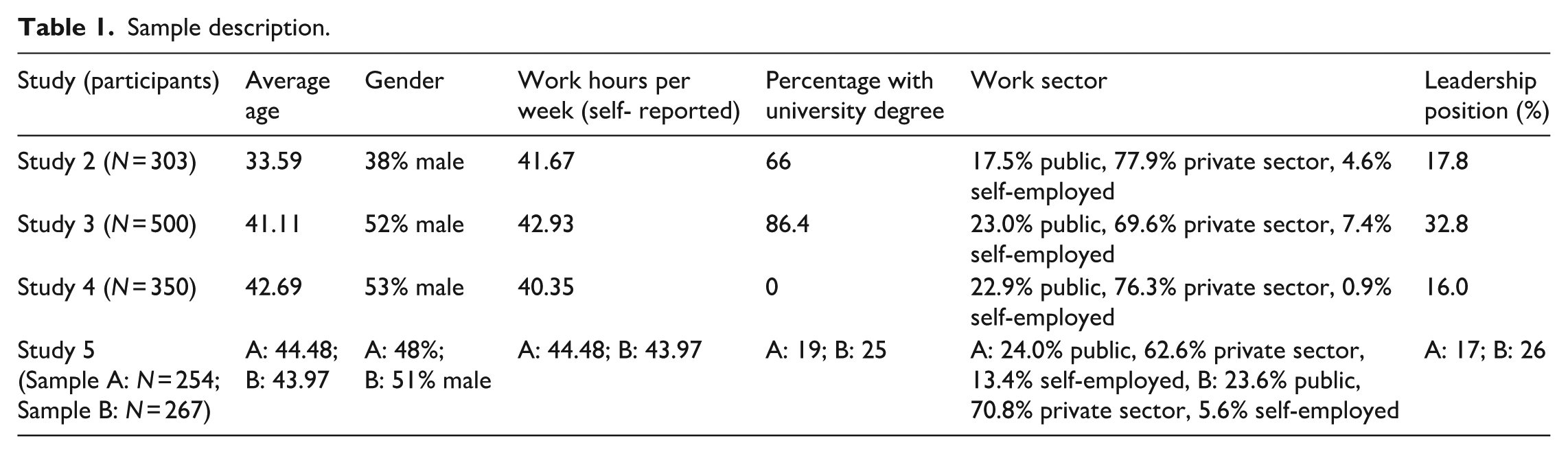
All data were collected in Germany through various online surveys. Table 1 summarizes the main demographic characteristics of participants; Appendix B1 provides extended sample descriptions. Most data collection took place before the COVID-19 pandemic affected the world of work, specifically between July 2016 and July 2020. Recruitment for study 2 occurred between July and November 2016 through social media posts on LinkedIn, Xing, Facebook, and e-fellows. Study 3 relied on university alumni networks and the survey panel responding, with data gathered between February and July 2017. In study 4, participants were recruited through responding survey panel and social media posts, primarily on Facebook, with data collected from November 2019 to July 2020. Each study applied data cleaning procedures, excluding fewer than 5% of participants due to careless responding. Alongside the development sample in study 2, study 3 intentionally included a sample of highly educated workers, while study 4 focused on a sample with lower educational attainment. This sampling strategy aimed to assess the reliability of results across educational groups, 3 drawing on prior research indicating that higher education is positively associated with overemployment (Golden and Gebreselassie, 2007; Reynolds and Aletraris, 2010).
Sample description.
Measures
Study 2 used the preliminary 27-item version of the POS, rated on a five-point Likert scale ranging from 1 (definitely disagree) to 5 (definitely agree), with higher values indicating greater psychological overemployment. Studies 3 and 4 employed the refined three-factorial version of the POS, which included 13 items derived from the findings of study 2 (Table 2).
Study 2 (split sample 1): Results of the final exploratory factor analysis.
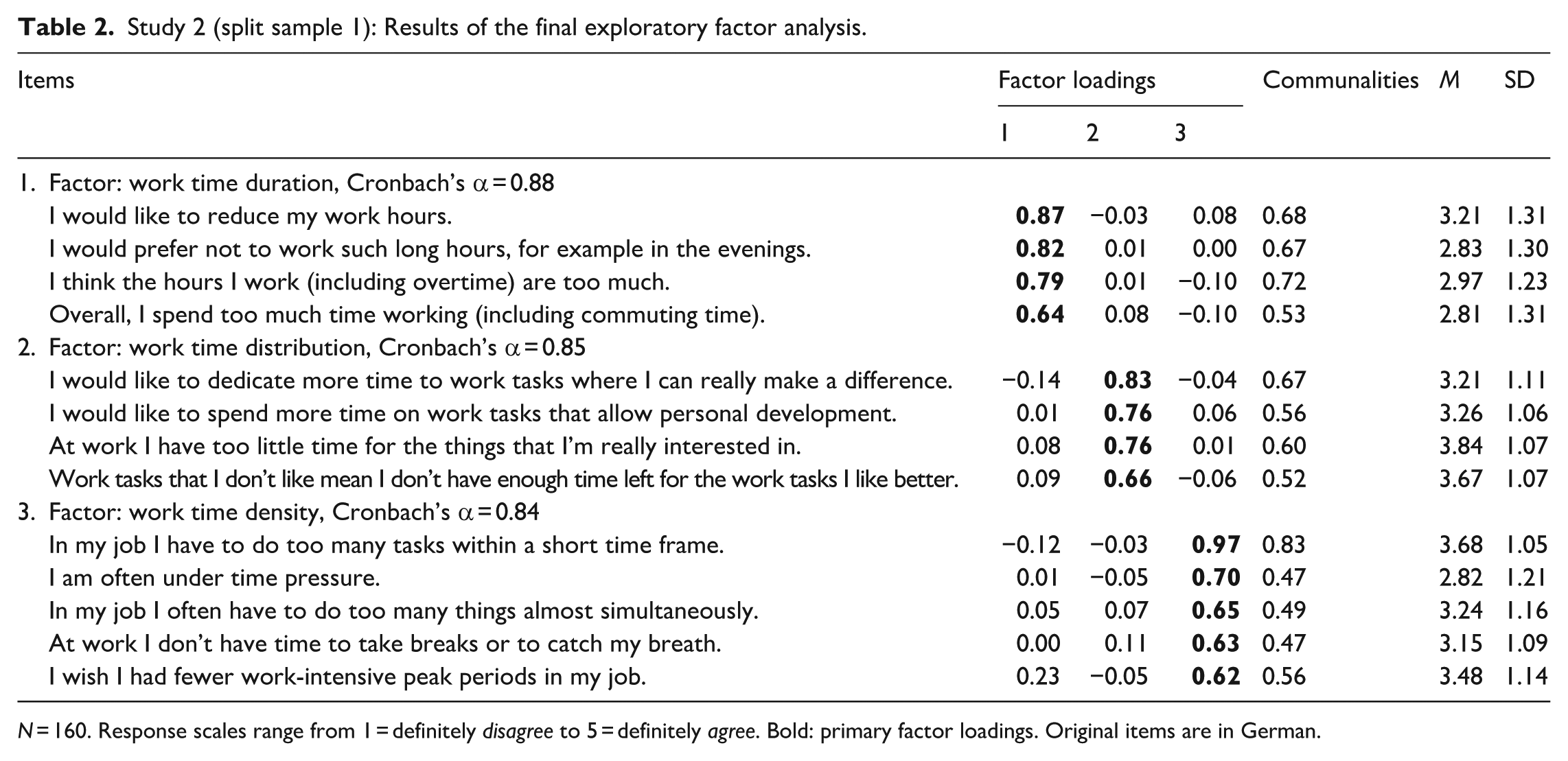
N = 160. Response scales range from 1 = definitely disagree to 5 = definitely agree. Bold: primary factor loadings. Original items are in German.
To check validity in studies 3 and 4, a conventional discrepancy measure of traditional overemployment from the Socio-Economic Panel (Matta, 2015) was used. Respondents answered two questions: “How many hours do you actually work per week including overtime?” and “If you could choose your work hours, considering that your income would change accordingly: How many hours per week would you prefer to work?”
Based on these questions, two values were constructed (see Pagan, 2017). The first, the “overemployment (OE)-discrepancy” value, represents the difference between respondents’ actual and preferred work hours. Higher positive values indicate greater overemployment, while a value of zero signifies that preferred and actual hours match. Respondents whose preferred hours exceeded actual hours were excluded from the analysis, as the POS does not measure underemployment related to work time. The second metric, the “OE-dichotomous” value, categorizes employees with actual hours exceeding preferred hours as “1” (indicating traditional overemployment), and those with matching actual and preferred hours as “0.”
Well-being was measured in studies 2 and 3 using a single-item measure for life satisfaction (Beierlein et al., 2015) and health satisfaction (Friedland and Price, 2003). Burnout was measured using the Oldenburg Burnout Inventory (Demerouti et al., 2001), which comprises the two factors of exhaustion and disengagement.
Job attitudes were measured in studies 2 and 3 using affective commitment (Felfe et al., 2014) and job satisfaction (Smiley–Kunin scale; Neuberger and Allerbeck, 2014).
Work behavior was measured in studies 2 and 3 in terms of OCB, with items for helpfulness, individual initiative, and straightforwardness (Staufenbiel and Hartz, 2000a, 2000b). Turnover intention was gaged with four items drawn from the Michigan Organizational Assessment Questionnaire (Cammann et al., 1983; Shore et al., 1990).
Work-life balance was measured with five items taken from Syrek et al. (2011). Work time sovereignty was assessed with five items closely related to previous measures used by Krausz et al. (2000) and by Moen et al. (2013).
To assess the criterion validity of the POS subscales in studies 2 and 3, conservative tests were conducted, controlling for gender, age, educational level, work sector, current occupation, multiple jobholding, leadership position, shift work, temporary job holding, relationship status, having children under 14 (all dummies), organizational tenure, income, and actual job hours (continuous variables). This first validation of the POS aimed to demonstrate that its subscales add to prediction of the criteria above and beyond the control variables (see Bernerth and Aguinis, 2016). Given criticisms regarding unexplained use of control variables (Bernerth and Aguinis, 2016), detailed rationales for their inclusion apper in Appendix B2.
Procedure
Study 2 employed a split sample method to explore the scale structure, using both exploratory factor analysis (EFA) and confirmatory factor analysis (CFA). As emphasized by Worthington and Whittaker (2006), initial validation of a new instrument requires empirical assessment of the underlying factor structure via EFA before conducting CFA. This approach supplements conceptually driven item development with empirical exploration of the underlying structure. Following DeVellis’s (2012) recommendation, the study applied a split-sample approach, conducting EFA and CFA on independent subsamples drawn from the same dataset. This method enhances the methodological rigor of scale development by reducing the risk that chance or sample-specific characteristics distort the identified factor structure. Random assignment created split samples 1 and 2, which did not differ significantly in demographic characteristics. The split was not completely even (split sample 1: N = 160; 2: N = 143) in order to ensure an approximate ratio of six participants per item for the EFA (Tinsley and Tinsley, 1987).
Studies 3 and 4 tested convergent validity by linking the POS to existing traditional overemployment measures. Work-life balance served as a criterion to assess discriminant validity. Study 3 also examined the nomological network of the three-dimensional psychological overemployment construct by relating it to other theoretically relevant constructs (MacKenzie et al., 2011). Criterion validity (Cronbach and Meehl, 1955) was established by linking the POS to measures of well-being, job attitudes, and work behavior. Incremental validity (Hunsley and Meyer, 2003) was tested by studying whether the POS subscales added anything to the prediction of well-being, job attitudes, and work behaviors above the traditional overemployment measures.
To minimize the occurrence of missing data, participants received a notification whenever they overlooked answering an item on a survey page. Additionally, responses to the items on the POS-scale and the items designed to assess validity were mandatory, requiring completion before proceeding. For variables exhibiting missing data (<10%), pairwise deletion was employed (see Newman, 2014). Moreover, we assessed data quality by checking for outliers, uniform response patterns (e.g. consistently selecting the first or last scale anchor throughout the survey), and extreme multicollinearity (Carpenter, 2018).
Results of study 2
Analysis began with data from split sample 1. Frequency distribution, item means, and standard deviations were assessed for each variable. Two POS items were excluded due to high mean values and skewed distributions: “There are times at work when I need to think about too many things at once” and “I would like to dedicate more time to certain work tasks and less time to others,” reducing the item pool to 25.
Principal axis factor analysis with oblique (direct oblimin) rotation was conducted, based on the assumption of correlated factors (see Field, 2014). The findings suggested a factorable correlation matrix (Kaiser–Meyer–Olkin measure of sampling adequacy: KMO = 0.89; Bartlett’s test of sphericity: χ²(300, N = 160) = 2025.97, p < 0.001). The scree plot indicated a clear three-factorial solution. In contrast, the Kaiser criterion (Kaiser, 1970), which is known for identifying rather too many factors (Hayton et al., 2004), suggested a five-factorial model. Factor 5, however, was supported by only two items (“I spend too much of my work time on tasks I get bored with”; “I spend too much time at my work on tasks I find less meaningful”)—both initially developed to capture POS-distribution—and both items exhibited high cross-loadings on other factors, warranting their exclusion. The fourth factor under the Kaiser criterion solution appeared to reflect „work time competition,“ but it also exhibited high cross-loadings to other factors. To determine the final factor structure, parallel analysis was conducted (Horn, 1965), which is considered one of the most accurate factor retention methods (Hayton et al., 2004). This simulation method compares the eigenvalues observed with those obtained from random data. A factor is retained if the associated eigenvalue is higher than the 95th percentile of the distribution of eigenvalues derived from random data. Parallel analysis with the remaining 23 items confirmed the three-factorial structure (see Appendix C).
This three-factor solution again demonstrated strong factorability (KMO = 0.90, Bartlett’s test of sphericity: χ²(253, N = 160) = 1911.35, p < 0.001) and explained 49.75% of the variance. Six items showed communalities smaller than 0.40 and cross-loadings with a gap smaller than 0.30 and were therefore deleted (see Field, 2014; Tabachnick and Fidell, 2001). Analysis of the remaining 17 items again revealed that the matrix was factorable (KMO = 0.90, Bartlett’s test of sphericity: χ²(136, N = 160) = 1434.78, p < 0.001), with a three-factor solution explaining 56.06% of item variance. 4 Two items initially intended to measure “work time competition” showed weak primary factor loadings (<0.60) and thus were excluded. This left only two items, which were conceptually designed to measure “work time competition” and loaded on factor 1. The items did not refer to the duration of working time but rather to specific aspects, that is, having time for oneself and for hobbies. As they did not fit conceptually with the other items loading on factor 1, they were excluded. The analysis proceeded with 13 items loading on three factors (Table 2). 5 Factor analysis of these 13 items again revealed a factorable matrix (KMO = 0.86, Bartlett’s test of sphericity: χ²(78, N = 160) = 1026.53, p < 0.001). The three-factor solution explained 59.59% of item variance (eigenvalues: 4.80, 1.77, and 1.18), which can be regarded as satisfactory (Diekhoff, 1992). All items had strong primary loadings (>0.62) and loaded clearly on one single factor. The three resulting subscales demonstrated good reliability and showed positive intercorrelations, r(160) = 0.26–0.58, p < 0.001 (see Table 2).
Overall, the three-factorial solution drew support from both statistical evidence (scree plot, parallel analysis) and conceptual reasoning. We also conceptually explored a potential fourth and fifth factor. Examination revealed that the items loading on the fourth factor appeared to represent a general negative attitude toward work (i.e. perceptions of work as not meaningful and boring). In contrast, the remaining items related to the POS-distribution however do not reflect this negativity; instead, they emphasize a lack of time for positive work activities. Furthermore, a potential fifth factor would have represented the work time competition factor, which is conceptually distinct from the other factors however. Work time competition is the only aspect that addresses not solely time spent at work but rather reflects the balance between work time and free time. All other three factors focus exclusively on perceptions of work time.
To confirm the three-factorial structure, CFA was conducted using split sample 2 (N = 143) with maximum likelihood estimation in AMOS. The three-factorial model showed a very good model fit (χ2 = 62.9, df = 62, comparative fit index (CFI) = 0.99, Tucker–Lewis index (TLI) = 0.99, root mean square error of approximation (RMSEA) = 0.01, standardized root mean square residual (SRMR) = 0.04; Hu and Bentler, 1999). An alternative one-factor model, tested due to a considerable drop in eigenvalues after the first factor in the EFA, did not have an acceptable fit (χ2 = 396.74, df = 65, CFI = 0.62, TLI = 0.54, RMSEA = 0.19, SRMR = 0.15; Hu and Bentler, 1999).
In sum, study 2 showed that psychological overemployment is a multidimensional construct consisting of the three dimensions of work time duration, density, and distribution. The three subscales demonstrated good internal consistency: Cronbach’s alpha α = 0.90 for work time duration, 0.84 for work time density, and 0.82 for work time distribution.
To check for the convergent validity of the POS subscales, that is, whether a set of items shares a high proportion of common variance, criteria from Hair et al. (2010) and Hu and Bentler (1999) were applied. According to these criteria, the factor loadings should be over 0.50, the average variance extracted (AVE) should reach at least 0.50, and composite reliability (CR) should be above 0.70. In the three-factorial solution, factor loadings were between 0.57 and 0.92 (in split sample 2). The AVE was consistently over 0.50 and CR ranged between 0.82 and 0.90 (see Table 3). This supports the convergent validity of the three-factorial solution.
Study 2 (split sample 2): Results of the discriminant validity analysis of the POS subscales.
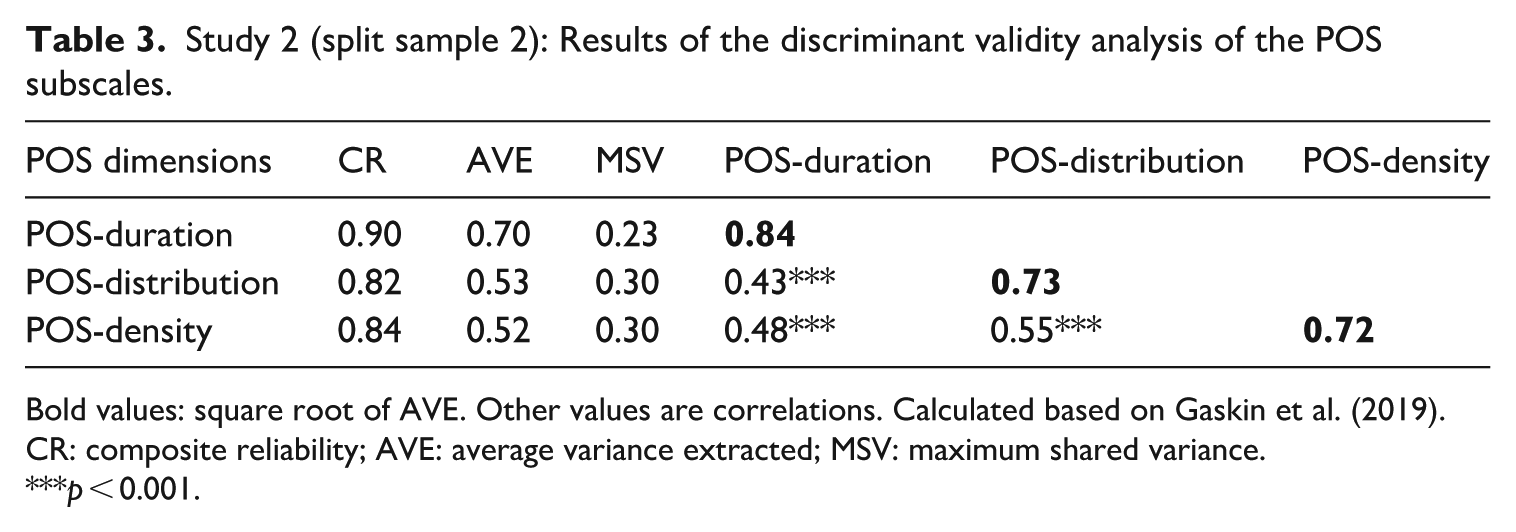
Bold values: square root of AVE. Other values are correlations. Calculated based on Gaskin et al. (2019).
CR: composite reliability; AVE: average variance extracted; MSV: maximum shared variance.
p < 0.001.
To check for the discriminant validity of the subscales, that is, whether the three dimensions can be separated from each other, Fornell and Larcker’s (1981) test was applied using the AMOS plugin developed by Gaskin et al. (2019). According to this method, two constructs are different if the square root of each construct’s AVE is higher than the correlation between the two constructs. This was the case for all three factors (Table 3). Moreover, the maximum shared variance (MSV) was smaller than the AVE, again supporting discriminant validity (Hair et al., 2010). This confirms the discriminant validity of the three-factorial structure of psychological overemployment.
Results of study 3
Construct validity and reliability of the POS
The CFA revealed a good model fit for the three-factorial structure (χ2 = 272.52, df = 62, CFI = 0.94, TLI = 0.93, RMSEA = 0.08, SRMR = 0.06; Weiber and Mühlhaus, 2014). An alternative one-factor model was not acceptable (χ2 = 1279.09, df = 65, CFI = 0.68, TLI = 0.61, RMSEA = 0.19, SRMR = 0.11). The three POS subscales were again positively correlated (r(500) = 0.49 to 0.54, p < 0.001). Cronbach’s alphas were high for all subscales: POS-duration: 0.90, POS-density: 0.87, POS-distribution: 0.84. Appendix D presents the correlations between POS and key external variables.
The POS subscales correlated positively with both OE discrepancy and OE dichotomy: r(468) = 0.22–0.52, ps < 0.01. Compared with usual standards of convergent validity (i.e. correlations over 0.50; Carlson and Herdman, 2012) some of these results are low. However, this is most likely due to method effects (Campbell and Fiske, 1959), as traditional overemployment measures and the POS scale involve two very different methods: Traditional measures represent unidimensional, objectivist approaches with relatively low reliability (Campbell and van Wanrooy, 2013), whereas the POS offers a a subjectivist, multidimensional alternative.
The POS subscales showed negative correlations with work time sovereignty (r(500) = −0.27 to −0.32, ps < 0.01), as did OE discrepancy and OE dichotomy (r(468) = −0.21 and −0.17, ps < 0.01). Similarly, the POS subscales correlated moderately with work-life balance (r(500) = −0.48 to −0.68, ps < 0.01), with OE discrepancy and OE dichotomy also showing positive correlations (r(468) = −0.31 and −0.51, ps < 0.01). These consistent correlation patterns suggest that both the traditional overemployment measures and the POS capture similar constructs, supporting the convergent validity of the POS (MacKenzie et al., 2011).
To test discriminant validity, the divergence of work-life balance from the three POS subscales was checked using Fornell and Larcker’s (1981) test. In each case, the square root of the construct’s AVE exceeded the correlation between the two constructs, and the MSV was smaller than the AVE (Hair et al., 2010), indicating discriminant validity (Table 4).
Study 3: Results of the discriminant validity analysis of the POS subscales and work-life balance.
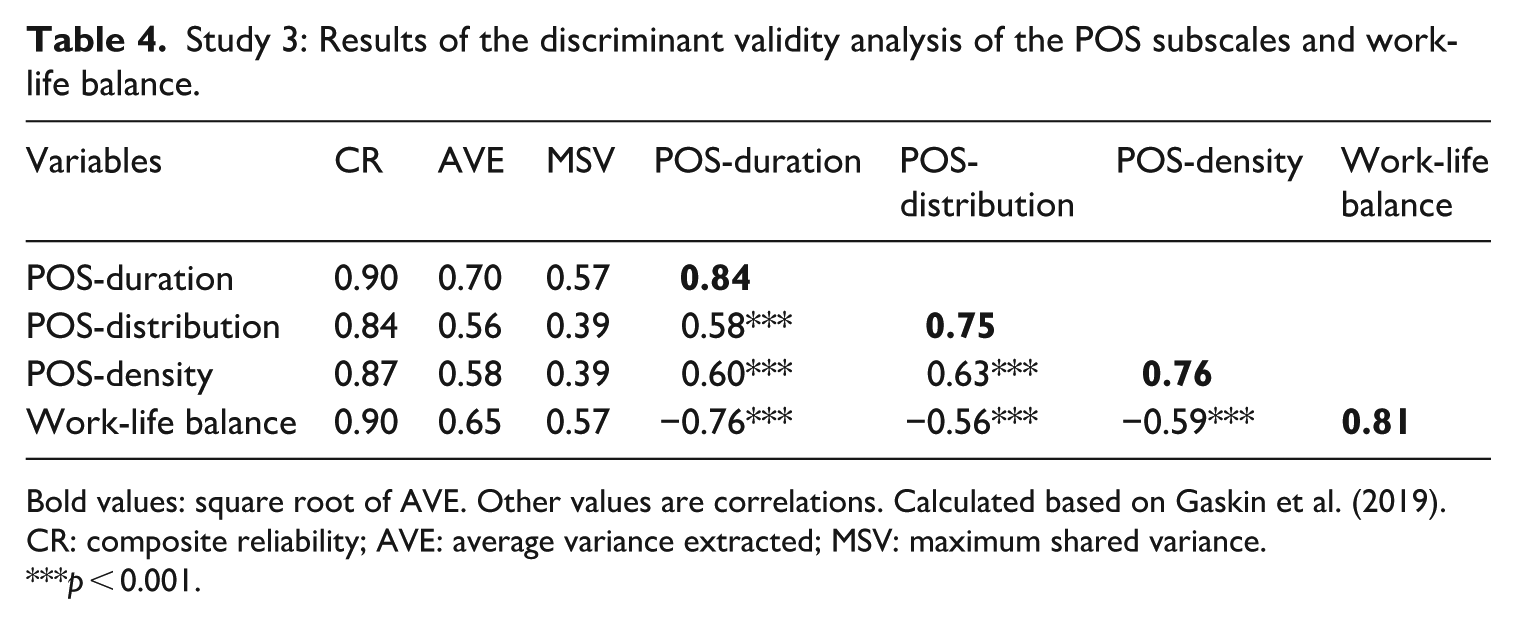
Bold values: square root of AVE. Other values are correlations. Calculated based on Gaskin et al. (2019).
CR: composite reliability; AVE: average variance extracted; MSV: maximum shared variance.
p < 0.001.
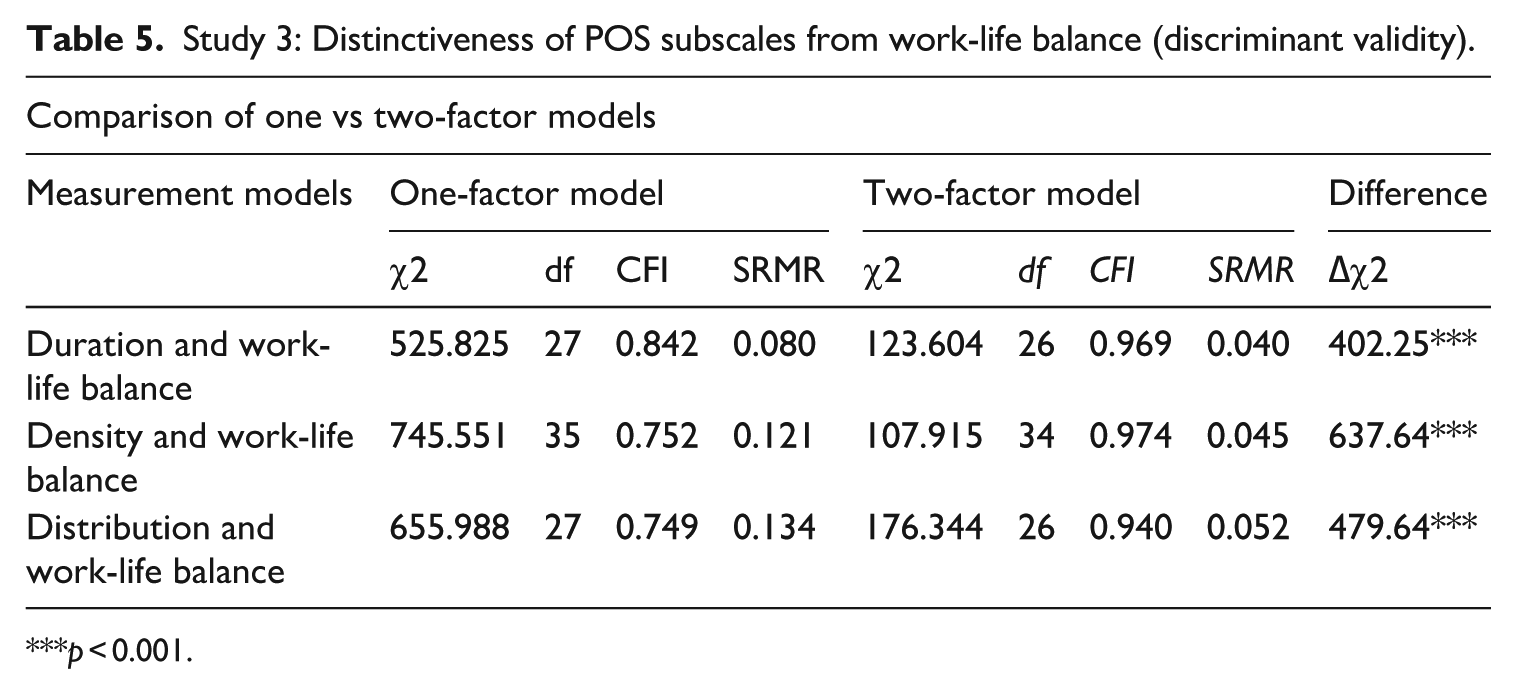
To further examine the discriminant validity of work-life balance in relation to the three POS subscales, we conducted a series of one-factor versus two-factor CFAs, following the procedure outlined by Holtz et al. (2025). For each POS subscale (duration, density, distribution), we checked whether their items loaded on the same factor as the work-life balance items or on a different factor.
Results (Table 5) consistently showed that the two-factor models fit the data significantly better than the one-factor models, confirming the distinctiveness of the POS subscales from work-life balance and further supporting their discriminant validity.
Study 3: Distinctiveness of POS subscales from work-life balance (discriminant validity).
***p < 0.001.
Criterion validity of the POS
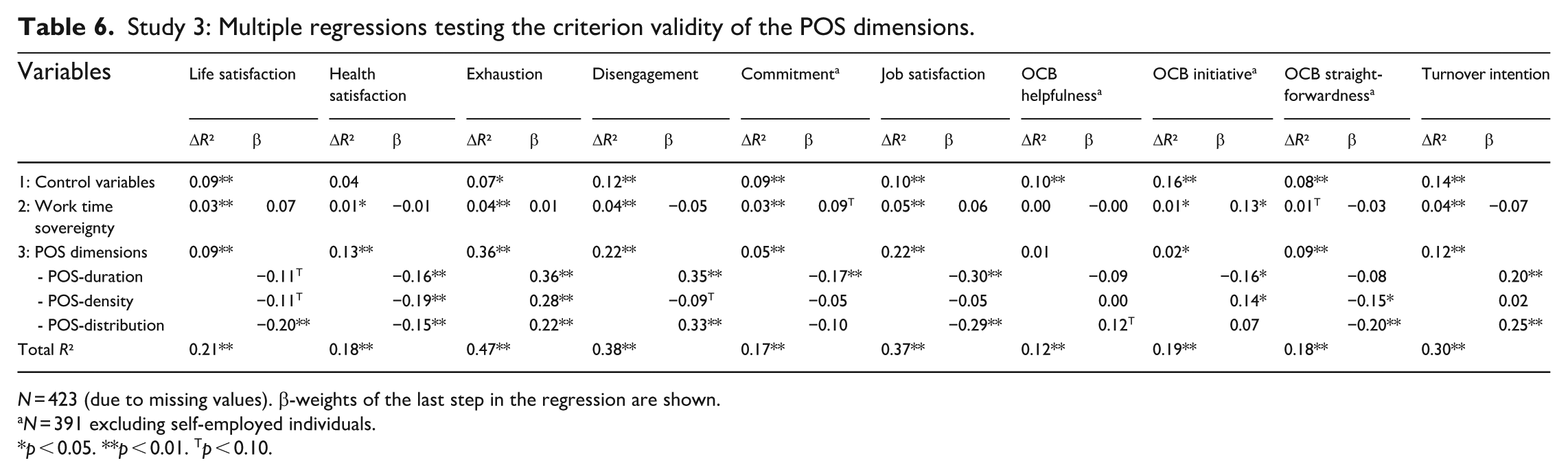
Hierarchical regression analyses served to test the predictive validity of the POS for the proposed well-being, job attitude, and work behavior variables (Table 6). Step 1 included the control variables, followed by work time sovereignty in step 2. Step 3 added the three POS subscales. POS-duration predicted all variables except OCB helpfulness and OCB straightforwardness; for life satisfaction, the prediction showed a tendency toward significance. POS-distribution predicted all variables except commitment, OCB helpfulness (tendency only), and OCB initiative. POS-density significantly predicted health satisfaction, exhaustion, and OCB straightforwardness in the expected direction, and it marginal associations with life satisfaction and disengagement. Contrary to expectations, it also positively predicted OCB initiative.
Study 3: Multiple regressions testing the criterion validity of the POS dimensions.
N = 423 (due to missing values). β-weights of the last step in the regression are shown.
N = 391 excluding self-employed individuals.
p < 0.05. **p < 0.01. Tp < 0.10.
In addition to the hierarchical regression, we conducted a structural equation model to further analyze the connections between the POS subscales, the two burnout dimensions (exhaustion and disengagement), and turnover. The results are shown in Appendix G.
Overall, the POS significantly predicted variance in the outcome variables even after control variables and work time sovereignty were entered. Thus, to a large extent the findings are in accordance with the overemployment theory developed by Hiemer and Andresen (2019), which proposes that psychological overemployment causes psychophysiological strain. This indicates criterion-related validity (MacKenzie et al., 2011).
Incremental validity of the POS
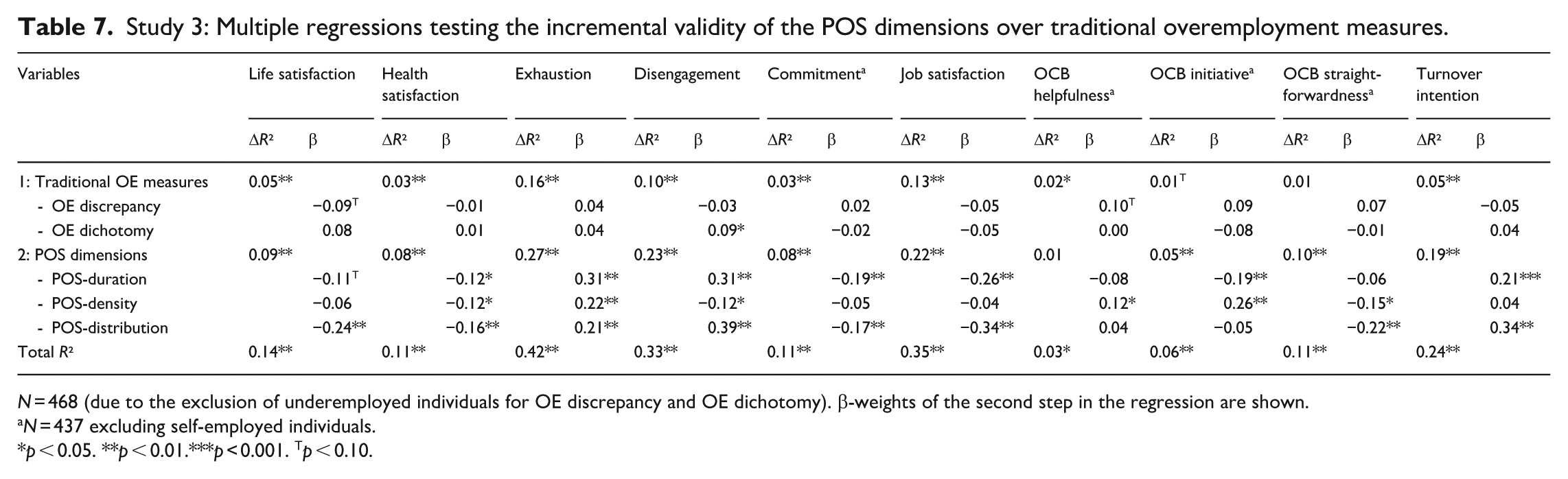
To examine the incremental validity of the POS subscales over traditional overemployment measures (OE discrepancy and OE dichotomy), a two-step hierarchical regression analysis assessed each criterion. Step 1 regressed the criteria on the traditional overemployment measures, that is, OE discrepancy and OE dichotomy. Step 2 added the POS subscales. Table 7 presents the results. In step 2, the POS dimensions accounted for significant variance above and beyond the variance explained by the traditional overemployment measures for all dependent variables except for OCB helpfulness (significant ΔR² ranging from 0.05 to 0.27). As these results show that the POS explains significant variance over traditional overemployment measures, they are evidence of the POS’s incremental validity (Hunsley and Meyer, 2003).
Study 3: Multiple regressions testing the incremental validity of the POS dimensions over traditional overemployment measures.
N = 468 (due to the exclusion of underemployed individuals for OE discrepancy and OE dichotomy). β-weights of the second step in the regression are shown.
N = 437 excluding self-employed individuals.
p < 0.05. **p < 0.01.***p < 0.001. Tp < 0.10.
Results of study 4
Construct validity and reliability of the POS
A CFA with three factors showed an overall acceptable model fit (χ2 = 270.18, df = 62, CFI = 0.92, TLI = 0.90, RMSEA = 0.10, SRMR = 0.06). In contrast, a one-factor alternative failed to achieve acceptable fit (χ2 = 860.90, df = 65, CFI = 0.70, TLI = 0.64, RMSEA = 0.19, SRMR = 0.11). The three POS subscales showed positive intercorrelations (r(350) = 0.43–0.64, ps < 0.001). Cronbach’s alphas were high across all subscales (POS-duration: 0.87; POS-density: 0.88; POS-distribution: 0.84).
The POS subscales correlated positively with both OE discrepancy and OE dichotomy (r(324) = 0.25–0.50, ps < 0.01; see Appendix D for all correlations). The partially low values likely reflect the limited reliability of earlier measures (Campbell and van Wanrooy, 2013).
POS-duration and POS-density negatively correlated with work time sovereignty (r(350) = −0.15 and −0.21, ps < 0.01), as did OE discrepancy (r(324) = −0.15, p < 0.01). The POS subscales also correlated negatively with work-life balance (r(350) = −0.44 to −0.66, ps < 0.01), mirroring the associations observed for OE discrepancy and OE dichotomy (r(324) = −0.34 and −0.43, ps < 0.01). Thus, the traditional overemployment measures and the POS showed similar correlation patterns to other constructs, which speaks in favor of construct validity (MacKenzie et al., 2011). 6
Criterion and incremental validity of the POS
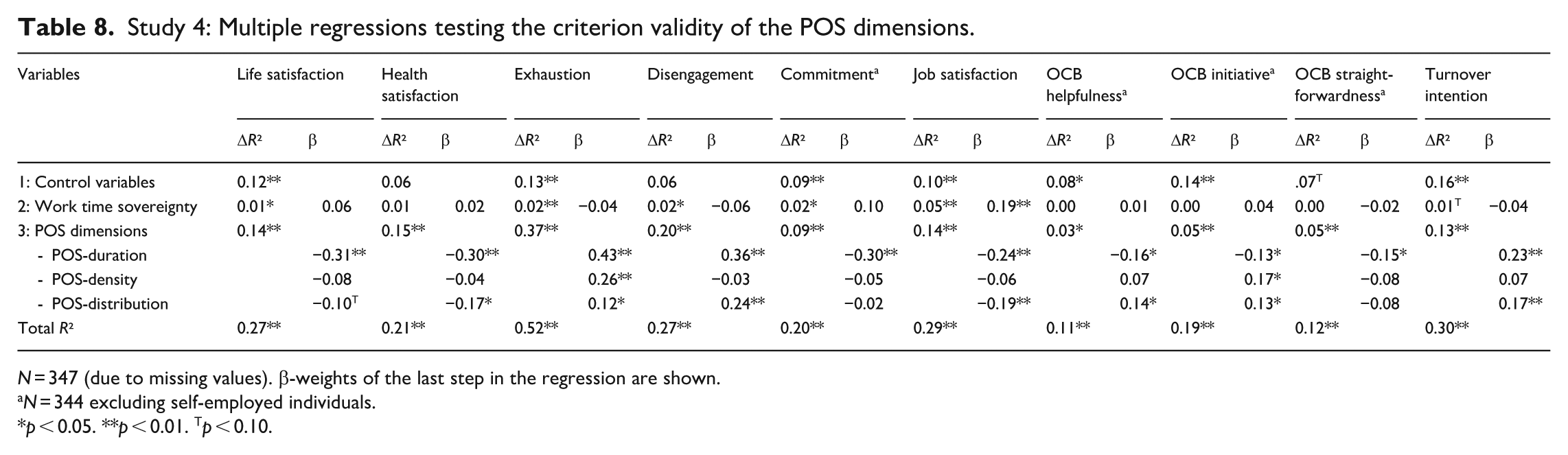
Hierarchical regression analyses tested the criterion validity of the POS in predicting the proposed variables (Table 8). The results provided mixed support for the theoretical assumptions. POS-duration predicted all variables in the expected direction. POS-distribution predicted health satisfaction, burnout, job satisfaction, and turnover in the expected direction, but also—contrary to expectations—showed positive correlations with two OCB dimensions (helpfulness and initiative). POS-density demonstrated the weakest predictive power; however, it was significantly positively correlated with exhaustion and, contra our assumptions, OCB initiative. The POS outperformed work time sovereignty in predicting the outcomes and explained additional variance beyond that accounted for by control variables, including actual work hours. These results—particularly the strong correlations between POS and well-being—align with the theory of overemployment described in Hiemer and Andresen (2019), which speaks in favor of good criterion-related validity (MacKenzie et al., 2011).
Study 4: Multiple regressions testing the criterion validity of the POS dimensions.
N = 347 (due to missing values). β-weights of the last step in the regression are shown.
N = 344 excluding self-employed individuals.
p < 0.05. **p < 0.01. Tp < 0.10.
Incremental validity was tested using the same two-step hierarchical regression approach as in study 3 (Table 9). In step 2, the POS dimensions accounted for significant variance over the variance explained by the traditional overemployment measures for all dependent variables (ΔR² ranging from 0.04 to 0.28). These results are evidence of the POS having good incremental validity over previous overemployment measures (Hunsley and Meyer, 2003).
Study 4: Multiple regressions testing the incremental validity of the POS dimensions over traditional overemployment measures.
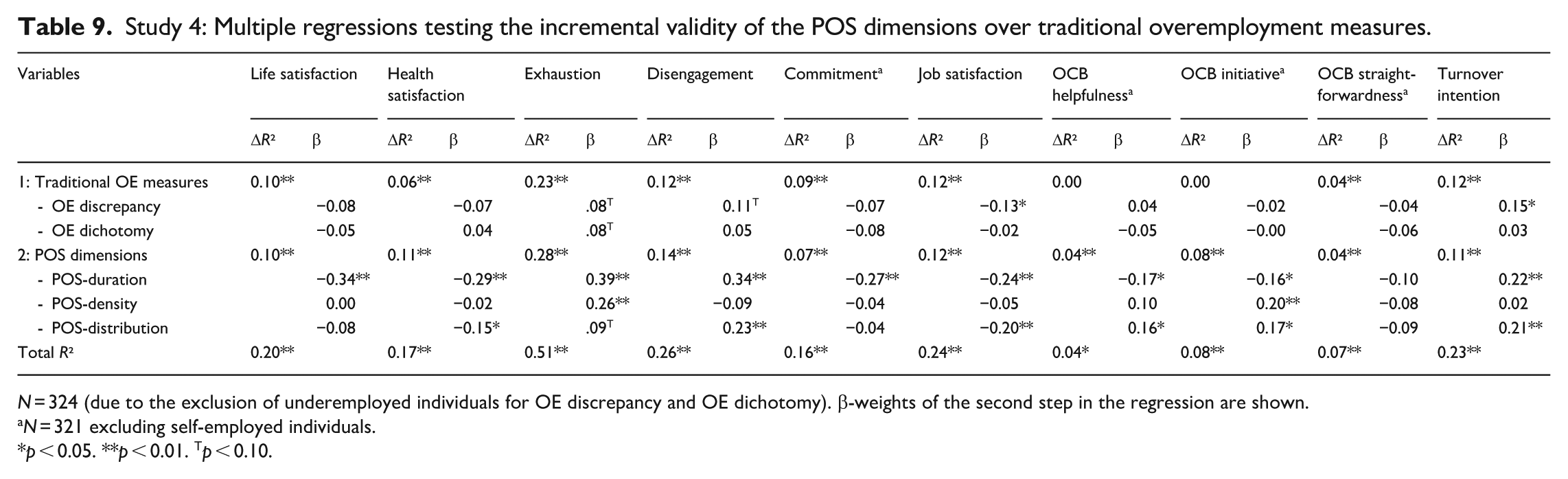
N = 324 (due to the exclusion of underemployed individuals for OE discrepancy and OE dichotomy). β-weights of the second step in the regression are shown.
N = 321 excluding self-employed individuals.
p < 0.05. **p < 0.01. Tp < 0.10.
Study 5: Discriminant validity using orbiting constructs
In addition to defining the construct, demonstrating its distinctiveness from well-established constructs within the same conceptual space remains essential. To establish this distinctiveness, we initially selected orbiting constructs (Colquitt et al., 2019) through consultations with experts in a focus group discussion. Subsequent statistical tests assessed whether these constructs differed meaningfully from psychological overemployment within the target population. This approach—combining expert evaluations with assessments from the target population—reflects widely recommended practices in scale development (Boateng et al., 2018).
Step1: Choosing orbiting constructs
Selection criteria
Colquitt et al. (2019) define definitional distinctiveness as “the degree to which a scale’s items correspond more to the focal construct’s definition than to the definitions of other orbiting constructs” (p. 1243). Colquitt et al. (2019) and Holtz et al. (2025) propose differentiating a focal construct from two orbiting constructs, selected according to four criteria: First, researchers should choose venerable constructs with strong empirical support and well-established definitions, whose corresponding scale is frequently used in the literature. Second, comparisons should occur at the same stage of “causal flow” as the focal construct, excluding its antecedents and consequences. Third, researchers should avoid constructs in a part-whole relationship, where one is a sub-facet or a more specific instance of the other (e.g. pay satisfaction vs overall satisfaction). Fourth, the constructs should share the same referent. For instance, if the focal construct pertains to working individuals, so should the orbiting construct.
The identification of constructs followed a two step process. First, based on Colquitt et al.’s (2019) criteria and a literature review of the nomological network of psychological overemployment, we identified potential constructs (see Table F1 in Appendix F). Second, following the recommendation of Podsakoff et al. (2016), we conducted a focus group discussion with six subject matter experts from public universities (see also Khatri et al., 2025). The group size adhered to the guidelines proposed by Gill et al. (2008) and Krueger (2014), which suggest that ideal focus group sizes range from three to 14 participants, with six to eight considered optimal to prevent both chaos or under-discussion. The focus group employed moderated discussion to generate qualitative data on psychological overemployment, hereby enriching and extending the conceptual understanding of the construct (Vogt et al., 2004).
Focus group discussion
To prepare for the discussion, we provided the experts with a definition of psychological overemployment, its dimensions and items, and a table of potential orbiting constructs (Appendix F) that included their definitions and corresponding measures. We then conducted a 90-minute online session with the experts. The goal of this discussion was to identify suitable orbiting constructs for subsequent statistical analyzes from among those listed in Appendix F. The discussion addressed the following topics: (1) What similarities do the experts perceive between the orbiting constructs and the psychological overemployment dimensions? (2) What delineations between orbiting constructs and each dimension of psychological overemployment are critical for empirically examining distinctiveness? (3) What additional constructs might be relevant for determining the distinctiveness of psychological overemployment? The experts’ role was to provide insights on the similarity and differences between psychological overemployment and the orbiting constructs. Based on expert input and the criteria outlined by Colquitt et al. (2019), we selected eight orbiting constructs from those listed in Appendix F: two for POS-duration (involuntary overtime, job demands), two for POS-density (chronic time pressure, role overload), and four for POS-distribution (skill variety, task identity, task significance, and task autonomy) derived from the Job Characteristics Model (Hackman and Oldham, 1975).
Measurement of orbiting constructs
The study measured involuntary overtime using two items from Beckers et al. (2008): “I work overtime because my supervisor wants me to” and “I work overtime because my colleagues expect me to.” Response options were “yes” or “no.” Job demands were measured with five items from the Job Content Questionnaire (Karasek et al., 1998; German version: Stab et al., 2016). Sample items are “My job requires me to work very quickly” and “I have enough time to get my work done,” rated from 1 (never/hardly ever) to 5 (always). Chronic time pressure was captured with four items from the ISTA-F questionnaire (Clasen, 2019), for example, “Are you under time pressure at work?” rated on a scale from 1 (vary rarely/never) to 5 (very often/almost continuously). Role overload was measured with three items from Beehr et al. (1976), such as “It often seems like I have too much work for one person,” with responses ranging from 1 (don’t agree at all) to 7 (totally agree). Skill variety, task identity, task significance, and task autonomy were assessed using items from the Work Design Questionnaire (Stegmann et al., 2010) on a scale from 1 (don’t agree at all) to 5 (totally agree). Skill variety was measured with four items (e.g. “I do a lot of different things in my job”); task identity with four items (e.g. “The results of my work are complete products/services”); task significance with four items (e.g. “My work has a significant impact on other people’s lives”). Task autonomy was measured using three sets of items for planning (three items; e.g. “I am free to organize my work in terms of time.”), decision making (three items; e.g. “I can make many decisions independently in my work.), and method (three items; e.g. “I have a lot of freedom in the way I do my work.”).
Step 2: Administering the survey
To reduce survey completion time and minimize the number of questions answered by a single participant, we conducted two separate surveys. Participants were randomly assigned to either survey A or survey B. After data cleaning, 254 participants completed survey A, and 267 completed survey B. All participants were recruited via Pureprofile (pureprofile.com). During data cleaning, we excluded 21 participants from survey A and 19 from survey B, for example, due to unusually fast response times identified using Tukey hinges (Tukey, 1977), inconsistent answering, or systematic answering patterns such as straight-lining (see Osborn and Overbay, 2004). Data collection took place in Germany, and the survey was administered in German. The sample was representative of the German working population in terms of education, gender, and age. In addition to the POS items, survey A included the following orbiting constructs: involuntary overtime, job demands, chronic time pressure, and role overload; and survey B included: skill variety, task identity, task significance, and task autonomy. Sample A consisted of 121 male and 133 female participants (mean age = 44.48, SD = 12.24). Sample B included 135 male and 132 female participants (mean age = 43.97, SD = 12.31).
Step 3: Assessing the discriminability of our scale
As suggested in Cortina et al. (2020), the analysis assessed the discriminant validity of the scale by testing its distinctiveness from orbiting constructs. First, we examined the correlations between the POS subscales and the orbiting constructs (see Tables 10 and 11). Following Cortina et al. (2020; see also Holtz et al., 2025), a significant correlation between the target measure and the orbiting construct provides evidence of the target measure’s convergent validity. As shown in Table 10, all POS subscales (duration, density, and distribution) were significantly correlated with involuntary overtime, job demands, chronic time pressure, and role overload (r = 0.32 to r = 0.67, p < 0.01). Table 11 further indicates that POS-density was significantly related to task autonomy (r = −0.12, p < 0.05), and POS-distribution showed a marginal relationship with task autonomy (r = −0.11, p = 0.08).
Study 5: Means, standard deviations, intercorrelations, and scale reliabilities of Survey A.
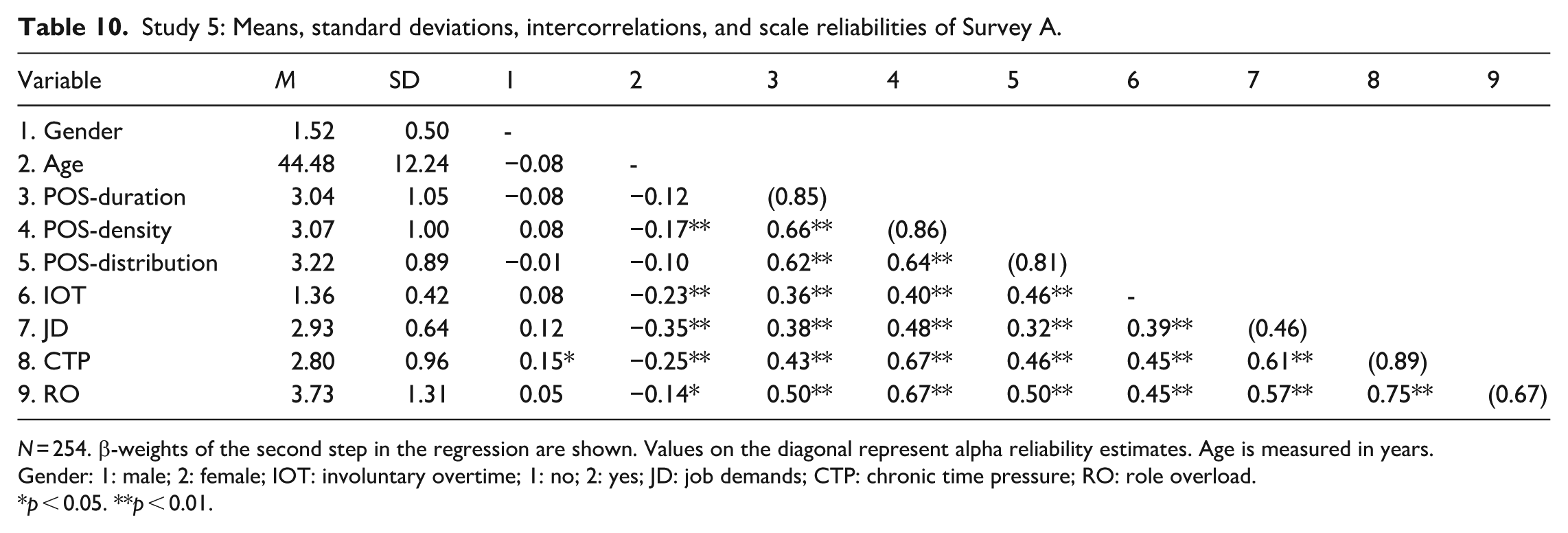
N = 254. β-weights of the second step in the regression are shown. Values on the diagonal represent alpha reliability estimates. Age is measured in years.
Gender: 1: male; 2: female; IOT: involuntary overtime; 1: no; 2: yes; JD: job demands; CTP: chronic time pressure; RO: role overload.
p < 0.05. **p < 0.01.
Study 5: Means, standard deviations, intercorrelations, and scale reliabilities of Survey B.
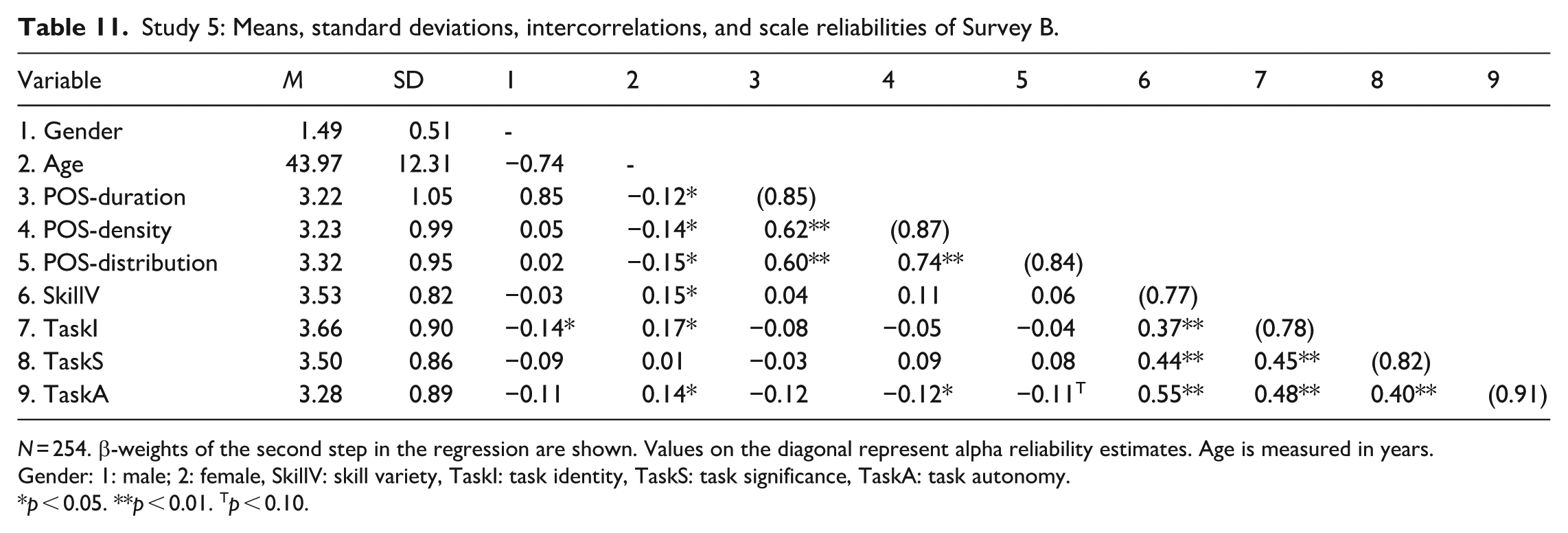
N = 254. β-weights of the second step in the regression are shown. Values on the diagonal represent alpha reliability estimates. Age is measured in years.
Gender: 1: male; 2: female, SkillV: skill variety, TaskI: task identity, TaskS: task significance, TaskA: task autonomy.
p < 0.05. **p < 0.01. Tp < 0.10.
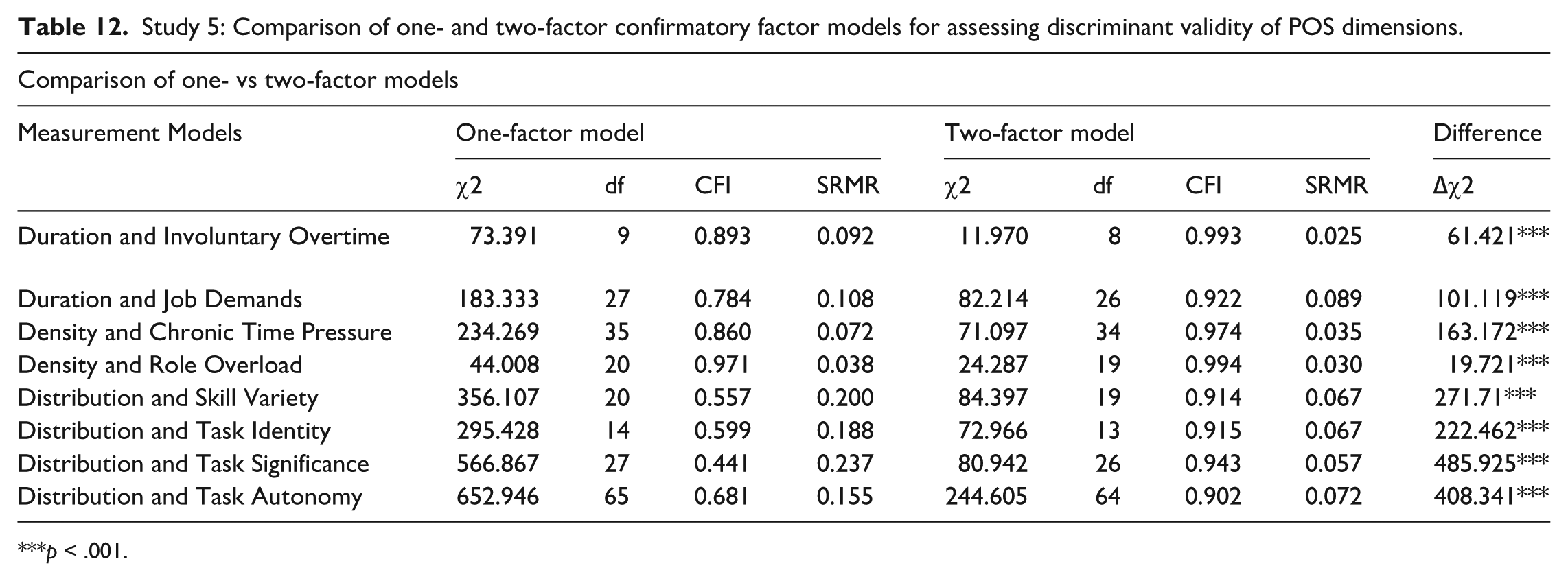
Second, following best practices outlined by Holtz et al. (2025), the evaluation of discriminant reliability relied on a series of one- and two-factor CFAs. Evidence of discriminant validity is indicated when the two-factor solution (including the target construct and the orbiting construct) shows a better fit than the one-factor solution. Each analysis paired items from one dimension of the POS (duration, density, or distribution) with items from one orbiting construct (e.g. involuntary overtime or job demands for duration), loading them either onto the same factor or onto two separate factors. As emphasized by Holtz et al. (2025), conducting these CFAs separately is preferable, as broader CFA models yield fit statistics that reflect the interrelations among other constructs—not just the focal ones—which can obscure the assessment of the focal construct’s uniqueness.
The results, summarized in Table 12, consistently show that the two-factor models provide a significantly better fit than the one-factor models. This pattern strongly supports the discriminant validity of the POS by confirming its distinctiveness from the selected orbiting constructs.
Study 5: Comparison of one- and two-factor confirmatory factor models for assessing discriminant validity of POS dimensions.
***p < .001.
Discussion
Workers often indicate that they are overemployed and desire to work less. Despite this widespread prevalence of overemployment, research to date has not provided a sufficiently complex measurement scale for overemployment. In this research, we chose a subjectivist, psychological approach, focusing on measuring psychological overemployment as perceived by affected employees (Hiemer and Andresen, 2019), in contrast to traditional approaches that objectively defined overemployment—focusing solely on duration—based on economic labor supply models and applied a single or two-item measure. The present study develops and validates a 13-item Psychological Overemployment Scale (POS) whose three dimensions of duration (desire to reduce the amount of time spent on work), distribution (desire to reduce time spent on some tasks and increase time spent on other tasks) and density (desire for a reduced number of tasks to be completed in a certain time frame) are related but significantly different from each other. Therefore, it is proposed that psychological overemployment be defined as follows
7
: Psychological overemployment is an individual’s desire to reduce any of the three work time dimensions − duration of work time, distribution of work time on certain tasks, and density of work time.
As defined here, psychological overemployment focuses solely on time spent at work, not on other life domains or on the balance between work time and leisure time. This distinction from work-life balance is further supported by empirical data.
The POS is explaining variance beyond traditional overemployment measures and provides important insights into the dimensionality, relationships, and measurement of psychological overemployment. The new scale enables systematic research to test and refine theories regarding psychological overemployment and allows a more nuanced approach to theoretical and practical research questions in HRM.
Theoretical contributions
Several theoretical contributions emerge from this work. First, we contribute to the overemployment literature by responding to the calls for the development of a more nuanced conceptualization and measurement of overemployment in the HR literature using rigorous approaches (Campbell and van Wanrooy, 2013; Hiemer and Andresen, 2020). The POS is, to the best of our knowledge, the first scale to measure psychological overemployment and as a multidimensional construct. While traditional overemployment is commonly associated in economics with the single dimension of working fewer hours, the POS distinguishes the three dimensions of duration, density, and distribution while providing a parsimonious measure of both the degree and the nature of workers’ psychological overemployment. The POS addresses the principal shortcomings of previous measures in three ways. There is no necessity to indicate an exact work hour preference, and overemployment is not reduced to a time/money problem alone (Campbell and van Wanrooy, 2013). Furthermore, in the single or two-item measures employed in previous studies, minor alterations in wording led to significant discrepancies in responses (Holst and Bringmann, 2016). This issue can be avoided by using a consistent scale. Finally, and most importantly, the POS addresses the problem of validity, as single items only have content validity if the construct is single-faceted in scope and there is unanimous agreement among respondents about what is being measured (Diamantopoulos et al., 2012). However, studies show that there is neither unanimous agreement on what overemployment is (Campbell and van Wanrooy, 2013), nor that it is single-faceted (Hiemer and Andresen, 2019).
In addition, our research supports the application of the JD-R model within the context of psychological overemployment and validates recent theoretical advancements in that area (Reich, 2024). More specifically, our study shows that the three dimensions duration, density, and distribution can be viewed as job demands that negatively impact well-being and job-related attitudes. Furthermore, psychological overemployment may describe a state in which demands exceed resources, leading to adverse psychological consequences. This is evidenced by the study results, which reveal significant relationships between POS-duration and POS-distribution with variables associated with decreased well-being (such as life satisfaction, health satisfaction, exhaustion, and disengagement) as well as job satisfaction, and increased turnover intention. However, the results concerning OCB and POS-density differ. These heterogeneous relationships among the POS dimensions and their various outcome variables suggest the value of incorporating a psychological construct of overemployment alongside the traditional single-factor construct of overemployment. Individuals perceive psychological overemployment across multiple dimensions, and the consequences of overemployment may differ depending on the respective dimension concerned. These findings underscore the importance of viewing overemployment also as a psychological construct with distinct dimensions, thereby acknowledging the value of both traditional measures and the new scale, each of which can offer useful insights in different contexts.
Additionally, psychological overemployment may not solely yield negative consequences, as a partially positive relationship has been identified between overemployment and OCB (e.g. between POS-density and OCB initiative). This result can inform future theoretical developments regarding overemployment. Thus, the results expand the literature on the consequences of overemployment and provide a foundation for further exploration of both its positive and negative consequences, as well as their interrelationships. The counterintuitive positive relationship between OCB and POS-density may indicate that personal engagement, manifested in OCB, can act as an antecedent of overemployment, offering new directions for theory development.
As previous research has not extensively examined the behavioral consequences of preferences for less work hours, this study also makes an initial contribution in this area. Hiemer and Andresen’s (2019) theory, which specifically addresses psychological overemployment, focuses on its psychophysiological consequences. The findings of this research corroborate most of the consequences of psychological overemployment on well-being as hypothesized by Hiemer and Andresen (2019). However, their theory does not fully explain how the different overemployment dimensions relate to the different correlates. The current study contributes to refining their theory by identifying differential relationships between the three psychological overemployment dimensions and various outcome variables.
Furthermore, in contrast to Hiemer and Andresen’s (2019) theory, which included work time competition as an aspect of overemployment, we delineate work-life balance from psychological overemployment. While work-life balance pertains to time outside of work (Greenhaus and Allen, 2011; Hill et al., 2013), psychological overemployment focuses solely on job-related time demands. This exclusive focus on the work context modifies Hiemer and Andresen’s (2019) theory and further refines the construct of psychological overemployment. It also enables a clear distinction between the construct itself and its antecedents and consequences. For example, overemployment may result in reduced work-life balance, making it a consequence rather than an inherent component of the construct. This distinction has practical implications, as interventions can now specifically target work-related demands, rather than demands arising from private life.
Limitations and directions for future research
This study is a first attempt to validate the POS. Consequently, further refinement of the nomological network of the new three-dimensional construct is necessary (MacKenzie et al., 2011). Future research is needed to extend the relevance of the concept and underline its distinctiveness from other concepts by relating the POS dimensions to other variables in the area of work time, such as work flexibility (Smit et al., 2025), or self-managed work schedules (Matta, 2015). Also, possible antecedents (e.g. organizational support of different work models) and consequences (e.g. for performance) need to be investigated further. This necessity arises from two observations. First, traditional measures of overemployment that focus solely on duration have yielded ambiguous results regarding the consequences of overemployment (Allan et al., 2016; Wunder and Heineck, 2013), which may be attributable to variations in item wording (e.g. Holst and Bringmann, 2016). The new scale-based measure could help address these issues and provide greater clarity on the consequences associated with the duration aspect of psychological overemployment. Second, the present study revealed that the three dimensions of the POS exhibit distinct predictive power. Consequently, some dimensions may be more strongly correlated with specific antecedents or outcomes than others. This warrants further exploration in future research to clarify how the three dimensions—duration, density, and distribution—are related both individually and in combination to the antecedents and consequences of psychological overemployment. To structure this research, the JD-R model could be applied to overemployment, keeping in mind that this model is not specifically designed to analyze work time and (psychological) overemployment and may not adequately explain potential differences between the POS dimensions.
Another limitation is that the scale was validated exclusively in Germany, which is a restriction regarding labor market and cultural context. The items presented are translations into English that require further validation and testing in different languages, as cultural or labor market differences may influence how overemployment is perceived (e.g. see literature on overwork in Japan; Kanai, 2009). A culturally invariant overemployment scale would facilitate comparative overemployment research in terms of cross-cultural comparison and multi-site research.
As the data are based on self-reported information, this study could be vulnerable to common method bias (CMB; Podsakoff et al., 2024). However, as Bozionelos and Simmering (2022) note, the problem of result distortion due to CMB appears to be relatively limited in empirical studies. Notwithstanding this, future studies could use different sources, such as relating overemployment to employee engagement and performance variables that can be measured by employees’ leaders or peers. Also, future studies may include a temporal separation between predictors and criterion, as suggested by Podsakoff et al. (2024).
To test the predictive validity, incremental validity, and criterion validity of the POS, hierarchical regression analyses were conducted here. While standard regression is the most common approach to validity testing (e.g. Wang and Eastwick, 2020), this approach may significantly inflate the likelihood of Type I errors and lead to invalid conclusions (Wang and Eastwick, 2020; Westfall and Yarkoni, 2016). To account for measurement error and control for the Type I error rate, future research could also employ more structural equation modeling (SEM) with latent variables.
Another limitation pertains to the incremental validity testing of the POS. In light of the absence of sufficiently complex measures of overemployment, the added value of the proposed scale was assessed against a traditional measure of overemployment. However, as previously discussed, this traditional measure is subject to criticism due to its low validity.
Furthermore, it cannot be asserted that the samples are representative. However, the samples used are heterogeneous and balanced in terms of respondent gender, age, educational level (low to high), and occupation. Future studies could integrate the POS into representative national panels, such as the German Socioeconomic Panel.
In addition to the research needs arising from the limitations, additional directions for future research are emerging. It is crucial to further explore the relationships between the different dimensions of psychological overemployment and their antecedents and consequences. This necessity arises from two observations. First, traditional measures of overemployment that focus solely on duration have yielded ambiguous results regarding the consequences of overemployment (Allan et al., 2016; Wunder and Heineck, 2013), which may be attributable to variations in item wording (e.g. Holst and Bringmann, 2016). The new scale-based measure could help address these issues and provide greater clarity on the consequences associated with the duration aspect of overemployment. Second, the present study revealed that the three dimensions of overemployment exhibit distinct predictive power. Consequently, some dimensions may be more strongly correlated with specific antecedents or outcomes than others. This warrants further exploration in future research to clarify how the three dimensions –duration, density, and distribution—are related both individually and in combination to the antecedents and consequences of overemployment. To structure this research, the JD-R model could be applied to overemployment, keeping in mind that the model is not specifically designed to analyze work time and (psychological) overemployment and may not adequately explain potential differences between the POS dimensions. When the JD-R model is used to frame future research, studies should analyze the impact of various resources, such as autonomy or social support, to examine their potential mitigating effects of the negative consequences of psychological overemployment.
Methodically, longitudinal research would contribute to clarifying causal relationships. Such longitudinal research would also contribute to understanding how long psychological overemployment persists and the potential strategies for its resolution. Initial research has adopted a longitudinal perspective concerning the duration dimension (Reynolds and Aletraris, 2010). However, if duration, density, and distribution are deeply intertwined, all three dimensions should be investigated simultaneously.
In terms of the consequences of overemployment, behavioral and attitudinal variables are of particular interest and have received less research attention compared to health and well-being variables. For instance, exploring the association between overemployment and job-related variables, such as commitment, OCB, and turnover, is a field that has limited prior research. Applying a JD-R perspective to psychological overemployment, one might expect a negative correlation with OCB and commitment, as well as a positive association with turnover intention. However, the results of the studies presented are inconclusive partly due to their cross-sectional design. For example, it is possible that individuals exhibiting higher OCB as a consequence may experience higher density (see Bolino and Turnley, 2005 for a similar argument), or that working longer than preferred is used to demonstrate higher commitment (e.g. van Emmerik and Sanders, 2005). To investigate causality in more detail, long-term studies are essential.
From a practical HRM perspective, identifying effective job design or working time models would benefit from studying their impact on different dimensions of psychological overemployment. Appropriate interventions may vary depending on the specific dimensions of psychological overemployment that are pertinent in each case. Concerning the 4-day workweek, one could hypothesize that it has positive effects on duration, while the effects on density or distribution may be neutral or even negative. This is due to the potential organizational expectation that the same amount and type of tasks must be completed in 4 days rather than five. A resulting increase in density may outweigh the positive effects of reduced duration, potentially leading to an overall increase in psychological overemployment in contexts with 4-day workweeks. Future studies could investigate this issue when evaluating the 4-day workweek or other job redesign models, such as results-only work environments. An important question for applied researchers is whether the experience of psychological overemployment concerning the three dimensions arises from organizational constraints on employee freedom, such as the imposition of rules and expectations regarding the ideal worker (Correll et al., 2014), or whether part of the problem can be attributed to individuals themselves, such as poor planning (Smit et al., 2025).
Practical implications for HRM
In light of the mounting challenge of talent scarcity (Choudhury, 2020), companies are now more compelled than ever to address individual employee preferences, including those pertaining to work time. This has implications for recruitment and HR development. Companies and employees should engage in more open discourse and negotiation, not only regarding individual solutions for contractual job hours (see Reich, 2024), but also how time is distributed on tasks and the density of work. This could be accomplished during job interviews, and as jobs may change over time, these aspects could be re-negotiated later. The POS can be used in this context as a diagnostic tool to advise managers and HR departments on how to enhance employees’ satisfaction with work time and to develop targeted plans of action. Supervisors or coaches could use the POS as a screening tool to assess whether a person is experiencing overemployment and which dimension is most pronounced. Leaders or coaches can then engage in discussions with workers regarding potential avenues for enhancing work time (see Boniwell et al., 2014). When deciding whether and how to take action to reduce psychological overemployment, an examination of the dimensions may prove beneficial. For instance, if employees score high on POS-duration, reducing work hours or implementing job sharing may be suitable approaches to mitigate psychological overemployment (Kossek et al., 2016). In the event that POS-density is high, it may be beneficial to revisit task allocation within the team, as well as to review job profiles and processes. Additionally, training may help employees in navigating stressful phases at work. In the case of a high POS-distribution, task distribution and work organization can be reviewed.
Finally, it is also the responsibility of policymakers to ensure good working conditions. The traditional overemployment measures used in survey panels present a challenge in determining overemployment rates (Holst and Bringmann, 2016) and in addressing more complex questions, such as those pertaining to the causes and potential solutions to overemployment (see Campbell and van Wanrooy, 2013). Integrating the POS into future panel studies could serve as a basis for identifying more effective policies, such as a working time law. From an individual perspective, a country-wide reduction of total work hours may not be the optimal solution to address psychological overemployment. Instead, a more nuanced approach that considers the unique circumstances of individuals and the multifaced nature of the problem is warranted.
Supplemental Material
sj-docx-1-gjh-10.1177_23970022251391028 – Supplemental material for The multidimensionality of psychological overemployment: Development and initial validation of a new scale
Supplemental material, sj-docx-1-gjh-10.1177_23970022251391028 for The multidimensionality of psychological overemployment: Development and initial validation of a new scale by Julia Hiemer and Maike Andresen in German Journal of Human Resource Management
Footnotes

References
Supplementary Material
Please find the following supplemental material available below.
For Open Access articles published under a Creative Commons License, all supplemental material carries the same license as the article it is associated with.
For non-Open Access articles published, all supplemental material carries a non-exclusive license, and permission requests for re-use of supplemental material or any part of supplemental material shall be sent directly to the copyright owner as specified in the copyright notice associated with the article.
