




Abstract
Formal hierarchical working environments are often characterized by power dynamics and control mechanisms that can create apprehension and prevent employees from raising concerns and speaking up about critical issues. This perceived inability to voice opinions and ideas can lead to poor employee well-being, increased turnover and, ultimately, lower organizational performance. In the context of professional services firms, we investigate perceptions of leader behaviors and psychological safety and their influence on employees’ decisions to leave or stay working in their profession. We conducted semi-structured interviews with 35 former and current lawyers and partners in New Zealand law firms. Thematic analysis of their experiences and perspectives suggest that in firms with a climate of psychological safety where employees have access to resources that foster resilience, employees—particularly women—expressed greater desire to continue working in their high-demand roles. Employees shared stories of leaders with high emotional intelligence who encouraged authenticity in the workplace, promoting employee’s affective commitment to their organization. Further, our study highlighted differing views between lawyers and partners on the factors that influence lawyers to leave legal practice. Our findings indicate that to prevent dysfunctional turnover, organizations, leaders, and HR practitioners benefit from strategies that prioritize supporting employee resilience and create safe spaces for open dialogue.
Keywords
There is a suite of reasons why people choose to leave their jobs, such as harmful workplace culture, poor leadership, demanding job characteristics, high workload, stress, emotional instability, and poor remuneration (Rubenstein et al., 2018). High turnover disrupts organizational success and financial performance (Park and Shaw, 2013; Violante, 2016), particularly in settings requiring complex tasks and decisions (Heavey et al., 2013). Turnover costs associated with recruiting and training new employees can exceed 200% of an employee’s annual salary (Allen et al., 2010), emphasizing the importance of employee retention. When employees leave their employer and join competitors, taking valuable knowledge and intellectual property (IP) with them, it weakens their former employer’s competitive edge (Agarwal et al., 2009). As a result, the management of knowledge workers in professional services firms is of critical importance as human capital has become a primary source of competitive advantage (Kaiser et al., 2015).
For over a decade, there has been a surge in junior lawyers leaving the legal profession, both in New Zealand (NZ) and worldwide (Kay et al., 2016; Pemberton, 2016; Thomson Reuter’s Institute, 2022; Wootton, 2022) to pursue other career opportunities. Motives for departure include billable hour requirements 1 (Bergin and Jimmieson, 2014), long working hours, poor work–life balance (Sommerlad, 2016), a lack of flexible working arrangements, dissatisfaction with leaders, low levels of autonomy, and higher remuneration elsewhere (Pemberton, 2016; Violante, 2016). Using semi-structured interviews, we seek to explore underlying factors that influence lawyers’ decisions to consider leaving, to actually leave or to stay, with a particular focus on the impact of leader behaviors and psychological safety in shaping these decisions. We also examine the similarities and differences in perceptions of reasons for leaving between lawyers and partners.
Our research contributes to the broader literature on Human Resource Management (HRM) in professional services firms by exploring how leadership behaviors can be used as a strategic tool to manage and retain human capital. Previous research has highlighted that professional services firms manage knowledge workers using a combination of organizational and professionally focused HR practices (Swart and Kinnie, 2013). Our study explores how organizations in competitive, high-demand environments can retain valuable human capital. These insights have implications for leaders and HR practices.
Our research draws on the reported experiences of current and former lawyers, as well as partners who serve as organizational leaders within law firms. These organizations are often characterized by power dynamics and control mechanisms that create an atmosphere of intimidation (Clarke, 2024; Colley et al., 2019; Glazebrook, 2016). These factors can prevent employees from voicing their concerns, openly discussing errors and taking interpersonal risks at work, potentially driving lawyers away from legal practice. Therefore, we examine differing perceptions of leader behaviors and psychological safety in NZ law firms and their impact on employees’ decisions to leave or stay.
Literature review
Previous research consistently shows, that in workplaces where employees feel safe to share their ideas, take intellectual risks and speak up about issues, employees are more likely to experience positive workplace perceptions (Ulusoy et al., 2016) and improved well-being (Clarke et al., 2024a). Further, when employees enjoy positive experiences, this increases the likelihood they will stay with their employer (Grant et al., 2007; Sears et al., 2013). Leaders who support employees, proactively seek input and value their contributions can help to establish psychological safety (Edmondson, 2004; Nembhard and Edmondson, 2006). Defined as a shared belief that the team will not reject, embarrass, or punish employees for speaking up (Edmondson, 2019; Frazier et al., 2017), psychological safety enables employees to bring their full selves to work and to express their views without worrying about negative repercussions (Hunt et al., 2021). In high-stress environments, a strong sense of psychological safety can help buffer negative employee wellbeing outcomes (Clarke et al., 2024b) and enhance employees’ ability to manage stress (Hebles et al., 2022), potentially reducing their desire to leave the organization.
Empirical research on HRM in professional services firms, such as law and accounting firms is scarce (for exceptions see Malhotra et al., 2010; Swart and Kinnie, 2013). Effective retention management is crucial in these work environments, where valuable talent and human capital can easily leave the organization (Kaiser et al., 2015). Extensive research on turnover and turnover intention is based on the premise that satisfied employees remain with their organizations, while dissatisfied ones leave (Hom et al., 2017; Lee et al., 2017). The majority of research has concentrated on understanding turnover driven by employee dissatisfaction, primarily focusing on rational decision-making and the capacity of individuals to act independently, while underestimating the impact of contextual factors (Sullivan and Al Ariss, 2019; Wordsworth and Nilakant, 2021). Given the high turnover (Thomson Reuter’s Institute, 2022) and poor well-being reported among lawyers (Aotearoa Legal Workers’ Union, 2021; Bergin and Jimmieson, 2014; Clarke, 2024), we chose the legal profession for this study as it provides a unique context in which to gain greater insight of the contextual factors that influence why some employees in professional services firms consider leaving, why some resign, and why others stay.
Employees who are treated fairly by their leaders, have flexible working arrangements, have opportunities for career and personal growth and can be themselves at work are more likely to stay (Thomson Reuter’s Institute, 2022). Access to resources provided by organizations and their leaders, help employees to cope with workplace stressors and minimizes the negative effects of high-demand jobs. In the present study, the Conservation of Resources (COR) Theory (Hobfoll, 1989) will be applied to explain how leader behaviors influence employees’ coping strategies and their perceptions of psychological safety in professional service firms. According to COR theory, employees’ coping strategies during stressful events or high demands depend on the availability of resources like autonomy, a culture of learning, and leader support (Halbesleben et al., 2014). These resources help employees achieve their objectives and gain additional resources such as self-efficacy.
Furthermore, we extend understanding of COR theory by explaining how employees might respond to stress in high-demand, high-stress workplaces such as law firms (Soon et al., 2023), deepening our understanding of psychological safety, turnover and retention. Employees who encounter stressful events or high demands at work, and have sufficient environmental and personal resources to cope, may also perceive their workplace to be psychologically safe (Hobfoll, 2011), influencing their decision to stay. Conversely, when employees experience resource loss due to a series of stressful events, they may perceive their workplace to be low in psychological safety and are less likely to speak to their leader about the impact of such issues (Clarke, 2024). As a result, these employees may resort to maladaptive coping strategies such as job searching, contributing to unwanted voluntary turnover for the organization. According to COR theory, when employees leave their organization, they are taking steps to safeguard their remaining resources (Halbesleben and Bowler, 2007) and remove themselves from the stressful environment.
Research investigating how psychological safety influences employees’ decision to stay is limited. Quantitative studies in healthcare suggest a negative relationship (Hebles et al., 2022; Ulusoy et al., 2016), however there is less insight into the lived experiences of leaders, employees and former employees. Further research is needed to explore how leaders’ heightened self-awareness and understanding of their own impact on employee well-being and performance, along with their acknowledgment of employees’ diverse perspectives, can enhance psychological safety and retention. Our research extends existing knowledge in three ways. First, it highlights underlying factors that influence employees’ decisions to leave or stay working in high-demand roles. Greater understanding of these factors is crucial for professional services firms to effectively tackle turnover, considering its substantial associated costs (Rubenstein et al., 2018). Previous research suggests that exit interviews and surveys conducted by the employer when employees leave their organization may lack validity, since departing employees often exhibit caution and are less-than-honest about their reasons for leaving (Feinberg and Jeppeson, 2000). Misjudging the reasons why employees leave their firm leaves organizations and their leaders oblivious to the real issues that are affecting employees. Second, we explore the differing perspectives between employees and leaders regarding why early career lawyers leave, which can result in missed opportunities to improve psychological safety and retention. Leaders who develop a greater understanding of employees’ differing perspectives, fostered by a psychologically safe climate, are more likely to positively influence employee well-being and retention. Finally, while some quantitative cross-sectional methodologies show a link between psychological safety and turnover intention (Hebles et al., 2022; Kirk-Brown and Van Dijk, 2016; Sobaih et al., 2022), the impact of psychological safety on actual turnover remains under-explored. Qualitative research can provide nuance to research findings through a closer examination of individual’s experiences (Soon et al., 2023). The present research, while exploratory, is novel in that it builds on previous theoretical insights by drawing on interview data of both lawyers and partners. We examine experiences of current and former employees in professional services firms to understand underlying influences that shape lawyers’ decisions to leave their firm, or stay, contributing to the literature on employee retention in high-demand hierarchical work environments.
Methodology
Procedure and participants
Semi-structured interviews were conducted with 35 law practitioners (21 lawyers and 14 partners) who had previously worked or were working in New Zealand (NZ) law firms from December 2021 to July 2022. Initially, the study included 30 participants (21 lawyers and 9 partners), but an additional 5 junior partners were recruited to validate initial findings, finishing with a total of 14 partners. Of the 35 participants, the sample comprised 23 female lawyers (including 4 partners) and 12 male lawyers (including 10 partners). Of the 21 lawyers interviewed, 5 were considering leaving their law firm and 4 had recently resigned and moved into legal roles either within the public sector or in-house. 2 All participants that had recently resigned or were considering leaving were women. Participants came from a range of roles including lawyer, solicitor, senior associate, special counsel, partner, and a representative from Aotearoa Legal Workers Union (ALWU). The age of participants ranged from 25 to 55 years (M = 37.88, SD = 9.79) and the range of post qualification experience (PQE) was 1–32 years (M = 12.69, SD = 9.67). The interviews were conducted over Zoom by the first author and were audio-recorded using Zoom’s audio-recording feature. Interview length ranged between 29 minutes to 1 hour and 4 minutes, with an average of 49 minutes.
In addition to the standard interview protocol (see Appendix 1), participants were asked open-ended questions to allow flexible responses. The interviewer asked participants to discuss examples of situations when they had concerns, they would have liked to raise with their leader or within the law firm partnership but felt unable to do so. Participants were also asked how they cope with and recover from work-related stresses. All participants were questioned about whether they had considered leaving their firm or legal practice and what factors contributed to such considerations. Early in our interviews, we discovered that some lawyers had recently resigned from their firm, leading to further questions about their motivations for leaving. This led to additional questions for these participants relating to the factors that led to their resignation. Partners were asked their perceptions of why people might leave legal practice and why employees have left their law firm. The study was approved by the Authors’ University’s Human Research Ethics Committee (REF: 2021/152).
Data analysis
Interviews were transcribed using Otter, a professional transcription program, and checked for accuracy. Finalized transcripts were sent to participants for approval and possible redactions.
Six participants made minor adjustments, which did not affect the findings. Thematic analysis (Thomas, 2006) was conducted using NVivo software. The first step involved identifying open codes within the transcripts, with each transcript coded line-by-line. Using a data-led approach, codes were chosen based on their relevance to the research topic (Clarke and Braun, 2013), generating 50 first-order codes. We then compared the concepts within each code. Matrix coding queries in NVivo, separated by job role, determined the frequency of codes in the interviews. Research-relevant codes were chosen from the data to create mind maps on A2 paper to identify patterns and visualize code relationships. Once the coding was completed, we used thematic analysis to develop the initial themes (Thomas, 2006), with similar codes grouped into themes (Charmaz and Thornberg, 2021; Clarke and Braun, 2013). There were three rounds of this process to ensure the codes made analytical sense, and the themes were discussed among the research team to ensure robust analysis (Yin, 2009).
Findings
The findings are presented in two sections. The first section presents key themes from interviews with law firm employees and former employees, while the second presents themes from interviews with law firm partners, as we discovered that employees and leaders described different views and perspectives in relation to the key themes. Anonymized identifiers have been used to represent quotes from participants (see Appendix 2 for demographic characteristics).
Contributors to lawyer retention: Psychological safety and leadership
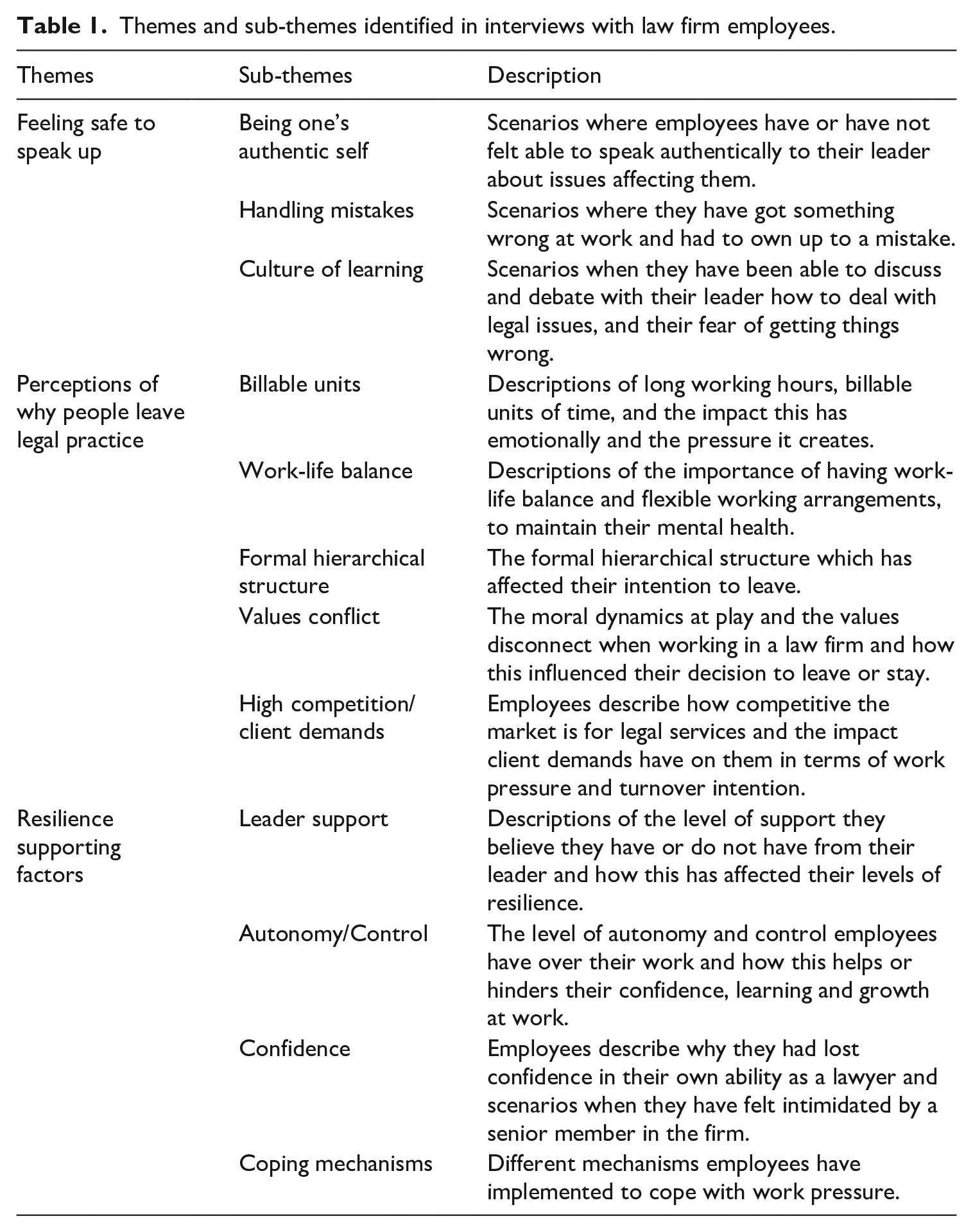
Three key themes were constructed based on the interviews with law firm employees and former employees: feeling safe to speak up, perceptions of why people leave legal practice, and perceptions of resilience-supporting factors in law firms. Each theme consisted of related sub-themes outlined in Table 1.
Themes and sub-themes identified in interviews with law firm employees.
Theme 1: Feeling safe to speak up
The first theme involves scenarios where employees and former employees felt safe or unsafe speaking to senior members about issues and concerns. The sub-themes include being one’s authentic self, handling mistakes and a culture of learning.
Being one’s authentic self
Half the participants described scenarios where they could not be open and honest about work or personal issues, which they felt impacted their work and contributed to many former employees leaving their firm. One former employee believed that lawyers in the firm were: “too frightened to support others and will not put their head above the parapet, just to survive” (Participant A, female), and another employee who was considering leaving explained: “I never felt like I could articulate what the [personal] problem was to him without him being really uncomfortable” (Participant I, female). When some of the former employees tried to talk about their personal lives at work, they felt awkward and uneasy: “I always just felt like I was doing something wrong when I talked about my life because no one else was doing it” (Participant K, female). However, a small group described times when they felt strongly about an issue and did raise it with management, even when they thought it might negatively affect their career and the outcome was positive. For example, an employee said: “I was very vocal towards the end about our pay, because we were getting paid a lot less than even median for a midsize firm. . . [I had to be] very vocal to get that through” (Participant D, female), This finding indicates that when employees felt uncomfortable discussing their concerns with their leader, only a small group managed to overcome these feelings, even if they believed that speaking up might have negative consequences.
Handling mistakes
Half the employees and former employees interviewed described examples of when they got something wrong at work and had to own up to a mistake. For example, one employee said that “. . . .you just have to sort of, you know, I’ve got that one wrong, and I’m sorry, I’ll do better next time” (Participant E, male) and another, similarly, that “sometimes you just have to say, yeah, I missed that one and you just have to deal with the consequences of that” (Participant F, female). Our interpretation, from the tone in which these examples were described by the participants, implied that employees had the perception that they might viewed by their leader as foolish if they were to own up to a mistake. Additionally, a small group of lawyers expressed fear about making mistakes, and having to tell their leader about mistakes because they believed this would have a negative impact on their career. A former employee described her experience: “[the partner]. . .would tell you off for things you’ve done, and mistakes,” and that “the fear of getting is wrong is pretty, it’s pretty up there” (Participant D, female).
Culture of learning
This sub-theme exemplifies work environments that supported psychological safety. A small group of employees described their work as a place where it was accepted that sometimes employees might make mistakes, or might want to challenge their leader’s idea, and that they were expected to learn from those experiences. For example, one employee explained “So if you think that your plan of attack, [. . .], it’s the right one, and you kind of can get that bit of debate going [. . .] like you’re making submissions to your boss. But it’s good, it’s all part of the learning” (Participant F, female). A small group of employees also explained that minor issues would often be considered acceptable and that these contributed to a learning culture, for example, “you’re not going to get suddenly pulled up on something very minor. So I think there is definitely a sort of very, you know, a very good [learning] environment in that sense” (Participant N, male). On the other hand, half of the junior lawyers described their low level of seniority in the firm as a barrier for speaking up about mistakes indicating that they believed their firm did not have a culture of learning.
For example, one former employee said “I feel like as a junior, it’s better to have a really good associate or senior associate looking after you than the partner. Because. . .they’re the person that’s going to think you’re an idiot rather than the partner” (Participant G, female). This finding suggests that those employees who believed their firm had a good learning culture felt safe to take intellectual risks and could challenge their leader with new ideas.
Theme 2: Reasons for leaving legal practice
The second theme related to different reasons why employees, former employees and some of their colleagues had resigned or were considering leaving the firm. Interestingly, this theme overlaps with the first theme of feeling safe to speak up because these participants were reluctant to share their genuine reasons for leaving with their leaders, alluding to a climate of low psychological safety. This theme arose from five interrelated sub-themes including billable hours and long working hours, work-life balance, formal hierarchical structure, values conflict, and high competition.
Billable hours and long working hours
Half the employees and former employees described long working hours. This was attributed to the use of billable hours as a primary measure of performance, and a reason for their desire to leave and, for some female employees, actually leaving. For example, one employee explains: “I appreciate that billable hours are work of the legal profession, just honestly as a lawyer, if what I’m selling is my time, the message I get indirectly is spend all your waking time working, and you will be deemed successful” (Participant C, female). Further, former employees described the unconstructive way in which billable hours were used to compare employees’ performance levels against each other. One former employee described how her performance in the firm was compared with her colleagues: “In my last performance review, [. . .] you get like, like a score on these, like five or six metrics. And the answer for me, they said, [. . .] you could have been good this year, but because of your health, we can’t give you a good score, because, [. . .] you didn’t do enough [hours] in order to earn a good score. Which, [. . .] I understood it, like I haven’t done as many hours as other people. And so, that’s how they’re ranking people” (Participant D, female). Female former employees explained that the number of hours worked placed enormous pressure on them, and that for many former employees, this pressure contributed to their decision to leave the firm.
Work-life balance
Half the employees and former employees in this study described the importance of work-life balance, and the difficulties they had achieving it because it was expected that they had to work long hours and be working in the office all day, “because, you know, you needed to be there when the partners were working” (Participant A, female). Female employees who had been unable to achieve the desired work-life balance because working less was not possible, said that the lack of balance led to their resignation. One employee explained, “You can still be an excellent lawyer and not have to work 100 hours per week” (Participant B, female). A representative from the legal worker’s union stated that the attitude of young lawyers toward work is changing, and the focus that young people have on achieving work-life balance has changed, even when law firm partners may not have changed their views. For example, “young people just seem to be more aware of [. . .] the importance of being young and enjoying your time while you’re young and not spending all night in an office by yourself and [. . .] they’re kind of slowly like pushing that narrative away” (Participant H, female). Most of the female former employees in this study shared the opinion that law firms are missing out on talent because they have not adjusted their inflexible views of work-life balance, to focus less on the number of hours an employee must work and more on the quality and outcome of their work. A contradictory opinion was offered by a small group of employees who felt that their firm did a good job of encouraging employees to have work-life balance. An employee described her memory of being warned by a senior colleague that she must set her own boundaries to protect her work-life balance or suffer the consequences: “I remember he said, something along the lines of, this job will eat your soul if you do not have a good work-life balance, [. . .]. And that just stuck with me, [. . .] I’ve maintained a work-life balance, I refuse to do it any other way” (Participant O, female).
Formal hierarchical structure: This sub-theme describes how employees’ thoughts about leaving could be attributed to the formal hierarchical structure of the firm which created an environment where some employees felt unable to speak to their leader about their concerns. For some, this led to their resignation. For example, one employee who was considering leaving explained her hesitation in speaking to her leader about his behavior because of his seniority in the firm: “No one is telling [the partner] that because it’s not a [people and culture] level issue, it’s more like, you know, occasional trends in [the partner’s] behavior, which everyone notices, and they talk about it, but we don’t tell [the partner] anything” (Participant I, female). The majority of employees in this study described a formal hierarchical structure in their law firm, whereby the firm was structured hierarchically based on knowledge and experience. This structure decreased the likelihood that employees would speak to the person above them in the hierarchy about their concerns. As an employee explains: “it’s an interesting dynamic, because sometimes you are very firm in your view that you’re right. And you’ve got to tread carefully, because you of course, you can’t overrule your supervising partner” (Participant F, female). Most employees and former employees had the impression that senior team members were treated differently to junior lawyers, and that those higher up the hierarchy were more likely to speak up about issues. Many female junior lawyers described how they did not feel as valued as the senior lawyers in their firm, for example, “there was the sense that people just won’t invest in you when you’re a junior” (Participant J, female) and such feelings led to some female employees leaving their firm. Majority of employees described the formal hierarchical structure of law firms as an environment that they believe will never change because those at the top want the juniors to go through the same painful experience that they went through.
Values conflict
This sub-theme relates to employees considering leaving or having resigned due to values and moral conflicts. Half the female former employees felt that decisions in the organization “didn’t align with not quite my morals, but kind of how I felt you would deal with the team” (Participant A, female). This misalignment with employee values and other ethical conflicts influenced a small group of employees to leave legal practice, with one former employee describing the working environment as somewhere where they could not relate to the others in the team. Furthermore, several female employees described “a sense of entitlement and high arrogance [that employees had at law firm name], and [. . .] I realized, I can’t really work in a place like this [. . . .] it just really didn’t align with my values.” Additionally, “There are definitely people at [law firm] who were like money, money, money, and I couldn’t relate to them at all” (Participant D, female) which led to this employee’s resignation. The female former employees in this study who resigned from their firm after a moral or values conflict, left legal practice and went to work in public sector or in-house roles.
High competition and client demands
This sub-theme relates directly to how employees think about leaving because of the highly competitive market that law firms operate in. For example, a small group of male employees said that in legal practice “the market for owners of businesses or partners of law firms is highly competitive” (Participant E, male). The impact for employees is that they have to work long hours or clients will go elsewhere. Many employees had the impression that this fear was instilled by their leaders in order to increase the performance of staff. High competition and demands from clients place pressure on employees to give clients the answers they want to hear, and to prevent clients from going to a competitor. This pressure creates ethical dilemmas as illustrated by the following employee quote: “Maybe something that I do find a little bit conflicting, sometimes is the conflict between giving the right answer and giving the answer the client wants to hear. I think there can be quite a bit of pressure on that, [. . .] because if you don’t give clients the answers they want to hear then they’ll go to another lawyer [. . .] I think it’s a bigger ethical issue for the profession [. . .], I think it’s a huge conflict for us all really” (Participant R, female). In some cases, the pressure created by client demands contributed to employees’ desire to leave their firm.
Theme 3: Resilience supporting factors
The third theme related to employee experiences and perceptions of the factors that support employee resilience in law firms. The sub-themes overlap and include leader support, autonomy and control over their work, confidence, and different mechanisms used to cope with stress and work pressure.
Leader support
This sub-theme links to resilience supporting factors because employee resilience can be improved when leaders provide their employees with support. Half of the employees described the positive support they received from their direct leader, for example “[the partner] was like do what you want, you’re all adults, [. . .] which is really good” (Participant M, female). Another employee explained “They were always a good manager to me, [. . .] we get along really well” (Participant P, female). A small group of employees described scenarios when they observed other leaders in their firm not providing adequate support to their team, and how lucky they felt not having to cope with poor leadership support, such as “there’s one partner in particular, who is notorious for being a bully, and would belittle people and [. . .] talk down the juniors work and stuff like that. And, you know, fortunately, I didn’t personally have that experience” (Participant O, female). The impact that poor leader support had on junior team members was observed by others in the firm and in some cases, the affected female employees left the firm. A small group of female former employees described the lack of support that they had when working at their firm and the negative impact this had on them. For example, “it took me a good few months at my new job, just build up my confidence again [. . .]. So [the firm] just had incredibly high standards and didn’t really support me properly” (Participant D, female).
Autonomy and control
Half the employees in this study described their ability to control the work they do and spoke of scenarios when they were given the autonomy to make decisions, which is a resilience supporting factor. For example, an employee explains: “So I have control over what I can do what I choose to do, you are master of your own destiny” (Participant O, female) and another employee explained, “I’ve been able to, you know, have a reasonable control over how that happens” (Participant N, male). This autonomy provided by their leader had a positive impact on these employees and their level of resilience, for example “as I have gotten more confidence, I really like being able to drive files myself, and have ownership of them and [. . .] be the primary contact for the client contacts” (Participant Q, female). However, a small group of female former employees described scenarios when their leader exerted control over their physical time in the office, and that this contributed to them resigning from the firm. For example, a former employee explains: “I said [to the partner], I worked for an hour, and I’ve just gone out to get a coffee with [a colleague] and [the partner] was just, I don’t care, its 8:30 you should be at your desk” (Participant K, female).
Confidence
Half the employees in this study described situations when they had felt intimidated by a senior member in the firm, and the incident caused them to lose confidence in their ability as a lawyer. For example, an employee explained “it was 100% a dig at me, a personal dig at me, I mean you’re like a full grown man who’s like 10 years more senior than me, this is just so, so bad” (Participant B, female). This group of employees blamed themselves when someone more senior was rude to them and when things went wrong. For example, an employee explained how a negative event impacted them: “my tendency is to think of how I could have done something differently to avoid the situation, even if there might be things that are outside my control that have driven something” (Participant Q, female). Conversely, a small group of female and male employees described their ability to move on from negative events: “I just had to tell myself, you know, that wasn’t a reflection of me being crappy at work or being a shitty lawyer” (Participant C, female) and this particular employee did not let the event negatively affect them.
Coping mechanisms
This sub-theme relates to perceptions of resilience supporting factors because they are activities that employees proactively initiated to cope with stressful situations. For example, a large group of employees described the mechanisms they use to try and separate work from their personal lives, and switch off from the day in order to cope with work pressure and stress. For example: “I leave at 5pm. . . .I don’t give out my personal number,” and “I try to go for a run. . . . [but] it’s really hard to find the time,” also “I always try and get a good sleep” (Participant O, female). A small group of employees described how they chose a specific practice area in order to manage stress. A female employee explained: “I also deliberately picked tax as a specialty, because it has the sort of reputation for having a much better work-life balance than a lot of other commercial law areas” (Participant M, female). These quotes illustrate how some employees proactively manage their time and made specific choices in order to cope with stress as a result of working in legal practice.
Findings from interviews with law firm partners
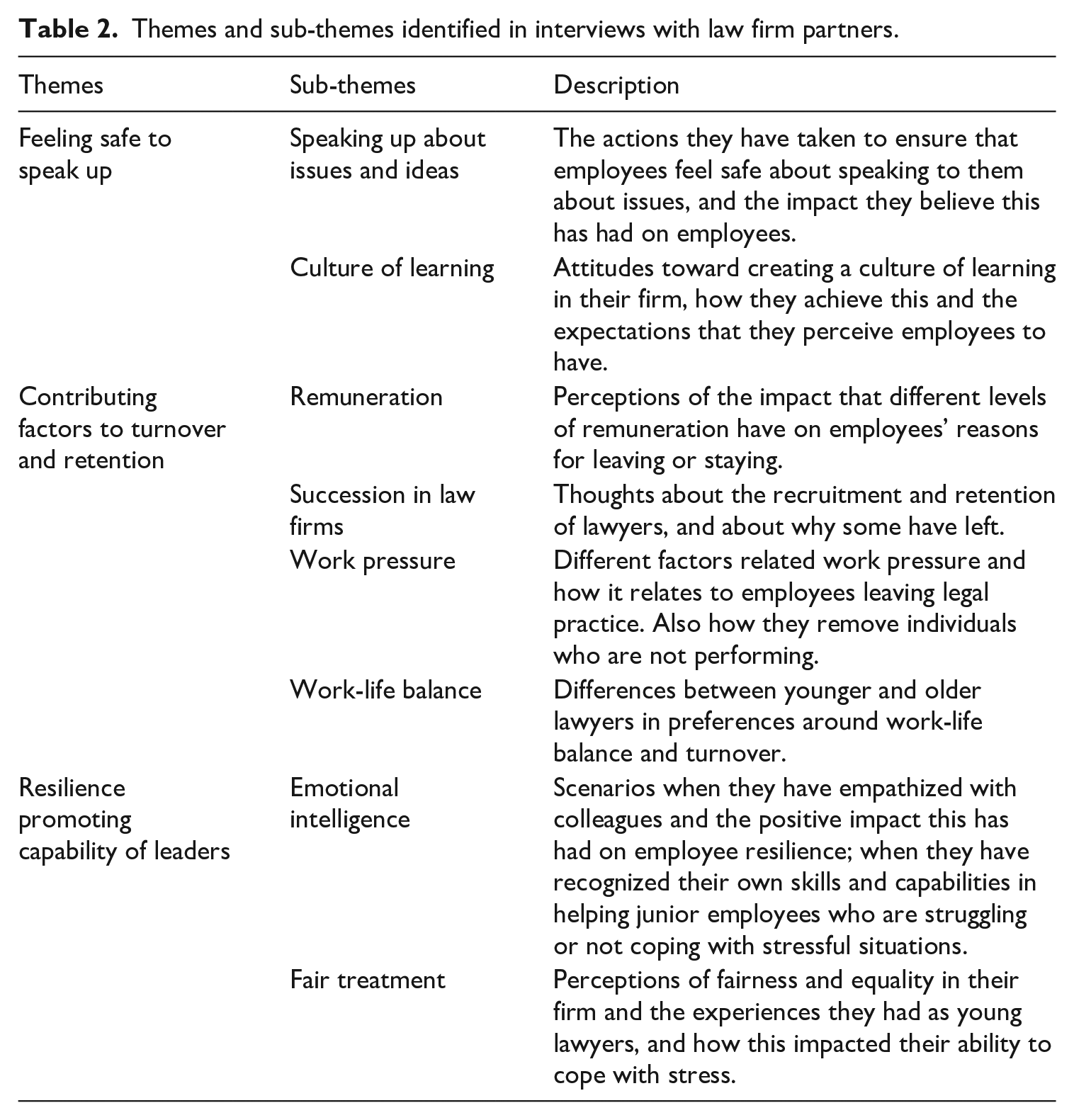
Three key themes emerged from interviews with law firm partners and former partners: feeling safe to speak up, perceptions of what influences employees to leave or consider leaving legal practice, and resilience promoting capability of leaders. These three themes are intricately connected as leaders emphasized the importance of fostering an environment where employees feel safe to share their concerns, while simultaneously highlighting their own resilience-promoting skills and capabilities, which influence employee turnover decisions. While the overall themes were similar to employees, there were noteworthy nuances to the partners’ perceptions under each theme that differed from those of employees. Each theme consisted of related sub-themes outlined in Table 2.
Themes and sub-themes identified in interviews with law firm partners.
Theme 1: Feeling safe to speak up
The first theme related to leader perceptions of how safe their employees feel about speaking to them about concerns if they have them. Notably, these leader perceptions differed from employee perceptions of feeling safe to speak up. This theme was made up of two related sub-themes, speaking up about issues and a culture of learning.
Speaking up about issues and ideas
Most of the partners described actions they had taken to develop a safe environment for employees to feel safe to speak to them about issues, and the impact this has had on the team. For example, one partner described an initiative whereby senior lawyers were asked to wait until junior lawyers had shared their thoughts, to encourage junior lawyers to talk more during team meetings, “I think that has been a quite helpful initiative to empower people to, again, talk more” (Partner A, male). Another small group of partners said that junior employees had brought issues to their attention and that they thought this was made possible by the environment that had been created. For example, “she was able to come to me, again, is reflective of the, I guess, the culture of the open door” (Partner B, male). Additionally, a small group of partners recognized that the formal hierarchical structure which is prominent in law firms could create a barrier for employees to speak up about new ideas, “So there’s that hierarchy, and I’m sure that affects people’s preparedness to engage, speak, be involved” (Partner C, male).
A culture of learning
Partners that described their firm as having a less formal, flat structure, also believed that this structure enabled junior lawyers to learn from their senior colleagues more easily. This indicates that the predominant perspective leaders have regarding workplace learning is one directional, where juniors gain knowledge from seniors, as opposed to a culture where everyone in the team learns from each other’s experiences. For example, a small group of partners said they are “happy to just work across all levels” (Partner D, female) so that the juniors can learn from the seniors. However, some partners explained that young lawyers in their firm have unrealistic expectations of the time it takes to learn how to be a successful lawyer, for example, “A lot of the millennials particularly, do have unrealistic expectations. So they want it and they want it now” (Partner B, male), implying that the younger generation are not as willing to put the time in to learn.
Additionally, some partners believed that junior lawyers have a more well-rounded skill set than previous lawyers had, so employees are more capable of learning new skills. For example, “I do think that the students coming out of university now are far more capable and flexible and have a better more rounded skill set, than perhaps the more on-dimensional skill set that I would have come out of law school with” (Partner C, male).
Theme 2: Contributing factors to turnover and retention
The second theme related to partner thoughts about employee turnover and what influences employees to want to leave or stay in legal practice. This theme was made up of four related sub-themes and include remuneration, succession in law firms, work pressure and work-life balance. These sub-themes reveal differing views to those expressed by employees as factors for leaving legal practice. Remuneration. A small group of law firm partners expressed the belief that there is pay inequity between partners and employees which might cause people to leave. For example, a partner described the “big disparity between partners, even between partner and senior lawyers as to what they get paid. And I actually think over time, that’s going to close” (Partner E, male). In contrast to the employee’s perceptions of why employees leave legal practice, none of the partners alluded to the impact of using billable hours as a performance measure that influences employees’ turnover.
Succession in law firms
A small group of law firm partners expressed the view that employees who do not see a clear pathway for themselves to partnership may decide to leave the firm. For example, a partner explains, “I think the ones who, maybe don’t progress as quickly [. . .] They don’t see themselves as the excellent one in the cohort. You know, you’re more likely to go. . . oh, this isn’t for me” (Partner F, male). Another partner also shared their impression of how employees view the succession pathway to partnership, “they’re unrealistic [. . .] most often for juniors how long it takes to develop experience and skill set and to be able to manage and run things they want to run before they can walk, and I was like that as well” (Partner G, male).
Work pressure
Majority of partners openly shared their views on the “very high expectations” (Partner H, female) and pressure placed on law firm employees and partners to consistently perform at a very high standard, and the negative impact they believe this has on employees’ decision to leave the firm. For example, a senior partner explained that “for most people they’ll be underperforming because [the firm] has set the performance bar so high” (Partner B, male) suggesting that feelings of underperformance may intensify an individual’s preference to leave the firm. A junior partner described the working environment and pressure from law firm partners as “quite ruthless, like a sports team, like some people are better. And there’s no, [. . .] mucking around with that. There’s no two ways to put it” (Partner F, male). Additionally, a small group of partners expressed the belief that the pressure placed on employees, and the outcome as a result of this pressure, can be managed by the individual. For example, a partner explains: “if you enjoy stress and can manage it, then it’ll [working in a law firm] be good for you. If you’re someone who doesn’t like stress and pressure at all, then again, you probably don’t enjoy it, and that motivates you to leave” (Partner I, female). Work-life balance. Half the partners described their efforts to maintain a favorable work-life balance so that they would want to stay working in legal practice. They emphasized its importance not only for themselves but also for their employees. Work-life balance aids them to recover from and cope with work-related pressures, ultimately increasing the likelihood that they will continue working in legal practice. For example, a senior partner explained that “it’s [work-life balance] something that I need to improve, I need to get better at that,” I don’t look after my personal affairs at all, because my energy goes into things at the office” (Partner B, male). A few partners commented that they had not had a decent break for more than a year. On the contrary, the majority of partners had the perception that their employees’ work-life balance is different to their own, with junior lawyers being “much better at managing their time and having boundaries, [. . .] they’re like, well, I’ve got this after work, and I’m not staying late,” and additionally, “more of our junior people are saying, I’m not prepared to stay. That’s not what I signed up for. I’m not going to do it. I’m not like you” (Partner D, female). Half the partners in this research believed that employees have a different perspective about work than they did when they were a junior. For example, one partner explains: “so in terms of I mean, the broader expectations of the work-life balance, I find that there isn’t the same level of enthusiasm [to work long hours]” (Partner J, male). A small group of partners also discussed their firm’s attitude toward employees maintaining a healthy work-life balance, and had the impression that their firm was very cognizant of staff having different preferences for how they maintain work-life balance.
Theme 3: Resilience-promoting capability of leaders
The third theme related to leader perceptions of the resilience-promoting skills and capabilities that both they and their fellow partners possess, and the impact they think these skills have on employees’ ability to learn from challenges, and grow as a result. The sub-themes that make up this theme include emotional intelligence and fair treatment.
Emotional intelligence
A small group of partners described scenarios when they were able to help an employee with a negative experience at work and how they believe this contributed to building levels of employee resilience. For example, a partner described their actions when another partner behaved poorly toward an employee and was making, “blokey inappropriate comments and probably a little bit bullying or dismissive [. . .], [the employee] had a couple of the team members that [the employee] was able to talk to, [the employee] came to talk to me directly as a support person,[. . .], we did then go to the both the chairman and the chief executive to call that out. And so the partner was then disciplined” (Partner C, male). Another partner described when they used their emotional intelligence in order to recognize and address negative situations that their employees might experience. For example, “I’m not sure that EQ is my number one strength in life, but I try. So I think it’s, it’s often if it gets to the point where I notice, then I take it that I trust my intuition when these things come up” (Partner E, male). Partner’s displaying such capabilities resulted in employees feeling supported, better enabling them to cope with difficult situations and move on. A small group of partners reflected on previous experiences and described actions they have proactively taken to try and be more empathic with each other as a team and this had a positive impact on their own resilience. For example, “I think it’s [when leaders share personal stories from their life] had an enormous impact on empathizing with each other. There’s always something horrific in somebody’s story, [. . .] challenges that they’ve overcome. People talk about their parents, [. . .] all kinds of things. And it’s just helped us to see how human we all are” (Partner D, female). On the contrary, over half the partners in this study did not describe empathetic behaviors when asked about their leadership style, or in their descriptions of situations when addressing issues raised by employees or when leading their team through challenging situations.
Fair treatment
This sub-theme is related to the previous sub-theme of emotional intelligence and to the law firm partner’s resilience-promoting skills and capabilities. A small group of partners described situations when they were young lawyers and had to create their own support systems in order to adapt and learn from challenges. For example, one partner explains, “You had to effectively create your own support system. I would like to think that wouldn’t be acceptable today, but I wouldn’t be satisfied” (Partner C, male). Additionally, a small group of partners felt that there are power dynamics which create a level of unfairness in their firm. A partner explains: “I don’t think, at any law firm you can say hand on heart that it’s total, total equality” (Partner E, male), which some partners believed negatively affected their employee’s ability to cope and adapt to challenging and stressful situations. One senior partner explained how previous leaders that she had treated employees fairly, and how this affected her ability to lead a team: “I’ve had two amazing leaders. He was very friendly. I always saw him treat people fairly with decency with honesty” (Partner D, female).
Discussion
This study aimed to explore the underlying factors that influence lawyers’ decisions to stay, consider leaving, or ultimately leave their workplace—focusing specifically on how leader behaviors and psychological safety shape these choices. The themes and ideas explored in this study reveal an interplay between leader behaviors, perceptions of psychological safety, and employee resilience providing novel insights to employee retention. Importantly, we show differences in perceptions between lawyers and partners, drawing attention to potential leader blind spots (Glover, 2021) and missed opportunities to enhance retention. Employee accounts suggest that when leaders provide employees with access to resources that foster resilience, helping them cope and adapt during stressful and challenging situations, this contributes to retaining them in legal practice. Participants shared stories of leaders with high emotional intelligence who fostered psychological safety, allowing employees to be themselves at work, promoting employees’ affective commitment to their organization (Clarke, 2024). Importantly, we uncovered differences in leader and employee perceptions of the factors that influence employees decisions to leave or stay working in professional services firms. Formal and informal hierarchies (Oedzes et al., 2019), which are common in legal practice, were found to hinder some employees from discussing the true sources of work pressure with their leaders, affecting their decision to leave their firm. This was particularly apparent for women in our study.
Psychological safety, turnover and gender differences
Our findings indicate that a climate of high psychological safety positively influences employees’ decision to remain in legal practice. Employees who described low psychological safety at their firm also felt unable to be themselves at work. Some felt apprehensive about voicing concerns to senior members, leading to a large group of female lawyers resigning or considering leaving. Although this research did not specifically ask about gender differences in perceptions of leadership behaviors and psychological safety, we uncovered some important themes in relation to turnover and retention that illuminate why women leave legal practice more frequently than men (Bambauer and Rahman, 2020). The majority of women in this research believed that not bringing up potentially controversial issues, such as accusations of unfair treatment, was a better decision to protect their future career prospects, indicating a climate of low psychological safety. Consequently, these women chose to depart from their firms without disclosing their reasons for leaving to their employers (Clarke, 2024). This discovery prompted further discussion about the potential motivations for their decisions and provided deeper insights into the cultural and structural challenges within law firms.
Our findings highlight gender differences in the allocation and access to valuable resources at work, which may contribute to women leaving legal practice. Resources such as autonomy and flexible work arrangements, support lawyers to cope with stressful situations and in the advancement of their professional career. In line with COR theory, we propose that in formal hierarchical workplaces such as professional services firms, women may not have the same allocation and level of access to resources to support them effectively, leading to a resource loss cycle and contributing to their decision to leave. For example, when law firm leaders provide employees with flexible working arrangements, the use of this resource may be influenced by the employee’s gender. European researchers Hofäcker and König (2013) suggested that when employees have greater flexibility with working arrangements, women tend to use this resource to achieve better work-life balance. In contrast, men tend to increase their work commitment, enabling them to work longer hours in paid work (Hofäcker and König, 2013). In our study, former female employees argued that poor work-life balance stemmed from the billable hours system, one of their primary reasons for leaving or considering leaving legal practice. Given the increase in flexible working arrangements and working from home, we argue that the billable hours mechanism, a primary measure of success in many professional services firms, may lead to bias, as it rewards those employees who work and bill longer hours and disadvantages those who work part time or have commitments beyond work such as childcare and domestic responsibilities (Ervin et al., 2022). As the billable hours system incentivizes long hours, this behavior is rewarded with promotions and bonuses (Kaiser et al., 2015; Parker and Ruschena, 2011). In this scenario, men have a comparative advantage because they can use time to create more value and complete their work at a lower opportunity cost than women can. However, many female employees in our study reported feeling unable to voice their concerns about the inherent unfairness of this performance metric prevalent in legal practice.
Our findings build on previous research which suggests that when employees can express themselves authentically and be true to oneself at work, this contributes to improved well-being (Sutton, 2018) and leads to a stronger desire to continue working in the organization (Gardner and Prasad, 2022; Roberts, 2005). Employees who feel supported by their leader and team, will, when errors occur, be more likely to speak up about their mistakes, improving learning outcomes (Liu et al., 2015; Smeets et al., 2021), and reducing stress (Hebles et al., 2022). Our findings suggest that when professional services firms foster a culture of resilience, driven by empathetic leaders who provide support during stressful situations, employees are likely to experience improved perceptions of psychological safety (Clarke, 2024). Consequently, these positive work environments were associated with lower turnover intentions among lawyers in our study.
Leader behaviors, resilience-enabling resources, and psychological safety
Resilience emerged as an important theme in our findings. In times of uncertainty, resilience enables employees to cope and adapt with changes. The presence of psychological safety is thought to be crucial in maintaining resilience throughout these challenging periods (Gube and Sabatini Hennelly, 2022) as psychological safety empowers employees to take intellectual risks and voice concerns when issues arise. Previous research predominantly in healthcare has highlighted the importance of psychological safety for successful change in high-demand environments (Clarke et al., 2024b), for organizational resilience (Rangachari and Woods, 2020; Siami et al., 2022) and between employee resilience and turnover (Hudgins, 2016; Liu et al., 2021). However, only a few studies have provided rich descriptions from interview data to investigate the interplay between leader behaviors, employee resilience, perceptions of psychological safety, and employees’ thoughts about leaving high-demand professional services environments. The present study thus presents an important contribution to this body of knowledge.
In line with COR theory (Hobfoll, 1989) our findings suggest that when leaders encourage and support employees with resources that promote employee resilience, such as flexibility and autonomy, perceptions of psychological safety are likely to improve. A unique finding in this study, is that when leaders provide employees with access to resources that build employee resilience and psychological safety, employees appeared to be more capable of coping with challenging situations. In addition, these employees expressed how resiliencebuilding-resources and a climate of psychological safety influenced their decision to stay or leave working in the organization. Our findings are in line with previous research on job resources and employee resilience (Cooke et al., 2019), indicating that job resources have a positive impact on employees’ resilience levels. Our findings suggest that leaders who actively support their employees’ resilience can expect greater commitment to the organization.
Furthermore, when leaders exhibit attributes of emotional intelligence, studies suggest this plays a role in aiding employees with managing work pressures (Clarke, 2024; Harms and Credé, 2010). Emotional intelligence encompasses characteristics such as self-awareness, empathy, motivation, optimism, and social skills which enable an individual to understand and evaluate their own and others’ emotions (Goleman, 1995; Van Rooy and Viswesvaran, 2004). Previous research suggests that these leader capabilities and resources bolster employee resilience (Förster and Duchek, 2017; Kuntz et al., 2016). For example Wibowo and Paramita (2022) found that leaders who support employees with resources to manage stress can increase their resilience and the likelihood of their retention.
Employees who have access to resilience-enabling resources, such as leaders who support them during challenging periods and a desired level of work-life balance, are more likely to cope with stressful periods, which protects them from resource loss (Hobfoll, 1989). By influencing the stress process at different stages, resilience acts as a resource that assists employees with their emotional response to stress and selection of different coping strategies (Fletcher and Sarkar, 2013). In line with COR theory (Hobfoll, 2011), and observations by Kuntz et al. (2016), our research indicates that when lawyers have the necessary resources to effectively manage stressful events at work, they are better equipped to build additional resources, such as enhanced self-efficacy and expertise (Clarke, 2024). These resource gains enable them to navigate challenges more successfully or even thrive in the face of adversity. As a result, employees’ resilience improves, and they develop a stronger sense of psychological safety. Additionally, in the present study, when leaders and employees helped their colleagues with high workload, this increased perceived coworker support, and trust that their colleagues will return the favor, creating a resource gain cycle (Halbesleben and Wheeler, 2015). A meta-analysis of the consequences of organizational citizenship behaviors suggests that when leaders and employees help one another, not only are companies more productive and profitable, these behaviors impact employee turnover intentions and actual turnover (Podsakoff et al., 2009), which our findings are in line with. Our findings reinforce the importance of psychological safety in professional services firms, where employees feel safe to speak to their leader and colleagues about their concerns, and know that when they ask for help, they will be supported properly, and not judged unfairly.
Differing views on work pressure and reasons for leaving
Our interviews revealed consistent differences between leaders’ and employees’ views on the sources of work pressure and reasons for considering leaving legal practice. Addressing these differing views is crucial for tackling unwanted turnover, given the costs related to turnover (Park and Shaw, 2013; Violante, 2016) and high turnover reported in the legal profession (Pemberton, 2016; Thomson Reuter’s Institute, 2022) and in professional services firms (Reid, 2015). To address unwanted turnover effectively, organizations, leaders and HR practitioners need a clear understanding of why employees choose to leave. For example, most leaders in our study expressed the belief that work pressure mainly stemmed from high performance standards and did not mention billable hours. In contrast, employees cited ethical conflicts from client demands, hierarchical structures, and using billable hours as a performance metric as reasons for leaving. These narratives from employees appeared to stem from a climate of low psychological safety (Clarke, 2024).
Participants identified ethical conflict, arising from the pressure to provide clients with favorable answers, as a primary reason for considering leaving. The competitive nature of law firms created a moral and ethical dilemma, as employees fear losing clients to competitors if they provide undesired advice. This fear, often instilled by firms and their leaders to boost employee performance, can adversely impact lawyers’ mental health (Aotearoa Legal Workers’ Union, 2021), reducing perceptions of psychological safety and contributing to voluntary turnover.
Additionally, employees and former employees cited billable hours as a primary performance measure and a reason for leaving or thinking about leaving their firm. Consistent with previous research (Anker and Krill, 2021; Sterling and Chanow, 2021), when participants were asked whether they had considered leaving or why they left, many said they were pressured to work long hours to meet billable targets, leading to stress and overwork. One former employee explained that working 45 hours per week was not considered enough for success in legal practice, as told by their leader: “there’s no one successful here doing that” (Participant J, female). Many employees and former employees reflected on experiences where they felt that measuring success using billable hours was unfair and worked against them, as their performance was measured primarily by time to deliver the work rather than the quality or outcome. However, they often felt unable to speak to their leader about their concerns, highlighting the low psychological safety climate in some teams.
In contrast, none of the leaders in this study mentioned billable hours as a possible source of work pressure or an explanation for why employees might leave. Leaders acknowledged that high standards of work were required in legal practice and that the large pay disparity between lawyers and partners might motivate junior lawyers to leave. However, billable targets were only mentioned by some leaders in relation to their own thoughts about leaving as the pressure on law firm partners was considered high. Additionally, nearly all leaders in this study felt their firm provided employees with adequate work-life balance and stated that employees were good at managing their work-life balance; however, many employees disagreed. Leaders in this study believed that most employees leave because they “figure out it’s [working in a law firm] not for them” (Partner F, male). Our interpretation of this discrepancy between employees’ and leaders’ views of the impact of billable hours is that leaders possess a blind spot when it comes to the negative impact that the billable hours system has on work-life balance and voluntary employee turnover. When combined with a lack of psychological safety, employees felt uncomfortable sharing their views with senior members of the firm about their desire to leave. We propose that by improving psychological safety, this will bring greater awareness to leaders and law firms of the negative impact that the billable hours system has on lawyers working in legal practice (Clarke, 2024).
Our study expands understanding of COR theory by explaining how leaders might support employees with resources to help them cope with stress in the workplace, positively influencing their perceptions of a psychologically safe climate and enhancing retention. For example, burnout arises as a consequence of prolonged stress due to excessive job demands, resulting in the depletion of resources (Whitman et al., 2014). Long work hours which are common in legal practice (Aotearoa Legal Workers’ Union, 2021; Sommerlad, 2016) and professional services firms (Kaiser et al., 2015), drain resources and take a toll on employees, leading to negative consequences, such as burnout (Moss, 2021). A common job demand in legal practice is workplace incivility (Bazley, 2018; The College of Law, 2020), which can be linked to poor leadership and is often considered part of an organization’s climate rather than an individual phenomenon (Leiter, 2013). Incivility at work can lead to the reduction of necessary resources required to cope with the stress of mistreatment. In line with COR theory, uncivil behavior may lead to employees conserving their remaining resources (Halbesleben and Bowler, 2007) by engaging in counterproductive work behaviors such as not speaking to their leaders about issues, and actively searching for new job opportunities.
Furthermore, although employees may actively avoid sharing concerns with their leader to conserve resources, this behavior results in subsequent resource loss, representing a loss spiral (Hobfoll, 2011). Due to employees’ dependence on their leaders for essential resources like salary increases, promotions, and job security, mistreated employees often refrain from retaliating. As a result, employees may resort to avoidant coping behaviors (Halbesleben et al., 2014), to prevent additional resource losses which might stem from interactions with an oppressive leader. Additionally, when employees face resource loss due to high job demands and perceive low psychological safety, they are less likely to ask for help, negatively impacting their resilience levels. Our research findings suggest that these experiences impact employees’ desire to leave their organization and in some cases, to actually leave.
Practical implications and future directions
Our findings offer many practical implications for organizations, leaders and HR practitioners in hierarchical, high-demand professional services environments that aim to improve retention. First, when leaders support employees with access to resilience-enabling resources and promote a psychologically safe climate, employees have greater ability to cope with challenging and stressful periods. Resources such as leader support, work-life balance, autonomy, and a culture of learning help employees cope with stress, protect them from resource loss and improve their self-efficacy and resilience. A psychologically safe workplace increases the likelihood that employees will recognize and utilize available resources during stressful events. Within professional service firms, when leaders commit to fostering perceptions of psychological safety, this endeavor not only enhances the resilience of their teams but also fosters a greater inclination among employees to remain working for the organization.
These findings also highlighted gender differences in the allocation and access to valuable resources at work, which may contribute to women leaving legal practice. We suggest that when law firms and their leaders are cognizant of potential gender differences in the allocation and access to resources at work, and how time is utilized, employees may experience improved levels of resilience and enhanced perceptions of psychological safety. In turn, positive work environments that were described by participants influenced their decision to stay in the legal practice, with this impact being especially pronounced among women. Professional services firms should be aware of this to enhance retention efforts.
Second, HR practitioners and organizations should recognize the positive impact of creating a psychologically safe climate, where employees feel comfortable discussing issues with their leaders without fear of punishment, on employees’ willingness to stay. Our study suggests that in law firms, when lawyers can be themselves at work and openly discuss work pressure with their leaders, it contributes to a greater desire to continue working in legal practice. Leaders can achieve this through exhibiting empathetic behaviors and displaying proficiency in identifying and addressing both their own and others’ emotions (Clarke, 2024). During stressful and challenging situations, such positive leadership behaviors can improve employee perceptions of psychological safety and motivate employees to stay in high-demand roles.
Lastly, discrepancies between employee and leader beliefs about the work environment are problematic, especially if leaders are unaware of issues negatively affecting their employees, such as high levels of stress. Leaders and HR practitioners working in professional services firms should try to identify the differing perceptions of leaders and early-career employees on sources of work pressure and factors influencing their departure decisions. Our study suggests that ethical conflicts from client demands and using billable hours as a primary performance metric can influence employee turnover. By fostering high quality relationships, leaders are more likely to create a psychologically safe environment where employees feel comfortable discussing client demands, work pressure and other concerns (Clarke, 2024). We suggest that leaders with a deeper understanding of these differing perspectives can more effectively influence employees’ desire to stay. For HR practitioners, using third-party professionals to conduct confidential exit interviews or other independent methods can help organizations uncover the true reasons for why employees leave.
Our research highlights the way in which leaders in formal hierarchical work environments behave during stressful periods can contribute to employees thinking about leaving and unwanted turnover. Further, in organizations with strict formal hierarchies, HR practitioners and organizational leaders should be cognizant that such structures can create fear and apprehension for employees about voicing concerns. By addressing this issue, law firms can attempt to tackle the rising trend of early-career lawyers leaving legal practice, and poor well-being experienced by lawyers in general (Clarke, 2024). We suggest that when leaders behave in a way that counteracts the barriers brought on by formal hierarchical structures, this has the potential to enrich organizational culture, leading to enhanced psychological safety and improved employee retention.
Methodological considerations
There are some methodological considerations to be noted with this study. First, our interviews were conducted with a non-random group of participants from a range of NZ law firms who volunteered for the study. A certain degree of self-selection bias is likely to be present, as those who chose to partake in this study may have held particularly strong sentiments regarding the research topic. Thus, lawyers with experiences of poor leadership and low levels of psychological safety in their organization could have been less likely to participate. Second, we did not specifically organize interview dyads involving both leaders and employees from the same firm, nor did we evaluate leader and employee perceptions across law firms of varying sizes, which may have provided accounts of the same scenarios from differing perspectives. Dyadic interviews would have captured whether employees and leaders had different perceptions about the same situations. Our research indicates that more qualitative research of dyads in other high-demand professional services contexts would be beneficial for understanding the experiences of both employees and leaders as well as the interaction between them. This may reveal greater variation between leader and employee perceptions of what motivates employees to leave. Third, the hierarchical structure of law firms is a unique context. Hence, while the results are likely generalizable to other professional services work contexts, further examination within other industries and professions is warranted. Furthermore, although the findings of this research can be applied to other Western contexts such as Australia, the United Kingdom, and the United States, further investigation in these regions is required. Lastly, a longitudinal study design, in which participants could describe their perspectives on the same phenomena at various points over time, could have provided more information about changes in perceptions of psychological safety. Such insights could shed light on how these changes might impact the attitudes of employees contemplating leaving their employer.
Concluding remarks
This exploratory study contributes to turnover and psychological safety literature by explaining why formal hierarchical workplaces may intimidate employees and prevent them from voicing concerns that lead to poor well-being and unwanted voluntary turnover. Our research suggests that in formal hierarchical environments such as law firms, when leaders support employee resilience and foster a climate of psychological safety with specific resources, lawyers have greater ability to cope with stressful events, influencing their decision to stay working in their firm. By choosing legal practice as a context for this study, we have provided further support of the importance of developing a psychologically safe climate to retain valuable talent in roles where job demands, competition, and turnover is high. This study makes a novel contribution to organizational psychology and HRM literature and is valuable research for HR practitioners and professional services firms as it examines the lived experiences and perceptions of leaders, employees, and former employees through qualitative data. Our research highlights potential leader blind spots of drivers of turnover, and suggests that specific leadership behaviors and psychological safety are crucial for employee retention and contributes to employees’ decision to continue working in high-stress, high-demand roles, particularly among women.
