




Abstract
We investigate whether employees with mental health disorders are likelier to be laid off during corporate downsizings. Our study uses nationwide administrative data from all private sector firms and their employees in Finland from 2001 to 2017 and focuses on firms with at least 20 employees that reduced their workforce by at least 20% over two consecutive years. We analyse whether the employees who were laid off had more diagnosed mental health disorders prior to downsizing compared than those who were not laid off. Controlling for employee characteristics, our baseline results show that a mental health disorder diagnosis in the 3 years before downsizing increases the likelihood of being laid off by about 6 percentage points. This highlights the increased vulnerability of employees with mental health disorders in mass layoff situations.
Introduction
Modern labour markets are characterised by turbulence. Extensive literature has examined the effects of firm closures/downsizing on an individual’s health (Black et al., 2015; Böckerman and Ilmakunnas, 2009; Browning et al., 2006; Browning and Heinesen, 2012; Eliason and Storrie, 2009). There are also studies within this body of literature that explicitly focus on mental health effects (Bach et al., 2021; Eliason and Storrie, 2010; Farré et al., 2018). These findings point to unemployment having a causal effect on health problems experienced by individual employees.
This research is of broader societal interest because although firm closures and corporate downsizings are a necessary part of creative destruction and subsequent productivity gains, they can lead to painful economic and non-economic consequences for employees who are laid off. Methodologically, these studies rely on a valid research design. Significant corporate downsizing acts as an exogenous shock to the individual employee. Consequently, it is plausible that the individual-level effects observed post-downsizing are caused by downsizing itself, rather than the reverse. This empirical strategy also helps to ensure that unaccounted confounding factors are not deemed the underlying cause of health problems and unemployment incidence. Moreover, research has found that those who are not laid off but are left in a shrinking firm after downsizing tend to suffer from pronounced mental health disorders due to work-related stress and increased perceived job insecurity (Kivimäki et al., 2000; Vahtera et al., 1997, 2004). Notably, psychological well-being is becoming an increasingly important aspect of overall employee well-being in high-income countries.
Considerably less attention has been given to the precursors of downsizing, particularly on whether employees with diagnosed mental health disorders are likelier to be laid off during mass downsizing events. This is an important issue because in most countries, it is illegal to prioritise healthy workers at the onset of a mass layoff. 1 For example, in Finland, according to binding collective labour agreements that cover practically all workforces, this prioritisation is not allowed apart from very severe cases. Finnish legal practice has established that these severe cases involve situations in which the employee has been absent from work for more than 40%–50% of working days, which is extremely rare in practical settings. 2 Individual employees only seldom sue Finnish firms for discriminatory behaviour in the context of layoffs; such cases are almost always brought by trade unions on behalf of an individual employee. 3 The primary reason is that the process is time-consuming (decisions from the Finnish labour court can take several years) and requires specialised knowledge of labour law. As a result, only a small fraction of disputed cases reach the labour court. Annually, there are typically only a few cases related to discriminatory behaviour.
Regarding research on this issue, Andreeva et al. (2015) provided evidence using a relatively small sample of Swedish workers and reported that women with major depression are at a higher risk of employment exclusion during organisational downsizing. In contrast, for men, job loss does not appear to be significantly influenced by their health. 4 Our study is also connected to a current debate in management literature, particularly where it intersects with the domains of organisational behaviour and employee well-being. The relationship between exposure to various organisational changes, such as mergers and acquisitions and hostile takeovers, and its subsequent impact on employee health and well-being has been a focal point in recent management literature (for a comprehensive survey of this literature, see Rafferty, 2022). The management literature has also recognised that employee well-being is comprised of both physical and mental components (Guest, 2017). This holistic view suggests that physical and mental well-being are interdependent and that both aspects are crucial for the overall health and productivity of employees (Inceoglu et al., 2018). Such an understanding is increasingly important in modern workspaces, where the impact of workplace culture and support systems on an individual’s well-being is more pronounced than ever before. Our results are potentially helpful for human resource management towards fostering an inclusive and supportive workplace culture. This could include mental health services and programmes aimed for improving work–life balance.
Another strand of literature that is partly related to our work involves research on purchases of psychotropic drugs (Blomqvist et al., 2023; Kaspersen et al., 2016; Magnusson Hanson et al., 2016). In this research, large cohorts of individuals are followed over time, and (importantly for our purposes) investigated to determine whether those who encounter layoffs in the future are likelier to have purchased psychotropic drugs before being laid off. The main conclusion from these studies is that purchases of drugs increase before downsizing for those who are later laid off. These findings are most likely explained by anticipation effects.
Although studies on purchases of psychotropic drugs shed some light on potential selection in terms of mental health in the situation of mass layoffs, these studies provide only partial evidence of the relationship between poor mental health and the probability of being laid off in a mass layoff. In this paper, we contribute to the empirical research by analysing information about employees’ actual mental health disorder diagnoses. Our analysis is based on data on all private sector establishments and their employees in Finland between 2001 and 2017. 5 We investigate firms with at least 20 employees (or 50 employees in robustness checks) who lay off at least 20% (or 30% in robustness checks) of their total workforce over the span of 2 years. We then compare employees from firms that were downsizing and analyse whether those employees who had mental health disorder diagnoses before downsizing are more likely to be laid off. Our empirical approach is based on the assumption that workplace downsizings can be viewed as natural experiments since they are independent of employee characteristics, such as educational attainment and prior health status (Black et al., 2015; Browning et al., 2006; Browning and Heinesen, 2012). Consequently, the larger the downsizing in a workplace, the less likely that individual characteristics will influence the probability of losing a job in the event of workplace downsizing.
Our results show that poor mental health significantly increases the likelihood of job loss during a mass layoff. According to our baseline specification, any mental health disorder diagnosis in the 3 years that precede a layoff increases the probability that an employee will be laid off by 6 percentage points. We also investigate various types of mental health disorder diagnoses and find that the two most important types of mental health disorder diagnoses are depression and substance use disorder. In the models, we control for a comprehensive set of potential confounders, such as employee demographic characteristics, the average earnings of the employee during the 3 years prior to the layoff, and the employee’s general health condition, which is measured by the number of sick days taken during the pre-displacement period. The models also include the full set of firm’s fixed effects that account for time-invariant employer characteristics.
Data
The data used in this paper are the result of a combination of information from administrative registers in Finland. 6 We used nationwide linked employee–employer data, constructed from several different registers on individuals, firms and establishments that are maintained by Statistics Finland. Employee characteristics such as educational attainment are based on Employment Statistics and firm/establishment characteristics are from Business Register. The data are linked using unique identifiers for employees and firms/establishments. Matching is exact, with (essentially) no missing observations. The linked employee–employer data contain detailed information on all private sector establishments and their employees in Finland for the period 2001–2017. The employee–employer data are linked to comprehensive information recording mental health disorders, using identifiers for employees.
Our main source for health information is the Finnish Hospital Discharge Register (HDR), which was compiled by the National Institute for Health and Welfare from 1969 to 2017. The data include information on the dates of admission to the hospital, dates of discharge and primary reasons for hospitalisation. Hospitalisation captures only severe mental health problems, which may lead to the underestimation of overall mental health-related problems. 7 Mental health disorders correspond to diagnostic codes beginning with the letter F in the International Statistical Classification of Diseases and Related Health Problems (ICD)-10 classification (and 290–319 in ICD-8 or 9). Validation studies have confirmed that the HDR is of high quality from 1972 onwards (Sund, 2012). Supplemental Appendix A contains information regarding the Finnish healthcare system and highlights the importance of occupational healthcare for those who are employed.
To measure medical absenteeism from work, we analysed the total data on medical leaves and sick days over the period 1998–2017. The comprehensive register-based data originate from the Social Insurance Institution of Finland (Kela), specifically the database used to pay out medical benefits to affected individuals. Before receiving any medical benefits from Kela, an employee must undergo a 9-day waiting period. The applicant’s inability to work must be certified by a physician (i.e. general physicians, occupational physicians, and psychiatrists), and the employer is obliged to notify Kela of the medical leave. Employees are entitled to normal full salaries during the 9-day waiting period (for a description of the Finnish medical insurance system, see Böckerman et al., 2018a, 2018b). Thus, due to the characteristics of the benefits system, the data recorded by Kela contain medical leave periods lasting longer than 9 days.
Empirical approach
Sample construction
We selected establishments from the private sector of the Finnish economy and examined the displacements that took place from 2005 to 2017. Following previous research (Black et al., 2015), we first define a base year (
The sample consisted of employees for whom three conditions were met. First, the establishment at which the employee was working at time
We divided the employees into a treatment group and a comparison group. The treatment group consisted of workers who were no longer employed in the same establishment at time
We applied further restrictions to the sample. First, we excluded public sector workers because their establishment codes are not well defined by Statistics Finland. Public sector units also typically do not resort to mass layoffs to reorganise their operations. Therefore, we focussed on the private business sector. Second, early retirement is a potential option for laid-off workers who are relatively close to the official retirement age. 9 Thus, we excluded wage and salary earners over 59, as the analysis may otherwise be affected by retirement decisions (Hakola and Uusitalo, 2005). 10 Notably, there has been a significant tightening of early retirement options in Finland over the past few decades (Kyyrä, 2015). Opting for early retirement results in a substantial reduction in disposable income compared to remaining in full-time employment. Finland also lacks nationwide, publicly subsidised hive-off or transfer companies specifically designed to mitigate the effects of mass layoffs.
Empirical approach
Using linked data, we estimated linear probability models with fixed effects of the following type:

where
Finally,
Our interest lies in the indicator variable
In the main models, we included only individuals who were employed in the establishment under consideration during all years between
Before discussing the results, we provide additional explanations for the control variables used in equation (1). We included a control for the number of sick days other than for mental health disorders per year that an employee has had. There are two reasons for this. First, as explained in the introduction, collective labour agreements that govern labour relations in Finland state that very long medical leaves can be a valid reason for job dismissal; therefore, it is necessary to account for this factor. Second, sick days are a useful measure of the overall health of an employee directly related to work capacity, capturing different aspects of health that may correlate with (current) mental health status. This was also found in earlier research (Sareen et al., 2006). Thus, if previous medical leaves were not included, the results regarding the effect of mental health on being laid off may be overstated, as they may hide the effects of other health problems.
We also included the log of average (annual) earnings among the control variables. This is because earnings are a proxy for employee productivity, which may negatively affect the probability that an employee will be dismissed in a mass layoff. 11 Moreover, we included controls for employees’ education levels. Education (as a key measure of human capital) correlates with earnings or, otherwise, with job tasks or positions in the firm and may affect one’s probability of being laid off in a mass layoff (Beuermann et al., 2021).
The log of the size of the establishment is included to control for potential nonlinear effects in the growth and reductions in the workforce. It is possible that smaller firms grow relatively more quickly but also shrink more quickly than larger firms, which would affect an employee’s probability of being laid off.
The regressions also include a full set of (base) year dummies, age dummies and an indicator for being female. In all regressions, we also use a full set of firm (establishment) fixed effects, thereby accounting for all permanent differences between establishments.
Results
Descriptive patterns
In Finland, as in other high-income countries, there is a considerable prevalence of mental health disorders, with approximately 10% of Finnish establishments employing at least one worker with a mental health-related diagnosis during the study period. Employed individuals with mental health disorder diagnoses have significantly lower earnings and go on more medical leave days than those without a diagnosis (Table B1). Mental health diagnoses are also slightly more common among women (see also Lehtinen et al., 1990). Additionally, 42% of those with a diagnosis experienced job separation during this period, which is higher than the 31% figure for those without.
Table 1 compares workers who were displaced with those who were not displaced. Mental health disorders, such as depression, are more common among employees who faced layoffs than among those who did not. This finding was also reflected in the number of sick days taken, which was much higher for those facing layoffs. Notably, average earnings were lower among those facing layoffs (€40,400 per year) compared to those who were not (€43,200).
Characteristics of displaced and not displaced individuals.
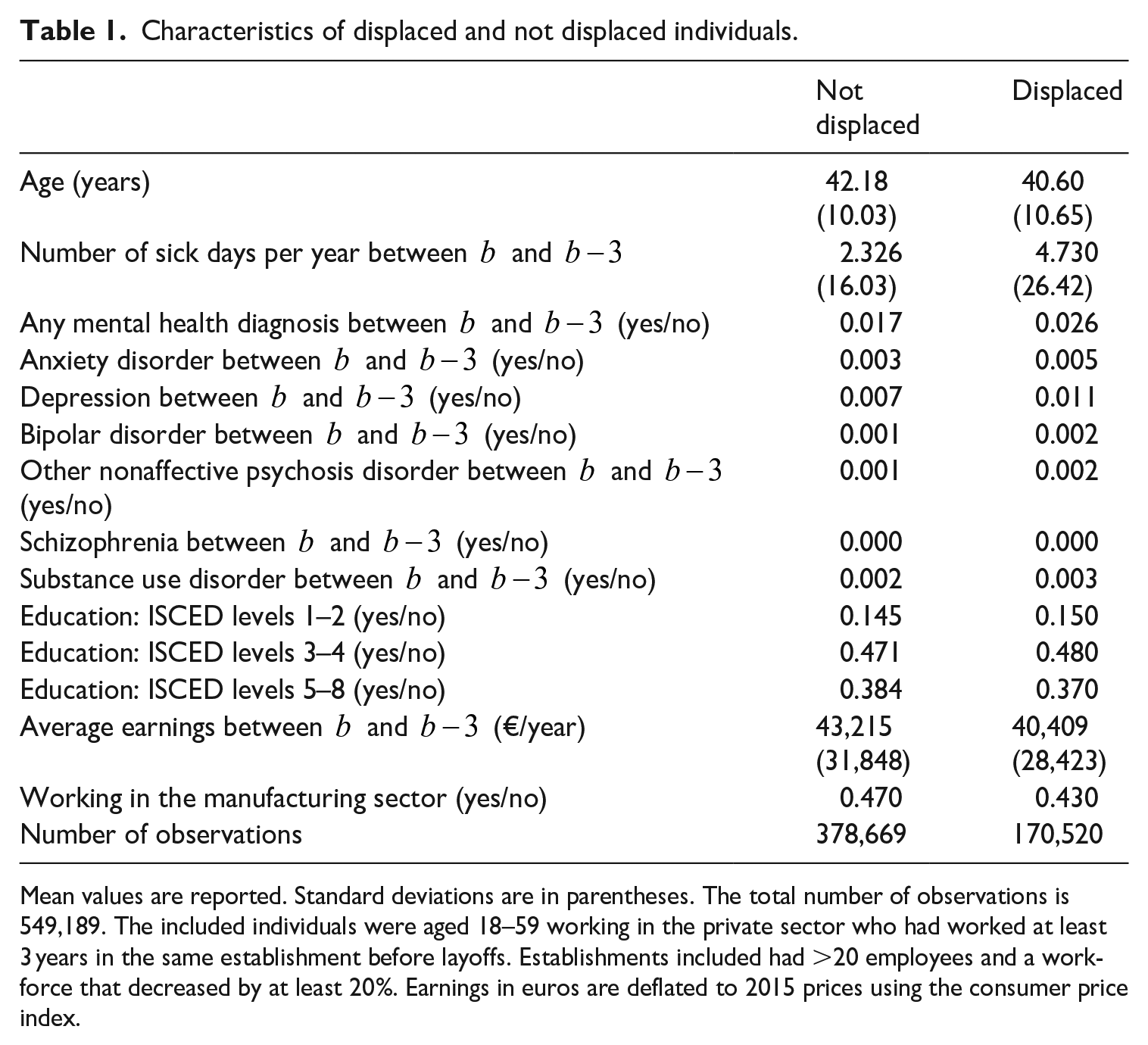
Mean values are reported. Standard deviations are in parentheses. The total number of observations is 549,189. The included individuals were aged 18–59 working in the private sector who had worked at least 3 years in the same establishment before layoffs. Establishments included had >20 employees and a workforce that decreased by at least 20%. Earnings in euros are deflated to 2015 prices using the consumer price index.
Figure 1 illustrates the difference in the distribution of sick days by mental health-related diagnosis during the last 3 years. The figure shows that individuals with mental health-related diagnoses use up a higher number of sick days. Similarly, Figure 2 illustrates the difference in the distribution of sick days between individuals who were laid off and those who were not during downsizing. It is evident that the two groups differ significantly in terms of their prior health status, with those being laid off having notably poorer health before downsizing. When considered jointly, these figures provide compelling evidence for the positive correlation between the diagnosis of mental health disorders and the risk of layoff from work.
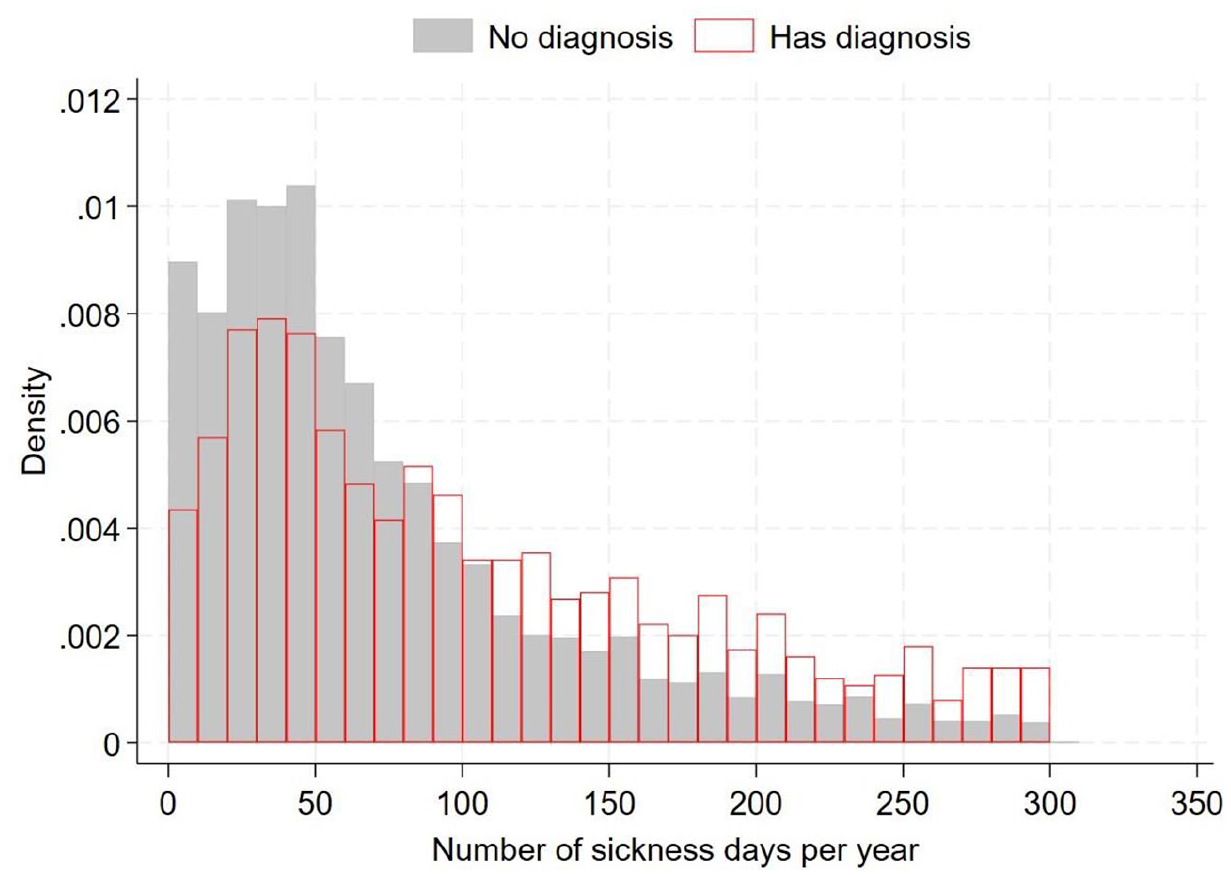
Distribution of the number of sick days by mental health diagnosis status.
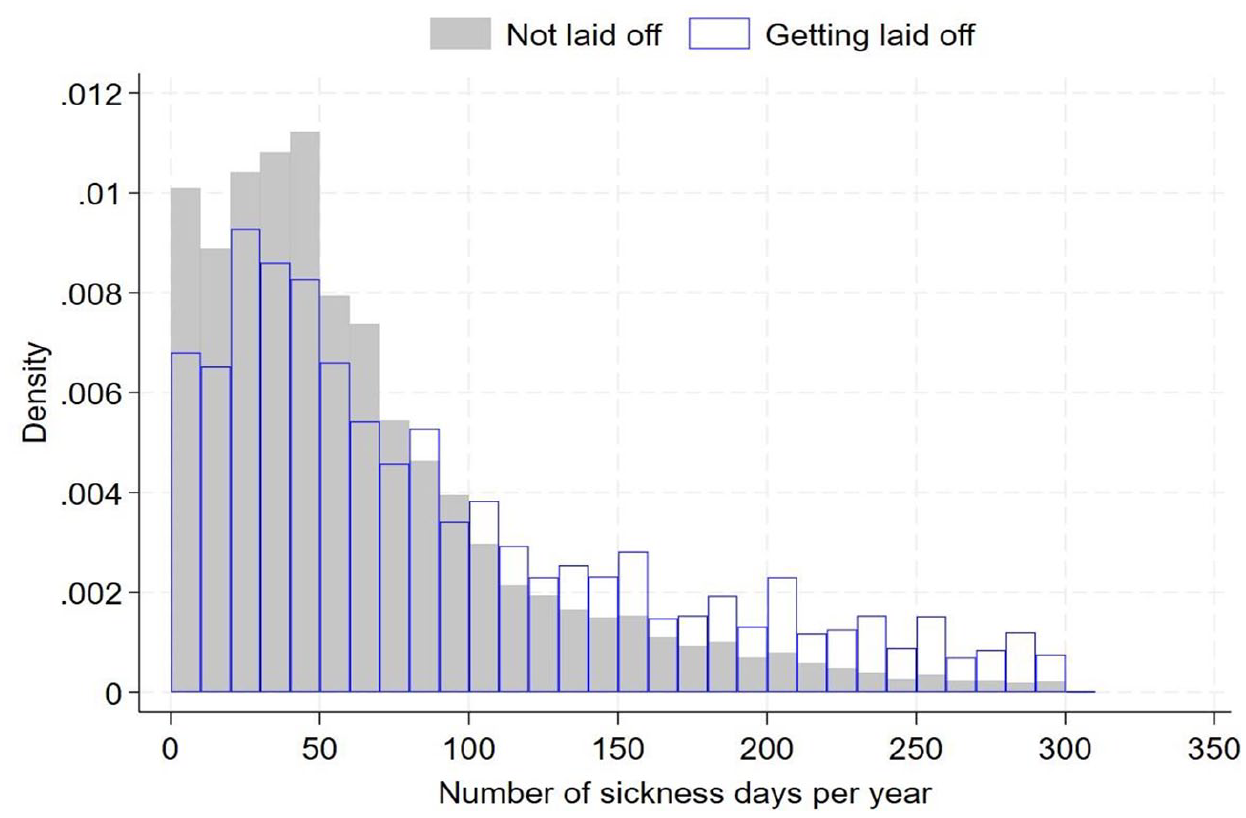
Distribution of the number of sick days by layoff status.
Baseline results
Table 2 shows the results of equation (1) for establishments that had a minimum of 20 employees at time b and experienced a workforce reduction of at least 20%. Column 1 of Table 2 presents the unconditional correlation (without any covariates) between the variables of interest, showing that having a mental health disorder diagnosis is associated with a roughly 8 percentage point increase in the likelihood of being laid off compared to not having a diagnosis. When covariates are included in the model, as shown in column 2, this effect is reduced to approximately 6 percentage points.
The effect of having mental health diagnosis on displacement.
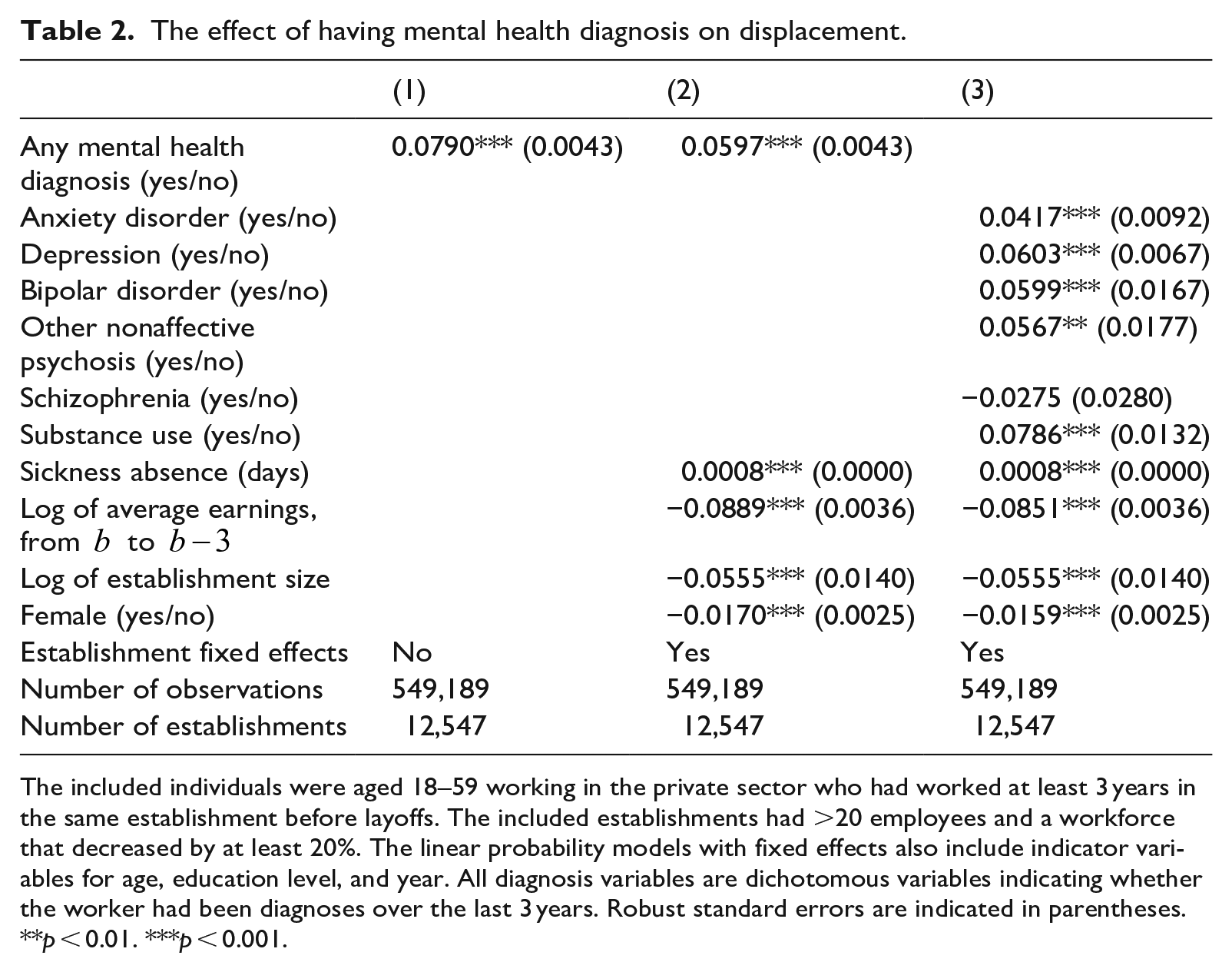
The included individuals were aged 18–59 working in the private sector who had worked at least 3 years in the same establishment before layoffs. The included establishments had >20 employees and a workforce that decreased by at least 20%. The linear probability models with fixed effects also include indicator variables for age, education level, and year. All diagnosis variables are dichotomous variables indicating whether the worker had been diagnoses over the last 3 years. Robust standard errors are indicated in parentheses.
p < 0.01. ***p < 0.001.
In column 3, we divide the mental health disorder diagnosis variable into separate dummy variables for different diagnoses. The table shows that substance abuse disorder – often alcohol abuse in the Finnish context – has the largest effect. Surprisingly, schizophrenia, despite being a severe mental illness, does not appear to influence layoff probability. This is likely because the sample only includes employed individuals, and those with schizophrenia seldom participate in the labour market (Hakulinen et al., 2019). Finally, the control variables yielded the anticipated results. An increase in the number of sick days increases the probability of being laid off. Conversely, having higher earnings and working in a larger establishment both decrease the likelihood of being laid off.
Robustness of the baseline results
To confirm the baseline results, we present the findings of several robustness checks (Tables B2a–B2c). 12 For brevity, we report only the coefficients of interest in Table 3. We made changes to key definitions utilised in the models, modify the estimation sample, and introduce extra covariates into the models that account for potential confounders.
The effect of having mental health diagnosis on displacement: Robustness checks.
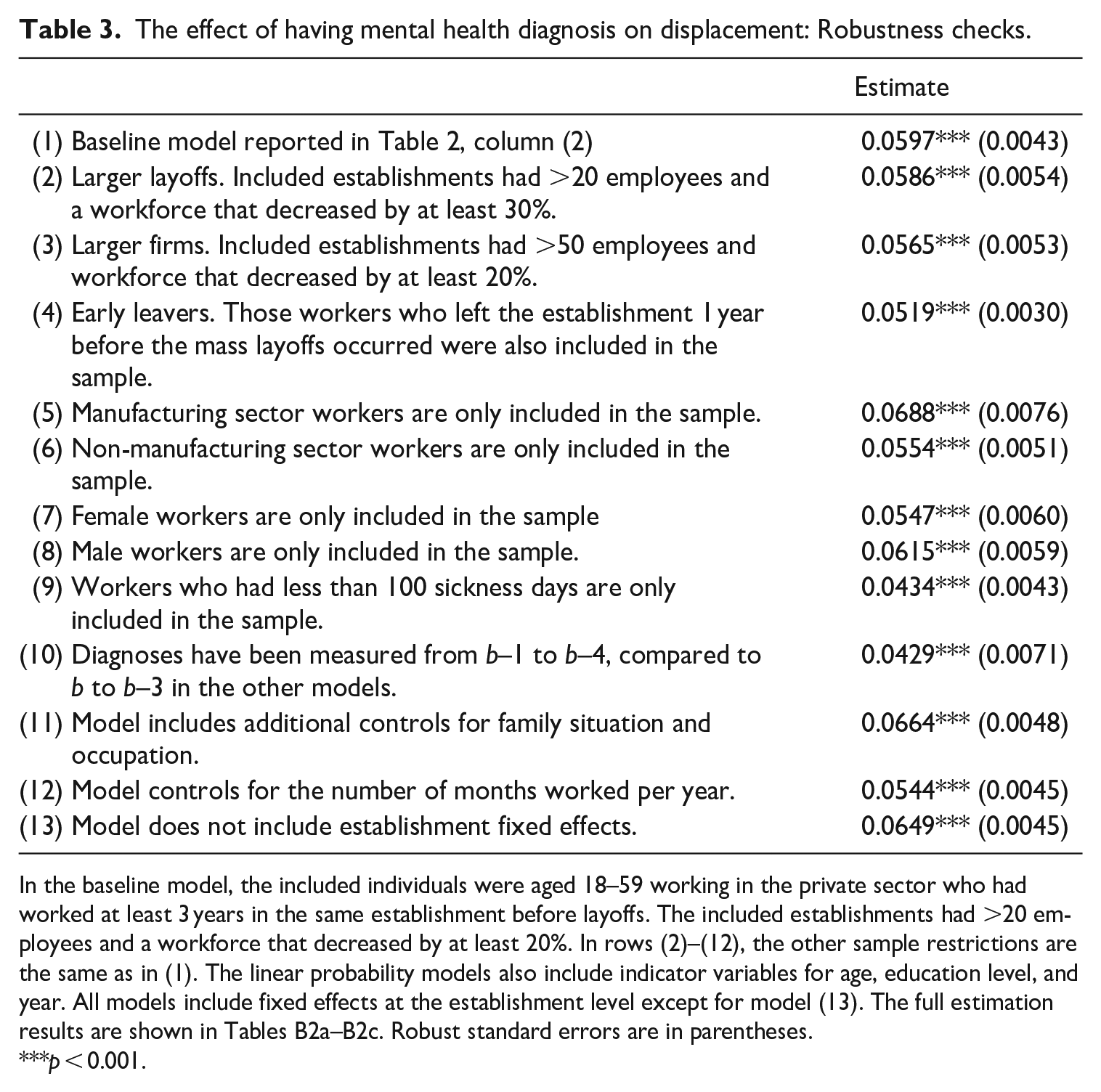
In the baseline model, the included individuals were aged 18–59 working in the private sector who had worked at least 3 years in the same establishment before layoffs. The included establishments had >20 employees and a workforce that decreased by at least 20%. In rows (2)–(12), the other sample restrictions are the same as in (1). The linear probability models also include indicator variables for age, education level, and year. All models include fixed effects at the establishment level except for model (13). The full estimation results are shown in Tables B2a–B2c. Robust standard errors are in parentheses.
p < 0.001.
Only establishments that lay off more than 30% of their workforce were included in Table 3, Model (2). In Model (3), only establishments with more than 50 employees at time b were included in the analysis. In both estimations, the number of observations is less than in Table 2, but the estimated effects remain remarkably similar to those in Table 2.
In Model (4) of Table 3, we also included among those who are considered laid off those who left the establishment 1 year before the mass layoff, or so-called early leavers (Schwerdt, 2011). A potential concern is that excluding early leaves in the baseline models might lead to selection bias in the analysis. Those who leave jobs pre-emptively might be systematically different in terms of health or other background characteristics from those who were laid off. To include the early leavers, we do not require that employees work at the same establishment for the previous 3 years. This did not change the overall conclusion, and the effect of interest remained statistically significant in this specification. However, the point estimate was slightly smaller, based on Model (4), when we included early leavers. The lower point estimate may indicate that there were some anticipation effects at play, but these effects were not strong enough to have a meaningful impact on our conclusions.
In Models (5–6), we divide the sample into the manufacturing sector and the non-manufacturing sector based on standard industry classification. We found that the estimated effect was only slightly smaller in the non-manufacturing sector.
We further divide the estimation sample into women and men in Models (7–8). Again, this did not greatly alter the conclusions, and there was only a small difference in the main effects for men and women (the estimates were 6.2 and 5.5 percentage points, respectively). For comparison, Andreeva et al. (2015) found using Swedish data that mental health problems do not seem to have a dismissal effect for men, and they have an effect only for women who have a major depression. Based on register data, we cannot definitively determine the reason for the slight difference in our point estimates between men and women. However, it is possible that mental health disorders leading to hospitalisation are more severe for Finnish men than women, because prevailing social norms may make Finnish men less inclined to seek help for their mental health issues. Moreover, there were some interesting differences between specific diagnoses (Table B3b). From these, different diagnoses are important for women and men. For women, depression diagnosis has a particularly large positive effect on the probability of being laid off, whereas substance use disorder greatly affects both men and women. Note, however, that alcohol consumption and abuse are much more frequent in men than in women in Finland, as is the case in most other countries (Mäkelä et al., 2006).
Another potential concern relates to the cut-off point for the number of sick days taken off from work. To address this, in Model (9) of Table 3, we present the results in which only workers with fewer than 100 days of medical leave per year are included. This did not change the overall results apart from the fact that the coefficient for sick days was smaller. Thus, although the number of employees who took more than 100 sick days in the sample is small, the probability that they were laid off was high, which affected the coefficient.
Moreover, it is possible that future layoffs are anticipated by employees, thus causing mental distress before a mass layoff. For this reason, we have also estimated models in which the diagnoses are lagged by one additional year; that is, we measure the diagnoses from
We also estimated a specification (Model 11) that controls for family situations and contains a full set of occupational indicators to capture job characteristics. Family situation (i.e. whether the individual was married as well as their number of children) can be a significant stressor and may increase the probability of being laid off. The primary reason for the inclusion of occupational indicators is that job level or working conditions may be linked to stressful and demanding work environments, which could increase one’s susceptibility to layoffs during downsizing. A potential concern with this specification is that occupational indicators could be interrelated with establishment indicators, as certain occupations tend to be more prevalent in specific types of establishments. Our conclusions remained intact in this extended specification.
To address the concern, which stems from the variation of (annual) working hours, we included months of employment as an additional control variable (Model 12). This had only a marginal impact on the point estimate of interest.
We also estimated a specification that did not contain establishment fixed effects (Model 13). We found that this had no meaningful impact on the results, which shows that our baseline results are not driven by accounting for time-invariant differences between establishments.
Finally, we extended the sample to firms that did not downsize and included the interaction term (downsizing × mental health diagnosis) along with the main effect of mental health diagnosis (Table B2c, column 4). Employees with mental health issues might have had a higher quit rate and part of the estimated effect in the baseline models might be due to natural mobility differences between employees with and without mental health issues. The estimate of interest is in this specification 10 percentage points larger in the downsizing firms than in the non-downsizing firms, and this estimate is statistically highly significant (p < 0.001). Note that these results are not directly comparable to the baseline specification, as the extended sample includes all establishments, not just those that downsized their workforce.
Conclusion
Health and labour market participation are closely interconnected. Individuals with poor health encounter numerous challenges in the labour market, including reduced earnings and an increased risk of unemployment. Modern societies have developed social safety nets, including income transfers, and policy interventions, such as training programmes, to alleviate these problems.
Similar to many other developed countries, in Finland, the Equality Act and binding collective labour market agreements prohibit discrimination based on health reasons in mass layoffs. Nevertheless, our empirical findings show that even when we include only employees who had worked in the same firm for at least 3 years before a mass layoff and include a comprehensive set of controls in the regression analysis, individuals diagnosed with a mental health disorder still face a significantly higher probability of being laid off in mass layoffs. The precise reason for these empirical findings is unclear; however, it is plausible to assume that employers are more inclined to include those with mental health disorders in the group of employees who are laid off for economic reasons. Extra training and support for those with mental health disorders would imply that our estimates could underrepresent the true effect of mental health disorders on the probability of losing a job during mass layoffs in the absence of policy interventions. Our register data lack information on public income transfers, additional training, or whether employers received hiring or wage subsidies.
Clearly, we cannot completely rule out alternative explanations. First, although we controlled for employees’ earnings, a proxy for individual productivity, and days absent due to illness (as a broad health indicator) in the regressions, it is possible that employers perceived employees’ productivity and job performance in ways not entirely captured by these factors. Thus, being diagnosed with a mental health disorder might be linked with productivity in a way that is not adequately addressed by our controls for sickness absence and earnings, leading to the results being influenced by an unobservable aspect of productivity that is not directly related to mental health issues.
Our empirical approach has other limitations as well. First, mass layoff may be a culmination point of long-term economic problems of the firms. However, the larger the downsizing at a workplace, the less individual employee characteristics are likely to influence the chance of job loss during workplace downsizing. We also showed that our findings are not sensitive to the specific cut-off point of defining mass layoffs. Second, using nationwide register data, we do not know whether the employees were dismissed or left the employer voluntarily. Notably, the distinction between quits and layoffs is not clearly defined from a theoretical standpoint. Employers with bargaining power can, at least in principle, lower workers’ wages and benefits to encourage ‘voluntary’ quits. Third, we do not distinguish between the various endpoints for workers affected by layoffs. However, an important point is that employees who are laid off experience significant welfare losses, such as the loss of firm-specific human capital, regardless of their circumstances after the mass layoff. Fourth, our data do not contain information on physical and cognitive disabilities.
In addition to mental health, our findings indicate that the number of sick days generally predicts job loss during mass layoffs. This suggests that firms might use mass layoffs as a strategy to remove employees with lower or compromised productivity and higher long-term non-wage costs. Within the Finnish occupational healthcare system, close supervisors might gain insights into the reasons behind an employee’s frequent sick leaves. Such information could potentially influence the selection of employees to be laid off during mass layoffs. Moreover, our results indirectly question the validity of the argument that the incidence of unemployment is strictly exogenous in studies on mass layoffs.
More generally, mental health disorders are increasingly becoming a major public health concern, particularly in high-income countries (Vigo et al., 2016; Whiteford et al., 2013). Moreover, mental health disorders are known to elevate the risk of poor physical health (Sareen et al., 2006). The empirical finding that individuals with poor mental health have a higher likelihood of job loss highlights the need for additional protections for this vulnerable group of workers. This is crucial because unemployment itself leads to deteriorating physical and mental health. An intriguing topic for future research would be to investigate the labour states of those who had been laid off, particularly focussing on long-term labour market trajectories.
Supplemental Material
sj-docx-1-gjh-10.1177_23970022241244988 – Supplemental material for Lost mind, lost job? Unequal effects of corporate downsizings on employees
Supplemental material, sj-docx-1-gjh-10.1177_23970022241244988 for Lost mind, lost job? Unequal effects of corporate downsizings on employees by Petri Böckerman, Mika Haapanen and Edvard Johansson in German Journal of Human Resource Management
Footnotes
Acknowledgements
We thank two anonymous reviewers, Michael Beckmann (associate editor) and Monika von Bonsdorff, as well as seminar participants at the Annual Conference of the European Association of Labour Economists (EALE), Labour Institute for Economic Research LABORE, University of Jyväskylä, and University of Turku for helpful comments.
Funding
The author(s) disclosed receipt of the following financial support for the research, authorship, and/or publication of this article: This study is part of a project supported by OP Group Research Foundation (no. 20180084).

Supplemental material
Supplemental material for this article is available online.
Notes
References
Supplementary Material
Please find the following supplemental material available below.
For Open Access articles published under a Creative Commons License, all supplemental material carries the same license as the article it is associated with.
For non-Open Access articles published, all supplemental material carries a non-exclusive license, and permission requests for re-use of supplemental material or any part of supplemental material shall be sent directly to the copyright owner as specified in the copyright notice associated with the article.
