



Abstract
This interdisciplinary research explored how executives make decisions which shape their career trajectories and sustain their careers. We selected executives so that our sample would consist of decision-makers with sufficient capital resources to support a range of career choices. In our analysis we applied a recent framework of distributed interactive decision-making, which proposes that decisions are shared interactions between personal and contextual agents. We conducted 40 semi-structured interviews with executives who are MBA Alumni of a leading global business school to investigate how they made their career decisions. We conducted thematic analysis using NVivo qualitative analysis software to identify the decision-makers in each decision and their levels of agentic participation. Our results reveal that: (1) (a) executive career decision-making is distributed between the person and a range of active stakeholders in their career context, and (b) stakeholders along with influences together form a decision-making unit (DMU), whose composition changes according to the circumstances; (2) each member of the DMU may participate at a different level in each career decision, along an interactive continuum which ranges from proactive decision-making, driven by the individual, to reactive decision-making, driven by other decision-makers in the career context. These findings have implications for individuals, career counselors and human resource managers: we identify the DMU of various participants in career decisions and their level of active contribution to the decision outcomes, in order to develop sustainable career management strategies and processes. This is original interdisciplinary research, combining and applying recent theories of distributed decision-making for the first time in empirical research into sustainable careers.
Keywords
Introduction
In the 21st century, many workers not only have a wider range of career choices than in the past, but they also often need to make choices to change job, role or sector, simply to sustain their careers in the precarious modern workplace (Direnzo and Greenhaus, 2011; Petriglieri et al., 2019). Therefore, career decision-making is a key skill for modern workers, yet there is little research into how this complex process takes place in practice. For example, extant decision-making models incorporate multiple factors that influence the career decision, but there is little empirical research into how these factors interact with the individual or with each other. To clarify, whilst there is a wealth of literature on career choice, the gap that we addressed was to set out the decision-making process (DMP) by which various unconnected participants together contributed to a career decision. In contrast to the key current individual-focused career models, we wished to investigate whether career decisions were primarily made independently by goal-driven individuals, or whether they were the outcome of the interaction between a number of factors and stakeholders in the career context, for example, family and colleagues, or the social and organizational structures themselves. We selected executives so that our sample would consist of decision-makers with sufficient capital resources to support a wide range of career choices and a career history which showed their ability to make hierarchical progress in their managerial careers (Reitman and Schneer, 2003).
Our objective was therefore to explore how executives make decisions which shape their career trajectories and sustain their careers. Our research addressed two questions:
(a) To what extent do executives make decisions to sustain their careers independently of, or interacting with, their career context, including family, employers, and social norms?
(b) Do other decision-makers participate actively in the career decision-making process (DMP)?
How actively do individuals interact with other stakeholders along with influences in their career decisions?
We set out below the key extant models and frameworks for sustainable careers and career decision-making and discuss their usefulness, but also their limitations: primarily, we critique their characterization of the individual decision-maker as fully-engaged and goal-driven in the decision-making process. We then propose how these limitations might be addressed by using recent frameworks from judgment and decision-making. Finally we discuss the findings of our present study which explores empirically how multiple decision-makers interact to make sustainable career decisions.
Models of career choice in the career literature
For most of the 20th century, career choice was conceived as a relatively straightforward employer-led, once-in-a-lifetime process of matching an individual’s characteristics to the work requirements (Holland, 1959; Parsons, 1909). Even when the emphasis first moved from a sociological approach to incorporate a psychological perspective (Moore et al., 2007), careers were still conceived as situated within a relatively stable career context. For example, Super’s (1980) “life-span life-space” theory set out a “rainbow” model in the form of a predictable natural progression through career stages which reflected the stages of human development, from growth, exploration, establishment and maintenance to final decline, leading to disengagement from the workplace, and this model remains seminal to career studies (Zacher et al., 2019). Models remained mainly linear and individual-centered into the 21st century, for example, Van Hooft et al. (2004). A key career development theory is the “Social Cognitive Career Theory” (SCCT) (Lent and Brown, 2013, 2019), in which the individual moves through a linear DMP toward their career goals (Latham and Locke, 1991). Although this model emphasizes the influence of contextual supports and barriers and individual self-efficacy on the individual’s choices, stakeholders are not discussed in detail, and external factors influence, but are secondary to, the individual’s ultimate career goals. A second key model is the model of career management by Greenhaus et al., (2010), which is a normative decision-making model in which the individual, again influenced by their context and background, progresses through a series of steps to their goals. However, both these models focus on the individual making the decision alone, and they neglect the reciprocal influence that individuals may actively bring to bear on those same contextual supports and barriers in the course of managing their careers; they also take little account of the disruptive role played by happenstance.
Personal agency and meaning
The individualist approach to careers received theoretical support toward the end of the 20th century (DeFillippi and Arthur, 1994; Hall and Mirvis, 1996; Moore et al., 2007), and this has continued to provide a key perspective in career studies. This approach emphasizes that individuals can proactively manage their own protean and boundaryless careers, and consequently, personal agency has been perceived as the key to career sustainability. Bandura (2001) defined personal agency as when individuals “intentionally make things happen” (p. 1). Individuals exercise personal agency when they carry out career self-management (King, 2004) and it implies a sense of self-efficacy (Bandura, 2001; Betz and Hackett, 1986). Yet personal agency is only one type of agency, and the implications for career theory of further types of agency are discussed in the section on decision-making below.
Building upon this individual-focused approach, a body of recent career research highlights personal meaning and fulfilment as important sources of personal career motivation (Allan et al., 2019; Bailey et al., 2019; Duffy et al., 2016; Steger et al., 2012). Achieving personal authenticity has been seen by some as the goal of a career (Baugh and Sullivan, 2015; Ibarra, 2015). Personal motivation theories (e.g. Ryan and Deci, 2000, 2017) have identified key drivers for career decision-making. Yet in contrast to this focus on the individual, we now consider another stream of career literature in which the individual needs to adapt to the career context.
The context in career development models
Despite focusing on the individual, the career literature by no means ignores the career context. Early career development models which describe an interactive process in response to the context over time include Amundson’s (1995) interactive decision-making model, in which a decision is iteratively re-framed by the individual through interaction with the career context, and the dynamic interactional career development model proposed by Vondracek et al. (1986), which identifies interactions between a range of influences on career development. These models identify the salience of interactivity in career decision-making, but still focus on the individual as the ultimate decision-maker.
The context is incorporated in existing career models as a source of influence and chance, which provide both opportunities and barriers. It has been described as an ecosystem which incorporates not only individuals and their families but also institutions and the macroeconomy (Baruch, 2015; Baruch and Rousseau, 2019; Gribling and Duberley, 2021). For example, the context can constrain career options, through family, social or work influences and boundaries (Gottfredson, 2005; Greenhaus and Powell, 2012; Rodrigues and Guest, 2010; Schooreel et al., 2017), or it can trigger transitions through unexpected positive or negative career events, termed “career shocks” (Blokker et al., 2019). To sustain their careers, further research has shown that individuals interact with the modern dynamic workplace, adapting to these career shocks and further changes in the work context (Bimrose and Hearne, 2012; Fugate et al., 2004; Gálvez et al., 2018; Savickas and Porfeli, 2012). To explain the relationship between individuals and their context, an individual’s cognitive and affective processes, along with their behavior, have been conceptualized as interacting with events in the wider environment, in the model of triadic reciprocal causation (Bandura, 1989, 2001). Furthermore, the concept of synchronicity, which highlights the interconnectedness between individuals and their environment, has been related to career choices in which apparent coincidences are examples of a holistic career context (Guindon and Hanna, 2002). Recent research explores how career development takes place through interactivity with the career context (Gunz and Mayrhofer, 2018; Hodkinson, 2009; Lee et al., 2011; Mainiero and Sullivan, 2005; Patton and McMahon, 2006; Schneidhofer et al., 2020) but this research does not focus on the mechanism of decision-making specifically.
Individuals have been encouraged to grasp affordances in the career context opportunistically, in order to optimize their career success in response to coincidences which arise through happenstance in the external career environment (Bandura, 1982; Bright et al., 2005; Kindsiko and Baruch, 2019; Krumboltz, 2009, 2011; Mitchell et al., 1999).
Secondly, the context also provides structure to the career trajectory, in the form of scripts. Scripts are sequences of standard interactions in daily life (Schank and Abelson, 1977), and career scripts are recognized career paths that provide the context-driven structure to most careers (Dany et al., 2011; Gioia and Poole, 1984; Grote and Hall, 2013; Laudel et al., 2019). Careers themselves have been compared to scripts which form a link between institutions and interactions (Barley, 1989), and indeed help to reproduce the institution itself by encoding and re-enacting its logic. Thus scripts simplify the career decision by providing standard career paths to follow, and they also enact the intentions of the organization, by directing individuals’ efforts to progress their careers. Yet, whilst the function of career scripts has been identified in the literature, scripts have not been explicitly integrated into the key current career decision-making models.
The limitation of the existing models which have been used in earlier empirical research into career choice, is that they continue to place the career actor at the center of the process, rather than, as is increasingly argued, interacting dynamically in a dialog with the contextual influences (De Vos et al., 2020; Van der Heijden and De Vos, 2015). An individual-centered approach does not address situations where other stakeholders make key decisions in an individual’s career, for example, when an employer makes an individual redundant, when the individual has no input into the career decision—or in the case of dual career couples (Petriglieri and Obodaru, 2019), when the individual explicitly shares career decision-making with their partner. Similarly, when an individual chooses to follow a profession such as accountancy or the law, they then follow a series of predetermined steps along a standard career path, and again the key decisions as to the next step in the process are already made by the organization or profession, rather than by the individual. The theoretical perspective in career research has recently begun to move beyond the individual-focused perspective to begin to develop a systemic, interactive approach to career development. This interactive systemic approach to careers was proposed by Patton and McMahon (2006) and by De Vos et al. (2020) in their seminal work on sustainable careers. The latter described three dimensions of a sustainable career: the person, in whom they identify agency and meaning as personal drivers; the career context; and, finally, time, including chance events. They suggested criteria against which to measure career sustainability in a dynamic workplace, namely that people should be happy, healthy and productive (Van der Heijden, 2005). This paper focuses on sustainable careers in order to emphasize that it is investigating key decisions taken to support the individual’s long-term career, and yet, in the modern precarious work environment, careers do not last a lifetime and therefore such major decisions will have to be taken successfully on a regular basis if the career is to be sustained. Consequently, each decision could be categorized as a major, potentially costly decision, which might be expected to be carefully researched using thoughtful and carefully planned decision-making processes, and one objective was to see whether the decision-making approaches were indeed explained by the approaches described in the extant linear models of career choice.
Taking a systemic approach exposed a gap in the literature, in the lack of an interactive decision-making model for career choice which explicitly takes into account the active participation of stakeholders in career decision-making. We therefore turn to the analysis of decision-making in the academic literature of judgment and decision-making theories to focus on the nature and mechanisms of interactive career decision-making.
Decision theories and frameworks
Decision theories focus on the processes required for decision-making itself. In the past, decisions were analyzed according to rational choice theory (Fischhoff and Broomell, 2020; Von Neumann and Morgenstern, 1944), which approaches decision-making as a logical progression through a series of steps leading to an objectively justifiable outcome. It lends itself to formal debate, and is designed to enable the decision-maker(s) to make optimal objective decisions, by comparing all the options, and setting out a process for choosing the best option according to measurable, predetermined criteria. Applied to the career domain, this decision-making approach may be used when the individual is considering a number of career options and discussing their merits and demerits with family members or career advisors, for instance, at an early exploration stage of their career.
A rational approach underlies Gati’s (1986) “selection through elimination” model, and current career decision-making models discussed above (Greenhaus et al., 2010; Lent and Brown, 2013). Adopting a structured approach lends itself to rational discussions with career advisors, but its limitations are that it relies on the assumption that the career actor has the information and the competence to address all the issues necessary to frame the decision, and to identify and assess the criteria (Fischhoff and Broomell, 2020). In contrast, the limits to rational thinking have been identified as bounded rationality (Simon, 1947), which suggests that individuals make adequate, rather than perfect choices, in the face of imperfect knowledge, and this limitation applies to many career decisions. Similarly, the trilateral model of career decision making [sic] (Krieshok et al., 2009) is based on the insights into heuristics and biases from the literature of judgment and decision-making (e.g. Kahneman and Tversky, 1979), but this model, too, still emphasizes the importance of engagement in, and adaptability to, the work context, but it still conceives career decisions as primarily driven by individual cognitive and motivational processes, rather than by the context.
Distributed decision-making
In order to analyze career decision-making from a systemic perspective, we turn to a distributed approach to decision-making. This builds upon a recent concept in the literature on judgment and decision-making which identifies distributed agency (Enfield and Kockelman, 2017), according to which agency can be distributed between different stakeholders, and even across time. Distributed agency is distinguished from collective agency, which is agency exercised by a group of individuals with similar intentions (Bandura, 2000), in that the participants in distributed agency may have different objectives. In particular, in distributed agency, social units co-operate across actors and activities (Enfield, 2017). Distributed agency, in turn, supports the concept of a distributed decision-making process, which takes place between the multiple stakeholders in each decision (Rapley, 2008; Schneeweiss, 2003, 2012; Treurniet and Wolbers, 2021). Distributed decision-making situates decisions within their systemic context, and identifies a decision-making unit (DMU) of stakeholders in the DMP (Schneeweiss, 2003, 2012). The DMU was identified in Marketing in the latter half of the 20th century (Moriarty and Bateson, 1982; Webster and Wind, 1972) but without an explicit theoretical framework. Various models of the DMU were developed. The concept of the DMU continues to be used in purchasing decision analysis (Abiola, 2000). From its initial use in marketing, it has been applied to healthcare (Gilbert et al., 2011) and, in the 21st century, in decision-making for Operational Research (OR) (e.g. Schneeweiss, 2003, 2012). Recently, with the inclusion of the role of influencer to those involved in the decision-making process, it has been applied to the information search process in decision-making from the Library and Information literature (LIS) (McNicholas and Marcella, 2022). Webster and Wind (1972) defined the five roles of DMU participants in organizational purchasing decisions as Users, Buyers, Influencers, Deciders, and Gatekeepers. Additional roles have been suggested for DMU membership including initiator and analyst/spectator (Wilson, 2000). Gilbert et al. (2011) defined a DMU for making decisions on long-term healthcare provision for the elderly as a group of individuals who are brought together to purchase a product or service. Research has found that the DMP is not always rational and linear, and instead the process has been described as informal and amorphous (Wilson, 2000).
A theoretical framework was subsequently provided by the concept of distributed cognition (Hutchins, 1995), which suggests that human thought is the product not of one single brain but of the individual interacting with individuals, structures and artifacts in their environment, and which underpins the concepts of distributed agency and distributed decision-making. This distributed perspective has been applied to career decision-making for the first time in a recent interactive distributed career decision-making framework (Hallpike et al., 2022) which addresses the role of the various stakeholders, for example, the individual, their family and friends, colleagues, supervisors and the policies and practices of employing organizations in career decision-making. The framework places the decision itself at the center of the process, in between the person and the ecosystem of the various active decision-makers and drivers in the career context. These broad contextual decision-makers and drivers include two categories of proximal drivers: firstly, the demands placed on an individual’s resources of time, energy and money by family, colleagues and friends, and, secondly, the career scripts created by organizations and individuals, which can actively determine the choices available to a decision-maker. Furthermore, career decisions are also subject to the unpredictable factor of chance or happenstance. We apply the distributed interactive career decision-making framework (Hallpike et al., 2022) to analyze career decision-making as a systemic process, in which decision-making is distributed amongst interactive stakeholders, in order to gain a better understanding of who makes career decisions and how career decisions are made in practice.
Sample and method
Procedure and participants
This section aims to situate the research so that the reader can gain an understanding of the investigator, the study topic and the data sources in the specific research context (Levitt et al., 2018). Participants were alumni from a leading global business school MBA program and all had at least 10 years’ subsequent work experience. Executives were chosen to find a group who could make their decisions with a minimum level of environmental constraints, so that they should have the maximum opportunity to manage their careers independently to achieve their career goals. The sample was therefore drawn from a population which, in terms of access to finance, education and high-flying careers, were in possession of high levels of all the relevant types of capital for a conventionally successful career, from human capital (Becker, 1964/1993) to economic, social, and cultural capital (Bourdieu, 1986). The sample comprised 23 men and 17 women, generally reflecting the higher proportion of male alumni. Most were married or living with partners (35 out of 40) with the remaining five single (3) or divorced (2). Most had children (30) but a substantial minority (10 out of 40) remained childless (see Supplemental Appendix C). Recruitment was in person at Alumni Association events, with the addition of some later recruits by email through purposive sampling to ensure access to a wide range of participants (Ritchie et al., 2014). Most alumni were working in the UK, but many were not UK nationals, for example, from France, Germany, India, Iraq, and Latin America, reflecting the international intake to the MBA program. A small number of alumni were retired from their main profession but remained actively engaged in business. Participants were recruited from the later career stages of maintenance or even disengagement in relation to their main employment, with a minimum of 10 years’ further work experience since attending the business school, to ensure that they had experience of making a number of key career decisions in different circumstances, and had experienced a range of career stages. However, in reality, career stage was variable and unpredictable, as many were recycling through the career stages from the beginning, as they explored new work opportunities. Therefore, the family life cycle and chronological age were also relevant characteristics. The age range was from 38 to 73 years, with the majority in their 40s and 50s, and an average age of 54, to enable the researchers to explore along an individual’s career trajectory and identify whether individual decision-making approaches remained consistent along the life span. This was of interest to see whether, for example, participants who referred to themselves as proactive, in other words, participants who were proactive and took the initiative in their careers (King, 2004; Patton and McMahon, 2006; Seibert et al., 2001), reported consistently proactive decision-making, and thus whether their personality determined how they made decisions, or their perceived self-concept influenced how they reported their decision-making. The interviewer is an alumna of the same business school and was therefore able to establish a knowledgeable rapport with the participants in a relationship of trust and mutual respect which increased openness in the interviews (Bryman and Bell, 2011), whilst remaining aware of potential limitations (see Discussion and Limitations section).
Data collection
Forty semi-structured interviews (Saunders et al., 2003) lasting between 1 and 2 hours were conducted at participants’ offices in London, or occasionally on a university campus, by Skype and on three occasions at a participant’s home. By using interviews, the researcher was able to ask questions, for example, about reasons for career choices, the interaction of work and home, and participants’ satisfaction with their career, and to follow up immediately to seek clarification, query inconsistencies or explore emergent themes. To ensure methodological integrity (Levitt et al., 2018), interviews were recorded and transcribed verbatim and, in the Findings section of this article, participants’ statements are cited verbatim so that all analysis is grounded in the evidence; the interview schedule (see Supplemental Appendix A) was developed to address the research questions and agreed by all three authors; all participants were asked the same basic set of questions so that the content is comparable across interviews; in addition the basic questions were supplemented by prompts and probing and insights volunteered by the participants. In dealing with the participants, the researcher guaranteed confidentiality and data security and created a climate of trust (Bryman and Bell, 2011). Interviews were recorded with prior written participant consent, and transcribed into Word, using pseudonyms (which are used in this manuscript) to anonymize the data, and all data were saved onto encrypted memory sticks and stored in a fireproof safe. To validate participants’ credentials, they were checked against a list of Alumni, CVs, and LinkedIn profiles. Participant demographic details were prepared in advance, and verified on the day of the interview.
Data analysis
The interview transcripts were transferred to NVivo 12 Pro and coded thematically (Ritchie et al., 2014). Coding was first carried out using an abductive approach, moving iteratively back and forth between the transcripts and the academic literature, in order to gain an understanding of the DMP. Adopting an abductive approach enabled us to code both the anticipated and the unanticipated themes, and furthermore it enabled the analysis to take place iteratively, in keeping with the interactive, constructionist approach taken to the research overall. In practice, applying the abductive approach entailed both deductive and inductive coding (Tavory and Timmermans, 2014; Vila-Henninger et al., 2022). The transcripts were initially coded deductively, using a priori codes derived from theories related to the key themes of sustainable career literature, namely: person, career context and time-related changes, and to themes from the literature on decision-making, such as goals, plans, and control. Key elements which constitute the interactivity perspective, such as proactive, reactive and interactive decisions as suggested by Hallpike et al. (2022) were also coded deductively. Further codes were subsequently derived from the analysis of the responses to specific interview questions. For example, many of the participants spontaneously referred to their early ignorance and how this restricted their ability to be proactive in their early career choices, so we added this code in vivo to the code book. Furthermore, the identification of the two contrasting interactive approaches, namely opportunism and fatalism, was added inductively during the coding process (Miles et al., 2020). Inductive findings also emerged from the combination of separate deductive codes. For example, coding for career scripts was combined with the coding for the reactive decision-making style to illustrate the new finding that individuals made many career decisions with a low level of active drive for change by instead simply following a career script. Furthermore, as we applied the concept of the DMU to the data, we identified the basic configurations of the DMU, including the identity of its various members and the role they played. The finding as to how the DMU functioned across time and space, and how and why it changed over time, emerged from the transcripts. We linked the concept of decision-making modes, which we applied to the individual, to the concept of the DMU, which incorporated both the individual and other contributors to the DMP. We linked the change in individuals’ decision-making mode to specific configurations of the DMUs, as set out below. For instance, the past contributions from family and current contributions from organizations, through their career scripts, clearly emerged from the transcripts. The findings were checked to take account of the theoretical underpinnings and any inconsistencies or contradictions. This resulted in more than 80 narrowly defined codes which needed to be consolidated to form more meaningful codes.
The second stage of the analysis was to integrate and synthesize the codes in order to relate the specific findings to the broader issues in the research questions. Consequently, we undertook a second cycle of coding, to create pattern codes, by grouping the specific codes into categories (Miles et al., 2020). Through an iterative process of tentative categorization and discussion, criteria were established to identify patterns in career structures and decision-making. We re-read each transcript to establish patterns in executives’ career trajectories, and compared these with their CVs and with the literature. We then compared the DMPs cross-sectionally across individuals, focusing initially on the common decision to undertake the same MBA course. Taking an interactivity perspective, the codes could be grouped into three broad levels of activity during the DMP, proactive, reactive and distributed interactive, as suggested by Hallpike et al. (2022).
These categories were checked by iteratively re-applying them to further examples of decision-making in our transcripts. The second comparison was of intra-individual career decisions along each individual’s career pathway, to see if an individual used one DMP exclusively, or changed their decision-making approach along the career span, according to circumstances.
Findings
Findings showed that the individuals reported that they made decisions in different ways, which varied according to their circumstances. In some circumstances, interviewees presented their decisions as independent of their career context and proactive. In other circumstances, decisions emerged from the interactions of multiple stakeholders acting as a DMU, whose composition varied by decision, and could include colleagues offering advice, family making demands on the individual’s resources, or employer career scripts which determined their next career move. Within the DMU, different functions were fulfilled by different members. Based on the existing literature on the DMU, we identified the following possible roles: initiator, affordance, support, hindrance, gatekeeper, and influence. For example, we analyzed the roles in the DMU for a participant’s decision where to develop her career. The initiator was the participant, experiencing feelings of boredom after several years in her role. The affordance was that she had been approached about roles with other employers and also about a change of role with her present employer. Her partner provided support to her decision-making. One hindrance was that she was the main family breadwinner. No gatekeeper was identified, except the possibility that the employers might not make a firm alternative offer. Influences included the attraction of spending more time on the house and family.
Additionally to the individual stakeholders, we identified a further contributor to the DMU, namely the organizational career script, as mentioned above, which offered affordances in the form of organizational career paths. These scripts were designed explicitly to guide individual employee career decisions and thus realize the collective intention of the organization. A second type of career script, a referent script observed by the career-seeker embodied in a colleague’s career, was not an active contributor to the DMU but its function was to influence the decision. For example, a colleague’s successful career path might influence the individual to try to emulate their career trajectory, which embodied an attractive referent career script. The sources for members of the DMU were stakeholders in the decision, including family, friends, colleagues and employers; sometimes more distal stakeholders such as governments could also be active participants in the DMU. We set out three examples in Table 1 below, to illustrate the different roles that can be played in the DMU in different decisions. The two examples for Participant C illustrate how the roles within the DMU can change in different circumstances and at different career stages.
Functions in the DMU.
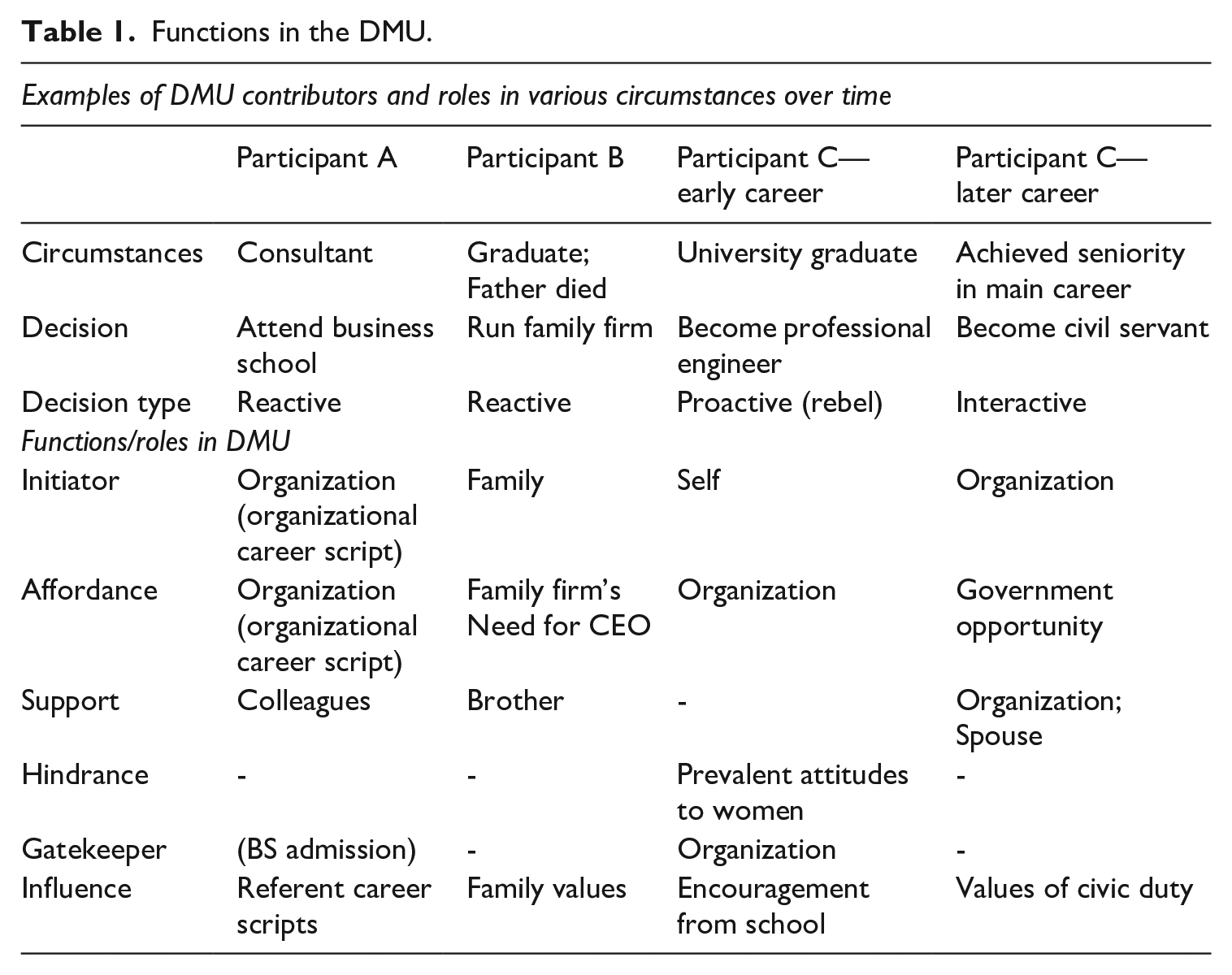
Sometimes the DMP was person-led, in other words, it was initiated by the individual, and sometimes it was context-led, triggered by a change or initiative in the context. In other cases, it was interactivity-led, that is to say, the decision emerged from a series of interactions between the person and their context. We categorized these three types of decision-making into three groups, or modes, reflecting the categories of decision-making archetypes proposed by Hallpike et al. (2022), and we analyzed their characteristics, defining them as proactive for person-led, reactive for context-led and distributed interactive for interactivity-led. We found that participants used different modes of decision-making in different circumstances. For example, when they had little knowledge of their options, such as early in their career, participants often followed the career scripts suggested to them, adopting the reactive mode. An exception to this was when participants rejected the scripts suggested to them, and instead proactively sought out a career that was not anticipated by their advisors or their social norms for example, when one participant rejected the role of PA suggested to her by her father and instead proactively found a way to start working in journalism. Participants adopted the interactive mode when they responded spontaneously to affordances which were presented to them unexpectedly by the career context, responding either opportunistically or fatalistically.
We identified links between the decision mode and the reported DMU Membership, in that a proactive decision-maker reported few, if any, other members of the DMU; a reactive decision-maker based their decision upon the existing career scripts which we have included as a contributor to the DMU and therefore included at least themselves and their organization in the DMU; and finally the interactive decision-makers reported a range of other members of the DMU with whom they interacted in reaching the decision outcome. (Interactive decision-makers subdivided into opportunistic and fatalistic but these were reported as individual attitudes and not related to the DMU membership.)
DMU and decision-making modes for career decision-making
Below we define and analyze different configurations of the DMU which could be linked to the three career decision-making modes, and we illustrate them with quotations from the interviews. The classification of the three career decision-making modes is built upon the conceptual framework by Hallpike et al. (2022) discussed above, which proposes three decision-making archetypes. These varied by decision instead of by individual, as individuals altered their decision-making mode according to the configuration of the DMU and also to their level of engagement in a specific decision. Please see the Gioia chart (Supplemental Appendix B) for the codes that formed each decision-making mode.
DMU driven by individual decision-maker: Proactive decision-making mode
One group of decisions was mainly person-driven by individuals who were purposeful, and had a high sense of their self-efficacy in achieving the particular outcome they desired. This decision-making mode was categorized as the proactive category. Proactive career decisions were primarily made independently of other people, and often no other active members of the DMU were identified, even when using prompting. Instead, the career-seeker reported that they carried out all the functions of the DMU, starting with initiating the process. As one participant described her decision to go to business school:
No, it was mainly on my own. I don’t think I knew anyone that had been to [the business school], so it was more just doing research on my own. (female, 49 years)
When a decision was person-led, the decision criteria were the individual’s values and goals, and these determined the choice of career and career environment.
I think the values – always to do something that I thought was worthwhile other than just interesting. (female, 51 years)
I sat down and thought what do I really want out of a job? And I’d sort of had lots of experiences by then and I sort of designed my ideal job just mentally and I think I basically found it. (male, 61 years)
Sometimes, the proactive individual actively opposed other members of the DMU, and acted contrary to the scripts recommended by others, overriding any opposition.
Everybody was telling me I needed to become an accountant [. . .] I said I’m not going to become an accountant, so I thought I’d be a kind of trainee manager. (male, 65 years)
In fact my first boss said to me, “I don’t think you should be here, you should be at home in the kitchen but I’ll put up with you because you’ve been imposed on me [. . .] you had to prove yourself. (female, 51 years)
Consequently, proactive decision-makers took the lead role in decisions, and were prepared to disagree with opposing views of other would-be decision-makers in any DMU, seeing themselves as having the autonomy and agency to take control of their own career decisions. Career actors were self-confident and not easily swayed by others’ opinions.
Some of my friends think I’m stupid, but that’s fine. Or courageous actually, but there’s a very thin line right? (male, 53 years)
Proactive decision-makers took the initiative in changing and reshaping their work context, for instance, they were prepared to undertake job crafting:
So I’ve been thinking, do I at some point go to my boss and say you’ve got to cut costs here and I’m willing to help? I’d do 4 days. 20% saving [. . .] and that 5
th
day would give me control over my time, would give me, well, time in the general sense to look elsewhere or to do things that I really like, to have a better balance. (female, 47 years)
Proactive decision-makers were prepared to take risks, but they also liked to take control of a situation, so proactive risky decisions could still include active planning for the downside risk of a decision.
You know, what happens tomorrow if everything collapses and I lose my job, what’s plan B? You should always have a plan B and that I think made me feel a little bit in control. (male, 40 years)
Decision-making modes were not necessarily linked to an individual. Instead, they described the DMP itself, and the proactive mode was characterized by taking the initiative, rejecting or improving the status quo, and taking risks.
DMU driven by career script: Reactive decision-making mode
A second mode of decision-making was categorized as the reactive mode. This contrasted strongly with the proactive mode, as it was primarily conventional and based upon options afforded by the existing career context. Options were selected from amongst established or socially expected career paths, or career scripts. In this configuration of the DMU, the career script was dominant as an affordance offered by the organization that the individual had chosen to follow, generally to have a clear line of sight of their future career path. This configuration was often found early in an interviewee’s career when, as many participants insisted, they had little knowledge of the world of work and little unique human capital due to a lack of experience, and a clear career path therefore reduced risk and uncertainty. Whilst career-seekers were not passive, and on the contrary, they energetically pursued their career advancement, nevertheless the dominant contributor to the DMU was the organizational career script that they followed, which fulfilled the function of initiator by presenting and promoting the career path, and which acted as the affordance which provided the opportunity for the individual to develop their career.
The career path was: everyone did two years’ investment banking, two years’ PE [Private Equity] and then an MBA. (female, 38 years)
Consequently, executives did not present their participation in the process as active decision-making. Instead, whilst they actively researched the options presented by friends, colleagues or organizational scripts they still accepted the norms of the career context, or the expectations of their employer embodied in their managers and colleagues.
It was very common to do two years – join from university, do two years, and then go to business school for one or two years. So it was a sort of well-trodden path. And sort of expected really. (female, 53 years)
Risk-taking was not part of the reactive approach, so any perception of risk was mitigated in reactive decision-making by relating the new role to previous roles and traditional career paths to mitigate the level of perceived change.
It was a change of location but not exactly a change of industry, and it was one step up in terms of getting a post MBA type of position. So, it felt that the risk was manageable. (male, 40 years)
Reactive decision-making was conformist, in that career actors did not attempt to change their career context but instead accepted the career paths that became available to them. On leaving business school, one participant needed a job and therefore accepted the only job that he was offered:
I chose [Company A] because they were the only one which offered me a job. (male, 55 years)
Consequently, reactive decision-makers took a mostly conformist role in their career DMU, generally complying with the precedents set by others, particularly in the form of established patterns within their career context. When making a reactive decision, they were not prepared to disagree with the opposing views of other decision-makers in the DMU, and did not seek the autonomy to control their own career decisions independently of others.
However, a decision-making mode was not necessarily linked to an individual. Major changes in direction were often made as a series of linked decisions, and each decision in the series could be made with a different approach. Decision styles broadly related to objectives, for example, when career actors were proactively seeking a new start. In this case, the first decision of the decision-making series which culminated in the decision to seek a new start was proactive, but when they sought a route to doing this they could make a second, reactive decision for example, to go to a business school, thus following the script of renewal that is offered by the business school recruitment literature and reputation.
So, I used [the business school] like many other people do as a launchpad to something else. (male, 73 years)
If I want to really build a career, an executive career in Europe, I need to be educated here. [. . .] So I did apply for an MBA in Europe and in the USA. (male, 53 years)
Similarly, deciding proactively to undergo training for the future was the first decision to make a change of career direction, and this allowed the decision-maker to take more control of their career and to prepare proactively for the future. In the second decision in the series, having actively researched options, the decision-maker chose a standard script for preparing for a successful future in a changing work context, by undertaking an MBA course.
I thought what could I do to equip myself for the future, and I came up with the idea of doing an MBA. (female, 52 years)
Between the proactive and reactive modes at either end of the decision-making continuum, a third, broad category of distributed, interactive decision-making was identified.
DMU with multiple members: Distributed, interactive decision-making mode
The third decision-making mode, which encompassed a large part of all decision-making, was distributed between stakeholders in the career decision. The DMU was a distributed forum configured with multiple members who actively contributed to or influenced the career decision. Individuals interacted with a range of stakeholders, including family members, who placed demands on the individual’s resources, work colleagues and employers who afforded career opportunities. The minimum number of participants in the career DMU, identified by interviewees, was themself alone, and the greatest number explicitly mentioned was a mixture of family members, work colleagues, legal requirements and other influences, totaling six. Decision-making was interactive, in response to happenstance and chance events, and this broad group was categorized as distributed and interactive. Distributed, interactive decision-makers participated reciprocally in their career DMU, which they viewed as presenting either opportunities or reasons for compromise. Instead of proactively initiating a new direction for their career, or reactively following a conventional path, interactive career actors changed direction according to changes in their own requirements and the circumstances prevailing in the context, making decisions in response to opportunities or setbacks in their environment.
And what you’ll see actually is a litany of poor career planning, basically going where I thought the opportunity would be. (male, 51 years)
We’d see where it went from there really. (male, 58 years)
Within the interactive mode we found that decisions were governed by two different emergent sets of individual approaches, which we categorized as opportunistic and fatalistic subgroups.
Distributed, interactive mode: Opportunistic subgroup
The first interactive subgroup approach that emerged from the analysis was categorized as opportunistic: the career actor hoped to optimize the upside of taking on the new role, and was prepared to take the risk of losing the security of an established career path to grasp an opportunity. Opportunistic interactive decision-makers took less account of the longer term than proactive decision-makers, who took responsibility for planning for the future, and reactive decision-makers, who considered that following an established career script would provide a less risky future career option. Opportunistic decision-makers took a higher-risk approach, potentially embarking upon an adventure into the unknown. Opportunistic career actors expected that the career context would continue to afford future opportunities for them to grasp.
When I left uni, I went on a short course about careers and they said you must have a five-year plan, and I said ‘I can’t think of anything worse.’ I really wanted to take opportunities as they came. I never made a plan. (female, 51 years)
Executives in this subgroup participated interactively with the DMU in their wider context, and their personal attitude was one of embracing opportunities offered by the context, rather than restricting themselves to their own a priori preferences. At a later career stage, when one participant had saved up sufficient funds to be financially secure, and instead of security was now seeking stimulus and fulfillment, he now felt able to grasp an opportunity that arose because it appealed to him:
[My mentor said] I’m looking at forming a private equity fund, so you know I teamed up with him. (male, 53 years)
Not adhering to a script, and taking a risk on the outcome which could be regarded as exceptional, and a luxury, by others, was the preferred approach by the career actor toward risk:
I speak with many people at different companies and they all say, ‘I’d love to do what you do, X.’ And so I say ‘Why don’t you do it?’ and nine out of ten just don’t have the risk profile. (male, 50 years)
For the opportunistic subgroup, agents within the career context played a key role in the career DMU, by affording opportunities with which the individual interacted.
Distributed, interactive mode: Fatalistic subgroup
The second distributed interactive subgroup approach that emerged from the analysis was categorized as fatalistic: it encompassed a pragmatic choice to accommodate altered career and personal circumstances. Executives still participated interactively with the DMU, but their personal attitude was one of accommodation to the other members’ needs rather than to their own preferences. The career actor took less personal responsibility for the outcome and approached the decision with the attitude “Why not?”
‘You’ve got a grant so do you want to do a PhD?’ and I went from ‘oh yeah, that would be nice I’m surrounded by nice people so why don’t I do that’ and I didn’t think it was a kind of a little bit letting myself drift around with opportunity. (female, 47 years)
Fatalistic decisions were made out of circumstantial necessity as a reaction to changes in the career or personal context.
It dawned on me how much money I’d spent through the year and [company A] had offered me a big sign on. I didn’t look for anything else – I thought oh I’ll just take that and hopefully it’ll work out. (female, 51 years)
The contextual demands took precedence because the career actor was willing to risk the optimal development of their career trajectory in response to demands on their resources from other members of their career decision-makers, for example, from children or elderly parents.
When I first made the decision, it was much more to do with my children, because I thought that I really needed to be much closer to home. (female, 55 years)
Contrasting approaches toward the same externality arising in the career context, namely an economic recession, were expressed by two participants, one opportunistic and the other fatalistic, apparently as a result of their different career outcomes.
I went for everything thinking ‘Well, who knows I might as well go and see,’ and I ended up with consultancies, banks, heavy industry and I ended up with about 18 job offers! [. . .] probably not a bad year for jobs. (female, 51 years)
It was not an ideal time to find a job. (female, 54 years )
Executives presented themselves in interviews as either decisive, driven and proactive, or, in contrast, as undirected and seeking opportunities. However, their accounts of their career decision-making revealed that they changed their decision-making to suit the context, as we illustrate below.
DMU and decision-making modes in different circumstances
The source and composition of the DMU changes over time (cf. Wilson, 2000) in ways that can be attributed partly to life stage and career stage, partly to general circumstances, and partly to happenstance. An example would be one of the participants who was greatly influenced by his parents and grandfather early in his career decisions, and reactively followed their advice unquestioningly, but later in life he made his decisions in interactive dialog with his employer and colleagues. Similarly, executives employed different career decision-making modes according to circumstances. For example, executives could be proactive decision-makers in circumstances when there was no immediate problem to be addressed and they had more flexibility in their career choices, but, in unforeseen circumstances, the same decision-makers made interactive career decisions, in consultation with others. The statements below illustrate how the same decision-maker employed different decision-making modes in different circumstances and different configurations for the DMU. One participant made an early reactive decision to join his family business. However, he subsequently made an interactive opportunistic decision to move into finance after his MBA, in response to the attractive career opportunities he observed.
My father was sick, our CEO got fired and I ended up at 23 becoming effectively CEO general manager. (male, age 50 years)
People were taking home barrel-loads [of money], or starting to, and so that was always the: ‘Well, if they’re doing that, maybe it’s something I should look at.’ It wasn’t: ‘I want to do it.’ (as above)
The participant below made a reactive decision to undertake an MBA and follow a standard career script, but she chose to be self-employed later in her career in order to be in control of her own proactive decisions.
An MBA was actually sort of part of the career path. (female, 48 years)
I’ve got the choice about whether I work with these people or not; I can decide how much money I want to earn, [I have] a huge amount of flexibility in terms of if I decide I don’t want to work over the summer. (as above)
Another participant proactively resisted her father’s low aspirations for her to be a man’s Personal Assistant, because she was intelligent, but female.
My father once said to me, ‘You’re really bright, you could grow up to be the PA to a CEO,’ and I said, ‘I don’t want to.’ (female, 52 years)
Later on in her career, however, she made an interactive opportunistic decision, in this case interactively engaging with a distributed DMU and accepting a friend’s suggestion to join his company’s management team.
A friend of mine had this little business that he was running, and he said come and join. (as above)
After a reactive decision to join consulting early in her career, accepting the general consensus that this was prestigious and desirable, later in her career the participant below made the proactive decision to set up her own company to gain control and flexibility in her work decisions.
Everybody wanted to go into consulting because it was viewed as high flying, where you would do interesting things with great people, work with clients, so that’s what I did. (female, 55 years)
Having freedom in terms of time, in terms of money, those are the things most important to me [from now being self-employed]. (as above)
Conversely, one male participant described making a key early career decision proactively, subsequently making career decisions interactively with others, and currently accepting his career situation and prospects reactively, giving examples of how he used all three decision-making modes over his career. He reported that he began his career with a proactive decision to move away from his home town, and reported no other members of the DMU, and INSTEAD indicated that he himself drove the decision:
My goal was not to have the life of my parents actually and not stay there, and to discover the world. (male, 51 years)
Subsequently he sought the advice of his colleagues and engaged in a distributed interactive decision to go to business school, identifying his work colleagues and supervisor as other members of the DMU:
I was trying to find a route to a more international career actually and my boss and one of my peers had done [the business school] and they told me: ‘ok you should go because it would be the best year of your life and it will help you achieve what you want to achieve.’ (as above)
However, as illustrated in his third statement below, he summed up his decision-making over his subsequent career as reactively following the career scripts offered by his employers.
I tend to trust the system actually – I believe that if I’m doing a good job, if I behave as I am with the team, people will notice, and I will get opportunities like this. (as above)
Therefore, although executives generally categorized their own approach to decision-making as one of the three modes of proactive, reactive and distributed interactive, we have shown how in different circumstances individuals changed from one mode to another according to their career context. Overall, these results demonstrate how executives make career decisions in different ways, either independently or as part of a DMU, and with different levels of proactive participation according to circumstances. We now move on to consider the implications of this evidence in the Discussion section below.
Discussion
In this study, we researched how individuals make their career decisions in practice, taking into account the influences from their career context. We defined the parameters of the career context broadly, as an ecosystem (Baruch, 2015; Baruch and Rousseau, 2019; Gribling and Duberley, 2021), composed of family, friends, colleagues, organizations and their internal career scripts, and the overarching political and economic circumstances. Our objective was to understand how the multiple stakeholders in the career context interact with an individual making the key decisions that determine whether and how they can sustain their career along their life span. In particular, our research questions investigated the extent to which individuals made their career decisions independently of other influences from individuals and structures in their broader career environment, and whether other decision-makers participated actively in the career DMP. We also set out to explore whether an individual’s decision-making style changed in different circumstances.
The established career decision-making literature analyzes the DMP from the perspective of the individual, who encounters supports and barriers from the context, but who remains the ultimate decision-maker (Forrier et al., 2009; Krieshok et al., 2009; Lent and Brown, 2013; Tomlinson et al., 2018). As set out in the Introduction, the key recent career decision-making models set out the many and various influences that an individual encounters when making a career decision, but they are excessively individual-centered, and present these influences as barriers and supports for the individual rather than as active contributors to the DMP. Recent career literature emphasizes that sustainable careers are the product of the person and their career context over time (De Vos et al., 2020) but, until now, the way that the various stakeholders work together in the career DMP has not been studied in empirical research. It was essential to build upon the career literature in order to incorporate its rich insights into the many varied influences on career decision-making, from the changes introduced by personal development over time and the personal quests for meaning, to conflicts between work and family life and finally the role of career scripts and happenstance in guiding and altering the career trajectory. The recent literature on the sustainable career is used as a starting-point for our analysis, as it encompasses the key dimensions of a career in a holistic framework. However, the sustainable career conceptual model does not specifically address career decision-making, and therefore still lacks a theoretical decision-making framework which needs to be provided by integrating concepts from the judgment and decision-making literature.
Recent decision-making theories have also highlighted the contribution of the context to decision-making, with theories of distributed agency (Enfield and Kockelman, 2017) and distributed decision-making (Rapley, 2008), both of which highlight that a range of different agents participate in the DMP for each decision. Following Hallpike et al. (2022) we have applied these general decision-making theories to the particular analysis of career decision-making, to improve upon the individual-focused approach, which ignores the active participation of other agentic decision-makers in each career decision. Interviewees described their career decision-making processes as interactions between themselves and their career context, and they recounted that these interactions took place continually over the timespan of the career. We apply the concept of the DMU (McNicholas and Marcella, 2022; Schneeweiss, 2003, 2012; Webster and Wind, 1972)) to empirical career decision-making research for the first time, to identify and categorize the role of the range of active participants in each career decision, and to provide an alternative perspective to the individualistic assumption that a career is primarily driven by each worker independently.
The two concepts of distributed decision-making and sustainable careers have recently been combined and applied to career decision-making from an interactive distributed perspective (Hallpike et al., 2022). The distributed, interactive career decision-making framework adds organizational and social structures, such as career scripts as active decision-makers, and we applied this perspective to the analysis of the interview data. Our findings demonstrate that decision-making needs to take into account the proactive participation of a range of other decision-makers in the career management DMU, including the active role of career scripts in many of the decisions, whereby reactive decision-makers chose to follow scripts, and proactive decision-makers explicitly rejected scripts. The evidence also showed that individuals contributed to their own career management and decision-making at different levels of active participation according to the circumstances. Both these results highlight that more focus needs to be placed on the various decision-makers in an individual’s career, by the individual, by career counselors and by human resources management in organizations, who themselves are active members of the career DMU.
Furthermore, drivers within the career context, in particular, career scripts, also played a key role in the DMP, by setting a path for executives to follow, and defining their expectations and aspirations. The collective actions of employees within an organization determine its organizational values, policies and career paths, and the implementation of these actions within the organization creates career scripts. These scripts thus embody the intentions of the organization as a whole, and they are in turn enacted by the behaviors of employees, who implement the organizational policies and follow the designated career scripts or, alternatively, amend the scripts by following new paths of their own. Consequently, career scripts are a collective driver resulting from the decisions and behaviors of various individual agents. Career scripts are flexible, evolving dynamically, according to circumstances and over time. They therefore play a part within the career choice DMU, contributing to the decisions which determine an individual’s career trajectory.
Turning to the level of participation in each decision by the various agents in the DMU, the interview data provided evidence of different levels of participation in decision-making. The analysis identified examples of participation in a given decision which could be categorized into three modes. In the first mode, the decision-maker was agentic and proactive, such that the decision was made mainly by this decision-maker, taking little account of the other participants; in the second mode, the decision-maker was reactive, and accepted the options offered by another decision-maker, or by the career scripts that were already established in the career context. The remaining decisions were broadly categorized as interactive, since decisions were made after an exchange between decision-making agents, who reciprocally influenced each other. We subdivided this broad interactive mode into two subgroups: we found during coding the decisions in the transcripts that decision-makers could be opportunistic, for example, the context might offer an unanticipated opportunity that was grasped by the individual, or fatalistic, such that a possibility was taken up without proactive commitment, as a compromise to suit the circumstances. We also found that decision-makers employed different modes according to different circumstances, for example, a person who described themselves initially as proactive also described making some decisions reactively, including rejecting social norms in some circumstances and conforming to them in different circumstances. We concluded that career decision-making was distributed between the individual and the career context in a DMU of agentic stakeholders and contextual influences, and that decision-makers participate in each decision at different levels of proactive involvement which varies according to circumstances. By accounting for a wider range of decision-makers and decision-making modes, the approach of analyzing sustainable career decision-making processes from the systemic perspective introduced here should produce more suitable and more sustainable career outcomes for individuals and their organizations.
Theoretical implications
Using an abductive approach (Tavory and Timmermans, 2014), we drew upon a broad range of theories to inform our initial understanding of the issues involved in career decision-making. In order to understand the particular influences and values underlying career choices, we first consulted the literature on career theory. To this we added the literature of decision-making in order to provide a theoretical explanation of how multi-agent decision-making works in practice. We built upon theoretical decision-making models from judgment and decision-making, focusing on distributed agency and distributed decision-making (Enfield and Kockelman, 2017; Fischhoff and Broomell, 2020; Schneeweiss, 2012; Vallée-Tourangeau and Vallée-Tourangeau, 2017), and combined them with the career choice models from career theory (De Vos et al., 2020; Gunz and Peiperl, 2007; Hallpike et al., 2022; Lent and Brown, 2013).
Our contribution to theory is as follows: Firstly, we have provided empirical evidence to support the concept that career decisions are made by a wide group of agentic decision-makers and influences. We built upon Bandura’s (2001) definition of agency, which includes having intentionality and making things happen. We also drew upon the propositions from Bandura’s system of triadic reciprocal causation, in which individuals’ own behavior and internal processes (such as cognition and affect) interact with the environment, and all three factors reciprocally determine individuals’ motivation and actions (Bandura, 1989: 1175). We found that the distributed, interactive theoretical perspective on career decision-making (Hallpike et al., 2022) could be usefully applied to participants’ accounts of their career decisions, as it integrated the various influences on career decisions, from existing contextual structures, changing patterns of personal career drivers over time, heuristics, and happenstance. We added to this concept with empirical data to illustrate how distributed interactive career decision-making worked in practice. We showed how different decision-makers can contribute to a single decision at different levels of participation. We identified different subgroups within the broad interactive mode, namely two different attitudes toward interactivity with the career context. Firstly, decision-makers could welcome the affordances offered by the context opportunistically, or secondly, they could interact with contextual affordances fatalistically.
To explain how the different decision-makers interact, we applied the concept of the DMU to empirical research on careers for the first time. We thus provided empirical data to support the concept that each career decision is made by a temporary DMU of stakeholders and influences in that decision. We applied findings from the literature on decision-making to identify the source and decision-making function of the various members of the DMU, and we demonstrated how these role configurations changed with circumstances and over time. Our data provided evidence for different modes of decision-making, indicating that decisions are not made by a single, fully engaged decision-maker, but by a DMU of decision-makers. We suggested how the individual’s decision-making mode changed with the configuration of the DMU. We also added rich empirical data to the research on judgment and decision-making literature by applying recent decision-making concepts to this new field of career decision-making. In particular, we provided data which illustrated complex decision-making, that is to say, decision-making which balanced multiple potentially conflicting goals, that were both objectively measurable (such as gaining promotion and a higher salary) and subjectively experienced (such as finding happiness through finding meaning in one’s job). We proposed that distributed, interactive decision-making is part of a systemic perspective which provides insights into how several actors, both personal and structural, contribute to a single decision.
Specifically, we drew upon the concept of distributed cognition (Hutchins, 1995) to illustrate how structural elements can contribute to a distributed decision as active agents. We argued that career scripts acquire intentionality from the organizations that create internal career paths, or scripts, with the intention of directing their employees’ efforts and ambitions. Additionally, we highlighted that the scripts actively direct the career choices of current or potential employees, as they evolve and reflect the aims of the organizations, thus contributing to an individual’s career DMU. Our theoretical and practical explanation integrates the broad range of both individuals and structures into one career DMP more fully than in previous models and frameworks.
Practical implications
The results of the study have practical implications for career management, both for individuals and their career counselors, and for human resource management in both small and large firms. To make sustainable career decisions, career-seekers need to explore their sense of agency and perceived decision-making approach toward the career context, for instance, by reviewing past and present decisions according to the proactive, active and interactive modes. Career counselors need to elicit detailed information about the client’s career context, both at distal, macroeconomic levels and at proximal levels, through family and friends, to identify not only influencers, but also active agents in the career DMP, who may play a proactive part in the individual’s career DMU.
The organization, through its human resource management function, was thus found to be one of the agentic members of each employee’s career DMU. Managers and colleagues could be involved at different levels of participation in employees’ career decisions: their level of contribution could range from proactive and deterministic, when implementing redundancies which deprive employees of any decision-making participation, to reactive, when an employee resigns for external reasons unconnected with the firm. Human resource management processes could therefore design work arrangements to take into account the broader career motivators of employees, to satisfy both the individual’s needs and ambitions, and also those of their family and other members of their distributed career DMU. Furthermore, the firm could take the opportunity presented by its proactive role in the DMU, to guide employee career choices by providing career scripts, by setting out career ladders, or career development paths, in company handbooks and by highlighting the embodied career paths enacted by other employees, who serve as reference groups to individual career seekers (Grote and Hall, 2013). These scripts can act as proactive agents, leading the career DMP, to which a new recruit or existing employee may respond reactively, by simply choosing to follow the sustainable career paths set out for them. The company policies and values, created and embodied by human resources personnel and the organizational leadership team, play an active role as the scripts which guide employee recruitment, retention and motivation and, despite being intangible, they are therefore nevertheless themselves key players in employee decisions and career sustainability. Company values and policies thus actively contribute, in the form of career scripts, to the process in which the firms attract, select, motivate, and train employees, and when the organization develops and implements them, they are acting as agentic participants in each employee’s career DMP.
Limitations and future research
Limitations of the chosen method include the selection of the sample from older age groups, so that the gig economy was probably underrepresented; early career advice was probably also less good than for younger generations. The executives were selected because they had access to the various types of capital required to achieve objective career success, and the interviews were designed to capture the DMP of this privileged group with an anticipated enhanced level of autonomy in their decision-making. The interviews provided high quality rich data from articulate and experienced businesspeople who are not easily available to interview and who had above average opportunities to pursue a protean or boundaryless career. The research was cross-sectional: longitudinal perspectives were obtained by asking retrospective questions about the course of a career.
Nevertheless, the aim of the research was to gain a retrospective view over a number of years of career decision-making, from the perspective of each individual, and this was achieved in the course of each of the forty interviews. Moreover, this is the first study to examine career decision-making from the new distributed interactive perspective, so there is scope for further research using other socio-demographic groups as participants. Self-reported data can incorporate recall inaccuracies and social desirability bias (Bryman and Bell, 2011), so the style of interviewing adopted aimed to offset these limitations through knowledgeable interaction with the participants, since the interviewer had attended the same business school, and was therefore able to probe answers that seemed formulaic. Furthermore, the frankness in many of the participants’ comments indicated that participants became quite open in the course of the interview, and indeed the transcripts revealed that interviewees could be quite self-critical, and this added a level of plausibility to our findings. Our epistemological approach was social constructivism (Patton and McMahon, 2006), such that, as researchers, we understood all career decisions to be jointly constructed by the person and the career context interacting together in a combination of agency and structure (Schneidhofer et al., 2020). Our findings therefore are taken to report the perspectives of the participants and their understanding of the sources of the contributions to their career DMP.
Our aim was to explore a diverse range of decision-making styles, rather than seeking to find consistency in our results, and participants gave a wide range of responses which exemplified different approaches to decision-making. The relevance of our findings is to provide evidence that career decisions are made not only to achieve individual’s goals but also those of decision-making agents within the context, and how these various goals interact within a DMU. Our findings also demonstrated that even in a well-informed sample of executives with ample personal and financial resources, pre-existing career scripts played a key role in the broader career DMP.
To enhance the trustworthiness of our study we have taken measures to provide for methodological integrity (Levitt et al., 2018), as set out in the Methods section. We have provided information about the interviewer, participants and interviews in order to situate the research within the interviewing context. Furthermore, interviews were recorded and transcribed verbatim to provide fidelity to the original interviews, and the same interviewer conducted all 40 interviews with a semi-structured schedule, so that issues could be explored in depth across a range of participants until saturation was reached. Coding was carried out in NVivo so that the definition of each code could be constantly updated in the codebook within the software application, and all the examples of text coded for each code could be easily retrieved and compared to ensure consistency. To illustrate our approach, we have set out the codes used to identify the decision-making agents and modes in a coding tree in the form of a Gioia chart in Supplemental Appendix B.
In addition to circumstances in the career context, there may have been a separate influence of an individual’s personality which determined whether a decision was presented as opportunistic or fatalistic, or even as proactive, interactive or reactive. However, the role of personality was outside the scope of this study, and this topic could usefully be explored in future research. A future approach could be to interview the other members of the DMU identified by the individual, and even some other possible stakeholders who were not identified, to incorporate their recollections and perspectives. This broader approach could yield a composite version of different perspectives on the decision-making “reality” based on a larger number of subjective accounts. Future research could also gain longitudinal insights by interviewing the same sample again after a time lapse, to see if their decision-making attitudes or intentions had changed and whether they reported their decision-making in the same way, in order to ascertain individuals’ consistency in their understanding of their decision-making. Furthermore, contrasting results might be produced by interviews with participants from different socio-demographic groups, including younger and/or less privileged groups of workers, in order to explore the extent to which they report that they are able to drive their careers proactively. Further analysis could usefully explore how decision-making approaches map to individual identity and which mode of decision-making leads to the greatest career sustainability and satisfaction.
Conclusion
In conclusion, in this study we have explored how executives make decisions to sustain their careers and shape their career trajectories, in conjunction with the various members of the career DMU. We used a distributed, interactive perspective to highlight a gap in our empirical understanding of the mechanisms and theoretical underpinning of the career DMP. Our research identified the sources and functions of the members of the DMU, and we found that an individual’s decision-making modes changed according to circumstances and to the different configurations of the DMU. Focusing on the range of distributed agents and influences in the DMU should facilitate more sustainable career decision-making and career outcomes for individuals and for organizations in the future.
Supplemental Material
sj-docx-1-gjh-10.1177_23970022231196425 – Supplemental material for Distributed interactive decision-making for sustainable careers: How do executives interact with their career context when making decisions to sustain their careers?
Supplemental material, sj-docx-1-gjh-10.1177_23970022231196425 for Distributed interactive decision-making for sustainable careers: How do executives interact with their career context when making decisions to sustain their careers? by Helen Hallpike, Gaëlle Vallée-Tourangeau and Beatrice Van der Heijden in German Journal of Human Resource Management
Supplemental Material
sj-docx-2-gjh-10.1177_23970022231196425 – Supplemental material for Distributed interactive decision-making for sustainable careers: How do executives interact with their career context when making decisions to sustain their careers?
Supplemental material, sj-docx-2-gjh-10.1177_23970022231196425 for Distributed interactive decision-making for sustainable careers: How do executives interact with their career context when making decisions to sustain their careers? by Helen Hallpike, Gaëlle Vallée-Tourangeau and Beatrice Van der Heijden in German Journal of Human Resource Management
Supplemental Material
sj-docx-3-gjh-10.1177_23970022231196425 – Supplemental material for Distributed interactive decision-making for sustainable careers: How do executives interact with their career context when making decisions to sustain their careers?
Supplemental material, sj-docx-3-gjh-10.1177_23970022231196425 for Distributed interactive decision-making for sustainable careers: How do executives interact with their career context when making decisions to sustain their careers? by Helen Hallpike, Gaëlle Vallée-Tourangeau and Beatrice Van der Heijden in German Journal of Human Resource Management
Footnotes

References
Supplementary Material
Please find the following supplemental material available below.
For Open Access articles published under a Creative Commons License, all supplemental material carries the same license as the article it is associated with.
For non-Open Access articles published, all supplemental material carries a non-exclusive license, and permission requests for re-use of supplemental material or any part of supplemental material shall be sent directly to the copyright owner as specified in the copyright notice associated with the article.
