




Abstract
Customer verbal aggression is a core social stressor among retail workers which impairs wellbeing via emotional dissonance. This study examined two moderators—supervisor support and ethnic minority status—in this well-established relationship. In addition, it tested a moderated moderated mediation model to explore whether the moderation effects of supervisor support on the indirect relationship between customer verbal aggression and wellbeing (measured as positive affect) via emotional dissonance vary between ethnic minority and ethnic majority workers. Retail workers of one retail chain (N = 603) completed our paper-pencil survey at two measurement points. Path modeling showed that emotional dissonance mediates between customer verbal aggression and positive affect. Taken alone, neither supervisor support nor ethnic minority status moderated this relationship. However, their combination had a significant moderating effect; supervisor support moderated the indirect effect of customer verbal aggression on positive affect through emotional dissonance only among ethnic minority workers. Surprisingly, supervisor support amplified this mediation. We discuss our findings by considering the role of supervisor support and the status of ethnic minority workers.
Keywords
Retail workers are exposed to customer-related social stressors such as customer verbal aggression. Factors inherent to working in retail, such as the power imbalance between customers and workers or the high degree of customer orientation, facilitate customer verbal aggression (Rafaeli et al., 2012; Sommovigo et al., 2019). The literature provides strong evidence that customer verbal aggression is a major stressor for retail workers and that it impairs their wellbeing (Dudenhöffer and Dormann, 2013; e.g., burnout symptoms; Sommovigo et al., 2019). Furthermore, customer verbal aggression is costly for organizations because workers engage in service recovery performance (e.g., Kim et al., 2012), provide lower service quality (Rafaeli et al., 2012), and are more likely to leave the organization (Li et al., 2013; Sommovigo et al., 2019). These costs for workers and organizations highlight the importance of understanding the underlying mechanisms and boundary conditions that alleviate or strengthen the negative effect of customer verbal aggression on workers’ wellbeing.
Several studies provide evidence that the relationship between customer verbal aggression and workers’ wellbeing is mediated by emotional dissonance, which is an incongruency between the negative emotions evoked by customer verbal aggression (e.g., Grandey et al., 2002; Sommovigo et al., 2020) and the positive emotions required by management (Hochschild, 2012; Sommovigo et al., 2019; Yagil, 2017). While emotional dissonance as an underlying mechanism in the relationship between customer verbal aggression and impaired workers’ wellbeing is well researched, we know little about the alleviating and strengthening boundary conditions of this relationship. Accordingly, in their recent systematic review on customer verbal aggression, Sommovigo et al. (2019) concluded that the role of supervisor support, as a boundary condition which alleviates the effects of customer verbal aggression, needs to be further explored. The conservation of social resources theory suggests that social support can provide a substantial reservoir of resources that nurtures wellbeing (Hobfoll et al., 1990). A large number of empirical studies have shown that supervisor support has these wellbeing-enhancing effects while other studies, surprisingly, show the opposite (Beehr et al., 2010; see Mathieu et al., 2019 for a review). To shed light on these opposing effects, we investigate supervisor support as a moderator in the relationship between customer verbal aggression and emotional dissonance.
Next, we focus on ethnic minority status as a boundary condition, again following Sommovigo et al. (2019) who call for research on the interaction between workers’ characteristics and customer verbal aggression. Regarding workers’ characteristics, research on customer contact jobs (e.g., retail workers) has traditionally focused on gender (e.g., Hochschild, 2012). Shifting attention to ethnic minority status is important because ethnic minority workers are strongly represented or even overrepresented in these jobs (OECD, 2021). When customers become verbally aggressive, they might make racist or discriminatory remarks (Sliter and Jones, 2016). Such remarks are likely to pose an additional threat to ethnic minority workers’ identity and thus have stronger negative effects on their wellbeing (Ellemers et al., 2002; Williams et al., 2019). Hence, we explore whether ethnic minority status affects the mediation of customer verbal aggression on workers’ wellbeing via emotional dissonance.
Finally, this study examines the combination of both boundary conditions – supervisor support and ethnic minority status. Several studies on ethnic minority workers in various countries and across occupations have shown that supervisor support has more pronounced effects on the wellbeing of ethnic minority workers (Hoppe, 2011a; Hoppe et al., 2010, 2017). However, none of these studies examined supervisor support in relation to customer verbal aggression, and two out of the three studies applied a cross-sectional design with only one point of measurement (Hoppe, 2011a; Hoppe et al., 2010).
The present study makes two contributions. First, we expand research on customer verbal aggression by including supervisor support as a moderator. Empirically, only one study in the systematic review by Sommovigo et al. (2019) showed that supervisor support buffered the relationship between customer incivility (a more subliminal customer-related social stressor than customer verbal aggression; Cortina et al., 2001) and burnout symptoms among restaurant frontline service workers (Han et al., 2016). More generally, there is evidence that supervisor support has a substantial impact on workers’ wellbeing and is capable of reducing stressor-strain relationships (cf. Beehr et al., 2010; Mathieu et al., 2019). At the same time, the severe consequences of customer verbal aggression (Sommovigo et al., 2019) underline the necessity of examining the potential buffering effects of social resources on customer verbal aggression. Thus, we examine the buffering effect of supervisor support on the relation between customer verbal aggression and emotional dissonance and, in turn, positive affect, which is a state that combines pleasurable emotions such as enthusiasm, calmness, or joy (Diener et al., 2010). As all these constructs have an emotion-laden nature, we can expect strong relationships based on the triple-match principle (de Jonge and Dormann, 2006).
Second, we contribute to the discussion of whether social stressors and resources affect the wellbeing of ethnic minority and ethnic majority workers differentially. By comparing the interaction of supervisor support and customer verbal aggression between ethnic minority and ethnic majority workers within a single organization among workers in similar jobs (see Figure 1), our study minimizes confounding factors related to the occupation or organization. Hence, a unique sample of retail workers participated in this two-measurement point study. A high participation rate of 86% ensured a sufficient sample size, allowing us to test for differences between ethnic minority and ethnic majority workers.
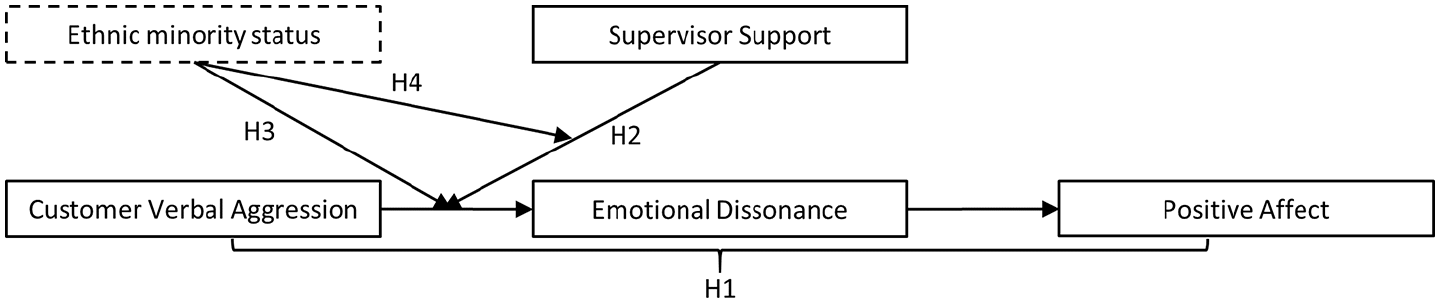
Conceptual Model Including Hypotheses (H). Ethnic Minority Status (Framed by Dashed Lines) is the Dichotomous Grouping Variable of the Multi-Group Model.
Customer verbal aggression toward retail workers
Customer verbal aggressions are defined as “direct verbal aggressions and criticism by customers” (Dudenhöffer and Dormann, 2015: 166) with a clear intention to harm workers (Dormann and Zapf, 2004). Customers may engage in verbal aggression and other customer-related social stressors for various reasons (Sliter and Jones, 2016; Sommovigo et al., 2019). For instance, customers may vent their frustration due to dissatisfaction with the service (e.g., not finding a sought-for item) or external causes (e.g., personal life events). Customers may also make use of verbal aggression to obtain some kind of tangible recompense (e.g., a discount; Sliter and Jones, 2016; see also Sommovigo et al., 2019). Customers may expect such rewards rather than risks (e.g., the risk of being accompanied away by security) as a result of their verbal aggression (Grandey et al., 2007) because they have internalized the concept of customer sovereignty, which is symbolized by phrases such as “the customer is king” (Yagil, 2017).
Related to customer sovereignty, several characteristics of the retail but also the service sector facilitate customer verbal aggression. According to Skarlicki et al. (2008), customers interact with workers episodically and can decide to never see the workers again (see also Ben-Zur and Yagil, 2005). As these episodic interactions primarily aim at fulfilling customers’ short-term needs, they involve less trust and a potential for more deceptive acts (Duck, 1998; Skarlicki et al., 2008). Moreover, customers feel anonymous and have no obligations or particular norms that force them to be kind (Ben-Zur and Yagil, 2005; Grandey et al., 2007; Korczynski and Evans, 2013). While some customers may become aggressive because they perceive themselves as being sovereign, others may do so because they realize that they are less sovereign than expected and “just another case to be processed” (Bolton and Houlihan, 2005; Korczynski and Evans, 2013).
In line with the ideology of customer sovereignty, organizations focus on customer satisfaction, creating a power imbalance between customers and workers (Rafaeli et al., 2012; Sommovigo et al., 2019) and reducing the likelihood that organizations intervene in the event of customer verbal aggression (Sommovigo et al., 2020). Instead, organizations install display rules explicitly or implicitly (i.e., as part of the job description) to retain customers and stay competitive (Grandey, 2000; Grandey et al., 2015; Grandey and Gabriel, 2015; Hochschild, 2012). These display rules prevent workers’ natural reactions to customer verbal aggression (e.g., leaving the shop floor; Yagil, 2017) as they instruct workers on which emotions to show and when and how to show them (e.g., “service with a smile”; Diefendorff and Gosserand, 2003; Ekman, 2006).
The effect of customer verbal aggression on workers’ positive affect via emotional dissonance
According to control theory (Diefendorff and Gosserand, 2003), retail workers view display rules as performance goals they have to meet to evoke positive emotions in customers and stimulate consumption. However, customer verbal aggression may arouse negative feelings which undermine the achievement of these goals. Thus, customer verbal aggression is likely to result in emotional dissonance in retail workers. To overcome large discrepancies between their emotional state and the positive emotions they are expected to express, retail workers have to apply more deliberate and effortful techniques than usual (e.g., by monitoring their emotional expression more closely). If workers conform with the display rules but still feel differently, they experience emotional dissonance (Diefendorff and Gosserand, 2003). Emotional dissonance, in turn, consumes psychological resources and puts workers in a state of tension (Grandey et al., 2012; Hülsheger and Schewe, 2011; Kenworthy et al., 2014). Thus, emotional dissonance is likely to reduce positive affect.
Six out of the 33 studies on customer verbal aggression included in the systematic review by Sommovigo et al. (2019) examined emotional dissonance as a mediator of the relationship between customer verbal aggression and a variety of outcomes. They found strong support for emotional dissonance as a mediator between customer verbal aggression and various wellbeing outcomes, such as affective discomfort (Molino et al., 2016), reduced job satisfaction (Dudenhöffer and Dormann, 2015), and emotional exhaustion (Dormann and Zapf, 2004; Sommovigo et al., 2019). Accordingly, we expect the following mediation also among our sample of retail workers:
Hypothesis 1: Emotional dissonance mediates the negative relationship between customer verbal aggression and positive affect.
Supervisor support as a moderator
House (1981) defines supervisor support as care and support workers perceive and experience from their supervisors such as listening to personal problems or providing hands-on help with handling of work tasks. According to the conservation of social resources theory, social support (e.g., by supervisors) helps workers to respond to stress and expands their resource reservoirs beyond resources they already possess (e.g., based on traits; Hobfoll et al., 1990). A principle of the conservation of social resources theory is that resource gains become more salient in the context of a resource loss (Hobfoll et al., 1990), implying that they have a buffering effect. A recent meta-analysis provided evidence for the buffering effects of supervisor support, in particular in jobs that require emotional labor (Mathieu et al., 2019). Thus, following the conservation of social resources theory, supervisor support is a major resource which may buffer a resource loss initiated by customer verbal aggression.
Supervisor support might compensate a resource loss triggered by customer verbal aggression. By showing care for workers, supervisors may support workers emotionally, which enhances their self-esteem (Thoits, 2011) and, in turn, enables them to deal more easily with negative events, such as customer verbal aggression (Brown, 2010). Moreover, supervisors might tell customers who engage in verbal aggression to leave the shop. By reacting authentically to customer verbal aggression, supervisors might validate workers’ feelings and reduce emotional dissonance (see also Brotheridge and Lee, 2002). Supervisors could also instruct workers when to set boundaries and not to conform with display rules. They may also plan for more-experienced workers to support less-experienced workers in shifts with aggressive customers or give them access to conflict-management courses. Thus, supervisor support might address customer verbal aggression directly and through expanded resource reservoirs.
In summary, supervisor support is likely to reduce the positive relationship between customer verbal aggression and emotional dissonance and thus reduce the negative indirect relationship to positive affect. For example, supervisor support was found to mitigate the relationship between customer incivility and burnout among restaurant service workers (Han et al., 2016). Similarly, Shih et al. (2014) showed that organizational support buffers the relationship between customer-related social stressors and emotional dissonance. Therefore, we hypothesize the following moderated mediation:
Hypothesis 2: Supervisor support moderates the indirect effect of customer verbal aggression on positive affect through emotional dissonance by buffering the positive relationship between customer verbal aggression and emotional dissonance.
Differential effects of customer verbal aggression and supervisor support
According to the stereotype content model (Fiske, 2012), society judges low-status groups, such as ethnic minority members, as less competent than high-status groups (Froehlich and Schulte, 2019). Related to these stereotypes, people develop meta-stereotypes, which are beliefs on the stereotypes that outgroup members hold about their own group (Vorauer et al., 1998). These cognitions may result in emotional reactions (e.g., anxiety) or behaviors (e.g., avoidance of outgroup members). Meta-stereotypes are activated in situations that involve evaluation (e.g., on the job) and outgroup contact (Gómez, 2002). Ethnic minority workers in retail might be in such situations as they work in an environment where they are often surrounded by ethnic majority members (e.g., customers and coworkers). In these situations, customer verbal aggression may not only trigger negative emotions (e.g., Dudenhöffer and Dormann, 2013; Sommovigo et al., 2019) but also activate negative meta-stereotypes. Thus, ethnic minority workers have more reason to adapt their emotional expression, implying that customer verbal aggression has a more pronounced effect on emotional dissonance among these workers.
At the same time, customers may include discriminating content in verbal aggression based on these stereotypes. A qualitative study showed that racial or sexist biases were among the main reasons why customers engaged in customer incivility (a subliminal form of discrimination; Cortina et al., 2013; Sliter and Jones, 2016). In another qualitative study with South Asian shopkeepers in Glasgow, 64% of shopkeepers reported racist encounters – primarily of a verbal nature (Ishaq et al., 2010). Other studies did not support these findings. For example, Kern and Grandey (2009) did not find higher levels of customer incivility in ethnic minority workers. However, they showed that the centrality of ethnic minority workers’ ethnic identity strengthened the relationship between customer incivility and emotional exhaustion (Kern and Grandey, 2009). This finding is in line with the group identity lens model, which suggests that people with a strong ethnic group identity are more likely to perceive ambiguous social situations as a threat to their racial identity (Major et al., 2003).
Taken together, stereotypes present in society may inform meta-stereotypes in ethnic minority workers and discrimination from customers. Consequently, customer verbal aggression might go beyond triggering negative emotions in ethnic minority workers, which might strengthen the relationship between customer verbal aggression and emotional dissonance among them (i.e., ethnic minority workers may have a stronger need to adapt emotional expressions in response to customer verbal aggression; Diefendorff and Gosserand, 2003). Therefore, we hypothesize:
Hypothesis 3: The relationship between customer verbal aggression and positive affect through emotional dissonance is stronger among ethnic minority workers than ethnic majority workers.
Ethnic minority workers face several obstacles and discrimination in their daily life (Choi et al., 2017; e.g., Goreis et al., 2020). Especially migrating from one country to another involves a loss of resources (e.g., Henry et al., 2005; Li et al., 2014), which is often passed on to immigrants’ children (i.e., the second generation; Hartmann, 2016). In line with the conservation of social resources theory, social support may buffer the effects of these obstacles and discrimination (e.g., Goreis et al., 2020) and serve as a key resource for ethnic minority members (Mirsky et al., 2002). Two studies empirically demonstrated stronger positive effects of supervisor support on wellbeing in ethnic minority workers compared to ethnic majority workers (Hoppe, 2011a; Hoppe et al., 2010). In these studies, which were conducted on warehouse workers in the United States (Hoppe et al., 2010) and postal workers in Germany (Hoppe, 2011a), supervisor support had stronger buffering effects on the stressor-strain relationships of ethnic minority workers than those of ethnic majority workers. However, these stronger buffering effects of supervisor support were found for general stressor-strain relationships in cross-sectional studies.
Regarding the specific indirect relationship between customer verbal aggression and positive affect via emotional dissonance, supervisor support may be a resource passageway for ethnic minority workers, as their supervisors may support them in interpreting the content of customer verbal aggression and dealing with customer verbal aggression. Supervisors might also provide ethnic minority workers with supportive social relationships with others. For instance, they may promote a common group identity, so workers also receive support from coworkers (Kunst et al., 2015). Building on these theoretical delineations and previous empirical studies, we hypothesize:
Hypothesis 4: The moderating effect of supervisor support is stronger for ethnic minority workers than ethnic majority workers; that is, supervisor support buffers the positive effect of customer verbal aggression on emotional dissonance and thereby its indirect effect on positive affect more strongly among ethnic minority workers.
Method
Research context
We collected data in a retail chain in a major city in Germany. The retail chain provided various products, such as food items, office supplies, and hygiene products. Before data collection, we observed the typical workflow and interviewed workers about their daily work in two stores. 1 We observed that workers executed standardized tasks such as performing store maintenance, stocking shelves, replenishing the warehouse, decorating the store, providing customer service, and operating the cash register. Workers interacted with customers either when workers operated the cash register or when customers approached workers who were working on other tasks. In this case, customers would, for example, ask for the location of a sought-for item, complain about problems with purchased items, or ask for information about discount campaigns. The supervisors or their deputies allocated these tasks to workers in each shift. The supervisors also communicated orders from management and planned shifts. The store’s staff worked in a team which had little contact with other stores. Compared to workers in other customer contact jobs in Germany, retail workers and their supervisors are less likely to have a higher education or on-the-job training (Schäfer and Schmidt, 2016).
Similar to the overall share of ethnic minority workers in the German workforce, approximately 20% of retail workers belonged to an ethnic minority in 2015 (Schäfer and Schmidt, 2016; Statistisches Bundesamt, 2018). Regarding ethnic minority status, two aspects are crucial for this study. First, ethnic minority members in Germany have diverse ethnic backgrounds due to waves of immigration from various countries (e.g., from the former USSR in the 1990s or from Mediterranean countries and Turkey in the 1960s). These backgrounds are apparent to customers and other workers due to the workers’ names, language skills, or outer appearance. Second, children of immigrants face similar prejudices and socioeconomic problems as their parents (Hartmann, 2016); this can be explained by taking a closer look at the immigration wave of the 1960s. Assuming that immigrants would ultimately return home, the government introduced guest-worker programs that attracted people to work in Germany but made little effort to integrate them and their families (Hansen, 2003). Thus, ethnic minority workers are from various ethnic backgrounds and immigrants of both the first and second generations.
Procedure
We collected data by distributing paper-pencil surveys at two measurement points with a time lag of 1 month (September and October 2017). The inclusion of two measurement points allowed us to use positive affect from T2 to reduce strong associations among the study variables resulting from extraordinary events or a temporary mood on 1 day (Podsakoff et al., 2003). By conducting the study before the holiday season, we ensured that the workers in our sample had a stable workload.
We distributed the surveys in person during team meetings or on regular workdays and provided linguistic support if necessary. Workers who missed a meeting returned the surveys by mailing them to us or putting them in a ballot box, which we picked up 2 weeks later. Survey completion took approximately 20 minutes.
Management credited the time for completing the survey to the workers’ time accounts to encourage participation. Additionally, we offered small edible gifts. In exchange for the organization’s willingness to host the study, we wrote a report on workers’ work-related wellbeing for management. The workers gave their informed consent to participation and publication. For that purpose, we debriefed all workers about the study and informed them about their rights to withdraw from it afterward. The works council of the retail chain and an academic ethical committee approved the study.
Participation rate, dropout analysis, and missing values
We invited 704 workers to participate in our study. A share of 86% participated in at least one of the measurement points. 2 Of these 606 respondents, 428 (71%) provided data at T1 and T2; 135 (22%) provided data only at T1, and 43 (7%) provided data only at T2. Thus, 43 workers had missing data for customer verbal aggression, emotional dissonance, and supervisor support measured at T1, and 135 workers had missing data for positive affect measured at T2. Our dropout analysis showed only one significant difference. The workers who completed the survey at both measurement points (M = 3.3, SD = 0.7) reported more supervisor support at T1 than the workers who dropped out after T1 (M = 3.1, SD = 0.7; t(215.2) = −2.05, p = .042).
To account for missing data in our analysis, we used a full information maximum likelihood estimator. Three workers did not provide enough information for this estimation; therefore, the final sample included 603 workers.
Sample
The participants worked in 50 teams of a retail chain in a major German city. The sample consisted of 91% women. Most participants were younger than 41 years (56%). The average team tenure was 5 years (SD = 4.9). Workers worked part-time (63%), full-time (28%), or on a mini job (9%); part-time workers worked on average 24.5 hours per week (SD = 4.5).
We categorized our participants as ethnic minority and ethnic majority workers by asking them about the birthplaces of their parents. If one or both parents were born outside of Germany, we categorized the worker as an ethnic minority worker. If both parents were born in Germany, we assigned the worker to the ethnic majority group (see Constant et al., 2012). If the birthplace of one (n = 7) or both parents (n = 15) was missing, we had the opportunity to determine the worker’s ethnic background using administrative data provided by management. Thus, we did not have to exclude these people or rely on less informed techniques. 3 According to these procedures, 16% of the workers were categorized as ethnic minority workers. These 95 ethnic minority workers had 21 different ethnic backgrounds. More specifically, 24% had Russian, 21% Turkish, 16% Polish, 11% Kazakh, 4% Lebanese, 3% Bulgarian, and 3% Hungarian backgrounds. Half of the ethnic minority workers were born in Germany (i.e., second-generation migrants; 52%).
A comparison of the ethnic minority and ethnic majority workers regarding work-related and sociodemographic variables showed that ethnic minority workers were less likely to have completed on-the-job training (X²(1, 587) = 26.16, p < 0.001). Related to this, ethnic minority workers more often held positions with lower responsibility (Z = −3.48, p < 0.001) and had contracts with fewer working hours (e.g., part-time or mini job; X²(2, 582) = 6.67, p = 0.036). 4
Measures
The surveys were in German which was the working language. We measured customer verbal aggression with the corresponding subscale of the customer-related social stressor scale (Dormann and Zapf, 2004) with an adapted version (Hoppe, 2011a). The participants rated three items (e.g., “Customers shout at me.”) on a Likert scale ranging from not at all true (0) to absolutely true (4).
We measured emotional dissonance with a corresponding subscale of the Frankfurt emotion work scales (Zapf et al., 2000) with an adapted version (Hoppe, 2011a). The participants responded to two questions (e.g., “How often do you have to suppress your own feelings (e.g., anger, dislike) during work?”) on a Likert scale ranging from never (0) to many times (4).
We measured supervisor support with the supervisor subscale of the German social support scales (Frese, 1989) with an adapted version (Hoppe, 2011a), which included questions on emotional supervisor support (i.e., listening to and showing concern for workers) and instrumental supervisor support (i.e., providing hands-on help with problems at work; House, 1981). The participants responded to three questions (e.g., “Is your supervisor willing to listen to your problems at work?”) on a Likert scale ranging from not at all (0) to absolutely (3).
We measured positive affect with the positive affect scale by Diener et al. (2010) which we translated and re-translated. We also adapted the scale to the work context by specifying “at work” in the items. The participants responded to six questions (e.g., “In the last 4 weeks, how often has your mood been positive at work?”) on a Likert scale ranging from never (0) to many times (4).
Statistical analysis
Path modeling
We tested our hypotheses by two path models using the lavaan package (Rosseel, 2012) in RStudio; one was a single-group path model (Hypotheses 1–2), and the other one was a multi-group path model in which we specified and estimated the hypothesized model simultaneously for ethnic minority and ethnic majority workers (Hypotheses 3–4; see also Figure 1). All models included paths between customer verbal aggression and emotional dissonance (a1-path), emotional dissonance and positive affect (b-path), customer verbal aggression and positive affect (c’1-path), 5 and between the customer verbal aggression-by-supervisor support interaction and emotional dissonance (a3-path) and positive affect (c’3-path), respectively. In the multi-group path model, we restricted the residual variance of the mediator and outcome to be equal between ethnic minority and ethnic majority workers (Ryu and Cheong, 2017); we allowed all paths to vary between ethnic minority and ethnic majority workers, except the b-path. 6
All predictors were centered at the grand mean, which was based on the mean of the respective group in the multi-group model. As the ethnic minority sample was small (n = 95), we applied a Yuan-Bentler estimator (Bentler and Yuan, 1999). Both the single-group path model (X² (2) = 8.58, p < 0.05, CFI = 0.98, RMSEA = 0.074 [0.028, 0.128], SRMR = 0.032) and the multi-group path model fitted the data well (X² (7) =16.64, p < 0.05, CFI = 0.97, RMSEA = 0.068 [0.025, 0.110], SRMR = 0.046). 7
Testing mediation and moderation
To test mediations, we first inspected the path coefficients of the a- and b-paths and then the indirect effect. As recommended for evaluating indirect effects (Preacher and Selig, 2012), we derived asymmetric Monte Carlo confidence intervals (MC-CIs) from the products of the coefficients using the semTools package (Jorgensen et al., 2021).
To test the moderation effects of supervisor support, we inspected the a3-paths. To test the moderation effects of ethnic minority status, we built a multi-group model and compared the single paths and indirect effects between ethnic minority and ethnic majority workers. To compare single paths, we compared the original model to a model in which the respective paths were constrained to equality between both groups (i.e., likelihood ratio test; Ryu and Cheong, 2017). To compare indirect effects, we derived MC-CIs from differences between both product coefficients (aethnic minority*b – aethnic majority*b), as recommended by Ryu and Cheong (2017) for analyzing moderated mediations with dichotomous moderators.
Probing
If a moderation effect was significant, we probed its interaction (Hayes, 2018; Preacher et al., 2007). To probe the moderation effect of supervisor support on an a-path, we calculated and plotted simple slopes for low (−1 SD) and high levels of supervisor support (+1 SD; Preacher et al., 2006). To probe the moderation effect of supervisor support on the indirect effect, we calculated indirect effects for low (–1 SD) and high levels of supervisor support (+1 SD). To probe the moderation effect of ethnic minority status, we inspected the coefficients of the a-paths and the MC-CIs of the indirect effects in each group, which is easier to do in multi-group models than in single-group models with a dichotomous moderator (Ryu and Cheong, 2017).
Results
Table 1 provides the descriptive statistics and intercorrelations of the study variables for ethnic minority and ethnic majority workers separately.
Descriptive Statistics and Intercorrelations for Ethnic Minority (above the diagonal) and Ethnic Majority Workers (below the diagonal).
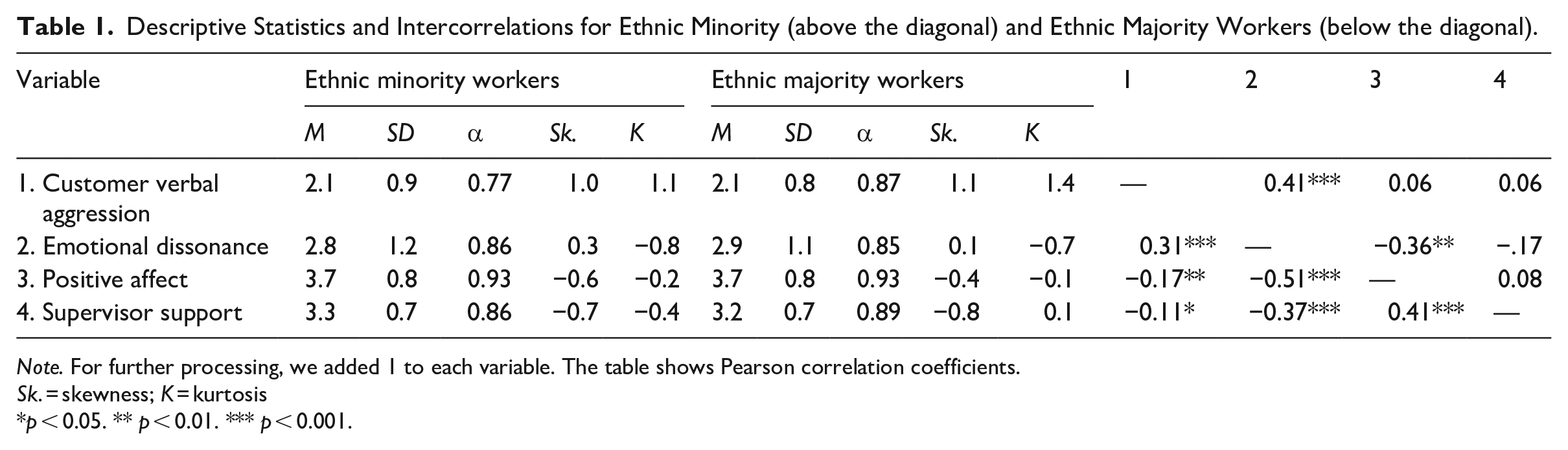
Note. For further processing, we added 1 to each variable. The table shows Pearson correlation coefficients.
Sk. = skewness; K = kurtosis
p < 0.05. ** p < 0.01. *** p < 0.001.
Mediation and moderated mediation
Hypothesis 1 suggested that emotional dissonance mediates the negative relationship between customer verbal aggression and work-related positive affect. As shown in Table 2, customer verbal aggression was significantly related to emotional dissonance which, in turn, was significantly related to positive affect. The product of the coefficients indicated a significant negative indirect effect of customer verbal aggression on positive affect through emotional dissonance (B = −0.12, 95% MC-CI [−0.161, −0.079]), thus supporting Hypothesis 1.
Unstandardized Regression Coefficients (B) and Standard Errors (SE) of the Path Model and the Multi-Group Path Model.
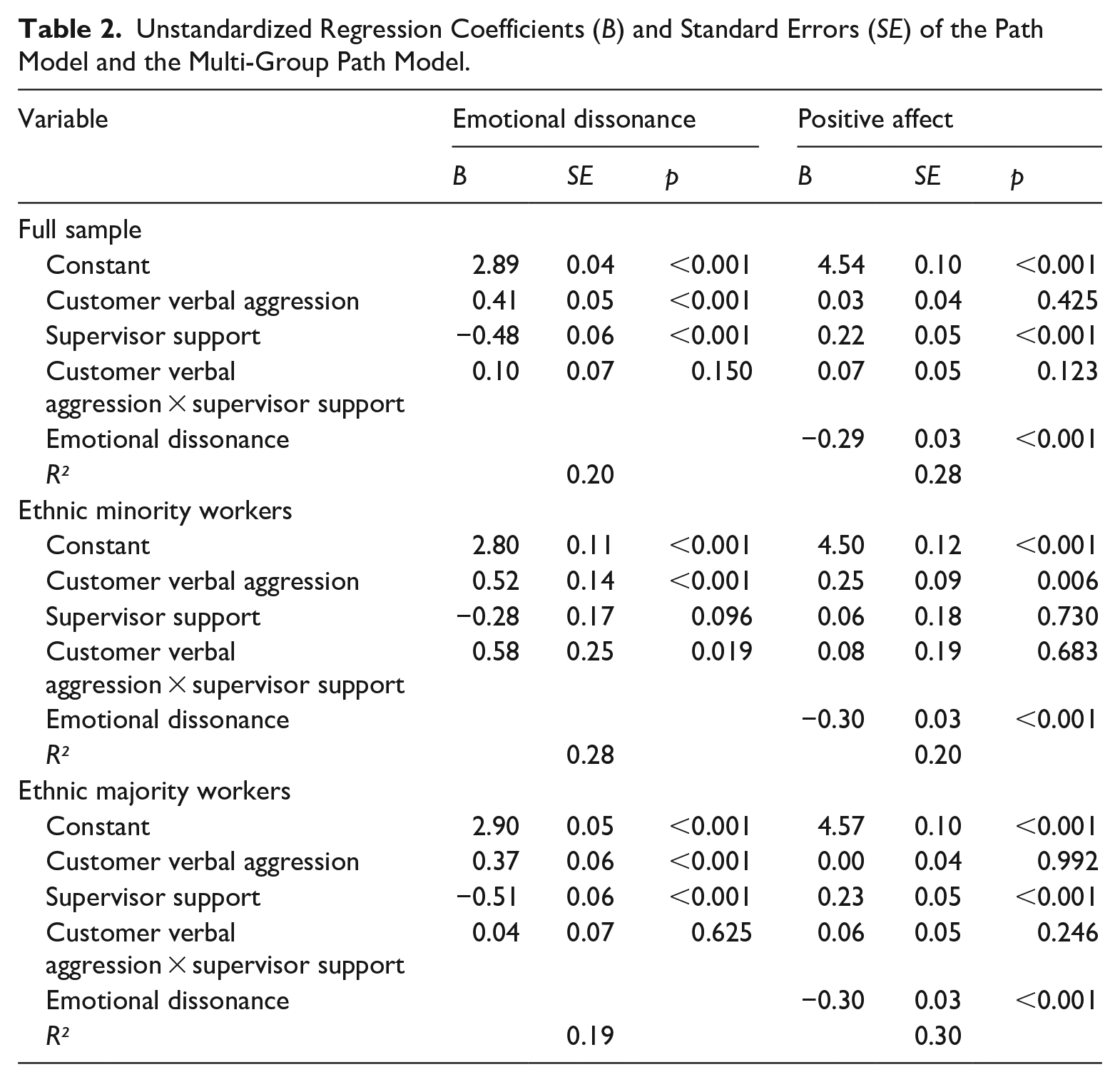
Hypothesis 2 suggested that supervisor support buffers the relationship between customer verbal aggression and emotional dissonance and thereby the indirect effect of customer verbal aggression on positive affect. Supervisor support did not significantly moderate the relationship between customer verbal aggression and emotional dissonance (see Table 2). Consequently, supervisor support did not significantly moderate the indirect relationship between customer verbal aggression and positive affect through emotional dissonance either (B = −0.03, 95% MC-CI [−0.068, 0.010]), thus not supporting Hypothesis 2.
Differences between ethnic minority and ethnic majority workers
Differences regarding the mediation
Hypothesis 3 suggested that the relationship between customer verbal aggression and positive affect through emotional dissonance would be stronger in ethnic minority workers than ethnic majority workers. In both ethnic minority and ethnic majority workers, we found positive significant associations between customer verbal aggression and emotional dissonance and negative significant associations between emotional dissonance and positive affect (see Table 2).
The likelihood ratio test comparing the original multi-group path model to the multi-group model in which the a1-paths were constrained to equality between ethnic minority and ethnic majority workers was not significant (ΔX² = 0.909, Δdf = 1, p = 0.340). Similarly, the MC-CIs of the difference between the product coefficients included zero (B = −0.05, 95% MC-CI (−0.135, 0.043)). Therefore, Hypothesis 3 was not supported.
Differences regarding the moderation and the moderated mediation
Hypothesis 4 suggested that the buffering effect of supervisor support on the indirect effect of customer verbal aggression on positive affect via emotional dissonance would be stronger for ethnic minority workers than for ethnic majority workers. As shown in Table 2, the customer verbal aggression-by-supervisor support interaction related significantly to emotional dissonance among ethnic minority workers only. Supervisor support taken alone was not significantly associated with emotional dissonance and positive affect among ethnic minority workers, but was among ethnic majority workers.
First, we tested the extent to which the relationship between the customer verbal aggression-by-supervisor support interaction and emotional dissonance varied between ethnic minority and majority workers (i.e., the moderated moderation). A likelihood ratio test in which we compared the original multi-group path model to a multi-group path model with a3-paths restricted to be equal across groups showed a significant moderation effect of ethnic minority status on the interaction (ΔX² = 7.454, Δdf = 1, p < 0.01). The relationship between the customer verbal aggression-by-supervisor support interaction and emotional dissonance was significant among ethnic minority workers only. As shown in Figure 2, probing this significant interaction revealed a strong positive relationship between customer verbal aggression and emotional dissonance among ethnic minority workers with high levels of supervisor support (B = 0.94, SE = 0.16, p < 0.001). However, this relationship was not significant among ethnic minority workers with low levels of supervisor support (B = 0.10, SE = 0.30, p = 0.747).
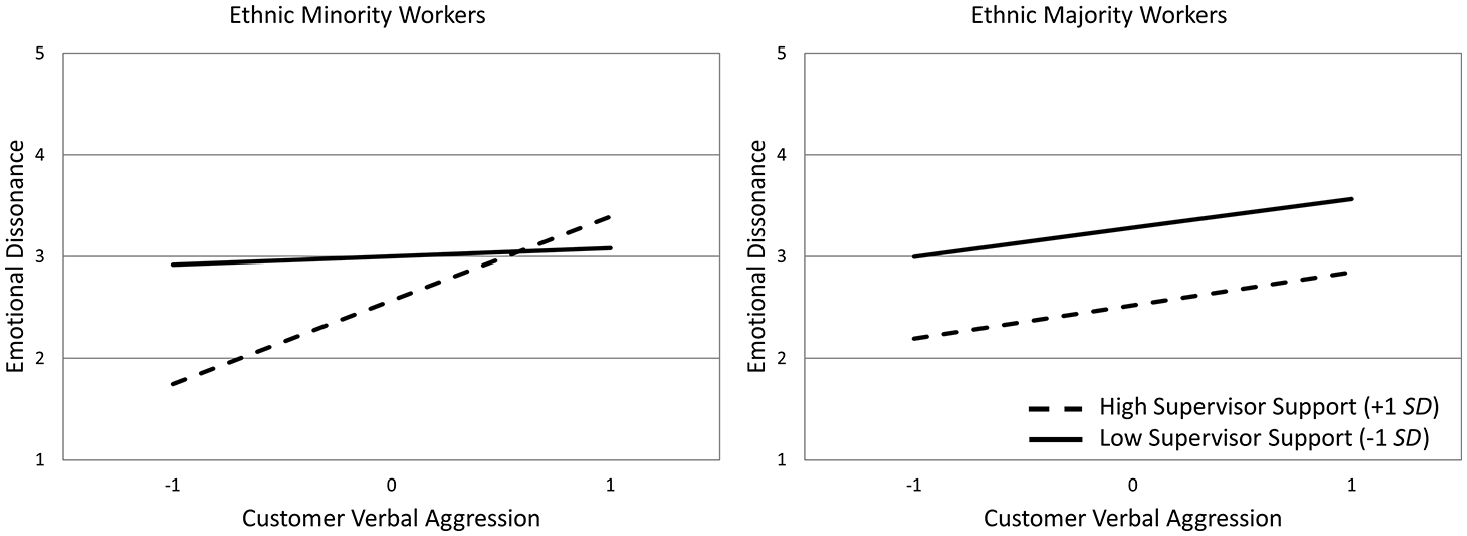
Interactions Between Customer Verbal Aggression and Supervisor Support Regarding Emotional Dissonance for Ethnic Minority and Ethnic Majority Workers. High Levels of Supervisor Support (+1 SD) Are in Dashed Lines and Low Levels of Supervisor Support (−1 SD) Are in Solid Lines.
Second, we tested the extent to which the indirect effect of customer verbal aggression-by-supervisor support interaction on positive affect varied between ethnic minority and ethnic majority workers (i.e. moderated moderated mediation). The MC-CIs derived from the difference between ethnic minority and ethnic majority workers’ product coefficients indicated a significant moderated moderated mediation (B = −0.16, 95% MC-CI [−0.324, −0.011]). The indirect effect of customer verbal aggression-by-supervisor support on positive affect via emotional dissonance was significant only among ethnic minority workers (B = −0.17, 95% MC-CI [−0.328, −0.027]). We probed the moderated moderation of this indirect effect. Among ethnic minority workers with high levels of supervisor support, we found a significant negative indirect effect (B = −0.28, 95% MC-CI [−0.401, −0.172]) and a significant positive direct effect (B = 0.31, 95% MC-CI [0.041, 0.573]). However, among ethnic minority workers with low levels of supervisor support, neither the indirect effect (B = −0.03, 95% MC-CI [−0.193, 0.155]) nor the direct effect was significant (B = 0.20, 95% MC-CI [−0.194, 0.570]).
Taken together, the moderated mediation was stronger among ethnic minority workers than ethnic majority workers. However, supervisor support strengthened the indirect effect. Thus, Hypothesis 4 was not supported.
Discussion
This study addressed two gaps in the literature on customer-related social stressors: The moderating role of supervisor support as a core social resource among retail workers and ethnic minority status as a central worker characteristic. We combined both boundary conditions and examined whether the buffering effect of supervisor support on the indirect relationship between customer verbal aggression and positive affect via emotional dissonance varied between ethnic minority and ethnic majority workers. Against expectations, taken alone, neither supervisor support nor ethnic minority status moderates the indirect effect (see also Kern and Grandey, 2009). However, the combination of both shows a moderation effect of supervisor support only in ethnic minority workers. Surprisingly, supervisor support strengthens the mediation effect among ethnic minority workers; the negative indirect effect of customer verbal aggression on positive affect is significant among ethnic minority workers with high levels of supervisor support. Thus, the paper points to the need of considering boundary conditions of the well-established relationship between customer verbal aggression and wellbeing outcomes such as positive affect.
The non-significant buffering effect of supervisor support
Our findings indicate that supervisor support does not moderate the relationship between customer verbal aggression and emotional dissonance. In contrast, other studies on relationships between customer-related social stressors and workers’ wellbeing have indeed shown that supervisor and organizational support have buffering effects (Han et al., 2016; Shih et al., 2014).
As organizational support had stronger buffering effects in previous studies (Han et al., 2016), a potential explanation for our results may be the source of social support examined in the present study. Supervisor support alone may not be sufficient to mitigate the effect of customer verbal aggression on emotional dissonance. Similar to service organizations, management in retail makes most decisions regarding customer sovereignty and display rules (Yagil, 2017), which affect the emergence of emotional dissonance (Diefendorff and Gosserand, 2003). Similarly, Shanock and Eisenberger (2006) showed that the extent to which retail workers perceive supervisor support depends on how supportive their supervisors perceive the organization to be. This suggests that supervisors may not have enough power to intervene in the event of customer verbal aggression because they cannot change the display rules made by management and might have to comply with these display rules themselves. Thus, organizational regulations and resources may more effectively support workers against customer verbal aggression than the direct supervisor. Alternatively, organizational support may enable supervisor support to mitigate the relationship between customer verbal aggression and emotional dissonance.
Potentially, coworkers can provide more effective support in mitigating the effects of customer verbal aggression because they are more likely to be present during customer verbal aggression. We chose supervisors as a source of support because we assumed them to have more control than coworkers (Thoits, 2011). Indeed, a meta-analysis showed supervisor support to be more strongly related to wellbeing outcomes than coworker support; however, this meta-analysis did not compare and contrast the buffering effects of supervisor support to coworker support (Mathieu et al., 2019). As we did not find a buffering effect of supervisor support on the relationship between customer verbal aggression and emotional dissonance, future studies might test the buffering effects of various sources of social support on this relationship.
Another explanation may be the measure of supervisor support used in our study, which consists of two items on available emotional support and one item on received instrumental support. Thus, it measured both types of social support—emotional and instrumental social support—and both scale types of social support—available and received social support. Despite this mixture of types and scale types of supervisor support, we chose this measure for the following reasons. First, our measure is a widely used and well-validated instrument for measuring supervisor support (Frese, 1989; for a validation with an ethnically diverse sample, see Hoppe, 2011b), as reflected by the Cronbach’s α and confirmatory factor analysis (see Appendix) in our study. Second, a meta-analysis has shown emotional and instrumental support to be strongly correlated and most effective when combined (Mathieu et al., 2019). This is supported by a qualitative study demonstrating that instrumental support always has an emotional component (Semmer et al., 2008). Third, available social support, which was measured by two out of three items in our study, was shown to be more strongly related to wellbeing outcomes (Mathieu et al., 2019). However, future research might use other measures to investigate whether the buffering effects of different types and scale types of supervisor support vary.
A final explanation concerns the relationship between customer verbal aggression and emotional dissonance. It is possible that retail workers almost automatically adapt their emotional expression when they face customer verbal aggression (Diefendorff and Gosserand, 2003), so supervisors may rarely be able to intervene. Thus, instead, supervisors could support workers in dealing with emotional dissonance and buffer the effect of emotional dissonance on positive affect. For example, they could give workers space to share and reflect upon their experiences. Similarly, studies have found supervisor support to be helpful in mitigating the effects of emotional dissonance (Abraham, 1998) and cognitive sharing of customer incivility to reduce negative affect after work (Tremmel and Sonnentag, 2018).
In a nutshell, our results suggest several starting points for future research. First, future research should compare and contrast various sources of social support regarding their effectiveness as a buffer and their relationship with each other (e.g., does supervisor support require organizational support to be effective?). Second, future research should examine the buffering effects of different types of available and received social support. Third, investigating the moderator effects of social support on other paths of the mediation (e.g., between emotional dissonance and positive affect) might contribute to our understanding of how social support works as a buffer.
The perspective of ethnic minority workers
In contrast to our expectation, the strength of the indirect relationship between customer verbal aggression and positive affect does not vary between ethnic minority workers and ethnic majority workers. This finding is consistent with Kern and Grandey (2009), but inconsistent with Hoppe (2011a).
There are two possible explanations for why the strength of the indirect relationships between customer verbal aggression and positive affect is similar for ethnic minority and ethnic majority workers. First, ethnic minority workers may get used to de-facto discrimination at work because they are repeatedly subjected to discrimination in social domains (Thau et al., 2008). Second, the social status of an occupation may be more important than ethnic minority status in customer interactions. In the work context, social status is commonly measured by occupational prestige, which is lower than the German average for retail workers (Ebner and Rohrbach-Schmidt, 2019). Occupational prestige predicts health beyond other status indicators (e.g., income), which may be because occupational prestige affects social interactions (Fujishiro et al., 2010). Our data suggest that ethnic minority status does not matter to customers. Instead, customers may perceive all retail workers—independent of the workers’ characteristics—as a low-status group whose job is to satisfy their needs. As shown in a field experiment, customers’ own status may also affect social interactions (Jerger and Wirtz, 2017). In organizations with a low level of service orientation, workers expressed more anger toward irate customers with a low social status than toward customers with a high social status (Jerger and Wirtz, 2017). Thus, future research should investigate the interplay between retail workers’ and customers’ social status.
Another unexpected finding is that supervisor support strengthens—instead of buffers—the indirect relationship between customer verbal aggression and emotional dissonance among ethnic minority workers; that is, the more supervisor support provided to ethnic minority workers, the stronger the relationship between customer verbal aggression and positive affect. Moreover, the direct effects of supervisor support on emotional dissonance and positive affect are not significant among ethnic minority workers but are significant among ethnic majority workers. These direct effects show that supervisor support indeed is a resource for ethnic majority workers but does not interact with customer verbal aggression. All of these unexpected findings are inconsistent with studies reporting that ethnic minority workers benefit more from supervisor support than ethnic majority workers (Hoppe, 2011a; Hoppe et al., 2010, 2017). However, they are consistent with public health studies based on large national surveys (e.g., Assari, 2017, 2018, 2019) which have shown that ethnic minority members benefit less from resources (e.g., income, optimism) in terms of health than ethnic majority members.
An explanation for diminished gains from resources, which is consistent with gain and loss spirals in the conservation of social resource theory (Hobfoll et al., 1990), is that initial disadvantages make it more difficult to benefit from a resource (cumulative disadvantages; Assari, 2018; Ceci and Papierno, 2005; Choi et al., 2017). A comparison of the sociodemographic data shows that the ethnic minority workers in our study were less likely to have job training, held lower positions, and worked fewer hours than ethnic majority workers. Due to these job-related disadvantages and other disadvantages outside of work, ethnic minority workers might have less access to resources and influence at work. While we initially argued that supervisor support possibly counteracts these disadvantages (e.g., by providing additional resources), our results suggest that this is not the case. Ethnic minority workers are potentially eager to reciprocate supervisor support because they want to maintain social support to protect resources and their identity (Hobfoll et al., 1990). They might do so through good performance, which implies following display rules (see also Yagil, 2017) and thus strengthens the relationship between customer verbal aggression and emotional dissonance (Beehr et al., 2010). Therefore, future research should explore the meaning and valence of supervisor support among ethnic minority workers in customer contact jobs.
Another explanation for our findings might be that supervisors support ethnic majority workers more actively than ethnic minority workers. This explanation is in line with the current literature on stereotypes and corresponding behaviors toward ethnic minority members in Germany (Froehlich and Schulte, 2019). As this study was not concerned with the content of supervisor support, we leave this subject to future research.
Strengths, limitations, and future research
In addition to the study’s high response rate (86% provided data at one measurement point at least), one strength of the study is that occupational and organizational differences do not affect the findings because the sample consists of retail workers holding the same job in the same organization. Possibly, our results would have been different if we had investigated workers holding more prestigious occupations or occupations in which customer interactions are less anonymous and take place repeatedly (e.g., teachers). Similarly, our findings are limited to the German context, which might influence the amount of control retail workers have over their emotional expressions and thus moderate the relationship between faking of emotional expressions and wellbeing (Grandey et al., 2005). Thus, future research on similar questions might show whether our findings are due to the specific occupational and national context of our sample.
Another limitation is that we focused only on ethnic minority status without considering additional workers’ characteristics such as social class, gender, or religion. We decided against the inclusion of additional characteristics because we wanted to maintain a clear focus on ethnic minority status. Moreover, we would have faced practical problems if we had included additional characteristics. First, the group of ethnic minority workers was small. Second, our sample was homogeneous regarding social class, because all participants worked as employees in the same job, and gender (91% female; see also Wright, 1980). However, future research would benefit from taking an intersectional perspective and investigating how other characteristics interact with ethnic minority status.
On a similar note, we did not examine the interplay between customers’ and workers’ characteristics. That is unfortunate as previous research showed that people expect stronger anger expressions from high-status individuals (Tiedens et al., 2000), which could affect workers’ perception of customer verbal aggression. In practice, however, assessing customers’ characteristics might be difficult, especially when they want to protect their privacy after an aggressive incident. However, conducting field experiments (Jerger and Wirtz, 2017) or including neighborhood demographics (e.g., Koopmans and Veit, 2014) might allow future research to investigate interactions between customers’ and workers’ characteristics.
An important limitation is that we do not know the content of customer verbal aggression. While we did not ask respondents to describe the content to reduce the complexity of our research questions, future studies may investigate the helpfulness of supervisor support as a buffer for customer verbal aggression using qualitative interviews or mixed methods.
As already mentioned, we focused only on supervisors as a source of social support and did not differentiate between different types and scale types of social support. Hence, future research might compare and contrast support provided by supervisors to other sources of social support. Likewise, researchers interested in whether only certain types and scale types of supervisor support effectively buffer the effects of customer verbal aggression might compare them using more refined measures.
To compare ethnic minority and ethnic majority workers, we applied multi-group path modeling. However, the valuable insights drawn from this approach came with two limitations. First, we could not apply multilevel modeling because ethnic minority status varied within teams and not between teams, which would have been necessary for combining multilevel and multi-group path modeling. Therefore, we could not examine team-level effects or differences between the team and individual levels. For instance, it is possible that supervisors create supportive team climates (Mathieu et al., 2019), which foster positive feelings in team members and thus buffer the adverse effects of customer verbal aggression (Grandey, 2000). To ensure that nesting did not affect our results, we performed a robustness check accounting for the nested nature of the data, which did not indicate any changes in our results (see Footnote 7). Similar hypotheses should be investigated in future multilevel studies on customer verbal aggression (Grandey and Gabriel, 2015). Second, because we compared only two groups (ethnic minority and ethnic majority workers), we were not able to capture differences within the group of ethnic minority workers (Gillborn et al., 2018). However, the sample size and large heterogeneity among countries of origins did not allow differentiation. A final limitation is the cross-sectional nature of the study. Although two measurement points do not allow causality claims, this study gives first insights into relationships between the examined variables, which may inspire future studies with longitudinal designs.
Practical implications
Our findings underline the need for effective measures to reduce the effects of customer verbal aggression. The stronger buffering effects of organizational support reported in a previous study (Han et al., 2016) and the non-significant buffering effect of supervisor support found in our study suggest that organizations should equip workers with the skills and resources they need to cope with customer verbal aggression and reduce emotional dissonance. For example, retail workers might learn in trainings how to deal with aggressive customers.
Similarly, supervisors might receive training on how to support their subordinates with the effects of customer verbal aggression. Despite lacking buffering effects, supervisor support is a resource for the ethnic majority workers in our study (e.g., due to the positive relationship to positive affect). In contrast, ethnic minority workers do not benefit from supervisor support at all. The differences between ethnic minority and ethnic majority workers in terms of job training, positions, and working hours suggest that equality practices (e.g., installing a task force concerned with equality) might provide workers with the resources they need to benefit from supervisor support. Works councils, as representatives of workers’ interests, should be involved in the development and implementation of these equality practices (Ortlieb et al., 2014).
Our findings suggest that practitioners and researchers should develop recommendations saying when workers have to follow display rules and when they do not. Our findings reflect the destructive potential of display rules. However, applying display rules can also be related positively to workers’ wellbeing. For example, workers might be proud if they manage a challenging situation using display rules (Cropanzano et al., 2003). Therefore, a critical reflection on display rules may be a first step toward promoting wellbeing among retail workers.
Conclusion
As this study shows, customer verbal aggression and emotional dissonance are severe stressors for retail workers in general. This study examined separate and joint moderation effects of supervisor support and ethnic minority status on the indirect relationship between customer verbal aggression and positive affect via emotional dissonance. Contrary to our expectations, neither supervisor support nor ethnic minority status moderate this relationship on their own. In combination, however, they have an unexpected moderated moderated mediation effect; the negative indirect relationship between customer verbal aggression and positive affect via emotional dissonance is stronger for ethnic minority workers with high levels of supervisor support. Therefore, these findings call for studies to identify and implement resources for ethnic minority workers.
Supplemental Material
sj-docx-1-gjh-10.1177_23970022221140560 – Supplemental material for The role of supervisor support for dealing with customer verbal aggression. Differences between ethnic minority and ethnic majority workers
Supplemental material, sj-docx-1-gjh-10.1177_23970022221140560 for The role of supervisor support for dealing with customer verbal aggression. Differences between ethnic minority and ethnic majority workers by Franziska J Kößler, Jana B Wilbert, Susanne Veit and Annekatrin Hoppe in German Journal of Human Resource Management: Zeitschrift für Personalforschung
Footnotes
Acknowledgements
We thank Cindy Wehe, Chantal Grohmann, Saskia Rickers, and Lydia Mosner who supported the data collection.
Disclosure of related reports
This article is based on a dataset already published in Kößler et al. (2022).
Funding
The author(s) disclosed receipt of the following financial support for the research, authorship, and/or publication of this article: The work is part of Franziska J. Kößler’s dissertation, which has been funded by the Hans-Boeckler foundation, Düsseldorf, Germany.

Supplemental material
Supplemental material for this article is available online.
Notes
References
Supplementary Material
Please find the following supplemental material available below.
For Open Access articles published under a Creative Commons License, all supplemental material carries the same license as the article it is associated with.
For non-Open Access articles published, all supplemental material carries a non-exclusive license, and permission requests for re-use of supplemental material or any part of supplemental material shall be sent directly to the copyright owner as specified in the copyright notice associated with the article.
