




Abstract
The hiring and recruitment process is one of the main challenges to the success of companies and a significant driver of total labor costs. We use representative employer data for German private-sector establishments with at least 50 employees to explore recent developments in employer search, selection, and screening activities over the years of 2012–2018. We document changes in hiring policies over time and address heterogeneity across establishments related to size, ownership, and industry sector. Our results show that although establishment characteristics are correlated with different facets of hiring behavior, there is no homogeneous pattern for employer search and selection instruments. We highlight differences of hiring practices targeted at managerial versus non-managerial new hires. Finally, we outline potential mechanisms and research gaps for future work and discuss managerial implications.
Introduction
The hiring and recruitment process, with its ultimate goal of identifying the best matches of workers to firms, is one of the main challenges to the success of companies (Alonso, 2018; Weaver and Osterman, 2017). This process is also a significant driver of total labor costs. Muehlemann and Strupler Leiser (2018) report that, in Switzerland, average hiring costs amount to about 16 weeks of wage payments. Oyer and Schaefer (2016) argue that, although the fundamental economic problems in hiring are well understood, much less is known about firms’ specific hiring strategies and employee search instruments. This is particularly true for the last two decades, as many areas of the labor market have undergone significant changes due to innovation in information technology.
A recent development, which we also document, has been the rise of the internet, and particularly social media, as a means to find workers. On the one hand, employer and employee search processes have become more complex through, for instance, the advent of information technology, resulting in an increasing number of recruitment channels. On the other hand, recruiting suitable workers has potentially become easier through the use of mechanisms such as algorithms in personnel selection, giving firms more opportunity to create economic surplus through efficient worker-firm matching (Oyer and Schaefer, 2011).
In this paper, we focus on the external recruitment process of firms. Using representative firm-level data from Germany, we explore the prevalence of employer search and employee selection instruments (also referred to as recruitment practices in the remainder of the paper), as well as their determinants.
The management literature has mainly investigated correlations between recruitment, selection practices, and firm characteristics such as firm size, industry, and type of ownership (e.g. Bayo-Moriones and Merino-Díaz de Cerio, 2001; Galang, 1999; Gooderham et al., 1999; Hsu and Leat, 2000; Lawler et al., 1995; Parry and Tyson, 2008; Shaw et al., 1993; Terpstra and Rozell, 1993; Zibarras and Woods, 2010). However, as most of these studies are cross-sectional and selective, we lack representative evidence on the incidence of recruitment practices, and particularly on their development over time (Alonso, 2018). Recruitment is also of minor relative importance in larger management surveys. Bloom and Van Reenen (2007, 2010), for instance, emphasize that structural firm characteristics such as ownership structure play a large role in determining the use of a larger set of management practices, but recruitment practices are not really reflected in their set of survey items.
The labor economics literature, on the other hand, has studied the matching process extensively (e.g. Eckstein and van Den Berg, 2007; Jovanovic, 1979; Mortensen and Pissarides, 1999; Rogerson et al., 2005), but has typically treated firms as homogeneous and as a black box (Oyer and Schaefer, 2011). 1 More recent studies such as Davis et al. (2013), Gavazza et al. (2018), Carrillo-Tudela et al. (2020), or Lochner et al. (2021) now take a closer look on the nexus between recruitment policies, match quality, vacancies, and hiring rates using mainly administrative data sets. Still missing are, however, analyses on firm-level differences in hiring strategies. The main reason for this gap in the literature has been the absence of panel data on detailed recruitment practices that is representative of firms of an entire economy.
In order to address the gaps in both the management and economics literature, we provide a detailed description of changes over time in the use of recruitment instruments and an analysis of heterogeneity in actual hiring practices across establishments. 2 In detail, we address the following two research questions: (1) Are there temporal changes in the use of a wide set of recruitment practices in the aggregate of German establishments? and (2) Which structural establishment characteristics determine cross-sectional differences in the use of recruitment practices? We believe that it is interesting for HR researchers (and practitioners) to learn whether there is variation in the use of recruitment practices across firms and if yes, where this variation stems from. 3
We make use of the employer survey of the Linked Personnel Panel (LPP), a representative panel data set for German establishments spanning the years 2012–2018. The employer survey covers private-sector establishments with at least 50 employees liable for the payment of social security contributions. Our data set includes a rich number of employer search, employee screening and selection, as well as on-the-job-screening measures, the majority of which has been asked repeatedly in each of the four survey waves.
Our results show that the prevalence of some recruitment practices changed over time. The largest aggregate change in recent years has been the advent of social networks such as LinkedIn and Xing to find workers (Roulin and Levashina, 2019). The take-up of these networks has increased in our sample from 27% in 2012 to 54% in 2018. Conversely, the use of personality and cognitive ability tests has declined in recent years, as has the turnover of staff during the probationary period. Furthermore, the importance of hiring criteria in the recruitment process has decreased. For other instruments, we document a rather stable time pattern such as for headhunting, employment interviews, and assessment centers. A topic that is receiving increasing attention in both the media and in academic literature is the use of artificial intelligence, algorithms, and machine learning techniques in the recruitment process (Erel et al., 2021; Hoffman et al., 2018; Horton, 2017). However, we observe that only a small fraction of establishments has already applied algorithms to assess workers.
The cross-sectional heterogeneity of recruitment practices, such as headhunting, employment interviews, and assessment centers, can largely be attributed to establishment size. We also find sectoral differences in the use of recruiting practices. For instance, the services sectors are more likely to use social networks, employment interviews, and assessment centers compared to the manufacturing sector. Additionally, the retail, logistics, and media sectors are more likely to use personality and integrity tests, which can be explained by high levels of customer interaction, and for which certain personality types and ethical behavior can be important. We also find that the healthcare and social services sector is rather unique compared to other sectors. Here, establishments are less likely to use standardized GMA tests and more likely to ask for short work samples during recruitment. Furthermore, more emphasis is put on ethical standards during recruitment.
Ownership type also predicts the use of some search and screening measures. Establishments with dispersed ownership are more likely to use social networks and to directly address potential recruits than family and founder firms. Importantly, family and founder firms are less likely to use interviews, while establishments owned by financial investors are more likely to use them. Additionally, establishments owned by financial investors are more likely to address employees via social networks and to poach employees using an agency or a head-hunter.
The paper proceeds as follows. Section 2 reviews related literature, and Section 3 describes the data used in this study and the variables of interest. Section 4 presents descriptive results on the use of recruitment practices over time. Section 5 presents econometric results of cross-sectional heterogeneity of recruitment practices and Section 6 discusses managerial implications and future research gaps.
Determinants of recruitment strategies
Firm size
The literature mainly argues that the professionalism of HR practices increases in firm size, that is, larger firms are more likely to employ a professional HR department and to adopt more sophisticated HR instruments. These firms have more monetary resources available, whereas smaller firms are more likely to follow an ad-hoc approach in recruiting (Barber et al., 1999; Bartram et al., 1995; Bayo-Moriones and Merino-Díaz de Cerio, 2001; Gooderham et al., 1999; Hsu and Leat, 2000; Parry and Tyson, 2008; Shaw et al., 1993; Terpstra and Rozell, 1993; Zibarras and Woods, 2010). This is particularly true for employee screening instruments, as larger firms are more likely to adjust these tools to their needs.
Besides more professionalism in HR, another important argument conveyed in the literature for a positive link between firm size and recruitment practices refers to economies of scale (Williamson, 1979). The costs of (more expensive) management practices can be allocated to a larger number of employees (Barber et al., 1999; Fields et al., 2000; Schuler and Jackson, 1996), which gives larger firms an advantage in using more formalized recruitment instruments. However, contrary to the previous evidence, some studies document that firm size is not correlated with the use of recruitment practices (Galang, 1999; Hausdorf and Duncan, 2004; Lawler et al., 1995; Zibarras and Woods, 2010).
Based on these professionalism or efficiency arguments, we would expect to see a positive correlation between firm size and the use of more formalized recruitment instruments. However, as the empirical evidence is quite mixed, we emphasize that it is ultimately an empirical question:
How is the rate of implementation of more formalized recruitment and selection practices linked with firm size?
Industry sector
Research analyzing firms’ heterogeneity in the use of recruitment and selection practices across various sectors and industries is scarce. Terpstra and Rozell (1993) do not find any significant industry differences with respect to the use of recruitment practices such as structured interviews, cognitive tests, and biographical information. Bartram et al. (1995) found for a sample of SMEs in the UK that job interviews were used more frequently in the financial services sector compared to manufacturing and that service sector firms were more likely to apply formalized selection methods than manufacturing firms. Zibarras and Woods (2010) find that UK public sector firms are less likely to use CVs and unstructured interviews compared to non-public sector firms and more likely to use references, structured interviews, application forms, and background checks. We highlight that there are almost no studies analyzing the use of recruitment practices over time across different industries using a representative data set. Based on these considerations, we want to know:
Is the implementation of formalized recruitment and selection practices more pronounced in services sector firms than in manufacturing firms?
Type of ownership
Research on the role of ownership type as a determinant of firms’ recruitment and selection practices is also scarce. Out of the very few studies, the focus is not so much on who owns the company and how this is related to the use of recruitment practices, but rather on differences in cultural backgrounds of firm owners. Hsu and Leat (2000) find that selection techniques such as recruitment tests, interviews, or assessment centers do not vary significantly with cultural ownership pattern (Taiwanese-owned, Japanese-owned, Western-owned) in a cross-section of Taiwanese manufacturing companies. Additionally, cultural background has not been found to be a significant determinant of the choice of recruitment practices in a sample of Hong Kong firms, as documented by Shaw et al. (1993). Lawler et al. (1995) show that there are cross-national differences in recruitment practices using a cross-section of larger firms from Thailand and India. In detail, ability tests for managers are more often used in Thailand, whereas ability tests for non-managerial employees, job interviews, and referrals are significantly more often applied by Thai firms. As previous empirical research on the type of ownership, that is, whether a company is, for instance, in dispersed ownership or owned by a financial investor, is almost absent, an important question is:
Is the type of ownership an important determinant for the implementation of formalized recruitment and selection practices in firms?
Lastly, an interesting research question we can address with our panel data set is the development of recruitment practices over time. Do certain well-establishment recruitment practices lose their importance over time, and do we see an increasing use of more modern selection practices such as cognitive and integrity tests? Or, more concisely:
How does the rate of implementation of more formalized recruitment and selection practices change over time?
Data and empirical strategy
Data sets
In order to present an encompassing overview of hiring policies in German firms, we use two representative data sets, which can be linked to each other. The first data set is the employer survey of the Linked Personnel Panel (LPP), a panel data set which is representative of German establishments in the private sector with at least 50 employees, except sectors of agriculture, forestry, and fishery, as well as civil service and charity organizations (see Kampkötter et al., 2016). The LPP employer survey focuses on management practices and structural firm characteristics and contains information on 700–1200 establishments (per wave) in four survey waves in 2012, 2014, 2016, and 2018. The LPP employer survey is a stratified, disproportionate sample of establishments, which is drawn from the IAB Establishment Panel (Ellguth et al., 2014). In detail, LPP establishments are randomly drawn from a matrix stratified by sector, establishment size, and region to ensure the sample is representative for German private sector establishments with at least 50 employees liable to social security. 4 In order to achieve sufficient cases in the different strata, for instance, large establishments and Eastern German establishments are overrepresented in the sample. Face-to-face interviews with establishment managers or HR executives for the LPP employer survey are conducted subsequently to the main Establishment Panel interview.
We match information from the LPP employer survey to the regular Establishment Panel data since it provides detailed information on the demand side of the labor market, in particular, information on the structure of the establishment’s workforce, fundamental establishment characteristics such as the type of management and establishment age, as well as labor turnover. Response rates range between 70% and 80% across waves. Overall, we do not find any significant selectivity effects on panel participation.
Measures
Recruitment and selection instruments
The LPP employer survey offers a range of items measuring an establishment’s recruitment behavior and employee selection process. We categorize the different survey items with respect to three stages of a typical staffing process.
The first part, employer search, involves activities such as recruiting and addressing candidates via online and social networks, as well as poaching activities via head-hunters or employment agencies (EA). After having received applications by potential candidates, firms start to screen and test their applicants, which constitutes the second phase. Here, we are interested in the use of selection instruments, the importance of different selection criteria, and the heterogeneity in pre-hire screening intensity, that is, the total amount of time an establishment invests into testing and screening of applicants. The last step of the staffing process deals with on-the-job screening. Due to German dismissal legislation, we are particularly interested in employee turnover during the probationary period, that is, within the first 6 months of an employment relationship. For this purpose, we have particularly focused on voluntary and involuntary turnover during probation. Appendix Table A1 provides a detailed overview of all survey items, and their wording.
Structural covariates
In order to address potential endogeneity problems, we will use variables on the establishment level that are rather exogenous in nature, such as the type of ownership, an establishment’s age, its industry, and region. These structural variables should not be influenced by an establishment’s recruitment strategy and have usually been applied in prior research (e.g. Bloom and Van Reenen, 2007; DeVaro, 2005; Rebien et al., 2020). 5 We only consider independent variables which are more or less time-invariant, that is, variables a firm decides to use in the long run or prior to or independent from its decision on hiring strategies.
Our set of right-hand side variables include establishment size (50–99 employees (base), 100–249, 250–499, larger than or equal to 500 employees); region (north (base), south, east, west); size of the city where the firm is located (small village (base), mid-sized town, metropolitan area); industry (manufacturing (base), metal/electrical/automotive industry, retail/logistics/media, company-related and financial services, IT/communication/other services, healthcare and social services); ownership structure (family and founder firm (base), dispersed ownership, manager firm, financial investor, other types); type of management (exclusively owners or members of owner families as managers (base), exclusively employed (i.e. external) managers, both types); independent establishment (vs subsidiary); Chief Human Resource Officer in executive board (vs CHRO below executive level); establishment age (0–5 years (base), 6–10, 11–20, greater than 20 years); establishment trains apprentices (1 if yes); works council (1 if present); and collective bargaining agreement (no collective agreement (base), sectoral-wide collective agreement, firm-wide collective agreement). 6 Further, we control for time-fixed effects.
An important additional control variable constitutes skill requirements of a job position (Wilk and Cappelli, 2003). We control for this by calculating industry-level (19 industries) shares on qualification requirements (share of jobs requiring no specific vocational education (base); share of skilled jobs requiring a vocational degree or comparable training; share of skilled jobs requiring a university degree; share of other jobs). We derived these variables from the IAB Establishment Panel, where in each wave establishments directly report the respective shares of jobs within their workforces that require a certain degree of education and training. Summary statistics for all dependent and independent variables are shown in Appendix Table A2. Additionally, Appendix Table A3 shows the distribution of firms used in our main regression analyses with respect to structural firm characteristics (size, industry, and ownership type).
Empirical strategy
To investigate the extent of cross-sectional heterogeneity in firms’ recruitment practices, we run multivariate, pooled logistic and OLS regressions. The unit of observation is an establishment

where we regress our set of recruitment strategies in a logistic regression (where F is a logistically distributed cdf), or as continuous variables using OLS (where F is a linear function), on the large set of structural covariates presented in Section 3.2 (sector, size, ownership, and others in vector
Overview on the use of recruitment and selection instruments
Prior to our econometric analyses, this section gives a descriptive and representative overview of the instruments German firms use to recruit, screen, and select new employees, and the developments over recent years. 7 This serves to answer the research question, whether there are temporal changes in the use of a wide set of recruitment practices in the aggregate of firms.
For the following, we use an unbalanced panel data set of all LPP establishments from 2012 to 2018. Furthermore, all descriptive statistics represent weighted shares of establishments to provide representative results for the German economy (recall that our results are representative for private-sector establishments with at least 50 employees liable to social security in all business sectors excluding agriculture, forestry, and fishery, as well as civil service and charity organizations). Importantly, in our sample, we only observe a small fraction of establishments that do not search for employees at all. 8
Employer search
Job search strategies of firms encompass a wide range of traditional instruments, such as advertising in newspapers or using employee networks to recruit potential applicants. As young professionals increasingly use the Internet and, especially, social media to communicate and search for jobs, we also expect firms to react to this trend. As shown in Figure 1, the use of social networks for recruitment purposes has risen sharply during the last decade. While only 27% of establishments used social networks in 2012, this proportion has doubled (significant at the 1%-level), such that more than half of the establishments (54%) used this tool in 2018. We also go into further detail on how employers use social networks as a recruitment tool. Conditional on using social networks for recruiting, the vast majority of establishments uses social networks to list vacancies (85% in 2018), followed by representation and advertising motives of the company (71% in 2018). Slightly more than half of the establishments in 2018 stated that they use social networks for search, selection, and direct approach of potential recruits, conditional on using social networks at all.
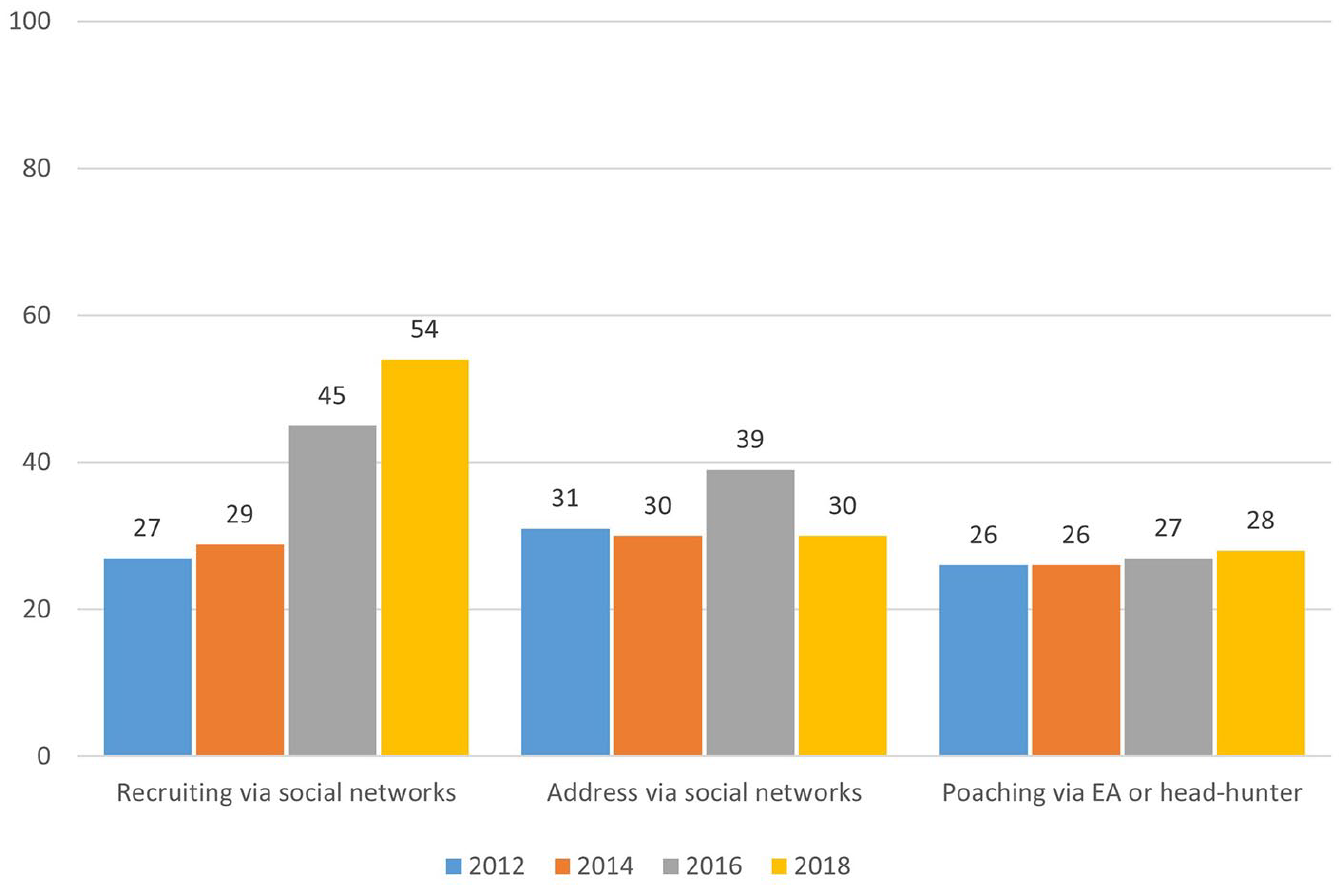
Employer search instruments by wave (in %).
For establishments already using social networks for recruitment purposes, a more direct approach is initiating direct contact with workers already employed in other firms via social networks such as XING or LinkedIn. The share of firms using this method (conditional on using social networks at all) has been fairly stable over time at around 30%, with the exception of 2016, where it has been at just below 40%. The use of head-hunters or employment agencies has also been fairly stable over time with a usage rate of 28% in 2018. Further analyses show that the use of social networks and poaching activities is more focused on the recruitment of managerial employees than on non-managerial employees (65%–73% vs 52%–59%).
Employee selection
We now turn to the second phase of a typical staffing process, namely the employee selection process. 9 Figure 2 shows that almost all establishments use job interviews to screen workers prior to employment. The share ranges between 85% in 2014 and 87% in 2018, and is rather stable across time. On the contrary, only a minority of establishments use assessment centers, cognitive ability (general mental ability (GMA)) tests, or personality tests during their employee selection process.
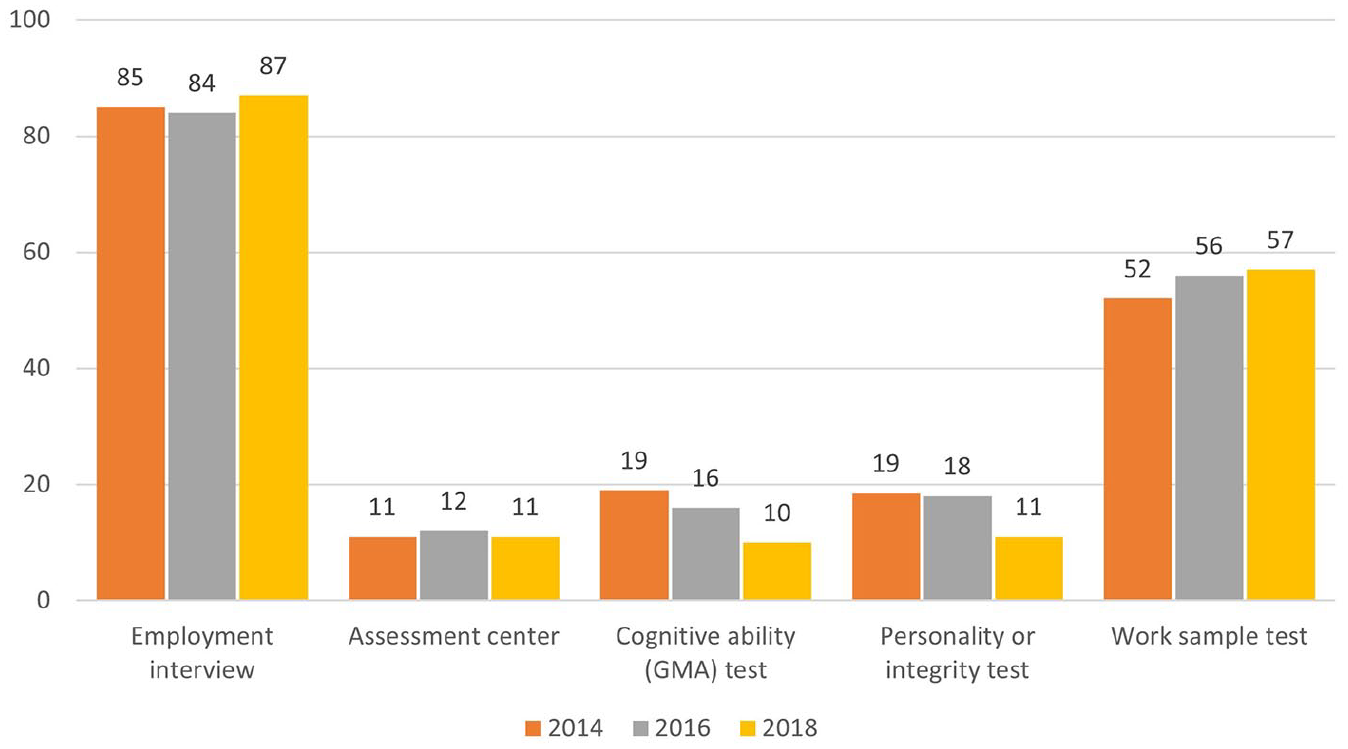
Employee selection instruments by wave (in %).
In detail, the low take-up of assessment centers is stable over time. The usage rate of GMA tests almost halves (minus 9 percentage points, significant at the 1%-level) from 2014 to 2018. This is surprising given the fact that “GMA can be considered the primary personnel measure for hiring decisions” (Schmidt and Hunter, 1998: 266), as it shows the highest criterion validity and lowest application cost. A further explanation for the decreasing trend might be the problem of transferring academic results into practitioner-oriented sources of information or the reluctance of applicants to participate in these tests (Alonso, 2018; Rynes et al., 2007).
The take-up of personality and integrity tests also shows a significant decrease of about 70% (minus 8 percentage points, 1%-level). Although prior research has demonstrated high criterion-related validities of personality and integrity tests (Ones et al., 2007), more recent studies suggest that these validities tend to be rather weak for job performance and only moderate for counterproductive work behavior (Van Iddekinge et al., 2012), which might explain why usage rates have decreased over time. The importance of short work samples is high and slightly increasing over time (significant at the 10%-level), which is in line with their high validity (Schmidt and Hunter, 1998). Concerning the use of new technologies, the LPP employer questionnaire 2018 asks for the first time about the use of algorithms for determining suitable candidates during the recruitment process. We observe that only about 2% of establishments make use of this new technology.
Focusing on the time used to screen managers and non-managerial employees (screening intensity), Figure 3 shows the disparity between these groups. While for non-managers between 2.6 and 3.2 hours of screening are allocated on average, this amount is much higher for managerial employees (between 4.5 and 5.4 hours). The graph also shows that there is no observable time trend.
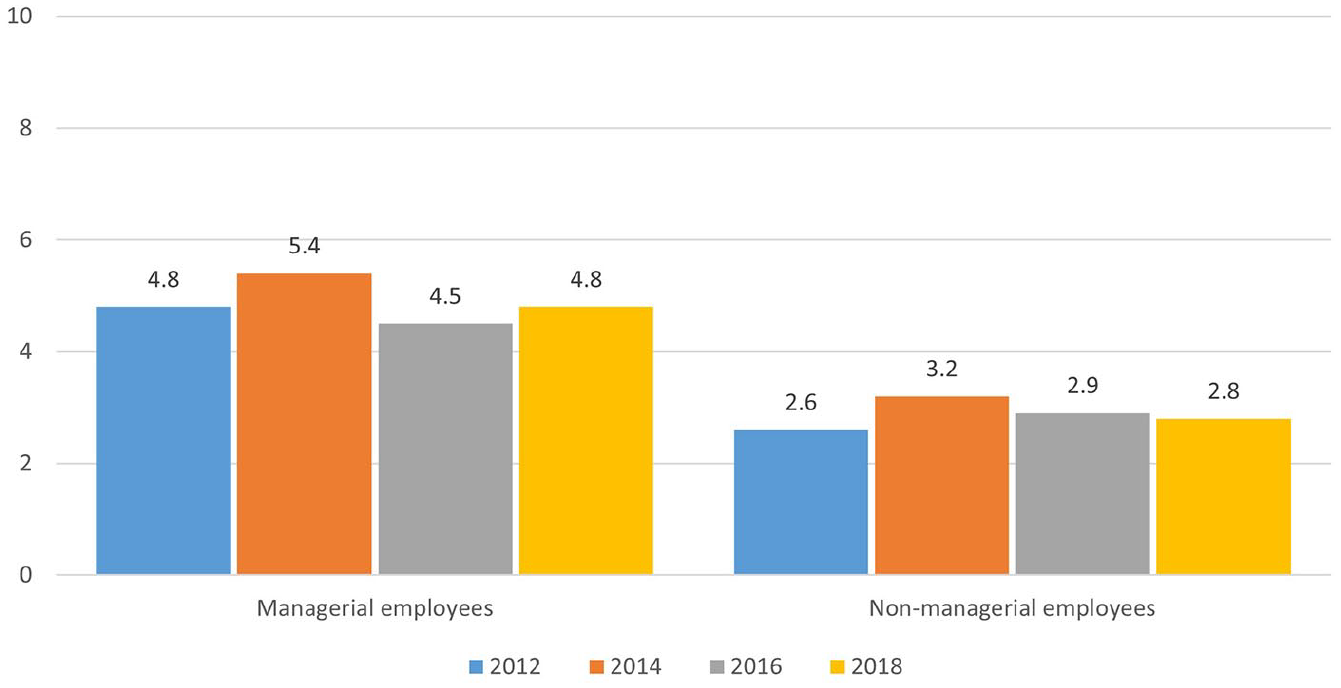
Screening intensity by wave (average hours of screening).
Turnover during probationary period
The final stage in firms’ hiring policies is on-the-job screening, which some firms might use to assess employees’ skills, effort, and output while working. The German Protection Against Dismissal Act (Kündigungsschutzgesetz, KSchG) allows on-the-job screening for a so-called probationary period of up to 6 months. During this period, working contracts can be terminated relatively easily. In contrast, terminations after this period become extremely difficult and almost impossible. 10 Figure 4 shows that voluntary as well as involuntary turnover are less frequent in recent years (differences not statistically significant), at 4.5% and 7.4% at the end of 2018, respectively. In unreported analyses, we distinguish between the following four reasons for involuntary turnover during the probationary period (available for survey waves 2016 and 2018): not suited for job (professional and/or personal reasons), new workers not needed due to changing economic conditions, gross misconduct of employee (extraordinary termination), and other reasons (e.g. severe illness). 11 The vast majority of involuntary quits during probationary periods are caused by an employee-job mismatch (around 80%), whereas severe misbehavior plays a minor but growing role (12% in 2016 and 14% in 2018). Thus, unsuitability is a driving force behind involuntary quits during the probationary period in Germany.
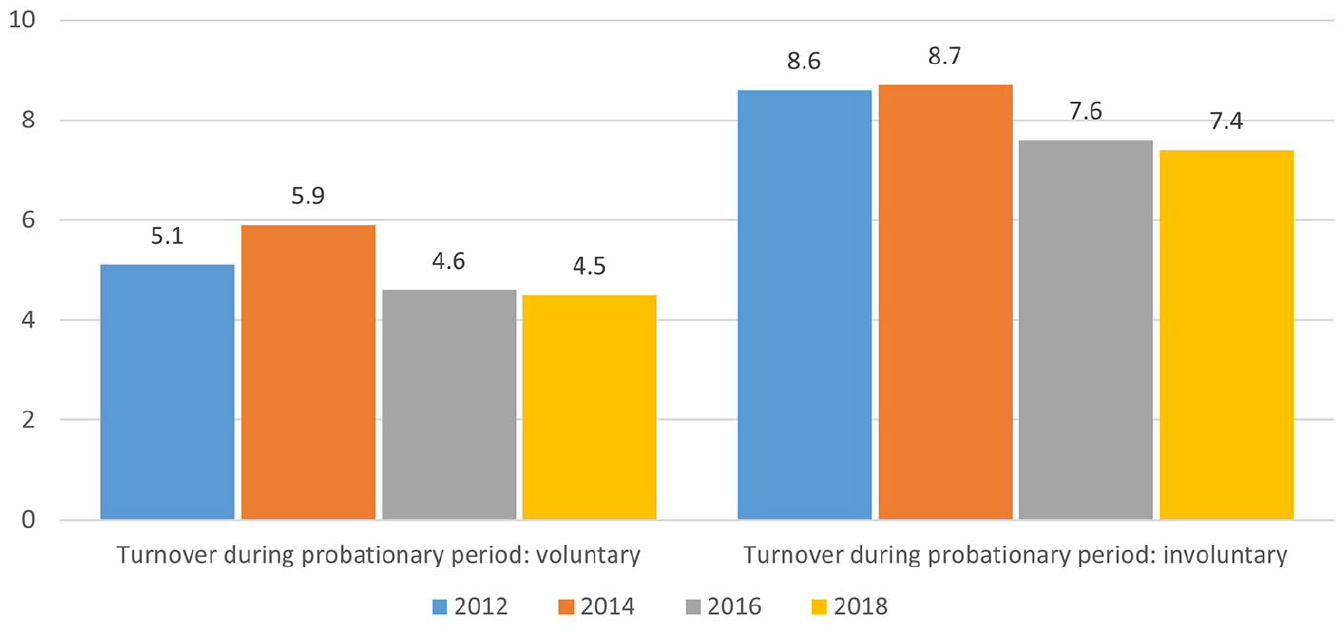
Employee turnover during probationary period (in %).
Importance of recruitment criteria
Apart from hiring strategies, establishments might also value hiring criteria differently. We measure the importance of the following individual characteristics for the hiring process: professional competence, personal competence, ethical standards, and cognitive ability. The items were asked in 2016 and 2018 and are measured on a five-point Likert scale from 1 “not important at all” to 5 “very important.” We document a downward trend in the importance of all hiring criteria. Professional and personal competence are the most important criteria for recruitment decisions (4.4 and 4.1 in 2018), followed by cognitive ability. Ethical standards are of lowest importance (3.6 in 2018). This is actually in line with the results in Figure 2, which shows a declining use of cognitive ability and personality tests.
Drivers of recruitment practices
Employer search
For all employer search instruments, we observe a frequency of use that strongly increases in establishment size, as Table 1 documents. Size effects are largest for the use of private employment agencies/head-hunters (34 percentage points (pp) more likely to be used by large establishments), followed by recruiting via social networks (28 pp), and lower for addressing workers via social networks (18 pp). Hence, we can answer the research question how the rate of implementation of more formalized recruitment and selection practices is linked with firm size.
Determinants of employer search instruments.
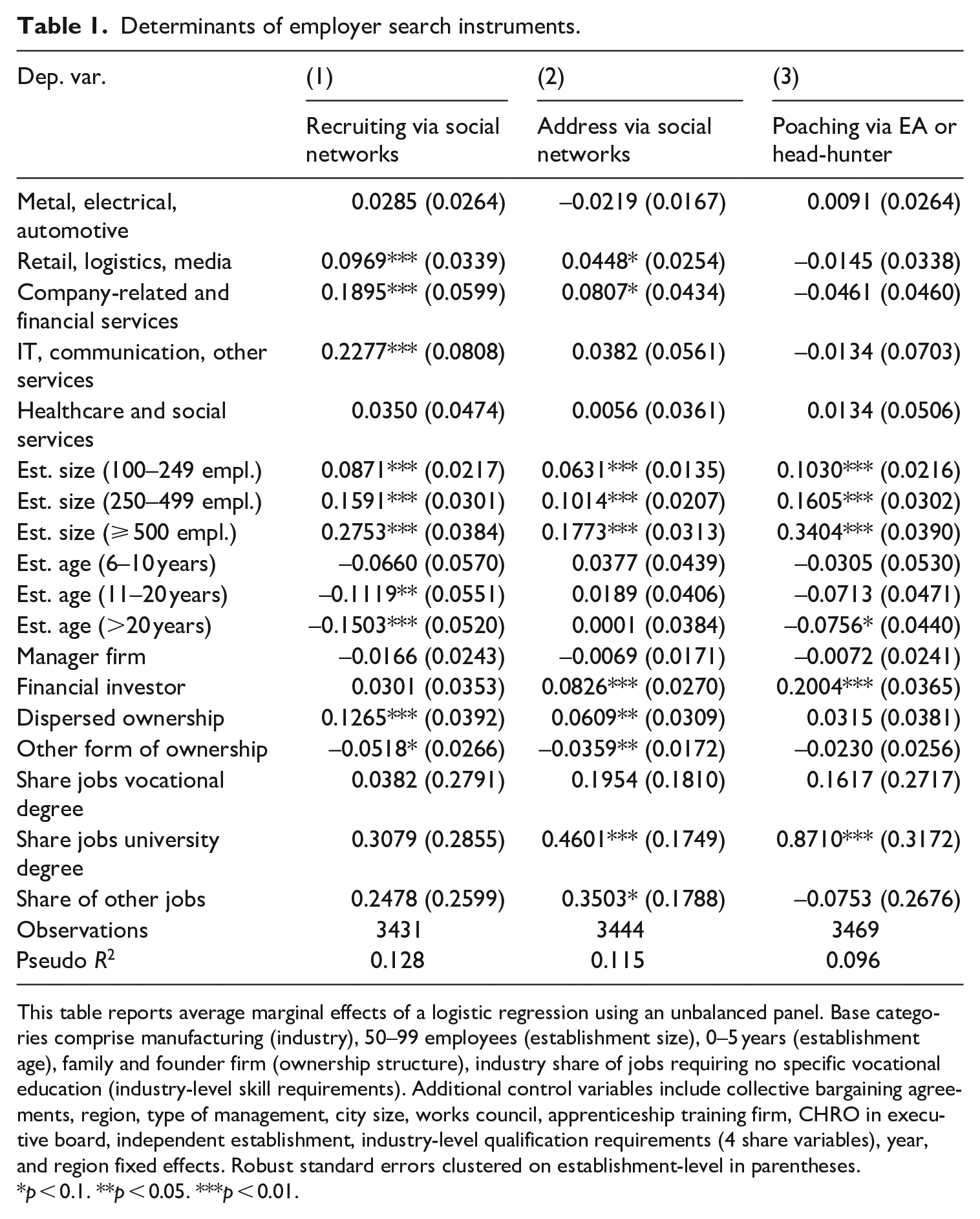
This table reports average marginal effects of a logistic regression using an unbalanced panel. Base categories comprise manufacturing (industry), 50–99 employees (establishment size), 0–5 years (establishment age), family and founder firm (ownership structure), industry share of jobs requiring no specific vocational education (industry-level skill requirements). Additional control variables include collective bargaining agreements, region, type of management, city size, works council, apprenticeship training firm, CHRO in executive board, independent establishment, industry-level qualification requirements (4 share variables), year, and region fixed effects. Robust standard errors clustered on establishment-level in parentheses.
p < 0.1. **p < 0.05. ***p < 0.01.
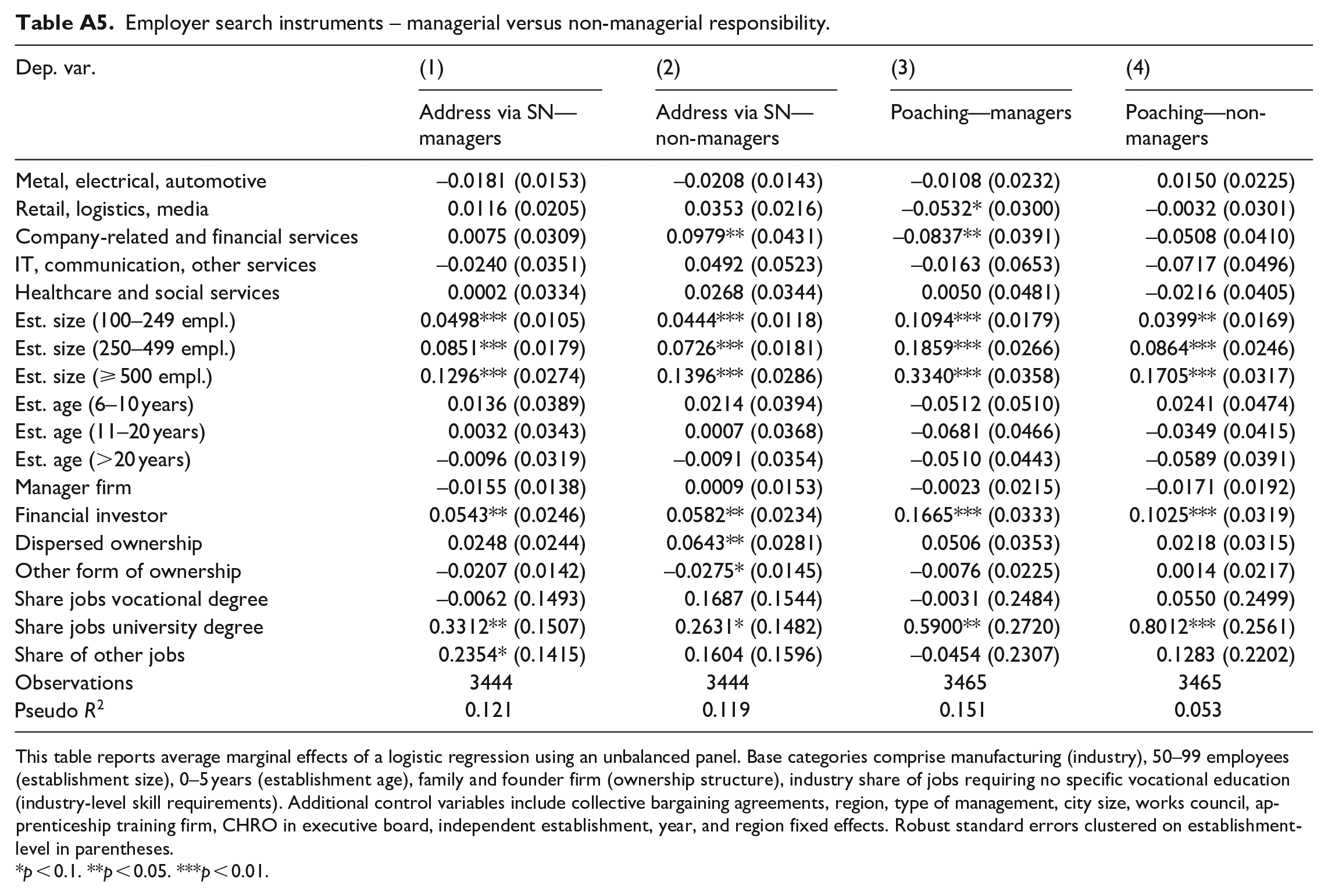
We are able to further differentiate which types of candidate firms have addressed via social networks or via the use of private employment agencies/head-hunters. In detail, the employer survey differentiates for these two items between candidates for jobs with management responsibility and candidates for jobs without management responsibility. Appendix Table A5 replicates columns 2 and 3 of Table 1, separately for managerial and non-managerial candidates. The regression results in columns 3 and 4 show that the very high usage rates for the use of private employment agencies/head-hunters in larger establishments are primarily driven by candidates with managerial responsibility (col. 3), with coefficient sizes almost double as high as compared to non-managerial employees (col. 4). Potentially, large firms need a higher level of talent for higher positions, and aim to poach more employees to apply for managerial positions. Assignment models of managers to firms predict that managers with a larger degree of talent can run firms with a higher amount of capital and labor. In this setting, larger establishments have a higher return than smaller firms in finding more talented managers, if their talent is a factor of production, and thus aim to find more applicants (Gabaix and Landier, 2008). For addressing employees via social networks, however, establishment size coefficients are almost the same (cols. 1 and 2).
Turning to industry sectors, the results in column 1 of Table 1 show that service sector establishments are significantly more likely to use social networks as a means to recruit employees than the manufacturing sector (reference category), holding other observable factors constant. Effect sizes range from 10 to 23 pp, which constitutes an economically sizeable difference. Columns 2 and 3 reveal that sectoral differences in addressing potential applicants via social networks and in poaching employees from competitors are mostly absent. Only the retail, logistics and media sector as well as the company-related and financial services sector are slightly more likely to address potential recruits via social networks, compared to manufacturing establishments. We can therefore state that the implementation of formalized recruitment and selection practices is more pronounced in service sector firms than in manufacturing firms.
Ownership is also a good predictor of employer search activities. Establishments with dispersed ownership are 13 pp more likely to use social networks and 6 pp more likely to directly address potential recruits compared to family and founder firms. An interesting pattern can be observed for establishments owned by financial investors. These firms are 8 pp more likely to address employees via social networks, and even 20 pp more likely to poach employees using an agency or a head-hunter compared to the reference group. This reveals that more direct and targeted recruitment behavior can rather be found in establishments owned by capital investors. Therefore, the type of ownership is an important determinant for the implementation of formalized recruitment and selection practices in firms. Interestingly, establishment age is negatively correlated with the use of social networks as a recruitment tool when simultaneously controlling for establishment size.
We have also conducted a series of robustness checks. First, a potential reverse causality problem might be grounded in the fact that better performing firms are more profitable and thus more able to formalize HR processes. To mitigate this issue, we have replicated our main analyses additionally controlling for annual net profits, using a profitability variable from the IAB establishment panel (asking establishments whether net profits in the last fiscal year were positive, balanced, or negative). All results remain qualitatively the same, indicating that our main independent variables are still drivers for the implementation of formal recruitment practices, even after controlling for profitability differences. Second, the use of recruitment practices might depend on the situation on the labor market and here, particularly important, the unemployment rate. We have replicated our main results additionally controlling for local unemployment rates at the county (“Landkreis”) level taken from administrative data. All our main results remain robust. Third, further analyses reveal that there is only very little within-establishment variation in these structural firm characteristics, which makes establishment fixed effects regressions infeasible.
Employee selection
In Table 2, we address the use of various employee selection (pre-hire screening) measures. We observe that the rate of implementation of more formalized recruitment and selection practices seems to be linked with firm size in some cases. Column 1 shows that the use of employment interviews is positively correlated with establishment size. Establishments with over 500 employees are 11 pp more likely to use them compared to the smallest establishments. Establishment size is also positively correlated with the use of assessment centers (ACs, col. 2), and even stronger compared to employment interviews. Large establishments are, on average, 21 pp more likely to use ACs than the smallest establishments. A potential explanation is that assessment centers have more setup costs involved than cognitive ability and other standardized, less customized tests (Schmidt and Hunter, 1998). Thus, returns to using an AC may be greater for larger establishments. There is no clear, increasing effect of establishment size for all other selection instruments, as shown in columns 3–6.
Determinants of employee selection instruments.
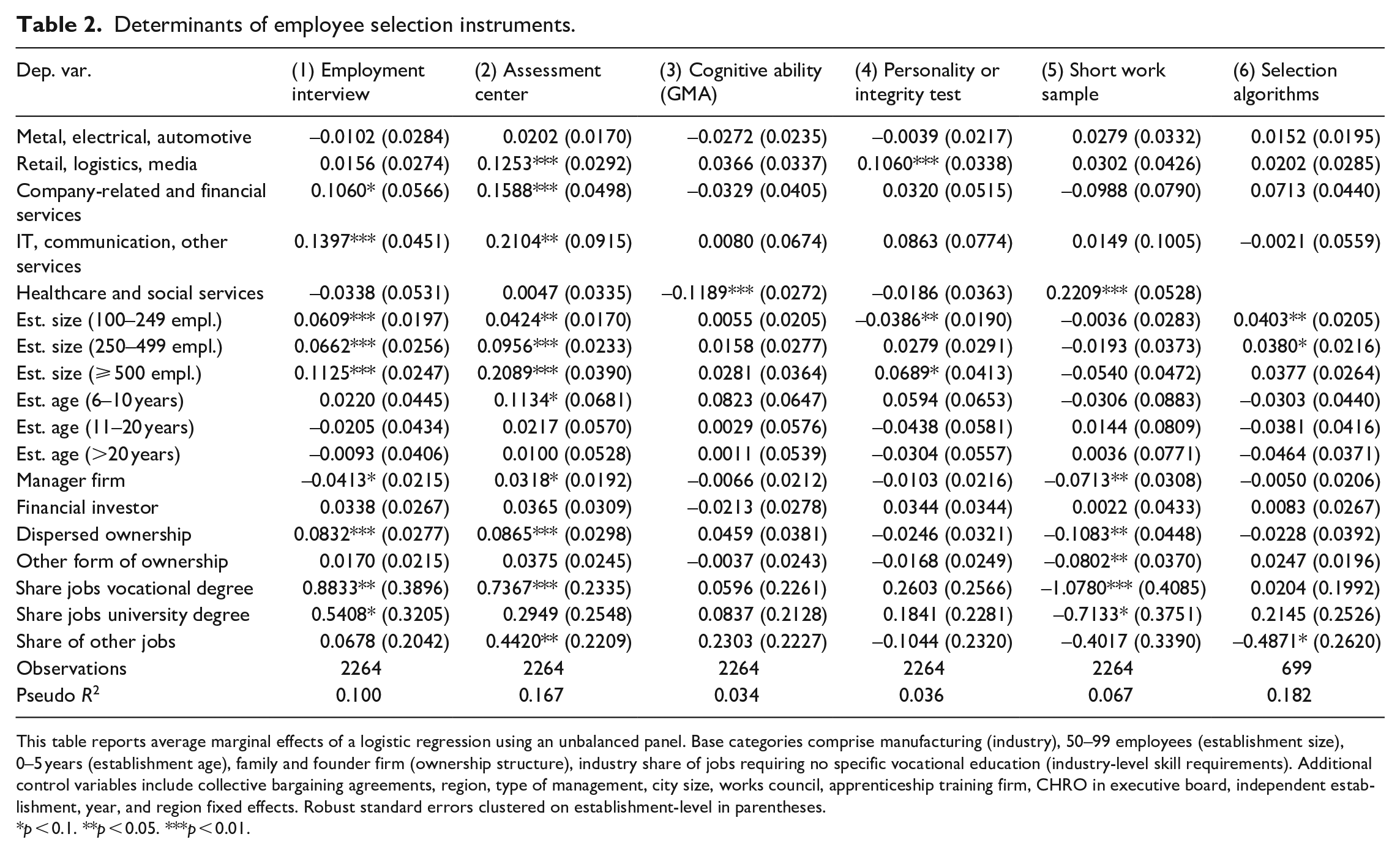
This table reports average marginal effects of a logistic regression using an unbalanced panel. Base categories comprise manufacturing (industry), 50–99 employees (establishment size), 0–5 years (establishment age), family and founder firm (ownership structure), industry share of jobs requiring no specific vocational education (industry-level skill requirements). Additional control variables include collective bargaining agreements, region, type of management, city size, works council, apprenticeship training firm, CHRO in executive board, independent establishment, year, and region fixed effects. Robust standard errors clustered on establishment-level in parentheses.
p < 0.1. **p < 0.05. ***p < 0.01.
Turning to industry differences, we observe a similar picture to establishment size. For employment interviews and ACs, we observe significantly higher usage rates in service sector firms than in manufacturing, particularly in IT, communication, and other services (interviews 14 pp more likely, ACs 21 pp). Again, there is no clear picture for the other selection instruments in columns 3–6. One exception is that the retail, logistics, and media sector is 11 pp more likely to use personality and integrity tests. One potential explanation is that these industries, particularly retailing and logistics, are characterized by high levels of customer interaction, for which certain personality types and ethical behavior can be important. Also, counterproductive work behavior (CWB) is likely to be very important in this sector, and these tests are better able to predict CWB than job performance (Van Iddekinge et al., 2012). Again, this seems to indicate that the implementation of formalized recruitment and selection practices is more pronounced in service sector firms than in manufacturing firms.
One striking exception is the healthcare and social services sector. Here, establishments are 12 pp less likely to use standardized GMA tests compared to manufacturing and 22 pp more likely to ask for short work samples during recruitment. Taken together with the results in column 3, the health care and social services sector shows the following pattern: It is reasonable to expect that social skills are more important in those jobs than cognitive ability, which might explain why GMA tests are significantly less used in this sector, but the sector shows the highest coefficient in magnitude when it comes to short work samples. This indicates that health and social services establishments try to assess their required social skills with the use of work samples. The missing coefficient for the healthcare and social services sector in column 6 indicates that there is no single establishment in the healthcare and social services sector which makes use of algorithms.
Concerning ownership type, we see that employment interviews and ACs are significantly more often applied by establishments with dispersed ownership (8–9 pp) compared to the base category of family and founder firms. Additionally, family and founder firms tend to rely more on short work samples during recruiting, all other factors being constant. Hence, the type of ownership seems like an important determinant for the implementation of formalized recruitment and selection practices in firms.
Determinants of recruitment criteria
We now assess whether there is also cross-sectional heterogeneity in the level of importance attributed to recruitment criteria by regressing the importance of these criteria, which are measured on a five-point Likert scale, on our set of establishment characteristics using pooled OLS. 12 The recruitment criteria consist of professional competencies, personal competencies, ethical standards, and cognitive ability. These can serve to corroborate the findings above, with the caveat that the responses from the answering HR managers will be subjective. Table 3 shows that the healthcare and social services sector is again significantly different from manufacturing in three out of four criteria. In detail, this sector places significantly higher weight than the manufacturing industry on professional and personal competence, as well as ethical standards. The importance of ethical values in the healthcare and social services sector is intuitively in line with the observation that prosocially oriented employees are more likely to work in this area (Brock et al., 2016). The magnitude of the correlation (0.52 scale points) is also very large, compared to our other results. Additionally, as column 2 shows, service sector establishments are more likely to put a higher weight on personal competencies for recruitment. Surprisingly, cognitive ability shows almost no statistically significant heterogeneity among establishments. The implementation of formalized recruitment and selection practices is again more pronounced in service sector firms than in manufacturing firms. To conclude, we observe much less diversity across establishments in the importance of recruitment criteria compared to the use of recruitment and selection instruments.
Determinants of recruitment criteria.
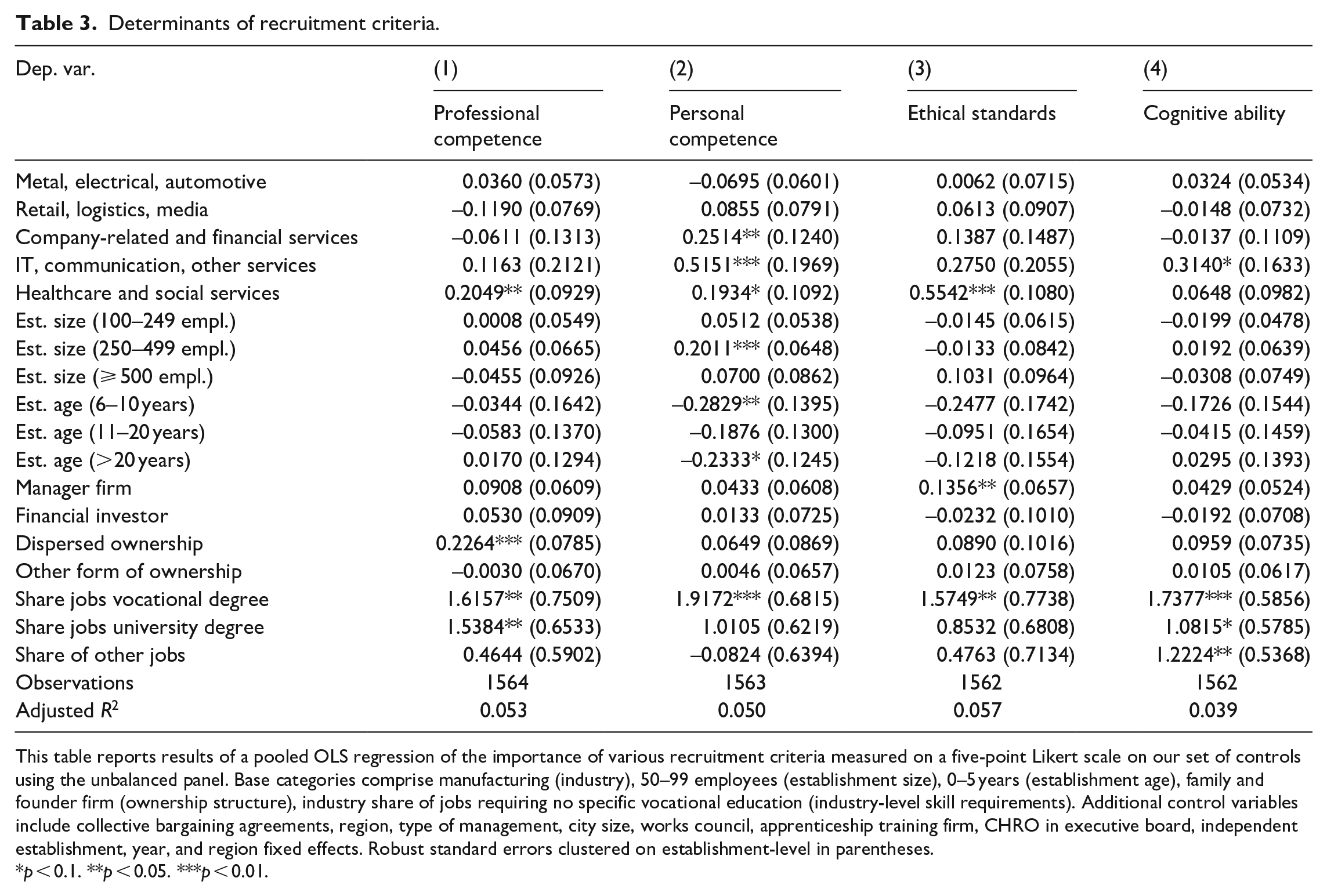
This table reports results of a pooled OLS regression of the importance of various recruitment criteria measured on a five-point Likert scale on our set of controls using the unbalanced panel. Base categories comprise manufacturing (industry), 50–99 employees (establishment size), 0–5 years (establishment age), family and founder firm (ownership structure), industry share of jobs requiring no specific vocational education (industry-level skill requirements). Additional control variables include collective bargaining agreements, region, type of management, city size, works council, apprenticeship training firm, CHRO in executive board, independent establishment, year, and region fixed effects. Robust standard errors clustered on establishment-level in parentheses.
p < 0.1. **p < 0.05. ***p < 0.01.
Pre-hire screening intensity
Our final instrument is pre-hire screening intensity, measured as the logarithm of the average number of hours spent on testing a successful applicant during recruitment. 13 Columns 1 and 2 of Table 4 present the corresponding OLS regression results, differentiated between managerial and non-managerial employees. We observe strong correlations of establishment size and the logarithm of screening intensity mainly for managerial employees. For this group, the largest establishments invest, on average, 31% 14 more time in testing an applicant in the selection process than the smallest establishments, while mid-sized establishments (250–499 employees) spend about 21% more time. Again, we can conclude that the rate of implementation of more formalized recruitment and selection practices increases with firm size. This result again seems intuitively in line with the argument that returns to managerial talent are increasing in firm size (Gabaix and Landier, 2008). This might also be indicative of a higher professionalism of HR management in larger firms (Bartram et al., 1995; Gooderham et al., 1999; Shaw et al., 1993; Zibarras and Woods, 2010). Our previous results, which show that larger establishments are more likely to address and poach managerial employees (and not non-managerial ones), are also in line with this interpretation.
Determinants of screening intensity and employee turnover during probation.
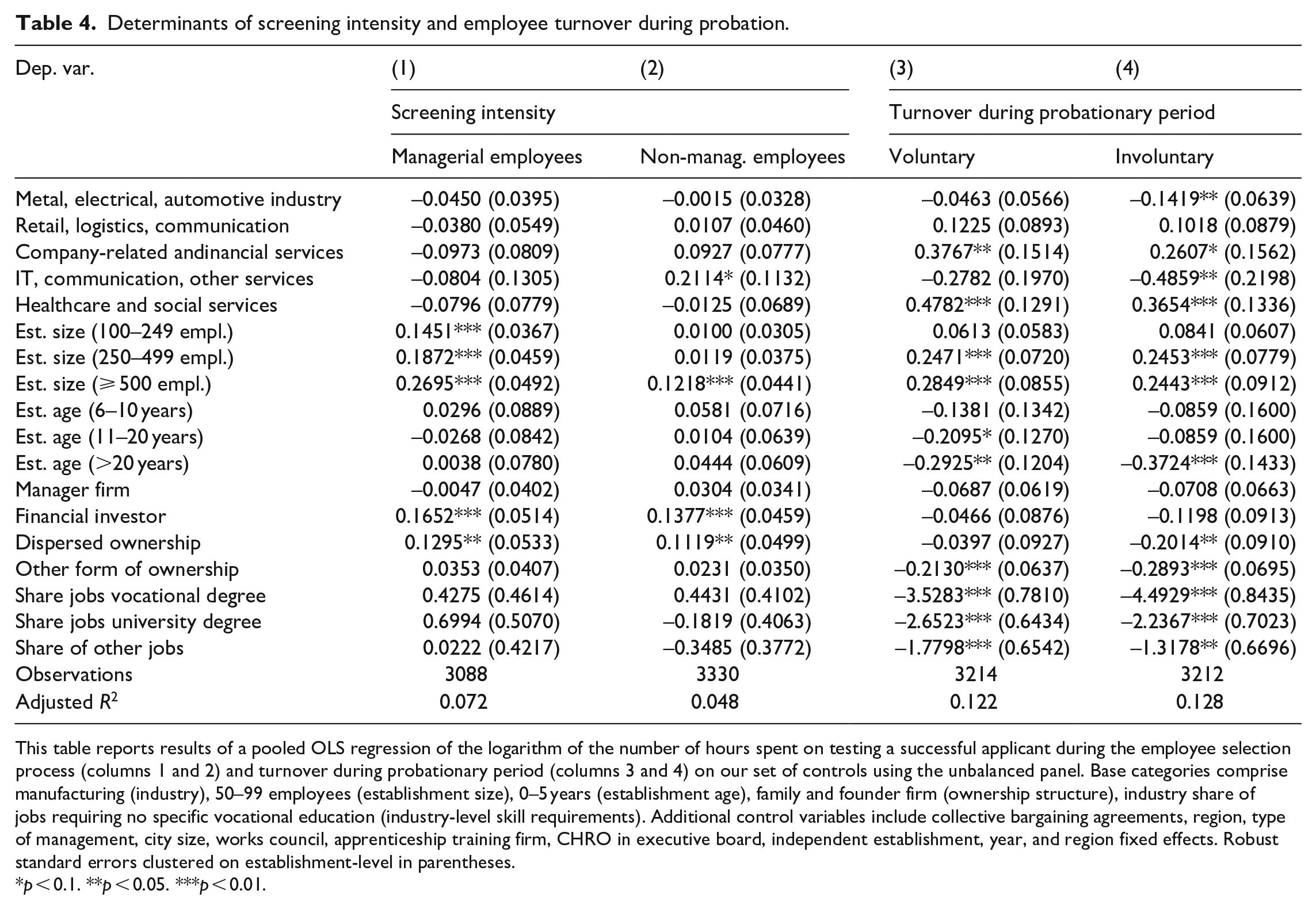
This table reports results of a pooled OLS regression of the logarithm of the number of hours spent on testing a successful applicant during the employee selection process (columns 1 and 2) and turnover during probationary period (columns 3 and 4) on our set of controls using the unbalanced panel. Base categories comprise manufacturing (industry), 50–99 employees (establishment size), 0–5 years (establishment age), family and founder firm (ownership structure), industry share of jobs requiring no specific vocational education (industry-level skill requirements). Additional control variables include collective bargaining agreements, region, type of management, city size, works council, apprenticeship training firm, CHRO in executive board, independent establishment, year, and region fixed effects. Robust standard errors clustered on establishment-level in parentheses.
p < 0.1. **p < 0.05. ***p < 0.01.
Table 4 also shows that the size effects are much weaker for job testing of non-managerial employees. Here, the size of the coefficient for the largest establishments amounts to 12% for screening intensity of non-managerial employees, whereas the coefficients for the other size dummies are statistically and economically insignificant. We further observe almost no heterogeneity across industries. Interestingly, establishments with dispersed ownership and financial investor ownership show significantly higher screening intensities for both types of employees. To conclude, industry and type of ownership are only slightly linked to formal practices, and less than firm size.
Turnover during probationary period
Finally, we are able to distinguish between voluntary, that is, employee-initiated, and involuntary turnover (Hom et al., 2017) during probationary period. As Rubenstein et al. (2018) emphasize, “the organizational context has generally been ignored in turnover research until recently.” Our analysis of size, industry, and ownership patterns can therefore contribute to this missing understanding. As can be seen in columns 3 and 4 of Table 4, we find evidence that larger establishments make more use of both types of turnover, which is in line with organizational-level data from the US trucking industry (see Table 2 in Shaw et al., 1998) and recent meta-analytic research on voluntary turnover (Rubenstein et al., 2018). The fact that larger firms invest more into pre-hire screening, but at the same time also show higher levels of involuntary turnover during probation is counterintuitive, as one would expect a negative relationship between the two variables. However, even when we regress the involuntary turnover rate on average pre-hire screening intensity in a firm and a vector of other hiring practices and standard establishment controls, we observe no statistically significant relationship.
Hom et al. (2017) also recommend to analyze industry differences in turnover research, which we do. Both types of on-the-job screening are more likely in the healthcare and social services sector, as well as the company-related and financial services sector. These correlations are also of economically significant magnitude, with values up to 3.7 pp for involuntary and 4.8 pp for voluntary turnover. By contrast, involuntary turnover is less likely (4.9 pp) in IT, communication, and other services compared to manufacturing. Again, concerning type of ownership, we observe no clear pattern.
Managerial implications and conclusion
Our goal was to provide a representative overview and an explanation for the use of recruitment strategies for a large industrialized country. We document across-establishment heterogeneity of hiring practices for a variety of establishments and industries in Germany, and an aggregate change over time. We find that, with some exceptions, the average use of recruitment practices has been quite persistent in recent years. The use of social networks to recruit has increased, and the use of cognitive ability and personality testing has decreased over our period of observation of 6 years in the last decade.
Moreover, we show that differences in recruitment strategies exist between economic sectors, establishment size, and ownership type. We document a strong link between firm size and the use of formalized recruitment and selection practice. Second, the implementation of formalized practices is more pronounced in service sector firms than in manufacturing firms for only some practices. Finally, the type of ownership, however, seems to supply the only a weak link to formalized recruitment and selection practices.
Hence, our results support the interpretation that establishment characteristics are correlated with different facets of hiring behavior, but that there is no homogeneous pattern for each of the employer search and selection instruments considered. Nevertheless, a substantial amount of variation in recruitment practices remains unexplained, implying that structural covariates do not capture all nuances of establishment-specific effects. Controlling for establishment fixed effects in addition to structural covariates leads to a large increase in explained variation of recruitment strategies, showing how prominent establishment-level heterogeneity (the black box) still is.
Our study may have important implications for HR management in establishments. By providing a description of changes over time in the use of recruitment instruments, and by analyzing heterogeneity in actual hiring practices across establishments, HR managers are now able to benchmark their use of recruitment practices with those of a representative sample in an industrialized country. Additionally, our study highlights a potential discrepancy between HR management and academic research when it comes to the use of, for instance, cognitive ability tests. At least in our German sample, the use of these tests has sharply decreased over time, although research has shown high levels of criterion validity.
To conclude, the recruiting behavior of establishments still remains at least partly a black box. To shed more light on recruitment-related questions, researchers need to apply multiple complementary research methods such as formal economic models on specific mechanisms, laboratory and field experiments, and representative employee and firm surveys (Kampkötter and Sliwka, 2016). Our paper has collected representative evidence on the relevance and frequency of recruitment strategies in larger companies.
Future research might explore several questions. First, as our data set is representative for private sector establishments employing at least 50 employees, it would be interesting to replicate our findings for smaller establishments, which might recruit very differently. In a next step it would, of course, be interesting to know more about the performance outcomes of this heterogeneity in recruitment practices. In our view gains of recruitment practices are most likely to be long-term, that is, attracting more productive employees and better matches (and therefore fewer quits), which contributes to long-term profits. Contrary, costs of recruitment practice are rather short-term, that is, implementation costs of hiring practices and higher wages for highly qualified new recruits. Therefore, answering this question would ideally need items on these mechanisms, that is, subjective (or even better: objective) measurements of the quality of new hires, match quality, or costs of hiring practices, all of which are not available in our data set.
Future empirical research could collect more detailed information on how screening mechanisms are implemented and which types of employees are targeted with these instruments to test hypotheses at the intensive margin. It is likely that firms are not aware of how well their recruitment strategies work in general, and whether some costly practices, such as assessment centers, may be inefficient.
Footnotes
Appendix
Employer search instruments – managerial versus non-managerial responsibility.
| Dep. var. | (1) | (2) | (3) | (4) |
|---|---|---|---|---|
| Address via SN—managers | Address via SN—non-managers | Poaching—managers | Poaching—non-managers | |
| Metal, electrical, automotive | –0.0181 (0.0153) | –0.0208 (0.0143) | –0.0108 (0.0232) | 0.0150 (0.0225) |
| Retail, logistics, media | 0.0116 (0.0205) | 0.0353 (0.0216) | –0.0532* (0.0300) | –0.0032 (0.0301) |
| Company-related and financial services | 0.0075 (0.0309) | 0.0979** (0.0431) | –0.0837** (0.0391) | –0.0508 (0.0410) |
| IT, communication, other services | –0.0240 (0.0351) | 0.0492 (0.0523) | –0.0163 (0.0653) | –0.0717 (0.0496) |
| Healthcare and social services | 0.0002 (0.0334) | 0.0268 (0.0344) | 0.0050 (0.0481) | –0.0216 (0.0405) |
| Est. size (100–249 empl.) | 0.0498*** (0.0105) | 0.0444*** (0.0118) | 0.1094*** (0.0179) | 0.0399** (0.0169) |
| Est. size (250–499 empl.) | 0.0851*** (0.0179) | 0.0726*** (0.0181) | 0.1859*** (0.0266) | 0.0864*** (0.0246) |
| Est. size (⩾ 500 empl.) | 0.1296*** (0.0274) | 0.1396*** (0.0286) | 0.3340*** (0.0358) | 0.1705*** (0.0317) |
| Est. age (6–10 years) | 0.0136 (0.0389) | 0.0214 (0.0394) | –0.0512 (0.0510) | 0.0241 (0.0474) |
| Est. age (11–20 years) | 0.0032 (0.0343) | 0.0007 (0.0368) | –0.0681 (0.0466) | –0.0349 (0.0415) |
| Est. age (>20 years) | –0.0096 (0.0319) | –0.0091 (0.0354) | –0.0510 (0.0443) | –0.0589 (0.0391) |
| Manager firm | –0.0155 (0.0138) | 0.0009 (0.0153) | –0.0023 (0.0215) | –0.0171 (0.0192) |
| Financial investor | 0.0543** (0.0246) | 0.0582** (0.0234) | 0.1665*** (0.0333) | 0.1025*** (0.0319) |
| Dispersed ownership | 0.0248 (0.0244) | 0.0643** (0.0281) | 0.0506 (0.0353) | 0.0218 (0.0315) |
| Other form of ownership | –0.0207 (0.0142) | –0.0275* (0.0145) | –0.0076 (0.0225) | 0.0014 (0.0217) |
| Share jobs vocational degree | –0.0062 (0.1493) | 0.1687 (0.1544) | –0.0031 (0.2484) | 0.0550 (0.2499) |
| Share jobs university degree | 0.3312** (0.1507) | 0.2631* (0.1482) | 0.5900** (0.2720) | 0.8012*** (0.2561) |
| Share of other jobs | 0.2354* (0.1415) | 0.1604 (0.1596) | –0.0454 (0.2307) | 0.1283 (0.2202) |
| Observations | 3444 | 3444 | 3465 | 3465 |
| Pseudo R2 | 0.121 | 0.119 | 0.151 | 0.053 |
This table reports average marginal effects of a logistic regression using an unbalanced panel. Base categories comprise manufacturing (industry), 50–99 employees (establishment size), 0–5 years (establishment age), family and founder firm (ownership structure), industry share of jobs requiring no specific vocational education (industry-level skill requirements). Additional control variables include collective bargaining agreements, region, type of management, city size, works council, apprenticeship training firm, CHRO in executive board, independent establishment, year, and region fixed effects. Robust standard errors clustered on establishment-level in parentheses.
p < 0.1. **p < 0.05. ***p < 0.01.
Acknowledgements
We thank Martin Biewen, Peter Eppinger, Christian Manger, Valeria Merlo, Dirk Sliwka, Susanne Steffes, and Georg Wamser for helpful comments and suggestions. Claudius Härdle and Mariella Misch provided excellent research assistance.
Funding
The author(s) disclosed receipt of the following financial support for the research, authorship, and/or publication of this article: Patrick Kampkötter thanks the German Research Foundation (DFG) for financial support through priority program SPP 1764 (KA 4591/1-2).
