




Abstract
The sudden and extensive implementation of teleworking in the beginning of the COVID-19 pandemic has threatened employees’ well-being. Based on the challenges that particularly threatened such well-being in the beginning of the pandemic, we identify sets of telework-specific HRM practices and leadership behaviors, and examine their joint relationships with teleworkers’ happiness well-being in terms of work engagement and job satisfaction. Thus, we also consider the mediating roles of social isolation (as an indicator of social well-being) and psychological strain (as an indicator of health well-being). We also expect that HRM and leadership should interact and reinforce each other. Our analyses are based on data from German teleworkers at two consecutive points in time. Our findings reveal differentiated and complementary effects of telework-oriented HRM and leadership. In particular, we identified the provision of health care to contribute most to telework-oriented HRM’s relationship with social isolation and happiness well-being. Telework-oriented leadership mainly affected teleworkers’ happiness well-being via strain by ensuring communication and information exchanges between teleworkers.
Keywords
Introduction
Teleworking–a mode of work where employees work remotely and independently of their company’s geographical location via information technologies (IT) (Baruch, 2001)–can have a series of positive effects by increasing employee flexibility and autonomy, which can lead to greater satisfaction and performance as well as lower work-family conflict (Gajendran and Harrison, 2007; Vega et al., 2015). Yet teleworking can also threaten employees’ well-being by causing dissatisfaction, social isolation, and strain (Golden and Veiga, 2005; Sardeshmukh et al., 2012).
In the spring of 2020, the worldwide COVID-19 pandemic and the resulting contact restrictions implied that large sections of the workforce were suddenly forced to work from home for an undefined period (e.g. Carillo et al., 2021). This was a new situation for many companies and employees; although telework was used before, the conditions changed fundamentally during the pandemic. Owing to its sudden occurrence and high levels of uncertainty and unpredictability, the pandemic led to a series of situation-specific challenges that particularly threatened teleworkers’ well-being (e.g. Eurofound, 2020; Evanoff et al., 2020). First, employee health was threatened by possible infection with the Coronavirus, but also through increased stress due to suddenly altered working conditions and workloads, an inadequate work environment at home, childcare demands, blurred working hours, and job insecurity. Second, the risk of social isolation dramatically increased, since contact restrictions limited the opportunities for communication and cooperation between employees. Third, employees experienced a lack of orientation owing to uncertainties about the situation and future developments as well as a jeopardized trust of and commitment to their company during times of crisis.
Companies can support employee well-being through human resource management (HRM) and leadership. Indeed, the impact of different HRM practices and leadership styles on employee well-being generally and in the context of teleworking is well documented (e.g. Guest, 2017; Malhotra et al., 2007; Nayani et al., 2018). However, the conditions changed fundamentally during the COVID-19 pandemic, which makes established approaches less likely to be applicable. Building on the Job Demands-Resources (JD-R) model (Bakker and Demerouti, 2007), we identify telework-specific sets of HRM practices and leadership behaviors and ask whether these can support employee well-being in the beginning of the COVID-19 crisis. We hypothesize that these sets of HRM practices and leadership behaviors will influence teleworkers’ happiness well-being (i.e. job satisfaction, work engagement), relational well-being (i.e. feelings of social isolation), and health well-being (i.e. psychological strain). We also consider mediating mechanisms between the different dimensions of teleworker well-being as well as the interaction between HRM and leadership. Our analyses are based on data from German teleworkers from two consecutive points in time during the first lockdown in the COVID-19 pandemic.
By analyzing how specific domains of HRM and leadership related to teleworkers’ well-being in the beginning of the COVID-19 pandemic, our study makes several contributions. First, we contribute to the novel research stream into the COVID-19 pandemic’s effects and its consequences for management (e.g. Carnevale and Hatak, 2020). We show that the JD-R framework may be transferable to specific contexts and may be a useful tool for identifying situation-specific resources that HRM and leaders need to provide to maintain employee well-being. Second, we contribute to the literature on how HRM and leadership can address teleworker well-being. By considering multiple outcomes (i.e. happiness well-being as well as feelings of social isolation and psychological strain) and their interrelationships, we provide insights into the multidimensionality of employee well-being (Grant et al., 2007; Guerci et al., 2022) and account for their unique relationships with HRM and leadership. Finally, by analyzing the interaction between HRM and leadership, we also extend the findings in the emerging research stream into the joint effects of HRM and leadership (Hauff et al., 2020; Leroy et al., 2018).
Theoretical background
Defining context-specific telework-oriented HRM practices and leadership behaviors
Teleworking in the beginning of the COVID-19 pandemic came with a series of challenges that threatened employees’ well-being (Bilotta et al., 2021; Dettmers and Plückhahn, 2021; Evanoff et al., 2020). Existing HRM and leadership approaches have provided little insights into how to deal with these challenges (e.g. Klebe et al., 2021). For instance, high-performance work practices (Appelbaum et al., 2000) are designed to increase employees’ abilities, motivations, and opportunities to perform, but not to cope with threats to employees’ health or a lack of orientation during times of a crisis. The main task for companies in the beginning of the COVID-19 pandemic was to provide structures that helped employees adjust to the drastically altered work conditions (Carnevale and Hatak, 2020). Common leadership styles such as transformational leadership don’t apply in such a situation, since they focus on more developmental goals. Further, they are not specifically designed to provide acute resources for employee well-being during times of a crisis. They also build on the assumption of face-to-face interaction (e.g. Weiß and Süß, 2016) and are therefore not completely transferable to the teleworking context. Similar, telework-specific leadership styles such as e-leadership (Avolio et al., 2014), virtual leadership (Malhotra et al., 2007), and paradoxical virtual leadership (Purvanova and Kenda, 2018) were designed for managing few, part-time and volunteer teleworkers or specialized remote work teams, but not the sudden implementation of teleworking for large parts of the workforce. Thus, they are not completely transferable to the situation in the beginning of the COVID-19 pandemic.
However, even if established approaches are not applicable to the well-being-related challenges at the beginning of the COVID-19 pandemic, HRM and leadership are crucial for supporting employee well-being, especially in times of a crisis. A key theoretical model to explain the positive links between HRM and leadership and employee well-being is the JD-R model (see e.g. Peccei and Van de Voorde, 2019 for the relevance of different theoretical models in HRM research). Building on this model, HRM and leadership behaviors can be understood as job resources that can help employees to reduce job demands as well as their physiological and psychological costs. Based on situation specific challenges in the beginning of the COVID-19 pandemic, we identified domains of HRM and leadership that can serve as resources and thus can help to maintain employee well-being in this situation.
First, employee health was endangered. While the virus presents risks, employee health was also threatened owing to drastically altered working conditions. Companies’ efforts to adapt to the crisis often led to an intensification of work, while recovery was limited due to a lack of organizational health care opportunities such as corporate sports and contact restrictions in private life. Further demands included an inadequate work environment at home, the blurring of working hours, and an increase in childcare owing to the closing of public institutions (Evanoff et al., 2020). Organizations can provide resources to face these challenges by improving staff members’ self care (Horstmann, 2018), for instance by providing health-relevant information and knowledge that can help employees to understand and therefore care for their own health. Further, the HRM department can offer low-threshold support from contact persons such as coaches or psychologists to address acute problems. We sum up these HRM practices that aim to provide health care in the context of teleworking as health care-oriented HRM practices.
Leaders can provide resources for employee health in the forms of self care and staff care (Franke et al., 2014). Self care describes leaders’ actions to maintain and improve their own health. This can affect employee well-being through role modeling as well as transfer effects (e.g. Huang et al., 2016). However, in the context of teleworking, owing to the lack of face-to-face interaction leadership, self care can become less visible to employees and therefore less effective. This makes it more important that leaders address employee health through staff care, which includes a set of interdependent leadership behaviors (Franke et al., 2014): First, leaders must be attentive to employee health issues in teleworking, especially when new crisis-specific stressors types further threaten their well-being. Next, they need to care about, feel responsible for, and prioritize these issues. Finally, they must take actions that actively address teleworkers’ health. We refer to these health-oriented leadership behaviors in the teleworking setting as health care-oriented leadership.
Second, the risk of social isolation has increased owing to the extensive use of teleworking in the beginning of the COVID-19 pandemic. Because teleworkers are generally less able to maintain interpersonal relationships, the isolation from coworkers and work social networks is one of teleworkers’ most frequently expressed concerns (Golden et al., 2008). The separation from others and the reliance on IT reduce interactions and social support, threatening the basic emotional need for relatedness (Baumeister and Leary, 1995). Also, lower accessibility of colleagues affects the coordination of work tasks, which in turn can impact on teleworkers’ strain and job satisfaction (Bentley et al., 2016) and can lead to role conflicts and ambiguity (Sardeshmukh et al., 2012). In the beginning of the pandemic, the risk of social isolation was dramatic: Contact restrictions prohibited personal meetings, and the problems associated with the sudden introduction of IT for teleworking posed a threat to the communication and cooperation between employees. HRM can provide resources in such a situation by establishing information-sharing routines and setting up conditions that enable employees to communicate with their colleagues over distance. Especially in times of the COVID-19 crisis, it was also crucial for employees to be informed about the current situation and ongoing changes so as to prevent feelings of uncertainty. We sum up these HRM practices, which seek to foster communication and information exchanges in the context of teleworking as information and communication-oriented HRM practices.
Leaders can also provide resources to reduce social isolation by empowering and urging their employees to use the possibilities provided by communication and information exchanges (Contreras et al., 2020). For instance, they can implement and pursue regular virtual meetings or other forms of interaction to ensure exchanges between employees; this counters feelings of social isolation. Further, especially during times of crisis, due to their professional level and the ways information are often communicated top-down, leaders may possess information that their subordinates don’t have. Thus, leaders should ensure that they share all the information their employees need and should keep them updated about ongoing changes. We named this behaviors set information and communication-oriented leadership.
Third, employees faced a lack of orientation. In the beginning of the COVID-19 pandemic, the sudden, new, and rapidly changing situation confronted teleworkers with high uncertainty. Role ambiguity, work overload, uncertainty about the situation, and a lack of trust and guidance in times of crisis are job characteristics that employees find cognitively and mentally demanding (Demerouti et al., 2001). Thus, Carnevale and Hatak (2020) argued that the main task for companies is to provide structures that help employees adjust to the drastically altered situation. Organizations generally use regulations, policies, and guidelines that help motivate employees to act in ways that advance organizational objectives (Cardinal et al., 2010). However, in the beginning of the COVID-19 pandemic, it was harder for companies to implement, communicate, and control these settings, while it was also harder for teleworkers to perceive them, since they were less visible. For many organizations, the (extensive) use of teleworking was an absolute novelty, and questions such as how to deal with recording work time, flexible work times, or additional expenses at home owing to teleworking had not previously been discussed. In such a situation, trust and perceived fairness become crucial factors in the management of teleworkers (O’Leary et al., 2002). Organizations can provide resources by creating telework-specific guidelines that are fair and transparent. They should also express confidence in teleworking as an equal and productive form of work and should support teleworkers’ autonomy and flexibility (Illegems and Verbeke, 2004). We refer to practices designed to give employees in teleworking structure and orientation as guidance-oriented HRM practices.
Leaders can also increase orientation by communicating these rules and guidelines, such that teleworkers perceive them to be fair and to achieve compliance. Further, since the possibilities for leaders to control their employees are limited, trust is crucial in the management of teleworkers (Handy, 1995). Accordingly, leaders should show confidence in their employees to work conscientiously from home. We refer to this set of leadership behaviors designed to provide an environment that is advantageous for teleworkers as guidance-oriented leadership.
In sum, the identified domains of HRM and leadership represent specific resources that may have helped teleworkers to cope with the specific challenges in the beginning of the COVID-19 pandemic. The system perspective on HRM (Jiang et al., 2012) and leadership (Avolio et al., 2009) assume that HRM practices and leadership behaviors are not independent, but work together to achieve a desired outcome. We follow this view, combining these domains into an overall telework-oriented HRM system and a telework-oriented leadership style (see Figure 1). In line with suggestions generated by the research (Hauff, 2021; Jiang et al., 2012), we conceptualized these concepts as a higher-order constructs, where the domains are formative latent constructs that represent formative indicators of the overall concept. Importantly, this approach allows us to analyze the relationships between the overall constructs and the relevant outcome variables while simultaneously identifying the drivers of these relationships.
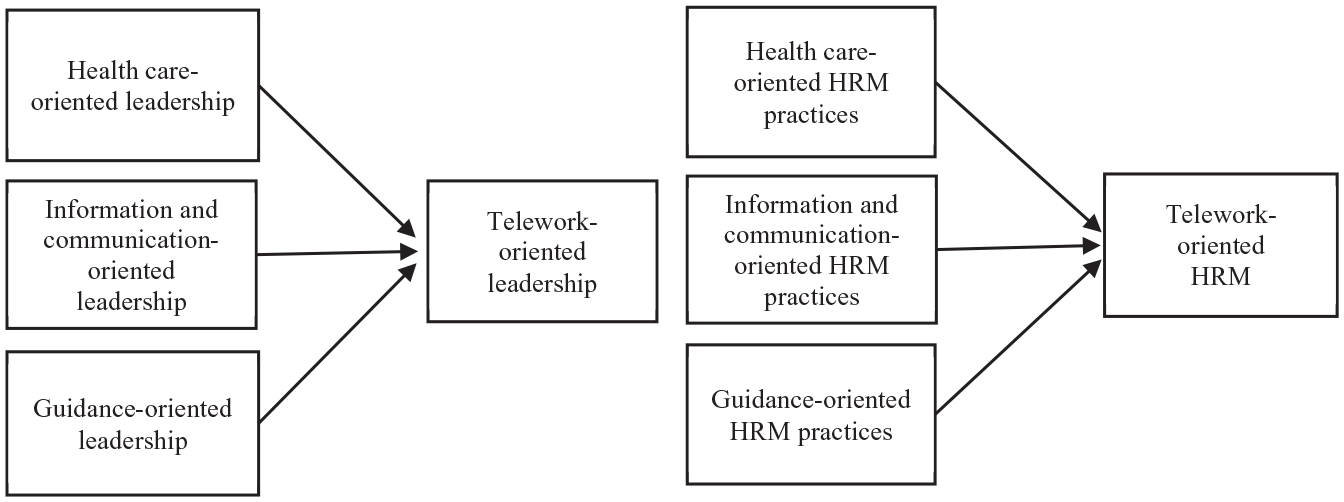
Telework-oriented HRM and leadership frameworks.
Linking telework-oriented HRM and leadership to teleworker well-being
We derived the telework-oriented sets of HRM practices and leadership behaviors based on the specific challenges associated with teleworking in the beginning of the COVID-19 pandemic. We expect that these sets have affected teleworker well-being. Employee well-being has been studied and measured in different ways. One of the conceptualizations that is used most often in occupational well-being was suggested by Grant et al. (2007), who described three dimensions of employee well-being: happiness, health, and relational well-being. We will now first consider happiness well-being. In the next section, we turn to the role of health well-being and relational well-being.
Happiness well-being has two components: hedonic and eudaimonic well-being (Ryan and Deci, 2001). Hedonic well-being describes the subjective feeling of happiness, such as a positive affect toward one’s job. Eudaimonic well-being describes employees’ feelings of fulfillment and purpose in their job. In the work domain, hedonic well-being is mostly measured as overall job satisfaction, while eudemonic well-being is best represented by employees’ work engagement, which has been described as an affective-motivational state of fulfillment often characterized by vigor, dedication, and absorption (Bakker and Schaufeli, 2014).
To explain the proposed relationships between telework-oriented HRM and telework-oriented leadership with job satisfaction and work engagement, we built on the JD-R model (Bakker and Demerouti, 2007). In the beginning of the COVID-19 pandemic, the different telework-oriented HRM and leadership dimensions represented resources that played extrinsic and intrinsic motivational roles. Providing an environment in which teleworkers’ health is noticed, prioritized, and cared for, building possibilities for information exchange and communication, and providing guidance and orientation motivate extrinsically by enabling teleworkers to achieve their work goals in a demanding work situation. Intrinsically, the resources fulfill the basic human needs for competence and relatedness (Bakker and Demerouti, 2007). The increased willingness and possibility to dedicate one’s efforts to work tasks lead to satisfaction and work engagement (Eisenberger and Stinglhamber, 2011; Nielsen and Munir, 2009).
Empirically, Bentley et al. (2016) as well as Sardeshmukh et al. (2012) found manager support for teleworking and the perception of organizational support to be positively related to teleworker job satisfaction and work engagement. In the context of the COVID-19 pandemic, Mihalache and Mihalache (2021) found organizational support and supervisor accessibility to be positively related to employees’ work-related well-being. In sum, these arguments and findings point out that telework-oriented HRM and leadership should increase teleworker work engagement and job satisfaction by providing resources that help teleworkers to fulfill their work goals and satisfy their needs for competence and relatedness. Thus, we propose:
Hypothesis 1: In the beginning of the COVID-19 pandemic, telework-oriented HRM was positively related to teleworker happiness well-being.
Hypothesis 2: In the beginning of the COVID-19 pandemic, telework-oriented leadership was positively related to teleworker happiness well-being.
The mediating role of strain and social isolation
Besides happiness well-being, employee well-being also has a health and a relational component (Grant et al., 2007). Health well-being can be described in terms of employees’ strain. Relational well-being describes the perceived quality of employees’ social interactions. We propose that telework-oriented HRM and leadership influenced strain and social isolation, which in turn influenced job satisfaction and work engagement; thus, the relationship between telework-oriented HRM and leadership and happiness well-being should have been mediated by strain and social isolation.
Strain in the work context is characterized as harmful physical and emotional responses that occur when a job’s requirements don’t match the individual capabilities (Theorell and Karasek, 1996). Stressors that can lead to psychological strain include aspects of work overload and time pressures (Cooper, 1987), elements of job design such as role ambiguity (Sutherland and Cooper, 1988), conflicts in social relationships (Parker and DeCotiis, 1983), or inadequate working conditions generally. In the context of teleworking, time pressures, role ambiguity, and role conflicts have been identified as primary stressors for teleworkers (Sardeshmukh et al., 2012). Further, in times of crisis, employees face a disruption in their previous working arrangements, which can lead to feelings of uncertainty and strain (Mihalache and Mihalache, 2021).
A central process of the JD-R model is the health impairment process, in which resources play a motivational role and affect engagement. However, various studies have shown that resources also directly negatively affect employees’ perceived stress, indicating that resources are able to directly prevent energy depletion (e.g. Bakker et al., 2003; Crawford et al., 2010; Schaufeli et al., 2009). Conservation of resources theory (Hobfoll, 2001) suggests that a lack of resources leads to the occurrence of stress, while the availability of adequate resources helps employees to meet demands and protect themselves from the strains of resource depletion (Lee and Ashforth, 1996).
By providing guidance and orientation and enabling employees to interact with leaders and coworkers, telework-oriented HRM and leadership have ensured a work environment where employees have the resources to better fulfill their work goals in a demanding work situation. This should have helped them to deal with demands such as time pressures and role ambiguity that would have led to strain. Accordingly, in the teleworking literature, teleworker support was found to reduce teleworker strain (Bentley et al., 2016; Sardeshmukh et al., 2012). In the context of the COVID-19 pandemic, Mihalache and Mihalache (2021) showed that organizational and managerial support can help employees to deal with the uncertainty of the situation, increasing their work-related well-being. Klebe et al. (2021) found that health-oriented leadership could decrease teleworkers’ perceptions of exhaustion during the pandemic. We therefore suggest that HRM and leader actions to provide health care, information and communication opportunities, and guidance and orientation should have helped employees to reduce the negative effects caused by fundamentally changed working conditions in the beginning of the COVID-19 pandemic.
While we assume that high telework-oriented HRM and leadership should have lowered teleworker strain, we expect strain itself to have influenced employees’ emotional perceptions of their jobs and thus their satisfaction with their jobs (Cass et al., 2003). Further, strain is also likely to affect work engagement, because stressors that cannot be coped with cause employees to limit their engagement so as to protect their resources. Perceiving stress also undermines employee feelings of fulfillment and absorption (Anthony-McMann et al., 2017). Accordingly, we expect that low strain should have positively affected job satisfaction and work engagement. Following this argumentation, we hypothesize that telework-oriented HRM and leadership should have affected employees’ happiness well-being through their impacts on teleworker strain. Therefore, we propose:
Hypothesis 3: In the beginning of the COVID-19 pandemic, teleworker strain mediated the relationship between telework-oriented HRM and teleworker happiness well-being.
Hypothesis 4: In the beginning of the COVID-19 pandemic, teleworker strain mediated the relationship between telework-oriented leadership and teleworker happiness well-being.
Relational well-being describes the quality of one’s relationships and interactions with others (Grant et al., 2007). In a workplace context, interactions with colleagues and leaders enable employees to share concerns and successes on an emotional level, and simplify exchanges and cooperation on a professional level. A state of mind or belief where employees experience being out of touch with their coworkers can lead to feelings of social isolation (Golden et al., 2008). In a teleworking context, building and maintaining social relationships are hindered by physical distance and the lack of face-to-face interaction, which also complicates receiving relevant information and opportunities for participating in organizational decision-making (Cooper and Kurland, 2002). This decrease in opportunities for social and emotional interactions with coworkers can cause feelings of social isolation (Mulki and Jaramillo, 2011), and has been found to be one primary negative consequence of teleworking (Bentley et al., 2016). Further, social distancing during the COVID-19 pandemic may exacerbate feelings of social isolation (Toscano and Zappalà, 2020).
In line with the JD-R literature, in the beginning of the pandemic, telework-oriented HRM practices provided resources in the form of communication and information channels that teleworkers could use to maintain their social and professional exchanges, while leaders empowered teleworkers to effectively use these possibilities for interaction and provided task support and information. We expect that these actions have satisfied teleworkers’ needs for relatedness (Baumeister and Leary, 1995) and have allowed them to interact on a professional level and achieve their work goals, reducing their perception of social isolation. Accordingly, in the teleworking literature, Bentley et al. (2016) found a strong negative relationship between organizational support and teleworkers’ social isolation. We therefore expect that telework-oriented HRM and leadership were negatively related to teleworkers’ feeling of social isolation.
Social interactions are a key determinant of job satisfaction (Sims et al., 1976) and can help teleworkers to increase their feelings of engagement toward their work. Interactions with colleagues and leaders simplify professional exchanges and cooperation, which makes it easier for teleworkers to achieve their work goals and thus develop favorable attitudes toward their jobs. Possibilities for social interaction also enable teleworkers to communicate about concerns and successes on an emotional level, which meets the basic needs for affiliation and satisfaction (Wiesenfeld et al., 2001). Indeed, the teleworking literature shows that a lack of social interaction leads to feelings of social isolation, which lowers job satisfaction and commitment (Bentley et al., 2016; Cooper and Kurland, 2002). We therefore propose that social isolation explained the relationship between telework-oriented HRM and leadership with teleworker happiness well-being:
Hypothesis 5: In the beginning of the COVID-19 pandemic, the relationship between telework-oriented HRM and teleworker happiness well-being was mediated by social isolation.
Hypothesis 6: In the beginning of the COVID-19 pandemic, the relationship between telework-oriented leadership and teleworker happiness well-being was mediated by social isolation.
Further, we propose that teleworker strain explained the relationship between social isolation and happiness well-being. Fundamentally, perceptions of social isolation can cause anxiety as they counter individual needs for social affiliation (Mulki and Jaramillo, 2011). In the work context, employees may get the feeling that the lack of social interaction compromises their achievement of work goals (Beehr et al., 2000). Lacking social support and cooperation can also lead to higher workloads and the feeling of exhaustion. The relationship between social isolation and stress in the context of the pandemic was empirically confirmed by Toscano and Zappalà (2020). Thus, we propose:
Hypothesis 7: In the beginning of the COVID-19 pandemic, the relationship between social isolation and teleworker happiness well-being was mediated by teleworker strain.
The nature of the fit between telework-oriented HRM and leadership
HRM and leadership are distinct constructs; researchers usually examine them individually. Nonetheless, both deal with the management of employees and are fundamental for employee well-being. Further, leaders are the ones who implement and communicate most of the HRM practices, affecting how employees perceive them (Nishii and Paluch, 2018). It is therefore likely that both constructs interact with each other, even though the nature of this interaction can be manifold.
Leroy et al. (2018) theoretically proposed several options how HRM and leadership may influence each other. They state that most of the research to date has assumed that HRM and leadership either contribute independently to the explanation of employee behaviors or reinforce each other if they send consistent signals to effectively influence employee behaviors. First empirical results have not provided a clear picture. Marescaux et al. (2019), for instance, found support for a supplementary fit by showing that developing leadership behaviors moderate developmental HRM’s effects on affective organizational commitment and exhaustion. In contrast, Hauff et al. (2020) found high-performance work practices and supportive leadership to not be reinforcing but substitutive or compensatory.
In the context of teleworking in the beginning of the COVID-19 pandemic, we also expect that telework-oriented HRM and leadership interacted with each other. Telework-oriented HRM are organizational activities that seek to support employees. In contrast, telework-oriented leadership focused on the interpersonal dynamics and the question how leaders can support employees in a direct interaction. Thus, both aim for the same goal, but via different means. However, if HRM and leadership work toward the same goal, it is possible that they reinforce each other. During times of crisis, employees need guidance and structures they can rely on. Thus, it was important for them to receive clear signals from HRM and leaders. Incongruent messages during times of uncertainty, for instance regarding the expression of trust, were therefore likely to reduce the overall efforts. In line with Leroy et al. (2018) supplementary fit or synergistic fit perspective, we therefore assume that telework-oriented HRM was more effective when telework-oriented leadership was in line with it, or even that they reinforced each other. Accordingly, we propose:
Hypothesis 8: In the beginning of the COVID-19 pandemic, telework-oriented leadership reinforced the relationship between telework-oriented HRM and social isolation, strain, and happiness well-being.
Method
Sample and procedure
We collected our data during the COVID-19 pandemic over 9 weeks between April and June 2020. We used an online questionnaire to collect data among German employees working from home. Participants were reached through various channels, including social media and personal relationships. We chose to introduce a time delay between the measurement of the independent and dependent measures in order to reduce the occurrence of transient occasion factors leading to problems with common method variance (e.g. Podsakoff et al., 2003). We chose a fairly short time-lag of 2 weeks to reduce dropout and avoid the risk of including unobserved influences in a highly uncertain and volatile situation. The effects of telework-oriented HRM and leadership that specifically address the immediate and urgent threats to employee well-being should have become apparent during this period.
Telework-oriented HRM and leadership and the demographic variables were measured at time point 1, and the dimensions of well-being at time point 2. Of those contacted, 601 completed the first survey and were invited to participate in the second survey 2 weeks after completing the first; 280 also completed the second survey. We used a speed index and an investigation of unrealistic response behavior for data cleansing. The final sample consisted of 262 participants.
Of the respondents who participated in both surveys, 50.0% were female; the mean age was 38.5 years (SD = 11.10); 80.5% had permanent employment status; most worked in the public sector (17.1%), IT (16%), or production (14.9%); 82.8% had no leadership responsibilities. The average proportion of their working week that the respondents spent teleworking was 14.3% before the crisis and 93.2% during the crisis; 48.5% worked in companies with more than 1000 employees.
Measures
Telework-oriented HRM and leadership
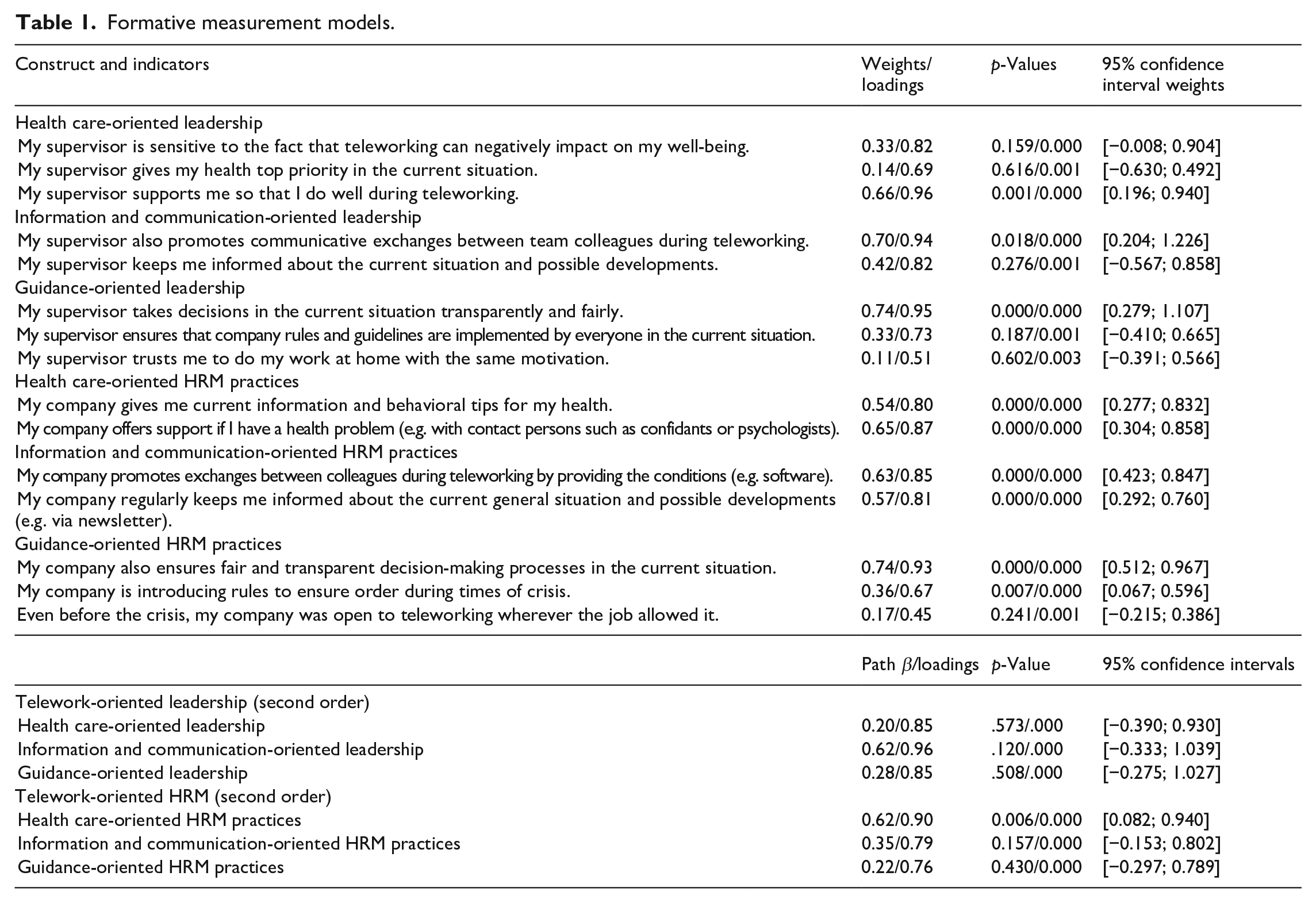
As noted, the literature has provided no information on sets of telework-oriented HRM practices and leadership behaviors that specifically fit into the context of the COVID-19 pandemic. Thus, our measures for telework-oriented HRM and leadership were largely self-developed items. However, where possible, we selected and adapted items from previous research that fit the abovementioned domains. For instance, information and communication-oriented HRM practices were measured by two items based on Jensen et al. (2013). Health care-oriented leadership items represent the categories perception, importance, and action from the health-oriented leadership scale (Franke et al., 2014). Following Beijer et al. (2021), we used descriptive instead of evaluative items in order to avoid problems with common method variance regarding the use of affectively loaded outcomes such as satisfaction and engagement. Further, since employees can differ in their evaluations of HRM and leaders(hip) based on their individual experiences, values, and expectations (Den Hartog et al., 2004), we chose to measure our independent and dependent variables based on employees’ individual perceptions, which are more likely to predict their attitudinal and behavioral outcomes (for the full items list, see Table 1 and the supplementary material). In line with our abovementioned considerations, we conceptualized telework-oriented HRM and leadership as higher-order constructs, where individual HRM practices and leader behaviors formatively operationalize the domains of HRM practices and leadership behaviors (i.e. health, information and communication, and guidance), which in turn formatively operationalized the overall constructs.
Formative measurement models.
Happiness well-being was conceptualized as a reflective higher-order construct consisting of job satisfaction and work engagement. Job satisfaction was measured using a single item (Overall, I am satisfied with my job in the current situation). Wanous et al. (1997) showed that job satisfaction can be measured in a valid, reliable way as a single-item measure. Work engagement was measured reflectively using a three-item short form of the Utrecht Work Engagement Scale (Schaufeli et al., 2019), covering three dimensions: vigor, dedication, and absorption (e.g. At my work at home, I feel full of energy). The Cronbach’s α of work engagement and happiness well-being were 0.71 and 0.75.
Social isolation was measured using a scale developed by Golden et al. (2008), with In telework, I miss face to face interaction with my colleagues as an example item. We excluded the first item due to a poor factor loading, considering its effect on content validity. This exclusion increased the composite reliability (CR) and average variance extracted (AVE) above their desired thresholds to ensure the measure’s reliability and validity (Hair et al., 2017). The Cronbach’s α was 0.84.
Psychological strain was measured using a German version of the 12-item General Health Questionnaire (Linden et al., 1996), of which we used seven items that applied to the teleworking situation (e.g. Since I have been working from home owing to the COVID-19 crisis, I have the feeling of being under constant pressure). We excluded one item due to a poor factor loading, considering its effect on content validity. This exclusion increased CR and AVE above their desired thresholds, to ensure the measure’s reliability and validity (Hair et al., 2017). The Cronbach’s α was 0.81.
All the abovementioned measures were scored on a scale between 1 (strongly disagree) and 5 (strongly agree).
Further, we included control variables that were relevant to our dependent variables from previous studies or to which we suspected a relationship in our research area. These included individual variables such as age (Heiden et al., 2020) and gender (Gajendran and Harrison, 2007) as well as job characteristics such as company size, employment status, and branch (Schabracq et al., 2004). In addition, we expected employees’ workload in teleworking, the proportion of their working hours doing teleworking before and during the pandemic, their individual difficulty to arrange their work and private life while teleworking (WLB), and their childcare demands to impact on their well-being. We also controlled for whether participants had leadership responsibilities, as leaders’ increased challenges due to teleworking may have had an increased impact on their well-being (Park and Cho, 2020). Since the situation during the data collection period may have changed rapidly owing to the crisis, we also controlled for the participation date by converting the dates in the participation period into numeric values that form a metric variable where higher values represent a later time of participation during the participation period.
Analysis
Following Nielsen and Raswant’s (2018) recommendations, we first estimated an initial control model involving all the abovementioned control variables. Next, we excluded all the control variables from this model that did not significantly influence any of the well-being constructs. Finally, the associations between the dependent constructs and telework-oriented HRM and leadership were added to the control model (Figure 2).
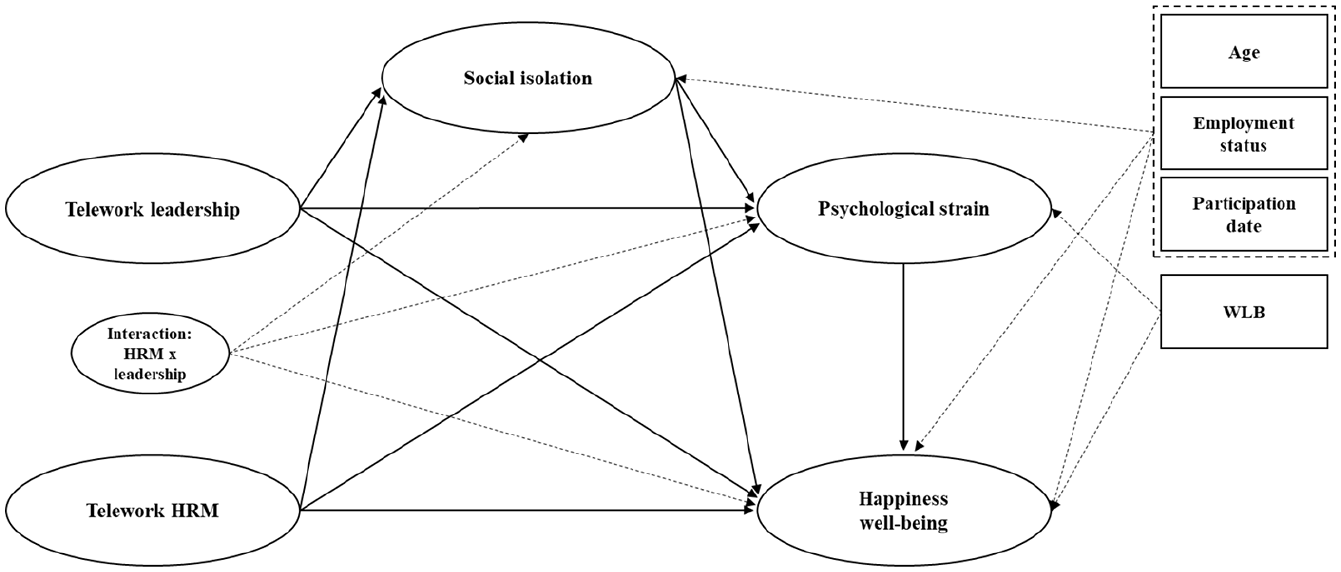
Conceptual model.
To test our final model, which contains reflective and formative second-order constructs as well as moderation and multiple mediation effects, we chose partial least squares structural equation modeling (PLS-SEM) employing the software SmartPLS 3 (Ringle et al., 2015). PLS-SEM is well established in HRM research and was particularly useful, since we analyzed data from an unknown population and conceptualized telework-oriented HRM and leadership as formative-formative higher-order constructs using the repeated indicator approach (Ringle et al., 2020). We obtained PLS-SEM results using the following settings in all steps of the analysis: path weighting scheme, 300 iterations, stop-criterion 0.0000001, and replaced missing values by the mean value. We determined the significance by applying the bootstrapping procedure with the following settings: 5000 subsamples, as many observations per subsample as in the original sample, and the no sign change option. Interactions were modeled using the two-step approach utilizing the latent variable scores of the latent predictor and latent moderator variable from the main effects model.
Results
Measurement models
We followed the recommendations for the evaluation of reflective measurement models in the PLS-SEM literature (Hair et al., 2017). To ensure our measures’ validity and reliability, we evaluated their indicator reliability, internal consistency, and convergent and discriminant validity. Social isolation has one item whose outer loading fell slightly below the desired threshold of 0.708. Nonetheless, AVE = 0.55 and CR = 0.88 were satisfactory (Hair et al., 2019). This also applied to three items of psychological strain (AVE = 0.52; CR = 0.86). Thresholds were also met for work engagement (AVE = 0.63; CR = 0.84). The discriminant validity between all constructs was ensured using the heterotrait-monotrait (HTMT) criterion and the bootstrapping procedure. All scales had a value significantly below 0.85.
The lower-order and higher-order formative measurement models were evaluated based on multicollinearity and their relevance for the formative construct (Hair et al., 2019). None of the variance inflation factor (VIF) scores indicated a problem of multicollinearity, with all having a value below the conservative threshold of 3.33 (Diamantopoulos and Siguaw, 2006). Since some of the lower-order and higher-order weights of the indicators and composites of telework-oriented HRM and leadership were not significant, their absolute contribution had to be considered (Hair et al., 2017). In the lower-order formative constructs, one item had a factor loading slightly below the threshold of 0.5, but was retained in the model owing to the significance of its loading. In a second-order formative construct, the loadings of the indicators for the higher-order construct were represented by their path regression coefficients/bivariate correlations with the higher-order construct. All factor loadings were >0.5 (p < 0.001), indicating that no indicators had to be removed and that absolute relevance can be assumed. Overall, these results confirmed the measurement model quality of our analyses.
Structural model
The final control model, which contains the remaining control variables age, WLB, employment status, and participation date, explained 5.9% of the variance in social isolation and 27.9% in psychological strain. Further, the final control model explained 11.8% of the variance in happiness well-being.
Table 2 provides the results for the full model. Overall, the model explained 14.2% of the variance in social isolation and 46.1% in psychological strain. Further, it explained 41.0% of the variance in happiness well-being. All values significantly exceeded the variance explained by the control model. In addition, the model demonstrated predictive relevance for all three dependent constructs with Q2 values above 0.
Results for final model.
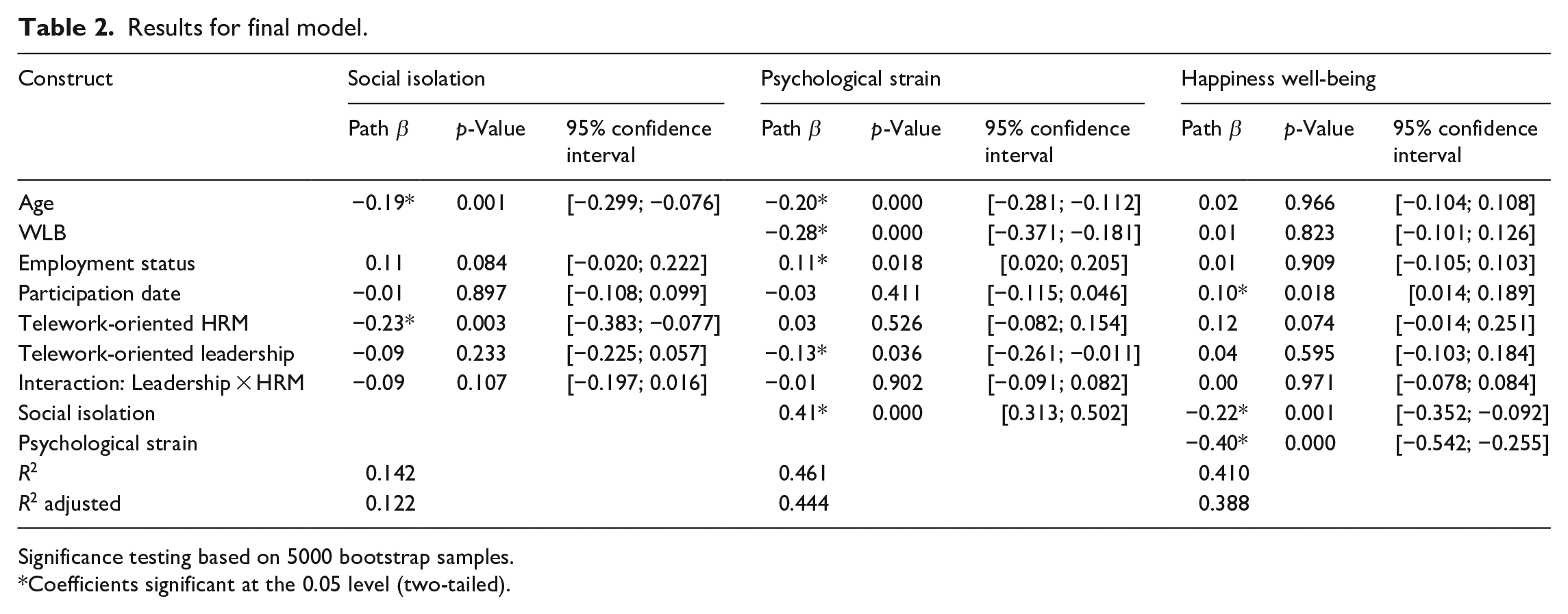
Significance testing based on 5000 bootstrap samples.
Coefficients significant at the 0.05 level (two-tailed).
Telework-oriented HRM and telework-oriented leadership were not directly related to happiness well-being, leading us to reject Hypothesis 1 and 2. However, telework-oriented HRM demonstrated a positive total effect (β = 0.20; p = 0.006) and telework-oriented leadership a total indirect effect (β = 0.09; p = 0.030) on happiness well-being (Table 3).
Total, direct, indirect and specific indirect effects of telework-oriented HRM and leadership.
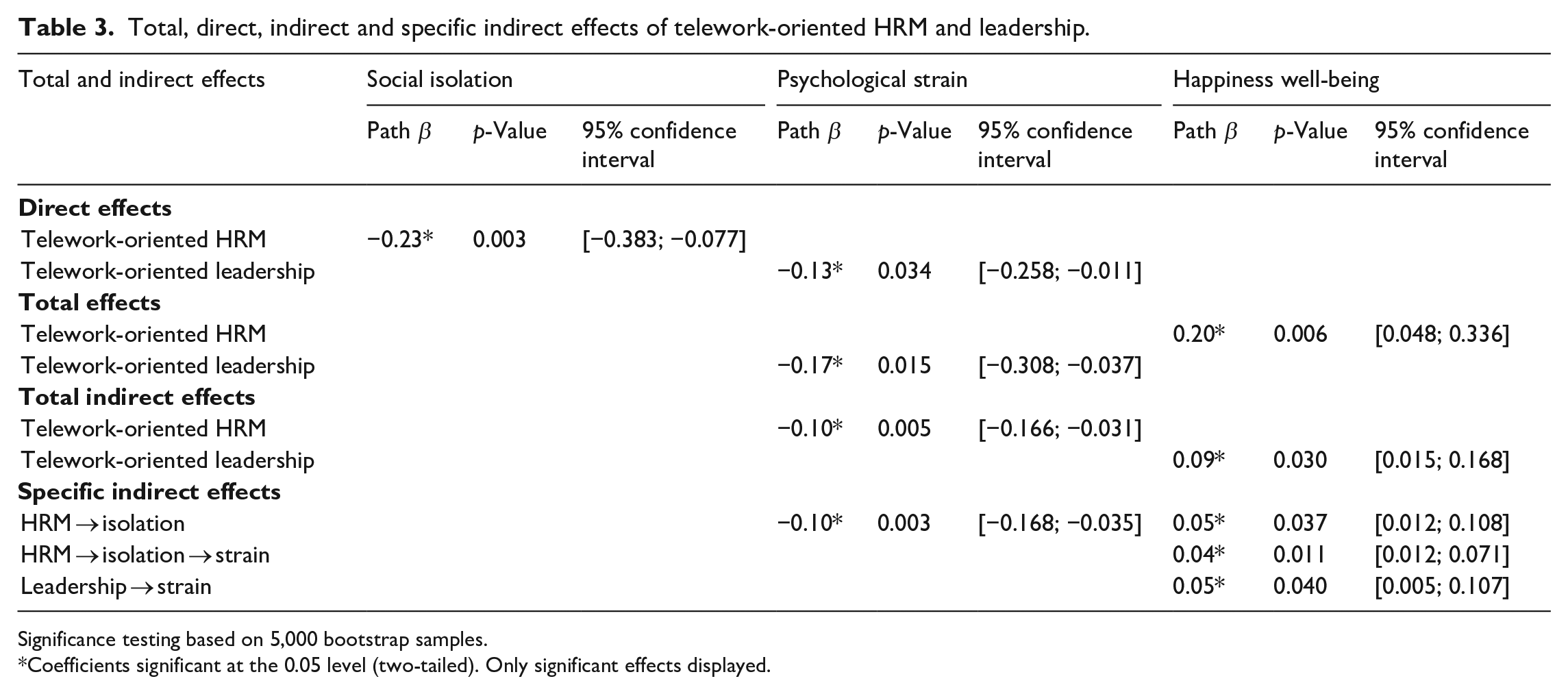
Significance testing based on 5,000 bootstrap samples.
Coefficients significant at the 0.05 level (two-tailed). Only significant effects displayed.
The results showed that psychological strain did not mediate the relationship between telework-oriented HRM and happiness well-being, leading us to reject Hypothesis 3. Strain mediated the relationship between telework-oriented leadership and happiness well-being (specific indirect effect: β = 0.05; p = 0.040), supporting Hypothesis 4. Next, social isolation mediated telework-oriented HRM’s effect on happiness well-being (specific indirect effect: β = 0.05; p = 0.037), supporting Hypothesis 5, but not between telework-oriented leadership and happiness well-being via social isolation, leading us to reject Hypothesis 6. Further, we also found that strain mediated the relationship between social isolation and happiness well-being, supporting Hypothesis 7 and resulting in a specific indirect effect of telework-oriented HRM on happiness well-being via isolation and strain (β = 0.04; p = 0.011). We do not find that isolation mediates the relationship between leadership and happiness well-being.
We further hypothesized that telework-oriented leadership reinforces the relationship between telework-oriented HRM and social isolation, strain, and happiness well-being. The data did not support the existence of interaction effects between telework-oriented HRM and leadership, leading us to reject Hypothesis 8.
Another aim was to gain a more detailed insight into which specific domains of HRM and leadership were the most relevant for increasing teleworker well-being. To explain teleworker happiness well-being, health care-oriented HRM practices were the strongest predictor within telework-oriented HRM (β = 0.62). Within telework-oriented leadership, information and communication-oriented leadership had the highest coefficient (β = 0.62) (see Table 1).
Discussion
Implications for theory and research
By identifying and testing, whether specific telework-oriented HRM practices and leadership behaviors were able to support teleworker well-being in the beginning of the COVID-19 pandemic, our study contributes to the novel research stream into the COVID-19 pandemic’s effects and its consequences for management. Building on the JD-R framework, our results highlighted the importance of the implementation and use of such situation-specific practices and behaviors that were positively related to teleworker well-being in the beginning of the pandemic. Further, our findings also provide detailed insights into these efforts’ specific functionalities regarding teleworkers’ happiness, health, and relational well-being, as well as their interrelationships.
Teleworking in the beginning of the COVID-19 pandemic led to various challenges that threatened employee well-being. It is hard for companies to react to such unexpected, sudden, and new situations, since their unpredictability hinders the establishment of preventive mechanisms and the use of experiences from the past. Our findings suggest that the JD-R framework (Bakker and Demerouti, 2007) may be particularly suited to identify immediate actions that can support employee well-being in unexpected situations. Based on the challenges and risks that arise in certain situations, companies can develop actions that provide resources to meet their employees’ specific needs. Although we did not control for the general quality of HRM and leadership, this is also in line with the Demand-Induced Strain Compensation (DISC) model, which extends the JD-R’s logic by considering contextual issues. De Jonge and Dormann (2006) argued that job resources’ effects depend on the nature of the job demands that prevail in a specific context and assume that they are most efficient when demands and resources match one another. Thus, sets of HRM practices and leadership behaviors that are adapted to a specific situation may be more effective or even necessary in contexts with different and unique demands.
Following the idea that well-being is a multidimensional construct (Grant et al., 2007; Van de Voorde et al., 2012), we included different dimensions of well-being into our model and considered potential mediating mechanisms between them. We identified several indirect effects that fully explained the relationships between telework-oriented HRM and telework-oriented leadership with happiness well-being. First, since lower feelings of social isolation related to higher perceptions of happiness well-being, telework-oriented HRM practices affected happiness well-being by their relationship to social isolation. Second, social isolation was also linked to teleworker strain. Since strain was related to happiness well-being, telework-oriented HRM practices were also linked to happiness well-being via the relationship between social isolation and teleworker strain. Teleworkers who felt less socially isolated may have been able to discuss work related issues, share emotions, and fulfill their work tasks, developing greater feelings of engagement with and satisfaction toward their work. Ensuring social interactions may have also met teleworkers’ need for social affiliation and led to possibilities for guidance and feedback, which related to the perception of stress. Third, we found a link between telework-oriented leadership and happiness well-being that was fully explained by the relationship between leadership and psychological strain, indicating that employees who could cope with stressors did not need to protect their individual resources and thus could become more engaged with their work (Anthony-McMann et al., 2017). In sum, these results support the necessity to integrate different well-being dimensions to better understand how HRM and leadership can contribute to employee well-being.
Further, by considering different dimensions of employee well-being and analyzing the joint effects of HRM and leadership, we could also show that HRM and leaders(hip) differ in their relationships with different dimensions of well-being in the context of teleworking. In line with research on the interaction of HRM and leadership (Ehrnrooth et al., 2021; Hauff et al., 2020; Leroy et al., 2018), our guiding assumption was that telework-oriented HRM and leadership should reinforce each other. However, in contrast to this assumption, we identified several unique relationships. For instance, we saw that besides its direct effect, telework-oriented HRM related to teleworker happiness well-being only through its relationship with social isolation while having no relationship with strain. The reason may be that telework-oriented HRM practices were perceived as resources that helped teleworkers to feel less socially isolated, while they did not meet the teleworkers’ specific work demands. The HRM practices were likely too distal to address teleworkers’ stressors that resulted from their individual changes in their individual private and work situations. In contrast, telework-oriented leadership was not related to teleworkers’ feeling of social isolation and only affected happiness well-being through its relationship with teleworker strain. A reason may be that the feeling of social isolation was mainly affected at the organizational level where the provision of information and opportunities for communication were more impactful than the behaviors of leaders who merely transmitted this information. However, leaders were much closer to their subordinates’ work-related needs, and were therefore more able to influence their perception of stress. Together, these results imply that HRM and leadership alone cannot target all aspects of teleworkers’ well-being; instead, there are independent and complementary effects where HRM and leadership are able to achieve different goals. Interestingly, although our HRM and leadership frameworks contain the same domains (the provision of health care, information and communication, and guidance), both had unique relationships to different dimensions of employee well-being. In line with the current debate about the universality of job resources (Van Veldhoven et al., 2020), this may indicate that it’s not only the presence of specific resources in terms of content that is important, but also the channels through which the resources are provided and the levels and ways in which they are perceived by employees that may determine their relationship to employee well-being.
In sum, these results have three major implications for theory and research. First, we applied the JD-R framework to the context of the beginning of the COVID-19 pandemic in order to identify telework-oriented HRM and leadership frameworks that were able to address employee well-being in this situation. Second, since we found different aspects of teleworker well-being to be interrelated and to have specific relationships to HRM and to a lesser extent leadership, the results indicated the importance of considering the happiness, health, and relational well-being of teleworkers simultaneously in order to understand teleworkers’ well-being in the context of the COVID-19 pandemic. Third, we found HRM and leadership to have unique relationships with different dimensions of teleworker well-being. This further highlighted the importance to consider HRM and leadership jointly if one is to get a holistic picture of their effects on well-being.
Implications for organizational and managerial practice
Our findings demonstrated that HRM and leadership served different functions in targeting different aspects of teleworkers’ well-being in the beginning of the COVID-19 pandemic. Although our analyses were conducted in a specific situation, their insights apply beyond our study context. First, companies and leaders should consider all aspects of teleworker well-being in order to identify adequate actions. In our context, we found that telework-oriented HRM and leadership related to happiness well-being via different mechanisms. For instance, our results indicated that HRM practices were related to lower feelings of social isolation and strain, which in turn were linked to increased happiness well-being. Thus, organizations should bear in mind that a desired outcome may not be achieved directly, but only through other means.
Furthermore, we found different domains of HRM and leadership to make different contributions to their respective frameworks and thus a different relationship with the dimensions of teleworker well-being. In the beginning of the pandemic, the provision of health care, for instance through contact persons or health-relevant information, contributed most to telework-oriented HRM’s relationship with social isolation and happiness well-being. Leaders should be aware that their behaviors are linked to teleworker happiness well-being via strain; further, our results indicated that ensuring communication and information exchanges between teleworkers was the most effective way to do so. These results indicated that companies should be aware that, although different kinds of actions may be necessary to address employee well-being, they are not equally effective. Thus, companies should follow an analytical approach and should seek to identify and prioritize the domains that contribute most to the impacts of their HRM systems and leadership styles.
Limitations and future research
Although we have shed light on the relationships between HRM, leadership, and well-being for teleworking in the beginning of the COVID-19 pandemic, our results have limitations, which offer potential for future research. First, we focused on the immediate threats to teleworker well-being in the beginning of the pandemic and did not consider long-term-oriented actions. However, in the long term, HRM practices such as recruitment, training, or long-term career planning can become key tools for developing a workforce with high adaptability and resilience to teleworking’s demands (Caligiuri et al., 2020). Thus, future research should consider a broader perspective on HRM and leadership when analyzing their effects in the context of teleworking. Further, since the negative effects of telework may increase when it exceeds a certain amount of time in a week (Gajendran and Harrison, 2007) it remains unclear whether our findings also apply to a situation with alternating teleworking and working in the workplace. Similarly, we did not study teleworking’s long-term effects. Interestingly, we found the date of participation in the study to be positively linked to happiness well-being, which could be explained by the occurrence of habituation effects. For further examination, more measurement time points would have been needed.
Regarding the methodology, a further limitation is the self-reported nature of our measures, which bears the potential risk of having common method variance. However, since employees’ perceptions and managers’ ratings don’t necessarily coincide (Den Hartog et al., 2004), we chose to solely use employees’ perceptions to measure the independent and dependent variables, which are more likely to be predictive of employees’ own attitudinal and behavioral outcomes (Beijer et al., 2021). Nonetheless, collecting multilevel data and contrasting employees’ answers to evaluations by their leaders and HR managers would add further information and prevent the potential occurrence of perceptual filters. Next, although we derived our measurements from the literature, we had to self-develop or adapt the wording of the items to fit our specific study context. Not using well-established scales carries the risk of having measures with poor psychometric quality, which can limit the findings’ validity. Nonetheless, we could show that our reflective and formative measurement models met the criteria for internal consistency reliability as well as convergent and discriminant validity in our dataset. Still, pretesting and validating our measures in an independent sample would have further improved their quality. Implementing a reflective measure of HRM and leadership using different indicators would have allowed us to conduct redundancy analysis so as to have a stronger argument for our formative measures’ convergent validity (Hair et al., 2020). Furthermore, although we implemented a time-lag, the implications we derived from our results must be treated with caution, since our study design did not allow for causal interpretation. Next, we encountered a relatively high dropout between the two questionnaires (56.3%). A comparison of the means of all constructs between the sample consisting of all participants (n = 599) and the sample with the participants in both waves (n = 262) revealed no evidence of systematic patterns that would indicate nonrandom missing data. We assume that an absence of commitment (Laurie et al., 1999) or the fact that in some cases employees had to return to work quickly in the early days of the pandemic (before governments urged companies to allow for long-term teleworking) are responsible for the high dropout rate.
Our findings suggest additional opportunities for future research. First, from a conceptual perspective, we modeled HRM and leadership as overall constructs that predict teleworker well-being. However, it may be possible that certain aspects of HRM or leadership may compensate for those of the other or, in contrast, there may be aspects that are required for teleworker well-being that cannot be compensated of when absent–so-called necessary conditions (Hauff et al., 2021). Further, concerning the direction of effects between the different dimensions of well-being, one could also argue that a reduction in happiness well-being is not caused by the absence of strain and social isolation, but leads to them. There is also a research field about the direction of the relationship between job satisfaction and work engagement (see Rothmann, 2008). Researchers should therefore consider different conceptualizations of HRM and leadership, and should model job satisfaction and work engagement independently to account for different directions of causation. Moreover, future research could further test the JD-R framework’s suitability for the identification of context-specific resources. While we found direct relationships between resources and well-being outcomes, we did not test for the interactions between demands and resources (buffer effect) described in the JD-R literature (Bakker and Demerouti, 2007).
Since we also found that older employees feel less stressed and socially isolated in the context of the COVID-19 pandemic, future studies could also consider the roles of a much broader range of variables. For instance, individual differences in personality or the organizational culture may be related to the perception of well-being in teleworking. Also, not everyone had a job that allowed for teleworking during the pandemic. Since this can also be the case within an organization, HRM and leaders face the additional challenges of managing diverse groups where constructs such as fairness may be relevant, especially during times when going to work is a potential risk (Mahler, 2012). Thus, future research should implement such variables so as to add even more detail to the picture.
Supplemental Material
sj-docx-1-gjh-10.1177_23970022221083694 – Supplemental material for The joint role of HRM and leadership for teleworker well-being: An analysis during the COVID-19 pandemic
Supplemental material, sj-docx-1-gjh-10.1177_23970022221083694 for The joint role of HRM and leadership for teleworker well-being: An analysis during the COVID-19 pandemic by Niklas Günther, Sven Hauff and Philip Gubernator in German Journal of Human Resource Management: Zeitschrift für Personalforschung
Footnotes

References
Supplementary Material
Please find the following supplemental material available below.
For Open Access articles published under a Creative Commons License, all supplemental material carries the same license as the article it is associated with.
For non-Open Access articles published, all supplemental material carries a non-exclusive license, and permission requests for re-use of supplemental material or any part of supplemental material shall be sent directly to the copyright owner as specified in the copyright notice associated with the article.
