




Abstract
Information and communication technologies facilitate connectivity to work-related matters after official working hours. Therefore, more and more employees engage in technology-assisted supplemental work (TASW) during recovery time. However, research on the association between TASW and well-being has shown mixed results. To shed further light on this relationship, we tested a moderated mediation model. Drawing upon the extended stressor-detachment model (Sonnentag and Fritz, 2015), we proposed that psychological detachment mediates the relationship between TASW and well-being (i.e. affect and vigor). Further, we expected appraisal to moderate the relationship between TASW and psychological detachment, as well as cognitive coping to moderate the relationship between psychological detachment and well-being. To test these hypotheses, we analyzed daily diary data from 100 employees. As hypothesized, daily psychological detachment after hours mediated the positive association between daily TASW and daily negative affect at bedtime. Contrary to expectations, daily TASW was not significantly related to daily positive affect at bedtime and daily vigor in the next morning. Additionally, we found no support for the moderating roles of appraisal and cognitive coping. These results suggest that TASW can be associated with negative well-being states via impaired recovery, but that further studies are needed to explore the ambiguous outcomes of TASW. We discuss practical implications and future research avenues regarding individual differences in the experience of TASW.
Keywords
Work has become increasingly accessible independent of official working hours or the confines of an office (Davis, 2002). This is due to the digitization of work processes and the invention of information and communication technologies (ICTs) like laptops and smartphones. Such devices make it possible for employees to access job-related information and perform work tasks at times that are predominantly reserved for leisure and relaxation, such as evenings and weekends. Around 60% of members of the German workforce engage in work-related tasks during leisure time at least once a week (Institut zur Zukunft der Arbeit, 2018). This suggests that checking e-mails before going to sleep or working on a presentation after dinner is common practice rather than an exception for a large part of the working population. Such behavior can be characterized as technology-assisted supplemental work (TASW). Fenner and Renn (2010) introduced this term and defined TASW as job-related activities that are performed at home after regular working hours via ICTs.
As the number of employees engaging in TASW increases steadily (Arlinghaus and Nachreiner, 2014), the topic is gaining growing scholarly attention. Researchers agree that TASW can increase temporal and spatial flexibility while, at the same time, it can blur work-life boundaries and interfere with recovery time (Bliese et al., 2017). However, findings on the relationships of TASW with employee recovery and well-being are mixed (for recent reviews, see Ďuranová and Ohly, 2016; Schlachter et al., 2018). This suggests the “important role of third variables, like cognition and/or personal [. . .] factors in the TASW-recovery/well-being process. These third variables might determine if TASW leads to positive or negative outcomes” (Ďuranová and Ohly, 2016: 76). To this point, individual differences that determine whether employees either benefit or suffer from TASW remain largely unknown. In particular, so far no attention has been paid to the potential moderating roles of appraisal and job-related thoughts, even though reviews have mentioned this possibility (Ďuranová and Ohly, 2016; Schlachter et al., 2018).
Using the extended stressor detachment model (extended SDM; Sonnentag and Fritz, 2015) as a theoretical lens, the present study aims to address this gap. We examine whether appraisal and job-related thoughts moderate the associations of TASW with employee recovery and well-being. The basic SDM states that job stressors like TASW prevent employees from psychologically detaching from work. Psychological detachment (hereafter detachment) is defined as a state of distancing oneself mentally from job-related thoughts during non-work time (Sonnentag and Bayer, 2005). Higher levels of detachment, in turn, are related to higher well-being (e.g. Feuerhahn et al., 2014). Thus, detachment mediates the negative relationship between job stressors and well-being (e.g. Ten Brummelhuis and Bakker, 2012). Accordingly, previous studies on TASW have shown that TASW is negatively related to well-being via detachment (e.g. Derks et al., 2014). Applying a daily diary approach, we aim to replicate these findings by investigating whether detachment after work mediates the relationships between employees’ TASW and affect at bedtime and vigor in the next morning, respectively.
Importantly, the extended SDM (Sonnentag and Fritz, 2015) proposes that job stressors such as TASW are not equally associated with detachment for all employees. Rather, the association depends on how harmful a job stressor is perceived (i.e. primary appraisal) and on the perceived availability of coping resources (i.e. secondary appraisal; Lazarus and Folkman, 1984). Drawing on these theoretical assumptions, we assume that employees who consider TASW as less harmful for their well-being and who have more coping resources will find it less difficult to detach due to TASW and, in turn, experience higher well-being.
Finally, Sonnentag and Fritz (2015) argue that the positive association between detachment and well-being can be weaker when job-related thoughts are used for cognitive coping (Carver et al., 1989; Lazarus and Folkman, 1984). We test this assumption by exploring whether daily cognitive coping moderates the association between daily detachment and daily well-being, such that the positive association is weaker when cognitive coping is high. Thereby, as advised by Ďuranová and Ohly (2016), we control for workload as an established work demand. Figure 1 depicts our conceptual model. To better understand the nature of TASW and to explore possible outcomes, we conducted a qualitative interview study before the quantitative data collection. Results of the 10 interviews provided initial support for our theoretical assumptions as participants reported a lack of detachment and both positive and negative well-being as a result of TASW. This mirrors the mixed findings on the well-being consequences of TASW and underlines the potentially important role of moderators as suggested in the present study. Detailed information on the method and results of the qualitative study are presented in the Supplemental Material (S1) in the Open Science Framework OSF. 1
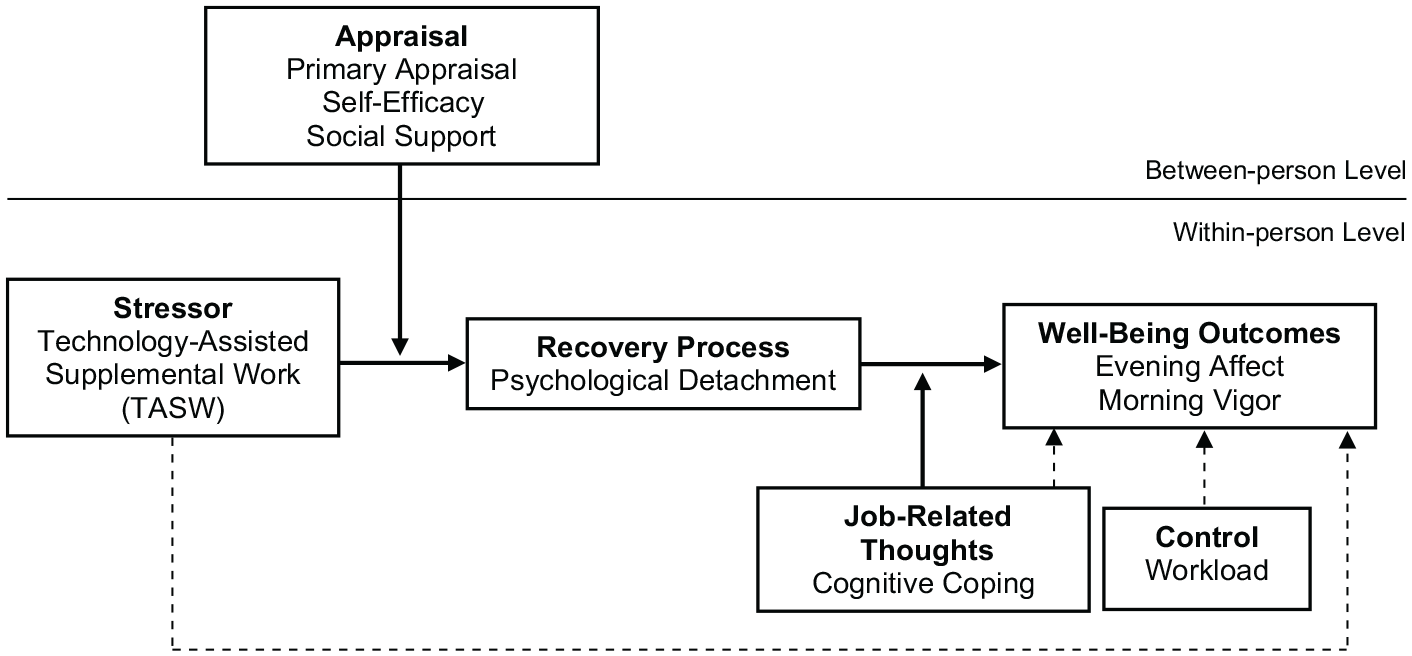
Conceptual model. The relationship between TASW and well-being is mediated by psychological detachment. Appraisal and cognitive coping moderate these relationships. Solid lines represent hypotheses. Dotted lines represent effects controlled for.
We intend to make three contributions to scholarly knowledge. First, we follow the call for research on the moderating role of appraisal and job-related thoughts in the TASW – recovery/well-being process (Ďuranová and Ohly, 2016; Schlachter et al., 2018). This individual difference perspective is important to develop tailored recommendations and training regarding the handling of TASW. Second, we aim to replicate previous findings on the mediating role of detachment in the TASW-well-being relationship within a diary design, which allows examining daily experiences of individuals (Ohly et al., 2010). This is important as the conclusions of other studies on the topic are partly limited by the cross-sectional nature of the investigations (e.g. Ward and Steptoe-Warren, 2014). In particular, such designs are problematic because they do not capture the dynamic nature of TASW and well-being. Third, we test the extended SDM (Sonnentag and Fritz, 2015) empirically. To our knowledge, there are only few studies that have done so (e.g. Haun et al., 2018; Schulz et al., 2019), despite the high impact of the article (i.e. 263 citations according to Web of Science 2 ).
From a practical point of view, the results of the present study will inform employees and organizations about the outcomes of TASW, enabling them to develop a sustainable and responsible handling of TASW. This is especially important as the use of TASW will likely continue to increase in the future. Additionally, TASW is receiving more and more attention in legislation and organizational policies, making it particularly important to intensify research on TASW and advise future practice accurately.
Theoretical background and hypothesis development
We draw on the extended SDM (Sonnentag and Fritz, 2015) to develop our hypotheses. The extended SDM combines the basic SDM with transactional stress theory (Lazarus and Folkman, 1984). The basic model assumes a mediating role of detachment in the relationship between job stressors and well-being. The extended SDM introduces appraisal and cognitive coping as moderators of these relationships. In the following, we will explain the model in further detail and use it to justify our hypotheses. Please note that we preregistered our hypotheses and methods using the Open Science Framework OSF. 3
TASW and well-being: the mediating role of detachment
Detachment is essential for recovery (Sonnentag and Fritz, 2007). Mentally detaching from work during recovery periods and engaging in non-work activities like sports facilitates the replenishment of resources that were depleted by the job. A lack of detachment entails the prolonged mental preoccupation with work-related issues, which impairs the recovery process (Sonnentag and Fritz, 2015). As recovery is essential for employee well-being (e.g. De Bloom et al., 2015), the basic SDM proposes that high detachment from work during non-work time predicts better well-being on a daily basis. This is supported by a growing body of empirical evidence. For example, in a daily diary study, Feuerhahn et al. (2014) showed that more detachment during the evening was related to higher positive affect and lower negative affect at bedtime.
The important process of detaching after work can be impaired by job stressors. Stressors are factors in the work environment that may lead to strain reactions (Kahn and Byosiere, 1992). The basic SDM proposes that job stressors are associated with an increase in negative activation (e.g. Volmer et al., 2012). This makes it more likely that employees stay mentally occupied with job-related issues after work and find it difficult to detach. Research bolsters this assumption and shows that various job stressors are negatively related to detachment (for a meta-analytic review, see Wendsche and Lohmann-Haislah, 2017). Overall, the SDM proposes that job stressors are negatively related to employee well-being through the process of detachment, which is supported by related research. For example, a daily diary study by Ten Brummelhuis and Bakker (2012) showed that detachment mediated the negative association of work activities in the evening with vigor in the following morning.
Sonnentag and Fritz (2015) describe TASW as a job stressor in the context of the SDM. Engaging in TASW automatically reduces the time available for detachment and recovery. Furthermore, being mentally pulled back to work-related issues due to TASW makes it likely that the mind sticks with job-related thoughts for a while which impedes detachment. We therefore expect detachment to function as process through which TASW is negatively related to well-being. Previous research has not only linked TASW to low detachment but also showed that high TASW was associated with more work-related exhaustion (e.g. Derks et al., 2014), and lower general well-being (Ward and Steptoe-Warren, 2014) via detachment. Following the SDM and in line with previous results on TASW, we assume that on days when employees engage in more TASW, they are less likely to experience detachment, resulting in lower well-being. Consistent with many diary studies (Sonnentag and Fritz, 2015), we selected evening positive and negative affect and morning vigor as indicators of employee well-being. On this basis, we present the following hypotheses:
Hypothesis 1a: The negative relationship between TASW and evening positive affect is mediated by psychological detachment.
Hypothesis 1b: The positive relationship between TASW and evening negative affect is mediated by psychological detachment.
Hypothesis 1c: The negative relationship between TASW and morning vigor is mediated by psychological detachment.
The moderating roles of primary and secondary appraisal
Although empirical evidence largely supports the basic SDM, Sonnentag and Fritz (2015) suggest that the relationships of the model might differ between individuals and within individuals across different situations. Therefore, they drew on transactional stress theory (Lazarus and Folkman, 1984) to derive an extended version of the basic SDM. According to transactional stress theory, the experience of stress differs between individuals, as it is influenced by primary and secondary appraisal (Lazarus and Folkman, 1984). Primary appraisal involves whether individuals consider a situation as harmful for their well-being or not. When a situation is perceived as harmful, this leads to stress reactions. Sonnentag and Fritz (2015) assume that when a job stressor is considered as harmful for well-being, this will make it more difficult to mentally disengage from the job stressor. When negative well-being consequences are expected, employees will experience more negative activation. As a result, employees will more likely keep worrying about the stressor, remain mentally stuck with work and, in turn, detach less. For example, when employees are assigned a strenuous task they will probably keep ruminating about this task in case it interferes with their non-work plans.
Secondary appraisal concerns an individual’s perceived availability of coping resources. When employees can rely on more coping resources, for example in the form of high self-efficacy or social support, it is easier for them to cope with stressful situations. As a result, a situation is experienced as less stressful when perceived coping resources are high. In the extended SDM, Sonnentag and Fritz (2015) propose that when coping resources are low, employees will feel more overwhelmed by work-related stressors. For example, when employees neither trust their own skills nor have others’ support for managing work-related stressors, they will be more concerned about job stressors. As a result, employees will more likely ruminate about work-related stressors after hours, and, in turn, detach less. Overall, Sonnentag and Fritz (2015) assume that both primary and secondary appraisal can moderate the relationship between job stressors and psychological detachment.
For TASW as a job stressor in the sense of the extended SDM (Sonnentag and Fritz, 2015) we adopt this line of argumentation. Specifically, we consider primary and secondary appraisal on a dispositional basis as both have a meaningful dispositional dimension (Roesch and Rowley, 2005). Additionally, Sonnentag and Fritz (2015) and Ďuranová and Ohly (2016) suggest that appraisal depends on stable individual characteristics.
We argue that, in case TASW is considered as harmful for well-being (i.e. primary appraisal), engaging in TASW will be experienced as more aversive and stressful. As a result, it will be more difficult to let go of work-related thoughts and to focus on leisure activities afterwards. Differences in the primary appraisal of TASW may arise from differences in attitudes and previous experiences regarding TASW. Some employees feel threatened when work-related issues spill over into their private life in form of TASW (Kreiner, 2006). Additionally, employees might have experienced morning depletion (Lanaj et al., 2014) or family conflict (Derks et al., 2016) resulting from TASW. Some employees also report physical discomfort due to TASW like headaches or eye strain (Scherer and Hatlevik, 2017). Others, however, appreciate the increased autonomy and flexibility that comes with TASW (Richardson and Thompson, 2012) and the possibility to work efficiently without being disturbed by day-to-day business demands (Diaz et al., 2012). Furthermore, TASW can be a chance to complete unfinished tasks which can be beneficial for sleep (Syrek et al., 2017). Finally, staying connected to work via TASW reduces the risk of missing out on new information, which can produce a reassuring and positive feeling (Jarvenpaa and Lang, 2005). While for some employees the positive aspects of TASW are more salient, others might focus on the dark side of TASW and consider it as more harmful for their well-being. Along this argumentation and in line with the extended SDM, we derive the following hypothesis:
Hypothesis 2: Primary appraisal regarding TASW (i.e. perceiving TASW generally as more or less harmful) moderates the negative relationship between TASW and psychological detachment, such that the relationship is stronger when TASW is perceived as more (vs less) harmful.
Furthermore, we expect that differences in the perceived availability of personal and social coping resources (secondary appraisal) will make TASW differently demanding for employees, thus functioning as second moderator of the TASW-detachment relationship. Regarding more elaborate TASW tasks (e.g. answering an e-mail, designing a presentation), employees who possess lower coping resources will experience the task as more demanding. They will need to put more effort into the task and ruminate whether the task was accomplished sufficiently or how it could further be solved. This could make disengaging from work very difficult. Concerning less time-consuming TASW tasks (e.g. checking e-mails or the calendar), employees with lower coping resources will be more likely to get caught up on the work issues that entered their mind via TASW and to worry how to meet work-related demands. In turn, it will be more difficult for them to disengage from work-related thoughts. Employees with higher coping resources, however, will be more likely to disengage afterwards, because they are more likely to be confident that they have the resources necessary for handling the work-related demands that occurred to them via TASW.
The moderating roles of social and personal resources in the relationships between job stressors and detachment and well-being, respectively, have been observed in previous studies. For example, Haun et al. (2017) found higher social support to alleviate the negative association between job demands and detachment. Further, Williams et al. (2010) found higher self-efficacy, an important personal resource, to attenuate the negative relationship between workload and employee well-being. On the basis of the theoretical assumptions of the extended SDM and consistent with these findings, we assume that employees with less personal and social coping resources will have more difficulties to mentally distance themselves from the working context after engaging in TASW, such that the negative relationship between TASW and detachment will be stronger. We included self-efficacy and social support as personal and social resources, respectively, to represent secondary appraisal, as both have been shown to be important assets in the stress process (e.g. Haun et al., 2017; Williams et al., 2010) and Sonnentag and Fritz (2015) referred to those resources in the extended SDM. To this end, we propose the following hypotheses 4 :
Hypothesis 3a: Self-efficacy moderates the negative relationship between TASW and psychological detachment, such that the relationship is stronger when perceived self-efficacy is low (vs high).
Hypothesis 3b: Social support moderates the negative relationship between TASW and psychological detachment, such that the relationship is stronger when perceived social support is low (vs high).
The moderating role of cognitive coping
Research shows that more detachment is associated with higher levels of well-being (Wendsche and Lohmann-Haislah, 2017). Nevertheless, in the extended SDM, Sonnentag and Fritz (2015) suggest that there are circumstances under which it is less harmful or even beneficial when employees think about work-related issues during nonwork time. They argue that, in case the mental connectedness to the work domain is used to engage in coping strategies like planning, problem-solving, or reinterpreting and accepting job demands in a positive way (Carver et al., 1989; Lazarus and Folkman, 1984), the positive relationship between detachment and well-being will be weaker.
Although TASW is related to prolonged thinking about job-related issues during non-work time, engaging in TASW could trigger planning solutions for work-related problems. For example, when an e-mail reminds an employee of a difficult task, this could foster developing strategies on how to solve the task like asking a colleague or looking for advice in a book. Additionally, engaging in TASW during the evening could lead employees to talking about their work issues with family and friends, who might be an important source for social support and produce further problem-solving approaches. This could, in turn, foster well-being. For example, Daniels et al. (2013) found that discussing problems with others or applying problem-solving strategies was associated with less negative affect and fatigue.
Besides planning how to meet work demands, engaging in TASW might also evoke positive and constructive reflection about work. Work demands might be less threatening when employees accept them and reinterpret them in a positive way, such as focusing on the chance to grow and gain new skills. This could, in turn, foster well-being. Our assumption is supported by research on links between positive work reflection after hours and higher positive affect (Sonnentag and Grant, 2012) and lower negative affect (Meier et al., 2016). In line with the extended SDM and these findings, we expect that detachment has a weaker positive relationship with well-being, when employees engage in cognitive coping. We therefore propose the following hypotheses:
Hypothesis 4a: Cognitive coping moderates the positive relationship between psychological detachment and evening positive affect, such that the relationship will be weaker (at high levels of positive affect) when employees use more (vs less) cognitive coping.
Hypothesis 4b: Cognitive coping moderates the negative relationship between psychological detachment and evening negative affect, such that the relationship will be weaker (at high levels of negative affect) when employees use more (vs less) cognitive coping.
Hypothesis 4c: Cognitive coping moderates the positive relationship between psychological detachment and morning vigor, such that the relationship will be weaker (at high levels of morning vigor) when employees use more (vs less) cognitive coping.
Method
Procedure and sample
The study was conducted in German-speaking countries. We recruited study participants from the first author’s personal and professional network by distributing flyers containing study information and a link to the first questionnaire. This kind of convenience sample produces similar, if not superior, results regarding internal and external validity when compared with other sampling techniques (see Demerouti and Rispens, 2014). As an incentive for participation, we offered feedback on the study results, a webinar on work-life balance, and a lottery for one 50€ gift card. Participants were asked to complete an online baseline questionnaire first, assessing demographics and appraisal. After 2 weeks, they received a diary booklet and an addressed and prepaid return envelope to be sent back with the completed material. The diary booklet included two surveys per day over one workweek: a bedtime questionnaire to be completed Mondays through Fridays before bedtime, and a morning questionnaire to be completed Tuesdays through Saturdays after waking up. Participants were only included in the study when they fulfilled the participation requirements of (a) working at least 20 hours per week, (b) having at least 3 months of work experience, and (c) regularly (at least once a week) engaging in TASW. To match baseline and daily data, participants generated a unique code used throughout the study that allowed no conclusion on person identity. Data collection was carried out from September 2019 to January 2020.
The baseline questionnaire was completed by 111 participants. Eleven persons were excluded from analyses, as they did not provide daily survey data. Using the self-reported dates, we matched bedtime data with morning data the next day for the remaining 100 participants. Of 500 possible matched and complete data points, 44 (8.8%) had to be excluded due to mismatch between evening and morning data or missing values. This resulted in a total of 456 observations and on average 4.56 out of 5 possible days per person (SD = 0.80). According to the self-reported time stamps, participants responded to the evening surveys at 10:46 p.m. (SD = 1 hour 17 minutes) and to the morning surveys at 7:19 a.m. (SD = 1 hour 21 minutes).
The final sample comprised 100 participants (58% female). They worked in a broad range of sectors, including research and development (18%), consulting (15%), and automotive (14%). The mean age was 35.27 years (SD = 10.8) with a range from 22 to 63 years and mean professional experience was 10.57 years (SD = 10.45) with a range from 3 months to 40 years. Mean working time was 40.53 hours per week (SD = 8.97) with a range from 20 to 70 hours per week. The most frequent educational level was master’s degree or diploma (71%) followed by PhD (9%) and bachelor’s degree (8%).
Measures
We used the baseline questionnaire to assess sociodemographic information and appraisal. The diary booklet measured daily study variables (i.e. TASW, detachment, evening affect, morning vigor, and cognitive coping) and the control variable (i.e. workload). All items were presented in German and, unless otherwise specified, rated on 5-point scales ranging from 1 (strongly disagree) to 5 (strongly agree). Scales with more than five answer categories in their original version were adjusted to a 5-point format to alleviate complexity for participants when filling out the diary. According to Bendig (1954), the number of scale categories does not influence the respective test reliability. Further, we adjusted scales for daily measures in case they were not developed for daily assessments in their original format. This is common practice among researchers adopting the diary methodology (see Gabriel et al., 2019). For the daily study variables, we calculated Cronbach’s α separately for the within and the between level, respectively, as recommended by Geldhof et al. (2014). Additionally, we computed 95% Bayesian credible intervals (CIs) for the reliability estimates (Geldhof et al., 2014).
Primary appraisal
We measured primary appraisal of TASW with three items adapted from the Primary Appraisal Questions of the Daily Inventory of Stressful Events (Almeida et al., 2002). Items refer to the extent that TASW is perceived as harmful for well-being. An example item is “How much do situations where you use technological devices for work purposes after hours risk your well-being and your physical health?” Items were rated on a 5-point scale ranging from 1 (not at all) to 5 (a lot). Cronbach’s α was .72.
Secondary appraisal
We measured perceived self-efficacy with the ten-item general self-efficacy scale (Schwarzer and Jerusalem, 1995). 5 An example item is “I can always manage to solve difficult problems if I try hard enough.” Cronbach’s α was .82. We measured social support with the 12-item scale of perceived social support (Zimet et al., 1988). An example item is “I get the emotional help and support I need from my family.” Cronbach’s α was .94.
TASW
We measured TASW with the four-item intensive smartphone-use scale (Derks and Bakker, 2014). Based on the result of our qualitative study that especially laptops are frequently used to engage in TASW, we extended the scale to technology-use in general, thus also including other devices like laptops or tablets. We chose this scale over the TASW scale (Fenner and Renn, 2010) as the scale by Derks and Bakker (2014) is shorter, which is especially important to improve compliance rates in diary studies (Ohly et al., 2010). Further, the scale has already successfully been used in other diary studies on TASW (see Ďuranová and Ohly, 2016). Additionally, besides the extent of TASW, the scale also covers compulsive checking behavior (“Today after work. . .when my technological devices indicated new messages from colleagues, customers or my boss, I couldn’t resist checking them”) and availability (“. . .I was available for colleagues, customers, and my boss until I went to bed”), which are related to well-being as well (e.g. Dettmers et al., 2016). The within person Cronbach’s α for TASW was .76 with a CI of [.71, .79]. The between person Cronbach’s α for TASW was .85 with a CI of [.76, .90].
Detachment
We measured detachment with the four-item psychological detachment subscale of the Recovery Experience Questionnaire (Sonnentag and Fritz, 2007). The day-level version of this scale has already been used in related diary studies (e.g. Derks et al., 2014). An example item is “Today after work I forgot about work.” The within person Cronbach’s α for detachment was .94 with a CI of [.93, .95]. The between person Cronbach’s α for detachment was .95 with a CI of [.91, .98].
Evening affect
We measured evening affect with the German version of the PANAS-X (Röcke and Grühn, 2003; Watson and Clark, 1999). The general scales for negative and positive affect contain ten items each. Participants had to specify how they felt before bedtime using adjectives like “strong” or “nervous.” Answers were given on a 5-point scale ranging from 1 (very slightly or not at all) to 5 (extremely). The within person Cronbach’s α for positive affect was .91 with a CI of [.90, .93]. The between person Cronbach’s α for positive affect was .93 with a CI of [.88, .96]. The within person Cronbach’s α for negative affect was .86 with a CI of [.84, .89]. The between person Cronbach’s α for negative affect was .94 with a CI of [.91, .96].
Morning vigor
We measured morning vigor with the five-item physical strength subscale of the Shirom-Melamed Vigor Measure (Shirom, 2003). An example item is “At the moment I feel vigorous.” The within person Cronbach’s α for vigor was .92 with a CI of [.90, .93]. The between person Cronbach’s α for vigor was .96 with a CI of [.94, .98].
Cognitive coping
We measured cognitive coping with items of the situational version of the brief COPE (Carver, 1997) and items of the long COPE (Carver et al., 1989). We selected three items for each of the two subdimensions planning and acceptance. For the dimension positive reframing, we selected two items and developed a third one. Example items are “When I was thinking about current work problems this evening. . .I’ve been trying to come up with a strategy about what to do,” “. . .I got used to the idea that it happened,” and “. . .I tried to see the opportunities that arise from this situation.” Answers were given on a 5-point scale ranging from 1 (not at all) to 5 (a lot). The within person Cronbach’s α for cognitive coping was .86 with a CI of [.83, .88]. The between person Cronbach’s α for cognitive coping was .92 with a CI of [.88, .95].
Workload
We measured workload with the three-item scale by Bakker et al. (2003). An example item is “Today I had to work extra hard to finish things.” The within person Cronbach’s α for workload was .84 with a CI of [.81, .87]. The between person Cronbach’s α for workload was .94 with a CI of [.90, .96]. 6
Analytical strategy
Since the days were nested within individuals, the structure of the data was multilevel, calling for multilevel analysis. We followed recommendations by Preacher et al. (2010) and applied path analyses in the multilevel structural equation modeling (MSEM) framework in Mplus 7.4 (Muthén and Muthén, 2017) applying the maximum likelihood (ML) estimation method. To test our hypotheses, we specified a within person mediation model with a 1-1-1 design (Preacher et al., 2010): daily detachment was modeled as a function of daily TASW. Furthermore, daily positive and negative affect, and daily vigor, respectively, were modeled as a function of daily detachment. When applying MSEM no explicit person-mean centering of predictor variables is required as the model does so implicitly by default (Preacher et al., 2010). We tested within-person indirect relationships via Monte Carlo simulation procedures as advised by Preacher and Selig (2012) to reflect the asymmetric nature of the sampling distribution of an indirect effect in multilevel models (Preacher et al., 2010). We did so by using the open source software R. We retrieved the respective R codes from the online calculator by Preacher and Selig (2010).
To test cross-level moderation effects, primary appraisal, self-efficacy, and social support were grand-mean centered (for details on centering variables regarding cross-level effects see Aguinis et al., 2013) and introduced as Level 2 predictors of the within-person random slope of daily TASW and daily detachment. We followed the approach described in Preacher et al. (2006) to test the within-level moderating effect of daily cognitive coping. We created the interaction term of daily detachment and daily cognitive coping prior to analysis and introduced it as Level 1 predictor of the outcomes. Before creating the interaction term, we person-mean centered both variables to eliminate their between-person parts, as we were solely interested in their within-person interaction. Based on a reviewer’s recommendation, we additionally applied an alternative method to test within-person moderation to check the robustness of our findings. Specifically, there are advantages of an alternative approach to within-level moderation analysis using latent interaction terms (Asparouhov and Muthén, 2020; Preacher et al., 2016). This approach decomposes within- and between-person effects more adequately and reduces bias of parameter estimates. We ran this analysis using Bayesian estimation to decrease computational complexity (Asparouhov and Muthén, 2020). We report the results of this robustness check in the results section.
Besides workload, we also controlled for the direct effects of daily TASW and daily cognitive coping on the outcomes to identify the incremental predictive values of the indirect and interaction effects. The Mplus syntax is provided in the Supplemental Material (S2). 7
Results
Confirmatory factor analysis
We ran multilevel confirmatory factor analyses (CFA) to test the psychometric distinctiveness of our variables. A 1-1-model with one factor at the within and between person level, respectively, was compared to a 7-3-model with seven factors at the within person level (TASW, detachment, positive affect, negative affect, vigor, cognitive coping, and workload) and three factors at the between person level (primary appraisal, self-efficacy, and social support). Following recommendations by Little et al. (2002), we built parcels for scales with more than five items using the items-to-construct balance technique. The 7-3-model (χ2(278) = 788.716; p < 0.001; CFI = 0.938; TLI = 0.925; RMSEA = 0.063; SRMRwithin = 0.056; SRMRbetween = 0.061) fit the data significantly better than the 1-1-model (χ2(302) = 5977.785; p < 0.001; CFI = 0.310; TLI = 0.232; RMSEA = 0.203; SRMRwithin = 0.200; SRMRbetween = 0.200; ∆χ2 = 5189.069; ∆df = 24; p < 0.001).
Preliminary analysis
We examined the degree of within-person variation of our day-level variables (1 − ICC = 1 − (σ2between person/σ2between person + σ2within person)) using the intraclass correlation coefficient (ICC) derived from intercept only models. As Table 1 shows, there was substantial between-person variation for all within-person variables, indicating the appropriateness of a multilevel approach for hypothesis testing.
Table 1 presents the means, standard deviations, Cronbach’s alphas, between-subject correlations among the study variables, and within-subject correlations among the daily measures. At the day level, TASW was significantly correlated with detachment (rwithin = −.48, p < 0.001) and detachment was significantly correlated with negative affect (rwithin = −.14, p = 0.003), but not with positive affect (rwithin = .03, p = 0.590) and vigor (rwithin = .04, p = 0.369). Furthermore, cognitive coping was significantly correlated with TASW (rwithin = .23, p < 0.001), detachment (rwithin = −.43, p < 0.001), and positive affect (rwithin = .14, p = 0.002).
Descriptive statistics and correlations of study variables.
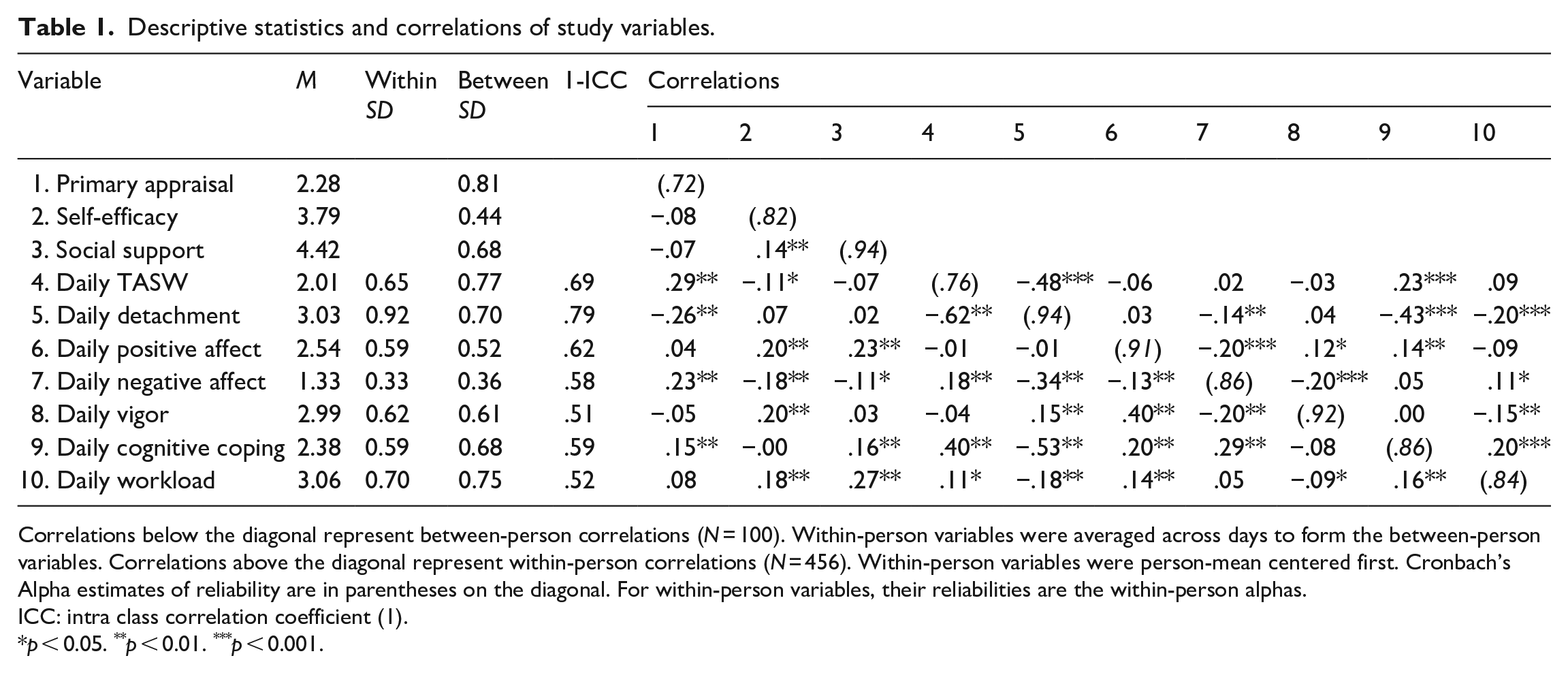
Correlations below the diagonal represent between-person correlations (N = 100). Within-person variables were averaged across days to form the between-person variables. Correlations above the diagonal represent within-person correlations (N = 456). Within-person variables were person-mean centered first. Cronbach’s Alpha estimates of reliability are in parentheses on the diagonal. For within-person variables, their reliabilities are the within-person alphas.
ICC: intra class correlation coefficient (1).
p < 0.05. **p < 0.01. ***p < 0.001.
Main effects and mediation effects
Table 2 presents parameter estimates and their 95% confidence intervals (CIs) for the overall model. Inspection of the within-person level shows that the mean value of the random slope for daily TASW on daily detachment was significant (γ = −0.64, p < 0.001). Consistent with the findings of our qualitative study, this indicates that on evenings that participants engaged in more TASW, they were less likely to psychologically detach from work-related issues. Further, the mean value of the random slope for daily detachment on daily negative affect was also significant (γ = −0.07, p = 0.004). In contrast, the mean values of the random slopes for daily detachment on daily positive affect (γ = 0.05, p = 0.222) and daily vigor (γ = 0.04, p = 0.364) were not significant. This suggests that participants experienced less negative mood before bedtime when they had detached more from work the respective evening, but they did not experience stronger positive mood or more vigor.
Unstandardized coefficients, standard errors, and confidence intervals of MSEM for testing main, mediation, and moderation effects.
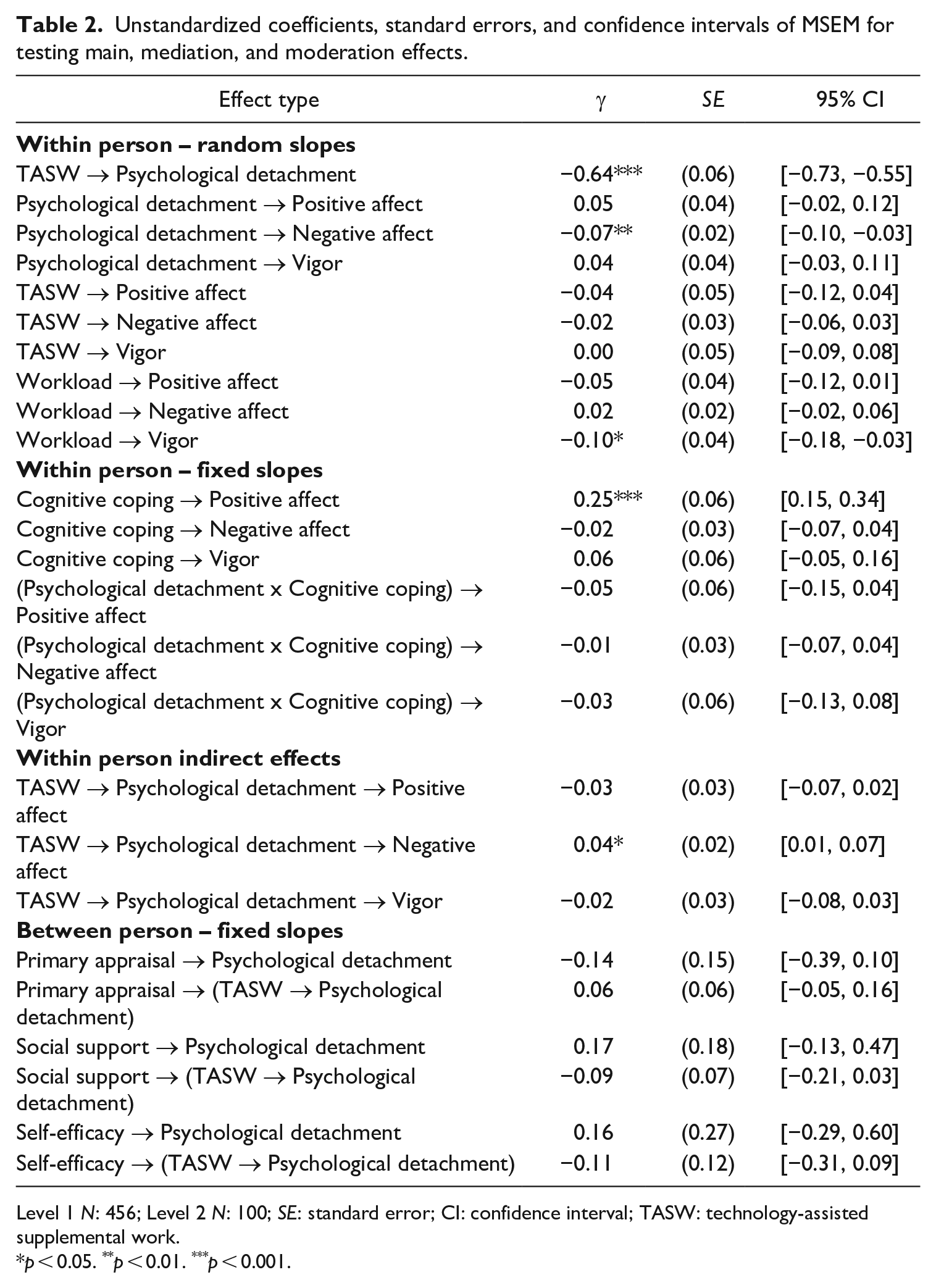
Level 1 N: 456; Level 2 N: 100; SE: standard error; CI: confidence interval; TASW: technology-assisted supplemental work.
p < 0.05. **p < 0.01. ***p < 0.001.
Using Monte Carlo simulation procedures with 20,000 replications, we found that the within-person indirect effect for TASW on negative affect via detachment was 0.04 with a 95% bias-corrected bootstrap confidence interval (CI) of [0.01, 0.07]. This finding indicates that TASW was significantly and positively related to negative affect via detachment. In contrast, the indirect effects for TASW on positive affect (γ = −0.03, [−0.07, 0.02]) and vigor (γ = −0.02, [−0.08, 0.03]) via detachment were not significant. These findings suggest that TASW was positively related to negative affect via detachment, whereas it was not related to positive affect and vigor. Thus, Hypothesis 1b was supported, whereas Hypotheses 1a and 1c were not supported.
Cross-level moderation effects
Table 2 presents parameter estimates and their 95% CIs for primary appraisal, social support, and self-efficacy as predictors of the within-person random slope between daily TASW and daily detachment. Primary appraisal was not significantly related to the random slope (γ = 0.06, p = 0.386). This finding suggests that primary appraisal did not buffer the negative relationship between daily TASW and daily detachment. Thus, there was no support for Hypothesis 2. Additionally, self-efficacy (γ = −0.11, p = 0.363) and social support (γ = −0.09, p = 0.231) were not significantly related to the random slope. This suggests that neither self-efficacy nor social support buffered the negative relationship between daily TASW and daily detachment. Thus, there was no support for Hypotheses 3a and 3b.
Level 1 moderation effects
Table 2 presents parameter estimates and their 95% CIs for the within-person joint effect of daily cognitive coping and daily detachment on the outcomes. After controlling for workload and direct effects of daily cognitive coping and daily TASW, the interaction term was not related to daily positive affect (γ = −0.05, p = 0.351), daily negative affect (γ = −0.01, p = 0.680), and daily vigor (γ = −0.03, p = 0.669). These findings imply that cognitive coping did not moderate the relationships of detachment with evening positive affect, evening negative affect, and morning vigor. Therefore, Hypotheses 4a, 4b, and 4c were not supported. However, cognitive coping was related to positive affect (γ = 0.25, p < 0.001). The results of the additional analysis with latent within-level interactions generated very similar results. The relationship between the latent interaction term and each outcome was −0.31 for daily positive affect with a Bayesian credibility interval (CI) of [−0.73, 0.01], 0.00 for daily negative affect with a CI of [−0.18, 0.16], and 0.02 for daily vigor with a CI of [−0.35, 0.42]. This underlines the robustness of our previous results. 8
Exploratory analyses
Due to the significant within-person correlations between cognitive coping and TASW and positive affect, we conducted an additional exploratory mediation analysis via Monte Carlo procedures and found that there was a positive indirect effect of TASW on positive affect via cognitive coping (γ = 0.04, [0.01, 0.07]). This indicates that on evenings that participants engaged in more TASW, they were more likely to engage in cognitive coping and, in turn, experienced more positive affect at bedtime. This finding is in line with the results of our qualitative study, which suggested that TASW can be associated with positive affective states like satisfaction and joy.
Discussion
Technological innovations have facilitated a stretch of conventional working hours. This includes performing work-related tasks via ICTs while at home during a time that is allocated to leisure and recovery from work demands. This so-called technology assisted supplemental work (TASW) is now part of everyday life for many employees. Mixed findings on the relationship between TASW and employee recovery and well-being led recent reviews on the topic to call for more research exploring which individual differences determine the outcomes of TASW (Ďuranová and Ohly, 2016; Schlachter et al., 2018). Answering this call, the aim of the present study was twofold. First, we tested the moderating roles of appraisal and cognitive coping. Second, we attempted to replicate previous findings on TASW, detachment, and well-being (i.e. affect and vigor). We conducted a daily diary study to test our hypotheses.
In line with our expectations, daily TASW was negatively related to daily detachment and daily detachment was negatively associated with daily negative affect. Furthermore, daily TASW had a positive indirect effect on daily negative affect at bedtime via daily detachment (Hypothesis 1b). This suggests that on evenings with more TASW, employees were less likely to disengage from work related issues and, in turn, experienced increased negative mood at bedtime. This result is consistent with the findings of our qualitative study which suggested that participants felt exhausted when engaging in TASW and had difficulties calming down afterwards. Our quantitative results are further in congruence with previous studies on TASW (e.g. Derks et al., 2014; Ward and Steptoe-Warren, 2014) and with the basic SDM (Sonnentag and Fritz, 2015). Furthermore, our results extend research on TASW by overcoming some of the methodological limitations of earlier studies on the topic. First, most of the afore-mentioned research applied cross-sectional designs. This is problematic because such designs do not capture daily fluctuations of TASW and well-being. By adopting a daily diary design, we attempted to reduce the retrospective bias and to examine individuals’ thoughts and feelings more accurately (Ohly et al., 2010). Second, this is the first study on TASW applying a paper-pencil design. We did so to avoid that online study participation would accidently draw participants’ attention to work-related messages and bias the assessment of TASW.
Unexpectedly, there was no direct relationship between daily detachment and daily positive affect before bedtime and daily vigor in the next morning, respectively. In turn, there was no association between daily TASW and daily positive affect and daily vigor, respectively, via daily detachment (Hypotheses 1a and 1c). This means that although higher detachment was associated with less negative affect, it was not associated with more positive affect or more vigor. These results are contrary to the propositions of the basic SDM (Sonnentag and Fritz, 2015). However, in a recent article, Sonnentag (2018) summarized that “with respect to psychological detachment from work, the (negative) associations with indicators of poor well-being are stronger than the (positive) associations with indicators of positive well-being, suggesting that detachment alone is not sufficient for promoting positive states” (p. 173). Our findings support this statement. Although employees detached more on evenings with less TASW, this was not enough to evoke positive well-being states in the form of more positive affect at bedtime and more vigor in the next morning. Overall, our mixed findings regarding the relationship between TASW and well-being mirror the ambiguous outcomes of TASW in previous research (Schlachter et al., 2018) and underline the necessity of exploring additional potential moderators.
Contrary to our hypotheses, primary appraisal (Hypothesis 2), self-efficacy (Hypothesis 3a), and social support (Hypothesis 3b) did not buffer the negative relationship between daily TASW and detachment. Additionally, daily cognitive coping did not moderate the associations between daily detachment and evening positive affect (Hypothesis 4a), evening negative affect (Hypothesis 4b), and morning vigor (Hypothesis 4c). Thus, our study did not provide evidence for the extended SDM (Sonnentag and Fritz, 2015). We offer some explanations for these findings. With regard to appraisals, it is conceivable that they are only partly dispositional but also share a situational component that can fluctuate across days. For example, employees who do not appraise TASW as generally harmful, might however experience TASW as threat for their well-being on some days when they face more family demands. The same applies for coping resources. For example, employees who perceive their social and personal resources as principally high, might still feel a lack of those resources on challenging days. Thus, it is possible that day-specific rather than dispositional appraisal moderates the relationship between daily TASW and detachment. Additionally, global social support and self-efficacy, our indicators of secondary appraisal, might not exactly match the stressor TASW. According to the matching hypothesis by De Jonge and Dormann (2006), resources that correspond to a prevalent stressor are more likely to mitigate the effect of the stressor on strain outcomes. Therefore, more specific resources that are directed to coping with TASW in particular, like family support (French et al., 2018), might buffer the negative relationship between TASW and detachment.
Regarding cognitive coping, the moderating effect might have been mitigated due to positive and negative job-related thoughts occurring simultaneously and influencing each other (Weigelt et al., 2019). For example, employees can think about the positive aspects of current work demands while at the same time ruminating about how to meet them. Controlling for negative job-related thoughts could reveal the sole effect of cognitive coping in future studies. Furthermore, TASW, cognitive coping, and well-being might relate to each other differently than proposed in our moderated mediation model. An additional exploratory analysis showed that daily cognitive coping mediated the positive relationship between daily TASW and positive affect at bedtime. This is an important contribution to research on TASW as it implies that TASW can be associated with positive well-being states via positive job-related thoughts. With regard to the extended SDM, our findings underline that constructive job-related thoughts are positively related to well-being. However, they also suggest that this is not via the interaction with detachment but as mediator of the relationship between job stressors and well-being.
Limitations and future research
As with any study, this paper has potential limitations that future research should address. First, there are some constraints regarding the definition and measurement of TASW. In line with most studies on the topic, we measured TASW via self-assessment which may have led to a discrepancy between subjectively experienced TASW and objective TASW. Future research could address this issue by implementing objective measures like tracking the duration of ICT use per evening with an App. When pursuing this approach, several devices would have to be monitored at the same time as results of our qualitative study show that most employees use different devices simultaneously for work-related purposes (e.g. smartphone, laptop, tablet). Additionally, we focused on the intensity of TASW in this study. Although this is a relevant indicator of TASW (Ďuranová and Ohly, 2016), more detailed information on TASW could help draw a more fine-grained picture of the outcomes and deduce more concrete guidelines for organizations. For example, future studies might assess the tasks conducted via TASW, the valence of received messages, and the devices used. Furthermore, TASW does not capture late-night work in the office and work-related activities conducted without ICTs, such as marking exams. As these forms of work during designated leisure time may have additional implications for detachment and affect, future research should control for daily working hours and overall time dedicated to work at home. Finally, it should be noted that our definition of TASW differed in two respects from the original one by Fenner and Renn (2010). They limited their definition of TASW to full-time employees without a compensation agreement regarding work after hours. However, findings of our qualitative study suggested that people working part-time also engage in TASW and that employees experience negative outcomes of TASW regardless of a compensation. Therefore, we also included employees who worked in part-time or received time off or extra pay in exchange for working after hours in our sample. Nevertheless, it might be interesting for future research to systematically explore whether there is a difference in the outcomes of TASW depending on full-time or part-time employment and the compensation for TASW.
Second, we must be careful in generalizing our results as our sample comprised primarily young and mostly highly educated employees. Although this may be the main target group for TASW, future studies should try to select more heterogeneous samples regarding age and educational level. This is important to collect insights that are generalizable to a larger share of the workforce. Especially the comparison of younger and older employees could be interesting because older employees are generally less familiar with the use of ICTs (Wandke et al., 2012), which could make TASW particularly challenging.
Third, we measured daily predictor and outcome variables at bedtime (except for vigor, which was measured in the morning). This means that the temporal and causal order of variables could not be reproduced. Future research could address this by assessing TASW and detachment at multiple time points during the evening. Additionally, our results might be skewed due to retrospective bias as we have no digital proof of whether employees answered the diary on the prescribed time slots. However, we opted for a paper-pencil design to avoid triggering TASW through study participation as explained above.
Fourth, more research is needed to define which moderators account for the mixed findings on TASW, recovery, and well-being. Although we did not find support that appraisal moderates the relationship between TASW and detachment, we think it is worth exploring this relationship with different operationalizations of appraisal. For example, more specific resources regarding the handling of TASW like family support could be examined. Furthermore, assessing appraisal on a daily level could yield more insights. The day-specific experience of TASW could determine how stressful TASW is perceived and, in turn, how detrimental it is for detachment. Concerning the relationship between detachment and well-being, more research is needed to explore which factors besides detachment can facilitate positive well-being states. For example, leisure activities like physical exercise might promote positive well-being (Feuerhahn et al., 2014). Furthermore, the proposition of the extended SDM that job-related thoughts potentially moderate the relationship between detachment and well-being needs further investigation. Thereby, future research might consider including positive and negative job-related thoughts like positive and negative work reflection or rumination and problem solving pondering (Weigelt et al., 2019), as well as their interactions. Moreover, recovery research might consider exploring the mediating role of job-related thoughts in the stressor-well-being relationship. Connecting job-related thoughts to TASW, it would be interesting to examine whether job-related thoughts can also be antecedents of TASW. In this context it would be especially important to explore whether TASW evoked by positive job-related thoughts is positively related to well-being while TASW triggered by negative job-related thoughts is negatively associated with well-being.
Finally, most studies on TASW use diary or cross-sectional designs. However, it would be relevant to know whether the accumulated stress resulting from persistent TASW leads to sustained impairment (Schlachter et al., 2018). Besides mental health, TASW could also have long-term effects for employee physical health. For example, results of our qualitative study suggest that TASW can prevent employees from engaging in sports or taking the time to prepare healthy meals which could cause long-term health damage. Detailed information on the long-term psychological and physiological effects of TASW on employee well-being would allow organizations and employees to take refined measures to foster employee health.
Practical implications
Our findings have several practical implications. We found that engaging in TASW after hours is associated with difficulties disengaging from work demands and, in turn, an increase in negative affect at bedtime. As recovery and well-being are essential for employee performance (Wright and Cropanzano, 2000), it is in the interest of both, employees and organizations, to establish a responsible and sustainable handling of TASW. Employees should become aware of their own TASW behavior and understand the risks. Furthermore, they should feel encouraged to set boundaries around TASW to detach and recover from work demands. For example, designating specific time slots to recovery, during which e-mail programs are deactivated or devices are switched to flight mode, can prevent being interrupted during recovery activities. It might further be helpful to use separate devices for work and private life (e.g. work phone and private phone) such that work devices can be switched off after a certain time of day and the risk of being mentally pulled back to work is reduced. Furthermore, recovery periods that were interrupted or disturbed by TASW should be compensated for with additional leisure time so that sufficient recovery is guaranteed. Moreover, supervisors have an important role in supporting employees in building a healthy work-life balance. More specifically, supervisors need to keep an eye on their employees’ TASW behavior. When employees repeatedly engage in TASW, it is the supervisor’s responsibility to inform employees about the potential negative effects of TASW and to support them in applying boundary setting strategies. In case constant TASW is necessary to meet the workload, supervisors need to reorganize work demands so that they can be accomplished during regular working hours. Additionally, supervisors function as important role models and their after-work behavior might shape employees’ TASW attitude. When employees repeatedly receive e-mails after hours from their supervisor, they might feel pressured to reply immediately. Further, this could leave the impression that working after-hours is at least well-received if not expected. Therefore, supervisors need to communicate explicitly what amount of after-work availability is expected, be attentive to their employees TASW behavior, and support employees in setting boundaries around TASW. Finally, from a broader perspective, companies might offer training to maintain and improve employee recovery and well-being (Hahn et al., 2011). Such training could also involve the topic of TASW by stimulating employees’ reflection on their TASW behavior and providing insights on how to set boundaries between work and private life.
Conclusion
TASW is a prevalent phenomenon in our digitized and globalized working environment. Our results suggest that employees should limit their engagement in TASW and dedicate an adequate amount of non-work time to recovery to protect their well-being. However, our study also provides a first hint that TASW can be related to positive well-being states in case it is accompanied by cognitive coping. Nevertheless, more research is needed regarding individual differences in the outcomes of TASW. We therefore encourage researchers to use our study as starting point to further explore when and why TASW is beneficial or harmful for employee recovery and well-being.
Footnotes

Funding
The author(s) received no financial support for the research, authorship, and/or publication of this article.