




Abstract
Do employers tend to exploit refugees or do they offer them high-quality jobs? This article examines the job quality of refugees from Afghanistan and Syria working in Austria. It uses unique survey data of 316 refugees and cluster analysis to identify job quality profiles. Drawing on well-established job quality frameworks, it considers multiple dimensions of job quality, including pay, job security, overqualification in terms of level and content area, learning opportunities, at-home feeling and health aspects. The findings reveal four job quality profiles with considerable trade-offs or compromises between job quality dimensions. Furthermore, the job quality profiles are associated with the methods refugees use to find a job. The study enhances understanding of labour market integration of refugees and the associated role of human resource management.
Introduction
As the unprecedented number of refugees arrived in Europe between 2015 and 2017, research on the refugees’ labour market integration increased. Along with this, there have been calls for businesses to take responsibility for refugee integration (Boese, 2015; Naccache and Al Ariss, 2018; OECD and UNHCR, 2018), and many organizations express on their websites their commitment to hiring refugees (e.g. ÖBB Group, 2020; REWE Group, 2020). However, previous research revealed that refugees face severe difficulties in finding a job due to limited informal knowledge about the job market, their lack of professional skills and insufficient language proficiency (Eggenhofer-Rehart et al., 2018; Van Tubergen, 2011; Verwiebe et al., 2019). If refugees eventually find a job, often they are underpaid and overqualified, and they feel exploited at work (Bakker et al., 2017; Baranik et al., 2018; Colic-Peisker and Tilbury, 2006; Knappert et al., 2018; Lamba, 2003; OECD, 2016).
However, employment in organizations that hire refugees only for ‘bad jobs’ that nobody else wants stands in stark contrast to commonly acknowledged integration aims (Ager and Strang, 2008; Cheung and Phillimore, 2014; OECD and UNHCR, 2018). But even though knowledge on refugees’ job quality is essential to better understand how work organizations and human resource management (HRM) can make a positive social impact, and job quality also is positively associated with business aims (Findlay et al., 2017; Hackman and Oldham, 1980; Parker et al., 2017), little is known to date about the quality of refugees’ jobs.
This study addresses this knowledge gap and seeks to enhance the understanding of refugees’ workplace integration. It adopts an explorative and comprehensive approach to refugees’ job quality by examining two research questions. First, the few existing empirical studies on refugees’ job quality are focused on pay and overqualification, and hence they are limited in scope concerning job features. In contrast, job quality scholars highlighted the multidimensionality of job quality (Eurofound, 2017; Findlay et al., 2013; Osterman, 2013), suggesting that job features such as job security, learning opportunities, the social environment and health aspects are also important to both workers and organizations. Taking account of the multidimensionality of job quality and possible trade-offs between job features, our first research question reads as follows: What are the main job quality profiles of refugees?
Second, a major strand in the existing literature on labour market integration of refugees addresses job search methods, examining how successful varying paths into employment are, including the public employment service, personal networks, job ads or direct applications (Brücker et al., 2019; De Vroome and Van Tubergen, 2011). Since this research indicates that the job search method used by refugees explains variations in the quality of some job features, we adopt a second research question: How are job quality profiles of refugees associated with their job-finding method?
The theoretical basis of this study is formed by well-established job quality frameworks (Eurofound, 2017; Findlay et al., 2013; Muñoz de Bustillo et al., 2011) as well as basic job search models (Mortensen, 1986; Stigler, 1962). To empirically identify job quality profiles, we use unique survey data of 316 refugees from Afghanistan and Syria working in Austria.
The Austrian context is especially well suited to our research because Austria is one of the main European countries receiving refugees, with almost 170,000 asylum applications between 2015 and 2018 and almost 100,000 positive decisions (Eurostat, 2019a). In 2018, Austria had the highest number of positive decisions per capita in Europe (6.4 positive decisions per 1000 people; Eurostat, 2019a). To reduce complexity, this study focuses on the biggest national groups of recent refugees in Austria, which are people from Afghanistan (43,191 applications and 12,966 positive decisions in 2015–2018) and Syria (43,983 applications and 41,332 positive decisions) (BMI, 2019).
This study makes three important contributions. First, it goes beyond the existing literature on labour market integration of refugees by providing a more comprehensive picture of refugees’ job quality, taking account of multiple dimensions of job quality and trade-offs among dimensions. Second, it adds to research on job search methods of refugees by highlighting the role of the public employment service and job ads in finding a high-quality job, which has rarely been studied to date. Third, this study contributes to an evolving line of research on employer engagement by showing the varying ways in which organizations contribute to refugee integration.
Theoretical background
Research on job quality has a long-standing tradition, with historical milestones represented by the human relations and the quality of working life movements (Findlay et al., 2013; Grote and Guest, 2017). Most conceptualizations of job quality view the well-being of workers as an overall aim (Muñoz de Bustillo et al., 2011), and scholars reached consensus that job quality emerges from a ‘set of features that help to meet jobholders’ needs from work’ (Green et al., 2013: 754). However, there is no common understanding in the literature of exactly which features a workplace must have in order to be classified as a high-quality job.
Existing concepts of job quality entail features such as pay, job security, health and safety, the opportunity to use one’s skills and to further develop skills, autonomy and participation in decision-making (Eurofound, 2017; Findlay et al., 2013; Grote and Guest, 2017; Muñoz de Bustillo et al., 2011). Compared to these frameworks, previous research on refugee labour market integration adopted a much narrower focus, concentrating on pay and overqualification. This research consistently shows that refugees earn lower wages than natives and non-refugee migrants (Bakker et al., 2017; Brücker et al., 2019; Giri, 2018), and that they are more often overqualified for their job (Lamba, 2003; OECD, 2016). Furthermore, there are qualitative studies indicating that refugees feel de-valued at work (Baranik et al., 2018; Eggenhofer-Rehart et al., 2018; Knappert et al., 2018; Ponzoni et al., 2017), and that particularly women experience exclusion at work (Knappert et al., 2018; Tomlinson, 2010).
Although these studies offer important insight into workplace characteristics for refugees, they are limited in scope concerning job features. To our knowledge, the only study using a broader spectrum of job quality dimensions is Lamba (2003). Drawing on structured interviews with 525 adult refugees in Canada, this study considered job satisfaction, overqualification, temporary employment, part-time employment, previous promotions and holding a professional or managerial position. Eighty-seven per cent of the refugee respondents stated that they were not satisfied with their current job; 74% reported overqualification, and 37% held temporary contracts. However, besides these descriptive data, the study does not offer details regarding job features, as it used a summative index of job quality. Nor does it take account of trade-offs between job features, which have been emphasized in the job quality literature (Holman, 2013; Osterman, 2013).
Following the more recent work suggesting that job quality comprises multiple dimensions, with possible trade-offs among the dimensions (Holman, 2013; Osterman, 2013), we take a comprehensive and detailed approach to job quality in this study. We draw on the frameworks suggested in the job quality literature and select those dimensions that have proven to be especially relevant in the refugee context. Specifically, we focus on the previously studied job features related to pay and overqualification. Furthermore, we consider employment stability in terms of fixed-term contracts: whether refugees can use existing skills in the same occupational area – what may be especially interesting from the perspective of employers – and whether they can further develop skills. In addition, we consider the refugees’ perceived social integration and health aspects as these dimensions reflect key areas of prevailing refugee integration concepts (Ager and Strang, 2008; Cheung and Phillimore, 2014). Finally, we take account of refugees’ job satisfaction as an outcome of job quality (Brown et al., 2015; Findlay et al., 2013; Muñoz de Bustillo et al., 2011; Osterman, 2013) in order to establish the validity of job quality profiles we will empirically identify.
As for our second research question concerning the association between job quality profiles and the job-finding method, we build on the well-established literature strand on job search methods of refugees. Job search and matching theories, such as the classics proposed by Stigler (1962) and Mortensen (1986), conceive of individuals’ search for employment – and vice versa, organizations’ search for personnel – as a problem of information gathering, signalling and assessment. In the case of refugees, search processes are especially complicated. Most refugees have only limited knowledge and experience of how to gather information on job vacancies, how to appropriately apply for a job (e.g. preparing resumes in writing and having a job interview) and how to credibly signal their qualifications (Baranik et al., 2018; Eggenhofer-Rehart et al., 2018; Verwiebe et al., 2019). Many refugees have lost their formal credentials on their flight, or their education and vocational training do not meet standards expected by recruiters (Lundborg and Skedinger, 2016; OECD and UNHCR, 2018). Moreover, language problems further complicate information signalling and assessment. Finally, on the side of the organizations, lacking knowledge of foreign educational and vocational training systems or ethnic biases in recruiting procedures often lead to less-than-optimal selection decisions (Derous and Ryan, 2018; Ponzoni et al., 2017).
To overcome the difficulties faced in the job search, many refugees rely on the support from specialists in the public employment service, non-governmental organizations (NGOs) or local volunteers (Brücker et al., 2019; Knappert et al., 2018; Van Tubergen, 2011; Verwiebe et al., 2019). Furthermore, personal contacts with either native-born locals or people from their own ethnic groups are of paramount importance for refugees to find a job at all (Cheung and Phillimore, 2014; De Vroome and Van Tubergen, 2011; Lamba, 2003; Torezani et al., 2008; Verwiebe et al., 2019). What these institutional and individual actors have in common is that they can provide refugees and recruiters with more accurate information, as compared to refugees searching for a job alone. In addition, they can help building trust between candidates and organizations, and circumvent ethnic discrimination.
There are differences between these actors too because they possess varying types of information on jobs and candidates as well as varying incentives for matching them. While institutions such as the public employment service or NGOs have been found to play an important role in the job search of vulnerable groups in general (Ingold and Valizade, 2017), and refugees in particular (Brücker et al., 2019; Van Tubergen, 2011), to our knowledge there is no empirical study on their relationship with the job quality of refugees to date. Research findings concerning immigrants are mixed, with searches via the public employment service resulting in higher wages (Lancee, 2016), but also in lower wages (Carlsson et al., 2018) and employment agencies being associated with involuntary temporary positions (Hopkins and Dawson, 2016).
Research on the role of personal networks in job search by refugees mostly draws on social capital theory and the influential work of Granovetter (1974) on the importance of social ties in finding a job. Whereas many individuals can act as ‘first connectors and translators’ (Ponzoni et al., 2017: 228), there are differences between such social contacts which refugees have with native-born locals and those with co-ethnic people. Locals have been found to better help refugees find any kind of job (Brücker et al., 2019; De Vroome and Van Tubergen, 2011), to find a job where they can make better use of their qualifications (Gericke et al., 2018) and to achieve higher occupational status (De Vroome and Van Tubergen, 2011).
Regardless of the kind of personal contacts (locals or co-ethnics), Lamba (2003) found social capital of refugees to be associated with higher job quality in terms of permanency of employment, qualification match and job satisfaction, as compared to other factors that influenced finding a job. However, Van Tubergen (2011) found job search via family and friends leading to lower socioeconomic status, as compared to finding a job alone. Hence, existing research evidence is inconclusive, and further research is needed.
In sum, whereas the existing literature provides considerable insight into topics such as refugees’ wages and qualification mismatch as well as the role of social capital in finding a job, the shape of further job quality features and their relationship with a larger set of job search methods are unclear. To shed light on the job quality of refugees, we adopted an explorative methodological approach, which we describe in the next section.
Methods
Sample and data collection
This study draws on data from a unique survey of refugees in Austria. 1 Data gathering in the refugee context is difficult because of access, language and ethical issues (Bloch, 2007; Block et al., 2012; Kühne et al., 2019). Following the existing literature, several ways were used to approach study participants. NGOs, public institutions concerned with refugee integration and client centres of the public employment service were visited to meet refugees in person. Furthermore, records from the public employment service covering all refugees who either applied for social welfare or were in training and/or searched for a job since 2011 were used. Registered refugees were invited via email and text message to participate in the survey. Participants received a €5 shopping voucher. The questionnaire was available through a web-based tool and in Arabic, Persian (Farsi) and German.
The data collection took place between December 2017 and April 2018. Participants were informed about the study aims and the voluntary nature of their participation. Data protection and full anonymity were assured. The procedure of data gathering and the questionnaire were approved by the ethics committee of the authors’ university.
Out of the total sample of 1635 survey respondents, this study considers refugees from Afghanistan and Syria aged 15–60 years, who entered Austria since 2010 and work at least 4 hours per week as salaried employees. After omitting four cases with especially high or low values in the pay, the final sample comprises 316 recognized refugees and legally equivalent individuals holding work permits, 74% of whom are from Syria and 26% from Afghanistan. Fifty-five per cent of the respondents arrived in Austria in 2015 or later. Eighty-nine per cent are men. The average age is 28.62 years (standard deviation (SD) = 6.95); the average job tenure is 9.90 months (SD = 10.23).
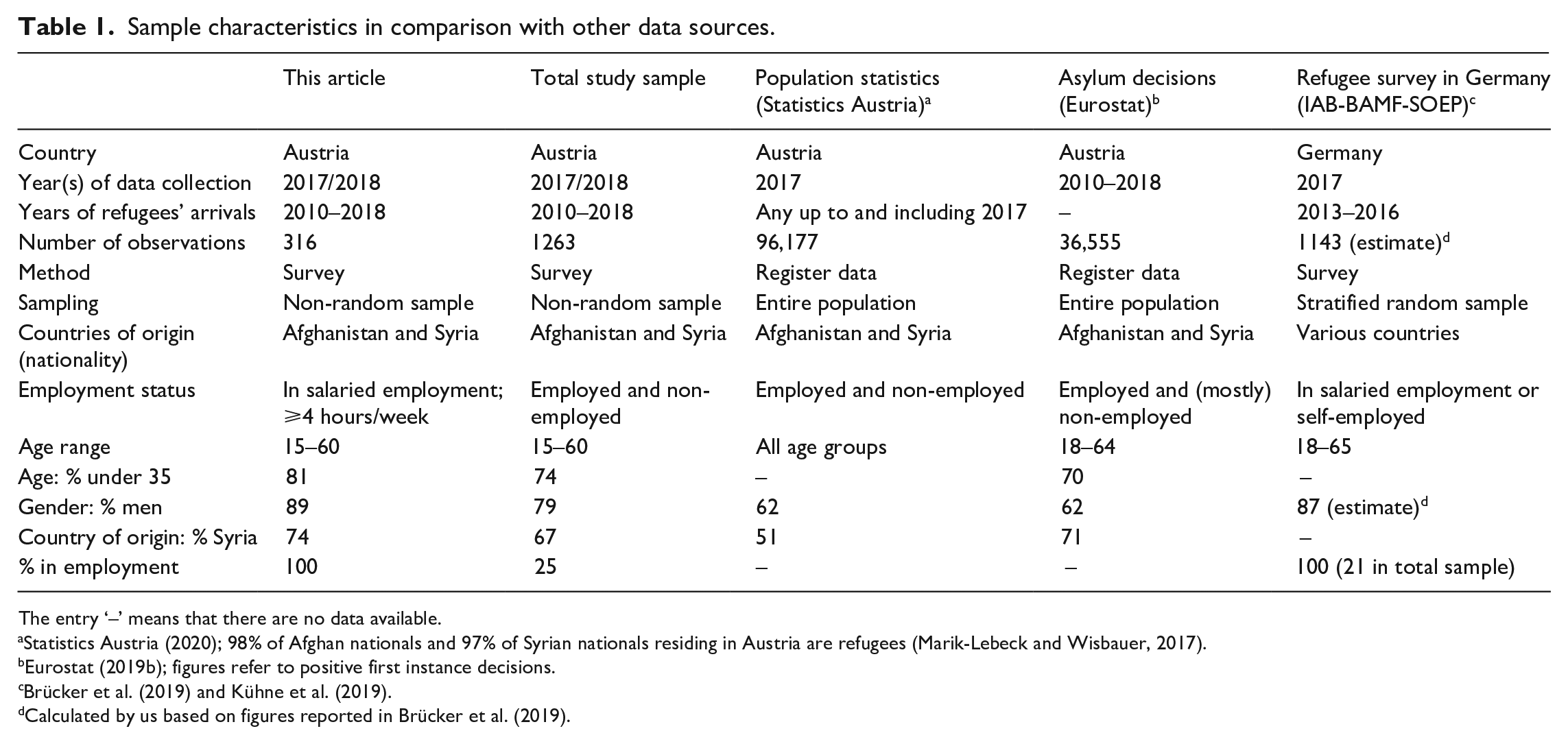
To enable an assessment of the generalizability of statistical results based on this sample, Table 1 presents key figures in comparison with other data sources. We chose official statistics on the population and asylum decisions in Austria (Eurostat, 2019b; Statistics Austria, 2020) as these data sources (register data) provide the most trustworthy information on the refugee population in Austria. Furthermore, to enable comparison with refugees residing in a similar country context, we chose the large refugee survey in Germany (the so-called IAB-BAMF-SOEP study; Brücker et al., 2019). While comparison across data sources can be problematic, given the different sampling criteria and procedures, Table 1 indicates that younger refugees, men and people from Syria are overrepresented in the total sample of our survey. Comparing the first and second column of Table 1 additionally shows that these groups are overrepresented to an even greater extent in the sub-sample we used in this article, concentrating on employed respondents. Such a selection effect, which does not come as a surprise, should be kept in mind when interpreting our findings. However, the overall pattern of our sample’s socio-demographic composition is similar to that of the other data sources. Thus, we see no reason to limit the generalizability of our statistical results.
Sample characteristics in comparison with other data sources.
The entry ‘–’ means that there are no data available.
Statistics Austria (2020); 98% of Afghan nationals and 97% of Syrian nationals residing in Austria are refugees (Marik-Lebeck and Wisbauer, 2017).
Eurostat (2019b); figures refer to positive first instance decisions.
Calculated by us based on figures reported in Brücker et al. (2019).
Measures
Our questionnaire draws on the already mentioned IAB-BAMF-SOEP refugee survey conducted in Germany (Brücker et al., 2016). We added questions for our research purposes, including some borrowed from the European Working Conditions Survey (Eurofound, 2019). Extensive discussions in the research consortium and with other experts as well as pretests involving more than 25 test respondents ensured that refugees understood questions and responses and that the entire questionnaire was manageable for them.
Job quality
As mentioned before, following the existing literature we considered multiple dimensions of job quality. For each of the following measures, variables are coded in such a way that higher values indicate higher job quality.
Pay
Respondents indicated their monthly gross earnings in euros, including overtime pay but excluding special payments such as holiday bonuses.
Permanent contract
This variable is coded 1 if the respondent works on a permanent contract and 0 for fixed-term employment.
Skill level use
Respondents were asked, ‘Does this job match the level of your education and work experience?’ This variable is coded 1 if the participant responded ‘yes’ or indicated to have less than the job required and 0 if she or he was overqualified for the current job.
Skill area use
Participants were asked, ‘Is this job related to the content area of your education?’ Response options ranged from ‘no, not at all’ (1) to ‘yes, full match’ (4).
Learning opportunities
Participants rated the following statement: ‘I can learn a lot during my work’. The response scale ranged from ‘strongly disagree’ (1) to ‘fully agree’ (5).
At-home feeling
The statement was, ‘I feel “at home” in this organization’, with the same response scale as the learning opportunities variable.
Health aspects
The statement was, ‘My work is bad for my health’. The response scale ranged from ‘fully agree’ (1) to ‘strongly disagree’ (5).
Job satisfaction
We considered this variable as a validity criterion concerning job quality profiles. Respondents were asked, ‘How satisfied are you with your current job situation?’ The response scale ranged from ‘completely dissatisfied’ (0) to ‘completely satisfied’ (10).
Job-finding methods
Respondents were asked how they had found their current job. In line with previous research, we considered the following job-finding methods: (1) public employment service; (2) NGO (full wording of the response: ‘NGO, association, refugee accommodation, language school’); (3) private agency; (4) Austrian contact (‘friends or acquaintances from Austria’); (5) co-ethnic contact (‘family, friends, or acquaintances from my country of origin’); (6) social media (‘social media, for example, Facebook, Twitter, Xing, LinkedIn’); (7) job ad (‘job ad in newspaper or on the Internet’); and (8) direct (‘direct application to the employer, for example, unsolicited application’). Multiple responses were allowed. We created dummy variables for the job-finding methods, each of which is coded 1 if a respondent indicated the respective job-finding method and 0 otherwise. We also included an open-ended ‘other’ response. All except two of the participants indicating this response referred to one of the previous eight categories; hence, we assigned them manually (e.g. for the response ‘Caritas’ we coded the NGO variable ‘1’).
Covariates
We also consider a set of socio-demographic variables and workplace characteristics, which according to previous research on the labour market integration of refugees and migrants, as well as job quality literature, are likely to be related to refugees’ job quality and/or job search methods (Bakker et al., 2017; Brücker et al., 2019; Giri, 2018; Lamba, 2003; Minor and Cameo, 2018; OECD, 2016; Van Tubergen, 2011).
Nationality
This variable was coded 1 for Syria and 0 for Afghanistan.
Age
We measured age in years.
Gender
This variable was coded 1 for male and 0 for female.
Education
We measured educational attainment using the International Standard Classification of Education (ISCED)-2011 classification scheme and created three dummy variables: low (ISCED = 0–2), intermediate (ISCED = 3–4) and high (ISCED = 5–8).
German language
Respondents rated their German proficiency on a scale ranging from ‘very poor’ (1) to ‘very good’ (5).
Length of stay in Austria
We measured length of stay in years, calculated as the difference between the survey date and the arrival date.
First job in Austria
This variable was coded 1 if respondents indicated that the current job was their first job in Austria and 0 otherwise.
Job tenure
We measured tenure in months, calculated as the difference between the survey date and the job entry date.
Occupational status
We measured the occupational status using the International Standard Classification of Occupations (ISCO)-2008 classification scheme. We created three dummy variables: low (ISCO = 9), intermediate (ISCO = 4–8) and high (ISCO = 1–3).
Weekly working hours
Respondents indicated their average actual working hours per week, including any overtime.
Firm size
Respondents indicated the number of employees in their organizations. We created three dummy variables: small (<20 employees), medium (20–199), and large (⩾200).
Industry
We measured the industry in which respondents worked using the statistical classification of economic activities in the European Community (NACE) and created seven dummy variables.
Typical migrants’ job
Participants rated the following statement: ‘My work is typical of migrants; people from Austria do not do such work’. The response scale ranged from ‘strongly disagree’ (1) to ‘fully agree’ (5).
Analytical strategy
To address our two research questions, we first identified job quality profiles via cluster analysis. Cluster analysis has been widely applied in management research, for instance, to develop typologies of management strategies (Ketchen and Shook, 1996), organizational capabilities (Wilden et al., 2019) or flexible work systems (De Menezes and Wood, 2006). It is an appropriate method to study patterns of job quality dimensions and to identify trade-offs among dimensions. Furthermore, it is relatively robust in terms of statistical assumptions (Hair et al., 2014).
Following existing standards concerning cluster analysis (Hair et al., 2014), we included z-standardized scores of the job features and used Ward’s method with Euclidean squared distance as a proximity measure. We identified an optimal four-cluster solution using the dendrogram and a series of robustness checks. We describe the identified job quality profiles along with covariates in the next section.
Furthermore, to establish external, criterion-related validity of the cluster solution, we used job satisfaction which has been found an outcome of job quality (Brown et al., 2015; Findlay et al., 2013; Muñoz de Bustillo et al., 2011; Osterman, 2013). We then examined whether job-finding methods differed across the four identified job quality profiles using multivariate analysis of variance (MANOVA) with Tukey’s test for post hoc analysis (for continuous variables) and z-tests with Bonferroni-adjusted p-values (for dichotomous variables/percentages).
Findings
Description of job quality profiles
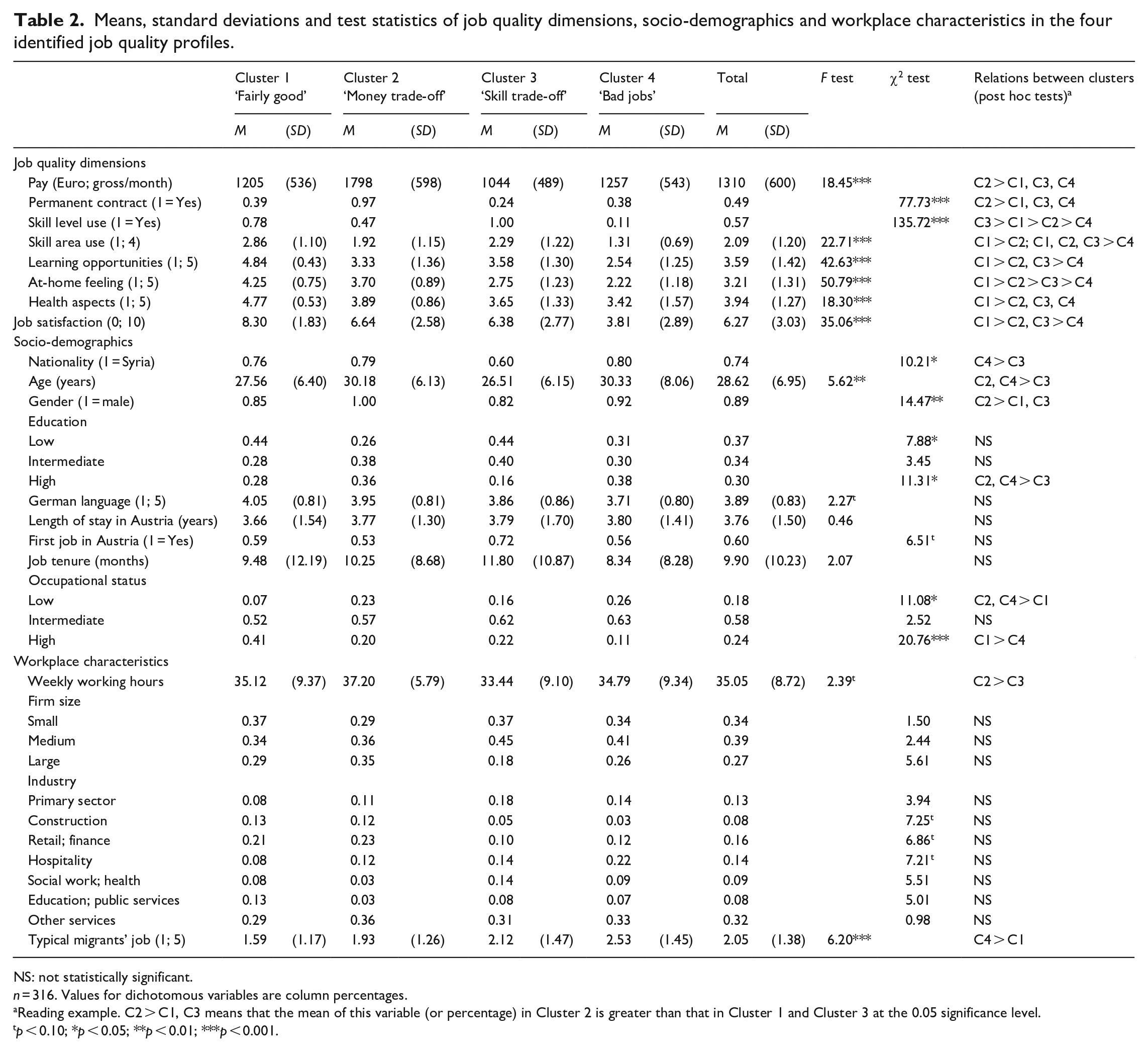
The cluster analysis yielded an optimal solution of four distinct job quality profiles of similar sizes. Figure 1 displays the four profiles, based on the job features’ z-values, to facilitate visual comparison within and across clusters. Table 2 additionally provides means and SDs of the job quality variables and covariates.
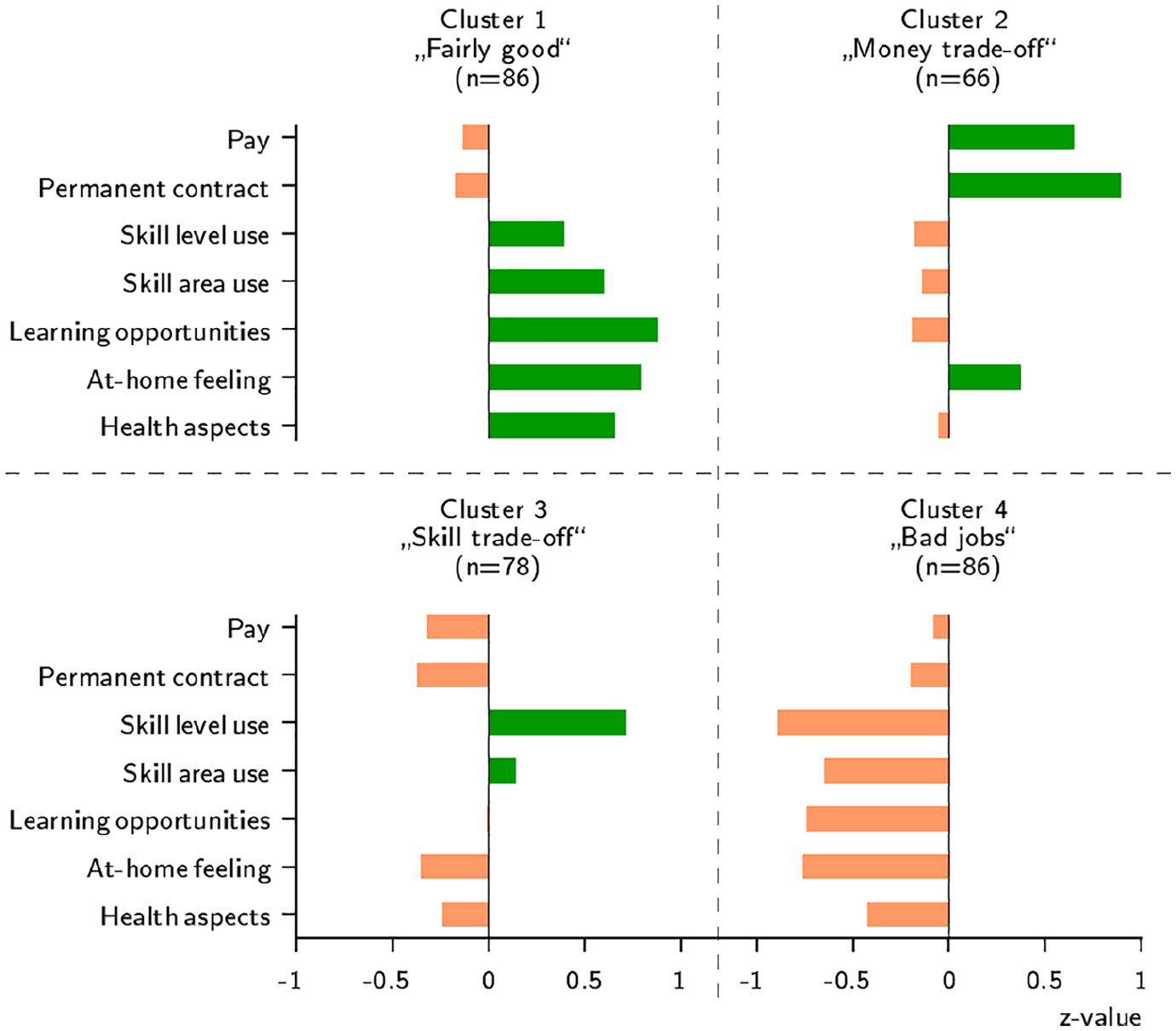
Job quality profiles, as emerged from the cluster analysis (n = 316).
Means, standard deviations and test statistics of job quality dimensions, socio-demographics and workplace characteristics in the four identified job quality profiles.
NS: not statistically significant.
n = 316. Values for dichotomous variables are column percentages.
Reading example. C2 > C1, C3 means that the mean of this variable (or percentage) in Cluster 2 is greater than that in Cluster 1 and Cluster 3 at the 0.05 significance level.
p < 0.10; *p < 0.05; **p < 0.01; ***p < 0.001.
As Figure 1 shows, none of the profiles reflects entirely high-quality jobs. Instead, each profile comprises at least two job features of below-average quality, indicating trade-offs between job features. Cluster 4 mirrors jobs of low quality in every dimension. In the next paragraphs, we present our interpretation of the four clusters. 2 It is important to note that this presentation, including the labels we have chosen for the clusters, is of merely descriptive nature. In particular, the cluster labels refer to job quality in relation to the other clusters in our sample. They should not be interpreted with regard to any external benchmarks.
In Cluster 1, most job features are of above-average quality. These jobs offer learning opportunities and healthy working conditions. Also, refugees can use their skills and they feel at home in these workplaces. However, these jobs have downsides in the form of comparatively low pay and being temporary. Thus, we label this profile ‘Fairly good’. Concerning socio-demographics, jobholders resemble the average respondent, but with comparatively high occupational status. Concerning workplace characteristics, these jobs are relatively often in the construction sector as well as in education and public services.
The profile of Cluster 2 is almost the reverse of Cluster 1. Although health aspects, skill usability and learning opportunities are better than in the ‘Bad jobs’ profile (Cluster 4), they are below average. Possibly to adjust for this, refugees receive relatively high pay – hence the label ‘Money trade-off’. Other positive features of these jobs include that they are often permanent, and they provide at-home feeling. Respondents are relatively older, exclusively men and highly educated. Furthermore, they work longer hours. These jobs are often in larger firms and in retail and finance as well as other services.
Jobs in Cluster 3 offer another kind of compensation for overall rather than poor job quality, namely, relatively good opportunities to use and further develop skills. We label this job quality profile ‘Skill trade-off’. These respondents are relatively younger and less educated, and a greater portion comes from Afghanistan. The jobs are relatively often in smaller firms and in the primary sector, as well as in the social work and health sector.
Finally, as already mentioned, Cluster 4 reflects the ‘Bad jobs’ profile, with low job quality in all of the considered dimensions. Jobholders are relatively older refugees who are highly educated but have lower occupational status. These jobs are often in the hospitality sector, and especially in ethnic niches within industries and organizations (i.e. they are typical of migrants’ work).
Validity of the cluster solution
We checked the validity of the identified job quality profiles by applying MANOVA and z-tests. Differences in job feature scores between all clusters are statistically significant (p < 0.001; F-values: see Table 2).
Furthermore, we analyzed job satisfaction in order to establish criterion-related validity. There are marked differences in job satisfaction across job quality profiles (F(3, 240) = 35.05; p < 0.001), with associations of the expected manner. Whereas job satisfaction is highest in ‘Fairly good’ jobs (mean score = 8.30), it is moderate in ‘Money trade-off’ (6.64) and ‘Skill trade-off’ (6.38) jobs and lowest in ‘Bad jobs’ (3.81).
Taken together, these findings suggest high validity of our cluster solution.
Job quality and job-finding methods
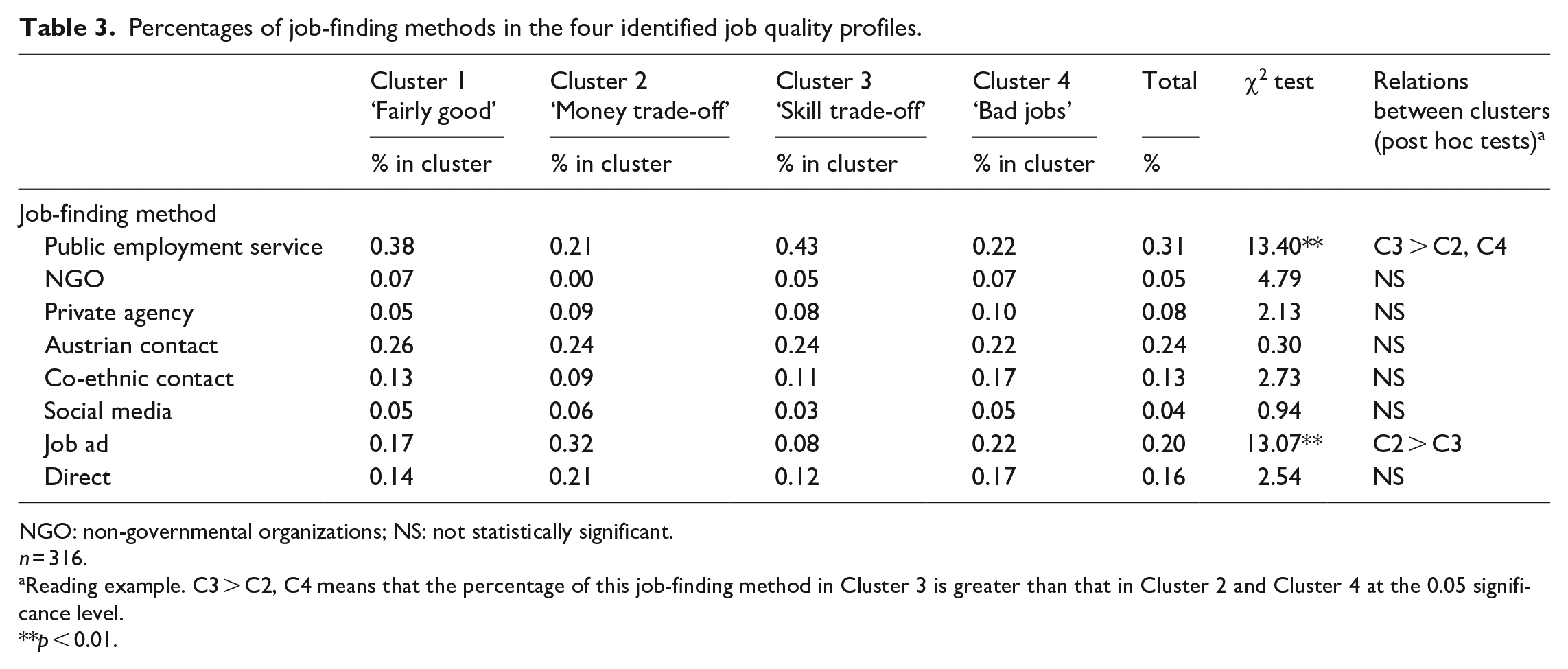
Addressing our second research question, we now turn to the association of the job quality profiles with job-finding methods. According to Table 3, there are a few notable differences between the clusters. Cluster 1 (‘Fairly good’) seems to be associated with the public employment service (38% of all responses covered by this cluster) and personal contacts with Austrians (26%), suggesting that these job search methods lead to jobs of relatively high quality. However, these associations are not statistically significant. Cluster 2 (‘Money trade-off’) is significantly associated with job ads (32%; χ2(3)=13.07; p < 0.01). Those refugees who responded to a job ad find more often jobs of the ‘Money trade-off’ profile than of the ‘Skill trade-off’ profile.
Percentages of job-finding methods in the four identified job quality profiles.
NGO: non-governmental organizations; NS: not statistically significant.
n = 316.
Reading example. C3 > C2, C4 means that the percentage of this job-finding method in Cluster 3 is greater than that in Cluster 2 and Cluster 4 at the 0.05 significance level.
p < 0.01.
The latter profile (Cluster 3; ‘Skill trade-off’), in turn, is significantly associated with the public employment service (43%; χ2(3)=13.40; p < 0.01). Those refugees who found a job through the public employment service more often work in jobs of the ‘Skill trade-off’ profile than in those of the ‘Money trade-off’ or the ‘Bad jobs’ profile, respectively. Finally, Cluster 4 (‘Bad jobs’) seems to be associated with finding a job through personal contacts with co-ethnic people. However, like the relation between the ‘Fairly good’ profile and personal contacts with Austrians, also this association is not statistically significant.
Comparison with other data sources
While our research focus is on refugees’ job quality and the association with job-finding methods, comparison with other studies helps understanding the significance of our results. As data sources we chose the following three surveys: the European Working Conditions Survey (EWCS; Eurofound, 2020), the European Labour Force Survey (EU-LFS; Eurostat, 2020) and once more, the German refugee survey (IAB-BAMF-SOEP; Brücker et al., 2019), as these data sources provide insights into at least several features of job quality in Austria, and of refugees working in Germany, along with job-finding methods. However, like in the comparison of sample characteristics across data sources (see above; Table 1), it is important to note that differences in samples and variable measures limit interpretability.
Table 4 shows results concerning those job quality dimensions and job-finding methods which also have been considered in the three other surveys. Compared to other people working in Austria, the refugees in our study report lower job quality, with the exception of learning opportunities provided at work. Regarding job-finding methods, they more often find a job via the public employment service and less often through direct applications to employers (unsolicited applications). Interestingly, comparing our study findings with those from the refugee survey in Germany (IAB-BAMF-SOEP; last column of Table 4) reveals some similarities: in both countries, the public employment service is the most prevalent job-finding method, and contacts with locals, respectively, play a more important role in finding a job than co-ethnic contacts. However, given the differences in the response options to this question in the two surveys, interpretability of the findings is limited. Similarly, caution is warranted in the interpretation of the average pay – which may be higher in our study because we excluded from our sample those respondents who worked less than 4 hours per week – and the extent to which refugees can use their skills at work, as different measures were used for this variable in the two studies.
Results concerning job quality and job-finding methods in comparison with other data sources.
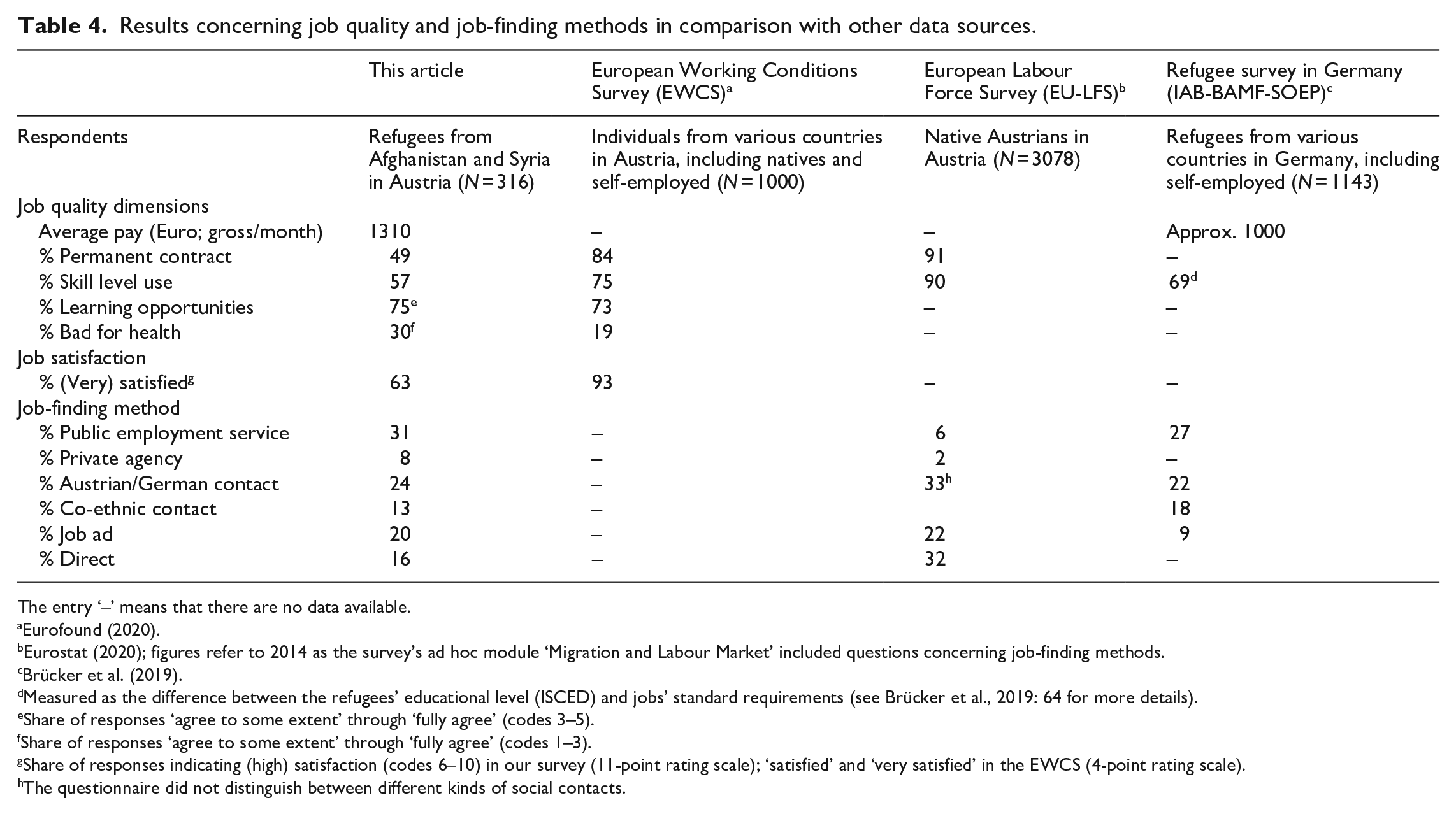
The entry ‘–’ means that there are no data available.
Eurostat (2020); figures refer to 2014 as the survey’s ad hoc module ‘Migration and Labour Market’ included questions concerning job-finding methods.
Measured as the difference between the refugees’ educational level (ISCED) and jobs’ standard requirements (see Brücker et al., 2019: 64 for more details).
Share of responses ‘agree to some extent’ through ‘fully agree’ (codes 3–5).
Share of responses ‘agree to some extent’ through ‘fully agree’ (codes 1–3).
Share of responses indicating (high) satisfaction (codes 6–10) in our survey (11-point rating scale); ‘satisfied’ and ‘very satisfied’ in the EWCS (4-point rating scale).
The questionnaire did not distinguish between different kinds of social contacts.
In addition to the three data sources depicted in Table 4, the following two comparisons are worth considering. First, the average pay reported by the refugees in our study is less than two-thirds of that of all salaried employees in Austria, which was around €2300 gross per month in 2018 (Statistics Austria, 2019). Although there are many factors that may account for this pay gap, including differences in the number of weekly work hours, professional skills or the age structure, the difference in what people have ‘in their wallet’ is remarkable.
Second, a research report based on the EWCS conducted in 2015 (Eurofound, 2017) describes five job quality profiles, each comprising seven job features such as skills and discretion, social environment, prospects and earnings. Comparing these five profiles with the four profiles identified in our study reveals that trade-offs between job features occur in various settings and have various shapes. More specifically, the EWCS job quality profiles are based on responses from individuals of various national backgrounds, including natives, working in the 28 Member States of the European Union (as of 2015). Despite the breadth of this sample, three of the five identified job quality profiles are characterized by trade-offs between job features, which the study authors interpret in a highly plausible manner. A fourth profile, named ‘Poor quality’, resembles our ‘Bad jobs’ profile (Cluster 4). Like in our study, the quality of every job feature in this profile is below average. However, different from our study, there is also a profile with almost no trade-offs. Although the quality of two job features in this fifth profile, which is labelled ‘High flying jobs’, is below average, the overall job quality is comparatively high: the scores of these two job features are only slightly below average, and the features are work intensity and working time quality, which can be categorized as less significant than the earnings or the opportunity to use one’s skills at work. Thus, while we are aware that much care has to be taken when comparing the four job profiles identified in our study with those reported by Eurofound (2017), we conclude that quality trade-offs between job features are a more relevant issue among refugees as compared to other people working in Europe.
Discussion
In response to calls to explore – and at the same time to strengthen – the role of employers in refugee integration (Naccache and Al Ariss, 2018; OECD and UNHCR, 2018), this study examined the quality of jobs refugees find in Austria. Going beyond the existing literature on labour market integration of refugees, we shed light on a larger array of job features in order to account for the multidimensionality of job quality. Our analysis based on unique fine-grained data revealed four distinct job quality profiles pointing out trade-offs among quality dimensions. In addition, we found that the job quality profiles are associated with job-finding methods. Our findings have several theoretical and practical implications.
Theoretical implications
We see three theoretical implications of our findings. First, this study contributes to the rapidly growing literature on labour market integration of refugees. In contrast to previous research, which has concentrated on wages and overqualification (Bakker et al., 2017; Brücker et al., 2019; Eggenhofer-Rehart et al., 2018; Giri, 2018; Van Tubergen, 2011), our research approach emphasizes that job quality comprises multiple dimensions. A particularly important finding of our study is that often trade-offs occur. For instance, relatively high pay and job security go hand in hand with below-average quality of other job features. Vice versa, jobs where refugees can use and further develop their skills and where they feel at home offer less pay and job security.
Hence, traditional job search models should be reconsidered in order to acknowledge the multidimensionality of job quality and to derive a more realistic picture of the workplaces of refugees. The four job quality profiles identified in this study can serve as a starting point for such reconsideration. Thereby, taking account of individual characteristics of refugees seems fruitful. For instance, the high share of older respondents we found in the ‘Bad jobs’ cluster reflects the specific problems of older refugees associated with job search and unemployment. Conversely, the higher share of younger respondents in the ‘Skill trade-off’ cluster suggests that employers and younger refugees are more willing to invest in the development of refugees’ skills (i.e. in human capital). Furthermore, examining trajectories of refugees from one profile to another – either between or within firms – may be a particularly fruitful aim of future research.
Second, our study provides novel insights on how varying methods refugees use in searching for employment lead to jobs of different quality. Whereas previous research on job search methods has theorized about differences between personal contacts with locals and those with co-ethnic people (De Vroome and Van Tubergen, 2011; Verwiebe et al., 2019), our empirical findings add to this literature strand by highlighting differences between job search via the public employment service and responding to a job ad vis-à-vis other job search methods. More specifically, the public employment service is related to better skill use, whereas job ad responses are associated with higher pay.
We suggest that these differences can be explained by various factors. First, the public employment service is known for its special tools for assessing refugees’ qualifications (OECD and UNHCR, 2018) as well as its preference of employers’ interests over jobseekers’ interests (Sowa et al., 2015; Torezani et al., 2008). Second, selectivity may exist among refugee jobseekers, which is, for instance, reflected in our finding that those who found a job via responding to a job ad have relatively high educational attainment. Third, firms may use specific recruitment channels to staff jobs of different quality profiles such as the ‘Money trade-off’ and the ‘Skill trade-off’ profiles.
While all these reasons are plausible against the background of our study findings and previous research, we see a need for more research in this regard. For a start, what is the role of the public employment service in mediating between refugees and employers? How does self-selection among refugees affect their probability of obtaining a high-quality job, and vice versa, the probability of finding the best qualified job candidates, as seen from the perspective of recruiters? Are there individual characteristics influencing both, selection into specific jobs and selection into specific search channels?
Finally, our findings have implications for the evolving literature on employer engagement (Ingold and Valizade, 2017; Simms, 2017). Employer engagement has been defined as ‘the active involvement of employers in addressing the societal challenge of promoting the labour market participation of vulnerable groups’ (Van Berkel et al., 2017: 503). This study adds to employer engagement research by providing empirical evidence concerning refugees, who constitute a particularly vulnerable group. Echoing previous research that pointed out refugees’ relatively poor job quality (Bakker et al., 2017; Colic-Peisker and Tilbury, 2006; Knappert et al., 2018; Ponzoni et al., 2017; Van Tubergen, 2011), our study too identified a large cluster of ‘Bad jobs’, where all job quality dimensions are below average.
Moreover, comparing the average scores of job features with those of other research – though comparability is limited – revealed that refugees tend to work in jobs of lower quality than other groups do. Next to the already mentioned factors accounting for this job quality gap, we also note refugees’ restricted labour market opportunities: given their especially weak labour market position, they may prefer to work in a job characterized by adverse features over being unemployed, to a larger extent than other jobseekers do.
On the contrary, we also found a good portion of jobs of higher quality – at least, concerning several job features. In particular, the firms reflected by the ‘Fairly good’ profile demonstrate employer engagement. Refugees employed by these firms work outside typical ethnic niches; they can use and expand their existing skills, and they feel healthy, at home and satisfied to a relatively large extent. This profile suggests that firms seek to give refugees a chance, although this is a less paid and temporary opportunity. Also interesting in this regard are those firms reflected by the ‘Money trade-off’ profile. These firms manage to provide refugee employees not only with moderately high pay and permanent contracts but also with a work environment that makes them feel at home.
However, it should be noted that even in the ‘Money trade-off’ profile, the average monthly gross wage of €1798 (with an average work week of 37.2 hours) is considerably below the Austrian average for salaried employees (see above: around €2300 in 2018; Statistics Austria, 2019). This insight advances the findings of Simms’ (2017) study on employer engagement and youth employment, which showed that many organizational decision-makers draw on an HR logic focused on the expected benefits and costs of employing young people. Thus, even though our findings indicate that organizations indeed take responsibility of refugee integration (Naccache and Al Ariss, 2018; OECD and UNHCR, 2018), in support of previous findings by Boese (2015) as well as Lundborg and Skedinger (2016), they also suggest that employers make sure that this endeavour is not too expensive for them. Hence, employers’ economic rationales should be given more central importance in future research on employer engagement – both in theoretical models and in empirical studies.
Practical implications
Our study findings suggest that organizations contribute to refugee integration by employing them in a variety of jobs. However, those employers who want to make a real social impact rather than hire refugees just to enhance their corporate image or ‘consider forced migration only as a window of opportunity to soften short-term labour shortage or to push down salaries’ (Naccache and Al Ariss, 2018: 590) should take care of the quality of the jobs in which their refugee employees work.
Furthermore, our study findings show that often refugees have higher skill levels as well as skills in areas different from those required by their current job, offering plenty opportunity to organizations to capitalize on the refugees’ untapped potential in the future. To better assess the refugees’ qualifications, collaboration with the public employment service, which has developed specific assessment tools for refugees (Mara et al., 2016), may help. However, turning to the perspective of the refugees, our findings indicate that especially the higher educated should be aware of the often-occurring trade-offs between skill utilization and pay. Hence, refugees themselves and their counsellors should take these trade-offs into consideration.
Limitations
Our study used unique survey data with a comparatively large sample in the refugee context and providing detailed information concerning job features as well as socio-demographic and workplace-related variables. However, there are some limitations too. First, this study uses data from Austria, provoking the question whether our findings can be generalized to other settings. The Austrian labour market is characterized by comparatively low unemployment rates in the last decades (Eurostat, 2019b), as well as a high significance of formal educational credentials and vocational training (Krause and Liebig, 2011). Further relevant country specifics include asylum procedures, the social welfare system and state programmes aimed at refugee integration. Thus, future research should expand our findings to other countries in order to obtain more general knowledge on refugees’ job quality and to identify contextual influences. While we made a first step into this direction by comparing selected sample characteristics, job features and job-finding methods with those from the German refugee survey (IAB-BAMF-SOEP), a more detailed comparison is needed. Similarly, refugees from countries other than Afghanistan and Syria working in Austria should be considered, as the country of origin has been found to be associated with labour market integration (Bakker et al., 2017; Giri, 2018; Minor and Cameo, 2018).
Second, while the comparison of sample characteristics between our study and Austrian register data suggested generalizability of our statistical results, our data are fraught with selectivity problems. More specifically, as we used several ways to approach study participants but did not have access to detailed information on the refugee population in Austria nor to all refugees’ contact addresses (like, for example, in the German refugee survey; IAB-BAMF-SOEP), we were neither able to use a random sample nor to conduct a proper non-response analysis. However, given that it is principally difficult to sample refugees (Cebulla et al., 2010; Kühne et al., 2019), we hold that our data set is the best one that could have been obtained – and there are no better data available to date. Moreover, next to sample selectivity we noted selectivity into employment. Finally, selectivity into certain job search channels may have occurred, potentially leading to endogeneity concerning the association between job-finding method and job quality profiles. As we cannot rule out these problems in this study, they have to be kept in mind when interpreting our findings.
A third limitation refers to the dimensions of job quality we considered in this study. Even though we extended previous research substantially by taking account of a variety of job features, we had to limit their number for the sake of the questionnaire’s length. In light of our findings that pointed out the trade-offs among job quality dimensions, future research should consider further important job features described in previous work, such as autonomy at work and participation in decision-making (Findlay et al., 2013; Green et al., 2013; Osterman, 2013).
Finally, our sample only contains a limited number of women, restricting the evidence about their job quality. As previous research revealed that women refugees face specific barriers in job search (Knappert et al., 2018; Minor and Cameo, 2018; Tomlinson, 2010), future research on these barriers and their relation to job quality is needed.
Conclusion
In times where migration flows and refugee populations are ever increasing worldwide, there are voices calling for responsible action by organizational decision-makers, aimed at workplace inclusion of refugees. This study explored the quality of jobs in which refugees work in Austria. The findings indicate that refugees not always end up in low-quality jobs, but that organizations offer jobs of varying quality profiles. We hope that the set of job quality profiles identified in this study stimulate further research and practical efforts aimed at refugee integration, to the benefit of individuals, organizations and society as a whole.
