




Abstract
Since the Chinese economic reform, the Communist Party of China (CPC) has gradually moved toward a separation of the party-state from society, manifested in the withdrawal of party power from many areas of society and the growing new power of private enterprises. The CPC has actively reformed itself as it has evolved from a revolutionary party into a governing party. The party’s support of and collaboration with private enterprises, a powerful and indispensable force in the Chinese economy, is a good example of such a change. Instead of focusing on political acceptance and organizational infiltration as most of the existing studies have done, this paper examines the political incorporation of the CPC’s integration policy towards private enterprises. Theoretical analysis, supported by case studies, indicates that the relationship between the ruling party and private businesses is not, contrary to common understanding, unidirectional absorption and penetration by the Party. Instead, it is an interdependent and mutually beneficial relationship. A further empirical examination of the Ninth National Survey of Private Enterprises confirms that private businesses that have set up CPC organizations or have owners who are themselves CPC members identify more strongly with the ruling party policies and are more active in production expansion and long-term growth. It appears that the CPC’s integration policy towards private enterprises has effectively utilized both ‘top-down’ organizational infiltration and ‘bottom-up’ political integration. In doing so, the CPC maintains its control over private enterprises. Not only does it consolidate the governing legitimacy of the Party, it also enables private businesses to fulfil its social function. The policy helps the Party successfully prevent the formation of non-institutionalized powers outside the system.
Introduction
After more than 30 years' reform and opening up, China has undergone tremendous changes in its social structure and economic system, but it has still maintained an authoritative governance system in its political structure (Cao, 2011). What has maintained the stability of the system for such a long time? Tsai (2007) believed that the changing Chinese political system had followed a path on which ‘the system’s structure remains unchanged and the political environment keeps changing’, enabling the Chinese government to satisfy the power demands of all kinds of economic entities represented by private enterprises without undergoing any political system reforms. After over 30 years' power-transfer reformation, the Communist Party of China (CPC) has weakened its control over all aspects of society, including ideological, social, economic and political life. The ‘Party-state’ system has undergone a process of atrophy (Shambaugh, 2011). It is the rapid growth and accumulation of the non-state-controlled social forces that have yielded a group of newly emerging economic and social forces that have drifted outside the existing political system. The impulsion of exploring action room and self-organization 1 has broken the existing patterns of power and interests in the Party-state and created challenges and threats to the political Party-state structure (Gong, 2012).
Therefore, the private sector, which has accumulated abundant economic and social capital, especially those private entrepreneurs outside the system, has, to some extent, possessed the potential capability of ‘rallying outside the system’. If the Chinese Communist Party leaves the ‘impulsion of self-organization’ uncontrolled, the newly emerging social strata may possibly organize themselves into an opposing force, causing actual threats and challenges to the ruling legitimacy of the CPC and social stability. Can it be said, then, that a social class of private entrepreneurs acts autonomously and struggles with the state's power in the market transformation in China? After studying the current literature, Huang (2014a, 2014b) concluded that this deduction was not reasonable, because the newly emerged class in China is a new social stratum that depends upon and conspires with the state. With its political advantage and organizational resources, the ruling party uses the integration strategy of political absorption and organizational embeddedness to effectively resolve the pressure from the newly emerging social stratum and makes those forces a part of the Party-state, thus forming mutualistic relations between those forces and the Party-state (Li, 2001; Chen and Dickson, 2008).
Most of the current research studies on the CPC’s political absorption and organizational embeddedness focus on a specific aspect. This process has never been studied from the perspective of Party-state integration, and the empirical studies of data analysis from this perspective are insufficient. Li et al. (2008) viewed Party membership as a bridge that connects the CPC and the government but did not pursue specific studies on the working mechanism that influences enterprise behavior; Ma et al. (2012, 2013) studied grassroots Party organizations' impacts on the governance of the state-owned enterprises, but he was only interested in the process of the Party's organizational embeddedness and ignored the process of political absorption. The influential mechanism of the Party-state behavior with Chinese characteristics towards private entrepreneurs' resource distribution and behavior selection is not fully discussed and is not given sufficient attention. These Party-state behaviors include absorbing private business owners into the CPC, establishing grassroots party organizations within private enterprises, and allowing these organizations to participate in decision-making.
Thus, to observe how the CPC uses its political advantage, organizational resources, integrated methods of political absorption, and organizational embeddedness to encourage private entrepreneurs to invest more into productive and long-term orientated activities is an appropriate perspective from which to study the effects of the CPC's integrated strategy concerning the private sector, and a direct manifestation of mutual political trust between the ruling party and private business owners. Based on the above analysis, this paper mainly focuses on the following issues:
Is the integrated strategy of the ruling party regarding the private sector a ‘unilateral wish’? What are private entrepreneurs' attitudes towards it? How do Communist Party memberships of private entrepreneurs and party organizations within enterprises jointly influence the private entrepreneurs’ evaluations of the policies implemented by the CPC? Do they advocate and support the CPC's leadership? Do they prefer associating outside the system or standing up for the current system? How does the influential mechanism of private entrepreneurs’ party memberships and party organizations within their enterprises work on productive activities and long-term orientated activities?
The logic and solutions of the ruling party's integration of private enterprises—political absorption and organizational embeddedness
Political absorption
Absorbing newly emerging social forces into a party organization is an indispensable path for the CPC's growth into a modern party and for maintaining its ruling legitimacy and consolidating its governance. The proposal of the important thoughts of the ‘Three Representatives’ indicates that the CPC has begun to absorb ‘the representatives of advanced productive forces’. Some scholars even believed that the thoughts of ‘Three Representatives’ were an invitation to private entrepreneurs to join the CPC (Guiheux, 2006). The issue concerning private entrepreneurs' joining the Communist Party was further clarified in the report of the 16th National Congress of the CPC, making it more accessible to private entrepreneurs.
The concept of ‘political absorption’ could be traced back to King (1997), who proposed ‘administrative absorption’, 2 which indicates that the government absorbs social elites or political forces represented by elite groups into its administrative decision-making framework, and thus a certain level of ‘elite integration’ is obtained. In order to acquire political identification from new social elites for consolidating legitimacy of governance and to display its resource advantages and economic social construction functions, the ruling party uses its own political and organizational resources to absorb social elites into the Party and the government bodies, making them a part of the ‘colluded party-state’ system (Goodman, 1995). More specifically, the CPC ‘absorbs politically’ 3 private entrepreneurs in two ways. First, the CPC gives private entrepreneurs political identities, such as Communist Party membership, deputyship to the People's Congress, membership in the People's Political Consultative Conference, etc.; and second, private entrepreneurs are absorbed into social groups, such as the All-China Federation of Industry and Commerce and Private Enterprise Association, which offer them limited access to political activities.
Investigation on private entrepreneurs' political identity and CPC organization in private enterprises.
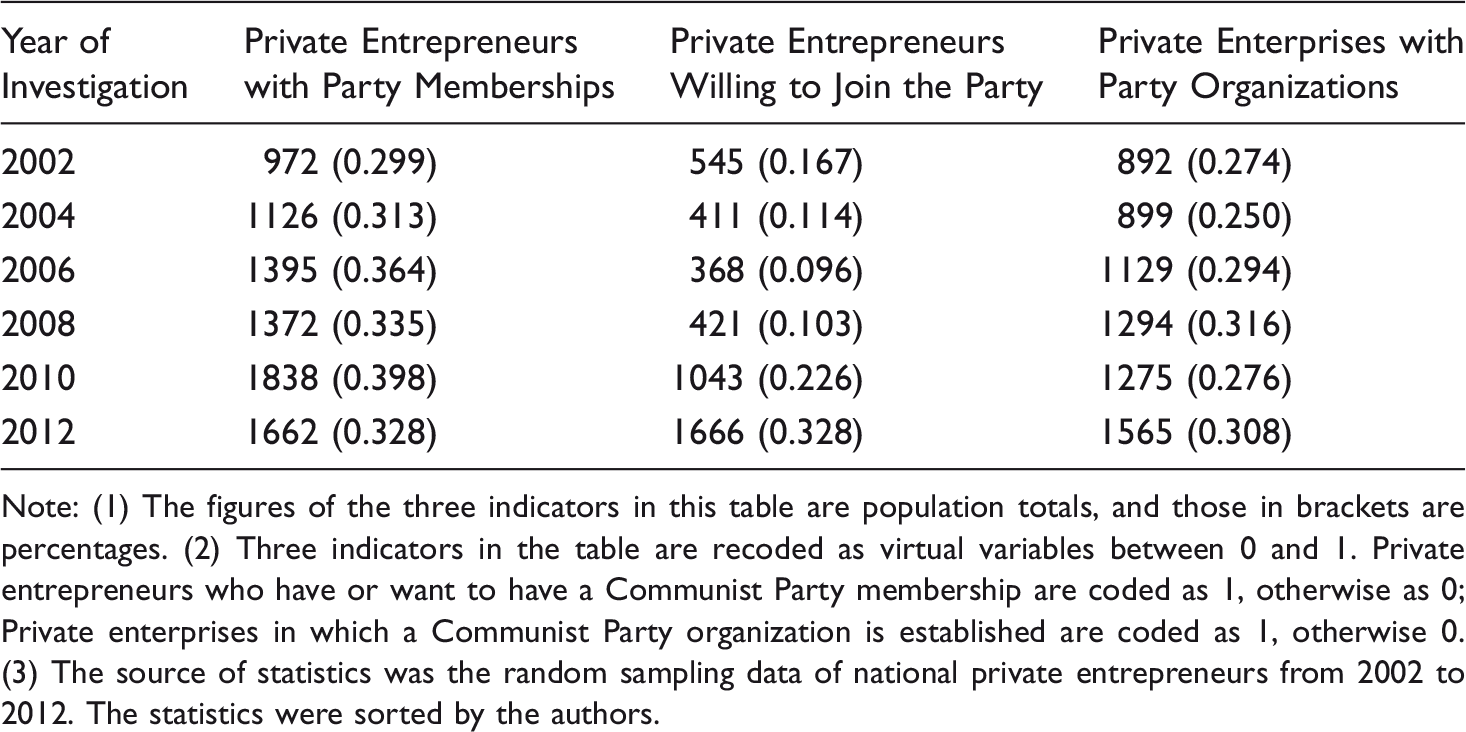
Note: (1) The figures of the three indicators in this table are population totals, and those in brackets are percentages. (2) Three indicators in the table are recoded as virtual variables between 0 and 1. Private entrepreneurs who have or want to have a Communist Party membership are coded as 1, otherwise as 0; Private enterprises in which a Communist Party organization is established are coded as 1, otherwise 0. (3) The source of statistics was the random sampling data of national private entrepreneurs from 2002 to 2012. The statistics were sorted by the authors.
Next, we shall discuss the process of the CPC’s political absorption, with two specific case examples:
Case 1. Su Wenfang was a rich entrepreneur in Xuanwei City, Yunnan Province. He owned several companies both within and outside of his village. In 1999, he was elected party branch secretary of Hongqiao Village in Banqiao Town, and he was elected Village Head in 2000. The media described the case of Su Wenfang as providing a solution for the future; they hoped that villagers could elect more village cadres like him, and village cadres should have three types of qualifications. First, applicants should have political qualifications, such as integrity and being fair and just. Second, applicants should be around the age of 40 and have at least a high school diploma. Third, candidates should have the ability to guide villagers to obtain wealth; a strong sense of the market and the ability to obtain wealth should be regarded as necessary requirements for village cadre election. The story of Su Wenfang and the above three points indicate that candidates for village cadre should be ‘excellent talents’ who are well-educated, with a strong sense of marketing and ample exposure to information; they are the ‘social elites’ that the CPC wants for its grassroots party branches. They are successful entrepreneurs, with solid economic foundations who have made great contributions to their local communities. They can more easily win support and acknowledgement from the local government and local people, and thus they are absorbed by the ruling party as leaders in local governments (Thøgersen, 2005).
Case 2. A technical engineer in Delixi group invented an assembling technology of a miniature circuit breaker, which was praised as a pioneering invention in technological design. Due to the promising future of this invention, the technician wanted to quit his job. The secretary of the company's Party Committee heard of this situation and came to talk with the engineer. He analyzed his career life and recommended his invention to some relevant government departments. Eventually, the employee was considered a technical expert in the machinery industry. After that, in a little talk between him and the secretary, the technician said, ‘If it was not for your help, I would have no idea where I am working right now, and I would not have today's accomplishment. I want to join the Party’. This case fully demonstrates that in the course of a company's development, the Party organization can play multiple functions in comforting, training, and recommending employees. When this technical ‘elite’ employee felt warmth and support from the Party, he asked to join the Party rather than waiting to be absorbed by it. This further displays the strong cohesive force of the CPC in its building process (Li, 2008).
In Cases 1 and 2, we can see that the ruling party selectively absorbs the elites in rural areas and enterprises. Economic and technological elites are absorbed into the Party and ‘integrated’. More importantly, this political absorption is not unilateral; it includes the absorption process of ‘active application’ in Case 2, forming a healthy process of embeddedness through interaction between grassroots party organizations and business and technical elites.
Organizational embeddedness
Ever since the establishment of the Communist Party of China, the building, infiltration and expanding of grassroots Party organizations have been top priorities of the CPC in enhancing its governing capacity. In 1927, the ‘restructuring reform in Sanwan’ officially affirmed the basic principle of building basic organizations, i.e. ‘build Party branches in army companies’. During war time, this principle guaranteed the CPC's effective control over rural areas and the army, ensuring successful implementation of its policies. After the establishment of the People's Republic of China, the CPC adhered to its principle of ‘building Party branches in army companies’. The Party organizations directly led the land revolution and cooperative movement in rural China and became the core forces in state-owned enterprises in urban areas, and in non-public enterprises, new Party organizations were established and the communist cadres were arranged in their positions. By doing this, the CPC infiltrated its power into every aspect of social living, built a modern state-bureaucratic organization system, and dealt with socioeconomic affairs by means of organized political power (Schurmann, 1968).
Since the implementation of the Reform and Opening-up policy, the Chinese market economic system and modern property rights system have gradually been established and developed. The CPC's direct control of socioeconomic resources has been steadily transferred to market entities, and the CPC now governs Chinese society more through its political resources (Li, 2008). On the one hand, the existing organizational resources of the CPC are being lost, deteriorating, or are consumed in the face of new risks (Li, 2005). On the other hand, as the newly emerging social forces, especially private enterprises, rapidly grow and accumulate power, the extensive action room and the impulsion of self-organization demonstrated during the process has infringed on the social room of the ruling party and weakened its infiltration and extending power. Therefore, it is extremely important, and urgent, to integrate private sectors into the party-state system by adopting effective strategies, restraining their potential threats and utilizing their irreplaceable function in economic and social construction. Next, we will illustrate the process of organizational embeddedness with the case of the Chint Group's party organization development.
Case 3. The Zhejiang Chint Group was one of the first private enterprises to found its own Party committee in the non-private sector in Wenzhou City. Before the establishment of the Party branch, the CEO of the group, Nan Cunhui, once proposed to the local party commission that he wanted to start Party building within his company and gained their support. With joint efforts, Chint Group set up its Party branch in 1993, founded its general Party branch in July 1995, and established its Party committee in December 1998. Nan Cunhui (2000), the CEO of the group, once confessed, Chint group has to develop, to grow bigger, and advance to a higher level, so what should we rely on? I believe we should mainly rely on technological advancement and scientific management. To realize our goal, we should essentially rely on the improvement of our people. While improving the quality of our people, the key is ideological and political education. The development of a non-private economy driven only by profit is far from enough; it still requires the guarantee of ideological work. Only by establishing Party organizations can this work be successfully guaranteed through organizations, policy-makers have guidance and instructions, shareholders have mainstays, employers have supporters, and enterprises have windows through which to demonstrate their image.
Both Case 2 and Case 3 demonstrate that the ruling party's integration of private entrepreneurs is not a matter of ‘one-sided wish’ nor simple exchanges among different levels of information, resources and power, nor patron-client power relations (Wank, 1996; Ji, 2012). It is more often displayed as a kind of co-colluding and co-existing exchange relation based on mutual political trust. Although their action logics are quite different, the results are exactly the same: the ruling party tries to integrate and control private enterprises by absorbing business elites and embedding Party organizations into enterprises, whereas entrepreneurs try to enter the political arena and build Party organizations in their enterprises so as to gain self-protection and stability. This further demonstrates that the Chinese political party system and new-emerging social classes represented by private entrepreneurs have gradually formed a positive prospect of benign political mutual trust and interaction, which is of great significance for Chinese society in a difficult time of reform. Next, we will further analyze how the process of political absorption and organizational embeddedness influences private entrepreneurs' perceptions and strategic behaviors.
The ruling party's integrated strategy and its effect on the Chinese private sector
The evaluation by private entrepreneurs of the ruling Party's administration, given the prospect of integration
From the perspective of the ruling party, the most direct and effective way to maintain and consolidate the legitimacy of governance and to win entrepreneurs' acknowledgment is to absorb them into the Party organization, making them a part of the ruling party and the CPC an elite party with business elites. From the perspective of private entrepreneurs, they were the product and one of the beneficiaries of the Chinese Reform and Opening-up policy, so there is no reason for them to challenge the government's policy priorities (Guiheux, 2006), nor form an association outside the system. On the contrary, they have a stronger desire to get into the system than to act autonomously (Pearson, 1997). A majority of private entrepreneurs actively asked for political participation (Chen et al., 2008), and some even offered to build Party branches within their enterprises (Cao, 2006). Thus, private enterprises were usually more likely to seek usable opportunities within the system to affect the policy-making process than to use confrontational methods outside the system (Huang, 2014a, 2014b). When they acquire political memberships such as Party membership, they regard themselves as members of a political party organization. Motivated and disciplined in their political behavior, they begin to feel political trust. Therefore, either because of their social origins, or because of the CPC’s integration policies, private entrepreneurs do not support political change, but instead support the current system and become its active advocates (Chen and Dickson, 2010), forming a kind of co-colluding and co-existing relationship with the CPC. Political status is supposedly a matter of ideology, but in this case it is actually a matter of private entrepreneurs’ support of and trust in the leadership of the Party, as to whether or not they are politically trustworthy (Cao, 2006); the most direct manifestation of this is private entrepreneurs' attitudes towards the CPC's governing and evaluations of the CPC's governing policies.
Political memberships such as Party membership are helpful to enterprises for acquiring financing, property rights protection, tax reductions, government subsidies, industry entrance permissions, and other forms of ‘political rent’ (Khwaja and Mian, 2005; Faccio, et al., 2006; Hu, 2006; Firth et al., 2009; Luo and Tang, 2009; Wu et al., 2009). After acquiring opportunities for political participation, most private entrepreneurs choose to infiltrate the system rather than to adopt the ‘embedded strategy’ of externally confronting it (Chen, 2009) and support the government's relevant policies with their own actual moves (Zhao, 2006).
Li (2008) found in his investigation that grassroots Party organizations in enterprises assisted non-public enterprises in improving their production operations and economic outcomes and increasing their employees' recognition of the Party organization by coordinating relations among society, government and employees. From the perspective of governing tendencies, private entrepreneurs advocated a series of lines, guidance, and policies of the Four Cardinal Principles and the Primary Stage of Socialism Theory, and welcomed the Party organization to establish its branches within their enterprises. Meanwhile, they held confident expectations regarding the Party's governance and policies, hoped those policies would last, and even expressed gratitude (Lang, 2012) for them, stating that the policies were sincerely welcomed by open-minded and far-sighted entrepreneurs (Dong, 2001).
Private entrepreneurs, who made no consistent political appeals, believed that ‘business is business’ and calculated their most favorable potential paths, sought balanced costs and profits, and looked for political status and legitimacy so as to fulfill their goals of seeking gains and avoiding losses (He et al., 2014). When political memberships such as Party membership and party organizational resources were able to provide actual economic benefits for private entrepreneurs, their recognition of the ruling Party and its policies was undoubtedly enhanced. Thus, private entrepreneurs formed a reciprocal and emotional connection with the ruling party. This connection has yielded a long-term reciprocal relationship between private entrepreneurs and the ‘party-state’, the sense of recognition and belonging to a ‘community’, so that private entrepreneurs with political memberships and Party organizational resources express a relatively high level of satisfaction regarding the CPC's governing capability and policy effects. Based on the above discussion, we now propose the following hypothesis: Hypothesis 1. Private entrepreneurs with Party memberships and Party organizations in their enterprises have higher levels of recognition of the ruling Party's governing policy.
The influence of political absorption and organizational embeddedness on private entrepreneurs' behavioral choices
When the profit logic of capital and the power logic of a political organization work together, private entrepreneurs can live in harmony with the basic Party organizations within their enterprises. When these logics conflict, private entrepreneurs, even with political memberships would probably choose economic profits over political gains. They might even become engaged in counterproductive activities such as bribery, tax evasion, and fraud (Baumol, 1990). Especially when political resources threaten an enterprise’s development (Fan el al., 2007), pressures from a deteriorating financial performance and falling production and competitiveness usually lead the enterprise to engage in opportunistic, counterproductive, and short-term-oriented activities (Greve et al., 2010). Furthermore, some entrepreneurs with political backgrounds are usually from top enterprises in the industry, and thus they tend to have an inflated sense of self-identification; however, the lack of restraining mechanisms encourages them to engage in speculative behaviors (Chen, 2015). However, the political membership and Party organizational resources of private entrepreneurs have multiple positive effects, such as guiding them to invest more into productive and long-term-oriented activities.
First, during the transition period, due to a general absence of formal rules and inconsistency of policy implementation, private enterprises have had to spend a great deal of time and energy gaining access to information and resources that they need for their development. A formal system membership such as a Party membership to some extent alleviates the pressures on private entrepreneurs of getting resources and dealing with the system and protects their enterprises' operations and assets from infringement (Cao, 2006). In fact, a political membership such as a Party membership functions as an alternative to the formal system (Zhou, 2013), assisting an enterprise in gaining ‘political rents’ such as convenience in getting loans, property right protections, tax reductions, and government subsidies. Meanwhile, it can also help entrepreneurs to better understand the key points of government policies and fight for a more favorable policy environment. Thus, by mechanisms such as strengthening property rights protection and lowering costs of political rents, Party memberships enhance private enterprises' legitimacy and encourage entrepreneurs to invest more in productive and long-term-oriented activities with confidence and capability.
Second, those enterprises whose owners are absorbed into the Party are often those operating on a considerable scale or playing a leading role in their own industries. These enterprises are often protected by all sorts of formal systems and have advanced to a favorable position; thus, they do not have to invest many resources in counterproductive activities (Zhang, 2013). Furthermore, the value of the connection network woven for the sake of rent-seeking is undermined as those enterprises are large-scale and industrial leaders (Dubini and Aldrich, 1991).
Third, after approaching the ruling Party, private entrepreneurs with Party memberships have a deeper understanding about the costs of counterproductive activities in anti-corruption. A kind of self-restrictive thinking will indirectly restrain them from too much rent-seeking and other counterproductive, and short-term-oriented behaviors. Shen Wenrong, the ‘king of steel’, a party representative at the 17th National Congress of the Communist Party of China, verified this kind of restraining effect in his words, ‘Wealth by itself is classless; our wealth shall be put into reproduction.’
From the perspective of organizational embeddedness, Party organizations in the private sector play a role in promoting coordinated productive relations so as to stimulate enterprises' productivity and motivate managers and workers to be more active and creative. In the first place, Party organizations in enterprises have close relations with the CPC and government and a fuller and deeper understanding of all sorts of policies and regulations. Party organizations can make use of their organizational resources and deliver useful external information to private entrepreneurs in a timely and accurately manner so they have less chance of misjudging the system environment and can lower costs in adapting to environmental changes. Secondly, the member and secretary of the Party committee can hold a concurrent administrative post and take part in board meetings and business management. This working mechanism helps to embed the work of Party-building into the company’s management structure; by this means, private enterprises can have easier access to the CPC and government's attention and guidance (Chen, 2015). Especially when private entrepreneurs take concurrent positions as directors of Party organizations, they are provided with a convenient communication channel with all levels of the Party committee, with which they manage to get necessary resources and market and supply information, and thus will be more confident in their production and creative activities.
It is undeniable that during the economic transformation, political memberships such as Party memberships and other political resources may lead private entrepreneurs to rent-seeking and other counterproductive activities. Nevertheless, as the marketization reform deepens, the formal system plays an increasingly large role, and market competitive strategies will create more value in the future. Given this situation, private entrepreneurs with party memberships could calculate their own costs and profits in a more accurate way. They could reduce counterproductive and short-term-oriented activities, such as rent-seeking, and increase productive and long-term-oriented activities such as creative activities. Furthermore, grassroots Party organizations in the private sector could actively participate in the reform and operation of enterprises with the excellent performance of their Party members in production and management. Thus, as the implementation of the ruling party's integration policy gradually takes effect, private entrepreneurs with Party memberships and Party organizations in their enterprises have a better understanding of their systematic environment, which exerts remarkable influence on enterprises' behavior and strengthens private entrepreneurs' confidence in productive and long-term-oriented activities. Based on this, we propose the following hypotheses: Hypothesis 2. Private entrepreneurs with Party membership and Party organizations in their enterprises prefer productive activities. Hypothesis 3. Private entrepreneurs with Party membership and Party organizations in their enterprises prefer long-term-oriented activities.
Statistics and variable measurement
Data resources
The data in this paper come from the data resource (collected in 2009) of the 9th National Survey of Chinese Private Enterprises, which was jointly conducted by the United Front Work Department of the CPC Central Committee, the All-China Federation of Industry and Commerce, the State Administration of Industry and Commerce, and China's Society for Non-State-owned Economy in 2010. The legal origin of the data source is the database of the Chinese Family Enterprise Research Center of Sun Yat-sen University. This investigation was conducted by the investigation group consisting of the Federations of Industry and Commerce in 31 provinces, cities and autonomous regions. The multistage sampling of private enterprises was conducted with a ratio of 0.55% throughout the country. According to the level of economic development, sample counties and county-level cities were randomly selected at first, then sample enterprises were randomly selected according to urban and rural categories and industrial categories. The owners of these sample enterprises were interviewed. This sampling retrieved 4614 effective questionnaires. At first, we eliminated illogical samples and samples that lacked key variables such as private entrepreneurs' ‘policy evaluations’, ‘productive activities’, and ‘long-term-oriented activities’. Then we further eliminated samples that lacked control variables of entrepreneurs and enterprises. Lastly, when dealing with samples requiring information on entrepreneurs with Party memberships and Party organizations in their enterprises, we found that these two questions in some samples were unanswered. For the sake of the credibility of statistics, we kept the samples without the answered information on Party organizations and labeled them as ‘Party organization unestablished’. We did the same with the question on Party membership.
Measurement of variables
Dependent variables
The dependent variables in Hypothesis 1 were measured by nine options concerning private entrepreneurs' policy evaluation effects on the ruling party in the questionnaire, using principal component analysis for a common factor of policy evaluation. The dependent variable in Hypothesis 2 was ‘investment in productive activities by private entrepreneurs’. Based on the availability of data and the micro-property of samples in this paper, we chose ‘time invested by entrepreneurs in daily operations and management’ in the questionnaire as the agent variable of productive activity. The dependent variable in Hypothesis 3 is ‘private entrepreneurs' investment in long-term-oriented activities’. We reference the studies by Miller and Le Breton-Miller (2005) and Block (2009) and evaluate the long-term orientation of private enterprises based on their two long-term behaviors, research and development investment, and human resources training investment, and use principal component analysis to extract a common factor.
Independent variables
We treat the Party memberships of private entrepreneurs as a measured variable of political absorption, and setting up Party organizations in private enterprises as a measured variable of organizational embeddedness. Note that ‘political absorption’ means that private entrepreneurs become Party members after they become entrepreneurs, and the chronological order of these events is concealed. Because the date of joining the Party is not mentioned in the questionnaire, we assume that entrepreneurs in restructured enterprises joined the Party before their enterprises' property rights became privately owned, and private entrepreneurs from non-restructured enterprises and those with Party memberships are considered ‘political absorption’. It is the same with ‘organizational embeddedness’. We assume that before their property rights became privately owned, restructured enterprises had already established their Party organizations; those companies which were non-restructured and those which had Party organizations are considered ‘organizational embeddedness’. Because this paper focuses on the effects of the CPC’s integration strategy (including the processes of political absorption and organizational embeddedness) on private entrepreneurs' subjective evaluations and objective behavior, we multiplied the two variables of private entrepreneurs’ Party membership and Party organizations in enterprises and got a recoded dichotomous dummy variable—1 for entrepreneurs with Party membership, Party organizations in enterprises, and private enterprises; 0 for other circumstances.
Control variables
We selected ‘individual entrepreneur’, ‘enterprise’ and ‘objective system environment’ as control variables. The features on entrepreneurs include their age, gender and educational background; the features on enterprises include their restructuring status, scale, and time of establishment, performance in the previous year, debt to capital ratio, owners' equity, and industrial type. ‘Objective system environment’ is about marketization indexes in all regions.
Variables and design.
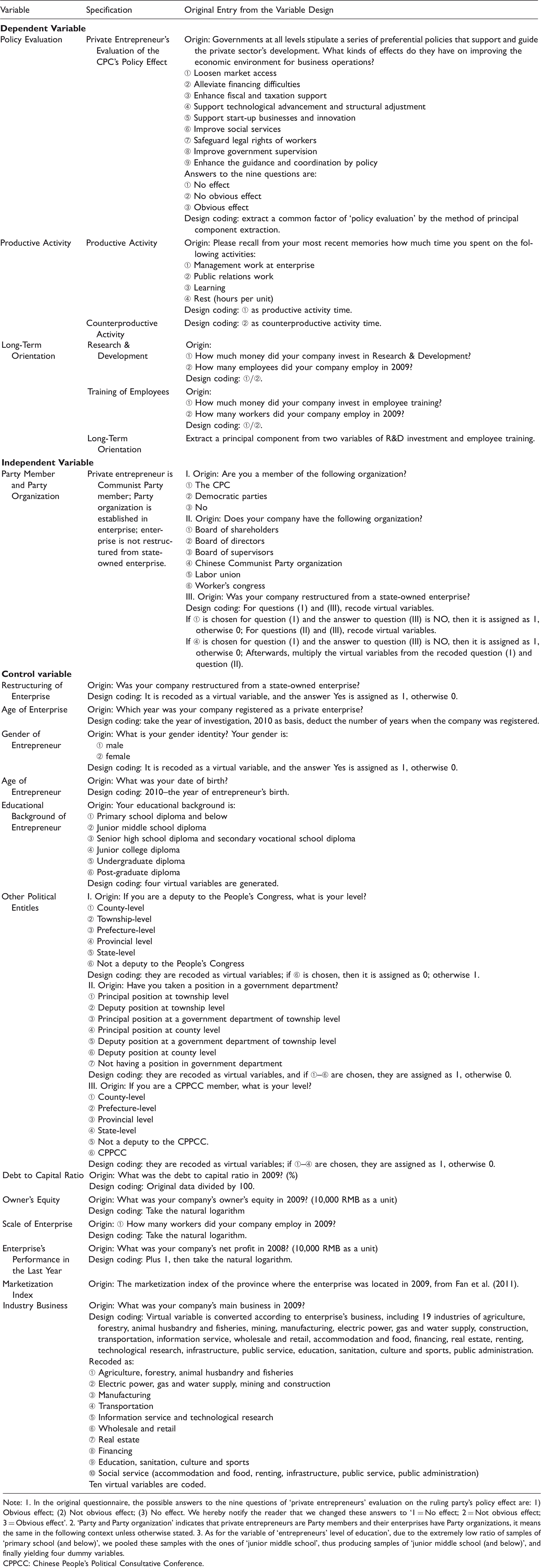
Note: 1. In the original questionnaire, the possible answers to the nine questions of ‘private entrepreneurs' evaluation on the ruling party's policy effect are: 1) Obvious effect; (2) Not obvious effect; (3) No effect. We hereby notify the reader that we changed these answers to ‘1 = No effect; 2 = Not obvious effect; 3 = Obvious effect’. 2. ‘Party and Party organization’ indicates that private entrepreneurs are Party members and their enterprises have Party organizations, it means the same in the following context unless otherwise stated. 3. As for the variable of ‘entrepreneurs' level of education’, due to the extremely low ratio of samples of ‘primary school (and below)’, we pooled these samples with the ones of ‘junior middle school’, thus producing samples of ‘junior middle school (and below)’, and finally yielding four dummy variables.
CPPCC: Chinese People's Political Consultative Conference.
Descriptive statistics
Descriptive statistics of main variables (N = 2561).
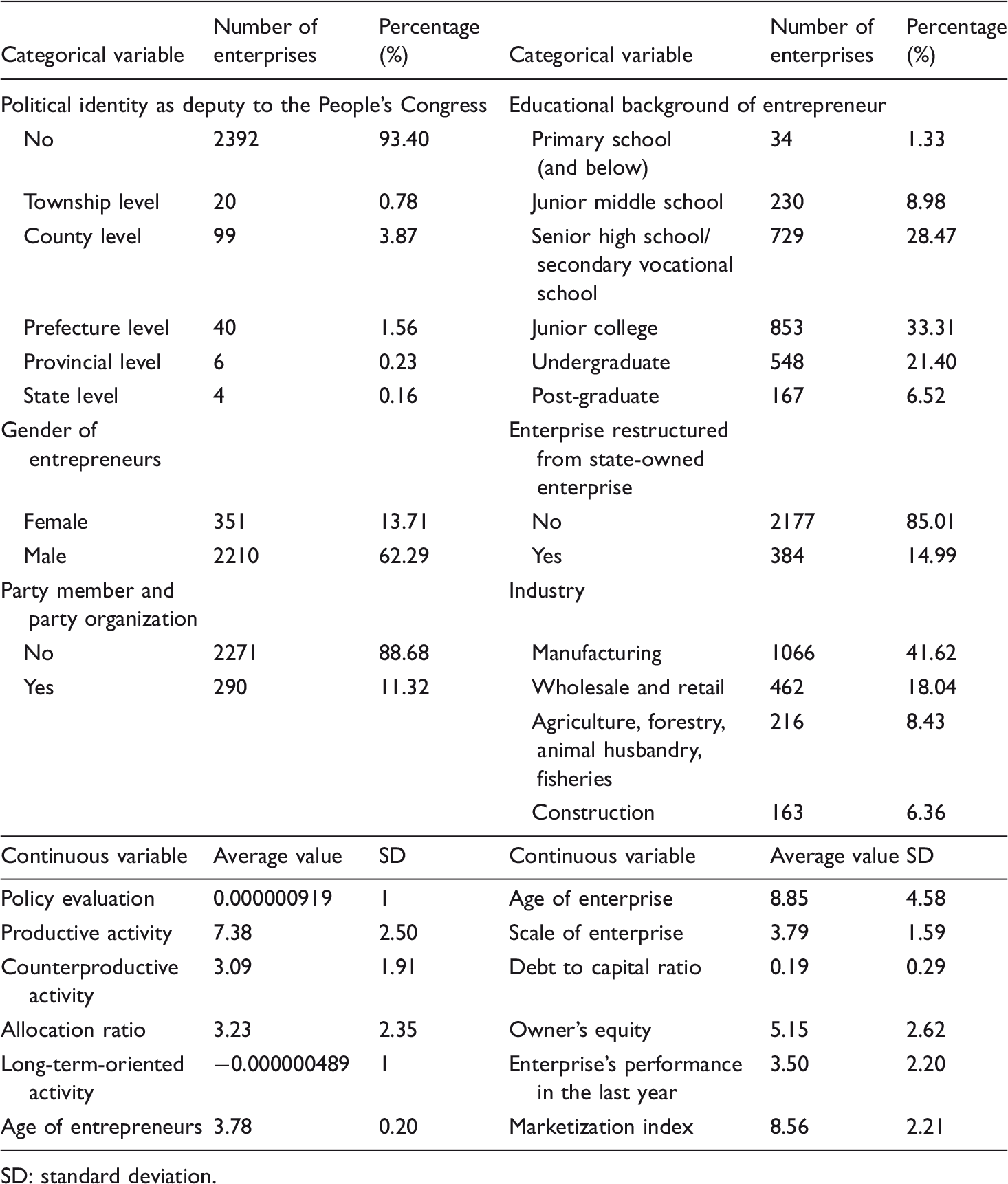
SD: standard deviation.
Analytical methods
The statistics adopted in this paper were procured through multistage sampling, a kind of complicated sampling investigation. If the analysis was conducted directly, the standard error of parameters would be underestimated, hypothesis testing affected, and statistical results deviated. Due to these facts, we process data with the ‘svy’ command in Stata. In the robustness test, to mitigate possible bias from heteroscedasticity, we conduct regression analysis with robust standard errors. All the regression equations in this paper are tested for multi-collinearity, and we have not found any serious multi-collinearity problems.
Empirical results and regression analysis
The regression analysis on the influences of political absorption and organizational embeddedness on private entrepreneurs' policy evaluations and behavior
Regression analysis results of effects on private entrepreneurs' policy evaluation and behavior from political absorption and organizational embeddedness.
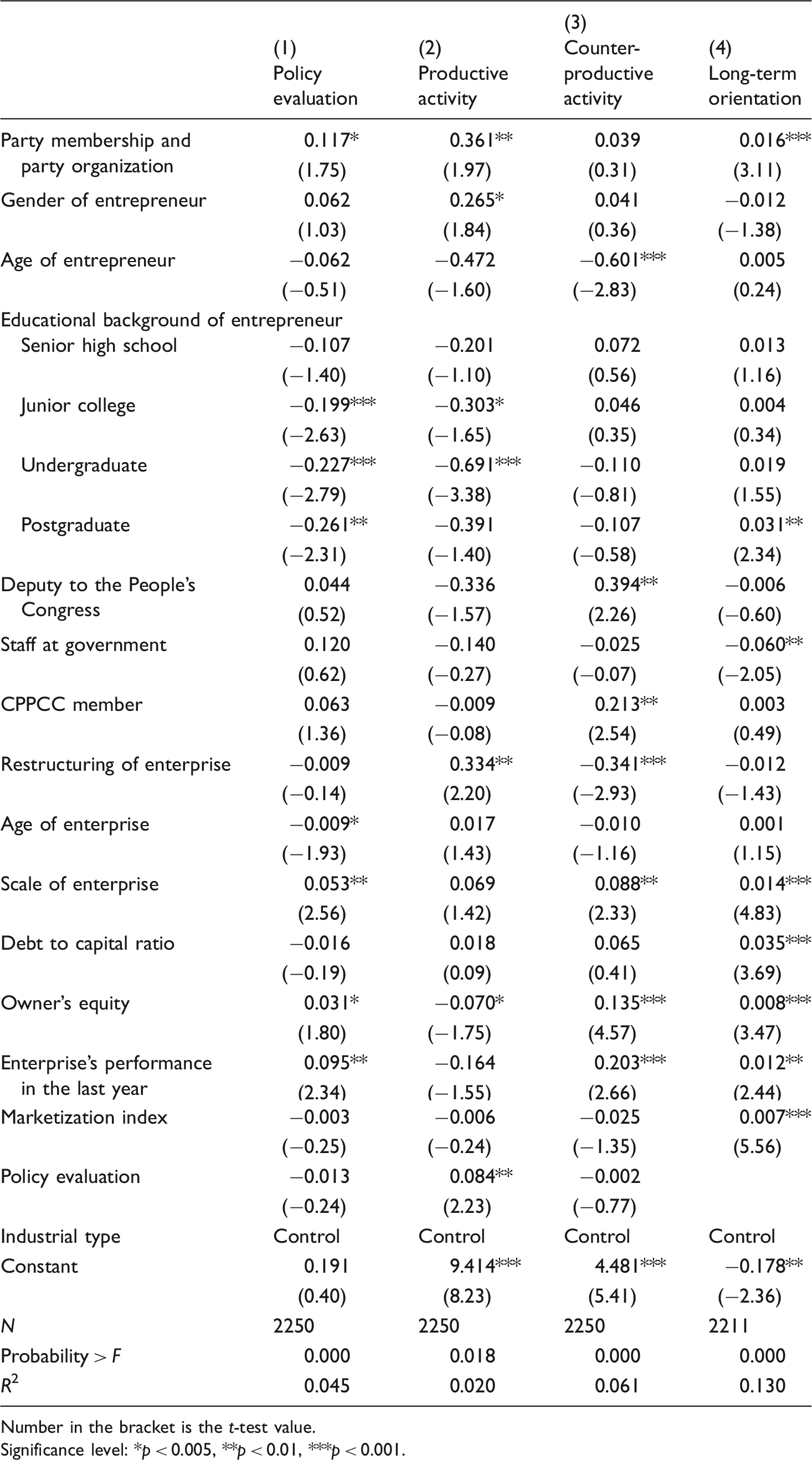
Number in the bracket is the t-test value.
Significance level: *p < 0.005, **p < 0.01, ***p < 0.001.
The results above show that compared with other types of private entrepreneurs (those without Party memberships or those without Party organizations in their enterprises; those with Party memberships but without Party organizations in their enterprises; those without Party memberships but with Party organizations in their enterprises; and those with Party memberships and Party organizations in enterprises that were formerly state-owned), private entrepreneurs with Party memberships and Party organizations in their enterprises evaluated the ruling party's supporting policies on guiding private sector economic development more highly. The political identity with and organizational resources of the Party could drive them to invest their resources in productive and long-term-oriented activities.
Robustness test
Robustness test on endogenous problems
Endogenous problems may exist in the discussed effects of establishing Party organizations in enterprises and entrepreneurs having Party memberships on the evaluation of the ruling party's policies and on investment in productive and long-term-oriented activities. The first reason for this is that the variables of Party membership and Party organization may be related to the residual item in the model. The second reason is that private entrepreneurs' policy evaluations and productive and long-term-oriented activities may affect their Party memberships and whether their enterprises have Party organizations. To mitigate bias from the heteroscedasticity model, we test with the Durbin-Wu-Hausman method (Durbin, 1954; Wu, 1973; Hausman, 1978).
In the process of testing, we chose ‘whether private entrepreneurs have taken positions as cadres, middle managers or officers in charge in the Party and government organizations, state-owned enterprises and collective-owned enterprises before they started their business’ as the instrumental variable of ‘party member and party organization’. We had three reasons for this decision: First, if private entrepreneurs once worked as the head of some department or organization, then they were probably already Party members. Even if they were not Party members, they were the representatives of ‘advanced productive forces’ and would be first absorbed into the Party by the state. Second, with the institutional identity, private entrepreneurs probably have stronger political sense and are more likely to answer the call of the state and to establish party organizations in their enterprises. Thus, institutional identity is highly related to whether private entrepreneurs have Party memberships and party organizations in their enterprises. Third, although institutional identity may prompt private entrepreneurs to take preference over counterproductive activities like connection maintenance in their daily operation, as the course of marketization forges ahead, the formal system is playing a larger role, and the strategy of market competition will have more possibilities for creating values. The influence that institutional identity has on private entrepreneurs' value judgments and behavior is weakening as time goes by. Based on that, we tested the instrumental variable of ‘whether private entrepreneurs have taken managerial positions or positions as officers in charge within the system’ with the Durbin-Wu-Hausman method. The results are that the model in this paper has no significant endogenous problems. We also tested the ‘restructuring of enterprise’ as an instrumental variable and found no serious endogenous problems. In addition, other key control variables may contain endogenous problems, so we tested them with the Durbin-Wu-Hausman method according to the above methods and found no serious endogenous problems, ensuring the stability of the regression results.
Regression by robust standard errors
Regression analysis results of effects on private entrepreneurs' policy evaluation and behavior from political absorption and organizational embeddedness: feasible generalized least squares.
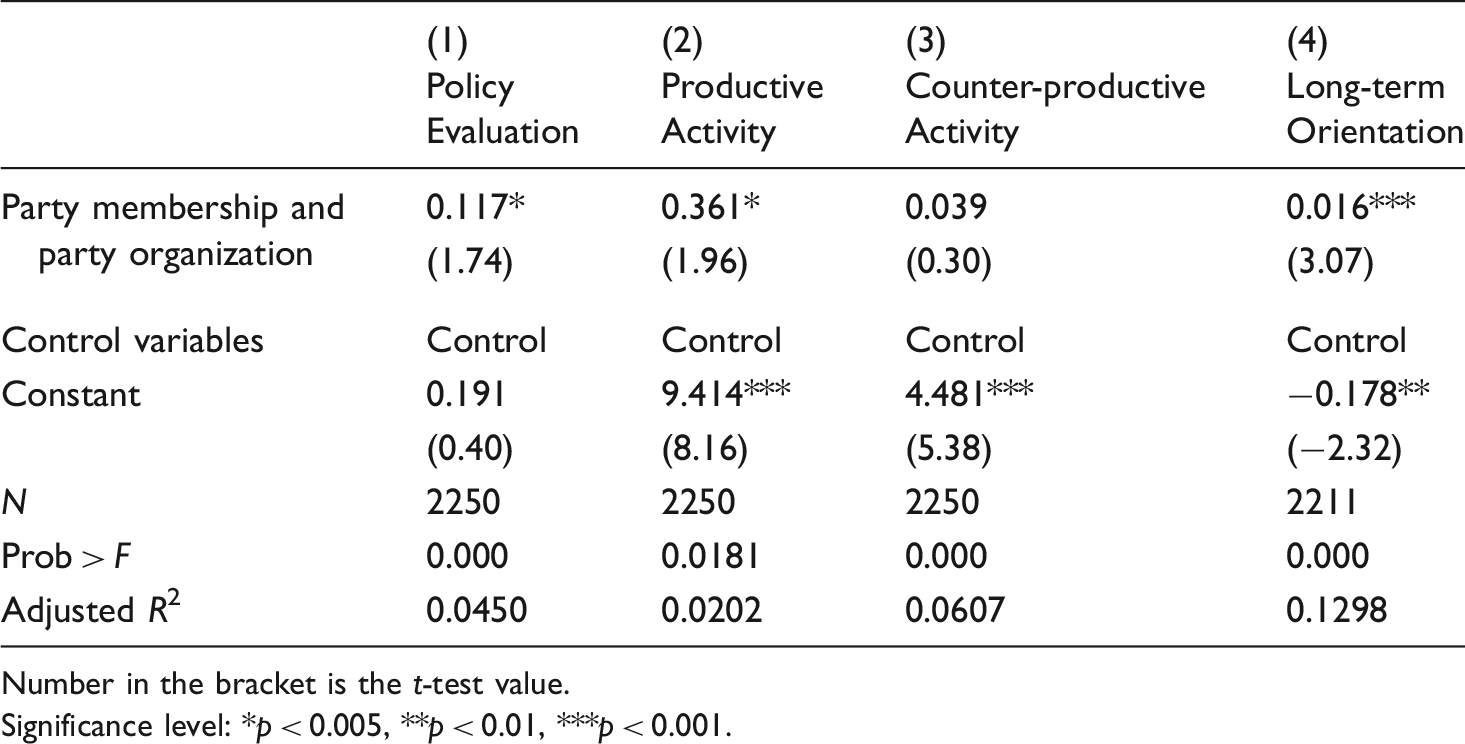
Number in the bracket is the t-test value.
Significance level: *p < 0.005, **p < 0.01, ***p < 0.001.
Discussion and conclusion
Since the Reform and Opening-up policy was implemented in China, the private sector, as the representative of newly emerging social forces, has accumulated abundant economic and social capital. Enormous economic and social energy has been rapidly unleashed and gathered up by the private sector, which at the same time has displayed the impulsion to expand its action room and to conduct self-organization. If the private sector's development is left unguided and unregulated, it will definitely exert some challenges and threats to the CPC's power status. In fact, the governance foundation of the ruling party lies in support from the public and newly emerging social forces, and the interactive relations between the Party and its people are becoming increasingly important following the development of the democratization of decision-making in China (Zhou, 2011). Many successful entrepreneurs have benefited greatly from the structural adjustments of the system and the split-up of economic interests. They have taken the initiative in the market economy, and at the same time they have been absorbed by the Party and government into some related political channels. The CPC extends its Party organization network into private enterprises by embeddedness, i.e. establishing grassroots Party organizations in the private sector. Through two effective methods of relieving political pressure, integrating bottom-up political absorption with top-down infiltration, the CPC realizes its classified control over private entrepreneurs (Kang and Han, 2005). On the other hand, a great many private entrepreneurs seek political participation and establish party organizations in their enterprises to further develop collusive and mutualistic relations.
In this paper, we find that the integration of private entrepreneurs by the ruling party is not one-sided, nor is it a simple exchange based on information, resources, power inequalities and patron-client power relations (Wank, 1996; Ji, 2012); it is manifested more as collusive and mutualistic relations based on mutual political trust. After analyzing the statistics of the 9th National Private Entrepreneurs Sampling Survey, we reached the following conclusions: First, in comparison with other types of private entrepreneurs (those without Party memberships or Party organizations in their enterprises; those with Party memberships but without Party organizations in their enterprises; those without Party memberships but with Party organizations in their enterprises; and those with Party memberships and with Party organizations but whose enterprises were formerly state-owned), private entrepreneurs with party memberships and party organizations in their enterprises evaluate the ruling party's relevant policies more highly. Second, private entrepreneurs with Party memberships and Party organizations in their enterprises prefer productive and long-term-oriented activities. Case studies and empirical conclusions indicate that the integration strategy of the ruling party has indeed exerted a positive effect; the ruling party is becoming increasingly dependent on the newly emerging social classes and their resources represented by private entrepreneurs, and the old one-sided dependency of private entrepreneurs on the ruling party and its policies has gradually been replaced by collusive and mutualistic relations between private entrepreneurs and the ruling party, which are ‘interdependent and mutually integrated’.
Our study is of theoretical and realistic significance. In the first place, we examine the logic and path of integration strategy adopted by the CPC for private enterprises through empirical statistics, which is a useful supplement to the current literature. Second, from the perspective of integration subject, the CPC has effectively relieved the private sector's political pressure through political absorption and organizational embeddedness. By doing so, the ruling legitimacy of the CPC is consolidated and maintained, and the production enthusiasm of private entrepreneurs is fully activated. From the perspective of the integration object, private entrepreneurs with Party memberships and Party organizations in their enterprises value the ruling party's relevant policies more highly, and thus they prefer productive and long-term-oriented activities. In fact, Chinese private enterprises and the ‘party-state’ have established a kind of mutualistic and emotional relationship, which motivates private entrepreneurs to form and cement their long-term reciprocal relationships with the ruling party and the state, and their sense of identity and sense of belonging to their shared ‘community’. Their relationship is more often manifested as a collusive and mutualistic evolutionary relationship based on mutual political trust. Third, the ruling party comes from society and will eventually return to society. The CPC is a party of all social classes. Only through continuous and positive self-adaptation can the Party play the role of leading and serving the country so as to better maintain and consolidate its legitimacy of governance and win more social support.
Based on the current literature, we believe that further research is merited to interpret the mutualistic and emotional relations between the ruling party and private enterprises from the perspective of mutual political trust, including (but not limited to) the essence, formations and effects of the mutual political trust mechanism. The collusive and mutualistic revolutionary relations (fundamentally, not superficially) would be more profoundly exhibited.
Footnotes
Acknowledgements
This paper was presented at the 11th Empirical Research Workshop of Organizational Sociology. Thanks for all the comments and suggestions from fellow participants. Thanks also to Professor Dian Yang for his modification advice on this paper and for the advice and suggestions from anonymous reviewers for the Chinese Journal of Sociology. The authors take sole responsibility for their views.
Funding
The research was sponsored by the National Natural Science Foundation of China ‘Co-Evolution of Chinese Family Business and Institutional Environment: Empirical Study Based on Allocation of Entrepreneurship’ (71572051) and ‘Moderating Effect of Entrepreneur’s Zhongyong Thinking Style on the Relationship Between Family Intention and Agent Governance Mode’ (71272083); the research was sponsored by the Special Funds for the Cultivation of Guangdong College Students' Scientific and Technological Innovation “The Micro-Mechanism of Innovation Leading in Guangdong Province: An Empirical Study Based on the Perspective of the Relationship between Innovation ‘Input-output’ in Family Firms” (pdjha0006).