




Abstract
Autism spectrum disorder (ASD) typically exhibits stereotyped or repetitive behavior that can be described as rigid, but also certain characteristics in the domain of language that can equally be characterized as rigid. These include heightened, enhanced sensitivity to the rules of grammar (morpho-syntax), often resulting in hyper-systemizing, as well as rigidity interpreting metaphorical, non-literal language. Human cognition and behavior (including language) believably resulted from an intense feedback loop between an increase in cognitive flexibility (primarily through a gradual emergence and complexification of language/grammar) and a reduction in reactive aggression and impulsivity (this resulting in more prosocial behaviors). Neurobiologically, this feedback loop contributed to a relatively recent evolution of denser connectivity between some cortical structures and the striatum, which is found affected in ASD. In this paper, we propose that the seemingly disparate features of ASD, including linguistic and behavioral rigidity, result from a common cause: an enhanced striatal function, linked to a reduced control of the striatum by selected cortical structures. The striatum is associated with both impulsiveness (including reactive aggression) and with automated, rigid, ritualized responses. Our proposal is specific enough that it can be experimentally tested, with implications for clinical approaches to autism.
Introduction
In this paper, we propose a unified account of certain salient linguistic and non-linguistic characteristics of rigidity in autism spectrum disorder (ASD) 1 . As with most, if not all cognitive conditions with a genetic basis and featuring atypical language patterns, it is not clear why (and how) such linguistic, but also cognitive and behavioral differences emerge from the alteration of individual genes. This difficulty is certainly expected given the pleiotropic nature of genes (i.e., the contribution of each gene to diverse biological processes), as well as to the multifactorial nature of development (as development results from complex, non-linear interactions between all the ontogenetic factors involved). That said, for a better understanding of ASD, we propose to derive its main characteristics by considering how our brain works and how it evolved (see Benítez-Burraco, 2023 for a recent overview; Benítez-Burraco & Progovac, 2024).
We specifically propose connecting the most salient non-linguistic and linguistic characteristics of rigidity in ASD to an enhanced, uninhibited striatal function, linked to a reduced control of the striatum by selected cortical areas. Besides building on neurobiological evidence, this hypothesis is embedded in one specific evolutionary framework for the human species, namely, the human self-domestication (HSD) hypothesis. According to this view, humans evolved certain features also found in domestic mammals, primarily through changes in the management of reactive aggression, particularly, changes affecting cortisol levels (see Hare et al., 2012; Hare, 2017; Rilling et al., 2012; Wrangham, 2019 for details). In this respect, Corbett et al.'s (2010) study using a peer interaction paradigm found higher levels of cortisol in many children with autism, while Spratt et al. (2012) found that cortisol levels in ASD are higher and more prolonged in reaction to a stressor from the environment, such as blood drawing, but also to other novel situations and stimuli. 2
In our previous work we have proposed that the (cultural) emergence of early forms of language/syntax and the reduction in reactive aggression levels associated with HSD were engaged in a feedback loop, both contributing to each other's intensification (see Benítez-Burraco & Progovac, 2020; Progovac & Benítez-Burraco, 2019). Importantly for our concerns in this paper, we have further hypothesized that this feedback loop both resulted from, and contributed to, an increased control by the cortex of the subcortical mechanisms, this ultimately resulting from an increased connectivity between selected cortical areas and striatal networks (e.g., Benítez-Burraco & Progovac, 2021). According to this view, in addition to being beneficial for the suppression of reactive aggression, the denser connectivity in these cortico-subcortical networks was also crucial for the sophistication of syntactic processing, as well as for the increased ability to process cross-modal input, which supports metaphorical extension in language.
Cross-modality is essentially about putting into relation information pertaining to different sources (perceptual or conceptual), which is achieved mostly through interactions and intersections among different sensory or cognitive pathways, supported by enhanced neuronal connectivity among several brain regions. In other words, denser connectivity in these networks is beneficial for all these processes: for the reduction in reactive aggression, for the increased sophistication of syntax, and for better ability to process cross-modal input, enabling humans to process metaphors such as sharp cheese or loud shirt. To consider another illustrative example, ideophones are a word category found in many languages across the world that convey diverse types of sensory information, including tastes, shapes, movement, textures, proprioceptive information, emotions (Dingemanse, 2012). Since they connect sounds to non-auditive information, they involve some sort of perceptive cross-modal thought. In purely symbolic words, sounds are linked to abstract concepts, where cross-modality transcends the perceptive domain and neurobiologically, depends on more extended networks.
Metaphorical extension is ubiquitous in language, and it is essential for vocabulary building, as well as for grammaticalization processes, which are directly relevant for syntax evolution (Benítez-Burraco, 2017; Benítez-Burraco et al., 2023). This can explain why altered reactive aggression responses (enhanced in ASD), atypical language structure, but also altered processing of figurative/metaphorical language (negatively affected in ASD), tend to cluster together in diverse cognitive conditions, including ASD and schizophrenia (Benítez-Burraco, 2017), Williams Syndrome (Niego & Benítez-Burraco, 2019), and bipolar disorder (Benítez-Burraco & Hansen, 2023); for a detailed overview and proposal, see Benítez-Burraco and Progovac (2021).
At the same time, as discussed below, independent evidence suggests that this neuronal connectivity of cortico-striatal networks has been bolstered significantly in relatively recent evolution. Additionally, candidate genes for the cognitive conditions mentioned above are enriched in genes that have been positively selected in our species (Banerjee et al., 2018; Polimanti & Gelernter, 2017; Srinivasan et al., 2016). This is also the case with our species-specific distinctive patterns of brain activity, which support language among other distinctive cognitive features (Murphy & Benítez-Burraco, 2018). There is a reason why a robust link is expected to exist between evolution and atypical development: recently evolved aspects of the human phenotype tend to be more susceptible to developmental damage because of their reduced resilience (see Pattabiraman et al., 2020; Toro et al., 2010).
One reason for the reduced resilience is that new mutations may eventually prove to be in conflict with some other genetic or environmental factors, unlike the older mutations, which have survived many such tests, and are therefore more robust. According to Toro et al. (2010), from an evolutionary perspective, brain networks which support more recently acquired cognitive skills, such as language or complex social behavior, might have less compensatory mechanisms compared with more ancient biological functions that have been shaped by a much stronger (and longer) selective pressure. According to Pattabiraman et al. (2020), evolutionary perspective is critical for understanding human biology, human medicine, and the traits that make human beings unique. Liu et al. (2016) also invoke evolutionary factors suggesting that ASD involves alterations in evolutionarily novel developmental processes, in particular those concerning the developmental expression pattern of synaptic genes, as discussed in section “Cognitive and neurobiological underpinnings of rigidity in ASD.” Since the evolution of dense connectivity in cortical-subcortical networks is a recent evolutionary development in our species, we expect that its altered presentation in these cognitive conditions would affect both the linguistic and behavioral features of rigidity. Our aim in this paper is to provide arguments for this scenario, focusing on ASD.
The Linguistic and Non-Linguistic Characteristics of ASD: Rigidity as a Common Feature
Autism presents with a wide individual variability in terms of its manifestations and intensity, and the discussion here pertains to the most salient features, the ones that are shared across a significant number of ASD individuals. The well-known characteristics of ASD encompass rigidity in behavior, including repetitive, ritualistic behaviors, as well as resistance to changing environments (Bailey et al., 1996; Frith & Happé, 2005; Kanner, 1943; Lord et al., 2018; Lord et al., 2020). Behavioral traits also include elevated reactive aggression in some individuals (Fitzpatrick et al., 2016; Hirota et al., 2020; Hill et al., 2014), whereas proactive (premeditated) aggression is less common in children with ASD (Farmer et al., 2015). 3 According to Fitzpatrick et al. (2016), elevated aggression is associated with negative outcomes for children with ASD, including increased stress levels and reduced availability of educational and social support. As mentioned in section “Introduction,” ASD is also characterized by higher cortisol levels in response to stressors. Moreover, aggressive behaviors in children with ASD have been linked to increased repetitive, stereotyped, and ritualistic behaviors as well as to resistance to change (Dominick et al., 2007; Hill et al., 2014; Kanne & Mazurek, 2011). This suggests that these behavioral manifestations can be attributed to a common cause. Here we propose that the salient linguistic features of rigidity can also be attributed to this same common cause.
Regarding language, although many aspects of language can be typical in ASD, there are still patterns of language processing and acquisition that differ from the non-ASD population (Bourguignon et al., 2012; Howlin, 2003). For example, atypical phonological and morphosyntactic patterns are frequently observed (Lindgren et al., 2009; Rapin & Dunn, 2003; Tager-Flusberg & Cooper, 1999; Tager-Flusberg & Joseph, 2003; see Norbury et al., 2010 for a discussion). When it comes to syntax, the atypical patterns are found with e.g., accusative clitics (Prévost et al., 2018), relative clauses (Durrleman et al., 2015), wh-questions (Prévost et al., 2017), passives (Ambridge et al., 2021; Durrleman et al., 2017), and embedded clauses (Silleresi et al., 2018). When it comes to word learning, some children with ASD rely more on auditory/phonological cues, rather than on semantic cues, the latter characteristic of their non-ASD peers (Kuhl, 2007; Preissler, 2008; Tager-Flusberg, 2006). Overall, when it comes to language acquisition, children with ASD exhibit more variable and heterogeneous linguistic profiles than their non-ASD peers (Eigsti et al., 2007; Kjelgaard & Tager-Flusberg, 2001; Luyster et al., 2007). Even though the ultimate causes of these ASD features are difficult to determine, some core processing/cognitive considerations have been hypothesized to account for the language patterns exhibited by ASD. Regarding expressive patterns, they might relate to an altered oromotor function (Belmonte et al., 2013). On the other hand, when it comes to the receptive language, the suggested causes include a reduced effect of semantic priming (Preissler, 2008), altered phonological processing (Lindgren et al., 2009), and/or altered functioning of procedural memory (Walenski et al., 2006).
Importantly for the considerations of this paper, ASD individuals show a notable increased aptitude for learning rules and for pattern recognition, including, but not limited to, those pertaining to language (Baron-Cohen et al., 2009; Ward et al., 2017). One visible side-effect of this heightened aptitude for rules involves hyper-systemizing, including over-regularizing e.g., past-tense forms (e.g., bring-bringed), which is one of the factors contributing to the atypical language profile (see e.g., Baron-Cohen et al., 2009). Sensitivity to language rules and patterns is certainly a crucial feature of human cognition, without which human language would not be possible. In this respect, ASD shows heightened sensitivity to the rules, which, from a non-ASD perspective is perceived as rigidity. But this propensity for focusing on rules and patterns would have been a crucial ingredient, and a crucial driving force in the evolution of human language. This beneficial effect on recognizing and learning language rules and patterns may also be the reason why this kind of neurodiversity persists in human populations.
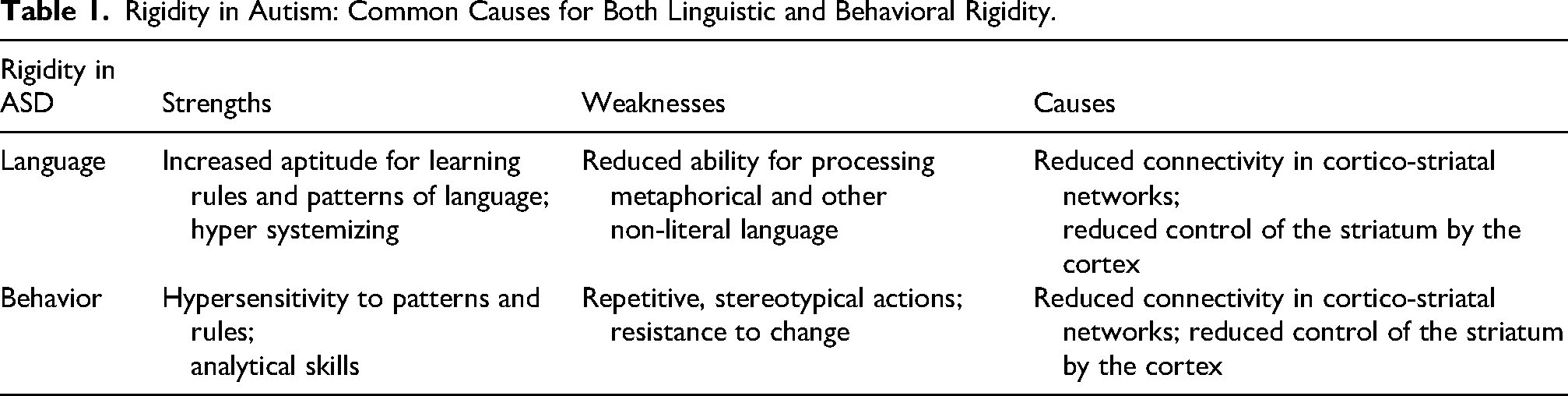
We propose that there is another instance of linguistic rigidity in ASD: difficulty in interpreting metaphors and non-literal language more generally (Jordan, 2010). For instance, Nagase (2018) reported a U-shaped relationship between the intensity of autistic traits and appreciation of humor, which often rests on unexpected turns and meaning extensions/stretching (see also Kana & Wadsworth, 2012). In this respect, ASD individuals often find it difficult to establish connections between two elements of a compound whose combination cannot be interpreted rigidly/literally, but instead relies on metaphorical “stretching” of meaning, as in belly button (Riches et al., 2012). These findings indicate that both behavioral and linguistic characteristics of ASD exhibit atypical rigidity, when compared to non-ASD populations. While rigidity in recognizing and learning the rules and patterns of language may present as an advantage/strength of autism, rigidity when it comes to metaphorical extension and interpretation of figurative language presents as a disadvantage. Table 1 summarizes the crux of the proposal.
Rigidity in Autism: Common Causes for Both Linguistic and Behavioral Rigidity.
Interestingly, similar considerations characterize Tourette's syndrome (TS) (McBride & Parker, 2015; Rapanelli et al., 2017). TS is a hereditary tic condition which is, in some individuals, accompanied by involuntary production of obscene speech and derogatory remarks/insults (coprolalia), that is, by verbal aggression (e.g., Van Lancker & Cummings, 1999). There are similarities between ASD and TS with regards to physical aggression as well, in that TS individuals tend to exhibit elevated reactive aggression (Ganos et al., 2014; also Budman et al., 2008; Chen et al., 2013; Kano et al., 2008; for studies on cortisol levels in TS, see e.g., Corbett et al., 2008). This highlights the continuity between physical aggression and verbal aggression and verbal behavior more generally, as discussed in detail in the context of language evolution in Progovac and Benítez-Burraco (2019). 4 Importantly, just as is the case with ASD, TS individuals also show hypersensitivity to syntactic rules, including hyper-systematizing, as well as rigidity with the interpretation of figurative language, including metaphors. In this respect, Eddy et al. (2010) found evidence of a reduced ability in TS for interpreting nonliteral remarks, such as sarcasm, metaphor, and indirect requests (see also Drury et al., 2018). In other words, and similarly to ASD, TS individuals exhibit an advantage in learning the rule-governed aspects of language/grammar, as opposed to idiosyncratic/irregular linguistic knowledge (Walenski et al., 2007). Finally, as with ASD, these weaknesses and strengths have both been attributed to an enhanced procedural memory (Takács et al., 2018).
As pointed out in Williams et al. (2018), it has proven difficult to find a clear correlation between behavioral issues in ASD, including aggression and self-injury, and communication/verbal skills. This may be because communication/language skills are typically taken as a monolith, rather than broken down into specific components. Our proposal identifies some specific hypotheses in this regard, predicting that there should be a correlation between linguistic and non-linguistic manifestations of rigidity in autism. The linguistic measures of rigidity include difficulty in interpreting metaphors and other non-literal language, as well as hyper-systemizing, i.e., rigid application of rules. The rigid (non-flexible) behaviors include stereotypical, repetitive actions and resistance to change. If the common cause for both linguistic and non-linguistic manifestations of rigidity is enhanced striatal activity, linked to a reduced control of the striatum by the cortical areas, then these characteristics are predicted to correlate in ASD. In order to test this prediction, one can design experiments to determine if ASD individuals with more rigid behaviors also exhibit more linguistic rigidity in the areas identified above. If so, therapies for autism may benefit from addressing both types of rigidity simultaneously, in a synchronized way, possibly through verbal and behavioral drills at an early age.
Moreover, this also predicts that these manifestations of rigidity should correlate with irritability and impulsivity, including aggressive and self-injurious behaviors, as these are also consequences of the same or overlapping underlying mechanisms: the reduced control of the striatum by the cortical areas (this is discussed further in the following section). Our proposal is consistent with Williams et al.'s (2018) suggestion that the aggressive behavior in ASD seems to be related to less emotion regulation and less cognitive control.
Cognitive and Neurobiological Underpinnings of Rigidity in ASD
As with most aspects of behavior, neurotypical language processing (and acquisition) relies on a delicate balance between, on the one hand, rules and patterns, and, on the other hand, the flexibility to suspend such rules when exceptions need to be learnt and accommodated (as with irregular verbs), or when metaphorical extension is intended (with such extensions defying the rules of compositionality, but adding the dimension of creativity and flexibility to language). As noted by Lieberman (2000, 2001), the knowledge of the rules of syntax, which is for the most part instinctive and automated, are largely driven by what he calls “the reptilian brain,” that is, by the basal ganglia. The basal ganglia (including the striatum) are the ancient brain structures which are essential for survival, as they support instinctual, unconscious, automated responses to the environment. The striatum is associated with the acquisition of habits and is the main link supporting procedural memory, the long-term memory contributing to unconscious and implicit learning.
Ullman (2004, 2015, 2016) has linked procedural memory to the processing of syntactic rules, in particular those phenomena that are systematic and regular. By contrast, declarative memory proves better at handling exceptions to the rules, as well as idiosyncratic meanings and idioms, including metaphorical language (see Ullman, 2015 for a review). Relevant for our proposal, the cortical control of striatal activity seems to be essential for overcoming the rigid, instinctive, ritualistic responses, which rely on the basal ganglia. Here we propose that the overreliance on rules (and more generally, what we have called “linguistic rigidity”) by ASD individuals, which also extends to, and is continuous with, general rigidity in behavior, is suggestive of an increased striatal function, which, in turn, can be linked to a reduced control of the striatum by the cortex. 5 As the global hypoconnectivity in ASD (footnote 5) negatively affects declarative memory, procedural memory can be seen as compensating for this weakness, specifically when it comes to language acquisition. As pointed out in e.g., Ullman (2015), even though the two memory types typically specialize for these different functions, they are also partly overlapping/redundant in their functions, which means that they can compensate for each other's weaknesses. In fact, if there is extra effort exerted by the striatum in processing language in ASD, then this enhanced engagement of the striatum in compensating for linguistic rigidity may be an additional contributing factor to behavioral rigidity.
There is evidence supporting this proposal. In fact, ASD has been reported to involve interneuron activity which results in altered (reduced) inhibition of specific cortico-striatal circuits and ultimately, in reduced control of striatal activity by cortical structures (Nelson & Valakh, 2015; see also McBride & Parker, 2015; Rapanelli et al., 2017). This also has an impact on procedural memory (Walenski et al., 2006). Such altered cortico-striatal connectivity has been linked to repetitive behaviors in ASD (see e.g., the review in Wilkes & Lewis, 2018). According to Kohls et al. (2014), the ventral striatum and dorsal striatum, the components of the basal ganglia, are the major subcortical targets within the frontostriatal behavior control loops that are implicated in rigid behavior in ASD. According to Haber (2016), these subcortical structures work in tandem with the cortex, in particular with the frontal cortex, via a complex cortico–basal ganglia network which is responsible for coordinating complex behaviors. This system relies on parallel cortico-subcortical channels through the basal ganglia, as discussed in detail in Haber (2016).
According to Evans et al. (2024), striatal abnormalities in ASD are often dynamic across development, where a key role is played by the dorsal striatum. Dorsal striatum, comprised of caudate nucleus and putamen, is the main input-receiving basal ganglia structure, receiving projections from many other brain regions, including most sub-regions of cerebral cortex. Langen et al.'s (2014) longitudinal study of brain development in ASD also implicates the involvement of dorsal striatum in repetitive behavior, specifically caudate nucleus, where the growth rate in ASD was found to be doubled in comparison to controls. They also found that faster striatal growth was correlated with more severe repetitive behavior (insistence on sameness) at the preschool age. Based on imaging studies in humans, Haber (2016) points out that activity specifically in the lateral putamen is associated with repetitive and well-learned movements that require little cognitive effort. In the review article, Soghomonian (2024) concludes that dorsal striatum is traditionally considered a key player in the generation of automatic repetitive movements.
A key question is what evolutionary forces favored this increased control of the striatum by the cortex, which appears to be instrumental for language/syntax processing in general. There is evidence that a significant strengthening of neuronal connectivity of cortico-striatal networks occurred in relatively recent evolution, in the line of descent of humans (Ardila et al., 2016; Dediu, 2015; Starr & Fraser, 2025). Current understanding of brain anatomy and function suggests that it is the striatal neural plasticity that allows the basal ganglia circuits to communicate between structures and to functionally operate in procedural memory processing (see e.g., the review in Kreitzer 2009). According to Evans et al. (2024), dorsal striatum is directly involved in procedural learning, characterized by acquisition of learned skills without conscious awareness. Accordingly, some changes in this plasticity are expected to have occurred in our lineage that would account for the discussed changes in brain connectivity. According to some proposals, these changes can be attributed to specific gene mutations, including in FOXP2, the (in)famous “language gene” (see e.g., Enard et al., 2009; Lieberman, 2009). Figure 1 illustrates the place of our proposal in this bigger picture.

Interactions Among Various Factors Affecting Rigidity in ASD.
Further support for our proposal comes from e.g., Isaacson's view of the brain (1982: 1, 240), the view that the lowest, protoreptilian brain involving ancestral learning and memories is subjugated by the higher limbic brain, thus allowing forgetfulness and suppression of the protoreptilian habitual way of responding. These ideas are predated by those of MacLean (1949), who proposed that “the reptilian complex” was responsible for instinctual, impulsive behaviors involved in aggression, dominance, territoriality, and ritual displays, which can be suppressed and constrained by the conscious thought associated with the neocortex. Rational decision making is associated with the prefrontal cortex, or yet-higher brain (Strickberger 2000: 506). Even though Isaacson's and MacLean's ideas have, naturally, been updated and revised, according to LeDoux (2000: 159), “MacLean's original ideas are very interesting in the context of a general evolutionary explanation of emotion and the brain. In particular, the notion that emotions involve relatively primitive circuits that are conserved throughout mammalian evolution seems right on target.”
Moving now to the domain of language, in his characterization of symbolic reference, Deacon (1997: 300) has relied on these notions, although in a revised, updated sense, arguing that each higher-order form of a representational relationship must be constructed from, or decomposed into, lower levels of representation, in such a way that symbolic reference depends on indexical reference, and indexical reference, in turn, depends on iconic reference. In our own research, we have built on extensive evidence of a functional connection, and a partial overlap of the brain (and cognitive) mechanisms involved in the modulation of aggression and in the processing of language (discussed in detail in Benítez-Burraco & Progovac, 2024). This reinforces the view that the suppression/subjugation by the cortex of the automated, instinctive responses of the basal ganglia, mostly through the evolution of dense connectivity between cortical and subcortical structures of the brain, was a byproduct of both the attenuation of reactive aggression and the emergence of early forms of language, more precisely, a byproduct of the intense feedback loop between the two. When the precise balance of inhibition/disinhibition in these networks, characterizing typical populations, is just a bit altered, the way it is with ASD where the control of the striatum by the cortex is diminished, we observe a cluster of characteristics manifesting as atypical rigidity both in linguistic and non-linguistic domains. This is consistent with Sohal and Rubenstein's (2019) finding that excitatory-inhibitory imbalance is a leading hypothesis for the circuit basis of ASD.
Conclusions
ASD exhibits not only behavioral characteristics of rigidity, but also linguistic rigidity, which includes heightened sensitivity to the rules of morpho-syntax, often resulting in hyper-systemizing, as well as rigidity in interpreting metaphorical, non-literal language. In addition, ASD tends to exhibit higher levels of reactive aggression. In this paper, we propose a common evolutionary cause for these seemingly disparate characteristics of ASD, with interest as well for human evolution, and language evolution more specifically. We have connected these characteristics of autism to an enhanced striatal function, linked to a reduced control of the striatum by cortical structures. In particular, we have embedded this proposal within the framework that sees the evolution of human species, and of human language more specifically, as a result of a feedback loop between HSD and the emergence of language/syntax. This feedback loop, we contend, was responsible for the relatively recent evolution of a denser connectivity in these brain circuits. This ultimately provided a mechanism for better control by the cortical structures of the striatum, the structure of the brain which is associated with impulsiveness/aggression, as well as with rigid, ritual, automated responses. We thus provide a unified account of these salient linguistic and behavioral characteristics of autism, relying on a common (evolutionary) cause.
In addition to offering a clearer view of how human cognitive distinctiveness evolved, including language, this view should also be of direct relevance for achieving a deeper understanding of ASD, highlighting both its strengths and its weaknesses, and shedding light on why this kind of neurodiversity persists. This approach has also identified new, more specific hypotheses, predicting that there should be a correlation in ASD individuals between the intensity of linguistic and non-linguistic manifestations of rigidity. These considerations would favor therapies for autism which target both linguistic and non-linguistic features of rigidity simultaneously, in a synchronized way.
Footnotes
Acknowledgments
We are grateful to two Reviewers for their careful reading of our paper, and for detailed and constructive feedback, which significantly improved our paper not only in its organization, but also in its insights. We also thank the Editor for the skillful guidance through this process.

Author Contributions
LP and ABB conceived the paper, reviewed the available literature, and wrote the paper. Both authors approved the final version of the manuscript.
Funding
The authors disclosed receipt of the following financial support for the research, authorship, and/or publication of this article: This research was supported by grant PID2023-147095NB-I00 funded by MICIU/AEI/10.13039/501100011033 and by ERDF/EU (to ABB).
Declaration of Conflicting Interests
The authors declared no potential conflicts of interest with respect to the research, authorship, and/or publication of this article.
Data Availability
The materials used in the paper are presented as a list of bibliographical references at the end of the paper.