




Abstract
Background and aims
Research on the psychological impact of the coronavirus disease 2019 pandemic has highlighted its negative and positive effects on children with autism spectrum disorder and their families. However, little is known about the neutral effects that remain the same, even in particular circumstances, and how children with autism spectrum disorder and their parents perceive each other. We explored how children with autism spectrum disorder and their mothers perceived and experienced the pandemic in Japan.
Methods
A mixed-methods design was employed. Thirteen children with autism spectrum disorder and 12 mothers participated. Data were collected through online semi-structured interviews and analyzed using thematic analysis. Similarities and differences in perceptions were compared.
Results
The results revealed six broad themes and 27 categories. Regarding neutral effects, some mothers reported no substantial impact because there were no changes in their jobs or other dramatic life changes. In addition, some children were not affected because they had had no social contact before the pandemic or because their lives had not changed dramatically. Regarding the perceptions of children/mothers, most expressed that they/their children enjoyed spending time with their families. At home, mothers made various efforts to interact with their children. However, mothers and children differed in their perceptions, such as regarding the emergence of anxiety about conducting school events and the resolution of study-related concerns.
Conclusions
There were negative, neutral, and positive effects on both children with autism spectrum disorder and their mothers; specifically, they were striving to move forward to overcome the problems posed by the pandemic. Both parties tapped into their resilience by enhancing family interactions, such as cooking together or discussing children's interests.
Implications
These findings have important implications for developing more creative solutions to the challenges of coping and resilience in future crises.
The coronavirus disease 2019 (COVID-19) pandemic, caused by severe acute respiratory syndrome coronavirus 2, spread rapidly worldwide in early 2020. In Japan, where this study was conducted, the first case of COVID-19 was confirmed in January 2020, following which the pandemic gradually spread. To prevent the further spread of the infection, almost all elementary and junior high schools were temporarily closed from March to May, resulting in a drastic change in children's living environments. In April of the same year, the Japanese government declared the first state of emergency for the entire country, which was subsequently issued several times in areas with many patients with COVID-19. Although the government did not implement lockdowns as in other countries, it recommended the avoidance of the “Three Cs”—closed spaces, crowded places, and close-contact settings. Also recommended was staying home to limit the flow of people and reduce the spread of the virus. Although these measures had no legal force, they resulted in changes in work and school situations (e.g. wearing a mask, working from home, and taking online classes). These efforts to prevent infection have continued, and the number of patients has continued to vary. The infection situation was not very severe at the time of conducting this study.
Prior to the pandemic, there was limited research on the experiences of children with autism spectrum disorder (ASD) during disasters and other emergency events, and there was a need to determine the psychological effects and resiliency in this population in response to such events (Stough et al., 2017). However, after the pandemic, the COVID-19 experiences of children with ASD and their families have provided the opportunity to study the impact of changing environments (Simpson & Adams, 2022), and there is a growing body of research focused specifically on their experiences and adaptation to the “new normal” as preparation for the future (for a review, Dal Pai et al., 2022).
The findings of previous studies that involved interviews with parents of children with ASD revealed that the pandemic is not phase-independent and has negative, neutral, or positive effects on the interpersonal relationships, mental health, and education of children with ASD and their families. Further, most parents reported that they and their children demonstrated both negative and positive changes in various domains. For example, Fox et al. (2022) surveyed parents’ perceptions of the impact of COVID-19 on the friendships of their children with ASD during the transition to a new school in December 2020. COVID-19 has negatively impacted friendships by reducing contact with existing and new friends and their parents. Regardless of lockdown restrictions, some had neutral experiences, wherein nothing changed because they had had no contact with friends outside school before the pandemic. Others had positive experiences, such as children who had difficulty making friends without bringing their friends home to play, thus reducing their stress.
In broader domains, including social interactions and communication (e.g. Fox et al., 2022), negative aspects extend to the deterioration of mental health (Asbury et al., 2021; Daulay, 2021; Pellicano et al., 2022; Rogers et al., 2021), difficulties in adaptation to remote learning (Amirova et al., 2022; Bozkus-Genc & Sani-Bozkurt, 2022; Heyworth et al., 2021; Majoko & Dudu, 2020; Meral, 2021), disruption of family routines (Bozkus-Genc & Sani-Bozkurt, 2022; Meral, 2021), and increased problem behaviors of children (Amirova et al., 2022; Daulay, 2021; Latzer et al., 2021; Meral, 2021). Some of the factors contributing to these negative effects suggest that parents of children with ASD generally experience higher levels of parental stress than those of typically developing children (Hayes & Watson, 2013; Osborne & Reed, 2009), and it is highly plausible that their stress might be magnified during a pandemic (Corbett et al., 2021). Owing to the characteristics of ASD, such as resistance to changes in routine and sensory issues, children with ASD may have had difficulty adapting to the new normal (Ameis et al., 2020). Subsequently, regarding neutral aspects, a large-scale survey conducted by Corbett et al. (2021) reported no changes in the measures of mental health and stress among children with ASD during lockdown, although the domains and factors were not sufficiently identified in the interview studies. Finally, positive aspects include acquisition of new routines and skills (Amirova et al., 2022; Latzer et al., 2021; Majoko & Dudu, 2020; Meral, 2021), enhancement of home education (Daulay, 2021; Heyworth et al., 2021; Majoko & Dudu, 2020), improved mental health and well-being of children with ASD and their parents (Latzer et al., 2021; Pellicano et al., 2022; Rogers et al., 2021), and sharing more family time (Bozkus-Genc & Sani-Bozkurt, 2022; Meral, 2021; Rogers et al., 2021). As for these factors, Bolbocean et al. (2022) speculated that this was because the COVID-19 crisis encouraged the activation of parental resilience, which is the ability of families and their children to beat the odds under adverse conditions. The activation was influenced by parents’ ability to accommodate their children's needs, in addition to their creativity, resourcefulness, and ability to maintain a positive outlook. A summary of the negative, neutral, and positive findings of previous studies is presented in Table 1.
Findings of previous studies related to the impact of the COVID-19 pandemic on children with autism spectrum disorder (ASD) and their families.

Previous studies demonstrated both negative and positive effects, except for Asbury et al. (2021), who reported mainly negative effects and partially revealed the impact of the pandemic from the parents’ perspective. However, these studies relied entirely on parental perceptions and did not involve children with ASD in the research process, except for Pellicano et al. (2022), who examined young people (aged 15 years) with autism. In addition, none of the interview studies sufficiently revealed neutral effects, and Pellicano et al. (2022) did not provide a detailed analysis of the commonalities and differences in the perceptions of parents and children. Identifying what remains the same during the pandemic helps further the understanding of ASD and, from both perspectives, provides valuable insights for supporting children with ASD and their parents, “making the world a more autism friendly place” (Spain et al., 2021, p. 9).
Based on prior findings, we investigated the long-term impact of the pandemic on daily life by conducting in-depth qualitative interviews with younger children with ASD compared to the participating children by Pellicano et al. (2022) and their mothers. The reason for assuming a “long-term” impact is that society is undergoing changes ranging from lockdowns to living with coronaviruses, and this situation warrants an analysis of the trends over time (Stadheim et al., 2022).
The research question in this study was how the long-lasting COVID-19 pandemic negatively, neutrally, and positively affected the psychological aspects of children with ASD and their mothers’ perceptions of their family functioning. In addressing this question, we hypothesized that mothers and their children with ASD could perceive both the negative and positive effects of the pandemic situation, and their perceptions could differ from each other depending on their individual perspectives. For example, we predicted that both the mother and her child would perceive the negative effects of the pandemic on their mental health and that the mother would perceive her child as having negative effects, while her child would feel positive for reasons such as being able to play video games at home.
Methods
Research design
A mixed-methods design—combining a quantitative approach using questionnaires with a qualitative approach using interviews—was used to reveal the common or different meanings based on individuals’ experiences (Creswell & Creswell, 2017). Focusing on the perspectives of mothers and their children, we examined their core experiences and reactions during a period approximately one and a half years from the beginning of the pandemic.
Participants
Twenty-five participants (13 children with ASD and 12 mothers of children with ASD) were recruited from three university clinic centers and one child development center. One mother had two children with ASD. To investigate the impact of the pandemic on parents and children, mothers were targeted instead of fathers, as mothers typically spend more time with their children at home and have more frequent interactions with their children. Most participating children and their mothers lived in urban areas of Japan, and all the children regularly went to school at the time of the survey. The eligibility criteria were (1) women with at least one child, (2) children aged 10–15 years, (3) the child having received a clinical diagnosis of autism according to the Diagnostic and Statistical Manual of Mental Disorders, Fifth Edition, Text Revision or Diagnostic and Statistical Manual of Mental Disorders, Fifth Edition criteria (APA, 2000, 2013), (4) a Full-Scale Intelligence Quotient ≥ 70 on the Wechsler Intelligence Scale for Children-Fourth Edition, and (5) mothers having spent time with the child at home. The reason behind choosing the lower age limit of 10 years was the need to convey pandemic-related in-depth personal experiences of this age group (Pellicano et al., 2022). Similarly, the reason for the upper age limit of 15 years was that the parent–child relationship in Japan generally changes substantially after high school age, such as children spending less time with their mothers.
Procedure
A short introduction to the study’s purpose was provided to the mothers and their children. Mothers also confirmed that the questionnaire and interview results could be recorded and stored and were informed that the anonymized data would be used only in publications. Importantly, participants were clearly informed that they had the right to withdraw from the study at any time. All the mothers signed an informed consent form. The survey was then conducted in the order of a series of questionnaires and interviews. All the procedures performed in this study were approved by the Department of Education Ethics Committee of Kochi University (no. 2021-08).
Instrument
We requested that the mothers send the completed questionnaires before the interview was conducted. The form included mothers’ demographic details such as age, educational level, family status, total number of children, and current working situation (usual working pattern, changed working pattern, or homemaker). This form also included details of children with ASD, such as age, sex, diagnosis, educational system (regular or special-needs education), changes in children's bedtime and waking times throughout the pandemic (earlier, no change, or later), and the number of services currently in use after school and on weekends (e.g. basketball, judo, or extra tuition).
In addition, mothers completed the Japanese version (Wakabayashi et al., 2004, 2007) of the autism-spectrum quotient (AQ; Baron-Cohen et al., 2001) to measure the strength of ASD characteristics in mothers and their children with ASD. As mothers’ characteristics were also considered relevant to the mother–child relationship, the AQ was implemented for mothers. The cut-off points for diagnosing ASD by AQ scores for adults and children were 33 and 25, respectively. Participants’ demographic profiles are summarized in Table 2.
Participants’ demographic profiles (N = 25).

M: mother; C: child; AQ: autism-spectrum quotient; WISC-IV: Wechsler Intelligence Scale for Children-Fourth Edition; FSIQ: Full Scale Intelligence Quotient; VCI: verbal comprehension index; PRI: perceptual reasoning index; WMI: working memory index; PSI: processing speed index; ASD: autism spectrum disorder; ADHD: attention-deficit/hyperactivity disorder.
M1 had two children: C1 and C6.
Interview
Online semi-structured interviews using Zoom were conducted between October and November 2021, depending upon participants’ convenience and availability. All interviews were performed individually with the child with ASD and the mother for ∼ 30 min each. The child and mother were asked a series of 16 and 20 open-ended questions, respectively, using a semi-structured interview guide developed specifically for this study.
To avoid misunderstandings, the interview guide for the child included attention to ensure confirmation as much as possible during the interview. The interviewer initially instructed, “I interviewed Ken (pseudonym) about COVID-19. Your school was closed when the pandemic occurred, right? Please think back carefully from that time to today and answer the questions.” Subsequently, slides created using Microsoft PowerPoint for Mac were shared on the screen. Questions pertaining to from the beginning of the pandemic until the study period were presented at the top of the screen. “The beginning of the pandemic” in this study was defined as around March 2020, when schools were closed countrywide in Japan. A space was provided below the question to enter what the child expressed. The interviewer asked the children to answer each of the questions in Table 3 and uttered the phrase, “From the beginning of the pandemic until now,” in a loud voice at the beginning of each question. They typed the children's utterances in real time and asked additional questions as needed (e.g. “What does that mean?” or “What else?”). The reason for visually presenting the expressed content was to enhance accuracy and elicit in-depth personal experiences. Questions 2 and 3 were asked only when disruptions were indicated in question 1. In the second half of the interview, the children were asked about the current situation (October or November 2021). The questions were the same as those in the first half, with the sentences in Table 3 modified to the present tense. It was clarified that, “From now on, I will ask about the current situation. The questions are the same.” Subsequently, “Now” was presented and emphasized with the question sentence on the screen. The other procedures were the same as in the first half of the interview.
Questions about the COVID-19 pandemic.

The interview procedures for the mother were modified from those for the child in the following ways. First, two questions were added regarding the changes in the mother–child relationship by increasing or decreasing the time spent with the child (questions 9 and 10 in Table 3). Only the mother was asked this question because describing the changes in the relationship was considered difficult for the child. Second, the interviewer asked about both the mother and her children (questions 1–3, 7, and 8). Finally, the interviewer did not type the mother's utterances and only verbally interacted with her. The other procedures were the same as those for the interviews with children.
Data analysis
Thematic analysis was performed, and the two themes of negative and positive effects indicated by Meral (2021) were expanded to three themes with the addition of neutral effects. The utterances of children with ASD and their mothers were distributed among these themes. Thereafter, the similarities and differences in children's and mothers’ perceptions were compared.
Further, the interview data were imported into NVivo (Release 1.6.2)—a qualitative data management software that helps organize and structure the data. Data were processed using thematic analysis in five stages: (1) data organization, (2) data coding, (3) creating themes, (4) editing codes and themes, and (5) explaining and writing themes (Alase, 2017; Braun & Clarke, 2006; Creswell & Creswell, 2017). Before data analysis, the interview recordings (audio records) were converted into textual data for each participant. The first author then read each of the interview transcripts several times to obtain a general meaning and analyzed them using six themes, consisting of three each for the mother and child, generated in accordance with the qualitative research questions (Braun & Clarke, 2013). All the data related to these themes were coded using a line-by-line approach. Each new code was compared to discern whether the code represented a new code or should be a part of an existing code, following which a preliminary codebook was created. To ensure the appropriate coding of all transcripts and to discern if any additional codes should be added using the codebook, an iterative consensus-building process used by Latzer et al. (2021) was implemented. The first and second authors re-read each interview separately and then discussed the codes that emerged, verifying that they faithfully reflected the content of the transcripts and not their own impressions. When there was a disagreement with the coding, the authors re-read the entire transcript and discussed it again to reach a consensus.
Results
Through analysis of the codes and concepts drawn from the interviews, the categories related to the effects of the COVID-19 pandemic in Japan on mothers and children with ASD emerged. We classified the categories that had the same effects on both mothers and children as “common” and those with different effects as “specific” (Table 4).
Quantitative and qualitative appraisals of mothers and children with autism spectrum disorder (ASD) (N = 25).
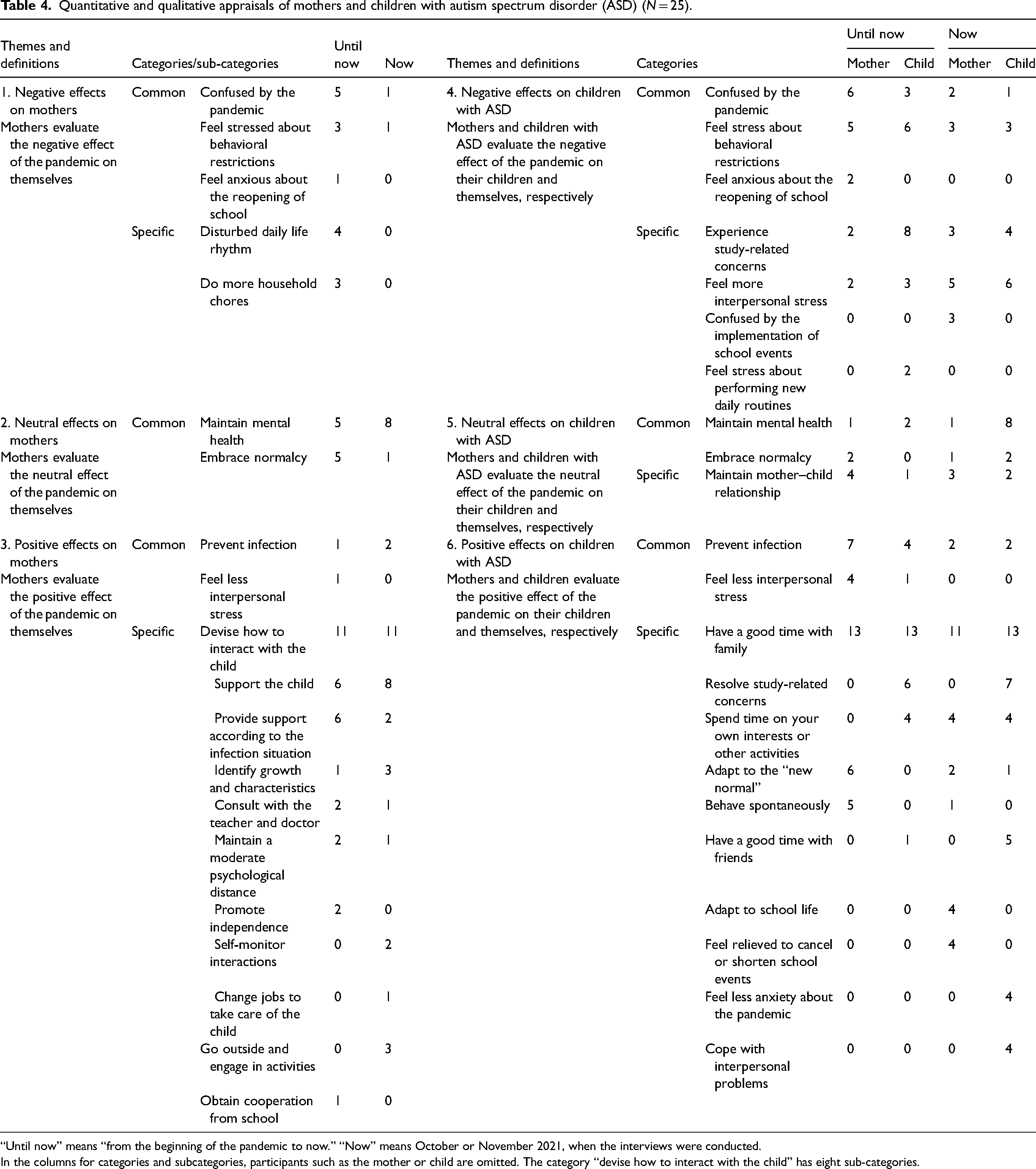
“Until now” means “from the beginning of the pandemic to now.” “Now” means October or November 2021, when the interviews were conducted.
In the columns for categories and subcategories, participants such as the mother or child are omitted. The category “devise how to interact with the child” has eight sub-categories.
Effects of the pandemic on mothers
As seen on the left side of Table 4, the “negative effects on mothers” category comprised five codes. Mothers emphasized that they felt confusion, stress, and anxiety owing to the pandemic, that the pandemic disrupted their daily rhythm, and that they did more household chores. The number of mentions of these things decreased in “now” compared to “until now.” Notable quotations for each code are presented in Table 5.
Codes for the effects on mothers and citations.

N/A (not applicable) indicates that none of the participants mentioned the code. SNS: social networking services.
The theme of neutral effects for mothers comprised two codes. The mentions indicated that they were not affected by the pandemic, such as the mothers maintaining their mental health (e.g. not feeling stressed) and embracing normalcy (i.e. spending every day in the same manner as before the pandemic).
The theme of positive effects on mothers consisted of five codes. The category “devise how to interact with the child” included eight sub-categories. When mothers mentioned common positive effects, they highlighted infection prevention (e.g. washing hands and gargling) and reduced interpersonal stress owing to behavioral restrictions. Specific effects on mothers included devising ways to interact with the child, going outside, and obtaining cooperation from the school. In particular, the number of mothers who mentioned “provide support according to the infection situation (e.g. suggesting that the child talk to friends on the phone during periods of behavioral restrictions)” as change from “until now” to “now” decreased from six to two. The number of “go outside and engage in activities” mentions increased from zero to three.
Effects of the pandemic on children with ASD
The negative effects for children with ASD mentioned by mothers and children with ASD themselves comprised seven codes, shown on the right side of Table 4. The number of references to confusion caused by the pandemic and feeling stressed owing to behavioral restrictions decreased, and interpersonal stress increased for both mothers and children. Moreover, only mothers emphasized that their children felt anxious about the reopening of schools and were confused by the implementation of school events. Only the children emphasized that they felt stressed about performing new daily routines.
The theme of neutral effects for children with ASD consisted of three codes. Both mothers and children highlighted that they maintained mental health, lived the same daily life as before the pandemic, and maintained the mother–child relationship. Specifically, the number of children who expressed that they maintained their mental health increased considerably in “now.”
The theme of positive effects for children consisted of 12 codes. The number of references to infection prevention and interpersonal stress decreased over time for both mothers and children. Most participants also reported having a good time with their family members throughout the pandemic. Contrastingly, only mothers emphasized that their children behaved spontaneously, adapted to school life, and felt relieved about the canceling or shortening of school events in “until now” and/or “now.” In addition, only children highlighted that they had resolved study-related concerns (e.g. difficulties understanding studies), had a good time with friends, felt less anxious about the pandemic, and coped with interpersonal problems. Prominent examples of each code are presented in Table 6.
Codes for the effects on children with autism spectrum disorder (ASD) and citations.

N/A (not applicable) indicates that none of the participants mentioned the code.
Discussion
In this study, we explored how children with ASD and their mothers experienced the COVID-19 pandemic in Japan. The findings corroborate and expand upon previous qualitative studies on the impact of the pandemic on children with ASD and their families, and they confirm the following important results. Specifically, the findings reinforce those of studies highlighting that the pandemic had both negative and positive effects on parents and children with ASD (e.g. Bozkus-Genc & Sani-Bozkurt, 2022; Latzer et al., 2021).
This study further revealed some aspects of phase-dependent changes, such as the emergence of effects (e.g. coping with interpersonal problems) in the new normal that was not seen in the pandemic, based on a comparison of “until now” and “now.” Further, in contrast to Meral (2021), who identified the specifics of negative and positive influences, this study has the advantage of identifying the specifics of neutral effects (e.g. maintaining mother–child relationships); that is, those that remain the same even in the specific circumstances of the pandemic.
In addition, in response to Pellicano et al. (2022), who interviewed both children with ASD and their parents, we compared the perceptions of both mothers and children and found the importance of the mother's focus on the child's positive aspects in challenging situations, which could have a positive impact on both the mother and child. Thus, the current findings play an important role in suggesting more creative solutions to the challenges of coping with and resilience to future crises. As noted by Bolbocean et al. (2022) and Daulay (2021), maternal resilience could have prompted the children's adaptation to their daily lives during the pandemic. Furthermore, this study suggests the presence of children's coping and resilience abilities, as they demonstrated efforts to cope with and overcome the constraints in their lives. A key factor that could help in the face of future potential crises is to draw upon the resilience of both children with ASD and their mothers. It is thus essential to enhance family interactions, such as cooking together or discussing children's interests.
The research question was answered by discussing the effects of the pandemic on mothers and children. Regarding the effects on the mothers themselves, first, negative effects (e.g. disturbed daily life rhythm) decreased overall from “until now” to “now.” This could be owing to the progress of coexistence with coronaviruses in Japan, the loosening of behavioral restrictions, and returning to the pre-pandemic working situation.
Second, concerning neutral effects, some mothers reported that their jobs and lives did not change, thus implying that they were not significantly affected. Third, regarding positive effects, the mothers reported that they worked out how to interact with the child, such as “provide support according to the infection situation” and “maintain a moderate psychological distance.” These results are consistent with those of Daulay (2021), who showed that mothers use coping strategies in their efforts to minimize the stress and difficulties they encounter and support the resilience model proposed by Bolbocean et al. (2022). Notably, the participating mothers had a history of receiving consultations and support in clinic centers and other sources prior to the pandemic, which could have facilitated their spontaneous use of coping strategies. Incidentally, mothers in Daulay's (2021) study used religious coping methods such as prayer and patience. Daulay (2021), who conducted a study in Indonesia, argued that Asian parents tend to use collectivistic problem-focused coping strategies; hence, religious coping, which is positioned as one of them, was used more often. However, none of the participating mothers used this strategy. A possible reason could be that Japan's percentage of non-religious people is higher than that of other Asian countries (Inglehart et al., 2014).
Subsequently, the impact of the pandemic on children with ASD was discussed from the perspectives of both mothers and children with ASD. First, concerning negative effects, there was a trend of both mothers and children with ASD reporting that the stress resulting from disruption and behavioral restrictions decreased over time, while interpersonal stress increased. These decreases in disruption and stress suggest that children adapted better to their environment, based on the statements of M12 and C4 about their acclimation to the pandemic (see the category “adapt to the new normal” in Table 6). Contrastingly, increased interpersonal stress owing to increased contact with friends could be related to autistic traits of difficulty with social interaction, as indicated by C12's statement: “My classmate is annoying and distracting to me” (see the category “feel more interpersonal stress” in Table 6). In addition, an increase in the number of children with ASD who said they enjoyed spending time with friends was a child-specific aspect, suggesting that some children experienced a decrease in interpersonal stress. This result was similar to the finding of Pellicano et al. (2022)—that people with autism felt a profound need for social contact during the lockdown. This seemingly contradictory result could be because children who could adjust to school before the pandemic perceived social contact positively, whereas those who had difficulty adjusting viewed it negatively. Only mothers reported that their children appeared anxious or confused about the reopening of schools and conducting school events, and none of the children with ASD reported these things. Presumably, one factor that explains this is the difficulty in monitoring changes in anxiety and confusion associated with the approach to school versus that associated with events owing to self-monitoring impairments in autism (Russell & Jarrold, 1998).
Second, regarding neutral effects, as stated by M2, “I do not think C2 was confused because he likes staying at home” (see the category “maintain mental health” in Table 6), and similar to the findings of Asbury et al. (2022), the lack of social contact prior to the pandemic left it unaffected. Children were not affected because their lives had not changed significantly, as indicated by C6: “Now I spend the day in the same way as I did before the pandemic” (see the category “embrace normalcy” in Table 6). The increase in the number of children who reported maintaining their mental health in “now” compared to “until now” could be owing to the pandemic becoming more normalized and less perceived as a “special” event.
Third, concerning the positive effects, many mothers and children consistently reported that the latter spent more time with their families. This is consistent with the results of Meral (2021), who reported that the highest number of parents indicated “more shared family time and improved family interaction.” The mother could have perceived it as an opportunity to get to know her child better or increase intimacy. In addition, only children reported resolving study-related concerns, having a good time with friends, and coping with interpersonal problems, presumably because children had more opportunities to go out alone in their community as behavioral restrictions were eased and their mothers were unaware of what was happening outside the home.
Limitations and implications for future research
This study is limited by the following points, which are challenges to be addressed in future research. First, participants were intentionally recruited, and the possibility that different profiles of participants could yield different results must be considered. To prepare for future crises, studies could be designed with a non-random selection of participants, including mothers with strong ASD characteristics. Second, we did not assess the actual situation of communication between mothers and children prior to the pandemic. In addition to using a psychological scale to evaluate parent–child relationships, an assessment of the actual situation could help clarify the relationship between communication and the impact of the pandemic. Third, all the families were from a single country. Results could have differed in other cultural contexts, such as differences in the use of religious coping demonstrated in Indonesia (Daulay, 2021) and Japan. To overcome this limitation, further studies should be conducted in other cultural contexts. Fourth, we simultaneously inquired about “until now” and “now,” which made participants rely on their memories for their responses for “until now.” Future studies need to conduct interviews separately at different periods to ensure accuracy.
Conclusion
This study demonstrated the influence of the COVID-19 pandemic on children with ASD and their mothers in Japan. Meral (2021) emphasized that there were overall positive effects, and we observed similar results. The factors that led to said effects included mothers’ focus on the positive aspects of their children and their attempts to elicit constructive behaviors in their children (e.g. prevent infection) and draw upon their own and their children's resilience. Further, neutral effects, such as maintaining mental health and continuing regular daily life, were observed in both mothers and children. These findings contribute to a deeper understanding of the pandemic's impact on families with children who have ASD and provide valuable insights for supporting them during future crises.
Footnotes
Acknowledgements
We are grateful to all mothers and children with ASD for their participation in sharing their experiences during a challenging period.
Declaration of conflicting interests
The author(s) declared no potential conflicts of interest with respect to the research, authorship, and/or publication of this article.
Funding
The author(s) received no financial support for the research, authorship, and/or publication of this article.
