




Abstract
Aim
This study explores how bilingual parents of autistic children made language decisions for their families, how the event of the SARS-CoV-2 pandemic and subsequent lockdown impacted the communication environment of their households, and whether these experiences affected their language habits.
Method
Semi-structured interviews were conducted with five bilingual parents of autistic children who lived through lockdown in France. Data were analysed using interpretative phenomenological analysis. Demographic and background information was collected using an adapted version of the Questionnaire for Parents of Bilingual Children.
Results
Participants reported conflicting advice given by a range of practitioners. Parents expressed differing beliefs about the impact of language choices on their children. Parents described active engagement with their children's home-learning as generally positive. Parents identified an increase in children's exposure to their first language during the lockdown. Parents reported an increase in children's overall communication abilities.
Conclusion
Parents believed that their children's positive communication development during lockdown was related to increased exposure to their first language(s), and direct involvement in their children's learning programs.
Keywords
Introduction
Autism is a developmental condition characterised by difficulties in social interaction and communication (American Psychiatric Association, 2013). As bilingual and bicultural families become the norm (Wei, 2000), autistic children are increasingly growing and developing in bilingual and bicultural environments. A growing body of evidence about bilingually exposed autistic 1 children is emerging with the consensus that bilingualism 2 does not impede the child's language development (Dai et al., 2018; Hambly & Fombonne, 2012; Lund et al., 2017; Ohashi et al., 2012; Valicenti-McDermott et al., 2019). Despite these findings, a large number of parents continue to report that practitioners advise them against maintaining a bilingual environment for their autistic children (Drysdale et al., 2015; Kay-Raining Bird et al., 2016a; Yu, 2013). Such well-intentioned but potentially misleading advice (Beauchamp & MacLeod, 2017; Genesee et al., 2004) goes against official recommendations of professional regulatory bodies (National Institute of Health, 2017; Speech Pathology Association of Australia, 2009; Stow & Pert, 2015).
Autistic children have been shown to perform similarly to, if not better than, their monolingual peers in measures of expressive and receptive vocabulary (Dai et al., 2018; Hambly & Fombonne, 2012), and structural language and pragmatic ability (Reetzke et al., 2015). Moreover, studies have found positive benefits as a result of bilingual exposure for cognitive and communicative skills, such as executive functioning, including inhibitory control (Montgomery et al., 2021; Peristeri et al., 2021; Sharaan et al., 2021), attention (Gonzalez-Barrero & Nadig, 2019), theory of mind (Peristeri et al., 2021), gesture use (Zhou et al., 2019), and math skills (Vanegas, 2019). Other benefits for autistic children associated with bilingual exposure include the development of multicultural identities and the preservation of heritage (Jegatheesan, 2011; Yu, 2013), as well as enriched family relationships (Hampton et al., 2017; Howard et al., 2020; Kay-Raining Bird et al., 2016b; Yu, 2013). Autistic adults have also described greater satisfaction with their social experiences associated with bilingualism (Digard et al., 2020).
Parental language choices
First language (often called native language or L1) is defined in this study as the language in which the person feels most proficient and at ease, usually connected to ethnic, social, and cultural identity (Ringbom, 1987). A heritage language is defined in this study as ‘languages other than the majority language that are tied to cultural heritage’ (Lim et al., 2019, p. 887). While many parents reportedly hold positive views of bilingualism, these views are not always reflected in their language practices (Howard et al., 2020; Yu, 2015). Parents express confusion and anxiety when making such decisions (Yu, 2013), particularly when receiving conflicting advice from multiple sources (Drysdale et al., 2015; Kay-Raining Bird et al., 2016b).
Parent–child interactions are critically important for autistic children, particularly during the early years when children spend more time in their homes and neighbourhoods than in other settings (Hyman et al., 2020; Zwaigenbaum et al., 2015). Given the importance of the parent–child communicative connection as part of effective early intervention, alarmingly little is known about the consequences for autistic children raised in environments where one, or both parents, communicate with their child in a non-L1 language (Hudry et al., 2018; Lim et al., 2018). Even less is known about the ways in which parents perceive the impact of such language choices on their child's communication development.
Context of the current study
The SARS-CoV-2 pandemic resulted in significant state-enforced restrictions on freedom of movement, also known as ‘lockdown’ in many countries around the world. Online education has been reported as ‘inaccessible for a majority of autistic children’ (Moran et al., 2020, p. 3). While current literature indicates that parents can be effective implementers of developmental/behavioural programs (Dawson et al., 2010; Remington et al., 2007), questions were warranted as to whether this remained the case in the unique circumstances of lockdown. Previous studies have highlighted that parent interventions are beneficial for social communication (Coolican et al., 2010; Green et al., 2010) and social bonds (Beaudoin et al., 2019). However, there is little known about how the impact on socio-communicative skills may be mediated by whether parents intervene in their L1 as opposed to an additional language.
Aim and research questions
Lockdown provided a unique opportunity to examine home language environments with minimal external involvement. The aim of this study was to understand how bilingual parents of autistic children made language decisions for their autistic children, and how lockdown affected their language values and attitudes. This study also sought to explore the consequences of these language decisions and examine similarities and differences in experiences and perspectives both between and within families. By drawing on individual perspectives of bilingual parents in the changing context of lockdown, this study asked three research questions:
How did bilingual parents of autistic children make language decisions for their families pre- versus post-lockdown? How did the lockdown affect the communication environment of their homes? Did parents’ experiences of lockdown and their perceptions of their children's communication development change their language beliefs and habits?
Methods
Design
This study was designed following the principles and guidelines of interpretative phenomenological analysis (IPA) (Smith et al., 2009), which is concerned with understanding lived experiences of a particular phenomenon. Well suited to small sample groups and increasingly applied in autism research (Howard et al., 2019), the ‘double hermeneutic’ that characterises IPA enables the researcher to interpret the varied accounts of parents, who themselves are making sense of their experiences. Similarly, to Howard et al. (2020), a ‘triple hermeneutic’ can be argued to be at play in this study, as the researcher and participant are also seeking to understand the experiences of their children.
Ethical considerations and rigor
This study received ethical approval from University College London (id 2693/013). All personal identifying information was replaced by pseudonyms for anonymity. Interview data were recorded and stored on password-protected servers. This study engaged to meet the five trustworthiness criteria (credibility, transferability, dependability, confirmability, audit trails) outlined by Nowell et al. (2017) to increase reliability and validity. Additionally, this study meets Smith's (2011) criteria for high-quality IPA (subscribes to the theoretical principles of IPA; generates an appropriate number of themes (3) for this sample size with suitable sampling from corpus to show the density of evidence for each theme; detailed findings allow the reader to get close to the experiences of each participant, offering fresh viewpoints to complement contemporary research).
Participants
Participants were recruited through Paris-based therapy clinics and family support groups. Inclusion criteria were: a bilingual household; ability to conduct the interview in either English or French; had a child aged younger than 6; 0 years who had received an autism diagnosis; and lived in France during the lockdown. Focusing on the early years was appropriate given the plethora of research regarding the effectiveness of early intervention (French & Kennedy, 2018; Oono et al., 2013). Exclusion criteria were: receiving therapy services from the first author; or having travelled away from France during the lockdown period.
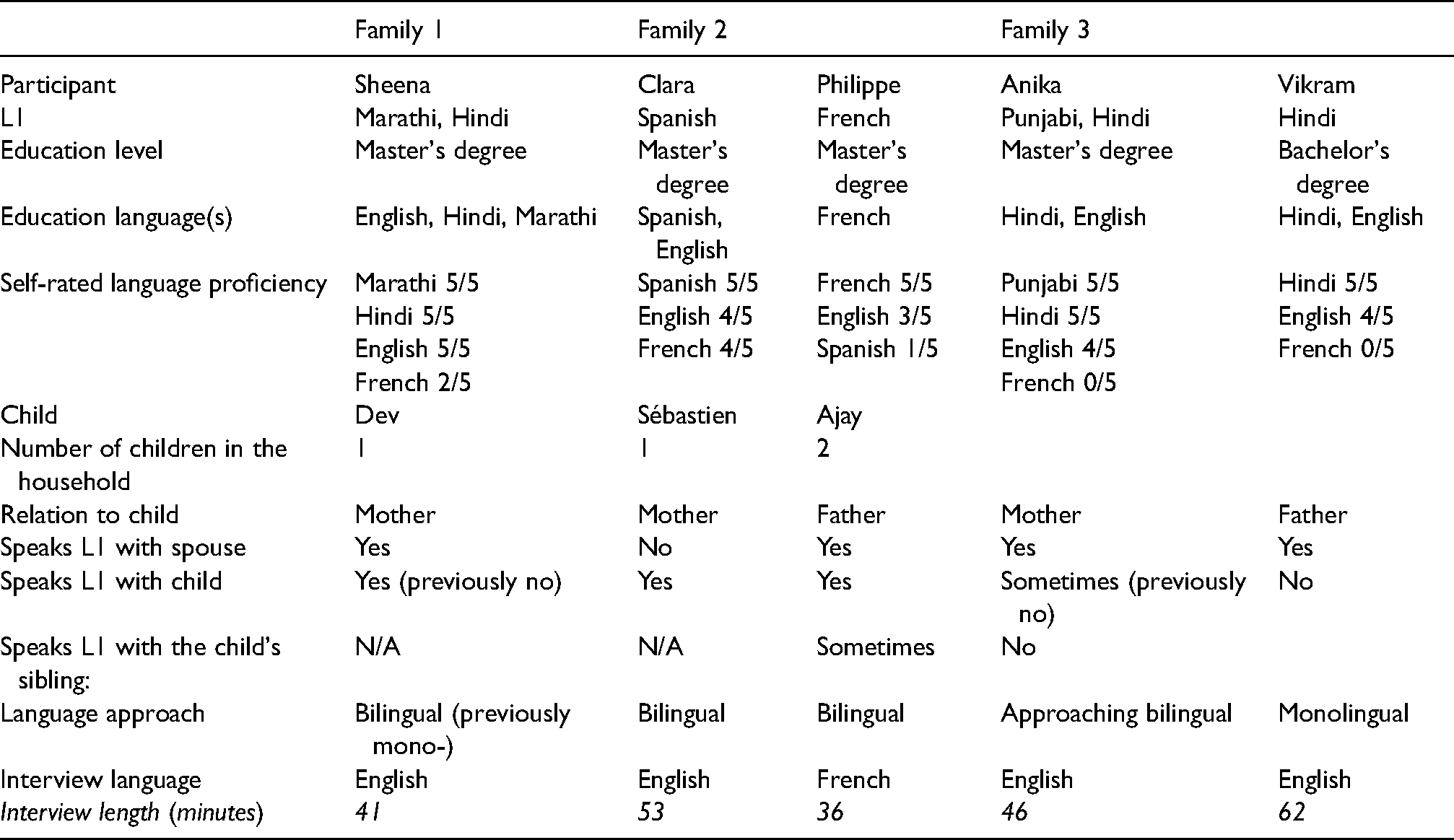
Participants (n = 5) were parents from three families (F1, F2 and F3) living in France, consisting of three mothers and two fathers. Four interviews were conducted in English and one interview was conducted in French. All families were residents in France during the first lockdown (17 March 2020–11 May 2020, 8 weeks or 55 days). All participants were interviewed separately, university educated, had differing L1s to their spouse, and lived in a nuclear family unit (parents and child(ren)). All children had started to receive early intervention therapy by 36 months and were attending mainstream French pre-schools. All families had one parent (father) working remotely from home and the other parent (mother) taking primary responsibility for their child's home learning during the lockdown. Table 1 reports the participants’ demographic and background characteristics. Table 2 reports the language environments of participants’ autistic children and the early intervention services received.
Participant demographic and interview information.
Language environments of participants’ children and early intervention services received.

Procedure
The Questionnaire for Parents of Bilingual Children (PABIQ) (COST Action IS0804, 2011) was adapted to include information relevant to autism and early intervention services and piloted through public involvement of a panel of experts by experience consisting of three bilingual parents. The modified PABIQ questionnaire was sent to participants by email for independent completion. An interview guide (see Appendix A) was created to address the research questions in line with IPA’s good practice of focusing on inviting and guiding the participant to share their experience rather than simply posing questions (Smith et al., 2009). The interview guide was piloted through the public involvement of a panel of experts by experience consisting of two parents of autistic children.
Individual semi-structured interviews were conducted by the first author with each participant via video call. The use of remote modes of an interview, such as telephone or video, has been found to have no notable impact when compared with direct face-to-face interviews (Novick, 2008; Sturges & Hanrahan, 2004). Interviews were manually transcribed verbatim from video recordings by the first author using conventions of Conversation Analysis (Wilkinson, 1999). The interview conducted in French was translated by the first author and reviewed by an independent bilingual researcher to assure an accurate rendition. Information and themes extracted from their interview were reviewed with each participant via email to verify that what was interpreted from their statements was what they intended to express.
Data analysis
Interview data were analysed by the first author in English using Smith's (2011) guidelines of IPA methodology. In keeping with the analysis strategies presented in Larkin et al. (2006), transcripts were analysed line by line. Initial impressions and exploratory notes for each account were made in the margin using Microsoft Word. Data were coded inductively for emergent patterns using Nvivo 12, that is, codes were developed from the data rather than predetermining codes and finding excerpts to fit. Emergent themes within every single account were then identified. Following this individual case-study-like analysis, super-ordinate themes were generated deductively for each account in line with Smith et al. (2009), that is, deductive reasoning was applied to progress from the general ideas expressed by participants to emergent themes extracted and specific super-ordinate themes ultimately extracted by the first author. Convergence and divergence across accounts were considered in the development of final super-ordinate themes. These are displayed in Figure 1.

Generated themes.
Sections of data and extracted themes (approximately 10%), which were analysed by the first author, were reviewed in collaboration with an independent group of researchers (two professors, and two student researchers) to increase the confirmability and legitimacy of findings. The focus of the review was to validate methods of deductive theme generation. Two review meetings were held in total. In the case of coding disagreement, relevant interview data were reviewed within the group and discussed until a consensus was reached.
Positionality of the researchers
The first author is a clinical-academic Speech-Language Therapist from a culturally and linguistically diverse background. Data were collected and analysed by the first author, whose interest in and engagement with these data have been shaped by her own personal experiences. Throughout the analysis, the first author worked to engage with each participant's account by first bracketing fore-conceptions as per IPA principles (Smith et al., 2009) to understand their personal experiences and contexts and ensure that each perspective is honoured. The independent group of researchers involved in reviewing sections of pseudonymised data was qualitative researchers from different fields of study. Reflection on the positionality of the reviewing researchers was actively done through discussion, with researchers bracketing their fields of study and research experiences that may impact their approach to the data.
Results
Three final super-ordinate themes and their respective sub-themes were extracted from the data.
THEME A: Parental language beliefs and choices
Overall, parents agreed on the value of bilingualism for typically developing children. Their language choices were influenced by factors such as advice received, their current community language, the perceived importance of English, their understanding of language development, connection with heritage culture and extended family, and social inclusion.
A.1 Bilingual approach
Parents who communicated with their children using their L1s reported doing so because it was ‘natural’. PhilippeF2 expressed his desire to avoid providing a distorted language model by speaking a language in which he did not feel proficient. Parents spoke about the role of language in sharing heritage culture with their children and the importance of social-emotional connection with extended family.
Parents’ desire to speak their L1 seemed to be driven by a sense of fear – for ClaraF2, a fear of her son not knowing his heritage culture; for AnikaF3, a fear of exclusion and loss of connection with extended family if her child ‘cannot fit in’. VikramF3 expressed a similar concern, however, his worry seemed based on physical presence ‘if we go back in our country’ and did not encompass communication between family members in different countries.
A.2 Exposure to one language at a time
Parents who were communicating with their children in a mostly monolingual way before lockdown expressed that they did this based on factors often against their personal preference, such as advice and therapy language. AnikaF3: So with Ajay I used to speak in Punjabi and Hindi both. And once we had the diagnosis everyone pushed us that you should speak only one language and his therapists and all, they were speaking English so we had to switch completely to English.
AnikaF3 specifically speaks about the importance of English, ‘because it's a global language’. Another factor in language choice was the importance placed on the practitioner's language, as VikramF3 explained: When we started with the therapies, everything was in English. With the therapist that we started with him, being in France, that's the best we can do. We don't have our mother tongue therapy so we started in English … it's also logical choice given a point that all his therapists are using the same language, we are using the same language.
VikramF3's remarks evidence a clear practitioner-centred view of his son's intervention and the value he places on the language of therapy. The recurrence of ‘no choice’ leading to his decision is present throughout his account. VikramF3 spoke of having ‘a chance to find someone who speaks English’ outside his home country and referred to monolingualism being ‘the only solution’ indicating he feels bound to speak only English with his son. The cost of accessing other-language schools and therapy services compared with public options was mentioned by two parents.
There also appears to be a perception of language as discrete blocks of learning that must be introduced one at a time. VikramF3 expressed that, ‘if we have one language that he connects with and … then you know, we can teach him the second language. It will be more easy for him to correlate’. Similarly to VikramF3, SheenaF1 expressed a belief in presenting one language at a time, although she nuanced this idea of sequencing language exposure by explaining that this choice is for the reassurance of the parent, ‘but for the child I think the more languages the better’.
The monolingual approach was said to be arduous when the language chosen for the child differed from the language spoken between spouses. AnikaF3 described speaking English at home as ‘a challenge, because we have to then translate everything for Ajay’.
A.3 Tension between divergent opinions
Some parents expressed difficulty managing contrasting notions and recommendations for their children. Advice to speak English, despite it not being a family language seems to be of the most significant impact. AnikaF3: It was the [English-speaking] therapist who told us that we should speak only one language with him … the French-speaking therapist always told us it should be your native language.
SheenaF1: In the beginning we were told, ‘stick to one language’, and then we were told, ‘no, now you can actually move to different languages’.
SheenaF1 reported that the initial advice to speak English created complications for extended family when trying to build relationships with her son. When they ‘knew that it's open for their language’, it appears to have been a communicative liberation for the whole family and now Dev is ‘exposed to five languages at any given time’.
On the other hand, AnikaF3 shared that contradicting directions have caused tension as each parent preferred to follow different advice: Being parents, the parent 1 and parent 2, they’re not on the same track … So, so even though, even though we, we had the advice, the, the, we had the conflicts … Something about that, whatever we thought, even though my husband thought that it should be English, but somehow we both are not able to cope up with that.
It is not clear in these data whether ‘the conflicts’ and her description of being ‘not able to cope’ relates to their diverging language beliefs, inconsistent professional advice, or an internal tension between personally held feelings and choices made. This discomfort is emphasised when she comments about having to ‘try that we speak in English’. The way AnikaF3 speaks about her ‘own language’ strongly suggests sadness and possibly regret that she does not share this with her children. It's the same whenever I pray. I speak in my own language. And whenever I, whenever I have to get my emotions out, I speak in my own language. So it's, it's, it's not the same. It's not the same if I speak in English. It's not the same. It's like not putting the emotions. It's just the words.
AnikaF3 seemed to have gained confidence during lockdown using her L1 with both her children despite not being in agreement with her husband: During lockdown [my husband's] still hesitant to use the second language, but I on purpose keep doing it. That they should know. They should know.
VikramF3 expressed contrary positions acknowledging that ‘being bilingual is, is, I think is, is not the problem’, while continuing to take a mostly monolingual approach with his children. His decision seems to be driven by fear that exposure to too many languages has been and will be harmful, despite stating that ‘bilingualism is not disadvantage’ and acknowledging that his younger child already understands some of his L1: The decision not to speak my mother tongue was mainly a learning experience from my first son. My second son he … he understand a little bit of our mother tongue but we’re just using English with him to communicate … because for the elder son we tried to expose him to the, to the, our mother tongue, English, French, everything but you know, it was not good so ((trails off)).
THEME B: Changes in child's communication environment during lockdown
All families indicated a noticeable change in their children's communication environment, with less exposure to community languages and more exposure to heritage languages.
B.1 Increased bilingual exposure
Increased video calls to relatives abroad were a common occurrence and resulted in increased exposure to heritage languages compared to pre-lockdown. Parents reported being more present with their children, who were, therefore, more exposed to heritage languages, for example, PhilippeF2 noting his son ‘was a little more with his mother and he has progressed more in Spanish’.
Parents spoke about their decision to use a non-L1 with their children to support schoolwork, regardless of their proficiency: ClaraF2: I just kept it because he started moyenne section.
3
They start English so I just wanted him to continue with his vocabulary.
AnikaF3 also indicated a change in her language decisions for her child, beginning to consciously expose him to Hindi during the lockdown. She expressed surprise that her child showed interest, seeming pleased about the apparent influence an increase in family language exposure was having on her child's communication inclinations: ‘During lockdown, he, if I talk about Ajay specifically he, he listens, he sometimes, accept the command as well. He understand as well, I believe’.
B.2 Indirect therapy approach
Parents reported that direct therapy by video was not an option as their children would not engage with an on-screen interventionist. This made indirect therapy most viable, reframing therapists as consultants, and parents as primary interventionists. ClaraF2 spoke about her collaborative approach with her child's therapists, commenting, ‘we are very close communication about the things that he does do in one language and does not in another’.
Many parents took charge of their child's learning, using therapy and school plans as guides, describing their own journey of self-learning to be interventionists. AnikaF3 described her experience of lockdown as ‘very good in term of learning … learning and understanding your own child, his needs, and how I can be better’. AnikaF3: Before that I was never, trying to be a therapist … And in lockdown I had to become the therapist, … And, yes, the lockdown period helped me to connect more with Ajay, to understand more of his needs and how I can help him, and changing my own teaching that with him. Post-lockdown we have the same connection, plus, he's more happier. Whatever we did in the lockdown it, our bond I would say get more stronger.
A strong inference can be made that taking an interventionist role with her son has led AnikaF3 to see daily activities as learning opportunities for him, and see him in a more wholistic and inclusive way within the family by ‘involving him in everything’. She also suggests that the relational dynamic changed by ‘being silly’ like a therapist, to which her son responded well. The benefit of involving the child in daily activities, for which they had the time during lockdown, is echoed by ClaraF2, who identified lockdown as ‘a period of growth for Sébastien in terms of language, also daily life skills’.
There was consensus among parents that being interventionists allowed them to be flexible according to their child's needs, which is difficult to achieve in the classroom. There was also a sense of the parent better knowing the child's limits and potential and being better able to capitalise on teachable moments. However, VikramF3 expressed difficulty adjusting to indirect therapy and juggling the role of interventionist for his child. He preferred to let therapists ‘do their things’.
THEME C: Child's communication development during lockdown
Parents agreed that their child had made progress during the lockdown, positing a variety of reasons and catalysts for the developments.
C.1 Perception of communication development
Four parents described lockdown as a largely beneficial experience, with all parents observing positive communication and relational developments. ClaraF2 commented that her son's language development ‘was like an explosion’ and that ‘we really saw a before and an after’. SheenaF1 spoke about her child's interaction and pragmatic skills when he started using babble to communicate ‘more constructively’. She also noted improved attention during table activities, which was something that waned post-lockdown.
AnikaF3 identified her child's increased exposure to Hindi during the lockdown, expressing surprise that this influenced her son's language preferences. Here she recognises that her child is picking up more than words as ‘the accent also, somehow matches’. This acknowledgment that communication is more than what she says but also how she says it when seen in the light of her comments about ‘targeted language to teach’ him, suggests she is starting to give her L1 more importance.
The ability to switch between languages in conversation was a welcome development for parents who were concerned about their choice to use their respective L1s with their children. Regarding video calls, parents reported their child's improved interaction and strengthened relationships with relatives in their heritage languages with satisfaction, for example, ClaraF2 remarking, ‘my parents were so so amazed’.
C.2 Factors affecting communication development
Parents reported influential factors both pre- and during lockdown as catalysts for communication development. PhilippeF2 believed a pre-lockdown family trip to a Spanish-speaking country was the foundation for his son's Spanish language progress. ClaraF2 commented her son's communication progress may have come about through natural developmental maturity. She also spoke about increased time at home during lockdown with both parents speaking their respective L1s in conversation as leading to her son's expressive code-switching.
SheenaF1 remarked that lockdown was a time of rest for her son and believed this gave him the space to develop and ‘take his own time’. She also expressed that increased time spent interacting with relatives abroad who spoke and sang in their respective L1s led to her son ‘picking it up’.
ClaraF2 and AnikaF3 spoke about involving their children in everyday household activities as bonding moments and teaching opportunities that facilitated connection and communication. Other parents reported that their role as interventionists and structuring home-learning helped their children develop communicatively. AnikaF3 commented that she tries to continue her home learning plan post-lockdown because she sees the benefit for her child.
Discussion
The aim of this study was to understand bilingual parents’ values and attitudes towards bilingualism for their autistic children, and how lockdown affected those beliefs and communication environments within their households. Using IPA, this study also sought to explore the consequences of these language decisions, in the changing context of lockdown, and examine commonalities and differences between parents’ experiences and perceptions of communication development. The findings and implications of this study are relevant to families of young (< 6 years) autistic children.
Parental language beliefs and choices
The first research question sought to understand parental language decisions pre- and post-lockdown. All parents spoke about the influence of clinical professional opinion around the time of their child's diagnosis (pre-lockdown), with three out of five parents reporting having received contradictory advice. This highlights the uncertainty of accessing evidence-based practice and clinical consistency when working with autistic children in bilingual families (Drysdale et al., 2015; Kay-Raining Bird, Genesee et al., 2016a; Yu, 2013). During the lockdown, parents indicated they saw the value of using their L1 with their children. Four parents reported their child had begun to communicate or improved communication in their heritage language during the lockdown, boosting these parents’ positive belief in bilingualism for their child and encouraging them to continue speaking their L1 at home.
For the four parents who had taken a bilingual approach, the most cited reasons were the importance of language as a connection to culture and community and the desire to communicate naturally, in line with current literature (Howard et al., 2020; Jegatheesan, 2011; Wang et al., 2018; Yu, 2013). Parents also expressed the belief that their autistic children had the capacity to learn and maintain their heritage languages, as has been reported (Petersen et al., 2012; Valicenti-McDermott et al., 2013). This emphasises the potential social-emotional and cultural benefits of maintaining an L1 within the family of the autistic child.
Parental language proficiency was noted as an important factor in parents’ language decisions for their children. Parents expressed nuanced ideas about language modelling, such as not wanting to distort their child's language learning with their non-L1 proficiency, similar to parents interviewed by Yu (2013). This underscores the importance of confidence in language models that parents present to their children. The issue of bilingual language confusion for the child is juxtaposed with the child's confusion with poor language modelling from a non-proficient language speaker.
Changes in child's communication environment during lockdown
The second research question considered how the lockdown may have affected families’ communication environments. Three parents reported the increase in bilingual exposure related to an increase in video time spent with relatives abroad who spoke the heritage languages. In contrast to that generally reported for typically developing children (Kuhl et al., 2003; Lytle et al., 2018), linguistic exposure via screens can lead to language acquisition for autistic children (Kissine et al., 2019). However, most parents expressed that the increase in bilingual exposure for their children during lockdown was a result of speaking naturally in their L1, consistent with previous reports (Hudry et al., 2018; Lim et al., 2018).
The indirect therapy and teaching model was a commonly cited lockdown change, with therapists and teachers becoming consultants to parents, who took on interventionist roles for their children. In line with contemporary research (Zlomke & Jeter, 2019), parents reported positive attitudes to this more active and collaborative approach to their child's therapy, all commenting that lockdown was a constructive time of learning for both them and their children. Also expressed was the desire to continue parent-led intervention despite the reopening of schools and therapy centres. This supports recommendations that effective early interventions include active parent involvement (Hyman et al., 2020; Zwaigenbaum et al., 2015). Notably, parents were able to, and most chose to, implement therapy in their L1s, which were different from the community and practitioner languages, addressing the issue of lack of, and cost of, bilingual practitioners.
Child's communication development during and following lockdown
The final research question sought to understand the extent to which parents’ experiences of lockdown and their perceptions of their children's communication development influenced their language beliefs and habits. Findings from Howard et al. (2019) indicate that autistic children were more receptive to multilingualism when multilingualism was normalised around them. This study mirrors these data, illustrating that, during the lockdown, parents perceived positive communication developments in their autistic children, which they related to increased bilingual exposure in the home as compared to their school, therapy, and childcare settings.
Following an increase in heritage language exposure during the lockdown, four parents reported enriched family relationships with relatives, in keeping with Kay-Raining Bird, Trudeau et al. (2016b) and Hampton et al. (2017). Increased bilingual exposure to the child's heritage language leading to increased social and cultural communication is consistent with existing research identifying the danger of monolingualism as an isolating barrier to communication opportunities (Baker, 2011; Yu, 2013).
Parents indicated their satisfaction with the communicative progress made by their children during the lockdown. In line with contemporary research, all parents mentioned gains in receptive and expressive vocabulary in their heritage languages (Dai et al., 2018). Two parents commented specifically on the improved pragmatic skills of their children consistent with the findings in (Reetzke et al., 2015). This highlights the need for active parent involvement in goal setting and therapy plans as recommended by Hyman et al. (2020).
All parents reported that lockdown, despite complex difficulties, was an overall positive experience, with the ability to more flexibly cater to their child's learning needs cited as a primary catalyst for development. In keeping with contemporary findings, this highlights the critical importance of parent–child interactions for learning and communication (Hyman et al., 2020; Zlomke & Jeter, 2019), and the need for more policy-relevant research based on autistic people and family-centred practice (Moran et al., 2020; Pavlopoulou et al., 2020).
Implications
The context of lockdown in this study has provided a figurative magnifying glass through which to examine previously presented issues arising for bilingual families of autistic children. For some participants, lockdown represented freedom from scheduled appointments and the stress of interacting with confusing clinical infrastructure. For most participants, lockdown brought to the forefront the impact they have as parents on their children's developmental outcomes, particularly when communicating in their L1s. For all participants, lockdown increased their understanding of and connection with their children, as well as the perception of positive progress in their child's communication development. This study has manifested what existing research evidence: children with developmental conditions, such as autism, can thrive in bilingual environments.
In line with Howard et al. (2020), this study identified an increase in parental well-being, relating to a sense of social-emotional and cultural connection, when speaking their L1s to their children. By contrast, findings suggest that adopting a more monolingual approach may provoke negative consequences for families, including reduced communication opportunities, fear of social isolation, loss of cultural heritage, and difficulties returning to home communities. A more bilingual approach may provide more, and higher quality, communication opportunities for the child, thus positively impacting upon the child's overall communication abilities (Lim et al., 2019). In keeping with contemporary research (Beauchamp & MacLeod, 2017; Howard et al., 2020; Lim et al., 2018), this study supports the call for greater awareness among practitioners, including training and guidance, about the complexity of language choices within bilingual families of children with developmental conditions. Greater attention must be given to recommendations made to bilingual parents of autistic children and the potential negative consequences of advising a monolingual approach.
Findings from this study suggest that traditional methods of practitioner-focused therapy can leave parents feeling disenfranchised from their child's intervention plan and confined to using the practitioner's language when carrying over strategies beyond direct therapy sessions. During the lockdown, parents were able to deliver interventions flexibly, understand and incorporate their child's special interests into learning, and adapt strategies and resources to their individual children. This supports existing findings that parents can be highly effective implementers of therapy (Dawson et al., 2010; Remington et al., 2007) even during unique times such as those presented during the lockdown, and can play a significant role in the delivery of practical and productive bilingual therapy to autistic children in their heritage languages. Parents in this study became more confident involving extended family members (grandparents) in interactions with their children in their respective L1s, suggesting that parent-led intervention may increase natural communication opportunities and better support the generalisation of skills. In line with Davis et al. (2021), this study calls for greater provision of resources for parents regarding autism and bilingualism to reach ‘the people who will have a prominent role in the language experiences of their children’ (p. 3). However, it must be noted, as in Cluver et al. (2020) and Ward et al. (2020), that not all familial situations lend themselves to parent-led therapy, with socio-economic factors such as household income, home resources, parent education level and multi-generational household structures impacting parents’ ability to be confident interventionists. The parents included in this study were university-educated individuals living in nuclear family structures with fathers working remotely from home and mothers working as primary caregivers. More attention is required for under-represented populations within the autistic community, including variations in socio-economic status and household structures.
The increase in parent–child interactions during lockdown explored in this study suggests that, with appropriate training, supervision, and monitoring from relevant practitioners, parents may be valuable interventionists. This finding is in line with contemporary recommendations (Hyman et al., 2020) and addresses the issue of access to bilingual therapists. Along with Zlomke and Jeter (2019) and Hyman et al. (2020), this study supports the call for greater and more direct parent involvement when implementing therapy for autistic children, particularly in the bilingual context in which parents can deliver the intervention in their L1s. Models of therapy based on understanding parent perceptions and altering parent behaviours may be relevant in therapies for children with developmental conditions, such as autism.
Reflections and limitations
There is some overlap within this participant group in that they are members of only three families, that is, two couples were interviewed, as well as one additional parent. This sampling limited the range of experiences that could be explored. However, there was great variability of perspective expressed within this small sample, both within and across families. Differences were extracted from accounts of married couples, as well as commonalities between mothers, who, in this sample, were the primary caregivers, while the fathers worked remotely from home. The mothers in this sample indicated the strongest preferences to maintain heritage language exposure for their children and reported higher levels of communication and enjoyment with their children in their heritage language. One father (F2) indicated no issue with bilingualism as long as it did not impact on his child's acquisition of the community language, which was also his L1. One father (F3) indicated a strong preference against heritage language exposure until his child had demonstrated acquisition of the so-called ‘global language’, English, and community language, French, even though neither of those languages were household L1s. Diverging viewpoints expressed by parents of the same family indicate the breadth of experiences within the same household. The ability to explore a small sample with great depth to examine nuances of individual experience within and across subsets (family, gender and household role) is considered a strength in this study.
One of the key assumptions of IPA is that the interpretation of what a person says can be seen as a gateway to cognition. This assumes a certain level of language proficiency when speaking to make appropriate choices from among the words available. In all interviews, one interlocuter each time was using their L2. How the use of their L2 impacted participants’ ability to wholly express themselves was not explored. Through their accounts, it is possible to interpret that using English is constraining for some participants when trying to best articulate their thoughts and feelings. This constraint may exist when parents speak to their children in their L2, which is a difficulty this study aimed to address that has been highlighted by IPA.
The concept of communication and language as geographically rather than socio-culturally oriented could also have been explored further. That is, the belief expressed by one participant that speaking their L1 was most important when living in their home country, and less important while living in a different country.
During the interview process, though outside the recorded interview, one participant spoke about the stigma of speaking their L1 in their current community. They identified a perceived social hierarchy of languages, noting that the stigma felt when speaking their language was felt specifically in France. This participant commented that lockdown was a time during which they were able to speak their L1 to their child freely without perceived judgement, which impacted the way their child perceived that language. The role of the perceived socio-cultural stigma of different languages in this study would have been an interesting theme to explore with all participants.
Although every effort was made to help participants feel safe to speak openly, it must be acknowledged that they knew the first author is a Speech-Language Therapist. It is possible that parents’ knowledge of this may have impacted the interview dynamic. Thus, care was taken to pose questions and remarks in a neutral and even-handed manner to avoid any appearance of judgement. This could have, at times, restricted how much certain participant comments were explored, where doing so may have given the impression of approval or disapproval. This was particularly apparent when participants spoke about their language beliefs. This reflexivity in interpretation exercised in line with IPA principles is engaged as part of the ‘double hermeneutic’ of this methodology and is considered a strength of the current study.
Future research
While this research contributes to our understanding of early years autism and bilingualism in the context of lockdown, more research into diverse populations is needed to identify reliable and effective support across socio-economic and geo-political groups. Future population samples must be matched on levels beyond Western, educated, industrialised, affluent and democratic backgrounds. Questions surrounding the efficacy and feasibility of L1 parent-implemented therapy plans must be answered, as families around the world re-establish routines beyond lockdown.
Footnotes
Acknowledgements
We thank the Swiss National Science Foundation for their publication support (grant no. PR00P1_193104/1).
Ethical approval
University College London (id 2693/013).
Declaration of conflicting interests
The author(s) declared no potential conflicts of interest with respect to the research, authorship, and/or publication of this article.
Funding
The author(s) received no financial support for the research and authorship of this article.
