




Abstract
Background and aims
The efficacy of parent–child reading for supporting language development has been well-established in the neurotypical (NT) literature. For children with autism spectrum disorder, (ASD) who may be at risk for delays in language development, prior research has shown promise for shared book-reading interventions. Yet there has been limited research on naturalistic parent–child reading with autistic children to date. The present study aimed to fill this missing link in the current literature.
Methods
Fifty-seven autistic toddlers participated at two developmental time points: Time 1 (Mage = 30.4 months) and Time 2 (Mage = 43.8 months). An NT control group (N = 31) was matched on age to a subset of the ASD group (N = 33). We assessed group differences in parent–child reading frequency between age-matched NT and autistic groups. Using a one-year follow-up design, we evaluated the relationship between parent–child reading and autistic children’s language development.
Results
Cross-group comparisons revealed that parents of age-matched NT children reported significantly more frequent weekly parent–child reading than parents of autistic toddlers. After a one-year follow-up with the autistic group, within-group analyses revealed that greater frequency of parent–child reading (controlling for maternal education, books in the home, and autism symptom severity) was associated with larger growth in autistic toddlers’ receptive and expressive language skills.
Conclusions and implications
These findings have important clinical implications as they emphasize the potential of parent–child reading for supporting autistic children’s language development. Findings demonstrate that frequency of parent–child reading is associated with language development over one year. Findings also demonstrate that parents of autistic children engage in less frequent parent–child reading than parents of age-matched NT peers, suggesting these parents may face more barriers to implementing parent–child reading than parents of NT children.
Introduction
Many children with autism spectrum disorder (ASD) demonstrate early language delays in addition to impairments in social communication and restricted and repetitive behaviors (Delehanty et al., 2018; Wiggins et al., 2015). Structural language abilities (i.e. vocabulary and grammar) vary widely among young autistic children. Although some children on the spectrum demonstrate age-appropriate or advanced language abilities, others demonstrate significant delays (Anderson et al., 2007). Indeed, a substantial proportion of autistic children do not develop spoken language before entering kindergarten (Tager-Flusberg & Kasari, 2013). Discerning the factors which underlie these differing outcomes is paramount, given that language and communication abilities are clear predictors of downstream quality of life indicators for autistic individuals into adulthood (Mason et al., 2018; Rodas et al., 2017; Friedman et al., 2019). Indeed, early language ability in children with ASD has been linked to later academic achievement (Miller et al., 2017), adaptive behaviors (Bennett et al., 2008), social development (Levinson et al., 2020), and cognitive abilities (Howlin et al., 2014). As such, disentangling the underpinnings of early language abilities may in turn forecast later outcomes across several domains, some of which have profound impacts on later quality of life. A robust understanding of the early factors that support language in this population will therefore be crucial for designing and targeting early interventions which will best support development in this population.
A substantial body of research has investigated which early factors—including measures of autistic children's language, cognition, and social abilities—might explain variation in their later language abilities. Because young children on the spectrum may show discrepant receptive and expressive language profiles (Davidson & Ellis Weismer, 2017; Hudry et al., 2010), it is important to consider predictors of each separately. With respect to receptive language ability, previous findings suggest gesture production (Choi et al., 2020) and autism symptom severity (Ellis Weismer & Kover, 2015) have shown promise as predictors. Studies have shown both linguistic and nonlinguistic measures are predictive of later expressive language ability, including age of first words (Kover et al., 2016), motor skills (LeBarton & Landa, 2019; Leonard et al., 2015), adaptive behavior (Kover et al., 2016) cognitive ability, and response to joint attention (Ellis Weismer & Kover, 2015). Importantly, early language markers have also been shown to be predictive of other downstream functional outcomes. While the significance of children's language outcomes is quite clear, the field's current understanding of these predictors remains relatively insufficient. Most research on predictors of language outcomes to date has focused on children's performance on standardized measures of adaptive functioning, social skills, and cognitive ability. While these predictors are inarguably crucial to understand, there are other classes of predictors, such as those related to the home and family environment, that have received scant attention in the literature.
The role of the family and home context in language outcomes has been studied extensively in the neurotypical (NT) literature. A robust body of research suggests that socioeconomic status (SES) is linked to later language development (Hart & Risley, 1995; Hoff, 2006). Importantly, further studies have investigated the factors which might mediate the relationship between SES and language, over and above income alone. These include parent education (Rindermann et al., 2015), as well as the quantity and quality of language input (Anderson et al., 2021; Gilkerson et al., 2018; Rowe, 2012; Weisleder & Fernald, 2013). It is unclear whether these relationships mirror NT development for autistic children, a population at risk for potential language delay or impairment (Anderson et al., 2007; Tager-Flusberg & Kasari, 2013). Understanding which of these background predictors influence language outcomes in autistic children may empower parents, clinicians, and other stakeholders to intervene in these areas of a child's environment, where possible, to best support their language development.
Arguably the best-studied environmental predictor in the NT literature is parent–child reading. Reading in the home has been shown to support linguistic, cognitive, and literacy outcomes in children with NT development (Chow & McBride-Chang, 2003; Demir-Lira et al., 2019; Montag et al., 2015; Palmer & Brooks, 2004; Sénéchal et al., 1998). Bus et al. (1995) meta-analysis reported a medium effect of early book reading on literacy development. In addition to later literacy outcomes, the tight link between parent–child reading and later language development has been widely established. Parent–child reading has been linked to receptive and expressive vocabulary in NT toddlers concurrently, and over the first three years of life (Raikes et al., 2006). There are several hypothesized pathways by which parent–child reading may support language development. For instance, reading in the home may broadly support language development by increasing and enriching opportunities for language exposure during parent–child interactions. Indeed, Gilkerson et al. (2017) found that periods of children's day during which caregivers were reading with their children yielded significantly higher adult word counts and conversational turns than non-reading periods. Thus, reading facilitated greater parent–child language engagement and interaction. These and other studies comprise a robust body of literature supporting the efficacy of parent–child reading for supporting the language development of NT children.
The existing literature on parent–child reading for autistic children is largely intervention-based. Research has established the effectiveness of shared book-reading (SBR) interventions for both NT and autistic children. SBR is the trained practice of adults reading aloud to children while using specified behaviors (e.g. asking questions, commenting about the story, and expanding on the child's utterance). These strategies are taught to promote interaction between the adult and child, as well as support the child's language and literacy development (National Early Literacy Panel, 2008). SBR has been shown to be effective in supporting the language and literacy development of children with NT development (NELP, 2008), and has been applied to intervention programs for language-delayed children both with ASD and other developmental disorders (Akemoglu & Tomeny, 2021; Boyle et al., 2019; D’Agostino et al., 2020; Fleury & Hugh, 2018; Karrass & Braungart-Rieker, 2005; Westerveld & Paynter, 2021; Westerveld et al., 2020; Whalon et al., 2015). Indeed, a recent meta-analysis by Boyle et al. (2019) of 11 studies found that SBR interventions were observed to have a moderate positive impact on children with ASD ages 2 to 14 years on a wide variety of measures including auditory comprehension and expressive language. Each of these studies included specific intervention protocols in which reading partners (e.g. caregivers, teachers, or researchers) were trained to engage in SBR interaction behaviors while reading, such as pausing, asking questions, expanding, extending the language beyond the text, or relating the text to experience. The effectiveness of these SBR interventions in ASD has been well-established.
However, our understanding of the frequency and effectiveness of parents’ and caregivers’ existing book-reading behaviors in the home, without explicit intervention, in this population is currently limited. The present study addresses two research questions to fill this missing link in the current literature. First, we addressed the open question of whether there were differences in reading frequency between parent–child dyads from age-matched NT and autistic groups. Second, given that autistic children show varied language outcomes (Delehanty et al., 2018; Koegel et al., 2020), we asked whether caregivers’ frequency of naturalistic reading to their children was associated with language development in autistic toddlers over an approximately one-year period.
Method
Participants
Full ASD sample
Participants in the full autistic sample were 57 toddlers (15 female) aged 24 to 36 months at Time 1 (Mage = 30.4 months, SD = 3.41) and aged 37 to 50 months at Time 2 (Mage = 43.8, SD = 3.52), who took part in a larger investigation, with an average of 13.4 months between the first and second time point (see Table 1). ASD diagnosis using Diagnostic and Statistical Manual of Mental Disorders, Fifth Edition (DSM-5, APA, 2013) criteria was established by an experienced psychologist during both visits (see the “Procedure” section). We tested 19 additional children who were excluded from analyses due to incomplete language testing at one or more time points (n = 12), failure to meet ASD diagnostic criteria at either time point (n = 4), or withdrawal from the study (n = 3). Table 1 details participant characteristics, including age, sex, maternal education, race/ethnicity, receptive and expressive language, nonverbal cognitive ability, and ASD symptom severity.
Participant characteristics: full ASD group.

ASD: autism spectrum disorders; SD: standard deviation; IQ: intelligence quotient.
Maternal education was measured by parent report, in years, at Time 1. High school degree = 12 years; Bachelor's degree = 16 years; Master's degree = 18 years.
Expressive Language Development was quantified by the difference between Time 1 and Time 2 expressive communication raw scores, measured by the Preschool Language Scales, 5th Edition (PLS-5).
Receptive language development was quantified by the difference between Time 1 and Time 2 Auditory Comprehension Raw Scores, measured by the PLS-5.
Nonverbal ratio IQ was measured by the Mullen Scales of Early Learning (MSEL) at Time 1.
ASD symptom severity was measured by the Autism Diagnostic Observation Schedule, 2nd Edition (ADOS-2) at Time 1.
Age-matched comparison groups
To evaluate diagnostic group differences, we recruited an NT control group that was distribution matched, based on age in months, to our autistic sample at Time 1. The matched sample was comprised of 33 autistic toddlers (10 female; Mage = 28.2 months; SD = 2.61) and 31 NT toddlers (20 female; Mage = 27.6 months; SD = 4.70). Table 2 details matched groups’ participant characteristics. We used matching procedures as described in Kover and Atwood (2013) to establish group equivalency. Welch's two-sample t-test confirmed groups were well-matched based on age in months (p = .577). It should be noted that the ASD and NT groups were not comparable in terms of sex, such that the ASD group had more than twice as many boys than girls.
Participant characteristics: matched groups.

ASD: autism spectrum disorders; NT: neurotypical; SD: standard deviation.
Maternal education was measured by parent report, in years. High school degree = 12 years; Bachelor's degree = 16 years; Master's degree = 18 years.
Receptive vocabulary was measured by words understood raw score on the MacArthur Bates Communicative Development Inventory (CDI).
Receptive language was measured by Auditory Comprehension Raw Scores, measured by the Preschool Language Scales, 5th Edition (PLS-5).
Procedure
Participants were recruited through local early intervention programs, pediatricians, and a research registry at the University of Wisconsin-Madison. This was a convenience sample recruited from a local (statewide) region. Legal guardians provided informed, written consent for each participant. Families received payment at each visit as compensation for their time and children received a book or small toy. The local Institutional Review Board approved all aspects of this research protocol. Exclusionary criteria included uncorrected hearing or vision impairments, known chromosomal abnormalities, cerebral palsy, fetal alcohol syndrome, seizure disorders, or other known neurological disorders. Additionally, inclusion in the NT group required that there were no signs of developmental delay per parent report on a background information form, standardized assessment scores, or through behavior observed by the team psychologist and speech-language pathologist, as well as a score within the “low risk of ASD” range based on a parent-report autism screening, the Modified Checklist for Autism in Children (Robins et al., 2001).
Visits were conducted by an interdisciplinary team including a licensed psychologist and speech-language pathologist with expertise in the diagnosis of ASD. Each visit lasted approximately 2.5 h. During each visit, children and their caregivers participated in a battery of assessments evaluating their linguistic, cognitive, and adaptive functioning abilities. As part of a larger project focused on language processing, children also participated in several language-based eye gaze experiments (Pomper et al., 2021; Venker et al., 2021; Mathée-Scott et al., 2022; Prescott et al., 2022). These assessments and experimental tasks were administered across the two-day research visit. To establish ASD diagnosis, children in the ASD group participated in the Autism Diagnostic Observation Schedule, 2nd Edition, ADOS-2 (Lord et al., 2012) and their parents participated in the Autism Diagnostic Interview-Revised (Rutter et al., 2003), administered by an experienced (research reliable) psychologist, at both time points. Children received Module 1, 2, or the Toddler Module of the ADOS-2, based on age and language ability. The ADOS-2 also provided symptom severity scores—a measure of the severity of autism symptoms compared to other autistic individuals of the same age and language ability—on a scale of 1 to 10, with greater scores indicating greater severity (ADOS-2; Lord et al., 2012). Participants in the ASD group were primarily referred by their pediatrician or early intervention provider when ASD was either suspected or diagnosed. For 83% of the ASD sample, our team provided the initial ASD diagnosis. All children recruited for the ASD group participated in the full diagnostic protocol in order to confirm ASD diagnosis. Children in both groups participated in the Auditory Comprehension and Expressive Communication scales of the Preschool Language Scales, 5th Edition (PLS-5; Zimmerman et al., 2011), administered by a certified speech-language pathologist, to assess receptive language and expressive language abilities. Parents in both groups completed the MacArthur Bates Communicative Development Inventory (CDI; Words and Sentences Form; Fenson et al., 2007) as a measure of receptive and expressive vocabulary. The toddler form is designed for use with 16- to 30-month-old children, however, the authors state that it may be used with older, developmentally delayed children.
Parents in both groups also completed a Background Form, which assessed demographic, intervention, and relevant medical information. Parents of autistic children completed this form at both time points, while parents of NT children completed this form at a single time point. For both groups, data from the Background Form administered at Time 1 were used as Time 1 background predictors. Maternal education, in years, and a number of books in the home were obtained from the Background Form. At both time points, parents answered the question: “Please estimate the number of children's books that are available in the household: 1–20, 21–40, 41–60, 61–80, More than 80.” Responses were coded categorically based on parent reports of the estimated number of children's books available in the household. A measure of weekly parent–child reading frequency was obtained from the Background Form and was coded categorically in accordance with the coding of this variable in prior research (Raikes et al., 2006). At both time points, parents answered the questions: “How often do you, or other members of the family, read to your child in a typical week at bedtime?” and “How often do you, or other members of the family, read to your child in a typical week at other times?” Responses from both questions were aggregated to form a total weekly reading measure. We modeled our coding of a weekly parent–child reading after Raikes et al. (2006), binning parents’ responses into 4 categories: never, 1 to 3 times per week, 4 to 6 times per week, and 7 or more times per week.
Results
Cross-group comparison
We used R software (Version 4.0.2, R Core Team, 2020) and RStudio software (Version 1.2, RStudio Team, 2019) for all analyses. First, we conducted a cross-group comparison to evaluate whether group differences in the frequency of parent–child reading were observed between age-matched groups of NT and ASD toddlers and their caregivers. We used data from a single time point for both groups. We fit an ordinal logistic regression to evaluate group differences in weekly parent–child reading. Weekly parent–child reading was regressed on a diagnostic group, covarying maternal education (in years), receptive vocabulary, and receptive language. All continuous predictors (maternal education, receptive vocabulary, and receptive language) were mean-centered. Receptive vocabulary was measured by a raw number of words reported to be understood on the CDI. The receptive language was measured by raw scores on the Auditory Comprehension subtest of the PLS-5. Results revealed significant effects for the diagnostic group and receptive vocabulary. For full model results, see Table 3. Parents of children in the NT group are significantly more likely to have reported that they read 7 or more times per week than children in the ASD group (95% confidence interval (CI): 12.38–14.81), holding all other variables constant. The 95% CI for this relationship falls within the threshold of statistical significance, as it does not contain zero. Across both groups, children who had higher receptive vocabulary scores, were more likely to have parents who reported that they read 7 or more times per week (95% CI: 0.10–3.63), holding all other variables constant. The 95% CI for this relationship falls within the threshold of statistical significance, as it does not contain zero. Figure 1 illustrates this group difference. These results indicate that parents of NT children were significantly more likely to report more frequent weekly parent–child reading. However, parents in both groups who reported higher receptive vocabulary skills in their children on the CDI, a parent report measure, were also more likely to report more frequent weekly parent–child reading. Importantly, receptive vocabulary scores were significantly lower, overall, in the ASD group than in the NT group (t = −12.58, p < .001).
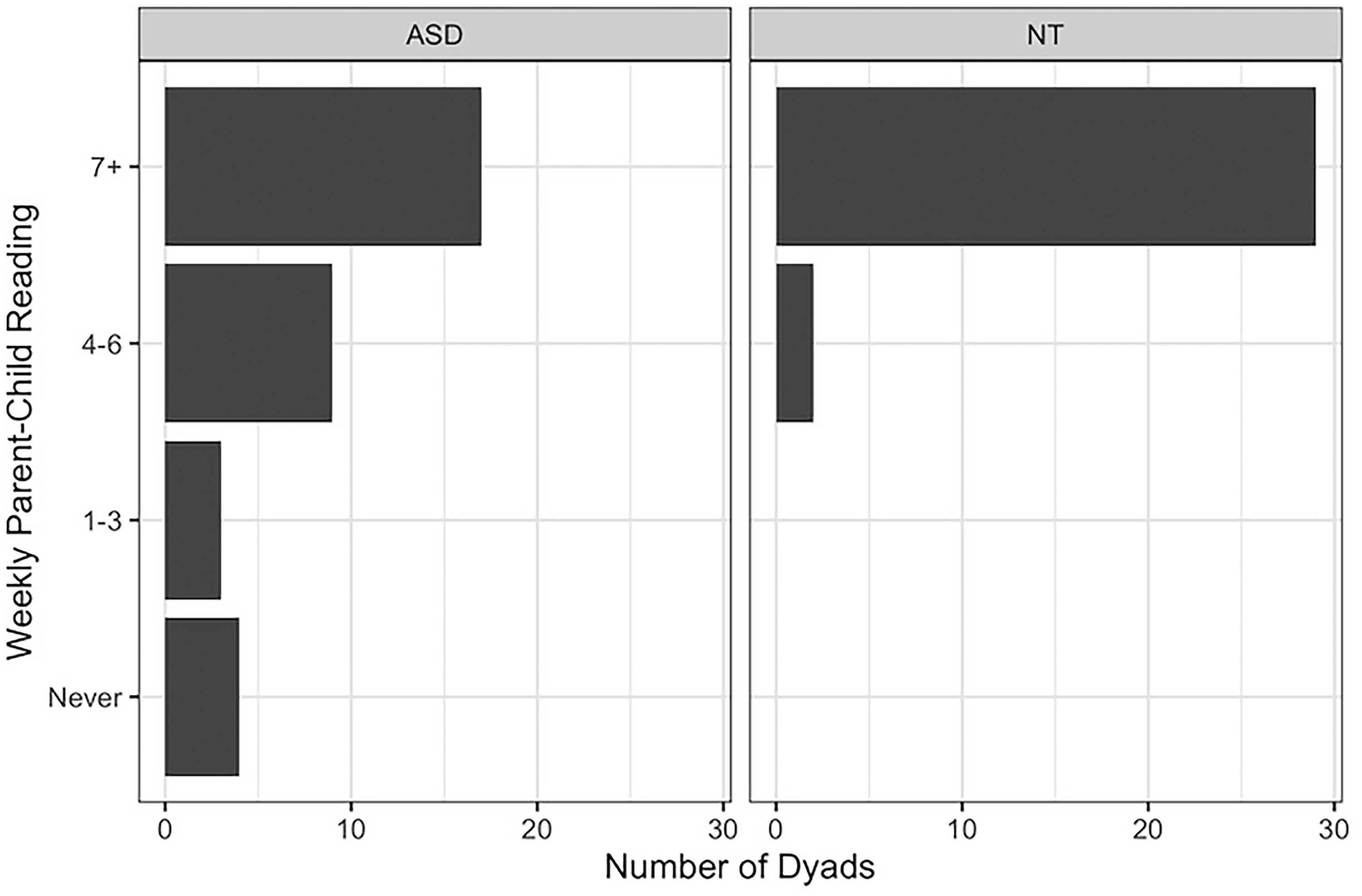
Weekly parent–child reading by diagnostic group note. Weekly parent-reported total reading is plotted as a function of the number of dyads, by diagnostic group. ASD (n = 33) and NT (n = 31) groups were matched on age in months. The frequency of total parent–child reading was measured by parent report of times per week parents read to their child, presented in categorical bins (never, 1–3 times per week, 4–6 times per week, and 7 or more times per week).
Model results: group comparison ordinal logistic regression.
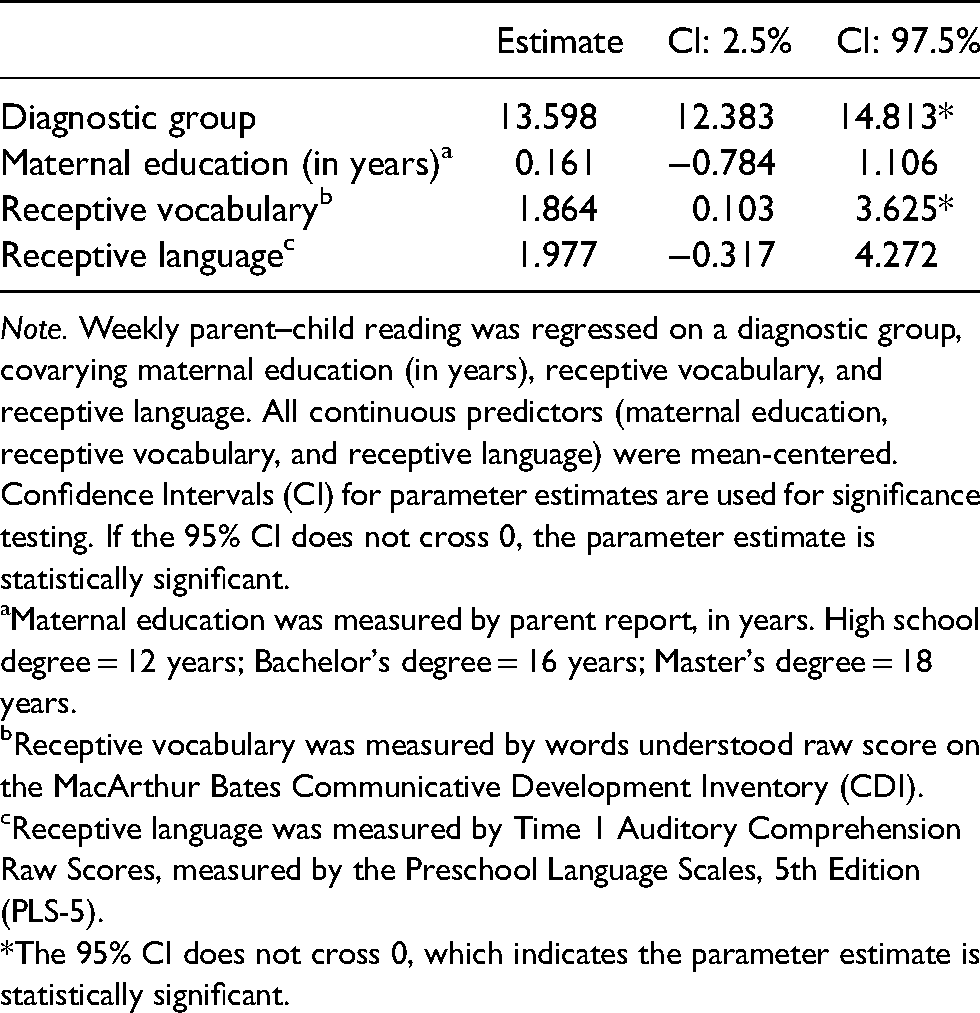
Note. Weekly parent–child reading was regressed on a diagnostic group, covarying maternal education (in years), receptive vocabulary, and receptive language. All continuous predictors (maternal education, receptive vocabulary, and receptive language) were mean-centered. Confidence Intervals (CI) for parameter estimates are used for significance testing. If the 95% CI does not cross 0, the parameter estimate is statistically significant.
Maternal education was measured by parent report, in years. High school degree = 12 years; Bachelor's degree = 16 years; Master's degree = 18 years.
Receptive vocabulary was measured by words understood raw score on the MacArthur Bates Communicative Development Inventory (CDI).
Receptive language was measured by Time 1 Auditory Comprehension Raw Scores, measured by the Preschool Language Scales, 5th Edition (PLS-5).
*The 95% CI does not cross 0, which indicates the parameter estimate is statistically significant.
ASD within-group analyses
Data from the full ASD group (n = 57) at Time 1 and Time 2 were analyzed to assess relationships between parent–child reading and language development over one year within the autistic group. We analyzed receptive and expressive language separately, as in previous studies (Ellis Weismer & Kover, 2015; Haebig et al., 2013). We quantified autistic children's language development over one year by calculating a difference score based on their Time 1 and Time 2 scores on the PLS-5, as in prior research (Kover et al., 2013). Children's Expressive Language Development (difference score) was measured by PLS-5 Expressive Communication subscale raw score at Time 1, subtracted from PLS-5 Expressive Communication subscale raw score at Time 2. Children's receptive language development (difference score) was measured by PLS-5 Auditory Comprehension subscale raw score at Time 1, subtracted from PLS-5 Auditory Comprehension subscale raw score at Time 2. We employed a generalized linear model analysis approach to evaluate relationships between parent–child reading and language development. The dependent variables were expressive language difference score and receptive language difference score. Independent variables were comprised of data from Time 1. The focal predictor in each model was parent-reported weekly reading (reported at Time 1). Number of books in the home, maternal education (in years), and ASD symptom severity (obtained from ADOS-2; Lord et al., 2012) were covariates in both models. We conducted a test for statistical outliers, using the threshold of 2.5 standard deviations above or below the mean of the dependent variables (receptive and Expressive Language Development). Using this criterion, one participant was excluded from final expressive language analyses as an outlier on this variable. Based on related research (Raikes et al., 2006) weekly reading was indexed by parent-reported frequency of bedtime reading with their child plus reading frequency during other times of the day. Results revealed positive associations between weekly parent–child reading and receptive language difference score (β = 3.38, t = 3.31, p < .01; see Figure 2 and Table 4) as well as expressive language difference score (β = 1.77, t = 2.72, p < .001; see Figure 3 and Table 5), when controlling for maternal education, number of books in the home and ASD symptom severity in both models. While ASD symptom severity was added as a covariate to the model, a significant negative association between ASD symptom severity and expressive language difference score also emerged (β = −1.76, t = −2.59, p < .05). Since all continuous predictors were mean-centered, this effect can be interpreted as follows: holding reading frequency, maternal education, and number of books constant at their means, there is a significant effect of ASD severity on expressive language difference score. In other words, for a hypothetical child who is exactly average on parental reading frequency, maternal education, and number of books, the model predicts a 1.76-unit lower expressive language difference score for every one-unit increase in ASD symptom severity.

ASD group receptive language difference score (Time 2 − Time 1) as a function of parent-reported weekly reading frequency. Note. The receptive language difference score (Time 2 − Time 1) is plotted as a function of parent-reported reading at home in a typical week. Receptive language ability at each time point was measured by Preschool Language Scales, Fifth Edition (PLS-5) Auditory Comprehension Scale raw scores. Frequency of reading at home was measured by parent report (at Time 1) of times per week parents read to their child at bedtime, presented in categorical bins (never, 1–3 times per week, 4–6 times per week, 7 or more times per week). Points represent individual participants (n = 57). The solid line represents the linear relationship between reading at home and receptive language difference score. Diamonds represent receptive language difference score means for each categorical bin of reading frequency.

ASD group expressive language difference score (Time 2 − Time 1) as a function of parent-reported weekly reading frequency. Note. Expressive language difference score (Time 2 − Time 1) is plotted as a function of parent-reported reading at home in a typical week. Expressive language ability at each time point was measured by Preschool Language Scales, Fifth Edition (PLS-5) Expressive Communication Scale raw scores. Frequency of reading at home was measured by parent report (at Time 1) of times per week parents read to their child at bedtime, presented in categorical bins (never, 1–3 times per week, 4–6 times per week, and 7 or more times per week). Points represent individual participants (n = 57). The line represents the linear relationship between reading at home and expressive language difference score. Diamonds represent expressive language difference score means for each categorical bin of reading frequency.
Model results: receptive language development, autism spectrum disorders (ASD) group.
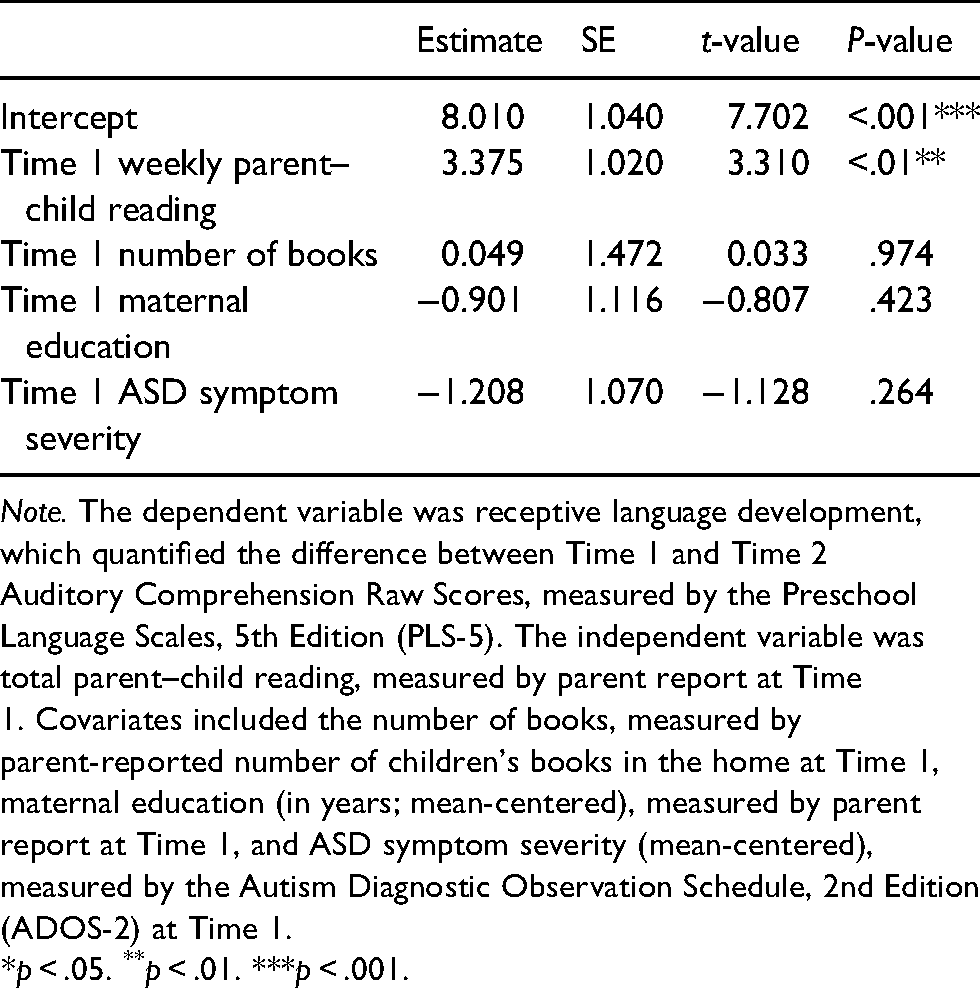
Note. The dependent variable was receptive language development, which quantified the difference between Time 1 and Time 2 Auditory Comprehension Raw Scores, measured by the Preschool Language Scales, 5th Edition (PLS-5). The independent variable was total parent–child reading, measured by parent report at Time 1. Covariates included the number of books, measured by parent-reported number of children's books in the home at Time 1, maternal education (in years; mean-centered), measured by parent report at Time 1, and ASD symptom severity (mean-centered), measured by the Autism Diagnostic Observation Schedule, 2nd Edition (ADOS-2) at Time 1.
*p < .05. **p < .01. ***p < .001.
Model results: expressive language development, ASD group.

Note. The dependent variable was Expressive Language Development, which quantified the difference between Time 1 and Time 2 expressive communication raw scores, measured by the Preschool Language Scales, 5th Edition (PLS-5). The independent variable was total parent–child reading, measured by parent report at Time 1. Covariates included the number of books, measured by parent-reported number of children's books in the home at Time 1, maternal education (in years; mean-centered), measured by parent report at Time 1, and ASD symptom severity (mean-centered), measured by the Autism Diagnostic Observation Schedule, 2nd Edition (ADOS-2) at Time 1.
*p < .05. **p < .01. ***p < .001.
Discussion
Findings from this study add to the vast body of research on parent–child reading and its efficacy in supporting children's language development. This study provides the first evidence to date that the frequency of parent–child reading differs between autistic and non-autistic parent–child dyads, and that this behavior is associated with language development in autistic toddlers, even without explicit SBR intervention. Our cross-group comparisons revealed that parents of age-matched groups of autistic and NT toddlers reported significantly different weekly reading frequencies, such that parents of NT children reported reading more frequently to their children than parents of autistic children. Interestingly, parent-reported receptive vocabulary also significantly predicted parent–child reading frequency across groups, but PLS-5 receptive language scores and maternal education were not significant predictors. This finding warrants further inquiry, particularly because children's receptive vocabulary abilities may be difficult for parents to accurately evaluate. Indeed, prior studies have revealed that autistic children may demonstrate knowledge of vocabulary words in eye gaze tasks that their parents reported they did not know on receptive vocabulary checklists (Venker et al., 2016). A similar pattern of results has been found in younger NT infants (Houston-Price et al., 2007). This may suggest that parents are, at least in some cases, underestimating their child's receptive vocabulary skills. If parents’ likelihood of reading to their child is related to their perception of how much their child understands, then it will be imperative for future research to better understand the interplay between parent–child reading and parent perceptions of receptive vocabulary in autistic children, given that they are likely to have language delays (Delehanty et al., 2018; Wiggins et al., 2015). It is important to acknowledge that, given that our findings represent a relationship between two parent-report measures, it is possible that this result is driven by some parents having a tendency toward under-reporting across items. Further research will be needed to disentangle this relationship between parent perceptions of children's receptive vocabulary abilities and the frequency with which they read to their children. Parents of children who have lower receptive vocabulary skills may need better support to facilitate more positive parent–child reading experiences.
Using a one-year follow-up design, we were able to assess the association between reading in the home, based on parents’ own reporting of book-reading, on autistic children's language development one year later. Importantly, we also statistically controlled for maternal education, number of children's books in the home, and autism symptom severity in our analyses. Findings revealed associations between the frequency of total parent–child reading and autistic children's receptive and Expressive Language Development over one year. Importantly, this study also controlled for potential confounds, lending further support to the hypothesis that parent–child reading can support the language of children, even those who may face other co-occurring challenges. We were careful to account for ASD symptom severity given that behaviors associated with autism severity may make reading in the home more challenging. Results indicated that the frequency of parent–child reading robustly predicted both receptive and Expressive Language Development while controlling for these factors. Thus, our findings suggest that time spent reading has a positive association with language development, even when we account for the number of children's books available, the education level of the mother, and the child's ASD symptom severity.
Our findings revealed positive associations between the frequency of naturalistic parent–child reading and language gains in autistic toddlers from 2.5 to 3.5 years of age. However, we are not able to pinpoint the exact emergence of this relationship, nor its direct causality. It is important to consider that some portion of this early relationship may be related to other factors intrinsic to the child or parents. Children who already have better language skills might be more likely to interact with their parents during shared reading. Similarly, van Bergen et al. (2018) have demonstrated in older NT children that reading ability predicts how often children read, but not vice-versa. Our group comparison finding suggests that language skills strongly predict engagement with reading. Our autistic sample also had lower overall language ability, which may be related to the lower frequency of reading shown in this group. Parents, on the other hand, may also have intrinsic factors which support both language and literacy in their children. van Bergen et al. (2017) have found strong correlations between heritable parent traits and children's reading ability in older NT children. Skibbe et al. (2008) have demonstrated links between both maternal literacy beliefs and the child's early language abilities to later literacy skills of preschool-aged children. While we cannot yet know the directionality, nor the precise developmental progression, our findings lend clear support to the hypothesis that reading to children early and often may support their language development. Given that autistic children are likely to experience language delays (Delehanty et al., 2018), parent–child reading may be particularly important for this population, as it is a relatively low-cost and time-efficient strategy for supporting language skills. Additional limitations that must be acknowledged are that our sample was relatively limited in socioeconomic, racial, and ethnic diversity. These demographic factors are especially important to consider, given the nature of our research question and the generalizability of these findings to the autistic population broadly. Future research on reading in the home in families from more diverse backgrounds will be imperative. Due to methodological constraints, we were not able to evaluate the NT group at a one-year follow-up. Our findings within this ASD sample are similar to those of prior work by Fletcher et al. (2008) who found that caregivers’ reading behaviors with their 24-month-old NT children were associated with expressive language ability at 30 months and that children's language skills at 24 months were associated with parents’ reported frequency of reading in the home.
While we accounted for potential confounds that were measurable in this study, there are others that were not measured. We acknowledge that there may be genetic confounds that may impact the relationship between reading and language. That is, there could be gene–environment interactions which jointly account for a parent's propensity for reading to their children and their child's language development. Some researchers have suggested that an interplay between genetic and environmental factors might account at least in part for the relationship between books in the home and children's reading ability (Hart et al., 2021). A similar interaction, which the present study did not test, may account for a portion of the effects of total parent–child reading on language development. These individual differences are important to consider in future research as they may be interrelated with both genetic and environmental factors important to the development of language, such as the literacy skills and language aptitude of the parents, which may be interrelated. We also acknowledge that not all caregivers have equal access to the time or resources required to read to their children at bedtime each night. Work demands, additional childcare responsibilities, housing considerations, and other barriers may make this challenging for many families. Special considerations and acknowledgments must be made regarding the finding that parents of autistic children report reading to their children less frequently than parents of NT children. Parents of autistic children, compared to children without autism, likely have many additional time constraints and stressors which might make frequent parent–child reading more challenging. Indeed, numerous studies have demonstrated increased stress in parents of autistic children compared to parents of NT children and children with other developmental disabilities (Hayes & Watson, 2013). Additionally, many autistic children are enrolled in intensive intervention programs, often requiring 20 to 40 h per week of intervention (Virués-Ortega, 2010). The time required for parents to accommodate these interventions into their daily schedules cannot be overlooked as we interpret these findings. Child-related factors such as behavior and attention may play a role. While we controlled for ASD symptom severity in this study, other research has found significant negative correlations between ASD symptom severity and early literacy abilities in older autistic children (Davidson & Ellis Weismer, 2014). Indeed, the results of the present study may have differed if we evaluated an older age range. We acknowledge that parents require support; however, these findings are consistent with a growing body of evidence that points to the role that parents of autistic children can play in facilitating their children's development (Heidlage et al., 2020; Roberts & Kaiser, 2011). Parents may benefit from implementing specific strategies, such as those recommended by Fleury (2015)—including following children's interests, re-reading familiar books, and making environmental modifications for sensory needs. Additional qualitative research (e.g. parental focus groups) is needed to better understand the barriers that parents of autistic children face, and the specific strategies which will help them to engage in reading activities more successfully.
Another important consideration is parents’ naturalistic behaviors during SBR. We did not have information about the interactive behavior parents used when reading (e.g. asking questions, expanding utterances, and pointing), which may have had an impact on the information their children gleaned from these interactions. While our findings suggest that time spent reading is associated with language gains without explicit instruction in these behaviors (i.e. SBR intervention), it is still important to acknowledge the possibility that parents who are reading to their children more frequently are also more likely to be naturally engaging in more frequent interactive behaviors during these book-reading periods. These, in turn, might be adding to the support that reading lends to children's language. These parents may also be engaging in this type of language enrichment behavior during other daily living activities such as mealtime or dressing. Future research examining caregivers’ naturalistic language input and reading practices will help to tease apart the influence of these behaviors on parents of autistic children. Demir-Lira et al. (2019) have addressed the question of whether early parent–child book reading is an index of generally rich linguistic input in parents of NT preschool children. Their findings suggested that the quantity of parent–child book-reading interactions predicted children's later receptive vocabulary, reading comprehension, and internal motivation to read when controlling for the quantity of other language input (outside of reading interactions). They found that parent input during book-reading interactions was significantly more linguistically rich, in terms of vocabulary diversity and semantic complexity, than other language input during the day. These findings suggest that parent–child reading may be uniquely beneficial for language enrichment, over and above other language input opportunities.
Conclusions
Findings from this study extend upon existing literature and provide new insights into the relationship between naturalistic parent–child reading and language development in autistic children. Cross-group comparison results also suggest that parents of autistic children are reading less with their children than parents of age-matched NT peers. This suggests that parents of autistic children may require greater support and resources to integrate parent–child reading into their routines. This study offers important implications for families and researchers alike. For families, the message from this work is clear: spending time reading to your child may help them develop their language skills. Researchers and clinicians have long known this to be true for the NT population and for those with neurodevelopmental disabilities in the context of SBR interventions (Boyle et al., 2019; Karrass & Braungart-Rieker, 2005). Our findings suggest that indeed these benefits may be available to young autistic children even without explicit SBR instruction. Additionally, our findings suggest that this relationship holds when controlling for important, potentially confounding individual factors such as ASD symptom severity and SES. That is, time spent reading appears to be impactful on its own, over and above the education of the parent or the number of books available in the home. These findings set the stage for additional research to establish whether naturalistic parent–child book reading and the accompanying interactive behaviors, play a causal role in promoting language abilities in autistic children.
Footnotes
Acknowledgements
This work would not have been possible without the support and commitment of the children and families who participated. We extend sincere thanks to Liz Premo, Jessica Umhoefer, Heidi Sindberg, Kristine Millard, Tracy Reuter, and Rob Olson for their support in completing this study. The authors also thank all the undergraduate research assistants in the Language Processes Lab (PI Ellis Weismer) for their contributions to this work.
Declaration of conflicting interests
The author(s) declared no potential conflicts of interest with respect to the research, authorship, and/or publication of this article.
Ethical statement
This manuscript is not currently under submission to another journal. It reports original data collected as part of a research project approved by the authors’ Institutional Review Board. Preliminary data from subsets of the participants in the current study were presented at the 2022 International Society for Autism Research Annual Meeting in Austin, TX.
Funding
The author(s) disclosed receipt of the following financial support for the research, authorship, and/or publication of this article: This work was supported by the National Institute on Deafness and Other Communication Disorders, Eunice Kennedy Shriver National Institute of Child Health and Human Development (grant numbers R01 DC012513, R01 DC17974, F31 DC020902 and U54 HD090256).
