




Abstract
Purpose
This descriptive multiple case study examined the effects of a contextualized expository strategy intervention on supported and independent note-taking, verbal rehearsal, and reporting skills for three elementary students with language disorders.
Method
Two 9-year-old fourth grade students and one 11-year-old sixth grade student with language disorders participated. The intervention was delivered as sixteen individual 20-minute sessions across nine weeks by the school speech-language pathologist. Students learned to take written and pictographic notes from expository texts and use verbal formulation and rehearsal of individual sentences and whole reports in varied learning contexts. To explore both emergent and independent accomplishments, performance was examined in final intervention session presentations and pre/post intervention testing.
Results
Following the intervention, all three students effectively used notes and verbal rehearsal to prepare and present fluent, organized, accurate, confident oral reports to an audience. From pre- to post-test, the students showed a range of improvements in the quality of notes, use of verbal rehearsal, holistic quality of oral and written reporting, and strategy awareness.
Conclusions
Sketch and Speak shows potential as an expository intervention for students who struggle with academic language learning. The results support further examination of this intervention for supported strategy use by younger students and independent use by older students.
Keywords
Speaking “like a scientist” for a class project, understanding a lecture, reading a textbook to learn information, writing a report about a historical event or famous person: these academic expectations start in early elementary grades in the U.S. (e.g. Common Core State Standards, National Governors Association Center for Best Practices and Council of Chief State School Officers (NGACBB-CCSSO), 2010). To meet these expectations, students must understand complex informational texts, use evidence to convey information clearly and accurately, and use appropriate organization and style for the task purpose and audience. With a limited availability of empirically supported interventions at the discourse level (Peterson et al., 2020), speech-language pathologists (SLPs) struggle to support this level of learning in students with language disorders. This descriptive case study examines the effects of an SLP intervention aimed at teaching students to take notes and use verbal rehearsal to compose and present expository reports from shared reading of informational texts.
Expository language intervention
Expository language is informational, non-narrative discourse that expresses logically-related ideas (Black, 1985; Bruner, 1986). It is characterized by logical links, a hierarchical organization from a central proposition, and a generalizing or abstract “true-for-all-time” stance (Scott, 2010; Ukrainetz, 2006a). Expository discourse can take the form of long stretches of text such as orations, articles, and book chapters. As a result, single texts can include multiple expository types, such as procedure, explanation, description, and persuasion, with specific organization depending on topic, purpose, and context (Ukrainetz, 2006a; Westby et al., 2015). Signaling features such as titles, headings, and key words are important to guide the author and audience through the variable and sometimes complicated structure of exposition (Golder & Coirier, 1994; Lorch & Lorch, 1996). Since it also often involves transmission of new information – information that is often difficult or specialized – expository discourse is also referred to as informational or academic talk.
Exposition has a long developmental path that is highly subject to schooling and life experiences. Preschoolers and kindergarteners are able to describe, explain, and persuade when given structural support (Ninio & Snow, 1996; Paley, 1981) and first graders can distinguish expository from narrative genres with differential “pretend-reading” of books and identification of the books’ purpose (Duthie, 1994; Pappas, 1991). By late elementary school, vocabulary and sentence structure are more complex in expository than in narrative discourse, though consistent control over expository discourse structure and signaling devices does not appear until adolescence (Berman & Nir-Sagiv, 2007).
Child language intervention has primarily targeted early communicative development, but language issues do not disappear when concerns shift from talking and listening to reading and writing. Longitudinal studies have consistently found that half or more of children with developmental language disorders have significant literacy and academic issues later in their school years (Conti-Ramsden et al., 2012; Dockrell et al., 2009; Nippold, 2017). A variety of effective educational interventions for older students involving expository discourse such as discourse structure analysis, summarization, and main idea identification have been identified (Ciullo et al., 2016; Kamil et al., 2008; Mason et al., 2006; Swanson & Hoskyn, 1998). There is a lot known about teaching students how to gain information from expository texts, how to use this information for their own expository products, and how to work toward becoming self-directed learners (Calkins et al., 2012; Common Core State Standards). However, there has been little attention to expository interventions particularly suited to SLPs.
Taking notes about ideas in words and pictures
For a successful expository event, authors must collect and organize information. An active approach to noting important ideas and key details is not only efficient, but improves learning compared to more passive ways of studying texts such as re-reading, highlighting, and verbatim copying (Arnold et al., 2017; Kobayashi, 2006). It promotes moving from superficial levels of comprehension to deeper understanding and ownership of underlying propositions or ideas through visual re-organization of relationships from the source text (Chang & Ku, 2015; Piolat et al., 2005; Kintsch, 1998).
Though active note-taking can significantly improve student performance, even this much writing can be a struggle for poor writers and readers. Students often take incomplete notes, miss important ideas, and write verbatim a mix of important, minor, and tangential ideas (Boyle & Forchelli, 2014; Hebert et al., 2014). Difficulties with the mechanics of writing, including misspelled words, illegible handwriting, and poor word choices can impair recall and distract learners from the content of the text. Finally, if students are resistant to writing, even minimal written notes can introduce a negative element to a learning task.
In response to these concerns, an alternate note-taking format of pictography or “picture writing” can be employed. Quick and easy iconic sketches that are just enough to remember have been found to be beneficial tools in narrative intervention for faster note-taking, longer narratives, and improved chronological organization with similar benefits for low and high performers (Ukrainetz, 1998; McFadden, 1998). Since those early studies, pictography has been incorporated as an instructional tool in a variety of narrative intervention programs, including ones with student-generated sketches (e.g. Gillam & Ukrainetz, 2006), and ones with sketches generated by the instructor (e.g. Gillam & Gillam, 2018; Spencer & Petersen, 2012). Though pictography has not been widely used in expository applications, graphic notations, such as symbols, flow charts, graphs, and semantic maps are well-established aids for expository learning in children as young as seven years of age (Mayer & Gallini, 1990; Karmiloff-Smith, 1979).
Saying what you noted, over and over again
Simply taking good notes is not sufficient for learning. Learning involves both encoding and retrieving of information from memory, with active retrieval of the ideas represented by notes being more effective for student learning (Smith et al., 2013). Students may re-read their notes and remember an original statement verbatim, but learning is deeper if the idea is reformulated into their own words. Such paraphrasing helps to transform knowledge, moving learning from superficial recall to deeper comprehension of language and underlying ideas (Arnold et al., 2017; Bretzing & Kulhavy, 1979; Kintsch, 1998; Slotte & Lonka, 1999).
Furthermore, it is not enough for a learner to note an idea and say it fully, in their own words, one time. Learning is enhanced by effortful, repeated retrieval of ideas from memory, opportunities for self-monitoring of accuracy, and revisions to improve upon expressions and understanding (Abel & Roediger, 2018; McDaniel et al., 2009). Verbal rehearsal can be done silently or aloud, but accountability for accurate recall, student self-monitoring, and scaffolded instruction are more accessible when the words are said overtly. The guided formulation and practice of individual sentences and then whole texts within a communicative context keeps the work firmly in memory so students who struggle to get words on paper do not forget what they are trying to say. It also enables fluent presentations of long, organized reports in full, well-formed sentences with technical vocabulary and audience hooks, just as if the student was “speaking like a scientist.”
Sketch and speak intervention
Sketch and Speak intervention was initially developed in response to the need for a contextualized strategy intervention designed around the distinctive expertise and opportunities of school-based SLPs to support students with language, reading, writing, or attentional difficulties beyond the early grades (Ukrainetz, 2019). It teaches intentional use of learning strategies within purposeful communicative activities, balancing learner-oriented meaningful activities with instructor-oriented skill training (Fey, 1986; Ukrainetz, 2006b, 2015). The core strategies of note it simply, say it fully, and say it again are basic, flexible, and clearly related to academic learning. The strategies are taught using research-based elements of strategy instruction: instructor modeling, practice with explicit feedback, matching support to learner level (i.e. systematic support), a routinized format, and coaching into use outside the treatment context (Gersten et al., 2001; Rosenshine et al., 1996; Swanson & Hoskyn, 1998). In Sketch and Speak, students learn to note it simply in two ways. First, students take notes using pictography to represent key ideas. Students then write conventional bulleted notes of key words, phrases, and telegraphic sentences with a minimum of punctuation and little attention to spelling from their pictography notes to encourage abbreviation of complete sentences with no temptation for verbatim copying from a source text. Abbreviating text in these accessible notation formats provides quick and easy, just enough to remember representation of the ideas for later recall.
SLPs can use this intervention to help students formulate their own complete sentences from their notes to clearly and accurately reflect the original text information. Sketch and Speak helps students access grade-level expository discourse through: multiple scaffolded interactions with texts; simple student-generated notes in two formats; repeated knowledge retrieval and transformation; and repeated oral formulation and rehearsal of full sentences and organized discourse. It uses speaking and listening to improve reading and writing through a few simple learning strategies in a routinized, procedural whole for SLPs to teach language and concepts to students across the grades and coach independent use in classroom applications for older students.
Ukrainetz (2019) examined whether a brief application of treatment would improve students’ written notes, teach them the pictographic note-taking strategy, and improve the quality of their oral and written reports from their notes. This group experimental study of 44 students with language-related learning disabilities in grades 4 to 6 randomly assigned participants to a treatment or control condition, with groups balanced for educational and demographic features. Pre- and post-treatment testing texts about historical peoples were counterbalanced across participants. Students in the treatment condition were instructed by their school SLPs using grade level expository texts on unusual animals in six 30-minute sessions. Treatment and testing articles were read aloud to the students with the print in view so no independent reading was required. Results showed the treatment group was significantly better on multiple quality features of the notes and oral reports at post-test, though no benefit was shown on written reports obtained 2–3 days later. SLPs indicated in reflective essays that there was high student buy-in with five themes emerging for the noticeable improvement of student expression and comprehension: simplicity, quick and easy visuals, oral creation of sentences, repeated practice, and visible progress of students. This initial investigation showed good potential for Sketch and Speak as an expository intervention, but also suggested the need for more attention to verbal rehearsal and scaffolding students toward independent use.
The current study
This descriptive multiple case study builds on Ukrainetz (2019), further investigating Sketch and Speak with three elementary students with language disorders. In the current study the investigators sought to increase student competence in expository reporting and ownership of the strategies by extending the treatment time, increasing attention to verbal rehearsal, and applying the strategies in more varied academic contexts, while retaining the core elements of “note it simply, say it fully, and say it again”. Shortening the intervention sessions and increasing the total treatment time to allow for further exploration of the strategies, made Sketch and Speak more amenable to SLP implementation in the schools.
The following questions (RQs) were investigated: RQ1: What is the quality of student notes and oral presentations in the final intervention session? RQ2: Do students improve from pre-test to post-test on the quality of their notes, verbal rehearsal preparation, and oral and written reports? RQ3: Do students show awareness of the taught learning strategies in their final intervention session or the post-test learner interview? RQ4: What is the nature of each student’s response to the expository strategy intervention?
Method
The impact of Sketch and Speak was examined in two ways: (a) students’ notes and oral presentation to peers and teachers in the final intervention session; and (b) independent performance on texts from a different topic area before and after intervention. Pre- and post-testing included video analysis of preparatory behaviors as indicators of verbal rehearsal and a learner interview on strategy awareness and student independence. Examination of supported and independent performance allowed views into Sketch and Speak as an integrated set of SLP intervention strategies and a way of teaching student learning strategies for their own use outside intervention. Analysis of individual participant performance allowed portraits of strategy use for what turned out to be three quite different learners.
This study was approved by the institutional review board at Utah State University and by the school district’s research coordinator.
Participants
Selection and recruitment
Participant eligibility was broad, based on the general applicability of the learning strategies to academic success and the likelihood that diverse students with language disorders would benefit from this intervention. Participants were recruited by a school resource teacher as meeting the following criteria: in fourth to sixth grade, receiving direct speech-language services for academic language goals on their Individualized Education Programs (IEPs), and not having been in the treatment condition of the prior study. The students were from minority backgrounds and attended a Title 1 school. Title 1 schools are provided additional federal funding due to the high proportion of students from families with low socioeconomic status. (Title 1, www2.ed.gov).
Study information and consent forms were sent home to four students who met the criteria and consent was obtained for three of them. IEP file review for demographic and test score data was conducted after permissions were obtained. Other information on student personality, learning style, and family background came from the resource teacher and SLP’s prior knowledge of the students. IEP goals relevant to this study targeted academic language (e.g. vocabulary and sentence structure) for all three students and were written collaboratively by the SLP and the resource teacher. All students are referred to by pseudonyms.
Steph
“Steph” was an 11-year-old Asian boy in sixth grade. He was on an IEP with Speech/Language Impairment as his primary eligibility category, and had received language intervention since starting elementary school. Steph also received support services for writing, though he did not qualify as a student with a learning disability. Steph was tested with the Clinical Evaluation of Language Fundamentals, 5th Edition (CELF-5, Wiig et al., 2013) as part of a three-year re-evaluation after completion of the study. His Language Core Composite was 86, and his Expressive and Receptive Composite scores were both 89. His composite score was 84 on the Kaufman Brief Intelligence Test, 2nd Edition (KBIT-2, Kaufman & Kaufman, 2004). Steph was an attentive, motivated student when learning about preferred topics, although he struggled with academic expression and following directions independently to complete assignments.
Pete
“Pete” was a nine-year-old Native American boy in fourth grade. He had a primary eligibility of Autism, originally diagnosed in his preschool years. He had received language services since the age of three years and was also receiving services in reading, writing, and math. His IEP goals since entering kindergarten were for articulation and academic language skills. The CELF-5 and KBIT-2 were administered six months prior to the initiation of the study, as part of Pete’s three-year re-evaluation. His CELF-5 Core Language Composite was 89. There was a significant discrepancy between his Expressive Language Composite of 94 and Receptive Language Composite of 74, which the SLP attributed to inattention to details (e.g. point to two pictures at the same time) and frequent need for task redirection. His KBIT-2 composite score was 96. Pete presented with some mild socially atypical behavior, including disregard for his communicative partners, perseveration on preferred topics with an inappropriate level of detail, and inattention to non-preferred topics during reading and speaking academic activities.
Angel
“Angel” was a nine-year-old Hispanic girl in fourth grade. She received language and academic services in reading, writing, and math under a primary eligibility of Speech/Language Impairment. Angel was administered the CELF-5 as part of her three-year re-evaluation during the current study. A Core Language Composite of 88, Receptive Composite of 88, and an Expressive Composite of 83 were reported. Her performance on the Wechsler Intelligence Test for Children, 5th Edition (WISC-V, Wechsler, 2014), yielded a full-scale IQ score of 76. Angel was discontinued from language services at the end of the study, but continued to receive support under a Specific Learning Disability eligibility. Angel was an attentive student who worked hard to please her teachers. At times, she had trouble understanding conversations or instructions, responding with irrelevant or incorrect connections to other topics. She was reticent when asked to present information to teachers and often hid her face behind her paper rather than answering.
Intervention
Intervention overview
Five hours of treatment was delivered in sixteen 20-minute individual sessions across nine weeks, serving as the students’ regular language intervention. Students participated in 2–3 sessions per week, dependent on school schedule and student absences. All sessions were video and audio recorded.
Intervention materials
The first three intervention treatment texts were on unusual animals: cassowary, axolotl, and aye-aye. These articles were developed and used in the prior study. The texts followed a descriptive-explanatory discourse structure: each animal was introduced with a notable feature and geographic location, then facts followed about appearance, diet, reproduction, habitat, and human encroachment. The fourth treatment text was on the professional basketball player Michael Jordan. It followed a descriptive-chronological discourse structure, addressing his career and personal life. While the students may have had general awareness of Jordan, his life details were not expected to be familiar to them. The texts were 425–477 words long, with 5th to 6th grade Lexiles™ of 900–1000 (https://www.lexile.com). Lexiles™ are a commonly used method of matching students’ reading levels to reading materials in American schools (see https://www.lexile.com). The matching algorithm is a propriety product based on a combination of word length, sentence length, along with semantic and syntactic features.
A formatted two-column sheet, often employed in classrooms, was used (Appendix A). The form has a topic line, five categories on the left side with labels matched to article information (e.g. habitat, appearance and behavior, food; personal life, career highlights, other accomplishments) and note-taking boxes on the right. The texts and notes sheet categories were read aloud by the SLP with the print in view.
Intervention procedure
The intervention involved teaching students how to compose and present a formal oral or written report of information from an article. They were taught to only report information stated in the article in a well-organized way.
In the first ten sessions, the strategies of pictography, bulleted notes, oral formulation, and verbal rehearsal were taught in a recursive pattern of sketch/note it simply, say it fully, then say it again (Table 1). The SLP read each article aloud, with the print in view of the student, stopping to allow the student to note important or interesting ideas using quick and easy, just enough to remember notes in the appropriate box on the note form. After each simple note was created, the SLP had the student orally formulate a full, well-formed sentence about the information represented. If the student hesitated or had difficulties formulating a full sentence, the SLP scaffolded an improved version. The student said the improved sentence at least twice before moving on to the next note. Students were guided to make 1–3 pictographs or notes of important and interesting ideas appropriately placed in the five categories on the note form. In the sessions where bulleted notes were created from pictography notes (i.e. sessions 3–4), the students used their pictography notes, not the source article, to generate the bulleted notes. At the end of each session, the student repeated all the sentences from the notes twice in a “half report” or “whole report” depending on the session. The next session started with the student giving their oral report from the prior session.
Sketch-and-speak treatment procedure by session.

In the fifth session, participants were taught to use opening and closing statements (e.g. Today I want to tell you about…, I hope you enjoyed my presentation.) with brief pictographic or written notes at the top and bottom of the form. There was no special place for these openings and closings because the form was one typically used in classrooms for note-taking, not presentations. In Sessions 9 and 10, the students chose either pictography, bulleted notes, or a mixture. At the end of Session 10, the student dictated the full report to the SLP, who wrote it down and then read it back to the student. The information was then compared to the source article to show how the strategies could result in a similar written product.
The remaining five sessions continued the path to student strategy ownership and use. In Session 11, verbal rehearsal was introduced as whisper rehearsal: a real-life way of orally practicing in places where talking aloud might disrupt others. In Sessions 12 and 13, participants created an animal brochure by dictating full oral reports from their notes, and choosing pictures, titles, and fonts to make it their own. Sessions 14–16 applied the learning strategies to an article about a professional athlete to support generalization of skills across topics. The student was expected to implement all aspects of the learning strategies with minimal scaffolding: pictography/bulleted notes, oral formulation of full sentences, verbal rehearsal of each sentence, topic line, opening/closing, and whisper rehearsal of the full report. In the final presentation session, the participants reported on the professional athlete to peers and teachers and showed their learning strategies to their audiences.
Intervention training and fidelity
The intervention was delivered by the first author. She had worked at that school for five years and the study participants were all on her caseload. This SLP was familiar with the basic intervention procedures through serving as an instructor in the prior study. She was trained on this version of the intervention through detailed written instructions and one two-hour training conducted remotely by the second and third authors. A brief in-person training on Sessions 10–16 was held shortly before those sessions.
To examine treatment fidelity, 16 (37.5%) of the intervention session videos were evaluated by a graduate research assistant and spot-checked by the second author: the first eight for Steph, the middle four for Pete, and the last four for Angel. A fidelity checklist of 10 key items matched to the sessions showed 100, 100, and 94%, respectively. In two of Angel’s sessions, individual full sentences were not consistently repeated after they were formulated.
Testing procedure
Test sessions
Two pre-test and two post-test individual 30-minute sessions were conducted in the week before and the week after intervention. All sessions were audio recorded. The oral report and learner interview were also video recorded. The pre/post-test sessions resulted in the following outcome measures: notes, verbal rehearsal preparation, oral and written reports, and learner interview.
The first testing session involved a shared reading of a text, note-taking, and oral report. The article was placed so that the student could follow along while the tester read the article aloud. Following the reading, the tester said: Now you will have a few minutes to take notes on the important and interesting ideas from this article to help you in your oral report. You can use words or pictures to make your notes. The participants were instructed to use their best guess on spelling and to tell the tester when they were done. All three students finished note-taking within ten minutes. The tester then removed the article and said: Now, you will give me an oral report about the information from the article. You can use your notes to help remember and organize your ideas. Before you start, look over your notes. Tell me when you are ready to start speaking. You can look at your notes while you are presenting. The tester gave the student up to one minute to prepare and then had the student present. If the student did not indicate he or she was done presenting, the tester asked if there was anything else to say.
The second testing session involved a written report from notes and an interview about the intervention. A multiple-choice comprehension test was also administered, but due to problematic test items, is not part of the results. The tester gave the participants their notes from the previous session and instructed them to write a report with best guesses on spelling. The participants finished their reports in less than 15 minutes. The tester took away the report, but left the notes and article in sight for reference when asking questions to assess awareness of note-taking strategies. The tester nodded neutrally to all answers given. If the answers given were very short, the tester was instructed to say tell me more up to two times.
Test texts
The two testing texts were from the prior study. Inca Empire was used for pre-testing and Apache Nation for post-testing. The historical civilization texts were descriptive-explanatory discourse with similar information, organization, length, grammar, and vocabulary (850 Lexile™, 533 and 535 words). The same two-column note form was used. In the prior study, the texts had been counter-balanced for pre- and post-testing. Scores from that study on the quality of notes and use of full sentences in oral reports were not significantly different on paired t-tests, t (43) = 1.315, p = .195; t (43) = 1.494, p = .142, indicating equivalent performance on the two texts regardless of presentation order.
Tester training
The testers were undergraduate students who had served as testers in the Ukrainetz (2019) study so they were familiar with the basic assessment procedures. Testers were re-trained individually for one hour by the second and third authors.
Outcome measures
Final intervention session presentation
The final oral presentations and notes were examined as an outcome measure. In this session, the students whisper rehearsed, orally presented their reports from their notes, and described their learning strategies to peers and teachers. Video recordings of that session and the students’ notes were descriptively examined. The notes were scored using the pre/post-test scale, by the first and second authors independently. Point-to-point agreement showed 98% for number of notes and 93% for quality ratings.
Pre/post-test notes
The pre- and post-test notes were scored for quantity and quality, using the following scale from Ukrainetz (2019). Quantity was scored as the number of notes, with separations indicated by a comma, bullet point, or spacing within a category on the 2-column form. Quality was determined for each of five categories: appropriate topic or open/close notes (Topic), use of bulleted notes or pictography (Bullet/Picto), use of phrases and key words instead of complete sentences (Quick), and sufficiency of the note to represent the idea (Enough). The final item was presence of paraphrasing instead of verbatim for the bulleted notes (Own) or simple, differentiated interpretable images for the pictographic notes (Diff). Each item was rated on a 0–3 point scale, for a total possible quality score of 15 points.
For scoring reliability, all six participant notes were independently re-scored by a research assistant. Point-to-point agreement showed 100% for number of notes. For quality, the overall agreement was 93%: Topic and Own/Diff were 100%, while the other three were 83%. Each of the three disagreements were by 1 point and each on a different participant.
Pre/post-test verbal rehearsal preparation
Participants were told to look over their notes before giving their oral reports. The period from when the tester told them to look over their notes until they said they were ready to speak was examined for indications the students were reviewing their notes and verbally rehearsing their reports.
Agreement was 100% for independent timings by the first and third authors. To evaluate preparatory behaviors, video segments of the preparation period were holistically rated, following the procedure described for the reports. A 5-point Likert-type scale was used with 2–3 possible reasons selected from a six-item list (e.g. looked longer at the notes, more lip or hand movement as if talking to self about the notes, hand movements as if counting details, fewer behaviors not about preparation) with an option to identify other reasons.
Pre/post-test oral and written reports
The oral and written reports were transcribed and segmented into C-units (e.g., statements or sentences) by two research assistants. Oral reports were marked for pauses and mazes (i.e. repetitions, restarts, reformulations, and filler words). Written reports were transcribed with corrected spelling or X for undecipherable words. Transcriptions were checked and corrected by the second author. Total number of C-units and words were generated using Systematic Analysis of Language Transcripts (SALT v.18, Miller & Iglesias, 2015).
To examine overall quality of the oral and written reports and preparatory behaviors, a holistic comparison of pretest and posttest reports was conducted for each student. Scoring of overall quality by multiple raters was used instead of discrete point evaluations because of the many ways that a complex communicative act can vary across learners (McFadden & Gillam, 1996). Indications of pre- and post-testing status were removed for all videos and written reports. For the oral report, the video showed only the student’s oral report, from the introductory statement until indication that the report was over. Written reports were copied from the original to preserve student handwriting, laminated, and presented in a file folder side-by-side.
Five holistic rating options were presented in a horizontal list with no numbers: Apache is substantially better. Apache is slightly better. Apache and Inca are similar in quality. Inca is slightly better. Inca is substantially better. Eleven possible reasons for the rating were provided for oral reports (e.g. more details, better sentence structure, seemed more confident, better word choice, more organized, stayed on topic, presentation voice, looked at audience). The eight written report reasons did not include auditory-visual options. The raters were asked to choose 2–3 reasons from the lists or write their own reason for their rating. If the reports were deemed “similar in quality,” raters were asked to provide a brief explanation.
The first author administered and supervised the holistic rating procedure with ten graduate SLP students. The holistic raters read the Inca and Apache articles before practicing the rating procedure on non-study videos. The first author monitored the practice ratings and answered any questions before the outcome ratings began. The training and outcome ratings took approximately two hours to complete.
The participants (Steph, Pete, Angel) and topics (Apache or Inca) were counterbalanced for presentation across the ten raters. Raters did not see the participants’ notes or the note form. Raters rated the “preparatory behavior” videos, followed by the oral report videos, and finally the written reports for each participant. Raters watched each video or read each report twice before giving a rating, with an option of a third review.
Learner interview
The interview questions gauged participants’ awareness of their learning before and after intervention. The tester gave participants their notes and written report to aid them in recall of strategy use. The questions were about: (a) what the student had been learning from Ms. Peterson in Speech (b) how the student turned the article into notes, (c) what the student said in his or her head as the notes were made, and (d) how the notes were used to write the report. At pre-testing, participants were also asked what they would like to learn next in Speech. At post-testing, they were asked whether they would use what was learned outside of Speech. At post-testing, in an effort to probe student awareness further, after asking what the students said in their heads, they were also asked what they did in preparation for the oral report.
Results
This descriptive multiple case study examined the effects of an expository intervention that taught note-taking and verbal rehearsal strategies to three elementary students, ages 9 and 11, with language disorders. Outcome measures of supported student performance in a final intervention session presentation and independent student performance through: pre- and post-test comparisons of independent notes; preparatory behaviors that suggest rehearsal; oral and written reports using self-generated notes; and student interviews on strategy awareness are described.
Final intervention session presentation (RQ1)
Steph
For the final presentation, Steph presented from his notes on Michael Jordan to a self-selected peer and teacher. Steph’s notes included a topic, an opener and closer, and brief phrases that were enough to cue him to his own full sentences about the article information (Figure 1). His notes were 12 brief bulleted items that earned 15 out of 15 possible points on the rating scale (Table 2). Steph’s presentation was fluent and included many specific details from the article. He made eye contact with his audience and was confident in his reporting, replying “I’m the man!” when congratulated on his presentation. After his report, he showed his notes and said how he practiced talking from them in Speech. The teacher commented that Steph was not just reading his short notes but saying whole sentences from them.

Steph’s treatment notes on Michael Jordan used for his oral report in session 16.
Quantity and quality of independent and supported notes.
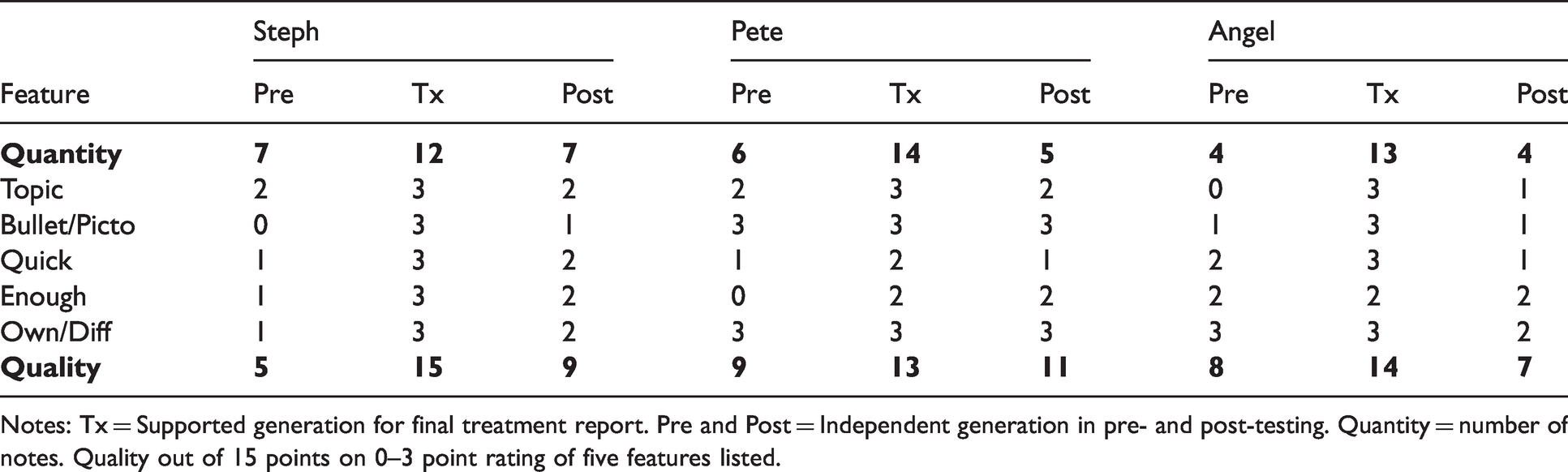
Notes: Tx = Supported generation for final treatment report. Pre and Post = Independent generation in pre- and post-testing. Quantity = number of notes. Quality out of 15 points on 0–3 point rating of five features listed.
Pete
For the final presentation on Michael Jordan, Pete composed 14 pictographic notes (Figure 2). He scored 13 out of 15 on the quality scale, losing points because not all of his pictographs were simple and two notes were skipped in his presentation. Pete put his notes on the board for his peers to see when presenting in his general education classroom, which made it difficult for him to move between the notes and looking at the audience. Pete spoke in fluent, well-formed sentences, with no extraneous comments, at a clear volume, even when turned away from his audience. He extemporaneously, but relevantly, stated that his teacher was wearing Air Jordans. After the report, Pete smiled and bowed in response to class applause. Cued by the SLP, Pete showed his pictographic notes to the class but did not explain how he used them.

Pete’s treatment notes on Michael Jordan used for his oral report in session 16.
Angel
Angel wanted to make bulleted notes for her final presentation, but the SLP said she would do better with pictographs because her handwriting was hard to read, but that she could add some written words. Angel accepted that plan. Angel made 13 clear, simple pictographs with some letters, numbers, and the words North Carolina and Air Jordan (Figure 3). Her quality score was 14 out of 15 due to her skipping one small pictograph in her presentation.

Angel’s treatment notes on Michael Jordan used for his oral report in session 16.
Angel presented to the same class as Pete, after he did. Before beginning her presentation, Angel assured the audience that her report, although on the same topic, was different from Pete’s. During her oral report, Angel looked mostly at her notes but faced the audience, made some eye contact, and smiled before and after her report. She spoke in fairly fluent, well-formed sentences, loud enough for the audience to hear. Occasionally, she paused mid-sentence and looked at the SLP who nodded assurance. Twice, the SLP cued words (season, Carolina) and prompted Angel to expand a sentence by asking “for what?” about Michael Jordan’s college career. Like Pete, Angel incorporated a comment about her teacher’s shoes and smiled at her teacher. Prior to her presentation, Angel spoke up when Pete was asked about the strategies, so the SLP had her join Pete at the front of the classroom. Angel said “so when we are reading them [the articles] and Ms. Peterson asks ‘what do you want to remember?’ But when we do it we don’t write anything, we just make pictures of it.” When asked what else they did, Angel answered that they used “whisper” and “out loud”.
Independent pre/post-test notes, preparation, and reports (RQ2 and RQ3)
Steph
Steph made written notes at pre- and post-testing. At both times, Steph wrote legibly with short sentences and phrases in appropriate categories on the note sheet, though he did not use initiating bullets. Steph made 7 distinct notes and wrote a topic at both testing times, but he improved in quality from 5–9 out of 15 points. At post-testing, he reduced his use of periods, verbatim statements, and the length of his notes while retaining interpretability. For example, for Preferred Foods at pre-testing, he wrote two statements which he read aloud, while at post-testing, he simply noted “berries,” and then combined the category heading and his note to create the full sentence, “Their food is berries.”
In the preparation period, Steph looked at his notes at both testing points, but spent less time at post-testing (8 seconds) than at pre-testing (20 seconds). Holistically, five raters judged no difference and four that the pre-test preparation was better, noting the longer time taken (Table 3). For both preparation times, raters commented that Steph took time, used lip movements or gestures, and looked focused, visible evidence of verbal rehearsal prior to his oral report. The one rater who judged that post-test rehearsal was better cited a longer review time which could have been a rating error.
Number of holistic ratings for pre/post-test preparation and reports.

Note: Total number of raters per measure = 10.
After the opportunity to review notes, participants gave an oral report to the tester. Steph’s oral reports at pre- and post-testing were similar in length (7 statements and 64 words vs. 8 statements and 72 words; Table 4). Steph’s pre-test oral report had a sense of trying to put information into sentences from the two-column note sheet while his post-test oral report was organized with well-formulated, quite fluent sentences. Steph’s post-test report had good expository discourse structure and pronominal reference cohesion with few uses of the note-form headings to organize his report details. Holistically, nine of the ten raters judged Steph’s post-test oral report as substantially better than pre-test. Raters described his presentation as having more organization, more details, better sentence structure, and opening and closing statements. They judged it to be more fluent with a better presentation voice and a greater sense of confidence.
Pre- and post-test oral reports by participant.

Note: [] = Researcher clarification of misspoken words or unintelligible utterances;: = noticeable mid-sentence speaker pause.
Steph’s written report, composed several days after the oral report, was longer at pre- than post-testing (9 statements and 85 words versus 6 statements and 71 words). The pre-test written report was a collection of statements grouped into three paragraphs, with some poorly formulated or incompletely copied statements from his notes or the text and no mention of whom the report was about. The post-test written report was one long paragraph, but started with a location statement and several sentences included “Apache Nation,” which made the topic clear and added coherence to the report. The individual sentences were generally well-formed although there were some spelling and verb conjugation errors, consistent with his identified language needs. For the holistic rating, there were no consistent differences. Raters judged that the two written reports had similar details, words, and grammatical errors, but that the pre-test report had paragraphing while the post-test report had clearer sentences and more topic referents.
Following the written report, the participants were interviewed about the learning strategies. Steph understood the interview questions and formulated clear answers that gave evidence of awareness and benefits of the verbal rehearsal strategy. When asked about his preparation for his oral report, Steph remarked that he “Just (kept) practicing and practicing…” When asked about what he was learning in Speech at pre-test, he answered, “Writing, saying my words, and yeah, doing fun stuff.” In his post-test interview, his answer was more strategy-focused: “I’ve been learning verbal rehearsal, whispers, and like, when I read a story to a teacher, I can like practice and remember stuff. And I do eye contact like look back at the story when I need to and then breaking stuff apart.” When asked whether he would use what he learned outside of Speech, at post-test he responded, “Yeah because it’s been helping me practice and when I’m at home I can remember some stuff and then practice it.”
Pete
Pete chose to draw for his notes at pre- and post-testing. In both testing sessions, Pete drew detailed representational images in generally appropriate categories and had a nation label in the topic line for both. Pete’s quantity of notes decreased from 6 to 5 distinct images, but his quality score increased from 9 to 11, due to the latter notes being sufficient to cue article information for the oral report. Although the sketches were detailed at both testing points, the use of the images was quite different. At pre-testing, Pete’s images were related to the article information, but did not directly represent a particular article idea. At post-testing, there were still unnecessary details, such as facial features, but all the pictographs directly represented ideas from the article that he turned into report statements.
In the preparation period, Pete increased his review time from 5 to 17 seconds. His post-test preparation behavior was judged as better by all ten holistic raters, with eight rating it as substantially better. Comments on his post-test all mentioned the greater length of time, and variably noted lip movements, finger movements, and gestures that suggested review and rehearsal. Two raters also noted an absence of extraneous movements and comments.
Pete decreased his oral report length from pre-test to post-test (12 statements and 81 words to 8 statements and 51 words; Table 4), but improved the quality. At pre-testing, Pete gave a description of his pictures that related only partially to the information in the article, while at post-testing, he started with a title and followed with a poor but recognizable expository report with sentences about article information. Pete’s post-test oral report was judged to be better than his pre-test report by all ten raters. Raters described his post-test report as more organized, more on topic, including more details and better sentence structure. At post-testing, Pete used the category headings on the note form in fluent sentences during his oral and written reports suggesting a deeper understanding of the information taken from the article.
Pete’s written report increased substantially in length from pre-test to post-test (7 statements and 18 words to 7 statements and 47 words). At pre-testing, Pete showed no recall of the article he was read, but rather wrote a series of labels for his pictures. At post-testing, Pete wrote a title and five sentences about Apache people, ending with a closing sentence from the source article that was not in his notes or oral report. He had some trouble incorporating the Apache shelters into his report because his teepee pictograph was upside down. Pete’s holistic ratings were unanimously in favor of his post-test report, judging it to be more organized, with a title, opening and closing sentences, with more details and better sentence structure.
Pete answered the learning interview questions willingly with concrete, brief responses, but his post-testing responses showed little awareness of the taught strategies. At both testing times, when asked what he said in his head as he made notes, he said he did not know. For how he prepared to give his oral report, he said he “got ready.” For what he had been learning in Speech, he said “about Michael Jordan, the Aye-Aye, the Cassowary”. The tester repeated the question and Pete said firmly, “Michael Jordan and the Aye-Aye. Like I said before when you asked me that question.” When asked if he would use what he had learned outside of Speech, he simply said “no.”
Angel
Angel wrote her notes at both testing times, despite her success with pictography for the final intervention report. At both testing times, she wrote only four notes (26 and 22 words), with difficult-to-read handwriting and spelling errors. Both times, she partially copied the first sentence from each article and then created three other partial or full sentences with no attention to category placement. Angel’s few notes received quality scores of 8 and 7 at pre- and post-testing, respectively. Angel wrote one fewer copied sentence and one additional long sentence at post-testing. The only improvement was Angel’s use of a topic referent, Apache. To avoid penalizing for quantity, the scoring procedure rated whether an item occurred more or less than half of total occurrences, resulting in a post-test notes quality score similar to that of Steph’s although his notes were substantially better.
In the pre-test preparation period, Angel glanced at her notes for one second during the instructions cleared her throat and told the tester “I’m gonna start speaking now” immediately after the instructions. At post-test she spent 49 seconds reviewing her notes. All ten holistic raters judged Angel’s verbal rehearsal as substantially better at post-test than at pre-test, noting that she looked longer at the notes and showed more lip movements which are considered visual evidence of verbal rehearsal.
Angel’s oral report decreased in length from pre- to post-testing (8 statements and 74 words to 7 statements and 46 words). Four of Angel’s pre-test statements were about having a lot of gold. At post-testing, Angel talked mainly about traveling, but advanced the idea with each statement. Angel looked at the written topic but could not read it, instead wondering aloud what the group was called. Angel’s post-test oral report was judged as holistically better by nine of the ten raters and was described as having better organization, word choice, and sentence structure. The raters reported she was more fluent, with better presentation voice and more confidence. At pre-testing, after Angel said she was done, the tester erroneously asked if she wanted to say anything else. She then recalled many more details from the source article but this was not included as part of the oral report. Angel did not use the topic referents on the note form to further organize her oral and written reports at post-test.
Angel’s written report was difficult to read due to spelling, punctuation, and word spacing difficulties. Both pre- and post-test reports were brief (4 statements and 56 words versus 3 statements and 29 words). At pre-testing, two of the statements were from the article but were not on her notes or in her oral report. Angel’s pre- and post-test written reports were rated as equivalent quality by six of the ten raters. Three raters judged the post-test report as slightly better with varied reasons of organization, sentence structure, word choice, opening statement, or better topic maintenance.
Angel responded willingly and understood most of the learner interview questions. At pre-testing, when asked what she said in her head as she was taking notes, she answered, “Well, when you were reading it, well I said in my head that I didn’t know about the empire was the largest kingdom”, and referred to making pictures and movies in her head. At post-testing, her answers referred to bulleted notes and pictography several times: “I was saying in my head, ‘What should I write?’ or ‘What should I do like bulleted notes or pictography?”. However, it was not clear Angel understood the question about strategy use outside of intervention, responding with her pre-test answer of making pictures and movies in her head.
Nature of learning (RQ4)
Steph
Steph had the highest level of skills at the outset of intervention. At post-testing, with a challenging article from a new topic area, Steph improved in the quality of his written notes, oral report, and strategy awareness. His written report was not consistently judged as holistically better, but improvements in specific features could reasonably be linked to intervention. Although he easily composed useful pictography notes in treatment, Steph preferred to write notes, which he did quite well. For the final intervention presentation, Steph made essentially perfect notes, using almost all the features taught to him, and composed sentences effectively from those notes. Following completion of the study, Steph repeatedly asked to practice his note-taking skills on preferred topics and asked if he could help to teach a peer the strategies outside of his speech time. He took initiative to learn more about Michael Jordan and wanted to compose a presentation on Steph Curry (hence his pseudonym). This student finished with a clear awareness of the value of notes and verbal rehearsal as tools for school projects and was motivated to go further in his own learning.
Pete
Pete gained a fundamental shift in task orientation and learning behaviors, from self-absorption to authorship: creating, reviewing, and carrying out an informational presentation with audience awareness. Pete’s profile was consistent with his diagnosis of autism, including his relative strengths in spelling, vocabulary, and grammar; and his weaknesses in adaptive behaviors such as shifting from his personal agenda to an externally-prescribed educational aim, following task instructions, and perseverating on actions and topics. The tendency toward too-detailed drawings continued throughout intervention, as did his resistance to task direction: “Don’t I have my own mouth?” when asked to repeat a sentence more than once as verbal rehearsal. However, his justification of needing the details to remember information indicated that Pete recognized the sketches were intended as memory tools. Pete was able to carry this change in orientation through to post-testing: he appeared to review his notes prior to speaking, and both his oral and written reports were organized expository discourse with use of topic headings. Pete was the student who most used the topic headings for organization at post-test, though this could have been due to his more rigid approach to generalizing intervention. While Pete had trouble expressing his learning, he showed foundational gains in competence.
Angel
Angel benefited from Sketch and Speak, not so much in terms of independent learning strategies, but rather as a set of SLP intervention strategies. In creating her notes on Michael Jordan, Angel needed the most specific scaffolding: on what was stated in the article versus her own imagination, how to note it, creating and practicing the sentences, and staying on task. However, in the end, Angel had a set of pictographic notes and rehearsed sentences that allowed her, with minimal scaffolding, to learn a lot of information on a new topic and give a fluent, well-formed expository presentation to an audience. Her awareness and pride in what she had learned showed in her explanations to her teacher and peers about drawing pictures and saying sentences, along with her reassurance to the audience that her report was unique. At post-testing, despite her competence with pictography, she chose to use her less useful memory tool of written notes. Angel took time to rehearse from her notes before the oral presentation, which was consistently rated as better than the pre-test report. However, the few and barely legible written notes were more of an impediment than a benefit, especially a few days later when generating the written report when the memory for the text was largely gone. While Angel was not ready for independent use, with continued SLP support, she could achieve in ways that matter in the classroom.
Discussion
This descriptive multiple case study examined the effects of Sketch and Speak on supported and independent note-taking, verbal rehearsal, and reporting skills. The contextualized intervention embedded repeated, supported, explicit instruction on a set of learning strategies in meaningful expository activities. Three students with language disorders, an 11-year-old in sixth grade and two 9-year-olds in fourth grade, participated. An earlier group experimental study, Ukrainetz (2019), had shown significant improvements in multiple aspects of note-taking and oral reporting with SLP interventionists strongly endorsing the core elements of the intervention. In the current study, the investigators modified some of the intervention and testing procedures to better gain and reveal student ownership of the strategies. Having only three participants allowed a rich examination of the nature of individual learning.
Benefits of Sketch and Speak
The effect of Sketch and Speak on the three students was examined in terms of the quantity and quality of written or pictographic notes, preparatory behaviors that suggest verbal rehearsal, holistic quality of oral and written reports, and learner interviews about strategy awareness. To examine both emergent and independent accomplishments, performance was examined in the final intervention presentations and in pre/post-intervention testing. All three participants improved on the majority of outcome measures of note-taking and rehearsal strategies, and resultant oral and written reports.
The final intervention session revealed all three students improved in the independent or scaffolded production of notes and use of the notes to give a presentation to an audience. Their informational reports showed confidence in presentation voice, organization of information, and reduced extraneous comments. In debriefing activities with peers, teachers, and the SLP, all three participants suggested awareness of strategies learned in Sketch and Speak and expressed excitement about their learning or their performance.
The post-test outcome measures showed improved quantity of notes for all three students, but changes in quality of notes for only Pete and Steph. For Angel, who had significant writing difficulties, the written notes had essentially the same quality at post-test and pre-test. This student’s choice of her weaker strategy of bulleted notes instead of pictography was consistent with her continued reliance on the SLP for guidance. The important strategy of verbal rehearsal in preparation for the oral report was substantially more evident at post-test than at pre-test for Angel and Pete. Steph’s preparatory behavior was similar in pre/post-test videos according to the holistic ratings. He spent less time in preparation at post-test, but considering the improved outcome, could have conceivably been more efficient at it.
Post-test oral reports were judged as holistically better for all three participants, with raters citing a better presentation voice and better organization of information. The students seemed to have learned how to “speak like a scientist” about an expository topic. Written reports were rated better at post-test for Steph and Pete, with raters commenting on improved topic maintenance, paragraphing, and inclusion of headings and titles. Angel’s written report was rated overall as similar for pre/post-test with difficult to read handwriting, spelling mistakes, and length of reports.
Finally, the post-test learner interviews suggested that Steph had strategy awareness and understanding of how this could be applied outside of the treatment setting. Learner interviews for Angel and Pete suggested some awareness of what they had been taught. Pete focused mostly on the topics instead of strategies and Angel focused on note-taking, but both demonstrated a lack of understanding of how to generalize Sketch and Speak to other settings or topics.
Three lessons from three learners
These three later elementary students with language disorders varied across the testing outcome measures consistent with their larger abilities and personalities. With varied learner profiles that make up the population of students with language disorders, there are likely to be differences in the strategies learned and level of scaffolding necessary to make Sketch and Speak a successful intervention for student learning.
In this multiple case study, the small participant pool allowed for detailed examination of individual outcomes and their potential impact on overall learning. Steph’s ability to generalize skills, use bulleted notes successfully, and interest in teaching his peers how to use Sketch and Speak suggests that he was ready to use this strategy more independently to improve learning outside of the research setting. Pete, who commonly focused on preferred topics and struggled to successfully complete assignments outside of the research setting, learned to use the strategies and to create notes and reports with scaffolded support that would inform his audience of his learning. Angel had lower overall language skills at the outset of the study and continued to rely on SLP cues and support throughout the final session performances, indicating that she may not be ready to use these strategies independently. These three learners provide valuable results for SLP use of Sketch and Speak to support their students’ learning.
Clinical implications
Importantly, this study showed how Sketch and Speak enabled these students to gain confidence and control in turning difficult concepts and language into their own work, with eagerness to display and comment on their achievements. Moreover, their work had a larger communicative reality of a formal scientific talk: using evidence from a source; distinguishing evidence from background knowledge and personal views; organizing source material into a new discourse structure; adding signaling devices like opening statements and category words; reviewing, revising, and rehearsing their work; and speaking to an audience with volume and eye contact.
This project arose through the combination of a clinician’s desire to adopt a promising novel intervention and two researchers’ desires to investigate improvements to that initial intervention. The resultant project is a descriptive multiple case study design, with its inherent limitations and its benefits. The investigators employed systematic treatment and testing procedures and measures, and multiple convergent sources of evidence to draw cautious empirically-based conclusions about the effects of treatment on the participants. The rich analysis of the participants’ learning allowed nuanced understanding of how this intervention can promote expository learning and how the findings can assist clinicians in implementing the treatment (Hengst et al., 2015).
This version of Sketch and Speak retains the core elements shown to be beneficial in Ukrainetz (2019), but adds more systematic verbal rehearsal and more varied opportunities for learning and practice. The intervention is simple, with no special materials needed, and adaptable to individual SLP situations. Detailed account of the intervention procedure, outcome measures, and individual student results allows clinicians and other investigators to use Sketch and Speak in their own endeavors. This study helps advance understanding of expository interventions suitable for SLP use in school settings for students of varied learning profiles.
Limitations and future directions
This small sample study reveals only the possibility, not the probability, that the findings can be obtained for other children with language and learning difficulties. Despite the systematic treatment and testing procedures, and the use of multiple sources of evidence, the absence of an experimental design structure limits certainty of the conclusions.
Two other limitations were in the participants and the research setting. The participation of students of very different learning profiles made determining patterns of performance difficult. Two participants were at the low end of the intended grade range. One student had mild autism. One had significant writing difficulties and low awareness of this deficit. The students were from three minority backgrounds with different family situations. Intervention was provided on a one-on-one basis, where the SLP could control treatment delivery, so generalizability to other settings is unknown. It was also carried out as part of the SLP’s regular work duties, with all the accompanying pressures and distractions, which added clinical relevance but decreased experimental control.
Another possible limitation is the grade range to which Sketch and Speak has been applied, both in this and the previous study (Ukrainetz, 2019). Students in the later elementary grades clearly benefit from use of Sketch and Speak as an SLP intervention strategy for learning academically-relevant concepts and language. However, for use as student-controlled learning strategies, Sketch and Speak intervention should be investigated with students in middle school or beyond.
Conclusion
This pre/post-test descriptive multiple case study explored the use of Sketch and Speak, a contextualized expository intervention procedure, to improve oral and written reporting from grade-level informational texts. Sketch and Speak addressed academic language goals for three quite different learners in ways that matter to students, SLPs, and teachers. In their final intervention and independent testing performance, the three students showed improvements across notes, verbal rehearsal, oral and written reports, and strategy awareness. Importantly, the students showed confidence and enjoyment using the strategies to turn grade-level informational texts into their own expository projects. The two fourth graders showed noticeable benefits within the intervention context, but would need continued scaffolding to be successful in generalization to less structured activities. The sixth grader showed the most readiness for use of the strategies of written note-taking and verbal rehearsal outside of the Speech room. This study provides evidence that Sketch and Speak has potential as an expository intervention for students with language disorders in later elementary grades.
Supplemental Material
sj-pdf-1-dli-10.1177_2396941521998604 - Supplemental material for Speaking like a scientist: A multiple case study on sketch and speak intervention to improve expository discourse
Supplemental material, sj-pdf-1-dli-10.1177_2396941521998604 for Speaking like a scientist: A multiple case study on sketch and speak intervention to improve expository discourse by Amy K Peterson, Teresa A Ukrainetz and RJ Risueño in Autism & Developmental Language Impairments
Footnotes
Acknowledgements
The authors would like to thank the students and staff in Laramie County School District #1. The authors would also like to recognize Catherine L Ross for her contribution to the origin of Sketch and Speak intervention. They also thank the research assistants: Joshua Woodruff, Megan Keate, Kristin Fitzgerald Pritchard, and Camilla Nelson at Utah State University; and Haley Hight and Riley Dolezal at the University of Wyoming. The research adheres to basic ethical considerations for the protection of human participants.
Declaration of conflicting interests
The author(s) declared no potential conflicts of interest with respect to the research, authorship, and/or publication of this article.
Funding
The author(s) disclosed receipt of the following financial support for the research, authorship, and/or publication of this article: This project was funded in part by an undergraduate research grant from Utah State University awarded to the third author.

Supplemental material
Supplemental material for this article is available online.
References
Supplementary Material
Please find the following supplemental material available below.
For Open Access articles published under a Creative Commons License, all supplemental material carries the same license as the article it is associated with.
For non-Open Access articles published, all supplemental material carries a non-exclusive license, and permission requests for re-use of supplemental material or any part of supplemental material shall be sent directly to the copyright owner as specified in the copyright notice associated with the article.
