




Abstract
Background and aims
Play is used by practitioners from across disciplinary backgrounds as a natural and enjoyable context for providing intervention and support in early childhood. In the case of autism interventions, many therapies are based on the association between social play and the development of social skills, language development, and communication skills, as these are often particular areas of challenge for autistic children. However, play is a wide-ranging concept and the extant literature on play-based interventions is large and heterogeneous. This means it is challenging for practitioners and families to navigate the evidence base and make choices about differing intervention strategies. This review aims to provide a comprehensive map of the research on this topic and to develop a conceptual framework to inform clinical decision-making.
Methods
An initial stakeholder consultation confirmed the relevance of the topic to practitioners and autistic people. A scoping review methodology (preregistered) was used to identify relevant literature. We systematically searched seven databases to find peer-reviewed primary intervention studies of play-based approaches targeting language, social and communication outcomes for autistic children aged 2-8 years. We then summarised the literature using narrative synthesis and Evidence Gap Maps (EGMs). The literature was summarised according to a range of characteristics, including study design, population characteristics, agent of intervention and outcomes measured, among others. These summaries were then used to develop a framework for some key considerations for practitioners appraising play-based approaches.
Results
388 studies met inclusion criteria. Approximately 21% of studies were RCTs, and over 50% had ≤10 participants. Over 45% of studies reported multiple relevant outcomes, with social play skills being the most common single intervention target. Girls and minority background groups are under-represented. A range of intervention types were identified, and some high-level categorisations are proposed.
Conclusions
The wide range of approaches uncovered by this review is a testament to the wonderful diversity inherent to both play and autism. However, research could usefully focus on consolidating the evidence base for existing approaches, rather than aiming for further diversification.
Introduction
There is increasing research and clinical interest in the role of play in children’s linguistic and social development (Gibson, Fink, et al., 2020; O’Connor & Stagnitti, 2011; Stagnitti et al., 2016; Toseeb et al., 2020). For typically developing children, it is well-documented that early pretend play appears around the end of first year of life, coinciding with the emergence of first words (Quinn et al., 2018; Toth et al., 2006). Other aspects of playful interactions have also been related to broader social competences known to support communicative development, such as joint attention, reciprocal initiations, imitation, and, the giving and reading of nonverbal cues (Godin et al., 2019a; Radley et al., 2014).
Play is often characterised as activities or behaviours that are non-literal, voluntary and fun or rewarding (Miller, 2017). Play takes on a wide range of forms, such as pretence, physical play, sports and digital play and has also been conceptualised as a dispositional trait or stage, i.e. ‘playfulness’ (Bundy, 2012; Fink et al., 2020; Skard & Bundy, 2008) or ‘playful engagement’ (Godin et al., 2019a). Children with autism spectrum disorder (ASD) show broad differences in the frequency and nature of play behaviours compared to children with typical development or with other cognitive or developmental conditions (Boutot et al., 2005; Francis et al., 2019). Autistic children’s play may be characterised by the presence of repetitive behaviours (Wing et al., 1977) and they may show qualitative differences in imaginative or pretend play relative to other children (Jarrold, 2003). Furthermore, as social and communication difficulties form part of the core diagnostic criteria for ASD (American Psychiatric Association, 2013), it is not surprising that differences in social play have been documented in this population and have been used to inform diagnostic assessments (Gibson et al., 2011; Lord et al., 2000).
The social and communication difficulties experienced by autistic children are associated with a range of negative outcomes including various aspects of daily or adaptive functioning and mood disorder symptomatology (Chang et al., 2012; Rai et al., 2018). Long-term impacts of these difficulties include poorer adaptive and social functioning (e.g. friendships (Magiati et al., 2014) and depression into adulthood (Rai et al., 2018)). Therefore, interventions targeting the development of such skills are considered a priority by autistic individuals and their families (Autistica, n.d.).
The significance of play in the development of communication and social skills, coupled with its inherent ‘enjoyableness’ as a mode of learning in childhood, has inspired practitioners to develop a range of play-based interventions to foster these skills in autistic children. The research on these play-based interventions, however, varies greatly. Differences are found in underpinning philosophies, modes of delivery and conceptualisations of play, as well as in the designs used to assess their effectiveness. Some approaches take a more instrumental approach, e.g. using a game as a vehicle to learn and practice pragmatic communication skills (Murphy et al., 2019), while others emphasise following a child’s voluntary play interests.
The extent of heterogeneity makes navigating this burgeoning field a challenge from many perspectives, from that of the clinician or family wanting to choose an intervention that is right for a particular child, to the researcher hoping to learn more about the nature of the relations between play and communication in autistic children. The present scoping review aims to address this issue by providing an accessible and comprehensive overview of research on this topic and suggesting new conceptual dimensions that could be used in future appraisal of play-based interventions that target social and communication outcomes.
Reviews of play-based interventions
Before outlining the methodology used in the current review, we highlight some relevant reviews identified during our preliminary literature searches. Broadly, reviews of play-based interventions for improving social communication skills in autism can be divided into those that focus on improving social play skills in their own right, and those that use playful methods to target other social outcomes.
Kuhaneck and colleagues (Kuhaneck et al., 2020) conducted a systematic review of Occupational Therapy interventions and examined which therapeutic strategies were more effective in improving play skills. The authors found evidence supporting a range of strategies including environmental modification and adult-led imitation. Although the authors acknowledge the variety of play behaviours and meaning, the approach is mainly focused on improving play skills in-line with typical developmental expectations. In a similar vein, Kent and colleagues (Kent et al., 2020) reviewed interventions related to play skills. In their systematic review, play-based interventions were included if they met crucial elements of intrinsic motivation, internal control, and the freedom to suspend reality alongside evidence of a ‘play frame’ identified by playful exchanges of social play cues (Bundy, 2012). Using these criteria, 11 randomised controlled trials (RCTs) were identified. Other reviews in this area investigate the type of social play skills targeted (Kossyvaki & Papoudi, 2016), playful engagement (Godin et al., 2019b), and interventions that have involved peer-mediated approaches (Lory et al., 2018).
Reviews investigating non-play outcomes relating to social and communication development have focused on specific therapeutic approaches. For example, Lindsay et al. (2017) investigated the evidence for LEGO Therapy, while Tiede and Walton investigated Naturalistic Developmental Behavioral Interventions (NDBIs; Tiede & Walton, 2019).
Overall, the existing reviews we identified are beneficial to understanding particular methods, or types of play-based interventions that have been researched. This body of literature demonstrates some promising findings but also raises important challenges.
Firstly, as discussed by Kent et al. (2020), the definitions of play used across literature are disparate, making synthesis a challenging task. Furthermore, the operationalisation of play within an intervention setting varies widely according to the philosophy or approach underpinning different intervention types. The latter is not always acknowledged by researchers or clinicians but preliminary consultation for the present study indicated that this aspect is important to autistic individuals and their families. Related to this, we identified no existing review in the literature that could help parents and practitioners to identify and appraise the relative merits of different play-based interventions that target similar outcomes.
The present study
The present study has the following aims
To provide a comprehensive map of the research regarding play-based interventions targeting social and communication outcomes for autistic children To develop a conceptual framework for the appraisal of play-based interventions targeting social and communication outcomes for autistic children
Methods
Approach
We adopted a scoping review methodology (Munn et al., 2018). The study design was informed by Joanna Briggs Institute guidelines (Peters et al., 2015), and the Preferred Reporting Items for Systematic Reviews and Meta-Analysis Extension for Scoping Reviews (PRISMA-ScR) statement (Tricco et al., 2018).
The protocol for the review was registered prospectively on the Open Science Framework (https://osf.io/ajp29), and updates, changes to this protocol (and the reasons for them) are recorded here https://osf.io/ajp29.
Community involvement
We held informal conversations with stakeholders, including autistic adults and parents and practitioners supporting autistic children, to learn more about their views on play and play-based interventions. All agreed on the importance of the topic and the need for clarification about how play can be used to support communication skills, however, conversations revealed varying personal perspectives. Some practitioners felt play was a less appropriate word as children got older, while others thought the emphasis should be on freely chosen, pleasurable activities, kept distinct from ‘work’ or ‘intervention’. Practitioners working in education noted different approaches between mainstream and specialist provision. From an autistic perspective, play was referred to as an escape that helps manage anxiety and promote communication and friendships with people with similar interests. However, autistic adults also reported that play can sometimes cause anxiety and expressed discomfort with the idea that some interventions could be rooted in a behaviourist approach.
This consultation informed our approach to evidence synthesis, as we reflected concerns of stakeholders within our framework for understanding play-based interventions. We also set up a separate, qualitative study to more systematically explore the different perspectives raised (see Gibson, de Lemos, et al., 2020 for preregistration of this study).
Eligibility criteria
To keep the scope of the review broad yet manageable, we investigated peer-reviewed research that had been published over the past 10 years, with samples of children up to the age of 8 years and concentrated on studies using quantitative or mixed-methods designs. Although some playful approaches are relevant to older children and adolescents, we restricted the search criteria to between 2-8 years of age as our preliminary searches indicated that this group is most likely to be included in play-based interventions and we did not have the resources to cover the entirety of childhood from 0-18 years of age. Resources did not permit a grey-literature search.
We adapted Bundy and colleagues’ (Bundy, 2012; Skard & Bundy, 2008) concept of playfulness, and Gibson and colleagues’ concept of social play as an optimised learning context (Gibson et al., 2020, p. 14) to inform judgements about whether an intervention could be considered play-based. According to Bundy and colleagues, playfulness consists of four elements: intrinsic motivation (a child playing simply because he or she wants to), internal control (a child feeling in control of their play-related actions), freedom to suspend reality (a child chooses how close to objective reality the play is e.g. engaging in pretend play), and framing (a child’s ability to give and read social play clues). Meanwhile, we argue that social play provides optimal conditions for the child to co-construct opportunities for practice and development of key social communication skills.
Translating this to an intervention setting, the interventionist must skilfully set the conditions for play, such that these constitute an optimised environment where affordances for learning are mapped to a child’s individual needs, providing conditions for developmental change to be enacted by children themselves. For the present review, we focused on judging whether an intervention created opportunities for intrinsic motivation, internal control and freedom to suspend reality. Most importantly, we considered a play-based intervention to be one that sets up the conditions for a child to engage in an intrinsically motivated fashion (see also Godin et al., 2019a, 2019b). As such, pure forms of discrete trial teaching (DTT) 1 were not included, even where a toy was offered as a ‘reinforcer’ as this was not considered an intrinsically motivated, volitional play opportunity.
We included studies meeting the following eligibility criteria:
Sample
Children aged 2:0-7:11 years with an autism diagnosis (e.g. ASD, autistic disorder, Asperger’s syndrome or pervasive developmental disorder not-otherwise specified (PDD-NOS)). Studies of participants with autism with co-occurring conditions were included.
Intervention
Study reports a play-based intervention. This criterion can be met when play is explicitly mentioned, or if raters judge that the intervention supports intrinsic motivation, internal control, and freedom to suspend reality.
Outcomes
Study reports outcomes regarding social and communication skills, including related skills in social cognition Study reports outcome measures that are primarily quantitative in nature
Other characteristics
Study presents original research (including published protocols) Published in a peer-reviewed journal Studies published since 2009 Written or translated into English or German (the languages available to the authors)
Exclusion characteristics
interventions that are too broad in nature to permit ‘isolation’ of elements relating to play interventions solely based on animal-assisted therapies, DTT, cognitive behavioural therapy, social media, or social stories outcomes solely related to educational achievement, sensory experience, routines, special interests, and inflexibility outcome measures that are entirely qualitative reviews, and meta-analyses book chapters
Search strategy
Terms relating to autism, play-based intervention, social/communication outcomes, and those implying an intervention study were combined for the literature search (see appended example, or online protocol for full strategy). A combination of free text (across title/abstract/keyword fields) and subject heading terms were used, and the search strategy was adapted for each database.
Electronic searches using these terms were conducted on 7 and 8 November 2019 across seven electronic databases covering the period 01/01/2009 -06/11/2019: British Education Index, Child Development & Adolescent Studies, ERIC, PsycINFO, PubMed, Scopus and Web of Science Core Collection. Filtering by publication date, participant age and publication or source type (those published in academic journals), was carried out after searching. There were no restrictions by language.
For quality assurance, the Web of Science and PsycINFO searches were peer-reviewed by a research librarian using the Peer Review of Electronic Search Strategies (PRESS) checklist (McGowan et al., 2016).
The electronic database searching was supplemented by scanning the reference lists of selected relevant reviews. Authors of potentially relevant but inaccessible articles were contacted up to three times to request full text articles. Articles that remained inaccessible were excluded.
Study selection
The search yielded 18,645 papers, which we uploaded into EPPI-Reviewer 4 software (Thomas et al., 2010). Handsearching techniques yielded seven further studies. Figure 1 shows the PRISMA-ScR process diagram of study selection within this review.

Study selection process.
After deduplication, 8,287 studies were screened for relevance based on title and abstract, 3% of these (248) were independently double-coded for inclusion, percentage agreement = 93.98%, Cohen’s kappa (κ) = .818 (95% CI, .646 to .990), p < .001. Any disagreements were resolved through discussion.
The remaining 1,130 articles were full-text reviewed against the study inclusion and exclusion criteria. 20% of these were double-blinded coded; 81% agreement and moderate κ = .619 (95% CI,.466 to .772), p < .001.
Charting and synthesising the data
The data charting process is the first step in summarising and synthesising across the evidence base. Aside from the codes based on the inclusion and exclusion criteria, we wished to chart important commonalities across the different studies. Therefore, creation of charting codes was an iterative process involving discussion and reflection between all authors, guided by principles set out by Gough, Oliver and Thomas (Gough et al., 2017; Thomas et al., 2017). The full data charting codes and categories are in the supplementary materials (S1).
The following data were recorded for each included study: Bibliographic data; data relevant to inclusion criteria; participant information; intervention details; aspects of play; outcome domain; agent of intervention. Classification under these different headings was double-blind coded for 20% of the 388 included studies, average κ =.75 across all codes.
Once charting was complete, we then conducted a narrative synthesis to address the second aim of developing a conceptual framework that can help practitioners and others navigate and appraise the extensive literature in this area.
Managing the high number of studies
After full-text review, 388 studies met the inclusion criteria (see Figure 1, plus list of included studies in supplementary materials S2). As this number of studies is too large to tabulate in the context of an academic paper, we took a different approach to that of scoping studies with smaller samples. We provide the full list of studies online using interactive evidence gap maps (EGMs). These allow the user to summarise charted characteristics across important dimensions, according to their own interests. In the Results section, we provide quantitative summaries of this evidence under different headings. Secondly, given our aim to provide practitioners with a useful way to navigate the evidence base, we selected a subset of interventions meeting the following criteria:
Intervention should be the subject of at least two research studies, and be a named or ‘manualised’ intervention approach
We refer to this subset, comprising 127 studies of 19 different interventions, as the ‘named interventions’. These selection criteria were devised to give a more detailed yet accessible overview of the interventions that clinicians may more commonly encounter in practice, given the high number of novel interventions reported by just one study.
The narrative synthesis element can be found in the Discussion section of the present paper.
Deviations from protocol
Deviations from the original protocol were largely the result of pragmatic decisions to enable the work to fit with available resources, however some changes were made on the basis of reflection, consultation with stakeholders and findings of unexpected complexity in some areas where our original thoughts no longer applied. All changes from protocol are documented here https://osf.io/ajp29.
Results
A total of 388 studies met inclusion criteria. The full list of included studies is in the supplementary materials (S2) and a summary of the named interventions is presented in Table 1.
Summary of named interventions.

Note: Totals may be less than or greater than expected as multiple codes have been applied to some studies for co-occurring conditions and others involved, and for protocols, gender and co-occurring conditions was not coded. For some studies, separate papers report the results based on the same initial RCT or trial. We have counted the number of RCTs per published paper rather than per study.
aN = 127.
bValues for ranges (age, IQ, VABS) represent a summary of the overall range covered across all studies within each named approach.
cSome studies have different codes for level of child-control (e.g. modified interventions) as this was coded on a paper-specific basis, rather than per intervention.
dVineland Adaptive Behavior Scales (VABS).
Below we report results of the charting and synthesis process, starting with our approach to mapping different types of play-based interventions and moving on to considering the characteristics of the evidence-base.
Play-based intervention types
To meet our first aim of providing a comprehensive map of the research regarding play-based interventions targeting social and communication outcomes, we devised categories to group together play-based interventions with a common methodological approach or aim, see Table 2. The categories are not necessarily mutually exclusive although for each study in the review we have attempted to identify the main intervention type wherever possible.
Types of play-based intervention.

Aspects of play within interventions
We also characterised the interventions along two main dimensions relating to their conceptualisation of play:
“role of play” – the extent that playful engagement is considered the key mechanism of developmental change, and “level of child control” – the extent to which the intervention is child-led
Codes relating to these aspects of play are shown in Table 3, and the frequency of each aspect of play by intervention type is shown in Figures 2 and 3.
Aspects of play coding.

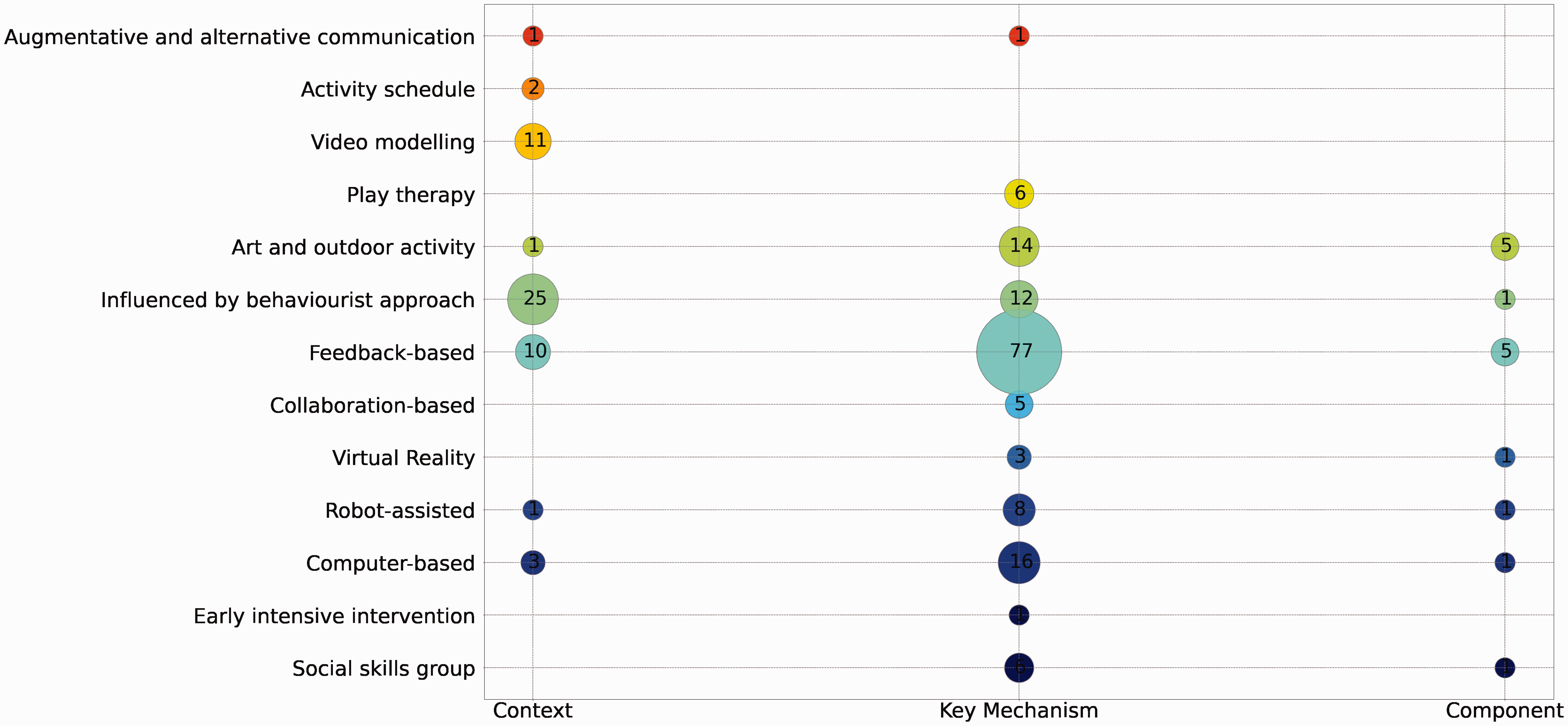
Frequency of role of play by intervention type.

Frequency of each level of child-control by intervention type.
Social communication outcomes
The present review focuses on interventions targeting outcomes related to social and communication development. To summarise the vast array of potential intervention targets in these areas, we devised eight broad outcome categories that capture the main area of focus for each study (see supplemental materials S3).
Figure 4 shows the proportion of studies (N = 388) for each outcome domain. The most common category is the ‘multiple’ outcomes category, with over 45% of studies using more than one relevant outcome. Social play skills are the next most common target of play-based interventions.

Proportion of studies targetting each outcome type.
Agent of intervention (AoI)
Given the scope of interdisciplinary involvement in play-based interventions, we aimed to record those who were actively involved in delivering the intervention in relation to its theorised mechanisms of change. Despite AoI-type codes being a common feature of many intervention-related reviews, this category was difficult to implement in practice for many reasons, including – multiple agency delivery or involvement, unclear reporting, the role of the main professional or others involved being complex and variable practices across interventions/studies. Two over-arching categories were developed: ‘
and ‘
The frequency for each subcategory within the AoI codes is shown in Table 4.
Frequency for each agent of intervention category (AoI).

Participant characteristics
Three hundred and sixty-four studies (94.79%) 2 included an autistic-only sample and 52 studies (13.54%) included autistic participants with co-occurring conditions. Sixty percent studied females and males, although mixed samples tended to include more males. Just 1.6% of studies looked at play-based interventions for girls only and 28.9% investigated boys only. The remaining studies did not report the gender/sex of their participants.
Reports of participant IQ and adaptive functioning were found in a substantial minority of studies. Figure 5 shows the breakdown for the 132 studies reporting IQ and Figure 6 shows comparable data for the Vineland Adaptive Behavior Scale (VABS) adaptive functioning scores. Table 5 shows the numbers of studies reporting these and other relevant characteristics such as language ability or autistic symptomatology scores.
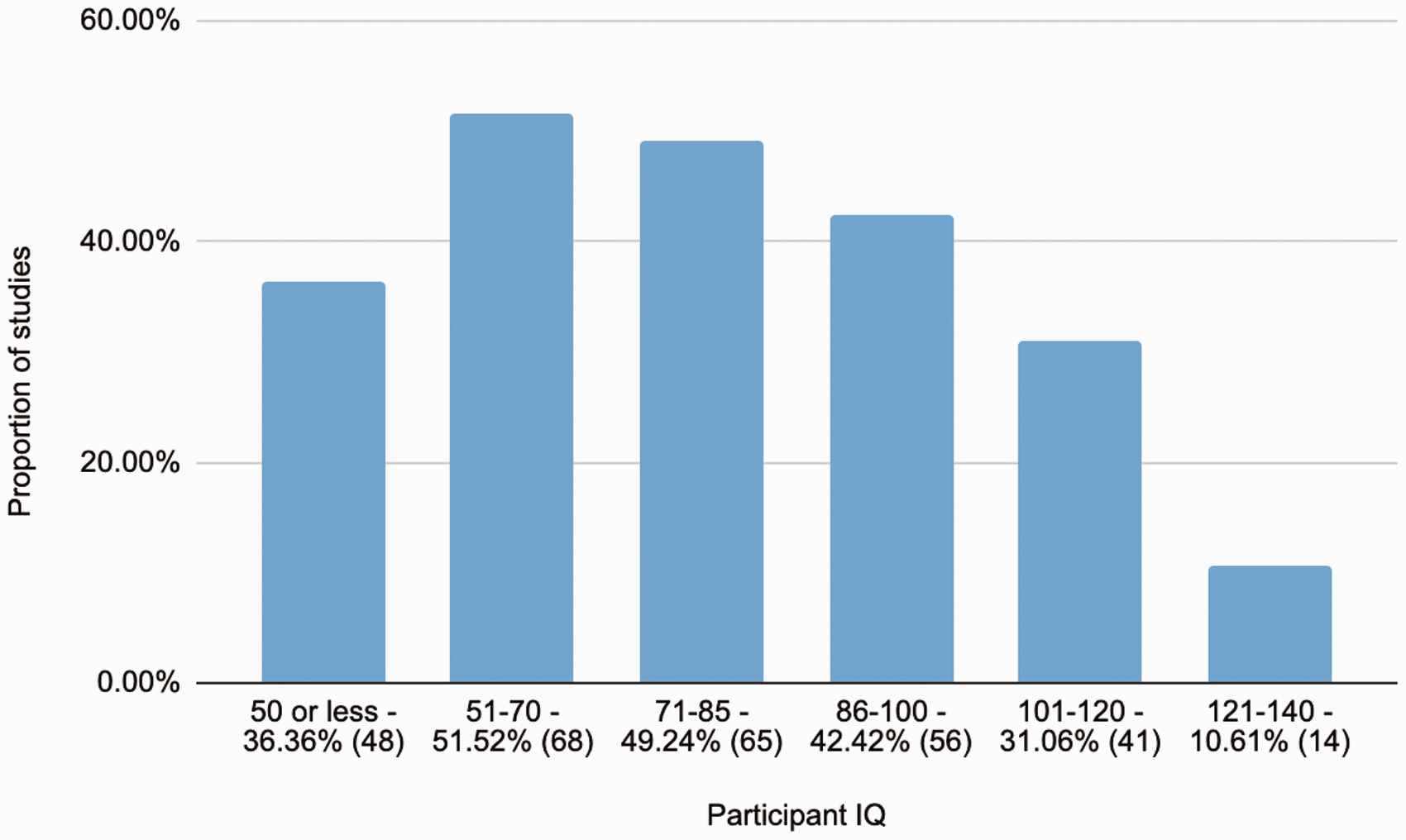
IQ ranges of participants in studies reporting an IQ measure (n = 132).

Vineland Adaptive Behavior Scales (VABS) ranges in studies reporting this measure (n = 124).
Indicators of functioning.

Moving to consider demographic and contextual characteristics, a substantial majority of the research has been produced in the USA, followed by Canada, Australia, and the UK. Most studies did not provide information about ethnicity (n = 239, 62.2%), family income (n = 349, 90.9%), parental occupation (n = 364, 93.8%), or maternal education levels (n = 287, 74.7%). Where reported, the most common ethnicity categories were White, Latinx/Hispanic, Black, Asian and Mixed/Other. Just five studies reported on indigenous or first nation cultures in the regions where the highest number of studies were conducted.
Study design
The coding of study designs, shown in Table 6, was adapted from the three ‘level of evidence’ ratings used by The Communication Trust’s Better Communication Research Project (Law et al., 2012). Note that while the study design categories give an indication of the overall quality of the evidence when it comes to intervention effectiveness, such that an RCT is considered more robust evidence than a quasi-experimental study and so on, the ‘level of evidence’ categorisation does not give any information about the quality or findings of an individual study. The percentage representation of each study design is shown in Figure 7.
Study design categories.


Frequency for each study design.
Fidelity, generalisation and follow-up
Excluding protocols (n = 4), 53.13% of studies reported some measure of treatment fidelity, while 28.09% (n = 109) reported a generalisation phase, and 39.18% (n = 152) reported longer term follow up after the immediate post-intervention measurement, eight of these studies were separate papers reporting a follow-up study from an earlier intervention, the rest report follow-up in the same paper.
Evidence gap maps (EGMs)
Readers are strongly encouraged to explore the interactive, online EGMs (https://eppi.ioe.ac.uk/cms/Default.aspx?tabid=3787). This will allow users to investigate the features of an intervention of interest, for example if it is child-led, guided or adult-led play, or whether or not it is linked to behaviourist methods. The screenshot in Figure 8 gives an example:

Screenshot of an Evidence Gap Map (EGM).
The small boxes each represent a study and, in this case, they are coloured according to the role of play code. So in the example screenshot we can see that the role of play in feedback-based interventions targeting social play skills tends to be that of a key mechanism.
Discussion
Conceptualising play-based interventions
The major contribution of the present paper is to summarise the heterogenous literature on the role of play in social and communication interventions in a way that has stakeholder relevance. The conceptualisation of the role of play within such interventions as falling within 3 broad categories of ‘context’, ‘component’ or a ‘key mechanism’ will support practitioners in reflections about their own views and practices regarding play. This approach reflects the theoretical and empirical play literature that asks questions about exactly how play activities or playful engagement might promote child development (Gibson, Fink, et al., 2020; Godin et al., 2019a; Hopkins et al., 2015; Luckett et al., 2007), as well as the literature that emphasises environmental adaptation, or ‘context-based’ therapies (Bundy et al., 2009, 2017).
Likewise, the ‘level of child control’ categories resonate with the literature on developmentalist strategies for intervention and debates around the role of guided-play vs direct instruction (Weisberg et al., 2016). The present review found that feedback-based approaches most frequently employ play as a key mechanism and are likely to be child-led. Interestingly, technology-based approaches tended to be more adult-directed, perhaps requiring a greater level of adult control to facilitate their use. More naturalistic approaches to technology use in autism have shown that free-play may be associated with higher levels of social and co-operative behaviour (Francis et al., 2019), so it is interesting to note that such approaches have not yet translated into intervention research.
The stakeholder consultation was also helpful in informing our approach to developing these two dimensions for scoping the literature. We found that play-based interventions were generally acceptable to practitioners, autistic people and the families of autistic people, although some concerns were raised from autistic individuals about the need to think carefully regarding bringing special interests into therapies and to consider the importance of autonomy. This chimes with Fletcher-Watson’s finding of a positive view of early intervention support (Fletcher-Watson et al., 2017). We hope that by reflecting on the extent to which their intervention practices are child-led and the different ways in which play underpins an intervention approach, practitioners can help autistic children and their families to make informed choices.
Types of play-based interventions
Categories for intervention types were developed reflecting the main intervention approaches that we judged would be of clinical interest. Furthermore, as some autistic stakeholders mentioned that they would be concerned about play-based therapies masking an underlying Applied Behaviour Analysis (ABA) approach, and some parents of autistic children wanted more information about ABA therapies, we also factored in information about the underlying philosophy, where this could be discerned. It is worth noting that this is not always self-evident. For example in the broader literature parent feedback models have been developed from both operant conditioning (Brookman-Frazee et al., 2006) and attachment theory perspectives (Juffer et al., 2017). In the present review, feedback approaches were one of the most common intervention types and were largely based on more naturalistic behaviourist approaches (e.g. Early Start Denver Model (ESDM)), or neuroconstructivist models (e.g. Pre-school Autism Communication Trial (PACT)). Although feedback-based approaches were mainly based on parenting interventions, there is also an emerging literature concerning peer feedback, including friends and siblings.
We also identified intervention types that are more likely to be carried out by practitioners based in schools, such as social skills groups, interest-based activity groups (e.g. music, drama) or collaborative play (e.g. LEGO-based therapy). These reflect the increasingly important role of peers in children’s learning and development as they move into the primary school years (Howe, 2009), and a move away from seeing play as a key developmental mechanism toward more of a learning context as children get older. We did not find any play-based interventions targeting social and communication outcomes that were explicitly strengths-based, by which we mean interventions acknowledging and celebrating autistic individuality in play and building on personalized preferences and contexts of play, or which view peer-peer interventions between autistic individuals as a deliberate strategy for supporting autistic communication styles (as contrasted with incidental groupings, e.g. due to school placement). This could be an interesting avenue for future play interventions, given recent findings of enhanced communication between autistic/autistic pairs, compared to autistic/non-autistic pairs (Crompton et al., 2020) and calls for strengths-based approaches from autism research organisations internationally (Huntley et al., 2019).
Having discussed the broader parameters used to scope the literature, we turn to discussion of more specific aspects of the studies reviewed, beginning with study design.
Study design
Just 21% of the included studies used an RCT design, which is typically considered the most robust way to test intervention efficacy 3 (Greenhalgh, 2014). Quasi-experimental designs, using a control group but with no random allocation, accounted for a further 17%, meaning most included studies used designs that cannot provide conclusive or convincing evidence of clinical efficacy. Thus, we can conclude that the current evidence base is limited, even though we did not specifically evaluate effect-sizes/outcomes.
The lack of robust intervention studies may be because play-based interventions are a relatively new type of 'complex intervention' requiring extensive, iterative development and testing before they are worth the expense of a large trial and can be effectively taken to scale (O’Cathain et al., 2019). Choosing a study design that fits the state of knowledge in the discipline and addresses ethical or pragmatic concerns is entirely appropriate in a field in its early stages. Robot-based and computer-based interventions are good examples of approaches at an early stage. Papers classed as ‘other’ or ‘indicative’ for these types of interventions often include discussion of the development process and stakeholder consultation, important features of inclusive research (Fletcher-Watson et al., 2018).
On the other hand, it is concerning that more than half of the included studies had 10 or fewer participants, and 43% had fewer than six participants. While case-studies, case-series and small-scale observational work can provide an important foundation for intervention research, the field needs to consolidate and scale-up research efforts if widely implementable evidence-based interventions are the ultimate ambition.
Participants
Reporting of participant characteristics was piecemeal. While all studies included autistic participants, just 14% report co-occurring conditions. This is in contrast with reports of a high frequency of co-occurring conditions in the literature. In line with many other autism-related studies, girls were also under-represented despite having a potentially different social phenotype (Van Wijngaarden-Cremers et al., 2014).
Agent of intervention and outcomes
Practitioners from many backgrounds have been creative in finding ways to use play to support autistic children facing challenges in communication and social interaction. We were surprised by the relatively low number of Occupational Therapy interventions, given that the field has a long-standing tradition of play-based intervention, and also by the relative scarcity of Speech and Language Therapy studies, given the focus on communication-based outcomes in the present review. Overall, the data highlight the importance of multi-disciplinary approaches in this field (Strunk et al., 2017). Congruent with a multi-disciplinary approach, we also found that play-based interventions frequently target multiple outcomes – an approach that makes sense given the pervasive nature of social communication difficulties in autism. Social play skills were the largest single type of outcome target, measured in 16.5% of studies. This ties in with the increasing recognition that play is a crucial tool for supporting learning and development, particularly in social domains (Toseeb et al., 2020; Weisberg et al., 2013; Whitebread et al., 2009). Language development and early communication skills development were also popular as intervention targets, particularly for studies using feedback and/or behaviourist influenced approaches.
The distinction between those studies which use play as a medium for interventions targeting other outcomes, and those which target social play skills as an outcome per se, will be useful to consider when making decisions about which play-based interventions to support in future research.
Strengths and limitations
This review synthesises evidence from across a wide range of play-based interventions, allowing practitioners to position their own intervention approaches within a broader context and highlighting features of interventions that can inform clinical decision making. Furthermore, use of a pre-registered design and independent inter-rater reliability for key codes demonstrates a rigorous approach. Nevertheless, it is important to consider limitations. Firstly, due to resource constraints, we have not been able to search the grey literature and therefore could have missed important new approaches. Relatedly, we acknowledge that our criteria for selection of the 19 ‘named interventions’ is somewhat arbitrary, being based on our clinical judgement rather than an independent criterion. Readers should consult the EGMs and supplemental materials if they wish to make their own judgement. Secondly, we have not included quality appraisals or outcome syntheses, meaning that questions of intervention efficacy cannot be addressed. While this is an omission in-keeping with the decision to use scoping review methods, effectiveness data would be an important next-step for evidence synthesis in this area. Readers could refer to existing meta-analyses on early intervention for some insight into evidence of efficacy (e.g. Sandbank et al., 2020). Finally, due to the extent and variation of specific outcome measures used in autism research and clinical practice, we have not reported the exact measurement tools that studies used within these domains. An excellent review of outcome measurement tools can be found in this comprehensive report by McConachie and colleagues (McConachie et al., 2015).
Conclusions and clinical implications
Regarding clinical implications, the conceptual framework proposed in this review can help practitioners appraise the literature and aid their advice to families when making shared intervention decisions. The observation that studies shift from play being used as a key developmental mechanism to a learning context as children get older warrants further exploration in research, when considering the public involvement feedback around the importance of play for supporting communication and friendships. Figure 9 contains some reflection and discussion prompts for practitioners to support engagement with the findings of this review.

Prompts for practitioner reflection and discussion.
The stakeholder consultation and review findings reveal important dimensions for appraisal of play-based interventions, including the role of play, the underpinning philosophy (e.g. behaviourist or developmental), the role of the practitioner (providing parent feedback, 1:1 intervention, group facilitation), and the involvement of others in implementation of play-based approaches.
The wide range of approaches uncovered by this review is a testament to the wonderful diversity inherent to both play and autism. However, future research could usefully focus on consolidating the evidence base for existing play-based interventions, as the overall impression is that evidence is sparse and tending to lack robust methods. The field would also benefit from greater attention to diversity of sampling, making sure to include girls and minority background individuals, and to conduct studies in a wider range of countries from more diverse socio-economic contexts.
Supplemental Material
sj-pdf-1-dli-10.1177_23969415211015840 - Supplemental material for Play-based interventions to support social and communication development in autistic children aged 2–8 years: A scoping review
Supplemental material, sj-pdf-1-dli-10.1177_23969415211015840 for Play-based interventions to support social and communication development in autistic children aged 2–8 years: A scoping review by Jenny L Gibson, Emma Pritchard and Carmen de Lemos in Autism & Developmental Language Impairments
Footnotes
Acknowledgements
We thank Angela Cutts and the team at the Everton Library, and Isla Kuhn and the team at the Medical Library for invaluable support, advice, and peer review. Thanks to the EPPI reviewer team for their support and patience.
Declaration of conflicting interests
The author(s) declared the following potential conflicts of interest with respect to the research, authorship, and/or publication of this article: This study is funded by LEGO Foundation and therefore the authors declare a potential conflict of interest due to the inclusion of studies of LEGO-based therapy in this review. This paper is included in the special collection co-edited by author JG. It was peer reviewed via an independent editorial process, separate from that of the special collection.
Funding
The author(s) disclosed receipt of the following financial support for the research, authorship, and/or publication of this article: We gratefully acknowledge funding from LEGO Foundation.

Notes
Supplemental Material
Supplemental material for this article is available online.
References
Supplementary Material
Please find the following supplemental material available below.
For Open Access articles published under a Creative Commons License, all supplemental material carries the same license as the article it is associated with.
For non-Open Access articles published, all supplemental material carries a non-exclusive license, and permission requests for re-use of supplemental material or any part of supplemental material shall be sent directly to the copyright owner as specified in the copyright notice associated with the article.
