




Abstract
Background
Studies involving autistic adults have often focused on negative outcomes and quality of life ratings.
Aims
This study provides a different viewpoint by examining the perspectives of autistic men who consider themselves to be successful.
Methods
Data were gathered from 10 men who shared their experiences and perceptions regarding their journey to achieve success. Self-determination theory provided a useful lens for examining the men’s narratives and understanding the factors that led to their success.
Results
Analysis of interviews revealed four main themes: (1) being my own self, (2) a competent professional, (3) solving problems in a neurotypical world, and (4) relating and connecting. These themes reflect the men’s perception of their own self-determination including their autonomy, competence, and relatedness with others.
Conclusions
The men’s sense of success was derived from their ability to achieve competence in their work, act without help or influence from others and demonstrate a high level of self-awareness and self-reflection. Despite this, many continued to experience difficulty in the social areas of their lives.
Introduction
Self-determination has been described as “acting as a causal agent to make decisions and take actions to achieve a goal without the undue influence of others” (Wehmeyer, 1992, p. 305). According to self-determination theory (Deci & Ryan, 2004), individuals are motivated by a need for autonomy, competence, and relatedness. By seeking to fulfill these needs, they become more self-determined. Individuals who act as causal agents and demonstrate higher levels of self-determination achieve greater outcomes and experience a higher degree of wellbeing and satisfaction with their lives (Shogren et al., 2017). For marginalized individuals such as autistic men, self-determination theory provides a useful theoretical lens for exploring factors that enable them to feel successful. Such understandings are important as they provide an alternative lens for examining achievements, outcomes, and the ways in which these can be constructed.
Shogren et al. (2017) suggest that to achieve success, individuals must negotiate a variety of challenges while accessing opportunities and supports in their lives, which enable them to develop skills associated with self-determination. To date, researchers have primarily examined traditional outcomes experienced by autistic adults (Levy & Perry, 2011) in employment (Scott et al., 2015), relationships (Renty & Roeyers, 2007), and quality of life (Kim, 2019; Zalewska et al., 2016). These studies have focused on the challenges and barriers faced by autistic individuals (deficit perspectives), rather than looking at actors that contribute to their sense of self-determination and ability to exercise agency in their lives. Autistic self-advocates (Ward & Meyer, 1999) contend that examining the self-determination of autistic individuals warrants further attention and suggest that autistic adults offer unique and important perspectives that can contribute to the collective awareness of values held within the autistic community.
Few studies have examined the specific self-determination of autistic individuals separate from that of other individuals with disability. Researchers (e.g. Carter et al., 2013; Cheak-Zamora et al., 2020) have gathered data from parents or carers to assess self-determination of autistic adolescents and adults. A number of others have utilized social skill programs and interventions to increase the self-determination of adolescents and adults (Fullerton & Coyne, 1999; Held et al., 2004), although these have not assessed ways in which the individual has demonstrated self-determination prior to intervention. Recently, researchers have begun to gather data directly from autistic individuals. These studies have typically utilized standardized measures to ascertain the individual’s overall level of self-determination (e.g. Chou et al., 2017) or have examined relationships between self-determination and quality of life measures (White et al., 2018), or employment outcomes (Zalewska et al., 2016). However, studies have almost exclusively focused on the perceived deficits of autistic individuals rather than exploring the ways in which autistic individuals feel they demonstrate self-determination.
Recently, Kim (2019) attempted to review studies that explored autistic perspectives of self-determination. Unable to find any, she reviewed 14 studies that indirectly examined self-determination through the perceptions of autistic individuals. This revealed that autistic individuals demonstrated self-determination in employment, advocacy stress management, social participation, and through developing a positive identity. All studies included autistic males and females but did not attempt to explore gender differences.In addition, males are diagnosed with autism spectrum disorder (ASD) four times more often than females; seven studies included equal numbers of males and females, while three studies included many more females than males.
Some emerging studies show gender differences in behavioural manifestations of autism, particularly in the areas of language skills and social awareness (Lai et al., 2011). Researchers have also found that autistic men and women differ in social (Head et al., 2014) and employment situations (Costley et al., 2016) and display different skills to manage the challenges they encounter (Frazier et al., 2014). Autistic men were also less adept at reading facial cues (Hall et al., 2010), were more likely to experience difficulties in friendships and social interactions (Sedgewick et al., 2016) and demonstrated a higher correlation between depressive symptoms and attempts to mask their autistic traits (Lai et al., 2017). Thus, it is important to gather data from autistic men to determine the ways in which their perceptions and experiences of self-determination and achievement are unique from those of autistic women. As yet, limited data exist about autistic men and self-determination. This study contributes to the field by providing baseline data.
The following study draws on self-determination theory to explore the narratives and perceptions of autistic men who consider themselves successful. A particular focus is made on how they have coped with barriers and problems they encounter in order to achieve valued outcomes and self-determination in their adult lives. The focus also allows positive perspectives of success to become known in the research literature, rather than a focus on deficits from autism. The study is not intended to provide a comparison between gender but rather develop foundational knowledge around autistic males and self-determination to allow the development of comparisons in the future.
Methods
Participants
Participants were recruited through convenience sampling (non-probability method where the sample was taken from people who were able to be accessed from advertisements). Advertisements were placed on the university website and were sent to known online support groups and organisations frequented by autistic adults. Participants could then contact the researcher if they were willing to be involved. The advertisement asked for autistic men who were at least 25 years old, had a formal diagnosis of autism spectrum disorder or a related condition, and felt they were successful. The term “successful” was not defined as the study aimed to determine how autistic men defined success. Ethical approval was received for this project from the university ethics committee (approval number 2016/207). Informed consent was given in hard signature as well as verbal consent at the commencement of the interview.
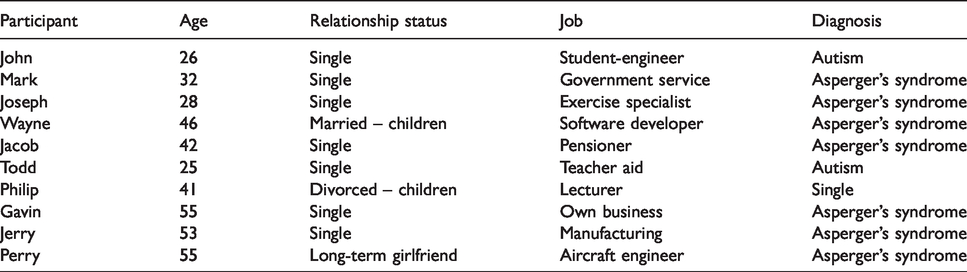
Ten men responded to the call and participated in the study (all men who responded to the call participated). Participants ranged in age from 25 to 55 years of age and had been diagnosed with either Asperger disorder (8) or autism (2) (see Table 1). Only one of the participants was currently married. Another was in a long-term relationship and a third was divorced. Two of the participants had children. The participants engaged in different types of work or study. Two were currently students; three owned their own business; two worked in industry and IT; one was an unemployed writer; and one was employed on a part-time basis.
Participant demographics.
Data collection
Data were collected through semi-structured interviews in which participants were asked to share their experiences. An interview guide (see online Appendix 1) served as a prompt for the key constructs rather than a set of structured questions. Each participant was given a copy of the interview guide when they consented to participate, so that they could prepare for the interview or make notes in advance if they wished (also improving the quality and amount of responses). The men were first asked to answer the series of demographic questions and then were asked to describe themselves and to discuss the ways in which they saw themselves as successful. These included ways in which they defined success, areas in which they saw themselves as successful, ways they described themselves, internal characteristics that enabled them to achieve success, external factors or individuals that enabled them to achieve success, people who they admired or had mentored them, ,and areas in which they continued to experience challenges and difficulties.
Throughout the interview, the men were prompted with questions from the interview guide if they had not already discussed a particular topic. Prior sharing of the interview guides however had allowed the men to prepare and understand the intent of the questions.
Interviews were audio-recorded and then transcribed verbatim. Vignettes from the verbatim text are presented in the results. In order to preserve the participant’s voice, quotes are provided verbatim, without change to grammar or sentence structure. Each interview lasted between 1 hour and 2 hours. Two participants (Gavin and Wayne) also provided additional notes in writing which they emailed to the researcher.
Data analysis
According to Haggarty (1996, pp. 99–101), “content analysis is a research method which allows the qualitative data collected in research to be analyzed systematically and reliably so that generalizations can be made from them in relation to the categories of interest to the researcher”. Using this methodological approach fulfils a double purpose. Firstly, there is the interest to identify, describe, and analyze contextual meanings, representing the experiences of men with autism. Secondly, there is the interest to generate wider understanding about how men with autism describe and understand success in their lives.
A process of both deductive and inductive analysis was utilized to first identify participant’s definition of success, factors they related to their success, and any other relevant variables that arose from the interviews (Roberts et al., 2019). This involved an initial reading of transcripts to memo and identify initial codes from raw data. After transferring these into NVIVO, a more detailed coding process was undertaken in which self-determination theory served as a focal point for deductive analysis (with a particular focus on relatedness, autonomy, and competence). NVIVO is a software program, which is ideally suited to the analysis of qualitative data, as it allows researchers to create codes from data and then to analyze intersection of codes to collapse codes and identify broader themes (Bazely, 2007). Using NVIVO, codes were created within themes to explore subthemes that became relevant.
Credibility of findings was ensured by several methods. As recommended by Roberts et al. (2019), a detailed codebook was kept to label and define codes, themes, and subthemes. Member checking was used to confirm validity of findings among participants, and categorisations were undertaken and discussed by two researchers and a research assistant to create trustworthiness. Elo et al. (2014) suggest such an approach is highly suitable to allow the confirmation of the credibility of the analysis in qualitative content analysis. Finally, thick descriptions have been presented in the findings to facilitate transparency of the themes derived (Long & Johnson, 2000). Thick descriptions provide detail not only of behaviours but of context, which offer an additional means of enhancing trustworthiness in qualitative research (Elo et al., 2014).
Results
Analysis of the men’s narratives revealed that their sense of success was influenced by a number of factors which were represented by four themes: being my own self, a competent professional, solving problems in a neurotypical world, and relating and connecting. Interwoven among these themes, participants discussed challenges they faced. Secondary, deductive analysis demonstrated that as the men discussed these themes, they highlighted ways in which they had fulfilled or not fulfilled their needs for autonomy, competence, and relatedness, enabling them to become more self-determined by exercising agency in their lives. Links between themes, subthemes, and motivational needs associated with self-determination are presented in Figure 1. In addition, a more detailed definition and illustrative example of each theme and subtheme is available in online Appendix 2.

Motivational needs and success of autistic men.
Being my own self
Throughout their narratives, participants demonstrated a strong sense of awareness of their own characteristics, capabilities, and ability to exercise choice and autonomy over their lives. This theme, being my own self, was reflected in four subthemes: descriptions of self, self-acceptance and self-confidence, self-awareness and self-reflection, and self-reliance.
Descriptions of self
All participants provided rich depictions of themselves. Participants described aspects of themselves they viewed as positive such as “Loyal, I’m very, almost stubbornly loyal to people and causes, that type of thing” (John) and “I was always someone who loved just to listen. I’m a very good listener if I want to be” (Joseph). They also related aspects of their personality, which caused them difficulties. For example, Joseph reflected that, “The only things that I probably find myself still getting in a little bit of a pickle with would be just maybe a fraction of naivete and maybe just a little bit of gullibleness”. Moreover, comments of participants demonstrate that, while they recognized their more challenging characteristics, they did perceive these to be negative characteristics that needed to be changed. Rather, they viewed them as an essential part of who they are. This is evident in Mark’s comment, “there’s always to my nature a very blunt and brutal sense of things. So, I’m not someone who likes to pussyfoot around. I’m someone who normally gets straight to the issue and to the concern of what’s going on”.
Several of the men expressed a reluctance to allow others to place labels on them. For instance, Mark stated, “I don’t like neurotypical people, sort of, pushing me into that category and ascribing a label, which therefore comes with stereotypes”. Others related that following their diagnosis, they internalized the label of autism spectrum disorder as means to understand themselves better. Philip recounts his feelings following his diagnosis of ASD: And it was really interesting that even though I went and sought out this label to try and normalise it for my children, I still went there. I still went through a period of internalising that shame and thinking, “Well obviously I am screwed up, and I obviously mustn’t be successful”. So, I actually started to reframe that, and I had to actually go to my, tell myself actually, “I went and got this label not to become a disorder but to become, to show my children, to be a role model. To show that I’m still no different, I’m still the same person”. But I had to do a lot of work to actually remind myself.
Self-awareness and self-reflection
In addition to describing their characteristics, the men demonstrated skills in self-awareness and self-reflection, which they associated with their life experiences. For example, Joseph related, And I think self-awareness, I think a lot of the successes and failures that I’ve done in life from an early age through teenage years, young adult years, everything, I’ve taken away and I’ve had, just I’ve lived a lot
Participants commented that their ability to reflect on the ways their characteristics influenced the choices they made. For example, Mark explained, “But I normally find that when I get proficient at something, whether it be study or a job, I have a tendency to leave it or to try and look for something else”. Another participant, Jacob, reflected on the way in which his needs impacted others around him saying, “I can appreciate that I’d be a pretty difficult person to live with, not because I, I’m not rule bound, I’m not particularly rigid with things, but I need an awful of time alone”. Participants also engaged in self-reflection about the reasons for their decisions. For instance, while discussing his social interactions, Gavin stated, “Whereas I realised in previous times I was wearing my sort of mask to be sort of perceived in some way a socialist type, you know, … whereas rather than saying what I really want to say”. Similarly, Todd reflected on the consequences of his actions stating, “I can completely agree that there were certain things that I did that were very much I should not have done”.
Interestingly, the men described the ways in which their unique, autistic thought processes both helped and hindered them. Gavin described how his style of thinking helped him to achieve in his career stating,
So I certainly have the ability, in spatial terms, to put something together in my mind that may involve some aspects of the mathematical process or be able to understand mechanistic or engineering type things quicker or faster or perhaps even differently than other people.
Likewise, Jacob stated, “Well I think thinking is the very best thing I do. There’s really no such thing as overthinking. I solve all problems, including thinking problems, by thinking”. In contrast, other participants identified ways in which their thinking processes made them anxious as evidenced by Joseph’s statement, “sometimes my brain would get hot”. However, Joseph went on to explain that he would use cognitive processes to “visualise sort of steam of smoke coming out”, which enabled him to manage his anxiety. Together, these statements illustrate the ways in which participants’ ability to self-reflect influenced their sense of control and autonomy over past and future actions.
Self-acceptance and self-confidence
Another aspect of their sense of autonomy was reflected in participant’s discussion of their journey towards developing self-acceptance and self-confidence. The evolution of the men’s belief in themselves is evident in Phillip’s comment, “I knew I wasn’t a stupid kid; I knew I wasn’t, I always felt like if I was told I was naughty or dumb I always thought, That’s not right. I’m a good kid, and I’m bright”. Jacob stated, “I normally don’t think I’m incapable of doing something. I like proving people wrong in that regard” highlighting that his self-confidence developed as a result of demonstrating that he could achieve beyond what others expected of him.
Participant’s self-acceptance was also reflected in their advice for other young autistic men. For example, John stated, “Be yourself. There’s nothing wrong with what you are”. All of the participants related experiences that had increased their self-confidence. These included learning new skills (Joseph, Phillip), feeling others believed in them (Todd, John), and even learning from failure as evidenced by the comments: But gees, I’m a better person. I’m so much stronger, confident, I can fail now too. (Phillip). Significantly. It was a very big part to my, to my development, absolutely, in just getting a lot more confidence. So that and exercise, two very big things. (Joseph).
Self-reliance
Throughout their narratives, participants expressed a strong desire to be self-reliant and autonomous. Participants took great pride in their ability to be independent and make their own decisions, emphasizing the ways in which they had achieved success without help from others. Comments about self-reliance included: So yeah when you were talking about who the influences are, I feel like I raised myself … And in a lot of respects if another person could do something, I thought that this just means I can do it as well. (Wayne) I don’t ask for help. I typically don’t ask for help at 42. (Jacob) I tended to trust people a lot and tended to get betrayed by them or let down by them or hurt by them and so I don’t anymore, you know, I just, so you know, I just, yeah. Yeah, so I’m probably immensely independent and, you know, try and stick to myself and, you know. (Jerry)
A competent professional
The second of Deci and Ryan’s (2004) motivational needs that must be met to develop self-determination is competence. Participant’s perceptions of competence were reflected in the second theme identified, a competent professional. Specifically, the men related ways in which their sense of success and competence was derived from their accomplishments, success in work, skill sets, and feeling of success.
Accomplishments
Participants talked about their accomplishments in a variety of areas. Although many involved their achievements in their career (see next section), a number of participants highlighted their accomplishments in education. For example, several men discussed different credentials and certifications they had completed. Phillip and Mark had recently attained a PhD, and John was working to complete a master’s degree. Achieving high grades in school or receiving academic awards was linked to feelings of competence and success as evident in Phillip’s comment, “then when I got that first A I was just like ‘I’m going to get an A for this subject’ and then when I got an A for that subject I just thought ‘I can get As’”. Other men described achieving recognition in sports such as tae kwon do (Jerry), marathons (Wayne), tennis (Philip and Joseph), and fitness programs (Joseph).
A few participants related feeling a sense of accomplishment after they had taken action to deal with an adverse situation. For example, John stated, “Personally, my greatest achievement is essentially, divorcing my parents”. Similarly, Phillip reflected, “and the fact that I’ve survived, even thrived. I actually achieved in a period of life where most people … not everyone does survive it I suppose”. Other men talked about the sense of accomplishment they felt in helping others as exemplified in Joseph’s comment: Biggest achievement I think is always, I humbly say it, is just seeing a child that literally start out with next to nothing in there, in their social or cognitive or physical development to finally get that smile or just know within themselves that they are, they’re starting to connect.
Success in work
Almost all of the men discussed their achievements in the workplace, emphasizing their feelings of competence and success in this area of their life. The men highlighted a range of work-related achievements including inventing a particular product (Perry) and being promoted to higher levels (John, Mark, and Wayne). Others explained that being able to translate their interests into a career (Perry, Jeremy, Todd, and Gavin) enabled them to build on particular skills they already possessed. Three men (Perry, Joseph, and Gavin) ran their own companies, which enabled them to focus on areas of strength, but presented them with additional challenges. Perry explained, “For me to be successful in this business, I had to engage mentors, because the actual running the business, I found a bit challenging”. Similarly, Gavin related: You can get busy for a period if you get lucky with a marketing or just plain lucky with people who want the service … but if you’re my type of person and you run as a self-employed type of thing, you can run the risk of getting overloaded there for periods because you’re wearing so many different hats.
Skill sets
Further evidence of participants’ sense of their own competence was provided as the men described their particular skills. Participants described being skilled at writing (Jacob, Phillip, and Wayne), public speaking (Mark and Todd), and using maths and logical thinking (Jacob). Others described aspects of their personality, which they felt had enabled them to achieve success. As the men explained, “basically that thing of just being able to throw myself into things” (John), and “when I set my mind to an issue or something, I tend to get it done” (Jacob).
Some of the men highlighted a strength in intellectual skills. Comments such as “I’m measured to be quite intelligent. I think that’s been an ongoing asset for me that I’ve relied on forever to figure things out and to get on well” (Wayne) and “I’ve been grateful that I’ve got a good IQ and all my inventions and ideas and that just come to me” (Phillip) illustrate that drawing on intellectual capacity enabled the men to feel competent in tackling challenges.
A number of men discussed their competence in self-management strategies. Some men used mindfulness or meditation to deal with stress. Joseph described his process: So, I literally would visualise sort of steam or smoke coming out. I’d sit there and I’d feel so calm and so relaxed, take in a few deep breaths afterwards, and I’d feel pretty fantastic. I felt fine … I think stimming was one meditation growing up.
Solving problems in a neurotypical world
The third theme, solving problems in a neurotypical world, was derived from participants’ descriptions of ways in which they navigated societal expectations. These descriptions reflected both the men’s sense of competence and autonomy to employ strategies such as analyzing the situation, reading and gathering information, and drawing on neurotypical models to cope with challenges in their life.
Analyzing the situation
The men discussed their use of logic and intellect to analyze and deconstruct different situations that challenged them in some way. Many examples involved navigating expectations of others. Perry explained, “And I’ve got my little cues that I do. I can’t read social situations, but my intellect can read enough to build my confidence”. This demonstrates that using his intellectual skills enabled him to feel he had the knowledge needed to successfully participate.
In addition to reading social cues, participants employed analytical techniques to work out the motivations of others, as illustrated in the following statements: I'll often spend a lot of time philosophising or thinking about why people do certain things the way they do them. (Mark) So, I got a fairly big interest in understanding other people and I think that’s a fairly common thing. But I just don’t know how much other people get into it. Like it’s kind of an obsession with me to learn about and figure out why people do certain things. (Wayne)
Reading and gathering information
Reading and gathering information was another problem-solving strategy described by participants. John described how gathering information following his diagnosis enabled him to develop a plan of action, “Well, I, basically went to a doctor, and said ‘Tell me what I haven’t been told’, and basically working out sort of a plan of action of how I could … best function with society”
Others related how reading enabled them to feel more competent in social situations.Wayne explained, “I read things like how to win friends and influence people, body language”. John reflected helped him to feel more confident he could manage challenges, Just to … say, to myself, ‘Okay, there’s something that you can … not exactly fix, but manage. Just find all the information you can and manage it the best you can’” (John).
Others built their knowledge by accessing information from others (Gavin), while some men built their skills by taking specific courses. Perry explained how taking courses improved his social competence stating, “I was just sick of lacking confidence and being really nervous and anxious and not being able to get on with people. So, I did that course and that was a real blessing to me”.
Drawing on neurotypical models
In addition to gathering information and analyzing situations, participants discussed using neurotypical models to develop their competence and autonomy to be successful in neurotypical society. Mark related how he tried to learn how neurotypical people acted, explaining, “I've had to learn the neurotypical ways, and I'm still going, and I still trip up every now and then, but I think that's, I think learning those ways is very important for success”. Joseph explained that drama helped him to be more confident and to develop a performance or character when he was in public. These comments indicate that competence for some participants was linked, at least in part, to their ability to act less like themselves, and more like their neurotypical peers.
Interestingly, Wayne had a slightly different perspective, stating: I think that not being diagnosed (as a child) allowed me to build up a lot of strategies and a lot of ways of coping that allowed me to be successful in a mainstream sort of a way that I possibly would not have had if I had been more protected.
Relating and connecting
The final theme, relating and connecting, was comprised of participants’ descriptions of their relationships and connections with others in their lives including the subthemes of social navigation, relationships, and support from others. As such, this theme clearly reflects Deci and Ryan’s (2004) third motivational need, relatedness.
Social navigation
Participants shared the ongoing challenges they experienced in navigating social environments. Participants expressed feeling they didn’t fit in with others, and their belief that others possessed social skills that they still lacked. This is illustrated as Gavin’s discusses his sense of isolation and incompetence on the playground: I made an attempt in primary school for a period to sort of fit in. All the kids are in big boys’ playground to play certain games and that. But there was always something that seemed to, I don’t know, maybe I was - look, there’s something brilliant about those younger kids where they can just, over a short of period of time somehow. But this person’s a bit different or geeky or whatever else, so they ostracise you or something else. So, you maybe ostracise yourself. I remember playground times or session times when I would read a book and sit against the tree, being some of the most loneliest times growing up. That sort of thing.
Almost all of the men discussed their experiences with bullying. Many reflected on the lasting impact these experiences had on their relationships with others. This is illustrated in Wayne’s recount of bullying he suffered in school, “Attending school was quite hard and I was bullied a lot and I lost faith in people around the age of 11 and, you know, vowed never to trust anyone again”. Jacob related that bullying and made him question what was wrong with him (Jacob) eroding his self-confidence. Participants related that bullying often caused them to withdraw from social interactions, which also prevented them from developing more positive connections with others.
In contrast, a few participants (Todd, Perry) reported they sought refuge from bullying through video games and sports. This gave enabled them to form connections with others who shared their interests. Perry explains the ways his interests have helped him to navigate social interactions stating: And lately the social side of my life, I’ve worked hard on that, to be able to do that. And, because I love cooking. So, I have people over for, when I cook for them. And cook for my girlfriend. And so, the social side of my life has really come very good. And that’s hard to do. Had to work really hard on that.
Relationships
The relatedness of participants was further highlighted in their discussions of the significant relationships they had with others. Participants described relationships they viewed as positive and supportive. These included relationships with wives, girlfriends, children, and family members. Only two of the men were currently married (Wayne) or in a long-term relationship (Perry) and two (Wayne, Phillip) were fathers. In exploring the men’s relationships, a difference was noted in the romantic intentions of younger and older men. In general, younger men expressed a desire for and hope they would establish a romantic relationship. Todd’s motivation is evident in his statement: I myself would love to have a relationship, well-rounded relationship where there’s no hiccups or bumps. I know so many people have one-way relationships. I’ve had several. And I’d like to see where I could take the romantic aspect of my life. I’ve always wanted to have kids and a family but that’s not something that I would obviously have immediately.
The two men who were fathers discussed the ways in which their relationships with their children had shaped their understanding of themselves. Wayne discussed how his experiences and diagnosis prepared him to support his daughter when he noticed her exhibiting some of the same characteristics, while Perry explored diagnosis for himself out of a desire to provide a model for his children who were also autistic. Both men felt that they were able to form unique connections with their children as a result of their shared experience. Perry related, “So that allows me to engage with my kids. They’re involved in the racing with me, especially my son. So, we spend a lot of time together bonding doing that together. And all his friends. It’s really cool”. In this comment, it is evident, that Perry’s relationships with his children enable him at least partly to fulfill his need for relatedness.
Support from others
Participants revealed complex feelings about support from others often separating relationships with others from their ability to demonstrate autonomy in their lives. Participants were hesitant to admit they needed any help from others. When asked who had supported them, the majority of men stated that no one had, they had achieved things through their own efforts. However, participants did highlight ways that family members had supported them. For example, several of the men discussed the encouragement they had received from their mothers. Mark related, So she has always encouraged me, as well as my brother, to be highly active and to also do things, so never to rest on one's laurels, and that has been very good advice. One of the things she's always said is make every post a winner. My early life there was my grandfather who treated me more like an adult. Left me free to make my own judgements and things and to back my judgments. He died when I was 11. Undoubtedly the best friend I’ve ever had.
Several of the men stated that their relationships with others helped them to translate and understand social expectations. Mark related that his friend helped him to navigate issues at his university, and Wayne highlighted that his wife helped him by reminding him to take a break when she saw he overwhelmed. A couple of the men related ways in which friends helped them learn new skills. Todd explained how his relationships with a friend enabled him to draw on a wider range of skills and experiences, And so we had this thing where we would talk to each other and have stories that we would tell. And it really came into a great factor for me because that way I could learn lessons from the experiences he had. (Todd)
Other men discussed times when they had been hurt by friends or teachers had treated them badly for being different. Jacob explained how this impacted his school experience saying, “I found teachers to be often worse bullies than the students”. In another example, Joseph explained how he turned lack of support from peers as an opportunity for growth: When I got significantly bullied and teased for a considerable amount of time in those early years, my mind over time started to develop a powerful voice of they’re telling me what I can’t do. Which means if I actually focus and listen on what they’re telling me, they’re feeding me clues as to the things I need to work on and improve significantly. Because if I can master the things that they’re telling me that I can’t, and I come out and achieve and show them that I can. The bullying and teasing will reduce and get less, which I found started to happen.
Discussion
Research, to date, has been sparse in gathering the perspectives of autistic adults, and has particularly failed to capture the perceptions and experiences of those men who consider themselves to have achieved success in their lives. The current study was conducted to ascertain the factors that have enabled autistic men to achieve success and exercise self-determination in their own lives. Ten autistic men, between the ages of 26 and 55 were interviewed about their experiences and perceptions of success and related factors. Themes derived from participant’s narratives included having the opportunity and ability to be their own selves, see themselves as competent professionals, solve problems in a neurotypical world, and relate and connect with others. These themes highlight key aspects of the ways in which the men viewed their journey towards achieving success and self-determination in their lives.
Self-determination is related to the psychological constructs of motivation, autonomy, and competence (Wehmeyer, 1999). Previous researchers (Carter et al., 2013; Chou et al., 2017) have suggested that autistic individuals may demonstrate lower levels of autonomy and self-determination than either individuals with other types of disability or neurotypical individuals. In contrast, the men in this study had a strong sense of their own autonomy equating their feelings of success with their ability to take action, not just without influence, but also without help from others. The men in this study rarely sought help from others and implied that success for them entailed their ability to solve problems without support from others. To do this, they drew on their ability to analyze and deconstruct problems in order to discern the correct approach. Moreover, the men had a strong sense of their own competence, particularly discussing ways in which being autistic gave them specific areas of strength or skills that made them uniquely adept at certain things that others were not. They particularly highlighted that building on their areas of interest enabled them to achieve within their chosen field or interest area and that their inner sense of drive and passion helped them to achieve in spite of obstacles.
Within self-determination theory, relatedness is an important element for motivation (Deci & Ryan, 2004). In this study, many of the men expressed that social relationships were the area of their life in which they felt they were the least successful, with all participants reported they continued to experience difficulties in this area. In general, although some men did discuss the ways that relationships had a positive impact on their lives, their sense of self-determination and agency appeared to be derived primarily from their sense of their own autonomy and competence including their self-acceptance, self-awareness, self-reflection, and self-reliance. Although these findings suggest that the men in this study demonstrated more self-determination than that reported for autistic teenagers or adults in previous research (e.g. Carter et al., 2013; Chou et al., 2017), it should be noted that these findings were derived with a group of men who identified themselves as successful. More research is needed to determine if these themes resonate with other autistic men who have achieved outcomes. Conversely, research is needed to determine if these factors are indeed absent from the experiences of autistic individuals who have experienced much poorer outcomes as adults.
The findings of this study contribute to the knowledge base on self-determination of autistic men and suggest several implications for practice. First, consistent with the findings of previous research (Teti et al., 2016), participants’ narratives indicate that providing opportunities for men to utilize their strengths to develop their sense of autonomy and competence can have a significant impact on the outcomes they are able to achieve. Additionally, the findings of the current study expand on that of Ashby and Causton‐Theoharis (2009) and suggest that presumption of competence and provision of opportunities for autistic men to work out solutions to their own problems is important to their ability to develop their self-determination and perceive themselves as successful. Although it could be argued that the men in this study comprised a group with strong language and cognitive skills, the findings of another study (Held et al., 2004) suggest that high expectations and opportunity to exercise causal agency can also empower autistic men with higher support needs. In this study, a young autistic man with significant language and cognitive delays became much more self-determined after he was provided with opportunities and peer support to develop his self-advocacy skills.
The men in the study relied more on analysis, logic, and observation, and deconstruction of observation of others to help them to solve problems and were much less inclined to seek help from peers or mentors. These findings suggest that differentiated strategies may be needed to support the self-determination of autistic males. Moreover, direct support or mentoring may not be the most effective means of developing the self-determination of autistic males. Rather autistic men may respond better when provided with opportunities and support to observe and deconstruct a problem or to connect with others over shared areas of interest, thereby placing them in a position to engage in proximal versus direct learning. Most importantly, the findings of this study suggest that involving autistic males in constructing their own solutions, they are more likely to develop their own sense of self-determination and potential for success, even if they fail.
Limitations
A few limitations of this study are noted. First, the study gathered data from a small sample size. Although this may have implications for the generalisability of the findings, the purpose of the study was to establish key themes in an area which has been relatively unexplored. Future research is needed to confirm these findings with a larger sample or with men outside of Australia to determine if autistic men who have achieved success in other cultures or environments have been influenced by similar or differing factors. It could also be argued that a second limitation of the study is that data collection relied solely on the self-report of the participants. Given that his study aimed to explore the perceptions of autistic men regarding their lived experiences, gathering data from others would not have added further data on the experiences of autistic men. Now that initial themes been identified, future researchers may wish to explore the ways in which others share or differ in their perspectives of the factors that have influenced the experiences of autistic men who consider themselves successful.
Conclusion
To date, there has been limited research gathering the perspectives of men with autism about their perspectives of success. This study helps to fill this void through the exploration in interviews of 10 men. Self-determination theory was used as a framework to understand men on the spectrum by exploring what factors enabled them to develop skills for success and achievement. Researchers (Shogren et al., 2017) indicate that to develop self-determination and achieve desired outcomes, individuals must be able to draw on their own innate physiological or psychological characteristics, access opportunities and supports, and demonstrate belief in their ability to take action, make decisions, and undertake actions to achieve specific goals. The themes derived from the men in this study illustrate how they developed a keen sense of themselves, built on their own inner strengths and interests and utilized logic and problem solving to develop their self-determination and sense of success.
Footnotes
Declaration of conflicting interests
The author(s) declared no potential conflicts of interest with respect to the research, authorship, and/or publication of this article.
Funding
The author(s) received no financial support for the research, authorship, and/or publication of this article.

Supplemental material
Supplemental material for this article is available online.