




Abstract
Abstract
Background and aims
Children with autism spectrum condition often have specific difficulties understanding that pictorial symbols refer to real-world objects in the environment. We investigated the influence of labelling on the symbolic understanding and dual representation of children with autism spectrum condition.
Methods
Children with autism spectrum condition and typically developing children were shown four coloured photographs of objects that had different functions across four separate trials. The participants were given either a novel label alongside a description of the object’s function or a description of the object’s function without a label. Children were then given 30 seconds to interact with an array of stimuli (pictures and objects) in a mapping test and in a generalisation test for each trial. This exploration phase allowed for spontaneous word–picture–referent mapping through free-play, providing an implicit measure of symbolic understanding.
Results
We found no significant difference in word–picture–referent mapping between groups and conditions. Both groups more often performed the described action on the target object in the exploration phase regardless of condition.
Conclusions and implications
Our results suggest that a spontaneous measure of symbolic understanding (such as free-play) may reveal competencies in word–picture–referent mapping in autism spectrum condition.
Children with autism spectrum condition (ASC) often experience specific difficulties in symbolic understanding of pictures – the knowledge that a picture represents and refers to a real-world referent (Hartley & Allen, 2014b; Preissler, 2008). Symbolic understanding is crucial for successful language development and social functioning, as symbols are used abundantly in society to convey information (DeLoache, 2004). Despite this, knowledge regarding how children with ASC understand and learn new symbols is relatively scarce.
Symbolic understanding emerges at around 18–24 months in early typical development (Ganea et al., 2009), coinciding with the development of dual representation (DeLoache et al., 1998; Preissler & Carey, 2004). Dual representation is the understanding that a symbol is both an object itself and a representation of a real-world referent (DeLoache, 1987, 1991, 1995). Before the development of dual representation, young children often manually interact with pictorial symbols as though they were the objects they depict, such as licking a picture of an ice-cream (DeLoache et al., 1998). However, after the age of 30 months, typically developing (TD) children reliably understand the referential nature of pictures, as demonstrated by their consistent success at picture-search tasks, such as locating a hidden toy using a pictorial symbol as a guide (DeLoache & Burns, 1994; Suddendorf, 2003).
In contrast to TD infants, who develop symbolic understanding early in development, older children with ASC often demonstrate a different route of symbol learning (Hartley & Allen, 2014b; Preissler, 2008). Preissler administered a word-mapping task to low-functioning children with ASC. Low-functioning is here defined as a child with an IQ under 70 and half of participants were entirely non-verbal. Participants were taught a new label matched with a novel picture (e.g. this is a whisk), over successive trials. Once it was confirmed that the participants learned the word–picture pairing, they were then administered a ‘mapping test’ in which the novel picture was paired with the referent object and the participant was asked to select the labelled item (e.g. show me a whisk). In contrast to TD peers who included the real object in their choice, children with ASC more often demonstrated associative responding, restricting the label to the pictorial symbol itself and failing to generalise to the real-world object. This pre-disposition towards associative responding in low-functioning children with ASC may implicate a different route of symbol acquisition and processing that could affect language development (Hartley & Allen, 2014b, 2015a, 2015b).
Language is thought to scaffold symbol learning in typical development (Callaghan, 2008; Preissler & Bloom, 2007). Moreover, young children have been found to generalise an exemplar to other category members when the item is labelled (Booth & Waxman, 2002; Waxman & Booth, 2003) and when they are given a verbal description of the item’s function, such as ‘it was made for cutting playdough’ (Field et al., 2016b). In one study investigating dual representation in typical development, Preissler and Bloom (2007) showed two-year-old children a pictorial symbol of an unfamiliar object which was either paired with a novel label (this is a dax) or accompanied with the verbal prompt ‘look at this!’. Participants were then shown an array of the target object and target picture, along with a distractor object and distractor picture, and were asked to show the experimenter another example of the stimulus they had seen. When the symbol was labelled, participants chose the corresponding object – demonstrating referential responding – 90% of the time, compared to 30% when the symbol was unlabelled. It was concluded that labelling a pictorial symbol highlights the referential nature of an image in early typical development.
In a similar experiment, Hartley and Allen (2015b) found a marked difference between TD and ASC participants. In line with Preissler and Bloom (2007), TD children more often demonstrated referential responding when the target was labelled compared to when it was not. Crucially, this was not the case for participants with ASC, who exhibited no significant difference in referential responding between the labelled and unlabelled conditions. It was suggested that, unlike children in early typical development, language does not scaffold symbolic understanding in ASC, potentially due to the language impairments often experienced by this population (Anderson et al., 2007; Wodka et al., 2013). However, in terms of function, Field et al., (2016b) found that both young TD children and children with ASC demonstrated a ‘function bias’, more often generalising a novel label of an exemplar to objects with the same function compared to objects of the same shape. It may be the case that adding additional information, such as function, reveals label generalisation competencies in ASC that are not found when generalising a label based on shape or colour.
It is possible that children with ASC have difficulty using labelling to scaffold symbol learning due to impairments in joint engagement (Adamson et al., 2009, 2010, 2019; Chevallier et al., 2012). Adamson et al. (2009) conducted a longitudinal study in which joint engagement between 30-month-old toddlers with ASC and their caregivers was coded during several play sessions and compared to language outcomes. Toddlers with ASC had specific difficulties with co-ordinated joint engagement (in which the child acknowledged the presence of the adult) and often disengaged when the caregiver was commenting on play. Symbol-infused joint engagement (in which the child attended to symbols during play) was related to an increase in receptive and expressive vocabulary during the study. This suggests that there is a relationship between symbolic understanding and language in ASC; however, young children with ASC may be less receptive to caregiver attempts to comment and label items during play.
To date, the influence of labelling on symbolic understanding in ASC has only been measured using a highly controlled task with explicit rules and instruction (Hartley & Allen, 2015b), whereas some children with ASC may find highly structured tasks, such as discrete trial training useful for teaching new skills (Callenmark et al., 2014; Lovaas, 1987; Paul & Cohen, 1985; Schreibman, 2005), a more naturalistic approach, such as free-play, may allow for the design of more inclusive and interactive tasks (Schreibman et al., 2015). Active participation in a task may suit the preferred learning style of typically and atypically developing children (Yurovsky et al., 2013), allowing children to test their own predictions through exploration and trial and error (Saffran et al., 1996). When learning using naturalistic approaches and activities, children with ASC demonstrate increased generalisation of new skills to different tasks and settings (Carr & Kologinsky, 1983; McGee et al., 1983). Naturalistic Developmental Behavioural Interventions (NDBI’s), such as aided language modelling, have been found to improve symbolic understanding in pre-schoolers with ASC (Drager et al., 2006; Schreibman et al., 2015). The current study aims to investigate dual representation and subsequent symbolic understanding in ASC through an exploration task, allowing for spontaneous word–picture–referent mapping through free-play and removing the forced-choice element of previous mapping tasks (Hartley & Allen, 2015b).
In this study, children with ASC and TD children, matched on receptive language ability, were shown four coloured photographs of objects that had different functions across four separate trials in a ‘training phase’. In both conditions, participants were provided with a description of the object’s function. The critical contrast was whether the images were labelled or unlabelled, to measure the influence of labelling on word–picture–referent mapping for both groups. Participant responses were recorded during the training phase and in a subsequent ‘exploration phase’, in which children were given an array of target and distractor items to play with.
We were interested in whether children imitated the action on the photograph in the training phase and whether children imitated the action on the target object or restricted this action to the target picture in the exploration phase – both immediately and throughout the trial. If a child did not understand the dual nature of symbols, we expected them to imitate the action on the target picture in both the training and exploration phase, showing associative symbolic understanding and failing to generalise to a real-world referent. If a child did understand the dual nature of symbols, we expected them to imitate the action on the target object, generalising the action from the picture to the real-world referent. The generalisation test allowed us to determine whether children restricted the action and knowledge of the object’s function to a particular stimulus or generalised this knowledge to a class/category of entities (Hartley & Allen, 2014a).
Prior to the development of dual representation, children often manually interact with a picture as though it was the object referent (DeLoache et al., 1998). Therefore, to measure dual representation in this study, we coded whether a participant performed the action on the target picture in the training phase (training phase action), the first item in the array a participant performed the action upon in the mapping and generalisation tests (first action) and the proportion of time spent performing the action on the target object in the mapping and generalisation tests compared to the target picture and distractor items (time spent performing action). Measuring the proportion of time spent performing the action on each item in the array allowed for a continuous measure of interest throughout each trial in addition to coding the first item. A greater proportion of time spent performing the action on the target object compared to the target picture would here be indicative of interest in the object. We also examined the relationship between symbolic responding and participant characteristics (chronological age and receptive language score), as the development of symbolic understanding has been found to relate to both age and receptive language ability (Ganea et al., 2009; Hartley & Allen, 2015a).
First, as children with ASC have been found to have specific difficulties with symbolic understanding and demonstrate a tendency towards associative learning (Hartley & Allen, 2014b; Preissler, 2008), it was expected that children with ASC would show more associative responding (performing the action upon the target picture) in the training phase and in the exploration phase. Second, as labelling has been found to scaffold symbol learning in TD populations (Callaghan, 2008; Preissler & Bloom, 2007) and not for children with ASC (Hartley & Allen, 2015b), it was expected that TD children would demonstrate less associative responding and more successful mapping of the action to the target object if the symbol was labelled compared to when it was unlabelled, whereas children with ASC would show no difference between conditions. This study therefore adds to the scant literature on dual representation in ASC and informs theories of categorisation and symbol learning.
Method
Participants
Sixty-four participants (23 females) participated. There were 32 children with ASC (10 females) whose ages ranged from 6 years 5 months to 14 years 7 months (Mage = 9 years 2.5 months, SDage = 24.23 months).1 They were recruited from six schools in the North West of England and North Wales and had been assessed by a qualified psychologist using standardised measures (Autism Diagnostic Observation Scale (ADOS), Autism Diagnostic Interview Revised (ADI-R)), subsequently receiving a diagnosis of autism. Teachers completed the Current Social Communication Questionnaire to provide a measure of characteristics consistent with autism (Mscore = 17.47; SDscore = 5.80; range =10–29).2 Thirty-two TD children (13 females) participated in the study, with ages ranging from 1 year 8 months to 6 years 9 months (Mage = 3 years 7 months, SDage =17.91 months); this broad range was purposely selected to pairwise match with the ASC group on receptive language ability and allow us to examine the role of chronological age. Four additional children with ASC and two children with TD could not complete the entire task due to fussiness or inattention and were excluded from the study.
The, mean (M), standard deviation (SD), range and number (N) of raw scores of participants for the BPVS3 (Receptive Language Ability), CPM and WPPSI 3 (Non-Verbal IQ) and chronological age (in months).

Materials
The experimental stimuli consisted of 12 cardboard boxes that were painted and decorated. Four boxes were target objects that each had a hidden function (lights up, light changes colour, plays a sound effect, makes sound if shaken) and were each a separate colour (see Figure 1
The four target objects (in the original colour) and their associated distractor objects below.
Experimental design
A between-subjects design with two conditions (label and description vs description only) was used, with 16 participants from each group (ASC and TD) in each condition. Participants were assigned to conditions based on their receptive language scores, ensuring that there were a similar range of abilities in each condition and that there was no significant difference in receptive language score between conditions for the ASC group, t(30) = 0.95, p = .35, d = 0.33 and the TD group, t(30) = 0.40, p = .64, d = 0.14.
Counterbalancing controlled for order effects. This included the order the target boxes were presented across the four trials, the label given to each target box (pim, dax, modi and zepper) and the order that the array of stimuli (pictures and objects) were presented on the tray in the exploration phase.
Procedure
Testing took place over two separate days approximately one week apart. On the first day, participants were administered receptive language and non-verbal IQ measures. On the second day, participants were taken individually to the testing room, seated at a table adjacent to the experimenter and told they were going to be shown some different things to play with. Participants completed four separate trials, each with a different target item. Each individual training phase was followed immediately by the exploration phase, containing a mapping and generalisation test for that item. After the first two trials, participants were given a two-minute break to do some colouring while the experimenter set up the stimuli for the final two trials. A Samsung camcorder on a tripod was positioned to record interaction with the items and allowed for the coding of participant responses.
Training phase
In the training phase, participants were shown an A5 coloured photograph of the target item. In the labelling and description condition, the image was given a novel label and a description of the object’s function, such as ‘this is a dax and it lights up when you press the white button’. In the description-only condition, the image was given only a description of the objects function, such as ‘look at this, this lights up with you press the white button’. The label and description/description alone were repeated twice as per previous research (Allen et al., 2015), as children with ASC often experience difficulties processing and consolidating new word knowledge (Haebig et al., 2017).
Exploration phase
The exploration phase allowed participants to play with an array of the target object, target picture, distractor object and distractor picture. This was split into a mapping test and a generalisation test.
Mapping test
Immediately after the training phase, the participant was given the target picture, target object, a distractor object and a picture of the distractor object on a tray. If the participant did not spontaneously play with the stimuli, the experimenter could give up to three verbal prompts of ‘you can have a play if you like’. (Mprompts = 0.38 per child across the entire experiment). As two items required participants to pick up stimuli from the tray to shake and turn upside down, the experimenter could provide one verbal prompt of ‘you can pick things up if you like’ if the participant was reluctant to do so (Mprompts = 0.05 per child across the entire experiment). The experimenter allowed the participants to explore the stimuli freely and the first 30 seconds of exploration was coded by the experimenter.
Generalisation test
This followed the mapping test and was the same except the target object was replaced by a differently coloured version of the same object. The distractor object remained the same colour as in the mapping test. The participants were told ‘I’ll go and get some more things’ and then given the new array. Participants were again given up to three verbal prompts of ‘you can have a play if you like’ if they did not spontaneously play with the stimuli. The experimenter allowed the participants to explore the stimuli freely and the first 30 seconds of exploration was coded by the experimenter.
Data coding
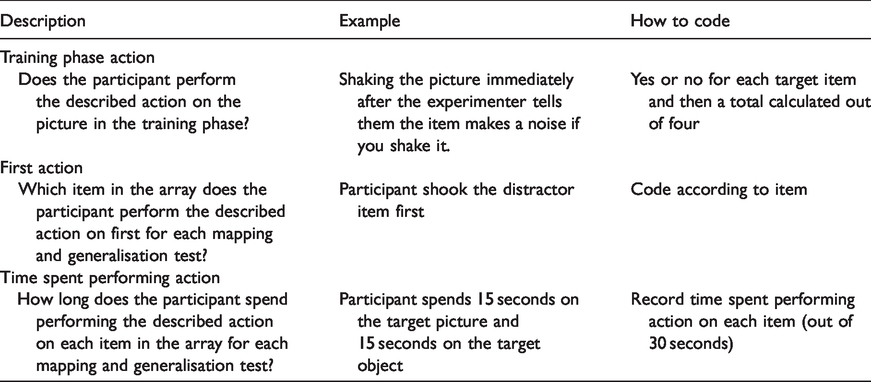
The description of the three response coding categories alongside an example and instructions how to code for each category.
Data analysis
We first analysed symbolic responding across the training phase and exploration phase (mapping test and generalisation test) for all four trials in terms of the three coding categories outlined in Table 2: training phase action (maximum total across trials = 4 points), first action in exploration phase for each mapping and generalisation test (maximum total across trials = 4 points for each) and the time spent performing the action on target object for each mapping and generalisation test (maximum 30 seconds total for each). Each dependent variable was analysed using two-way ANOVAs with group and condition as factors. We conducted a correlational analysis to examine whether participant characteristics (chronological age and receptive language score) were correlates of symbolic responding in this study.
Results
Training phase
The mean (M) standard deviation (SD) and range of the training phase action scores (out of four) split by group and condition.

Exploration phase
First action
The percentage of ‘first actions’ performed on each of the stimuli – Combined across the four trials for the mapping and generalisation tests.

ASC: Autism Spectrum Condition; TD: typically developing.
Mapping test
Whether participants performed the described action first on the target object did not differ between groups, F(1,60) = 0.77, p = .38, η2 = .01, or conditions, F(1,60) = 0.77, p = .38, η2 = .01. No significant interaction was found between group and condition, F(1,60) = 1.28, p = .26, η2 = .02.
Generalisation test
Whether participants performed the described action first on the target object did not differ between groups, F(1,60) = 1.16, p = .29, η2 = .02, or conditions, F(1,60) = 0.42, p = .52, η2 = .01. No significant interaction was found between group and condition, F(1,60) = 0.05, p = .83, η2 = .001.
Time spent performing the action
The percentage of time spent performing the described action on each of the stimuli – Combined across the four trials for the mapping and generalisation tests.
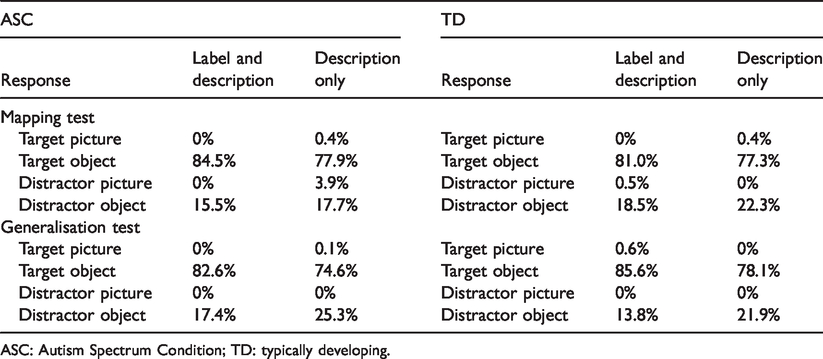
ASC: Autism Spectrum Condition; TD: typically developing.
Mapping test
There was no significant main effect of group, F(1,58) = 0.30, p = .59, η2 = .01, with a similar proportion of time spent performing the action on the target object across groups. Despite a higher proportion of time spent performing the action on the target object in the label and description condition compared to the description-only condition, we did not find a significant main effect of condition, F(1,58) = 1.82, p = .18, η2 = .03. No significant interaction was found between groups and conditions, F(1,58) = 0.14, p = .71, η2 = .002.
Generalisation test
There was no significant main effect of group, F(1,58) = 0.38, p = .54, η2 = .01, with a similar proportion of time spent performing the action on the target object across groups. Despite a higher proportion of time spent performing the action on the target object in the label and description condition compared to the description-only condition, there was no significant main effect of condition, F(1,58) = 2.10, p = .15, η2 = .04. The interaction between group and condition was not significant, F(1,58) = 0.03, p = .96, η2 < .001.
Correlates of performance
This section examined whether participant characteristics (age and receptive language score) were related to symbolic understanding (training phase action, first action and action time). Chronological age and receptive language score were not significantly correlated for the ASC group, r = .04, n = 32, p = .83, but they were significantly correlated for the TD group, r = .90, n = 32, p < . 001.
Training phase action
Children with ASC who had a poorer receptive language score performed the described action on the image in the training phase significantly more frequently than those with a greater receptive language score, r = –.37, n = 32, p = .04. In contrast, receptive language score did not significantly correlate with training phase action, r = .17, n = 32, p = .35, for the TD group. For both groups, age did not significantly correlate with training phase action: ASC group, r = .08, n = 32, p = .67; TD group, r = .20, n = 32, p = .28.
First action
For both groups, receptive language score was significantly positively correlated with performing the action first on the target object in the mapping test: ASC group, r = .41, n = 32, p = .02; TD group, r = .47, n = 32, p = .01, and the generalisation test: ASC group, r = .57, n = 32, p = .001; TD group, r = .52, n = 32, p = .002. For the TD group alone, age was significantly positively correlated with performing the action first on the target object in the mapping test, r = .46, n = 32, p = .01, and the generalisation test, r = .49, n = 32, p = .004, which is expected given the collinearity with receptive language score.
Time spent performing the action
For both groups, receptive language score was significantly positively correlated with the proportion of time spent performing the action on the target object in the mapping test: ASC group, r = .62, n = 30, p < .001; TD group, r = .58, n = 32, p = .001, and the generalisation test: ASC group, r = .47, n = 30, p = .01; TD group, r = .43, n = 32, p = .02. For the TD group alone, age was significantly positively correlated with the proportion of time spent performing the action on the target object in the mapping test, r = .65, n = 32, p < .001, and the generalisation test, r = .43, n = 32, p = .02.
Results summary
Overall, we found no significant difference between groups and conditions in terms of symbolic understanding in the training phase or the exploration phase. Receptive language score mediated performance for both groups.
Discussion
This study investigated symbolic understanding and dual representation in ASC with an object exploration task, allowing for spontaneous word–picture–referent mapping through free-play. We investigated whether symbolic understanding would differ when participants were provided with a novel label alongside a description of the object’s function (label and description condition) compared to when they were given a description of the object’s function without a label (description-only condition). We were also interested in whether symbolic understanding would differ between the ASC group and a receptive language-matched control group. Contrary to predictions, we found no difference between the ASC and TD groups in terms of symbolic understanding. In line with predictions, we found no difference between the labelled and unlabelled conditions for the ASC group; however, in contrast with previous research, this was also this case with the TD group. Moreover, we found that receptive language ability mediated performance for both groups. We discuss these findings in turn.
In contrast with our predictions, we found no difference between the groups in terms of performance. We found a high level of symbolic understanding across both groups, with approximately 79.6% of time spent performing the action on the target object across the mapping and generalisation tests. Overall, both groups demonstrated low levels of associative responding across conditions, with associative responding on approximately one out of four images in the training phase and less than 1% of time spent performing the action on the target picture in the exploration phase. Moreover, despite ASC and TD groups spending 7.3% and 5.6% more time respectively performing the action on the target object in the mapping and generalisation tests in the label and description condition compared to the description-only condition, this difference was not significant. This is in line with predictions for the ASC group; however, this contrasts with our hypothesis that the TD group would demonstrate greater symbolic responding when the target was labelled compared to when the target was unlabelled.
There are several possible explanations for the high levels of symbolic understanding found across groups and conditions in our study. First, it was necessary to match our groups on receptive language ability as opposed to age, consistent with previous research in this field (Field et al., 2016a; Tager-Flusberg, 1985; Tek et al., 2008). Therefore, our study used TD children of an older age than previous research in this area (Mage = 3 years 7 months), such as Preissler and Bloom (2007), who only tested two-year-olds. Indeed, age correlated with performance for our TD group, with older children demonstrating more successful word–picture–referent mapping than younger children. As TD children demonstrate reliable symbolic understanding between 24 and 30 months of age (Ganea et al., 2009), our older sample may explain the high performance of our control group.
Second, research to date investigating symbolic understanding have used word–picture–referent mapping tasks, asking the child to select the referent of a symbol from a forced-choice array. Such studies have found poorer word–picture–mapping in the ASC group compared to TD controls (Hartley & Allen, 2014b, 2015a, 2015b). However, forced-choice tasks such as this are highly controlled and arguably dissimilar from every-day spontaneous symbol mapping in the environment (Baumann, 1982), and often include a social element, with children being asked to ‘show’ the experimenter the target referent in the array (Hartley & Allen, 2015b). This may be an added complication for children with ASC, who often have difficulties with social interaction and reduced social motivation (Adamson et al., 2009, 2010, 2019; Neuhaus et al., 2019). With our free-play paradigm, which allowed for spontaneous symbol mapping based on function, children with ASC interacted with the stimuli in the same way as the control group. Therefore, it is possible that a spontaneous measure of symbolic understanding, such as our object exploration task, may reveal competencies in word–picture–referent mapping in ASC.
Third, previous research investigating the influence of labelling on word–picture–referent mapping used black and white line drawings as opposed to coloured photographs, providing a lower level of pictorial iconicity than the current study (Hartley & Allen, 2015b; Preissler & Bloom, 2007). Aside from labelling, more highly iconic (realistic) images have been found to aid the referential understanding of children with ASC (Hartley & Allen, 2015a) and young TD children (Ganea et al., 2008). Although the influence of iconicity lessens with age in typical development, children with ASC often continue to rely on a high level of realism when matching a symbol to a real-world object (Hartley & Allen, 2014b, 2015a). As our symbols had maximum transparency in terms of iconicity (Fuller et al., 1997), it is possible that this may have negated the influence of labelling in this study, with the coloured photographs providing sufficient benefit to symbolic processing (Wainwright et al., 2020). Future research could repeat our object exploration task with black and white symbols as opposed to coloured photographs to investigate whether labelling aids referential understanding of less iconic symbols, such as those used in Makaton sign language (Sheehy, 2005).
Receptive language ability was found to mediate performance for both groups. In the exploration phase, those with a higher BPVS score performed the action on the target object first more often than those with a lower BPVS score, also spending more overall time performing the action on the target object. In the ASC group alone, associative responding in the training phase was associated with a lower BPVS score. As this study required children to understand a verbal description of an object’s function and included novel labels, receptive language ability was a key skill in this task. In our TD control group, this finding may further be explained by the collinearity between receptive language and age, as older children scored more highly on the BPVS and older children have greater symbolic understanding than younger children (Ganea et al., 2009; Preissler & Carey, 2004; Suddendorf, 2003).
Limitations
In addition to the limitations outlined above, we here discuss the four most pertinent for future research. First, our children with ASC had a lower mean SCQ score by 10 points compared to previous research investigating word–picture–referent mapping (Allen et al., 2015), suggesting that our sample consists of higher-functioning participants than past studies. This could explain the low levels of associative responding in this study, with lower-functioning individuals with ASC considered to be more natural associative learners (Preissler, 2008). To investigate this, future research should compare the performance of ASC participants with differing ability levels (low vs high functioning) on the same methodology.
Second, although our study has a greater sample size and goes beyond the single-trial, forced-choice methodology of previous studies in this area (Hartley & Allen, 2015a, 2015b; Preissler, 2008), the relatively small sample size and limited number of trials may still not be generalisable to symbol learning at large (Wainwright et al., 2020). Moreover, despite participants demonstrating their symbolic understanding through spontaneous interaction and object exploration, the task was still dissimilar to everyday learning. In contrast to NDBI’s, this study was not conducted during the child’s daily routine and was performed within a controlled experimental setting with an unfamiliar adult (Schreibman et al., 2015). Therefore, future work should increase the generalisability of findings to real-world symbol learning by increasing the sample size and the number of trials. Moreover, future research could incorporate the task into the child’s everyday routine using the child’s own teacher to increase the generalisability of the results to real-world symbol learning.
Third, it is possible that a greater proportion of time spent performing the action on the target object is not indicative of symbolic understanding and is instead measuring a preference towards interactive objects. Children often prefer objects to pictures (Geraghty et al., 2014), especially interactive stimuli with multimedia features such as sound effects (Takacs et al., 2015). Although we found that a greater proportion of time was spent performing the action on the target object compared to the target picture for both groups, this may simply be indicative of higher engagement with objects compared to pictures. However, despite this, children spent on an average 19.1% of the time performing the action on the distractor objects across groups and conditions compared to 80.2% of the time performing action on the target objects. Therefore, this suggests that the time data in this study is not indicative of an object bias.
Finally, we only examined immediate word–picture–referent mapping in this study and did not examine how participants retained this information after a delay. Therefore, although we found a high level of immediate symbolic responding regardless of condition, we cannot examine how long-term retention/learning of a symbol was influenced by labelling. Future research should consider including follow-up sessions of the exploration phase at multiple time points using the same methodology to examine the retention of new symbol knowledge after a delay, potentially making the findings more generalisable to real-world symbol learning.
Conclusion
Overall, this study suggests that providing a novel label alongside a description of an object’s function does not influence the word–picture–referent mapping of children with ASC and a TD control group. Moreover, symbolic understanding does not differ between children with ASC and TD children on an object exploration task, with a high level of symbolic responding found across groups. Receptive language ability mediated symbolic understanding for both groups, as children had to understand the verbal descriptions of object function to be able to successfully complete the exploration phase. Taken together, our results suggest that a spontaneous measure of symbolic understanding (such as free-play) may reveal competencies in word–picture–referent mapping in ASC compared to traditional mapping tasks (Allen et al., 2015; Hartley & Allen, 2015a), and providing a high level of visual iconicity may mask the effect of labelling on symbolic understanding in typical development (Hartley & Allen, 2015b).
Footnotes
Notes
Declaration of conflicting interests
The author(s) declared no potential conflicts of interest with respect to the research, authorship, and/or publication of this article.
Ethical approval
All procedures performed in studies involving human participants were in accordance with the ethical standards of the institutional research committee (Lancaster University Faculty of Science and Technology Ethics Comittee, reference number: FST16071).
Funding
The author(s) disclosed receipt of the following financial support for the research, authorship, and/or publication of this article: This study is funded by the Leverhulme Trust Doctoral Scholarship Programme in Interdisciplinary Research on Infant Development.
Informed consent
Informed consent was obtained from all individual participants included in the study.
