




Abstract
Background and aims
Children’s early interactions with books are important for fostering development of oral language and emergent literacy skills. It is not known whether children diagnosed with autism spectrum disorder show different preferences for text types in the home environment prior to school entry. The current study aimed to: (i) investigate parent-reports of the favourite books of their children with autism spectrum disorder compared to typically developing children and (ii) identify whether there are differences in the reasons why books were preferred across the two groups.
Methods
Participants included children (aged 26–70 months) with autism spectrum disorder (n = 41) and typically developing peers (n = 164). Parent-reports of their child’s current favourite book/s were coded as fiction versus non-fiction and also category type. Parents also reported why the book was considered a favourite and this was coded.
Results
There were no differences between groups for fiction versus non-fiction, with both groups preferring fiction (>95% of responses). A strong category preference for animal topics across both groups was present. Significant group differences were found when asked to select specific reasons for favourite book preferences.
Conclusions
This study provides preliminary evidence of similarities between preschool children with autism spectrum disorder and typically developing peers’ preferences for fiction books during the early years.
Implications
It should not be assumed that children with autism spectrum disorder have different preferences for book types compared to typically developing children in the early years of development. Providing preschoolers with a range of book types during the preschool years will help to facilitate early language and emergent literacy skills.
Introduction
Autism spectrum disorder (ASD) is a neurodevelopmental condition characterised by social communication impairments and the presence of restricted and repetitive behaviours and interests (American Psychiatric Association, 2013). Children with ASD are at an increased risk for poor reading outcomes, with more than 50% of children with ASD demonstrating challenges in reading comprehension during the school years (e.g. Johnels, Carlsson, Norbury, Gillberg, & Miniscalco, 2019; Nation, Clarke, Wright, & Williams, 2006). However, literacy learning begins well before children commence formal schooling through their home literacy experiences, including their early interactions with print (Sénéchal, LeFevre, Thomas, & Daley, 1998). One of these key interactions is through shared book reading at home which has been shown to foster reading and oral language skills in typically-developing children (see meta-analysis, Bus, van Ijzendoorn, & Pellegrini, 1995). Although research has started to investigate shared book-reading practices with young children with ASD (e.g. Fleury, Miramontez, Hudson, & Schwartz, 2014; Fleury & Schwartz, 2017; Mucchetti, 2013; Westerveld, Paynter, & Wicks, 2019), to date, research has not investigated the types of books young preschool-age children with ASD prefer. The types of books children are exposed to, influence learning opportunities and is thus important to understand for this at-risk group. We aim to address this gap through exploring the book-reading choices of children with, and without, ASD prior to school entry.
Parent–child interactions are integral to the development of language and social communication skills (Bronfenbrenner, 1979). Shared book reading has been identified as a powerful context in which parents can foster children’s early language and literacy skills in the home environment (e.g. Justice & Kaderavek, 2002). However, a recent study conducted by Westerveld and van Bysterveldt (2017) with parents of children with ASD found that while shared book reading was part of many families’ routines, young children with ASD showed lower interest in shared book reading as an activity compared to their peers with Down syndrome. However, whether differences between children with ASD and other groups exist in their engagement with different types of books in the home environment, which could be further influencing their learning opportunities in the early years, has not been investigated.
There are theoretical reasons why children with ASD may show differences in their book preferences compared to typically developing peers making this a compelling area for further investigation. First, for children with ASD, difficulties in social communication may reduce their ability and motivation to engage in shared book-reading activities due to the social interaction and communication demands placed on the child and their parent during these print interactions (e.g. Fleury & Hugh, 2018). Second, restricted interests may predispose children with ASD to focus narrowly on specific topics or books and limit the children’s exposure to a range of book types in the home environment. Given the importance of home literacy experiences for promoting positive long-term outcomes, and these known difficulties for children with ASD which can influence early reading habits, one fruitful area for further consideration is whether children with ASD differ from children not on the spectrum in terms of their preferences in book types.
Exploring book preferences in children with ASD further warrants investigation due to the known delays and differences in Theory of Mind (ToM; i.e. understanding and reasoning about own and other’s mental states) development for individuals with ASD compared to typically developing peers (e.g. Baron-Cohen, 2000; Peterson, Wellman, & Lui, 2005). These skills rapidly develop during the preschool period in typical development with achievement of the litmus test of ToM, the false belief task, around the age of four years in typical development (Baron-Cohen, 2000). ToM has been shown to be fostered through shared book reading in both typical development and in ASD (Slaughter, Peterson, & Mackintosh, 2007). Furthermore, ToM has been shown to contribute unique variance in reading comprehension skills in adolescents with ASD (McIntyre et al., 2018; Ricketts et al., 2013). Thus, distinctive difficulties in ToM could influence book preferences for young children with ASD as difficulties with understanding story characters’ mental states may make fictional narrative books (i.e. goal-directed stories about characters) less appealing. Children with ASD may therefore show differences in book preferences to children who are typically developing due to social communication impairments associated with ToM impairments.
Several studies have investigated the book preferences of children without ASD (Boraks, Hoffman, & Bauer, 1997; Chapman et al., 2007; Mohr, 2006). Boraks et al. (1997) investigated patterns of book preferences in children from grades 3 to 5 (n = 315) by asking children to name their favourite book and to explain why it was their favourite. Children showed a developmental trend in book choices, moving from preferring picture books and fantasy towards realistic fiction by grade 5. However, it was not clear if the category of ‘picture books’ referred to fiction or non-fiction. The key reasons children identified for why they liked the book were similar across year levels and revolved around the story plot, characters, emotional impact, genre and author writing style. In samples of younger school-age children, Mohr (2006) and Chapman et al. (2007) investigated book preferences in first graders by providing the students with a selection of books from which to choose, and similar to Boraks and colleagues, participants were asked to explain why the book was selected as their preference. Mixed results were reported; Mohr (2006) found a strong preference for non-fiction books and books about animals in their sample (n = 190), whereas Chapman et al. (2007) found mixed preferences across gender for both fiction and non-fiction texts (n = 40). Similarities for why books were chosen emerged across the two studies including children reporting their choices were most commonly based on the topic, visual appeal/pictures and connectedness. Of note, unlike Boraks et al. (1997), in both of these later studies, researchers asked children to choose from researcher-selected texts, thus these studies did not capture the everyday choices children make from selections provided by families, schools and childcare, for example. Moreover, none of these studies investigated the book preferences of children prior to school entry and it is unknown whether these findings would generalise to children with ASD.
Only two studies have investigated book preferences in individuals with ASD (Barnes, 2012; Davidson & Ellis Weismer, 2018). Barnes (2012) investigated the reading preferences of 64 undergraduate students from the United States (ages 18–22 years) and 64 adults with a diagnosis of an ASD without intellectual impairment (from the United Kingdom, age not known). Participants were shown a sheet with short descriptions of four possible narratives and were asked to rank the narratives on a scale from 1 to 4, from ‘most like to read’ to ‘least like to read’. The undergraduate students preferred narratives about people (to those about objects), and there was no effect for fiction versus non-fiction narratives. A different trend emerged in the ASD group, with these adults showing no preferences for stories about people to those about objects. Furthermore, the adults with ASD demonstrated a significant preference for non-fiction (encyclopedia entry) over fiction. Despite the significant limitations identified in this study (i.e. different geographic locations and short experimenter-selected narrative descriptions, rather than more authentic reading materials), these results suggest a potential preference for non-fiction over fiction in adults with ASD.
Davidson and Ellis Weismer (2018) investigated the preferences for fiction versus non-fiction texts in children diagnosed with ASD (n = 19) compared to typically developing children (n = 21) aged 8–14 years. In this study, parents were asked to report their child’s favourite book, and responses were coded accordingly into ‘fiction’ or ‘non-fiction’. Results showed no significant difference across the groups for book type, and children in both groups preferred fiction to non-fiction books. This finding is in contrast to Barnes’ (2012) findings showing preference for non-fiction texts in adults with ASD. This difference could be attributed to methodological differences as Barnes (2012) provided the participants with set narrative options to make their choice, whereas Davidson and Ellis Weismer (2018) based their findings on book preferences from the home environment. In addition, age may be an influencing factor; with increasing age, children with ASD may be more drawn to non-fiction texts. Although the results of Davidson and Ellis Weismer’s study are indicative of what children with ASD as well as their typically developing peers choose to read in the home environment, there may be differences over time, and therefore investigating children’s preferences prior to starting school is important. Capturing the reasons why books were the child’s favourite were not explored by Davidson and Ellis Weismer (2018). Children with ASD may have different reasons based on their restricted interests, ToM differences or social challenges that impact on the reasons they consider books to be favourites compared to typically developing peers. Exploring potential differences in book type and category preferences, and the reasons for book preferences in children with ASD are important gaps addressed in the current study.
The current study aimed to answer the following two research questions: (1) are there parent-reported differences in book preferences between preschool-aged children with ASD and their peers with typical development? and (2) are there differences in parent-reported reasons for book preferences for children across the two groups? Based on the limited research to date (Davidson & Ellis Weismer, 2018), we predicted no group differences for story type (fiction versus non-fiction). In contrast, based on the known challenges many children on the spectrum show in ToM (impacting social interest), along with the potential impact of restricted/repetitive interests, we anticipated parent-reported differences between groups on the reasons why books were a favourite.
Method
Ethics approval for this project was granted by the respective Universities’ Human Ethics Committees (2017/720; 2019000145), and all parents/caregivers provided informed consent.
Participants
Participants (N = 424) were recruited for a larger home literacy project. Recruitment was via professional networks, social media and project partner websites (e.g. The Cooperative Research Centre for Living with Autism [Autism CRC], Autism Queensland, and Brisbane City Council Libraries. Inclusion criteria was living in Australia; child age of 26 months or older; and reported ASD diagnosis (ASD group) or a reported ‘no known diagnoses or conditions’ (henceforth, typically developing (TD)), thus excluding those with other diagnoses (n = 28). Exclusion criteria was families not residing in Australia at that time (n = 134) for consistency of context. Finally, to ensure similar age ranges, children younger than 26 months of age were excluded from the TD group (n = 57). The final sample included 205 parents/caregivers, including 41 with a child with ASD (aged 27–70 months; M = 49.44 months; SD = 13.07) and 164 with a TD child (aged 26–70 months; M = 47.01 months; SD = 11.35), with no significant differences across groups for age, t (203) = –1.19, p = .235, d = .20. Groups did not differ on English as an Additional Language or Dialect status, χ2(1) = 1.238, p = .266, ϕC = –.078. There was a significant difference between groups for gender, with a higher proportion of males in the ASD group compared to the TD group, χ2(1) = 5.926, p = .015, ϕC = –.171, consistent with ASD prevalence data (e.g. CDC, 2018). There was also a significant difference between groups for parental educational level, with parents of TD children reporting higher qualification levels, χ2(4) = 11.223, p = .024, ϕC = .234. Table 1 shows additional group characteristics of the final sample.
Demographic characteristics for ASD (n = 41) and typically developing (n = 164) groups (N = 205).
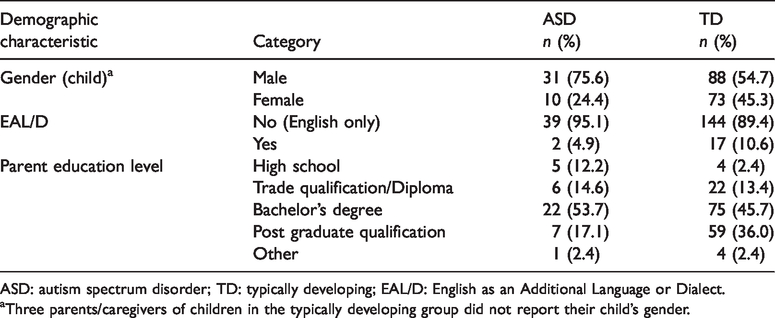
ASD: autism spectrum disorder; TD: typically developing; EAL/D: English as an Additional Language or Dialect.
aThree parents/caregivers of children in the typically developing group did not report their child’s gender.
Procedure
Participants completed an online questionnaire through SurveyMonkey adapted from Boudreau (2005). The key questions for this study were: (1) What are some of your child’s favourite books? and (2) Why do you consider those books to be your child’s favourite? Only the first two reported favourite book responses were included as only three parents of children in the ASD group (and none from the TD group) reported more than two books in their responses. Book titles were searched in a local public library catalogue, and information pertaining to the author of the book and the book type (fiction versus non-fiction) was retrieved from the Author, Subject and/or Genre fields. In line with previous research (e.g. Mohr, 2006), books were classified further into categories (e.g. animals). In collaboration with two librarians, categories were selected for classification and included animals, transport, people, classics, commercial, feelings, early learning (including numeracy and alphabet) and religion. Books that belonged across multiple categories were coded as ‘multiple’. For example, the book ‘Animal Train’ could appear within both ‘animals’ and ‘transport’ categories and therefore was coded as ‘multiple’ (first preference, n = 5; second preference, n = 8).
In line with Davidson and Ellis Weismer (2018), books classified as comics or Manga were coded as fiction. Parents who listed an author rather than a specific book, for example ‘Generally ones by Lynley Dodd’ were coded according to the category area that the author writes (ASD = 1). Furthermore, parents who listed a general topic rather than a specific book title were coded accordingly when it could be determined based on the topic whether the book related to fiction or non-fiction (ASD = 1; TD = 10). For example, ‘nursery rhyme books’ were coded as fiction, as regardless of book title, these books within this heading would always fall into the category of fiction. Parent responses that were too vague and the researchers were unable to confidently determine the type of book (fiction or non-fiction), for example ‘A book about dinosaurs’, were coded as missing. However, these books remained in the analysis for category type (e.g. animals, transport) when this could be determined (ASD = 6; TD = 13). Several other parent/caregiver responses had to be coded as missing or not available as follows: (1) parents who left the response to this question blank (ASD = 10; TD = 12); (2) parents who reported their child did not have a favourite book or that the favourite book changed constantly and thus a specific book title was not listed and could not be coded (ASD = 1; TD = 1); (3) book titles that were listed by parents but were unable to be located by the researchers, for example ‘Nik’ (ASD = 5; TD = 10).
After this data cleaning process was completed, the number of book preferences for the TD group available for analysis included: 149 first book preferences and 143 second book preferences. For the ASD group, numbers included: 31 first book preferences and 29 second book preferences.
For the second research question, ‘Why do you consider those books to be your child’s favourite?’, the following forced-choice options were provided to parents for completing this question: (1) pictures appeal to my child; (2) story appeals to me and/or my child (e.g. easy to understand, funny); (3) characters appeal to my child; (4) my child likes the feel of the book; (5) the book is linked to my child’s special interest; (6) other. Parents were allowed to select multiple options. If parents selected ‘other’, a comment box was provided, and parents were asked to describe other reasons for their child’s favourite book choice. These open-ended responses were then grouped by the researchers according to similar content areas and categories. The number of responses within each category were then tallied to identify the most frequent ‘other’ reasons reported by parents across the two groups.
Reliability
Approximately 20% of data were chosen at random and both first and second book preferences were independently rated by a second rater (author: JP). Inter-rater reliability was at acceptable levels with 95% agreement between the two raters for book preference one (Cohen’s Kappa = 0.78), and 88% for book preference two (Cohen’s Kappa = 0.53). The main differences between raters were for book titles that were ambiguous. For example, when determining whether the book ABC was fiction or non-fiction, one rater coded as ‘unable to locate’ due to the ambiguity of the book title and the other rated as ‘non-fiction’.
Data analysis
Chi-square statistics were conducted by book type with gender and parental educational level given systematic differences between groups. As all comparisons were non-significant (p > .05), these were consequently not controlled in analyses. All other analyses were run using Chi-square statistics, with Fisher’s exact tests conducted for all analyses with small cell sizes (<5). Cramer’s Phi effect sizes are reported for all Chi-square analysis, with values .10 indicating a small effect size, .30 a moderate effect and values greater than .50 a large effect (Cohen, 1988). Other reasons for child book choices given by parents were categorised into themes predominantly based on parent key words (e.g. ‘rhyming words’ or ‘rhythm and repetition’ categorised as rhyme) by the first author and reviewed by the second and third author with consensus across all codes.
Results
Overall preferences
The five most common reported books across the ASD and TD groups are shown in Table 2. The Gruffalo, Hairy Maclary and We’re Going on a Bear Hunt were reported in the top five for both groups. Both groups had a preference for books within an ‘animal’ category as based on the five most common reported book titles.
The most popular book titles (and author) reported by parents/caregivers in each diagnostic group for both first and second preferences.

ASD: autism spectrum disorder; F/NF: fiction/non-fiction; TD: typically developing.
Groups were first compared based on book preference type (fiction versus non-fiction), see Table 3. Fiction was almost unanimously (>95%) the first and second book preference across groups. There were no statistically significant differences between groups for book preference type for both the reported first preference, χ2(1) = .0017, p = .724, ϕC = –.003 and second preference, χ2(1) = .034, p = .617, ϕC = .013.
Parent-reported book preferences coded for type for children with autism spectrum disorder (ASD) and typically developing (TD) peers.

Different categories that were identified based on the reported first and second book preferences were compared across groups, see Figures 1 (first preference) and 2 (second preference). Across both groups, animal books were the preferred category accounting for 46% of first book preferences for both children with ASD and TD peers; and 32% of second book preferences for children with ASD compared to 39% TD children. A secondary analysis was subsequently completed to see if the preference for animal books compared to all other types of books was stronger for children with ASD compared to TD children. Due to small group sizes, all categories aside from ‘animals’ were collapsed to the one ‘non-animal’ category for this analysis. There was no significant difference between groups for preference for ‘animals’ versus ‘non-animal’ books, χ2(1) = 2.695, p = .101, ϕC = –.119.

Book categories for parent-reported first book preferences for their children on the spectrum and typically developing peers.

Book categories for parent-reported second book preferences for their children on the spectrum and typically developing peers.
Group comparisons were then conducted to compare the potential differences for the reasons parents reported around their child’s book preferences. A significantly higher proportion of parents of TD children reported that their child’s favourite book preferences were due to the pictures, the characters and the story, compared to children in the ASD group, see Table 4. However, there were no statistically significant differences between groups for the feel of the book or the book being linked to their child’s special interest.
Parent/caregiver reports for reasons surrounding child’s favourite book preferences for ASD and TD children.

ASD: autism spectrum disorder; TD: typically developing.
ap < .05.
Open-ended responses for parents who responded ‘other’ were evaluated. Five parents (12%) in the ASD group provided responses in this domain, including mentioning the repetition and rhythmical patterns of the book, the bright and basic pictures, and also their child’s familiarity and independence in reading the book. For the TD group, 44 parents (27%) provided responses relating to additional reasons for their child’s favourite book choices. Varying responses were provided, however, some common themes emerged, including the rhyme and repetition of the book (47% of ‘other’ responses), relating to other interests of the child (18% of ‘other’ responses), the interactive feature of the book such as pop up or animal noises (9% of ‘other’ responses) and also interest from older siblings (6% of ‘other’ responses).
Discussion
We investigated parent-reported book preferences of their preschool-age children with ASD compared to typically-developing peers. Both groups’ parents reported a preference for fiction over non-fiction texts. Moreover, animal books accounted for almost 50% of the reported first book preferences in both groups. Our findings of a preference for fiction over non-fiction are consistent with previous research into the book-preferences of school-age children with ASD (Davidson & Ellis Weismer, 2018), but differ from adult findings (Barnes, 2012). These differences in findings may be linked to the different methodologies used across studies. Consistent with Davidson and Ellis Weismer (2018), we focused on book preferences in the home environment, whereas Barnes (2012) provided participants with researcher-selected options. This may have led to situation-specific results, and it is unknown what books adults with ASD self-select. Alternatively, there may be developmental differences, with changes in preferences from fiction to non-fiction from childhood to adulthood in individuals with ASD. This developmental shift may link to ToM differences and the social understanding demands of fiction that increase with complexity of narratives over time. This increase in social complexity of fiction texts may outpace ToM development that is often delayed and shows differing developmental trajectories in ASD (e.g. Peterson et al., 2005), potentially resulting in changes to book preferences with age for this population.
Consistent with results from studies investigating book-preferences in TD young school-age children (Mohr, 2006), we found a strong preference for animal books, regardless of diagnosis. This high frequency of preference for animal books may reflect availability. However, in contrast to the current study, Mohr (2006) found stronger preferences for non-fiction to fiction texts in their sample. These contrasting findings may be due to methodological differences as Mohr (2006) provided students with forced choices to select from, and thus did not capture real-world reading habits in their sample. It is also possible that non-fiction texts with language and content suitable for younger children may be more difficult for parents to locate, or these types of texts may contain higher vocabulary levels and fewer pictures making these types of texts less appealing to parents and/or children. It is important to consider that, particularly in the early years, exposure to books/book types is often based on the recommendations of others, such as teachers, parents and siblings, and therefore the choices of those around them could motivate what students select and read (Mohr, 2006). It is thus plausible that parents may not offer non-fiction texts to their children, particularly during the preschool years, in the home environment.
In the current study, when asked why certain books were preferred by their children, group differences emerged. Parents of TD children were more likely to report the book was preferred due to pictures, characters or the story compared to the ASD group. This was consistent with findings by Chapman et al. (2007), who found that features such as visuals and topics appealed to their TD participants. Contrary to our expectations, children’s special interests did not significantly influence parents’ reasons for their child’s book preferences in this study.
Limitations and future directions
This is the first study investigating book preferences in children with ASD compared to TD peers prior to school entry. Due to the use of survey data, we could not confirm the ASD diagnosis of the participants and missing survey data resulted in smaller numbers available for analysis, particularly in the ASD group. While we asked those in the TD group to confirm no known conditions, we did not verify this and future research could be strengthened through the addition of a measure of autism symptoms to clearly differentiate groups. Future research should consider book preferences in children with confirmed diagnoses of ASD in larger samples across a wider age range to more accurately capture the developmental trends in book preferences of children in this population. With more specific information about the children’s level of adaptive functioning, including language and cognition, and also ToM, it would provide further understanding of how differences in each of these domains that are known to be affected in ASD may impact on book choices. Preliminary evidence from Davidson and Ellis Weismer (2018) has shown an association between children’s social communication abilities, but not oral language, and their preferences for fiction texts. Extending these findings to understand cognitive profiles across additional areas of functioning and how this relationship may change across developmental stages and levels of functioning in individuals with ASD is an avenue for further research.
In this study, book preference data were based on parent-report, rather than child report. Furthermore, while this study considered book preferences based on home environments, as opposed to researcher-selected choices, it is acknowledged that children’s home book choices may be influenced by the books made available by families/child environment (e.g. childcare). This preference for fiction texts may actually reflect what parents think children will enjoy (e.g. fiction), and thus make available within the home environment, but may conflict with what children may actually prefer if provided with more variety, such as non-fiction books as in Mohr’s (2006) study. Hence, it would be important to find out from parents what influences the books available in the home environment, particularly to understand whether parents purposively avoid exposure to non-fiction texts (and if so to understand the reasons why) or if indeed children prefer fictional stories in the early years. Furthermore, gathering more specific information about the book selection process in the home environment may inform whether the popularity of animal books is reflective of what is most available to young children or if these texts are purposively sought by parents due to other reasons. It is also important for further research to capture child preferences (based on their own reports) and to know the reasons why from children themselves. Understanding book preferences of children with ASD through their own self-report becomes increasingly important as children become older and receive more autonomy in their book selection through library borrowing.
Implications for practice
While preliminary in nature, two key implications are tentatively posed. First, clinicians and parents should not assume preschoolers with ASD will prefer non-fiction texts over fiction. Avoiding stereotyping based on diagnostic categories is important to foster literacy skills in children with ASD. Second, exposure to a range of book types in the early years should continue to be encouraged by professionals working with families of children at-risk of literacy difficulties, including children with ASD. By encouraging access to a wide range of texts that are appealing and motivating for young children, it ensures children are exposed to different story grammar models and can help foster development of understanding of story grammar structure, ToM and understanding of mental states, and later reading comprehension.
Summary and conclusion
Results from this preliminary investigation showed no parent-reported differences in the types of books that are preferred for preschool children with ASD compared with TD children. However, some differences emerged for why books were considered to be children’s favourites across the two groups. Exposure to different books (and book types) in the early years provides young children with access to a range of vocabulary important for later reading comprehension. While this study showed similar preferences in the home environment for book type, a better understanding of what drives family decision-making in shared book reading may be helpful for clinicians when providing suggestions for intervention to address early language and literacy skills for this population. Thus, continued emphasis on increasing our understanding of book preferences and fostering positive reading experiences in the early years for young people at-risk of poorer reading outcomes, such as children with ASD, remains important.
Footnotes
Declaration of conflicting interests
The author(s) declared no potential conflicts of interest with respect to the research, authorship, and/or publication of this article.
Funding
The author(s) disclosed receipt of the following financial support for the research, authorship, and/or publication of this article: The authors acknowledge the financial support of the Cooperative Research Centre for Living with Autism (Autism CRC), established and supported under the Australian Government’s Cooperative Research Centres Program.
