




Abstract
In this article, three differing approaches to faith representation will be presented. Sawai Chinnawong uses a traditional Thai art form, while Arnan Moontrakorn utilizes an amalgamated approach to Thai and Modern art. Jompol Puatawee, while using Thai imagery in his contemporary art style, does not reference traditional symbols. The artists featured, while all representing their Christian faith, do not use obvious Christian symbolism. As this article shows, Thai Christians can accept Thai traditional art as a useful medium for presenting Christian ideas, and these works of art are understood to have a Christian message.
Characteristics of traditional Thai approach
The style of the first artist discussed here, Sawai Chinnawong, uses Thai traditional images in his work. A highlight of this group of artwork is the detail the artist creates. Unlike Western artistic principles, the traditional Thai approach does not show correct anatomical structure, exact scaling, realistic lighting, or a combination of colors seen in nature. When transferring the image onto a wall, paper, or canvas, Thai traditional artists use tempera paints, acrylic paints, and lacquer-gilding techniques.
Sawai Chinnawong’s painting Creation (Figure 1) uses imagery more commonly seen in a Thai Buddhist temple. His use of real and imaginary flora and fauna gives the painting a surreal feel. Chinnawong, a Christian Thai artist and master of traditional Thai art, employs his preferred medium to illustrate Bible stories. For example, Chinnawong might paint Jesus in a unique way, depicting him as a normal person but dressed in a Thai traditional loincloth called a sarong.
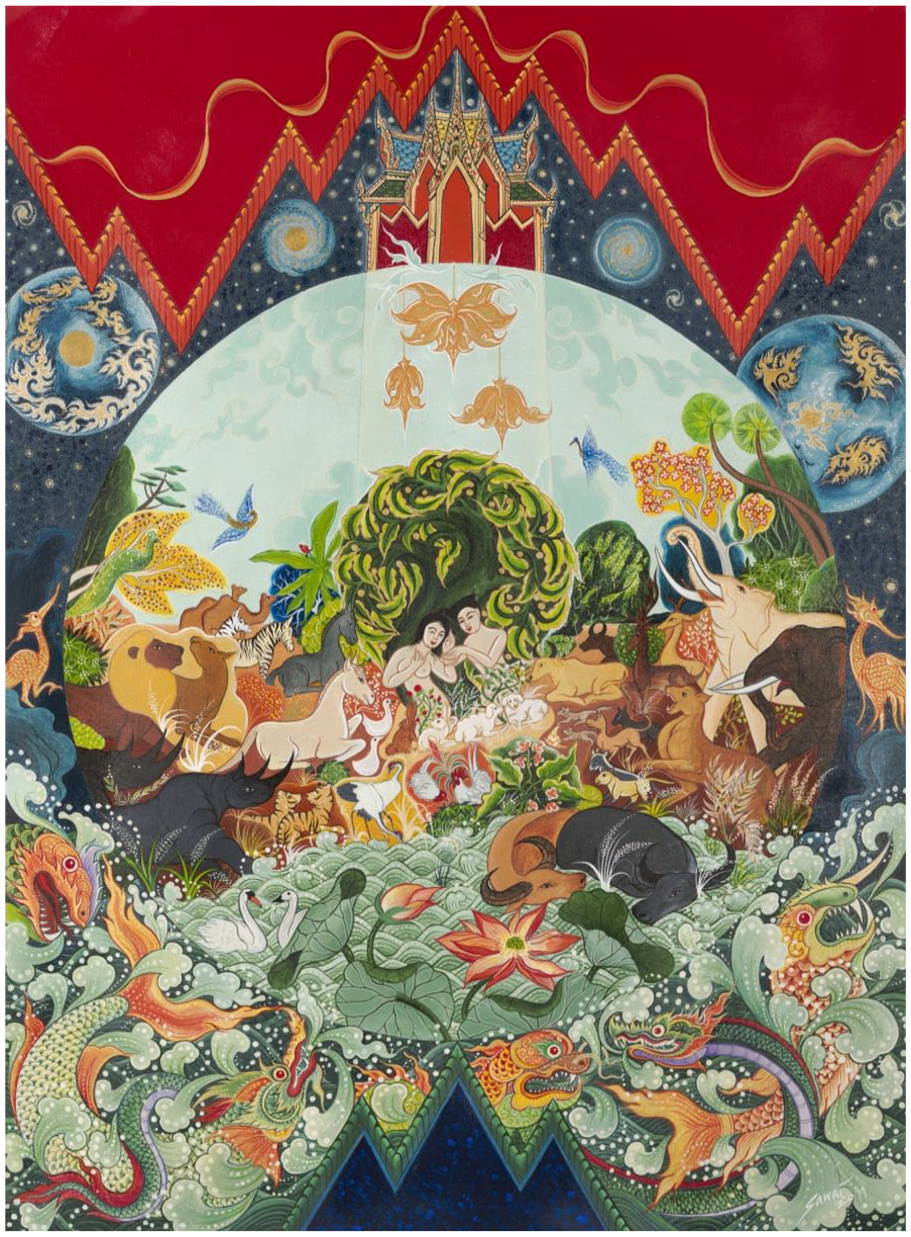
Sawai Chinnawong, Creation, 2011, acrylic on canvas, 80 × 100 cm. Reprinted with permission of the artist. (Note: The color paintings in this article are included in the online version.)
In Chinnawong’s Mother and Child (Figure 2), the common Christian image of the Madonna is here seen as a traditional Thai woman and child. He uses his traditional style to highlight a beautiful and traditional cloth called teen jok 1 used by women for special occasions, annual and traditional festivals. This clothing is worn by the mother in Mother and Child. It is handmade of cotton alternating with silk in a cross-body pattern. The pattern is ancient, having been used for generations. It is usually geometric, using diamonds, squares, and small, condensed patterns. The weave alternates these shapes by stacking and separating the layers with borders of small stripes. Bright and rich colors are used to add interest and contrast with the bright vermillion, rich ochre, and lighter colors scattered throughout.
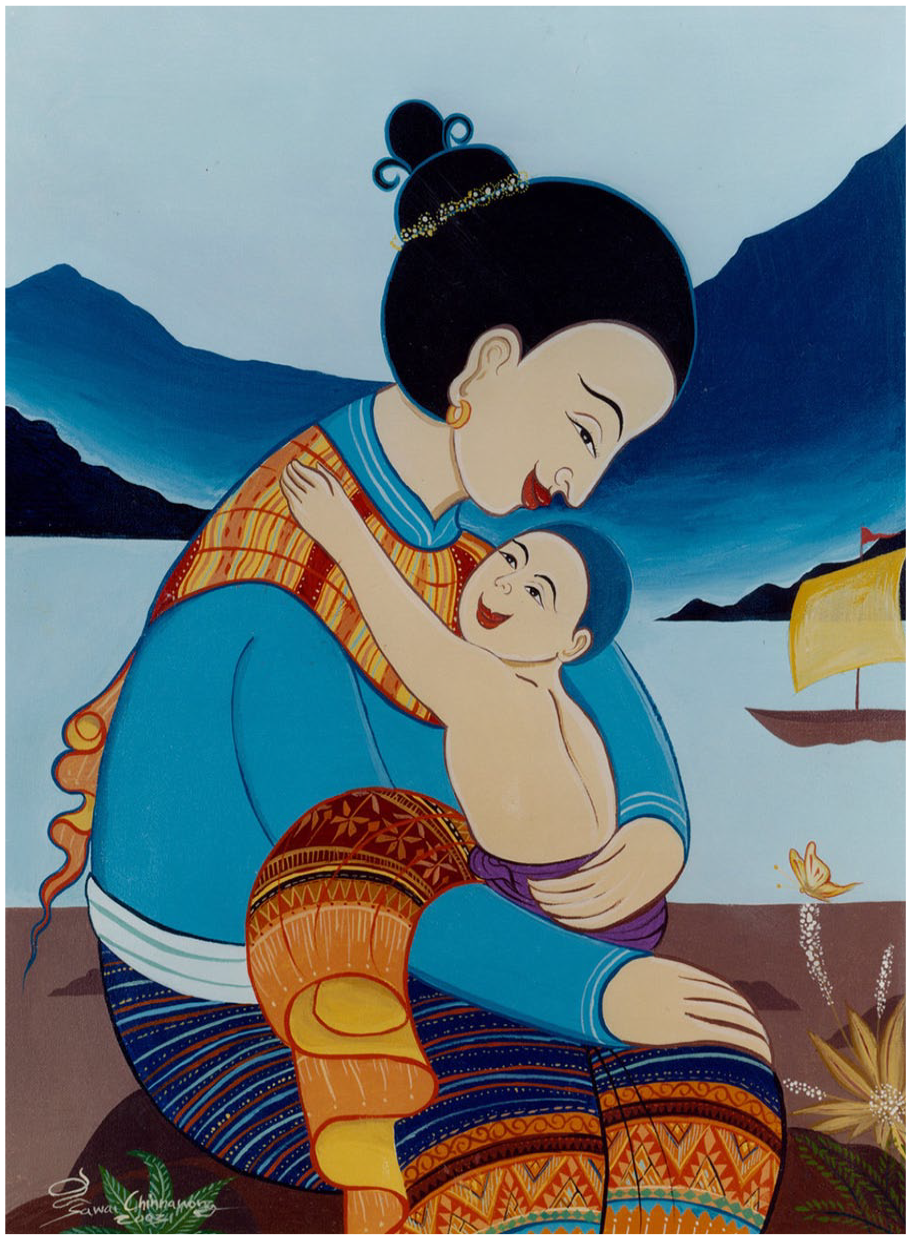
Sawai Chinnawong, Mother and Child, 2003, acrylic on canvas, 60 × 80 cm. Reprinted with permission of the artist.
Depiction of color combinations: The application of color in Thai traditional art is evident in many ways. Chinnawong enjoys using fresh and bright colors, which sets him apart from more traditional color traditions. In the early Ayutthaya period of Thai mural paintings, dating as far back as the fourteenth century, the main color was a monochromatic red cast that mixed vermilion and red earth. The reds were simply paired with black and white. Later, as a result of contacts with foreign countries, various colors were added, for example scarlet red and green from China, red clay from India and Persia, and blue from Europe.
The addition of these colors, initially traded from China, 2 resulted in the artisans incorporating landscapes, trees, mountains, rocks, and a variety of shading options into early paintings. Since Chinnawong is influenced by the early style of painting, he creates a magnificent effect by using dark tones in the lower portion, which draws the viewer’s eye to the lighter colors in the middle and upper portions or focal point of his paintings. The outline color that Chinnawong chooses to use in his painting of Mother and Child is one that is already a part of his painting. This technique gives exquisite beauty to the subject, since the outline color harmonizes rather than contrasts with the surrounding parts of the painting. In Creation, Chinnawong uses the color gold in reference to early Thai traditional art when painting the traditional Thai flower. These gold leaves emphasize the focal point and call to mind the historical tradition in Thai art that gold is only used when symbolizing special blessings from heaven.
Perspective: Chinnawong adopts the theme of nature found in Thai traditional paintings and uses color as a way to distinguish the layers of the background and the foreground. In the painting Creation, a smaller portion in the upper background and architecture uses a warm tone, while the vast sky, mountains, trees, rivers, oceans, fauna, and creatures are in cold tones of blue, beryl and verdant green. The perspective of color gives the viewer the impression that there is a separation between heaven and earth. The darkness of the color in the foreground draws the viewer’s attention to the light colors in the background.
In Mother and Child, Chinnawong adopts a Western perspective, giving the painting depth by placing the adoring mother in the center of the painting. While Thai traditional art does not have proportional measurements, the size of the subject painted stresses its importance. The larger the character the more importance it has. Likewise, the smaller the character the lesser importance it has in the painting. In this painting the mother and child clearly play the central role.
Space: Chinnawong uses lines to create rhythm and direction between identifiable shapes and empty space. The upper space of the painting shows few verifiable shapes, representing a clear atmosphere and producing in the viewer a sense of peace. The space in the lower part of the painting appears busier than the upper, possibly because it is pointing to the struggle of earthly living. There is very little unidentifiable space, which could give the viewer a sense of a tired person in need of rest. Visually, this space also shows the beautiful connection between humanity and everything else created by the Creator. The created beings are drawn into the eternal peace depicted in the space beyond them. The connection of shape and space shows a pattern of colors, which is a charming composition similar to Thai traditional painting.
Symbolic: It is undeniable that Chinnawong’s Christian beliefs are shown in the inclusion of foliage, fish, and butterflies while presenting Thai traditional characteristics in the creatures and vegetation. In Thai traditional paintings the lotus flower is an important aspect of Thai culture as well as a Buddhist symbol; so even though Chinnawong includes the lotus flower in his painting Creation, he does not draw attention to it. The artist symbolizes the imagery of heaven with the chapel, the earth is shown teeming with living creatures: elephant, buffalo, lotus, and other wildlife, and beneath the land with water and the creatures of the deep. This reflects the Christian concept that everything was created without any division between species. There was peace and harmony between the lion and the lamb, the human being and the snake. In Mother and Child, Chinnawong seeks to symbolize Mother Mary and Jesus from a Thai perspective. He shocked the Thai Christian audience by showing that Mother Mary does not have to look the same as the popular international image that immediately pops into one’s mind when thinking of “the Madonna.” Like a Thai mother embraces those whom she loves, Christianity similarly draws people into a life of love and acceptance.
Characteristics of an amalgamated approach to Thai and modern art
The second artist, Arnan Moontrakorn, creates work that is an amalgamation of Thai and Western art principles. He has been influenced by artists who have been academically trained in Western art composition using specific techniques of textures, color schemes, and principles. Moontrakorn has been celebrated for his excellence and skill. While he is a Christian, his aim is to communicate his personal perspective and understanding about God without using traditional Christian symbols, such as the cross, or other common representations of Jesus.
Instead, he combines new symbols in the context of his work to express Thai traditions and more globally understood elements that the audience must interpret. Moontrakorn uses Thai traditional overture in his art to tell stories from Scripture. His painting entitled No Oil (Figure 3) tries to appeal to an Asian audience by using traditional Asian clothing on Asian figures. The traditional cloth painted around the man’s waist as well as the person facing the audience are both unmistakably Asian. While Moontrakorn visually presents traditional Asian imagery, the viewer does not discern commonly understood images of Christianity.
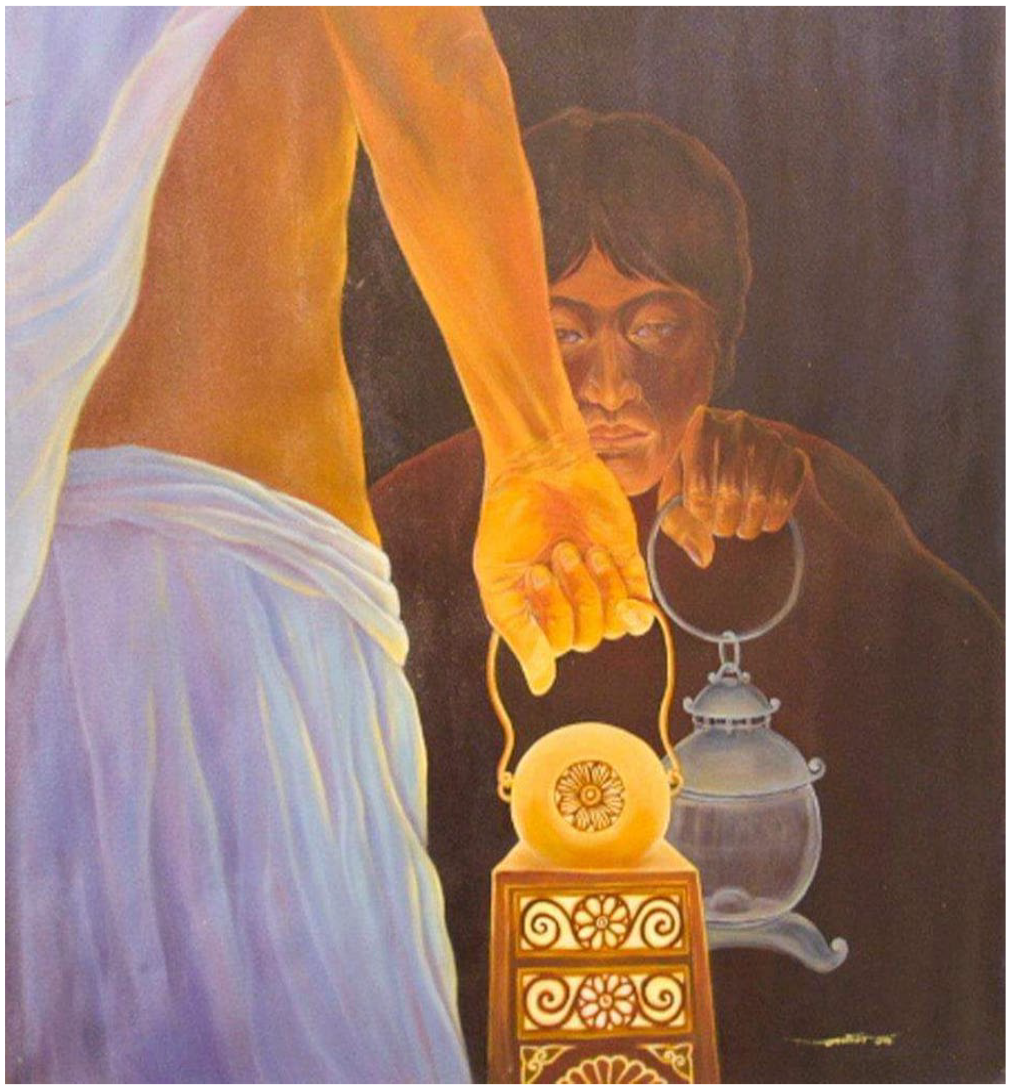
Arnan Moontrakorn, No Oil, 2012, acrylic on canvas, 75 × 70 cm. Reprinted with permission of the artist.
Depiction of color combinations: Moontrakorn’s No Oil uses a glistening warm tone. He keeps the brightest part of the painting as its main focus, whereas the background uses cool tones and dim colors connoting misery in the man in the background. The usage of highlights and low lights to indicate the story come from his modern art background. However, the specific colors evoke Thai art traditions. The saffron tones of the skin, to the Thai mindset, evoke a sense of sacredness. The background color has a striking contrast to that of the image Moontrakorn seeks to highlight. No Oil uses mainly monochromatic colors, utilizing three basic tones of burnt sienna, warm yellow, and white. The shimmering white feel of the loin cloth is achieved with subtle hints of blue and purple in order to draw attention to the yellow and saffron hues of the lamp and lamp bearer.
On That Day What If Adam Said (Figure 4) has a simple color scheme, but the difference between the foreground and background are seen through the separation of layers. The background, having a dark blue tone, differentiates it from the foreground, giving the entire painting depth. Moontrakorn chose not to lean heavily into contrasting colors to build “body” but instead used luminescent shades of three basic colors of permanent green, indigo, and cadmium orange. The colors chosen for the apple are unusual and perhaps indicate a fantastical or dream-like reimagining of the story of Adam and Eve.
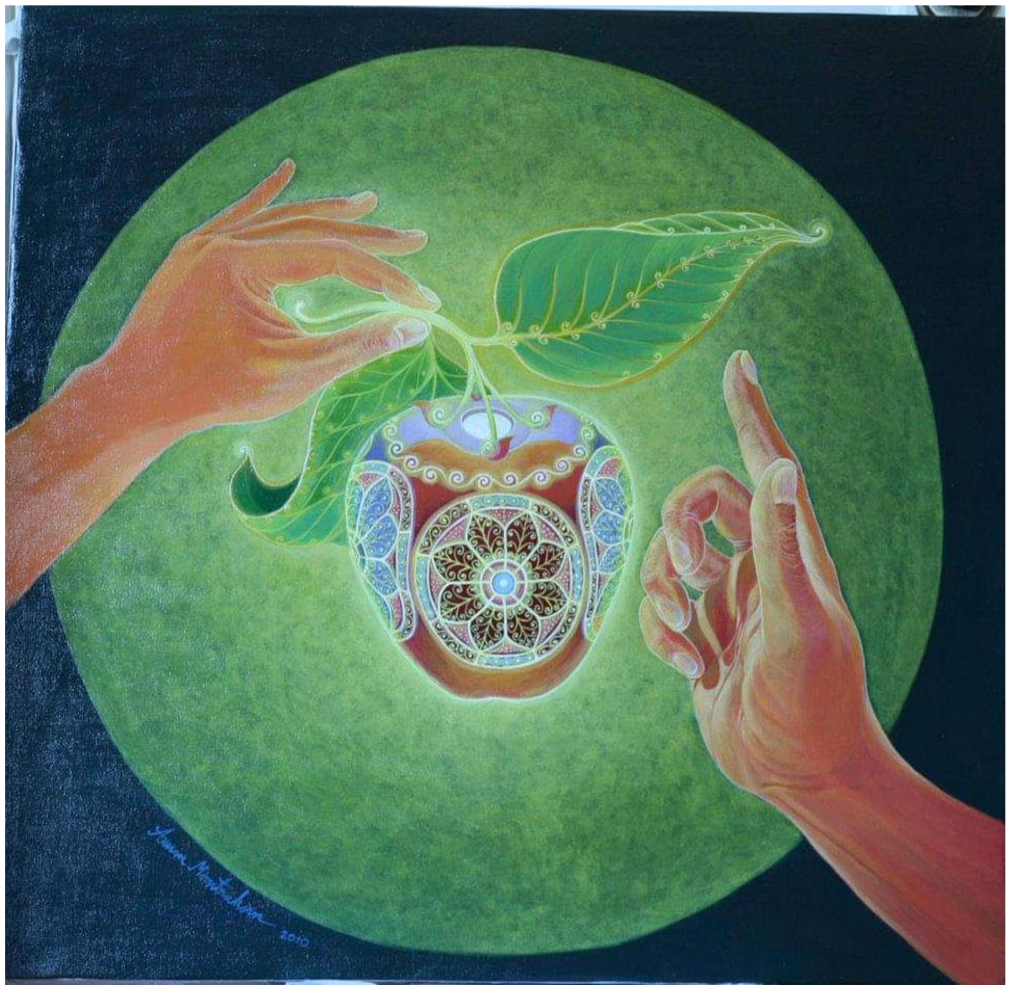
Arnan Moontrakorn, On That Day What If Adam Said, 2012, acrylic on canvas, 75 × 70 cm. Reprinted with permission of the artist.
Perspective: In general, Moontrakorn’s perspective in No Oil gives the figures an unfamiliar composition compared to the traditional Thai approach. Instead of painting the whole body he has cut off the bottom half of the figure in the background and the top half of the figure in the foreground. Arranging the features in the most central part of the painting gives added emphasis and draws the audience’s attention to this highlighted part. The layers of foreground and background help to emphasize the realism of the drawing, giving authentic likeness to both characters. The light illuminates the person in the foreground, giving the standing person importance, while the crouching individual is in the dimmer background.
Space: In No Oil, Moontrakorn creates what seems to be a great space between the image in the foreground and the image in the background. Through paint tones, he creates sharp edges to make a clear distinction between the two images. The gap between the two images is a place of beauty. The monochrome tones create distinction and yet connect the person in white with the meek one. He also extends the space and meaning of the painting by focusing almost uncomfortably on the hip and waist of the person in the foreground, and not completely “filling in” the details of the person whose face is visible. In On That Day What If Adam Said the painted texture of the blue and green spaces is similar but helps engage the viewer and draw their eye to the activity of the apple and the hands. He captures a small moment in time by extending the arms beyond the painting.
Symbolic: In Moontrakorn’s featured paintings of No Oil and On That Day What If Adam Said, he picks the international symbols of an apple and lamp to resemble and portray the stories in the Bible. His goal is to take the audience back to the early period when the gospel was preached. The archetypal motif that he uses to narrate the story allows the painting itself to tell the story without words. Another characteristic of Moontrakorn’s symbols is the use of ornamental designs combined with the dazzling colors on the apple and lamp, which cause the viewer to feel like they may be in a dream. These symbols are used to help interpret the story. The symbols bridge the chasm between the artists’s perception of the story and the viewer’s understanding.
Arnan Moontrakorn is a Christian artist who devotes himself to sharing the gospel discretely through his art. His intention is to encourage people to decipher biblical stories through his artwork. He is an academically trained artist who confesses that his highest achievement is receiving salvation through Jesus Christ. According to Moontrakorn, God has extended divine artistic inspiration to him daily through the light, life, and wellness that he then desires to communicate through the personal characteristics he brings to his work. His paintings focus on his personal interpretations of biblical stories. For example, No Oil is a telling of a parable of Jesus found in Matthew 25:1–13. An audience who does not know the parable and may not know the direct meaning will still understand the emptiness of life. The painting gives importance to the light that we, as humans, need. Moontrakorn paints the image of the one who stands with his back to the audience as Jesus. Jesus is the one who fills the lamp with light and gives fullness to the human’s empty life. Moontrakorn was raised as a Buddhist, but during his years at university he became a Christian. He then began painting as a Thai Christian artist and strives not to be tempted by fame and wealth that his skill could afford him. Instead, he stays focused on honoring God with his paintings.
Characteristics of Thai contemporary art
The third and final artist to be discussed here is Jompol Puatawee. The characteristics of his artwork do not identify its place, origin of circumstance, or context. His work is boundless, seamlessly meshing Thai and Western techniques and styles. While he is a Thai Christian artist, his expansive, contemporary outlook does not immediately cause the viewer to identify it as Christian art. His works relate to biblical narrative and there are Christian meanings behind each work of art, but these cannot be specifically identified. When researching for his master’s degree, he created art that portrayed human’s habitual essences in diverse settings, such as the living conditions of the impoverished—what looks to be a pile of rubbish in a cart, is a person’s habitat and valued possessions. Puatawee uses both real-life imagery collaged with textures and sometimes script to portray destitute situations and his own point and purpose.
Depiction of color combinations: The colors of Puatawee’s paintings are drab, as he uses hues of grey and chrome with a few tinges of magenta, navy, and burnt umber to illustrate a barren moment. He uses a dark background in contrast to the even darker colors used for the subject of the painting. Because of the dull colors and unattractive nature of his work, his paintings do not convey a direct message, nor do they encourage the viewer to pay detailed attention to his work.
Perspective: Puatawee’s one-point perspective is an artistic technique drawing the eye to focus on the middle of the painting. This one-point perspective gives the feeling of a three-dimensional illusion. In Treasure No. 12 (Figure 5) the scattered items in the background are used to give an impression of depth to the center of the painting, working with the focal point to draw the viewer’s attention to the middle.
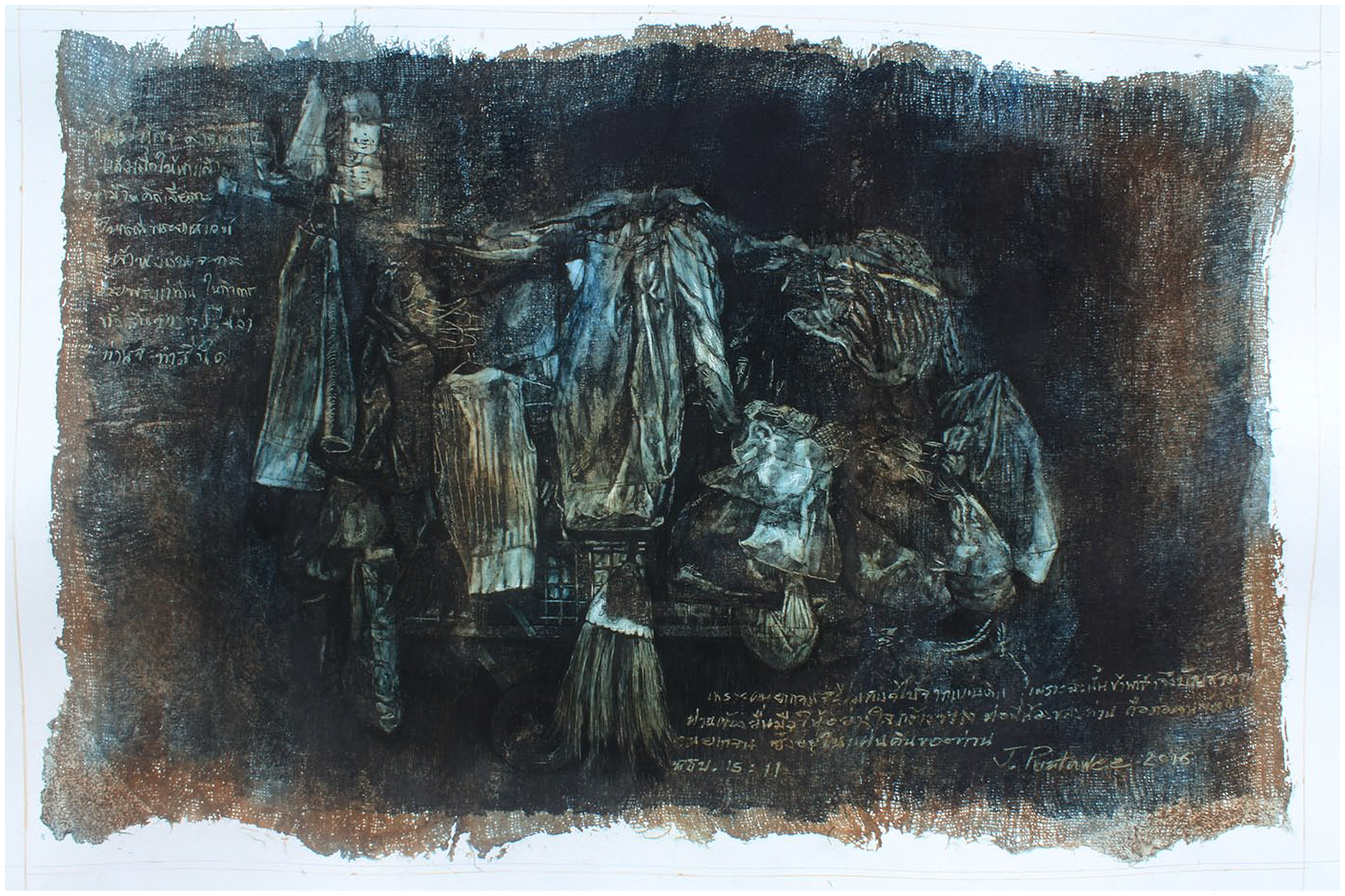
Jompol Puatawee, Treasure No. 12, 2016, tempera on paper, 36.7 × 57.6 cm. Reprinted with permission of the artist.
Space: In Treasure No.12 Puatawee showcases the Western academic theory of composition seeking to make the center the convergence point of the space and allowing the background to be an unspoken conversation. He has coordinated the patterned texture of the background with the content of the foreground. The dim background and dark space do not evoke feelings of life or transparency, and while this is not a negative attribute of the painting, it does make the space feel somewhat stifling.
Symbolic: In the painting A Home of Mine (Figure 6), Puatawee displays many items, including multi-purpose plain cloth, a clothes hanger, a blue plastic bag, a newspaper, a trolley, and many other items that are used to help the viewer meditate on the reality of an impoverished home for someone in a meager living situation. Puatawee uses the dilapidated appearance of the worn-out and unclean items on the trolley to project a seemingly lethargic theme.
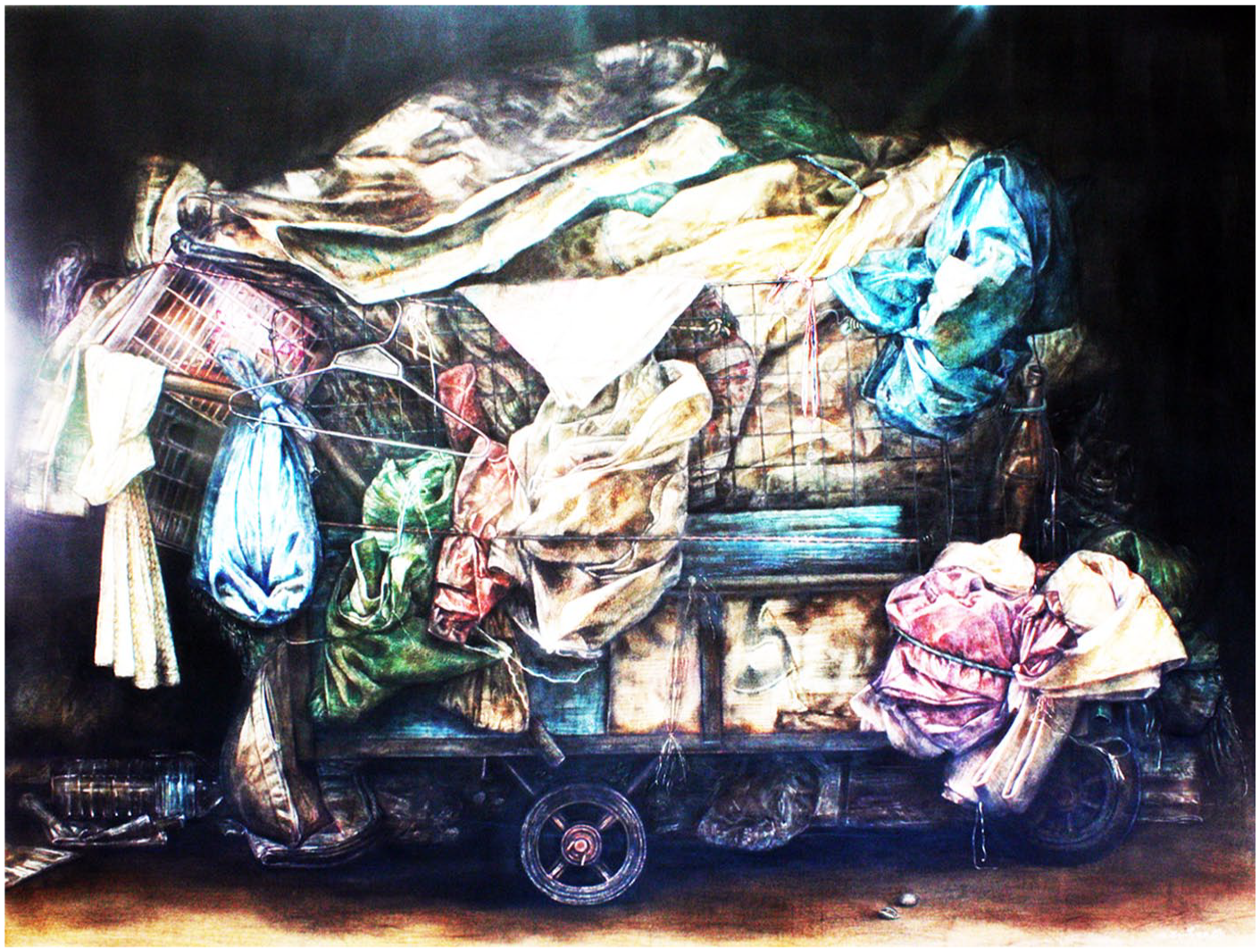
Jompol Puatawee, A Home of Mine, 2013, acrylic on canvas, 146 × 200 cm. Reprinted with permission of the artist.
Jompol Puatawee has shared about his joyful life living the mission of a Christian. After completing his master’s degree, he had the opportunity to produce professional artwork for an art gallery. He is a highly skilled artist; however, he eventually found a greater calling in becoming the pastor of a local Christian church in Chiang Mai, Thailand. He remembers that as a teenager he had the desire to make money but now seeks to stay away from the prideful ego, which a focus on money would bring to his life. As Puatawee studied for a master’s degree in fine arts, he began to see the sympathy God has for the underprivileged, which drew him to become a pastor. When realizing that God has a deep love for those who are unfortunate, he created a series of paintings, which included Treasure No. 12 and A Home of Mine. God’s love compelled him to create these works as he remembered the words from Proverbs 12:9 (NIV): “Better to be a nobody and yet have a servant than pretend to be somebody and have no food,” and Deuteronomy 15:11 (NIV): “There will always be poor people in the land. Therefore, I command you to be openhanded toward your fellow Israelites who are poor and needy in your land.”
Critical Christian thinking towards works of art
Scrutinizing these three Thai Christian artists and their specialized artwork helps to bring an understanding of their work to a broader audience beyond a Thai context. It may be fair to say that Thai people in their native context may not have noticed or even understood the driving force behind these Christian artists’ work. There may be controversy and misunderstanding as to why these artists feature characteristics of Thai traditional patterns, fused together with both Thai and modern approaches, or even use contemporary components in their artworks. Appreciating these works of art to a greater degree may require consideration of political, cultural, historical, and mainstream beliefs of Thai society, which certainly affects the work of these Christian artists.
This study identifies the characteristics of Chinnawong, Moontrakorn and Puatawee and seeks to understand some of their motivations and passions, and how they all use imagination and observation from nature to convey the meaning of life in their works.
Chinnawong’s personal affection for Thai traditional style and culture affirms and praises the exquisite beauty of Thai living chronicled in his work. His consistent use of Thai traditional symbols and patterns might bewilder those attached to long-established Christian doctrines. Yet, his work with its traditional imagery is accepted both locally and in expanding circles, adding to and influencing Christian art in international communities.
Moontrakorn integrates global images with Asian scenes to bring a unique perspective to the perception of Christian Thai art pieces. Both Chinnawong’s and Moontrakorn’s content portray messages that Christians ought to understand through the text of the Holy Bible. However, the lesser elements of Thai traditional patterns used by Moontrakorn are not an invitation to criticize his use of traditional biblical symbols, such as the cross or Jesus, which is a part of his intended Christian message. Additionally, Moontrakorn works toward an enthralling alternative, which is indicated by the captivating images he has personally chosen in his works of art.
Puatawee’s passionate, realistic painting portrays an indirect message of Christianity by showing God’s kindness. The painting’s appearance depicts poor and unattractive objects that have been chosen not because of their outward beauty but because of the importance they have to the One who chose them. God seeks and chooses those who have importance to him based on their desire for him. The inner need for God is more important than outward beauty. God’s kindness can be seen in Puatawee’s painting as a way of God extending his kingdom to those on the margins of society. Puatawee uses symbols of life, struggle, and movement to communicate that the way life is being lived in his painting may be different than expected, but there is beauty in the deeper and hidden meanings.
Studying the history of the Christian movement in Thailand, living among conservative Christians in a Thai context, as well as interviewing Christian artists in Chiang Mai, Thailand, has resulted in an expanded perspective of Christian artwork in the midst of Thai-style Buddhist society. This new perspective creates a greater understanding of the origins of the work of Thai Christian artists. It also gives pause for greater reflection on Thai society, which does in fact include a small Christian minority. At the same time, there are problems which add pressure to the Thai Christian artists and their works of art.
When we thoroughly study the factors that lead to the creation of these pieces of art, we may find that the artwork is able to enhance the coexistence of a Christian perspective in Thai society. Shedding light on the experiences and perspective of hidden minority differences enhances the intellect and aesthetic of the society, educating others through the artistic process. This can be seen in the way these featured artists blend Western art with Thai patterns, traditions, and customs.
Analyzing and comparing the big picture of both Christian and non-Christian artists in their thinking, work process, and production, it is apparent that truly they are not very different. The difference, in fact, comes down to a matter of personal beliefs that will then determine the content of the artwork. While highlighting the different perspectives of Christian artists, the passion in their work is not the same. Christian artists differ from non-Christian artists in that the inspiration and focus of the work spotlights Jesus and the meaning he has in their personal lives. The result of a Christian work of art may be seen in the way the theme or content is presented. Many times, it is dependent on the experience that an artist has had with God’s inspiration in their personal lives. Christian artists are blessed to serve God through their different abilities and by sharing central ideas of the Bible such as the Great Commission, to preach, and to love your neighbor as yourself. These themes are influential in determining the role of the artist to work in charity, music, and various media. Using Christian artworks as a medium for people to see the love of God is effective even when working on a poster featuring Christian work with a complex design but simple in composition and color. There is a need for people to see beautiful images representing biblical truths and Bible verses. Artists are not just creating works or holding on to an identity of a master product, but rather Christian artists can themselves be God’s masterpiece in place of the products. God created holy things and the things modeled in the world are complete in and of themselves. Christian artists can, therefore, reflect God’s creation as they are the original works of the world helping a wider audience understand in a creative way the truths found in scripture. Christians need to create with a sense of humility that they are not the original creator of anything, but mere imitators of a creative God.
The nature of God’s creation in each individual is represented differently depending on a person’s talents. From the mind of the artist these talents are used as blessings portrayed in the work of art, ultimately showing the love the artist has for the Creator God. Love is an important starting point of faith. For example, in Christian prayer, the pronunciation of prayers evokes the power of surrendering, seeking, and asking God. Working in the artistic realm with unbelievers is interactive and can be used as a relationship to show love to fellow human beings. Serving in the church in areas of art can likewise be used as blessings from God. Decorating the church during important festivals, bringing artistic talent to design, and creating publications to promote and encourage the Christian faith are all ways God uses art to bless the church. A direct correlation can be made when considering a Christian who has the talent to preach, a Christian who has the talent to serve through media, or the Christian who is talented in using a method of painting to present the truth of the teachings of Christianity. God has called and chosen Christian artists to use his talents to serve him. There is no boundary of time and place but using artistic talents in the present is a cause for rejoicing.
An artist’s general goal is to create a work and have his name credited to it. Contrary to artists who do not follow the Christian faith, the goal of Christian artists is that we, ourselves, are tools, and mediators, which God uses fully. God works in and through the artist, using the hands of the artist but credit goes to God. Experiencing growth in the production of Christian art has caused artists to be highly specialized in the way that God has provided. Honoring God in the work is the nature of the artist’s work. While the intended result of the art may be the same, the artist has achieved his goal when the artist gives credit to God and bestows on the viewer the ability and honor to recognize God, his creation, and his story in a new and fresh way.
Christian concepts from the New Testament teach the art of using respectful arguments against traditional customs. Outspoken criticism was the primary tool Jesus used to debate with the Pharisees who were a group of Jews in Jesus’ time who specialized in Jewish law and religion. It has become the custom of Christians of all ages to question whether orthodoxy suits the inner moral consciousness. Jesus placed more importance on the renewing of the inner mind than the perception of a righteous outside. This practice has become a guideline for improving not only various arts and sciences but addressing the Christian concept needed to influence political turmoil or even so far as the split between the Protestants and the Catholics. Internally holding true to the values of Jesus’ teachings allows practicing Christians who dedicate themselves to serving God in various fields become the foundation of culture. They live through the strength given to them by God to break out of pragmatism embedded in tradition and forge a new path.
The transformation a life goes through in both cultural and traditional frameworks in order to accomplish the spiritual mission of bringing the Christian belief to different sectors of the world is made through the sacrifice of personal identities. This sacrifice allows the Christian practice in the context of other cultures to become a guide to the next generation of believers. Christians see an example of this in the life of the Apostle Paul whose life was radically transformed from identifying with those who persecuted Christians to being a devout Christ follower. With examples such as these, the conceptual space of Christianity is thus open and free to create good things. Christianity in its pure essence is full of generosity. It blends with different local cultures in order to bring awareness to the truth but should not lose its identity. In this way, it is the author’s opinion that Western art styles have created more space for a versatility of messages than traditional Thai art on its own. Christianity in art allows other cultures to borrow and even incorporate its valuable concepts. It represents that “to give is better than to receive” (Acts 20:35b). And this is an expression of love and sacrifice found within the art.
Footnotes
Funding
This research is supported by Chiang Mai University’s Junior Research Fellowship Program 2021 and is a part of “A Study on Art Practice for Christianity in Chiang Mai.”
Notes
Author biography