




Abstract
This article marks the 40th year of including statistical information on World Christianity and mission in the I
Keywords
In 1985 David B. Barrett produced the first statistical table in this series in the January issue of the I
This article represents the 40th year of providing annual statistics in the I
The twentieth century witnessed a concerted effort to address divisions among Christians. One important gathering for Protestants (including Anglicans) was the 1910 World Missionary Conference in Edinburgh, Scotland. The meeting was intended to bring together Christians to plan for the evangelization of the world. While this did not include Roman Catholics or Orthodox, it did attract Protestants from a number of denominations. Although missionary in focus, the Edinburgh meeting was part of a sequence of international and interdenominational meetings dating to at least 1854. 2 However, the makeup of its attendees would not be considered either international or ecumenical by modern-day standards. Its 1,215 delegates included 509 British, 491 North Americans, 169 from continental Europe, 27 from the White colonies in South Africa and Australasia, and 19 from the “majority” world.
No women were invited as formal delegates even though they made up an estimated two-thirds of all Western missionaries. 3 In fact, Edinburgh 1910 contributed to the decline of Western women’s participation in overseas missions in the twentieth century by encouraging (or demanding) the merger of autonomous women-run missionary societies with general denominational sending boards. 4 Nevertheless, three important ecumenical efforts emerged from Edinburgh 1910: (1) Life and Work, concerned with fostering a common Christian response to war, poverty, and oppression; (2) Faith and Order, addressing disagreements over doctrine, sacraments, and church authority; and (3) Missions, expressed in the formation of the International Missionary Council (IMC), which promoted a more cooperative approach to evangelism. Each of these streams convened a series of meetings throughout the twentieth century.
World Council of Churches
Christian ecumenical optimism from Edinburgh 1910 had been utterly dashed by world war, where “Christian nations” engaged in brutal warfare, damaging Christian mission and any claims of Western moral superiority. In 1920, J. H. Oldham, organizing secretary of Edinburgh 1910 and secretary of its continuation committee, sent a letter requesting a meeting of leaders to coordinate international Christian mission efforts. At the same time, Ecumenical Patriarchate of the Church of Constantinople (one of the 14 jurisdictions of the Eastern Orthodox Church) sent a letter to “all the churches of Christ everywhere” for the formation of a “league of churches.” The intent was to create a council of churches that could speak not only to each other, but also to the world.
Life and Work and Faith and Order merged to form the World Council of Churches (WCC) in 1948. The IMC joined the WCC in 1961. By the year 2000, the WCC had grown to over 350 member churches representing roughly 500 million Christians. Creation of the WCC encouraged churches in nearly every country to dialogue in and among national church councils. Its headquarters are in Geneva, Switzerland, just down the road from the United Nations, the World Health Organization (WHO), and many other international organizations. The WCC meets approximately every seven to eight years in a general assembly in different parts of the world. Recent assemblies include Harare, Zimbabwe (1998); Porto Alegro, Brazil (2006); and Busan, South Korea (2013). The 11th General Assembly took place in Karlsruhe, Germany, in 2022 under the theme “Christ’s love moves the world to reconciliation and unity.” The WCC engages in global work related to environmental and gender justice, support of marginalized Christian communities worldwide, and promoting human dignity.
World Evangelical Alliance
Efforts to bring together Evangelicals from around the world were underway as early as the mid-nineteenth century. But while attempts at an international fellowship floundered, national Evangelical alliances were formed in many countries, setting the stage for a new umbrella organization. In 1948, not so coincidentally in the same year as the founding of the WCC, many Evangelicals began to feel a renewed sense of the need for an international body that focused on what they understood as “traditional” Christian values and theology, especially world mission. In 1951, the World Evangelical Fellowship (WEF) was founded. Its first two co-secretaries, Roy Cattell (England) and J. Elwin Wright (USA), were tasked with travelling around the world to visit national fellowships to help unite Evangelicals on common causes. Soon a pattern of holding General Committees (later Assemblies) every six years or so was established. The WEF faced many financial and leadership challenges and in 2001, at a General Assembly in Kuala Lumpur, Malaysia, changed its name to the World Evangelical Alliance (WEA). Today, the WEA is active in 129 countries and gives voice to over 600 million Evangelicals around the world. 5
Lausanne Movement
In 1974, American evangelist Billy Graham called for an International Congress on World Evangelization to be held in Lausanne, Switzerland. 6 In July 1974 some 2,700 participants and guests from over 150 nations gathered for ten days of discussion, fellowship, worship, and prayer. Given the range of nationalities, ethnicities, ages, occupations, and church affiliations, Time magazine described it as “a formidable forum, possibly the widest-ranging meeting of Christians ever held.” 7 Speakers included some of the world’s most respected Evangelical Christian thinkers of the time, including Samuel Escobar, Francis Schaeffer, Carl Henry, and John Stott. The second major congress, known as Lausanne II (Manila, Philippines, July 1989), drew 3,000 participants from 170 countries including Eastern Europe and the Soviet Union, but unfortunately, not China because of the political situation. Lausanne II produced the Manila Manifesto, 8 a statement of 31 clauses elaborated on in the Lausanne Covenant. The Third Lausanne Congress on World Evangelization was held in Cape Town, South Africa, in October 2010. Roughly 4,000 leaders from 198 countries attended as participants; thousands more observers took part in seminaries, universities, churches, and through mission agencies and radio networks globally as part of the Cape Town GlobaLink. The fourth conference is planned for September 2024, to be held in Seoul, South Korea.
World Pentecostal Fellowship
Another important global body is the World Pentecostal Fellowship, founded in 1947 in Zürich, Switzerland. 9 Pentecostals are distinct from Evangelicals although many attend Evangelical meetings. The modern Pentecostal Movement “began” at the end of the nineteenth century in a series of revivals around the world, including in South India (1861), Topeka, Kansas (1895), Wales (1904–1905), Bombay, India (1905), and Pyongyang (1907–1908). Women have always been prominent in Pentecostal revivals and leadership, such as Phoebe Palmer (USA), Pandita Ramabai (India), and Jashil Choi (South Korea). Perhaps the most prominent historical revival was that on Azusa Street in Los Angeles in 1906, to which many large Pentecostal denominations, both in the USA and elsewhere, trace their origins.
While these are often considered the Pentecostals, there are two other significantly larger movements in the overall Pentecostal-Charismatic world. A second type, often referred to as the Charismatic movement, is found among mainline churches in which an emphasis on the gifts of the Holy Spirit has taken root—impacting Roman Catholics, Lutherans, Presbyterians, and many others. The third type involves movements that arose independently of Azusa Street or the mainline denominations. These include African Independent (or Initiated) Churches, Chinese house churches, and charismatic megachurches. These are usually referred to as Independent Charismatics. Together, these three types constitute the whole of the Pentecostal-Charismatic movement—today nearly 700 million Christians identify with this wider movement (Table 3).
Empowered21
Over 10,000 Christians gathered in Los Angeles for a centennial meeting on the 100th anniversary of the Azusa Street Revival in 2006. Leading pastors and evangelists from many different Pentecostal streams reported on the progress, obstacles, and future vision of Full Gospel preaching and church planting around the world. The leaders called for a second large conference that they named Empowered21, first held in Tulsa, Oklahoma, at Oral Roberts University in 2010. 10 Today, Empowered21 spans the globe through twelve regional cabinets. Each cabinet focuses on pursuing initiatives and events in their area of the world to address the future of Spirit-empowered Christianity. As a global movement it aims to:
Promote the empowerment of the Holy Spirit on all believers and the empowerment of the generations to serve God.
Unite the Spirit-filled movement together in intergenerational gatherings for the purpose of seeking a fresh outpouring of the Holy Spirit in the twenty-first century.
Focus the energy and resources of the Spirit-empowered church on the harvest and challenges before us.
Provide a platform for addressing the critical issues facing the Spirit-empowered church in the twenty-first century.
Discover contemporary methods, vocabulary and ministry grace needed for engaging every generation in Spirit-empowered living.
Witness greater convergence and collaboration of Spirit-empowered ministries.
Empowered21 recently hosted a conference in Amsterdam with over 5,000 participants from 125 countries. The theme was EveryONE: a vision is for everyone on Earth to have an authentic encounter with Jesus Christ through the power and presence of the Holy Spirit by Pentecost 2033.
Global Christian Forum
The World Council of Churches, World Evangelical Alliance, World Pentecostal Fellowship, and Empowered21 have made important contributions to interchurch dialogue and reconciliation within each of their respective traditions. However, each of these largely operated in silos from one other—until the founding of the Global Christian Forum (GCF). 11 The GCF arose out of the World Council of Churches 8th General Assembly in Harare, Zimbabwe, in 1998, and then became autonomous. Konrad Raiser, General Secretary from 1993 to 2003, outlined the challenge facing the WCC, stating that World Christianity could be divided into four main families—Catholic, historic Protestant, Evangelical/Pentecostal, and Orthodox. The WCC’s membership comprised, for the most part, of churches belonging to only two of those families—historic Protestant and Orthodox. Consequently, a new “ecumenical space” was needed to draw together leaders from the full breadth of World Christianity to establish a place of ongoing relationships, fellowship, and interchange. After a series of exploratory meetings, a draft purpose statement was developed in 2002 that included this description of the Global Christian Forum’s intent: “To create an open space wherein representatives from a broad range of Christian churches and interchurch organizations, which confess the triune God and Jesus Christ as perfect in His divinity and humanity, can gather together to foster mutual respect, to explore and to address common challenges.” 12
Regional consultations laid the groundwork for the first world gathering of the Global Christian Forum, held in Limuru, Kenya, in 2007. About half of the 240 Christian leaders gathered were Pentecostal or Evangelical, two traditions historically outside of the mainline Christian ecumenical movement in the twentieth century. Nearly 300 gathered from 65 countries in Manado, Indonesia, in October 2011 for a second meeting to explore the theme “Life Together in Jesus Christ, Empowered by the Holy Spirit.” Again, half were from Pentecostal and Evangelical backgrounds, with the others from Orthodox, historic Protestant, and Catholic churches, as well as other ecumenical organizations. The Pentecostal World Fellowship, the World Council of Churches, the World Evangelical Alliance, and the Pontifical Council for Promoting Christian Unity at the Vatican are the four key organizations—called the four pillars—now jointly supporting the Global Christian Forum. Nearly all the Christian world communions, such as the Lutheran World Federation, the Mennonite World Conference, the World Communion of Reformed Churches, the Organization of African Instituted Churches, and several others offer support in tangible ways. Global ecumenical leader Wesley Granberg-Michaelson comments,
Three words can best describe the space and style that have emerged in the process of the Global Christian Forum: testimonial, relational, and missional. From its first exploratory meetings in Bossey [WCC seminary in Geneva] and Fuller Seminary [Evangelical seminary in California], those who gathered decided to begin by sharing with each other the stories of their journeys of faith in Christ. This simple exercise established a starting point of trust rather than division.
13
The Global Christian Forum provides a place for Christians from many diverse traditions to fellowship and to learn from each other. Under the leadership of Ghanaian Methodist minister Casely Essamuah, the next conference is planned for Accra, Ghana, in April 2024.
What is the impact of these umbrella organizations? They offer a place for Christians of various backgrounds to meet, to share, to fellowship, and, sometimes, to plan. They provide an invaluable service to all Christians by recognizing commonalities while valuing difference. They also represent strategies to address fragmentation in the churches with the ongoing theme of unity in diversity and the desire that “They all may be one.”
Global Population, Global Cities, and Urban Mission, 1900–2050.
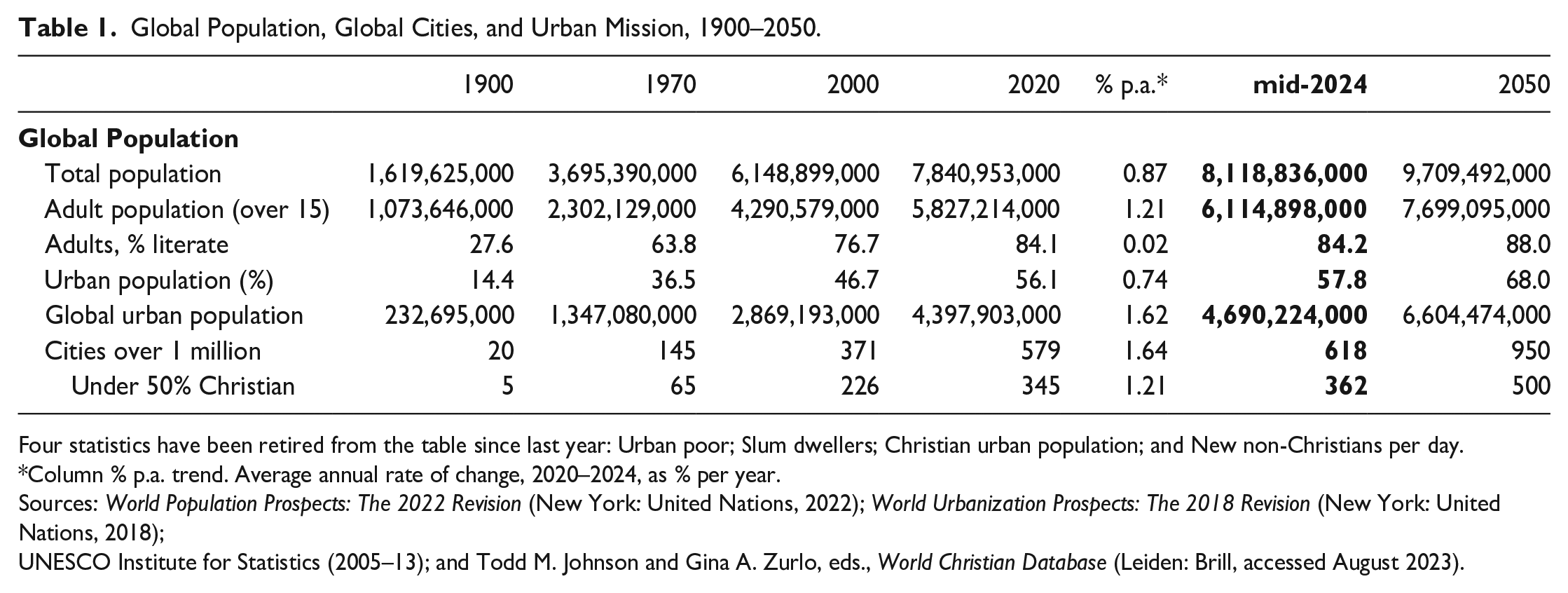
Four statistics have been retired from the table since last year: Urban poor; Slum dwellers; Christian urban population; and New non-Christians per day.
Column % p.a. trend. Average annual rate of change, 2020–2024, as % per year.
Sources: World Population Prospects: The 2022 Revision (New York: United Nations, 2022); World Urbanization Prospects: The 2018 Revision (New York: United Nations, 2018);
UNESCO Institute for Statistics (2005–13); and Todd M. Johnson and Gina A. Zurlo, eds., World Christian Database (Leiden: Brill, accessed August 2023).
Global Religion, 1900–2050.
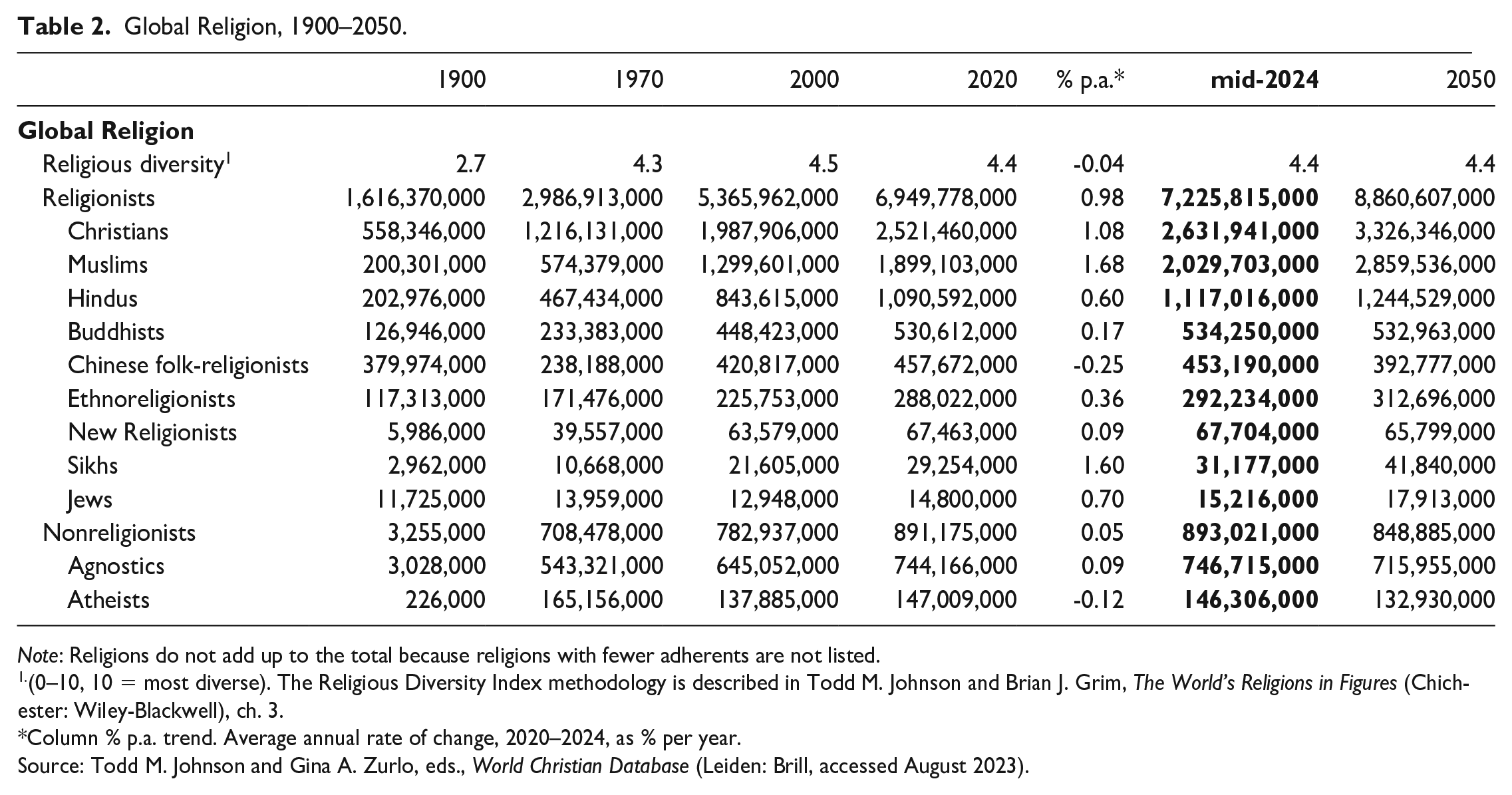
Note: Religions do not add up to the total because religions with fewer adherents are not listed.
(0–10, 10 = most diverse). The Religious Diversity Index methodology is described in Todd M. Johnson and Brian J. Grim, The World’s Religions in Figures (Chichester: Wiley-Blackwell), ch. 3.
Column % p.a. trend. Average annual rate of change, 2020–2024, as % per year.
Source: Todd M. Johnson and Gina A. Zurlo, eds., World Christian Database (Leiden: Brill, accessed August 2023).
Global Christianity by Tradition, 1900–2050.
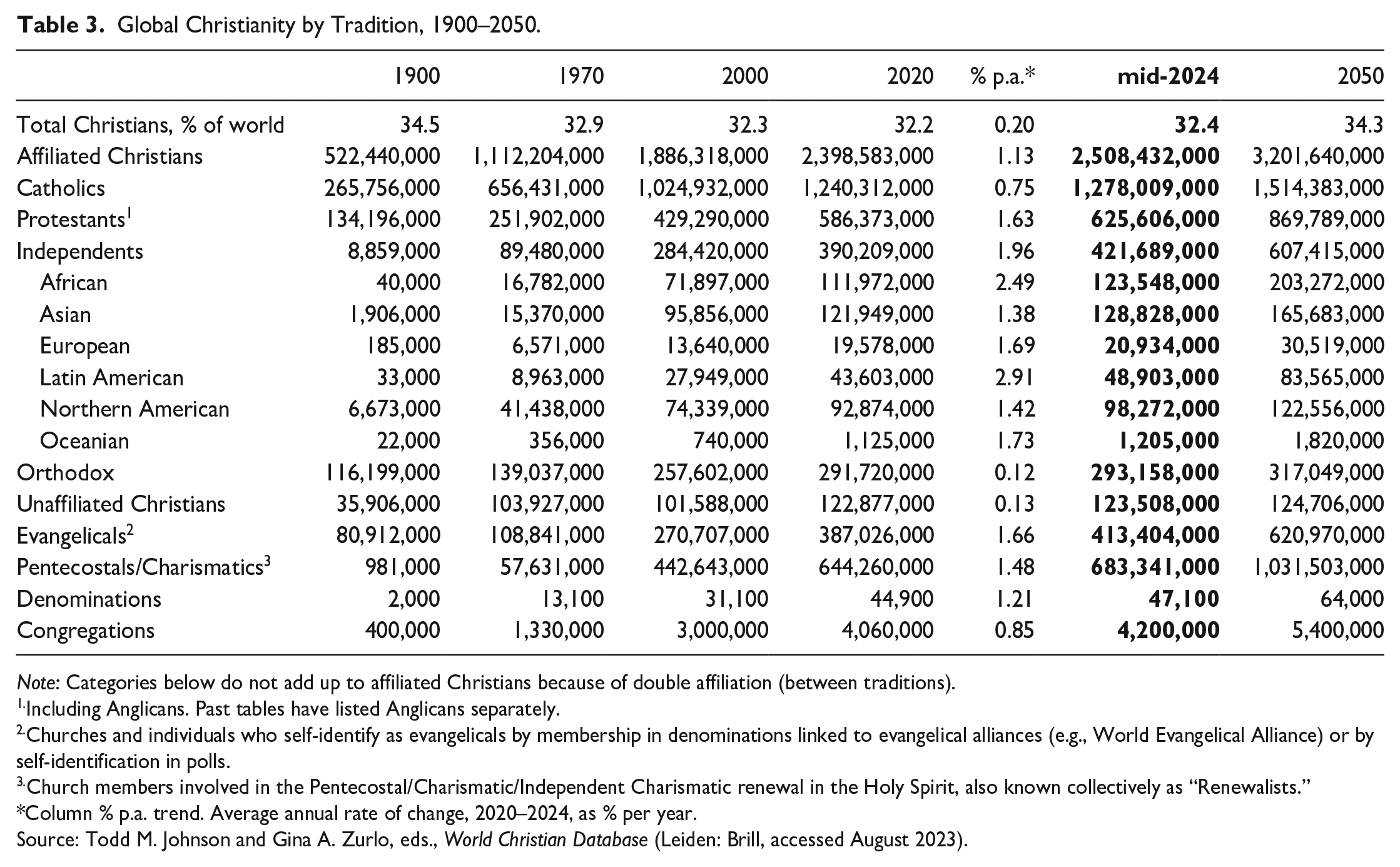
Note: Categories below do not add up to affiliated Christians because of double affiliation (between traditions).
Including Anglicans. Past tables have listed Anglicans separately.
Churches and individuals who self-identify as evangelicals by membership in denominations linked to evangelical alliances (e.g., World Evangelical Alliance) or by self-identification in polls.
Church members involved in the Pentecostal/Charismatic/Independent Charismatic renewal in the Holy Spirit, also known collectively as “Renewalists.”
Column % p.a. trend. Average annual rate of change, 2020–2024, as % per year.
Source: Todd M. Johnson and Gina A. Zurlo, eds., World Christian Database (Leiden: Brill, accessed August 2023).
Christians by Continent and Christian Mission and Evangelization, 1900–2050.
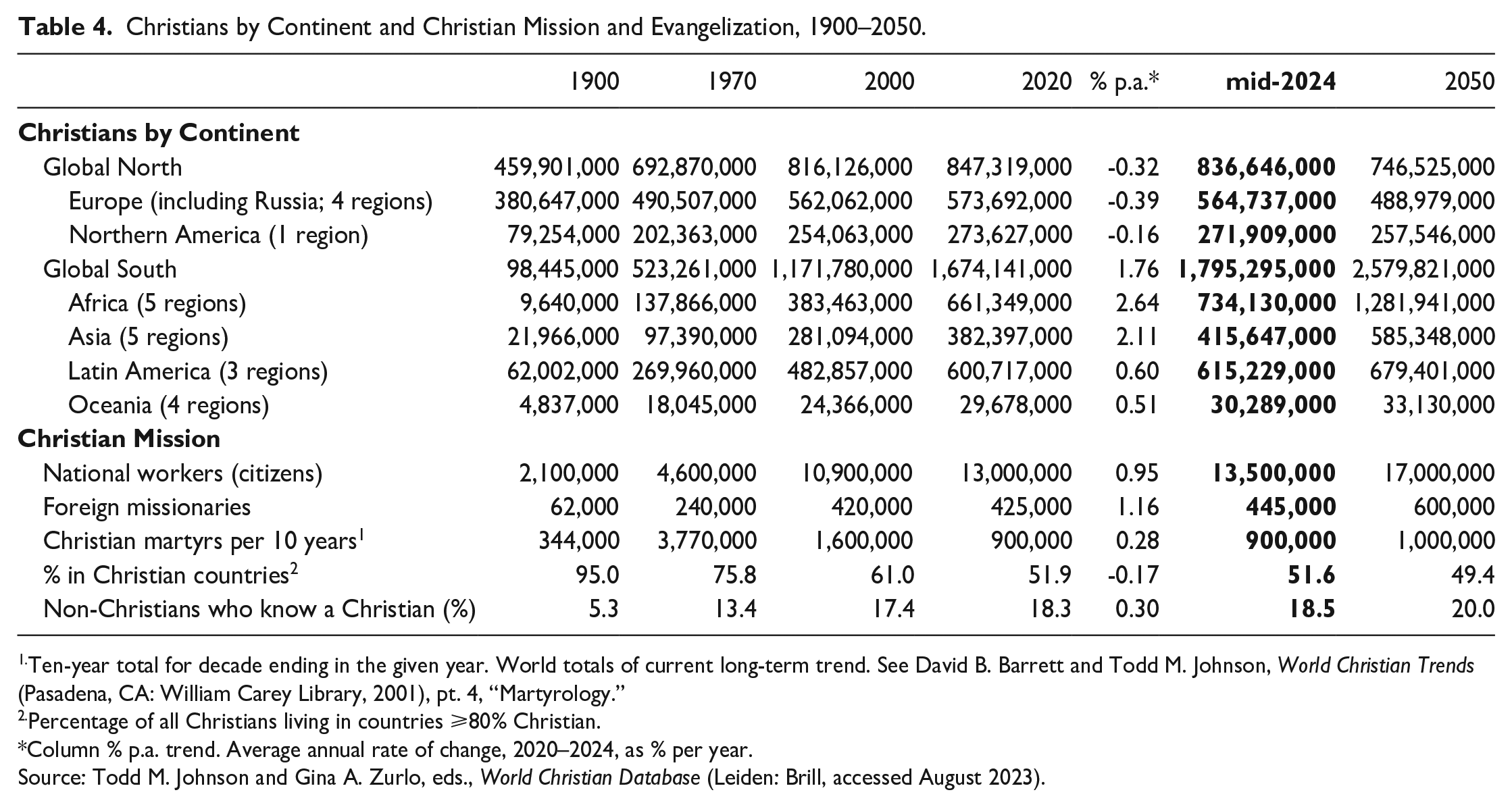
Ten-year total for decade ending in the given year. World totals of current long-term trend. See David B. Barrett and Todd M. Johnson, World Christian Trends (Pasadena, CA: William Carey Library, 2001), pt. 4, “Martyrology.”
Percentage of all Christians living in countries ⩾80% Christian.
Column % p.a. trend. Average annual rate of change, 2020–2024, as % per year.
Source: Todd M. Johnson and Gina A. Zurlo, eds., World Christian Database (Leiden: Brill, accessed August 2023).
Scriptures, Gospel Access, and Christian Finance, 1900–2050.
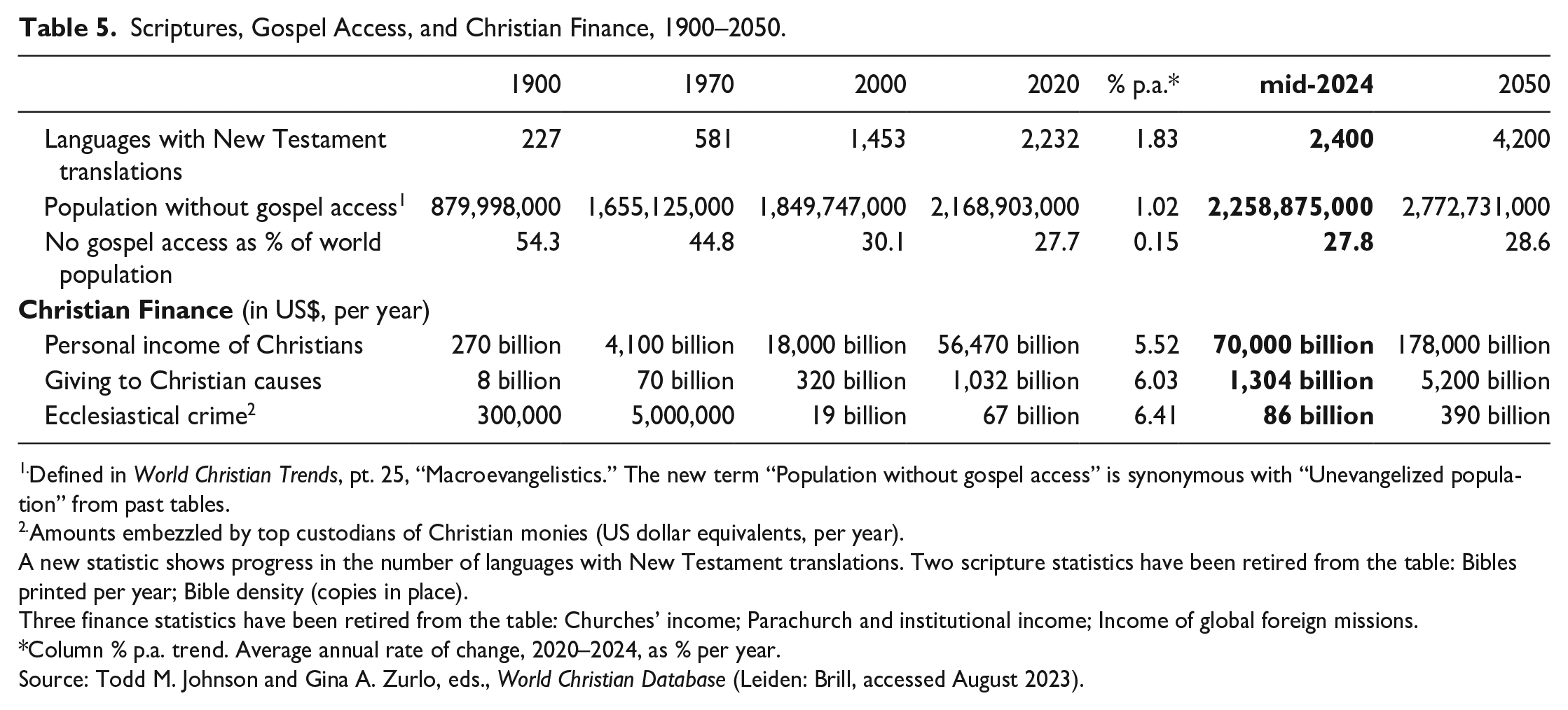
Defined in World Christian Trends, pt. 25, “Macroevangelistics.” The new term “Population without gospel access” is synonymous with “Unevangelized population” from past tables.
Amounts embezzled by top custodians of Christian monies (US dollar equivalents, per year).
A new statistic shows progress in the number of languages with New Testament translations. Two scripture statistics have been retired from the table: Bibles printed per year; Bible density (copies in place).
Three finance statistics have been retired from the table: Churches’ income; Parachurch and institutional income; Income of global foreign missions.
Column % p.a. trend. Average annual rate of change, 2020–2024, as % per year.
Source: Todd M. Johnson and Gina A. Zurlo, eds., World Christian Database (Leiden: Brill, accessed August 2023).
Footnotes
Notes
Author biographies
This article was prepared by staff at the Center for the Study of Global Christianity at Gordon-Conwell Theological Seminary, South Hamilton, MA: Gina A. Zurlo, co-director; Todd M. Johnson, codirector; and Peter F. Crossing, data analyst. For more information, visit  and follow us on X at @CSGC and Facebook.com/centerforglobalchristianity.