




Abstract
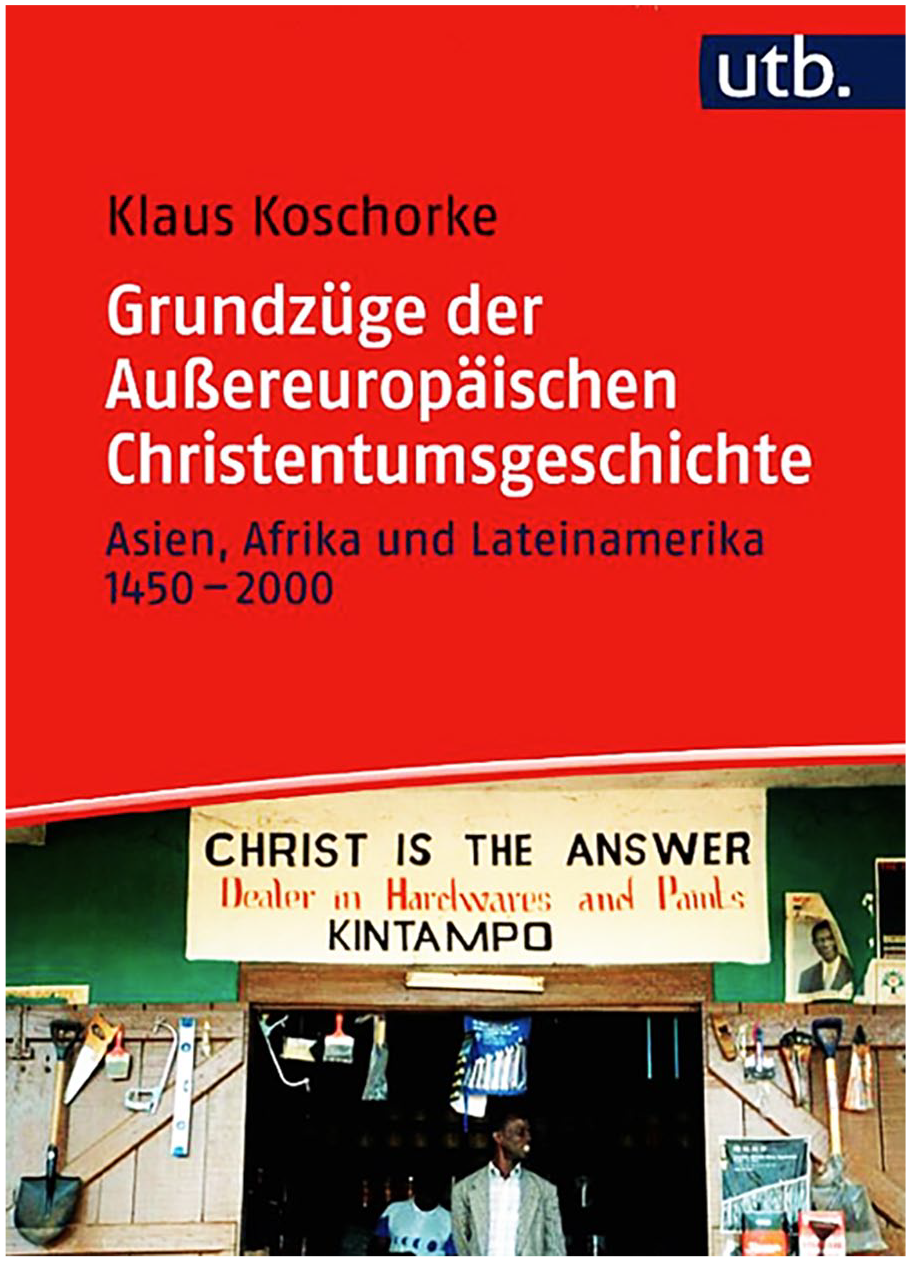
Professor Klaus Koschorke’s pioneering work Grundzüge der Außereuropäischen Christentumsgeschichte: Asien, Afrika, und Lateinamerika 1450–2000 (Main features of the non-European history of Christianity: Asia, Africa, and Latin America, 1450–2000) provides an overview of the historical development of Christianity in the Global South between 1450 and 2000. Koschorke emphasized the “polycentric” nature of Christianity—the fact that, for the gospel to be successful, it must become deeply embedded in the local cultures it encounters, producing forms of Christianity that are distinctive from those of Europe or North America, and in which indigenous evangelism, theology, and discipleship flourish. Koschorke also highlights the importance of relationships between the churches of South America, Asia, and Africa, the Black Atlantic, networks of co-operation throughout the Indian and Pacific Oceans that are as important as Western missionary movements in identifying Christianity as a world religion.
This pioneering book provides an overview of the historical development of Chri-stianity in the Global South: Asia, Africa, and Latin America. 1 From 1993 to 2013, the author was Professor of Worldwide Christianity at the Ludwig Maximilian University of Munich. This was an innovative appointment. Traditionally, academic theology in Germany has had a strongly confessional basis, both Catholic and Protestant faculties focusing on the impact of the Reformation on European Christianity, with non-European Christianity of marginal concern. This Eurocentric vision was also dominant in the universities and theological colleges of the English-speaking world, including those of North America. Worldwide Christianity was acknowledged, but often seen as little more than an extension of Western Christianity, a phenomenon of the colonial expansion of Europe. In a post-colonial world, “mission history” was often seen as a rather embarrassing legacy. With the decline of Christianity in the West, and the fact that an increasing majority of Christians live in Africa, Asia and Latin America, this view has become increasingly untenable. Nevertheless, it lives on in popular perception. In my work as a university teacher of African religion in Leeds, undergraduates were fascinated by traditional African religions and spirituality, but tended to regard African Christianity as likely to be “inauthentic” and not genuinely African. Korschorke’s courses in Munich, and this book, which is its fruit, aims to show that non-European Christianity, in its various manifestations, has a vitality, a creativity, value, and authenticity of its own.
Koschorke has developed an intellectual approach to the study of Christian history which emphasizes the “polycentric” nature of Christianity. This develops Lamin Sanneh’s emphasis on the “translatability” of Christianity: the importance of hearing the Bible in one’s own tongue means that the Church must embed itself in the particular cultures it encounters. The Christian message both affirms and challenges culture. It can never simply be transplanted from outside. Foreign missionaries have their importance and cannot be ignored. Yet too often they demonstrate the dangers of attempting to impose an alien culture and civilization on “the Other.” But many foreign missionaries have also evidenced an ability to enter into, and be transformed by, the new culture into which they are immersed. For them it was a prerequisite to making the Christian message meaningful and attractive. Koschorke shows that the main emphasis for the historian must be on those who received and conveyed the Christian message from within their own societies: as translators, interpreters, mediators, evangelists, thinkers, and theologians to their own people. 2
Koschorke’s other important concept is that of “networking,” by which Christian communities in the global South established relationships with other Christian groups in the South, and thus are strengthened to challenge the hegemony of the West. The inter-relationships between Christian communities in the Global South are highlighted throughout the book. The book follows a chronological order so that Asia, Africa, and Latin America are not treated in isolation. Cross-currents between the different regions of the South emerge strongly, not only in recent times but throughout the history of Christianity in these regions. An earlier textbook of sources has been translated into English: Klaus Koschorke, Frieder Ludwig, and Mariano Delgado (editors), A History of Christianity in Asia, Africa and Latin America: A Documentary Sourcebook, Grand Rapids: Eerdmans, 2007 (originally published in German in 2004). This gives a wide selection of relatively short, highly illuminating, texts from both missionary and indigenous sources. The present work refers specifically to these texts. The two books go hand in hand. The new book provides a deeper, more contextualized analysis. Koschorke is a keen photographer, and the present work is enlivened by a variety of pictures and photographs. 3
In the first part of his book, Koschorke points out that, in the period before the Reformation, there was a growing awareness of Christian communities outside the West, whose existence was independent of European Christendom. The Muslim challenge to the Byzantine Orthodox Church led Europeans to reach out to churches in the East for support. Coptic, Ethiopian, and Armenian delegates were invited to various councils in fifteenth-century Italy. Koschorke points out that Luther was particularly interested in the Ethiopian Church, as an example of an ancient church which had avoided submission to Rome, and which therefore potentially might be an ally in his campaign to reform Western Christendom. In practice, it was the Catholic Church which first reached out to the non-Western world, in part as a compensation for their losses to the Protestants in Europe. Their encounter with Ethiopia began positively when the Portuguese assisted the Christian kingdom to survive a threat to its existence from the jihad of Ahmad Gran in the 1540s. Jesuits subsequently formed a cordial relationship with the Emperor Susenyos, but this turned sour when the missionaries formed a negative opinion of the life of the Ethiopian Church, insisting on rebaptism and re-ordination, and attempting to enforce Chalcedonian and recent Tridentine doctrines onto the church. The result was a complete breakdown in relations and the expulsion of missionaries in 1632. The Ethiopian Church was determined on isolation and freedom from Western influence. A Lutheran encounter with Ethiopia was delayed until the nineteenth century, when the CMS missionary Ludwig Krapf unsuccessfully attempted to establish a Protestant presence. Eventually Norwegian Lutherans did manage to create a strong indigenous Ethiopian Lutheran church, Mekane Yesus.
Jesuits had high hopes of establishing good relations in India with the ancient indigenous churches of St. Thomas, but, again, there was resistance to counter-reformation rigidity and high-handedness, which served to divide and undermine the ancient church rather than support and strengthen it. At the treaty of Tordesillas in 1494, the pope had given authority to the Portuguese monarch to supervise Catholic missions in the East (the so-called Padroado). Goa became the center from which evangelization radiated—to other parts of India, Southeast Asia, China, and Japan. Francis Xavier’s mission to Japan in 1549 was undertaken from Goa, where Xavier recruited two Japanese sailors to accompany him to Kagoshima. One of them, Yajiro [Anjiro], became indispensable as interpreter and translator, evangelist among his kinsmen, and general mediator between the missionaries and Japanese authorities. During a period of instability and civil war, Christianity proved an attractive option for some local daimyo (territorial rulers) but there was much confusion about the precise meaning of the new religion, which at first appeared to present itself as a new sect of Buddhism. Christianity increasingly appeared as a threat to central power, and with the establishment of the Pax Tokugawa in the early seventeenth century, the missionaries were expelled, some missionaries and Japanese converts were crucified, and Christianity was ruthlessly stamped out. A policy of isolation from the West was implemented for some 250 years.
In China, the outstanding Jesuit missionary Matteo Ricci emphasized the need to make Christianity relate to the Confucian ethics of the elite. He met with some success, but long after his death these attempts came under suspicion, not least the question of whether veneration of ancestors was compatible with Christian faith (the rites controversy). The Jesuit attempt at indigenization was outlawed by the pope in 1724. The Chinese Emperor subsequently banned Christianity from China. In both Japan and China, Christianity persisted, in difficult circumstances, without priests or access to the sacraments. The pope only overturned this decision in 1939.
In Africa, the Portuguese did have an outstanding success in the Kingdom of Kongo (largely in modern-day northern Angola), that, with the baptism of the Manikongo ruler, became a thoroughly Catholic kingdom, enduring for over 200 years. Gradually, the debilitating effects of the slave trade undermined both the state and the integrity of the church. Around 1700 Donna Beatrice attempted to revive both church and state. She proclaimed a vision from St. Antony (a popular saint in Portuguese Catholicism) that she would give birth to an African Christ. Alas, her campaign resulted in defeat. She was condemned as a heretic and burned (along with her child).
In his account of Christianity in Latin America, Koschorke makes the important point that this is the only part of the world where Christians (in the form of the Spanish conquistadores) considered that they could eliminate the existing pagan culture completely and replace it by a totally new, purely Christian civilization, aided by large-scale immigration from Iberia. 4 The establishment of Catholic dioceses, under regular clergy, primarily served the settler population. However, the religious orders (Franciscans, Dominicans, Jesuits) increasingly presented an obstacle to such domination, defending the rights of the native populations. Bishop Bartolemé de las Casas, a Dominican, became the most famous and influential defender of the right of the native populations of the “New World.” Koschorke shows how Catholicism developed in different, often contradictory, directions. Indigenous peoples, mestizos, and Creole Americans, as well as the African slave population, all felt that they were not adequately represented or esteemed by the colonial church establishment. In Mexico the cult of the Virgin of Guadalupe, who had appeared to an indigenous priest Juan Diego on the site of an ancient Aztec goddess, became a symbol of an indigenous spirituality and sense of identity. 5
During this period there are interesting examples of inter-continental connections: for example, devotion to the Japanese Christian martyrs in South America; or the case of Don Jeronimo Chingulia, a ruler from Mombasa, educated in Goa where he converted to Christianity. Unfortunately, this did not result in a happy ending. On returning to East Africa, he quarreled with the Portuguese, returned to his Muslim roots, and was responsible for a massacre of Christians, missionaries, and indigenous converts. The “Black Atlantic” for Christian evangelism was of supreme importance, but it was not the first example of transcontinental networks.
It was not until the late eighteenth century when Protestants, influenced by Pietism and Evangelicalism, became deeply involved in missionary work. Their emphasis on biblical translation and creating self-governing, self-financing, and self-extending Christian communities (to use the terms articulated by Rufus Anderson and Henry Venn) immediately put a priority on local involvement in the extension of Christianity. William Carey at Serampore in Bengal, and Karl Gützlaff and Robert Morrison in China, relied on native speakers in their endeavors to translate the Bible. African American freed slaves were, from the beginning, participants in the evangelization of Africa. For them the Bible was the “Charter of their freedom and dignity.” 6 In both Asia and Africa, literacy enabled the rise of a vibrant periodical literature, in local languages and in lingua franca such as English, Swahili, Bengali, and Urdu. Such Christian periodicals became the forum for vigorous debate, and demonstrate the rise of networks of communication, often intercontinental in scope. Koschorke cites the example of Bishop Samuel Ajayi Crowther, a Yoruba and missionary among the Igbo-speaking peoples of West Africa, who was consecrated as the first African Anglican bishop in 1864. Indian Christians expressed joy at the establishment of a “native episcopate,” but asked why no similar developments were taking place in India, despite its much longer mission history. They were also concerned, at the end of Crowther’s episcopate in the 1890s, at the undermining of his authority and the decision not to replace him as a diocesan bishop by another African. 7
In India itself, Christianity, at the beginning of the nineteenth century, had spurred a reform movement within Hinduism, advocated by the Bengali scholar Ram Mohan Roy. 8 By the late nineteenth century, with the development of “scientific racism” and social Darwinism, there was an increasing sense of alienation between missionary domination of the church and a rising body of articulate local Christians, who demanded full participation in the life of the church. Hinduism in India, and Buddhism in Sri Lanka, became more assertive in challenging the superiority of Christianity. The sense of an emerging Asia, freed from colonial oppression, was given a boost by the victory of Japan in the Russo-Japanese war of 1904–5. Japan had, almost uniquely, managed to avoid a colonial takeover by initiating its own modernization program. A small, but socially active Christianity had emerged with the establishment of freedom of religion in the Meiji constitution. Despite its small numbers, Christianity had an important influence on the development of modern Japanese society. In 1906 a delegation of Japanese Protestants was invited by Indian Christians, inspired by the success of Japan, to discuss common Asian problems in church and state. 9 Japanese Christians expressed a supreme confidence that their faith was not a foreign import. One of the most important intellectuals of the early twentieth century, Uchimura Kanzo, established his No-Church movement (Mukyokai) as a nondenominational, non-missionary led, Japanese expression of Christianity. 10 Another noteworthy Japanese Christian mentioned by Koschorke is Toyohiko Kagawa, a social activist, evangelist, and pacifist, who resisted the ultra-nationalist ideology of Japanese militarism in the 1930s and 40s.
The defeat of an Italian attempt to conquer Ethiopia in 1896 inspired Africans throughout the continent. Already several independent churches in South and West Africa had emerged. They often described themselves as “Ethiopian” in recognition of the historical antiquity of Christianity in Africa, and of the fact that “Ethiopia” has an honorable place in the Bible itself. In the widespread African phrase, the Europeans “took our land and gave us the Bible.” But what the colonialists didn’t realize was that the Bible empowers and subverts all attempts to enslave and impoverish Africans: indeed, it is a “charter of freedom and dignity.” This was nowhere more salient than in South Africa, where segregation and, after 1948, apartheid was fiercely resisted by many church leaders of all denominations (Archbishop Desmond Tutu, Beyers Naude, Frank Chikane, and Allan Boesak). The Barmen Declaration of 1934, in its resistance to Hitler’s racist ideology, inspired South African theologians in their resistance to the apartheid regime. The Belhar Confession of 1984 looked forward to the establishment of a non-racial Reformed Church in which the white Dutch Reformed Church would abandon its emphasis on racial purity. The 1985 Kairos Document issued a clarion call in the struggle to overcome apartheid. 11 Among Catholics in West Africa, there emerged an assertiveness based on a rigorous intellectual insight into Christian and African identities, at a profound intellectual level. The impact of the Second Vatican Council also had a profound impact on worldwide Catholicism, not least in the election of an Argentinian pope.
In Asia, Korea has become an outstanding example of a church that was founded by Koreans long before missionaries entered the country. It has grown rapidly, partly stimulated by an evangelical revival in the first decade of the twentieth century, and became strongly identified with resistance to Japanese colonial rule. Many of the signatories of the March First Independence declaration of 1919 were Christians.
Koschorke’s emphasis on South-South networking is demonstrated by the involvement of Christians from the South in organizations such as the Ecumenical Association of Third World Theologians, and the Circle of Concerned African Women Theologians. Latin American and Asian liberation theologies, and African theology, have both had an impact on theological discourse worldwide. On a more basic level, there has been the long-standing importance of migration and ethnic diasporas in the expansion of Christianity: the “Black Atlantic,” in which enslaved Africans created Christian communities in the New World and then, as free men and women, returned to Africa as missionaries, at first with European missionary societies, then as representatives of African-founded churches (such as the African American Episcopal Church Zion), which made a big independent in early twentieth-century South Africa and Namibia. In Asia, the Chinese diaspora (particularly the Hakka, Fujian, and Cantonese) in South East Asia have been important agents of the spread of Christianity, as have Tamils in Malaysia. More recently “reverse mission” has powerfully impacted European and North American countries. Christians from the Global South have established thriving churches in the North: Indonesians in the Netherlands, Ghanaians in Germany, Koreans in the United States, Nigerians and, more recently, Hong Kong refugees in the United Kingdom. These churches have not only provided refuge and a sense of belonging to migrants but have participated in the renewal of Christianity in the host countries of the North.
Perhaps China deserved a longer survey in Koschorke’s account, which inevitably can only sketch major themes and trends. Fr. Vincent Lebbe, a Belgian priest who spent his life in China, was instrumental in persuading Pope Pius XI to establish a native Chinese episcopate in China in 1925. Christian education in late imperial and early republican China, both Catholic and Protestant, provided a strong critique of the Confucian examination system which was seen as inhibiting the modernization of China. Yet the New Culture movement and the May 4th [1919] student protests were highly critical of Christianity as a colonial force, inspiring an anti-Christian movement, at the same time the protesters deeply criticized traditional Confucianism. Koschorke does examine the status of Christianity since the Communist takeover in 1949, but perhaps more could have been said about the contrasting theologies of the Three-Self Patriotic Church and those “post-denominational” Christians who refused to join what they saw as a state-controlled body, and exist as “unregistered” churches. There is also the continuing confusion about the status of the Catholic Church in China. A recent Concordat between Pope Francis and President Xi has not yet been implemented (but that takes us well beyond the 2000 closure date of this book). Chinese Christianity, both in the People’s Republic and in diaspora, is likely to be one of the most important centers of Christianity in the twenty-first century.
Koschorke’s final section is entitled “An der Schwelle zum 21. Jahrhundert” (On the threshold of the twenty-first century). He has pertinent things to say on the advance of Pentecostalism, with its tendency to “re-enchant” the world in the face of a secular modernity. Yet, as he also notes, Pentecostals are often the first adopters of modern technology, in the use of the internet, film, and international (largely American) music styles. As he puts it, “these services aim not only for publicity and advertising but to develop new forms of godly life and Christian spirituality.” 12
One trend that was perhaps not so obvious in 2000 was the rise of a new theological conservatism. One might say that churches of the South have always shown a biblical conservatism—liberal scholarship emanating from the West is often seen as irrelevant to the practical needs of the church. Koschorke briefly mentions the issue of homosexuality, particularly as an issue for the worldwide Anglican community. This was only just manifesting itself in 2000 but has since become a defining issue for some churches in the South, who see the question of sexuality as a sign of a general apostasy of the West. This is ironic, in that a fairly relaxed attitude to same-sex activity in many parts of Asia and Africa has only recently been undermined by Western colonial legislation, which remained in the legislative codes of independent states.
Koschorke rightly sees 1989 as a turning-point in history, with the collapse of Communism in the Soviet Union and Eastern Europe. One area where the Cold War continues is Korea, freed from Japanese colonialism in 1945, but soon embroiled in a civil war that has created two Koreas. A peace treaty has yet to be concluded. Before 1945 the north was seen as the vital center of Protestantism (particularly Presbyterian). The first leader Kim Il Sung had been educated in a Christian school but found Christians a threat to his initially fragile rule. There was a mass exodus of Christians to the south. In South Korea itself, anti-communism and an American-inspired fundamentalism became deeply engrained in much Protestant thinking, despite the rise of Minjung theology. Theological conservatism is still the dominant force among the majority of Protestant churches in South Korea.
Klaus Koschorke’s book will be translated into English, hopefully in the near future. It is a rich testimony to the importance of understanding Christianity as a vital faith in the global South, increasingly important for our understanding of the nature of the Christian faith. I commend this book, and its future English translation, as a vital companion in understanding these developments.
Footnotes
Notes
Author biography