




Abstract
Hildegard Prozell (1869–1948) was the first female missionary from the territory of Latvia (then the Russian Empire), who went to India to serve through Leipzig Mission. During her thirteen-year ministry there she established multiple schools for girls, was the school principal, developed zenana mission work in Mayavaram, and trained Bible women in India. Because of her ministry, a female mission support association was established in Riga, as well as mission nights and conferences. Her writing gave people back home a window to sharing the Good News to children in Eastern India.
Short biography before and after her ministry in India
Hildegard Prozell was born on August 9, 1869 in Schwarzeckhof (today Jaunmārupe), near Riga, as the second child out of four in the family of a landowner (Gutsbesitzers). In 1879 she moved to Riga with her aunt, studied at the higher girls’ school (Höhere Töchterschule I Ordnung), which she graduated from in 1886 with the qualifications to be employed as a teacher. In 1887, she was confirmed by Theophil Gaehtgens in the Riga Dome Cathedral. After that Hildegard spent two years at home, looking after the children of the poor families of her father’s tenants, gathering them for daily classes. When her father’s financial situation worsened, her parents had to sell the property and her mother became the head of the Magdalena shelter in Riga in 1895. 1 After some time, in 1889, Hildegard went to work as a private tutor in various places in Russia. 2
Prozell said that both her schooling and the confirmation classes helped to establish her in the Christian faith, and the guiding theme of her life was to strive to live according to the knowledge she gained about Christianity. She did not mention exactly how her interest in mission work began, but only that she had a love for mission work and that she hoped to find her life’s calling in mission service. She had prayed for it while she worked as a teacher in various places over the years. She noted that “the waiting time has been very long, often even heavy, but it has brought many blessings to my inner person.” 3
Miss Prozell with her Bible women. Reprint permission from Evangelisch-Lutherisches Missionswerk Leipzig e.V.
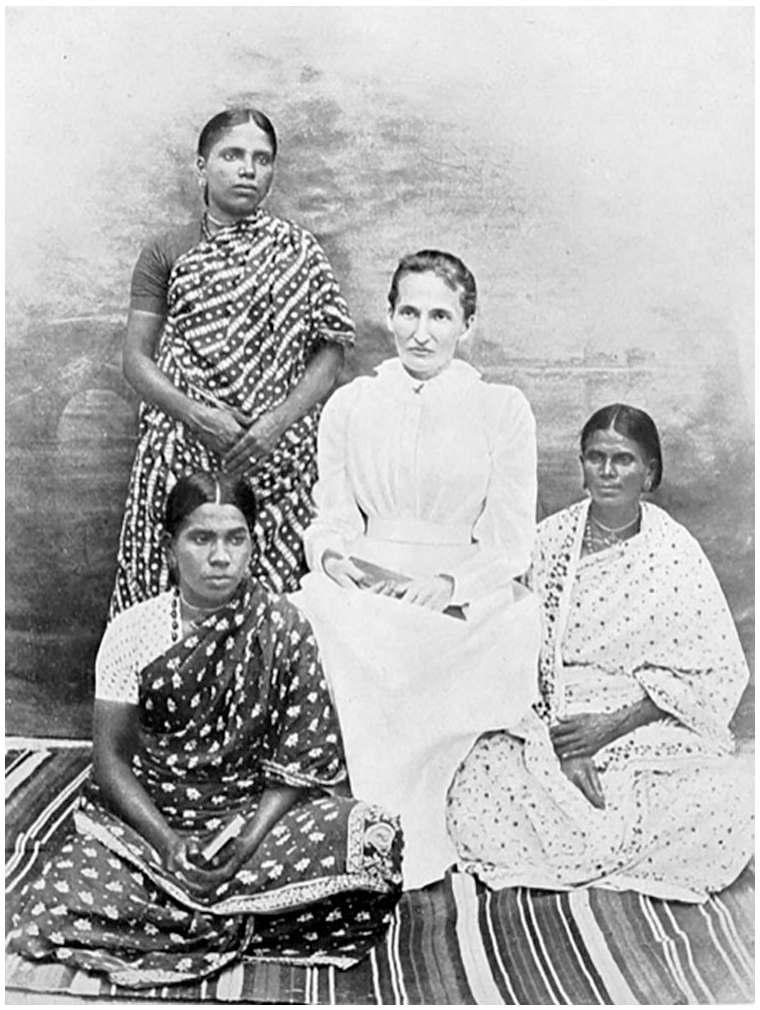
From the available materials, it is impossible to determine exactly what provided Hildegard the opportunity to join the mission in 1896, but her last place of work was Tver in Russia and from there she received excellent references about her work and abilities as a teacher. 4 Prozell applied to the Leipzig Mission (Die Ev. Luth. Mission zu Leipzig) and Pastor Gustav Cleemann wrote a recommendation in February 1896. It was very positive, pointing out that Hildegard’s Christianity was pure, deep, and sincere, that “she is a living branch on the vine of Christ, drawing from Him the juice and power, with a rich and deep life of faith, a fervent love for the Lord, and a fervent tendency to bring the lost poor blind pagans unto Him.” She was admitted to the Leipzig Mission in May 1896 and in September of the same year was sent to work on a mission in India as a teacher, where she served until 1909. 5
Serving in India was a strain on Prozell’s body. She had to leave India due to illness, 6 and became a professional employee of the Leipzig Mission in Russia. Between 1909 and 1911, she served in Sevastopol and Yalta in the German evangelical congregations. 7 The outbreak of World War I had a significant impact on German mission societies, including Leipzig Mission. There was a breakdown in communication with the mission areas where some missionaries were deported, as well as with non-German countries such as Russia. In October 1917, the director of the Leipzig Mission, Carl Paul, writes that for more than three years there had been no news from Prozell. 8 Hildegard had gone on vacation to her home town, and then was no longer able to continue her ministry. 9 Due to all the political uncertainties, Prozell retired on November 1, 1917. 10
After the war, when the opportunity finally came, Prozell and her sister travelled to Leipzig and there in the Leipzig Mission found a place of safety and service for them by Lake Constance. 11 This was the end of her relationship with the Baltics, but until the end of her life she continued to work on home missions in Germany. As her strength was fading, she supported the mission house and continued to intercede for the work in India. She was able to evoke love for mission work in others. 12 Hildegard Prozell passed away on March 8, 1948 in Spangenberg, Germany, at the age of seventy-eight. 13
Leipzig Mission
The best resource about the Leipzig Mission (LM) is the history of the German Lutheran mission written by the German theologian Paul Fleisch in 1936. 14 Initially, this mission society was founded in Dresden in 1836 as “Ev. ‘Luth’ Missionsgesellschaft zu Dresden”, a Lutheran mission. Such a mission society received extensive support from various traditional Lutheran lands and aid organizations in Hannover, Hamburg, Bavaria, Braunschweig, as well as southern Russia, the Baltics, Denmark, and Sweden, 15 making it one of the largest mission societies in Germany. Its first official director was Dr. Karl Graul (1844–59), who also essentially established this mission society. Graul believed that education and science were needed, and therefore the mission seminar and society were moved to the university city of Leipzig. Its name was changed to Leipzig Evangelical Lutheran Mission Society or Leipzig Mission. 16 The emphasis was on Lutheran theology, including missiology, with a desire to form one worldwide Lutheran Church. The LM was a legally independent organization that cooperated with territorial (state) churches, but finances came mainly from donations. 17
Leipzig Mission’s first mission field was southern India. In the 1840s the LM took over what was left of the ancient Danish-Halle mission, thus expanding the Lutheran testimony in India. While doing mission work in India, women’s work was developed. LM was the one that encouraged women’s involvement. 18 Swedish missionaries who were part of the LM placed particular emphasis on women’s ministry. It was first talked about at the 28th Synod in 1889, and everyone unanimously agreed that women as missionaries were needed. After this decision the first female LM missionary was the Swede Esther Peterson, who arrived in India in 1890 19 and who later was Prozell’s colleague. The first German female missionary arrived in 1891. 20
Graul was very interested in building support from Lutherans in the Baltic lands. Therefore in August 1856 he visited Synods of Lutheran Pastors first in Kurland (Libau) and then also in Livland (Valka). 21 The subsequent directors Julius Hardeland and Karl von Schwartz made visits to the Baltics over many years thus strengthening the relationships between the LM and the Lutherans there, as well as raising missionaries and support for them. 22
Preparing for ministry and sending
For unmarried women, Leipzig Mission required parental permission and a pastor’s recommendation. Nothing is known about the permission of Prozell’s parents, but there is clear evidence that Pastor Cleemann (at the time in Pinki Parish) made an excellent recommendation. Although Prozell was the first female missionary from Vidzeme (Livland), apparently Cleeman had no objections to her ministry, as it was through the LM which was a chief Lutheran mission society in Germany.
Prozell became a missionary with the LM in May 1896. In Leipzig, she was received by the director of the mission, von Schwartz, and his wife, with whom a very close and cordial relationship was formed, which can be seen in the first letters 23 going out on the mission field and later. Months in Leipzig are spent learning Tamil until she received her referral (Vocation) on September 13, 1896. The referral states that Prozell was called to be a teacher in the service of the Tamil Mission in East India. She was expected to be able to learn the language in about two years so that she could fully serve in her calling. 24 Thus, it can be inferred from Prozell’s experience that the LM placed a great emphasis on learning the local language, but since she had the qualification to serve as a teacher, no other training was conducted. Prozell went on a mission only after four months of training.
Mission work in India
First period of service, 1896–1903—Madura and Coimbatore
Prozell arrived in India on October 16, 1896, in the port city of Tranquebar (now Tharangambadi), where she was greeted by the leaders of the church council (Kirchenrat) and instructed to go to Madura (now Madurai), learn the Tamil language, and get to know the schools already in place, so that she could later take over the mission boarding school (Kostschule).
During her first year in Madura, she was welcomed into the Blomstrand family of Swedish missionaries, who often gave friendly advice in both everyday life and ministry. Her days were mostly spent learning Tamil for at least four hours a day with a language teacher, or munchi. Prozell admitted that the language was difficult. The rest of the time she worked at the boarding school. She tried to practice the new words she had learned, spending time with the children. 25 Gradually she managed to learn the language so far as to be able to conduct religion lessons with Bible stories. 26 She also had the opportunity to meet fellow missionaries serving in similar positions, only in other schools. 27 Although in her letters Prozell did not indicate huge conflicts with other missionaries, she did admit that she was not a true South German, that is, she was from the Baltics, and not from the German lands as the majority of the LM missionaries in Madura were. 28 A year later, in January 1898, she wrote: “I love all Swedes so much, they are so much more affectionate and behave warmer than the Germans treat me.” 29
After passing the language exam on September 19, 1898, a wide field of work opened up for Prozell in Madura. Already by then, on November 1, 1897, Mrs. Blomstrand entrusted Prozell with many more responsibilities in the boarding school. 30 This meant following up on the children’s exams, preparing Christmas gifts for them, communicating with parents, as well as doing other administrative tasks. At the time, she had forty-three children in her care, as well as overseeing three teachers, and other school staff. She made reforms at the school, dismissed a cook and one teacher, which caused certain problems, because the rest of the staff were not satisfied with the new order. 31 Being a female missionary in India at the time meant not only being a teacher, which was Prozell’s main role, but also being a local nurse and treating children’s minor illnesses. 32 Consequently, both the formal education required by the British administration and informal knowledge in various areas of life were needed in order to be able to help in the widest possible way. In September 1898, Hildegard also began work with Indian Bible women and began zenana ministry (zenana is the private area of Indian houses where women reside), visiting non-Christian women three times a week, for three hours each time. 33 This ministry became essential to Prozell’s work.
Miss Prozell with her students. Girls school in Madura. Reprint permission from Evangelisch-Lutherisches Missionswerk Leipzig e.V.
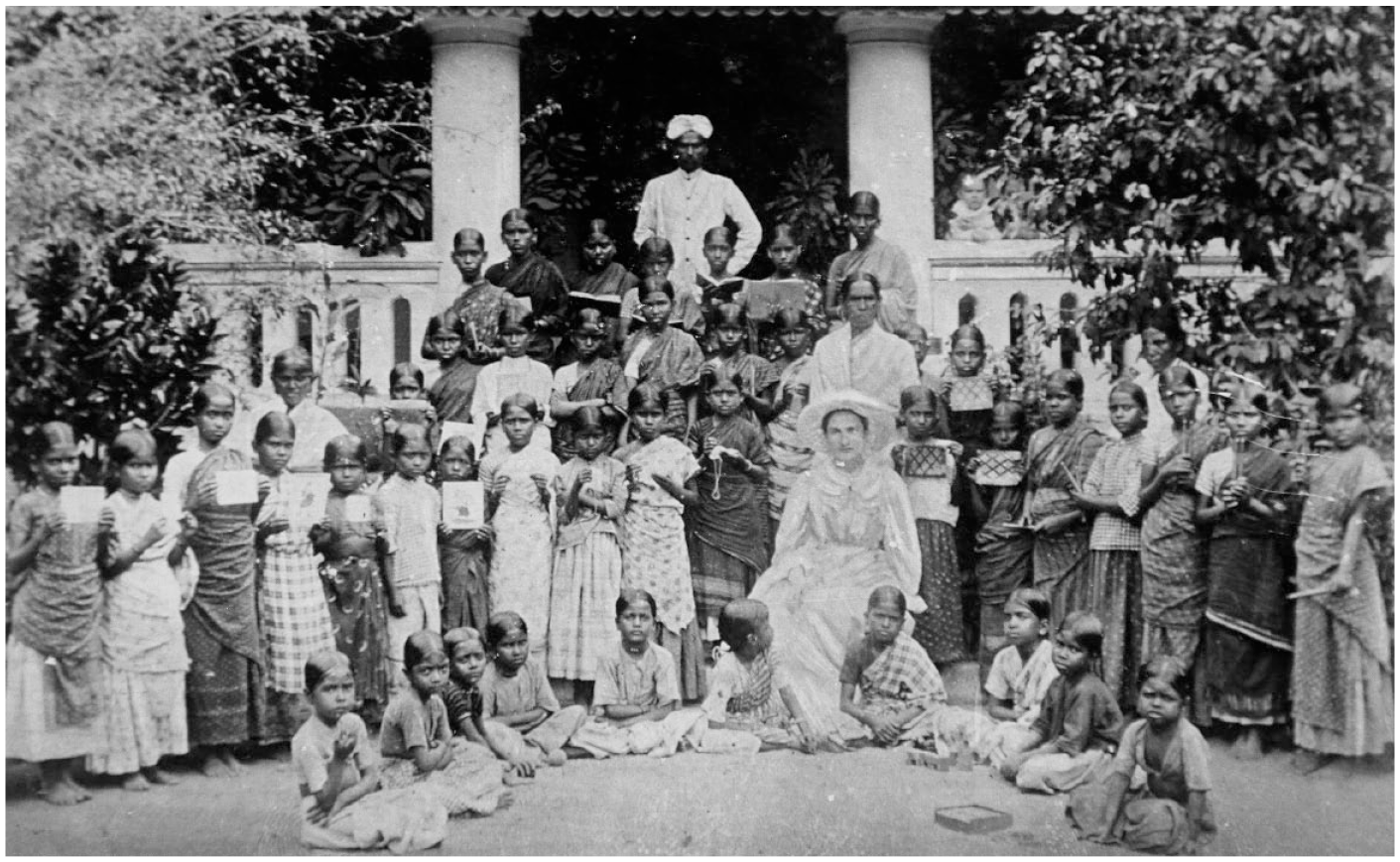
In 1901, the LM made changes to its ministry areas. These changes were explained in detail to the mission supporters in Riga. “Madura is one of those stations that is now grouped as the ‘Swedish Diocese.’ Therefore, Miss Ester Peterson, as a Swede, was moved from Coimbatore to Madura after the New Year and exchanged spheres of activity with Miss Prozell.” 34 The work Prozel had developed and the relationships she had established with Indian women in Madura were halted as she began a new ministry in Coimbatore. The scope of activity did not change—in Coimbatore too, she was the principal of a school for children and trained non-Christian women. Fleisch pointed out that it was Prozell who started women’s work in Coimbatore. 35 In Coimbatore, forty-three non-Christian women were going through zenana training, and it was impossible for one 60-year-old woman to train them all. Consequently, Prozell asked the LM to find funding that would allow for faster preparation of at least one other Bible woman to assist her in the training work. She offered to conduct an educational experiment—to train some women who were willing and had the potential, to give them a slightly higher status in the congregation, and after two years of training, to pass an exam with the church council. 36 The LM approved this idea and in 1902 there were special courses for Bible women; these courses were supposed to be conducted specifically by Prozell, but due to her illness this did not occur. 37
Prozell’s reports of 1903 do not indicate major health problems, but she occasionally mentioned the hot climate of Madura and Coimbatore, which was not healthy for Europeans. Favorite vacation spots were in the mountains, usually in Yercaud or Kodaikanal, that were a little cooler. Prozell wrote, “Heat is a serious obstacle to clear, sharp thinking; and for me twice as much, because I have to overcome its impact not only on me, but on my munschi (language teacher), and it is really an exhausting job.” 38 However, in May 1903, Prozell was forced to apply for a vacation in Europe, as she developed problems with her veins, as evidenced by a doctor. 39 Moreover, in a letter in June, she wrote that she needed rejuvenation. 40 The request for leave was approved and in the second half of 1903 Prozell went home to Europe via Cairo and sent the next letter to the LM from Sassenhof in the vicinity of Riga on December 28. 41 This marked the end of her first ministry period in India.
Second period of service, 1905–1908—Mayavaram
Whilst on board a ship to India, on September 26, 1905, Prozell, full of hope, wrote that everything was fine with her health and that she had regained her physical strength. 42 After the first, relatively successful, period of service in Coimbatore, Prozell was sent to Mayavaram (now Mayiladuthurai). In this city Prozell in 1905 was the first to start the work with women. Mayavaram had a long tradition of Hinduism and its fanatical adherents; however, Prozell was able to establish three schools for girls with 180 students and zenana classes in twelve families. 43 The first two schools opened at the end of 1905, while the school in Mayavaram itself opened in mid-January 1906. 44
An immense challenge for Prozell was to get all three schools officially registered and recognized by the British government. In February 1907 the schools in Tiruvilandur and Kornat obtained government registration, but the Mayavaram school did not receive it. Prozell, however, did not give up and was able to show the supervising inspector that the Mayavaram school had the highest number of students and the best academic achievements and she visited the authorities in Madrasa until she received the registration. 45
In 1908, Prozell pointed out that all three schools had been able to do excellent educational work and thus found their way to the hearts of parents. The mistrust that was originally in Mayavaram was overcome. 46 It is possible to conclude that during the three years of ministry, Prozell managed to fulfill the task given by the LM, to establish schools, and in this way preach the Christian message to Indian girls. 47
In a similar way, Prozell’s zenana work can be evaluated. At first, the work was cumbersome. She had only one Bible woman to help, and in the first months she managed to visit only three Brahmin families and three other caste women. Difficulties in the zenana work were also caused by geographical conditions—a limited number of roads and water barriers. 48
As mentioned earlier, to promote the zenana work and train young Bible women, Prozell sought to prepare a course for them. Initially, however, it was not her health or the lack of suitable candidates that raised doubts, but the lack of training materials. 49 Due to a lack of training in 1908, Prozell had to admit that the zenana work had not been as successful as the work with schools. At the same time, she saw that here, too, the initial difficulties had been overcome, and the zenana work was promising and starting to flourish, and it was already like what it was in Madura eight years ago. 50
In the second period of Prozell’s ministry, a significant obstacle and problem was her health. Doctors in Riga had already said that she would not be able to endure in India as long as the first time. 51 Her initial health problems, manifested by an “indescribable lack of energy and fatigue,” reappeared only half a year after arriving in Mayavaram. A month later, Prozell wrote that she needed to rest more and she was forced to transfer some of her work to another missionary. 52 In the spring of 1908, Prozell began to realize that she did not have the strength or the will to go back to Europe. 53 Sadly, in December, she was already aware that this would be her last Christmas in India. 54
This second phase of the ministry shows that Prozell was able to show initiative and was ready to begin ministry in a new location. The creation of three schools demonstrates good administrative skills and the ability to operate both in Indian culture and the British bureaucratic system. The creation of zenana work in Mayavaram can also be considered a success, despite initial resistance from the local population. This period coincides with a time of turmoil and change in the territory of Latvia, which affected both Prozell’s emotional state and financial support from Riga. Due to the state of her health, after three and a half years, it was necessary for Prozell to leave India and continue her service as a lecturer of the LM in the south of Russia.
Publicity and echoes in the homeland
Prozell was able to receive support from her homeland in her ministry. Prozell was a Baltic German, and her family was initially prosperous. Her pastor Cleemann, and the Dean of the Riga District Gaehtgens, who was interested in the foreign mission, supported Prozell and her ministry.
This interaction with the motherland also contributes to the formation of an understanding of mission work in Riga. To support Prozell’s ministry, a women’s mission support society was established, and mission evenings and mission conferences were organized. During both periods of her ministry, Rigasches Kirchenblatt regularly published both Prozell’s letters and reports compiled by dean Gaehtgens from private letters. 55 Although others had gone on to serve as missionaries prior to Prozell, it seemed that it was Prozell’s ministry that received a lot of prominence in the printed press, so that a large section of the public who read German had the opportunity to learn about mission work in India, and especially women’s ministry, which was a novelty at the time. As the first woman from the territory of Latvia, Prozell achieved great recognition and influence during her ministry. There were not as many publications about Prozell’s work in Latvian as there were in German; however, there were at least three such publications in 1898, 56 1899, 57 and 1903. 58
Legacy
Prozell, being the first female missionary from the territory of Latvia (then part of Russian Empire), brings a certain legacy with her. Prozell did not emphasize her ministry as something special or equivalent to men. It was obvious to her that the ministry she performed could not be done by male missionaries.
In the mission field, and in ministry, the mother tongue and nationality were not important. The key was the missionary’s ability to learn the local language so that they could work in the calling where they were sent. Prozell pointed out that missionary relationships and well-being were also critical to building relationships. Even though she was a Baltic German, it is possible that other German missionaries considered her as Russian, because her homeland at that time was a part of the Russian Empire.
Traditionally, mission work in the nineteenth century and early twentieth centuries was associated with spreading Western culture. In that sense, the ministry of Prozell was not much different. She did not emphasize anywhere in her communication that she felt like a carrier of culture—her main concern was to introduce children and their families to the gospel of Christ—but she wanted to rearrange the schools she ran so that they were more in line with Western standards.
Much has vanished in the history of the Latvian mission. Prozell’s ministry is evidenced by the numerous archival materials in Halle and publications in newspapers. We can remember Prozell as a successful teacher and school principal, who was able to share Christ with children and their parents in India. Prozell was also full of zeal to pioneer the zenana ministry and train Indian Bible women. Because of her ministry, a mission society was established in Riga. She is, however, undeservedly forgotten. This is probably because prior to the creation of independent Latvia, she had already gone to Germany and carried out her further ministry there. Still, Hildegard Prozell plays an important role in Latvian mission history because of her ability to overcome obstacles and to respond to God’s call. She was among the few who dared to do so.
Footnotes
Funding
This research was carried out with support from the project, “Strengthening of the capacity of doctoral studies at the University of Latvia within the framework of the new doctoral model,” identification No. 8.2.2.0/20/I/006.
Notes
Author biography