




Abstract
While there is a fair amount of research on consumer disposal, there is scant research on value in disposition and a need for more research on the role of social media in the consumer disposal decision-making process. This research provides insights into how consumers create value-in disposal through social media ‘closet cleanout’ pages on Instagram. Through a grounded theory approach, interviews with Instagram closet cleaners reveal how value-in disposition is enacted using Holbrook’s (1998) classification of value. The findings show the multidimensional nature of value in digital disposal and empirically substantiate the enduring nature of Holbrook’s (1998) value conceptualization.
Introduction
The consumer disposal process has also been widely explored by scholars. However, exploration has been largely done within traditional retail contexts and very little has explored the role of value within a digital context. ‘The evolving digital era presents numerous opportunities for identifying value-creating potential’ (Kumar & Srivastava, 2022) but ignores disposition. Additionally, if it has been determined consumers follow a subconscious process to revalue their possessions, known as value-in-disposition (Ture, 2014), can the same be said when the acquisition or divestment process is entirely mediated by tiny computers in our pockets?
Using a grounded theory approach with data collected through semi-structured interviews, this article seeks to understand how the derivation of consumer value-in disposition is affected when the disposal conduit is digital. Using Holbrook’s (1998, 2002) value conceptualization value and relying on data obtained from trendy ‘closet cleaning’ pages on Instagram and experiences of those who are ‘closet cleaners’ on Instagram. Ultimately, we explore how individuals derive value from disposal through a public yet controlled resale process and create value-in clothing disposition or ‘dispossession’ (Roster, 2001) by resale.
Research on creating value-in disposal in the reuse of clothing is emerging (Cruz-Cárdenasa et al., 2019), but this is the first study that explicitly looks at value creation in digital clothing disposal.
Therefore, this study explores:
When closet cleaning, how do sellers create value-in disposal when taking over an Instagram closet cleaning page?
Value-in Disposition
Simply defined, disposition is a process of revaluation of possessions, highlighting all moments of exchange have some kind of value attached to them (Ture, 2014). Disposal is ‘an autonomous behaviour in which the consumer mixes resources and performs a series of actions to create value’ (Cruz-Cárdenasa et al., 2019, p. 846). It is about ‘managing the flow of an object’s transferable value among consumers or between consumption contexts’ (Ture, 2014, p. 59). The concept and reconfiguration of ‘value’ by consumers as goods are moved along is central to the consumer disposition process and underpins consumer disposal research. In disposition, consumers conduct ongoing value and performance assessments when ‘the value of the object, whether financial, utilitarian, symbolic or any combination of these, was compared to the costs of continuing to retain the object in their possession’ (Roster, 2001), while minimalists ‘engage in a constant process of curating their goods to ensure they only own things that continue to add value…’ (Wilson & Bellezza, 2022).
However, few studies with the exception of Ture (2014), explicitly focus on how value-in disposition is derived, especially in digital disposal channels with the digitalization of disposal, and how these mobile and social media-based channels affect the creation of value-in disposition. This is important as specific modes of disposal can create distinct disposal processes (Gregson et al., 2007), and the disposal context affects the value placed on disposed items (Denegri-Knott & Molesworth, 2009).
Disposal can be defined by a process of ‘letting go’ in the ‘movement along of things’ (Gregson et al., 2007; Roster, 2001) and acknowledges ‘objects circulate in different regimes of value in space and time’ (Appadurai, 1986, p. 4). It is how the consumer detaches the meaning of ‘the thing’ from the self (Young & Wallendorg, 1989). Mellander and McIntyre (2021) saw fashion as a process of detachment and ‘letting go’ of clothes as being a process full of complexities.
The process of disposing by selling is riddled with notions, formulations and reconfigurations of value between seller and buyer through a series of divestment rituals (Lastovicka & Fernandez, 2005; Turunen et al., 2020). How consumers derive value-in disposition when closet cleaning by taking over an Instagram account, a new disposal conduit in the time and space of consumers ‘letting go’ or ‘dispossessing’ (Roster, 2001) clothing, is unknown.
The value of everything, including things, changes as consumers move to different identity projects, and possessions no longer serve their anchoring purpose (Bardhi et al., 2012). The disposal process starts when the possession’s meaning or ‘life story’ (Ture, 2014, p. 67) or ‘sense of value’ no longer fits the owner’s current identity (Roster, 2001). As consumers divest these extensions of the self symbolically, there is a liminal zone between ‘me’ vs. ‘not me’ (Lastovicka & Fernandez, 2005, pp. 813–814), and a transition period of detachment from the past self to constructing a new self (Turunen et al., 2020). This disconnect and ‘not me’ moment prompts a process of re-evaluating possessions with physical and emotional detachment (Cherrier, 2009; Ture, 2014) and divestment rituals (McCracken, 1986). Value-in disposition can arise from use, relationships, money and morals (Ture, 2014), and divestment practices and rituals (Cappellini, 2009) as goods circulate to get a ‘second chance’ (Soderman & Carter, 2008, p. 22). The running of a closet and its contents overlaps with the running of emotions (Mellander & McIntyre, 2021).
Holbrook’s Conceptualization of Value
The concept of value, its dimensions, and measurement are perennially contested and still remain an ‘elusive and complex’ concept in consumer behaviour research (Gallarza et al., 2011). Babin and Krey (2020) observed, ‘consequently, a multitude of conceptualizations, models and measurement tools has been proposed throughout the construct’s advancement’ (pp. 124–125). One of the most enduring, comprehensive and diverse typologies (Sánchez-Fernández et al., 2009) comes from Holbrook’s (1998).
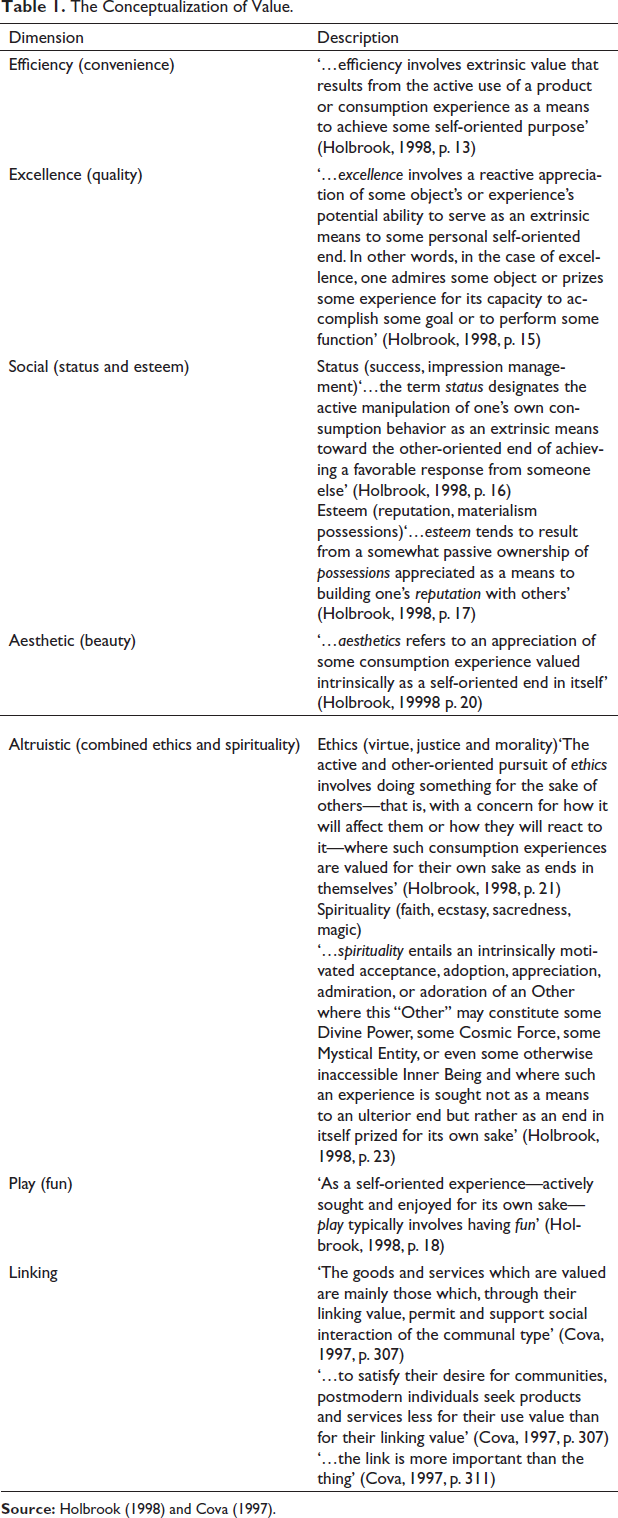
This typology outlines dimensions of efficiency, excellence, status, esteem, play, aesthetics, ethics and spiritually where ‘one can understand a given type of value only by considering its relationship to other types of value’ (Holbrook, 1998, p. 4). The distinction between status and esteem has the ‘fuzziest demarcation’ (Holbrook’s 1998, p. 17), and the ‘closely related categories’ (Sánchez-Fernández et al., 2009, p. 6) of ethics and spirituality were respectively combined into social and altruistic value, creating six value dimensions (Sánchez-Fernández et al., 2009). This conceptualization of value underpinned Ture’s (2014) study of how consumers derive value-in disposition and reflects value’s multidimensional nature in peer-to-peer social media-based e-commerce (Saarijarvi et al., 2018).
Recent attention has focused on linking value to a community or tribe (Cova, 1997). Closet sites are localized to a city or neighbourhood and may share a sense of ‘we-ness’ or ‘co-constructed shared aggregate selves’ (Belk, 2013) or a ‘shared self’ in disposition (Lastovicka & Fernandez, 2005). A sense of belonging and seeing members as partners contributes to platform loyalty of secondhand redistribution networks (Abbes et al., 2020). Products for sale can provide a symbolic ‘linking value’ (Cova & Cova, 2002), and style is a ‘connective tissue’ as clothing is a strong marker of collective values and community lines (Enwhistle, 2015). Ethically and spiritually, the sociality of deconsumption through buying used clothes links individuals together in an ephemeral consumer tribe (Cova, 1997) or ethical community (Arvidsson, 2011). They possess a shared vision of life and style. Disposal conduits are ‘doors’ and consumers act as ‘doorkeepers’ in the ‘absent presence’ of secondhandness; ‘a hand that moves value on’ (Hetherington, 2004, p. 171). These dimensions of value are outlined and defined in Table 1.
The Conceptualization of Value.
Method
This study’s objective is to gain an in-depth understanding of how closet cleaners create value-in disposal through clothing resale while closet cleaning and taking over for a nominal fee an established Instagram closet cleaning page.
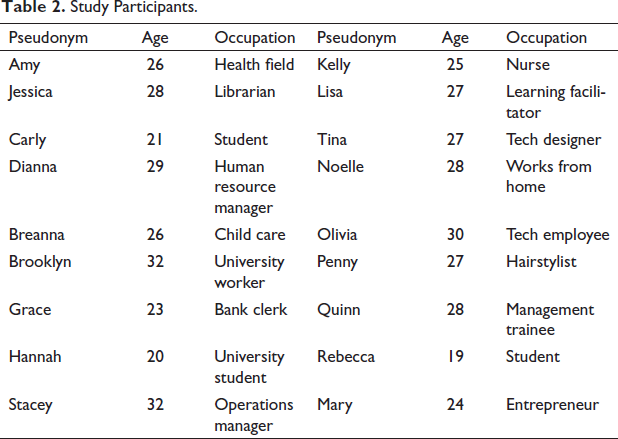
Interviews were used to explore disposal as inseparable from consumers’ lived experience (Belk, 1988; Young & Wallendorf, 1989) and require study of ‘changes in values and meanings attached to material possessions’ (Cherrier, 2009, p. 328). It was decided the best way to locate active closet cleaners was to interview consumers who had taken over an existing closet cleaning page on Instagram, instead of their self-created page. This meant sellers took over a closet cleaning page with an established following for a period of 2 days for a nominal fee of $20, instead of selling clothes on their own individual Instagram pages. Interviews consisted of open-ended in-depth interviews with consumers. Potential respondents had to ‘takeover’ a closet cleaning page within the previous 3 months to aid recall. Purposive sampling and later convenience sampling were used to locate potential respondents. Potential respondents were initially contacted through Instagram’s direct messaging function and invited to participate. In total, 18 interviews were conducted, which is sufficient to reach theoretical saturation (Boddy, 2016). Interviews were conducted in a major Canadian city over the period of Spring 2020 to the Summer of 2022.
The interviews were guided by a few preplanned questions relating to the consumer’s lifeworld and their experiences of using a closet cleaning page to generate self-narrated disposal ‘stories’ (Thompson, 1997). Participants were asked to describe themselves, why and how they took over a closet clean out page. The brands, types of clothing, their user-name, profile description and demographic information were also collected. Details of the 18 participants are in Table 2. Interviews were audio recorded and transcribed, creating nearly 300 pages of documentation for analysis.
Study Participants.
Using a grounded theory approach (Charmaz, 2008), the overall aim of analysis and interpretation, following the guidelines of Spriggle (1994) and Thompson (1997), was the vertical generation of theory, rather than horizontal generalizability (Braun & Clarke, 2013). Interview transcripts were read multiple times to sensitize researchers to the broad essence of narratives. Line-by-line open coding with short active codes (Charmaz, 2008) and coding with gerunds (Glaser, 1978) was used to ‘break into’ the data with microanalysis (Corbin & Strauss, 2008). Focused coding was used raise shortcodes into categories as these, ‘lower-level concepts, fill in, explain, tell us something about who the person was and give us some of the properties and dimensions of “locating the self”’ (Corbin & Strauss, 2008, p. 165).
The narrative accounts of their lived experiences of Instagram closet cleaning were, after many readings, searched for patterns and similarities. This involved textual and intertextual analysis (Thompson, 1997) to gain an empirically grounded and holistic understanding of closet cleaning disposal practices on Instagram in consumer’s consumption cycle.
The literature on disposition, identity, sharing, sustainability, changing notions of ownership, the Maire Kondo effect and digital–virtual goods provided initial sensitizing concepts (Blumer) and initial questioning provided a ‘point of departure’ (Charmaz, 2006, p. 100). However, after initial coding, notions of ‘value’ emerged from the data and the literature was consulted again. While striving to maintain a balance and openness between theoretical sensitivity before exclusively committing to a preconceived theory and losing the ability to ‘see around’ (Glaser & Strauss, 1967, p. 46), it emerged these notions could be ‘anchored’ (Charmaz, 2006) in Holbrook’s extant substantive typology of value in digital disposal, as the study moved to theoretical sampling. Holbrook’s conceptualization of value was applied as it is ‘the most comprehensive approach to the value construct because it captures more potential sources of value than do other conceptualizations’ (Sánchez-Fernández et al., 2009, p. 97), and ‘multidimensional approaches are needed to adequately capture the complexity of consumers’ value perceptions’ (Leroi-Werelds et al., 2014).
The fit of the value in conceptualization (Holbrook, 1998) to Instagram closet cleaning was evaluated by the capability of the conceptualization to deliver a clear account of the data (Glaser & Strauss, 1967), tested by constant comparison within the conceptual framework to answer the research question (Corbin & Strauss, 2008; Goulding, 1998). Table 3 shows how conceptualization is derived from and supported by the data, an essential component of grounded theory (Goulding, 1998).
Themes of Value in Disposition.

Findings
The findings explicitly reveal that closet cleaners on Instagram derive value in disposition based on the dimensions of Holbrook’s (1998) conceptualization of value. The description section is organized according to Holbrook’s (1998) classification of value as detailed in Table 1.
Efficiency is demonstrated in many ways: The site was easy to use, and clothing is sold quickly. The site was better (had more followers) than other closet cleaning pages, ‘…so that way you don’t really have to market’ (Rebecca). Efficiency was summed up by Tina who stated, ‘I just I really like the convenience of it’.
Excellence is manifested by the high quality of the clothing offered for sale: ‘A lot of it was nice stuff that we didn’t necessarily want to donate because I spent so much money on this and it’s in such good condition’ (Carly). It was too good to be donated but good enough to monetize through selling. Efficiency was further enabled by the page’s increased selling performance compared to selling clothes individually, the absence of a limit on the number of items that could be sold, and it performed better in user experience than other digital disposal conduits, such as Facebook Marketplace.
Social value was exhibited by ‘being seen to be green’, which was closely linked to the altruistic moral act of boycotting fast fashion and the esteem of having good taste, as other people desired clothing that sellers considered as being more worthless. This is shown by:
‘I always do #Sustainable living and #Slow fashion. My two, motto things that I fall back on all the time. I think that sums it up’. (Dianna)
Aesthetic value came through the design elements of the page and the inherent aesthetic of the clothes and clothing brands offered for sale:
‘You know, iron fold steam, whatever I need to do to make them look the most presentable. That’s another thing I’ve noticed is sometimes stuff doesn’t sell just because it’s wrinkly. Like, it’s not aesthetically pleasing’. (Penny)
The technology added to the importance of the photographed moments that displayed the clothes and was an enabler of value:
‘I do care about the picture. I’ll try and take really good pictures with like several angles. And this last time I did videos of every single garment. So, a bit like turning and then me wearing it. So, people could get a sense of what it was’. (Mary)
Altruistic value arose from the moral act of cutting out fast fashion, downsizing and pursuing sustainability, and the ranking of the disposal method on goodness compared to other disposal outlets such as donating to charity shops. The quest of doing good and being concerned with the future produced a spiritual component of altruistic value.
‘I’m trying to, like break the cycle of fast fashion, and also try and force myself to not buy trends, because it’s like, not sustainable. I don’t want to like, add to the ethical issues of shopping fast fashion’. (Olivia) ‘I’m trying to break the cycle of fast fashion, and also try and force myself to not buy trends, because it’s not sustainable’. (Mary)
Play was derived by seeing the act of closet cleaning as a gamble or game of chance, adapting various roles such as an entrepreneur or salesperson, and the sheer fun of pleasurable play of selling clothes:
‘So yeah, you’re like a shift worker or a substitute teacher or something where you just kind of like pop in and pop out and nobody ever really sees you again’. (Stacey) ‘I really like the shopping part of it, the finding of things, the finding of treasures, the going through the garbage bag of consignment clothes. That part is really fun for me’. (Hannah)
Cova’s (1997) linking value, not highlighted under Holbrook’s (1998) value conceptualization, came from the local feel of the page, the page being seen as a consumption community, and the sense of ‘we-ness’ of cutting out of fast fashion.
‘It’s all really like-minded people who follow it and sell on it’. (Penny) ‘There’s a little community where if you have a sale coming up, I might reach out to somebody who just did one and be like, “What was your experience? Do you have any advice?” And usually people are, like, really friendly and really eager to share’. (Stacey)
Linking value arose from doing a joint takeover: ‘I was too shy to do it on my own, and so finding somebody who was just as game as I was to try this out for the first time was a big part of it as well’. (Hannah). Interestingly, the COVID pandemic reduced the opportunities for social value and for developing a sense of community during the personal interaction of picking up the clothes from the seller: It was a ‘touch and go affair. They just want to get the thing and leave’. (Amy); there was a ‘Social awkwardness of pick up’ as it was a ‘a quick exchange’, and buyers called by their Instagram name (Carly).
Discussion
This study contributes to the value creation literature by exploring the creation of value in digital disposal, specifically closet cleaning on Instagram, and makes the novel application of Holbrook’s dimensions of value in online disposal processes. Instagram is a convenient and efficient way to sell clothes, and results show that closet cleaners were ‘Planned Disposers’ (Harrell & McConocha, 1992), and their pages are a ‘media of value’ (Ture, 2014, p. 68). In the excellence category, the goods are recognized as such because they are deemed to be too good to merely give away. The platform also provides excellent opportunities for disposal such as getting money back, ease of use and number of potential purchasers. This expands the excellence dimension to explain how the goods as well as the platform, both matter in this context.
There is limited status presented through, adapting Griskevicius et al. (2010), showing off and ‘being seen to be green’, while pursuing voluntary simplicity (Etzioni, 1998; Shaw & Newholm, 2002). However, there is social value in terms of disclosing and sharing personal information. If unsold clothing is donated, certain disposal channels are seen as more ethical and worthy than others, increasing perceived social value.
There is a shift to cutting out ‘stuff’ and caring for the environment. Thrifting is outwardly ethical—it is a means to shop sustainability with educated consumerism. Inwardly, it becomes a fashionable and fun way to find cool clothing, which underlines ‘Köpskam’, a Swedish term for ‘shame of buying’. Instagram closet pages are a visible means of signalling they have chosen voluntary simplification while providing a way for users to create a visual of their ability to be green. The pursuit of thrift in itself is a moral act (Miller, 1998), and thrift shopping is ‘highly moral’ (Bardhi & Arnould, 2005) as it involves ‘sacrificing the new’ by shopping secondhand. There is a quasi-spiritual quest to cut out fast fashion and being unable to get rid of really precious items, and the closet cleaner is both a simplifier and an environmentalist (Etzioni, 1998) or ethical simplifier (Shaw & Newholm, 2002). They achieve a spiritual value on quest for sustainability, and boycotting fast fashion is seen as a moral and ethical act.
There is personal pride and aesthetic value in presenting and/or displaying and photographing the items. The photographed moment transforms the pre-owned item into precious stock (Denegri-Knott & Molesworth, 2009). The possession ritual of photographing possessions (McCracken, 1986) or the photographed moment has extra significance in clothing disposal using Instagram closet cleaning pages as Instagram is a visual medium and fashion marketplace that involves photographing clothes that the consumer wants to be moved along. Digital photographs have ‘become part of a constant flux of images and representational strategies’ (Calderia, 2016, p. 135).
The effort necessary to carefully select one’s goods and maintain a minimalist aesthetic, as well as the ability to express limited consumption—rather than a result of circumstances—could reasonably lead to inferences of status in the eyes of others (Wilson & Bellezza, 2022). Linking value is created by shared sense of ethical we-ness for sustainability. Feeling lonely intensifies consumers’ liking for secondhand goods as lonely consumers’ desire to symbolically connect with previous owners (Huang & Fishbach, 2021). This logic may apply to buyers and sellers closet cleaning, especially during the pandemic.
There were elements of pleasurable play accompanied by mainly arduous work as shoppers’ thrift for fun to realize consumer fantasies and to pursue the unexpected (Bardhi & Arnould, 2005). ‘…they like to play shopkeeper; taking beautiful pictures, displaying their objects appropriately, setting prices, negotiating and so on’ (Cerio & Debenedetti, 2021, p. 585). Disposition by selling is a game to them. The value of play lessens as the intensity increases. It starts as ‘enchanted prosumption’ and shifts to ‘disenchanted presumption’ (Denegri-Knott & Zwick, 2012). Early stages in the sequence of play include anticipation, surprise and pleasure (Eberle, 2014). These early stages are present before it turns into work. The technology increases intensity. The slow setting aside of items, waiting for the takeover and the hectic actual time of the takeover is stressful—a lot of work and organization that is often underestimated. This moving along starts playfully with the delight, charm and convenience of Instagram, but as the intensity of digital disposal through closet cleaning on Instagram increases, it shifts to become work.
Instagram closet cleanout pages represent the digitization of a mundane market (Hagberg & Kjellberg, 2020), the fashion market (Schöps et al., 2020) and the disposal process. Research into the effects of this digitization on the disposal process in this new market setting is needed. From a CCT perspective, Instagram is a visual digital marketplace and market space (Schöps et al., 2020) where ‘visual and textual conversations among market actors on Instagram potentially transform shared understandings that constitute the fashion market’ (p. 195). ‘A locale where market-level dynamics result from visual “micro” performances, and vice versa visual performativity’. Instagram aims to create a visual representation of triumph (Verdina, 2013), such as desirable objects acquired through consumption; this fleeting ‘aesthetic harmony’ (Tortorici, 2020) may be contradicted undesirable objects that consumers have earmarked for disposal.
Limitations and Future Research
The risk of confirmation bias by coding the data into forced categories (Glaser, 1992) of Holbrook’s typology of value must be recognized, especially when a single substantive area is used. However, the researchers did not start with the aim of studying value in disposition as the concept emerged from the data during the initial coding, and the value literature was then consulted to provide more theoretical grounding to the emerging insights as per grounded theory (Charmaz, 2006).
The findings may have limited generalizability beyond the context of Instagram closet cleaners, but it does answer the call for more context-specific studies (Stremersch et al., 2023). The findings may be specific to the era of the COVID pandemic. The pandemic limited the opportunities for social and linking value, and these may be underestimated in the findings. The interviews were conducted with young and relatively young people. If other age groups were studied (Generation X, Generation Y), the results could differ significantly. The co-cocreation of value in disposal and in social media was overlooked. The study only looked at sellers but in the ‘valuescape’ (Nojd, 2020) sellers interact with buyers, followers and digital technology to co-create value on Instagram (Casalo et al., 2020). If sellers can be seen as micro-influencers, their homophily with buyers can co-create value (Bu et al., 2022). Future research can adopt the service-dominant logic (Vargo & Lusch, 2004) to study value co-creation in digital disposal. The disposal process has become digitized, but the active and working role of consumers as marketers and sellers has been ignored (Turunen et al., 2020).
Instagram closet cleaning pages disrupt the traditional linear pipeline model of value creation, ‘creating a complex web of value-creating interactions’ (Wichmann et al., 2022, p. 185), and new methods for creating value, meaning these frameworks must be updated for the digital era. Future research can move value-creating frameworks and dichotomies into the digital era, especially regarding the value-enhancing capabilities of digital platforms with a specific focus on disposition.
Concluding Comments
Research on disposal using digital platforms exists (Denegri-Knott & Molesworth, 2009), but little is known about the role of social media, especially Instagram, in the context of value creation in consumer-to-consumer clothing disposal process. More qualitative studies are needed to assess the ‘elusive and complex’ construct of consumer value derivation (Gallarza et al., 2011), especially in disposal behaviour where research is still limited (Alevizou et al., 2021; Ture, 2014). This study explicitly analyzed the derivation of value in disposal in the new digital disposal conduit of closet cleaning pages on Instagram. Closet cleaning is a timely topic with important personal and social meanings, and the value typology can be a useful framework for the analysis, interpretation and meanings of consumer responses on the topic of closet cleaning. This study empirically validated Holbrook’s (1998) conceptualization of value and reveals to managers that value in disposal is multidimensional and is derived from many avenues.
Footnotes
Declaration of Conflicting Interests
The authors declared no potential conflicts of interest with respect to the research, authorship and/or publication of this article.
Funding
The authors received no financial support for the research, authorship and/or publication of this article.
