




Abstract
This research aims to understand customer motivations to display customer citizenship behaviour in the emerging market setting of Egypt. It develops and empirically tests the multidimensional perspective of online experiential value (grounded in the theory of consumption value) and customer citizenship behaviour to determine customer motivations to become company citizens on social media brand pages. Using an online self-administered survey, 294 responses were collected. Data were analyzed using structural equation modelling to achieve the research objectives. Findings confirm there is a positive and significant relationship between online experiential value and customer citizenship behaviour on social media brand pages. This research contributes to the literature by providing an understanding of how to employ the online experiential value dimensions to drive customer citizenship behaviour. The findings of this research will help marketers build effective social media marketing strategies where they provide customers with the five essential components of online experiential value necessary to establish customer citizenship behaviour.
Keywords
Introduction
Within the recent view of experiential value, there has been a shift from the common cognitive perspective to recognize the value in the context of customer experience (Heinonen et al., 2013). Studying experiential value in the online context is quite important as virtual experiences are perceived to be valuable to consumers, which in turn facilitates positive consumer behaviour towards the brand (Dirsehan & Tor Kadıoglu, 2023). Interactions between the firm and the customer led to a dialogue for information seeking, information sharing, giving feedback to other customers, and acting as a citizenship agent for the firm (Shamim et al., 2017). This aligns with the conceptualization of interactional creation, where interaction forms a crucial part of the customer value co-creation experience (Ramaswamy & Ozcan, 2018).
Numerous research has been conducted on the role of social media in marketing; however, little research has studied the innovative potential of social media to drive customer citizenship behaviour (Mitrega et al., 2022; Ramaswamy & Ozcan, 2018). In the new age of interconnections catalyzed by technology and digitalization, it is crucial to study online customer experiences and the role of firms in motivating positive customer behaviours such as value co-creation and customer citizenship behaviour (Shahin et al., 2022). Further calls for research have been to explore the dynamics of social media and the implications offered for value creation (Hollebeek et al., 2023) to apply new ways of cooperation with customers and other stakeholders (AlSharji et al., 2018).
Considering the above, this research is designed to address the research gap concerning the innovative potential of social media in driving customer citizenship behaviour. Through examining the role of experiential value in displaying customer citizenship behaviour on social media, this research combines the theory of consumption value (Sheth, 1991) with value in the experience perspectives (Carlson, Rahman et al., 2019; Heinonen et al., 2013; Helkkula et al., 2012), in addition to the multidimensional perspective of customer citizenship behaviour. The contribution of this research lies in expanding the value co-creation behaviour literature, by applying the theory of consumption value in modern contexts such as social media since technology has a crucial role in transforming customers into citizens in the new age of interconnections catalyzed by technology and digitalization . (Ramaswamy & Ozcan, 2018). Moreover, the practical implications of this research provide marketers with a better understanding of the motivations and influences affecting customer citizenship behaviour. This can then be translated into an action plan combining the five components of value that are recommended to be considered as a fundamental input to forming value in social media brand pages.
Literature Review
Theory of Consumption Value
Through extensive examination of marketing, economics, psychology, and sociology literature, Sheth (1991) introduced five dimensions to constitute the theory of consumption value. These are functional value, social value, emotional value, epistemic value and conditional value, as shown in Table 1. This theory is used to predict consumption behaviour, as well as to describe and explain it. Consumption values are a fundamental method that is crucial for consumer research and consumer purchase decisions, as they show the explicit and implicit reasons and underlying motives (Sheth et al., 1991).
Theory of Consumption Values—Original Dimensions.
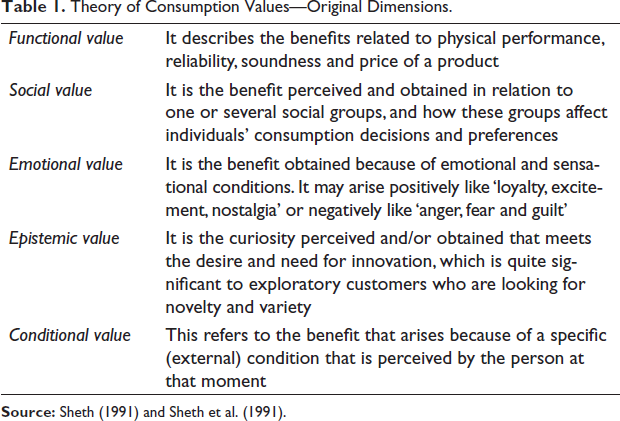
The original theory of consumption value presented a multidimensional perspective of value, which only affected consumption choice decisions. However, experiential value as a cognitive concept may influence other behavioural outcomes too such as brand loyalty, word-of-mouth intentions and overall intention to interact with and support the brand. Therefore, the theory may be extended to include other behavioural outcomes beyond purchase decisions (Lee et al., 2015).
Online Experiential Value
Value has become a fundamental concept in marketing, where it is important to consider the subjective feelings of the customer (Zhao et al., 2019). Previous research has defined value from the view that ‘value resides not in the object of consumption, but in the experience of consumption’ (Helkkula et al., 2012). This definition is particularly relevant within the social media consumption experience because there is a focus on how value is interpreted and perceived due to the interactions with the brand directly, as well as collective interactions (Carlson, Rahman et al., 2019).
These positive experiences that take place as a result of customers’ interactions have a positive impact on their active engagement on social media as they tend to have a greater role regarding participation, giving and receiving recommendations and membership continuance, and eventually translate to customer citizenship behaviour (Larivière et al., 2013). It also continues to be an important means of achieving a sustainable competitive advantage (Kumar & Reinartz, 2016), in addition to positively affecting the financial and non-financial growth of micro, small and medium enterprises (MSMEs) (Fakhreldin et al., 2023). Experiential value has been previously studied as a significant predictor of customer behavioural intentions towards shopping (Keng et al., 2007) in addition to online retailing (Shobeiri, 2011).
Nowadays, consumers seek to become more active in the marketing process; this is because of the ‘power’ given to them by social media to share their thoughts, feelings and ideas (Chapman & Dilmperi, 2022). This power transforms customers to become a source of competence, where their knowledge, willingness to explore and learn and ability to engage in an active dialogue are crucial (Fagerstrøm & Gheorghita, 2013).
As this research studies experiential value on social media platforms, it is crucial to use the latest adoption of the theory of consumption value, proposed by Carlson, Rahman et al. in 2019 (Shekher Bal et al., 2023), which consists of a five-dimension construct: functional value, socialization value, emotional value, innovativeness value and relationship-building value (Carlson, Rahman et al., 2019).
In the context of social media, functional value refers to helpful, practical and useful content (Jahn & Kunz, 2012). This leads customers to increase their usage of this brand page to gain information about the products and services, either from the brand itself or from other customers (de Vries & Carlson, 2014). Informational content is an important driver that leads active users to participate in engaging behaviours such as liking, commenting and sharing posts, in addition to increasing the duration of the interaction (Cvijikj & Michahelles, 2013). Emotional value was found to be a major antecedent of online brand community participation (Madupu & Cooley, 2010), where experiential value triggers specific inner feelings and emotions (Tynan et al., 2014). Customers require access to fun, entertaining and exciting content to fulfil their emotional and hedonic needs (de Vries & Carlson, 2014). Socialization value builds on the main function of social media, where customers interact with each other (de Vries & Carlson, 2014). These interactions were found to enhance customers’ sense of belonging and emotional attachment (Nambisan & Baron, 2009). Innovativeness value is the perception that the social media brand page is novel, dynamic, unique and distinct from competitor offerings (Carlson, Rahman et al., 2019). When the firm gets creative, this excites customers and creates novel experiences that arouse curiosity and drive participation and commitment (de Vries & Carlson, 2014). Relationship-building value offers customers fast responses to queries, easy access, add-on values such as loyalty programmes, and interaction that sustain a long-term relationship (Carlson et al., 2015). Through social media, these relationships can be facilitated through relevant, personalized, live interactions, which in turn further enhances the customer–brand relationship (Carlson, Rahman et al., 2019).
Since the consumption value theory argues that a decision may be influenced by one or all the value components (Carlson, Rahman et al., 2019), this research will consider the above five value components as a representation of online experiential value and will investigate their impact on customer citizenship behaviour.
Customer Citizenship Behaviour
Customer citizenship behaviour means that the customer becomes a ‘good soldier’ by supporting the company and providing help and assistance to employees or fellow customers (Mitrega et al., 2022; Yi & Gong, 2008). It is an extra-role behaviour by customers, which provides an additional advantage to the firms (Yi & Gong, 2013). Consequently, previous literature highlights the extraordinary significance of customer citizenship behaviour in improving service quality and productivity through constructive feedback to help the organization thrive (Bove et al., 2009).
This research adopts the scale developed by Yi and Gong in 2013, where customer citizenship behaviour consists of four dimensions: feedback, advocacy, helping and tolerance. Feedback includes information (that may be invited or uninvited) provided by customers to employees or other customers (Groth et al., 2005). Nowadays, customers offer suggestions to employees, which can result in better service, and to other customers as guidance from their own experience with the firm. Advocacy is the voluntary customer behaviour of recommending the brand to others (Yi & Gong, 2013) reflecting the customer’s commitment to the firm (Bettencourt, 1997). Advocacy through positive word-of-mouth contributes to building a good firm reputation and is often an indicator of customer loyalty (Groth et al., 2005). Helping is voluntary customer participation in supporting other customers, which leads to enhancing their overall brand experience (Yi & Gong, 2013). Customers may extend empathy to other customers by recalling their own difficult experiences and displaying a sense of social responsibility to help other customers who experience similar difficulties (Rosenbaum & Massiah, 2007). Tolerance refers to the readiness of the customer to be patient in case their expectations are not met (Yi & Gong, 2013).
Research Methodology
Research Setting
This research aims to investigate the impact of online experiential value on customer citizenship behaviour on social media brand pages. Data were collected using a self-administered online survey, yielding 294 responses over two months. This research used convenience and snowball sampling to reach the intended number, under the condition that the respondent needs to have a Facebook and/or Instagram account before answering the survey. Convenience sampling has some benefits such as saving cost and time and ensuring an appropriate selection of target respondents, while it also has drawbacks such as generating a non-representative sample. The snowball sampling method is a well-known non-probability sampling method that helps in spreading the survey among the target sample who share some common interests (Saunders et al., 2019), which is highly efficient, especially on social media platforms, where one respondent shares the survey with their network (Johnson, 2014).
Since this research was carried out in Egypt, it was important to select the most popular social media platforms in the country. With steady growth rates and no signs of slowing down, Egypt holds the highest number of Facebook users in the region. As of May 2023, over 55.4 million have been recorded as daily active Facebook users in Egypt (Digital 2023, Statista, 2023a; WiseVoters, 2023). The largest age group for Facebook usage is currently 18–24, followed by users aged 25–34 (Chen, 2022). Instagram is the second most popular social media platform in Egypt with a total number of 19.2 million users, as of May 2023 (Statista, 2023b). Because of its dependence on visual content and images, Instagram is considered a fertile environment for fashion, events and the travel industry (Bjurling & Ekstam, 2018). Additionally, Instagram is considered to have the highest engagement rates among social media platforms (Chen, 2022). Therefore, Facebook and Instagram are selected to fit the context of this research as they have the largest number of active users and the highest engagement rate, respectively (Chen, 2022; Digital 2023). Moreover, both Facebook and Instagram provide enough tools that allow companies to share relevant resources in the form of experiential value, in addition to facilitating user interaction with the firm and with other customers as well as displaying citizenship behaviour. Accordingly, both platforms are deemed suitable to achieve the research objectives and to investigate the impact of online experiential value on customer citizenship behaviour.
Sample Profile
The sample comprised 28 per cent males and 72 per cent females. Regarding the age of respondents, around 43 per cent were from the age of 25 to 34 years while 24 per cent were from 18 to 24 years, which means that over 67 per cent of the sample is under the age of 34. The sample age distribution precisely reflects the social media population in Egypt; as it has been reported that over 45 per cent of social media users in Egypt are aged below 34 years old (Kemp, 2021). Moreover, over 60 per cent of Facebook and Instagram users are aged between 18 and 34 years old (Chen, 2022; Statista, 2021). This shows that the research sample needed to have more youth to present the population accurately.
Data Analysis
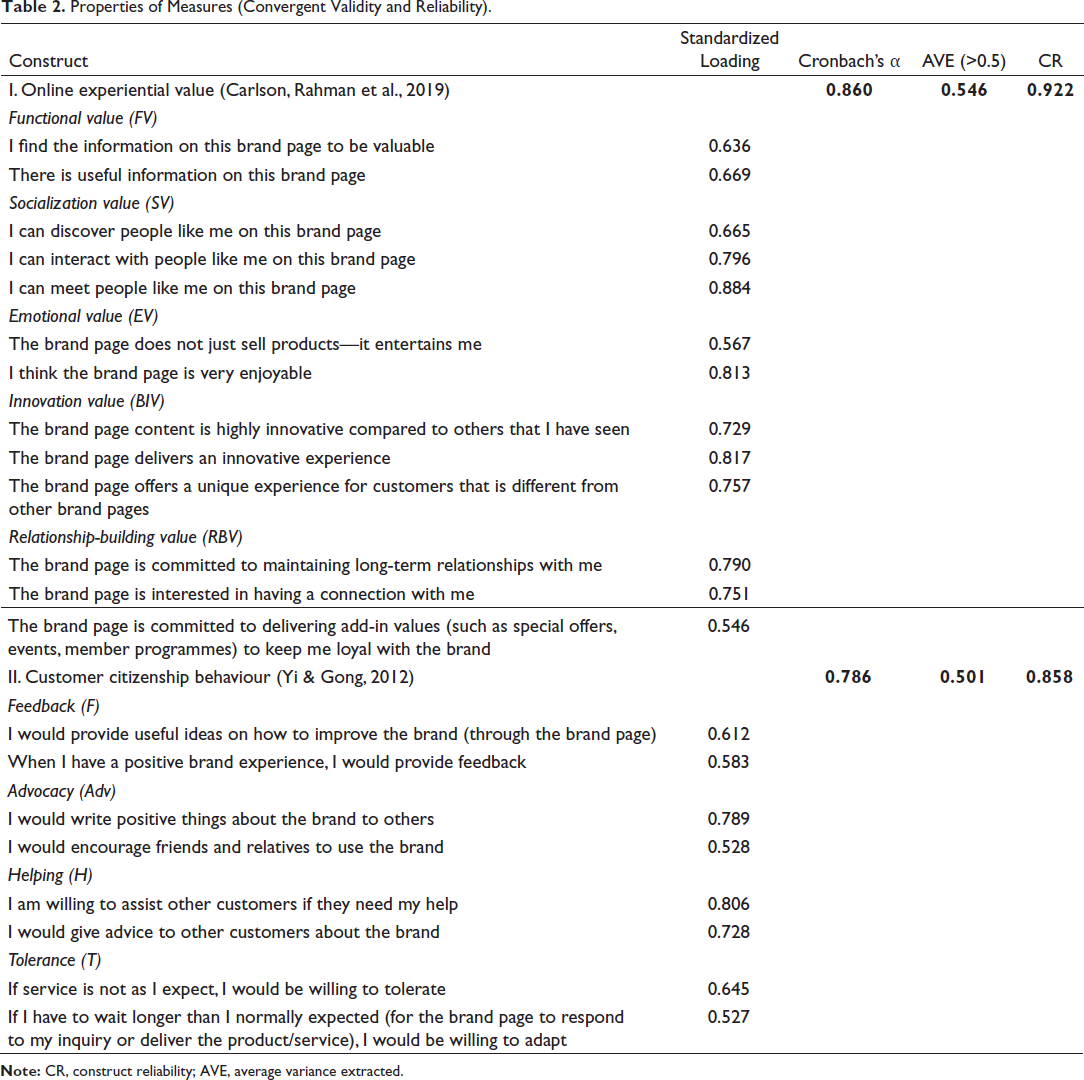
To ensure content validity and reliability, all measurement items were adapted from existing literature (Carlson, Rahman et al., 2019; Yi & Gong, 2013). Modifications of all items ensured fit with the social media context. All variables employed a five-point Likert scale ranging from 1: Strongly Disagree to 5: Strongly Agree. SPSS V.23 was used for the descriptive statistics of all variables and confirmatory factor analysis (CFA) to assess the construct’s validity. Table 2 shows the convergent validity and reliability. To determine convergent validity, standardized loading estimates have been computed for all variables (ranging from 0.527 to 0.884), and all showed values higher than 0.5, which indicates the satisfied convergent validity of the measurement model (Hair et al., 2010). As recommended by Malhotra (2011), Cronbach’s alpha should be calculated to test the reliability of data and should be 0.7 or higher. The Cronbach’s alpha for online experiential value is 0.860 and for customer citizenship behaviour is 0.786, which means the questionnaire is reliable.
Properties of Measures (Convergent Validity and Reliability).
Structural equation modelling was used as it represents a suitable approach to empirically test the proposed framework. It has been widely used in several research studying similar topics such as the relationship between customer value co-creation and positive brand experience (Shamim et al., 2017). For this research, AMOS V.23 is employed to investigate the causal relationships, where the path coefficients are tested for significance and goodness-of-fit indices. The overall model fit measures were used to evaluate the fit of the structural model.
Findings
Overall, the model shows a satisfactory fit. Table 3 presents the results of the individual test of the significance of the effect of online experiential value on customer citizenship behaviour. It explains that online experiential value leads to customer citizenship behaviour, accounting for 76 per cent of its variance (unstandardized estimate). These results show that the relationship is supported as online experiential value has a positive and significant impact on customer citizenship behaviour (β = 0.46, p < .001). Furthermore, the model shows that relationship-building value has the highest impact on formulating the latent variable: ‘online experiential value’ (β = 0.91), followed by emotional value (β = 0.89), then innovativeness value (β = 0.87), functional value (β = 0.75) and finally socialization value (β = 0.43). Also, the latent variable: ‘customer citizenship behaviour’ is affected highly by feedback (β = 0.96), followed by advocacy (β = 0.94), helping (β = 0.82) and finally, tolerance (β = 0.71).
Maximum Likelihood Estimates of the Proposed Model and Model Fit Statistics (n = 294).
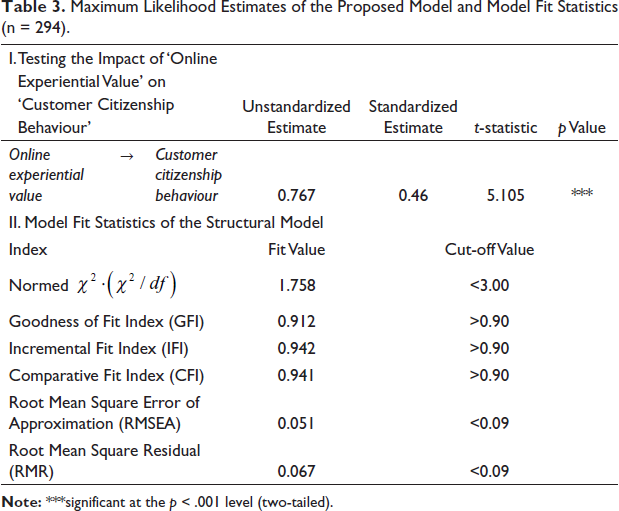
The model fit indices of the structural model and the cut-off value of those fit indices are also presented in Table 3. For example, the Goodness of Fit Index (GFI), Incremental Fit Index (IFI) and Comparative Fit Index (CFI) have values of 0.912, 0.942 and 0.941, respectively. This is acceptable as their cut-off value should be above 0.90. It can be concluded that the structural model was a good fit and it is confirmed that the impact is positive and statistically significant at the significant level of p < .001.
Discussion
This research aimed to investigate the impact of online experiential value on customer citizenship behaviour on social media. Results show that if customers perceive more experiential value on the social media brand page, they will be more willing to display customer citizenship behaviour. This leads to more benefits to the company itself as well as to other potential customers. These results are consistent with previous research, which found that experiential value in luxury hotels has a positive impact on customer citizenship behaviour (Lin & Choe, 2022). Moreover, a positive relationship has been established between perceived value and customer citizenship behaviour in cause-related marketing on social media (Deng et al., 2023).
Customers feel appreciated when the brand page acknowledges their post and re-shares it, which pushes them to repeat the behaviour because of the emotional value experienced. This is justifiable as most Egyptian consumers lean to use their affection instead of their logic, especially in online shopping behaviours (Tahawy, 2019) in addition to engaging more with the content and brands that they already love (EgyptInnovate, 2017). Moreover, some customers reported their initiative to support good products and companies (especially start-ups) through sharing reviews/pictures on their own accounts. By providing direct feedback to the company about potential improvements to offerings and brand experiences, those customers influence their social network and create an innovative experience through relationship-building value. This is in line with the findings of Carlson, Rahman et al. (2019) and Carlson, Wyllie et al. (2019). Furthermore, the socialization value is highly important as customers seek other customers’ advice and/or are happy to receive reactions from others on their posts, which is the core purpose of social media.
Since this research was carried out in Egypt, there emerges the need to reflect on the Egyptian culture and display customer citizenship behaviour. Egyptians tend to rely on centralized authority; this happens through the apparent contrasts in social class, occupation and education (Hofstede Insights, 2022). Therefore, some customers are more likely to be more patient and endure failure from certain brands (Abdelaziz et al., 2021). Moreover, Egyptian consumers are attracted to their known trusted brands to which they feel they belong (Hofstede Insights, 2022). This leads to setting low expectations as they are more loyal to the brands they trust and follow on social media, in addition to having less tendency to switch their favourite brands to avoid ambiguous situations. This is supported by previous literature on Egypt which states that high uncertainty avoidance is found to be associated with a stronger effect on the creation of brand trust online (El Said & Galal-Edeen, 2009).
Conclusion
This research aimed to investigate the impact of online experiential value in displaying customer citizenship behaviour on social media, in the emerging market setting of Egypt. It combined the theory of consumption value (Sheth, 1991) with value in the experience perspectives (Carlson, Rahman et al., 2019; Heinonen et al., 2013; Helkkula et al., 2012), in addition to the multidimensional perspective of customer citizenship behaviour.
Theoretical Implications
Several contributions to theory may be implied from this research. First, it contributes to the emerging body of literature to advance the theory of consumption value through studying the impact of online experiential value on different behavioural outcomes other than purchase behaviours. Previous literature has focused on studying the theory’s effect on purchase decisions solely (Lee et al., 2015; Zailani et al., 2019), while it can be extended to other behaviours as well. Moreover, this research extends the theory to be applied in modern contexts such as social media.
Another contribution of this research is that it directly responds to the research gaps proposed by Zhao et al. (2019), Carlson, Rahman et al. (2019), Carlson, Wyllie et al. (2019) and Hollebeek et al. (2023), where further research needs to focus on social media consumption experiences in emerging and understudied markets while examining the concept of customer citizenship behaviour. It also responds to Ramaswamy and Ozcan (2018) who called for research to study the concept of online customer experiences through the new age of interconnections catalyzed by technology and digitalization. Moreover, this research adds insight to the literature from a different geographic market where there is scarce research (Carlson, Rahman et al., 2019) despite the rising number of social media users in it, in addition to the difference in customers’ nature from other developed regions.
Practical Implications
The findings of this research provide implications on how brands can utilize new technologies to deliver innovative customer experiences and motivate their customers to display customer citizenship behaviour on social media. Effective methods to promote citizenship behaviours are crucial to gaining a competitive advantage and establishing sustainable management strategies in a highly competitive market (Abdelaziz et al., 2021; Chapman & Dilmperi, 2022).
Based on the research findings, marketers will have a clearer understanding of the motivations affecting customer citizenship behaviour, to help them effectively operate and manage their social media brand pages. Moreover, since online experiential value depends directly on five value components, marketers need to develop appropriate marketing strategies that touch upon all of them and ensure their proper delivery.
First of all, since relationship-building value has the highest impact in formulating a better online experiential value, firms may stimulate community discussions such as posing interesting queries, encouraging content generated by users and public acknowledgement of regular contributions. This presents an opportunity to engage with key opinion leaders and social media influencers, so the brand may be associated with trusted personalities that the target audience can relate to (Shaker et al., 2021). Emotional value also plays an important role, where the prerequisites for citizenship behaviour are an affective experience state (fun, enjoyment and entertainment). Findings of this research have shown that customers feel appreciated when the brand page re-shares their post, which leads to increased emotional value. Emotional engagement is specifically dominant in industries such as fashion and cosmetics (Merrilees, 2016). This presents an opportunity to enforce brand values and synchronize the core message of the brand through connecting content and emotion, perhaps through using fashion lessons and advice, and/or videos supporting a cause. Innovativeness value also constitutes higher online experiential value and helps in differentiating the brand as one that provides novel and innovative experiences. Companies should focus on delivering content through technological features to deliver an exciting experience, such as live streaming and 360° photograph capability. Functional value could also be enhanced by assuring that the company’s page transforms to become a resourceful platform for the customer to solve brand-related problems. Finally, socialization value is considered the core purpose of social media, where customers ask for recommendations/reviews to purchase or use certain products, and other existing/potential customers answer them. This presents an opportunity that if customers display citizenship behaviour, they will engage in positive word of mouth and become loyal advocates for the company.
By identifying the factors motivating customers to display citizenship behaviour on social media, companies may build more effective social media marketing strategies to provide customers with the essential components of online experiential value. Each of the five value components needs to be enhanced separately, in order to maximize the display of customer citizenship behaviour among customers.
Research Limitations and Recommendations for Future Research
It is important to acknowledge the limitations of this research, which may provide a starting point for further research. First, the survey was distributed in Cairo, Egypt, and although the sample size is acceptable, it is recommended that future research investigate more diversified customers to make the sample more representative. Second, the research framework offers a theoretical basis for the antecedents of customer citizenship behaviour; however, it only studies the impact of online experiential value. Future research may incorporate novel elements into the framework to broaden its applicability within the field of marketing. This may include studying additional antecedents of customer citizenship behaviour and extending the research framework to include the influence of individual factors (such as extraversion and self-efficacy), environmental factors (such as user experience) and brand factors (such as brand congruity). A comparative study among different cultures may also provide remarkable input regarding targeting strategies. Moreover, the comparison of customer citizenship behaviour using different social media platforms may generate interesting insights that will help understand any variability across different customer personas.
Footnotes
Declaration of Conflicting Interests
The author declared no potential conflicts of interest with respect to the research, authorship and/or publication of this article.
Funding
The author received no financial support for the research, authorship and/or publication of this article.
