




Abstract
This study examines the effect of digital marketing capability, relational capability, market knowledge capability and value creation agility on business performance. This study includes 312 owners or leaders of fashion retail small and medium enterprises in Central Java, Indonesia’s respondents. The data obtained were analysed by using the structural equation model. The results show that digital marketing capability, relational capability and market knowledge capability affect value creation agility and business performance. Furthermore, value creation agility affects business performance.
Keywords
Introduction
Digitalization in marketing practices is carried out by integrating telephone, Internet, cellular technology to build communication with suppliers, customers and channel partners (Coreynen et al., 2016; Yoo et al., 2012). Digitalization can strengthen trends in business practice and sometimes obstacles occur due to limited digital mastery (Day, 2011; Kane et al., 2015) and it is also a transformation of organizational functions and business processes (Sinkovics et al., 2013).
Fashion small and medium enterprises (SMEs) face the problem of competition and mastery of information technology. The dominance of fast-changing style elements requires a quick response to create the best value for customers. Haksever et al. (2004) stated that value is an activity to satisfy needs and provide benefits to partners. Value is easy to obtain if business actors have the agility to create value that provides mutual benefits. Value creation is a proactive, conscious and inspiring action that enhances all goodness in the value of goods, ideas and services for all stakeholders and social organizations. Value creation has been widely investigated by previous studies such as Haksever et al. (2004) on value creation (financial, non-financial and time), Uddin and Akhter (2012) on inter-firm value creation, Banyte and Dovaliene (2014) and Nuryakin et al. (2018) on value creation in customer engagement. However, this study focuses on value creation agility.
The adoption of e-commerce can provide convenience for SMEs in market development, sales promotion efficiency, easy access to new customers and cost efficiency (Kaynak et al., 2005). Effective use of e-commerce will encourage the realization of the best value creation agility for customers. Previous studies showed that digital marketing capability improves business performance (Wang, 2020), while digitalization has not increased profitability (Niemand et al., 2021). Moreover, the improvement of business performance does not always need IT competence support (Chakravarty et al., 2013).
Previous studies found that relational capability can strengthen business performance by providing the best value for (Erdélyi et al., 2010; Farida & Nuryakin, 2021; Mitrega, 2012; Nuryakin et al., 2018). Close relationships make it easier to identify customer needs and encourage the creation of the best value creation agility for customers. Relational capability has a negative effect on SMEs’ performance, because SME leaders are still not optimal in building trust, communication and negotiation with partners (Salisu & Abu Bakar, 2019). Likewise, market knowledge is an organizational asset that is the key to a company’s competitiveness (Jia-Jeng & Ying-Tsung, 2010) and improves business performance (Hughes et al., 2008). Previous studies found that business performance is not always influenced by market orientation (Gholami & Birjandi, 2016; Mahmoud et al., 2016).
Previous studies have given inconsistent results, thereby the relationship between digital marketing capability, relationship capability, market knowledge capability, value creation agility and business performance is critical to study. Research findings will provide solutions on differences in the results of previous studies and have theoretical and practical implications. Therefore, it is possible for value creation agility to strengthen business performance.
Literature Review and Hypothesis Development
Value Creation Agility
Based on service dominant logic (SDL), customers become partners who will create mutual value through mutually beneficial exchanges (Vargo & Lusch, 2008). Value is an activity to satisfy needs and provide mutual benefits (Haksever et al., 2004). Value is based on certain beliefs which are related to the value of an idea, behaviour and mutual assessment of a relationship (Mahajan, 2018). Inside the organizations, value is created for employees, customers, business partners, CEOs, communities, companies and stakeholders (Mahajan, 2018). More value creation requires understanding, implementation, exploration and evaluation of the value destruction (Mahajan, 2019). Value creation will occur if interaction with partners is created by sharing resources and information (Vargo & Lusch, 2016). Value creation is a proactive, conscious and inspiring action that enhances all goodness in the value of goods, ideas and services for all stakeholders and social organizations (Mahajan, 2017). Value creation will increase and reduce accidental value destruction if it is done consciously (Mahajan, 2017). Value creation determines the success of product innovation (Gurău, 2015; Sørensen & Jensen, 2015; Viljakainen & Toivonen, 2014), and successful innovation and shared value creation will go hand in hand with the world developments (Drummond-Dunn, 2016). Shared value creation spearheads the creation of economic and social opportunities in creating customer value (Javed et al., 2016). Nuryakin et al. (2018) asserted value added, and cost efficiency and the ability to respond to customer needs quickly will be created if value creation in the company runs effectively. The fact shows that creativity in creating value is one of the drivers of organizational agility (Nemkova, 2017), and organizations that have the capability to respond to environmental changes quickly indicate having agility (Ravichandran, 2018). Organizational agility cannot predict value creation because it was determined by customers (Heisterkamp, 2019). Organizational agility will affect the company’s performance since it can make decisions quickly to respond to market changes (Cegarra-Navarro et al., 2016). The author defines value creation agility as a proactive, conscious, inspiring and imaginative action in dealing with environmental changes to increase benefits and the value of goods and services for business partners and stakeholders.
Digital Marketing Capability and Value Creation Agility
Digital platforms can be used by companies to manage relationships with customers, suppliers, retailers and maintain customers for strengthening business performance (Wang, 2020). E-commerce acts as a means of communication with partners and gathering information for the benefit of market research and product development (Kaynak et al., 2005). Information technology competence supports the creation of adaptive agility and organizational agility (Chakravarty et al., 2013), while agility can help to adopt and gain the value of information technology innovation (Marhraoui & El Manouar, 2017). Agile can help weak teams by providing new enthusiasm, so as not to destroy the value of virtual teamwork (Kramer & Heuvel, 2019). Agile plays the role of integrating adaptive and creative resources for experimentation which enables actors to function dynamically to enhance value creation (Findsrud, 2020). Knowledge applications increase responsiveness to environmental changes, creativity and openness in organizations (Valacherry & Pakkeerappa, 2020). Value creation in an organization plays a role in determining the speed of innovation according to the resources it has (Aron O’Cass, 2013). Value creation is an internal company activity that can provide the best value for its customers (Gurău, 2015). Therefore, companies that utilize digital platforms appropriately to support marketing activities will be easy to communicate and agile to explore the value expected by the customers. Therefore, digital marketing capability has the potential to increase value creation agility.
H1: Digital marketing capability affects value creation agility.
Relationship Capability and Value Creation Agility
Relational capability is needed to share information from receiving orders to shipping products to customers (Lee, 2007). Moreover, value chain efficiency for all customers will be created when the company can respond to customer desires quickly (Wang, 2020). The fact showed that customer loyalty can encourage value creation (Banyte & Dovaliene, 2014). Effective value creation has an important role as a determinant of organizational innovation (Aron O’Cass, 2013). The effective value creation can create value added for customers, for example, improving product and service quality, cost efficiency and customer response speed (Nuryakin et al., 2018), and the involvement of all stakeholders is the key to the success of corporate value creation (Grimonpont, 2016). Furthermore, an agile company will respond to environmental changes quickly (Ravichandran, 2018). Therefore, creating a harmonious relationship with customers will obtain the information that customers need. The speed and agility of responding to customer needs to create the best value for customers will create value creation agility.
H2: Relational capability affects value creation agility.
Market Knowledge Capability and Value Creation Agility
According to Kohli and Jarworsky (1993), market knowledge in the marketing function has an important role to formulate strategies, obtain competitor information and coordinate between departments to formulate and implement marketing strategies. Value creation is needed to create better customer value than competitors, especially product design to delivery of goods to customers (Gurău, 2015). Customer references have an important role in providing value to customers and potential customers (Morgado, 2018), and integrated channel quality has a strong influence on customer perceived value (Kabadayi et al., 2017). Agility will be a driver of marketing performance when decision makers have certain skills to optimize their abilities, including market knowledge (Nemkova, 2017). Value added for customers can be achieved if there is value creation to respond to customer needs, create cost efficiency and improve product and service quality (Nuryakin et al., 2018). Customer responsiveness as a component of organizational agility is a determinant in responding to the speed of environmental change (Ravichandran, 2018). Companies that have the ability to understand market changes will develop appropriate strategies to deliver the best value for customers. The ability to explore market potential, operate flexibly and formulate the right strategy makes it possible to create value creation agility in the organization.
H3: Market knowledge capability affects value creation agility.
Digital Marketing Capability and Business Performance
Digital marketing has a major contribution to improve business performance (De Pelsmacker et al., 2018; Wang, 2020) and digital communication tools can stimulate customer engagement.
Digital marketing can be used to sense the market, build good relationships with customers and build mutually beneficial relationships (Wang, 2020), and digital communication tools can stimulate customer engagement (Amitrano et al., 2018). Marketing capability built through the Internet, such as online advertising and social media, can drive business performance (Alarcón et al., 2018). E-commerce capability tends to increase distribution and communication efficiency so that it increases the company’s performance (Alarcón et al., 2018; Gregory et al., 2017). The ability to utilize e-commerce appropriately tends to increase distribution and communication efficiency which affects the company’s performance.
H4: Digital marketing capability affects business performance.
Relational Capability and Business Performance
Relational capability is a strategic asset and shows the organization’s internal capabilities (Esther et al., 2011; Fazli et al., 2013; Zohdi et al., 2013). Relational capability is necessity for companies to access knowledge through partners to support the speed of the innovation (Smirnova et al., 2011). Furthermore, relational capability can integrate variations of knowledge so that it is easy to obtain customer information. According to Nuryakin et al. (2018), relationship capability can increase business performance by building good communication, coordination and managing business interactions.
H5: Relational capability affects business performance.
Market Knowledge and Business Performance
Hewett et al. (2004) confirmed that market knowledge process can be measured through the ability to respond to customers. Zaim et al. (2013) stated that the creation, development, storage and knowledge sharing have a strong correlation. Therefore, the organization continues to explore new ideas and understand market needs to be better prepared to face environmental changes (Hoe, 2008). The fact showed that one of the keys to maintaining competitiveness is that companies create and share knowledge and develop new market knowledge (Jia-Jeng & Ying-Tsung, 2010). Market knowledge capability is a determinant for understanding customer needs, responding quickly to customer expectations and having an impact on increasing company performance (Hewett et al., 2004; Nuryakin, et al., 2018).
H6: Market knowledge capability affects business performance.
Value Creation Agility and Business Performance
Agility shows the organization’s capability in dealing with environmental changes, such as having responsive to customer needs and flexible operations (Ravichandran, 2018). Organizational agility will improve company performance, if it can respond to customer needs quickly, adjust to fluctuations in demand, quickly resolve problems with suppliers, redesign the organization, observe market-changing opportunities and make decisions quickly (Cegarra-Navarro et al., 2016). The long-term sustainability of the company is affected by the organizational agility (Marhraoui & El Manouar, 2017). Value creation is one of the successful determinants of product innovation and business practice (Gurău, 2015; Sørensen & Jensen, 2015; Viljakainen & Toivonen, 2014). Organizational agility is needed in order to respond to environmental changes quickly, respond to customer needs and capture market opportunities quickly. Value creation agility is a means to create the best value for customers, operational cost efficiency and respond to customers quickly in order to create increased sales. Therefore, value creation agility is possible to improve business performance.
H7: Value creation agility affects business performance.
Research Methodology
Sample and Data Collection
This study used fashion retail SMEs in Central Java, Indonesia as a sample of the study. The respondents involved are owners or leaders of fashion retail SMEs and have been operating for at least three years. Primary data collection technique was carried out by direct interviews and distributing questionnaires directly to respondents in order to obtain valid. The sampling technique used a purposive sampling approach that the selected sample is limited to certain respondents who are considered capable of providing relevant information according to the criteria set by the researcher (Sekaran & Roger, 2016).
The questionnaire was distributed to 460 respondents and 394 questionnaires collected for data. Furthermore, the available data was validated and it turned out to be 312 respondents (79.18%). The general description of the respondents consists of 34.56% men and 65.44% women, the length of operation is between 3 and 32 years and the age is between 18 and 64 years.
Measurement
A Likert scale score of 1 (strongly disagree) to 5 (strongly agree) is used to measure the variables in this study. The indicators of this research variable were adapted from several views of previous researchers. Digital marketing capability is adapted from Wang (2020) that measured it through five indicators. Relational capability is adapted from Nuryakin et al. (2018) that measured it through four indicators. Market knowledge capability is adapted from Hewett and Jayachandran (2004) that measured it through four indicators. Value creation agility is adapted from Cegarra-Navarro et al. (2016), Nuryakin et al. (2018) and López-Sánchez et al. (2010) that measured it through six indicators. Measurement of business performance is adopted from the opinion of Nuryakin et al. (2018) and Ga et al. (2011) that include five indicators.
Analysis Techniques
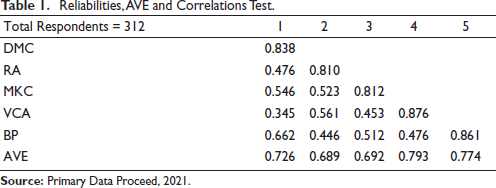
The research data obtained were processed by using the structural equation model (SEM) approach. The results of the validity test show that the indicators of each variable have a value of loading factor > 0.7, all indicators are valid. The results of the reliability test show that all indicators of the variables have internal consistency (Hair et al., 2010). Furthermore, the value of reliability (CR) > 0.6 and variance extracted (VE) > 0.5 so that it was in accordance with the internal consistency standard required in SEM. Furthermore, the variables of digital marketing capability, relational capability, market knowledge capability, value creation agility and business performance have CR value of > 0.7 and average variance extracted (AVE) > 0.5.
Results
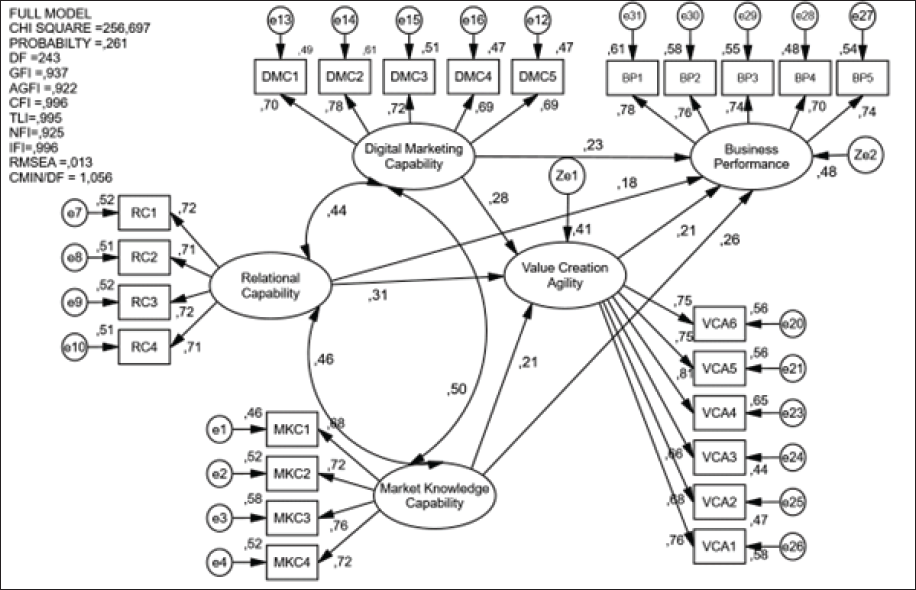
In this study, the results of the data testing showed that the goodness-of-fit index (GFI) was in accordance with the SEM criteria. The value of X2 = 256,697 and not significant at: 0.05, GFI index: 0.937; adjusted GFI: 0.922; Tucker-Lewis Index (TLI): 0.995; comparative fit index (CFI): 0.996; root mean square error of approximation (RMSEA) = 0.013 and CMIN/df is 1.056. Thus, the results of GFI indicates that the model obtained is fit to test the relationship among the variables.
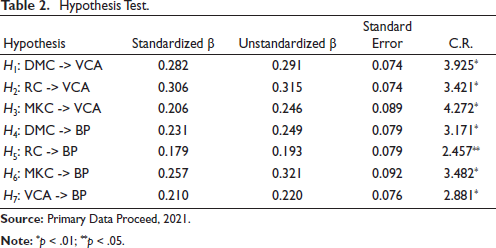
The results of hypothesis testing are presented in Table 2. Based on Figure 1 and Table 2, it can be seen that all the hypotheses proposed (H1, H2, H3, H4, H5, H6, H7) obtained a p value <.05 so that all hypotheses were accepted.
Reliabilities, AVE and Correlations Test.
Hypothesis Test.
Discussion
Digital marketing capability encourages the value creation agility. Companies that utilize digital media will respond to environmental changes quickly. The proper use of digital media will create organizational agility in creating the best value for customers through its operational activities. The use of digital media in marketing practices facilitates harmonious and agile interactions with customers in creating the best value for customers, such as quickly identifying customer needs. This finding is in line with the opinion that information technology competence is a determinant of adaptive agility and organizational agility (Chakravarty et al., 2013).
Relational capability can increase value creation agility. Relationships with mutually beneficial customers will make it easier for companies to obtain product and service information that customers need and can respond quickly to environmental changes. The close relationship will make it easy to get information about customer needs, so that it will encourage the value creation agility in accordance with customer desires. These findings strengthen the opinion that relational capability makes it easier to share information with customers from receiving orders to product delivery (Lee, 2007) and customer loyalty encourages value creation (Banyte & Dovaliene, 2014).
Market knowledge capability has an effect on value creation agility. The speed in understanding customer needs will make it easier to develop the right strategy. Furthermore, harmonious interaction with customers will make it easy to obtain complete information on customer needs. The creation of a harmonious relationship will encourage the value creation agility. This finding is in line with the opinion that the speed of responding to customer needs and improving the quality of products will encourage the value creation (Nuryakin et al., 2018).
Digital marketing capability increases business performance. Digital media can be leveraged to build long-term relationships, predict customer preferences and retain customers. The use of digital media in marketing practices can facilitate interaction and communication with customers. The more harmonious relationships with customers through digital media will encourage product purchases and ultimately have an impact on improving business performance. The findings strengthen opinion that business performance can be improved by utilizing digital marketing appropriately (De Pelsmacker et al., 2018; Wang, 2020).
Relational capability improves business performance. The findings of this study support the opinion that business performance can be improved when companies build communication, coordinate and manage business interactions with customers (Nuryakin et al., 2018). The ability to establish relationships with customers through kinship and personal bonds will create a harmonious relationship. Close relationships that are mutually beneficial will trigger an increase in more purchases and have the potential to increase company profits.
SMEs’ performance can be improved through market knowledge capability. The ability to obtain market information and respond quickly to market needs through a family approach will encourage an increase in the number of purchases. The higher number of purchases will encourage increased company profits. The results strengthen the statement that company performance can be improved if the company understands customer needs and responds quickly to customer needs (Hewett et al., 2004; Nuryakin, et al., 2018).
Value creation agility is one of the determinants of SMEs’ performance. The speed of responding to environmental changes will gain information on market trends, responding quickly to customer needs and delivering new products according to customer expectations. The close relationship will obtain complete information on customer needs so as to encourage the best value creation agility for customers. The best value creation agility for customers will drive increased purchases and potentially improve business performance. This strengthens the opinion that organizational agility is a determinant of company sustainability (Marhraoui & El Manouar, 2017). Value creation affects business performance through innovation (Gurău, 2015; Sørensen & Jensen, 2015; Viljakainen & Toivonen, 2014).
Conclusion
Business performance in fashion SMEs can be improved by utilizing digital platforms to build harmonious relationships with partners. Likewise, harmonious relationships with customers are very necessary in order to obtain information on customer needs quickly. Efforts to obtain market information continue to be carried out to ensure product demand, especially in new market segments so as to create familial relationships that will encourage an increase in the number of purchases. Customer references are needed so that companies provide the best value for customers. Utilization of digital platforms will facilitate communication and collaboration so that they are adaptive to environmental changes and agile organizations in increasing value creation. Proactive and inspirational actions can encourage increased value creation of goods, ideas and services that are beneficial to stakeholders. SME leaders should be agile in integrating adaptive and creative resources to encourage innovation so as to increase the value creation of goods and services. Value creation agility is continuously needed to be developed so that it can respond quickly to environmental changes. The speed of innovation to create the best value-added for customers will improve the number of purchases and customers. The findings contribute to the development of SDL, in terms of organizational agility in increasing value creation. Value creation is a proactive, conscious and inspiring action that enhances all goodness in the value of goods, ideas and services for all stakeholders and social organizations.
Limitations and Future Research
Fashion is dominated by elements of style that changes quickly according to market trends, so it really needs a quick response in order to meet customer needs and desires. This study only focuses on fashion retail SMEs, while the types and numbers of SMEs vary widely. Therefore, research by taking the object of all SMEs or being applied to large companies is still interesting to study in the future so that it will provide more complete results. This research provides a solution to the gaps in previous research results and develops SDL, especially value creation in organizations.
Footnotes
Declaration of Conflicting Interests
The authors declared no potential conflicts of interest with respect to the research, authorship and/or publication of this article.
Funding
The authors received no financial support for the research, authorship and/or publication of this article.
