




Abstract
Due to supply chain disruptions and sourcing uncertainties, multinational and large food manufacturers, retailers and suppliers are investing in New Food Product Development (NFPD) to add value and differentiate themselves from homogeneous food markets. However, for start-up food companies, especially in the NFPD field and within marketing research, this is difficult to do. This article’s aim is to analyse a microalgae milk pioneer and proteinalternative food technology company, its emerging NFPD, and its focused values, highlighting the differences with prior evolutions. A design science methodology and case study are applied. The findings show that technologydriven NFPD, with an integrative process, is promising. Moreover, a diversified and plant-based NFPD is encouraged as it creates sustainability values for consumer well-being by enhancing food technology and business performance. This study contributes to the NFPD literature and marketing research by improving current understandings of how to implement sustainability through technological breakthroughs and innovation in the NFPD process. In addition, it makes a methodological contribution by means of demonstrating how design science can help researchers think outside the box and create practical research to provide valuable solutions. Finally, this is the first study to use design science guidelines to create the NFPD value chain framework.
Keywords
Introduction
The United Nations sustainable development goals (SDGs) called for worldwide action to end poverty, realize zero hunger, good health, well-being and responsible consumption, and protect the planet. These goals present a great challenge for the food industry in sourcing, production, supplying, retailing and recycling. The global pandemic and zoonotic origins of the disease intensified these significant challenges (Mintel, 2020). Moreover, animal-based food production and consumption have increased the carbon footprint, created substantial environmental impacts and influenced healthy diets (Detzel et al., 2021; Poore & Nemecek, 2018). ‘Consumers are seeking a sense of agency over their lives through products that give them knowledge about food and options’ (NYIFT, 2022), as personal health and safety continues to be a priority (Mintel, 2020). They are interested in the ‘clean label’ that indicates the ingredients of the food (Aschemann-Witzel & Peschel, 2019) and perceive plant-based diets as ethical, healthy and environmentally friendly (Aschemann-Witzel et al., 2021).
The SDGs urge the market to provide sustainable food products that can reduce the carbon footprint and encourage consumers in developed countries to change their diets (Grahl et al., 2020), while food companies retain their profits. However, the natural resources for food production are limited and the climate change problem is significant. This has prompted food marketing researchers, food producers and manufacturers to seek innovative and sustainable strategies (Pontieri et al., 2022) with new products for a healthy ecosystem and a global food supply system that further improves consumer well-being.
Sustainable design for food-related products and services is influencing the food experience in terms of its physiological and psychological status and social and environmental value. The values created by these experiences and meanings (Zarantonello et al., 2021) are the success factors of food companies. However, it is difficult for consumers to perceive such values in rarely developed innovative new food products (Costa & Jongen, 2006) because new food product development (NFPD) is complex (Siró et al., 2008) and involves different phases and inputs. Previous research proposed that sustainability analysis should be applied at the commencement stages of the NFPD (Garcia-Garcia et al., 2021). This requires process design, special costs, measurement and technical support. Multinational food manufacturers have enough resources, retailer feedback and purchase bargaining power for profits and value transfer. But start-up food companies have difficulties doing so.
The question then is how can companies create value for consumers while profiting based on the well-being principles? Start-up food companies need to understand the relationship between food and well-being, and consumers’ care, which can help food companies generate value for consumers and benefits for all stakeholders (Kumar & Rajan, 2017). Food well-being (FWB) is a consumer-oriented positive approach involving attitudinal and behavioural change (Block et al., 2011) at individual and societal levels. There are few pieces of literature to help understand this connection and further provide the solution concept for food business practitioners, especially in the beginning phases. Applying and optimizing FWB knowledge to design solutions can help the NFPD. This study, first and foremost, contributes to the existing literature on NFPD about the understanding of how NFPD can create value by transferring the FWB paradigm and the emerging elements with innovative technology breakthroughs. It links sustainability and its application in NFPD to fill the gap in covering the practical application of well-being principles. Second is the methodological contribution by means of demonstrating how design science helped us conduct valuable research. This is characteristic of solution-oriented designing and evaluating of artifacts instead of theory-dominant abstracting. The following sections provide solid answers to the research question.
Methodology
Study Design
The design science method and a case study are applied. We borrow principles from design science from Stange et al. (2022) and apply them to NFPD and marketing science for designing solutions for the start-up food business which is inspired by the individual case study. Case studies can contribute to marketing research for innovative practices (Kristal et al., 2020; Piekkari et al., 2010; Weinstein et al., 2022). This is based mostly on contemporary events to understand complex phenomena and reflect important theoretical issues (Yin, 2003).
The special NFPD of new food technology companies is the best case for this study. It is challenging to find similar research for such food start-ups, which use new technology and ingredients hitherto not widely perceived or accepted in the market. In other words, consumers have no or limited knowledge about such new food products, although related scientific proof for such food resources has also been published recently (Tzachor et al., 2021) and discussed and reported by the BBC in 2021. Therefore, using the design science method and case study can yield solution-oriented concepts and further reduce the gap between academics and practitioners.
The Case Selection
The business-to-business (B2B) food technology company being investigated is Sophie’s BioNutrients (hereafter ‘SBN’), located in Wageningen in the Netherlands. The Co-Founder and CEO related the initial story of the company, emerging from problem-solving for an established business-to-consumer (B2C) seafood business more than 10 years ago. As a B2C company, it possesses first-hand data on sales and consumer experience that helps quickly identify and respond to consumer demand. It is observed that the consumer attitude towards, and acceptance of, algae-based seafood, is conservative and diffident. The company conducted consumer research and discovered that the reason for this diffidence, despite algae being a suitable protein, is its dark colour. Motivated to solve this problem, the CEO resorted to research and contacted food technologists. Fermentation technology not only improves the algae colour and outlook but also provides the possibility of technical isolation for alternative new food products. As Co-Founder and CEO, he partnered with food technologists and advanced to the next step—founding a B2B company in Europe, SBN, focused on an alternative protein business based on algae fermentation and isolation technology. Thereafter, the company experienced a series of technological breakthroughs for producing plant-based, protein-rich alternatives to meat, milk, cheese, seafood, and other food categories using the new ingredient microalgae.
Algae-based ingredients have piqued food industry interest in recent years as a sustainable, animal-free source of protein, lipids and micronutrients. Algae are protein-rich organisms containing essential amino acids and fatty acids, including omega-3, omega-6 and omega-7, along with vitamins A, D and E (Beall, 2022). By optimizing algae’s attributes of being fast-growing with few input requirements, SBN proposed a new possibility based on fermentation, using food industry waste as feedstock for growing microalgae for food. Using fermentation can increase production efficiency. In 2019, the company introduced its milk alternative made from 100% microalgae. This technology can be applied to further NFPD, for example plant-based meat, yogurt, cheese and bakery protein flour, according to a different kind of protein isolation process.
From lab-scale to pilot-scale volumes, as a start-up food company, it relies on not only the manufacturing partners but also a high degree of cooperation with research and development (R&D) collaborators. SBN has cooperated with the Food Valley NL ecosystem to develop the business further. The Netherlands, considered a European research hotspot for alternative proteins and microbial fermentation for food production, boasts over 250 plant-based protein companies. There are numerous alternative protein and algae-oriented start-ups in Food Valley, but even industry leaders like Unilever and Vivera Foodgroup have invested in plant-based innovation (KADANS, 2021). SBN received support from StartLife, which is Europe’s longest-running and leading agrifood tech start-up accelerator.
From a business perspective, SBN has created an entrepreneur- and technology-driven core team and an alternative protein-focused product strategy. However, it is different from the general product development process wherein food technology breakthroughs precede marketing, driven by food retailers. That is the reason we selected SBN as our case study. It presents a new art of NFPD that creates value towards sustainability.
Data Collection
The semi-structured interview is the first source of our data. Table 1 presents more sources for this study.
Data Sources.
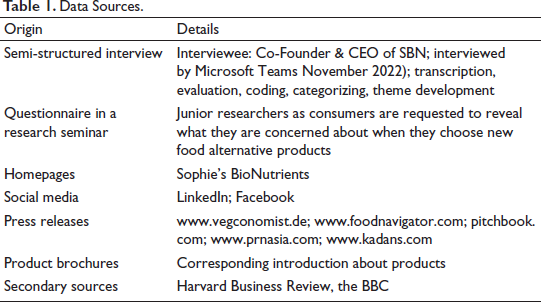
Table 1 explains the data sources for this study. The semi-structured expert interview is employed to explore the issues connected with the questions, including ‘how’, ‘what’ and ‘why’. It provides rough guidelines for researchers, but also allows interviewers to reveal their own outlooks and reflections (Meuser & Nagel, 2009). Good qualitative questions should inform the objective of the study theoretically and methodologically. The basic element of analysis is words and ideas from the interviewee. The authors, as interviewers, have formulated questions, the answers to which were recorded to keywords and interpreted as elements of the NFPD value creation framework. Other secondary resources like introductions, business reports and comments from the official website of the company, professional journals and social media are supplementarily incorporated.
Theory and Practice
The NFPD Evolution
We made a short summary of the existing NFPD from the literature and extracted the emerging elements. Table 2 shows the traditional NFPD, its evolution and its focused values in the extant literature; the emerging NFPD elements are highlighted.
The NFPD Evolution and Focused Value.
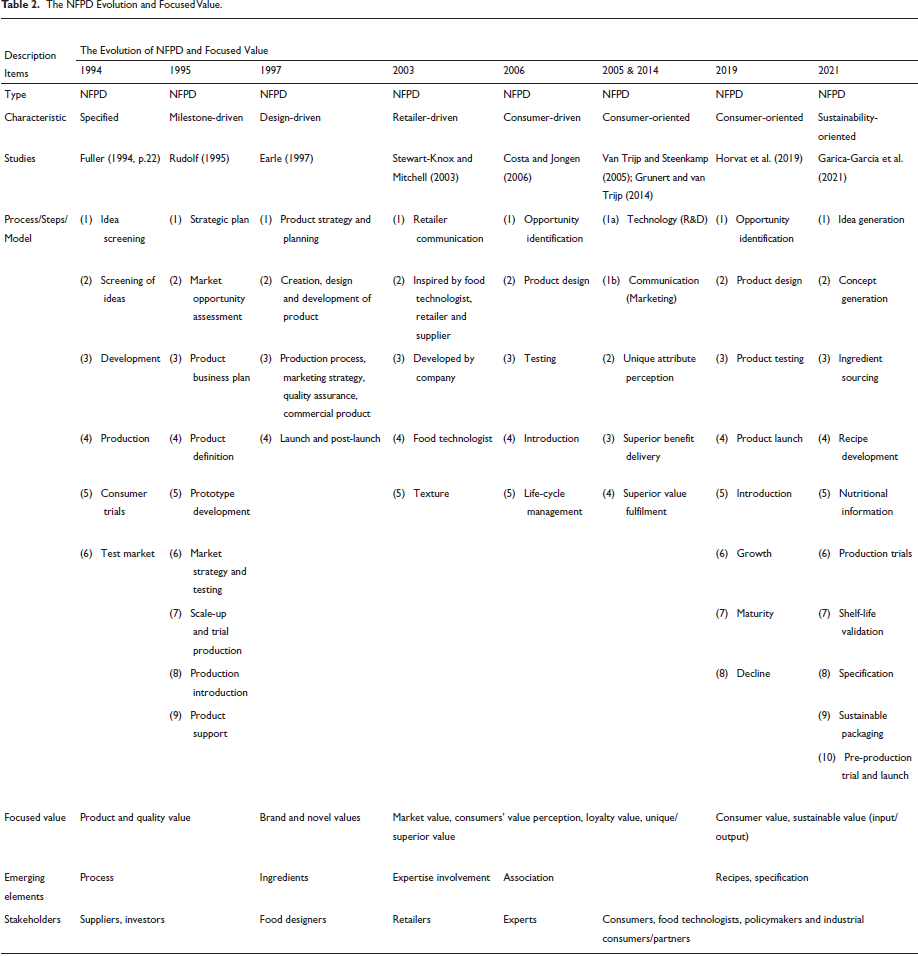
Table 2 presents the research on the evolution of the existing NFPD process and models. The NFPD evolution demonstrates the changes of drivers in developing new food products and focused values: from specified, retailer-driven, design-driven and consumer-driven to sustainability-driven; from product, quality, brand, market and consumer value to sustainability values. Fuller (1994) has stressed the importance of sensory, taste and consumer trial in the NFPD. Thereafter, brand and novel values, based on ingredients, specifications and packaging and requiring attention for NFPD in future, were predicted (Earle, 1997). Subsequent research follows a similar pattern, depending on recommendations from, or communication with, retailers. Retailer feedback helps food manufacturers and producers to better conceptualize nutrition recipes, food portion size, packaging and price at which value is created and added. Costa and Jongen (2006) proposed the consumer-led NFPD for food products and emphasized the essential role of consumer research.
Alternative Protein Food Market
Generally, animal-based foods, like meat, poultry, seafood, and dairy, are known to constitute good sources of complete protein. The leading alternative protein sources are plant protein (e.g., soy, pea), insect (e.g., crickets), mycoprotein and single cell (e.g., cultured meat). Food manufacturers and producers are competing to find new and better solutions for alternative protein food products (Bashi et al., 2019).
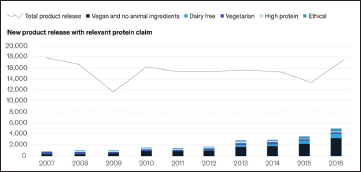
As Figure 1 shows, diversified alternative protein new food products get released in the market annually. There is a growing trend to use fewer animal ingredients for new alternative protein food products. However, these sources are facing global and local supply problems. The cell-based cultured protein industry is still in its infancy (proteinreport.org, 2022). Soy production requires a large volume of water, and therefore, the increasing soybean demand (which will be 80% by 2050) may drive deforestation and environmental damage (Beall, 2022). Meanwhile, existing food security is threatened. Protein-alternative food products carry sustainable, nutritional and ethical advantages and have been identified by the European Commission (EC) as important to the transition to a sustainable food system.
Food Policy and Social Value
The Farm to Fork Strategy of the EU is at the centre of the sustainable food system; the food business must ensure a neutral or positive environmental impact, mitigate climate change, food security, nutrition and public health, and preserve the affordability of food from sourcing to end consumption. It assures that the food chain that covers food production, transport, distribution and marketing and consumption has a neutral or positive environmental impact. The EC has published a proposal for regulation of the European Parliament and the Council on the export of certain commodities and products associated with deforestation and forest degradation, and repealing regulation (EC, 2021) from the EU, as well as their availability in the market. Prior to this, the EU already issued a legislation for general food-labelling rules that requires listing all ingredients of pre-packaged food on the packaging, to provide comprehensive information about the product to consumers.
Findings
Regarding the health value and new food products in the alternative protein food market, as the previous section showed, the competition for sources is inevitably fierce. A promising source of protein is algae, which consists of polyunsaturated fatty acids and fibre, including vitamin B12 and iodine. There is ongoing research on algae and microalgae. SBN has pioneered technological breakthroughs for microalgae as a protein source. However, there are also other factors essential to the NFPD.
Industrial Expertise
As a start-up food company, SBN had limited opportunity to receive retailers’ recommendations on new product development, and first underwent technological breakthroughs. SBN conducted the structured consumer experiment, for which they invited industrial consumers and potential partners, food professionals and experts. The new food products were presented, in different forms, with natural and recyclable packaging. Eighty to ninety per cent of participants were satisfied with the food taste, colour and the extrinsic food factor design. They also confirmed the nutritional values from a professional perspective.
Reuse of Food Waste
Although the food product itself solves the protein-source problem by providing diversity for future food security in terms of SDGs, it is still a challenge to create value for sustainability as well as for consumers, to be able to compete in the food market. The recent sustainability-oriented NFPD demonstrated the importance of including sustainability analysis, nutrition information related to the food labelling policy and nutritional value, as the outputs of sustainable food products (Garcia-Garcia et al., 2021). SBN has achieved this at the first step of NFPD through the complete use of food waste to produce new products.
Emerging Elements of NFPD
Plants are perceived by consumers as healthy and sustainable as they have a lower environmental impact. The value that each protein offers is associated with its price and nutrition. SBN is especially distinguished from market competitors by advanced food technology—a special focus on heterotrophic strains. While 70% of its competitors adopted technology at the cluster level, SBN adopted refinement technology at the individual level. The company develops new food products with its excellent isolation process. Though it also faces the challenge of introducing them in the market, SBN demonstrates an innovative way to market its products in comparison to the traditional NFPD process. The case of SBN showed an emerging NFPD technique integrating prior evolution with refinement of the following core elements: process (technical and labour scale-up), ingredients characteristics (physical, sensory, nutritional), specification (recipe, customize, labelling) and association (branding and co-branding, retail distribution, consumer). These are the constituents of the emerging NFPD.
Process
The process is emphasized in the commencement phase of NFPD. Instead of retailer communication in the standard NFPD process, an entrepreneur-driven technological breakthrough constitutes the first step of the process. Technical extraction is the key to such food products. Following that, solutions are required for industrial applications. Scale-up is the process from laboratory stage to mass production.
Ingredients
Ingredients significantly affect the overall food experience, consisting of taste, flavour, aroma and oral-somatosensory attributes. They are important driving forces for consumer well-being, and a path to FWB. Any new food product needs to be designed in combination with sensory, physical and nutritional elements so that it can cater to consumers’ preferences.
Specification
The specification provides solutions for industrial consumers and product differentiation for food retail. This includes tailored recipes, texting, customized formulations for industrial partners and target consumers, nutrition labelling and footprint label.
Association
The association includes further factors that promote new food products in the market. SBN has more choices for food business with industrial and retailing consumers, who pave the way for communication with individual consumers. With previous structured experiments, SBN can smoothly introduce new food products in the market and attract more individual consumers by creating benefits for the collaborative society.
SBN planned the two-step value transfer according to the product life cycle by (a) creating highly specific, customized recipes and formulations, according to individual requirements, to enable industrial consumers to acquire possible higher profits and (b) standardizing the NFPD process and making the food specifications and recipes wholesale to reduce costs.
Food Product Market and Policy
Policy-related problems faced by SBN included the permission of strains in the EU and production using ingredients generating lesser emissions and no waste. In 2021, twenty microalgae strains were approved by the EU, which did not include two important strains. These two special strains were permitted in 2022. Food with ingredients sourced from chlorella vulgaris, chlorella sorokiniana and chlorella protothecoides is allowed to be processed and sold in the market. These policy permissions and requirements are essential for further new food technological applications by SBN as per interview responses. According to USA dietary guidelines, seafood, including algae-based food, is a protein foods subgroup that is strongly recommended. In this case, the more valuable microalgae strains are permitted, the better for the NFPD. This further provides more diversified food choices for consumers while benefiting the climate and environment.
According to the Co-Founder and CEO of SBN, a reduced carbon footprint and use of sustainable ingredients constitute the foremost criterion for, and the highlight of, their new products. Three product features are (a) no waste generated into the environment and a minimum ecological footprint; (b) Nature-cultivated heterotrophic strains, with no pesticides or herbicides and (c) use of fermentation technology for food to look and taste better and be nutrient-rich.
This contributes significantly to the social value, as it guarantees a clean food source for consumers in accordance with the SDGs and motivates the company to develop new product categories to satisfy consumers. Food policy issues must be contended with to create social value for consumers.
The Well-balanced Value Creation Framework
Different factors can influence the success of NFPD and its contribution to the value chain. Retailers are barometers of benefits to consumers but are not interested in new food technologies (Esbjerg et al., 2016). Retailer-driven NFPD may focus more on commercial profits than on other values. The success of NFPD can also be attributed to R&D, marketing, top management support and supplier and customer involvement (González & Palacios, 2002). Lack of both marketing experience and knowledge about consumer perception and preferences may constitute barriers for start-up food companies. This can limit the transfer of value creation from NFPD to the market. However, inspired by SBN, we have designed a solution concept for such food companies, namely using a new and emergent NFPD path to create sustainability value and link industrial customers and individual consumers. Meanwhile, it provides benefits for each stakeholder in the value chain.
Figure 2 demonstrates our framework. The start-up food companies do not have feedback from retailers and enough financial input. They could develop new food technologies that can reduce the costs of raw materials; for example, SBN grows reliable protein-alternative food raw materials. The following concepts can be encouraged by suppliers and will be further developed for advancement from labour-scale to mass production. However, food perception by consumers must be tested before new food products are launched in the market. Linnemann et al. (2006) demonstrated the factors that influence the food perception of consumers. These could be related to the individual (demographic, physiological and psychological factors), food (product characteristics and production system), context (consumption moment, time and place) and/or environment (family and societal characteristics). Aschemann-Witzel and Peschel (2019) identified consumer acceptance of a certain new food product through visualization of the product category and the basic ingredient list accompanying the sketch. The information for participants includes the details of ingredients and their respective percentages. The package design and ingredient description are critical for consumer perception. Consumer survey and involvement data are widely used in the testing phase of NFPD but not in the pre-development phase (Horvat et al., 2019). In fact, the consumption decision may not depend upon the product per se, but rather on the different values perceived and received from the means-to-end consumption of such new food products (van Trijp and Steenkamp, 2005).
The NFPD Value Creation Framework.
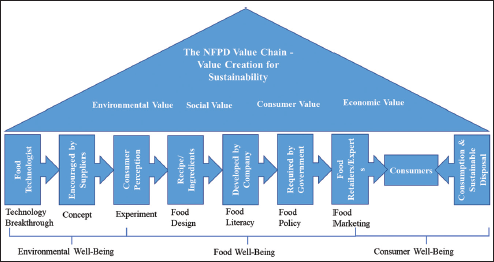
Therefore, improving product features, reducing environmental impact and targeting consumers’ health and nutrition through a focus on values for sustainability can make NFPD efficiently accessible to consumers. The practical means is by customer experiment. This can perceive the values that consumers care about, receive feedback from them to improve food design and identify the knowledge required to supplement food literacy and packaging information in the future. It can better facilitate application in the retail market in the case of retailers using branding or co-branding strategies to sell the corresponding new products.
Food policy, as discussed above, has a strong influence on NFPD for creating value for society (Tian & Kamran, 2022). Sustainable food design should already have been considered at the consumption stage; sustainable food ingredients leading to sustainable disposal can also create value for consumer well-being. The NFPD framework implies a path of value creation from environmental to consumer well-being by transferring the FWB paradigm (Block et al., 2011).
Discussion
The analytical findings show that diversified plant-based NFPD are encouraged as they create sustainability values for consumer well-being by enhancing food technology and business performance. From the previous evolution, it appears that NFPD depends significantly upon retailers’ commercial interests and consumers’ involvement. The practical result is the new NFPD value creation framework inspired by the case study.
Sustainability and NFPD
First, in comparison to the recent sustainability-oriented NFPD, the different emerging elements and food policies in the EU are considered. Second, the sequence of the NFPD process has been restructured via technological priority. Instead of being driven by retailers initially, start-up food companies can utilize the advantage of technology (Wiesel, 2022). Third, a superior sustainability-oriented and well-balanced NFPD process results from design thinking. Through design thinking (Brown, 2009) a start-up food company can optimize its product design, prototyping, storytelling and experience experimentation. It has been embraced in the business field but is still lagging behind in the research of value creation (Halstrick et al., 2020), especially in the food industry and marketing (Henseler & Guerreiro, 2020). Since the preliminary phase of the NFPD, the example of SBN considered the environmental impact and used sustainable food raw materials for mass production.
Transferring the FWB Paradigm
There is also some evidence of the possibility for the food business to create sustainability values by transferring the FWB paradigm. Rather than incurring high investment costs to reduce the environmental footprint, this saves initial costs of NFPD by employing novel food technologies to use the fast-growing alternative protein food source of microalgae (Prüser et al., 2021). Furthermore, it is also possible to create industrial solutions for B2B partners and serve the commercial interests of retailers and expert marketers by designing concepts and food recipes. Industrial specifications can optimize their NFPD and customize services. It enables food knowledge transfer to consumers to change their attitudes and behaviour towards sustainable food consumption. While following the EU food policy guidelines and sustainable food design, the protein-alternative food products also provide solutions for consumers’ concerns regarding (a) clean food sources or health and nutrition, (b) healthy (allergic) problems from other food ingredients and (c) carbon footprint and environmental impact as the SBN case showed.
Implications
This study implies that, through food technology and innovation, the food business can create not only commercial benefits for partners but also sustainability values if it manages to integrate FWB elements. The important factor is that NFPD is not about developing one ingredient but providing diversified solutions for multiple actors.
Possible Support and Challenges
The establishment of the SBN and the experience of food valley Netherlands have shown that in order to maintain a sustainable NFPD, the efforts of food companies should also be supported and encouraged by the government and non-governmental organizations. These can be financial incentives, research grants or public awareness campaigns. Funding has proved difficult for start-up food technology companies. As reported by the SBN, in the protein alternative food industry, start-up companies in the UK, Canada and the USA have more opportunities to receive more financial subsidies and investments. In addition to financial support, consumer’ FWB can be further promoted through campaigns, publicity and social events to raise public awareness of healthy eating and reducing food waste.
The other issue is the challenges for start-up food companies in implementing the proposed NFPD value creation framework. The technological breakthrough brings new alternative foods to the market. It may suffer from the acceptance problem. The established food categories may face substitution, and the benefits to food retailers and suppliers may not pay off in the short term. The possible strategies to overcome these challenges may be to differentiate the design of food products and optimize the quality for customer specifications.
Contributions
The value of this case study is the identification of emerging NFPD elements and the design of a well-balanced NFPD value creation framework. Solving problems for industrial customers, gaining consumer acceptance and support from technologists, using FWB knowledge and entrepreneurial and sustainable food technologies are all important for the success of NFPD as they involve multiple stakeholders and create value for environmental, health, social and consumer well-being. Eight groups of items constituted the final NFPD value creation framework. This was coded from the keywords of the interviews to demonstrate where sustainability values could be created. These items are related to food technology, business concepts, experiments, food design, food literacy, food policy, food marketing to consumers and sustainable disposal.
Conclusion
The existing NFPD research tends to interpret NFPD phases based on traditional new product development steps. Our study is one of the first of its kind to adopt an entrepreneur- and technology-driven and integrative value chain from an NFPD perspective by investigating a real-world practical case. Accordingly, the input of food technology, design thinking, and FWB-centred recipe solutions for industries and food retailers may be imperative for success. Design thinking has been increasingly adopted to incubate new products across multinational companies, especially in the food industry (Harrington, 2004).
The contribution of this study is its novelty in the overall food industry and value creation application in food marketing research. In the NFPD literature, most scholars proposed similar sequential steps for NFPD. The design of the NFPD value creation framework integrates essences simultaneously, namely, not in regular order sequence, but using core elements and combining them into an emerging practical NFPD: process, ingredients, specifications and associations. To guarantee value in each business activity, those elements are optimized and kneaded into the framework. With the call for SDGs, the food policy issues and the relationships with the environment, food and society inevitably are reconsidered.
Finally, this study shows how start-up food companies can create value with technology-driven NFPD by considering the FWB paradigm together with sustainability values. Although the design of the NFPD value creation framework is inspired by a single case, it can provide practical guidelines for food entrepreneurs and start-up food manufacturers to structure their NFPD and business models. It also paves the way for further empirical research to construct the factors to forecast the influence of NFPD on consumer well-being.
Footnotes
Acknowledgements
The authors wish to thank Sophie’s BioNutrients for valuable discussions, technical views and comments on the subject of this article. We also thank them for agreeing to publish the story of the firm in the academic journal.
Declaration of Conflicting Interests
The authors declared no potential conflicts of interest with respect to the research, authorship and/or publication of this article.
Funding
The authors received no financial support for the research, authorship and/or publication of this article.
