




Abstract
This article shows that the COVID-19 pandemic exposed informal institutional voids that exist for Black, Asian and Minority Ethnic (BAME) business owners in the United Kingdom. Based on a primary database of surveys and semi-structured interviews, the results show that many BAME small and medium-sized enterprise (SME) owners encountered informal institutional voids that White SME owners did not face during the pandemic. The article also shows how these BAME SME owners created value amid these institutional voids and how they can continue to do so. The article concludes by suggesting that bridging these voids is crucial for promoting a more inclusive environment where ethnic and non-ethnic entrepreneurs can succeed. It also presents policy implications and offers directions for future research.
Introduction
The literature shows that many ethnic minority business (EMB) owners in the UK report distrust with, and difficulties in accessing different types of formal institutional support (Davidson et al., 2010; Jones et al., 2014). In addition, the business environment during the COVID-19 pandemic in the UK (i. e., from the first quarter of 2020 to the first quarter of 2021), was marked by huge uncertainties for businesses (Fairlie, 2020; Stephan et al., 2020). Yet, research has not observed that the confluence of these conditions for EMB owners during the COVID-19 pandemic, that is, distrust of formal institutions, difficulties in accessing formal support and acute business uncertainty, can be likened to the institutional void conditions that increase transactions costs and are typically found in the Global South (Khanna & Palepu, 1997; Webb et al., 2020).
In this article, we contribute to the literature on EMBs in the UK from the Black, Asian and Minority Ethnic (BAME) group (Davidson et al., 2010; Ram et al., 2017), and utilize the notions of relational trust (Poppo et al., 2016), and transaction costs/institutional voids theory (Khanna & Palepu, 2010), to pay particular attention to the experiences of BAME Small and medium-sized enterprise (SME) owners during the COVID-19 pandemic. More specifically, this article answers the following research questions: (1) Did the COVID-19 pandemic reveal unknown informal institutional voids that exist for ethnic minority SME owners in the UK? and (2) How can ethnic minority SME owners create value amid informal institutional voids? The article shows that many BAME SME owners reported informal institutional voids that White SME owners did not face during the pandemic. The article also shows how these BAME SME owners can create value amid these informal institutional voids. This is an area that the literature and policymakers are unaware of, and we conclude by providing recommendations for possible implementation.
Literature Review
In parallel with Khanna and Palepu’s (1997) notion of formal institutional voids, Webb et al. (2020) characterized informal institutional voids as ‘the inability of norms, values and beliefs and their localized representations to facilitate stable, efficient and effective transactions and enterprise processes that contribute to the development of productive markets’. Webb et al.’s (2020) conceptualization of informal institutional voids does not imply a fundamental lack of norms, values and attitudes in society. Rather, it refers to situations in which there is an absence, repression or restricted manifestation of the particular informal institutions that encourage effective and efficient market transactions at a level that encourages growth.
Webb et al. (2020) described five forms of informal institutional voids that arise from caste system, power-based misallocation, belief system, relationship barriers and lack of coordination. The fourth form of informal institutional void, the relationship barrier, occurs due to a lack of trust in society (De Soto, 2006). Such voids can occur due to biases, repression, prohibition or restricted participation in more resource-rich networks, or a lack of trust in working with outsiders (i. e., outgroups). Lack of trust not only triggers the requirement to construct costlier safeguards but also increases the cost and rigours of monitoring contracts (Collewaert et al., 2021). It also limits the willingness to invest in operations and the investment size when this is done, thereby undermining market activities (Khoury et al., 2015). Ultimately, informal institutional voids arising from trust barriers discourage economic activity by undermining cooperation and social cohesion.
Entrepreneurs often make decisions under conditions of Knightian uncertainty (Knight, 1921) from positions where they utilize the two key bases of trust in the management literature; ‘calculative trust’ and ‘relational trust’. Calculative trust arises because parties believe that the costs and advantages of conforming with the business agreement outweigh the benefits of self-interested, unscrupulous activities and act accordingly (Poppo et al., 2016; Williamson, 1993). Conversely, relational trust arises from interactions as parties accumulate encounters, form beliefs about each other, and develop mutual values and standardized conventions that define how parties work together (Bercovitz et al., 2006). Relational trust ultimately refers to a trustor’s belief that a trustee will act in good faith because the trustee cares about the trustor’s welfare (Saparito et al., 2004).
Severe informal institutional voids, due to limited trust or extreme power differentials (De Soto, 2006), destabilize the reliability of transactions and as a substitute encourage smaller, less efficient, more frequent, face-to-face modes of transacting (Webb et al., 2020), thereby increasing the transactions costs for entrepreneurs. They can also lead entrepreneurs to resort to operational structures that are unnecessarily labour-intensive, while at the same time limiting the willingness of entrepreneurs to invest in more productive assets (Webb et al., 2015). This distrust and the subsequent informal institutional voids thus have the overall effect of pushing entrepreneurs into chronic poverty (Hulme & Shepherd, 2003). The implications of this regarding poverty and value creation for ethnic entrepreneurs are significant for the UK and the Global North given that ethnic minorities in these contexts often report higher poverty rates (Weekes-Bernard, 2017).
Data and Methodology
Data collection on the business experiences of SME owners during the pandemic was via semi-structured interviews and an online questionnaire from a wide cohort of small business owners within the UK with the aid of a television network station (ITV) that shared the questionnaire via their social media channels (i. e., Facebook and Twitter). The data collection took place between March 2020 and July 2022. The interview questions covered the relational trust preferences of the SME owners and the strategies that they used to deal with the exogenous shock of the pandemic to prevent business closure. Overall, there were a total of 82 responses with an ethnic split of BAME SME owners (n = 27) and White SME owners (n = 55). The businesses belonged to the industry sectors of arts and hospitality (23%), retail and wholesale (13%), beauty and leisure (12%), manufacturing and construction (10%), finance and information technology (10%), education and training (11%) and others (21%). All the responses were analysed by using thematic and regression analysis (Miles & Huberman, 1994; Yan & Su, 2009). The coding followed an iterative approach to revisiting and categorizing the data with regard to emerging categories (Gaber & Gaber, 2018). This methodology is well-established in many studies of ethnic minority business owners (Kloosterman et al., 2016; Ram et al., 2017).
Results
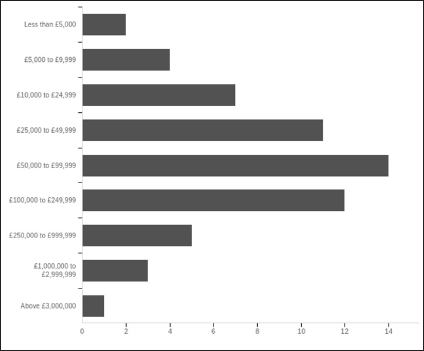
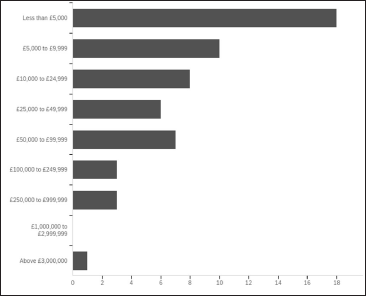
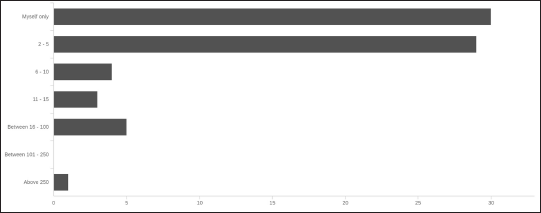
The findings showed the COVID-19 pandemic had a sudden detrimental effect on business operations. Overall, almost all the SME owners indicated that the exogenous shock of the COVID-19 crisis had a negative effect on business income as shown in Figures 1 and 2, although a very small minority (n = 4) reported finding opportunities for business expansion because of the pandemic. While some SME owners (n = 16) reported having to stop their business activities because their businesses involved physical contact and were not suitable for ‘working from home’ (e. g., hairdressing and personal tailoring), a majority of the SME owners (n = 64) reported making adjustments to their business activities as a result of the pandemic to enable them to continue business activities in some form, some SMEs reported supply chain disruptions (n = 9) and many businesses (n = 17) reported a reduction in the number of staff employed as also shown in Figures 3 and 4.
Net Income of SMEs in the Accounting Year Before the COVID-19 Pandemic.
Net Income of SMEs in the Accounting Year of the COVID-19 Pandemic.
Number of Staff in SMEs in the Accounting Year Before the COVID-19 Pandemic.
Number of Staff in SMEs in the Accounting Year of the COVID-19 Pandemic.
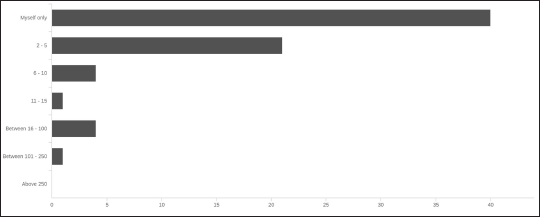
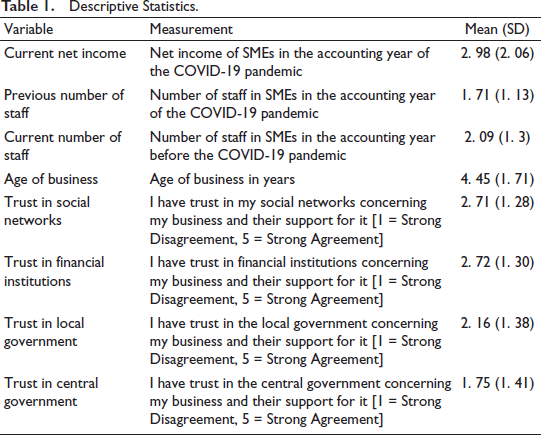
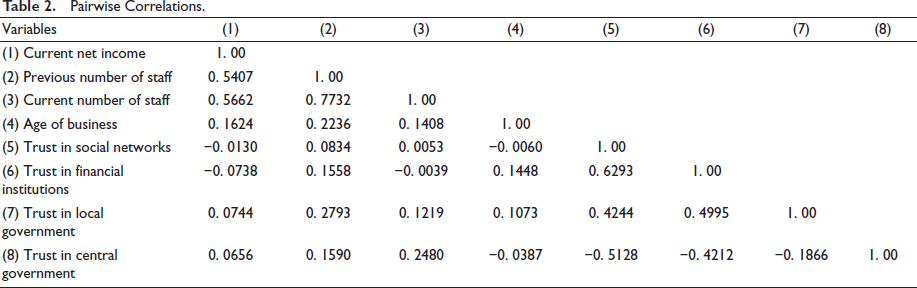
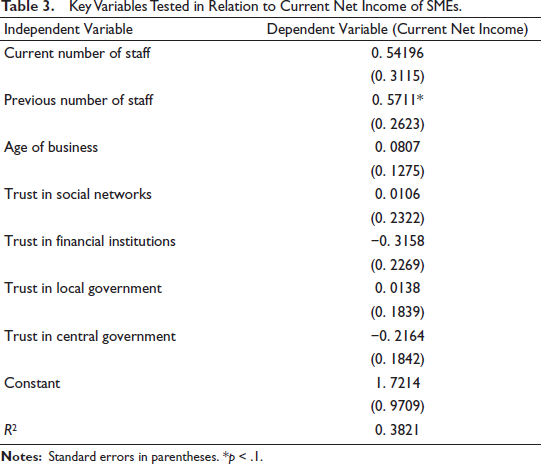
Table 1 presents the descriptive statistics of key numerical data collected; Table 2 presents the correlation matrix and Table 3 presents our regression specification where the dependent variable is the net income of the SMEs in the accounting year of the pandemic. The correlation matrix shows that trust in the local government is the most highly correlated trust variable with net income while the regression result shows that exhibiting prior preparedness by having more staff before the pandemic was a statistically significant factor for the net income of the SMEs.
Descriptive Statistics.
Pairwise Correlations.
Key Variables Tested in Relation to Current Net Income of SMEs.
As a result of the COVID-19 pandemic, the central government of the UK introduced support for SMEs such as the Coronavirus Job Retention Scheme (CJRS), the Coronavirus Business Interruption Loan Scheme (CBILS), Bounce Back Loan Scheme (BBLS), Trade Credit Reinsurance programme and the Future Fund. There were also grant schemes such as the £10,000 and £25,000 one-off grants, tax holidays and tax deferrals (Lambert & Van Reenen, 2020). While some of the support schemes were administered directly by the central government, often working with financial institutions to support SMEs, the delivery of some support schemes was delegated to local governments who decided the beneficiaries. Examples of schemes like these include the Small Business Grant Fund (SBGF), the Retail, Hospitality and Leisure Grant Fund (RHLGF) and the Local Authority Discretionary Fund (GOV. UK, 2020).
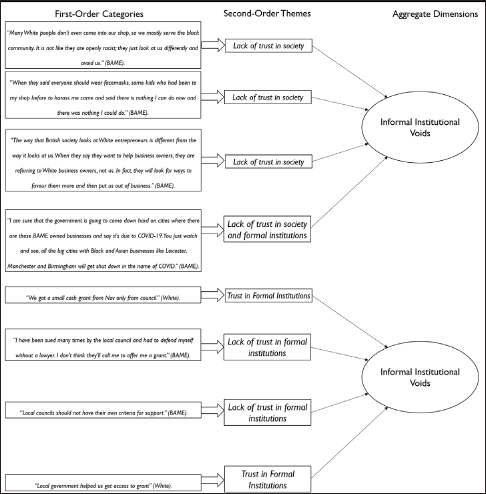
However, the qualitative data we collected showed that many of the BAME SME owners reported a lack of relational trust with society and government institutions as shown in Figure 5. This distrust of society was not reported by White SME owners who classified as having similar characteristics as the BAME SME owners. The responses from our sample also showed that there was deep suspicion from BAME SME owners as to the fairness to access the support schemes that came through local government institutions. In contrast, White SME owners did not report this relational distrust with society and suspicion of unfairness with access to support schemes that came through local government institutions and were often confident as to how to leverage resources from these institutions as shown in Figure 5.
Emerging Themes: Informal Institutional Voids for BAME SME Owners.
Relational trust arises from repeated interaction and benefits from a shared social identity (Poppo et al., 2016). Relational trust is at a high level when social relations evolve to a state in which each partner can anticipate acting according to the other’s good (Saparito et al., 2004). Relational trust functions as a shortcut to logical evaluation, based on the overall quality of the relationship rather than every single transaction (Uzzi, 1997; Rousseau et al., 1998), and thereby reduces transaction costs. It enables the navigation of progressively complicated interpersonal situations by making simpler the information-processing task (Poppo et al., 2008). More specifically, a relational base of trust best describes long-standing, stable business relationships from ongoing interactions that define how parties will work together (Macneil, 1980). Relational trust can help actors make decisions when there is increased market uncertainty due to unpredictable changes in the external environment (Poppo et al., 2016) as was reported by many SME owners during the pandemic.
Although many White SME owners often expressed displeasure with the way that government support was administered, they did not express a lack of trust in society or feelings of being of an outgroup. Lack of trust in society and feelings of being an outgroup was reported by a distinct social category: BAME SME owners:
‘Make decisions sooner, and clearer plan of timescales’ (White)
‘Make the support for White business owners the same for other nationalities. Racism still exists in business opportunities available’ (BAME)
‘Prompt payment of grants’ (White)
Since trust is a component of symbolic capital that can be exploited for symbolic power and exchange (Siisiainen, 2003), the results from this study have implications for the sources of capital that are also impacted by limited access to power corridors by BAME SME owners in times of crisis. The disparate trust preferences between the BAME and White SME owners also reveal that there are informal institutional voids that disproportionately impact the BAME SME owners that were exposed by the pandemic.
Our findings on this distrust are also supported by the government’s own report on BAME SME owners in the ‘listening exercise’ held by the All-Party Parliamentary Groups (APPGs) of the UK in June 2020 (UKParliament, 2020). The listening exercise was embarked on to unlock unique insights into the challenges faced by BAME-owned businesses during the COVID pandemic and was attended by 439 grassroots BAME company owners from various industries and regions. The intention was to compile a qualitative report with evidence that policymakers might use in calibrating existing policies and introducing new policies (Chrouch, 2020). The APPG report highlighted the relational distrust that many BAME business owners had when viewing the COVID-19 business support and with British society in general (Chrouch, 2020, pp. 23–25).
Webb et al. (2020) expected that as informal institutional voids become more severe, entrepreneurs’ objectives and activities become subsistence or survival based. This is because the apparatuses that support businesses, such as insurance mechanisms, informal lending and inter-household transfers of resources, are frequently embedded within specific social classes and localities. Correspondingly, entrepreneurs also draw upon informal institution-construed collective rights and informal institutional voids will force entrepreneurs to rely even more on informal sources of support. This could also help to explain why many EMBs tend to operate in ethnic enclaves (Maalaoui, 2021).
How can Ethnic Minority SME Owners Create Value Amid Newly Revealed Informal Institutional Voids?
Value creation involves a range of actions, events and measures that increase the worth of goods, services and businesses and better the welfare and worth of individuals and organizations. In the context of ethnic entrepreneurship, value creation should not be equated with limited interpretations and historic perceptions of the differential between labour cost and profit (Mahajan, 2017; Olarewaju, 2019). ‘Bricolage’ as a concept has been extremely useful to the value creation activities of entrepreneurs in areas of resource constraints and we predict that it will be a useful tool for ethnic entrepreneurs as they undertake entrepreneurial activities where there are informal institutional voids in the UK.
Bricolage, as a notion, is used to describe how entrepreneurs ‘make do’ by applying creative problem solving techniques and utilizing combinations of resources at hand to new problems and opportunities (Baker & Nelson, 2005; Levi-Strauss, 1966). Two types of bricolage are identified in the entrepreneurship literature: internal bricolage and external (network) bricolage (Tasavori et al., 2018; Vanevenhoven et al., 2011). Entrepreneurs, regardless of ethnicity, often make do by bricolage, solving problems as they emerge with whatever is available rather than what is needed (Levi-Strauss, 1966; Baker & Nelson, 2005). For this, there are positive effects of relational trust in opportunity recognition, evaluation, refinement, championing and implementation (Zahra et al., 2006). Bricolage has also been recognized as a strategic response to the exogenous shock of the COVID-19 pandemic (Gur et al., 2020; Manolova et al., 2020). The data show that bricolage can be a very useful strategy in conditions of informal institutional voids because it helps to encourage informal market activity that gradually bridges the relationship barrier and can slowly rebuild trust in society over time. Bricolage will increasingly need to be used by ethnic minority businesses in the current era of radical social and technological change (Wiesel, 2022), and we predict that the use of bricolage will increase as institutional voids become more obvious.
Also related is the concept of ‘institutional entrepreneurship’ which describes how individuals and organizations resolutely and tactically shape their institutional environment to enhance their value creation activities (Marquis & Raynard, 2015). When entrepreneurs engage frequently in bricolage activities and create institutions tied to those activities, they become institutional entrepreneurs. We interpret institutional entrepreneurship in this context to refer to the activities of entrepreneurs who have an interest in institutional arrangements in their communities, and who manage resources to create new institutions in the face of institutional voids. It is via bricolage and institutional entrepreneurship that ethnic minority SME owners can create value amid newly revealed institutional voids as exemplified by the results in Figure 6.
Emerging Themes: BAME SME Owners Creating Value Amid Newly Revealed Informal Institutional Voids.
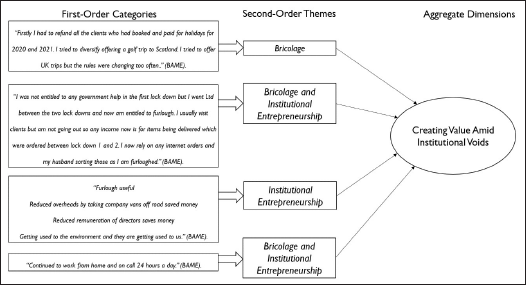
According to Bourdieu (1985), social capital resides in the individual and is linked to social class and the connections that a person can utilize. Social capital can aid external bricolage because it enables entrepreneurs to exert power on the group or individual who mobilizes the resources (Keating et al., 2014). Social capital is aided by trust-based relationships and belonging to the social classification that wields the capital. Platt and Nandi (2020) found evidence of structuration and social classification in the UK such that Whites tend to occupy higher social roles compared with ethnic minorities. Coad and Glyptis (2014) argued for an analysis of the configuration and articulation of patterns in relations between agents over time. They advocate a position–practice perspective, with four interrelated elements: praxis, positioning, capabilities and trust. The trust aspect of such structuration theory is particularly useful because it acknowledges the interaction of perception, values and power, and posits a dynamic relationship between different groups (Stones, 2017). Trust helps in overcoming institutional voids due to country-specific uncertainties that create higher transaction costs for doing business and are commonly found in the emerging markets of the Global South (Mickiewicz & Olarewaju, 2020; Williamson, 1989). However, EMBs in the UK are vibrant in transaction economies that intersect local and migratory resources, eluding the categorization of either a Global North or a Global South (Hall et al., 2017). The bricolage and institutional entrepreneurship perspectives we have uncovered can help rebuild trust and reconfigure patterns in relations between agents over time, but bricolage and institutional entrepreneurship will need environments of support.
As entrepreneurs ‘make do’ with limited resources, they can find ways to operate without the need to construct costly safeguards that ultimately increase the cost and rigours of monitoring. Entrepreneurs also use their bricolage activities to decide what operations to invest in by gauging how useful such operations have been to their bricolage activities in the past. They can also start making limited investments into such operations before moving on to more substantial investment sizes. Furthermore, as these bricolage activities become more frequent, institutional entrepreneurship sets in when the informal environment and formal institutions become used to such activities and create measures to support them.
Thus, entrepreneurs themselves can create informal institutions that encourage effective and efficient market transactions at a level that encourages growth over time. Ethnic minority entrepreneurs will also need to engage with different actors in their environments to enhance their business activities and bridge institutional voids. Conversely, these actors, including local and central governments, other indigenous entrepreneurs, financial actors and the local population will also need to create a conducive atmosphere for mutual prosperity and undertake actions to gain and regain the trust of ethnic minority entrepreneurs.
Discussion
In addition to the concepts of bricolage and institutional entrepreneurship we have discussed, Herbane (2013) showed that planning can be used to address crisis prevention and lower the impact of crises and reveal six crucial factors in this respect: resilience through planning; financial impact; operational crisis management; the perfect storm; the aftermath of survival and atrophy. In a similar vein, Doern (2016) suggested exploring preparedness as a particularly relevant concept for understanding entrepreneurs’ responses to crises. The concept of entrepreneurial preparedness highlights the important role that the community plays in recovery from a crisis (Muñoz et al., 2019). Likewise, Olarewaju and Tamvada (2022) indicated that resilience to crises is enhanced by having more resources in the same manner that resourcefulness has also been viewed as critical for resilience in times of crisis (Ayala & Manzano, 2014).
Taken together, our qualitative and quantitative analyses agree with the literature that highlights the need for resilience as well as the ability of entrepreneurs, organizations and economies to absorb and adapt to shocks (Batjargal et al., 2023). Our analysis also shows that SME owners need to pay attention to building resilience and pulling together useful tangible and intangible resources to help in both pandemic and non-pandemic periods. For example, SME owners who reported finding opportunities for business expansion during the pandemic often described how they had purposely chosen to operate in sectors and spaces that could withstand crisis conditions by paying attention to short- and long-term trends. Others who practised resilience found ways to obtain useful information and reduce costs while being agile to changing business conditions.
No research is without limitations and a limitation of our research is that research is yet to uncover how these institutional voids came to be over time. However, the UK can fill these institutional voids and assist BAME SME owners by engaging in activities to rebuild trust with BAME SME owners as well as by ensuring that government institutions are visible and operate fairly. This should also help BAME SME owners as they practise bricolage, institutional entrepreneurship, resilience and resourcefulness. The strategies we have highlighted will also be useful after the pandemic.
The newly revealed informal institutional void challenges that faced BAME SME owners during the COVID-19 pandemic and the strategies taken to overcome them must be properly understood so that coherent policy can be drafted to protect these SME owners after the pandemic and if similar conditions occur in the future. Non-BAME business owners can also learn from the bricolage and institutional entrepreneurship strategies employed by BAME SME owners that we have uncovered in this article. This can help with knowledge spillover through observational learning and positive competition, generating secondary constructive effects for the entire nation.
Conclusion
This article has presented hitherto undiscovered evidence that informal institutional voids for BAME SME owners were revealed by the COVID-19 pandemic. The article also sheds light on hitherto unexplored factors that inhibit ethnic minority entrepreneurship during the pandemic that could persist during non-pandemic periods. The results imply that BAME SME owners should be offered business support through channels that are more likely to be trusted by them—for example, central government institutions that are more likely to be trusted by them, while efforts should be made to bridge the gap between BAME SME owners and local government institutions that they are more likely to distrust. The article reveals the existence of informal institutional voids in the Global North and future research should uncover subtle aspects of ethnic minority entrepreneurship that have long-term implications for opportunity, inclusion and social cohesion in developed countries.
The existence of informal institutional voids in the UK and the Global North, in general, has tremendous policy implications. The Global North is typically seen as the citadel of efficient and effective market conditions and the presence of informal institutional voids is a wake-up call for policymakers in the region. Future research will need to investigate the interactive influence that arises from informal institutional voids in environments that have previously not been known to have formal institutional voids. Finally, all stakeholders should ensure that informal institutional voids do not fatally affect businesses in times of crisis. Overall, there is a need for research and sincere dialogue into why this distrust exists and how to bridge it for societal good. With this work, we also show that managers, entrepreneurs and policymakers need to consider informal institutional voids that are exposed during periods of crisis and economic hardship.
Footnotes
Declaration of Conflicting Interests
The authors declared no potential conflicts of interest with respect to the research, authorship and/or publication of this article.
Funding
The authors disclosed receipt of the following financial support for the research, authorship, and/or publication of this article: This work was supported by the British Academy.
