




Abstract
Though firms are making substantial investments in the customer journey (CJ), the return on these investments remains tenuous, yielding a critical need for enhanced CJ-related accountability. Addressing this gap, we develop the concept of ‘customer journey value’ (CJV), defined as the perceived value of a customer’s journey to the customer and the firm, which facilitates the development of accountability in this regard. We also develop a social exchange theory-informed framework of CJV, which proposes customer- and firm-based customer engagement value (CEV) as core CJV antecedents. In turn, CJV is predicted to yield the customer-based consequences of attitudinal and behavioural brand loyalty and the firm-based consequences of enhanced customer lifetime value, as formalized in a set of propositions based on the framework. We conclude by outlining pertinent implications that arise from our analyses.
Keywords
Introduction
In recent years, research addressing the customer journey (CJ), defined as ‘the process a customer goes through, across all stages and touchpoints, that makes up the customer experience’ (Lemon & Verhoef, 2016, p. 71), has received significant, and rising, attention (e.g., Hamilton & Price, 2019). The CJ typically describes a customer’s progression through a sequence of role-related stages and activities in making a purchase, offering a chronological account of their purchase-related activity.
Authors are increasingly proposing a key role of customer engagement (CE), or a customer’s resource investments in their brand interactions (e.g., Kumar et al., 2019), in shaping the CJ (e.g., Demmers et al., 2020; Mele & Russo-Spena, 2021). Specifically, these authors suggest CE’s prerequisite role in driving the CJ, as without these investments, the journey’s unfolding would be halted. That is, as long as customers invest their resources (e.g., time, emotions or financial resources) in their brand interactions, their journey with the company will continue to unfold (Hollebeek et al., 2023).
However, while CJ-based insight is rapidly developing (Hamilton et al., 2021), little is known about whether or the extent to which the CJ creates value for customers and firms (Pastoors & Baier, 2018), exposing an important literature-based gap. Thus, though a customer’s journey with companies like Tesla or Walmart describes the individual’s evolving role-related activities with the firm, the buyer’s level of perceived value arising from these interactions remains tenuous (Kuehnl et al., 2019). Likewise, the value of a customer’s journey to the firm remains nebulous (Ang & Buttle, 2002), leaving questions including ‘How does a customer’s journey contribute to bottom-line firm performance?’ largely unanswered (Klink et al., 2021). In other words, while leading companies, including Mercedes or Apple, are making significant investments in the CJ (Kelly, 2018), the return on these investments remains unclear, as addressed in this article by developing customer journey value (CJV; Pastoors & Baier, 2018).
To develop CJV, we link the CJ/CE (e.g., Demmers et al., 2020) and apply the latter’s derivative concept of customer engagement value (CEV), or the value of CE to the firm (Kumar et al., 2010), to the CJ. However, the related brand equity literature recognizes key customer and firm-based perspectives on brand-related value (creation) (e.g., Ailawadi et al., 2003; Keller, 1993), leading us to extend Kumar et al.’s (2010) firm-based CEV to also include customer-perceived (customer-based) engagement value (i.e., the value of a customer’s engagement to the customer) and yielding a more balanced customer/firm-based CEV perspective.
While Kumar et al.’s (2010) firm-based CEV comprises customers’ purchase, referral, influencer and knowledge value, we propose customer-perceived CEV comprise customer-perceived functional, experiential and symbolic value. Collectively, customer and firm-based CEV, which arise from the customer’s journey-based engagement, drive customer and firm-based CJV, which we define as the perceived value of a customer’s journey to the customer and the firm (Hollebeek et al., 2023; Kumar et al., 2010).
This conceptual article contributes to the CJ, engagement and perceived value literature. First, though CJ is receiving surging literature-based attention (e.g., Novak & Hoffman, 2019), its perceived value to the customer and the firm remains tenuous, revealing an important gap. Addressing this gap, we conceptualize CJV as the customer’s and firm’s perceived value emanating from a customer’s journey with a firm, thus paralleling the notions of customer and firm-based brand equity (Aaker, 1991; Keller, 1993) thus answering the following research question: ‘What is CJV?’ CJV’s development not only reflects a novel addition to the literature but also has managerial relevance. Specifically, while firms are making substantial CJ-based investments, the value of or return on, these investments remains indeterminate (DecisionLink, 2022), warranting further research on this important, rising metric (Klein et al., 2020; Tueanrat et al., 2021). For example, the longer a customer’s journey, the greater its potential to add value to the firm (e.g., through the customer’s elevated lifetime value) and the buyer (e.g., by offering enhanced relational or convenience-based benefits; Hollebeek et al., 2022).
By developing customer and firm-based CJV, our analyses extend Pastoors and Baier’s (2018) exploratory CJV-based analyses. However, while these authors limit their analyses to a firm (valuation)-based perspective of CJV, we more comprehensively examine CJV from customer and firm perspectives. Moreover, the following authors, including Demmers et al. (2020), Venkatesan et al. (2018) and Hollebeek et al. (2022), argue for CE’s core role in shaping the CJ. Specifically, we propose that CE yields CEV (Kumar et al., 2010), driving customer and firm-perceived CJV. Overall, by developing CJV, our analyses reveal MacInnis’ (2011, p. 146) integrating purpose of conceptual research, which implies ‘the creation of a whole [here, CJV] from diverse parts’ (e.g., the CJ, CE and CEV).
Second, we examine CJV’s role in a broader social exchange theory-informed nomological network, which suggests that as long as individuals experience perceived benefit (value) from their brand interactions, they are predicted to continue reciprocating with (engaging with) the object (Bagozzi, 1975; Blau, 1964), thus prolonging their journey with the firm. Correspondingly, the framework comprises customer and firm-based CEV as core CJV antecedents, thus further substantiating engagement (value)’s key role in the journey’s unfolding (Hollebeek et al., 2023; Venkatesan et al., 2018; Vredeveld & Coulter, 2019). The framework also outlines pertinent CJV consequences, including customer-based brand loyalty (Oliver, 1999) and firm-based customer lifetime value (Gupta et al., 2006), thus answering the following research question: ‘What are CJV’s key antecedents and consequences? Overall, the framework answers the following research question: “What are key CJV antecedents and consequences?”, thus supporting MacInnis’ (2011, p. 141) observation that ‘knowledge advancement occurs not only by studying and developing constructs, but also by conceptualizing their relationship to other concepts, often in a nomological network’. We also developed a set of propositions of CJV aligned with the framework.
The article unfolds as follows. We next review key CJ and engagement (value) literature, followed by the development of CJV and its nomological network. We conclude by discussing pertinent implications that arise from this research.
Literature Review
The Customer Journey
Though the CJ has received extensive investigation (e.g., Kuehnl et al., 2019), CJV or the perceived value of a customer’s journey to the customer and the firm remains under-studied to date (Pastoors & Baier, 2018), despite its managerial pertinence. We, therefore, review key CJ research in Table 1, which offers a pertinent theoretical foundation for CJV.
Customer Journey Conceptualizations.
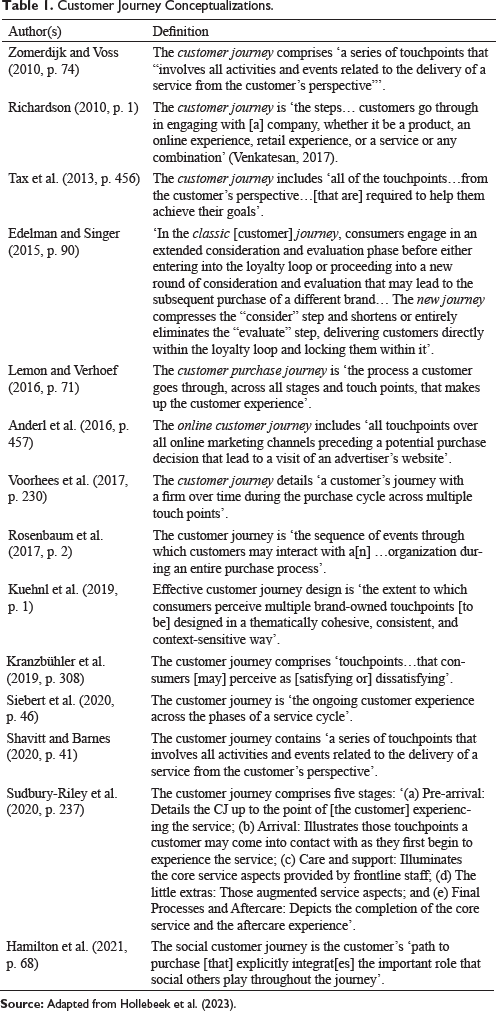
Reviewing important CJ conceptualizations (Table 1), we observe the following. First, the CJ maps the customer’s advancement through a set of stages in completing their goal of making a purchase (Lemon & Verhoef, 2016). It, thus, comprises the customer’s entire purchase experience, ranging from their initial product information search to their post-purchase evaluation. Although repeat purchases are commonly modelled as separate journeys (e.g., Voorhees et al., 2017), authors including Novak and Hoffman (2019) and Hollebeek et al. (2022) suggest the importance of taking a more relational view where the CJ comprises the customer’s cumulative brand/firm interactions over time.
Second, the journey comprises different touchpoints, or ‘points of human, …communication, spatial, and electronic interaction collectively constituting the interface between an enterprise and its customers’ (Dhebar, 2013, p. 200). Touchpoints can be owned by the brand, brand partner(s), customer(s) or other stakeholders (Becker & Jaakkola, 2020; Lemon & Verhoef, 2016). For example, a retailer’s touchpoints may include the physical store(s), phone number, email address, website and social media channels, instigating customers’ potentially phygital (i.e., physical/digital) journeys (Mele & Russo-Spena, 2021).
Third, the CJ is intricately linked to the customer experience (CX), ‘a multidimensional construct focusing on a customer’s cognitive, emotional, behavioural, sensorial and social responses to a firm’s offerings during the customer’s entire purchase journey’ (Lemon & Verhoef, 2016, p. 71). Authors including Hollebeek et al. (2022) and Jaakkola and Alexander (2018) propose that the customer’s journey-based experience arises from their engagement or the individual’s volitional resource investment in their brand interactions (Kumar et al., 2019) as also adopted in this article. Correspondingly, we follow Hollebeek et al.’s (2022) perspective of CX as a customer’s role-related responses (role outputs; Brakus et al., 2009), which arise from their role-related engagement.
Customer Engagement (Value)
CE represents a vital CJ-shaping conduit (Venkatesan et al., 2018; Vredeveld & Coulter, 2019), leading us to adopt the concept as a key constituent in our CJ-based analyses (Hollebeek et al., 2023). Correspondingly, we review key CE conceptualizations in Table 2, from which we draw the following observations. Overall, while the concept’s definition is debated (e.g., Pansari & Kumar, 2017), we observe several areas of CE-based agreement, as discussed further.
Customer Engagement Conceptualizations.
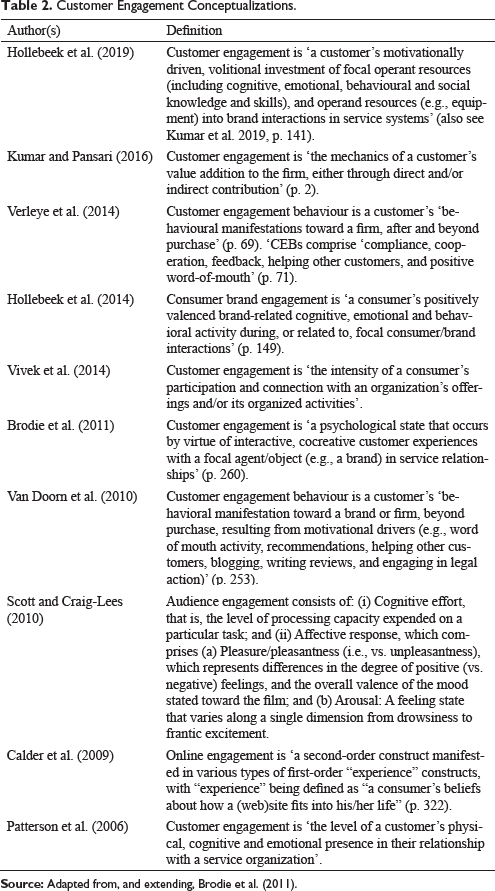
First, broad consensus exists regarding CE’s core interactive nature (e.g., Rosado-Pinto & Loureiro, 2020; So et al., 2021). In other words, CE is commonly used to describe the customer’s interactions with objects, including a brand, company, or product (e.g., Hollebeek et al., 2014; Kumar et al., 2019). Here, interaction has been defined as “mutual or reciprocal action or influence” (Vargo & Lusch, 2016, p. 9). While CE-based interactivity, traditionally, transpires through the customer’s interactions with human stakeholders (e.g., service employees/fellow customers), it can also manifest through their interactions with non-human entities, including service robots, chatbots, or virtual reality-based interfaces (e.g., Güngör, 2020; Storbacka et al., 2016).
Second, CE is commonly viewed as a customer’s resource investment in, or contribution to, their brand or firm-based interactions (Hollebeek et al., 2019; Pansari & Kumar, 2017; Rosado-Pinto & Loureiro, 2020). Generally, the more of their operant (e.g., cognitive knowledge or skill-based) and/or operand (e.g., equipment-based) resources customers invest in their interactions, the higher their engagement (Rosado-Pinto & Loureiro, 2020). Customers’ role-based resource investments may also transpire at differing levels of customer volition (Hollebeek et al., 2022). For example, while customers are likely to willingly, or voluntarily, invest their (e.g., temporal/monetary) resources in their leisure activities (e.g., attending a Cirque du Soleil show), their investments in paying a fine or using unsought (e.g., healthcare) services are likely not to be purely by choice.
Third, CE is typically viewed as a multidimensional concept comprising cognitive, emotional and behavioural facets (e.g., Lim et al., 2022; Vivek et al., 2014). For example, Hollebeek et al.’s (2014) consumer brand engagement (CBE) comprises (a) cognitive processing (the consumer’s cognitive resource investment in a brand/firm interaction), (b) affection (the individual’s emotional investment in such interaction) and (c) activation (the consumer’s behavioural resource investment [e.g., of effort/energy] in an interaction). Moreover, while some authors add a social CE dimension, this may lack relevance in some contexts (e.g., privately consumed goods). Based on our review, we adopt Kumar et al.’s (2019, p. 141) and Hollebeek et al.’s (2019, p. 166) widely cited conceptualization that defines CE as ‘a customer’s…volitional investment of operant [e.g., cognitive/emotional] and operand [e.g., equipment-based] resources in [their] brand interactions’.
Fourth, extending CE research, Kumar et al. (2010) propose CEV, or the value of a customer’s engagement to the firm, which comprises:
Customer purchase value: The value of the customer’s purchase behaviour (p. 297), whether ‘repeat purchases or additional purchases through up-selling and cross-selling’ (p. 299), Customer referral value: The value of a firm’s newly acquired customers through a ‘firm-initiated and incentivised formal referral program’ (p. 299), Customer influencer value: The value of a customer’s influence on other acquired customers, as well as on prospects (e.g., word of mouth activity that persuades/converts prospects to customers, minimizes buyer remorse to reduce defections or boosts existing customers’ share of wallet; p. 299), and Customer knowledge value: The value of customer feedback provided to the firm (e.g., ideas for product innovation/improvements; p. 299).
However, as Kumar et al.’s (2010) CEV is limited to firm-based CEV, we develop customer-based (customer-perceived) CEV as its theoretical counterpart below, akin to the notions of customer and firm-based brand equity, as outlined.
Conceptual Development
Conceptualizing Customer Journey Value
We define CJV as the value of a customer’s journey to the customer/firm. Thus, while customer-based CJV reflects a buyer’s perceived value of their journey with a firm, firm-based CJV exposes the (financial) value of a customer’s journey to the firm. Given CE’s critical role in the CJ’s unfolding (Demmers et al., 2020), we posit that CEV, or the value of a customer’s engagement with a brand or firm (Kumar et al., 2010), acts as a primary CJV determinant. That is, as a customer’s engagement is a prerequisite to their unfolding journey (Hollebeek et al., 2023), the CEV generated through this engagement, over time, maps the individual’s CJV. While we reviewed firm-based CEV literature, we have developed the customer-based CEV below.
Conceptualizing Customer-Based CEV
Though firm-based CEV comprises customer purchase, referral, influencer and knowledge value (Kumar et al., 2010), as noted, customer-based CEV’s components are yet to be determined. Addressing this gap, we develop customer-based CEV by extending the notions of CE (e.g., Hollebeek et al., 2019), customer-based brand equity (e.g., Aaker, 1991; Netemeijer et al., 2004; Wang et al., 2018) and customer (perceived) value (e.g., Kotler, 2020; Mahajan, 2020; Zeithaml, 1988).
The scrutiny of this literature is appropriate, given its focus on customer-perceived value dynamics, which is also applicable to customer-based CEV. That is, while the reviewed literature adopts customer-based/perceived value (equity) terminology (vs. customer-based CEV), closer inspection reveals that its value/equity designations, respectively, typically address the value arising from a customer’s brand/firm interactions, like CE (Hollebeek et al., 2019) and thus, like CEV. Supporting this observation, Leroi-Werelds et al. (2014, p. 431) state: ‘Customer value implies an interaction between a subject (the customer) and an object (e.g., a product, a brand, a service, a store)’, as backed by authors including Holbrook (1999) and Gallarza et al. (2017), to name a few. Likewise, Pham and Gammoh (2015) explore interactive social media’s effect on customer-perceived brand equity (i.e., the brand’s value in the customer’s mind), thus also signalling the key role of customers’ brand/firm interactions in driving customer-perceived brand equity (Solem & Pedersen, 2016; Wang et al., 2018). We, therefore, review key customer (perceived) value and brand equity literature to develop customer-based CEV while staying true to CE(V)’s theoretical scope, as reviewed above.
For example, we consulted the customer value work of authors, including Zeithaml (1988), Leroi-Werelds et al. (2014), Holbrook (1999), Mahajan (2020) and Woodruff (1997), while also inspecting the work of customer-based brand equity authors, including Ailawadi et al. (2003), Keller (1993) and Aaker (1991), among others. In this process, we reflected on key customer value/equity tenets, including its buyer-perceived, subjective nature and the customer’s inherent mental trade-off of attained brand-related benefits (vs. costs; Parasuraman, 1997; Zeithaml, 1988), which is also recognized in the CE literature (e.g., see Hollebeek’s [2016] net CE). Based on these analyses, we propose the following dimensionality of customer-based engagement value: Functional value: A customer’s perceived functional/utilitarian benefits (minus perceived costs) attained from their brand interactions. For example, functional value can arise from high-quality products/services or from using the brand as a purchase-based mental shortcut or perceived risk reducer (e.g., Gallarza et al., 2017; Keller, 1993; Kim et al., 2011; Leroi-Werelds et al., 2014; Netemeijer et al., 2004; Sweeney & Soutar, 2001; Wang et al., 2018; Zeithaml, 1988). Experiential value: A customer’s perceived phenomenological, experience-based (e.g., emotional/social) benefits (minus perceived costs) attained their brand interactions. For example, customers may bond with the brand, form brand-related attachments or develop a passion for the brand (e.g., Holbrook & Hirschman, 1982; Keller, 1993; Leroi-Werelds et al., 2014; Mathwick et al., 2001; Sweeney & Soutar, 2001; Yang et al., 2015). Symbolic value: A customer’s perceived symbolic, or meaning-based, benefits (minus perceived costs) attained from their brand interactions. For example, customers are likely to develop specific brand (personality) associations (Gallarza et al., 2017; Holbrook & Hirschman, 1982; Keller, 1993; Saarijärvi, 2012).
Overall, we define customer-perceived CJV as the perceived value of a customer’s journey to the customer, which we propose comprises functional, experiential and symbolic value.
Conceptual Framework of CJV
Overview
The proposed framework is grounded in social exchange theory, which posits that customers are predicted to reciprocate positive thoughts, feelings and behaviours toward an object (e.g., a brand) upon receiving specific perceived benefits (Blau, 1964). Social exchange, thus, involves unspecified obligations, whereby one party (e.g., the brand) doing the other a favour (e.g., by providing exceptional service) is motivated by the objective of some future return (e.g., boosting customer loyalty; Hollebeek, 2011). For a customer in an exchange, what (s)he gives may be perceived as a cost, while what is received may be viewed as a reward, akin to customer value and engagement, a mental cost/benefit trade-off (Hollebeek, 2016; Zeithaml, 1988).
Given CE’s intra-interaction scope (e.g., Khan et al., 2020), its levels may fluctuate across a customer’s brand interactions (Hollebeek et al., 2014), revealing its discrete interactional nature. For example, while a customer’s CEV-based purchase or experiential value may be high in some transactions, it can be substantially lower in others. However, while CEV arises from the customer’s brand interactions, the CJ aggregates CE-based interaction episodes over time (Hollebeek et al., 2023; Novak & Hoffman, 2019). Therefore, the proposed framework transcends the customer’s discrete brand interaction episodes to collectively yield trans-interactional (cumulative) CJV.
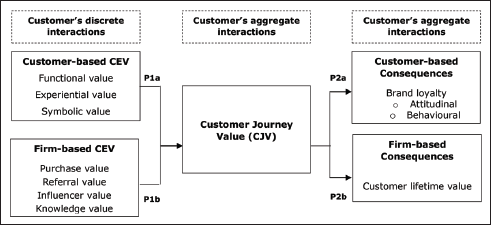
As CE episodes are aggregated through the CJ, it logically follows that CE’s derivative concept of customer/firm-based CEV will, likewise, accumulate through the CJ over time, revealing a similar transition from the customer’s individual, discrete interactions to a CJ-based aggregate interaction perspective (Figure 1). Below, we discuss the framework’s proposed associations from which we also derive a set of propositions of CJV.
Propositions of CJV
We next develop a set of propositions that formalize CJV’s associations depicted in Figure 1. As shown, we collectively predict customer/firm-based CEV to drive CJV’s development. Rising levels of intra-interaction customer/firm-based CEV, which emerge from the customer’s interactive brand engagement, are predicted to boost trans-interaction CJV (Hollebeek et al., 2023). The customer’s higher perceived brand interaction value is, thus, likely to see their repeated brand interactions, in turn boosting their expected CJV over time. We postulate:
CJV, in turn, is expected to generate specific customer/firm-based consequences. In terms of its customer-based consequences, CJV is anticipated to impact the customer’s brand loyalty, ‘a deeply held commitment to rebuy or repatronize a preferred product or service consistently in the future’ (Oliver, 1999, p. 34). According to Oliver (1999), brand loyalty comprises (a) Attitudinal loyalty, or ‘the psychological component of a consumer’s commitment to a brand [that] may encompass beliefs of product/service superiority, as well as positive and accessible reactions toward the brand’ (e.g., through positive brand-related word-of-mouth; Liu-Thompkins & Tam, 2013) and (b) behavioural loyalty or the customer’s brand repurchase (e.g., Fader & Schmittlein, 1993). Thus, the higher a customer’s perceived CJV, the more likely (s)he is predicted to be to disseminate brand-related advocacy or favourable word of mouth and to repurchase the brand (Kumar et al., 2007). A customer’s elevated brand loyalty, in turn, secures CJ’s continuation.
In terms of firm-based CJV consequences, the framework proposes customer lifetime value, ‘the [net] present value of all future profits obtained from a customer over his or her life of relationship with a firm’ (Gupta et al., 2006, p. 141), as a key outcome. Customer lifetime value is usually estimated at an individual customer level (Gupta et al., 2006), permitting marketers to differentiate between more (vs. less) profitable customers (Venkatesan & Kumar, 2004). While Kumar et al. (2010) use CEV-based purchase value synonymously with customer lifetime value, we caution against this, given CE’s, and thus, CEV’s, intra (vs. trans)-interaction nature, as discussed (Hollebeek & Macky, 2019; Khan et al., 2020). That is, based on its discrete interactional engagement component, CEV likewise boasts an intra (vs. a trans)-interaction scope, rendering the aggregate measure of customer lifetime value (i.e., comprising the totality of a customer’s transactions with a firm over time) less suitable for gauging CEV. Consequently, while we advise against the inclusion of customer lifetime value as an engagement-based CJV antecedent, we view it as a key CJV consequence (Figure 1). Thus, given CJV’s aggregate (vs. discrete interactional) nature, it is expected to yield cumulative outcomes, like customer lifetime value (Gupta et al., 2006). We, thus, propose customer lifetime value as a firm-based CJV consequence, substantiating CJV’s impact on firm performance (Pastoors & Baier, 2018). We posit:
Discussion, Implications and Limitations
Theoretical Implications
We proposed the CJV concept, thus extending existing CJ, CE, customer value and customer-based brand equity literature. First, extending these literature streams, we conceptualized CJV as the perceived value of a customer’s journey to the customer and the firm, making a pertinent theoretical contribution. The development of CJV matters because while many firms make substantial CJ-based investments (Rosenbaum et al., 2017), little remains are known regarding the actual customer/firm-based value accruing from these investments, warranting CJV’s development. The proposed CJV conceptualization, therefore, yields pertinent implications for theory development. Applying CJV, scholars can further investigate the concept (e.g., in future empirical research). For example, given CJV’s nascent nature, undertaking qualitative research is appropriate (e.g., verifying the proposed conceptualization/nomological network). Moreover, quantitative studies may examine CEV’s or CJV’s evolution through the journey (e.g., by conducting longitudinal studies).
Second, we proposed a framework comprising key CJV antecedents and consequences (MacInnis, 2011). The framework also conceptualized customer-perceived CEV because while Kumar et al. (2010) proposed firm-based CEV, its customer-based counterpart remained tenuous, specifically by drawing on established customer value (e.g., Mahajan, 2020; Zeithaml, 1988), and customer-based brand equity (e.g., Ailawadi et al., 2003; Keller, 1993) literature, we propose customer-based CEV to comprise functional, experiential and symbolic value. Customer-based CEV development yields several research opportunities. For example, scholars may integratively examine customer/firm-based CEV, yielding a more balanced, comprehensive perspective by elucidating CE-based value to the individual and the firm. Relatedly, the framework suggests that customer and firm-based CEV collectively drive CJV, offering a roadmap for further research.
Managerial Implications
This research also raises pertinent implications for marketing practitioners. First, developing a CJV-based understanding is expected to equip marketers with improved strategic insight in terms of safeguarding their CJ-related return on investment (DecisionLink, 2022). That is, by adopting CJV as an organizational metric, managerial accountability for specific CJ-related investments is expected to improve, in turn allowing practitioners to boost their CJ-based investment portfolio (e.g., by selecting CJV-optimizing investments while avoiding value-destructive ones; Mahajan, 2019). Given CEV’s identified core antecedent role to CJV, we advise managers to invest in those CJ-based activities that will optimize CEV (e.g., by stimulating customers’ referral value; Kumar et al., 2010).
Second, based on our social exchange theory-informed perspective, we suggest that when customers perceive their CJ-related interactions to generate value for them, they are predicted to reciprocate this received value by offering value back to the firm (Blau, 1964), including by repeat purchasing its offerings (i.e., behavioural loyalty) and/or by offering brand-related advocacy (i.e., attitudinal loyalty), in turn boosting the firm’s customer lifetime value and creating a virtuous cycle. We recommend managers stimulate the agile development of such positive cycles (e.g., by consistently ensuring the customer’s positive [vs. negative] engagement and perceived value; e.g., Rademakers et al., 2019). To consistently offer elevated levels of customer-perceived value, it is essential to engage these individuals, as engaged buyers have been shown to spend more with the firm, exhibit a higher share-of-wallet, and yield higher overall profitability (Brodie et al., 2011). To engage customers, it is important to provide perceived relevant, valuable offerings conducive to yielding customer-based experiential and symbolic value, in particular (e.g., Hollebeek & Macky, 2019).
Limitations and Further Research
This study also has inherent limitations that offer additional research opportunities. First, the purely conceptual nature of our analyses reveals a need for their future empirical testing and validation (Hair et al., 2013). For example, the propositions may be further examined in subsequent qualitative (e.g., focus group-based) research or empirically tested in quantitative (e.g., survey-based) studies.
Second, while we deployed social exchange theory to inform our analyses, future studies may adopt alternate theoretical perspectives. For example, value creation theory (Windsor, 2017), service-dominant (S-D) logic (Vargo & Lusch, 2016) or entrepreneurial value creation theory (Mishra & Zachary, 2014) may be used, thus supplementing or refining the reported insight. Relatedly, future scholars may wish to employ specific moderators (e.g., culture/need-for-control) in their proposed CJV-based frameworks or the role and value of more (vs. less) relevant CJs, whether to the firm or the customer.
Third, while we explored customer/firm perspectives of CJV, future scholars could also examine CJV from a multi-stakeholder perspective (Hollebeek et al., 2022), thus broadening the range of studied stakeholders (Freeman, 1984). To examine these issues, we recommend undertaking initial exploratory, qualitative research, followed by quantitative studies delving further into the observed dynamics.
Fourth, scholars may wish to explore the proposed dynamics in the context of new technologies, including artificial intelligence (Güngör, 2020; Kaartemo & Helkkula, 2018; Russo-Spena et al., 2018), social media (Brey, 2019), cognitive technologies (Mele et al., 2018) or digital networks (e.g., Boswijk, 2017), which are expected to offer pertinent implications for value creation in increasingly digital or phygital CJs.
Footnotes
Acknowledgments
We thank the editor and the anonymous reviewers for their constructive feedback, which has helped improve this article.
Declaration of Conflicting Interests
The authors declared no potential conflicts of interest with respect to the research, authorship, and/or publication of this article.
Funding
The authors thank The Icelandic Centre for Research (RANNIS) for partially funding this study (Grant Number 218235-051).