




Abstract
We focus on the digital solution supplier’s perspective to analyse which information systems (IS) capabilities are essential for business-to-business (B2B) value co-creation. To gain a deeper understanding of the issue, a qualitative multi-case study was used. The results show that the focus of digital solutions in business has changed and shifted from the technical functions of solutions to the need for supplier and customer to work towards a common goal. The study proposes that, in advanced digital solutions, all parts of the solution development process require co-creation, either direct or indirect. In particular, forming IS–business partnerships, one of the spanning capabilities which integrates with internal organizational processes shows great potential in value co-creation. Originality builds on the understanding of which IS capabilities are essential when advanced digital solution suppliers offer services to their customers in the B2B context. This outcome contributes to the IS capabilities literature by showing the shift in focus from technically oriented capabilities to relationship-oriented capabilities in value co-creation.
Introduction
Information systems (IS) capabilities, such as external relationship management, technical skills and planning, have been considered as vital for the implementation and use of IS and digital solutions (Bharadwaj, 2000; Tan et al., 2015; Wade & Hulland, 2004). IS capabilities refer to the deployment of information technology-based resources with other organizational resources and capabilities (Bharadwaj, 2000) in a way that strives to enhance value creation, such as overall efficiency, effectiveness and flexibility, among other business needs (Karimi et al., 2007). IS capabilities have been found to play a significant role in value co-creation in developing digital solutions (Grover & Kohli, 2012; Haki et al., 2019; Saunila et al., 2019; Winkler & Wulf, 2019). Recent research has called for studies into the essential capabilities of producing digital solutions (Lenka et al., 2017). As a result, O’Cass and Ngo (2012) argued that the suppliers of digital solutions should ‘give significant attention to interpreting and responding to what value it perceives customers are looking for’ (p. 126). The importance of customer perspectives emphasizes the distinct roles of suppliers and customers, meaning that value is co-created (e.g., Grönroos, 2011; Grönroos & Voima, 2013; Vargo & Lusch, 2008). Value co-creation can be defined as ‘the processes and activities that underlie resource integration and incorporate different actor roles in the service ecosystem’ (Lusch & Nambisan, 2015, p. 162). This study is based on the dual nature of the value co-creation process, denoting that both the supplier and customer may engage in each other’s processes as value co-creators (Grönroos & Ravald, 2011).
It has been shown that value co-creation in a business-to-business (B2B) context differs from a business-to-consumer (B2C) context in terms of, for example, complexity and multidimensionality (Roser et al., 2013; Saunila et al., 2019). As most of the capability-related studies around digital solutions have been conducted in the B2C context, little is known about their use in the B2B context (Lenka et al., 2017). Yet what remains to be discovered is what digital solution suppliers consider to be the essential IS capabilities in digital solution production when they co-create value with their business customers. This is important to study as, first, business customers generally represent a considerably larger value to the provider than a single consumer. Second, the purchasing duration typically takes longer, as in the customary B2C case (Oliveira & Roth, 2012). This is because of the amount of interaction needed for making complex buying decisions, which typically involve several different practices on both the provider and customer sides, for instance, related to technological and financial issues (Grönroos & Helle, 2010; Oliveira & Roth, 2012). Moreover, firms that operate in the B2B context typically need to have a broader view of the entire supply chain than those operating in the B2C context (Oliveira & Roth, 2012). Therefore, this study aims to contribute to this gap in the research by answering the following research question: Which IS capabilities are essential for B2B value co-creation? This study presents suppliers’ perspectives on the essential IS capabilities using a qualitative multi-case study approach. A multi-case study was used due to its potential to provide higher external validity compared with single cases. Utilized cases include situations where digital solution suppliers co-create digital solutions with their business customers. Thus, a digital solution supplier and its relationships with its customers formed the unit of analysis.
IS Capabilities
Many studies that try to understand the impact of IS on firm performance rely on the resource-based view (RBV; Tan et al., 2015; Wade & Hulland, 2004). RBV builds on the assumption that firms possess unique resources that will allow them to gain sustainable competitive advantage (Barney, 1991). There are legions of definitions and classifications of the resource concept in the literature (Wade & Hulland, 2004). In this article, we divide resources into assets and capabilities (Wade & Hulland, 2004) and define assets as available tangibles or intangibles a firm can use in its operations to achieve its goals and capabilities as intangible, repeatable patterns of actions deploying assets to reach the desired outcomes (Karimi et al., 2007; Wade & Hulland, 2004). Capabilities in the context of IS refer to the ‘ability to mobilize and deploy IT-based resources in combination or copresent with other resources and capabilities’ (Bharadwaj, 2000, p. 171) to achieve desired outcomes such as improving efficiency, effectiveness, and/or flexibility (Karimi et al., 2007; Tan et al., 2015).
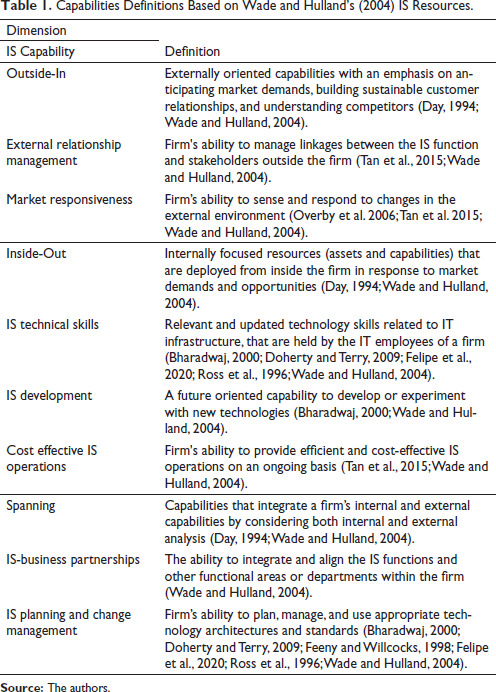
Various typological categorizations comprise a variety of IS-related organizational capabilities that are considered to create business value. After reviewing numerous typologies (see Appendix 1), we concluded to adopt Wade and Hulland’s (2004) typology. It has been found to be one of the most consistent and comprehensive typologies (Doherty & Terry, 2009; Felipe et al., 2020), and, in addition to the internally targeted IS capabilities, it addresses the externally oriented capabilities relevant to our study. Furthermore, the IS capabilities in the typology are ‘all mid-level constructs that are reasonably specific while also permitting an acceptable level of generalizability across studies’ (Wade & Hulland, 2004, p. 129), thus building a perfect framework for our study (see Table 1). IS infrastructure is excluded in this study, as it is an asset rather than a capability.
Capabilities Definitions Based on Wade and Hulland’s (2004) IS Resources.
IS and Value Co-creation in the B2B Context
IS research has shown a growth in studies considering service-dominant logic and value co-creation (Grover & Kohli, 2012; Haki et al., 2019; Saunila et al., 2019; Winkler & Wulf, 2019). Value co-creation can be considered as the supplier’s willingness to participate in its customer’s value creation processes or allowing the customer the opportunity to participate in the supplier’s value creation processes as a co-creator (Grönroos, 2011; Grönroos & Voima, 2013). This means that the supplier can ask the customer to co-produce the solution, or the customer can extend active participation into the supplier sphere (Grönroos & Voima, 2013). Both of these widen the interconnection beyond direct interaction and make co-creation possible (Grönroos & Voima, 2013; Lenka et al., 2017). Co-creation will then provide value for both the supplier and the customer. While IS service research has mainly focused on value co-creation in B2C relationships, some scholars have adopted value co-creation to study B2B relationships (Blaschke et al., 2018; Roser et al., 2013). However, the B2B context differs from B2C regarding value co-creation (D’Andrea et al., 2019; Roser et al., 2013). B2B co-creation is a way of promoting ideas through shared knowledge and experience, while B2C co-creation is usually aimed at engaging customers in innovation-related tasks (Roser et al., 2013).
Due to the rise of service-dominant logic and the need for value co-creation, it is necessary to examine whether extant IS approaches can adequately capture these novel business requirements (Haki et al., 2019). Recently, IS research has promoted value co-creation as a theoretical lens to study various IS phenomena, such as digital service systems or digital business ecosystems (Blaschke et al., 2018; Tan et al., 2020), IS strategy (Winkler & Wulf, 2019) and associated human factors (Grover & Kohli, 2012; Saunila et al., 2019). IT facilitation necessitates governance that concentrates on novel value co-creation in which informal social controls have the potential to drive the co-creation of value (Grover & Kohli, 2012) Similarly, Saunila et al. (2019) found that behavioural factors (such as attitude or motivation) together with skills and a customer-oriented mindset played a key role in value co-creation. These are supported by digital solutions aiming to co-create value through effective interaction, information exchange and collaboration. Successful collaboration, however, requires an understanding of the capabilities that lead to value creation (Blaschke et al., 2018; Tan et al., 2020).
While the value co-creation perspective provides new possibilities for analysing IS (Haki et al., 2019), we argue that capabilities are essential in leveraging the fulfilment of value co-creation, especially when the interaction between the supplier and the customer is indirect and part of the co-creation of value. Therefore, what still needs to be discovered is what digital solution suppliers consider the essential IS capabilities for co-creating value with their business customers. Thus, the purpose of this study is to examine what IS capabilities are essential for B2B value co-creation from the digital solution supplier’s perspective.
Methodology
Research Strategy
As this study aims to gain a deeper insight into the IS capabilities of digital solution production for co-creating value with business customers, a qualitative approach was employed. Qualitative case studies are used to gain an understanding of phenomena that have complex and multiple variables and processes (Yin, 2003). According to Yin (2003), one rationale for using cases is the researcher’s access to a previously inaccessible situation, which makes the descriptive information alone revelatory. This is the premise of this study in providing insights from two digital solution suppliers. A digital solution supplier and its relationships with its customers formed the unit of analysis. This study analysed the phenomenon from the digital solution suppliers’ perspectives and focused on the suppliers’ understanding of the essential IS capabilities in digital solution production.
Research Design, Case Selection and Case Descriptions
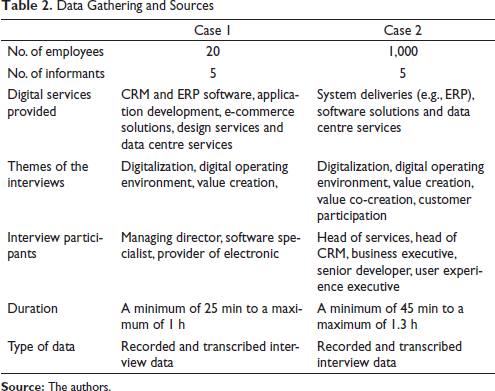
A multiple case study design was used, and two cases were selected through theoretical sampling (Eisenhardt & Graebner, 2007) with the purpose of contributing to the theory (Yin, 2003). Four criteria were used to determine the appropriate cases. First, the selected firms were advanced in terms of provided digital solutions. Second, these firms had concrete initiatives towards the co-creation of IS capabilities and, as such, were considered more likely to have a greater understanding of the value co-creation process and, hence, were successful in building customer value. Third, one case should be small and the other large to reduce the effect of contextual factors. Finally, a case should provide access to a sufficient amount of relevant information.
Both cases met the criteria and were digital solution suppliers comprising different types of functions that co-create value through advanced digital solutions. Case 1 (referred to hereafter as Supplier 1) is an IT firm that employs 20 people. As a fast-growing firm, it offers a wide range of digital solutions, including customer relationship management (CRM) and enterprise resource planning (ERP) software, application development, e-commerce solutions, design services and data centre services. The digital solutions offered by this firm are strongly based on customization and versatility because it aims to build long-term customer relationships instead of one-time deliveries. Thus, the firm builds its operations on customer understanding and flexibility in meeting customer needs by continually tailoring and shaping products and services. Case 2 (referred to hereafter as Supplier 2) is a large international firm that produces a broad range of digital solutions, such as system deliveries (e.g., ERP), software solutions and data centre services. Its solutions are not heavily customized according to customer preferences, but the value is in providing comprehensive solutions so that the customer receives all services in the same place.
Data Collection and Analysis
Data Gathering and Sources.
The data analysis was conducted using the content analysis method (e.g., Carley, 1990) based on findings from the previous literature (e.g., Doherty & Terry, 2009; Felipe et al., 2020; Wade & Hulland, 2004). Three researchers analysed the data and discussed any differing interpretations. As the goal of the study was not to achieve scientific generalization, theoretical concepts of prevailing understanding were used for themes in the analysis (Yin, 2003). Thus, the data analysis was guided by the conceptualization of IS capabilities in the digital solution context. The principal themes centred on capabilities relating to the outside-in, spanning and inside-out perspectives. First, a preliminary division of categories was imposed, but themes were also allowed to emerge from an exploratory base. The final categories were found through a cyclic analytical process, including the following stages: (a) reading the transcriptions, interpreting the contents and writing notes; (b) coding and classifying the data into themes; and (c) combining themes into initial and new categories. These iterative processes resulted in a stage in which no new information was found in the data, after which a comprehensive interpretation was developed. Thus, the research validity was strengthened through replication, with the case findings compared against the theoretical framework.
Findings
Value Co-creation via Outside-In Capabilities
Managing the external relationship from the co-creation perspective, the supplier and the customer must work closely together. The best value is achieved when the customer lets the supplier be their partner and shares their business information.
We need to be able to understand the needs of our customers very accurately, the needs of our customers’ end-users or our own customers, so that we can create value for them. That is to say that our own customers should let us be their partners. (S2 expert 1)
In order to share business information, besides trusting the supplier in terms of secrecy, ‘a customer should be confident about getting real added value from our services’ (S2 manager 2). Suppliers stressed that in addition to being able to create the best value for the customer by working as partners, they have the opportunity to benefit from such customer relationships themselves. Thus, the best value for both actors in a supplier–customer relationship is created through a partnership.
The suppliers found that their customers are a great source of information for gaining market intelligence because they help suppliers understand both the current and future customer requirements which are needed to respond to changes in market conditions. Supplier 2 had a systematic way of collecting feedback from customers, while Supplier 1 did not. However, S1 manager 1 emphasized the importance of customer feedback: ‘By actively providing feedback, they [the customer] develop our business and enable us to bring new business models to them.’ In addition to gathering feedback in the conventional way, Supplier 2 facilitated several industry-specific customer events for information sharing. While getting ‘a huge amount of knowledge capital for ourselves’ (S2 manager 2), the events were found to create value for all the participants. Therefore, gaining market intelligence from customers by letting them disseminate it among others can lead to value co-creation for both the supplier and the customer.
Value Co-creation via Inside-Out Capabilities
The suppliers considered the current IS technical skills of IT employees to include the ability to take usability and user experience into account when building technical solutions. For example, according to S2 manager 2, an online store needs to be able to be built such that an end user ‘should feel like visiting a village shop: he’s known in advance, and the range of services is controlled by this’. To succeed here, the supplier needs ‘“input feed” [from the customer] throughout the development process [of a technical solution]’ (S1 expert 3). In order to gain in-depth information to be able to produce an appropriate digital solution for a customer, Supplier 2 had created a ‘Day in Your Life’ operating model alongside various feedback channels.
We spend a day with the customer and watch what they are doing, what it is that irritates them. In this way, we get the end user’s point of view, which differs from the point of view of management representatives. (S2 manager 2)
Supplier 2 emphasized that they are clearly doing better with the customers with whom they have this operating model in use. ‘The fact that we are in the office and the customer is there in their own office does not produce the best result at all’ (S2 manager 2). Hence, the ability to create in-depth knowledge of customer needs in collaboration with customers leads to the best value for the customer.
Both suppliers felt that they needed to be familiar with emerging technologies, and they emphasized the relentless acquisition of new specific expertise from outside the house. In addition, Supplier 2 highlighted that they also set goals for customer projects in this regard.
We also have internal ambitions for those [customer projects]. We may take a cut in profitability if only we are able to learn a new thing with a customer. (S2 expert 2)
This is to say that besides learning a new technology, the supplier is able to apply and test it in a real situation for the benefit of the customer, and by doing so, both the customer and the supplier gain value.
Supplier 1 underlined that the ability to develop and manage IS operations should be cost-effective for each customer individually, while Supplier 2 considered that overall cost-effectiveness is adequate. However, both suppliers emphasized that in order to create value for the customer, digital solutions must be of high quality. As the value is ‘partly created due to how well the service stays alive’ (S1 expert 1), the contracts of Supplier 2 are based on the time span; the value depends on a service’s resilience. Technical system failures are solved independently by the suppliers, but ‘if it’s a problem which requires a little thinking, we usually explore interactively how to improve the situation’ (S1 expert 4). Thus, for ‘efficient, high-quality digital solutions’, the best value for the customer is created when they are managed together with the supplier and the customer.
Value Co-creation via Spanning Capabilities
Both suppliers saw a change in the role of IT houses in the market. S2 expert 1 expressed, ‘We’re not only dealing with IT departments but also with business.’ Both suppliers emphasized that this is the right direction, as from the perspective of value co-creation, the most important thing is that the customer opens their own business to the supplier. In addition to being able to create the most value for the customer, opening the business also increases the supplier’s business expertise, and so the supplier is able to develop more relevant technical solutions.
With this [knowing the customer’s business], we strive to build a lasting customer relationship, and we are able to create more and better for each customer. (S1 expert 2)
Moreover, S1 manager 1 is confident that they can benefit the customer: ‘We are able to process it [customer data] into our customer’s most profitable business areas.’ Accordingly, IT suppliers’ ability to collaborate with the customer’s business co-creates value for both the supplier and the customer.
In addition to experimenting with new technologies per se, both suppliers seek to figure out how to leverage them for the benefit of the customer. This is also what the suppliers felt the customers expected from them, as customers are often unaware of the potential of information technology.
The customers expect from us the intelligence to overcome their everyday challenges as well as the competence to predict future challenges and opportunities. (S2 manager 3)
In order to be able to support the customer in developing the business, both suppliers strived to monitor the consequences of their operations on the customer. Both also highlighted that, in addition to monitoring various business indicators, they aim to be part of the customer’s business development. S1 expert 3 noted, ‘We might even try to advise the customers how they should handle the business, so that, for example, they could be able to improve their own internal processes,’ while S2 expert 2 agreed, ‘The aim is to hold such regular development meetings where it is really looked ahead what development issues there are.’ The suppliers also felt that they have a good ability to meet the diverse development needs of customers as, in addition to business know-how, both stated that they have a wide range of expertise in the IT industry. Consequently, co-developing the customer’s business with digital solutions creates the best value for the customer.
Summary
The Essential IS Capabilities in Value Co-creation.
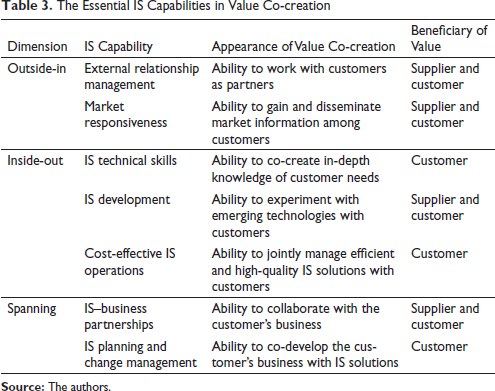
To sum up, cost-effective IS operations do not bring a competitive advantage as such, although few inside-out capabilities were highlighted in the findings. Thus, the key for co-creation to happen is the supplier and the customer working towards a common goal. As a result, the role of digital solutions has changed, now underlining the need to consider the solution platform more broadly than for co-creation in bilateral relations. This is evident due to the rise in the importance of external relationship management and market responsiveness-related capabilities. The study proposes that in ‘advanced digital solutions’, all parts of the solution development process require co-creation, either direct or indirect.
Discussion and Conclusions
Theoretical Implications
The purpose of this article was to analyse which IS capabilities are essential for B2B value co-creation from the digital solution suppliers’ perspective. The findings indicated that spanning and outside-in capabilities are of great importance in value co-creation between digital solution suppliers and their customers. This study sees the outside-in capabilities as externally focused, with an emphasis on anticipating market demands, understanding competitors and building long-lasting relationships with customers (Felipe et al., 2020; Tan et al., 2015; Wade & Hulland, 2004) that facilitate the co-creation of digital solutions. Especially forming IS–business partnerships, one of the spanning capabilities that integrate outside-in with internal organizational processes, shows great importance in value co-creation. This result supports prior studies which have called for further understanding of the capabilities that lead to value creation (Blaschke et al., 2018; Tan et al., 2020). Co-creating value through effective interaction, information exchange and collaboration is considered an essential capability in digital solution development and is needed to achieve B2B value co-creation. These outcomes contribute to the IS capabilities literature (Doherty & Terry, 2009; Felipe et al., 2020; Wade & Hulland, 2004) in the value co-creation context (e.g., Grover & Kohli, 2012; Haki et al., 2019; Saunila et al., 2019; Winkler & Wulf, 2019) by showing the shift in focus from technically oriented capabilities to relationship-oriented capabilities in value co-creation.
This article supports the long-acknowledged understanding that digital technologies alone do not contribute to value co-creation, and that human and business resources in direct and indirect interaction are needed to complement digital technologies (Grover & Kohli, 2012; Saunila et al., 2019). This is to say that the added value for the customer is created through capabilities other than those related to the technical solution. There has been a noticeable shift in the role of digital solution suppliers from being merely technical professionals to becoming wide-ranging experts in digitalization services. This is in line with Saunila et al. (2019), who found that behavioural factors (such as attitude or motivation) together with skills and a customer-oriented mindset played a key role in value co-creation.
Managerial Implications
The practical importance of this study was to provide a deeper insight for digital solution suppliers and to recognize the essential IS capabilities in value co-creation with their customers. Managers need to be aware that inside-out capabilities do not bring a competitive advantage as such. Presently, customers of digital solution suppliers are seeking wider expertise than only for technical solutions. Customers take for granted that the supplier has the IS technical skills, IS development abilities and ability to deliver and run cost-effective IS operations.
Digital solution suppliers should focus on developing outside-in and spanning capabilities, since the value for the customer in advanced digital solutions requires co-creation through the digital solution development process. Added value is co-created when suppliers become more proficient with other capabilities than those related to inside-out capabilities. Based on these findings, organizations that provide digital solutions should actively seek ways to improve their service processes and relationship capabilities. Managers must also recognize that value for the customer may be other than purely monetary. The study further revealed that the co-creation process may act as an important possibility for digital solution suppliers to develop their own expertise.
Limitations and Directions for Future Research
Selected Studies Linking IS Capabilities with Business Value

Footnotes
Declaration of Conflicting Interests
The authors declared no potential conflicts of interest with respect to the research, authorship and/or publication of this article.
Funding
The authors received no financial support for the research, authorship and/or publication of this article.
